


Introduction
The red panda Ailurus fulgens, categorized as Endangered on the IUCN Red List (Glatston et al., Reference Glatston, Wei, Zaw and Sherpa2015), is endemic to the mountainous regions of Bhutan, China, India, Myanmar and Nepal (Bista et al., Reference Bista, Shrestha, Sherpa, Thapa, Kokh and Lama2017; Thapa et al., Reference Thapa, Hu and Wei2018; Panthi et al., Reference Panthi, Wang, Sun and Thapa2019; Dendup et al., Reference Dendup, Humle, Bista, Penjor, Lham and Gyeltshen2020). The global population is believed to be < 10,000 (Panthi et al., Reference Panthi, Khanal, Acharya, Aryal and Srivathsa2017; Acharya et al., Reference Acharya, Shrestha, Paudel, Sherpa, Jnawali, Acharya and Bista2018). A habitat suitability study suggested Nepal contains 2% of this global population (Lama, Reference Lama2019), and a population and habitat viability assessment (Acharya et al., Reference Acharya, Shrestha, Paudel, Sherpa, Jnawali, Acharya and Bista2018) reported a population of 237–1,061 red pandas in Nepal.
The popularity of wildlife viewing, particularly of birds and mammals, has grown significantly (Vladimir & Jon, Reference Vladimir and Jon2018). The red panda is a charismatic species that attracts such interest in its natural habitat, yet > 70% of the potential red panda habitat in Nepal lies outside protected areas (Bista et al., Reference Bista, Shrestha, Sherpa, Thapa, Kokh and Lama2017; Gyawali et al., Reference Gyawali, Thapa, Neupane and Thapa2022), putting the species at risk of illegal hunting. However, there is also an opportunity to develop wildlife tourism in these areas (Sherpa et al., Reference Sherpa, Lama, Shrestha, Williams, Bista and Glatston2022; Bista et al., Reference Bista, Baxter, Hudson and Murray2023). Red panda habitats outside protected areas are managed and governed through community-based conservation. This empowers local communities by providing education and capacity building while supporting sustainable livelihoods through ecotourism, homestay businesses, organic farming, micro-enterprises and renewable energy practices. The Department of Forest and Wildlife Conservation of Nepal, in collaboration with donors and local conservation organizations, has implemented a red panda conservation action plan in various parts of the country to ensure habitat management and conservation in the wild. The growing interest of communities in conservation, the availability of ecotourism options, an influx of visitors, ongoing studies and the application of research findings have all played significant roles in red panda conservation and improving habitat management in Nepal.
Ecotourism activities focused on the red panda can provide additional sources of income and employment opportunities such as forest guardians, nature guides, and travel and tour operators (Panthi et al., Reference Panthi, Khanal, Acharya, Aryal and Srivathsa2017). In addition to the ecological value of the red panda and the importance of conserving the species, it is also valuable for education, research, recreation and, particularly, for the development of community-based conservation activities and ecotourism promotion in the Panchthar, Ilam and Taplejung districts of eastern Nepal. Visitors can observe scats and footprints of red pandas, and, if fortunate, individuals in the wild. The number of red panda sightings in eastern Nepal is increasing, and typically a tourist may see a red panda within the first 2–4 days of a trip (Sherpa et al., Reference Sherpa, Lama, Shrestha, Williams, Bista and Glatston2022), depending on the weather and the season. Both national and international tourists travel to watch red pandas in the wild for recreation, research and wildlife photography. These ecotourism practices and homestay businesses are gaining popularity in eastern Nepal (Bhattarai et al., Reference Bhattarai, Jojiju, Gyawali and Neupane2024). Developing and promoting wildlife-based tourism with scientifically robust conservation practices is essential for minimizing the long-term impacts of tourism on this species (Panthi et al., Reference Panthi, Wang, Sun and Thapa2019; Bista et al., Reference Bista, Baxter, Hudson and Murray2023).
Research on the red panda has focused on habitat management and preferences (Bhatta et al., Reference Bhatta, Shah, Devkota, Paudel and Panthi2014; Bista et al., Reference Bista, Shrestha, Sherpa, Thapa, Kokh and Lama2017; Acharya et al., Reference Acharya, Shrestha, Paudel, Sherpa, Jnawali, Acharya and Bista2018), species distribution (Panthi et al., Reference Panthi, Khanal, Acharya, Aryal and Srivathsa2017; Thapa et al., Reference Thapa, Hu and Wei2018; Gyawali et al., Reference Gyawali, Thapa, Neupane and Thapa2022), evaluation of conservation threats (Panthi et al., Reference Panthi, Wang, Sun and Thapa2019) and the effects of livestock grazing (Lama et al., Reference Lama, Shrestha, Koju, Sherpa and Tamang2020). There have been limited studies on the economic benefits of red panda conservation in Nepal (Bista et al., Reference Bista, Baxter, Hudson, Lama, Weerman and Murray2021). Here, we address this by examining visitors’ willingness to pay for red panda conservation using the contingent valuation method. The contingent valuation method is unique in accounting for non-use values (Carson & Mitchell, Reference Carson and Mitchell1993; White et al., Reference White, Bennett and Hayes2001; Reynisdottir et al., Reference Reynisdottir, Song and Agrusa2008), which are crucial in exploring the value of threatened, rare species, and has been used to examine the economic value of the African wild dog Lycaon pictus (Tsi et al., Reference Tsi, Ajaga, Wiegleb and Mühlenberg2008), frogs (Velasco et al., Reference Velasco, Tseng, Chang, Chiueh, Liu and Chang2024) and the snow leopard Panthera uncia (Schutgens et al., Reference Schutgens, Hanson, Baral and Ale2019).
Our specific objectives were to calculate the average willingness to pay for red panda conservation, determine the major factors influencing willingness to pay, evaluate the possible economic benefits of incorporating willingness to pay into community-based conservation and ecotourism projects, and assess how ecotourism contributes to conservation while improving the experience of visitors.
Study area
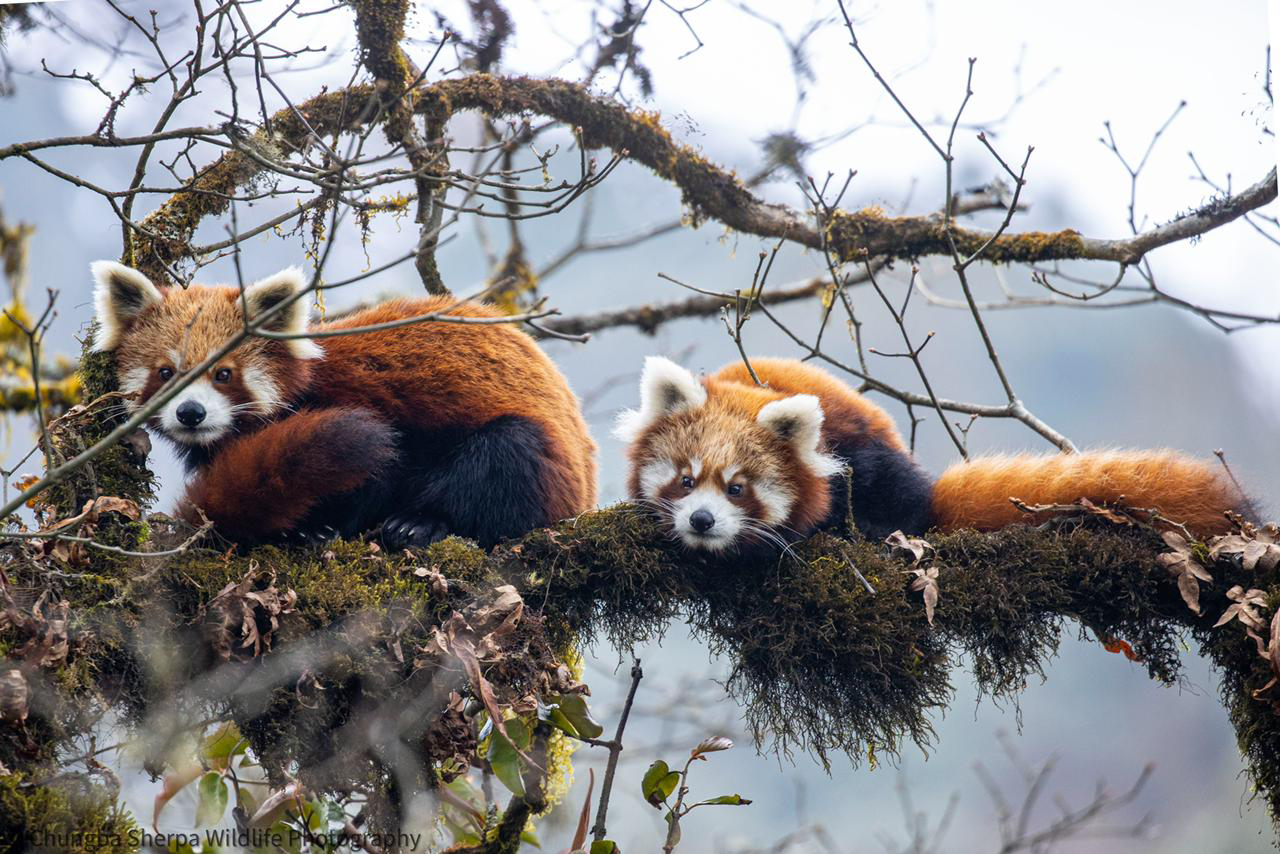
The study was carried out in the three wards (2: Sandakpur; 4: Dobato; 5: Choyatar) of Sandakpur Rural Municipality, Ilam, a red panda habitat in eastern Nepal that is popular with tourists. The study area (Fig. 1) is a part of the Panchthar, Ilam and Taplejung forest corridor, which encompasses 20% of the potential red panda habitat in Nepal and contains 25% of the country’s red panda population (Lama et al., Reference Lama, Shrestha, Koju, Sherpa and Tamang2020). Sandakpur Rural Municipality lies at elevations of 2,500–3,600 m on the eastern border of Nepal with India. The community-managed forest of Sandakpur Rural Municipality is a habitat for threatened species such as the red panda (Plate 1), pangolins Manis spp., the crimson-horned pheasant Tragopan satyra and 28 species of rhododendron. Sherpas, an ethnic group native to the mountains, are the main inhabitants of this region. Sandakpur attracts thousands of visitors annually, both domestic and international, who mostly visit to enjoy the montane scenery, watch red pandas, engage in wildlife photography and bird watching, and trek. Community-based conservation practices and a homestay programme have boosted ecotourism in Sandakpur.
The three wards (2: Sandakpur; 4: Dobato; 5: Choyatar) of Sandakpur Rural Municipality, Ilam, eastern Nepal, in which we elicited willingness to pay for conservation of the Endangered red panda Ailurus fulgens. Elevations across the landscape are 2,500–3,600 m.

Mother and young red panda Ailurus fulgens observed in Dobato ward, Sandakpur Rural Municipality, Ilam (Fig. 1), an area of community-managed forest. Photograph: late wildlife photographer Chungba Sherpa.
Methods
Data collection
We surveyed tourists, using a questionnaire (Supplementary Material 1), during 15 March–3 April 2021. Participants were selected based on their availability and willingness to participate. In-person surveys were conducted during 9.00–19.00, when visitors were available, by visiting hotels and homestays or by approaching tourists on the streets. The contingent valuation method requires face-to-face interaction, to minimize biases (Arrow et al., Reference Arrow, Solow, Portney, Leamer, Radner and Schuman1993). Because of social distancing measures in place as a result of the Covid-19 pandemic, only 102 respondents were willing to participate in the survey, of whom 70 were foreign tourists and the remaining 32 Nepali citizens.
Consenting visitors were given printed questionnaires, and the KoboToolbox mobile app was used to gather their responses. The questionnaire consisted of five sections: demographic information, purpose of travel, red panda conservation, travel experience and willingness to pay. Questions were multiple choice, a dichotomous choice, a five-point Likert scale or open-ended. The average time to complete the survey was 25–30 minutes. Care was taken to survey individuals only once. We exported the questions and data from KoboToolbox to a spreadsheet, where we reviewed and cross-checked the data. Descriptive statistics were calculated, and the data were further analysed using R 4.3.1 (R Core Team, 2023).
Contingent valuation method
The contingent valuation method sets up a hypothetical market, within which respondents are asked to state bids for goods and services based on the information provided (Loomis & White, Reference Loomis and White1996; White et al., Reference White, Bennett and Hayes2001). Different methods can be used, such as open-ended questions, iterative bidding games, dichotomous choice and the payment card method (Calia & Strazzera, Reference Calia and Strazzera2000; Kaffashi et al., Reference Kaffashi, Yacob, Clark, Radam and Mamat2015; Sajise et al., Reference Sajise, Samson, Quiao, Sibal, Raitzer and Harder2021). We used the single-bounded dichotomous choice approach, the most popular contingent valuation method technique (Kerr, Reference Kerr2000), as it is efficient (Velasco et al., Reference Velasco, Tseng, Chang, Chiueh, Liu and Chang2024). The survey respondents were asked whether they would be willing to pay an additional fee to watch red pandas in the wild if red panda habitat was improved such that seeing the red panda could be guaranteed, and if so, how much would they be willing to pay. The respondents were offered monetary values, ranging from the current entry fee to enter the community-managed forest (USD 8.48) to greater values. In our hypothetical scenario, we assumed that visitors would be willing to pay a higher entry fee than at present, to support red panda conservation and improved habitat management. Follow-up questions examined possible reasons for willingness to pay and, for those who were not willing to pay, their reasons for this.
The logistic regression used to examine the relationship between willingness to pay (which is categorical: yes or no) and potential predictors was:
 $${P_{i}} = {1 \over {1 + {e^{ - \left( {\alpha + {\beta _1}{x_1} + {\beta _2}{x_2} \ldots \ldots . + {\beta _i}{x_i} + {\varepsilon _i}} \right)}}}}$$
 $$logit\left( P \right) = {\rm{ln}}{P \over {1 - P}} = \alpha + {\beta _1}{x_1} + {\beta _2}{x_2} + \ldots . + {\beta _n}{x_n}$$
where P is the probability that visitors are willing to pay; e is the natural logarithm, $\alpha $
is a constant,
$\alpha $
is a constant, ${\beta _1}$
…β
n
are the coefficients,
${\beta _1}$
…β
n
are the coefficients, $\;{x_{1 \ldots ..}}{x_{n}}$
are the vectors of the predictor variables and n is the number of respondents. Visitors’ willingness to pay (VWTP) for red panda conservation was calculated as:
$\;{x_{1 \ldots ..}}{x_{n}}$
are the vectors of the predictor variables and n is the number of respondents. Visitors’ willingness to pay (VWTP) for red panda conservation was calculated as:
 $${{\rm{VWTP}}_{i}} = {{1}\over{1 + {{e^{-a}} + {\varepsilon _i}}}}$$
where $a = {{\beta _0} + {\beta _1}\left( {AGE} \right) + {\beta _2}\left( {EDU} \right) + {\beta _3}\left( {GEN} \right) + {\beta _4}\left( {INC} \right) + {\beta _5}\left( {NAT} \right) + {\beta _6}\left( {OCC} \right) + {\beta _7}\left( {POV} \right) \!+ {\beta _8}\left( {STM} \right)\hskip 0.85pt+ {\beta _9}\left( {TCO} \right) + {\beta _{10}}\left( {TGU} \right)}.$
 $${\rm{Mean}}\;{\rm{VWTP}} = {{\sum\nolimits_{i = 1}^n V WT{P_i}_{\left( {B{P_i}} \right)}} \over {\sum\nolimits_{i = 1}^n V WT{P_i}}}$$
where e is the natural logarithm, ${\beta _1}$
…β
n
are the coefficients, BPi
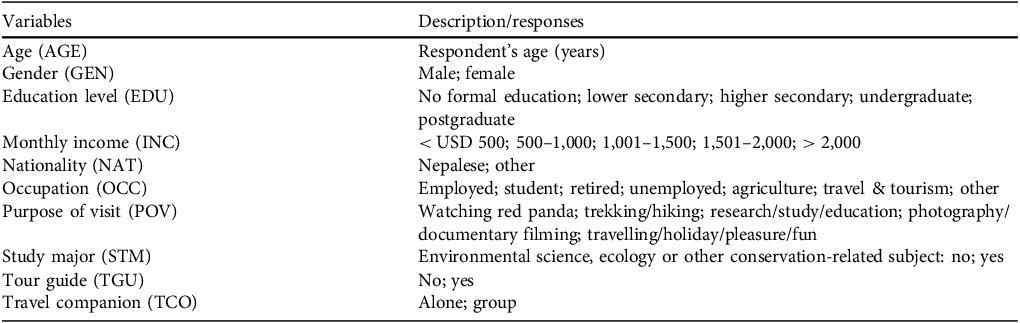
is the chosen bid price, n is the number of respondents, and the 10 predictor variables are described in Table 1. Potential predictor variables were chosen based on previous studies (Lee & Mjelde, Reference Lee and Mjelde2007; Baral et al., Reference Baral, Stern and Bhattarai2008).
${\beta _1}$
…β
n
are the coefficients, BPi
is the chosen bid price, n is the number of respondents, and the 10 predictor variables are described in Table 1. Potential predictor variables were chosen based on previous studies (Lee & Mjelde, Reference Lee and Mjelde2007; Baral et al., Reference Baral, Stern and Bhattarai2008).
The 10 potential predictor variables for respondents’ willingness to pay an entrance fee for habitat management and conservation of the red panda Ailurus fulgens.

Table 1 Long description
A table with two columns and ten rows. The first column lists variables and their abbreviations, and the second column provides descriptions or responses for each variable. The variables include Age (AGE), Gender (GEN), Education level (EDU), Monthly income (INC), Nationality (NAT), Occupation (OCC), Purpose of visit (POV), Study major (STM), Tour guide (TGV), and Travel companion (TCO). Each variable is described with specific categories or ranges, such as age in years, gender as male or female, education levels from no formal education to postgraduate, and monthly income ranges in USD. Other variables include nationality, occupation, purpose of visit, study major, whether a tour guide is used, and travel companion status.
To understand preferences for willingness to pay, it is important to consider the potential multiple biases that can influence the contingent valuation method, including hypothetical bias, strategic bias, design bias involving reflectivity in initial bids, and operational bias involving personal decisions (Banerjee & Sarkhel, Reference Banerjee and Sarkhel2012). We therefore asked additional follow-up questions regarding factors influencing willingness to pay, and used the current entry fee as a reference, to reduce design bias (Baral et al., Reference Baral, Stern and Hammett2012). We addressed hypothetical bias by clarifying with the respondents that the management authority might be sceptical about raising the entry fee. It was difficult to exclude strategic bias, however, as respondents could potentially have changed their willingness to pay in response to worries about possible expenses or a desire to show their dedication to conservation. A five-point Likert scale was used to examine the satisfaction level of visitors for five attributes of their trip: natural beauty and scenery, hospitality and attitude of local people, knowledge of tour guides, infrastructure facilities, and safety and other facilities.
Results
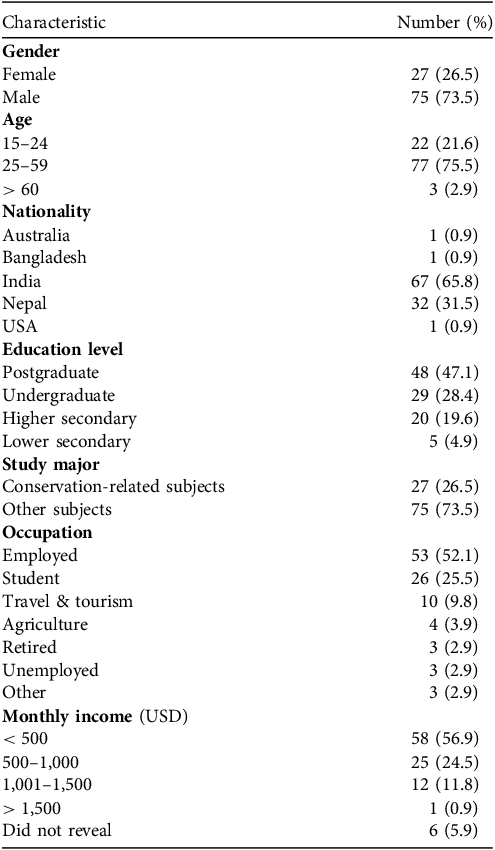
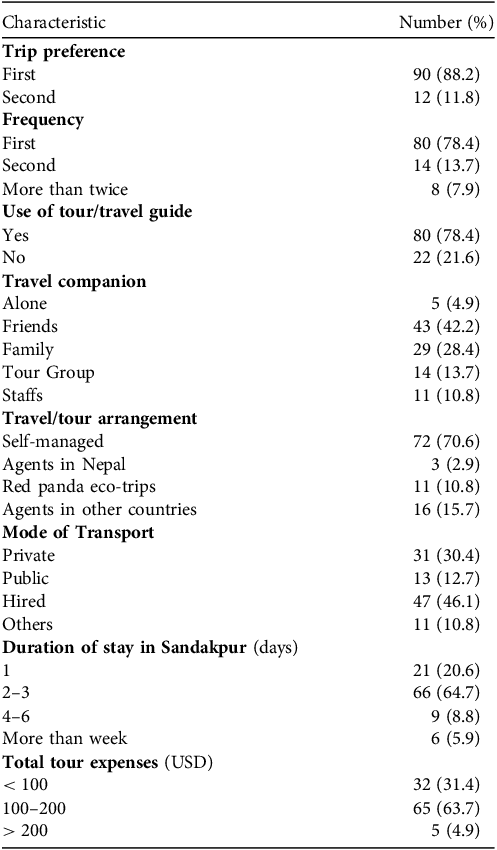
Of the 102 respondents, a 73.5% were men, 75.5% were aged 25–59 years, 47.1% had a postgraduate qualification, and 26.5% had a background or profession related to conservation or similar subjects (Table 2). Sandakpur was the first travel preference for the majority of respondents, and most were first-time visitors (Table 3). The mean group size of people travelling to Sandakpur was 5.82 ± SD 2.75 (range 1–15). A stay of 2–3 days was most common, most visitors managed their trip independently, mostly hiring vehicles, and expenses were most commonly USD 100–200 (Table 3).
The demographic characteristics of the 102 respondents surveyed in Sandakpur.
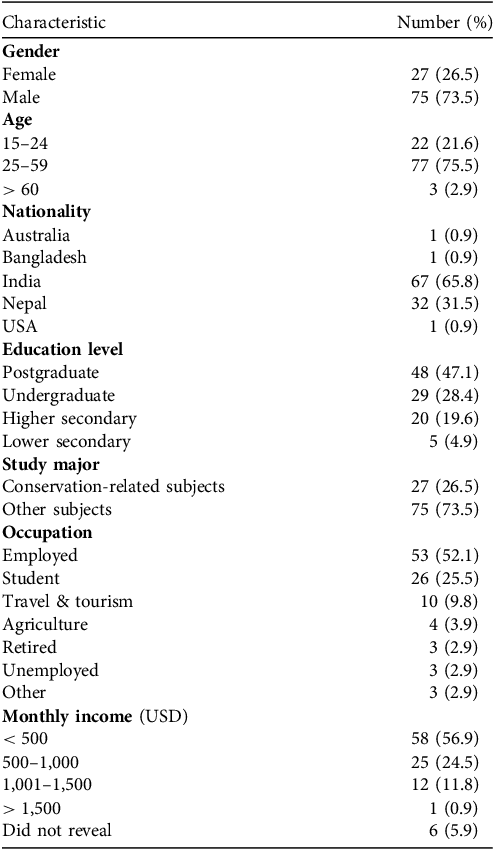
Table 2 Long description
The table presents the demographic characteristics of 102 respondents surveyed in Sandakpur. It has 10 rows and 2 columns. The columns are labeled Characteristic and Number (%). The table includes the following data: Row 1: Gender, Female, 27 (26.5); Male, 75 (73.5). Row 2: Age, 15-24, 22 (21.6); 25-59, 77 (75.5); > 60, 3 (2.9). Row 3: Nationality, Australia, 1 (0.9); Bangladesh, 1 (0.9); India, 67 (65.8); Nepal, 32 (31.5); USA, 1 (0.9). Row 4: Education level, Postgraduate, 48 (47.1); Undergraduate, 29 (28.4); Higher secondary, 20 (19.6); Lower secondary, 5 (4.9). Row 5: Study major, Conservation-related subjects, 27 (26.5); Other subjects, 75 (73.5). Row 6: Occupation, Employed, 53 (52.1); Student, 26 (25.5); Travel & tourism, 10 (9.8); Agriculture, 4 (3.9); Retired, 3 (2.9); Unemployed, 3 (2.9); Other, 3 (2.9). Row 7: Monthly income (USD), <; 500, 58 (56.9); 500-1,000, 25 (24.5); 1,001-1,500, 12 (11.8); > 1,500, 1 (0.9); Did not reveal, 6 (5.9).
The travel characteristics of the 102 respondents surveyed in Sandakpur.
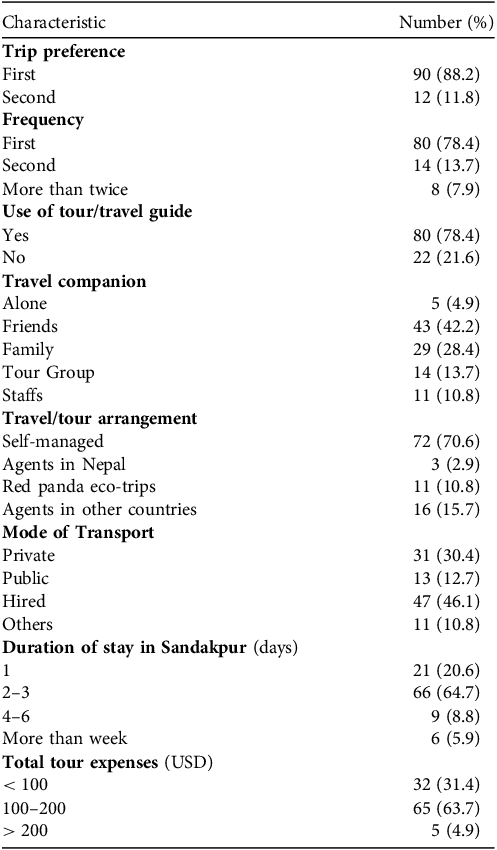
Table 3 Long description
A table showing travel characteristics of respondents in Sandakpur. The table has 10 rows and 2 columns. The columns are labeled ‘Characteristic’ and ‘Number (%)’. The rows are labeled with different travel characteristics and their corresponding numbers and percentages. Row 1: Trip preference, First, 90 (88.2 percent). Row 2: Trip preference, Second, 12 (11.8 percent). Row 3: Frequency, First, 80 (78.4 percent). Row 4: Frequency, Second, 14 (13.7 percent). Row 5: Frequency, More than twice, 8 (7.9 percent). Row 6: Use of tour/travel guide, Yes, 80 (78.4 percent). Row 7: Use of tour/travel guide, No, 22 (21.6 percent). Row 8: Travel companion, Alone, 5 (4.9 percent). Row 9: Travel companion, Friends, 43 (42.2 percent). Row 10: Travel companion, Family, 29 (28.4 percent). Row 11: Travel companion, Tour Group, 14 (13.7 percent). Row 12: Travel companion, Staffs, 11 (10.8 percent). Row 13: Travel/tour arrangement, Self-managed, 72 (70.6 percent). Row 14: Travel/tour arrangement, Agents in Nepal, 3 (2.9 percent). Row 15: Travel/tour arrangement, Red panda eco-trips, 11 (10.8 percent). Row 16: Travel/tour arrangement, Agents in other countries, 16 (15.7 percent). Row 17: Mode of Transport, Private, 31 (30.4 percent). Row 18: Mode of Transport, Public, 13 (12.7 percent). Row 19: Mode of Transport, Hired, 47 (46.1 percent). Row 20: Mode of Transport, Others, 11 (10.8 percent). Row 21: Duration of stay in Sandakpur (days), 1, 21 (20.6 percent). Row 22: Duration of stay in Sandakpur (days), 2-3, 66 (64.7 percent). Row 23: Duration of stay in Sandakpur (days), 4-6, 9 (8.8 percent). Row 24: Duration of stay in Sandakpur (days), More than week, 6 (5.9 percent). Row 25: Total tour expenses (USD), less than 100, 32 (31.4 percent). Row 26: Total tour expenses (USD), 100-200, 65 (63.7 percent). Row 27: Total tour expenses (USD), more than 200, 5 (4.9 percent).
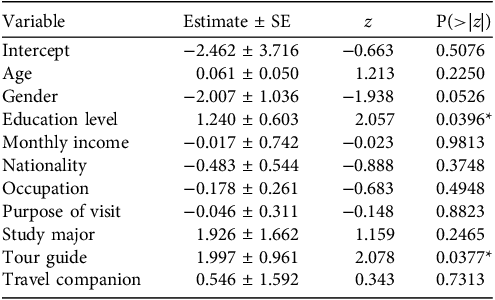
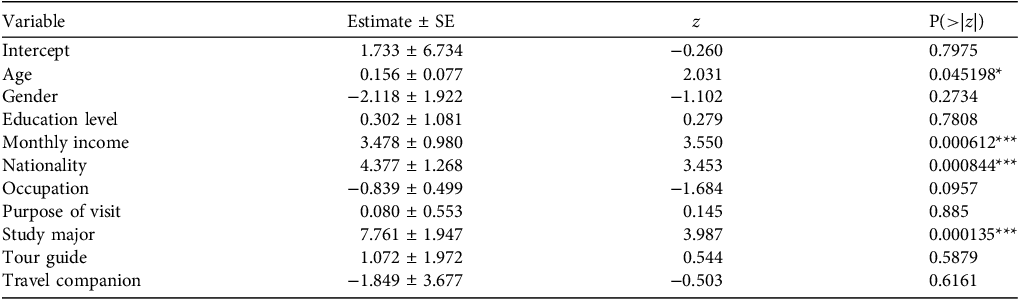
The amount people were willing to pay ranged from USD 0.00 to USD 42.37, with a mean of USD 14.21 ± SD 9.70. Of the 102 respondents, most (89) were willing to pay some amount; 31 were willing to pay the current fee of USD 8.48, 46 willing to pay USD 16.95, six willing to pay USD 25.42, and six willing to pay USD 42.37. The logistic regression analysis indicated that education level and use of a tour guide were significant predictors of whether respondents were willing to pay an entrance fee to view the red panda (Table 4), and age, monthly income, nationality and study major were significant predictors of the amount respondents were willing to pay as an entrance fee (Table 5).
Logistic regression model examining the influence of the 10 potential predictor variables (Table 1) on whether visitors were willing to pay (yes or no) an entrance fee to view the red panda Ailurus fulgens.
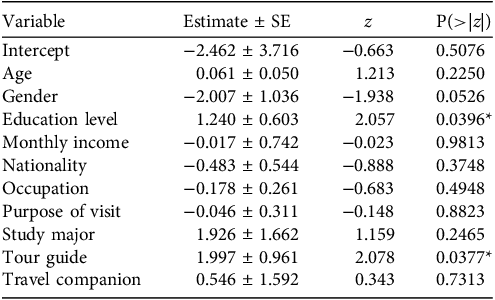
Table 4 Long description
A table with 11 rows and 4 columns. The columns are labeled Variable, Estimate ± SE, z, and P(>|z|). The rows list different variables and their respective estimates, standard errors, z-values, and p-values. The variables include Intercept, Age, Gender, Education level, Monthly income, Nationality, Occupation, Purpose of visit, Study major, Tour guide, and Travel companion. Each row provides specific values for these variables. Notable trends include significant p-values for Education level and Tour guide, indicating their influence on willingness to pay an entrance fee.
*P < 0.05.
Logistic regression model examining the influence of the 10 potential predictor variables (Table 1) on the amount (in USD) that visitors were willing to pay as an entrance fee to view the red panda.
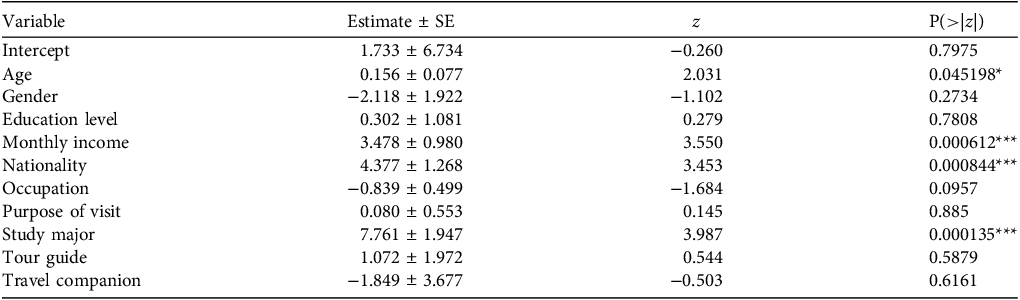
Table 5 Long description
A table with 10 rows and 4 columns. The columns are labeled Variable, Estimate ± SE, z, and P(>|z|). The rows are labeled with different variables: Intercept, Age, Gender, Education level, Monthly income, Nationality, Occupation, Purpose of visit, Study major, Tour guide, and Travel companion. Each row provides the estimate with standard error, z value, and P value for the respective variable. Notable trends include significant P values for Monthly income, Nationality, and Study major, indicating these variables have a significant influence on the amount visitors are willing to pay.
*P < 0.05; ***P < 0.001.
Of the 89 respondents willing to pay for red panda conservation, 72 provided a reason for their willingness to pay: (1) to promote red panda conservation and better habitat management (34.7%); (2) to help in the preservation of ecological integrity (10.3%); (3) to minimize pollution and waste management (22.8%); (4) to preserve nature, culture and ecotourism resources at Sandakpur (28.0%); and (5) ‘if I have enough money to travel, then the entry fee is not a problem’ (4.2%). Only 13 respondents replied to follow-up questions regarding their unwillingness to pay, as follows: (1) they did not believe the money would be managed properly (53.8%); (2) they were unable to pay (30.8%); (3) the fee should be paid by the government (7.7%); and (4) they did not believe that paying would benefit them (7.7%).
Approximately 3% of the 102 respondents indicated the current entry fee was cheap, 63% indicated it was affordable, 28% indicated it was expensive and 6 % indicated it was very expensive. The majority of respondents were satisfied or strongly satisfied with the natural beauty and scenery, hospitality and attitude of local people, knowledge of tour guides and safety and other facilities, but a majority of respondents were neutral or dissatisfied with the infrastructure facilities (Table 6).
The level of satisfaction of visitors for five attributes of their trip to Sandakpur, on a five-point Likert scale from strongly dissatisfied to strongly satisfied. The numbers indicate the per cent of 102 respondents.

Table 6 Long description
A table showing the level of satisfaction of visitors for five attributes of their trip to Sandakpur, on a five-point Likert scale from strongly dissatisfied to strongly satisfied. The table has five rows and five columns. The columns are labeled as Strongly dissatisfied, Dissatisfied, Neutral, Satisfied, and Strongly satisfied. The rows are labeled as Natural beauty & scenery, Hospitality & attitude of local people, Knowledge of tour guides, Infrastructure facilities, and Safety & other facilities. Row 1: Natural beauty & scenery, Strongly dissatisfied 0, Dissatisfied 0, Neutral 0, Satisfied 26, Strongly satisfied 74. Row 2: Hospitality & attitude of local people, Strongly dissatisfied 0, Dissatisfied 0, Neutral 2, Satisfied 42, Strongly satisfied 56. Row 3: Knowledge of tour guides, Strongly dissatisfied 0, Dissatisfied 1, Neutral 27, Satisfied 45, Strongly satisfied 27. Row 4: Infrastructure facilities, Strongly dissatisfied 5, Dissatisfied 31, Neutral 37, Satisfied 27, Strongly satisfied 0. Row 5: Safety & other facilities, Strongly dissatisfied 0, Dissatisfied 0, Neutral 7, Satisfied 57, Strongly satisfied 36.
Discussion
On average, the visitors we surveyed were willing to pay 1.67× the current entry fee at Sandakpur. Measured as a multiple of the current entry fee, this is less than reported for other conservation areas in Nepal (e.g. 2.5–2.65× the current entry fee to Annapurna Conservation Area: Baral et al., Reference Baral, Stern and Bhattarai2008; Wrobel & Kozlowski, Reference Wrobel and Kozlowski2011; 2.12× the current entry fee to Langtang National Park: Thapa, Reference Thapa2014). In absolute terms, the mean amount our respondents were willing to pay for red panda conservation (USD 14.21) was less than that reported for conservation of the tiger Panthera tigris (USD 20; Bhattarai et al., Reference Bhattarai, Morgan and Wright2021) or snow leopard Panthera uncia (USD 59; Schutgens et al., Reference Schutgens, Hanson, Baral and Ale2019) in protected areas in Nepal. These differences could be because protected areas have a greater diversity of natural resources and attractions for visitors, whereas Sandakpur is a part of the Panchthar, Ilam and Taplejung forest corridor rather than a protected area. It is also possible that protected areas attract affluent tourists with higher incomes.
Consideration needs to be given to the increasing interest in watching threatened wildlife. For the red panda, ecotourism can promote conservation and improve habitat, and also preserve nature and culture at Sandakpur. Therefore, targeted marketing campaigns that highlight Sandakpur’s ecological and cultural advantages could be created to enrich visitor experiences and raise willingness to pay. An increase in the entry fee to watch red pandas could be utilized for meeting conservation objectives and for developmental work (Dahal et al., Reference Dahal, K C and Sapkota2020; Neupane et al., Reference Neupane, K.C., Aryal and Rijal2021), encouraging the community to take a more active role in red panda conservation. People also visit Sandakpur for trekking, the panoramic mountain views, and spending time in a cool, natural setting, as elsewhere in Nepal (Neupane et al., Reference Neupane, K.C., Aryal and Rijal2021). We found that some visitors were unaware they could watch red pandas in the wild in Sandakpur. Alliances with local and national travel agencies could increase awareness and attract more tourists interested in ecotourism and the red panda.
The education level of visitors and use of a tour guide were significant predictors of the willingness to pay an entry fee. As c. 75% of the participants had undergraduate and postgraduate qualifications, this highly educated group may have greater understanding of and willingness to support red panda conservation. Education helps to create awareness and supports understanding of conservation issues, thereby promoting stronger pro-conservation attitudes (Ardoin et al., Reference Ardoin, Bowers and Gaillard2020; Zhao et al., Reference Zhao, Liu and Han2024). Although it is not mandatory to hire a tour guide in Sandakpur, they can play an important role in influencing willingness to pay by explaining conservation practices, the value of the red panda and ecotourism attractions. Respondents who did not wish to pay an entry fee indicated their lack of trust that the donated fee would be properly managed. Similarly, Schutgens et al. (Reference Schutgens, Hanson, Baral and Ale2019) reported that 10% of survey respondents expressed concerns over corruption and misuse and leakage of donated funds.
We found that age, monthly income, study major and nationality influenced the amount that visitors were willing to pay. In contrast to willingness to pay for conservation in the Annapurna Conservation Area of Nepal (Baral et al., Reference Baral, Stern and Bhattarai2008; Schutgens et al., Reference Schutgens, Hanson, Baral and Ale2019), we found that older respondents were willing to pay more, perhaps because two-thirds of our survey participants were young or middle-aged and may therefore have had a stable income and awareness of conservation. Younger people generally show strong support for environmental and outdoor recreation fee policies (Dardanoni & Guerriero, Reference Dardanoni and Guerriero2021). It is relatively rare for entrance fees to have a significant distributional impact on different income groups because people who visit natural sites tend to be wealthy (Reynisdottir et al., Reference Reynisdottir, Song and Agrusa2008). Respondents with a specialization in environmental science, ecology, forestry or other conservation-related subject were willing to pay more for red panda conservation, as Thapa (Reference Thapa2014) found for the entrance fee to Langtang National Park. Knowledge of nature conservation can generate a degree of dedication towards wildlife conservation, and such people travel to explore recreation options (Ballantyne et al., Reference Ballantyne, Packer and Hughes2009). The influence of nationality on willingness to pay may have been a result of prior knowledge or awareness of red pandas at the study site among domestic visitors and visitors from the Indian subcontinent regions. However, our sample included only a few visitors from other countries, therefore we cannot accurately assess their willingness to pay.
The disadvantage of any increase in the entrance fee is the potential for discouraging visitors. Any increase would therefore need to be associated with improved management and conservation strategies, to attract visitors. The amount that visitors are willing to pay is determined not by a single factor but rather by a complex combination of various factors, such as cultural and ethical considerations (White et al., Reference White, Bennett and Hayes2001). Although our study highlights the possibility of enhancing revenue generation for the conservation of red pandas by increasing the entry fee at Sandakpur, this would require well-structured ecotourism programmes, efficient utilization of fees received, improved public awareness of red panda tourism, and the development of a site-specific tourism management plan or guidelines (Bista et al., Reference Bista, Baxter, Hudson and Murray2023).
To maximize the benefits and utilize the full economic advantages of ecotourism, we recommend that the Ministry of Tourism, Nepal Tourism Board, Red Panda Network and other conservation partners focus on the promotion of red panda tourism and ecotourism packages. Any revenue collected from an increased visitors’ entry fee should be invested in implementing and improving sustainable conservation actions. However, as tourism can degrade habitat quality and disturb shy and elusive species such as the red panda, visitor numbers need to be regulated and entry into red panda habitat should be restricted during the mating and breeding seasons.
A major portion of red panda habitat in Nepal falls outside protected areas, which could limit the potential for generating tourism income to sustain conservation efforts. Further research is required to determine the monetary value of red panda conservation in these other regions, although it may not be feasible to implement the same practices in locations where red panda ecotourism is not well established.
Supplementary material
The supplementary material for this article is available at doi.org/10.1017/S0030605325101725
Author contributions
Design, methods, writing: RKR; data collection, analysis, writing, revision: PB, BG, RBKC; design, editing, revision: AKC; funding acquisition, writing, organization: KB.
Acknowledgments
We thank the Nepal Tourism Board for financial support under a research grant opportunity for young researchers; Bikesh Jojiju, Bhuwan Singh Bist, Sanjib Singh Thakuri, Naresh Shrestha, Sonam Tashi Lama, Finju Sherpa, Nima Sherpa and Krishna Rai for assistance; Red Panda Network Nepal, Mountain Organization of Nepal, Sandakpur Rural Municipality, Dobato and Choyatar homestays and local people for providing their support and time; and the anonymous reviewers for their feedback.
Competing interests
None.
Ethical standards
This study abided by the Oryx guidelines on ethical standards. Prior to conducting the survey, we obtained the verbal consent of all respondents, informed them that the information collected would be solely used for research purposes, and gave assurance that identities would remain confidential. Ethical clearance for this research was provided by Tribhuvan University.
Data availability
The data are available from the corresponding author upon reasonable request.





 Open access

