




1. Introduction
This paper investigates the variation in null subject usage across Slavic languages, with a focus on Polish, Russian, and Ukrainian. Null subjects are a central topic in generative linguistics, and this study explores the syntactic and interpretive conditions that allow for their presence. Polish, a consistent null subject language, permits the omission of subjects governed by factors such as information structure and discourse, with verbal agreement playing a crucial role. In contrast, Russian and Ukrainian, classified as partial null subject languages, impose stricter constraints, particularly in embedded clauses, due to structural factors such as c-command and the absence of a pronominal D-feature in verbs. This paper highlights the variable behavior of Russian and Ukrainian, which complicates their classification.
A key point to better understand the classification of the three languages under analysis is the use of noncontrolled null subjects in subjunctive complements which are introduced by different complementizers (żeby in Polish, čtoby in Russian, and ščob in Ukrainian). The three subjunctive complementizers are morphologically decomposable into an initial element corresponding to the indicative complementizer (Polish że, Russian čto, Ukrainian ščo) and a modal element -b(y). Footnote 1 While the subjunctive form in Russian and Ukrainian is marked only for gender and number, Polish additionally marks both person and number on the complementizer. Polish subjunctive clauses show obviation effects; Russian and Ukrainian, on the other hand, are expected to disallow null subjects in subjunctive clauses. We aim at capturing the real distribution of embedded null subjects in partial null subject languages, especially in view of their variable behavior with respect to the traditional null subject parameter.
Our study of null subject usage across the three languages reveals significant differences in the acceptability of embedded null subjects. Polish speakers strongly accept null subjects; Ukrainian speakers exhibit more variability, while Russian speakers rate their acceptability the lowest, but not all speakers firmly reject them.
The syntactic analysis employs a cartographic approach to understand the distribution of embedded null subjects in Polish, Russian, and Ukrainian. Relying on Rizzi’s (Reference Rizzi1997) Split-CP Hypothesis, the study assumes that embedded clauses have a layered left periphery, with separate functional heads dedicated to various interpretive properties. The analysis posits that only structures containing ForceP are considered phases, necessary for transferring syntactic material to the LF interface. This distinction helps explain the variability in null subject licensing: in Polish, null subjects are licensed by a complete set of φ-features, split between the T and the C heads, while Russian and Ukrainian exhibit φ-defectivity, complicating null subject licensing. We show that Polish consistently moves its complementizer to the ForceP, while Russian and Ukrainian allow for variation, with complementizers remaining in FinP in some cases, enabling null subjects to be licensed across clause boundaries. Our novel Slavic data allows us to propose that this variation is linked to the size of the embedded clauses, with smaller clauses facilitating the binding of null subjects. The movement of the complementizer is driven by an uninterpretable edge feature uF on ForceP, which triggers movement of the complementizer from FinP to ForceP in Polish. In Russian and Ukrainian, however, this movement is not always required, allowing for alternative configurations where a null subject can be licensed. This analysis reveals the complex interaction between syntactic structure, clause size, and φ-features, providing a detailed understanding of how null subjects are licensed in these languages.
The article is organized as follows. Section 2 briefly introduces the typology of null subjects and generative studies regarding the null subject parameter as it manifests in the Slavic family of languages. Section 3 introduces the distinction between Polish, a consistent null subject language, and Russian and Ukrainian, partial null subject languages, in the realization of embedded null subjects in subjunctive complements. Section 4 discusses the exploratory study we conducted, showing that the acceptability of null subjects in Russian and Ukrainian is nuanced and requires a flexible analysis capable of capturing such variation. In Section 5, we present our cartographic analysis of Slavic embedded clauses, which allows us to explain the variable behavior of Russian and Ukrainian in the acceptability of embedded null subjects, concluding that multiple settings for the null subject parameter are most likely available across speakers of these languages. Section 6 concludes the paper.
2. A typology of null subjects in Slavic
The question of why some languages permit null subjects, identified with the null category pro, while others require overt material to fill the subject position has long been a central topic in generative linguistics. The exploration of this phenomenon dates back to foundational works in the field, including Perlmutter (Reference Perlmutter1971), Taraldsen (Reference Taraldsen1978), and Rizzi (Reference Rizzi1982), who laid the groundwork for understanding the conditions under which null subjects can be licensed in specific syntactic environments.
Within the Slavic language family, variation in null subject usage is particularly pronounced. While some Slavic languages exhibit all the key properties associated with null subjects, others place more restrictions on their distribution, raising critical questions about the syntactic and interpretive constraints at play. This study focuses on the distribution of null subjects in Polish, Russian, and Ukrainian, offering a comparative perspective on the conditions under which null subjects are licensed in embedded environments in these languages. Polish serves as a representative example of consistent null subject languages, while Russian and Ukrainian show a more limited distribution of null subjects, with overt pronouns being required in contexts where Polish would allow for subject omission. We adopt the classification of pro-drop languages proposed, among others, in Roberts & Holmberg (Reference Roberts and Holmberg2009) and Roberts (Reference Roberts2019). Consistent pro-drop languages, such as Polish, allow referential null subjects across all persons and numbers in finite clauses, including third person, with interpretation determined by discourse factors. In addition, consistent pro-drop languages allow arbitrary interpretations of null subjects, but these are not restricted to a particular person–number combination. More specifically, Polish referential null subjects are generally not constrained by strict syntactic rules and are instead governed by information structure and discourse factors: several studies (Frascarelli Reference Frascarelli2007, Sigurðsson Reference Sigurðsson2011, Reference Sigurðsson2014, Frasson Reference Frasson2022, among others) have argued that null subjects in languages like Polish are most commonly found in contexts where the referent has already been established in the discourse and remains a salient topic in the sentence. This aligns with the idea that the rich verbal agreement morphology plays a crucial role in licensing subject omission. The inflectional morphology in Polish (1) not only conveys tense, number, and person but also carries pronominal and referential features, which help establish the coreference necessary for the presence of a null subject.

Both null and overt subjects are felicitous in this context in (1), which is meant to illustrate grammatical availability rather than discourse preferences or topic-shift effects. Roberts (Reference Roberts2009) proposes that the subject of a sentence like (1) in Polish can be defined as a regular pronoun which gets deleted at PF when its φ-features are identical to the φ-features of the T head it agrees with. This phenomenon was defined by Sheehan (Reference Sheehan2006) as Deletion under feature-identity (see also Saab Reference Saab2020, Reference Saab2024 for an ellipsis approach to null subjects), whereby a pronoun can be deleted when its fully specified φ-features correspond to a proper subset of the features carried by the verb (which include other features, such as tense).Footnote 3
Partial pro-drop languages, by contrast, display a restricted distribution of null subjects. As extensively discussed in Holmberg (Reference Holmberg, Biberauer, Holmberg, Roberts and Sheehan2009) and subsequent work,Footnote 4 a hallmark of partial pro-drop systems is that null subjects are typically limited to some persons or require specific syntactic licensing conditions. Importantly, what defines partial pro-drop is the limited availability of referential third-person null subjects. Russian and Ukrainian patterns together in this respect. Both languages show a sharp contrast between first- and second-person null subjects, which are more easily licensed, and third-person null subjects, which are more restricted and require an appropriate syntactic antecedent. This restriction distinguishes them from Polish and motivates their classification as partial pro-drop languages (Madariaga Reference Madariaga, Dalmi, Tsedryk and Cegłowski2022, Tsedryk Reference Tsedryk, Dalmi, Tsedryk and Cegłowski2022). Specifically, Russian and Ukrainian display more constrained patterns of null subject usage in main clause contexts (Franks Reference Franks1995, Lindseth Reference Lindseth1998, McShane Reference McShane2009, Madariaga Reference Madariaga, Cognola and Casalicchio2018, Fellerer Reference Fellerer2022, Tsedryk Reference Tsedryk, Dalmi, Tsedryk and Cegłowski2022, among others). The key differences reside in the fact that the distribution of Russian and Ukrainian null subjects also depends on structural factors, such as c-command. For example, as illustrated for Ukrainian in (2), a null subject cannot be used in topic continuity (Frascarelli Reference Frascarelli2007), a context in which the availability of null subjects is ruled by information-structural constraints rather than syntactic dependencies like c-command.

Example (2) demonstrates how Ukrainian forces the realization of a referential subject pronoun in contexts in which Polish does not. As we will show in the analysis, these constraints have to do with the structural properties of the pronoun itself: Polish pro is a null counterpart of a full pronoun, responding to Binding Condition B: it has referential properties and can therefore function as a pragmatic tool to identify a topic; conversely, Russian and Ukrainian pro is a null counterpart of a weak pronoun (Holmberg et al. Reference Holmberg, Nayudu and Sheehan2009), which behaves as a bound variable (Cardinaletti & Starke Reference Cardinaletti, Starke and van Riemsdijk1999, Déchaine & Wiltschko Reference Déchaine and Wiltschko2002). Crucially, in Ukrainian and Russian, a null subject can only be licensed if a c-command relationship with an antecedent within the same syntactic domain can be established, following Binding Condition B. We will return to this point in Section 5.
Other than topic continuity, the presence of null subjects in a language has been linked to a variety of syntactic phenomena in the generative syntactic tradition; some of these phenomena reflect deeper properties of the language’s syntactic structure. In addition to rich subject–verb agreement, the grammaticality of subject extraction over a complementizer, commonly referred to as the that-trace effect (Perlmutter Reference Perlmutter1971), has been identified as one of the key syntactic diagnostics tied to null subject languages. This effect highlights the restrictions on wh-movement, where subject extraction from a CP is disallowed in certain languages which require overt subjects. In addition to the that-trace effect, null subject languages also tend to display a free subject–verb inversion (Rizzi Reference Rizzi1982). These observations led to the conceptualization of the null subject parameter (Chomsky Reference Chomsky1981, Rizzi Reference Rizzi1982), a set of interrelated syntactic properties that cluster together in languages that allow subject omission. The key insight, which survives the test of time (e.g., Barbosa Reference Barbosa2019, Roberts Reference Roberts2019), is that null subjects are licensed in such languages when the verbal inflection functions as a pronoun, establishing coreference with an antecedent.
Starting from Holmberg (Reference Holmberg2005), languages like Polish have been classified as consistent null subject languages, while Russian and Ukrainian have been defined as partial null subject languages.Footnote 5 In consistent null subject languages like Polish, verbal inflection encodes a D feature, associated with definiteness, allowing the omission of referential and definite subjects. Therefore, Polish (3) allows for an interpretation whereby a definite group of people is buying food. This is not the case in partial null-subject languages like Russian (4), where verbs do not encode a D feature, meaning that they lack the definiteness that Polish verbs carry. As a result, when a subject is dropped in Russian, it cannot be interpreted as definite unless a local overt definite antecedent is found to provide this reference. In this sense, Russian requires an overt subject to carry a D feature, which is necessary for a definite interpretation of the subject.


According to Holmberg (Reference Holmberg2005, Reference Holmberg, Biberauer, Holmberg, Roberts and Sheehan2009), the key distinction between consistent and partial null-subject languages shown in (3) and (4) revolves around the presence or absence of the D feature in the verb. In consistent null subject languages like Polish, the verb’s ability to encode the D feature allows for the omission of definite subjects without losing definiteness. Conversely, in partial null subject languages like Russian, the lack of a D feature in the verb means that a null subject cannot be interpreted as definite unless an overt pronoun is merged into the sentence, carrying its own D feature.
This difference in the licensing of null subjects in Polish and Russian is mirrored by the distribution of the that–trace effect. The that–trace effect concerns the availability of wh-extraction from a CP. In consistent null subject languages, the that–trace effect is typically absent, meaning that a wh-subject can be extracted from an embedded clause introduced by an overt complementizer. This is precisely what is observed in Polish (5a), where subject extraction is allowed regardless of the presence of a complementizer.Footnote 6 Conversely, in nonnull subject languages and partial null subject languages like Russian, the that–trace effect is expected to hold. As shown in (5b), subject extraction is blocked when the embedded clause is introduced by an overt complementizer. Extraction is only possible when the embedded clause is headed by a null complementizer, highlighting the syntactic restrictions in Russian and other nonnull subject languages (Pesetsky Reference Pesetsky1982, Morgunova Reference Morgunova2021). Interestingly, the literature on Ukrainian (5c) evidenced variation in the that–trace effect: Rudin (Reference Rudin1988) shows that Ukrainian behaves more like Polish in this respect, allowing subject extraction from embedded clauses regardless of the complementizer type, while Bashutski (Reference Bashutski2008) shows that Ukrainian behaves more like Russian, blocking subject extraction from an embedded clause. This is a particularly intriguing aspect of Ukrainian, which, despite its status as a partial null subject language, shows variation and, at least in some studies, has been described as lacking the that–trace effect, similar to consistent null-subject languages like Polish.


The status of extraction in Ukrainian is therefore controversial. While some authors argue for a general ban on extraction (e.g., Rudin 1989), others report more permissive judgments, including potential subject–object asymmetries (e.g., Bashutski Reference Bashutski2008, Morgunova Reference Morgunova2021). To the best of our knowledge, these contrasts have not been systematically tested experimentally for Ukrainian. We therefore remain agnostic as to fine-grained differences between Russian and Ukrainian in this domain. Example (5), therefore, is simply consistent with claims in the literatureFootnote 7 that Ukrainian exhibits more variable behavior in this domain in comparison to Russian and Polish, illustrating how the absence of a clear that–trace effect in Ukrainian aligns it with the consistent null subject languages.
The typology of null subjects in Slavic languages highlights key distinctions between closely related consistent null subject languages like Polish and partial null subject languages like Russian and Ukrainian. Polish allows widespread subject omission due to rich verbal agreement and discourse factors, whereas Russian and Ukrainian impose additional syntactic constraints, particularly concerning c-command and the absence of a D feature in verbal inflection. Moreover, the controversial behavior of Ukrainian with regard to the that–trace effect challenges its classification, suggesting that a more nuanced approach is needed. In this paper, we argue that a deeper examination of the referential properties of null subjects in embedded contexts is crucial to fully understand structural and interpretive constraints governing their distribution in Slavic languages. It should be noticed that, while partial null subject languages notoriously show significant variation in the conditions under which null subjects are licensed (e.g., depending on person, as in Finnish, or depending on tense, as in Hebrew), these differences have been shown to result from contingent variation among unrelated or only distantly related languages. This contrasts with well-known cases such as European and Brazilian Portuguese (Duarte Reference Duarte, Roberts and Kato1993, Kato Reference Kato1999, Barbosa et al. Reference Barbosa, Duarte and Kato2005, Saab Reference Saab, Kato and Ordonez2016), closely related varieties that are independently argued to instantiate different types of null subject systems.
3. Embedded null subjects in Polish, Ukrainian, and Russian
In addition to the phenomena discussed in Section 2, the interpretation and availability of null subjects in embedded contexts constitute one of the main criteria used to differentiate between partial and consistent null subject languages. In this paper, we focus on noncontrolled null subjects (i.e., referential contexts) in subjunctive complements in Polish, Russian, and Ukrainian.
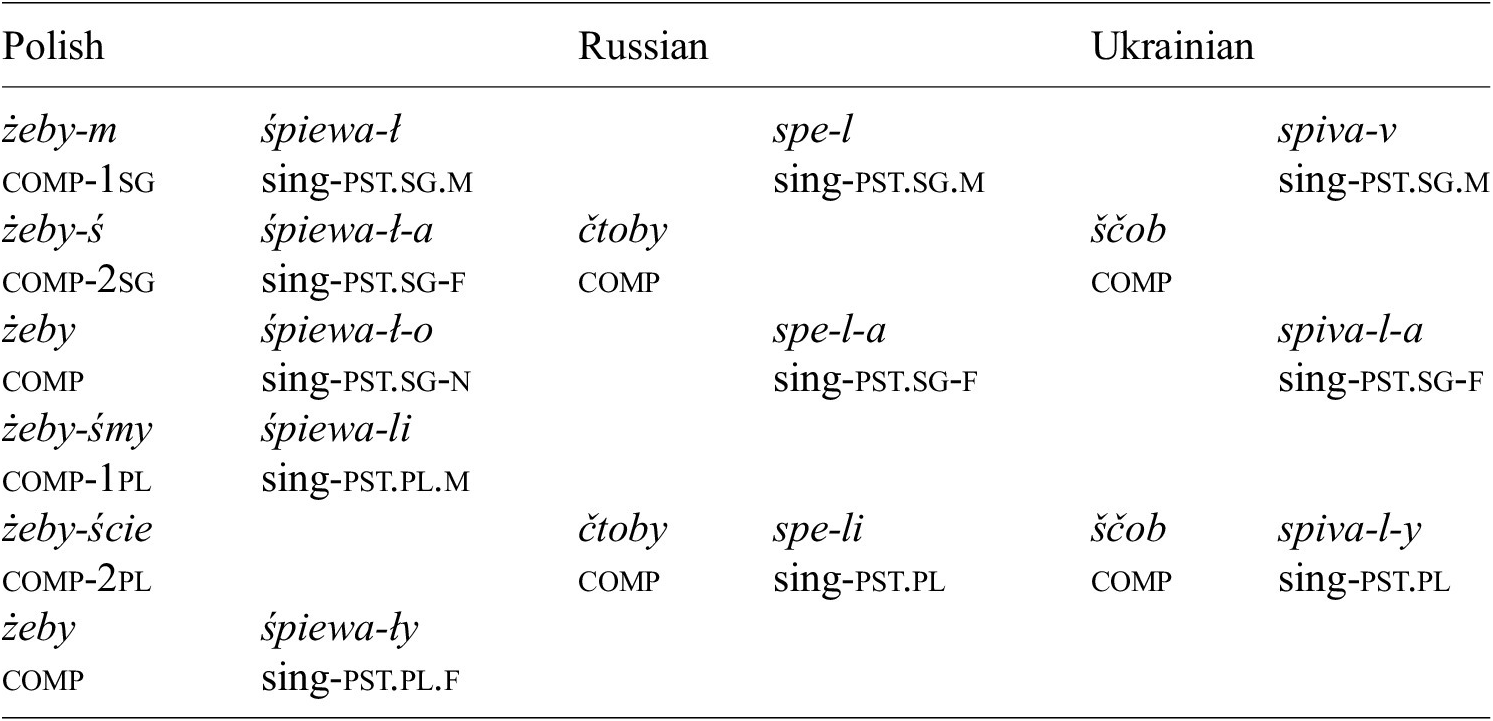
Subjunctive complements are introduced by the complementizer żeby in Polish, čtoby in Russian, and ščob in Ukrainian, as shown in Table 1. The subjunctive complement features an l-participle, formally identical to the past tense and inflected for gender and number. Crucially, this form is not marked for a person in Russian and Ukrainian. In contrast, Polish marks the first and second person together with the number on the complementizer.
Subjunctive forms in embedded clauses in Polish, Russian, and Ukrainian

Subjunctive clauses have received wide attention in research on control. According to Landau (Reference Landau2004), control configurations correlate systematically with the classification of the embedded subjects as either PRO or pro. Crucially, the interaction between tense and agreement features on the embedded verb dictates whether the embedded subject position accommodates obligatorily controlled PRO or referential pro. In the latter case, the null subject might alternate with overt subjects. Within this framework, the difference between obligatory control and noncontrol hinges on the presence or absence of an [R] (referential) feature. In obligatory control, PRO bears [-R], signifying its anaphoric dependence on the matrix subject. In noncontrolled environments, pro or overt subjects carry [+R], allowing for an independent reference interpretation that does not necessitate coreference with the matrix subject. Leaving aside the technical details of this analysis, in the present paper we focus on the second type of structure, whereby the null subject is assumed to be pro, rather than PRO.Footnote 8
This case is clearly exemplified by Polish, whose subjunctive clauses show obviation effects (6). By obviation in this context, we mean the systematic exclusion of coreference between the embedded null subject and the matrix subject in finite subjunctive complements, as opposed to the availability of such coreference in nonfinite complements. This notion of obviation is compatible with the use of finite complementation and does not imply a control-based analysis. Importantly, the null subject in Polish finite subjunctive clauses is a referential pro rather than PRO: its reference is not fixed syntactically and may be resolved to any salient antecedent in the discourse, provided that coreference with the matrix subject is excluded. When it comes to antecedent selection of null subjects in finite embedded environments, a switch from the subject of the main clause is forced. The null subject can alternate with an overt subject too. Conversely, null subjects in Russian are generally not acceptable in subjunctive embedded clauses (7) (Avrutin & Babyonyshev Reference Avrutin and Babyonyshev1997, McShane Reference McShane2009: 120).


In (6)–(7), the embedded subject does not behave like a controlled PRO. In Polish (6), an overt embedded subject pronoun defaults to a discourse-salient referent distinct from both the matrix subject and the indirect object, while a null subject allows broader discourse resolution. More specifically, the null subject of the embedded clause cannot be coreferential with the matrix subject, but it may be interpreted as coreferential with the indirect object or with a contextually salient third person. This exclusion of matrix subject coreference is what we refer to as an obviation effect in Polish finite subjunctive clauses. According to the typology of null subject languages discussed in Section 2, Ukrainian should pattern with Russian (7) and not allow for a null subject in a parallel context. However, the variation described in the literature with respect to effects linked to the null subject parameter (such as the that–trace effect) led us to postulate the existence of additional inconsistencies in the behavior of Ukrainian in specific embedded contexts. Our research question is therefore whether Ukrainian, like Russian, really disallows a null subject in a context like (8), or rather behaves like Polish:

A clarification is in order at this point. Although both Polish and Ukrainian allow null subjects in subjunctive complements, the interpretive properties of these null subjects differ fundamentally. In Polish (6), null subjects in subjunctive clauses display classic obviation effects: the embedded null subject cannot be coreferential with the matrix subject and must instead pick a distinct antecedent. This behavior is consistent with analyses of consistent null subject languages, where referential pro is licensed by a fully specified set of φ-features and its interpretation is regulated by discourse constraints rather than by syntactic binding.
In contrast, null subjects in Ukrainian (8) subjunctive clauses do not display obviation effects. When available, they are interpreted anaphorically and are preferentially resolved with the closest c-commanding antecedent in the matrix clause. This difference is expected under the assumption that Ukrainian and Russian null subjects are not referential pro but φPs (Déchaine and Wiltschko Reference Déchaine and Wiltschko2002), which require syntactic binding and therefore pattern differently from Polish null subjects. Importantly, we do not analyze Ukrainian subjunctive null subjects as instances of PRO, but as cases of anaphoric pro licensed under partial null subject systems.
Slavic subjunctive clauses therefore provide a privileged testing ground for theories of null subject licensing, because this is precisely the domain in which Polish, on the one hand, and Russian and Ukrainian, on the other, diverge, revealing a sharp contrast in the distribution of φ-features across functional heads. Polish marks a person (together with a number) on the complementizer, while Russian and Ukrainian employ a bare participial form marked only for gender and number. This difference directly bears on the feature specification of T and C, which has been independently argued to underlie the distinction between consistent and partial null subject languages. Subjunctive clauses therefore make visible differences in the architecture of the functional spine that remain opaque in other tense configurations, allowing us to isolate the interaction between clause size, φ-feature distribution, and null subject licensing. Other syntactic environments, such as main clauses and nonsubjunctive embedded clauses, are discussed in Section 2 and show that null subject licensing differs systematically between consistent and partial null subject languages. However, these contexts allow additional strategies for subject interpretation, including discourse-based resolution, which may obscure underlying syntactic contrasts. Finite control-like subjunctive configurations minimize such interpretive flexibility: due to the semantics of the embedding predicate, reference to nonsubject antecedents is blocked and discourse-based resolution is strongly disfavored. As a result, these contexts provide a particularly stringent test of whether null subjects are licensed syntactically or via discourse.
In the next section, we present the results of an empirical questionnaire study of parametric variation in the use of embedded null subjects in Polish, Russian, and Ukrainian. The statistical analysis we present will later help to formulate a theoretical analysis that captures potential variation in the way the null subject parameter is set across speakers of the languages under analysis.
4. The studyFootnote 9
4.1. Methodology
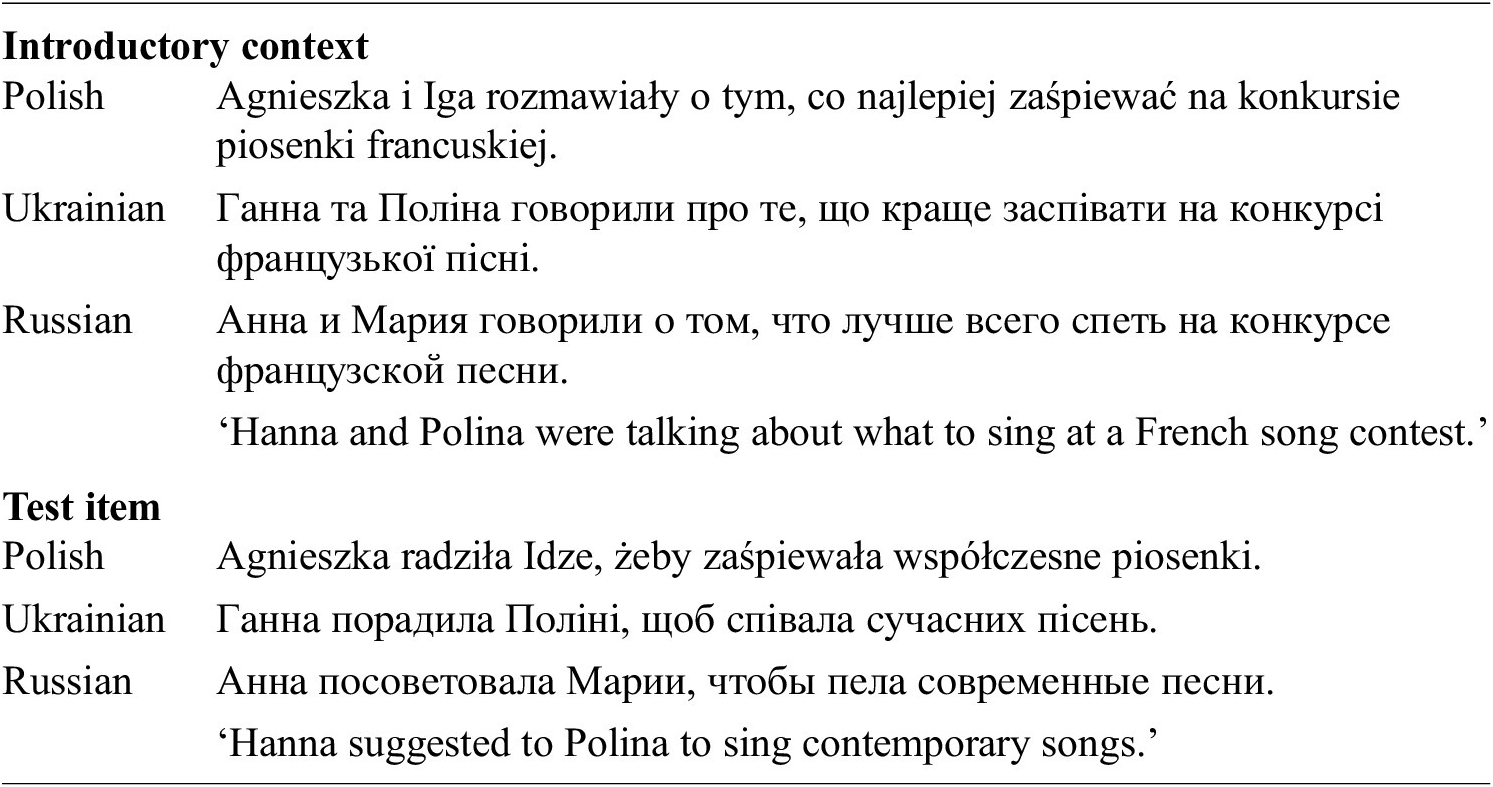
Since embedded null subjects in subjunctive clauses have not been systematically investigated in the literature on Slavic languages, we carried out a grammaticality judgment task in the form of a questionnaire in order to provide independent empirical support for the formal analysis.Footnote 10 Our exploratory test consisted of a short grammaticality judgment task with 14 items and the same number of fillers. Each item had a short introductory context, followed by the test item, as exemplified in Table 2. The introductory context described a situation in which two referents (matched per person and gender) were presented. This context was followed by the test item, made up of a main clause and an embedded clause introduced by a subordinating complementizer; the main clause reintroduced the two referents already presented in the introductory context, the first acting as the subject of the main clause and the second acting as an object of the main clause in the dative case. In the embedded clause, there is no overt subject.
Examples of tested items in Polish, Ukrainian, and Russian
All test items were pretested with native speakers to ensure that they were independently acceptable apart from the manipulation of the embedded subject. In the questionnaire, administered via SoSci Survey, the participants were asked to rate the acceptability of the contexts with a slider, placed under the tested sentence. The left end of the scale was 0 (meaning that the sentence is judged as fully unacceptable), while the right end of the scale was 100 (meaning that the sentence is judged as fully acceptable). Informants could move the slider along the scale and therefore select any value between 0 (on the left end) and 100 (on the right end).
The aim of the acceptability judgment task was to assess the availability of null subjects in embedded subjunctive clauses independently of participants’ preferred interpretation of the embedded subject. For this reason, the contexts were designed to be compatible with more than one potential antecedent, rather than to force a single referential reading. While this choice may introduce a degree of variability in the ratings, it allows us to abstract away from interpretive preferences and focus on the grammatical availability of null subjects in the relevant syntactic configuration.
Importantly, the exploratory study was not intended to test the interpretation of null subjects or to distinguish systematically between discourse-based and syntactic antecedents. Testing such predictions would require a different experimental design, including contexts that force specific antecedents and a direct elicitation of interpretive judgments. We therefore view the present results as establishing the basic acceptability profile of null subjects across the three languages, which can serve as the basis for follow-up work targeting interpretive resolution more directly. Similarly, overt embedded subjects were not included in the design, as their acceptability in the tested contexts is largely uncontroversial; investigating their discourse status would again require a separate experimental setup.
69 informants (20 native speakers of Polish, 19 native speakers of Russian, 30 native speakers of Ukrainian) filled in the questionnaire. Three versions of the questionnaire were prepared, specifically for speakers of each of the languages under analysis. Informants could select to fill in the questionnaire in their native language at the beginning of the test and the questionnaires were administered entirely in the target languages. All informants were asked to confirm that they are native speakers of the language for which they were responding. Participants were also asked about country of residence, languages spoken, and the language used in daily life. In view of the specific situation of Ukrainian (most speakers being bilingual or fluent in Russian as wellFootnote 11 and an expected high number of possible respondents currently living outside Ukraine), Ukrainian informants were asked to fill in a detailed sociolinguistic questionnaire to allow us to directly compare them to Russian and Polish speakers, whose status as native monolingual speakers of their languages is more easily defined. The additional sociolinguistic questions regarded the language used at home during childhood, the language in which they received formal education, the region of origin in Ukraine, the country of residence, and, if they are living outside Ukraine, the number of years spent abroad. While most reported knowledge of Russian and residence in English-speaking countries, only one participant reported residence in Poland, making it impossible to assess the differential effects of contact with Polish versus English.
4.2. Defining variation in Ukrainian
A linear mixed-effects model was fitted using the lmer() function from the lme4 and lmerTest packages (Bates et al. Reference Bates, Mächler, Bolker and Walker2015) to examine factors influencing the acceptability ratings of Ukrainian sentences, with Region, Education in Ukrainian, and Bilingualism as fixed effects and Informant as a random intercept to account for individual differences.
Informants who received formal education in Ukrainian tended to rate sentences approximately 18 points lower than those who did not receive formal education in Ukrainian, an almost significant effect (p = 0.0725).
In the definition of bilingualism, all informants who stated that they have been living abroad for at least 20 years (and may therefore present attrition effects, Montrul Reference Montrul, Nicoladis and Montanari2016) or that they left Ukraine before the age of 6 (and therefore qualify as heritage speakers of Ukrainian, see Rothman Reference Rothman2009, Polinsky Reference Polinsky2018), were coded as bilinguals. However, bilingualism had no significant effect on ratings (p = 0.29).
Moving to regional variation, the intercept (80.22) represents the baseline average rating for informants from the Central region. Regional differences did not reach statistical significance, as shown in Table 3.
Regional variation in Ukrainian

No single region shows a statistically reliable effect on acceptability ratings; informants from the North, East, South, and Kyiv regions provided lower ratings for the items, but the results were not significant; similarly, responses by informants from the North-West and the South-West regions did not significantly differ from those of informants from the Central region, while being higher; only the North-East region shows a trend toward lower ratings, which is approaching significance with respect to the Central Ukrainian intercept.
Random effects revealed substantial individual variability in sentence ratings, with informant variance at 419.7 (Standard Deviation = 20.49) and residual variance at 543.5 (Standard Deviation = 23.31), as will be shown in the next section as well.
In summary, while no significant effects were found for region or bilingualism, the marginal effect of education in Ukrainian suggests a potential trend toward stricter grammatical evaluations among informants with formal language training. This preliminary analysis of variation in Ukrainian allowed us to exclude effects of formal instruction, bilingualism, and dialectal variation as potential factors in Ukrainian: there is no principled reason to assume significant language-external effects on the responses provided by our Ukrainian informants. Additionally, the model highlighted considerable individual variation, a factor we will include in the next section, discussing the results for the full set of languages.
4.3. Variation in Polish, Russian, and Ukrainian
As mentioned in Section 4.1, participants rated the acceptability of test items on a scale from 0 to 100. Figure 1 shows a comparison of the results for every test item between the three languages.
Acceptability ratings by test item.

To examine whether acceptability ratings of the sentences differed significantly among Russian, Polish, and Ukrainian speakers, a linear regression analysis was conducted in R using the lm() function from the stats package (R Core Team, 2024). The dependent variable was the rating (on a 1–100 scale), while the independent variable was the language (Russian, Polish, Ukrainian), with Russian serving as the baseline category. The model was specified as Rating = β0 + β1 + β2 + ϵ. Russian, which is expected to exhibit the lowest acceptability for null subjects, is used as an intercept and is represented as β0, indicating the mean rating for Russian speakers; the Polish coefficient (indicating the difference between Polish and Russian speakers), is represented as β1; the Ukrainian coefficient (indicating the difference between Ukrainian and Russian speakers) is represented as β2. ϵ represents random variation, which the model does not explain.
The results showed that the intercept for Russian speakers was 41.06, indicating low acceptability ratings for sentences with null subjects. The coefficient for Polish speakers was 41.01 (p < 0.001), yielding an estimated mean rating of 82.07, which reflects a significantly higher level of acceptance relative to Russian speakers. Ukrainian speakers also rated the sentences significantly higher than Russian speakers, with a coefficient of 23.80 (p < 0.001) and an estimated mean rating of 64.86, indicating intermediate acceptability. A Tukey-adjusted pairwise comparison of mean ratings across the three languages revealed statistically significant differences for all language pairs. Specifically, Polish sentences received significantly higher ratings than both Russian (mean difference = 41.0, p < 0.0001) and Ukrainian sentences (mean difference = 17.2, p < 0.0001). Similarly, Ukrainian sentences received significantly higher ratings than Russian ones (mean difference = 23.8, p < 0.0001).
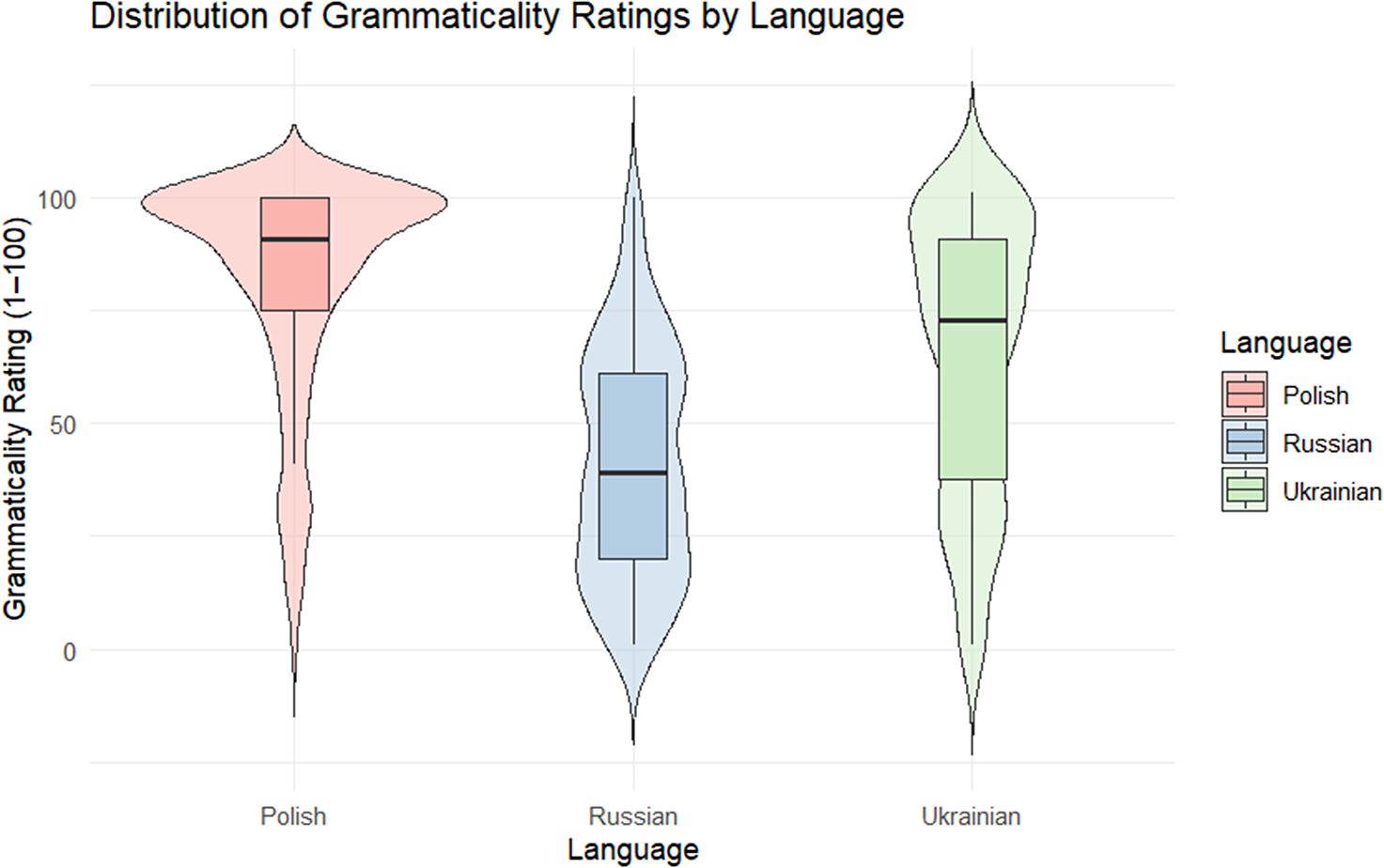
These results confirm that mean acceptability ratings differ significantly between all three languages, with Polish being rated the highest, Russian the lowest, and Ukrainian falling in between. The model demonstrated a good goodness of fit, capturing approximately 24% of the variance in the ratings (R² = 0.24), indicating a strong effect of language on sentence acceptability. A visualization of the rating distributions (Figure 2) further highlights these trends, demonstrating clear distinctions between groups, with Russian ratings clustering at the lower end, Polish ratings at the upper end, and Ukrainian ratings displaying a wider spread.
Grammaticality ratings in Polish, Russian, and Ukrainian.

The violin plot with overlaid boxplots illustrates that Polish ratings were consistently high and tightly clustered near the top of the scale, while Russian ratings were lower and more widely spread. Ukrainian ratings showed a broader distribution, overlapping with both Polish and Russian ranges, reflecting an intermediate and more variable pattern of acceptance.
To account for variation attributable to individual differences, a linear mixed-effects model was subsequently fitted using the lmer() function from the lme4 and lmerTest packages (Bates et al. Reference Bates, Mächler, Bolker and Walker2015). Language remained a fixed effect, while Informant was added as a random intercept. The variance attributed to Informant was 301.2 (Standard Deviation = 17.35), indicating substantial between-participant variability. Residual variance was 468.8 (Standard Deviation = 21.65), reflecting within-participant and item-level noise not explained by language alone. Including Informant as a random effect increased the explained variance to approximately 39% (conditional R² = 0.39), confirming that a considerable portion of the overall variation is due to consistent individual differences in grammaticality judgments, independent of language background.
When modelling each language group separately, the proportion of variance attributable to Informant was 39.1% for Russian (R² = 0.391), 32.4% for Polish (R² = 0.324), and 41.5% for Ukrainian (R² = 0.415). The proportion of variance across languages is not statistically significant. These findings further highlight the importance of accounting for participant-level variability in acceptability judgment research, with informant effects contributing substantially across all three language groups.
In sum, this model confirms that Polish generally accepts null subjects in embedded clauses, while their acceptability in Russian is significantly more limited. Ukrainian exhibits extensive variability, which suggests variation in the way the null subject parameters are set: while it is true that some speakers, in line with the predictions made for partial null subject languages, disfavor an embedded clause with a null subject, a significant part of Ukrainian speakers allow them. In Section 5, we show that parametric variation in Russian and, especially, Ukrainian can be captured in terms of clause size.
5. Syntactic analysis and discussion
5.1. A cartographic approach to the Slavic left periphery
As shown in Section 4, the examination of embedded null subjects in Slavic subjunctive clauses further refines our understanding of the distinction between consistent and partial null subject languages. Crucially, all the languages under analysis exhibit variation, regardless of whether they are classified as consistent or partial null subject languages. On the one hand, languages significantly differ in the acceptance of embedded null subjects, with Russian exhibiting a lower acceptability of null subjects compared to Polish and Ukrainian, where they are more frequently accepted, especially in Polish. On the other hand, a considerable variation emerged at the inter-speaker level, suggesting that it is not possible to fully generalize the predictions made by the typology of null subjects. Our analysis aims to fully capture the variation in null subject distribution in the Slavic languages under analysis in terms of a crucial difference in clause size.
As a premise, we assume that finite embedded clauses are syntactically represented as CPs. More specifically, we rely on a version of the Split-CP Hypothesis as proposed by Rizzi (Reference Rizzi1997), which posits that the left periphery of a sentence is not a monolithic phrase headed by a single C, but rather a sequence of functional projections. Each of these projections encodes a variety of syntactic and interface features, such as Force, Topic, Focus, etc.
One of the central components of our analysis is the claim that the lower part of the left periphery in finite embedded clauses encodes features related to grammatical information, such as mood and finiteness properties. These properties are typically expressed through complementizers in finite embedded clauses and structurally such features are encoded within FinP. The higher layers of the left periphery, on the other hand, hold information about the clause type, illocutionary force, and pragmatic or discursive elements. Consistent with Rizzi’s (Reference Rizzi1997) model, we assign these higher-layer features to ForceP. Additionally, intermediate layers corresponding to topic and focus are sandwiched between ForceP and FinP. In line with the cartographic approach, we assume that the minimal structure for Split-CPs in finite embedded clauses includes the following layers:

This syntactic structure is essential for understanding the distribution of syntactic and semantic features within the left periphery of embedded clauses.
Another crucial aspect of our analysis is the treatment of CPs as phases, following Chomsky’s (Reference Chomsky, Kenstowicz and Hale2001) definition. We propose that only structures which include the external ForceP layer constitute domains for the transfer of syntactic material to the LF interface. Thus, CPs that only merge lower functional heads, such as FinP, are not considered phases. This distinction is important for the interpretation and derivation of syntactic structures, as only full CPs with ForceP can be transferred to the interpretive system (see also Carstens and Diercks Reference Carstens and Diercks2013, Kim Reference Kim2024 for similar proposals).
Building on the framework outlined above, we assert that embedded clauses can be syntactically represented as structures of variable size, a position in line with Wurmbrand (Reference Wurmbrand2001, Reference Wurmbrand, Bui and Özyıldız2015), Wurmbrand and Lohniger (Reference Wurmbrand, Lohninger, Hartmann and Wöllstein2023).Footnote 12 However, we also contend that finite complementizers are never merged in TP. Instead, they are always externally merged within the lower part of the Split-CP, specifically within FinP. This distinction is crucial for understanding the syntactic position of complementizers and their movement within the clause.Footnote 13
To substantiate this claim, we argue that FinP can be associated with a modal (subjunctive or imperative) feature, as discussed by Isac (Reference Isac2015) and Kaufmann (Reference Kaufmann2019). Our analysis holds that all complementizers under investigation are initially merged in FinP, regardless of the variations in embedding patterns observed across different Slavic languages. Furthermore, complementizers may undergo movement to ForceP, the phase edge, as part of the derivational process. This movement is reminiscent of the proposal by Ledgeway and Lombardi (Reference Ledgeway, Lombardi, Benincà, Ledgeway and Vincent2014) for southern Italo-Romance subjunctives, where complementizers move to a higher functional position to satisfy syntactic requirements.
In the case of Polish żeby, Russian čtoby, and Ukrainian ščob, we argue that these complementizers may use this additional step, but we will show that there is variation, especially in the case of Ukrainian ščob, while Polish żeby and Russian čtoby generally undergo movement from FinP to ForceP, as shown in the following structure:

We argue for the presence of an uninterpretable edge feature uF associated with the Force head in the embedded CP. The movement of the complementizer is triggered by the presence of an interpretable edge feature, F, associated with the complementizer (see Chomsky Reference Chomsky, Kenstowicz and Hale2001). In this context, we adopt a framework akin to Bošković (Reference Bošković2007), where uF must probe the C-domain to be licensed. As a result, complementizers like żeby and čtoby are required to move to the edge of the CP domain, satisfying syntactic constraints imposed by the presence of uF.Footnote 14 We propose that this is always true in Polish, while additional considerations need to be made for Russian and Ukrainian, specifically in the case in which a speaker allows for a null subject.
Specifically, the fact that a significant part of Ukrainian informants, as well as a minority of Russian informants, accepted a null subject in the same context makes it necessary to hypothesize that čtoby and ščob do not always undergo this movement. Rather, in order to allow for a null embedded subject, they may remain in the lower FinP position, and in this configuration they lack the higher C-head required for movement (Veselinović Reference Veselinović2019, Wurmbrand et al. Reference Wurmbrand, Kovač, Lohninger, Pajančič and Todorović2020). This results in a reduced syntactic structure, as follows:

This configuration is consistent with the absence of the uF, which has been shown to be more widely accepted in Ukrainian than in Russian (where it still remains available, at least for some speakers). In this configuration, finite embedded clauses are too small to constitute a phase, and operations between the matrix and embedded clauses are allowed without triggering any syntactic violations.
To further clarify, the presence of uF ultimately drives the movement of the complementizer from FinP to ForceP. When uF is present, complementizers must move to the SpecCP position; otherwise, the derivation will fail to converge at the LF interface. The presence of the uninterpretable edge feature when the phase is closed would make the sentence syntactically illegible to the interpretive system (Nunes Reference Nunes, Kosta, Franks, Radeva-Bork and Schürcks2014), leading to a derivational crash. This movement is therefore an instance of Agree, whereby uF is deleted upon movement of the complementizer to ForceP; the same movement is not necessary in Ukrainian because of the lack of ForceP in embedded subjunctive clauses and, consequently, of uF.
In summary, our analysis predicts that the three complementizers discussed in this paper are initially merged in FinP, the lower part of the split CP structure. This approach aligns with previous proposals by Ledgeway (Reference Ledgeway2005), Belletti (Reference Belletti and Belletti2009), Demonte and Fernandez-Soriano (Reference Demonte and Fernández-Soriano2009), Villa-García (Reference Villa-García2012), Corr (Reference Corr2016), and Kocher (Reference Kocher2022), who also argued for a movement-based treatment of complementizers. We maintain that complementizers can move through the left periphery, surfacing in different positions depending on the type of embedded construction. Importantly, as demonstrated in Belletti (Reference Belletti and Belletti2009), the same complementizer can realize the content of both FinP and ForceP, supporting the flexibility of complementizer movement across different syntactic environments.
5.2. Clause size and the variability in the licensing of null subjects
Building on the syntactic structure proposed for embedded clauses in Section 5.1, we now turn to the licensing of null subjects in Polish, Russian, and Ukrainian. We argue that the licensing of null subjects is contingent upon the presence of a fully specified set of φ-features, which can be scattered across different heads; crucially, they can be either fully realized on the T head or divided between the T and C heads.
In Polish (12), null subjects in embedded clauses are licensed by a complete set of φ-features, though these features are not fully realized on T:

In (12), like in the third person example presented in (6; Section 3), the embedded clause contains the φ-defective participle przeczytała ‘read-pst-sg.f’, which encodes number and gender features, but lacks person marking. However, here it is clear that φ-defectivity is only apparent in Polish. The absence of the person feature on T is compensated for by the realization of person and number morphology on C. Historically, this inflection originates from a free auxiliary which later grammaticalized into a clitic. In Modern Polish, conditional and person–number clitics rise from the verbal domain to a high clausal head, serving to distinguish indicative and subjunctive clauses (Migdalski Reference Migdalski, Bański, Łukaszewicz, Opalińska and Zaleska2011, Reference Migdalski, Ionin and MacDonald2020).
This suggests that the PF requirement that allows for the subject to be null under identity is not limited to T. Rather, the set of φ-features needs to be complete at the point of transfer, which occurs when the edge of the C-phase is merged, as presented in (13).

In summary, Polish compensates for φ-defectivity on T by realizing person and number morphology on the C head. The null subject in Polish is interpreted as a referential pro, a null counterpart of a full pronoun. The φ-features on C license the null subject via deletion under identity at PF (Sheehan Reference Sheehan2006, Holmberg et al. Reference Holmberg, Biberauer, Holmberg, Roberts and Sheehan2009).
In contrast, the situation in Russian (14) and Ukrainian (15) is more complex, as these languages exhibit true φ-defectivity:


In both cases, the participles pročitala (Russian) and pročytala (Ukrainian) encode gender and number but lack person features. Unlike Polish, however, the person is not specified on C either, making the deletion of the subject under identity impossible. This difference points to a fundamental distinction in the licensing of null subjects across these languages and it results in a more nuanced degree of acceptability of null subjects in such contexts in the two languages.
Our study provides evidence that null subjects can be accepted in Russian and Ukrainian subjunctive embedded clauses, unlike the literature presented in Section 2. While Russian marginally allows for a null subject, Ukrainian more clearly permits it. This contrast raises the question of what allows null subjects to be licensed, despite the absence of a fully specified set of φ-features. In order to explain this difference, we first need to consider that Russian and Ukrainian null subjects are anaphoric in nature (Holmberg Reference Holmberg2005, Ackema & Neeleman Reference Ackema and Neeleman2018, Tsedryk Reference Tsedryk, Dalmi, Tsedryk and Cegłowski2022), meaning they are licensed only when bound by an antecedent in the main clause. In both languages, null subjects are treated as φPs (Déchaine & Wiltschko Reference Déchaine and Wiltschko2002), which are equipped with interpretable, valued φ-features, but lack a D-head, which is required for a definite or referential interpretation; they are capable of being bound by a DP in the higher clause. This is compatible with the fact that third-person plural null subjects receive a generic interpretation when no suitable binder is found, as in the Ukrainian example below. It is crucial to note that, contrastively, generic interpretation is not available for third-person singular null subjects.

The absence of a generic singular null in Ukrainian does not undermine its classification as a partial pro-drop language. While Holmberg (Reference Holmberg, Biberauer, Holmberg, Roberts and Sheehan2009) identifies the availability of generic null third person as a frequent property of partial pro-drop systems, subsequent work has shown that this property is not uniform across all such languages. In Russian and Ukrainian, generic or arbitrary interpretations are instead preferentially associated with third plural null subjects, a strategy that is independently well attested in consistent pro-drop languages as well. As already shown in Section 2, this distribution contrasts with languages like Polish, where null subjects are referential pro forms. In these languages, null subjects are not anaphoric but are instead licensed directly via φ-features, which makes their interpretation as generic or bound readings unnecessary. Crucially, what sets Russian and Ukrainian apart from Polish is not the availability of arbitrary null subjects, but the strong restriction on referential third-person null subjects. As noted by Madariaga (Reference Madariaga, Dalmi, Tsedryk and Cegłowski2022), changes in Russian pro-drop primarily affected defective referential pronouns, while generic or arbitrary null subjects remained largely unaffected. Ukrainian patterns in the same way. The availability of arbitrary null third person plural therefore reflects a shared strategy across Slavic languages and does not bear directly on the distinction between consistent and partial pro-drop systems.
Assuming that the categorization of Russian and Ukrainian as partial null subject languages, and therefore the classification of their pro as a φPs, are on the right track, the core of the difference between Russian and Ukrainian needs to be captured otherwise. We propose that the difference lies in the size of the embedded clauses. An independent indication that Ukrainian allows optional reduction of the left periphery comes from the interaction between null subjects and left-peripheral topicalization. It has been observed that in East Slavic languages null subjects are systematically blocked in the presence of a fronted referential XP, a configuration independently diagnosed as involving the projection of TopP (Madariaga Reference Madariaga, Dalmi, Tsedryk and Cegłowski2022). Under standard cartographic assumptions (Rizzi Reference Rizzi1997), the projection of TopP entails the presence of ForceP, yielding a fully articulated CP.
If ForceP constitutes a phase, as assumed here, the presence of a Topic position is expected to block the licensing of anaphoric null subjects, which require binding by an antecedent in the higher clause. The fact that null subjects are possible only in the absence of topicalization therefore provides independent syntactic evidence that Ukrainian allows finite clauses with a reduced left periphery, lacking ForceP. In line with this reasoning, we argue that Ukrainian (and in a more limited way, also Russian) subjunctive embedded clauses do not always involve a full CP. If they do, their syntactic derivation will result in a configuration in which null subjects are banned. Conversely, when null subjects are possible, subjunctive clauses are not phases and, as a result, they allow for the binding of null subjects by a matrix antecedent. In particular, Ukrainian ščob is very frequently realized in FinP, and this configuration allows the embedded clause to remain small enough to facilitate binding across clause boundaries. This configuration is also possible in Russian, but it is not as common as in Ukrainian.

In this configuration, the clause does not merge a full CP, and null subjects can be licensed across clause boundaries, as the embedded clause lacks a ForceP and thus does not constitute a phase.
In contrast, the majority of Russian informants (as well as some Ukrainians) adopted a different strategy, in which embedded clauses are full phases, and as a result, the anaphoric dependency between the bound null subject and an antecedent in the matrix clause cannot be established across domains. The full clause structure here prevents the licensing of null subjects, disallowing them from being bound by a higher antecedent.

Here, the presence of a full ForceP in the embedded clause makes it a phase, which blocks the binding of the null subject across domains. The complementizer must move to ForceP due to the uninterpretable edge feature uF (Chomsky Reference Chomsky, Kenstowicz and Hale2001), which prevents the null subject from being licensed in the embedded clause.
5.3. Analysis summary
Our analysis builds on the assumption that Polish, Russian, and Ukrainian embedded clauses use a φ-defective T, encoding number and gender but not person. However, Polish realizes person and number morphology on C (Migdalski Reference Migdalski, Bański, Łukaszewicz, Opalińska and Zaleska2011, Reference Migdalski, Ionin and MacDonald2020). Conversely, Russian and Ukrainian exhibit real defectivity: a person is not specified on either embedded T or C, making deletion under identity impossible.
We capture the distinct distribution of null subjects in Polish, Ukrainian, and Russian as a structural difference. Crucially, we argue that only ForcePs constitute phases, while structures merging only FinP do not. We propose that the complementizers čtoby, żeby and ščob are first merged in FinP, but only Polish żeby needs to undergo movement to the phase edge, associated with embedded ForceP, while Russian čtoby and Ukrainian ščob may remain in FinP, a configuration which allows these two partial null subject languages to save a null subject. The proposal therefore distinguishes between pronominal deletion in Polish, which targets DPs and allows discourse-based coreference and φP-deletion in Russian and Ukrainian, which yields elements that must be syntactically bound. Consistent with this distinction, embedded null subjects in Polish may refer to a discourse topic distinct from the matrix indirect object, whereas in Russian and Ukrainian null subjects, when available, require a local binder.
The movement of the complementizer is motivated by the presence of an uninterpretable (force-related) edge feature uF on the embedded ForceP, triggering movement of the complementizer from FinP to ForceP. Żeby and, in a less consistent way, čtoby carry an interpretable F feature and move to ForceP to delete uF, as otherwise the syntactic computation will not converge at LF. In other words, Polish (and Russian) complements are phases, transfer domains that disallow syntactic operations between embedded and matrix clauses; however, while the Polish referential pro is licensed by φ-features on C, the anaphoric dependency between the bound Russian null subject and an antecedent in the matrix clause cannot be established across domains, disallowing embedded pro. This possibility is not banned for Ukrainian ščob, but it is not frequent.
Conversely, the variation exhibited by ščob (and, to a minor extent by Russian čtoby) suggests the co-existence of two structural configurations within the same system: in the first one, the derivation parallels the one discussed for Polish; in the second one, the complementizers remain in FinP and the embedded clause lacks ForceP. These complements are not phases, therefore the binding of null subjects by a matrix antecedent is possible. The reasons behind the alternation of the two configurations in Russian and Ukrainian are linked to the realization of an edge feature on ForceP, whose distribution in the two languages is a matter of current investigation. Following Biberauer and Richards (Reference Biberauer, Richards and Boeckx2006), we preliminarily suggest that the alternation of two possible choices in Russian and Ukrainian is a case of true optionality, crucially, a persistent case of optionality in a language, which is not affected by the pressures of language acquisition. This means that learners must not show consistent biases, whether due to frequency, processing ease, or simplicity, that would lead them to prefer one variant over another. In the absence of such biases, both options can remain viable across generations, allowing optional structures to remain stable rather than being resolved or eliminated over time. A summary of our model for Polish, Russian, and Ukrainian is presented in Table 4.
Featural specification and complement size in Polish, Russian, and Ukrainian

Following Holmberg et al. (Reference Holmberg, Biberauer, Holmberg, Roberts and Sheehan2009), we assumed that the categorial status of null pronominals depends on the availability of φ-features on functional heads. In consistent null subject languages such as Polish, verbal inflection is sufficiently rich to project a D-layer, allowing null pronominals to be full DPs. These pronominals are referential and may be deleted under identity at PF.
In partial null subject languages such as Russian and Ukrainian, verbal inflection lacks the D-feature. As a result, only smaller φPs can be deleted, yielding null subjects that are nonreferential and require syntactic licensing via binding. This distinction captures the contrast between discourse-licensed null subjects in Polish and syntactically constrained null subjects in Russian and Ukrainian in main clauses.
The novel contribution of the present paper concerns subjunctive complements. In Polish, subjunctive clauses retain a D-feature. Consequently, null pronominals in Polish subjunctive clauses are analyzed as full DPs and behave like their main-clause counterparts. In Russian and Ukrainian, by contrast, subjunctive clauses employ a bare participial form marked only for number and gender, which is insufficient to license a D-layer. As a result, only φPs can be deleted in these languages and only under appropriate syntactic licensing conditions.
We further assume that when the complementizer rises from Fin to Force, the embedded clause constitutes a full CP and therefore a phase. In such configurations, deletion of a φP is blocked in Russian and Ukrainian, yielding the general unavailability of null subjects. When the complementizer remains in Fin, however, a reduced clause lacking ForceP is embedded. These reduced structures are nonphasal and allow the deletion of a φP, provided that it is syntactically bound by a c-commanding antecedent in the matrix clause.
Independent evidence for the reduced nature of such embedded clauses comes from the interaction between null subjects and left-peripheral structure discussed in Section 5.2. In particular, the presence of topicalization, which independently diagnoses the presence of TopP and ForceP, systematically blocks null subject licensing. This supports the claim that null subjects in Russian and Ukrainian are available only in structurally reduced embedded clauses lacking a full left periphery.
In sum, the analysis developed in this paper makes a number of empirical predictions concerning the distribution and interpretation of null subjects across the three languages. First, in partial null subject languages such as Russian and Ukrainian, null subjects are predicted to be available only when a syntactic licensing relation can be established, specifically a local c-command relation with a suitable antecedent. This follows from the assumption that only φP-sized pronominals can be deleted in these languages and that such pronominals require syntactic binding.
Second, null subjects in Russian and Ukrainian are predicted to be systematically excluded in embedded clauses that constitute full CP phases, since φP deletion is blocked across a phase boundary. This prediction is borne out by the contrast between configurations in which the complementizer raises to Force and those in which it remains in Fin, yielding a reduced, nonphasal structure.
Third, consistent null subject languages such as Polish are predicted to allow null subjects independently of c-command relations, since deleted pronominals may be full DPs and are identified via discourse rather than syntactic binding. As a result, Polish is expected to show greater flexibility in the interpretation of embedded null subjects, including in subjunctive contexts.
While the acceptability judgment task reported in this paper was designed to test the general availability of null subjects across these configurations, more fine-grained predictions (such as the role of c-command in Russian and Ukrainian) were not directly manipulated in the experimental design. These predictions have nevertheless been checked through targeted consultation with native speakers and are robustly confirmed. We leave systematic experimental testing of these finer distinctions for future work.
Finally, a brief comment is in order concerning indicative complement clauses. In indicative environments, the three languages do not pattern uniformly across tenses. In the present tense, verbs in Polish, Russian, and Ukrainian are fully inflected for person and number, making these contexts less informative for distinguishing between consistent and partial null subject systems. In the past tense, by contrast, Russian and Ukrainian employ a bare participial form marked only for gender and number, while Polish typically realizes person and number morphology on the verb; for some speakers, this morphology may surface on the complementizer. These patterns are compatible with the present analysis, but indicative clauses do not provide as sharp a diagnostic as subjunctive clauses, since they allow multiple tense-dependent strategies for φ-feature realization. For this reason, the paper focuses on subjunctive complements, where cross-linguistic differences in feature distribution are systematic and directly bear on null subject licensing.
6. Conclusion
In conclusion, this study provides valuable insights into the variation of null subject usage across Slavic languages, specifically Polish, Russian, and Ukrainian. The investigation into subjunctive complements highlights the complexities of null subject realization in these languages, revealing how variation in complementizer structures and mood marking influences subject omission. The variation exhibited by the results of our study suggests that individual speaker differences play a crucial role in determining the acceptability of embedded null subjects, reinforcing the need for further research into the factors that drive these judgments.
The syntactic analysis captures this variation based on a cartographic approach and offers a nuanced understanding of how the distribution of null subjects is shaped by the structure of embedded clauses. The study’s findings emphasize the intricate interaction between clause size, syntactic movement, and φ-features in licensing null subjects, providing a comprehensive framework for understanding their behavior in these languages.
Overall, the results of this study contribute to a deeper understanding of null subject variation in Slavic languages and offer important implications for future research into the syntactic and interpretive dimensions of subject omission. The findings underscore the relevance of structural factors in shaping null subject patterns and suggest avenues for further exploration of this phenomenon across a wider range of languages.
Acknowledgments
We thank the anonymous reviewers and the audience of FDSL 17 (Masaryk University in Brno) and SIL 9 (University of Bucharest) for their helpful comments and contributions. This research was supported by the Polish National Science Centre (NCN) grant SONATA BIS-11 HS2 (2021/42/E/HS2/00143). All remaining errors are our own.
Competing interests
The author(s) declare none. All authors have contributed significantly to the work and have approved the final version of the manuscript.






 Open access

