





1 Introduction
This work concerns evaluating logical formulas over an infinite structure. For example, our structure could be the real ordered field, and we want to evaluate a sentence $\phi $
that mentions the symbols
$\phi $
that mentions the symbols $+,*,<$
, and some constants, like “is one element of the set
$+,*,<$
, and some constants, like “is one element of the set $\{ 1/2, 1/3, 2/7\}$
the square root of another element of the set.” Many structures exist such that this problem is decidable—the real field, the complex field, and integer additive arithmetic. And the complexity of these decision procedures has been studied for many decades—in the real field case (see, e.g., [Reference Basu, Pollack and Roy3]). In decidable cases, the complexity is generally high: for example, doubly-exponential for the real field.
$\{ 1/2, 1/3, 2/7\}$
the square root of another element of the set.” Many structures exist such that this problem is decidable—the real field, the complex field, and integer additive arithmetic. And the complexity of these decision procedures has been studied for many decades—in the real field case (see, e.g., [Reference Basu, Pollack and Roy3]). In decidable cases, the complexity is generally high: for example, doubly-exponential for the real field.
Rather than analyzing the complexity of an arbitrary sentence as a function of the size of its string representation, one can look at families of sentences parameterized by a finite relation. Generalizing the example above, we could take a finite set P and consider the statement “is one element of P the square root of another element of P.” Obviously the truth value will depend upon P, and the complexity will be higher the more elements P has. We can thus analyze the complexity of such a data-parameterized family in the size of P. Following common practice in computational logic, we can denote this as the “data complexity of the family,” indicating that everything except P is fixed, as opposed to the “combined complexity” above, where the parameterized formula also varies.
Let us formalize this notion of parameterized family of formulas a bit more. We can consider an arbitrary theory T—a collection of logical sentences—in some language L. And we consider formulas over the language $L_V$
expanding L by predicates in a finite relational signature V, with the intention that the interpretation of the V predicates ranges over finite subsets in a model of T. When we talk about an
$L_V$
expanding L by predicates in a finite relational signature V, with the intention that the interpretation of the V predicates ranges over finite subsets in a model of T. When we talk about an $L_V$
formula, we always mean a standard first-order formula in this signature. Based on the intended semantics mentioned above, two
$L_V$
formula, we always mean a standard first-order formula in this signature. Based on the intended semantics mentioned above, two $L_V$
formulas are said to be equivalent (modulo T) if they agree over all finite interpretations of V in a model of T. In past work, such finite interpretations are referred to as embedded finite models (for T) (see [Reference Benedikt5, Reference Benedikt and Libkin6, Reference Libkin35]). In analogy, we refer to the case where
$L_V$
formulas are said to be equivalent (modulo T) if they agree over all finite interpretations of V in a model of T. In past work, such finite interpretations are referred to as embedded finite models (for T) (see [Reference Benedikt5, Reference Benedikt and Libkin6, Reference Libkin35]). In analogy, we refer to the case where $V=\{P\}$
, P is a single unary predicate, as an embedded finite subset. Our data-parameterized families referred to informally above are just formulas of
$V=\{P\}$
, P is a single unary predicate, as an embedded finite subset. Our data-parameterized families referred to informally above are just formulas of $L_V$
, and the data complexity corresponds to the complexity of evaluating a fixed
$L_V$
, and the data complexity corresponds to the complexity of evaluating a fixed $L_V$
formula as the finite interpretation for the V relations varies. There are several ways of measuring “the size of V,” but for our results we can consider the number of tuples in the interpretation.
$L_V$
formula as the finite interpretation for the V relations varies. There are several ways of measuring “the size of V,” but for our results we can consider the number of tuples in the interpretation.
Above we mentioned the high complexity of evaluating logical sentences on a structure, in terms of the size of the sentence. In contrast, it was discovered in the 1990s that the data complexity of parameterized formulas $L_V$
, for common decidable theories, is often polynomial in the size of V. The general technique for showing such tractability results is to rewrite the
$L_V$
, for common decidable theories, is often polynomial in the size of V. The general technique for showing such tractability results is to rewrite the $L_V$
formula to eliminate unbounded quantification over the infinite structure. That is, we transform the formula into a special kind of
$L_V$
formula to eliminate unbounded quantification over the infinite structure. That is, we transform the formula into a special kind of $L_V$
formula, a first-order formula built up from L formulas with quantifiers ranging over elements in the interpretation of the V relations: we call these first-order restricted-quantifier formulas or
$L_V$
formula, a first-order formula built up from L formulas with quantifiers ranging over elements in the interpretation of the V relations: we call these first-order restricted-quantifier formulas or $1$
-RQ formulas for short. If we assume that we have eliminated quantifiers in the L formulas, this gives a family of quantifier-free formulas as we vary V. Assuming that the model and the interpretations are restricted so that evaluating quantifier-free formulas is tractable, the data complexity of this family will be low.
$1$
-RQ formulas for short. If we assume that we have eliminated quantifiers in the L formulas, this gives a family of quantifier-free formulas as we vary V. Assuming that the model and the interpretations are restricted so that evaluating quantifier-free formulas is tractable, the data complexity of this family will be low.
Prior work has identified conditions in which all sentences of $L_V$
are equivalent to
$L_V$
are equivalent to $1$
-RQ ones, either over all embedded finite models for a given theory T [Reference Belegradek, Stolboushkin and Taitslin4, Reference Benedikt5, Reference Casanovas and Ziegler9, Reference Flum and Ziegler18, Reference Paredaens, Van den Bussche and Van Gucht39] or over a particular class of such models [Reference Baldwin and Benedikt2]. For example, [Reference Benedikt and Libkin6] shows such results for a class of theories containing the real field, [Reference Belegradek, Stolboushkin and Taitslin4] extends to a class containing Presburger arithmetic, while [Reference Flum and Ziegler18] gives results for a class that includes the complex field. These are sometimes referred to as restricted-quantifier collapse (RQC) results in the literature, and we modify the notation slightly to say that they have first-order
$1$
-RQ ones, either over all embedded finite models for a given theory T [Reference Belegradek, Stolboushkin and Taitslin4, Reference Benedikt5, Reference Casanovas and Ziegler9, Reference Flum and Ziegler18, Reference Paredaens, Van den Bussche and Van Gucht39] or over a particular class of such models [Reference Baldwin and Benedikt2]. For example, [Reference Benedikt and Libkin6] shows such results for a class of theories containing the real field, [Reference Belegradek, Stolboushkin and Taitslin4] extends to a class containing Presburger arithmetic, while [Reference Flum and Ziegler18] gives results for a class that includes the complex field. These are sometimes referred to as restricted-quantifier collapse (RQC) results in the literature, and we modify the notation slightly to say that they have first-order $RQC$
or
$RQC$
or $1$
-RQC. They show that the additional power of quantification over an infinite structure in
$1$
-RQC. They show that the additional power of quantification over an infinite structure in $L_V$
formulas can be “compiled away.” In the presence of
$L_V$
formulas can be “compiled away.” In the presence of $1$
-RQC,
$1$
-RQC, $L_V$
sentences are, in some sense, no more expressive than traditional first-order logic over finite models. Much of the early work was motivated from spatial databases, thus there was an emphasis on the case where the infinite universe is the real numbers [Reference Basu, Pollack and Roy3, Reference Libkin35]. The above notion of
$L_V$
sentences are, in some sense, no more expressive than traditional first-order logic over finite models. Much of the early work was motivated from spatial databases, thus there was an emphasis on the case where the infinite universe is the real numbers [Reference Basu, Pollack and Roy3, Reference Libkin35]. The above notion of $1$
-RQC was for a theory, with the compilation producing an equivalent formula over all models of the theory. We can also say that a structure has
$1$
-RQC was for a theory, with the compilation producing an equivalent formula over all models of the theory. We can also say that a structure has $1$
-RQC if every first-order
$1$
-RQC if every first-order $L_V$
formula is equivalent to a
$L_V$
formula is equivalent to a $1$
-RQ formula over the structure. This is equivalent to the theory of the structure having
$1$
-RQ formula over the structure. This is equivalent to the theory of the structure having $1$
-RQC.
$1$
-RQC.
Previous research focused on the case where $1$
-RQC holds, and its consequences for the complexity of evaluation. It is not clear what happens when
$1$
-RQC holds, and its consequences for the complexity of evaluation. It is not clear what happens when $1$
-RQC fails. What can we say about the complexity or the expressiveness of
$1$
-RQC fails. What can we say about the complexity or the expressiveness of $L_V$
formulas in this case? What are the possibilities for the expressiveness of
$L_V$
formulas in this case? What are the possibilities for the expressiveness of $L_V$
formulas over all models, or over all decidable models? In this article we make a step towards a more complete picture, looking at models that do not have
$L_V$
formulas over all models, or over all decidable models? In this article we make a step towards a more complete picture, looking at models that do not have $1$
-RQC, and investigating several weakenings of
$1$
-RQC, and investigating several weakenings of $1$
-RQC. In the process we get new complexity results for decision procedures.
$1$
-RQC. In the process we get new complexity results for decision procedures.
1.1 Higher-order collapse and higher complexity theories
Our goal is to explore theories which behave worse than $1$
-RQC, but where we still get some control over expressiveness and complexity of evaluation. Towards that end, we consider a weakening of
$1$
-RQC, but where we still get some control over expressiveness and complexity of evaluation. Towards that end, we consider a weakening of $1$
-RQC where we eliminate unrestricted quantification in favor of higher-order quantification over the finite structure. We say that a theory is k-RQC if every
$1$
-RQC where we eliminate unrestricted quantification in favor of higher-order quantification over the finite structure. We say that a theory is k-RQC if every $L_V$
formula is equivalent (over all embedded finite models for T) to a formula built up from L formulas using
$L_V$
formula is equivalent (over all embedded finite models for T) to a formula built up from L formulas using $i^{th}$
-order quantification over elements in V for
$i^{th}$
-order quantification over elements in V for $i \leq k$
. Thus RQC from the literature corresponds to
$i \leq k$
. Thus RQC from the literature corresponds to $k=1$
. We call a theory
$k=1$
. We call a theory $\omega $
-RQC if every formula can be converted to a
$\omega $
-RQC if every formula can be converted to a $k^{th}$
-order one for some k, but not necessarily with a uniform bound on k. It is easy to see that completely computationally badly-behaved structures like full integer arithmetic cannot have this property—indeed,
$k^{th}$
-order one for some k, but not necessarily with a uniform bound on k. It is easy to see that completely computationally badly-behaved structures like full integer arithmetic cannot have this property—indeed, $\omega $
-RQC implies that one cannot use first-order formulas to perform a computation on the finite part of the structure that is non-elementary in the size of the structure alone. We provide examples that show that the hierarchy of theories with k-RQC does not collapse. Our construction will further show that the complexity of evaluating logical formulas can be as wild as possible.
$\omega $
-RQC implies that one cannot use first-order formulas to perform a computation on the finite part of the structure that is non-elementary in the size of the structure alone. We provide examples that show that the hierarchy of theories with k-RQC does not collapse. Our construction will further show that the complexity of evaluating logical formulas can be as wild as possible.
1.2 Disconnects between collapse and complexity
In our investigation of higher-order collapse, we provide a recipe for generating decidable theories where first-order logic over the ambient structure can capture higher-order logic over the embedded finite structure, and examples where the complexity of evaluation is arbitrarily high. But some theories have a disconnect between expressiveness of the logic and complexity: there are first-order sentences over embedded finite models which we cannot express in any reasonable logic quantifying over the finite structure alone, and yet the complexity of evaluation in the theory is still not very high. We give examples where this disconnect can be “fixed,” by expanding the signature, so that the level of collapse reflects the complexity of evaluation. But we give a natural example, using Boolean Algebras, where this disconnect is fundamental: the complexity of evaluation is elementary, but we cannot obtain RQC even by extending the signature.
1.3 Notions of collapse and complexity
Although many of our main results on weaker notions of collapse are negative—certain theories do not admit this form of collapse—we show that our results imply lower bounds on complexity of decision procedures for the underlying theory.
1.4 Evaluating formulas over finite fields
We turn to the question of whether there are important and natural decidable theories where both the expressiveness of the logic and also the complexity of evaluation is high. We demonstrate this for the theory of finite fields and for the theory of pseudo-finite fields [Reference Ax1]. The former refers to the first-order sentences which hold in every finite field, while the latter adds on the assertion that the field is infinite. We show that the theory of finite fields and the theory of pseudo-finite fields are not $\omega $
-RQC. We use results about (failure of) RQC for pseudo-fields to give lower bounds on quantifier-elimination for the theory. We hope this connection between collapse to restricted-quantifier formulas and lower bounds can be exploited for other examples.
$\omega $
-RQC. We use results about (failure of) RQC for pseudo-fields to give lower bounds on quantifier-elimination for the theory. We hope this connection between collapse to restricted-quantifier formulas and lower bounds can be exploited for other examples.
1.5 Restricting the signatures for the uninterpreted predicates
Finally, we consider weakening collapse by requiring that it holds only for signatures $L_P$
: that is, for embedded finite subsets. We show that this weakening of
$L_P$
: that is, for embedded finite subsets. We show that this weakening of $1$
-RQC is actually not a weakening at all: it is equivalent to
$1$
-RQC is actually not a weakening at all: it is equivalent to $1$
-RQC. We show that for a variation of RQC studied in past work—focusing on
$1$
-RQC. We show that for a variation of RQC studied in past work—focusing on $L_V$
formulas depending only on the V isomorphism type—the arity of relations in V can make a difference.
$L_V$
formulas depending only on the V isomorphism type—the arity of relations in V can make a difference.
1.6 Our techniques
The prior results in embedded finite model theory [Reference Belegradek, Stolboushkin and Taitslin4, Reference Benedikt5] use classical model-theoretic techniques. For example, results that unrestricted quantification can be eliminated from real closed fields rely on some very basic properties of fields, namely, o-minimality. We hope that our work also offers some insight into the use of more recent technical tools. In investigating finite fields, we naturally make use of the techniques developed for the theory of finite fields over the last decades, including quantifier-elimination and expressiveness results [Reference Ax1, Reference Chatzidakis, Van den Dries and Macintyre11]. In our results on impact of the signature, we make use of recent results on NIP theories, an area that has developed rapidly over the last decade: [Reference Simon42, Reference Chernikov and Simon14]. NIP theories have strong links with both machine learning and efficient model checking [Reference Dreier, Mählmann, Siebertz and Torunczyk15]. In investigating weaker notions of collapse one main tool is a construction of Henson [Reference Henson23], which has also found other applications in theoretical computer science recently [Reference Bodirsky, Martin, Pinsker and Pongrácz8]. In investigating weakening of collapse via expansion, we make use of results on Ramsey expansions of theories [Reference Hrushovski27].
1.7 Organization
Section 2 reviews the basic definitions around embedded finite model theory, and also overviews some older results on the topic. Section 3 studies higher-order collapse. Section 4 investigates whether the failure of collapse can be fixed by extending the signature. Section 5 focuses on the case of finite and pseudo-finite fields. Section 6 presents our results on collapse in monadic relational signatures vs. collapse over all relational signatures. We close with a discussion of our results and open questions in Section 7.
The body of the article focuses on results of interest to theoretical computer science. Some further algebraic examples, some background on a quantifier-elimination result used in the finite field section, along with supplementary results of a more model-theoretic nature, are included in the Appendix.
2 Definitions and prior results
Let T be a complete theory in a language L. Fix a finite relational signature V disjoint from L and let $L_V$
be the union of L by V. We write an
$L_V$
be the union of L by V. We write an $L_V$
structure as
$L_V$
structure as $(M, I)$
. Given a V structure I, the active domain of I,
$(M, I)$
. Given a V structure I, the active domain of I, ${\mathsf {Adom}}(I)$
, is the union of the projections of the interpretations of symbols in V. Thus if I interprets each relation in V by a finite set of tuples,
${\mathsf {Adom}}(I)$
, is the union of the projections of the interpretations of symbols in V. Thus if I interprets each relation in V by a finite set of tuples, ${\mathsf {Adom}}(I)$
is a finite set. An
${\mathsf {Adom}}(I)$
is a finite set. An $L_V$
formula always means an ordinary first-order formula in this signature. A first-order restricted-quantifier formula (or just “
$L_V$
formula always means an ordinary first-order formula in this signature. A first-order restricted-quantifier formula (or just “ $1$
-RQ formula”) is built up starting from first-order L formulas and V atoms as the atomic formulas. We close under Boolean connectives and quantifications of the form
$1$
-RQ formula”) is built up starting from first-order L formulas and V atoms as the atomic formulas. We close under Boolean connectives and quantifications of the form $\exists x \in {\mathsf {Adom}}~ \phi $
or
$\exists x \in {\mathsf {Adom}}~ \phi $
or $\forall x \in {\mathsf {Adom}} ~ \phi $
where x is a variable. The semantics on
$\forall x \in {\mathsf {Adom}} ~ \phi $
where x is a variable. The semantics on $L_V$
structure
$L_V$
structure $(M,I)$
with valuation
$(M,I)$
with valuation $\sigma $
is that
$\sigma $
is that $\exists x \in {\mathsf {Adom}}~ \phi $
holds when there is
$\exists x \in {\mathsf {Adom}}~ \phi $
holds when there is $x_0$
in
$x_0$
in ${\mathsf {Adom}}(I)$
such that
${\mathsf {Adom}}(I)$
such that $\phi $
holds on
$\phi $
holds on $\sigma $
extended with
$\sigma $
extended with $x \mapsto x_0$
. The semantics of
$x \mapsto x_0$
. The semantics of $\forall x \in {\mathsf {Adom}} ~ \phi $
is given similarly or by duality. It is easy to see that these formulas can be translated to special kinds of
$\forall x \in {\mathsf {Adom}} ~ \phi $
is given similarly or by duality. It is easy to see that these formulas can be translated to special kinds of $L_V$
formulas: we can expand out
$L_V$
formulas: we can expand out $\exists x \in {\mathsf {Adom}} ~ \phi $
into disjunctions of formulas having the form
$\exists x \in {\mathsf {Adom}} ~ \phi $
into disjunctions of formulas having the form $\exists x \mathbf {y} ~ A(x, \mathbf {y}) \wedge \phi $
for some relation
$\exists x \mathbf {y} ~ A(x, \mathbf {y}) \wedge \phi $
for some relation $A \in V$
.
$A \in V$
.
We will also focus on the case $V = \{P\}$
, abbreviating
$V = \{P\}$
, abbreviating $L_V$
as
$L_V$
as $L_P$
. Here active domain quantification is just quantification over P, and we write
$L_P$
. Here active domain quantification is just quantification over P, and we write $\exists x \in P ~ \phi $
or
$\exists x \in P ~ \phi $
or $\forall x \in P ~ \phi $
for such quantification. We do not need atom
$\forall x \in P ~ \phi $
for such quantification. We do not need atom $P(y)$
in the base case of the syntax, since they can be mimiked by quantifications
$P(y)$
in the base case of the syntax, since they can be mimiked by quantifications $\exists x \in P ~ x=y$
.
$\exists x \in P ~ x=y$
.
Example 1. Let T be the theory of an infinite dense linear order $<$
. If V contains two unary predicates P and Q, then one
$<$
. If V contains two unary predicates P and Q, then one $L_{V}$
sentence states that there is an element above every member of Q and below every member of P:
$L_{V}$
sentence states that there is an element above every member of Q and below every member of P:
 $$\begin{align*}\exists x ~ (\forall q \in Q ~ x>q) \wedge(\forall p \in P ~ p< x). \end{align*}$$
This sentence is not $1$
-RQ. But it is equivalent to the following
$1$
-RQ. But it is equivalent to the following $1$
-RQ sentence:
$1$
-RQ sentence:
 $$\begin{align*}\forall p \in P ~ \forall q \in Q ~ p>q. \end{align*}$$
Note that in the prior literature many other names are used for these formulas: e.g., “active domain” or “restricted.” There, attention is often focused on theories with quantifier-elimination, and RQ formulas are built up only from atomic L formulas rather than arbitrary L formulas. In this work we will not assume quantifier-elimination in the theory, and thus use the more general definition.
An embedded finite model (over V) for theory T is a pair $(M,I)$
as above where
$(M,I)$
as above where $M \models T$
, and
$M \models T$
, and ${\mathsf {Adom}}(I)$
is a finite subset of the domain of M. An embedded finite subset for theory T is just the special case where
${\mathsf {Adom}}(I)$
is a finite subset of the domain of M. An embedded finite subset for theory T is just the special case where $V=\{P\}$
with P unary: A pair
$V=\{P\}$
with P unary: A pair $(M, P)$
, where
$(M, P)$
, where $M, \models T$
and P is a finite subset of a domain. We say two formulas
$M, \models T$
and P is a finite subset of a domain. We say two formulas $\phi (\mathbf {x})$
and
$\phi (\mathbf {x})$
and $\phi '(\mathbf {x})$
of
$\phi '(\mathbf {x})$
of $L_V$
are equivalent over T if in every embedded finite model
$L_V$
are equivalent over T if in every embedded finite model $(M,I)$
for T,
$(M,I)$
for T, $(M, I) \models \forall \mathbf {x} ~ [\phi \leftrightarrow \phi ']$
.
$(M, I) \models \forall \mathbf {x} ~ [\phi \leftrightarrow \phi ']$
.
We now come to our central definition.
Definition 2.1. We say that a theory T has $1$
-restricted quantifier collapse (“is
$1$
-restricted quantifier collapse (“is $1$
-RQC”) if: every
$1$
-RQC”) if: every $L_V$
formula is equivalent to a
$L_V$
formula is equivalent to a $1$
-RQ formula.
$1$
-RQ formula.
In the prior literature $1$
-RQC is referred to just as RQC [Reference Benedikt5]: the reason for the prefix “
$1$
-RQC is referred to just as RQC [Reference Benedikt5]: the reason for the prefix “ $1$
” will be clear when we introduce higher-order generalizations below.
$1$
” will be clear when we introduce higher-order generalizations below.
2.1 A little bit of model theory
We briefly overview some of the model theoretic notions that are relevant to our work.
2.1.1 Indiscernible sequences
Let J be a linear-ordered set and $a_i: i \in J$
be a J-indexed sequence in an L structure M: an injective function from J into an L structure M. The sequence is order indiscernible (or order L-indiscernible, if L is not clear from context) if for any k, any two k tuples
$a_i: i \in J$
be a J-indexed sequence in an L structure M: an injective function from J into an L structure M. The sequence is order indiscernible (or order L-indiscernible, if L is not clear from context) if for any k, any two k tuples $a_{n_1} \ldots a_{n_k}$
,
$a_{n_1} \ldots a_{n_k}$
, $a_{n^{\prime }_1} \ldots a_{n^{\prime }_k}$
with
$a_{n^{\prime }_1} \ldots a_{n^{\prime }_k}$
with $n_1 < n_2 \dots < n_k$
and
$n_1 < n_2 \dots < n_k$
and $n^{\prime }_1 <n^{\prime }_2 \dots <n^{\prime }_k$
, and any L formula
$n^{\prime }_1 <n^{\prime }_2 \dots <n^{\prime }_k$
, and any L formula $\phi (x_1 \ldots x_k)$
,
$\phi (x_1 \ldots x_k)$
, $M \models \phi (a_{n_1} \ldots a_{n_k}) \leftrightarrow \phi (a_{n^{\prime }_1} \ldots a_{n^{\prime }_k})$
. That is, the ordering on the indices determines the formulas satisfied by elements in the sequence. We will often deal with the case where the ordering of the elements is given by an indexing by natural numbers, thus writing
$M \models \phi (a_{n_1} \ldots a_{n_k}) \leftrightarrow \phi (a_{n^{\prime }_1} \ldots a_{n^{\prime }_k})$
. That is, the ordering on the indices determines the formulas satisfied by elements in the sequence. We will often deal with the case where the ordering of the elements is given by an indexing by natural numbers, thus writing $a_i: i \in \mathbb {N}$
, and refer to this as an indiscernible sequence. Every theory with an infinite model has one with an indiscernible sequence [Reference Hodges25]. A totally indiscernible set is an infinite set A in a model where
$a_i: i \in \mathbb {N}$
, and refer to this as an indiscernible sequence. Every theory with an infinite model has one with an indiscernible sequence [Reference Hodges25]. A totally indiscernible set is an infinite set A in a model where $M \models \phi (\mathbf {a}) \leftrightarrow \phi (\mathbf {a}')$
for each k-tuple of distinct elements
$M \models \phi (\mathbf {a}) \leftrightarrow \phi (\mathbf {a}')$
for each k-tuple of distinct elements $\mathbf {a}, \mathbf {a}'$
and each L formula
$\mathbf {a}, \mathbf {a}'$
and each L formula $\phi (x_1 \ldots x_k)$
. We often just talk about an indiscernible set, where the context makes clear whether it is order indiscernible for some ordering or totally indiscernible. If
$\phi (x_1 \ldots x_k)$
. We often just talk about an indiscernible set, where the context makes clear whether it is order indiscernible for some ordering or totally indiscernible. If $\mathbf {d}$
is a subset of an L-structure M, a sequence is indiscernible over
$\mathbf {d}$
is a subset of an L-structure M, a sequence is indiscernible over $\mathbf {d}$
if it is indiscernible in the model for the extension of L with constants interpreted by
$\mathbf {d}$
if it is indiscernible in the model for the extension of L with constants interpreted by $\mathbf {d}$
.
$\mathbf {d}$
.
2.1.2 NFCP theories
A theory T is NFCPFootnote
1
if it satisfies a strong quantitative form of the compactness theorem. For every $\phi (x_1 \ldots x_j, y_1 \ldots y_k)$
there is number n such that for any finite set S of k-tuples in a model M of T, if for every subset
$\phi (x_1 \ldots x_j, y_1 \ldots y_k)$
there is number n such that for any finite set S of k-tuples in a model M of T, if for every subset $S_0$
of S of size at most n,
$S_0$
of S of size at most n, $M \models \exists \mathbf {x}~ \bigwedge _{\mathbf {s} \in S_0} \phi (\mathbf {x}, \mathbf {s})$
, then
$M \models \exists \mathbf {x}~ \bigwedge _{\mathbf {s} \in S_0} \phi (\mathbf {x}, \mathbf {s})$
, then $M \models \exists \mathbf {x} \bigwedge _{\mathbf {s} \in S} \phi (\mathbf {x}, \mathbf {s})$
. Examples of NFCP theories include the theory of algebraically closed fields in each characteristic—in particular, the theory of the complex numbers.
$M \models \exists \mathbf {x} \bigwedge _{\mathbf {s} \in S} \phi (\mathbf {x}, \mathbf {s})$
. Examples of NFCP theories include the theory of algebraically closed fields in each characteristic—in particular, the theory of the complex numbers.
NFCP theories are inherently unordered: they do not admit a definable linear order. In fact, a much stronger statement is true: NFCP theories are stable, informally meaning that there is no formula $\phi (\mathbf {x}, \mathbf {y})$
, such that
$\phi (\mathbf {x}, \mathbf {y})$
, such that $\phi $
restricted to arbitrarily large finite sets of tuples defines a linear order.
$\phi $
restricted to arbitrarily large finite sets of tuples defines a linear order.
It is known that there are very basic stable theories that are not $1$
-RQC. One of them is the canonical example of a theory without NFCP, which will be particularly relevant to our discussion.
$1$
-RQC. One of them is the canonical example of a theory without NFCP, which will be particularly relevant to our discussion.
Example 2. Let $L=\{E(x,y)\}$
and T be the L-theory stating that E is an equivalence relation with classes of each finite size. Consider the
$L=\{E(x,y)\}$
and T be the L-theory stating that E is an equivalence relation with classes of each finite size. Consider the $L_P$
formula
$L_P$
formula $\phi _{\subseteq }$
stating “some equivalence class is contained in P.” It is easy to show that this is not equivalent to any
$\phi _{\subseteq }$
stating “some equivalence class is contained in P.” It is easy to show that this is not equivalent to any $1$
-RQ formula. Informally with a
$1$
-RQ formula. Informally with a $1$
-RQ formula, all we can say about a finite set P that lies within a single equivalence class are Boolean combinations of cardinality bounds:
$1$
-RQ formula, all we can say about a finite set P that lies within a single equivalence class are Boolean combinations of cardinality bounds: $|P|\geq k$
for fixed k.
$|P|\geq k$
for fixed k.
2.1.3 O-minimal theories
We now turn to a model theoretic tameness property for linear ordered structures. Consider a theory T with a relation $<(x,y)$
such that T implies that
$<(x,y)$
such that T implies that $<$
is a linear order. Such a T is o-minimal if for every
$<$
is a linear order. Such a T is o-minimal if for every $\phi (x, \mathbf {y})$
for every model M of T and any
$\phi (x, \mathbf {y})$
for every model M of T and any $\mathbf {c}$
in M,
$\mathbf {c}$
in M, $\{x | M \models \phi (x, \mathbf {c})\}$
is a finite union of intervals. The real ordered group, real ordered field, and the real exponential field are all o-minimal [Reference van den Dries16]. Since no NFCP theory has a definable linear order, NFCP and o-minimal are disjoint.
$\{x | M \models \phi (x, \mathbf {c})\}$
is a finite union of intervals. The real ordered group, real ordered field, and the real exponential field are all o-minimal [Reference van den Dries16]. Since no NFCP theory has a definable linear order, NFCP and o-minimal are disjoint.
2.1.4 NIP theories
The most important class we deal with here are NIP theories [Reference Simon41]. Given $\phi (x_1 \ldots x_j, y_1 \ldots y_k)$
, and a finite set of j-tuples S in a model M we say that S is shattered by
$\phi (x_1 \ldots x_j, y_1 \ldots y_k)$
, and a finite set of j-tuples S in a model M we say that S is shattered by $\phi _{\mathbf {y}}$
if for each subset
$\phi _{\mathbf {y}}$
if for each subset $S_0$
of S there is
$S_0$
of S there is $\mathbf {y}_0$
such that
$\mathbf {y}_0$
such that $S_0=\{\mathbf {s} \in S| M \models \phi (\mathbf {s}, \mathbf {y}_0)\}$
. A theory T is NIP if for each formula
$S_0=\{\mathbf {s} \in S| M \models \phi (\mathbf {s}, \mathbf {y}_0)\}$
. A theory T is NIP if for each formula $\phi $
and each partition of the free variables into
$\phi $
and each partition of the free variables into $\mathbf {x}, \mathbf {y}$
, there is a number that bounds the size of a set shattered by
$\mathbf {x}, \mathbf {y}$
, there is a number that bounds the size of a set shattered by $\phi _{\mathbf {y}}$
in a model of T. NIP theories include both ordered and highly unordered structures. Specifically, they contain o-minimal structures, Presburger arithmetic, as well as all stable structures, and hence all NFCP structures. NIP can also be rephrased in terms of the well-known notion of VC dimension in learning theory. Every partitioned L formula
$\phi _{\mathbf {y}}$
in a model of T. NIP theories include both ordered and highly unordered structures. Specifically, they contain o-minimal structures, Presburger arithmetic, as well as all stable structures, and hence all NFCP structures. NIP can also be rephrased in terms of the well-known notion of VC dimension in learning theory. Every partitioned L formula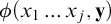 $\phi (x_1 \ldots x_j, \mathbf {y})$
gives a family of subsets of the j-tuples in a model, as we vary
$\phi (x_1 \ldots x_j, \mathbf {y})$
gives a family of subsets of the j-tuples in a model, as we vary $\mathbf {y}$
. NIP can be restated as asserting that for every
$\mathbf {y}$
. NIP can be restated as asserting that for every $\phi $
, the corresponding family has finite VC dimension [Reference Laskowski34].
$\phi $
, the corresponding family has finite VC dimension [Reference Laskowski34].
2.1.5 Sufficient conditions for $1$
-RQC
$1$
-RQC

In the setting of “unordered” structures, the main known example of $1$
-RQC comes from NFCP theories.
$1$
-RQC comes from NFCP theories.
Theorem 2.2 [Reference Flum and Ziegler18]
Every NFCP theory is $1$
-RQC.
$1$
-RQC.
Note that this includes the case of pure equality, which was known very early in database theory [Reference Hull and Jianwen29]. And this result implies that the field of complex numbers is $1$
-RQC.
$1$
-RQC.
On the side of “ordered structures,” a model-theoretic sufficient condition concerning $1$
-RQC involves o-minimal theories.
$1$
-RQC involves o-minimal theories.
Theorem 2.3 [Reference Benedikt and Libkin6]
Every o-minimal theory is $1$
-RQC.
$1$
-RQC.
[Reference Belegradek, Stolboushkin and Taitslin4] showed $1$
-RQC for an even broader class, what today are known as distal theories. We will not need the definition here, but it subsumes o-minimal theories, Presburger arithmetic, and the theory of the infinite tree, while being contained in NIP. Thus in particular the real closed field and Presburger arithmetic have 1-RQC.
$1$
-RQC for an even broader class, what today are known as distal theories. We will not need the definition here, but it subsumes o-minimal theories, Presburger arithmetic, and the theory of the infinite tree, while being contained in NIP. Thus in particular the real closed field and Presburger arithmetic have 1-RQC.
An easy observation is that NIP is necessary for $1$
-RQC.
$1$
-RQC.
Proposition 2.4 [Reference Benedikt5]
If T is $1$
-RQC, then T is NIP.
$1$
-RQC, then T is NIP.
We will strengthen this result in Theorem 6.2 below.
We mentioned previously that Example 2 is stable, and from this it follows that it is NIP. Since Example 2 is not $1$
-RQC, we see that NIP theories do not necessarily have
$1$
-RQC, we see that NIP theories do not necessarily have $1$
-RQC. However, in NIP theories T, we can eliminate unrestricted quantifiers for special kinds of sentences.
$1$
-RQC. However, in NIP theories T, we can eliminate unrestricted quantifiers for special kinds of sentences.
Definition 2.5 (Isomorphism-invariant
$L_V$
sentence)

For a given T, a first-order $L_V$
sentence
$L_V$
sentence $\phi $
is isomorphism-invariant, denoted
$\phi $
is isomorphism-invariant, denoted $\phi \in {\mathsf {IsoInv}}$
, if its truth value, for embedded finite models in any model of T, only depends on the isomorphism type of the V predicates.
$\phi \in {\mathsf {IsoInv}}$
, if its truth value, for embedded finite models in any model of T, only depends on the isomorphism type of the V predicates.
Result from [Reference Baldwin and Benedikt2] shows that in NIP theories, any isomorphism-invariant sentence is equivalent to a $1$
-RQ sentence. This follows from the following result.
$1$
-RQ sentence. This follows from the following result.
Theorem 2.6 [Reference Baldwin and Benedikt2]
In every NIP theory, there is a model containing an infinite set I such that for every $L_V$
sentence
$L_V$
sentence $\phi $
, there is a
$\phi $
, there is a $1$
-RQ formula
$1$
-RQ formula $\phi '$
such that
$\phi '$
such that $\phi $
and
$\phi $
and $\phi '$
are equivalent, over embedded finite structures in the model where the domain of the V structure lies within I.
$\phi '$
are equivalent, over embedded finite structures in the model where the domain of the V structure lies within I.
The result in [Reference Baldwin and Benedikt2] is stated a bit differently: we explain how to bridge the gap between them in Appendix A.
This result limits what can be expressed by a sentence in $L_V$
whose truth value depends only on the isomorphism type of the V structure. Isomorphism invariance allows us to assume that the embedded finite structure is based on a set of indiscernibles for the model, and on such a set we can replace all L formulas by a linear order representing the order on indiscernibles. From this we can see from Theorem 2.6 that in NIP structures isomorphism-invariant sentences are expressible in order-invariant first-order logic. Syntactically, this is first-order logic over a relational signature V augmented with an additional symbol
$L_V$
whose truth value depends only on the isomorphism type of the V structure. Isomorphism invariance allows us to assume that the embedded finite structure is based on a set of indiscernibles for the model, and on such a set we can replace all L formulas by a linear order representing the order on indiscernibles. From this we can see from Theorem 2.6 that in NIP structures isomorphism-invariant sentences are expressible in order-invariant first-order logic. Syntactically, this is first-order logic over a relational signature V augmented with an additional symbol $<$
, with the additional semantic requirement that the result of Q is the same whenever
$<$
, with the additional semantic requirement that the result of Q is the same whenever $<$
is interpreted by a linear order on the domain of the finite structure, regardless of how the elements are ordered. For more on the expressiveness of order-invariant FO on finite models, see [Reference Schweikardt40].
$<$
is interpreted by a linear order on the domain of the finite structure, regardless of how the elements are ordered. For more on the expressiveness of order-invariant FO on finite models, see [Reference Schweikardt40].
Thus Theorem 2.6 and known limitations of FO on finite structures imply the following corollary.
Corollary 2.7. In an NIP theory any isomorphism-invariant $L_V$
sentence is expressible in order-invariant FO over the V vocabulary. Hence no
$L_V$
sentence is expressible in order-invariant FO over the V vocabulary. Hence no $L_P$
sentence, for unary predicate P, can express a property of
$L_P$
sentence, for unary predicate P, can express a property of $|P|$
that holds on infinitely and co-infinitely many cardinalities. And no
$|P|$
that holds on infinitely and co-infinitely many cardinalities. And no $L \cup \{G\}$
sentence, for binary predicate G, can express that G is connected.
$L \cup \{G\}$
sentence, for binary predicate G, can express that G is connected.
2.1.6 Fraïssé limits
We will make use of a well-known model-theoretic construction known as the Fraïssé limit. We apply it to a class C of isomorphism types of finite structures in a finite relational signature that satisfy some closure properties: the joint embedding property and the hereditary property. Fraïssè’s theorem states that for any such class C there is a countably infinite model such that C is the class of (isomorphism types) of finite substructures of M, and which is homogeneous: in our setting, this means that every isomorphism between finite substructures of the model extends to an isomorphism of the whole model. Furthermore, if C satisfies another closure property—the amalgamation property—then there is a unique such structure. One canonical example is where C is just the class of graphs. In this case, the Fraïssé limit is the random graph, whose theory is axiomatized by the extension axioms stating that for every finite graph G and every supergraph H of G, any embedding of G in the model extends to an embedding of H. Another example is where C is the class of finite linear orders, where the Fraïssé limit is simply a countable dense linear order without endpoints. We will not need the precise definitions of the closure properties above, but see, e.g., [Reference Hodges25].
3 Higher-order collapse and high complexity evaluation
How can we obtain structures where evaluating a first-order logic formula over the model is more complicated than in $1$
-RQC structures, but not completely wild as in integer arithmetic?
$1$
-RQC structures, but not completely wild as in integer arithmetic?
We will consider a first natural weakening of RQC by loosening the notion of restricted-quantifier formula, allowing higher-order quantification over the active domain. We define higher-order sorts by starting with some base sort B and closing under tupling and power sets. The order of a sort is the maximum number of nested powersets: e.g., a sort $\mathcal {P}(\mathcal {P}(B) \times B)$
has order
$\mathcal {P}(\mathcal {P}(B) \times B)$
has order $2$
. The first component is a set of elements of base sort and the second is an element of base sort. Given a finite set
$2$
. The first component is a set of elements of base sort and the second is an element of base sort. Given a finite set $P_0$
, and a variable of sort
$P_0$
, and a variable of sort $\tau $
, the valid valuations of the variables are defined in terms of the hierarchy over
$\tau $
, the valid valuations of the variables are defined in terms of the hierarchy over $P_0$
: for a variable X of sort
$P_0$
: for a variable X of sort $\mathcal {P}(\mathcal {P}(B) \times B)$
, a valid valuation of X assigns to it sets of pairs, where the first component is a set of elements of
$\mathcal {P}(\mathcal {P}(B) \times B)$
, a valid valuation of X assigns to it sets of pairs, where the first component is a set of elements of $P_0$
sort and the second is an element of
$P_0$
sort and the second is an element of $P_0$
.
$P_0$
.
Given relational schema V disjoint from L, the higher-order restricted-quantifier formulas over $L \cup V$
are built up from L formulas, atomic V formulas, and atoms
$L \cup V$
are built up from L formulas, atomic V formulas, and atoms $X(u_1 \ldots u_m)$
, where X and each
$X(u_1 \ldots u_m)$
, where X and each $u_i$
are higher-order variables. The inductive definition is formed by closing under Boolean connectives and under the (implicitly) restricted quantifications
$u_i$
are higher-order variables. The inductive definition is formed by closing under Boolean connectives and under the (implicitly) restricted quantifications $\exists X$
and
$\exists X$
and $\forall X$
for X a higher-order variable. The semantics on embedded finite model
$\forall X$
for X a higher-order variable. The semantics on embedded finite model $(M,I)$
is in terms of valuations over
$(M,I)$
is in terms of valuations over ${\mathsf {Adom}}(I)$
. For x of sort B we write out
${\mathsf {Adom}}(I)$
. For x of sort B we write out $\exists x ~ \phi $
as
$\exists x ~ \phi $
as $\exists x \in {\mathsf {Adom}} ~ \phi $
, in order to make the bounding explicit in the syntax and to be consistent with our definition of
$\exists x \in {\mathsf {Adom}} ~ \phi $
, in order to make the bounding explicit in the syntax and to be consistent with our definition of $1$
-RQ formulas. Similarly for universal quantifiers restricted to the active domain. For X of sort
$1$
-RQ formulas. Similarly for universal quantifiers restricted to the active domain. For X of sort $\mathcal {P}(B)$
, we write
$\mathcal {P}(B)$
, we write $\exists X ~ \phi $
as
$\exists X ~ \phi $
as $\exists X \subseteq {\mathsf {Adom}} ~ \phi $
, again to make the bounding explicit. And similarly for universal quantification and at higher orders. In the case where
$\exists X \subseteq {\mathsf {Adom}} ~ \phi $
, again to make the bounding explicit. And similarly for universal quantification and at higher orders. In the case where $V=\{P\}$
, P a unary predicate, we can simplify the restricted existential second-order quantifier as
$V=\{P\}$
, P a unary predicate, we can simplify the restricted existential second-order quantifier as $\exists X \subseteq P ~ \phi $
. For a number k, a k-restricted-quantifier formula or just k-RQ formula is one where the variables are of order at most k.
$\exists X \subseteq P ~ \phi $
. For a number k, a k-restricted-quantifier formula or just k-RQ formula is one where the variables are of order at most k.
Example 3. Let $L=G(x,y)$
and
$L=G(x,y)$
and $V=\{P(x),Q(x)\}$
. If X is a variable of sort
$V=\{P(x),Q(x)\}$
. If X is a variable of sort $\mathcal {P}(B)$
then
$\mathcal {P}(B)$
then $\forall S \subseteq P ~ \exists x\in Q ~ \forall y \in P ~(G(x,y) \leftrightarrow S(x))$
is a
$\forall S \subseteq P ~ \exists x\in Q ~ \forall y \in P ~(G(x,y) \leftrightarrow S(x))$
is a $2$
-RQ formula. Informally, it says that using G and elements of Q, we can pick out any subset of P.
$2$
-RQ formula. Informally, it says that using G and elements of Q, we can pick out any subset of P.
We are now ready to give our first weakening of $1$
-RQC.
$1$
-RQC.
Definition 3.1. A theory is k-RQC if for every finite relational signature V, every $L_V$
sentence is equivalent to a k-RQ one.
$L_V$
sentence is equivalent to a k-RQ one.
We say T is $\omega $
-RQC if for every
$\omega $
-RQC if for every $L_P$
formula
$L_P$
formula $\tau $
there is a formula
$\tau $
there is a formula $\theta $
that is k-RQ for some k such that
$\theta $
that is k-RQ for some k such that $\theta $
is equivalent to
$\theta $
is equivalent to $\tau $
.
$\tau $
.
Higher-order RQC has not been explored in any depth. But there is one simple observation in the literature (see [Reference Libkin35]).
Proposition 3.2. The random graph is $2$
-RQC but not
$2$
-RQC but not $1$
-RQC.
$1$
-RQC.
It is easy to see that in considering k-RQC for any fixed k, or $\omega $
-RQC for a theory, we can restrict attention to any model of the theory. Although
$\omega $
-RQC for a theory, we can restrict attention to any model of the theory. Although $\omega $
-RQC has not been studied explicitly, it is easy to see that certain examples that are not
$\omega $
-RQC has not been studied explicitly, it is easy to see that certain examples that are not $1$
-RQC are also not
$1$
-RQC are also not $\omega $
-RQC.
$\omega $
-RQC.
Proposition 3.3. The theory of full integer arithmetic $(N, +, \cdot )$
is not
$(N, +, \cdot )$
is not $\omega $
-RQC.
$\omega $
-RQC.
A key motivation for k-RQC comes from complexity. In the context of logics over finite structures, there is a strong connection between definability in higher-order logics and complexity. For example, existential second-order definability in a language with only a relational signature—that is, no interpreted structure—corresponds to the complexity class ${\mathsf {NP}}$
. While full second-order logic, again in the setting with out interpreted structure, corresponds to
${\mathsf {NP}}$
. While full second-order logic, again in the setting with out interpreted structure, corresponds to ${\mathsf {PSPACE}}$
[Reference Immerman30]. In the context of finite models, higher-order definability has a correspondence with the exponential time hierarchy (see [Reference Hella and Turull-Torres22]). In the presence of interpreted structure, we can see that if
${\mathsf {PSPACE}}$
[Reference Immerman30]. In the context of finite models, higher-order definability has a correspondence with the exponential time hierarchy (see [Reference Hella and Turull-Torres22]). In the presence of interpreted structure, we can see that if $L_V$
formulas can express arbitrary k-RQC sentences, then the complexity of evaluation is (at least) non-elementary—just inheriting results from the case of finite structures. Such coarse lower bounds are independent of how the infinite structure is encoded: thus in this work, when we talk about lower bounds on evaluating sentences for a given theory, this will always refer isomorphism-invariant formulas.
$L_V$
formulas can express arbitrary k-RQC sentences, then the complexity of evaluation is (at least) non-elementary—just inheriting results from the case of finite structures. Such coarse lower bounds are independent of how the infinite structure is encoded: thus in this work, when we talk about lower bounds on evaluating sentences for a given theory, this will always refer isomorphism-invariant formulas.
We cannot claim that k-RQC implies elementary upper bounds on the complexity of evaluation for arbitrary sentences. Complexity upper bounds depend on how easy it is to evaluate quantifier-free sentences, which will depend on the specifics of the presentation of the model. But we can see the following proposition.
Proposition 3.4. If T has k-RQC, then any isomorphism-invariant sentence $\phi $
of
$\phi $
of $L_V$
the set of isomorphism types of finite V which satisfy
$L_V$
the set of isomorphism types of finite V which satisfy $\phi $
can be recognized by a Turing Machine running in k-iterated exponential time.
$\phi $
can be recognized by a Turing Machine running in k-iterated exponential time.
Proof. Let $I_\phi $
be the set of V isomorphism types of V structures that satisfy
$I_\phi $
be the set of V isomorphism types of V structures that satisfy $\phi $
in some (equivalently) all embedded finite structure. By k-RQC we can rewrite the sentence
$\phi $
in some (equivalently) all embedded finite structure. By k-RQC we can rewrite the sentence $\phi $
to k-RQ formula. There is a model of T with a set of order-indiscernibles I, and over I the k-RQ formula can be rewritten to a
$\phi $
to k-RQ formula. There is a model of T with a set of order-indiscernibles I, and over I the k-RQ formula can be rewritten to a $\phi '$
use only the ordering symbol. Let
$\phi '$
use only the ordering symbol. Let $\phi "$
be obtained by existentially quantifying over the linear order. Given an isomorphism type, presented on a tape with an arbitrary ordering,
$\phi "$
be obtained by existentially quantifying over the linear order. Given an isomorphism type, presented on a tape with an arbitrary ordering, $V_0 \in I_C$
if and only if
$V_0 \in I_C$
if and only if $\phi '$
holds of it as an ordered structure. This can be checked in time a tower in k.
$\phi '$
holds of it as an ordered structure. This can be checked in time a tower in k.
A partial converse will be given in Proposition 3.11.
3.1 Separating RQC levels and higher-order spectra
We will show that for any k there is a T that is $(k+2)$
-RQC but not k-RQC. We will also show that there are decidable theories that are not even
$(k+2)$
-RQC but not k-RQC. We will also show that there are decidable theories that are not even $\omega $
-RQC.
$\omega $
-RQC.
As mentioned above, there is a strong connection between definability in higher-order logics and complexity. For example, existential second-order definability in a language with only a relational signature—that is, no interpreted structure, corresponds to the complexity class ${\mathsf {NP}}$
, while full second-order logic corresponds to
${\mathsf {NP}}$
, while full second-order logic corresponds to ${\mathsf {PSPACE}}$
. Higher-order definability has a close connection to the exponential hierarchy [Reference Hella and Turull-Torres22].
${\mathsf {PSPACE}}$
. Higher-order definability has a close connection to the exponential hierarchy [Reference Hella and Turull-Torres22].
In the process of separating $(k+2)$
-RQC and k-RQC, we will obtain examples of decidable structures where the complexity of evaluating formulas can be arbitrarily high.
$(k+2)$
-RQC and k-RQC, we will obtain examples of decidable structures where the complexity of evaluating formulas can be arbitrarily high. $k^{th}$
-order logic is the logic built up using variables of order
$k^{th}$
-order logic is the logic built up using variables of order $1$
to k, with atomic formulas equality as well as
$1$
to k, with atomic formulas equality as well as $X(x)$
, where X has order
$X(x)$
, where X has order $j+1$
and x order j via Boolean connectives and quantifiers
$j+1$
and x order j via Boolean connectives and quantifiers $\exists S$
. We will consider “pure equality higher-order sentences”:
$\exists S$
. We will consider “pure equality higher-order sentences”: $k^{th}$
-order logic sentences with no relational constants, only quantified variables. We can interpret such sentences over a structure consisting only of a domain—a pure set. We call a set J of numbers a pure
$k^{th}$
-order logic sentences with no relational constants, only quantified variables. We can interpret such sentences over a structure consisting only of a domain—a pure set. We call a set J of numbers a pure $k^{th}$
-order spectrum if there is a sentence
$k^{th}$
-order spectrum if there is a sentence $\phi $
of the above form such that
$\phi $
of the above form such that $J= \{n ~ \mid \{1 , \ldots n\} \models \phi \}$
.
$J= \{n ~ \mid \{1 , \ldots n\} \models \phi \}$
.
The following is a variation of results in [Reference Hella and Turull-Torres22].
Proposition 3.5. For any k, there is a set $J_k$
of numbers that is a pure
$J_k$
of numbers that is a pure $k+2$
-order spectrum but not a pure k-order spectrum.
$k+2$
-order spectrum but not a pure k-order spectrum.
Note that for formulas with only equality, there is a one-to-one correspondence between models of the formula and integers, where the correspondence maps a model to its size. Thus it is enough to separate the expressiveness of $k+2$
-order logic from that of k-order logic, over a unary signature. This last follows from results in [Reference Kolodziejczyk32, Reference Mostowski, Rojszczak, Cachro and Kurczewski38], stating that a truth definition for a k-order logic sentence can always be expressed as
$k+2$
-order logic from that of k-order logic, over a unary signature. This last follows from results in [Reference Kolodziejczyk32, Reference Mostowski, Rojszczak, Cachro and Kurczewski38], stating that a truth definition for a k-order logic sentence can always be expressed as $k+2$
-order logic sentence. This holds for any fixed signature, hence also for the signature with only equality.
$k+2$
-order logic sentence. This holds for any fixed signature, hence also for the signature with only equality.
Note that [Reference Hella and Turull-Torres22, Reference Hull and Jianwen28] claim separation results for expressibility in higher-order logic, following from complexity characterizations of the definable sets in the logic: in [Reference Hella and Turull-Torres22] the characterization is via non-deterministic iterated exponential time with an oracle for a class in the polynomial hierarchy. Similar characterizations are provided in [Reference Kolodziejczyk32]. In [Reference Hella and Turull-Torres22], the argument that is sketched for separation does not apply to a signature with only equality. In [Reference Hull and Jianwen28] the argument for separation relies on unpublished results in a Ph.D. thesis [Reference Bennett7], so it is difficult to say the signatures to which it applies. But it seems likely that the separation result does not apply to the case of a trivial signature.
We now show how to generate theories $T_J$
from a set of numbers J, such that
$T_J$
from a set of numbers J, such that $T_J$
is k-RQC if and only if J is a pure k-order spectrum. Thus separation of RQC levels corresponds to separation of higher-order definability in finite model theory. As a consequence we will have the following theorem.
$T_J$
is k-RQC if and only if J is a pure k-order spectrum. Thus separation of RQC levels corresponds to separation of higher-order definability in finite model theory. As a consequence we will have the following theorem.
Theorem 3.6. For each k there are decidable complete theories $T_k$
that are
$T_k$
that are $(k+2)$
-RQC but not k-RQC.
$(k+2)$
-RQC but not k-RQC.
The recipe for obtaining $T_J$
from J can be used to reduce other separation statements (e.g., about the variation of k-RQC where only Monadic higher-order quantification is allowed) to separations in finite model theory. We use a construction due to Henson [Reference Henson23], first used to show that there are uncountably many homogeneous directed graphs. See [Reference Macpherson36] for more background on these constructions.
$T_J$
from J can be used to reduce other separation statements (e.g., about the variation of k-RQC where only Monadic higher-order quantification is allowed) to separations in finite model theory. We use a construction due to Henson [Reference Henson23], first used to show that there are uncountably many homogeneous directed graphs. See [Reference Macpherson36] for more background on these constructions.
A graph is decomposable if there is a non-trivial set S of vertices with the property that for each pair $x, y \in S$
and every other vertex v in the graph, there is an edge from x to v if and only there is an edge from y to v and similarly for edges from v to x. That is, elements of S behave the same way with respect to elements outside of S. A graph is indecomposable if it is not decomposable. What is achieved by the construction of Henson can be stated as follows.
$x, y \in S$
and every other vertex v in the graph, there is an edge from x to v if and only there is an edge from y to v and similarly for edges from v to x. That is, elements of S behave the same way with respect to elements outside of S. A graph is indecomposable if it is not decomposable. What is achieved by the construction of Henson can be stated as follows.
Theorem 3.7 [Reference Henson23]
For each natural number there is a finite indecomposable directed graph $B(n)$
such that for
$B(n)$
such that for $n \neq n'$
,
$n \neq n'$
, $B(n)$
does not embed as an induced substructure of
$B(n)$
does not embed as an induced substructure of $B(n')$
. Furthermore, there is a first-order interpretation
$B(n')$
. Furthermore, there is a first-order interpretation $\delta $
whose input language is just a binary language
$\delta $
whose input language is just a binary language $<$
, such that applying the interpretation to a linear order of size n gives
$<$
, such that applying the interpretation to a linear order of size n gives $B(n)$
.
$B(n)$
.
A first-order interpretation of dimension d [Reference Hodges25] is a function from structures to structures, specified by a formula $\phi _{{\mathsf {Dom}}}(x_1 \ldots x_d)$
in the input vocabulary describing the domain of the output, along with, for each k-ary relation symbol in the output vocabulary, a
$\phi _{{\mathsf {Dom}}}(x_1 \ldots x_d)$
in the input vocabulary describing the domain of the output, along with, for each k-ary relation symbol in the output vocabulary, a $(k \cdot d)$
-ary formula in the input vocabulary. An interpretation allows a formula also for equality—meaning that the domain of the output is actually a quotient of the k-tuples satisfying
$(k \cdot d)$
-ary formula in the input vocabulary. An interpretation allows a formula also for equality—meaning that the domain of the output is actually a quotient of the k-tuples satisfying $\phi _{{\mathsf {Dom}}}$
. But such a quotient is not needed in the interpretations of Theorem 3.7.
$\phi _{{\mathsf {Dom}}}$
. But such a quotient is not needed in the interpretations of Theorem 3.7.
Let a cone be a digraph of the form $\{d\} \times D$
or
$\{d\} \times D$
or $D \times \{d\}$
. One can verify that the construction of [Reference Henson23] has the property that no
$D \times \{d\}$
. One can verify that the construction of [Reference Henson23] has the property that no $B(n)$
is an induced substructure of a cone.
$B(n)$
is an induced substructure of a cone.
We consider a signature consisting of ternary relations R and Z. Given a structure M for such a relation and a in the domain of M we let $R_{a}$
be the binary relation such that
$R_{a}$
be the binary relation such that $R_{a}(b,c)$
holds exactly when
$R_{a}(b,c)$
holds exactly when $R(a, b,c)$
holds. Let
$R(a, b,c)$
holds. Let $Z_a$
be a binary relation defined analogously.
$Z_a$
be a binary relation defined analogously.
For a set of numbers J, let $K_J$
be the set of finite structures for
$K_J$
be the set of finite structures for $R,Z$
such that
$R,Z$
such that $R(x,y,z)$
implies
$R(x,y,z)$
implies $x,y, z$
are all distinct and
$x,y, z$
are all distinct and $B(n)$
for
$B(n)$
for $n \in J$
does not embed as an induced substructure of
$n \in J$
does not embed as an induced substructure of $R_a$
, for any a in the domain. This set of structures is easily seen to have the hereditary, amalgamation, and joint embedding properties. Thus there is a Fraïssé limit (see Section 2) which we denote as
$R_a$
, for any a in the domain. This set of structures is easily seen to have the hereditary, amalgamation, and joint embedding properties. Thus there is a Fraïssé limit (see Section 2) which we denote as $M_J$
. Let
$M_J$
. Let $T_J$
be the complete theory of
$T_J$
be the complete theory of $M_J$
. Since there was no restriction on Z, in
$M_J$
. Since there was no restriction on Z, in $M_J$
the relation Z will simply be a random ternary relation. Whenever J is a decidable set, the class of finite structures
$M_J$
the relation Z will simply be a random ternary relation. Whenever J is a decidable set, the class of finite structures $K_J$
is effective, and thus the theory
$K_J$
is effective, and thus the theory $T_J$
is computably axiomatizable via the usual “extension axioms,” stating that for every tuple
$T_J$
is computably axiomatizable via the usual “extension axioms,” stating that for every tuple $\mathbf {t}_1$
in the model and isomorphism
$\mathbf {t}_1$
in the model and isomorphism $h_1$
of a structure
$h_1$
of a structure $s_1$
in
$s_1$
in $K_J$
to the substructure of the model induced on
$K_J$
to the substructure of the model induced on $\mathbf {t}_1$
, for every structure
$\mathbf {t}_1$
, for every structure $s_2$
such that
$s_2$
such that $s_1$
is an induced substructure of
$s_1$
is an induced substructure of $s_2$
, there is a tuple
$s_2$
, there is a tuple $\mathbf {t}_2$
extending
$\mathbf {t}_2$
extending $\mathbf {t}_1$
and isomorphism of
$\mathbf {t}_1$
and isomorphism of $s_2$
to
$s_2$
to $\mathbf {t}_2$
. Since
$\mathbf {t}_2$
. Since $T_J$
is a complete theory with a computable axiomatization, it is decidable.
$T_J$
is a complete theory with a computable axiomatization, it is decidable.
The key property of $T_J$
is that for any finite linear order O over a domain
$T_J$
is that for any finite linear order O over a domain $D_O$
and any a in a model M of
$D_O$
and any a in a model M of $T_J$
,
$T_J$
, $\delta (O)$
can be embedded in
$\delta (O)$
can be embedded in $R_a$
if and only if
$R_a$
if and only if $|D_O| \not \in J$
.
$|D_O| \not \in J$
.
Proposition 3.8. For $k \geq 2$
, if
$k \geq 2$
, if $T_J$
is k-RQC then J is a pure k-order spectrum.
$T_J$
is k-RQC then J is a pure k-order spectrum.
Proof. Consider the sentence $\psi (P)$
in
$\psi (P)$
in $L_P$
stating that:
$L_P$
stating that:
For some a and some b, $Z_{b}$
induces a linear order
$Z_{b}$
induces a linear order $<_P$
on P, and
$<_P$
on P, and $\delta $
applied to
$\delta $
applied to $<_P$
is an induced substructure of
$<_P$
is an induced substructure of $R_a$
.
$R_a$
.
The properties of the structure guarantee that such a sentence is true if and only if $|P| \not \in J$
.
$|P| \not \in J$
.
Suppose $T_J$
is k-RQC. The sentence
$T_J$
is k-RQC. The sentence $\psi $
is cardinality-invariant. We first consider embedded finite subsets living within a totally indiscernible set I. Then there is a k-RQ sentence that defines
$\psi $
is cardinality-invariant. We first consider embedded finite subsets living within a totally indiscernible set I. Then there is a k-RQ sentence that defines $\psi $
, and indiscernibility allows the references to the ambient structure to be eliminated from
$\psi $
, and indiscernibility allows the references to the ambient structure to be eliminated from $\psi $
resulting in
$\psi $
resulting in $\psi '$
in pure
$\psi '$
in pure $k^{th}$
-order logic. The sentence
$k^{th}$
-order logic. The sentence $\psi $
is cardinality-invariant, thus
$\psi $
is cardinality-invariant, thus $\psi $
is equivalent to
$\psi $
is equivalent to $\psi '$
on arbitrary embedded finite structures. From this we see that J is the spectrum of a
$\psi '$
on arbitrary embedded finite structures. From this we see that J is the spectrum of a $k^{th}$
-order logic sentence. In general we know only that there is a model with an order-indiscernible set: we can proceed as above (since
$k^{th}$
-order logic sentence. In general we know only that there is a model with an order-indiscernible set: we can proceed as above (since $k \geq 2$
) but guess the ordering with second-order quantification.
$k \geq 2$
) but guess the ordering with second-order quantification.
Proposition 3.9. For $k \geq 2$
if J is a pure
$k \geq 2$
if J is a pure $k^{th}$
-order logic spectrum, then
$k^{th}$
-order logic spectrum, then $T_J$
is k-RQC.
$T_J$
is k-RQC.
Proof. Suppose J is the spectrum of $\tau $
.
$\tau $
.
For $G \subseteq P^2$
, we write
$G \subseteq P^2$
, we write $R_{x,1,P}=G$
to abbreviate the formula
$R_{x,1,P}=G$
to abbreviate the formula
 $$\begin{align*}\forall y,z \in P ~ R(x,y,z) \leftrightarrow G(y,z). \end{align*}$$
We let $R_{x,2,P}=G$
abbreviate
$R_{x,2,P}=G$
abbreviate
 $$\begin{align*}\forall y,z \in P ~ R(y,x,z) \leftrightarrow G(y,z) \end{align*}$$
and define $R_{x,3,P}=G$
,
$R_{x,3,P}=G$
, $Z_{x,i,P}=G$
for
$Z_{x,i,P}=G$
for $i=1,2,3$
analogously.
$i=1,2,3$
analogously.
Inductively, it suffices to show that a formula $\gamma (x, \mathbf {y})$
of the form:
$\gamma (x, \mathbf {y})$
of the form:
 $$\begin{align*}\exists x ~ \rho(x, \mathbf{y}) \end{align*}$$
with $\rho\ k$
-RQ, is equivalent to a k-RQ formula.
$\rho\ k$
-RQ, is equivalent to a k-RQ formula.
We can assume that x occurs in $\rho $
only in L atoms. Since
$\rho $
only in L atoms. Since $T_J$
enforces that
$T_J$
enforces that $R(x,y,z)$
implies
$R(x,y,z)$
implies $x,y,z$
distinct, we can also assume x occurs at most once in each R atom. We then rewrite
$x,y,z$
distinct, we can also assume x occurs at most once in each R atom. We then rewrite $\rho $
as
$\rho $
as
 $$ \begin{align*} \exists ~ G_1, G_2, G_3 Z_1, Z_2, Z_3 \subset P^2 ~ R_{x,1,P}=G_1 \wedge \\ R_{x,2,P}=G_2 \wedge R_{x,3,P}=G_3 \wedge \cdots \wedge \rho'. \end{align*} $$
Here $\ldots $
indicates additional equalities with
$\ldots $
indicates additional equalities with $Z_{x,i,P}$
. And
$Z_{x,i,P}$
. And $\rho '$
is obtained from
$\rho '$
is obtained from $\rho $
by replacing each R atom containing x with the appropriate
$\rho $
by replacing each R atom containing x with the appropriate $G_i$
atom and similarly for Z. It will suffice to simplify the formula
$G_i$
atom and similarly for Z. It will suffice to simplify the formula
 $$ \begin{align*} \exists x ~ R_{x,1,P}=G_1 \wedge R_{x,2,P}=G_2 \wedge R_{x,3,P}=G_3 \wedge \cdots, \end{align*} $$
where $G_1, G_2$
, and
$G_1, G_2$
, and $G_3$
are constrained to be in
$G_3$
are constrained to be in $P^2$
.
$P^2$
.
We claim that for $G_1, G_2, G_3 \subseteq P^2$
and P finite, there is x such that
$G_1, G_2, G_3 \subseteq P^2$
and P finite, there is x such that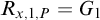 $R_{x,1,P}=G_1$
,
$R_{x,1,P}=G_1$
, $R_{x,2,P}=G_2$
, and
$R_{x,2,P}=G_2$
, and $R_{x,3,P}=G_3$
and the
$R_{x,3,P}=G_3$
and the $Z_{x,i,P}$
equalities hold exactly when no
$Z_{x,i,P}$
equalities hold exactly when no $B(n)$
for
$B(n)$
for $n \in J$
embeds as an induced substructure of
$n \in J$
embeds as an induced substructure of $G_1$
. This is easily verified: the fact that
$G_1$
. This is easily verified: the fact that $G_2$
and
$G_2$
and $G_3$
play no role uses the assumption that no
$G_3$
play no role uses the assumption that no $B(n)$
is contained in a cone. The equalities involving Z can always be achieved.
$B(n)$
is contained in a cone. The equalities involving Z can always be achieved.
Note that if $G_1$
contains some
$G_1$
contains some $B(n)$
then necessarily
$B(n)$
then necessarily $n \leq |P|$
, since
$n \leq |P|$
, since $G_1$
is contained in
$G_1$
is contained in $P^2$
. Thus the condition that
$P^2$
. Thus the condition that $G_1$
does not contain any
$G_1$
does not contain any $B(n)$
can be expressed as:
$B(n)$
can be expressed as:
for no subset $P'$
of P, for no linear order
$P'$
of P, for no linear order $<$
on
$<$
on $P'$
if
$P'$
if $P'$
satisfies
$P'$
satisfies $\tau $
, then
$\tau $
, then $\delta (<)$
does not embed as an induced substructure of
$\delta (<)$
does not embed as an induced substructure of $G_1$
.
$G_1$
.
Since $\tau $
is a k-RQ formula in P, this is a k-RQ formula on
$\tau $
is a k-RQ formula in P, this is a k-RQ formula on $G_1, P$
.
$G_1, P$
.
Thus we have reduced separating levels of RQC to the corresponding separations in finite model theory. By Proposition 3.5 we can choose J to be the spectrum of a $k+2$
sentence but not a k-order logic sentence, and thus get theories that are
$k+2$
sentence but not a k-order logic sentence, and thus get theories that are $k+2$
-RQC but not k-RQC. By adjusting the definability of the set of natural numbers J, we can also show the following corollary.
$k+2$
-RQC but not k-RQC. By adjusting the definability of the set of natural numbers J, we can also show the following corollary.
Corollary 3.10. There are decidable theories that are not $\omega $
-RQC.
$\omega $
-RQC.
Proof. Choose J that is decidable, but not a pure k spectrum for any k.
By varying the complexity of the set J (while retaining decidability) we can show that the complexity of evaluating formulas can be arbitrarily high.
Recall from Section 2 that there is a strong connection between various classical model-theoretic dividing lines and $1$
-RQC: for example,
$1$
-RQC: for example, $1$
-RQC implies NIP. The result above can be seen as a negative one about similar connections between higher-order collapse and classical model-theoretic dividing lines: Note that model-theoretically the different theories
$1$
-RQC implies NIP. The result above can be seen as a negative one about similar connections between higher-order collapse and classical model-theoretic dividing lines: Note that model-theoretically the different theories $T_J$
are quite similar. But they can be adjusted to get any level of RQC or none at all, depending on J.
$T_J$
are quite similar. But they can be adjusted to get any level of RQC or none at all, depending on J.
The construction does not give theories that are NIP. We can show that it is possible to separate $2$
-RQC from
$2$
-RQC from $1$
-RQC with an NIP theory (see Appendix H). But the problem of separating
$1$
-RQC with an NIP theory (see Appendix H). But the problem of separating $k+2$
from k with an NIP theory for
$k+2$
from k with an NIP theory for $k>0$
is open.
$k>0$
is open.
3.2 Isomorphism-invariant higher-order restricted-quantifier formulas and the complexity of theories
The previous family of examples was constructed so that there is a tight connection between the level of RQC (i.e., the k such that it is k-RQC) of general $L_V$
formulas and the descriptive complexity of the underlying set of integers J, which also controls the complexity of the theory. Is there a more general connection between higher-order RQC for a theory T and the complexity of decision procedures for T?
$L_V$
formulas and the descriptive complexity of the underlying set of integers J, which also controls the complexity of the theory. Is there a more general connection between higher-order RQC for a theory T and the complexity of decision procedures for T?
For an arbitrary theory there may be no connection between the complexity of the theory and the ability to convert $L_V$
sentences to RQ ones: this is the case, for example, in Example 2. But the following result shows that if we focus on isomorphism-invariant sentences, then collapse can follow from reasonably weak assumptions on the complexity of a decision procedure for the theory. We tailor the result for isomorphism-invariant
$L_V$
sentences to RQ ones: this is the case, for example, in Example 2. But the following result shows that if we focus on isomorphism-invariant sentences, then collapse can follow from reasonably weak assumptions on the complexity of a decision procedure for the theory. We tailor the result for isomorphism-invariant $\omega $
-RQC, but variations hold for k-RQC.
$\omega $
-RQC, but variations hold for k-RQC.
Proposition 3.11. Consider a complete theory T in a language L and let C be an infinite set of constant symbols disjoint from L. Assume that valid sentences of $L \cup C$
can be efficiently enumerated and also that for any number v, there is an elementary time algorithm that decides whether a first-order sentence
$L \cup C$
can be efficiently enumerated and also that for any number v, there is an elementary time algorithm that decides whether a first-order sentence $\phi $
in
$\phi $
in $L \cup C$
with at most v bound variables is consistent with T. Then every isomorphism-invariant sentence in
$L \cup C$
with at most v bound variables is consistent with T. Then every isomorphism-invariant sentence in $L_V$
is equivalent to a k-RQ one for some k.
$L_V$
is equivalent to a k-RQ one for some k.
Proof. Fix an $L_V$
sentence
$L_V$
sentence $\phi $
. For an interpretation I over constants in C, let
$\phi $
. For an interpretation I over constants in C, let $\phi (I)$
be the truth value of
$\phi (I)$
be the truth value of $\phi $
in any embedded finite model for T isomorphic to I. This is well-defined since
$\phi $
in any embedded finite model for T isomorphic to I. This is well-defined since $\phi $
is isomorphism-invariant. By assumption, there is a non-elementary algorithm that takes as input a standard string coding of I and returns
$\phi $
is isomorphism-invariant. By assumption, there is a non-elementary algorithm that takes as input a standard string coding of I and returns $\phi (I)$
. This algorithm can be encoded by a higher-order sentence over I: one simply encodes runs as higher-order objects (see [Reference Hull and Jianwen28, Theorem 4.4] and [Reference Hella and Turull-Torres22, Section 3]. Letting
$\phi (I)$
. This algorithm can be encoded by a higher-order sentence over I: one simply encodes runs as higher-order objects (see [Reference Hull and Jianwen28, Theorem 4.4] and [Reference Hella and Turull-Torres22, Section 3]. Letting $\phi "$
be such a sentence, we have
$\phi "$
be such a sentence, we have $\phi $
is equivalent to
$\phi $
is equivalent to $\phi "$
over embedded finite models for T.
$\phi "$
over embedded finite models for T.
However, note that the model-theoretic sufficient conditions given in Section 2 imply that even $1$
-RQC can hold for theories that are not even decidable.
$1$
-RQC can hold for theories that are not even decidable.
4 Complexity disconnects and weakening RQC by allowing expansion of the signature
In Section 3 we dealt with examples where there was some correlation between the expressiveness of formulas and complexity of evaluation. We provided examples which not only fail to have k-RQC, but examples where logical formulas are highly expressive, and thus complex to evaluate.
On the other hand, the failure of $1$
-RQC or k-RQC alone does not mean that evaluation of formulas is complex. It might be that a structure fails to have RQC (
$1$
-RQC or k-RQC alone does not mean that evaluation of formulas is complex. It might be that a structure fails to have RQC ( $1$
- or k-) not because it is too expressive, but because it is not expressive enough. Like quantifier-elimination, k-RQC is sensitive to the signature. It is easy to construct theories that are “badly behaved”—not even
$1$
- or k-) not because it is too expressive, but because it is not expressive enough. Like quantifier-elimination, k-RQC is sensitive to the signature. It is easy to construct theories that are “badly behaved”—not even $\omega $
-RQC—but which become
$\omega $
-RQC—but which become $1$
-RQC when the theory is expanded.
$1$
-RQC when the theory is expanded.
Before we give an example of this, we give a simple tool for verifying failure of $\omega $
-RQC.
$\omega $
-RQC.
Definition 4.1. We say that an $L_P$
formula
$L_P$
formula $\phi $
is “not finitely redeemable” (NFR) if:
$\phi $
is “not finitely redeemable” (NFR) if:
for each k, there are $P_k,P^{\prime }_k$
, and a function
$P_k,P^{\prime }_k$
, and a function $f_k$
taking
$f_k$
taking $P_k$
to
$P_k$
to $P^{\prime }_k$
such that:
$P^{\prime }_k$
such that:
-
•
$(M,P_k) \models \phi $
,
$(M,P^{\prime }_k) \models \neg \phi $
; -
•
$f_k$
preserves all L formulas with at most k variables.

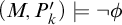

NFR formalizes the idea that there are embedded subsets distinguished by $\phi $
that are increasingly similar locally. It is easy to see the following proposition.
$\phi $
that are increasingly similar locally. It is easy to see the following proposition.
Proposition 4.2. An NFR formula cannot be converted to any higher-order restricted-quantifier formula. Thus if T has an NFR formula it does not have $\omega $
-RQC.
$\omega $
-RQC.
Proof. Fix any higher-order RQ sentence $\phi '$
. Let k be such that every L subformula of
$\phi '$
. Let k be such that every L subformula of $\phi '$
has at most k variables. Then
$\phi '$
has at most k variables. Then $\phi '$
would be preserved by
$\phi '$
would be preserved by $f_k$
above.
$f_k$
above.
We now turn to the example.
Example 4. Let us return to Example 2, an equivalence relation with classes of each finite size. We first argue that the $L_P$
formula
$L_P$
formula $\phi _{\subseteq }$
is not equivalent to any k-RQ formula. Fix the standard model of this theory, call it M.
$\phi _{\subseteq }$
is not equivalent to any k-RQ formula. Fix the standard model of this theory, call it M.
We proceed by showing that $\phi _{\subseteq }$
is NFR, hence not
$\phi _{\subseteq }$
is NFR, hence not $\omega $
-RQC. We choose
$\omega $
-RQC. We choose $P_k$
to be a set of k elements that exhausts an equivalence class of size k, and
$P_k$
to be a set of k elements that exhausts an equivalence class of size k, and $P^{\prime }_k$
to be a set of k elements inside an equivalence class of size larger than k. We can then choose
$P^{\prime }_k$
to be a set of k elements inside an equivalence class of size larger than k. We can then choose $f_k$
to be an arbitrary bijection between
$f_k$
to be an arbitrary bijection between $P_k$
and
$P_k$
and $P^{\prime }_k$
.
$P^{\prime }_k$
.
Let $T^+$
expand T to
$T^+$
expand T to $L^+=\{E, <(x,y)\}$
, stating that
$L^+=\{E, <(x,y)\}$
, stating that $<$
is a linear order for which each E equivalence class is an interval with endpoints. Then
$<$
is a linear order for which each E equivalence class is an interval with endpoints. Then $T^+$
can be shown to be
$T^+$
can be shown to be $1$
-RQC: in fact, the structure is o-minimal. For example, the sentence
$1$
-RQC: in fact, the structure is o-minimal. For example, the sentence $\phi _\subseteq $
now becomes equivalent to a restricted-quantifier one: intuitively, we say that P contains the interval between two equivalent elements a and b which form the endpoints of a class. The full argument is included in Appendix B.
$\phi _\subseteq $
now becomes equivalent to a restricted-quantifier one: intuitively, we say that P contains the interval between two equivalent elements a and b which form the endpoints of a class. The full argument is included in Appendix B.
The example shows another disconnect between the notion of collapse and the complexity of the theory. In the theory T above, we do not have any kind of collapse, but this is not because evaluation of formulas is too expressive, it is just because the signature was two restricted. Thus the disconnect can be fixed by adding to the signature. We thus investigate another weakening of $1$
-RQC, allowing expansion of the interpreted signature. We wish to see if adding this ability to expand gives us a closer correlation between the collapse notion and complexity.
$1$
-RQC, allowing expansion of the interpreted signature. We wish to see if adding this ability to expand gives us a closer correlation between the collapse notion and complexity.
Definition 4.3. Say that an $L_V$
sentence
$L_V$
sentence $\phi $
is potentially k-RQC (for T) if there is some expansion of T where
$\phi $
is potentially k-RQC (for T) if there is some expansion of T where $\phi $
is equivalent to a k-RQ sentence. We say that a theory is potentially k-RQC if there is an expansion of T that is k-RQC, and define potentially
$\phi $
is equivalent to a k-RQ sentence. We say that a theory is potentially k-RQC if there is an expansion of T that is k-RQC, and define potentially $\omega $
-RQC analogously. A theory that is not potentially
$\omega $
-RQC analogously. A theory that is not potentially $\omega $
-RQC is said to be persistently unrestricted.
$\omega $
-RQC is said to be persistently unrestricted.
Thus the persistently unrestricted theories are ones in which this weakening does not help us obtain RQC. Notice that the “potentially RQ” sentence $\phi _{\subseteq }$
in Example 2 is not isomorphism-invariant. This is not a coincidence.
$\phi _{\subseteq }$
in Example 2 is not isomorphism-invariant. This is not a coincidence.
Proposition 4.4. If theory T has an isomorphism-invariant $L_V$
sentence
$L_V$
sentence $\phi $
not equivalent to a k-RQ sentence, then the same is true in any consistent expansion of T.
$\phi $
not equivalent to a k-RQ sentence, then the same is true in any consistent expansion of T.
The argument is given in Appendix D.
The proposition tells us that weakening RQC in this manner cannot allow us to use unrestricted quantification to do any new “pure relational computation.” In particular, really badly-behaved theories like full arithmetic cannot become k-RQC via augmenting the signature.
An open question is: Is every NIP theory potentially $\omega $
-RQC? One cannot use isomorphism-invariant sentences to get a counterexample, since by Theorem 2.6 from [Reference Baldwin and Benedikt2], isomorphism-invariant formulas in NIP theories are always equivalent to
$\omega $
-RQC? One cannot use isomorphism-invariant sentences to get a counterexample, since by Theorem 2.6 from [Reference Baldwin and Benedikt2], isomorphism-invariant formulas in NIP theories are always equivalent to $1$
-RQ ones that use an additional order, and thus in particular are equivalent to
$1$
-RQ ones that use an additional order, and thus in particular are equivalent to $2$
-RQ ones.
$2$
-RQ ones.
Although we do not have an NIP theory that is persistently unrestricted, the main result of this section is that there are persistently unrestricted theories that are reasonably well-behaved. We show that even when isomorphism-invariant formulas are well-behaved, and the complexity of deciding the theory is elementary (see [Reference Kozen33]), the theory may be persistently unrestricted. Thus even with this weakening, failure of the (weakened) collapse does not imply high complexity of evaluation.
Theorem 4.5. In the theory of Atomless Boolean Algebras, each $L_V$
formula that is isomorphism-invariant is equivalent to a
$L_V$
formula that is isomorphism-invariant is equivalent to a $2$
-RQ formula. In addition, isomorphism-invariant
$2$
-RQ formula. In addition, isomorphism-invariant $L_P$
sentences are equivalent to
$L_P$
sentences are equivalent to $1$
-RQ ones.
$1$
-RQ ones.
But the theory is persistently unrestricted.
We will sketch an argument that there is an infinite set A such that, for embedded finite structures with active domain of the V relations in A, every $L_V$
sentence is equivalent to a Monadic second-order logic RQ formula. In fact, we will describe such a set where the elements are totally indiscernible: the L formulas
$L_V$
sentence is equivalent to a Monadic second-order logic RQ formula. In fact, we will describe such a set where the elements are totally indiscernible: the L formulas $\phi (\mathbf {a})$
satisfied by tuples
$\phi (\mathbf {a})$
satisfied by tuples $\mathbf {a}$
of distinct elements are independent of the choice of
$\mathbf {a}$
of distinct elements are independent of the choice of $\mathbf {a}$
. Hence for P unary, isomorphism-invariant
$\mathbf {a}$
. Hence for P unary, isomorphism-invariant $L_P$
sentences are equivalent to first-order sentences quantifying over P.
$L_P$
sentences are equivalent to first-order sentences quantifying over P.
We first consider a different way of restricting the embedded finite structures, not looking at a set A of elements which must contain the domains.
Definition 4.6. Let $\mathcal C$
be the class of embedded finite models where the active domain is a subalgebra of the underlying substructure.
$\mathcal C$
be the class of embedded finite models where the active domain is a subalgebra of the underlying substructure.
We observe the following claim.
Claim 1. Every $L_V$
formula
$L_V$
formula $\phi $
is equivalent, for embedded finite models in
$\phi $
is equivalent, for embedded finite models in $\mathcal C$
, to a
$\mathcal C$
, to a $1$
-RQ formula.
$1$
-RQ formula.
Proof. We give a simple argument for $L_P$
with P unary. An alternative inductive transformation proving that the claim in general is given in Appendix C. Consider a finite subalgebra
$L_P$
with P unary. An alternative inductive transformation proving that the claim in general is given in Appendix C. Consider a finite subalgebra $P_0$
. Note that the full Boolean algebra factors as
$P_0$
. Note that the full Boolean algebra factors as $P_0 \times B$
, where B is just a copy of the full algebra. Thus by the Fefferman–Vaught theorem for products [Reference Hodges25], a first-order sentence over P can be decomposed into a Boolean combination of sentences over
$P_0 \times B$
, where B is just a copy of the full algebra. Thus by the Fefferman–Vaught theorem for products [Reference Hodges25], a first-order sentence over P can be decomposed into a Boolean combination of sentences over $P_0$
and over B, uniformly in
$P_0$
and over B, uniformly in $P_0$
. The sentences over
$P_0$
. The sentences over $P_0$
are just
$P_0$
are just $1$
-RQ sentences, while the sentences over B are independent of
$1$
-RQ sentences, while the sentences over B are independent of $P_0$
, hence they can be replaced with true or false.
$P_0$
, hence they can be replaced with true or false.
Now take A to be an infinite antichain in a model. We argue that A has the required property. The antichain is definable within the subalgebra that it generates by a $1$
-RQ formula: it is just the atoms of that algebra. We transform
$1$
-RQ formula: it is just the atoms of that algebra. We transform $\phi $
to
$\phi $
to $\phi '$
as follows. We add to the V signature a unary predicate P, and add a conjunct
$\phi '$
as follows. We add to the V signature a unary predicate P, and add a conjunct $\phi _{{\mathsf {sub}}}$
saying that the domain of P is a subalgebra, and that its atoms are exactly the active domain of V. We replace references to a V relation symbol U in
$\phi _{{\mathsf {sub}}}$
saying that the domain of P is a subalgebra, and that its atoms are exactly the active domain of V. We replace references to a V relation symbol U in $\phi $
with references to the restriction of U to elements that are atoms of the domain of P. For example, if
$\phi $
with references to the restriction of U to elements that are atoms of the domain of P. For example, if $\phi = \exists x y ~ \neg U(x,y)$
, then
$\phi = \exists x y ~ \neg U(x,y)$
, then $\phi '$
would be
$\phi '$
would be $\phi _{{\mathsf {sub}}} \wedge \exists x y ~ \neg ( x \text { and } y \text { are atoms of the domain of } P \text { such that } U(x,y))$
. It is easy to verify that
$\phi _{{\mathsf {sub}}} \wedge \exists x y ~ \neg ( x \text { and } y \text { are atoms of the domain of } P \text { such that } U(x,y))$
. It is easy to verify that $\phi '$
holds on an interpretation of relational vocabulary
$\phi '$
holds on an interpretation of relational vocabulary $V \cup \{P\}$
, where P is the subalgebra generated by the active domain of the structure, exactly when
$V \cup \{P\}$
, where P is the subalgebra generated by the active domain of the structure, exactly when $\phi $
is true on the original interpretations. By Claim 1,
$\phi $
is true on the original interpretations. By Claim 1, $\phi '$
can be converted to a
$\phi '$
can be converted to a $1$
-RQ formula
$1$
-RQ formula $\phi "$
over
$\phi "$
over $\mathcal C$
. Then quantifications in
$\mathcal C$
. Then quantifications in $\phi "$
, where quantifications range over the subalgebra generated by the active domain, can be replaced by references to subsets of the atoms, giving a Monadic second-order restricted-quantifier formula.
$\phi "$
, where quantifications range over the subalgebra generated by the active domain, can be replaced by references to subsets of the atoms, giving a Monadic second-order restricted-quantifier formula.
Summarizing, we have shown each claim in Theorem 4.5 except the last one. We now sketch the argument that the theory is persistently unrestricted.
We start by considering one particular extension ${\mathsf {ALessBA}}^<$
, which we describe as the complete theory of a particular model. Consider the class of finite Boolean algebras, where we have an ordering on the generators and induce from this the lexicographic ordering on the corresponding algebra elements. This class of models has a Fraïsse limit [Reference Kechris, Pestov and Todorcevic31], which is the model we want. In this model we have a distinguished partition of
${\mathsf {ALessBA}}^<$
, which we describe as the complete theory of a particular model. Consider the class of finite Boolean algebras, where we have an ordering on the generators and induce from this the lexicographic ordering on the corresponding algebra elements. This class of models has a Fraïsse limit [Reference Kechris, Pestov and Todorcevic31], which is the model we want. In this model we have a distinguished partition of $1$
into countably many elements ordered by a discrete linear order
$1$
into countably many elements ordered by a discrete linear order $<$
.
$<$
.
We next consider the $L_P$
formula
$L_P$
formula $\phi _{\bigcup }$
stating that P has an element
$\phi _{\bigcup }$
stating that P has an element $x_P$
that is the union of all other elements of P. We claim that
$x_P$
that is the union of all other elements of P. We claim that $\phi _{\bigcup }$
is NFR within
$\phi _{\bigcup }$
is NFR within ${\mathsf {ALessBA}}^<$
. Let us recall the definition of an
${\mathsf {ALessBA}}^<$
. Let us recall the definition of an $L_V$
formula being NFR(see Definition 4.1). This means that there is a family of pairs of embedded finite subsets
$L_V$
formula being NFR(see Definition 4.1). This means that there is a family of pairs of embedded finite subsets $P_n$
and
$P_n$
and $P^{\prime }_n$
, along with a mapping
$P^{\prime }_n$
, along with a mapping $f_n$
from
$f_n$
from $P_n$
to
$P_n$
to $P^{\prime }_n$
such that
$P^{\prime }_n$
such that $f_n$
preserves all L formulas with at most n free variables, but each
$f_n$
preserves all L formulas with at most n free variables, but each $(M,P_n)$
disagrees with
$(M,P_n)$
disagrees with $(M,P^{\prime }_n)$
on
$(M,P^{\prime }_n)$
on $\phi $
. Here “all L formulas” can be replaced by “all atomic L formulas,” using quantifier elimination in
$\phi $
. Here “all L formulas” can be replaced by “all atomic L formulas,” using quantifier elimination in ${\mathsf {ALessBA}}$
. It is easy to see that
${\mathsf {ALessBA}}$
. It is easy to see that ${\mathsf {ALessBA}}^<$
admits such a family. We let
${\mathsf {ALessBA}}^<$
admits such a family. We let $P_n$
be a set of n disjoint Boolean algebra elements in the linear ordered set, along with an additional element representing their union. While
$P_n$
be a set of n disjoint Boolean algebra elements in the linear ordered set, along with an additional element representing their union. While $P^{\prime }_n$
consists of all but the
$P^{\prime }_n$
consists of all but the $<$
-last of the n elements, along with the union of all the n elements. We note that NFR witnesses the failure of
$<$
-last of the n elements, along with the union of all the n elements. We note that NFR witnesses the failure of $\omega $
-RQC, as mentioned in Proposition 4.2.
$\omega $
-RQC, as mentioned in Proposition 4.2.
We next make use of a result from [Reference Hrushovski27]. For a tuple $\mathbf {x}_0$
in an
$\mathbf {x}_0$
in an $L'$
structure
$L'$
structure $M'$
and
$M'$
and $L'$
a subset of L, the L-type of
$L'$
a subset of L, the L-type of $\mathbf {x}_0$
is the set of formulas
$\mathbf {x}_0$
is the set of formulas $\phi (\mathbf {x})$
with vocabulary in L that are satisfied by
$\phi (\mathbf {x})$
with vocabulary in L that are satisfied by $\mathbf {x}_0$
. A theory T is everywhere Ramsey theory if for every model M of T, for every expansion
$\mathbf {x}_0$
. A theory T is everywhere Ramsey theory if for every model M of T, for every expansion $M_e$
of M, there is an elementary extension
$M_e$
of M, there is an elementary extension $M^*_e$
of
$M^*_e$
of $M_e$
and a copy
$M_e$
and a copy $M'$
of M such that for every k, the
$M'$
of M such that for every k, the $L(M)$
-type of a k-tuple in
$L(M)$
-type of a k-tuple in $M'$
determines its type in
$M'$
determines its type in $M^*_e$
. The result we use is Example 5.7, part 7, from [Reference Hrushovski27].
$M^*_e$
. The result we use is Example 5.7, part 7, from [Reference Hrushovski27].
Proposition 4.7. ${\mathsf {ALessBA}}^<$
is an everywhere Ramsey theory.
${\mathsf {ALessBA}}^<$
is an everywhere Ramsey theory.
Further discussion on Ramsey properties of ${\mathsf {ALessBA}}^<$
, and the corresponding class of finite lex-ordered subalgebras, can be found in Section D, starting page 34 in [Reference Kechris, Pestov and Todorcevic31].
${\mathsf {ALessBA}}^<$
, and the corresponding class of finite lex-ordered subalgebras, can be found in Section D, starting page 34 in [Reference Kechris, Pestov and Todorcevic31].
Now consider an arbitrary expansion $M^*$
of a model of
$M^*$
of a model of ${\mathsf {ALessBA}}$
. We can further expand
${\mathsf {ALessBA}}$
. We can further expand $M^*$
to a model of
$M^*$
to a model of ${\mathsf {ALessBA}}^<$
by choosing the ordering appropriately. Let
${\mathsf {ALessBA}}^<$
by choosing the ordering appropriately. Let $M, P_n, P^{\prime }_n$
, and
$M, P_n, P^{\prime }_n$
, and $f_n$
be the witness finite models for
$f_n$
be the witness finite models for ${\mathsf {ALessBA}}^<$
above. Since
${\mathsf {ALessBA}}^<$
above. Since ${\mathsf {ALessBA}}^<$
is everywhere Ramsey, we find a copy of M inside an elementary extension of
${\mathsf {ALessBA}}^<$
is everywhere Ramsey, we find a copy of M inside an elementary extension of $M^*$
. The copies of
$M^*$
. The copies of $P_n, P^{\prime }_n$
, and
$P_n, P^{\prime }_n$
, and $f_n$
will witness that
$f_n$
will witness that $M^*$
is also not
$M^*$
is also not $\omega $
-RQC.
$\omega $
-RQC.
5 Failure of weaker forms of collapse for finite fields and connections to complexity of decision procedures
Section 3.1 provided us with examples of theories that have different levels of higher-order collapse, and also varying complexity of evaluation. It is natural to ask about decidable theories arising naturally, both in terms of collapse and complexity. In Section 4 we saw examples of decidable structures that behave badly with respect to collapse—not even $\omega $
RQC—but this did not reflect something fundamental about complexity. This was true in the case of Example 4, since collapse could be fixed by expansion.
$\omega $
RQC—but this did not reflect something fundamental about complexity. This was true in the case of Example 4, since collapse could be fixed by expansion.
What about other well-studied decidable theories. In previous work it was noted that many decidable examples (e.g., real-closed fields) satisfy broad model-theoretic properties like o-minimality, known to imply $1$
-RQC. We have seen that random graph is
$1$
-RQC. We have seen that random graph is $2$
-RQC. Another well-known source of decidable theory is the theory of finite fields: the set of sentences that hold in all finite structures. This was shown decidable by Ax [Reference Ax1]. This is an incomplete theory, but there are decidable completions, the theories of pseudo-finite fields: infinite fields that satisfy all the sentences holding in every finite field. There are several alternative definitions. For example, they are the ultraproducts of finite fields [Reference Ax1, Reference Fried and Jarden20]: a pseudo-finite field of characteristic p is an ultraproduct of finite fields of characteristic p, while a pseudo-field of characteristic
$2$
-RQC. Another well-known source of decidable theory is the theory of finite fields: the set of sentences that hold in all finite structures. This was shown decidable by Ax [Reference Ax1]. This is an incomplete theory, but there are decidable completions, the theories of pseudo-finite fields: infinite fields that satisfy all the sentences holding in every finite field. There are several alternative definitions. For example, they are the ultraproducts of finite fields [Reference Ax1, Reference Fried and Jarden20]: a pseudo-finite field of characteristic p is an ultraproduct of finite fields of characteristic p, while a pseudo-field of characteristic $0$
is an ultraproduct of finite fields with unbounded characteristic. Pseudo-finiteness can be axiomatized, giving another decidable incomplete theory [Reference Ax1]: the assertions we make below will apply to all pseudo-finite fields—equivalently, all completions of the axiomatization.
$0$
is an ultraproduct of finite fields with unbounded characteristic. Pseudo-finiteness can be axiomatized, giving another decidable incomplete theory [Reference Ax1]: the assertions we make below will apply to all pseudo-finite fields—equivalently, all completions of the axiomatization.
Some of our results will focus on positive characteristic. We let $F_p$
be the theory of finite fields in characteristic p, and
$F_p$
be the theory of finite fields in characteristic p, and $PF_p$
be the theory of pseudo-finite fields in characteristic p. We begin by showing that these are not k-RQC for any k, even for isomorphism-invariant formulas. This result shows that natural decidable theories can fail to have even weak forms of RQC. It is arguably surprising given that pseudo-finite fields have some commonalities with the
$PF_p$
be the theory of pseudo-finite fields in characteristic p. We begin by showing that these are not k-RQC for any k, even for isomorphism-invariant formulas. This result shows that natural decidable theories can fail to have even weak forms of RQC. It is arguably surprising given that pseudo-finite fields have some commonalities with the $2$
-RQC random graph. They are both canonical examples of “simple but unstable” (hence not NIP) theories [Reference Wagner43].
$2$
-RQC random graph. They are both canonical examples of “simple but unstable” (hence not NIP) theories [Reference Wagner43].
In fact, we will show that in pseudo-finite fields, and in sufficiently large finite fields, we can interpret the $n^{th}$
iterated powerset over P, for all n, uniformly in the field. From there it is easy to show, since we can code k-order logic for any k, that such fields cannot be k-RQC for any k. We will use this result to derive new lower bounds on decision procedures for pseudo-finite fields and for finite fields.
$n^{th}$
iterated powerset over P, for all n, uniformly in the field. From there it is easy to show, since we can code k-order logic for any k, that such fields cannot be k-RQC for any k. We will use this result to derive new lower bounds on decision procedures for pseudo-finite fields and for finite fields.
By a $k^{th}$
-order finite set theory structure over a predicate P, we mean a structure with language
$k^{th}$
-order finite set theory structure over a predicate P, we mean a structure with language $(P_1,\ldots ,P_k,E_1,\ldots ,E_k)$
, with
$(P_1,\ldots ,P_k,E_1,\ldots ,E_k)$
, with $P_1=P$
,
$P_1=P$
, $P_i$
a unary predicate,
$P_i$
a unary predicate, $E_i \subset P_i \times P_{i+1}$
a binary predicate for a membership relation, such that
$E_i \subset P_i \times P_{i+1}$
a binary predicate for a membership relation, such that $E_i$
satisfies extensionality and
$E_i$
satisfies extensionality and $P_{i+1}$
can be viewed as a set of subsets of
$P_{i+1}$
can be viewed as a set of subsets of $P_i$
closed under flipping membership of one element, i.e., such that
$P_i$
closed under flipping membership of one element, i.e., such that
 $$ \begin{align*} \forall x \in P_i ~ \forall y \in P_{i+1} ~ \exists y' \in P_{i+1}\\ (x E_i y' \leftrightarrow \neg x E_i y) \wedge [\forall z \in P_i ~ z \neq x \rightarrow (z E_i y' \leftrightarrow x E_i y) ]. \end{align*} $$
In case the interpretation of P is finite, this implies that $(P_i,P_{i+1},E_i)$
is isomorphic to the membership relation on
$(P_i,P_{i+1},E_i)$
is isomorphic to the membership relation on $P_i$
and the set of subsets of
$P_i$
and the set of subsets of $P_i$
. Interpreting such a structure is equivalent to interpreting the
$P_i$
. Interpreting such a structure is equivalent to interpreting the $k^{th}$
iterated powerset of P.
$k^{th}$
iterated powerset of P.
Theorem 5.1. For any k, there exist $L_P$
formulas
$L_P$
formulas
 $$\begin{align*}\phi_{P_1},\ldots,\phi_{P_k}, \phi_{E_1},\ldots,\phi_{E_k} \end{align*}$$
with the following properties:
-
• each
$\phi _{P_i}$
has one distinguished free variable, and each
$\phi _{E_i}$
has two distinguished free variables. Each formula may optionally have additional “parameter variables”; -
• for any
$M \models PF_p$
, and any interpretation of P as a finite subset of M, for some elements
$(c_1,\ldots ,c_j)$
of M for the parameter variables the
$\phi _{P_i},\phi _{E_i}$
define the full
$k^{th}$
-order set theory structure over P.


Further, there is an $L_P$
formula
$L_P$
formula $\phi _{\textbf {good}}$
such that the parameters can be taken to satisfy
$\phi _{\textbf {good}}$
such that the parameters can be taken to satisfy $\phi _{\textbf {good}}$
, and every parameters satisfying
$\phi _{\textbf {good}}$
, and every parameters satisfying $\phi _{\textbf {good}}$
have the properties above.
$\phi _{\textbf {good}}$
have the properties above.
Proof. Consider the additive group A as an ${\mathbb {F}}_p$
-vector space. We make use of the fact that there is a definable non-degenerate bilinear form
${\mathbb {F}}_p$
-vector space. We make use of the fact that there is a definable non-degenerate bilinear form ${b}$
into
${b}$
into ${\mathbb {F}}_p$
. For example, one can use the trace product (see Lemma 3.9 of [Reference Macpherson and Steinhorn37]). Now consider
${\mathbb {F}}_p$
. For example, one can use the trace product (see Lemma 3.9 of [Reference Macpherson and Steinhorn37]). Now consider $X_0$
a finite subset of A, of size
$X_0$
a finite subset of A, of size $n_0$
. Define
$n_0$
. Define $X_i,Y_i \subset A$
inductively. We will use as parameters elements
$X_i,Y_i \subset A$
inductively. We will use as parameters elements $t_1,t_2,\ldots $
, taken to be algebraically independent over the field generated by
$t_1,t_2,\ldots $
, taken to be algebraically independent over the field generated by $X_0$
. We will always have
$X_0$
. We will always have $Y_i$
be the subspace generated by
$Y_i$
be the subspace generated by $X_i$
:
$X_i$
:
 $$\begin{align*}y \in Y_i \iff (\forall x)[(\forall u \in X_i ~ {b}(x,u) = 0) \to {b}(x,y)=0]. \end{align*}$$
Inductively we set
 $$\begin{align*}X_{i+1} = \left\{ \frac{1}{t_i-y}: y \in Y_i \right\}. \end{align*}$$
Then $X_{i+1}$
is linearly independent, and we can generate
$X_{i+1}$
is linearly independent, and we can generate $Y_{i+1}$
as above. Note that for a non-degenerate bilinear form, the linear span of a finite set P is just the orthogonal complement of the orthogonal complement: the set of elements x such that
$Y_{i+1}$
as above. Note that for a non-degenerate bilinear form, the linear span of a finite set P is just the orthogonal complement of the orthogonal complement: the set of elements x such that ${b}(x,a)=0$
whenever
${b}(x,a)=0$
whenever ${b}(a,p)=0$
for each
${b}(a,p)=0$
for each $p \in P$
. Thus there is an
$p \in P$
. Thus there is an $L_P$
open formula that defines the linear span of a finite set P. Given a finite subset J of
$L_P$
open formula that defines the linear span of a finite set P. Given a finite subset J of $X_{i+1}$
with its sum
$X_{i+1}$
with its sum $e_J$
, we can recover J from
$e_J$
, we can recover J from $e_J$
as the set of
$e_J$
as the set of $j \in J$
such that
$j \in J$
such that $e_J$
is not in the span of
$e_J$
is not in the span of $J-\{j\}$
: this definition is correct because J was linearly independent. Composing with the inverse of the map
$J-\{j\}$
: this definition is correct because J was linearly independent. Composing with the inverse of the map $ \frac {1}{t_i-y}$
, we can see that
$ \frac {1}{t_i-y}$
, we can see that $X_{i+1}$
codes subsets of
$X_{i+1}$
codes subsets of $X_i$
. Thus
$X_i$
. Thus $i^{th}$
-order monadic logic over
$i^{th}$
-order monadic logic over $X_0$
is interpretable in
$X_0$
is interpretable in $X_i$
, and by considering
$X_i$
, and by considering $k'$
sufficiently higher than k we can interpret full
$k'$
sufficiently higher than k we can interpret full $k^{th}$
-order logic.
$k^{th}$
-order logic.
We now discuss how to capture the parameters by a formula $\phi _{\textbf {good}}$
as required in the last part of the theorem. Let
$\phi _{\textbf {good}}$
as required in the last part of the theorem. Let $T_i(P)$
be the theory of
$T_i(P)$
be the theory of $i^{th}$
-order set theory over a predicate P interpreted by a finite set.
$i^{th}$
-order set theory over a predicate P interpreted by a finite set. $T_i(P)$
is finitely axiomatizable. For example, for
$T_i(P)$
is finitely axiomatizable. For example, for $i=1$
we have a predicate
$i=1$
we have a predicate $\epsilon (x,y)$
and we need to say that there is y with no elements, and for each y and each
$\epsilon (x,y)$
and we need to say that there is y with no elements, and for each y and each $p \in P$
there is a
$p \in P$
there is a $y'$
such that
$y'$
such that $y'$
agrees with y on
$y'$
agrees with y on $P \setminus \{p\}$
and disagrees with y on p. Let
$P \setminus \{p\}$
and disagrees with y on p. Let $good_i(\mathbf {t})$
be an
$good_i(\mathbf {t})$
be an $L_P$
formula expressing that the formulas
$L_P$
formula expressing that the formulas $\phi _1(\mathbf {t}) \ldots $
with parameters
$\phi _1(\mathbf {t}) \ldots $
with parameters $\mathbf {t}$
defined above (for i) give an interpretation satisfying
$\mathbf {t}$
defined above (for i) give an interpretation satisfying $T_i(P)$
. Since
$T_i(P)$
. Since $T_i(P)$
is finitely axiomatizable, this is a first-order sentence in
$T_i(P)$
is finitely axiomatizable, this is a first-order sentence in $L_P$
. The result above shows that the theory of pseudo-finite fields entails
$L_P$
. The result above shows that the theory of pseudo-finite fields entails $\exists \mathbf {t} ~ good_i(\mathbf {t})$
, for each i.
$\exists \mathbf {t} ~ good_i(\mathbf {t})$
, for each i.
Note that above we talked about an interpretation with equality interpreted in the standard way, but where the formulas in the interpretation can include parameters. The standard notion of interpretation [Reference Hodges25] allows the output model to be defined as a quotient by a definable equivalence relation. That is, the interpretation can interpret equality. We can remove the notion of “good parameter” by introducing such an equivalence relation, thus talking about an interpretation without parameters. In either case, the consequence is the following corollary.
Corollary 5.2. Any k-RQC sentence $\gamma $
over P can be expressed using an
$\gamma $
over P can be expressed using an $L_P$
sentence: by existentially quantifying over
$L_P$
sentence: by existentially quantifying over $\mathbf {t}$
satisfying
$\mathbf {t}$
satisfying $good_k$
and checking
$good_k$
and checking $\gamma $
in the resulting interpretation.
$\gamma $
in the resulting interpretation.
Corollary 5.3. For every number k, any completion of the theory of pseudo-finite fields in positive characteristic cannot be k-RQC (even for isomorphic-invariant sentences).
Proof. By Proposition 3.5 for each k there is a set of integers that is the spectrum of a $k+2$
-order logic sentence
$k+2$
-order logic sentence $\phi _k$
over the empty vocabulary, which is not the spectrum of a k-order logic sentence over the empty vocabulary. By the result above,
$\phi _k$
over the empty vocabulary, which is not the spectrum of a k-order logic sentence over the empty vocabulary. By the result above, $\phi _k$
can be described in
$\phi _k$
can be described in $L_P$
. But clearly
$L_P$
. But clearly $\phi _k$
cannot be described by a k-RQ sentence of
$\phi _k$
cannot be described by a k-RQ sentence of $L_P$
, since over an indiscernible set the L atoms could be eliminated.
$L_P$
, since over an indiscernible set the L atoms could be eliminated.
5.1 Embedded finite model theory and lower bounds
Recall that Proposition 3.11 indicated that if $\omega $
-RQC fails for an isomorphism-invariant sentence, then the complexity of deciding the theory must be very high. We show that efficiently interpreting iterated powersets can also suffice to give lower bounds on the complexity of the theory, illustrating this in the case of pseudo-finite fields, and also for the incomplete theory of finite fields. We doubt that one can get an isomorphism-invariant counterexample to
$\omega $
-RQC fails for an isomorphism-invariant sentence, then the complexity of deciding the theory must be very high. We show that efficiently interpreting iterated powersets can also suffice to give lower bounds on the complexity of the theory, illustrating this in the case of pseudo-finite fields, and also for the incomplete theory of finite fields. We doubt that one can get an isomorphism-invariant counterexample to $\omega $
-RQC for pseudo-finite field (see discussion in the next section).
$\omega $
-RQC for pseudo-finite field (see discussion in the next section).
A primitive recursive decision procedure for the theory is obtained in Fried–Sacerdote [Reference Fried and Sacerdote19]. But to our knowledge it has not been improved by concrete bounds. This contrasts with theories, such as real closed fields, where doubly exponential bounds are known [Reference Basu, Pollack and Roy3].
From our construction we immediately obtain the following lower bound.
Proposition 5.4. There is no decision procedure for $PF_p$
in positive characteristic p that works in elementary complexity.
$PF_p$
in positive characteristic p that works in elementary complexity.
Proof. We have shown that the theory can interpret the $k^{th}$
-iterated powerset for any k. This allows us to polynomially many-one reduce the model-checking problem for
$k^{th}$
-iterated powerset for any k. This allows us to polynomially many-one reduce the model-checking problem for $k^{th}$
-order logic to satisfiability of sentences in the theory, uniformly in k. Since the model checking problem for
$k^{th}$
-order logic to satisfiability of sentences in the theory, uniformly in k. Since the model checking problem for $k^{th}$
-order logic is known to be hard for an
$k^{th}$
-order logic is known to be hard for an $O(k)$
exponential tower in k (see, e.g., [Reference Hella and Turull-Torres22]) we can conclude.
$O(k)$
exponential tower in k (see, e.g., [Reference Hella and Turull-Torres22]) we can conclude.
We now draw the promised conclusion for the theory of finite fields. Recall that this is the incomplete theory consisting of all sentences that hold in every finite field.
Proposition 5.5. There is no decision procedure for the theory of finite fields in positive characteristic p that works in elementary complexity, and thus there can be no such procedure for theory of finite fields (without restricting the characteristic).
Proof. Fix our interpretation $\iota _k$
of the
$\iota _k$
of the $k^{th}$
-order powerset of P from above. Not every finite field of characteristic p will interpret
$k^{th}$
-order powerset of P from above. Not every finite field of characteristic p will interpret $\iota _k(P_0)$
as the powerset, but by the compactness theorem, cofinitely many of them will. Furthermore we can efficiently write a sentence
$\iota _k(P_0)$
as the powerset, but by the compactness theorem, cofinitely many of them will. Furthermore we can efficiently write a sentence ${\mathsf {verify}}_k$
that checks whether a hierarchical structure is indeed the k-iterated powerset of
${\mathsf {verify}}_k$
that checks whether a hierarchical structure is indeed the k-iterated powerset of $P_0$
:
$P_0$
: ${\mathsf {verify}}_k$
checks that the empty set is represented, and that if a set is represented, so is any set formed by changing one membership. We are now ready to reduce model checking a k-higher-order logic sentence
${\mathsf {verify}}_k$
checks that the empty set is represented, and that if a set is represented, so is any set formed by changing one membership. We are now ready to reduce model checking a k-higher-order logic sentence $\psi $
to entailment in finite fields: we generate the sentence
$\psi $
to entailment in finite fields: we generate the sentence ${\mathsf {verify}}_k(\iota _k(P_0)) \rightarrow \psi (P)$
. Roughly, “if the
${\mathsf {verify}}_k(\iota _k(P_0)) \rightarrow \psi (P)$
. Roughly, “if the $k^{th}$
power set exists then
$k^{th}$
power set exists then $\psi $
holds in it.” This sentence will be true in all finite fields iff
$\psi $
holds in it.” This sentence will be true in all finite fields iff $\psi $
actually holds in the
$\psi $
actually holds in the $k^{th}$
iterated power set of P.
$k^{th}$
iterated power set of P.
5.2 Lower bounds for quantifier-elimination
We can also make a conclusion about quantifier elimination. We will state the results for pseudo-finite fields, but they could be restated in terms of finite fields.
A parameterized algebraically-constrained formula is a formula
 $$\begin{align*}\exists y_1 \ldots y_k ~ \bigwedge_i F_i(\mathbf{x}, y_1 \ldots y_k,\mathbf{p})=0, \end{align*}$$
where $F_i$
are sums of monomial terms in
$F_i$
are sums of monomial terms in $\mathbf {p}, \mathbf {y}, \mathbf {x}$
, such that, in any finite field, for each
$\mathbf {p}, \mathbf {y}, \mathbf {x}$
, such that, in any finite field, for each $\mathbf {x}$
and
$\mathbf {x}$
and $\mathbf {y}$
, the number of witnesses
$\mathbf {y}$
, the number of witnesses $\mathbf {y}$
that satisfy the formula is at most polynomial in k and the maximum degree of the
$\mathbf {y}$
that satisfy the formula is at most polynomial in k and the maximum degree of the $F_i$
.
$F_i$
.
Theorem 5.6. For every formula $\phi (\mathbf {x})$
in the language of fields there is a disjunction of parameterized algebraically-constrained formulas
$\phi (\mathbf {x})$
in the language of fields there is a disjunction of parameterized algebraically-constrained formulas $\phi '(\mathbf {x}, \mathbf {p})$
and a formula
$\phi '(\mathbf {x}, \mathbf {p})$
and a formula $\theta (\mathbf {p})$
such that in every pseudo-finite field M there is some
$\theta (\mathbf {p})$
such that in every pseudo-finite field M there is some $\mathbf {p}_0$
satisfying
$\mathbf {p}_0$
satisfying $\theta $
, and for any such
$\theta $
, and for any such $\mathbf {p} \phi (\mathbf {x})$
is equivalent to
$\mathbf {p} \phi (\mathbf {x})$
is equivalent to $\phi '(\mathbf {x}, \mathbf {p})$
in M.
$\phi '(\mathbf {x}, \mathbf {p})$
in M.
We provide a proof in Appendix F, but we stress that similar quantifier elimination results are known from the literature (see, e.g., Section 2 of [Reference Chatzidakis, Van den Dries and Macintyre11] and [Reference Ax1]).
Theorem 5.7. The complexity of quantifier-elimination turning a $PF_p$
formula into a positive Boolean combination of basic formulas cannot be bounded by a stack of exponentials of bounded height; this is already true for
$PF_p$
formula into a positive Boolean combination of basic formulas cannot be bounded by a stack of exponentials of bounded height; this is already true for $PF_p$
for any fixed prime p. In fact for any k there exist formulas
$PF_p$
for any fixed prime p. In fact for any k there exist formulas $\phi _n$
with a bounded number of variables—and hence with a bounded quantifier rank, independent of n—of length
$\phi _n$
with a bounded number of variables—and hence with a bounded quantifier rank, independent of n—of length $O(n)$
, such that any basic formula
$O(n)$
, such that any basic formula $\psi _n$
which is
$\psi _n$
which is $PF_p$
equivalent to
$PF_p$
equivalent to $\phi _n$
, must have size at least
$\phi _n$
, must have size at least $p^{p^{\cdot ^{\cdot ^{\cdot ^{p^n}}}}}$
(exponential tower of height
$p^{p^{\cdot ^{\cdot ^{\cdot ^{p^n}}}}}$
(exponential tower of height $O(k)$
).
$O(k)$
).
Before giving the proof of the proposition, we present the main tool that we use.
We will argue the following theorem.
Theorem 5.8. There is an elementary function F such that in any pseudo-finite field if $\theta (\mathbf {x}, \mathbf {p})$
is an algebraically-constrained formula and for a given
$\theta (\mathbf {x}, \mathbf {p})$
is an algebraically-constrained formula and for a given $\mathbf {p}$
the set
$\mathbf {p}$
the set $\theta _{\mathbf {p}}$
of
$\theta _{\mathbf {p}}$
of $\mathbf {x}$
such that
$\mathbf {x}$
such that $\theta (\mathbf {x}, \mathbf {p})$
holds is finite, then
$\theta (\mathbf {x}, \mathbf {p})$
holds is finite, then $\theta _{\mathbf {p}}$
has size at most
$\theta _{\mathbf {p}}$
has size at most $F(size(\theta ))$
. Here size of
$F(size(\theta ))$
. Here size of $\theta $
takes into account the degrees of the polynomials in addition to the number of terms.
$\theta $
takes into account the degrees of the polynomials in addition to the number of terms.
Theorem 5.8 can be thought of as an analog of Bezout’s theorem bounding the number of joint solutions of polynomial equalities. The subtlety is that while Bezout’s theorem works over algebraically closed fields, here we are working in pseudo-finite fields, which will never be algebraically closed. The above result follows from [Reference Hrushovski26, Proposition 2.2.1]. We now give the details.
Recall that an algebraically-constrained formula is an existential quantification of a conjunction of polynomial equalities, The result can be restated in terms of finite fields: if we have a basic formula $\theta $
where the size of solutions is bounded as we range over all finite fields and parameters
$\theta $
where the size of solutions is bounded as we range over all finite fields and parameters $\mathbf {p}$
, then the size must be bounded by an elementary function. We first argue for a similar statement that removes the existential quantification.
$\mathbf {p}$
, then the size must be bounded by an elementary function. We first argue for a similar statement that removes the existential quantification.
Theorem 5.9. There is an elementary function F such that in any pseudo-finite field if $\theta (\mathbf {x}, \mathbf {p})$
is a conjunction of polynomial equalities and for a given
$\theta (\mathbf {x}, \mathbf {p})$
is a conjunction of polynomial equalities and for a given $\mathbf {p}$
the set
$\mathbf {p}$
the set $\theta _{\mathbf {p}}$
of
$\theta _{\mathbf {p}}$
of $\mathbf {x}$
such that
$\mathbf {x}$
such that $\theta (\mathbf {x}, \mathbf {p})$
holds is finite, then
$\theta (\mathbf {x}, \mathbf {p})$
holds is finite, then $\theta _{\mathbf {p}}$
has size
$\theta _{\mathbf {p}}$
has size $F(size(\theta ))$
. As in Theorem 5.8, size takes account the degrees of the polynomials in addition to the number of terms.
$F(size(\theta ))$
. As in Theorem 5.8, size takes account the degrees of the polynomials in addition to the number of terms.
We need some auxiliary definitions. The theory of algebraically closed fields with an automorphism (ACFA) is in the language of an algebraically closed field F with a distinguished automorphism $\sigma $
satisfying certain axioms, one of which is that it is a difference-closed difference field.
$\sigma $
satisfying certain axioms, one of which is that it is a difference-closed difference field.
The axioms will not concern us. The only thing that is important to us is as follows.
Proposition 5.10. Every pseudo-finite field is the fixed field of $(K, \sigma )$
that is a model of ACFA.
$(K, \sigma )$
that is a model of ACFA.
See, for example, [Reference Garcia, Macpherson and Steinhorn21], comments after Proposition 4.3.6. The proposition above allows us to reduce reasoning about polynomial equalities within a pseudo-finite field, which is not algebraically closed, to reasoning within the fixed field of an algebraically closed field with a suitable automorphism. We can thus think of our solution set as the conjunction of the polynomial equalities along with the “difference equation” $\sigma (x)=x$
.
$\sigma (x)=x$
.
An affine variety over a field K is a set of elements K defined by polynomial equations with coefficients in the field. So we are interested in the intersection of an affine variety with a simple difference equation.
We now state Proposition 2.2.1 of [Reference Hrushovski26].
Proposition 5.11. Let $(K; \sigma )$
be a difference-closed difference field; and let S be a subvariety of
$(K; \sigma )$
be a difference-closed difference field; and let S be a subvariety of $\mathcal {P}^l$
defined over K. Let Z be the Zariski closure of
$\mathcal {P}^l$
defined over K. Let Z be the Zariski closure of
 $$\begin{align*}\{x \in \mathcal{P}:(x, \sigma(x) \dots \sigma^{l-1}(x)) \in S\}. \end{align*}$$
Then $deg(Z) \leq deg(S)^{dim(S)}$
. In particular, Z has at most
$deg(Z) \leq deg(S)^{dim(S)}$
. In particular, Z has at most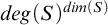 $deg(S)^{dim(S)}$
irreducible components.
$deg(S)^{dim(S)}$
irreducible components.
We explain the route from Proposition 5.11 to Theorem 5.9, first introducing what we need to know about the relevant terminology from Proposition 5.11. Proposition 5.11 is stated for a subvariety of a projective variety: this is $\mathcal {P}^l$
. Again, we will not need the definition of projective varieties, but note that an affine variety can be embedded in a projective variety in a way that preserves number of solutions (by adding additional variables and equations). Thus the same proposition also holds for an affine variety S sitting within another affine variety.
$\mathcal {P}^l$
. Again, we will not need the definition of projective varieties, but note that an affine variety can be embedded in a projective variety in a way that preserves number of solutions (by adding additional variables and equations). Thus the same proposition also holds for an affine variety S sitting within another affine variety.
Proposition 5.11 also refers to the Zariski closure, degree, and dimension. But if a variety is finite, its Zariski closure is just itself, the degree is the number of points, and the dimension is upper bounded by the number of variables in the defining polynomials.
With this in mind, we begin the proof of Theorem 5.9.
Proof. We apply Proposition 5.10, to fix an algebraically closed field K and an automorphism $\sigma $
with
$\sigma $
with $(K, \sigma ) \models ACFA$
, such that our pseudo-finite field is the fixed field of K under
$(K, \sigma ) \models ACFA$
, such that our pseudo-finite field is the fixed field of K under $\sigma $
. Thus the set we are interested in is
$\sigma $
. Thus the set we are interested in is
 $$\begin{align*}\{x | \{(x, \sigma(x) \dots \sigma^{l-1}(x)) \in S\}, \end{align*}$$
where S is the subvariety of the product of our variety with itself, adding the additional equation saying that the components are all equal. Proposition 5.11 tells us that the degree of this subvariety is bounded by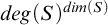 $deg(S)^{dim(S)}$
. By the comments above about degree and dimension for finite set, this is an exponential in the size, so we are done.
$deg(S)^{dim(S)}$
. By the comments above about degree and dimension for finite set, this is an exponential in the size, so we are done.
We are now ready to begin the proof of Theorem 5.7.
Proof. Fix k. As in Theorem 5.1, we can write a formula $\phi ^k(x;P)$
of
$\phi ^k(x;P)$
of $L_P$
of size
$L_P$
of size $O(k)$
such that whenever P is interpreted by a set of size n elements, then
$O(k)$
such that whenever P is interpreted by a set of size n elements, then $\phi ^{k}(x;A)$
defines a set whose size is on the order of
$\phi ^{k}(x;A)$
defines a set whose size is on the order of $n^{n^{\cdot ^{\cdot ^{\cdot ^n}}}}$
, where the ellipses denote an exponential tower of height
$n^{n^{\cdot ^{\cdot ^{\cdot ^n}}}}$
, where the ellipses denote an exponential tower of height $k'$
. For q a power of p, let
$k'$
. For q a power of p, let $\phi _{k,q}(x) = \phi _{k}(x; x^{q}=x)$
be the formula obtained from
$\phi _{k,q}(x) = \phi _{k}(x; x^{q}=x)$
be the formula obtained from $\phi _k$
by replacing P by
$\phi _k$
by replacing P by $x^q=x$
. Note that
$x^q=x$
. Note that $x^q=x$
has precisely q solutions, and so
$x^q=x$
has precisely q solutions, and so $\phi _{k,q}$
has on the order of
$\phi _{k,q}$
has on the order of $q^{q^{\cdot ^{\cdot ^{\cdot ^{q}}}}}$
solutions, where again the ellipses denote an exponential tower of height
$q^{q^{\cdot ^{\cdot ^{\cdot ^{q}}}}}$
solutions, where again the ellipses denote an exponential tower of height $k'$
. Note that these formulas have bounded quantifier rank.
$k'$
. Note that these formulas have bounded quantifier rank.
Consider a disjunction of algebraically-constrained formulas $\psi _q$
produced by
$\psi _q$
produced by $\phi _{k,q}$
. It suffices to show: the number of solutions of such a formula is at most elementary in its size. For this, it suffices to show this for a single algebraically-constrained formula.
$\phi _{k,q}$
. It suffices to show: the number of solutions of such a formula is at most elementary in its size. For this, it suffices to show this for a single algebraically-constrained formula.
The projection $(x,y) \mapsto x$
maps the solutions of the atomic formulas
$(x,y) \mapsto x$
maps the solutions of the atomic formulas $\theta (x, y)$
in an algebraically-constrained formula equivalent to
$\theta (x, y)$
in an algebraically-constrained formula equivalent to $\psi $
onto those of
$\psi $
onto those of $\psi $
. By the definition of algebraically-constrained, this map is at most
$\psi $
. By the definition of algebraically-constrained, this map is at most $\ell $
to
$\ell $
to $1$
, where
$1$
, where $\ell $
is the maximum degree of polynomials in the representation. So it suffices to bound the number of x in the quantifier-free formulas of the form
$\ell $
is the maximum degree of polynomials in the representation. So it suffices to bound the number of x in the quantifier-free formulas of the form $\theta $
. We obtain this via Theorem 5.9.
$\theta $
. We obtain this via Theorem 5.9.
5.3
$\omega $
-RQC and pseudo-finite fields

We continue with the theory $T_p$
of pseudo-finite fields of positive characteristic
$T_p$
of pseudo-finite fields of positive characteristic $p>0$
. Our next goal is the following theorem.
$p>0$
. Our next goal is the following theorem.
Theorem 5.12. The theory of a pseudo-finite field of positive characteristic p is not $\omega $
-RQC.
$\omega $
-RQC.
As in our earlier examples of badly-behaved theories, we contradict $\omega $
-RQC by displaying a formula that is NFR. That is, we show that there is an
$\omega $
-RQC by displaying a formula that is NFR. That is, we show that there is an $L_P$
-sentence
$L_P$
-sentence $\psi $
such that for arbitrary large n, there are embedded finite subsets
$\psi $
such that for arbitrary large n, there are embedded finite subsets $(M,P_n)$
,
$(M,P_n)$
, $(M,P^{\prime }_n)$
with M a pseudo-finite field and a function
$(M,P^{\prime }_n)$
with M a pseudo-finite field and a function $h_n$
from
$h_n$
from $P_n$
to
$P_n$
to $P^{\prime }_n$
that preserves all atomic formulas among n elements. Rephrased, we show that we can find isomorphic pseudo-finite substructures of some pseudo-finite field of characteristic p such that
$P^{\prime }_n$
that preserves all atomic formulas among n elements. Rephrased, we show that we can find isomorphic pseudo-finite substructures of some pseudo-finite field of characteristic p such that $\psi $
holds in one but not the other.
$\psi $
holds in one but not the other.
We will assume $p>2$
; but an analogous construction works if
$p>2$
; but an analogous construction works if $p=2$
, replacing the use of square roots in the argument below by Artin–Schreier roots (solutions y of
$p=2$
, replacing the use of square roots in the argument below by Artin–Schreier roots (solutions y of $y^2+y=x$
).
$y^2+y=x$
).
Lemma 5.13. Let k be a field of char. $p\neq 2$
. Let
$p\neq 2$
. Let $K=k(x_1,\ldots ,x_n)$
be the rational function field over k in n variables. We can consider each
$K=k(x_1,\ldots ,x_n)$
be the rational function field over k in n variables. We can consider each $x_i$
as a member of the field, and let
$x_i$
as a member of the field, and let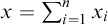 $x=\sum _{i=1}^n x_i$
. Let
$x=\sum _{i=1}^n x_i$
. Let $K^{alg}$
be an algebraic closure of K. Within
$K^{alg}$
be an algebraic closure of K. Within $K^{alg}$
, let
$K^{alg}$
, let $K_i$
be the algebraic closure of
$K_i$
be the algebraic closure of $k_i:=k(x_1,\ldots ,x_{i-1},x_{i+1},\ldots ,x_n)$
. Then x is not a square in
$k_i:=k(x_1,\ldots ,x_{i-1},x_{i+1},\ldots ,x_n)$
. Then x is not a square in $K_1 K_2 \ldots K_n$
.
$K_1 K_2 \ldots K_n$
.
Proof. For any irreducible $f \in k[X_1,\ldots ,X_n]$
, we have a valuation
$f \in k[X_1,\ldots ,X_n]$
, we have a valuation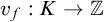 $v_f: K \to {\mathbb {Z}}$
, defined by
$v_f: K \to {\mathbb {Z}}$
, defined by
 $$\begin{align*}v_f(g) = j \iff g= f^j \cdot h, \end{align*}$$
where h is a polynomial relatively prime to f. The existence and uniqueness of j follows from unique factorization in $k[X_1,\ldots ,X_n]$
, and the fact that f is irreducible. It is clear that
$k[X_1,\ldots ,X_n]$
, and the fact that f is irreducible. It is clear that $v_f(uv)=v_f(u)+v_f(v)$
,
$v_f(uv)=v_f(u)+v_f(v)$
, $v_f$
is
$v_f$
is $0$
on k,
$0$
on k, $v_f(u+v) \geq \min (v_f(u),v_f(v))$
.
$v_f(u+v) \geq \min (v_f(u),v_f(v))$
.
Extend $v_{x_1+\cdots +x_n} $
to a valuation on
$v_{x_1+\cdots +x_n} $
to a valuation on $K^{alg}$
, denoted by v. The key property is that v is
$K^{alg}$
, denoted by v. The key property is that v is $0$
on K and
$0$
on K and $1$
on x.
$1$
on x.
An automorphism $\sigma $
of a Galois extension L of K over K is said to fix the residue field if whenever
$\sigma $
of a Galois extension L of K over K is said to fix the residue field if whenever $v(u)=0$
, we have
$v(u)=0$
, we have $v(u-\sigma (u))>0$
, i.e.,
$v(u-\sigma (u))>0$
, i.e., $\sigma $
induces the identity on the residue field. Let
$\sigma $
induces the identity on the residue field. Let $Aut(L/K,{\mathrm {res}}(L))$
denote the group of automorphisms of
$Aut(L/K,{\mathrm {res}}(L))$
denote the group of automorphisms of $L/K$
fixing the residue field. The set of elements fixed by every member of
$L/K$
fixing the residue field. The set of elements fixed by every member of $Aut(L/K,{\mathrm {res}}(L))$
is called the maximal unramified subextension of L/K. If it equals L, we say that
$Aut(L/K,{\mathrm {res}}(L))$
is called the maximal unramified subextension of L/K. If it equals L, we say that $L/K$
is unramified or L is unramified over K, and otherwise we say that L is ramified over K.
$L/K$
is unramified or L is unramified over K, and otherwise we say that L is ramified over K.
Now v restricts to the trivial valuation of each field $k_i$
: every non-zero element maps to
$k_i$
: every non-zero element maps to $0$
. Using basic valuation theory (applying the definition of a valuation to minimal polynomials), v is trivial on each
$0$
. Using basic valuation theory (applying the definition of a valuation to minimal polynomials), v is trivial on each $K_i$
. Hence the only automorphism of
$K_i$
. Hence the only automorphism of $K_i$
over
$K_i$
over $k_i$
that fixes the residue field is the identity, and thus the same statement holds for automorphisms of
$k_i$
that fixes the residue field is the identity, and thus the same statement holds for automorphisms of $K_1\ldots K_n$
fixing the residue field. So
$K_1\ldots K_n$
fixing the residue field. So $K_1 \ldots K_n$
is unramified over K. To prove that
$K_1 \ldots K_n$
is unramified over K. To prove that $\sqrt {x} \notin K_1 \ldots K_n$
, it suffices to show that
$\sqrt {x} \notin K_1 \ldots K_n$
, it suffices to show that $K(\sqrt {x})$
is ramified over K, which we argue next.
$K(\sqrt {x})$
is ramified over K, which we argue next.
Since x is not a square in K (again using unique factorization), $K(\sqrt {x})$
is a Galois extension of K of degree
$K(\sqrt {x})$
is a Galois extension of K of degree $2$
and admits the automorphism
$2$
and admits the automorphism $\tau $
fixing K and with
$\tau $
fixing K and with $\tau (\sqrt {x})=- \sqrt {x}$
. Since
$\tau (\sqrt {x})=- \sqrt {x}$
. Since $p \neq 2$
,
$p \neq 2$
, $\tau $
is not the identity. We will show that
$\tau $
is not the identity. We will show that $\tau $
fixes the residue field, thus
$\tau $
fixes the residue field, thus $\sqrt {x}$
witnesses that
$\sqrt {x}$
witnesses that $K(\sqrt {x})$
is ramified over K.
$K(\sqrt {x})$
is ramified over K.
An element c of $K(\sqrt {x})$
has the form
$K(\sqrt {x})$
has the form $c=a+b \sqrt {x}$
with
$c=a+b \sqrt {x}$
with $a,b \in K$
. If
$a,b \in K$
. If $b=0$
then
$b=0$
then $v(c-\tau (c))=v(0)=\infty $
and in particular
$v(c-\tau (c))=v(0)=\infty $
and in particular $v(c-\tau (c)) \neq 0$
. Thus for the purposes of showing that
$v(c-\tau (c)) \neq 0$
. Thus for the purposes of showing that $\tau $
fixes the residue field, we assume
$\tau $
fixes the residue field, we assume $b \neq 0$
. We have
$b \neq 0$
. We have $v(a) \in {\mathbb {Z}}$
, and
$v(a) \in {\mathbb {Z}}$
, and $v( b \sqrt {x}) = 1/2 + v(b) \notin {\mathbb {Z}}$
. So
$v( b \sqrt {x}) = 1/2 + v(b) \notin {\mathbb {Z}}$
. So $v(a) \neq v(b \sqrt {x})$
. Thus
$v(a) \neq v(b \sqrt {x})$
. Thus $v(c) = \min \{v(a), v(b)+1/2\}$
. Towards arguing that
$v(c) = \min \{v(a), v(b)+1/2\}$
. Towards arguing that $\tau $
fixes the residue field, we are interested in c with
$\tau $
fixes the residue field, we are interested in c with $v(c) =0$
.
$v(c) =0$
. $v(b)+1/2$
cannot be
$v(b)+1/2$
cannot be $0$
, so if
$0$
, so if $v(c)=0$
, we know that
$v(c)=0$
, we know that $v(a)=0$
and
$v(a)=0$
and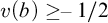 $v(b) \geq -1/2$
. Since
$v(b) \geq -1/2$
. Since $v(b)$
is an integer, we conclude that
$v(b)$
is an integer, we conclude that $v(b) \geq 0$
. We have
$v(b) \geq 0$
. We have $v(c-\tau (c))=v(a+b\sqrt {x}- (a-b \sqrt {x}))=v(2b \sqrt {x})\geq v(b)+1/2$
. Since
$v(c-\tau (c))=v(a+b\sqrt {x}- (a-b \sqrt {x}))=v(2b \sqrt {x})\geq v(b)+1/2$
. Since $v(b) \geq 0$
, we deduce that
$v(b) \geq 0$
, we deduce that $v(c-\tau (c))>0$
as required.
$v(c-\tau (c))>0$
as required.
This shows that $\tau $
fixes the residue field, and
$\tau $
fixes the residue field, and $K(\sqrt {x})$
is ramified over K, finishing the proof of the lemma.
$K(\sqrt {x})$
is ramified over K, finishing the proof of the lemma.
Lemma 5.14. Let F be a pseudo-finite field of char. >2, and $a_1,\ldots ,a_n \in F$
algebraically independent elements. Then there exists a pseudo-finite field
$a_1,\ldots ,a_n \in F$
algebraically independent elements. Then there exists a pseudo-finite field $F'$
and
$F'$
and $a^{\prime }_1,\ldots ,a^{\prime }_n \in F'$
such that
$a^{\prime }_1,\ldots ,a^{\prime }_n \in F'$
such that
 $$\begin{align*}(F,a_1,\ldots,a_{i-1},a_{i+1},\ldots,a_n) \equiv (F',a^{\prime}_1,\ldots,a^{\prime}_{i-1},a^{\prime}_{i+1},\ldots,a^{\prime}_n) \end{align*}$$
for each i, while also $F \models (\exists y)(y^2 =\sum a_i)$
iff
$F \models (\exists y)(y^2 =\sum a_i)$
iff $F' \models \neg (\exists y)(y^2 =\sum a_i')$
.
$F' \models \neg (\exists y)(y^2 =\sum a_i')$
.
Proof. Since F is pseudo-finite, it has one extension of each fixed degree, and thus the Galois group for any fixed degree is cyclic (see, e.g., [Reference Chatazadakis10]). We can thus create an automorphism of each fixed degree extension where the set of elements fixed is exactly F, and since the full algebraic closure is the union of these extensions,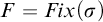 $F=Fix(\sigma )$
for some automorphism
$F=Fix(\sigma )$
for some automorphism $\sigma $
of the algebraic closure
$\sigma $
of the algebraic closure $F^{alg}$
.
$F^{alg}$
.
Let k be the algebraic closure of the prime field, $K=k(a_1,\ldots ,a_n)$
,
$K=k(a_1,\ldots ,a_n)$
, $k_i = k(a_1,\ldots ,a_{i-1},a_{i+1},\ldots ,a_n)$
, and
$k_i = k(a_1,\ldots ,a_{i-1},a_{i+1},\ldots ,a_n)$
, and $K_i = k_i^{alg}$
. By Lemma 5.13, there exists an automorphism
$K_i = k_i^{alg}$
. By Lemma 5.13, there exists an automorphism $\tau $
of
$\tau $
of $F^{alg}$
fixing
$F^{alg}$
fixing $K_1,\ldots ,K_n$
but with
$K_1,\ldots ,K_n$
but with $\tau (a) = -a$
, where
$\tau (a) = -a$
, where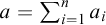 $a=\sum _{i=1}^n a_i$
. Let
$a=\sum _{i=1}^n a_i$
. Let $\sigma ' = \tau \sigma $
. Let K be
$\sigma ' = \tau \sigma $
. Let K be $Fix(\sigma ')$
. Thus K is a subfield of
$Fix(\sigma ')$
. Thus K is a subfield of $F^{alg}$
. Further K has exactly one extension of every degree. We now use the following result.
$F^{alg}$
. Further K has exactly one extension of every degree. We now use the following result.
For F a pseudo-finite field, K a subfield of $F^{alg}$
having at most one extension of each degree, there is a pseudo-finite field
$F^{alg}$
having at most one extension of each degree, there is a pseudo-finite field $K'$
such that the algebraic numbers in
$K'$
such that the algebraic numbers in $K'$
are isomorphic to K. By taking an isomorphic copy, we get that K is a subfield of
$K'$
are isomorphic to K. By taking an isomorphic copy, we get that K is a subfield of $K'$
and K is relatively algebraically closed in
$K'$
and K is relatively algebraically closed in $K'$
.
$K'$
.
The claim above is an extension of Proposition 7 in [Reference Ax1], which states that for every subfield K of the algebraic numbers such that K has at most one extension of each degree, there is a pseudo-finite field $K'$
such that the algebraic numbers in
$K'$
such that the algebraic numbers in $K'$
are isomorphic to K.
$K'$
are isomorphic to K.
Thus there exists a pseudo-finite field $F'$
containing
$F'$
containing $Fix(\sigma ')$
and such that
$Fix(\sigma ')$
and such that $Fix(\sigma ')$
is relatively algebraically closed in
$Fix(\sigma ')$
is relatively algebraically closed in $F'$
. For each i set
$F'$
. For each i set $a_i' = a_i$
. Then for any x we have
$a_i' = a_i$
. Then for any x we have $F' \models (\exists y)(y^2 =x)$
iff
$F' \models (\exists y)(y^2 =x)$
iff $Fix(\sigma ') \models (\exists y)(y^2 =x)$
. In the case
$Fix(\sigma ') \models (\exists y)(y^2 =x)$
. In the case $x=a$
, we have this is true iff
$x=a$
, we have this is true iff $\tau \sigma (\sqrt {a} ) = \sqrt {a}$
iff
$\tau \sigma (\sqrt {a} ) = \sqrt {a}$
iff $- \sigma (\sqrt {a}) = \sqrt {a}$
iff
$- \sigma (\sqrt {a}) = \sqrt {a}$
iff $\sqrt {a} \notin F$
iff
$\sqrt {a} \notin F$
iff $F \models \neg (\exists y)(y^2 =a)$
. To see the right to left direction, note that if
$F \models \neg (\exists y)(y^2 =a)$
. To see the right to left direction, note that if $F \models \neg (\exists y)(y^2 =a)$
, then
$F \models \neg (\exists y)(y^2 =a)$
, then $\sigma $
cannot fix
$\sigma $
cannot fix $\sqrt {a}$
, and hence it must map
$\sqrt {a}$
, and hence it must map $\sqrt {a}$
to
$\sqrt {a}$
to $-\sqrt {a}$
, the only other root of a in the algebraic closure.
$-\sqrt {a}$
, the only other root of a in the algebraic closure. $\tau $
would need to send
$\tau $
would need to send $-\sqrt {a}$
to
$-\sqrt {a}$
to $\sqrt {a}$
, since otherwise it must fix
$\sqrt {a}$
, since otherwise it must fix $\sqrt {a}$
, which means it would fix a as well, contrary to the assumption on
$\sqrt {a}$
, which means it would fix a as well, contrary to the assumption on $\tau $
. The left-to-right direction is argued similarly.
$\tau $
. The left-to-right direction is argued similarly.
Again by results of Ax, the theory of $(F, a_1,\ldots ,a_{n-1})$
is determined by
$(F, a_1,\ldots ,a_{n-1})$
is determined by
 $$\begin{align*}k(a_1,\ldots,a_{n-1})^{alg} \cap F. \end{align*}$$
This is identical to the same expression for $F'$
, so the theories are equal; and likewise for any other
$F'$
, so the theories are equal; and likewise for any other $n-1$
-tuple. This completes the proof of Lemma 5.14.
$n-1$
-tuple. This completes the proof of Lemma 5.14.
Note that above we have dealt with embedded finite subsets over distinct pseudo-finite fields. We can get the same result for a class over the same field: $F,F'$
are elementarily equivalent; so one can find
$F,F'$
are elementarily equivalent; so one can find $F"$
and elementary embeddings of F and
$F"$
and elementary embeddings of F and $F'$
into
$F'$
into $F"$
; of course the images of the
$F"$
; of course the images of the $a_i$
will be two different n-tuples in
$a_i$
will be two different n-tuples in $F"$
, with the same properties as above.
$F"$
, with the same properties as above.
We now prove Theorem 5.12. Now recall that, due to the presence of a nondegenerate bilinear form, we have $L_P$
formulas that assert:
$L_P$
formulas that assert:
-
• P is linearly independent;
-
• y is the sum of the elements of P: in particular, y depends on P and for
$u \in P y-u$
depends on
$P \smallsetminus \{u\}$
.


The bilinear form is used to state that y is the sum of elements of P. Let $\phi (y)$
be this formula. We also have an
$\phi (y)$
be this formula. We also have an $L_P$
sentence
$L_P$
sentence $\psi $
asserting that the sum of elements of P is a square. By Lemma 5.14, for any sublanguage
$\psi $
asserting that the sum of elements of P is a square. By Lemma 5.14, for any sublanguage $L'$
of L generated by formulas of arity
$L'$
of L generated by formulas of arity $n-1$
or less, there exist two
$n-1$
or less, there exist two $L'$
-isomorphic choices of P, one satisfying
$L'$
-isomorphic choices of P, one satisfying $\psi $
and the other not. From this we can easily conclude that
$\psi $
and the other not. From this we can easily conclude that $\psi $
cannot be equivalent to a k-RQ formula for any k. Therefore the theory is not
$\psi $
cannot be equivalent to a k-RQ formula for any k. Therefore the theory is not $\omega $
-RQC.
$\omega $
-RQC.
Notice that our example contradicting $\omega $
-RQC is not isomorphism-invariant. We believe this is not a coincidence. By Proposition 3.11 if there were an isomorphism-invariant
$\omega $
-RQC is not isomorphism-invariant. We believe this is not a coincidence. By Proposition 3.11 if there were an isomorphism-invariant $L_V$
sentence that is not equivalent to a k-RQ one for any k, then there could be no elementary time algorithm for deciding sentences with a fixed number of variables, for any completion of theory of pseudo-finite fields. We conjecture that there are completions that are “fixed-variable elementary,” which would disprove the existence of such a sentence.
$L_V$
sentence that is not equivalent to a k-RQ one for any k, then there could be no elementary time algorithm for deciding sentences with a fixed number of variables, for any completion of theory of pseudo-finite fields. We conjecture that there are completions that are “fixed-variable elementary,” which would disprove the existence of such a sentence.
6 Embedded models vs embedded subsets
We consider one more weakening of ( $1$
-)RQC, where we restrict based on the signature for uninterpreted relations, focusing on sentences dealing with embedded finite subsets rather than general embedded finite models.
$1$
-)RQC, where we restrict based on the signature for uninterpreted relations, focusing on sentences dealing with embedded finite subsets rather than general embedded finite models.
Definition 6.1. We say a theory is 1, Monadic-RQC if every $L_P$
formula is equivalent to a
$L_P$
formula is equivalent to a $1$
-RQ formula.
$1$
-RQ formula.
The motivation is to say whether this provides us with new collapse phenomena. We will see that it does not.
We begin by extending Proposition 2.4.
Theorem 6.2. If M has $1$
, Monadic-RQC, then M is NIP.
$1$
, Monadic-RQC, then M is NIP.
Proof. If T is not NIP, then by [Reference Simon42], we can find an L formula $R(x,y, \mathbf {p})$
such that in every model there is
$R(x,y, \mathbf {p})$
such that in every model there is $\mathbf {c}$
such that there are arbitrarily large sets shattered by
$\mathbf {c}$
such that there are arbitrarily large sets shattered by $R_{y,\mathbf {c}}=\{x ~ | ~ R(x; y, \mathbf {c})\}$
. For short “R has IP.” Thus, we can find an infinite order indiscernible sequence such that every subset of the sequence is
$R_{y,\mathbf {c}}=\{x ~ | ~ R(x; y, \mathbf {c})\}$
. For short “R has IP.” Thus, we can find an infinite order indiscernible sequence such that every subset of the sequence is $\{x | R(x, b, \mathbf {c})\}$
for some b.
$\{x | R(x, b, \mathbf {c})\}$
for some b.
We find a sequence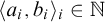 $\langle a_i, b_i\rangle _i \in {\mathbb {N}}$
with each
$\langle a_i, b_i\rangle _i \in {\mathbb {N}}$
with each $a_i \neq b_i$
,
$a_i \neq b_i$
, $\langle a_i, b_i\rangle $
indiscernible over
$\langle a_i, b_i\rangle $
indiscernible over $\mathbf {c}$
, and for each
$\mathbf {c}$
, and for each $i, j \in {\mathbb {N}}$
,
$i, j \in {\mathbb {N}}$
, $R(a_i, b_j, \mathbf {c})$
if and only if
$R(a_i, b_j, \mathbf {c})$
if and only if $i<j$
.
$i<j$
.
We can do this by starting with $\langle a_i\rangle $
indiscernible over
$\langle a_i\rangle $
indiscernible over $\mathbf {c}$
, then build
$\mathbf {c}$
, then build $b_j$
inductively: the induction step uses that every subset of the sequence is
$b_j$
inductively: the induction step uses that every subset of the sequence is $\{x| R(x, b, \mathbf {c})\}$
for some b. Then we take a subsequence of
$\{x| R(x, b, \mathbf {c})\}$
for some b. Then we take a subsequence of $\langle a_i, b_i\rangle $
that is indiscernible over
$\langle a_i, b_i\rangle $
that is indiscernible over $\mathbf {c}$
.
$\mathbf {c}$
.
We now consider several cases.
Case 1: There exists some $b^*$
such that
$b^*$
such that $R(a_i,b^*, \mathbf {c})$
for all i, and for infinitely many
$R(a_i,b^*, \mathbf {c})$
for all i, and for infinitely many $i \neg R(b_i, b^*, \mathbf {c})$
. Then, by refining, we can arrange that
$i \neg R(b_i, b^*, \mathbf {c})$
. Then, by refining, we can arrange that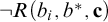 $\neg R(b_i,b^*, \mathbf {c})$
for all i and
$\neg R(b_i,b^*, \mathbf {c})$
for all i and $\langle a_i, b_i\rangle $
is indiscernible over
$\langle a_i, b_i\rangle $
is indiscernible over $\mathbf {c} \cup b^*$
.
$\mathbf {c} \cup b^*$
.
We can arrange that $\mathbf {c} \cup b^*$
has cardinality
$\mathbf {c} \cup b^*$
has cardinality $0$
mod
$0$
mod $4$
via padding. Now we consider the class
$4$
via padding. Now we consider the class $\mathcal C$
of embedded finite subsets where P is interpreted by
$\mathcal C$
of embedded finite subsets where P is interpreted by $P_i=A_i \cup B_i \cup \mathbf {c} \cup b^*$
.
$P_i=A_i \cup B_i \cup \mathbf {c} \cup b^*$
.
We define the $L_P$
sentence
$L_P$
sentence $\phi $
to hold if there exists
$\phi $
to hold if there exists $\mathbf {c}, b^*$
consisting of distinct values, such that, letting:
$\mathbf {c}, b^*$
consisting of distinct values, such that, letting:
 $$\begin{align*} & A_{\mathbf{c},b*} = \{x \in P ~ | \bigwedge_i x \neq c_i \wedge x \neq b^* \wedge R(x, b^*, \mathbf{c})\} &\\ & B_{\mathbf{c}, b^*} = P \setminus A_{\mathbf{c}, b^*} \setminus b^* \setminus \mathbf{c} &\\ & <^A_{\mathbf{c}, b^*} = \{ \langle x,y \rangle ~ | x \neq y \wedge x,y \in A_{\mathbf{c}, b^*} \wedge \forall z \in B_{\mathbf{c}, b^*} (R(x,z, \mathbf{c}) \rightarrow R(y,z, \mathbf{c})\} &\\ & <^B_{\mathbf{c}, b^*} \text{ defined similarly as above but with } B_{\mathbf{c}, b^*} \text{ and } A_{\mathbf{c}, b^*} \text{ swapped } &\\ & {\mathsf{Biject}}_{\mathbf{c},b^*} = \{ \langle x, y \rangle ~ | ~ x \in A_{\mathbf{c}, b^*} \wedge y \in B_{\mathbf{c}, b^*} \wedge y \text{ is } \\ & <^B_{\mathbf{c}, b^*}\text{- maximal such that } R(x,y, \mathbf{c}) \} & \end{align*}$$
then:
-
•
$<^A_{\mathbf {c}, b^*}$
is a linear order on
$A_{\mathbf {c}, b^*}$
and similarly for
$<^B_{\mathbf {c}, b^*}$
; -
•
${\mathsf {Biject}}_{\mathbf {c},b^*}$
is a bijection from
$A_{\mathbf {c}, b*}$
to
$B_{\mathbf {c}, b*}$
; -
• for some b,
$\{x \in A_{\mathbf {c}, b^*} ~ | R(x,b, \mathbf {c}) \}$
includes exactly one of any element of
$A_{\mathbf {c}, b^*}$
and its
$<^A_{\mathbf {c},b^*}$
successor, while including the first element and excluding the last element according to
$<^A_{\mathbf {c}, b^*}$
.


The important points about $\phi $
are:
$\phi $
are:
-
•
$\phi $
is in
$L_P$
. -
•
$\phi $
implies, over any embedded finite subset, that the cardinality of P is
$0$
mod
$4$
. This follows directly from the definitions and the assumption that
$\mathbf {c} \cup \mathbf {b}^*$
has cardinality a multiple of
$4$
. In particular this implication holds for subsets in
$\mathcal C$
. -
• Conversely, for any
$P_i \in \mathcal C$
, if
$P_i$
has cardinality
$0$
mod
$4$
then
$|A_i|$
and
$|B_i|$
are even, and by choosing
$\mathbf {c}$
and
$b^*$
correctly—that is, as above—we see that
$\phi $
holds.


But $\phi $
cannot be definable by a
$\phi $
cannot be definable by a $1$
-RQC formula for embedded finite subsets in class
$1$
-RQC formula for embedded finite subsets in class $\mathcal C$
. Over this class, every L formula is equivalent (modulo expansion) to a formula using
$\mathcal C$
. Over this class, every L formula is equivalent (modulo expansion) to a formula using ${\mathsf {Biject}}_{\mathbf {c},b^*}$
,
${\mathsf {Biject}}_{\mathbf {c},b^*}$
, $<^A_{\mathbf {c}, b^*}$
,
$<^A_{\mathbf {c}, b^*}$
, $<^B_{\mathbf {c}, b^*}$
for the correct
$<^B_{\mathbf {c}, b^*}$
for the correct $\mathbf {c}, b^*$
, where these are formulas in L extended with constants. So we have a formula in this language over a structure consisting of two linear ordered sets with a bijective correspondence. By a standard Ehrenfeucht–Fraïssé argument it is clear that the cardinality of the universe modulo
$\mathbf {c}, b^*$
, where these are formulas in L extended with constants. So we have a formula in this language over a structure consisting of two linear ordered sets with a bijective correspondence. By a standard Ehrenfeucht–Fraïssé argument it is clear that the cardinality of the universe modulo $4$
cannot be defined in such a family. This completes the argument for Case 1.
$4$
cannot be defined in such a family. This completes the argument for Case 1.
Case 2: There exists some $b^*$
such that
$b^*$
such that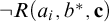 $\neg R(a_i,b^*, \mathbf {c})$
holds for all i, and for infinitely many
$\neg R(a_i,b^*, \mathbf {c})$
holds for all i, and for infinitely many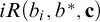 $i R(b_i, b^*, \mathbf {c})$
.
$i R(b_i, b^*, \mathbf {c})$
.
This is argued symmetrically with Case 1 above.
Case 3. None of the above. If $R(b_i,b_j, \mathbf {c})$
and
$R(b_i,b_j, \mathbf {c})$
and $\neg R(b_j,b_i, \mathbf {c})$
holds for all
$\neg R(b_j,b_i, \mathbf {c})$
holds for all $i<j$
(or dually) then
$i<j$
(or dually) then $R(x,y, \mathbf {c})$
defines an ordering on the
$R(x,y, \mathbf {c})$
defines an ordering on the $b_i$
. We let
$b_i$
. We let $\mathcal C$
be defined as above but without the
$\mathcal C$
be defined as above but without the $a_i$
or
$a_i$
or $b^*$
, and conclude analogously to Case 1.
$b^*$
, and conclude analogously to Case 1.
Otherwise, by indiscernibility of $b_i$
over
$b_i$
over $\mathbf {c}$
, either
$\mathbf {c}$
, either $R(b_i,b_j, \mathbf {c})$
holds for all
$R(b_i,b_j, \mathbf {c})$
holds for all $i \neq j$
, or
$i \neq j$
, or $\neg R(b_i,b_j, \mathbf {c})$
holds for all
$\neg R(b_i,b_j, \mathbf {c})$
holds for all $i \neq j$
. Let us assume the latter. Extend the indiscernible sequence
$i \neq j$
. Let us assume the latter. Extend the indiscernible sequence $\langle a_i,b_i \rangle _{i \in {\mathbb {N}}}$
by adding one more element
$\langle a_i,b_i \rangle _{i \in {\mathbb {N}}}$
by adding one more element $(a_\omega ,b_\omega )$
maximal in the ordering. So
$(a_\omega ,b_\omega )$
maximal in the ordering. So $R(a_i,b_\omega , \mathbf {c})$
holds for all
$R(a_i,b_\omega , \mathbf {c})$
holds for all $i \in {\mathbb {N}}$
, using indiscernibility, since
$i \in {\mathbb {N}}$
, using indiscernibility, since $b_\omega $
is above
$b_\omega $
is above $b_i$
for all standard i. But
$b_i$
for all standard i. But $\neg R(b_i,b_\omega , \mathbf {c})$
holds for all i, again by indiscernibility and
$\neg R(b_i,b_\omega , \mathbf {c})$
holds for all i, again by indiscernibility and $b_\omega $
being above
$b_\omega $
being above $b_i \in {\mathbb {N}}$
. Hence we are in Case 1, a contradiction.
$b_i \in {\mathbb {N}}$
. Hence we are in Case 1, a contradiction.
We now show that for $1$
-RQC, there is no difference between looking at embedded finite subsets and embedded finite models. That is, our weakening does not make any difference at the level of theories.
$1$
-RQC, there is no difference between looking at embedded finite subsets and embedded finite models. That is, our weakening does not make any difference at the level of theories.
Theorem 6.3. A theory T is $1$
, Monadic-RQC iff T is
$1$
, Monadic-RQC iff T is $1$
-RQC.
$1$
-RQC.
Proof. The interesting direction is assuming $1$
, Monadic-RQC and proving
$1$
, Monadic-RQC and proving $1$
-RQC. Inductively it suffices to convert a formula
$1$
-RQC. Inductively it suffices to convert a formula $\phi $
of the form:
$\phi $
of the form:
 $$\begin{align*}\exists x ~ Q_1(u_1) \ldots Q_n(u_n) ~ \Gamma(x, \mathbf{u}, \mathbf{y}) \end{align*}$$
to an active domain formula, where the $Q_i$
are active domain quantifiers and
$Q_i$
are active domain quantifiers and $\Gamma $
is a Boolean combination of
$\Gamma $
is a Boolean combination of $\sigma $
formulas and L formulas. We can assume that x only occurs in L formulas. Let
$\sigma $
formulas and L formulas. We can assume that x only occurs in L formulas. Let $\Gamma _L(x, \mathbf {u}, \mathbf {y})$
be the vector of L subformulas of
$\Gamma _L(x, \mathbf {u}, \mathbf {y})$
be the vector of L subformulas of $\Gamma $
. By Theorem 6.2, T is NIP. By [Reference Chernikov and Simon14] “local types are uniformly definable over finite sets”:
$\Gamma $
. By Theorem 6.2, T is NIP. By [Reference Chernikov and Simon14] “local types are uniformly definable over finite sets”:
for every L formula $\phi (\mathbf {x}; \mathbf {y})$
, there is L formula
$\phi (\mathbf {x}; \mathbf {y})$
, there is L formula $\delta (\mathbf {y}; \mathbf {p})$
such that: for any finite set S, for any
$\delta (\mathbf {y}; \mathbf {p})$
such that: for any finite set S, for any $\mathbf {x}_0$
, there is a tuple
$\mathbf {x}_0$
, there is a tuple $\mathbf {p}_0$
such that
$\mathbf {p}_0$
such that $\forall \mathbf {y} \in S ~ \phi (\mathbf {x}_0, \mathbf {y}) \leftrightarrow \delta (\mathbf {y}, \mathbf {p}_0)$
.
$\forall \mathbf {y} \in S ~ \phi (\mathbf {x}_0, \mathbf {y}) \leftrightarrow \delta (\mathbf {y}, \mathbf {p}_0)$
.
This means, in particular, that for $\gamma _i \in \Gamma _L$
there is
$\gamma _i \in \Gamma _L$
there is $\delta _i(\mathbf {u}, \mathbf {p})$
such that for every finite set P for every
$\delta _i(\mathbf {u}, \mathbf {p})$
such that for every finite set P for every $x_0, \mathbf {y}_0$
in a model of T there is
$x_0, \mathbf {y}_0$
in a model of T there is $\mathbf {p}^i$
in P such that
$\mathbf {p}^i$
in P such that
 $$\begin{align*}\forall \mathbf{u} \in P ~ \gamma_i(x_0, \mathbf{y}_0, \mathbf{u}) \leftrightarrow \delta_i(\mathbf{u}, \mathbf{p}^i). \end{align*}$$
This holds over all finite P, so in particular for the active domain of an embedded finite model.
We can thus replace $\phi $
with
$\phi $
with
 $$ \begin{align*} \exists \mathbf{p}^1 \in {\mathsf{Adom}} \dots \exists \mathbf{p}^n \in {\mathsf{Adom}} \\\mathbf{p}^1 \ldots \mathbf{p}^n \text{ are definers for some } x \text{ for } \mathbf{y}\ \wedge \\~ Q_1(u_1) \ldots Q_n(u_n) ~ \Gamma'(\mathbf{u}, \mathbf{y}, \mathbf{p}^1 \ldots \mathbf{p}^n). \end{align*} $$
Here $\Gamma '$
is obtained by
$\Gamma '$
is obtained by $\Gamma $
via replacing
$\Gamma $
via replacing $\gamma _i$
with the corresponding
$\gamma _i$
with the corresponding $\delta _i$
. The first conjunct inside the existential has the obvious meaning, that the iff above holds for some x in the role of
$\delta _i$
. The first conjunct inside the existential has the obvious meaning, that the iff above holds for some x in the role of $x_0$
, with
$x_0$
, with $\mathbf {y}$
in the role of
$\mathbf {y}$
in the role of $\mathbf {y}_0$
.
$\mathbf {y}_0$
.
The first conjunct does not mention the additional relational signature $\sigma $
, and thus can be transformed into a
$\sigma $
, and thus can be transformed into a $1$
-RQ formula via
$1$
-RQ formula via $1$
, Monadic-RQC.
$1$
, Monadic-RQC.
Embedded subsets vs embedded models for isomorphism-invariant sentences: We contrast Theorem 6.3 with the situation when we restrict to isomorphism-invariant sentences. Recall that this denotes sentences of $L_V$
whose truth value in an embedded finite model for theory T depends only on the isomorphism type of the interpretations of the V predicates. Isomorphism-invariant
$L_V$
whose truth value in an embedded finite model for theory T depends only on the isomorphism type of the interpretations of the V predicates. Isomorphism-invariant $L_V$
sentences are ones that represent “pure relational computation.” Consider the random graph. The theory is not NIP, so by Theorem 6.2 it is not
$L_V$
sentences are ones that represent “pure relational computation.” Consider the random graph. The theory is not NIP, so by Theorem 6.2 it is not $1$
-RQC, and indeed not even
$1$
-RQC, and indeed not even $1$
, Monadic-RQC. And we have mentioned before that it is
$1$
, Monadic-RQC. And we have mentioned before that it is $2$
-RQC. In fact, every
$2$
-RQC. In fact, every $L_V$
sentence can be converted to one that uses only Monadic second-order quantification over the active domain of the V predicates. Thus, informally, first-order quantification over the model gives you the power of Monadic second-order active domain quantification over the relational signature V.
$L_V$
sentence can be converted to one that uses only Monadic second-order quantification over the active domain of the V predicates. Thus, informally, first-order quantification over the model gives you the power of Monadic second-order active domain quantification over the relational signature V.
We can also see that there are isomorphism-invariant $L \cup \{G(x,y)\}$
sentences
$L \cup \{G(x,y)\}$
sentences $\gamma $
that are not equivalent to
$\gamma $
that are not equivalent to $1$
-RQ ones: by using unrestricted existential quantification to quantify over subsets of the nodes of G, we can express that G has a non-trivial connected component.
$1$
-RQ ones: by using unrestricted existential quantification to quantify over subsets of the nodes of G, we can express that G has a non-trivial connected component.
But consider an isomorphism-invariant sentence in $L_P$
. By the observation above, applicable to arbitrary
$L_P$
. By the observation above, applicable to arbitrary $L_P$
sentences, these can all be expressed in restricted-quantifier Monadic second-order logic
$L_P$
sentences, these can all be expressed in restricted-quantifier Monadic second-order logic $\phi '$
, equivalent over embedded finite subsets to
$\phi '$
, equivalent over embedded finite subsets to $\phi $
quantifying only over unary predicate P. By isomorphism-invariance, such a sentence is determined by its truth value on P lying within an order-indiscernible set, and thus we can rewrite such a sentence to
$\phi $
quantifying only over unary predicate P. By isomorphism-invariance, such a sentence is determined by its truth value on P lying within an order-indiscernible set, and thus we can rewrite such a sentence to $\phi "$
that does not mention the graph predicate of L at all: only equality atoms in it. Such a sentence can only define the set of finite P’s whose cardinality is in a finite or co-finite set. And such a set of finite P’s can also be defined in first-order logic over P. Thus there can be a difference between considering unary signatures and higher-arity signatures for isomorphism-invariant sentences.
$\phi "$
that does not mention the graph predicate of L at all: only equality atoms in it. Such a sentence can only define the set of finite P’s whose cardinality is in a finite or co-finite set. And such a set of finite P’s can also be defined in first-order logic over P. Thus there can be a difference between considering unary signatures and higher-arity signatures for isomorphism-invariant sentences.
7 Discussion and open issues
The main goal of this work was to revisit the evaluation of formulas that refer to a vocabulary $L_V$
mixing the signature of an infinite structure with a finite uninterpreted relational vocabulary. When this setting was studied in the 90s and the early 2000s, the emphasis was on the “very sunny day” scenario of RQC, where the expressiveness and evaluation complexity is not so different—from the point of view of “data complexity”—from that of evaluation of first-order formulas in a relational vocabulary over finite models.
$L_V$
mixing the signature of an infinite structure with a finite uninterpreted relational vocabulary. When this setting was studied in the 90s and the early 2000s, the emphasis was on the “very sunny day” scenario of RQC, where the expressiveness and evaluation complexity is not so different—from the point of view of “data complexity”—from that of evaluation of first-order formulas in a relational vocabulary over finite models.
In this article we show a much richer landscape, including:
-
• Structures/theories where first-order logic over
$L_V$
captures higher-order logic, or beyond. Thus both the expressiveness and complexity is high. -
• Structures/theories where first-order logic over
$L_V$
does not correspond to any reasonable logic over the finite vocabulary, where this can be “fixed” by expanding the signature, and cases where it cannot be fixed.


We also locate the theory of finite and pseudo-finite fields lives within this landscape, showing that it is extremely expressive.
In each of the approaches to exploring evaluation on wider classes of infinite structures, we have left open many basic questions.
In terms of higher-order collapse, although we have separated $k+2$
from k-RQC for every k, we do not have the corresponding separation for
$k+2$
from k-RQC for every k, we do not have the corresponding separation for $k+1$
and k. Thus it is possible that, for example, two consecutive levels of the hierarchy collapse, but the remainder are separated. Our construction from Section 3.1 shows that this would follow from the corresponding separation of pure spectra in finite model theory. We believe one can construct examples
$k+1$
and k. Thus it is possible that, for example, two consecutive levels of the hierarchy collapse, but the remainder are separated. Our construction from Section 3.1 shows that this would follow from the corresponding separation of pure spectra in finite model theory. We believe one can construct examples $T_k$
where the
$T_k$
where the $L_P$
theory is bi-interpretable with k-higher-order logic over P, which would provide an equivalence between separations of RQC levels and expressiveness separations in higher-order logic.
$L_P$
theory is bi-interpretable with k-higher-order logic over P, which would provide an equivalence between separations of RQC levels and expressiveness separations in higher-order logic.
On the issue of persistent unrestrictedness, one major question is whether any model theoretic criteria can enforce potential RQC. In particular, we do not know if NIP theories can always be expanded to become RQC. It is known that there are NIP theories (even stable theories) that cannot be expanded to fall into the known existing classes that imply $1$
-RQC [Reference Hieronymi, Nell and Walsberg24]. We have shown that Atomless Boolean Algebras are persistently unrestricted. We suspect the same argument applies to another well-known decidable theory, Büchi arithmetic, but we have not verified this.
$1$
-RQC [Reference Hieronymi, Nell and Walsberg24]. We have shown that Atomless Boolean Algebras are persistently unrestricted. We suspect the same argument applies to another well-known decidable theory, Büchi arithmetic, but we have not verified this.
Our discussion of algebraic examples focused on finite and pseudo-finite fields, and (in Appendix G) on the related topic of vector spaces with a bilinear form into a finite field. Even for pseudo-finite fields and finite fields, we do not have results when we restrict to characteristic $0$
.
$0$
.
On the issue of impact of the signature, the main question is whether k-RQC for $V=\{P\}$
, P a unary predicate P implies that k-RQC for general V.
$V=\{P\}$
, P a unary predicate P implies that k-RQC for general V.
The results on finite and pseudo-finite fields relate to the broader question of the connection between “tame definability properties” of a structure, such as k-RQC and the complexity of the underlying theory. In Proposition 3.11, we noted one simple connection: roughly speaking, high expressiveness of isomorphism-invariant $L_V$
sentences implies lower bounds for deciding L formulas. In Section 5 we showed that we can sometimes convert high expressiveness of isomorphism-invariant sentences into lower bounds on quantifier elimination in the theory, even when the number of variables is not fixed.
$L_V$
sentences implies lower bounds for deciding L formulas. In Section 5 we showed that we can sometimes convert high expressiveness of isomorphism-invariant sentences into lower bounds on quantifier elimination in the theory, even when the number of variables is not fixed.
We know that, in general, properties like k-RQC do not even imply decidability of the theory, much less complexity bounds. This follows from the fact that purely model-theoretic properties—e.g., NFCP and o-minimality (see Section 2)—with no effectiveness requirement suffice to get $1$
-RQC. Conversely, Example 2 can be used to show that theories with modest complexity of satisfiability (even for fixed number of variables) may not even be
$1$
-RQC. Conversely, Example 2 can be used to show that theories with modest complexity of satisfiability (even for fixed number of variables) may not even be $\omega $
-RQC. Intuitively, a Turing Machine can decide the theory by accessing additional parts of the structure, while restricted-quantifier formulas have no means to access this structure. One might hope that adding function symbols to the signature might close this gap, as it does in Example 4. But Theorem 4.5 shows that there are examples where this tactic cannot help.
$\omega $
-RQC. Intuitively, a Turing Machine can decide the theory by accessing additional parts of the structure, while restricted-quantifier formulas have no means to access this structure. One might hope that adding function symbols to the signature might close this gap, as it does in Example 4. But Theorem 4.5 shows that there are examples where this tactic cannot help.
Appendix A Proof of Theorem 2.6: NIP theories are RQC within an infinite set, and also the proof of Proposition 4.4
Recall that in the body of the article we stated.
In every NIP theory, there is a model containing an infinite set I such that, for embedded finite models based on I, every isomorphism-invariant $L_V$
formula is equivalent to a
$L_V$
formula is equivalent to a $1$
-RQ formula.
$1$
-RQ formula.
As mentioned in the body, this is a variation of a result in [Reference Baldwin and Benedikt2]. But the exact statement of the result in [Reference Baldwin and Benedikt2] is different. Theorem 2.5 of [Reference Baldwin and Benedikt2] states the following theorem.
Theorem A.1. Fix NIP T, $M is$
a model of T, and
$M is$
a model of T, and $I,<$
a dense linearly ordered set of elements in M that is order-indiscernible: the truth value of each formula
$I,<$
a dense linearly ordered set of elements in M that is order-indiscernible: the truth value of each formula $\phi (\mathbf {x})$
depends only on the ordering relations among
$\phi (\mathbf {x})$
depends only on the ordering relations among $\mathbf {x}$
for
$\mathbf {x}$
for $\mathbf {x}$
in I.
$\mathbf {x}$
in I.
Then any isomorphism-invariant $L_V$
formula is equivalent, over embedded finite models in I, to an RQ formula that can make use of
$L_V$
formula is equivalent, over embedded finite models in I, to an RQ formula that can make use of $<$
.
$<$
.
Now suppose that we have an isomorphism-invariant $L \cup V$
formula
$L \cup V$
formula $\phi $
.
$\phi $
.
It is well-known that every theory with infinite models has a model with an infinite indiscernible sequence based on a dense linear order. And isomorphism-invariance implies that any operation can be moved into the set. Thus to close the gap to Theorem 2.6, we need to show that we can eliminate the reference to the indiscernible ordering $<$
in
$<$
in $\phi '$
, instead using L formulas. In the case that
$\phi '$
, instead using L formulas. In the case that $V=\{P\}$
this is easy, since if we have a sentence quantifying over P using only a linear order on the domain, and the truth of the sentence depends only on the cardinality of P, it must define a finite or co-finite set of cardinalities. These can be described without referencing the order.
$V=\{P\}$
this is easy, since if we have a sentence quantifying over P using only a linear order on the domain, and the truth of the sentence depends only on the cardinality of P, it must define a finite or co-finite set of cardinalities. These can be described without referencing the order.
For general V, we provide an argument similar to the one in [Reference Chernikov and Simon13] (page 422, below Fact 3.1).
First, suppose that the sequence is not totally indiscernible: that means that for some L formula $\gamma (\mathbf {x})$
, we can use
$\gamma (\mathbf {x})$
, we can use $\phi $
to distinguish a tuple
$\phi $
to distinguish a tuple $\mathbf {i}$
in I from a permutation of
$\mathbf {i}$
in I from a permutation of $\mathbf {i}$
. Then for large enough embedded finite models within I, the ordering on I is definable with parameters in the model, by some formula
$\mathbf {i}$
. Then for large enough embedded finite models within I, the ordering on I is definable with parameters in the model, by some formula $\lambda (i, i', \mathbf {p})$
(see comments below Fact 3.1 in [Reference Chernikov and Simon13]). Consider the
$\lambda (i, i', \mathbf {p})$
(see comments below Fact 3.1 in [Reference Chernikov and Simon13]). Consider the $L \cup P$
sentence
$L \cup P$
sentence $\phi "$
that states there is
$\phi "$
that states there is $\mathbf {p}$
in the active domain of the embedded finite model such that
$\mathbf {p}$
in the active domain of the embedded finite model such that $\lambda ( x,x', \mathbf {p})$
induces a linear order on the elements in the active domain and the sentence obtained from
$\lambda ( x,x', \mathbf {p})$
induces a linear order on the elements in the active domain and the sentence obtained from $\psi $
by replacing
$\psi $
by replacing $<$
with
$<$
with $\lambda (x,x', \mathbf {p})$
holds. Since
$\lambda (x,x', \mathbf {p})$
holds. Since $\phi $
was isomorphism-invariant,
$\phi $
was isomorphism-invariant, $\phi "$
is equivalent to
$\phi "$
is equivalent to $\phi $
.
$\phi $
.
Now suppose the sequence is totally indiscernible. Then we can observe that the argument in Section 4 of [Reference Baldwin and Benedikt2] goes through to show that we get a first-order restricted-quantifier formula using only the predicates in V and equality. The argument is given only for $L_P$
, but generalizes to arbitrary relational V. The proof uses only that the trace of an L formula on a totally indiscernible set is uniformly defined by an equality formula with parameters in the set. The same holds for a finite indiscernible set in an NIP theory.
$L_P$
, but generalizes to arbitrary relational V. The proof uses only that the trace of an L formula on a totally indiscernible set is uniformly defined by an equality formula with parameters in the set. The same holds for a finite indiscernible set in an NIP theory.
We use a similar approach to prove Proposition 4.4. Recall the statement.
Proposition 4.4. If theory T has an isomorphism-invariant $L_V$
sentence
$L_V$
sentence $\phi $
not equivalent to a k-RQ sentence, then the same is true in any consistent expansion of T.
$\phi $
not equivalent to a k-RQ sentence, then the same is true in any consistent expansion of T.
Proof. By way of contradiction, let $\phi ^{\prime }_k$
be a k-RQ sentence equivalent to
$\phi ^{\prime }_k$
be a k-RQ sentence equivalent to $\phi $
in some expansion
$\phi $
in some expansion $T^+$
. Let I be an order-indiscernible set in a model of
$T^+$
. Let I be an order-indiscernible set in a model of $T^+$
. Let
$T^+$
. Let $\phi ^{\prime \prime }_k$
be obtained by replacing atomic formulas in
$\phi ^{\prime \prime }_k$
be obtained by replacing atomic formulas in $\phi ^{\prime }_k$
by a disjunction of ordering formulas, depending on whether the corresponding atom holds for some—equivalently all—tuples with the given ordering. For
$\phi ^{\prime }_k$
by a disjunction of ordering formulas, depending on whether the corresponding atom holds for some—equivalently all—tuples with the given ordering. For $V_0$
an embedded structure in a model
$V_0$
an embedded structure in a model $M^+$
of
$M^+$
of $T^+$
,
$T^+$
, $\phi $
holds in
$\phi $
holds in $M^+, V_0$
if and only if
$M^+, V_0$
if and only if $\phi ^{\prime \prime }_k$
holds on
$\phi ^{\prime \prime }_k$
holds on $M^+$
,
$M^+$
, $V^I_0$
, where
$V^I_0$
, where $V^I_0$
is a copy of
$V^I_0$
is a copy of $V_0$
with active domain in I. Thus, arguing by way of contradiction, we can see that the same equivalence holds in any model of T with an order-indiscernible set, where
$V_0$
with active domain in I. Thus, arguing by way of contradiction, we can see that the same equivalence holds in any model of T with an order-indiscernible set, where $<$
in
$<$
in $\phi ^{\prime \prime }_k$
is interpreted as the indiscernible order. At this point we have
$\phi ^{\prime \prime }_k$
is interpreted as the indiscernible order. At this point we have $\phi $
equivalent to a higher-order RQ formula, except for the use of the ordering.
$\phi $
equivalent to a higher-order RQ formula, except for the use of the ordering.
If $k \geq 2$
, we can use higher-order quantification over the active domain to guess the ordering. If
$k \geq 2$
, we can use higher-order quantification over the active domain to guess the ordering. If $k=1$
we can use the argument above to eliminate the use of ordering in favor of L formulas.
$k=1$
we can use the argument above to eliminate the use of ordering in favor of L formulas.
Appendix B Proof that Example 2 is not
$\omega $
-RQC, but is potentially
$1$
-RQC


In the body of the article we mentioned that NIP theories that are not $1$
-RQC, or even
$1$
-RQC, or even $\omega $
-RQC, may become
$\omega $
-RQC, may become $1$
-RQC when the theory is expanded. And we claimed in Example 4 that this phenomena holds in Example 2, which involves an equivalence relation
$1$
-RQC when the theory is expanded. And we claimed in Example 4 that this phenomena holds in Example 2, which involves an equivalence relation $E(x,y)$
with arbitrarily large finite classes. We now give the details.
$E(x,y)$
with arbitrarily large finite classes. We now give the details.
We let $M^+$
expand M by a discrete linear order
$M^+$
expand M by a discrete linear order $<$
for which each equivalence class is an interval, and
$<$
for which each equivalence class is an interval, and $T^+$
be the theory of this model. We claim that
$T^+$
be the theory of this model. We claim that $T^+$
is
$T^+$
is $1$
-RQC. For intuition, consider the formula
$1$
-RQC. For intuition, consider the formula $\phi \in L_P$
stating that P contains an equivalence class. In M this was not expressible by an RQ formula. In
$\phi \in L_P$
stating that P contains an equivalence class. In M this was not expressible by an RQ formula. In $M^+$
,
$M^+$
, $\phi $
is equivalent—over finite P embedded in
$\phi $
is equivalent—over finite P embedded in $M^+$
—to the following sentence
$M^+$
—to the following sentence $\phi '$
:
$\phi '$
:
 $$ \begin{align*} \exists l \in P ~ \exists u \in P ~ E(l,u) \wedge \phi_{min}(l) \wedge \phi_{max}(u) \wedge \\ \forall y \in P [(l \leq y < u) \rightarrow \exists y' \in P ~ Succ(y,y')], \end{align*} $$
where $\phi _{min}(l)$
asserts that l is the minimal element of its equivalence class,
$\phi _{min}(l)$
asserts that l is the minimal element of its equivalence class, $\phi _{max}(u)$
asserts that u is the maximal element of its equivalence relation, and
$\phi _{max}(u)$
asserts that u is the maximal element of its equivalence relation, and $Succ(y,y')$
expresses that
$Succ(y,y')$
expresses that $y'$
is the successor of y in the linear order. Recalling that
$y'$
is the successor of y in the linear order. Recalling that $1$
-RQ formulas are built up from atoms of S and L formulas, we see that
$1$
-RQ formulas are built up from atoms of S and L formulas, we see that $\phi '$
is a
$\phi '$
is a $1$
-RQ formula.
$1$
-RQ formula.
To see the general result, it suffices, by [Reference Benedikt and Libkin6] or [Reference Belegradek, Stolboushkin and Taitslin4], to show that $M^+$
is o-minimal: for every L formula
$M^+$
is o-minimal: for every L formula $\phi (x,\mathbf {p})$
and any
$\phi (x,\mathbf {p})$
and any $\mathbf {p}_0$
,
$\mathbf {p}_0$
, $\{x| M^+ \models \phi (x, \mathbf {p}_0)\}$
is a finite union of intervals.
$\{x| M^+ \models \phi (x, \mathbf {p}_0)\}$
is a finite union of intervals.
For this it suffices to show that an L formula in variables $\mathbf {x}$
is a disjunction of formulas specifying:
$\mathbf {x}$
is a disjunction of formulas specifying:
-
• which of the
$x_i$
are equivalent, -
• ordering among the equivalence classes of the
$x_i$
(where the notion of one class being above another is the obvious one), -
• ordering among the
$x_i$
in the same class, -
• for each
$x_i$
and
$x_j$
that are neighbors in the ordering lying within the same class, and -
• information (lower bounds or exact bounds) on the distance of the lowest
$x_i$
in the class from the minimal element of the class, and similarly for the highest
$x_i$
in a class.


Given this statement, if we fix values for all but one free variable x, and fix a formula as above, the set of values will be a single interval. The o-minimality result will then follow.
The quantifier-elimination result above is proven by a standard induction.
Appendix C Alternative proof of Claim 1:
$1$
-RQC over subalgebras of an Atomless Boolean Algebras

Let T be the theory of Atomless Boolean Algebras. In the body of the article we claimed that for this theory, every isomorphism-invariant sentence was equivalent to a $2$
-RQ sentence. In the body we argued that it suffices to prove Claim 1.
$2$
-RQ sentence. In the body we argued that it suffices to prove Claim 1.
For every $L_V$
formula
$L_V$
formula $\phi $
there is a
$\phi $
there is a $1$
-RQ formula
$1$
-RQ formula $\phi '$
that is equivalent to
$\phi '$
that is equivalent to $\phi $
over embedded finite models in which the active domain of the reduct to V is a subalgebra.
$\phi $
over embedded finite models in which the active domain of the reduct to V is a subalgebra.
We gave a model-theoretic proof in the body, and here we give an alternative algorithmic argument.
As usual it suffices to eliminate one unrestricted quantifier at a time, performing a conversion to $1$
-RQ of the formula:
$1$
-RQ of the formula:
 $$\begin{align*}\phi=\exists x ~ Q(u_1) \ldots Q(u_k) ~ \Gamma(x,\mathbf{u}, \mathbf{y}). \end{align*}$$
Above $Q(u_i)$
are active domain quantifiers and
$Q(u_i)$
are active domain quantifiers and $\Gamma $
is a Boolean combination of L formulas and V formulas. We ignore the V formulas in
$\Gamma $
is a Boolean combination of L formulas and V formulas. We ignore the V formulas in $\Gamma $
in the analysis below.
$\Gamma $
in the analysis below.
Atomic formulas in $\Gamma $
are of one of the forms
$\Gamma $
are of one of the forms $x \cap \sigma _1(\mathbf {u}) \cap \sigma _2(\mathbf {y}) \neq 0$
,
$x \cap \sigma _1(\mathbf {u}) \cap \sigma _2(\mathbf {y}) \neq 0$
, $x^c \cap \sigma _1(\mathbf {u}) \cap \sigma _2(\mathbf {y}) \neq 0$
, where
$x^c \cap \sigma _1(\mathbf {u}) \cap \sigma _2(\mathbf {y}) \neq 0$
, where $\sigma _1$
,
$\sigma _1$
, $\sigma _2$
are terms built up using
$\sigma _2$
are terms built up using $0,1$
and the usual Boolean operators. We will assume that
$0,1$
and the usual Boolean operators. We will assume that $\Gamma $
covers all terms in these variables.
$\Gamma $
covers all terms in these variables.
A Boolean algebra term $\sigma _1$
in variables
$\sigma _1$
in variables $\mathbf {x}$
is contained in Boolean algebra term
$\mathbf {x}$
is contained in Boolean algebra term $\sigma ^{\prime }_1$
if we have containment for every valuation of
$\sigma ^{\prime }_1$
if we have containment for every valuation of $\mathbf {x}$
.
$\mathbf {x}$
.
Fixing the variables as above, consider any element x of the algebra. For a given $\sigma _2$
, and an element
$\sigma _2$
, and an element $x_0$
and vector of elements
$x_0$
and vector of elements $\mathbf {y}_0$
the
$\mathbf {y}_0$
the $\sigma _2$
representation of
$\sigma _2$
representation of $x_0, \mathbf {y}_0$
is the pair
$x_0, \mathbf {y}_0$
is the pair $(e_1, e_2)$
, where
$(e_1, e_2)$
, where $e_1$
is the union of all atoms u in the subalgebra such that
$e_1$
is the union of all atoms u in the subalgebra such that $x_0 \cap u \cap \sigma _2(\mathbf {y}_0) \neq 0$
and
$x_0 \cap u \cap \sigma _2(\mathbf {y}_0) \neq 0$
and $e_2$
is the union of all atoms u in the subalgebra such that
$e_2$
is the union of all atoms u in the subalgebra such that $(x_0)^c \cap u \cap \sigma _2(\mathbf {y}_0) \neq 0$
. The full representation of
$(x_0)^c \cap u \cap \sigma _2(\mathbf {y}_0) \neq 0$
. The full representation of $x_0, \mathbf {y}_0$
consist of representatives for each
$x_0, \mathbf {y}_0$
consist of representatives for each $\sigma _2$
. We index a full representation as
$\sigma _2$
. We index a full representation as $\mathbf {w}$
, where
$\mathbf {w}$
, where $w_{x, \sigma _2}$
represents the first components of the pair for
$w_{x, \sigma _2}$
represents the first components of the pair for $\sigma _2$
, and
$\sigma _2$
, and $w_{x^c, \sigma _2}$
represents the second component of that pair.
$w_{x^c, \sigma _2}$
represents the second component of that pair.
A vector of pairs $p_{\sigma _2}$
, where
$p_{\sigma _2}$
, where $\sigma _2$
range over terms in the appropriate variables, is said to be
$\sigma _2$
range over terms in the appropriate variables, is said to be $\mathbf {y}_0$
realizable if there is some
$\mathbf {y}_0$
realizable if there is some $x_0$
such they are the full representation of
$x_0$
such they are the full representation of $x_0, \mathbf {y}_0$
.
$x_0, \mathbf {y}_0$
.
Proposition C.1. There is a $1$
-RQ formula
$1$
-RQ formula $\kappa (\mathbf {w}, \mathbf {y})$
that holds if and only if
$\kappa (\mathbf {w}, \mathbf {y})$
that holds if and only if $\mathbf {w}$
is
$\mathbf {w}$
is $\mathbf {y}$
realizable.
$\mathbf {y}$
realizable.
Given the proposition, we rewrite $\phi $
to
$\phi $
to
 $$\begin{align*}\phi'= \exists \mathbf{w} \in {\mathsf{Adom}} ~ \kappa(\mathbf{w}, \mathbf{y}) \wedge Q(u_1) \ldots Q(u_k) ~ \Gamma'(\mathbf{u}, \mathbf{w}), \end{align*}$$
where in $\Gamma ' x \cap \sigma _1(\mathbf {u}) \cap \sigma _2(\mathbf {y}) \neq 0$
is replaced with a formula stating
$\Gamma ' x \cap \sigma _1(\mathbf {u}) \cap \sigma _2(\mathbf {y}) \neq 0$
is replaced with a formula stating $\sigma _1(\mathbf {u})$
contains an atom in
$\sigma _1(\mathbf {u})$
contains an atom in $w_{x, \sigma _2}$
, while
$w_{x, \sigma _2}$
, while $x \cap \sigma _1(\mathbf {u}) \cap \sigma _2(\mathbf {y}) \neq 0$
is replaced with a formula stating
$x \cap \sigma _1(\mathbf {u}) \cap \sigma _2(\mathbf {y}) \neq 0$
is replaced with a formula stating $\sigma _1(\mathbf {u})$
contains an atom in
$\sigma _1(\mathbf {u})$
contains an atom in $w_{x^c, \sigma _2}$
.
$w_{x^c, \sigma _2}$
.
We now give the proof of Proposition C.1. We say a vector $\mathbf {w}$
of pairs of elements as above is consistent for
$\mathbf {w}$
of pairs of elements as above is consistent for $\mathbf {y}$
if:
$\mathbf {y}$
if:
-
• (Complementarity): For every index
$\sigma _2$
, for every atom a of the subalgebra such that
$\sigma _2(\mathbf {y}) \cap a$
is non-empty, a intersects either
$w_{x, \sigma _2}$
or
$w_{x^c, \sigma _2}$
. Further, for any non-maximal
$\sigma _2$
and any
$y_i$
not mentioned in
$\sigma _2$
, a intersects either
$w_{x, \sigma _2 \cap y_i}$
or
$w_{x^c, \sigma _2 \cap (y_i^c}$
. -
• (Containment): If a intersects
$w_{x, \sigma _2}$
then
$\sigma _2(\mathbf {y}) \cap a$
is non-empty and if a intersects
$w_{x^c, \sigma _2}$
then
$\sigma _2(\mathbf {y}) \cap a$
is not all of
$\sigma _2(\mathbf {y})$
. -
• (Monotonicity): If
$\sigma _2$
is contained in
$\sigma ^{\prime }_2$
, then
$w_{x, \sigma _2}$
is contained in
$w_{x, \sigma ^{\prime }_2}$
and similarly for
$x^c$
.


Clearly consistency can be expressed as a $1$
-RQ formula. It is also easy to see that if vector is
$1$
-RQ formula. It is also easy to see that if vector is $\mathbf {y}$
realizable then it is
$\mathbf {y}$
realizable then it is $\mathbf {y}$
consistent. We finish the argument by showing that if a vector
$\mathbf {y}$
consistent. We finish the argument by showing that if a vector $\mathbf {w}$
is
$\mathbf {w}$
is $\mathbf {y}$
consistent then it is
$\mathbf {y}$
consistent then it is $\mathbf {y}$
realizable. Given a
$\mathbf {y}$
realizable. Given a $\mathbf {y}$
consistent
$\mathbf {y}$
consistent $\mathbf {w}$
, for each
$\mathbf {w}$
, for each $\sigma _2$
of the maximal length we let
$\sigma _2$
of the maximal length we let $x_{\sigma _2}$
be the union of the following elements:
$x_{\sigma _2}$
be the union of the following elements:
-
•
$u \cap \sigma _2(\mathbf {y})$
, for each atom u of the subalgebra that intersects
$w_{x, \sigma _2}$
but does not intersect
$w_{x^c, \sigma _2}$
; -
• for each atom u of the subalgebra that intersects both
$w_{x, \sigma _2}$
and
$w_{x^c, \sigma _2}$
, an element of the Atomless Boolean Algebra that is a non-zero proper subset of
$\sigma _2(\mathbf {y}) \cap u$
. By the (Containment) condition, for each atom u that intersects
$w_{x, \sigma _2} \sigma _2(\mathbf {y}) \cap u$
is non-empty, so such a subset exists.


We let $x_0$
be the union of
$x_0$
be the union of $x_{\sigma _2}$
over all maximal-length
$x_{\sigma _2}$
over all maximal-length $\sigma _2$
. We claim
$\sigma _2$
. We claim $x_0$
is the desired realization.
$x_0$
is the desired realization.
Fixing an arbitrary $\sigma _2$
, we need to argue that the
$\sigma _2$
, we need to argue that the $\sigma _2$
representation of
$\sigma _2$
representation of $x_0$
is the pair
$x_0$
is the pair $w_{x,\sigma _2}, w_{x^c, \sigma _2}$
.
$w_{x,\sigma _2}, w_{x^c, \sigma _2}$
.
We first show that $w_{x,\sigma _2}$
is correct. In one direction, suppose u is an atom of the subalgebra for which
$w_{x,\sigma _2}$
is correct. In one direction, suppose u is an atom of the subalgebra for which $x_0 \cap u \cap \sigma _2(\mathbf {y})$
is non-empty. We argue that u intersects
$x_0 \cap u \cap \sigma _2(\mathbf {y})$
is non-empty. We argue that u intersects $w_{x,\sigma _2}$
. If
$w_{x,\sigma _2}$
. If $\sigma _2$
is of maximal length, this is true by definition. In the general case we can choose some maximal
$\sigma _2$
is of maximal length, this is true by definition. In the general case we can choose some maximal $\sigma ^{\prime }_2$
that
$\sigma ^{\prime }_2$
that $x_ \cap \sigma ^{\prime }_2(\mathbf {y})$
is non-empty and then argue via (Monotonicity).
$x_ \cap \sigma ^{\prime }_2(\mathbf {y})$
is non-empty and then argue via (Monotonicity).
In the other direction, suppose that u intersects $w_{x,\sigma _2}$
. We need to argue that
$w_{x,\sigma _2}$
. We need to argue that $x_0 \cap u \cap \sigma _2(\mathbf {y})$
is non-empty. By repeated applications of (Complementarity), we can find a
$x_0 \cap u \cap \sigma _2(\mathbf {y})$
is non-empty. By repeated applications of (Complementarity), we can find a $\sigma ^{\prime }_2$
of maximal length such that u intersects
$\sigma ^{\prime }_2$
of maximal length such that u intersects $w_{x, \sigma _2}$
. Now by definition
$w_{x, \sigma _2}$
. Now by definition $x_0 \cap u \cap \sigma ^{\prime }_2(\mathbf {y})$
is non-empty, and the result follows.
$x_0 \cap u \cap \sigma ^{\prime }_2(\mathbf {y})$
is non-empty, and the result follows.
We now give the argument that $w_{x^c,\sigma _2}$
is correct. This will not be quite symmetrical, since we did not form
$w_{x^c,\sigma _2}$
is correct. This will not be quite symmetrical, since we did not form $x^c$
explicitly.
$x^c$
explicitly.
In one direction, suppose u is an atom of the subalgebra for which $(x_0)^c \cap u \cap \sigma _2(\mathbf {y})$
is non-empty. We need to argue that u intersects
$(x_0)^c \cap u \cap \sigma _2(\mathbf {y})$
is non-empty. We need to argue that u intersects $w_{x^c,\sigma _2}$
. Let us consider the case, where
$w_{x^c,\sigma _2}$
. Let us consider the case, where $\sigma _2$
is maximal. We know that
$\sigma _2$
is maximal. We know that $u \cap \sigma _2(\mathbf {y})$
is not contained in
$u \cap \sigma _2(\mathbf {y})$
is not contained in $x_0$
. Thus u could not have fallen under the first condition in the construction of
$x_0$
. Thus u could not have fallen under the first condition in the construction of $x_0$
. This means that u either does not intersect
$x_0$
. This means that u either does not intersect $w_{x, \sigma _2}$
or intersects
$w_{x, \sigma _2}$
or intersects $w_{x^c, \sigma _2}$
. But if u does not intersect
$w_{x^c, \sigma _2}$
. But if u does not intersect $w_{x, \sigma _2}$
, by (Complementarity) it must intersect
$w_{x, \sigma _2}$
, by (Complementarity) it must intersect $w_{x^c, \sigma _2}$
, and hence we can conclude that u must intersect
$w_{x^c, \sigma _2}$
, and hence we can conclude that u must intersect $w_{x^c, \sigma _2}$
as required. In the case that
$w_{x^c, \sigma _2}$
as required. In the case that $\sigma _2$
is not maximal, we apply (Monotonicity).
$\sigma _2$
is not maximal, we apply (Monotonicity).
In the other direction, suppose u intersects $w_{x^c,\sigma _2}$
. We argue that
$w_{x^c,\sigma _2}$
. We argue that $(x_0)^c \cap u \cap \sigma _2(\mathbf {y})$
is non-empty. By repeatedly applying (Complementarity), we can assume that
$(x_0)^c \cap u \cap \sigma _2(\mathbf {y})$
is non-empty. By repeatedly applying (Complementarity), we can assume that $\sigma _2$
is of maximal length. Suppose by way of contradiction that u were contained in
$\sigma _2$
is of maximal length. Suppose by way of contradiction that u were contained in $(x_0) \cap \sigma _2(\mathbf {y})$
. Then u must have fallen into the first case of the construction of
$(x_0) \cap \sigma _2(\mathbf {y})$
. Then u must have fallen into the first case of the construction of $x_0$
for
$x_0$
for $\sigma _2$
. Thus u intersects
$\sigma _2$
. Thus u intersects $w_{x, \sigma _2}$
but does not intersect
$w_{x, \sigma _2}$
but does not intersect $w_{x^c, \sigma _2}$
, a contradiction.
$w_{x^c, \sigma _2}$
, a contradiction.
Appendix D Proof of Proposition 4.4: Isomorphism-invariant sentences that cannot be converted to restricted-quantifier form, cannot become restricted-quantifier in an expansion
Recall the statement.
If a theory T has an isomorphism-invariant $L_V$
sentence
$L_V$
sentence $\phi $
that is not equivalent to a k-RQ sentence relative to T, then the same will be true in any expansion of T.
$\phi $
that is not equivalent to a k-RQ sentence relative to T, then the same will be true in any expansion of T.
Proof. We first deal with the case of $k>1$
, fixing a
$k>1$
, fixing a $\phi $
and considering some expansion
$\phi $
and considering some expansion $T^+$
of T, where
$T^+$
of T, where $\phi $
is equivalent to a k-RQ
$\phi $
is equivalent to a k-RQ $\phi '$
. By considering an order indiscernible set in some model of
$\phi '$
. By considering an order indiscernible set in some model of $T^+$
,
$T^+$
, $\phi '$
can be rewritten to have only the V predicates and the ordering relation on the indiscernibles. This ordering can be guessed, since
$\phi '$
can be rewritten to have only the V predicates and the ordering relation on the indiscernibles. This ordering can be guessed, since $k>1$
. Thus
$k>1$
. Thus $\phi $
can be rewritten to have only the V predicates, for all models of
$\phi $
can be rewritten to have only the V predicates, for all models of $T^+$
. An equivalence
$T^+$
. An equivalence $M \models \phi \leftrightarrow \phi '$
over finite embedded models does not depend on the model of T, since a counterexample would be witnessed by an L sentence and T is complete. Hence the equivalence of
$M \models \phi \leftrightarrow \phi '$
over finite embedded models does not depend on the model of T, since a counterexample would be witnessed by an L sentence and T is complete. Hence the equivalence of $\phi $
to a
$\phi $
to a $k^{th}$
-order V sentence holds in models of T as required.
$k^{th}$
-order V sentence holds in models of T as required.
Now assume $k=1$
, and fix
$k=1$
, and fix $\phi $
. The only difference in the argument will be that we do not get rid of the ordering by guessing it. Over models of
$\phi $
. The only difference in the argument will be that we do not get rid of the ordering by guessing it. Over models of $T^+ \phi $
is equivalent to a sentence using only the V predicates and the ordering relation on the indiscernibles, thus
$T^+ \phi $
is equivalent to a sentence using only the V predicates and the ordering relation on the indiscernibles, thus $\phi $
can be rewritten using only the V predicates and an additional arbitrary ordering on the finite model. The same will be true in all models of T, by the observations above. If T has a totally indiscernible set I—one where the truth values of L formulas
$\phi $
can be rewritten using only the V predicates and an additional arbitrary ordering on the finite model. The same will be true in all models of T, by the observations above. If T has a totally indiscernible set I—one where the truth values of L formulas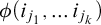 $\phi (i_{j_1}, \ldots i_{j_k})$
is invariant under permutations—then over this set, the ordering can be removed, and thus
$\phi (i_{j_1}, \ldots i_{j_k})$
is invariant under permutations—then over this set, the ordering can be removed, and thus $\phi $
is equivalent to a sentence using only V atoms on models of T, a contradiction of the hypothesis that
$\phi $
is equivalent to a sentence using only V atoms on models of T, a contradiction of the hypothesis that $\phi $
was not
$\phi $
was not $1$
-RQ in T. If T does not have such a set, then there is an order indiscernible I, where the ordering over I is L-definable with parameters from I (see also the proof of Theorem 2.6 in the other appendix). The truth value of
$1$
-RQ in T. If T does not have such a set, then there is an order indiscernible I, where the ordering over I is L-definable with parameters from I (see also the proof of Theorem 2.6 in the other appendix). The truth value of $\phi $
will not depend on which parameters are chosen, so they can be existentially quantified. Thus
$\phi $
will not depend on which parameters are chosen, so they can be existentially quantified. Thus $\phi $
is equivalent to a
$\phi $
is equivalent to a $1$
-RQ formula over models of T, as required.
$1$
-RQ formula over models of T, as required.
Appendix E Details in the proof of Theorem 4.5: Atomless Boolean Algebra is persistently unrestricted
Recall the statement.
No expansion of a theory of an infinite Boolean algebra is $\omega $
-RQC.
$\omega $
-RQC.
Proof. We give the argument for ${\mathsf {ALessBA}}$
, but the reader will see that atomlessness is not crucial. We start by considering one particular extension
${\mathsf {ALessBA}}$
, but the reader will see that atomlessness is not crucial. We start by considering one particular extension ${\mathsf {ALessBA}}^<$
, which we describe as the complete theory of a particular model. In this model we have a distinguished partition of
${\mathsf {ALessBA}}^<$
, which we describe as the complete theory of a particular model. In this model we have a distinguished partition of $1$
into countably many elements
$1$
into countably many elements $E_i$
ordered by a discrete linear order
$E_i$
ordered by a discrete linear order $<$
. We look at the Boolean algebra generated by these sets. Each element of the subalgebra is of the form
$<$
. We look at the Boolean algebra generated by these sets. Each element of the subalgebra is of the form $E_S=\bigcup _{i \in S} E_i$
, where S is a subset of of the natural numbers. We can identify
$E_S=\bigcup _{i \in S} E_i$
, where S is a subset of of the natural numbers. We can identify $E_S$
with the infinite bit strings over
$E_S$
with the infinite bit strings over $\mathbb {N}$
where there is a
$\mathbb {N}$
where there is a $1$
on the
$1$
on the $i^{th}$
bit exactly when
$i^{th}$
bit exactly when $i \in S$
. We order two elements of the subalgebra via the lexicographic ordering on the corresponding strings. Let
$i \in S$
. We order two elements of the subalgebra via the lexicographic ordering on the corresponding strings. Let $\phi _{\cup }$
be the
$\phi _{\cup }$
be the $L_P$
sentence stating that there is an element that is the union of all the other elements. We claim that
$L_P$
sentence stating that there is an element that is the union of all the other elements. We claim that $\phi _{\cup }$
is NFR within
$\phi _{\cup }$
is NFR within ${\mathsf {ALessBA}}^<$
. For a given k we create sets
${\mathsf {ALessBA}}^<$
. For a given k we create sets $U_k$
,
$U_k$
, $U^{\prime }_k$
by letting
$U^{\prime }_k$
by letting $U_k$
include
$U_k$
include $E_i$
for i in a set
$E_i$
for i in a set $S_k$
of natural numbers of size k and also
$S_k$
of natural numbers of size k and also $E_{S_k}$
.
$E_{S_k}$
. $U^{\prime }_k$
consists of
$U^{\prime }_k$
consists of $E_i$
for
$E_i$
for $i \in S_k$
and also
$i \in S_k$
and also $E_{S^{\prime }_k}$
, where
$E_{S^{\prime }_k}$
, where $S^{\prime }_k=S_k\cup \{i'\}$
, where
$S^{\prime }_k=S_k\cup \{i'\}$
, where $i'$
is above every element in
$i'$
is above every element in $S_k$
. The embedded finite subset
$S_k$
. The embedded finite subset $U_k$
satisfies
$U_k$
satisfies $\phi _{\cup }$
, while
$\phi _{\cup }$
, while $U^{\prime }_k$
does not. Let
$U^{\prime }_k$
does not. Let $f_k$
be the identity on
$f_k$
be the identity on $E_i$
for
$E_i$
for $i \in S_k$
and map
$i \in S_k$
and map $E_{S_k}$
to
$E_{S_k}$
to $E_{S^{\prime }_k}$
. Then
$E_{S^{\prime }_k}$
. Then $f_k$
is a bijection from
$f_k$
is a bijection from $U_k$
to
$U_k$
to $U^{\prime }_k$
which preserves all atomic formulas of arity at most k.
$U^{\prime }_k$
which preserves all atomic formulas of arity at most k.
The proof closes as described in the body of the article. We recall the characterization of everywhere Ramsey expansions from [Reference Hrushovski27], which we denote as $(\dagger )$
.
$(\dagger )$
.
For every $M \models T$
every k, and every set of k-tuples A in M, there exists an elementary extension
$M \models T$
every k, and every set of k-tuples A in M, there exists an elementary extension $(M^*, A^*)$
of
$(M^*, A^*)$
of $(M, A)$
containing a copy
$(M, A)$
containing a copy $M'$
of M such that
$M'$
of M such that $A^* \cap M'$
is definable by an
$A^* \cap M'$
is definable by an $L(M)$
formula without parameters.
$L(M)$
formula without parameters.
In [Reference Hrushovski27, Section 5.6], it is shown that ${\mathsf {ALessBA}}^<$
satisfies
${\mathsf {ALessBA}}^<$
satisfies $(\dagger )$
. Now consider an expansion
$(\dagger )$
. Now consider an expansion $M^*$
of a model of
$M^*$
of a model of ${\mathsf {ALessBA}}$
. We can further expand
${\mathsf {ALessBA}}$
. We can further expand $M^*$
to a model of
$M^*$
to a model of ${\mathsf {ALessBA}}^<$
by choosing the ordering appropriately. By a compactness argument, we can assume that
${\mathsf {ALessBA}}^<$
by choosing the ordering appropriately. By a compactness argument, we can assume that $M^*$
is countably saturated: any countable collection of formulas with parameters from the model that is consistent is satisfied in
$M^*$
is countably saturated: any countable collection of formulas with parameters from the model that is consistent is satisfied in $M^*$
. We thus assume
$M^*$
. We thus assume $M^*$
already has this property. Let
$M^*$
already has this property. Let $U_n, U^{\prime }_n, f_n: n < \omega $
be the witnesses above that
$U_n, U^{\prime }_n, f_n: n < \omega $
be the witnesses above that $\phi _{\cup }$
is NFR in
$\phi _{\cup }$
is NFR in ${\mathsf {ALessBA}}^<$
. We will argue that there is a sequence
${\mathsf {ALessBA}}^<$
. We will argue that there is a sequence $Q_n, Q^{\prime }_n, f^{\prime }_n$
witnessing that
$Q_n, Q^{\prime }_n, f^{\prime }_n$
witnessing that $\phi _{\cup }$
is still NFR in
$\phi _{\cup }$
is still NFR in $M^*$
. Fixing n, it suffices, by countable saturation in
$M^*$
. Fixing n, it suffices, by countable saturation in $M^*$
, to show that for any fixed
$M^*$
, to show that for any fixed $\phi _1(\mathbf {x}) \ldots \phi _n(\mathbf {x})$
there are
$\phi _1(\mathbf {x}) \ldots \phi _n(\mathbf {x})$
there are $Q_n, Q^{\prime }_n, f^{\prime }_n$
such that
$Q_n, Q^{\prime }_n, f^{\prime }_n$
such that $f^{\prime }_n$
preserves each
$f^{\prime }_n$
preserves each $\phi _i:i< n$
,
$\phi _i:i< n$
, $(M^*,Q_n) \models \phi _{\cup }$
, and
$(M^*,Q_n) \models \phi _{\cup }$
, and $(M^*, Q^{\prime }_n) \models \neg \phi _{\cup }$
. By
$(M^*, Q^{\prime }_n) \models \neg \phi _{\cup }$
. By $(\dagger )$
there is a copy
$(\dagger )$
there is a copy $M_0$
of a model of
$M_0$
of a model of ${\mathsf {ALessBA}}^<$
in
${\mathsf {ALessBA}}^<$
in $M^*$
, where each
$M^*$
, where each $\phi _i$
intersected with the domain of
$\phi _i$
intersected with the domain of $M_0$
is
$M_0$
is $L(M)$
-definable. The copies of
$L(M)$
-definable. The copies of $U_n, U^{\prime }_n$
in
$U_n, U^{\prime }_n$
in $M_0$
can be taken as witnesses:
$M_0$
can be taken as witnesses: $f_n$
will preserve each n-ary definable set, thus it will preserve each
$f_n$
will preserve each n-ary definable set, thus it will preserve each $\phi _i$
for tuples in the copy.
$\phi _i$
for tuples in the copy.
Appendix F Proof of Theorem 5.6
We recall the statement of Theorem 5.6.
Proposition 5.6. For every formula $\phi (\mathbf {x})$
in the language of fields there is a disjunction of parameterized algebraically-constrained formulas
$\phi (\mathbf {x})$
in the language of fields there is a disjunction of parameterized algebraically-constrained formulas $\phi '(\mathbf {x}, \mathbf {p})$
and a formula
$\phi '(\mathbf {x}, \mathbf {p})$
and a formula $\theta (\mathbf {p})$
such that in every pseudo-finite field M there is some
$\theta (\mathbf {p})$
such that in every pseudo-finite field M there is some $\mathbf {p}_0$
satisfying
$\mathbf {p}_0$
satisfying $\theta $
, and for any such
$\theta $
, and for any such $\mathbf {p} \phi (\mathbf {x})$
is equivalent to
$\mathbf {p} \phi (\mathbf {x})$
is equivalent to $\phi '(\mathbf {x}, \mathbf {p})$
in M.
$\phi '(\mathbf {x}, \mathbf {p})$
in M.
Let $x=(x_1,\ldots ,x_n)$
be an n-tuple of variables, y another. A basic formula is one of the form
$x=(x_1,\ldots ,x_n)$
be an n-tuple of variables, y another. A basic formula is one of the form
 $$\begin{align*}(\exists y) (f_m(x) y^m + \cdots + f_0(x) \wedge f_m(x) \neq 0 \wedge \theta(x,y)), \end{align*}$$
where $\theta (x,y)$
is a quantifier-free formula in the language of rings.
$\theta (x,y)$
is a quantifier-free formula in the language of rings.
Notice that such a formula is algebraically-constrained and does not use parameters. Our first step is to reduce to a Boolean combinations of such formulas.
Proposition F.1. Any formula $\phi (x)$
in the language of field is equivalent, uniformly over finite fields, to a Boolean combination of basic formulas.
$\phi (x)$
in the language of field is equivalent, uniformly over finite fields, to a Boolean combination of basic formulas.
Proof. By absoluteness of arithmetic statements, we may assume $2^{\aleph _0} = \aleph _1$
We will work model-theoretically. It suffices to show that:
$2^{\aleph _0} = \aleph _1$
We will work model-theoretically. It suffices to show that:
if $M,N$
are saturated models of the theory of pseudo-finite fields of cardinality
$M,N$
are saturated models of the theory of pseudo-finite fields of cardinality $2^{\aleph _0}$
,
$2^{\aleph _0}$
, $a \in M^n, b \in N^n$
, and
$a \in M^n, b \in N^n$
, and $a,b$
satisfy the same basic formulas, then there exists an isomorphism
$a,b$
satisfy the same basic formulas, then there exists an isomorphism $f: M \to N$
with
$f: M \to N$
with $f(a)=b$
.
$f(a)=b$
.
Let $A_0$
be the field spanned by a, and
$A_0$
be the field spanned by a, and $B_0$
be the field spanned by b. Then we have an isomorphism
$B_0$
be the field spanned by b. Then we have an isomorphism $f_0: A_0 \to B_0$
.
$f_0: A_0 \to B_0$
.
Let $A_1,B_1$
be the perfect hulls (see [Reference Chatazadakis10]) within
$A_1,B_1$
be the perfect hulls (see [Reference Chatazadakis10]) within $M,N$
, respectively. Extend
$M,N$
, respectively. Extend $f_0$
to
$f_0$
to $f_1:A_1 \to B_1$
: if
$f_1:A_1 \to B_1$
: if $x \in A_1$
, then
$x \in A_1$
, then $x^q=a_0 \in A_0$
for some power q of p. Then
$x^q=a_0 \in A_0$
for some power q of p. Then $M \models (\exists x)(x^q=a_0)$
and it follows that
$M \models (\exists x)(x^q=a_0)$
and it follows that $N \models (\exists y)(y^q = f_0(a_0)$
. Moreover, given the choice of q, y is unique. Map x to y; it is easy to check that this is well-defined and an isomorphism
$N \models (\exists y)(y^q = f_0(a_0)$
. Moreover, given the choice of q, y is unique. Map x to y; it is easy to check that this is well-defined and an isomorphism $A_1 \to B_1$
.
$A_1 \to B_1$
.
We now claim:
If K is any finite field extension of $A_1$
,
$A_1$
, $f_1$
can be extended to have domain K.
$f_1$
can be extended to have domain K.
We prove the claim. For this claim, we may identify $A_1$
with
$A_1$
with $B_1$
via
$B_1$
via $f_1$
, so we can assume
$f_1$
, so we can assume $f_1$
is the identity restricted to
$f_1$
is the identity restricted to ${A_1}$
. If the base field is perfect, then every finite extension is separable. By the theorem of the primitive element,
${A_1}$
. If the base field is perfect, then every finite extension is separable. By the theorem of the primitive element, $K=A_1[c]$
for some element c. The minimal polynomial of c over
$K=A_1[c]$
for some element c. The minimal polynomial of c over $A_1$
can be written as
$A_1$
can be written as $f_m(a^{1/q} ) y^m + \cdots + f_0(a^{1/q}) =0$
, with
$f_m(a^{1/q} ) y^m + \cdots + f_0(a^{1/q}) =0$
, with $f_i$
polynomials over
$f_i$
polynomials over ${\mathbb {Z}}$
. So
${\mathbb {Z}}$
. So $f_m^q(a) y^{qm} + \cdots + f_0^q(a) =0$
. Since b satisfies the same basic formulas as a, we can find
$f_m^q(a) y^{qm} + \cdots + f_0^q(a) =0$
. Since b satisfies the same basic formulas as a, we can find $d \in N$
with
$d \in N$
with $f_m^q(b) y^{qm} + \cdots + f_0^q(b) =0$
, and by basic algebra we have
$f_m^q(b) y^{qm} + \cdots + f_0^q(b) =0$
, and by basic algebra we have $A_1[c] \cong B_1[d]$
.
$A_1[c] \cong B_1[d]$
.
Let $A,B$
be the relative algebraic closures of
$A,B$
be the relative algebraic closures of $A_1,B_1$
in
$A_1,B_1$
in $M,N$
, respectively. We will argue now that
$M,N$
, respectively. We will argue now that $f_1$
extends to
$f_1$
extends to $f: A \to B$
, using Koenig’s tree lemma.
$f: A \to B$
, using Koenig’s tree lemma.
Let $K_1 \leq K_2 \leq \cdots $
be a chain of finite field extensions of
$K_1 \leq K_2 \leq \cdots $
be a chain of finite field extensions of $A_1$
, with
$A_1$
, with $\cup _m K_m = A$
. Consider the tree whose
$\cup _m K_m = A$
. Consider the tree whose $n^{th}$
level is the (finite) set of extensions of
$n^{th}$
level is the (finite) set of extensions of $f_1$
to
$f_1$
to $K_n$
. Similarly
$K_n$
. Similarly $f ^{-1} $
extends to a map g from B to A. Any field homomorphism
$f ^{-1} $
extends to a map g from B to A. Any field homomorphism $gf: A \to A$
over
$gf: A \to A$
over $A_1$
must be surjective, since the restriction of
$A_1$
must be surjective, since the restriction of $gf$
to
$gf$
to $A \cap N$
, with N any finite Galois extension of
$A \cap N$
, with N any finite Galois extension of $A_1$
, is surjective. Hence
$A_1$
, is surjective. Hence $gf$
is surjective, so f is surjective, and so
$gf$
is surjective, so f is surjective, and so $f: A \to B$
is an isomorphism. This completes the proof of the claim.
$f: A \to B$
is an isomorphism. This completes the proof of the claim.
Returning to the proof of the proposition, by [Reference Ax1, Theorem 1] $(M,a) \cong (N,b)$
. This completes the proof of the proposition.
$(M,a) \cong (N,b)$
. This completes the proof of the proposition.
The proof above also shows that any formula is equivalent to a disjunction of conjunctions of a single basic formula and a negated basic formula: the proof of the claim uses just one basic formula, as does the dual direction—i.e., the same claim used from N to M.
Now let us return to the proof of Theorem 5.6. We note that a negated basic formula is equivalent to a disjunction of basic formulas with parameters. For example, consider $\neg (\exists y)(y^2=x)$
. This is equivalent to
$\neg (\exists y)(y^2=x)$
. This is equivalent to $(\exists y)(y^2 \cdot c=x)$
, where c is any element that is not a square (see, e.g., the remarks in [Reference van den Dries17]).
$(\exists y)(y^2 \cdot c=x)$
, where c is any element that is not a square (see, e.g., the remarks in [Reference van den Dries17]).
Also note that a conjunction of basic formulas is an algebraically-constrained formula. This completes the proof of Theorem 5.6.
Appendix G Analogs of Boolean algebras using bilinear forms
We know that NIP theories may not have $1$
-RQC or even
$1$
-RQC or even $\omega $
-RQC (see Example 2). But they have
$\omega $
-RQC (see Example 2). But they have $1$
-RQC when restricting interpretations of V predicates which lie within an order-indiscernible set. Hence isomorphism invariant sentences are well-behaved: contained in order-invariant FO.
$1$
-RQC when restricting interpretations of V predicates which lie within an order-indiscernible set. Hence isomorphism invariant sentences are well-behaved: contained in order-invariant FO.
Atomless Boolean Algebras are an example that is similar to NIP theories, to some extent: they do not have $1$
-RQC or even
$1$
-RQC or even $\omega $
-RQC, but for very specialized interpretations they have
$\omega $
-RQC, but for very specialized interpretations they have $1$
-RQC. Hence isomorphism-invariant
$1$
-RQC. Hence isomorphism-invariant $L_P$
sentences (Monadic uninterpreted signature) are still equivalent to
$L_P$
sentences (Monadic uninterpreted signature) are still equivalent to $1$
-RQ sentences. In this case, the well-behaved instances are not indiscernible bur rather have certain closure properties: namely, they are subalgebras.
$1$
-RQ sentences. In this case, the well-behaved instances are not indiscernible bur rather have certain closure properties: namely, they are subalgebras.
We show similarly phenomena for another basic algebraic example, a vector space with a bilinear form.
Assume T consists of an infinite Abelian group structure $(G,+)$
of finite exponent
$(G,+)$
of finite exponent $p \neq 2$
and a nondegenerate symmetric bilinear form
$p \neq 2$
and a nondegenerate symmetric bilinear form
 .
.
We start by showing that T does not have $1$
-RQC, and does not even have it when we restrict to an indiscernible set. We first note the following proposition.
$1$
-RQC, and does not even have it when we restrict to an indiscernible set. We first note the following proposition.
Proposition G.1. In any model there is an infinite I that is indiscernible and such that ${b}(d,d) =a \neq 0$
for each d and
${b}(d,d) =a \neq 0$
for each d and ${b}(d,c)=0$
for distinct
${b}(d,c)=0$
for distinct $d,c$
.
$d,c$
.
Proof. We show by induction that a finite set of mutual orthogonal elements with ${b}(d,d) \neq 0$
cannot be maximal. Letting A be the span of such a set, it is clear that
${b}(d,d) \neq 0$
cannot be maximal. Letting A be the span of such a set, it is clear that $A^\perp \cap A=\{0\}$
. We can also see that
$A^\perp \cap A=\{0\}$
. We can also see that $A^\perp $
is infinite: considering the standard map g from V to the dual
$A^\perp $
is infinite: considering the standard map g from V to the dual $A^*$
of A, we have
$A^*$
of A, we have $A^\perp $
is the kernel of g. If
$A^\perp $
is the kernel of g. If $A^\perp $
were finite, since
$A^\perp $
were finite, since $A^*$
is finite, we would have that V is finite. But choosing a non-zero element of
$A^*$
is finite, we would have that V is finite. But choosing a non-zero element of $A^\perp $
, we have contradicted maximally. Given that we have an infinite set with
$A^\perp $
, we have contradicted maximally. Given that we have an infinite set with ${b}(d,d) \neq 0$
we can take a subset where the value of
${b}(d,d) \neq 0$
we can take a subset where the value of ${b}(d,d)$
is constant.
${b}(d,d)$
is constant.
We will consider a J interpreting P ranging over finite subsets of I. We refer to this as an orthonormal interpretation below.
The span V of such a $J \subset I$
interpreting P is
$J \subset I$
interpreting P is $L_P$
definable: the span is the same as the orthogonal complement of the orthogonal complement: e is in V if and only if
$L_P$
definable: the span is the same as the orthogonal complement of the orthogonal complement: e is in V if and only if $\forall d$
if
$\forall d$
if ${b}(d,c)=0$
for each
${b}(d,c)=0$
for each $c \in J$
then
$c \in J$
then ${b}(d, e)=0$
.
${b}(d, e)=0$
.
Given an element e of the span of J, consider the set $S_e= \{i \in I ~ \mid ~ {b}(e,i) \neq 0 \}$
. This is a subset of J, and it is easy to see (using the properties of I) that every subset S of J is
$S_e= \{i \in I ~ \mid ~ {b}(e,i) \neq 0 \}$
. This is a subset of J, and it is easy to see (using the properties of I) that every subset S of J is $S_e$
for a unique e in the span, namely, the sum of the elements of S. Thus we can quantify over subsets of J using quantification in
$S_e$
for a unique e in the span, namely, the sum of the elements of S. Thus we can quantify over subsets of J using quantification in $L_P$
.
$L_P$
.
We can also define the parity of a subset S of J modulo p, and in particular, the parity of J itself. Namely, if S is represented by its sum e in the span, then $|S| = a \cdot {b}(e,e)$
modulo p.
$|S| = a \cdot {b}(e,e)$
modulo p.
Using this we see that $1$
-RQC fails even when restricting interpretations to lie inside this indiscernible set. As the trace on J of the first-order structure on G is just pure equality, parity cannot be defined by any first-order logic formula on J.
$1$
-RQC fails even when restricting interpretations to lie inside this indiscernible set. As the trace on J of the first-order structure on G is just pure equality, parity cannot be defined by any first-order logic formula on J.
We now consider restricting interpretations to finite non-degenerate subspaces of a model M of the theory: those for which the form restricted to the subspace is non-degenerate. Any finite set $P_0$
has a finite superset
$P_0$
has a finite superset $P^{\prime }_0$
that is in this class: for any
$P^{\prime }_0$
that is in this class: for any $p \neq 0 \in P_0$
with
$p \neq 0 \in P_0$
with ${b}(p, q)=0$
, for each
${b}(p, q)=0$
, for each $q \in P$
, we throw into
$q \in P$
, we throw into $P_0$
an element
$P_0$
an element $q'$
such that
$q'$
such that ${b}(p, q') \neq 0$
. We then close under addition to get a subspace.
${b}(p, q') \neq 0$
. We then close under addition to get a subspace.
We claim that for interpretations of P lying within this class, the theory has $1$
-RQC. We will use the well-known fact that as a vector space M is the direct sum of P and
$1$
-RQC. We will use the well-known fact that as a vector space M is the direct sum of P and $P^\perp $
. And the bi-linear form structure on the direct sum is determined by its values on the two components. Thus by a standard Fefferman–Vaught argument, any sentence
$P^\perp $
. And the bi-linear form structure on the direct sum is determined by its values on the two components. Thus by a standard Fefferman–Vaught argument, any sentence $\phi $
in
$\phi $
in $L_P$
decomposes into a Boolean combination of sentences
$L_P$
decomposes into a Boolean combination of sentences $\phi _P$
quantifying over P and sentences
$\phi _P$
quantifying over P and sentences $\phi ^\perp _P$
over
$\phi ^\perp _P$
over $P^\perp $
, uniformly in P. But
$P^\perp $
, uniformly in P. But $P^\perp $
is also a model of the same theory, and thus by completeness its theory does not depend on P. Thus we can reduce to a
$P^\perp $
is also a model of the same theory, and thus by completeness its theory does not depend on P. Thus we can reduce to a $1$
-RQ sentence. The argument for open formulas is similar.
$1$
-RQ sentence. The argument for open formulas is similar.
We combine the above two arguments above to conclude the following proposition.
Proposition G.2. If we restrict interpretations of P to be orthonormal, then every $L_P$
sentence is equivalent to a
$L_P$
sentence is equivalent to a $2$
-RQ one. Since every interpretation can be mapped to an orthonormal one, we have every
$2$
-RQ one. Since every interpretation can be mapped to an orthonormal one, we have every $L_P$
isomorphism-invariant sentence is equivalent to a
$L_P$
isomorphism-invariant sentence is equivalent to a $2$
-RQ one.
$2$
-RQ one.
Proof. Fix $\phi $
in
$\phi $
in $L_P$
. We let
$L_P$
. We let $\phi ^*$
be such that for any P in the class,
$\phi ^*$
be such that for any P in the class, $\phi $
evaluated over P is the same as
$\phi $
evaluated over P is the same as $\phi ^*$
evaluated over
$\phi ^*$
evaluated over $P^*$
equal to the span of P. P is definable within its span, so
$P^*$
equal to the span of P. P is definable within its span, so $\phi ^*$
can easily be created. There is a
$\phi ^*$
can easily be created. There is a $1$
-RQ formula
$1$
-RQ formula $\phi '$
that is equivalent to
$\phi '$
that is equivalent to $\phi ^*$
over non-degenerate subspaces. In the orthonormal case, the span of P is a non-degenerate subspace, thus
$\phi ^*$
over non-degenerate subspaces. In the orthonormal case, the span of P is a non-degenerate subspace, thus $\phi '$
evaluated over
$\phi '$
evaluated over $P^*$
is equivalent to
$P^*$
is equivalent to $\phi ^*$
over
$\phi ^*$
over $P^*$
. However the span of P is clearly restricted-quantifier second-order definable over P. Thus replacing
$P^*$
. However the span of P is clearly restricted-quantifier second-order definable over P. Thus replacing $P^*$
in
$P^*$
in $\phi '$
by the RQ second-order definition shows that we have
$\phi '$
by the RQ second-order definition shows that we have $2$
-RQC when restricting to embedded finite models in this class.
$2$
-RQC when restricting to embedded finite models in this class.
Note that this contrasts with the case of pseudo-finite fields, where isomorphic-invariant sentences can be extremely complex (see Theorem 5.1).
Continuing the analogy with Atomless Boolean Algebra, we show that the theory does not have $\omega $
-RQC: obviously, using queries that are not isomorphism-invariant.
$\omega $
-RQC: obviously, using queries that are not isomorphism-invariant.
We proceed in the same way as for Example 2, Atomless Boolean Algebra, and pseudo-finite fields, by providing an $L_P$
sentence
$L_P$
sentence $\phi $
such that:
$\phi $
such that:
for each k, there are $P_k,P^{\prime }_k$
and a function
$P_k,P^{\prime }_k$
and a function $f_k$
taking
$f_k$
taking $P_k$
to
$P_k$
to $P^{\prime }_k$
such that:
$P^{\prime }_k$
such that: $(M,P_k) \models \phi $
,
$(M,P_k) \models \phi $
, $(M,P^{\prime }_k) \models \neg \phi $
, but
$(M,P^{\prime }_k) \models \neg \phi $
, but $f_k$
preserves all formulas with at most k variables.
$f_k$
preserves all formulas with at most k variables.
Following the terminology given in Definition 4.1, we say that the formula $\phi $
is NFR.
$\phi $
is NFR.
For simplicity, we will assume $p=2$
in the argument below.
$p=2$
in the argument below.
Consider the sequence of subsets $C_k$
and
$C_k$
and $D_k$
such that
$D_k$
such that $C_k= \{x_1,\ldots ,x_k\}$
with
$C_k= \{x_1,\ldots ,x_k\}$
with ${b}(x_i,x_j)=0$
for each
${b}(x_i,x_j)=0$
for each $i,j \leq k$
, and the
$i,j \leq k$
, and the $x_i$
are linearly independent. The fact that G is infinite implies that such a
$x_i$
are linearly independent. The fact that G is infinite implies that such a $C_k$
exists. Note that
$C_k$
exists. Note that ${b}(x_i, x_i)=0$
, in contrast to the assumption on the set I considered above. Let
${b}(x_i, x_i)=0$
, in contrast to the assumption on the set I considered above. Let $D_k =\{x^{\prime }_1,\ldots ,x^{\prime }_k\}$
with
$D_k =\{x^{\prime }_1,\ldots ,x^{\prime }_k\}$
with $x^{\prime }_i=x_i$
for
$x^{\prime }_i=x_i$
for $i \leq k-1$
and
$i \leq k-1$
and $x^{\prime }_k=-\Sigma _{i \leq k-1} x_i$
. Note that we still have
$x^{\prime }_k=-\Sigma _{i \leq k-1} x_i$
. Note that we still have ${b}(x^{\prime }_k, x^{\prime }_j)=0$
for
${b}(x^{\prime }_k, x^{\prime }_j)=0$
for $j <k$
.
$j <k$
.
Note that in $D_k$
there is an element that is in the span of the remaining elements, but this is not the case in
$D_k$
there is an element that is in the span of the remaining elements, but this is not the case in $C_k$
. It is thus easy to distinguish them with an
$C_k$
. It is thus easy to distinguish them with an $L_P$
formula
$L_P$
formula $\phi $
.
$\phi $
.
Fixing an arbitrary bijection $f_k$
from
$f_k$
from $C_k$
to
$C_k$
to $D_k$
, we next claim that
$D_k$
, we next claim that $f_k$
preserves each atomic formula of size at most
$f_k$
preserves each atomic formula of size at most $k-1$
. Atomic formulas of the form
$k-1$
. Atomic formulas of the form ${b}(\tau _1, \tau _2)=0$
for arbitrary terms
${b}(\tau _1, \tau _2)=0$
for arbitrary terms $\tau _1, \tau _2$
will be true when bindings of variables to either
$\tau _1, \tau _2$
will be true when bindings of variables to either $C_k$
or
$C_k$
or $D_k$
are applied. While formulas of the form
$D_k$
are applied. While formulas of the form ${b}(\tau _1, \tau _2)=1$
are the negation of the equality above, given that
${b}(\tau _1, \tau _2)=1$
are the negation of the equality above, given that $p=2$
. Atomic formulas of the form
$p=2$
. Atomic formulas of the form $\tau _1=\tau _2$
will be preserved when the sum of the sizes of
$\tau _1=\tau _2$
will be preserved when the sum of the sizes of $\tau _i$
is at most
$\tau _i$
is at most $k-1$
.
$k-1$
.
We then claim that for any fixed set J of L formulas, there is k such that $f_k$
preserves the truth of all formulas in J. This follows from quantifier-elimination for the theory, which is argued in [Reference Cherlin and Hrushovski12]. This completes the argument that the theory is NFR, and hence not
$f_k$
preserves the truth of all formulas in J. This follows from quantifier-elimination for the theory, which is argued in [Reference Cherlin and Hrushovski12]. This completes the argument that the theory is NFR, and hence not $\omega $
-RQC.
$\omega $
-RQC.
Although the results above indicate a similarity between this example and Atomless Boolean Algebras, we do not know if this example is persistently unrestricted.
Appendix H Separating RQC levels with NIP theories
In the body of the article we proved that there are theories that are $k+2$
-RQC but not k-RQC. The argument also shows that one can separate
$k+2$
-RQC but not k-RQC. The argument also shows that one can separate $k+1$
from k if one can separate the hierarchy of pure spectra. But the examples we get are not NIP. We mentioned that for NIP theories we can get separation of
$k+1$
from k if one can separate the hierarchy of pure spectra. But the examples we get are not NIP. We mentioned that for NIP theories we can get separation of $2$
-RQC and
$2$
-RQC and $1$
-RQC. This is more evidence that imposing NIP does not tell us much about higher RQC: it does not imply even
$1$
-RQC. This is more evidence that imposing NIP does not tell us much about higher RQC: it does not imply even $\omega $
-RQC (Example 2), and it does not imply that the k-RQC hierarchy collapses.
$\omega $
-RQC (Example 2), and it does not imply that the k-RQC hierarchy collapses.
We now give a separating example. It will be decidable, NIP (in fact stable, which implies NIP), and $2$
-RQC, but not
$2$
-RQC, but not $1$
-RQC. We do not have NIP examples that are
$1$
-RQC. We do not have NIP examples that are $k+2$
-RQC but no k-RQC for
$k+2$
-RQC but no k-RQC for $k>1$
.
$k>1$
.
Let $I_n=[a_n, b_n]: n \in \omega $
be a partition of the natural numbers into intervals, where
$I_n=[a_n, b_n]: n \in \omega $
be a partition of the natural numbers into intervals, where $b_n-a_n =n$
. Let
$b_n-a_n =n$
. Let $g(n)= \Sigma _{i \in I_n} i$
.
$g(n)= \Sigma _{i \in I_n} i$
.
Consider a signature with binary relations E, F, and unary relations ${\mathsf {Max}}$
and
${\mathsf {Max}}$
and ${\mathsf {Min}}$
, and let M be a structure in which E is an equivalence relation with equivalence classes
${\mathsf {Min}}$
, and let M be a structure in which E is an equivalence relation with equivalence classes $C_n$
for each n, where
$C_n$
for each n, where $C_n$
has size
$C_n$
has size $g(n)$
. F is a binary relation such that for each n, F defines a bijection on
$g(n)$
. F is a binary relation such that for each n, F defines a bijection on $C_n$
such that there is one F-orbit of size i for each
$C_n$
such that there is one F-orbit of size i for each $i \in I_n$
.
$i \in I_n$
. ${\mathsf {Min}}$
contains, for each E equivalence class
${\mathsf {Min}}$
contains, for each E equivalence class $C_n$
exactly one element of
$C_n$
exactly one element of $c \in C$
, where c must be in an orbit of size
$c \in C$
, where c must be in an orbit of size $a_n$
.
$a_n$
. ${\mathsf {Max}}$
also contains one element in each
${\mathsf {Max}}$
also contains one element in each $C_n$
, but this time one that lies in an orbit of size
$C_n$
, but this time one that lies in an orbit of size $b_n$
.
$b_n$
.
Formulas in the base language L can express whether the $x_i$
are equivalent, and if they are equivalent whether or not they are a fixed F-distance from each other or from the unique
$x_i$
are equivalent, and if they are equivalent whether or not they are a fixed F-distance from each other or from the unique ${\mathsf {Min}}$
and
${\mathsf {Min}}$
and ${\mathsf {Max}}$
elements in their equivalence-class. One can thus show directly that all types are definable, and thus that M is stable.
${\mathsf {Max}}$
elements in their equivalence-class. One can thus show directly that all types are definable, and thus that M is stable.
The statement $\phi (P)$
that P takes up a whole equivalence class is clearly not definable by a restricted-quantifier formula, so M is not
$\phi (P)$
that P takes up a whole equivalence class is clearly not definable by a restricted-quantifier formula, so M is not $1$
-RQC.
$1$
-RQC.
We now argue that M is $2$
-RQC.
$2$
-RQC.
By a simple ultraproduct argument it suffices to show the following.
Let $M'$
be an ultrapower of M via a non-principal ultrafilter. In
$M'$
be an ultrapower of M via a non-principal ultrafilter. In $M'$
say a subset of the domain is hyper-finite if it is an ultraproduct of finite sets. Let
$M'$
say a subset of the domain is hyper-finite if it is an ultraproduct of finite sets. Let $P_0$
and
$P_0$
and $P^{\prime }_0$
be hyper-finite sets in
$P^{\prime }_0$
be hyper-finite sets in $M'$
such that the expansion of M with P interpreted by
$M'$
such that the expansion of M with P interpreted by $P_0$
and the expansion of M with P interpreted by
$P_0$
and the expansion of M with P interpreted by $P^{\prime }_0$
agree on all restricted-quantifier second-order formulas, where the quantifiers are interpreted to range over hyper-finite subsets of the interpretations of P. Then the expansions with
$P^{\prime }_0$
agree on all restricted-quantifier second-order formulas, where the quantifiers are interpreted to range over hyper-finite subsets of the interpretations of P. Then the expansions with $P_0$
and
$P_0$
and $P^{\prime }_0$
agree on all
$P^{\prime }_0$
agree on all $L_P$
formulas.
$L_P$
formulas.
To show the conclusion, it suffices to construct a back-and-forth. Suppose we have a partial isomorphism h in $M'$
between hyper-finite sets P and
$M'$
between hyper-finite sets P and $P'$
, and an x in
$P'$
, and an x in $M'$
. We will show that we can extend h to include x. Let
$M'$
. We will show that we can extend h to include x. Let $C_x$
be the E-equivalence class of x in
$C_x$
be the E-equivalence class of x in $M'$
. The interesting case is when
$M'$
. The interesting case is when $C_x$
is hyper-finite but not finite, so we assume this below. If
$C_x$
is hyper-finite but not finite, so we assume this below. If $C_x$
does not contain an element of P, then we can map x to an arbitrary infinite equivalence class that does not contain an element of
$C_x$
does not contain an element of P, then we can map x to an arbitrary infinite equivalence class that does not contain an element of $P'$
. So assume that
$P'$
. So assume that $C_x$
contains an element
$C_x$
contains an element $p_0 \in P$
, and let
$p_0 \in P$
, and let $C'$
be the equivalence class of
$C'$
be the equivalence class of $h(p_0)$
. We will also assume that P contains the unique element satisfying
$h(p_0)$
. We will also assume that P contains the unique element satisfying ${\mathsf {Min}}$
and the unique element satisfying
${\mathsf {Min}}$
and the unique element satisfying ${\mathsf {Max}}$
in
${\mathsf {Max}}$
in $C_x$
, since these can be referenced with restricted-quantifier formulas.
$C_x$
, since these can be referenced with restricted-quantifier formulas.
If x has finite F-distance k from some $p \in P$
, then we can map it to the unique element
$p \in P$
, then we can map it to the unique element $x'$
that is k away from
$x'$
that is k away from $h(p)$
in the same direction, and it is clear that this extends h to a partial isomorphism. So we can further suppose P is disjoint from the F-orbit containing x.
$h(p)$
in the same direction, and it is clear that this extends h to a partial isomorphism. So we can further suppose P is disjoint from the F-orbit containing x.
First consider the case where for arbitrarily large k, $C_x$
has an orbit that contains an element
$C_x$
has an orbit that contains an element $p_1$
of P but does not contain any elements in an F-interval of size k around
$p_1$
of P but does not contain any elements in an F-interval of size k around $p_1$
, where by an F-interval we mean a set
$p_1$
, where by an F-interval we mean a set $o, F(o)\ldots F^k(o)$
. Then the same is true for
$o, F(o)\ldots F^k(o)$
. Then the same is true for $P'$
in
$P'$
in $C'$
, since we can talk about the interval around
$C'$
, since we can talk about the interval around $h(p_1)$
with first-order restricted quantifiers. Thus (by saturation)
$h(p_1)$
with first-order restricted quantifiers. Thus (by saturation) $C'$
will contain a hyper-finite F-interval that contains no elements of P, and hence in particular contains an orbit with no elements of P. We can map x into that orbit.
$C'$
will contain a hyper-finite F-interval that contains no elements of P, and hence in particular contains an orbit with no elements of P. We can map x into that orbit.
Now consider the case where there is a bound $k_0$
on the size of a P-free interval in any of the orbits containing a P element within
$k_0$
on the size of a P-free interval in any of the orbits containing a P element within $C_x$
. That is, in orbits which are not P-free, the P elements are very dense. Then there is a second-order restricted-quantifier formula
$C_x$
. That is, in orbits which are not P-free, the P elements are very dense. Then there is a second-order restricted-quantifier formula $\phi (p, p')$
such that for each
$\phi (p, p')$
such that for each $p \in P \phi $
holds of all the
$p \in P \phi $
holds of all the $p' \in P$
that are in the F-orbit of p. The formula quantifies over a partial function taking elements of P to the nearest element of P in terms of F-distance. From this we can find a restricted-quantifier formula that defines the F-orbit of p. Finally, we can use this latter formula to obtain a restricted-quantifier second-order logic formula enforcing that the F-orbit closure of
$p' \in P$
that are in the F-orbit of p. The formula quantifies over a partial function taking elements of P to the nearest element of P in terms of F-distance. From this we can find a restricted-quantifier formula that defines the F-orbit of p. Finally, we can use this latter formula to obtain a restricted-quantifier second-order logic formula enforcing that the F-orbit closure of $C_x$
is not all of
$C_x$
is not all of $C_x$
. Informally the formula says that we “skip a cardinality.” We state that there are
$C_x$
. Informally the formula says that we “skip a cardinality.” We state that there are $p,p' \in P$
such that the cardinality of the F-orbit of
$p,p' \in P$
such that the cardinality of the F-orbit of $p'$
is larger than the cardinality of the F-orbit of p, and there is no
$p'$
is larger than the cardinality of the F-orbit of p, and there is no $p" \in P$
such that the F-orbit of
$p" \in P$
such that the F-orbit of $p"$
has cardinality strictly between that of p and that of
$p"$
has cardinality strictly between that of p and that of $p'$
. Here the restricted second-order quantifiers are existential and the witnesses can be taken to be hyper-finite. Thus the formula will also hold in
$p'$
. Here the restricted second-order quantifiers are existential and the witnesses can be taken to be hyper-finite. Thus the formula will also hold in $P'$
, which allows us to map x.
$P'$
, which allows us to map x.
Acknowledgments
We thank the referees of LICS for many helpful comments.
Funding
This research was funded in part by EPSRC grant EP/T022124/1.


 Open access

