

The example of Pisistratus is already in everyone's minds.Footnote 1
These words appeared in a British intelligence briefing, based on a spy report from Paris, dated 30 May 1794. This was at the height of the Terror, some two months before the overthrow of Robespierre on 27 July (or 9 Thermidor Year II), following assassination attempts made on 22–3 May by two obscure figures, Henri Admiral and Cécile Renault, on the lives of Collot d'Herbois and Robespierre, both key members of the Committee of Public Safety (CPS) then governing France. The report claimed to encapsulate the capital's political mood.Footnote 2 More than a year later, the erstwhile Jacobin radical Xavier Audouin would make the same association. Following his discussion of the Cécile Renault assassination attempt, ‘Modern Pisistratus!’, he exclaimed of Robespierre: ‘He made himself interesting by recounting the dangers that threatened him.’Footnote 3
The Athenian tyrant Pisistratus is not a figure much mentioned by historians of the French Revolutionary Terror. Yet as these references suggest, at that moment his was a name to conjure with, and in this article we seek to understand why. We do so by exploring the entangled connections linking his name with that of Robespierre and, through an unlikely thread evident in a vicious war of words, with that of the duke of York, the commander of British armed forces fighting against France on the northern front. This enables us to bring into conjunction two apparently distinct developments: first, the polemic between Robespierre and York following the French government's notorious decision on 7 Prairial/26 May 1794 to take no British and Hanoverian prisoners of war; second, how that polemic spilled into wider debates in Paris centred around the figure of Pisistratus, debates which allow us to track growing opposition to Robespierre on the charge of tyranny. It will be helpful, in other words, better to understand why at this critical moment in the Terror, Pisistratus was ‘in everyone's minds’.
I
The penchant of Revolutionary statesmen to cite ancient history as guide and reference for their own doings is widely acknowledged. As Marx noted in his The Eighteenth Brumaire of Louis Bonaparte (1852), ‘the revolution of 1789–1814 draped itself alternately as Roman Republic and Roman Empire’.Footnote 4 But Ancient Greece was not forgotten. Indeed, Plutarch's Parallel lives, ubiquitous eighteenth-century school text for the Revolutionary generation, was structured around Romano-Greek comparisons.Footnote 5 Plutarch told the story of Pisistratus and faction-fights in 561 bce against Solon, the great Athenian lawgiver. Pisistratus was an aristocrat who represented the city's poorer inhabitants in the grouping known as the Hill Dwellers (who opposed the Men of the Plains and the Men of the Coast), and he seized power by trickery. Plutarch drew heavily on Herodotus's earlier account:
Wounding himself and his mules, he drove his carriage into the market place with a tale that he had escaped from his enemies, who would have slain him (so he said)… So he besought the people that he might have a guard…Thus deceived, the Athenian people gave him a chosen guard of citizens, of whom Pisistratus made not spearmen but clubmen[.]Footnote 6
Pisistratus subsequently used this force to seize the acropolis and, brushing aside constitutional niceties, to establish himself in power.
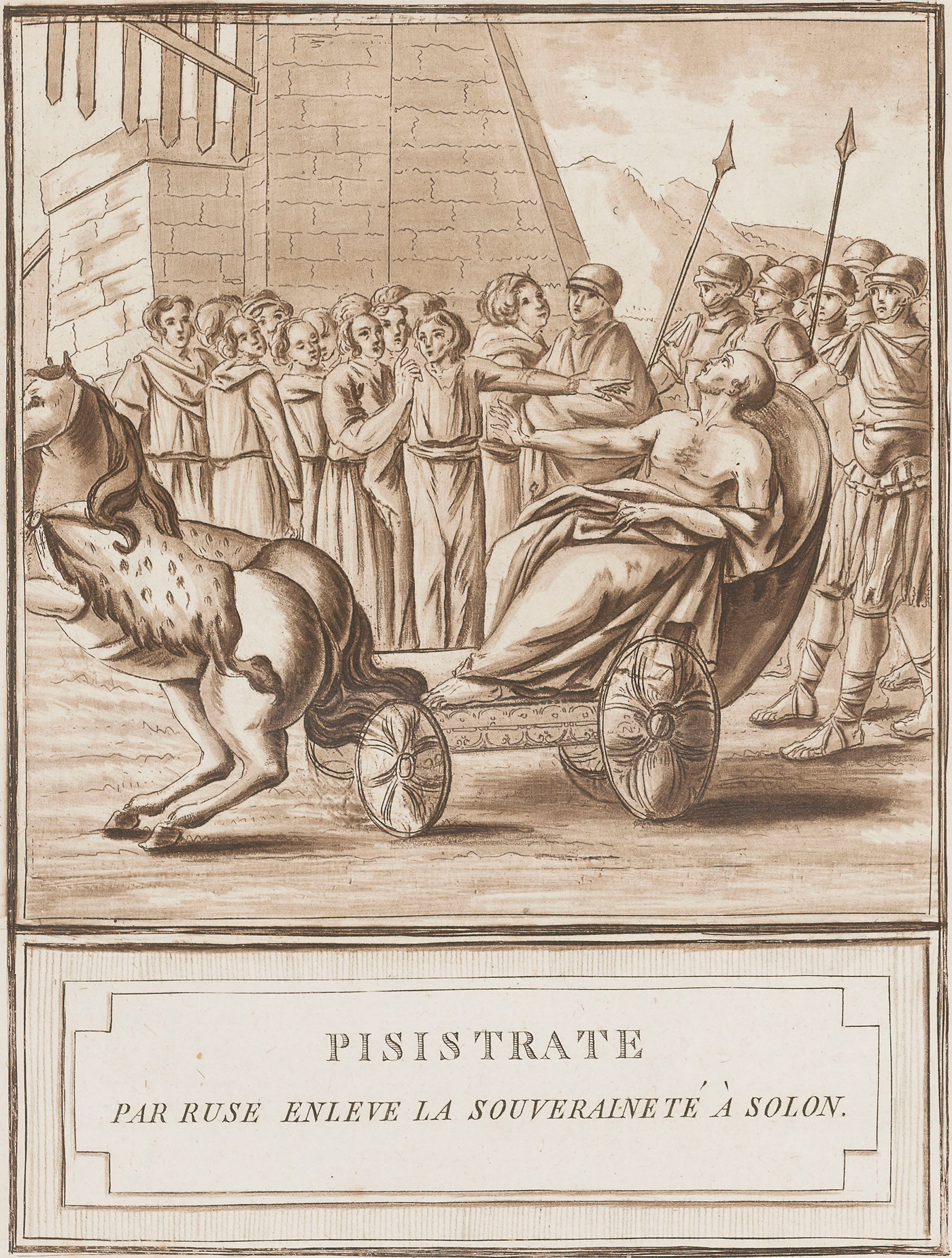
There were worse rulers in ancient history than Pisistratus – he created public works, sponsored the arts, established public festivals, and championed the city's poorer inhabitants. But he was certainly a tyrant. Eighteenth-century readers would have found allusions to him in contemporary as well as classical texts: in Montesquieu, for example, and in Voltaire's Essai sur les moeurs, Mably's Entretiens de Phocion, Marat's Chains of slavery, and Barthélemy's Voyage du jeune Anarchasis en Grèce.Footnote 7 On the eve of the Revolution, Sylvain Maréchal's Histoire de la Grèce, représentée par figures (1787–9) featured an engraving of the ‘ruse’ whereby Pisistratus established his tyranny (Figure 1).Footnote 8
Jean-Marie Mixelle, Pisistrate / Par ruse enleve la souveraineté à Solon, in [Sylvain Maréchal], Histoire de la Grèce, représentée par des figures (n.p. [Paris], n.d. [1787–9]). Engraving, 20·5 × 15·6 cm. Bibliothèque nationale de France, J-3226.
From 1789, Pisistratus's name would occasionally crop up in debates in the Constituent Assembly and Legislative Assembly.Footnote 9 Revealingly, speakers did not need to explain to their listeners who Pisistratus was. His name was not as widely cited in Revolutionary discourse as Cicero or Brutus, for example, and when politicians evoked tyrants, they might instead cite Cromwell, Caesar, Catiline, or various French monarchs. Yet Pisistratus shared the same semantic field.Footnote 10 Allusions to him were within the intellectual compass of any literate French politician worried about the Revolution ending in tyranny.
According to our British spy, Pisistratus came to Parisian minds in May 1794 amid assassination attempts targeting Robespierre and Collot d'Herbois. Collot and Robespierre presented their ‘wounds’ in both the Convention and Jacobin Club, triggering an emotional response.Footnote 11 The whole affair, our spy opined, ‘will serve no little the plans of the Leaders’, who ‘are considering turning it to good account’, to buttress their own authority; furthermore, ‘this attack will serve as a pretext for new cruelties’.Footnote 12
There were worse predictions in the course of the Revolution. Many historians have argued that the Admiral and Renault assassination attempts catalysed state repression, and exacerbated tensions within the Revolutionary Government. The introduction of the notorious law of 22 Prairial (10 June) turbocharged Revolutionary Tribunal convictions.Footnote 13 Even more clearly linked to the political atmosphere following the Admiral/Renault incidents was the infamous law of 7 Prairial (26 May) which stated that ‘English’ and Hanoverian soldiers would not be taken prisoner, but would be executed on the spot.Footnote 14 Barère, the CPS member who introduced the decree, blamed the assassination attempts on British plotting. That line had been elaborated the previous evening in wildly applauded speeches in the Jacobin Club by Robespierre and Collot. The enemy powers had tried, Robespierre noted, ‘calumnies, treasons, arsons, poisonings, atheism, bribery, famine’; now they were resorting to ‘assassination, followed by assassination, and then more assassination’.Footnote 15
The severity of the 7 Prairial law so enthusiastically proposed by Barère and Robespierre was draconian even by the standards of the Terror. It fell way outside the customary conventions of eighteenth-century warfare.Footnote 16 It also up-ended earlier Revolutionary ideals about conflict, notably May 1792 legislation that, in the spirit of the Rights of Man, had safeguarded the rights of prisoners of war, insisting that they should be treated as if they were French nationals.Footnote 17 The law also diverged from recent practice at the front, which had urged blandishments to fellow-patriots labouring under tyrannical governments rather than blood-curdling threats.Footnote 18 Yet internationalist appeals to potential brother sans-culottes were in steep decline. France had claimed to have gone to war in February 1793 against George III, but as the war progressed the distinction between the king and his subjects became increasingly blurred in Revolutionary pronouncements. This was especially as, from late 1793, Robespierre became convinced that a ‘foreign plot’ threatened the Revolution.Footnote 19 Tougher measures than ever before were introduced against enemy non-combatants living in France, culminating in an October 1793 decree ordering the arrest of all the British, Irish, and Hanoverians present in France. Suspicion developed that British and Irish so-called friends of the Revolution in France were acting as spies and subversives, and a number were guillotined as counter-revolutionaries.Footnote 20
The notion that a ‘foreign plot’ was promoting domestic strife in France also threatened to collapse distinctions between the internal enemies in France's civil war – notably, the merciless violence being deployed against the royalist uprising in the Vendée – and the external ones of its international conflicts. Already in September 1793, following an allegation that British forces had killed French prisoners and civilians, the Convention diluted protections to prisoners of war, approving military reprisals corresponding to the barbarity of France's enemies and ‘renouncing henceforth every philanthropic notion’.Footnote 21 Barère, defending this measure, envisaged such violence expansively: though France did not wish to make war ‘as cannibals’, ‘when, for the security of the whole Nation, you are forced, in the Vendée, to burn your own towns, and to annihilate a royalist and fanaticized population, how can you not employ the same means against your foreign enemies?’Footnote 22
Additional polemic against the British was cultivated in debates Robespierre stage-managed at the Jacobin Club in January 1794 on ‘the crimes of the English government, and the vices of the British constitution’.Footnote 23 Robespierre roundly declared that ‘I do not like the English’, describing them as ‘an insolent people’ impudently making war on the French (‘the generous people who have reconquered their liberty’).Footnote 24 With the Prairial assassination attempts, this view further smoothed the way for the Barère decree's bald brutality. The seeming confirmation that Britain was engaged in assassinating enemy politicians demonstrated that it was beyond civilized interchange. Generosity towards the English people, Barère affirmed, was tantamount to lèse-humanité, that is, treasonous acts against the human race: ‘humanity’, Barère insisted, ‘consists in exterminating its enemies: generosity consists in sparing the blood of republicans’.Footnote 25 That there was no dissent in the Convention when the 7 Prairial law was passed demonstrated that this view enjoyed political credibility.Footnote 26 The Convention played to the prevalent mood, ordering that the Barère decree be dispatched to the front accompanied by a separate, even more sanguinary proclamation: ‘When victory presents you with English or Hanoverians, strike; none ought to return to the liberticide lands of Great Britain or to the free soil of France. Let the English slaves perish and Europe will be free.’Footnote 27
When Barère reported to the Convention on 26 June 1793 regarding a series of French victories culminating in the battle of Fleurus, he was cheered rapturously when he pointedly boasted that ‘The English above all are not spared’, and his description of the battle highlighted the point when French forces charged on ‘the redcoats’ with bayonets, ‘instead of taking them prisoner. Not a single one escaped the blows of the republicans.’Footnote 28 On 20 July, a similar note was struck in a report to the French admiralty by the captain of the frigate La Boudeuse, concerning his treatment of a captured British merchant ship: ‘I had the crew brought aboard’, he stated; and then he had them shot, ‘according to the decree’.Footnote 29 Thanks to the 7 Prairial law, a new, savage kind of war seemed to be emerging.
In the event, however, the unsparingly anti-British turn in the war's conduct proved chimerical, and the La Boudeuse affair is the only known example where the 7 Prairial law was unequivocally implemented. There were no land-based incidents – Barère's notorious hyperbole in speeches reporting military affairs makes the Fleurus example suspect. Furthermore, the law seems to have elicited opposition even within the CPS. In particular, Lazare Carnot, the CPS member most responsible for the war effort, prioritized showing no mercy towards French émigré troops over exterminating the British.Footnote 30
Historians have long maintained that there was little appetite for implementing the 7 Prairial law at the front either, ascribing this to an ingrained sense of humanity among French troops.Footnote 31 Our research revisits this question, however, and suggests that the British played a role in deterring the French from putting the law into practice, by dint of an official Declaration from the commander in chief of British forces in Flanders, Frederick Augustus, duke of York, second and favourite son of George III. News of the 7 Prairial law had not taken long to reach the British army at the front. Colonel Harry Calvert, an officer on York's staff involved in intelligence matters, will have seen spy reports in late May that ascribed the unwillingness of French soldiers to desert to their conviction that ‘those who are made prisoners [by the British] are murdered’.Footnote 32 Calvert had noted on 6 June that hand-bills containing the Convention's decree had been distributed throughout the French army, and he now grasped how the British might turn the 7 Prairial law to advantage:
I think that by moderation much good may accrue to us from this manoeuvre of the Convention. By disclaiming any idea of following an example so atrocious, we may awaken the sparks of honour yet remaining in the French army, and point out to what an extent it is made the tool of its sanguinary employers.Footnote 33
Accordingly, the next day, York issued a Declaration in riposte to the Convention's decree. This overtly propagandistic document restated the British commitment to the traditional policy of taking prisoners rather than massacring them. Drafted by the army's adjutant-general, Colonel James Craig, seemingly under close direction from York himself, it was to be read and explained to the British forces at their roll-call in an explicit response to Barère's decree.Footnote 34 Frequently evoked in historians’ accounts, the York Declaration has never to our knowledge been located or analysed. We have identified the manuscript ‘authentic copy’ sent by Craig to London to serve as an official record, and we base our analysis on this document.Footnote 35
The Convention, the York Declaration stated, ‘pursuing that gradation of Crimes and Horrors which has distinguished the period of its Government as the most calamitous of any that has yet occurred in the History of the World, has just passed a Decree, that their Soldiers shall give no Quarter to the British and Hannoverian Troops’. While York anticipated the ‘indignation & horror’ which this would naturally elicit among the ‘Brave Troops’ of his army, he instructed that they should nonetheless continue to take prisoners. Declaring that ‘mercy to the vanquished is the Brightest Gem in a Soldier's character’, moreover, he exhorted his men ‘not to Suffer their resentment to lead to any precipitate act of cruelty on their part which may sully the reputation they have acquired in the World’. ‘Humanity and kindness’ had always characterized relations between soldiers of the two nations once conflict ended, and even during wartime had been extended to their wounded.
York thus sought to drive a wedge between France's political leaders in Paris and its army: ‘it will be difficult for brave Men to conceive, that any set of Men who are themselves exempt from sharing in the dangers of War, should be so base and Cowardly as to seek to aggravate the calamities of it upon the unfortunate people who are subject to their orders’. He invoked an unwritten sense of military honour as the basis for believing that French soldiers could not possibly so far ‘forget their characters as Soldiers, as to pay any attention to a Decree as injurious to themselves, as it is disgraceful to the persons who passed it’. York expressed confidence that soldierly solidarity would trump French obedience to the Convention's orders: ‘the Soldiers of both Nations will confine their sentiments of resentment and abhorence to the National Convention alone’. No ‘Frenchman, who possesses one spark of Honor or one principle of a soldier’ could, he trusted, do otherwise.
Despite this upbeat note, York ended with an explicit threat about what would result if Barère's decree were observed by the French army. With words that echoed the infamous Brunswick Declaration in August 1792,Footnote 36 he promised punitive retaliation and escalation:
the French army alone will be answerable for the Tenfold Vengeance which will fall upon themselves their Wives and their Children, and their unfortunate Country, already groaning under every calamity which the accumulated crimes of unprincipled ambition and avarice can heap upon their devoted Victims[.]
The York Declaration was thus an artful combination of carrot and stick. It offered humane treatment to those French soldiers who showed humanity to their British opponents in the customary manner. Yet it threatened fire and brimstone for combatants and non-combatants alike if French troops obeyed the 7 Prairial law. French troops may well have appreciated the Declaration's chivalrous generosity of spirit – but would also have been understandably apprehensive about their own well-being and that of their comrades and in many cases their families too if they chose to obey the Convention's orders. The principle of symmetry in handling prisoners of war was long established in international law: extending mercy to prisoners legitimated the expectation of reciprocal treatment – and, conversely, excessive violence towards them justified receiving the same in return.Footnote 37 Fear of reprisals ranked alongside humanity and chivalry as considerations.
The military frontline was more permeable than the manichean rhetoric of the political principals in Paris imagined. Between the two armies, there existed a kind of contact zone wherein illicit communication occurred and rumour throve.Footnote 38 The British appear to have been rather imaginative in their stratagems for getting propaganda tracts across the lines, at one point even countenancing using aerial bombardment from balloons.Footnote 39 On the occasion of the Declaration, Craig explicitly stated that copies of the document were to be printed for frontline dissemination, so as ‘to fall into the hands’ of the French troops and thereby to increase ‘the discontent of their Army’Footnote 40 – although we do not know the ruses employed. A French source later recorded that he had personally seen a copy of the Declaration at the army's headquarters in Guise.Footnote 41 British evidence confirms the Declaration's diffusion on the French side. On 6 June, Craig passed on reports of the law's unpopularity, especially among the French cavalry; on 17 June, he noted that ‘Some Prisoners taken this day say that the order for not giving Quarter to the British & Hanoverians has been publickly rescinded’ in the French army, ‘and in very strong terms’.Footnote 42 The evidence we have thus points to the law being widely disregarded by French soldiers. One British officer's memoirs later stated that York's Declaration ‘carried to the French posts’, ‘produced considerable effect, and the French officers took every opportunity of declaring that they disregarded Robespierre's sanguinary edict’.Footnote 43 The anonymous account of another British soldier states that the 7 Prairial law ‘never met with any approbation from the French army, who, on most occasions, behaved with the greatest kindness and liberality to the British troops, whom the chance of war threw into their hands’. He concluded that this ‘may partly be attributed’ to the ‘admirable Manifesto published on the occasion’ by York.Footnote 44
Besides impacting upon the French army, the York Declaration was aimed at influencing international public opinion. The manuscript ‘authentic copy’ of the Declaration sent to London was intended for press dissemination. Craig suggested publication in The Sun, a newspaper friendly to the government, and the Morning Chronicle, an opposition newspaper of which copies were known to reach France.Footnote 45 In the event, the text was initially carried on 16 June in The Times, another paper close to government, and the Morning Chronicle.Footnote 46 Numerous other British publications subsequently reported it.Footnote 47 The law's wide media resonance confirmed the British reading public in the barbarity of the French Revolutionary state, a cherished theme in counter-revolutionary propaganda.Footnote 48
Craig also intended the York Declaration to insinuate itself within French public opinion. Here too his efforts met with success. The Declaration soon appeared in French translation in newspapers on the continent. The Brussels-based Journal général de la guerre printed it on 14 June, for example, followed by the Courrier belgique (16 June), and the Gazette de Leyde (20 June). The British-based but francophone Courier de Londres and Correspondance politique carried it on 17 and 19 June respectively. But arguably the Declaration registered its greatest propaganda success by being picked up and attacked by no less a figure than Robespierre.
The Declaration had been packaged with some deliberately anti-Robespierre jibes. It scorned the idea – ‘too absurd to be Noticed, and still more to be refuted’ – that the British were engaged upon the selective assassination of Revolutionary leaders, as both Barère and Robespierre had claimed in Paris. Such a view, the Declaration contended, was just a manoeuvre to increase domestic repression. If there were a tyrant involved, it was not King George III, but Robespierre, who was tilting for the status of monarch. ‘The French must themselves see through the flimsy artifice of a pretended assassination by which Robespierre has succeeded in procuring that Military Guard which has at once established him the successor of the unfortunate Louis, by whatever Name he may choose to dignify his future Reign.’ By such Machiavellian manoeuvrings, including equipping himself with a personal bodyguard, Robespierre was preparing to join the ranks of political tyrants.
Robespierre, ever watchful regarding his personal reputation, rose to the bait. On 21 June, he introduced the topic at the Jacobin Club. His phrasing implied that the Declaration was not yet known to his audience: ‘I come to make known to you and to lay before your eyes a sort of proclamation published in the British forces, by order of the so-called duke of York.’Footnote 49 Robespierre then turned mouthpiece for the Declaration, reading out passages and commenting on them. Journalists following the debate, but presumably lacking the text of the Declaration themselves, carried Robespierre's speech only in précis form. The Moniteur reported:
Robespierre read out this proclamation, coated in all the distinctive character and perfidious cunning and low villainy of tyrants. Although most contemptible in itself, he continued, it is not inopportune to add a short commentary.
He immediately took it up again line by line, and gave an energetic discussion to each point of view it presents whilst covering each with all the indignation of angered integrity, or with all the ridicule that ill-disguised baseness brings upon itself. Every word of the orator was worth a sentence, every sentence a speech, given how much sense and energy he packed into everything he says.Footnote 50
The core of Robespierre's refutation of York's argument was that the inherited principle of clemency (‘clémence’) towards enemy troops was obsolete. In March and April 1794, Robespierre had been the most vehement opponent of the indulgence and clémence towards the Terror shown by Georges Danton, Camille Desmoulins, and their other alleged co-conspirators in notorious factional trials.Footnote 51 As within France then, so without France now. Soldiers in opposing armies may have been merciful to each other in the past. But this had now become impossible, Robespierre held. In present circumstances, there could be no common ground between ‘the soldiers of liberty and the slaves of tyranny’. Ruled by a tyrannical king, England had become a tyrant among nations.
Robespierre argued that York was guilty of rank hypocrisy, moreover, in giving his Declaration a humanitarian sheen. ‘Yorck talks of humanity! What! Yorck, a tyrant, a soldier of George, the orator of a government which has filled the universe with its crimes and its infamies…How odious is a tyrant therefore while he talks of humanity!’Footnote 52
Robespierre was correct in perceiving the Declaration as aimed at inciting disobedience among French soldiers and dividing the army from government. His antagonism towards York's ‘plan of division’ may have been exacerbated by awareness that the law was not being strictly enforced at the front, and he may have thought it prudent to issue a pre-emptive riposte to the Declaration before it gained traction in France. Yet by attacking the Declaration before anyone much in Paris had even heard of it, Robespierre was also becoming its amplifier in the public sphere. This was all the more significant, moreover, in that the Declaration had personalized its attacks on Robespierre himself. The manner in which the document spotlighted his own personal conduct and putative ambitions, and blamed him for all Revolutionary ills, caused him intense and unfeigned irritation. ‘And what is the meaning of this preference that the duke of York gives to me?’, he expostulated. ‘I thought I was a French citizen’, and yet ‘he makes me king of France and Navarre.’ (The latter words are in fact not found in the Declaration.) He did not wish to descend, he stated, from the heady heights of French citizenship to be abased by being placed on the throne by ‘tyrants and their henchmen’.Footnote 53
The sarcasm was a little too heavy in this passage, however, the tone a little too imperious, the rewording of York's phrases a little too random, for the speech not to suggest that Robespierre was personally nettled. His annoyance extended to the question of a supposed military guard that accompanied him. This was just mendacious: ‘The duke of York adds that I am surrounded by a military guard. As you can see’, he noted with dripping sarcasm, ‘it is a most constant fact.’Footnote 54
The bodyguard issue was particularly moot, since at the 25 May session of the Jacobin Club in which Robespierre and Collot were acclaimed for surviving assassination attempts, Robespierre had specifically rejected proposals that he and the Convention should be given an armed guard. The suggestion seems to have emerged from the Paris sections: in petitions sent to the Convention responding to news of the attempted assassinations, the Cité and Chalier sections urged ‘an elite guard’ or ‘a sacred battalion’ to protect the whole assembly, while the Montblanc section proposed that the committees of government be placed in the Louvre under ‘a shield’ of sans-culottes.Footnote 55 But when the matter was raised at the Jacobin Club, the fact that these motions were supported by fellow-Jacobins such as the maverick Alexandre Rousselin, whose political motives Robespierre suspected, made him rule such ideas completely out of court.Footnote 56 His ally, René-François Dumas, president of the Revolutionary Tribunal, produced an appropriate echo, stating that the Convention would never abide such a guard, even ‘were it to have the name of guard of friendship’.Footnote 57
This war of words, venomously and vicariously conducted between Robespierre and York, played into established political tropes. When introducing the 7 Prairial law at the Convention, Barère had noted how British propaganda depicted Robespierre as effective dictator and putative king of the French, making him personally responsible for the CPS's policies and the war's conduct. Robespierre himself, in concluding discussion at the same sitting, observed that ‘calumnies’ were among the disreputable techniques of war directed against the republic and its leaders.Footnote 58 Conversely, in personalizing his attack on York, Robespierre was targeting a key bugaboo of Revolutionary propaganda.
Along with British Prime Minister William Pitt and commander of allied forces, the duke of Saxe-Coburg, York was a storied figure in French polemics revolving around counter-revolutionary plots and foreign subversion – and a caricaturist's dream: a 1794 print, for example, commissioned as CPS propaganda, shows him being unceremoniously spanked by the French General Pichegru, with the duke, bedecked with ass's ears, revealing the coat of arms of England tattooed onto his rear.Footnote 59 His notoriety in France went back to January 1792 when the radical journalist Jean-Louis Carra had proposed York's candidacy to the French throne as a possible substitute for Louis XVI, in the event that the latter again attempted flight, on the grounds that this dynastic link could pre-empt armed conflict against Britain.Footnote 60 The idea provoked consternation at the time, and re-emerged with a vengeance as a charge against Carra (by then a member of the Convention) in the febrile atmosphere of August 1793. With a republic declared, France and Britain at war, and York directing a British army on French soil, Robespierre lambasted Carra for having ‘constantly pursued the project of placing a prince of England on the French throne’.Footnote 61 In further polemics, York became viewed as the British government's preferred candidate for the French throne and as central to a web of counter-revolutionary intrigue – including assassination plots.Footnote 62 Another item was added to the charge-sheet against York in early 1794 with the uncovering of an unsavoury financial episode from 1790, whereby he and his two royal brothers, the prince of Wales and the duke of Clarence, had borrowed heavily on the Paris finance market. The loan venture was represented in the Convention as a ‘conspiracy formed by the court of London’, with it being taken as axiomatic that ‘a borrowing by the three sons of George’ was ‘doubtless directed by Pitt’. In an imaginative manoeuvre, the perfidious British were subverting the republic with money which had been borrowed in France.Footnote 63
Given this pedigree, ridiculing York's claims to humanity was an easy task, even for an orator as humourless as Robespierre. York was called many things in the 1790s – it was he after all who would be ridiculed forever in English folk song as the ‘Grand Old Duke’ who marched his men ‘up to the top of the hill’ and then ‘down again’ – but humane is not one of them, even if sometimes the word did pass his lips.Footnote 64 His calls for surrender in the sieges of Valenciennes and Dunkirk during the summer of 1793, for example, had been laced with talk of ‘humanity and generosity’ – even as he threatened the cities with ‘irremediable ruin’ if they continued to resist.Footnote 65 Moreover, York had a poor reputation for humane conduct even toward his own troops. The artist Joseph Farington, who visited the British forces in Flanders in 1793, wrote that York ‘was said to have unnecessarily or injudiciously exposed his troops to slaughter and that He had used improper expressions showing much levity as that: “He had bled His troops to prove their quality”, and such like ill considered words’.Footnote 66 One British radical broadside, satirizing the 1794 campaign, dubbed York a ‘Kill-’Em-All’ whose bloodthirstiness had backfired on his own troops while the opposing French army had triumphed.Footnote 67 At the time of his verbal sparring with Robespierre, moreover, the fortunes of the allied armies were at a low ebb following York's recent defeat at Tourcoing: ‘disasters have followed disasters’, was one military estimate.Footnote 68 In some ways, therefore, one might see the 7 Prairial decree as a propaganda gift to a beleaguered and unpopular commander. It gave York opportunity to claim moral high ground even as the British were coming off worse in the military struggle.
If, as we shall see, the war of words continued, the dramatic effort to transform the conduct of war had fizzled out. This received confirmation from an unlikely source – from Robespierre himself, in his last great speech before the Convention, on the eve of 9 Thermidor. Denouncing the leadership of the French war effort (in the scarcely veiled form of his CPS colleague Carnot), and repeatedly going out of his way to insult York, he noted angrily that ‘your decree against the English has been eternally violated; England, so manhandled by our speeches, is spared by our arms’.Footnote 69 The Terror was not being carried out as it should be in Robespierre's opinion against France's external enemies.
Robespierre's earlier attack on York on 21 June had, moreover, been given an additional twist three days later, when he launched a tirade at the Jacobin Club about how his speech had been misreported in the press. In particular, he bitterly attacked the editors of the Moniteur for composing ‘sycophancies and inaccuracies’.Footnote 70 Press coverage of his anti-York speech, he stated, was a complete misrepresentation. He reproved the newspaper in particular for the over-the-top flattery of a comment regarding the speech: ‘every word was worth a sentence, every sentence a speech’. According to Robespierre, treating him as special in this way played up to York's claims. He further reproached the reporter for failing to detect the irony with which he had treated York's allegation that he had a military guard. Many readers, he complained, would have missed the throwaway irony of the statement, ‘The duke of York adds that I am surrounded by a military guard. As you can see, it is a most constant fact’, and would have assumed that Robespierre was speaking the unvarnished truth.Footnote 71
The Moniteur would defend itself by pointing out that its account had been taken word-for-word from the Journal de la Montagne, the Jacobins’ own in-house newspaper, and that they had left in the piece of flattery at which Robespierre protested inadvertently.Footnote 72 But this was not good enough for Robespierre, who expressed a fear that France's advantage on the battlefield might be sabotaged by false friends and covert enemies within the print media. The press was intimately bound up in factionalism and treachery:
Whosoever has ideas about the Revolution and its enemies must grasp their tactic. They have several, but one of the simplest and most powerful is to mislead public opinion about principles and about men. This is why newspapers always play a role in revolutions. Their enemies have always had writers in their pay.Footnote 73
This general sentiment was of a piece with the views on censorship that Robespierre expressed on numerous occasions. In the circumstances, one can well understand the reaction of many newspaper editors in seeking Robespierre's imprimatur before publishing his speeches.Footnote 74 But this does not explain why he should have been so sensitive about the issue of the military guard. Perhaps, we surmise, there was an unavowed reason behind Robespierre being rattled. Perhaps at that moment, Robespierre realized, as our British spy had announced, that the story of Pisistratus – whose exemplary use of a military guard to seize personal power was well known – was in ‘everyone's minds’? And even if the example of Pisistratus was not in ‘everyone's’ minds, there were grounds for thinking that it was lurking in the minds of Robespierre and his political enemies. For, as we shall now explore, Robespierre's enemies had begun to equate him with Pisistratus.
II
When the feckless twenty-year-old Cécile Renault was interrogated by the Committee of General Security about why she had sought access to Robespierre armed with two knives (admittedly only penknives), she stated that ‘I only went to Robespierre's home to see what a tyrant looked like.’Footnote 75 Robespierre could hurl the charge of tyranny against the English nation; but such an incident underlined that the charge of aspiring to supreme power was coming from domestic as well as foreign sources. Accusations even surfaced in the CPS if we can believe later accounts: it seems to have been in Prairial that Carnot, for example, was said to have rounded on Robespierre and Saint-Just and dubbed them ‘ridiculous dictators’.Footnote 76 Various issues, including the 22 Prairial law forced through the Convention by Robespierre and his allies, seem to have been in contention. It was indeed from June onwards, according to the liberal historian François-Auguste Mignet, that Robespierre's CPS colleagues began to suspect him of planning a tyrannical coup d’état. ‘Amongst themselves’, he wrote in his 1824 history of the Revolution, ‘they called him Pisistratus’, and ‘this name passed from mouth to mouth’.Footnote 77 Pisistratus, apparently, had become a coded way of referring to Robespierre.
This association may well have started earlier. For the name of Pisistratus and its specific reference to Robespierre had already served as a kind of shuttlecock in the factional strife of late 1792 and early 1793. Allegations of tyrannical aspirations had ever been a leitmotiv in Revolutionary discourse, and indeed before Robespierre gained an ascendant position in the Convention he was constantly charging political opponents with tyrannical tendencies. In October 1792, he had been involved in opposing the Girondin demand that the Convention, to secure itself against the Parisian sans-culottes, should have an armed bodyguard, a covert means of preparing a coup d’état – very much in the style of Pisistratus.Footnote 78 ‘Why an armed force? The only guard for the Convention is the people's love’, proclaimed the Montagnard Bentabole, while Tallien attacked the idea as equivalent to reviving Louis XVI's personal bodyguard (‘une garde de parade’) or Rome's imperial force (the ‘garde prétorienne’). In December 1792, during a stormy Convention debate over the fate of the duke of Orleans, Robespierre became involved in an altercation with his Girondin opponents, whom he accused of plotting to seize power. This triggered tumultuous scenes where Robespierre was shouted down. In one account, an unnamed deputy was recorded as yelling out that Robespierre was ‘the ape of Pisistratus’ (le singe de Pisistrate).Footnote 79 In an article published in January 1793, Robespierre sought to bat back the Pisistratus comparison to his Girondin opponents. Dipping into the politics of ancient Athens – Rome and ancient Sparta were his more normal frames of reference – he highlighted the risk of seeing ‘the tyranny of Pisistratus arise’ on the ruins of ‘short-lived and insecure legislation’. This would have been the fate of France, he argued, had it not been for the sovereign people's intervention on 10 August 1792.Footnote 80 As Anne Simonin has shown, a concern with preventing Revolutionary government from transforming into (or facilitating the advent of) military dictatorship lay at the heart of Robespierre's thinking.Footnote 81 It was probably good sense, however, given the ‘ape of Pisistratus’ jibe, for Robespierre himself not to over-use the example of Pisistratus. Yet Robespierre's Girondin critics did not slacken in pursuing Robespierre for tyrannical intent. Articles in pro-Girondin journals such as the Bulletin des amis de la vérité and the Chronique du mois poured scorn on Robespierre who they alleged sought to become a latterday Solon, serving ‘for arbitrator, for judge, and for drafting a constitution’. But had not Solon subsequently become ‘the friend and partisan of Pisistratus’?Footnote 82
The expulsion of the Girondins in the journées of 31 May and 2 June 1793 did not, moreover, erase the image of Robespierre as ‘the ape of Pisistratus’, although once he became a member of the CPS in July 1793 the epithet was doubtless deployed more cautiously.Footnote 83 It returned into vogue by the spring of 1794, when in a factional struggle Robespierre and his allies worked to send their political enemies to the guillotine. Among the Indulgents in the Dantonist faction was Camille Desmoulins, journalist, deputy, and Robespierre's old school-friend, who would be executed on 10 April 1794. In an unpublished fragment, which almost certainly reached the ears of Robespierre and the Revolutionary Government, Desmoulins praised Athenian democracy and reserved tough words for Pisistratus.
The confidence of the sans-culottes went so far as to furnish Pisistratus with the power to subjugate them supremely: just to have conspired against his life became a crime of treason, and thereafter he was a complete tyrant: so it goes whenever conspiring against a man becomes equated to conspiring against the republic; whenever the people is represented by citizens so ill-informed about their task as to tie themselves to doctrines, or to the reputation of a single individual, no matter how good a sans-culotte he might seem to them.Footnote 84
The allegory could not be clearer: the Athenian people were equated with the sans-culottes, while if the man these had brought to power and adulated was not named, it was clearly Robespierre. Although the latter might appear to have the values of a good sans-culotte, in reality he aspired to tyranny.
Desmoulins was not alone in citing the Pisistratus comparison, as Robespierre's ally Saint-Just was to attest. It had currency at the heart of a CPS itself increasingly riven by faction. Saint-Just's undelivered speech in defence of Robespierre on 9 Thermidor contained a critique of the recent behaviour within the CPS of Billaud-Varenne, who had shaped up as one of Robespierre's sternest critics. Dramatically breaking the confidentiality of the CPS's inner workings, Saint-Just portrayed Billaud as always muttering, ‘We are walking on a volcano’, and evoking the name of Pisistratus among the dangers facing the Revolution. Billaud ‘called such a man when absent [understood to be a wry reference to Robespierre] Pisistratus, today when present, he was his friend’. He alternated between the words ‘Pisistratus’ or ‘dangers’, Saint-Just claimed. Seemingly, on 5 Thermidor, when an attempt had been made to heal the rift between Robespierre and the rump of the CPS, ‘Billaud-Varenne said to Robespierre: we are your friends; we have always walked together. This two-facedness’, Saint-Just wrote, ‘made my heart shudder. The day before he had called him Pisistratus, and had drawn up his bill of indictment.’Footnote 85
In a stepped, ongoing process, Pisistratus had thus become a code-word by which Robespierre's enemies evoked his ambitions for supreme power. Reference to a Greek tyrant will have seemed more appropriate for Robespierre rather than a military-style dictator on the English (Cromwell) or else the Roman model that seems to have been foremost in Robespierre's own mind.Footnote 86 But the Athenian identification rested on a number of other points of comparison. If Pisistratus represented the Hill Dwellers, for example, Robespierre for his part was of course a member of the Montagne (‘Mountain’) in the Convention.Footnote 87 Furthermore, like Pisistratus, Robespierre's support lay among the popular classes; he had been swept into government in 1793 amid a wave of sans-culotte enthusiasm. And long before his arrival in the CPS, this champion of the people deployed an egalitarian language to seek popular endorsement for his policies. His role as ideologist and originator of the Cult of the Supreme Being inaugurated on 10 June 1794 constituted another point of rapprochement, for Pisistratus was known for having created and sponsored public festivals. Indeed, Mignet reports that Robespierre's enemies in government feared that the inauguration of the Cult of the Supreme Being would be the moment that Robespierre seized power. This did not transpire, although Robespierre's leading role that day brought many of his colleagues into open hostility against what they took to be his apparent narcissism, self-seeking arrogance, and political ambition.Footnote 88
The ruse which Pisistratus used to seize power – mutilating himself and then using his wounds to attract sympathy and protection among the people – also had strong Robespierrist resonance. The British spy we cited at the beginning of this article suggested that Robespierre would use the supposed danger of assassination in early Prairial to make political capital, cultivate popular support, and strengthen his position. His speeches in the Convention and the Jacobin Club at that juncture were indeed constructed around his self-ascribed status as a potential martyr of revolution, whose life had been spared this time but who remained available for patriotic victimhood.
Ostentatious invocation of one's death in the patriotic cause was not confined to Robespierre of course. It was a staple of Revolutionary, and especially Montagnard, discourse that played into the sentimental narrative.Footnote 89 Yet even Robespierre's enemies would grudgingly admit that it was a trait he displayed more artfully, more frequently, and for longer than anyone else. Even before Robespierre had entered the national political stage in 1789 he had used a rhetoric of martyrdom.Footnote 90 He developed this self-sacrificing trope as a signature gesture in the Constituent Assembly where threats of violence on his person by sabre-rattling royalists were frequent, and when his life was indeed sometimes in danger. The element of pathos in his speeches was particularly evident when his back was against the wall. Thus, the taunt of being ‘the ape of Pisistratus’ came when he was being shouted down by his Girondin opponents. As he strove to overcome the hubbub, he exclaimed, ‘Let me be heard or cut my throat.’Footnote 91
It was by presenting himself in this melodramatic way – as apparently at his weakest, unwilling to resist his own death in the public cause – that Robespierre's rhetoric sometimes produced the strongest effects on his audience, promoting his prestige and power. Yet this was not always the case, as was to be shown in his famous final Convention speech on 8 Thermidor/26 July. Many historians have regarded his stirring willingness then to visualize and assume his own death for the res publica as a sincerely suicidal gesture (or else a symptom of a depressive malaise).Footnote 92 More prosaically, however, it may also be inserted into a long line of similar rhetorical invocations throughout Robespierre's political career, particularly – as then – at moments when he was in a tight political corner. From his initial evocation of the ‘persecutions of which I am the object’, through his self-description as ‘a slave of liberty, a living martyr of the Republic’, through to his signing off self-identification as ‘a man who is in the right and who knows how to die for his country’, Robespierre's peroration provided an emotionally super-charged casing around a programme of fierce severity, which would leave no corner of government untouched. This extraordinary performance of wounded patriotism won more hearts in the public tribunes than among the deputies. When he repeated the speech in the Jacobin Club that evening, there was an upsurge of emotion as the painter Jacques-Louis David offered to drink hemlock alongside Robespierre if all failed on the following day.Footnote 93 Yet for most deputies, such behaviour had set the bells of tyranny ringing. Robespierre seemed more and more to be following the Pisistratus script.
Amid the personal score settling and the cascade of raw feeling that Robespierre unleashed on the Convention in his 8 Thermidor speech, it is symptomatic that he found time for swingeing asides aimed at York:
may I be permitted to send back to the Duke of York and all the royal writers the patents of this ridiculous dignity, which they were the first to send to me. When kings who are not certain of keeping their own crowns assume the right to distribute them to others, they show too much insolence!Footnote 94
This comment testified to the extent that the York Declaration six weeks earlier had hit a nerve. The accusation of aspiring for the throne was something Robespierre wished to expunge from the record. So was the related charge of having a personal bodyguard whereby he would be able to seize power, following the scheming of Pisistratus: as we have seen, Robespierre had long denied the need for Conventionnels to have personal bodyguards.Footnote 95 He was aware that his enemies could capitalize upon any such move. Indeed, even his categorical refusal could inspire suspicion rather than trust. Noting his refusal of an armed guard, the London-based Correspondance politique sneered that ‘demagogues have always known how to obtain bodyguards, in appearing to refuse them’.Footnote 96
If Robespierre's official position was unbending opposition to the idea of an armed guard, his practice seems often to have been at variance with this. Indeed, on 25 June 1794, the day after he had reiterated his rejection of York's allegation that he had a ‘military guard’, Robespierre acted to increase his security when working in the CPS's General Police Bureau, ordering that a guard (gendarme) be posted at the door to screen visitors.Footnote 97 Privately, moreover, Robespierre appears to have been frequently accompanied on his outings by a group of men (armed men, at that) in which he was almost alone among deputies in the Convention.Footnote 98 On this score too, then, Robespierre seemed to be performing to Pisistratus type.
Robespierre was a figure who invited and accepted protection. Even under the Constituent Assembly, his outspoken attacks on perceived enemies had put him at risk. Danger to his person during the anti-radical repression that had followed the Champ de Mars Massacre of July 1791 had been his reason for moving in as a lodger with master-carpenter and fellow-Jacobin Maurice Duplay at 366 Rue Saint-Honoré. The casual intimacy of the ensuing domestic arrangements (Robespierre was romantically linked to Éléonore Duplay, his host's daughter, and he dined and took his leisure with the family) distanced him from the buzzing and perilous atmosphere of the streets. The women of the Duplay family, notably Éléonore Duplay and her mother, served as gatekeepers to Robespierre's presence, vetting visitors, turning many away, and keeping an eye out for suspicious characters. Duplay was also at the centre of a network of business contacts and fellow-Jacobins who formed the nucleus of an entourage that came to surround Robespierre.Footnote 99
In his Vieux Cordelier, Camille Desmoulins recalled a figure who had afforded Robespierre protection in the Revolution's early years, namely, the printer Charles-Léopold Nicolas, who lived just down the road from Duplay at 355 Rue Saint-Honoré. According to Desmoulins, in those early years Robespierre was at greater peril ‘than any of us, because his talent and popularity were more dangerous to the counter-revolutionaries’, and therefore ‘the patriots did not let him go out alone at all’. Nicolas accompanied Robespierre: ‘big and strong, armed with a simple stick, [he] was alone worth a troop of royalists [muscadins]’.Footnote 100 Nicolas allegedly retained this role in Year II.Footnote 101 In one post-Thermidorian account, he was cast as being ‘at the head of fifty-odd [sic] bandits who almost always formed the escort, and so to speak, the bodyguard of this wretched tyrant’.Footnote 102
One may suspect that this description fitted Robespierre into Plutarch's account of Pisistratus a little too readily: Plutarch had specified that Pisistratus's men, ‘club-bearers’ or korynephori, were fifty in number.Footnote 103 Yet even allowing for Thermidorian exaggeration, Robespierre does appear to have been followed around by an escort of militant supporters more extensive than Duplay and Nicolas – six or seven (and never less than two or three) individuals carrying ‘big sticks or sword canes’ was one more plausible estimate.Footnote 104
Three men later charged with belonging to this group – Jean-Baptiste Didier, Charles-Louis Châtelet, and Servais-Beaudoin Boulanger – had been involved in dealing with the incident at Robespierre's lodgings on 4 Prairial. After the Duplay women intercepted Cécile Renault, these men took her into custody, conducting her to the offices of the Committee of General Security for interrogation.Footnote 105 Of the three, Didier, a journeyman locksmith, supposedly lived in Robespierre's lodgings for a period in 1794, before moving to nearby 355 Rue Saint-Honoré (which was also Nicolas's address). Like both Duplay and Nicolas, Didier became a juryman (juré) on the Revolutionary Tribunal. Although we should allow for inbuilt Thermidorian bias, he was later alleged to have confessed to have never voted for any sentence apart from death. Police files describe him as frequently armed with a sabre; he also had the distinction of accompanying Robespierre to the Convention from the Duplay household on the fateful morning of 9 Thermidor.Footnote 106 Châtelet (or Duchâtelet) was a landscape painter, who also became a juré.Footnote 107 Boulanger went from a career as an apprentice jeweller to National Guard and military service during the Revolution, ultimately becoming a général de brigade. For reasons which are unclear, Robespierre offered him patronage and protection, and in the spring of 1794 he was made aide-de-camp to the Paris National Guard commander, Hanriot, while also serving as a key henchman for Robespierre.Footnote 108
The individuals allegedly involved in this escort group were card-carrying Jacobins in the main. Some were demonstrably close to Robespierre, and lived alongside, or in proximity to him. All were characterized by strong political convictions. And a number had used their positions for social and economic as well as political advancement. Duplay, for example, did well out of the Montagnard ascendancy, diversifying into property management and also securing major building contracts, notably for national festivities: on 8–9 Thermidor, for example, his men were hard at work at setting up the seating outside the Panthéon for a festival in honour of the young patriot martyrs Bara and Viala which was to be celebrated on 10 Thermidor – but which was cancelled due to the events of 9 Thermidor.Footnote 109 Nicolas, for his part, also profited from his persistent attachment to Robespierre. His printing business boomed and he acquired commissions to publish the Jacobin news-sheet, Journal de la Montagne, as well as the acts of the Revolutionary Tribunal (on which he was a juré) and other commissions totalling well over 100,000 livres.Footnote 110
These men thus had material interests as well as political convictions in protecting Robespierre. Even so, one does not get the impression – even discounting the vengeful rhetoric of the post-Thermidorian period – that they much resemble Pisistratus's fifty-strong club-bearing coup d’état force. Symptomatically, on the journée of 9 Thermidor, they offered no concerted force and indeed the different individuals were scattered around the city going about their normal business. We should not of course underestimate the function of easy sociability that such men offered Robespierre: why should he not be accompanied in the streets by fellow-Jacobins who lived in his neighbourhood? Nor was the existence of such a group difficult to explain: Robespierre was the victim of one assassination attempt; he received other ominous death-threats; he knew he was hated and feared as well as loved; and he may have been genuinely and understandably frightened. The radical feminist Claire Lacombe's testimony following meetings she had with him in late 1793 is revealing in this respect: she described him as scared that his days were numbered, with ‘fear written on his face’.Footnote 111
Yet the group of militants brought Robespierre reassurance and security only at a grave reputational price. The price was that it gave greater credence to the Pisistratus identity which his political enemies had been fashioning for him for more than a year. Self-sacrificial rhetoric designed to elicit sympathy and support, popular backing, indeterminate political ambitions, and an armed force at his beck and call were elements of the Pisistratus script that Robespierre seemed to be performing. And sure enough, once the storm broke, the comparison would become explicit. At the climax of the day of dramatic action on 9 Thermidor as Robespierre's followers sought to rally Paris to his cause, Barère declared to the Convention that Robespierre was not just aping Pisistratus, he was outdoing him: ‘Here you see the most atrocious conspiracy, a military conspiracy, a conspiracy hatched with a latitude, art and cold-bloodedness such as were never manifested either by Pisistratus or Catiline.’Footnote 112 But this Pisistratus did not seize power.
III
In this article, we have sought to follow the tangled, triangulated links over the late spring and summer months between Robespierre, the duke of York, and the story of the Greek tyrant Pisistratus. Our starting point was the draconian 7 Prairial law forbidding the taking of British or Hanoverian prisoners, which, as our research confirms, was largely unenforced at the front.Footnote 113 The mixture of generous and punitive policies promised by the York Declaration proved a potent motivation: the French army's disobedience to their government sprang not simply from chivalry or humanity, as from a realistic appraisal of the grim reprisals they risked if themselves taken prisoner. This appraisal by individual soldiers and their commanders at the front, moreover, was made in situations far removed from Paris and London. The impact of the political and governmental wars of words was filtered through the circumstances in which soldiers found themselves. It would be helpful, we would argue, to examine the conduct of war with a greater sense of the existence of a zone in which the two armies exchanged information and rumours as well as shots and bayonet thrusts.
By bringing into scholarly discussion the text of the York Declaration, reproduced here for the first time, we have also been able to reassess Robespierre's responses to the Declaration in his speeches in the Jacobin Club and the Convention. While Robespierre was correct in seeing the Declaration as a Machiavellian ploy by the British commander aimed at detaching French troops from obedience to their government, we have argued that his compulsive and combative dwelling on the Declaration sprang from a desire to repulse accusations of dictatorship which were being retailed about him not simply in British representations, nor even just behind closed doors within the political elite, but even inside the ruling CPS (notably by Billaud-Varenne).
The risks inherent in talking openly about Robespierre's putative political ambitions meant that such discussions had to be conducted largely away from the public sphere. The fate of the Hébertist and Dantonist factions in spring 1794 showed the perils of bringing criticisms of Robespierre into the open. Consequently, as we have argued in this article's second part, his critics coded their comments, drawing on their classical heritage. Quizzical references to classical antiquity could thus – no doubt along with nods and winks and sardonic or stoical smiles – serve as a formative language of political opposition.Footnote 114 French Revolutionary politics thus became tangled up with ancient Athenian history in the summer of 1794, as striking parallels were perceived between Robespierre and the Greek tyrant Pisistratus: both ‘Montagnards’, it was held, used self-mutilation (though in Robespierre's case, this was only linguistic) to secure sympathetic support from the popular classes and then to cultivate an armed guard designed to seize power.
Yet what also emerges from our discussion of the state of Revolutionary politics amid these entanglements – transnational as well as transhistorical – is not simply the growth of opposition to Robespierre under conditions of semi-clandestinity but the maladroitness of Robespierre's political behaviour. His anxiety about the threat that military dictatorship posed to the Revolution was genuine enough. Yet his over-reaction to the York Declaration rebounded badly against him by making him seem to be protesting too much. Had he ignored it, the whole matter might have been merely a footnote to the Franco–British military struggle. But by making such an issue of it – when most of his listeners knew nothing about it – he diffused the Declaration very widely, opening up the possibility of a critique of government policy over the 7 Prairial prisoners decree that he had framed. Furthermore, although he obstinately shunned the idea of Convention deputies having an armed guard, he himself apparently went around with an entourage of armed followers that seemed straight out of the Pisistratus script. It did not really matter that when one scratches the surface of his ‘armed guard’, they hardly seem the stuff of which a coup d’état might be made. It was the symbolic rather than the practical aspects of the guard that most irked his fellow-deputies. It suggested that Robespierre believed himself above the law, and could hypocritically ignore what he stipulated for others. As we have seen, his acolyte Dumas had declared that even a ‘guard of friendship’ was unacceptable in a republic. Robespierre was unable to perceive how his use of an armed escort – informal, occasional, and small scale as this might have been – was viewed by a political elite steeped in the culture of antiquity, increasingly inimical towards him, and fearful of his ambitions. The evidence that emerges from his entanglements with the duke of York and the Athenian tyrant indicates that in the summer of 1794 Robespierre really had lost his political touch.
Slyly coded references to Robespierre/Pisistratus did not, finally, rule out similar discussions of Robespierre's alleged wish for supreme power in terms of monarchy or dictatorship. Indeed, knowledge of French monarchical and wider ancient history probably came easier to most Conventionnels. Robespierre/Pisistratus's club-bearers/korynephori bore comparison with Rome's praetorian guard or with the personal bodyguard of the kings of France. But perhaps such references were insufficiently oblique to avoid attracting suspicion in the tense summer of 1794; Pisistratus was altogether more apt. Once Robespierre was out of the way, however, things rapidly changed. References to Pisistratus receded after 9 Thermidor.Footnote 115 As Bronislaw Baczko has shown, the circumstances of the critical night of 9–10 Thermidor spawned the idea that Robespierre was aiming not for Athenian tyranny but for French-style kingship.Footnote 116 References to Pisistratus were also increasingly shaded by evocations of the Catiline conspiracy denounced by Cicero. Tallien, who had led the attack on Robespierre on 9 Thermidor, encouraged this by self-conscious Ciceronian posturing. Ultimately, however, in the post-Thermidorian vilification of Robespierre, classical and historical referents were increasingly displaced by zoomorphic and teratological ones: Robespierre embodied less an Athenian tyrant, a Roman conspirator, or a French king than a tiger or a vampire. For most of the nineteenth century, Robespierre would be figured not as a failed Pisistratus but rather as a sly, feline, bloodthirsty monster.Footnote 117 As soon as his head fell in the tumbril, one lost sight of the way that the name of Pisistratus had been used in the months preceding his overthrow as a stimulus to and rallying-point for opposition, and as a thorn in the flesh of a Robespierre anxious to cast off a Pisistratus image that he must have realized he was coming to represent in the eyes of his enemies.
AppendixFootnote 118
His Royal Highness the Duke of York, thinks it incumbent on him to announce to the British and Hannoverian Troops under his Command, that the National Convention of France, pursuing that gradation of Crimes and Horrors which has distinguished the period of its Government as the most calamitous of any that has yet occurred in the History of the World, has just passed a Decree, that their Soldiers shall give no Quarter to the British and Hannoverian Troops –
His Royal Highness anticipates the indignation & horror which will naturally arise in the Minds of the Brave Troops whom he addresses upon receiving this information – His Royal Highness desires however to remind them, that mercy to the vanquished is the Brightest Gem in a Soldier's character, and he exhorts them, not to Suffer their resentment to lead to any precipitate act of cruelty on their part which may sully the reputation they have acquired in the World –
His Royal Highness believes that it will be difficult for brave Men to conceive, that any set of Men who are themselves exempt from sharing in the dangers of War, should be so base and Cowardly as to seek to aggravate the calamities of it upon the unfortunate people who are subject to their orders – It was indeed reserved for the present times to produce to the World the prooff of the possibility of the existence of such atrocity & Infamy – The pretence for Issuing this Decree even if founded in Truth could justify it only to Minds similar to those of the Members of the National Convention, but is in fact too absurd to be Noticed, and still more to be refuted – The French must themselves see through the flimsy artifice of a pretended assassination by which Robespierre has succeeded in procuring that Military GuardFootnote 119 which has at once established him the successor of the unfortunate Louis, by whatever Name he may choose to dignify his future Reign –
In all the wars which from the earliest times have existed between the British and French Nations, they have been accustomed to consider each other in the Light of Generous as well as brave enemies, while the Hannoverians for a century the allies of the Former have shared in this reciprocal esteem – Humanity and kindness have at all times taken place the instant that opposition has ceased, and the same Cloak has frequently been seen covering wounded Enemies while indiscriminately conveying to the Hospitals of the Conqueror. – The British and Hannoverian armies will not believe that the French Nation, even under their present infatuation, can so far forget their characters as Soldiers, as to pay any attention to a Decree as injurious to themselves, as it is disgraceful to the persons who passed it – In this confidence His Royal Highness trusts, that the Soldiers of both Nations will confine their sentiments of resentment and abhorence to the National Convention alone, persuaded that they will be joined in them by every Frenchman, who possesses one spark of Honor or one principle of a soldier and His Royal Highness is confident, that it will only be on finding, contrary to every expectation that the French army has relinquished every Title to the fair character of Soldiers and of Men, by submitting to and obeying so atrocious an Order, that the Brave Troops under his command, will think themselves Justified and indeed under the necessity of themselves adopting a Species of Warfare, for which they will stand acquitted to their own Consciences, to their Country, and to the World – In such an event, the French army alone will be answerable for the Tenfold Vengeance which will fall upon themselves their Wives and their Children, and their unfortunate Country, already groaning under every calamity which the accumulated crimes of unprincipled ambition and avarice can heap upon their devoted Victims
His Royal Highness desires that these orders may be read and Explained to the Men at Three successive Roll callings –
Head Quarters Tournay
7th June 1794


 Open access

