

1 Introduction
This article considers the effect of the influx of French vocabulary on the emerging technical lexis of Middle English (ME). The starting point is the still-unanswered question posed by Michael Samuels:
[I]s it the availability (for mechanical, extralinguistic or extrasystemic reasons) of new forms that causes the shift, by differentiation from them, of older forms? Or is it the prior shift of the old form to a new meaning (by extension and limitation) which creates the need for a new form? (Reference Samuels1972: 67)
Samuels was a functionalist. This approach drove his research questions. Functionalism seems to be a particularly useful way to think about a language in contact with another language. It considers a language as a system, but its focus is on speakers and their communicative needs. The ostensible focus of Samuels’ formulation is the tension between the multiplication of (near-)synonyms, for maximal precision, and constraints on sense development, for functionality, that is, ease of communication. Implicit in the question is the impact of loanwords on the native vocabulary. A situation of multilingualism is likely to produce synchronous synonyms, which, for functionalist reasons, are likely to undergo differentiation by means of semantic shift (though this may take place over an extended time period: see Molencki, this volume).Footnote 2 In the case of English, such a situation was present in the late medieval period. Anglo-French, Latin and English were all languages of record (Schendl & Wright Reference Schendl and Wright2011a: 19). Richard Ingham (Reference Ingham2010, Reference Ingham2012, Reference Ingham, Collette and Fenster2017) has shown that Anglo-French remained a systematically structured dialect employed by bilingual speakers until about the mid fourteenth century and so the resources of English and Anglo-French were available to educated English speakers, along with Latin, which was still employed in some administrative functions. Samuels’ focus on the possible effects of ‘old’ and ‘new’ forms points to the importance of lexical borrowing in the chain leading to semantic shift. Manfred Görlach argues for the ‘correlation between types of situation, textual functions and conventionalized linguistic features’, noting that for the ME period the focus should be on ‘the massive borrowing from many languages and the consequences of this process’ (Reference Görlach, Diller and Görlach2001: 47; cf. Durkin, this volume). Esme Winter-Froemel (Reference Winter-Froemel, Kristiansen and Zenner2014) focuses on loanwords that undergo semantic change. Winter-Froemel examines only a handful of terms, but she notes that two types of semantic change in borrowing can be seen, semantic specialization and metonymic change, and that the former is quantitatively more significant.
At this stage in its history, English had not yet reached the level of linguistic development characterizing an Ausbau language; that is, ‘an autonomous standard variety together with all the nonstandard varieties from the dialect continuum which are heteronomous with respect to it’ (Trudgill Reference Trudgill1992: 169). One of the markers of the final level of an Ausbau language in order for it to become a standardized tool of literary expression is a technical register (Kloss Reference Kloss1967: 29). The notion of the development of a technical lexis seems of great importance for the examination of semantic shift in Middle English. This is in part because early studies suggested that a significant proportion of the French borrowings were technical terminology (Serjeantson Reference Serjeantson1935; Prins Reference Prins1941), but this idea has received little attention in more recent scholarship. In this article, vocabulary from the ME period relating to one conceptual field, that of Building, is classified into semantic hierarchies in order to compare the use of native vs loanword vocabulary in the technical register with that found in the more general vocabulary. We may note here Gábor Györi and Irén Hegedüs’ argument that in closed or semi-closed parts of the semantic structure, such as lexical fields, ‘the system characteristics of a semantic space will condition the changes’ (Reference Györi, Hegedüs, Allan and Robinson2012: 316–17). It is still an open question whether changes in lexical fields might condition further changes across the whole vocabulary of a language, as Samuels (Reference Samuels1972) seems to suggest. The case study below offers an example of the kind of research (on a much larger scale, of course) that is needed to answer this question.
The first issue concerns the definition of technical language for the medieval period. The single-volume histories of English are reticent on the subject: there is no entry for technical terms in the index in Strang (Reference Strang1970), Baugh & Cable (Reference Baugh and Cable1993) or Hogg & Denison (Reference Hogg and Denison2006). Geoffrey Hughes observes that the Normans introduced ‘a foreign nomenclature’ into the language of the law, suggesting that ‘there consequently developed parallel vocabularies of broad, general, native words and specific alien technical terms’, citing e.g. theft vs larceny (Reference Hughes2000: 221), but here, as elsewhere, the domain is specified before the language is analysed. There is some discussion of technical vocabulary in David Burnley's chapter on lexis and semantics in volume II of the Cambridge History of the English Language (Reference Burnley and Blake1992). Burnley notes that Chaucer's distinguishing of the terminology of fields such as law, astrology, physics, alchemy and love help us to define areas of discourse recognized by fourteenth- and early fifteenth-century writers, though words in technical fields may also be part of the common core of vocabulary in other contexts (Burnley Reference Burnley and Blake1992). This is the approach taken by Joanna Bugaj, who bases her (Reference Bugaj, Dossena and Taavitsainen2006) study on the idea that official documents exhibit a particular range of vocabulary, which distinguishes them from everyday language. Discussions of modern technical language tend to confirm the idea that technicality is manifested most obviously at the level of lexis (Bloor Reference Bloor1979: 137; Sager et al. Reference Sager, Dungworth and McDonald1980: 230; Fögen Reference Fögen and Clackson2011: 448), but these analyses, like the scholarship on the medieval period, rest on the assumption that the criterion for determining technical language is that it is found in technical texts even though, as Fögen notes, earlier periods allowed for ‘a broad spectrum of text types in the technical engagement with a subject’ (Reference Fögen and Clackson2011: 445–6). In the next section, diagnostics for technicality of vocabulary in the medieval period are outlined, before the discussion proceeds to methodology for addressing contact effects on the emerging technical vocabulary of Middle English.
2 Methodology
I addressed the issue of isolating technical lexis in the medieval period by examining the distribution of terms for dress and textiles in a text base collected for the Medieval Dress and Textile Vocabulary in Unpublished Sources project (Sylvester Reference Sylvester2016).Footnote 3 My assumption there was that lexical items which appeared within a range of text types were likely to be the most polysemic and general terms, and lexical items which were unique to one text type (e.g. wills) were likely to be more specific in their meaning. Distribution was thus one diagnostic. A further, more salient test was derived from Laura Wright's (Reference Wright and Fisiak1995) study of mixed-language business writing in which she considers the semantic relationships between terms which occur in the base language and lexical items which are in the embedded language, that is, nonce borrowings or single-word code-switches.Footnote 4 Wright considers that technicality may be central to the question of code choice, and argues that technicality entails restriction of meaning, categorizing noun phrases in the accounts she examines, which contain a great many lists of items and their costs, according to their superordinate and hyponymic relations.
Rather than beginning with the vocabulary found in documents of a specific text type, as Wright has done in relation to medieval accounts, I take the lexis as my starting point in this article, arranging terminology from the semantic domain of Building into semantic hierarchies. Historical lexicologists working within a cognitive semantic framework have argued for the salience of approaches to the lexicon based on hierarchical classifications in which features are inherited from superordinate terms (see, for example, Lyons Reference Lyons1977; Geeraerts Reference Geeraerts and Rudzka-Ostyn1988; Kay Reference Kay, Kay and Coleman2000; Sylvester Reference Sylvester, Kay and Smith2004a, Reference Sylvester, Moskowich-Spiegel Fandiño and Crespo Garcia2004b). Analysis of the hyponymic relations of the vocabulary of a semantic field into a hierarchy places the most general terms (such as plant in a botanical taxonomy) at the top and proceeds downwards, moving to a new level with each new component of meaning. As we move down the hierarchy, the terms become more and more precise in their meanings. In this article, a small set of data drawn from the Historical Thesaurus (HT) and the Bilingual Thesaurus of Everyday Life in Medieval England project (BTh) is classified into semantic hierarchies, making use of the definitions of the terms in the historical dictionaries, mainly the Middle English Dictionary (MED), to determine the components of meaning for each sense of each lexical item, as was done by the compilers of the HT (see Kay Reference Kay and Hartmann1984, Reference Kay2010; Samuels Reference Samuels, Koopman, van der Leek, Fischer and Eaton1987; Sylvester Reference Sylvester1994; Kay, Wotherspoon & Sylvester Reference Kay, Wotherspoon, Sylvester, Kay and Sylvester2001; Wotherspoon Reference Wotherspoon2010). The hyponymic semantic relation is used to classify the vocabulary and fine-grainedness of sense is equated with technicality.
3 Data
The vocabulary relating to the semantic domain of Building assembled for the BTh consists of 504 terms (as against the 408 in Domestic activities, 1,128 in Farming, 432 in Food preparation, 996 in Manufacture, 816 in Trade, and 540 in Travel by water). Final editing of the BTh is still in progress, but the figures are suggestive about the lexicalization of the various concepts in the medieval period. In the BTh database, the vocabulary may be viewed according to the subdomains (for Building these are Metalworking and Woodworking); and/or according to semantic role (Agents, Instruments, Materials, Processes, Specialized locations); and/or according to language (Middle English and/or Anglo-Norman). These are not arrangements of the vocabulary, but ways of filtering the data for more or less specific searches. As a case study, I have chosen Building > Instruments > Middle English. The terms found via this search are as follows:
bem nail · bergog · blokker · bord ax · boune · chip-ax · hauser · lat hamer · lat nail · latthe nail · led · line · masoun hak · plaunche(s) nail · plum · plum reule · plumet · punchoun · rof nail(s) · scaffold nail · scot-sem(e) · scot-sem(e) nail · seuing(e) nail · shelt-bem nail · ston axe · ston barwe · ston brod · ston cart · ston hamer · ston hok · verge · wal nail · wough prig nailes
One issue with this dataset is immediately apparent as it arises out of the methodology that was employed to populate the BTh domains. The aim of that project was to include the vocabulary items that were used in relation to the occupations selected. It was recognized that terms specific to particular domains may also be part of the vocabulary in general use in other contexts (Sager et al. Reference Sager, Dungworth and McDonald1980: 230; Burnley Reference Burnley and Blake1992: 454; Fögen Reference Fögen and Clackson2011: 448), and this presented the problem of distinguishing, from the evidence in the dictionaries, whether a particular lexical item has a special, technical sense, or is simply recorded as having been used in a particular context, the special sense being suggested by the collocation (for example, by the object in the case of a verb). An example is provided by the verb leien, which is listed with multiple senses in the MED, including ‘drop (anchor)’, a usage which looks as if it belongs with the vocabulary related to Travel by water, one of the semantic domains included in the BTh. These senses were excluded from the BTh database on the grounds that this was an instance of a general term being used in a particular context, rather than a specific sense of the verb. The outcome of these decisions is that terms with the most general senses, that is, those belonging at the higher levels of the semantic hierarchy, are not included in the BTh. In order to examine the contact effects on Middle English at the different levels of the semantic hierarchy in this study, technical lexis assembled for the BTh is supplemented by vocabulary at the basic and superordinate levels from the HT.
The section of BTh data chosen for this study begins with bem nail. Checking the relevant HT entry shows that there are many types of nail, once we include the later periods of the language, but there are only three terms at the basic level of the hierarchy that fall within our period. These are:
03.11.11.34.01|01 n Fastenings:: nail
pil OE · nail < nægl OE– also fig. · tacket 1316– now Scots & northern dial.
We may note that the first two terms, pil and nail, are present in Old English. The first did not continue in use beyond the OE period; the second is the term that has survived into Present-day English; it is in common use, it is the word that was chosen as the headword in the HT classification, and it had begun to be used figuratively by the beginning of the fifteenth century. This is indicative for the idea that it is in the lower parts of the hierarchy where the more technical terms and more lexical borrowing are found. Of the third term, tacket, the Oxford English Dictionary (OED) notes indicate that it did not remain in use as a general term for a nail, providing the following definition: ‘A nail; in later use a small nail’ and noting that the term now denotes studs on the sole of a shoe in Scottish and northern dialects (the entry as a whole is labelled ‘Now dial.’). Thus, the term has shifted lower down the semantic hierarchy to a more technical sense, rather than the native term undergoing semantic shift under pressure from the borrowed term, as is the result indicated in textbook accounts. So what we have is two native terms, one derived from Old French with a French suffix and first used in the middle of the fourteenth century. We see the sidelining of the French term so that tack becomes restricted to Scots and northern dialects. It looks as if the borrowed term continued in use as a more technical term (as it appears in the Anglo-Norman Dictionary (AND) entry tache (peg)), and as a superordinate term, with the sense ‘fastening’, but was not retained in the language as the basic-level term; more semantic domains would need to be compared to discover if this is the common pattern at this level of the semantic hierarchy. This case study will allow us to compare the finding for basic level vocabulary with the ratios of native to borrowed terms at the superordinate and hyponymic levels.
Returning to the subset of data from the BTh, we can focus on the subgroup containing terms for nails. We begin with a term (bem nail), which means ‘A nail or spike used for fastening a timber’. Although the data are not classified into semantic hierarchies in the BTh, there is a rough taxonomy and items may be further grouped together on this basis; for example, bem nail is in Building > Instruments > Building and constructing equipment (n.) > Fastenings > Nail > For specific purpose. The part of the taxonomy showing the place of bem nail makes it clear how far down a semantic hierarchy this term would be. Employing the methodology that was used in the construction of the semantic hierarchies for the HT (see, for example, Sylvester Reference Sylvester1994), we can analyse the definitions into their components of meaning and construct a semantic classification of the set of Building terms from the BTh. For example, the terms for ‘nails’ should be grouped together, while the shared sense of fastening timber (boards or lathes) with the additional descriptor ‘small’ means that lat nail and lathe nail have similar but more specific senses and therefore belong one place lower down the semantic hierarchy, below bem nail. In this way, we can determine the category (Building) and add subcategories (e.g. Instruments used in building), and subgroups of terms. Beatrice Warren (Reference Warren, Blank and Kock1999: 217) argues that the characteristics that make an entity or phenomenon a member of a category become features of meaning, and that is why it is natural to think of word meaning as composed of components. In this classification the components of meaning derived from the definitions in the historical dictionaries determine the placing of the individual terms within the classification. The classification that forms this case study is based on the idea that categories inherit the properties of their superordinates (see e.g. Miller Reference Miller, Halle, Bresnan and Miller1978; Fellbaum Reference Fellbaum and Viegas1999) and the lexical items are categorized according to two relations: hyponymy (x is a kind of y) and meronymy (x is a part of y). The analysis that follows the classification examines the effect of language contact at the superordinate, basic and hyponymic levels of the semantic hierarchy. William Croft and D. A. Cruse argue that basic-level categories ideally have rich content and clear differentiation from sisters, and so a term lower down the semantic hierarchy will be a basic-level term for a speaker with rich knowledge of the category, but will not be a satisfactory basic-level term for one who has limited experience of it (Reference Croft and Cruse2004: 96–7). It should be noted that this classification includes technical terminology and therefore reflects a high level of knowledge and experience of the Building category in the medieval period.
4 Classification
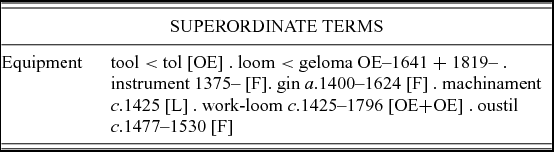
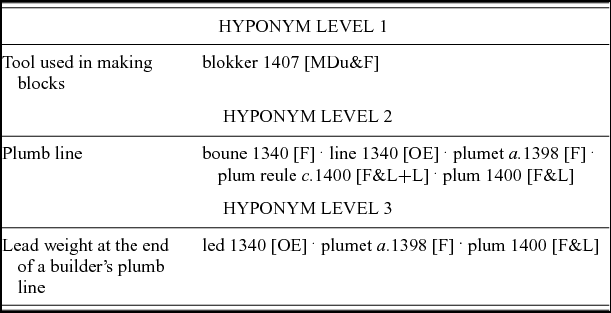
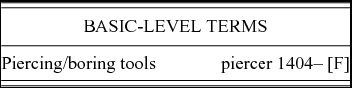
The core of the case study for this article is the semantic classification of the Middle English vocabulary for instruments used in building. Table 1a shows the superordinate terms for this category; tables 1b and 1c show the basic terms and hyponyms for this category; and tables 2–8 show the vocabulary at the basic and hyponymic levels for the subcategories below this heading, that is, the terms denoting specific instruments, and the lexis for more precise designations of such instruments with further components of meaning such as ‘large’, ‘small’, etc. or use for a particular purpose. In this classification, unlike those in the HT, information about the languages of origin of the lexical items is included, enabling analysis of the influence of contact with French and other languages at the different levels of the lexis assembled for this case study (see the discussion which follows the classification). The vocabulary at the superordinate and basic levels is taken from the HT, the vocabulary at the hyponymic levels is from the BTh project. Please note (i) that where a term is recorded as having more than one sense, it appears in more than one place in the classification; and (ii) that I have used the symbols &, where the MED records more than one language from which a term may have entered English; and +, to separate the languages of origin of the separate elements of compounds.Footnote 5
4.1 Classification of instruments used in building
Superordinate terms for instruments used in building
Basic-level terms for instruments used in building

Co-hyponyms for instruments used in building
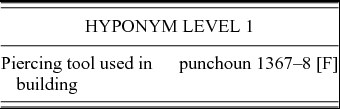
Basic-level terms denoting piercing tools
Hyponym denoting piercing tool
Basic-level terms for ropes
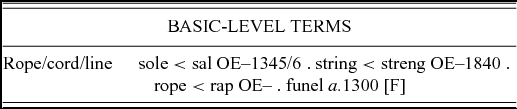
Co-hyponyms denoting ropes

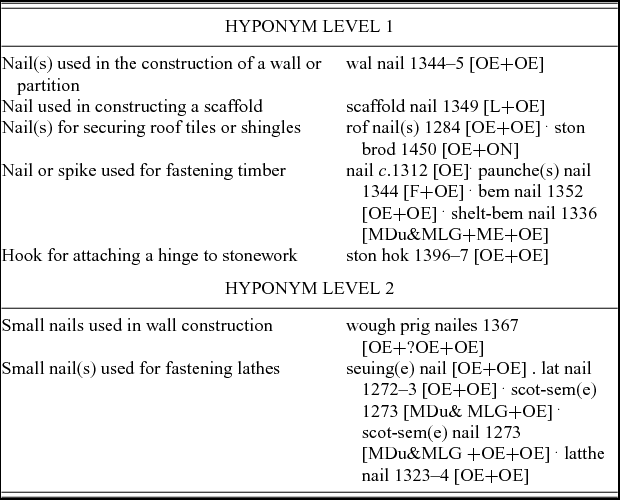
Basic-level terms for nails

Co-hyponyms denoting nails
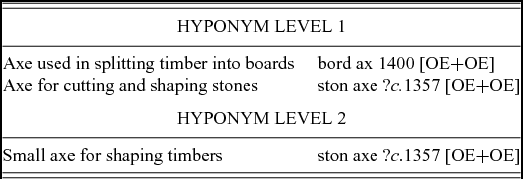
Basic-level terms for axes

Co-hyponyms denoting axes
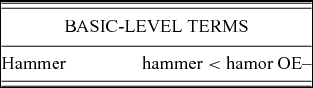
Basic-level terms for hammers
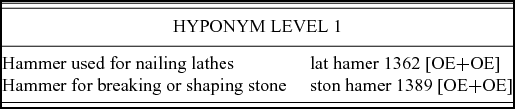
Co-hyponyms denoting hammers
Basic-level terms for cutting tools

Hyponym denoting a cutting tool

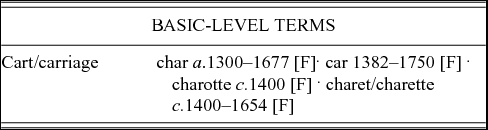
Basic-level terms for carts
Co-hyponyms denoting carts

In the next section, the semantic classification and what it shows us about the impact of the contact with French on this area of the ME lexis is discussed.
5 Analysis
This article aimed to test the suggestion that vocabulary at the level of greatest specificity within the semantic hierarchy, thus the most technical terminology, is more or less likely to be more heavily weighted towards loanwords than terminology higher up the semantic hierarchy where lexical items with more general meaning are found. There are cases, an example is provided by plum, where we need to decide if we are counting senses or lexical items, since the term occurs more than once in the classification, with the same date of first usage given in the MED. The term plum occurs three times: once as part of an incipient compound (plum reule), and twice as a simplex term, first with the same sense as plum reule, and once with a slightly narrower sense. The dates of first usage suggest that the term was borrowed into English in the different senses, but the definitions in the Anglo-Norman Dictionary (AND), Dictionnaire étymologique de l'ancien français and the Dictionnaire du moyen français (DMF) do not match those of the MED. Six senses are given in the AND, but although clearly related to the ME senses, they are not exact matches, and appear to be unrelated to the semantic field of Building, even when the senses are close, e.g. sense 2 ‘(as a heavy object) leaden weights, designed to increase the weight of an object’; and sense 6 ‘plumb, leaden ball on a weapon’ (s.v. AND plum1); and the senses in the DMF do not match either; beyond the metal itself, they pertain to fishing and clocks. The French senses are thus more general than the senses in which the term appears in English, and they do not relate to a specific semantic domain, as the senses of the term in Middle English do. This further suggests a pattern (seen with tack above) in which French terms with quite general senses are borrowed into the language, but over time their senses become more specialized in the borrowing language, where the terms remain in use.
The classification shown here includes only a small amount of data. Nevertheless, we can make a number of observations. At the superordinate level in this classification, that is, those items whose definitions are the most general, there are seven lexical items denoting instruments or tools in use in our period, of which three are native (tool, loom and work-loom), three are borrowed from French (instrument, gin, and oustil), and one is borrowed from Latin (machinament).
The next level down in the classification, the basic-level terms for instruments in Building, contains fifteen lexical items. One of these (bergog) is of uncertain origin: the remaining terms are equally divided between Old English (string, rope, nail, axe, belt, hammer, edge-tool) and French (piercer, funnel, tacket, car, char, charotte, charet/charette). The first dates of usage as well as variations in the etymologies given in the OED indicate that these terms were borrowed into English at different times. These findings are summarized in table 9.
Languages of origin of lexical items at the superordinate and basic levels of the semantic hierarchy

At the hyponymic level, many of the terms are compounds, suggesting attempts at greater precision as the terms for the concepts contain modifiers describing what they are used for, e.g. bord ax, lat hamer, ston axe, ston hammer and ston cart. What we see here is the use of mostly native resources to create these word forms, and it is tempting to ascribe this to the idea that the workers themselves needed to understand the texts in which the terms appear.Footnote 6 Of the items at this level, six are French borrowings; three are compounds made up of French and Latin or possibly only Latin (it is not always possible to distinguish borrowings directly from Latin and those whose etymology is Latin but came into English via French); two are compounds composed of native and French terms; one is a compound made up of one native term and one borrowed from Latin; eighteen are native (including compounds in which both elements are native); one is a compound made up of one native term and one borrowed from Old Norse; three are compounds of one (or more) native terms and one term borrowed from Germanic languages; one came into English from Middle Dutch and French. Thus, the vast majority of items at this level (74.2 per cent) are either fully native terms or are compounds containing native elements. These findings are summarized in table 10.
Languages of origin of the lexical items at the hyponymic level of the semantic hierarchy

What this study shows is that at the higher levels, where meanings are more general, the vocabulary is almost equally divided between native and borrowed items, but at the technical level, native terms predominate and there seems to be resistance to borrowing lexis.
6 Concluding remarks
Samuels’ (Reference Samuels1972) question about whether it is the availability of new forms that causes semantic shift or prior shifts of old forms to new meanings that creates the need for a new form prompted the establishment of the Historical Thesaurus project. That project, however, did not investigate the sources of the new forms. Nor, despite its classification of the lexicon of English into semantic hierarchies, did it concern itself with whether the impact of borrowed terms was felt more at particular levels of the semantic hierarchy. Nor did it question whether lexical borrowing following particular kinds of contact resulted in movement of native terms up or down the semantic hierarchy or prompted similar shifts in meaning in the borrowed items. Samuels was interested in the language as a whole, and so did not examine particular periods in which those pressures have been felt most forcibly, such as the contact with Norse in the Old English period, and with French following the Norman Conquest. The case study presented here cannot offer an answer to the question Samuels posed, but it provides an example of how the question might be more effectively addressed by beginning with a focus on a particular period in the language's history; utilizing the methodology of classification into semantic hierarchies so that the levels of the language are made visible; and including the languages of origin of all the terms at the different levels.
This classification of a small subset of the Middle English lexis for Building suggests that it is worthwhile thinking specifically about contact effects on the technical terminology in terms of the different strata of the vocabulary, as one way of getting at the question of why sections of the lexis were replaced by borrowed terms, while elsewhere the native terms continued in use. The difficulties of addressing this question are, of course, compounded by the medieval period being so far removed from us in time; the fact that we have little or no record of the spoken language of the period; and that it is not until quite late in the Middle English period that we have evidence of a consciousness about their language on the part of speakers, or any reflection on the varieties of language encountered by speakers.
One finding of this case study suggests that where terms are borrowed from French in quite general senses, these tend to become more specialized within English, a development not echoed in the source language, while the native terms at the same level drop out of use or retain their general senses. A diachronic study tracking the semantic shifts of terms at the superordinate and basic levels of the semantic hierarchy is needed to confirm that this is a pattern across the language. Further findings, summarized in table 9, show that at the superordinate and basic levels of the semantic hierarchy, there are almost equal numbers of native and borrowed terms. Table 10 shows that at the hyponymic level, we find that the vast majority of terms are native. It is difficult to know if this finding is suggestive more of a drive towards retention of the native terminology for the most technical vocabulary as a way of making sure that the terms for the most precise instruments (in this case) are intelligible to those working with them; or perhaps out of a sense of national pride in the precision tools of the trade; or perhaps a resistance to the imported French vocabulary not at the lowest section of the social stratum, but rather by the class of skilled workers. There does not appear to be any evidence of a drive in the opposite direction, which would shift the native terms upwards towards more general senses, leaving a space to be filled by the borrowed terminology. This article paves the way for future work focusing on the outcomes for the native lexis at the different levels of the semantic hierarchy across a broader range of semantic domains. We know that semantic hierarchies differ according to the level of the speaker's knowledge about the field. The BTh data allow us to see the semantic hierarchies of speakers in the Middle English period with the technical knowledge that comes from extensive experience of a semantic domain. This offers a unique window into the vocabulary of the everyday lives of speakers in the multilingual context of medieval Britain.



