Introduction
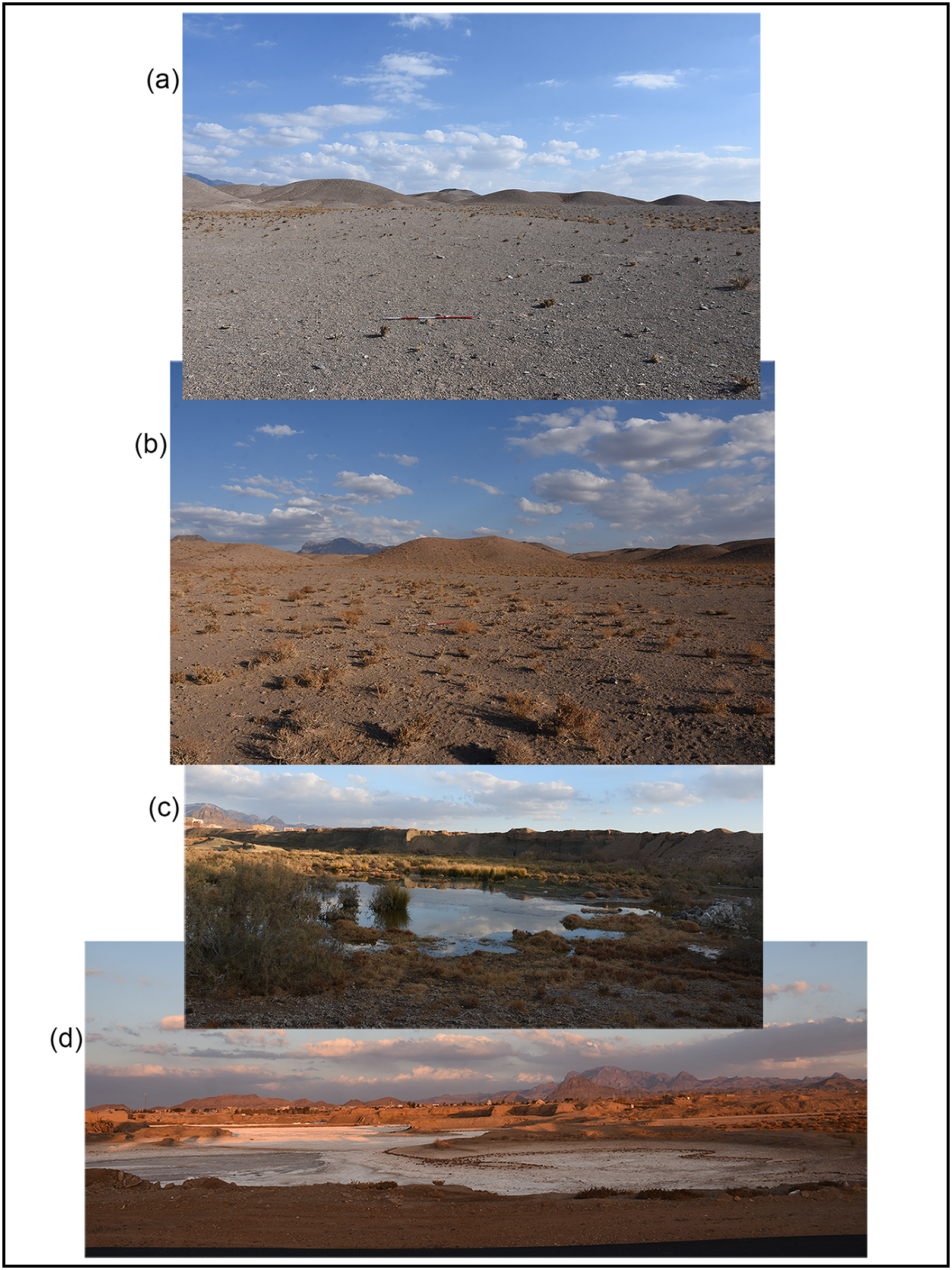
The eastern half of the Iranian plateau is today characterised by arid desert, but the formation of lakes and river drainage networks during Pleistocene wet periods may have facilitated the movement of hominin groups (Groucutt et al. Reference Groucutt, Shipton, Alsharekh, Jennings, Scerri and Petraglia2015; Vahdati Nasab & Hashemi Reference Vahdati Nasab and Hashemi2016; Heydari-Guran & Ghasidian Reference Heydari-Guran, Ghasidian and Abar2021; Shoaee et al. Reference Shoaee2023). Based on previous Palaeolithic discoveries from the east of Iran (Nikzad et al. Reference Nikzad, Sedighian and Ghasemi2015; Sadraei & Anani Reference Sadraei and Anani2018; Sadraei et al. Reference Sadraei, Mehneh, Sheikh, Anani and Minaei2019, Reference Sadraei, Garazhian and Sabori2021, Reference Sadraei, Farjami, Zafaranlou and Vahedi2022, Reference Sadraei, Shipton, Garazhian, Azar, Zafaranlou and Reza Soroush2023), an in-depth investigation was conducted around a possible Pleistocene playa, locally called Goab, on the outskirts of Khosuf City (Figure 1).
The landscape of Khousf plain (a & b) and the remains of the possible Pleistocene playa in Khousf (c & d) (figure by authors).

Geographical setting
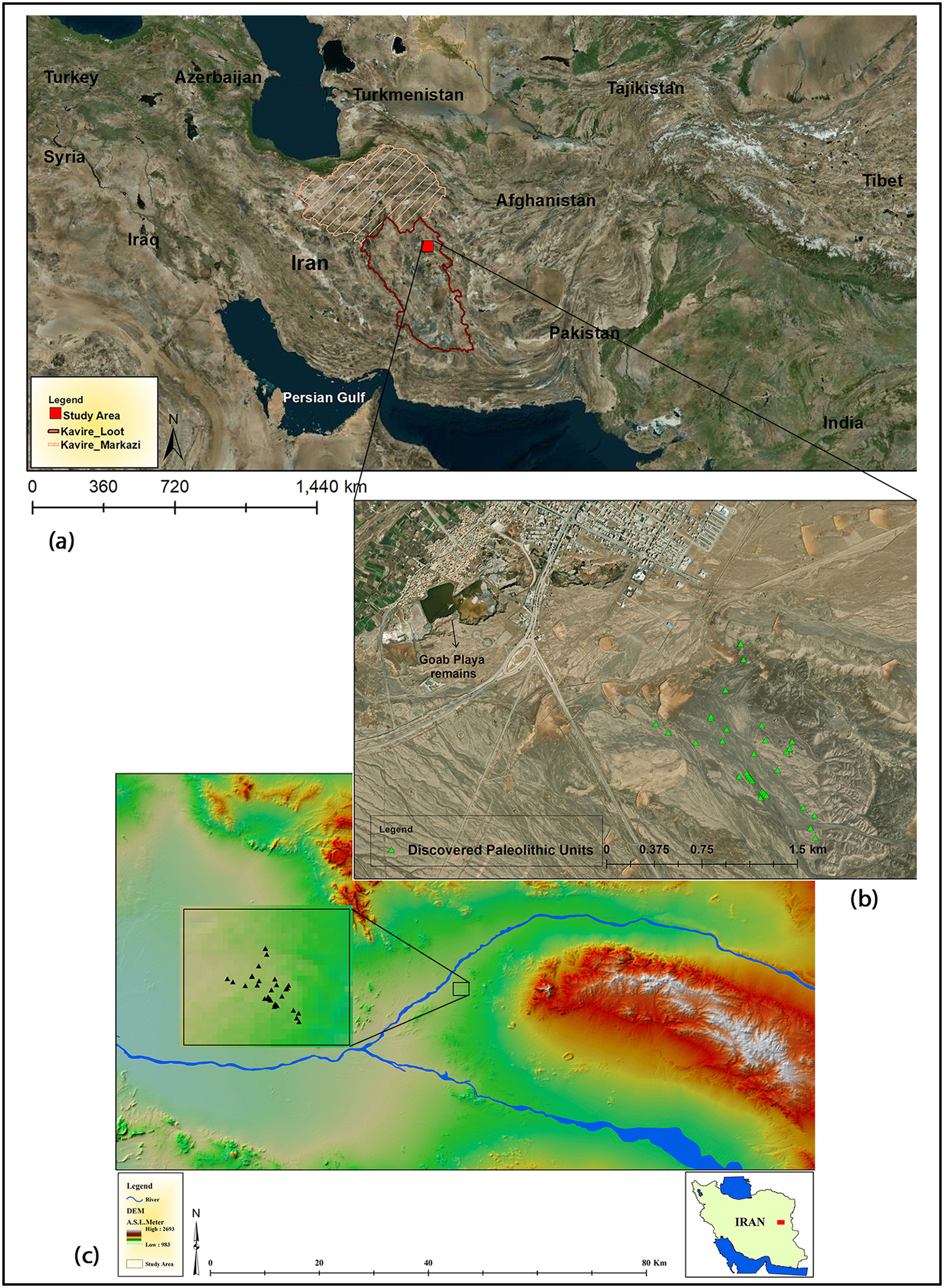
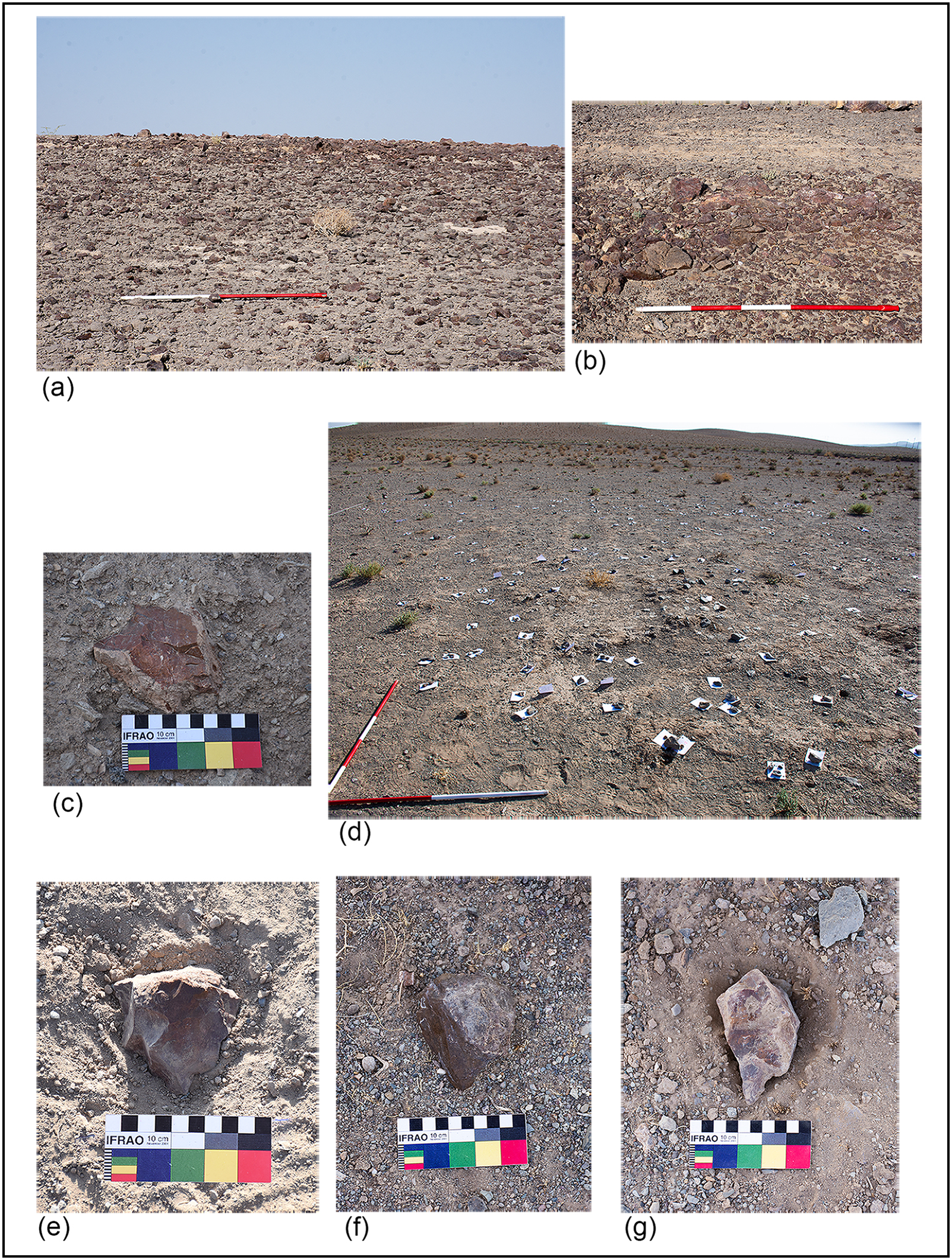
Khousf City, located in South Khorasan Province on the Lut Desert, sits at coordinates 32°48′11″N and 58°54′14″E, at an altitude of 1290m. The studied area in the north-eastern Goab playa (Figure 2) offers access to a source of red flint for stone artefact production (Figure 3a–c).
a & b) The location of the studied area on the margin of the Lut Desert in eastern Iran; c) the Goap playa remains and the discovered sites (figure by authors).

Results of the survey in north-eastern playa Goab: a–c) distribution of raw flint; d) workshop area; e–g) surface finds in situ (figure by authors).

Method
A field survey was conducted to investigate a potential hominin dispersal route to Eastern Asia through the identification of Palaeolithic settlements and stone artefacts in the Khousf region, East of Iran. Using grid systems and pedestrian methods, a systematic survey was carried out in a 1-sq-km area around the Goab playa. The survey area was divided into 30 units based on morphological differences. A total of 340 stone artefacts, including cleavers, handaxes and Levallois lithics, were discovered on the surface of the Khousf Plain (see Figure 3e–g).
Results
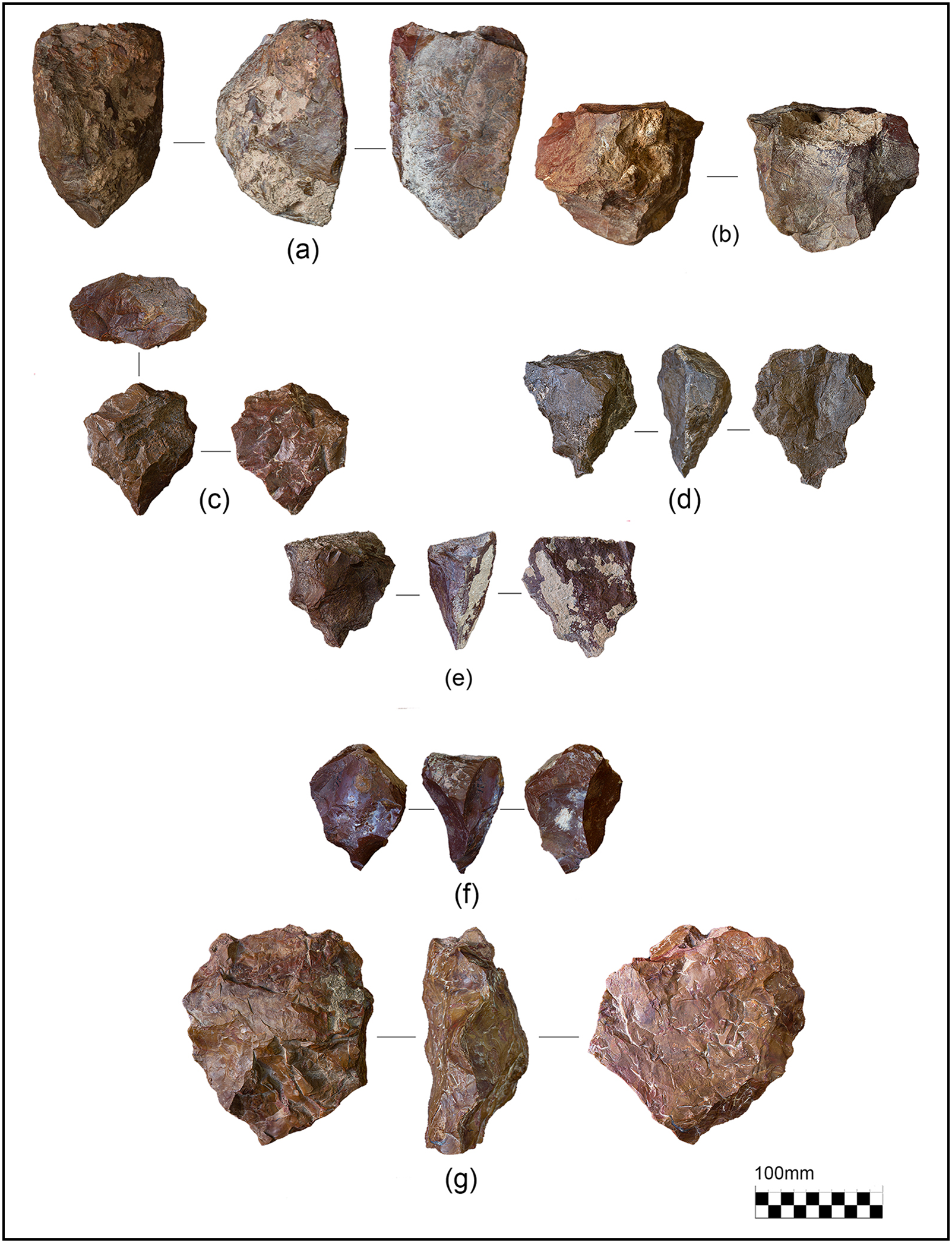
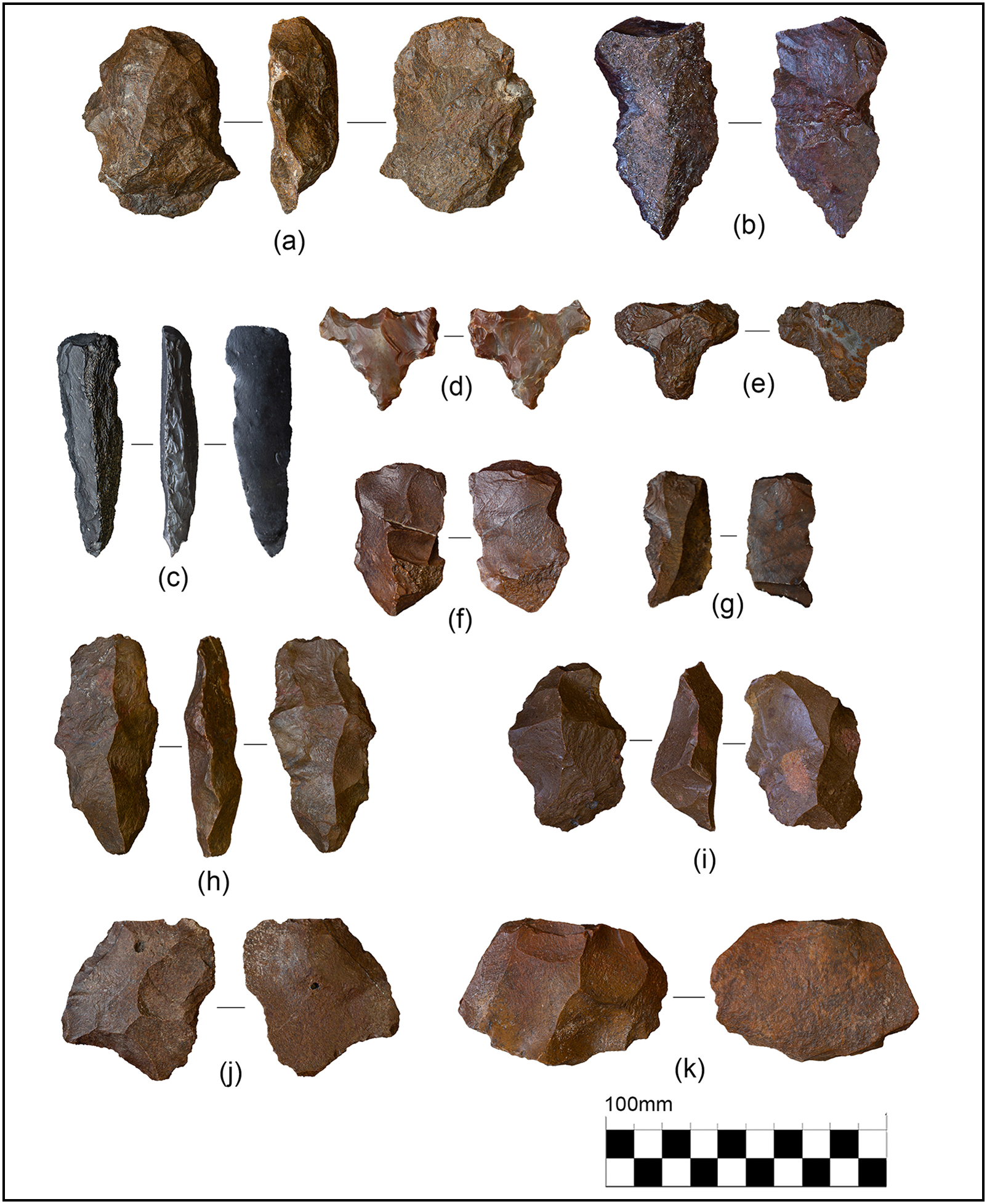
The survey identified open-air sites and tool-making workshops near flint raw material sources. The presence of stone artefacts, substantial debitage and unfinished tools, indicates workshop areas in the Khousf Plain (Figure 3d). The stone artefacts include bifacial tools (cleavers and handaxes) (Figure 4a–e); the cleavers are wide, U-shaped and exhibit debitage removals at their tips (Figure 4a & b), while handaxes have flat ends, narrower pointed tips and ripple edges indicative of the Levallois technique (Figure 4c–e). These handaxes exhibit flat ventral and pebble-like dorsal surfaces with signs of debitage removal. The ripple edges show techno-typological similarities to handaxes discovered at Acheulian sites in the Nefud Desert of Northern Arabia (Shipton et al. Reference Shipton2014).
a & b) Large cleaver; c) cordiform handaxe; d & e) triangular handaxes; f) unidirectional core; g) Levallois core (figure by authors).

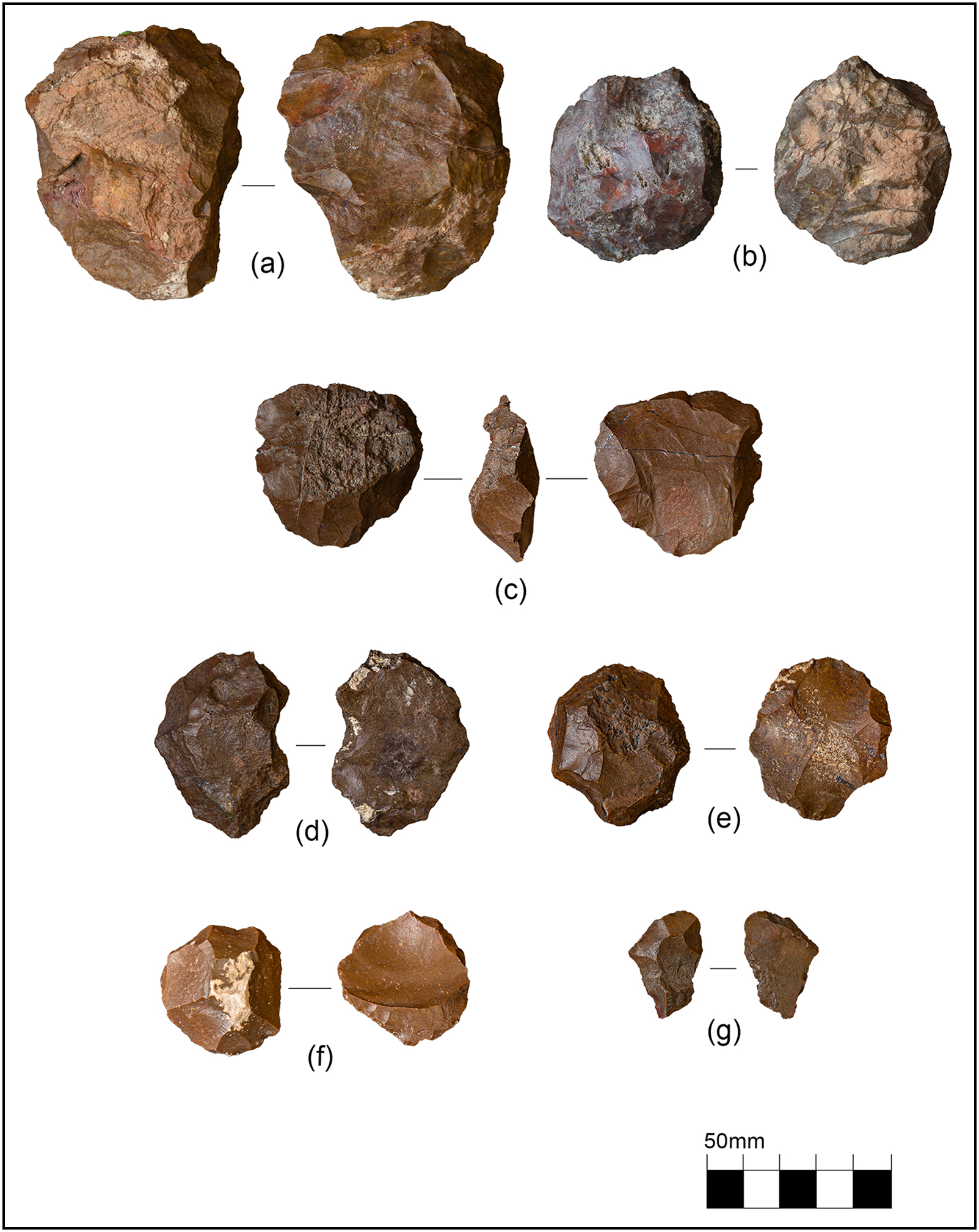
Levallois cores exhibit signs of rotation and manipulation by the knapper, allowing for the strategic removal of debitage from the edges in a centripetal reduction method, resulting in a distinctive rippled appearance (Figures 4f–g & 5). In this method, one surface was used for debitage removal while the other functioned as a striking platform (the asymmetrical surfaces) (Boëda Reference Boëda, Dibble and Bar-Yosef1995), and cores with centripetal scar patterns typically display a tortoise-shell shape (Figure 5e–g).
a) Incomplete Levallois core; on the ventral surface, a single Levallois flake has been detached from the core’s centre through a strike platform created by removing debitage flakes around the core’s edges; b–g) centripetal Levallois cores (figure by authors).

Other finds include a large number of Levallois flakes and points with centripetal scar patterns, which make up 70 per cent of the total findings, as well as borers and scrapers (Figure 6). The Levallois flakes with centripetal and bidirectional scars are ovoid or circular (Figure 6j & k), and the points are based on preferential Levallois flakes (Figure 6f–i). The discovery of borers and scrapers with lateral retouch reveals the use of Mousterian techniques in producing specialised stone tools (Figure 6b–e).
a) Borer; b) Mousterian point-scraper with lateral retouch; c) Mousterian lateral scraper on a flake; d & e) Mousterian borer-scraper with retouch on the edges; f & g) Levallois point; h & i) bifacial thinning flakes; j & k) Levallois flakes with centripetal patterns (figure by authors).

Moreover, the discovery of Levallois stone artefacts at Khousf and other Palaeolithic sites in eastern Iran, along with the presence of scrapers, Mousterian points and Levallois technology in Qaleh Kurd Cave in the central plateau (see Kamrani et al. Reference Kamrani2022), indicates the employment of Levallois and Mousterian techniques for manufacturing specialised stone tools in environments that currently exhibit arid and desert-like conditions. Recent Middle Pleistocene research indicates a human presence in such areas during the Middle Pleistocene and emphasises the importance of Palaeolithic studies in arid environments (Vahdati Nasab et al. Reference Vahdati Nasab2024).
Conclusion
The findings suggest that hominins inhabited the north-eastern part of the Goab playa on the Lut Desert margin. The assemblage of stone artefacts shares technological and morphological similarities with Levallois and Mousterian industries. The presence of large bifacial tools, including cleavers and handaxes, along with Levallois and Mousterian tools, indicates that the studied area may represent a transitional period in technological innovation and cultural development.
Our findings from Eastern Iran highlight the potential of this region for Palaeolithic archaeological research and suggest that it could have served as a potential corridor for early hominin dispersal from Africa through Iran and further eastward toward East Asia.
This study provides the basis for future research in this region, paving the way for further studies of the novel corridor used by early hominins during their dispersal to Eastern Asia.
Acknowledgements
We are grateful to Mohammad Farjami and Roghayeh Zafaranlou, archaeology experts at Cultural Heritage, Tourism and Handicrafts of South Khorasan, Birjand, for their assistance in facilitating this project.
Funding statement
This research received no specific grant from any funding agency or from commercial and not-for-profit sectors.
Author Contributions: using CRediT categories
Seyyed Reza Rafei: Data curation-Lead, Formal analysis-Lead, Funding acquisition-Equal, Investigation-Lead, Methodology-Equal, Project administration-Equal, Software-Supporting, Supervision-Lead, Validation-Lead, Visualization-Equal, Writing - original draft-Supporting, Writing - review & editing-Supporting. Malihe Shayestehfar: Data curation-Equal, Formal analysis-Equal, Investigation-Equal, Methodology-Supporting, Project administration-Supporting, Resources-Equal, Software-Lead, Writing - original draft-Lead, Writing - review & editing-Lead. Zahra Bakhshandeh Pahmedani: Formal analysis-Supporting, Investigation-Supporting, Writing - original draft-Supporting, Writing - review & editing-Supporting. Meisam Nikzad: vestigation-Supporting, Writing - review & editing-Supporting. Ali Sadraei: Investigation-Supporting, Writing - review & editing-Supporting.