


Introduction
Working after retirement is increasingly common in many Western societies. Following a period at the end of the 20th century in which early retirement was widespread, nowadays working lives are increasingly extended beyond the public pension age (Organisation for Economic Co-operation and Development (OECD), 2017). With increasing participation rates of the labour force after retirement, questions about the conditions in which retirees work are gaining in importance. Research in the United Kingdom (UK) suggests a division among working retirees, in which privileged older workers with a high level of autonomy in their retirement are contrasted with disadvantaged older workers who tend to end up in low-quality work at the end of their careers (Flynn, Reference Flynn2010; Lain, Reference Lain2012). Similarly, different groups in old age have been suggested in the United States of America (USA), where well-off older workers are clearly in a better position than a poorer less-advantaged group (Falkingham and Johnson, Reference Falkingham and Johnson1992). In spite of potentially increasing inequalities in living standards after retirement (Komp et al., Reference Komp, Van Tilburg and Broese van Groenou2010), little is known about the specific working conditions and the quality of jobs among populations of working retirees (Wahrendorf et al., Reference Wahrendorf, Akinwale, Landy, Matthews and Blane2017). In this study, the research questions are:
(1) To what extent can working retirees be categorised by the quality of their post-retirement employment?
(2) To what extent do stratification markers channel working retirees into different types of jobs?
Much of the existing research on working after retirement has focused on the question of who works after retirement (e.g. Gobeski and Beehr, Reference Gobeski and Beehr2009; Cahill et al., Reference Cahill, Giandrea and Quinn2011). In these studies, it is consistently shown that young retirees with strong educational backgrounds participate particularly in paid work (Wang et al., Reference Wang, Zhan, Liu and Shultz2008; Komp et al., Reference Komp, Van Tilburg and Broese van Groenou2010), while a U-shaped relationship is found for working after retirement against income status (Giandrea et al., Reference Giandrea, Cahill and Quinn2009). Other research focusing on the consequences of working after retirement found that it can increase wellbeing (Zhan et al., Reference Zhan, Wang, Liu and Shultz2009), particularly among those who experience involuntary retirement (Dingemans and Henkens, Reference Dingemans and Henkens2014). What post-retirement work consists of remains something of a ‘black box’ in the existing literature, however. One exception is the study of Wahrendorf et al. (Reference Wahrendorf, Akinwale, Landy, Matthews and Blane2017), who compared the working conditions of workers above state pension age to the former working conditions of full-time retirees, and concluded that working retirees were more likely to participate in jobs with favourable psycho-social working conditions and with a somewhat lower number of working hours. Little is known, however, about diversity within populations of working retirees. While average working conditions might improve after retirement, questions arise on the prevalence of post-retirement work in unfavourable working conditions and its distribution across socio-economic groups and countries. This is particularly important, because unfavourable working conditions have been found to have a negative impact on wellbeing and job satisfaction, in general (Hausser et al., Reference Hausser, Mojzisch, Niesel and Schulz-Hardt2010), and on the productivity and task performance of older employees, in particular (Müller et al., Reference Müller, De Lange, Weigl, Van der Heijden, Ackermans and Wilkenloh2015).
The current study contributes to the literature on working after retirement in three ways. First, we investigate whether working retirees can be categorised by the quality of their post-retirement jobs. Accounting for these sub-populations may be crucial to understand better the complex dynamics of the concept of working after retirement (Flynn, Reference Flynn2010). Using latent class analysis (LCA), we analyse to what extent working conditions co-occur among working retirees. Guided by theoretical arguments, we specifically focus on physical and mental job demands, job control (Shultz et al., Reference Shultz, Wang, Crimmins and Fisher2010) and the number of work hours (Moen, Reference Moen2007). Second, we analyse the importance of a set of stratification markers that can predict membership of certain sub-populations as revealed by the LCA. This analysis improves our insight into how stratification processes translate into different working conditions in old age. Third, while research on working after retirement commonly focuses on a single country (for an overview of country-specific studies, see Alcover et al., Reference Alcover, Topa, Parry, Fraccaroli and Depolo2014), countries are known to differ widely in their pension contexts and the likelihood of working beyond retirement age (Dingemans et al., Reference Dingemans, Henkens and Van Solinge2017). Therefore, we take a European country-comparative approach to study whether the probability of certain post-retirement job types differs by country and to what extent this is associated with differences in poverty levels among the older population.
We use data from the Survey of Health, Ageing and Retirement in Europe (SHARE) project. SHARE provides information on older adults aged 50 years and over in various European countries. The great diversity in definitions and measures of working after retirement in existing country-specific research hinders the comparability of the results across country borders (Alcover et al., Reference Alcover, Topa, Parry, Fraccaroli and Depolo2014). In this study, we constructed a harmonised measure of working after retirement, defined as participation in paid work, while also receiving a pension income (Parry and Bown Wilson, Reference Parry, Bown Wilson, Alcover, Topa, Parry, Fraccaroli and Depolo2014; Dingemans et al., Reference Dingemans, Henkens and Van Solinge2017).
Theoretical framework
Working conditions of post-retirement jobs
Various theoretical models of psycho-social working conditions have been presented in previous research to identify stressful and harmful work. The general premise of these models is that high job demands can be harmful for physical and psychological health (Karasek, Reference Karasek1979; Siegrist, Reference Siegrist1996; Bakker and Demerouti, Reference Bakker and Demerouti2007). Job demands, such as a heavy physical workload or time pressure, are characterised by the high level of energy required of the worker. It is argued, however, that it is not only the job demands in themselves but also the interplay with other working conditions that can be particularly harmful. Job control – a person's freedom to decide how to undertake work – is argued to be important in this respect (Karasek and Theorell, Reference Karasek and Theorell1990; Demerouti et al., Reference Demerouti, Bakker, Nachreiner and Schaufeli2001).
For example, the demand–control model (Karasek, Reference Karasek1979) postulates that job demands are harmful when the level of job control is low (Karasek and Theorell, Reference Karasek and Theorell1990; Hausser et al., Reference Hausser, Mojzisch, Niesel and Schulz-Hardt2010). This means that the health of individuals is particularly threatened when they do not experience freedom in terms of how to deal with high demands. Moreover, Shultz et al. (Reference Shultz, Wang, Crimmins and Fisher2010) have shown that job control is more important for older than for younger workers as a tool to deal with high job demands. The underlying mechanism is that when older adults are confronted with age-related cognitive decline, this can be compensated by a certain degree of freedom in how to execute demanding tasks. In a similar vein, job control has been shown to be a valuable resource for task performance among working retirees (i.e. bridge employees; Müller et al., Reference Müller, De Lange, Weigl, Van der Heijden, Ackermans and Wilkenloh2015). Following this literature, we expect physical and mental job demands as well as job control to be central indicators of post-retirement job quality.
Another working condition that is increasingly important after retirement is the number of working hours, with an increasing preference for part-time arrangements with old age (McNair, Reference McNair2006; Lain and Vickerstaff, Reference Lain, Vickerstaff, Harper and Hamblin2014). Based on various studies in the US context, Moen (Reference Moen2007: 31) argues that older workers and retirees do not want to work full-time, instead preferring ‘not so big jobs’. Instead of the ‘big’ full-time jobs, which often have high job demands and little schedule control (Moen, Reference Moen2007), older adults desire part-time jobs that can be combined with other activities that are increasingly important in old age, such as spending time with family and care-giving demands. Additionally, demanding jobs require large amounts of physiological and/or psychological energy. Participation in such jobs full-time, compared with smaller part-time arrangements, could be problematic because there is less time for recovery (Kiss et al., Reference Kiss, De Meester and Braeckman2008).
To summarise, in line with the ‘big’ and ‘not so big’ jobs that Moen (Reference Moen2007) describes in the US context, we will test whether such a distinction also exists in the European population of working retirees. Based on working conditions such as physical and mental job demands, job control and working hours, we explore the quality of post-retirement jobs and investigate whether working retirees can be categorised accordingly.
Stratification in different post-retirement jobs
The categorisation of working retirees may not be random, but is most likely to rely upon stratification forces (Ekerdt, Reference Ekerdt2010). Commonly used stratification markers in research on working after retirement refer to socio-economic status, which may also channel different retirees into different post-retirement jobs.
The model of strategic selection (Moen and Chermack, Reference Moen and Chermack2005) postulates that dissatisfied older workers with unfavourable working conditions tend to leave the workforce (Moen, Reference Moen2007). In this vein, it has been shown that older adults tend to retire early when the quality of their work is poor (Elovianio et al., Reference Elovianio, Forma, Kivimaki, Sinervo, Sutinen and Laine2005; Siegrist et al., Reference Siegrist, Wahrendorf, Knesebeck, Jürges and Borsch-Supan2006), and this may be the case particularly when there is no financial motive to stay in work (McNair, Reference McNair2006). In the case of working after retirement, we could argue that those with high educational backgrounds and high pension income are most likely only to select or accept jobs with favourable work conditions, rather than low-quality jobs. In addition, ‘retirees who have higher levels of education are likely to have more choices in choosing a bridge job’ (Wang et al., Reference Wang, Adams, Beehr, Shultz, Baugh and Sullivan2009). By contrast, for less-educated and low-income retirees, who are more likely to feel financially forced to remain in paid labour, there may be no option other than to accept a low-quality job should more favourable ones be unavailable. We thus hypothesise that retirees with high educational background and high pension income are less likely to participate in jobs with unfavourable working conditions than their less-educated and lower-income counterparts.
Previous research has shown that not only individual, but also national circumstances enable or constrain behavioural outcomes in post-retirement years (Dingemans et al., Reference Dingemans, Henkens and Van Solinge2017). Various theoretical frameworks, such as Moen and Chermak's (Reference Moen and Chermack2005) model of strategic selection and the lifecourse notion of ‘agency within structure’ (Settersten and Gannon, Reference Settersten, Gannon, Levy, Ghisletta, Le Goff, Spini and Widmer2005), state that national contexts produce opportunities and constraints on older adults’ strategic selections and choices. Not only the choice of whether to work after retirement, but also the selection of a specific post-retirement job, is likely to be embedded in the broader context. Following the arguments for individual socio-economic status, we expect the likelihood of working in unfavourable conditions to be higher in countries with high rather than low levels of old-age poverty. In such countries, the need for income from paid work to make ends meet in retirement is likely to be higher (Kolev and Pascal, Reference Kolev and Pascal2002; Yang, Reference Yang2011), which forces retirees to accept unfavourable working conditions in the absence of better alternatives. As a result, working after retirement may be seen as an indicator of disadvantage in these countries.
Data and methods
Data
We used data from Waves 1, 2 and 4, of SHARE. The third wave of SHARE was excluded because of its specific format focusing on life histories. Waves 5 and 6 were excluded because in these waves a large proportion of working retirees were not asked about the quality of their jobs. In the current study, working after retirement was measured by focusing on the income sources of older adults. Retirement, here, was conceptualised as receiving a form of public and/or occupational pension income. Respondents who did not receive any form of pension income, i.e. those who were still in their main careers, were excluded. Retirees who received income from paid work in addition to their pension income were classified as working retirees. Because pensions can be claimed as early as 60 in most countries and working after retirement is often found to start shortly after career exit (Maestas, Reference Maestas2010; Kail and Warner, Reference Kail and Warner2013), we selected working retirees in the age range between 60 and 75. To make optimal use of the SHARE data, we stacked the data of the three selected waves (2004, 2006 and 2011; ‘append’ in Stata 14.2). The analytical sample used in this study consisted of 2,926 working retirees in 11 European countries, namely Austria, Belgium, Czech Republic, Denmark, Estonia, France, Germany, Italy, the Netherlands, Sweden and Switzerland. The mean age was 67, and 47 per cent of respondents were women.
Measures
The working conditions found in post-retirement employment are divided across three dimensions. First, we assessed the extent to which a job was perceived to be demanding. In SHARE, respondents were asked whether they strongly agreed, agreed, disagreed or strongly disagreed with the following statements: (a) ‘My job is physically demanding’, and (b) ‘I am under constant time pressure due to a heavy workload’. The answers to these two statements were used as indicators of physical and mental job demands, respectively. Second, the extent to which respondents felt in control of their job was assessed by the statement: ‘I have very little freedom to decide how I do my work’, following the same answer format ranging from strongly agree to strongly disagree. Because these three respective statements were used in an LCA in which it is customary to dichotomise items, we recoded their ordinal measurement scales into a dummy format indicating whether respondents (strongly) agreed (1) or (strongly) disagreed (0) with the statement. Third, we assessed how many hours respondents worked per week. We created three categories, namely small part-time jobs of 1–16 hours per week, large part-time jobs of 17–32 hours per week and full-time jobs of 33 or more hours per week.
Measures of educational background and pension income were taken from the imputations file provided by SHARE (see Christelis, Reference Christelis2011). For educational background, SHARE researchers had constructed a variable following ISCED 1997 classification (1997 International Standard Classification of Education). Following Wahrendorf et al. (Reference Wahrendorf, Akinwale, Landy, Matthews and Blane2017), we constructed a variable distinguishing low (pre-primary, primary or lower secondary education), middle (secondary or post-secondary education) and high (first and second stage of tertiary education) educational background. For pension income, we summed income from old age, early retirement and survivor pensions, private and occupational pensions, disability pensions-benefits, unemployment benefits insurance and social assistance, which were all calculated and imputed by the SHARE team. To deal with the wide distribution and outliers, we constructed pension income quartiles. Furthermore, we controlled for age, gender and marital status. Age was calculated based on the year of birth reported by the respondent. Gender was measured by a dummy variable indicating whether the respondent was female (1) or male (0). Finally, marital status was measured by asking respondents whether they were currently married/in registered partnership, never married, divorced or widowed. A total of 1.6 per cent of the cases had missing values on educational background, marital status or both, which were imputed by mode imputation.
Finally, at the macro-level, we measured old-age poverty using the ‘severe material deprivation rate’ from Eurostat (2018). Specifically, we took the statistics for severe material deprivation among the population aged 60 years and older. Material deprivation refers to economic strain, which Eurostat (2018) defined as ‘the enforced inability to afford a set of indicative material standards, considered by most people to be desirable or even necessary to lead an adequate life’. Instead of looking at a relative poverty measure (Price, Reference Price2006), such as the risk of poverty, material deprivation was measured looking at objective and absolute criteria, e.g. the inability to afford mortgage or rent payments, a protein-rich meal every second day or unexpected financial expenses. The proportion of the population unable to afford at least four of the 11 criteria is reflected in the severe material deprivation rate. We calculated the mean over the years 2004–2011 covering the period of data collection of the three waves included in our sample. The descriptive information of the independent variables is presented in Table 1.
Means and standard deviations (SD) for the covariates

Note: SD: standard deviation.
Source: Survey of Health, Ageing and Retirement in Europe, Waves 1, 2 and 4.
Analytical strategy
First, LCA was performed to test whether working retirees could be categorised by the quality of their post-retirement jobs. LCA is a person-centred analytical approach that ‘posits that there is an underlying unobserved categorical variable that divides a population in mutually exclusive and exhaustive latent classes’ (Lanza and Rhoades, Reference Lanza and Rhoades2013: 159). It helps to find complex patterns of associations among a set of observed variables, in this case variables regarding physical and mental job demands, job control and work hours. We started with exploratory LCA to determine the best-fitting model from an empirical point of view. We compared a series of latent class models with different numbers of classes using goodness-of-fit criteria, such as the Akaike Information Criterion (AIC) and Bayesian Information Criterion (BIC) (Lanza and Cooper, Reference Lanza and Cooper2016). In addition to the purely empirical explanatory approach, we also used our theoretical framework to guide our decision on the final model (Wang and Hanges, Reference Wang and Hanges2011).
Second, we performed (multi-level) logit analyses to understand further how the sub-groups of working retirees identified by the LCA differ by socio-demographic determinants. The dependent variable in the logit analysis was constructed based on maximum posterior probabilities generated by the LCA, which were used to assign working retirees to latent classes. Because our sample of working retirees was likely to be a selective group of retirees, we followed a Heckman procedure to control for this selectivity (Heckman, Reference Heckman1979). Specifically, we included retirees who did not work after retirement in our initial sample as a control group to estimate the probability of working after retirement. The lambda term that resulted from this Heckman procedure was subsequently added to the final (multi-level) logit models that were estimated for the sample of working retirees only.
Results
LCA: co-occurrence of job quality indicators
Descriptive information on the observed variables for the LCA is presented in Table 2. About two in five working retirees reported their post-retirement job to be physically demanding (39%). A smaller group of about one in four working retirees felt they were under constant time pressure due to a heavy workload (24%), and another one in four reported having very little freedom to decide how they did their work (23%). Many of the working retirees were employed in small part-time jobs with a maximum of 16 work hours per week (40%), while approximately one in three working retirees participated in full-time jobs for more than 32 hours per week (36%).
Descriptive information of the observed variables for the latent class analysis
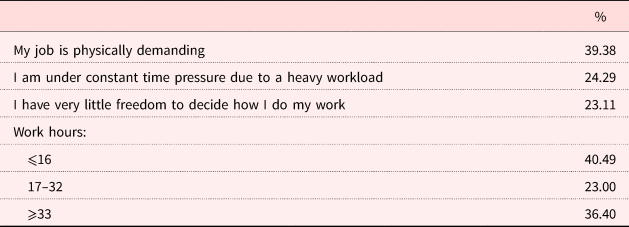
Source: Survey of Health, Ageing and Retirement in Europe, Waves 1, 2 and 4.
Using LCA, we tested whether we could divide post-retirement jobs into sub-groups based on the observed variables in Table 2. We started by comparing a one-class with a two-class model. Both AIC and BIC preferred the two-class over the one-class model, indicating that the sample of working retirees consisted of at least two sub-groups. Next, we compared the two-class model with the more complex three-class model. While the three-class model was preferred by the AIC (15,977.54 versus 15,992.69 for the two-class solution), the two-class model was preferred by the BIC (16,058.49 versus 16,079.54 for the three-class solution). By further considering the meaningfulness of the latent classes, we found that the third class in the three-class model was highly comparable in its interpretation to the second class. Moreover, following our theoretical arguments pointing to the existence of two groups of working retirees, we decided to select the two-class model.
In Table 3, we present the item-response probabilities, which provide information on the probability of a particular response to an item given membership of a particular class. For example, for working retirees in the first class there was a 25 per cent likelihood that they experienced their job to be physically demanding and only a 5 per cent likelihood that they experienced constant time pressure due to heavy workload. In addition to the low job demands, for working retirees in class 1 the likelihood of experiencing little freedom to decide how to do their work was 17 per cent, and they had a 55 per cent likelihood of working in small part-time jobs. The item-response probabilities for high job demands, low job control and high number of work hours were much higher in class 2 than in class 1. In class 2, the likelihood of experiencing physical and mental job demands was 62 and 53 per cent, respectively. Furthermore, working retirees in the second class had a 33 per cent likelihood of experiencing low job control and a 60 per cent likelihood of working in full-time jobs. Taken together, the results of the LCA indicate a clear divide between high- and low-quality jobs post-retirement. Following the demand–control model, which points to the harmful combination of high job demands and low job control (Karasek, Reference Karasek1979; Müller et al., Reference Müller, De Lange, Weigl, Van der Heijden, Ackermans and Wilkenloh2015), we assigned the following labels to the two classes: class 1 was labelled ‘low-strain jobs’, and class 2 was labelled ‘high-strain jobs’.
Item-response probabilities for the two-class model

Note: N = 2,926.
Source: Survey of Health, Ageing and Retirement in Europe, Waves 1, 2 and 4.
Table 4 presents the membership probabilities, which indicate the estimated proportions of individuals in the classes. Our results show that the first class representing low-strain jobs contained 61 per cent of the working retirees versus 39 per cent in the second class representing high-strain jobs. The membership probabilities differ across the independent variables in this study. For instance, 34 per cent of the female working retirees are working in a high-strain job versus 33 per cent of the male working retirees. The results also show that lower percentages working in a high-strain job were found for higher educational levels and higher pension income quartiles. For marital status, 35 per cent of the married working retirees participated in a high-strain job versus 29 per cent of the widowed working retirees.
Membership probabilities for the two-class model

Note: N = 2,926.
Source: Survey of Health, Ageing and Retirement in Europe, Waves 1, 2 and 4.
Sensitivity checks for the LCA
The stability of the LCA solution was confirmed in several sensitivity analyses. To check whether the maximum likelihood solution was correctly identified, we estimated a series of models with randomly generated starting values. Further, we also checked the stability of the final solution using different sub-samples (i.e. separate for men and women, different age ranges, specific countries having a sufficient sample size and step-by-step excluding one of the countries to check for potential outliers). Additionally, we performed the LCA with different measurement scales of the observed variables (job quality items as ordinal variables and work hours as a linear variable). None of the sensitivity checks altered the substantive interpretation of the results.
Logit analysis: further understanding of the two classes
Table 5 presents the results of the logit analysis to predict participation in high- (1) versus low- (0) strain jobs, which helps us understand better who works in what kind of post-retirement job. We started in the first model by accounting for the clustering of working retirees in the 11 European countries in our sample using a logit model with country-fixed effects. The Netherlands was taken as the reference category, because it had the lowest probability of work in high-strain jobs. Germany, Denmark and Switzerland did not significantly differ from the Netherlands in this respect. By contrast, working retirees were much more likely to work in high-strain jobs in Austria, Italy, the Czech Republic and Estonia. We calculated predicted probabilities by country and found that approximately 20 per cent of working retirees were working in a high-strain job after retirement in the Netherlands and Denmark, compared to approximately 50 per cent in Italy and Estonia. In Model 2 of Table 5, we included individual-level stratification markers to check whether compositional differences across countries could explain the differences we found in Model 1. The results show that although the coefficients change slightly, overall we conclude that the country differences remain in terms of the likelihood of working in high- versus low-strain jobs.
Logit models to predict the participation in high- versus low-strain jobs

Notes: N = 2,926. Ref. reference category. OR: odds ratio. Standard errors (SE) are corrected for clustering of cases in individuals. The models are further controlled for survey year and for selection into the sample of working retirees (lambda, Heckman approach). 1. Model 3 is a multi-level logit model in which the country fixed effects of the logit Models 1 and 2 are replaced by a variance term.
Source: Survey of Health, Ageing and Retirement in Europe, Waves 1, 2 and 4.
Significance levels: † p < 0.10, * p < 0.05, ** p < 0.01.
We also conducted multinomial logit analysis for the results in Model 2 of Table 5 to explore the difference between full retirees (without a post-retirement job) and working retirees in terms of their socio-economic determinants. The results are presented in Appendix Table A1. Working retirees were generally younger, more often male, better educated and had less pension income compared to their fully retired counterparts. These findings were consistent across the two groups of working retirees (with low- and high-strain jobs). For marital status, we found that those never married, divorced and widowed were more likely to work in a low-strain job than to be fully retired. For the comparison between the participation in a high-strain job versus full retirement, only divorced retirees had a higher likelihood of working than married retirees.
The results of the multinomial logit model comparing working retirees in a high-strain job with those in a low-strain job are highly comparable to the results presented in Model 2 of Table 5. As hypothesised, the results show that educational background and pension income relate to the likelihood of working in a high-strain job. The higher the educational background, the lower were the odds of working in a high- versus a low-strain job. Similarly, we found a negative relationship between pension income and working in a high-strain job. In addition, we found age to be negatively associated with working in a high- versus low-strain job. We did not find a relationship between gender and the type of post-retirement job. Furthermore, differences by marital status were only found for widows compared to married working retirees. Widowed working retirees had a lower probability of working in a high- versus low-strain job than those in a marriage or registered partnership.
In Model 3 of Table 5, we present the results of a multi-level logit model including the macro indicator for old-age poverty, namely the rate of severe material deprivation. In line with our expectation, the results show a positive relationship between the percentage of severe material deprivation among the population of 60 years and older and the likelihood of working in a high-strain job. The higher the severe material deprivation rate in a country, the higher the odds of working in a high- versus a low-strain job post-retirement. We further illustrate this result in Figure 1, where we relate the severe material deprivation rate to the predicted probabilities of working in a high-strain job per country. The figure shows that the countries we found to have a higher likelihood of working in a high-strain job, such as Estonia and Italy, were also found to be those countries with a higher percentage of the 60+ population in severe material deprivation. By contrast, countries such as the Netherlands and Denmark were characterised by the combination of a lower likelihood of working in high-strain jobs and lower levels of severe material deprivation.
Relationship between severe material deprivation rate and the percentage of working retirees in high-strain jobs (calculated based on Model 2 in Table 4).

Discussion
In this study, we examined whether and how work quality indicators co-occur in a sample of European working retirees. Combining literature on working conditions of older workers with literature on working after retirement, we selected psycho-social working conditions and work hours as important indicators for the categorisation of levels of strain that jobs place on the shoulders of working retirees. We discuss the three major findings that result from our analyses.
First, the results of the LCA reveal that working retirees in Europe can be divided into two sub-groups according to the level of job strain. In line with the conclusion of Wahrendorf et al. (Reference Wahrendorf, Akinwale, Landy, Matthews and Blane2017) that European working retirees tend to experience favourable working conditions, we find a majority of working retirees participating in low-strain jobs, characterised by part-time work, low physical and mental job demands, and high levels of job control. This supports the assumption often made in the literature on bridge employment that participation in paid work after retirement can be a tool allowing gradual adjustment to life without paid work as the central activity (Kim and Feldman, Reference Kim and Feldman2000; Wang et al., Reference Wang, Adams, Beehr, Shultz, Baugh and Sullivan2009). Nevertheless, a considerable group of two in five working retirees is found to participate in high-strain jobs. These jobs are characterised by working conditions that are generally found to be undesirable by older workers (Moen, Reference Moen2007; Lain and Vickerstaff, Reference Lain, Vickerstaff, Harper and Hamblin2014), such as full-time work, high physical and mental job demands, and low levels of job control. In particular, the intersection of high job demands and low job control may threaten the ability of working retirees to deal with age-related changes, such as cognitive decline (Shultz et al., Reference Shultz, Wang, Crimmins and Fisher2010; Müller et al., Reference Müller, De Lange, Weigl, Van der Heijden, Ackermans and Wilkenloh2015), while longer working hours may hamper full recovery from work before a new work shift starts (Kiss et al., Reference Kiss, De Meester and Braeckman2008).
Second, our results show that working retirees in high-strain jobs are most likely to have a low educational background and low pension income. This supports the idea derived from the model of strategic selection (Moen and Chermack, Reference Moen and Chermack2005) that retirees with high socio-economic backgrounds only choose to stay in the labour force when favourable working conditions were available, whereas there is no choice than to remain working for those with low socio-economic background, even if this means accepting work with unfavourable working conditions. Moreover, retirees with high instead of low socio-economic status may have more choice in choosing between several post-retirement jobs, enabling them to choose the highest quality job (Wang et al., Reference Wang, Adams, Beehr, Shultz, Baugh and Sullivan2009). Participation in high-strain jobs is thus likely to be at least partially driven by constraints rather than free choice. Apparently, those retirees most likely to feel forced to continue working after retirement end up in the worst jobs, which suggests a process of cumulative disadvantage that has also been found in the UK (Flynn, Reference Flynn2010; Lain, Reference Lain2012) and the USA (Falkingham and Johnson, Reference Falkingham and Johnson1992).
Third, the two sub-groups of working retirees in high- and low-strain jobs are not evenly distributed across the European countries under study. While a majority of working retirees participate in low-strain jobs in countries such as the Netherlands and Denmark, only half of the working retirees in countries such as Estonia and Italy participate in low-strain jobs, which implies that the other half is confronted with unfavourable working conditions. The results of the multi-level analysis suggest that this difference is associated with the level of old-age poverty in the countries concerned. The higher the proportion of severe material deprivation among the 60+ population, the more likely retirees are to participate in a high-strain job post-retirement. This is particularly striking in Estonia, where the prevalence of working after retirement is relatively high (Dingemans et al., Reference Dingemans, Henkens and Van Solinge2017). The situation in Estonia may be comparable to that in Russia (Kolev and Pascal, Reference Kolev and Pascal2002), where working in old age is almost a given due to severe material deprivation in retirement, and thus also appears to place a high strain on working retirees. By contrast, working after retirement is mostly an expression of intrinsic motivation in the Netherlands, which is characterised by a relatively generous pension system and low old-age poverty (OECD, 2017). A large majority of working retirees in the Netherlands report working for enjoyment (Dingemans and Henkens, Reference Dingemans and Henkens2014), and the present study adds to this in that they also often participate in small jobs with favourable working conditions. These results suggest that working after retirement may be a completely different concept in countries such as the Netherlands, where it seems to be an indicator of preference, compared to countries such as Estonia, where it may be more of an indicator of disadvantage in old age.
In sum, our study adds to the conceptualisation of working after retirement by revealing two sub-groups of working retirees differing widely in their working conditions. Where previous research mainly focused on the dichotomy of whether a retiree participates in paid work or not (e.g. Cahill et al., Reference Cahill, Giandrea and Quinn2017; Dingemans et al., Reference Dingemans, Henkens and Van Solinge2017), a better understanding of diversity among working retirees is critical. The positive notion of choosing to work part-time in favourable working conditions after retirement is in sharp contrast to the much less-pleasant idea of forced continuation in full-time work in unfavourable working conditions. The latter picture corresponds to what (McNair, Reference McNair2006: 490) refers to as ‘survivors’, reflecting the struggle to deal with life in a sample of pre-retired older adults, and extends this to the post-retirement case. The suggestion that working after retirement in a low-strain job could mean something completely different from working after retirement in a high-strain job may have serious implications for policies on retrenching pension systems and extending working lives. It nuances the notion of post-retirement work as a beneficial tool to reduce poverty in retirement years (Yang, Reference Yang2011). Although levels of financial security may be increased by the addition of income from paid work to the pension income of retirees from low socio-economic backgrounds (Dingemans and Henkens, Reference Dingemans and Henkens2019), working after retirement in high-strain jobs could presage negative outcomes such as low levels of wellbeing and health, as well as low productivity, low task performance and low job satisfaction, all of which are associated with unfavourable job conditions (Hausser et al., Reference Hausser, Mojzisch, Niesel and Schulz-Hardt2010; Shultz et al., Reference Shultz, Wang, Crimmins and Fisher2010; Müller et al., Reference Müller, De Lange, Weigl, Van der Heijden, Ackermans and Wilkenloh2015).
The strengths of this study lie in our capacity to unravel the existence of various sub-groups of working retirees, and its cross-national comparative nature. However, the results should be interpreted with some limitations in mind. First, even though our sample includes many working retirees across several countries, the number of cases in each country was not large enough to investigate whether the LCA would give the same result in all countries. Our sensitivity checks for countries with a sufficient number of cases (Czech Republic, Estonia, Germany, Sweden and Switzerland) nevertheless point the same way. Second, the number of countries was also limited. As a result, we were unable to investigate multiple country-specific characteristics that could explain the country differences in the prevalence of high- versus low-strain jobs. For instance, country differences in generosity of the pension system and social norms on extending working lives may play a role in the motives of working retirees and their position in the labour market (Dingemans et al., Reference Dingemans, Henkens and Van Solinge2017). Additional research with a larger number of countries at the contextual level, as well as a larger number of working retirees in the countries at the individual level, is needed to increase further the understanding of country differences in the concept of working after retirement.
A third limitation refers to selection of working retirees in our sample. Even though we attempt to control for the selection of retirees in the sample of working retirees using a Heckman procedure (Heckman, Reference Heckman1979), we must keep in mind that our study results are based on a sample of ‘successful job seekers’. Not every working retiree is able to continue working with their previous employer or to find a job with a new employer after their retirement. Re-entry is difficult, if not impossible, for some groups of retirees, particularly those who have been involuntarily pushed into (early) retirement by their employer (Dingemans et al., Reference Dingemans, Henkens and Van Solinge2016). Special attention is also required for older adults who have been living in another country, like migrants. Living in another country influences the employment history and the accumulation of pension entitlements (Henkens et al., Reference Henkens, Van Dalen, Ekerdt, Hershey, Hyde, Radl, Van Solinge, Wang and Zacher2018). National pension systems differ starkly in terms of how benefit calculations affect migrants (Heising et al., Reference Heising, Lancee and Radl2018), which may also affect their necessity to gain extra income from paid work to supplement their pension income. However, migrants may experience the adverse consequences of discriminatory attitudes in the labour market and remain unsuccessful in their search for a post-retirement job. The (cumulative) disadvantage that is unravelled in this study by focusing on working retirees in high- versus low-strain jobs may turn out to be even stronger when it is taken into account that some retirees (most likely those at the bottom of the ladder in terms of social status) have no access to the labour market whatsoever, despite their need for extra income to make ends meet.
Despite these limitations, we conclude that while the majority of working retirees participate in jobs with favourable conditions, working after retirement is not necessarily a successful retirement adjustment strategy, nor is it always a beneficial solution to old-age poverty. Given that paid work is available to retirees, it may put a great strain on the shoulders of working retirees with negative consequences at both the individual and the organisational level (Shultz et al., Reference Shultz, Wang, Crimmins and Fisher2010; Müller et al., Reference Müller, De Lange, Weigl, Van der Heijden, Ackermans and Wilkenloh2015). Therefore, attention should be paid to the physical and mental job demands and the level of job control, as well as to the availability of part-time work arrangements, to retain and employ retirees successfully.
Data
This paper uses data from SHARE Waves 1, 2 and 4 (DOIs: 10.6103/SHARE.w1.611, 10.6103/SHARE.w2.611, 10.6103/SHARE.w4.611), see Borsch-Supan et al. (Reference Borsch-Supan, Brandt, Hunkler, Kneip, Korbmacher, Malter, Schaan, Stuck and Zuber2013) for methodological details. The SHARE data collection was primarily funded by the European Commission through FP5 (QLK6-CT-2001-00360), FP6 (SHARE-I3: RII-CT-2006-062193, COMPARE: CIT5-CT-2005-028857, SHARELIFE: CIT4-CT-2006-028812) and FP7 (SHARE-PREP: No. 211909, SHARE-LEAP: No. 227822, SHARE M4: No. 261982). Additional funding from the German Ministry of Education and Research, the US National Institute on Aging (U01_AG09740-13S2, P01_AG005842, P01_AG08291, P30_AG12815, R21_AG025169, Y1-AG-4553-01, IAG_BSR06-11, OGHA_04-064) and from various national funding sources is gratefully acknowledged (see www.share-project.org).
Financial support
This work was supported by a VICI Innovational Research Grant from the Netherlands Organization for Scientific Research (NWO; KH); and an Individual Research Grant from the Network for Studies on Pensions, Aging and Retirement (Netspar; ED).
Appendix
Multinomial logit model to predict post-retirement work status


 Open access

