




Satnam Singh’s deathFootnote 1
On June 17th, 2024, Satnam Singh died in the countryside near Latina, a rural town a few dozen kilometres from Rome. He and his wife had come from India to Italy three years before, and in the last two years, they had been working without a contract for twelve hours a day at the Borgo Santa Maria farm, where the wage was four euros per hour. June 17th was a fatal day for Satnam: while he was at work, a piece of machinery severed his right arm and fractured his legs. His employer, instead of rescuing him and immediately calling an ambulance to take him to the hospital, loaded him into his van and abandoned him in front of his house. In a seriously contemptuous gesture, he threw the arm into a plastic box, mainly used to collect fruit. He also seized Satnam and his wife’s mobile phone, threatening them not to report what had happened shortly before. After a few minutes, Satnam died. Had he been taken to hospital he might have been saved (Camilli Reference Camilli2024). A death that unfortunately does not occur out of the blue: for some time now, qualified research has documented widespread cases of irregular employment and exploitation to which Indian agricultural workers are victims in the Latina countryside (Omizzolo Reference Omizzolo2015).
Singh’s death dramatically re-proposes migrants’ slavery condition in the countryside of that area, located in the southern Latium region. Together with Caserta, in the north of Campania, it represents a territorial ‘unicum’ relevant to the national agricultural economy due to the high fertility of the land. These are strongly deprived areas, because of the widespread presence of organised crime that, on the one hand, has poisoned the fields through illegal trafficking of toxic waste and, on the other, plays a crucial role in recruiting and exploiting migrant workers (Dandolo and Mosca Reference Dandolo and Mosca2020b). However, while it is well known that this is an issue of national importance (Cappellini Reference Cappellini2024), Southern Italy is particularly affected by these problems: recent scientific reports show that this area is home to the highest number of cases of labour exploitation nationwide (Carchedi and Gonnelli Reference Carchedi and Gonnelli2024). Yet this is an issue that has existed and has been known even in other Italian regions for over fifty years, although there is little attention to it in scientific publications (Colloca and Corrado Reference Colloca and Corrado2013)Footnote 2.
These situations are only mentioned in the press when migrant labourers die because of severe exploitation (Ambrosini Reference Ambrosini2024). And it is relevant that the authors who describe the strenuous work of migrant labourers are journalists (Leogrande Reference Leogrande2008; Mangano Reference Mangano2023). This is why this topic must be analysed from the perspective of an informed historical research. This needs to be done with special urgency, to restore to historical research the value of memory and of ethical and civil denunciation of such brutal situations that occur in Italy, in opposition to the founding values of the Republican Constitution centred on full respect for the person and his dignity.
Based on these premises, this paper aims to provide a detailed analysis, grounded in statistical data and personal stories, of the problem of labour exploitation in the agricultural sector in Southern Italy over the last fifty years. By highlighting the most significant aspects of the phenomenon of illegal hiring, the study aims to reconstruct the dynamics of foreign workers’ integration into the primary sector. The research was conducted from a necessarily multidisciplinary perspective and covers a wide range of areas, from the evolution of labour market to the impact of migration and the protection of fundamental human rights. The analysis confirms that, in the long term, there is a progressive replacement of Italian labour with foreign one in the agricultural sector, especially with migrants from African countries. This is highlighted in paragraphs 3 and 4: the story of Jerry Masslo shakes the conscience of Italians and opens their eyes to labour exploitation in the southern countryside. This phenomenon is difficult to quantify, but annual reports published by numerous associations attempt to estimate it in an effort to highlight the serious legislative shortcomings in the protection of workers’ rights. Paragraph 5 presents these statistics from a long-term perspective, tracing some interpretative lines that allow us to understand the progressive spread of illegal hiring in the continental Mezzogiorno. Paragraph 6 provides an overview of international and Italian legislation on labour exploitation, while paragraphs 7 and 8 analyse ‘caporalato’ from a historical perspective and examine the various types of ‘contracts’ and the roles that ‘caporali’ play in the recruitment of agricultural workers. Paragraph 9 reports on protests organised by foreigners to demand respect for fundamental human rights and an end to exploitation in the primary sector, while paragraphs 10 and 11 analyse the issues of the housing emergency and white deaths in rural areas.
From a broad perspective, the research structured in this way highlights that, in the long term, the hiring of irregular labour in the agricultural sector affects an increasing number of territories and businesses. This has been demonstrated recently by the decision to approve regularisation measures for foreigners when, with the spread of the COVID-19 pandemic, it became necessary to offer greater protection to employees in sectors that are fundamental to the economic system. This paper therefore aims to fill an important historiographical gap by adopting a quantitative and qualitative approach. To date, there has been little scientific research into the phenomenon of illegal hiring in Southern Italy, and most of the evidence can be found in newspaper articles, novels or reports by local associations. For this reason, it is necessary to adopt an approach that combines qualitative and quantitative research, which also values the narration of personal stories to describe broader scenarios in which evolutionary dynamics can be identified, concerning, on the one hand, the productive structure of the agricultural sector and, on the other, changes in the patterns of migration to Southern Italy.
‘Modern slavery’
As a preliminary point, it is necessary to specify the definition of ‘modern slavery’ adopted in this paper. From a technical and legal point of view, slavery implies the existence of a title of ‘ownership’ of the person (Turi Reference Turi2012). This is not the case with agricultural labour, for which it seems appropriate to refer to ‘slave-like labour’. Therefore, in this research, the term ‘slavery’ is used to denounce the persistence of recruitment and work patterns in which exploitation is evident, even within a regulated market system and in developed countries where a democratic constitution promoting respect for fundamental rights has long been adopted (Osservatorio Placido Rizzotto 2025). This definition can be applied in different ways, depending on the parameters used to specify it. In this paper, we adopt two, bearing in mind the conventions approved by the International Labour Organisation (ILO). First, exploitation can be measured by the ratio between hours worked and daily pay: when wages are 50% lower than the levels established by national collective agreements, forms of slave-like employment emerge (ILO 2009). Given that cases of wages of one euro per hour without a contract have been reported in rural areas of Southern Italy, even when migrants have residence permits, it is clear that this condition is comparable to forms of ‘modern slavery’ (Osservatorio Placido Rizzotto 2020). Furthermore, according to the ILO, cases of forced labour arise when workers are forced to pay a ‘bribe’ to be ‘hired’ and to cover the costs of accommodation – in slums and ghettos – transport and meals (ILO 2009).
In this scenario, the quality of employment can be placed on a continuum, with ‘slavery’ at one end and perfectly free exchange at the other. Every position between the two extremes is determined by a combination of two factors: workers’ skills, which are assessed during bargaining, and the protections offered by institutions to ensure respect for fundamental rights and decent working conditions. In the case of the agricultural sector, the skills offered by workers, although in many cases recognised as necessary (Polchi Reference Polchi2020), are generally associated with lower pay levels than technical, administrative or intellectual skills that are crucial in other sectors. Furthermore, as highlighted below, forms of protection for migrants are weak or ineffective due to the impossibility of regularising their residence in Italy through the issuance of a residence permit in a short period of time. As a result, foreign workers are at greater risk of falling into forms of employment akin to ‘slavery’, which in most cases takes the form of illegal recruitment through the ‘caporalato’ system, assessing labourers’ skills during the selection phase and matching supply and demand for labour using criminal and coercive methods. Therefore, in the absence of legal protections guaranteeing the rights of foreign workers, there is a clear free market ‘failure’.
In fact, when interpreting this dynamic using Albert Hirschman’s Exit-Voice-Loyalty model, it becomes clear that migrant workers are denied any possibility of Exit, i.e. of refusing the job offer made by the ‘caporali’ in order to exercise greater bargaining power in negotiations with other potential employers. At the same time, poor institutional enforcement of existing regulations (Law n. 199, 29/10/2016) makes it largely ineffective to exercise the Voice function, i.e. to ‘protest’ and demand better guarantees from companies. In fact, as discussed below, strikes by migrant workers – although substantial and well organised – have not yet led to the development of a shared consciousness and ethic and, therefore, to the approval of regulations capable of fighting ‘caporalato’.
In other words, in the continuum that measures the quality of labour relations, every shift towards the extreme of ‘slavery’ is associated with a progressive reduction in the degree of freedom of choice for workers (Jinkang Reference Jinkang2020).
This is proved by the increasingly severe forms of coercion used by ‘caporali’ against migrants. This violent use of bargaining power is facilitated by the interaction of multiple factors that undermine the proper functioning of the labour market in the agricultural sector for foreigners. On the supply side, wage differential with countries of origin and obstacles posed by Italian legislation for obtaining a residence permit limit the possibilities of escaping ‘caporalato’ system. On the demand side, the Italian business model based on small and medium-sized enterprises (SMEs), the still largely insufficient level of mechanisation and the excessive influence of large distribution networks that impose low prices for essential products favour the penetration of illegal recruitment systems that guarantee low-cost labour (Scaturro Reference Scaturro2021). Because of this, migrant workers are often linked to ‘slavery’ in the public imagination.
This analysis is not meant to justify these business strategies. Rather, respect for basic human and workers’ rights is best promoted by an ethical business culture, which is lacking in Italy, especially in the agricultural sector. Ultimately, we believe that the persistence of these conditions, as proved by data collected and published annually by local associations and by personal stories of exploited migrants, justifies the use of the term ‘modern slavery’ in the agricultural sector of Southern Italy.
Exploitation revealed: the death of Jerry Masslo
On the evening of August 24th 1989, Jerry Essan Masslo was murdered in the countryside of Villa Literno, in the province of Caserta, by a gang of Italian youths in an attempt to steal the little money he earned working in the fields (Pompei Reference Pompei, De Cesaris and Impagliazzo2020). He was coming back with his friends to their ‘shack’, the makeshift accommodation lacking water and sanitation where they were staying overnight. They had spent the whole day working in the fields as ‘invisibles’ because they were not officially employed. Masslo’s death revealed to Italians the inhuman conditions migrant labourers were subjected to (Di Luzio Reference Di Luzio2016). Masslo was a young refugee who had fled apartheid, which was dominant in the Republic of South Africa at the time. In March 1988 he arrived in Rome, at Fiumicino airport.
His arrival highlighted the fact that Italy did not have a law to take in those fleeing persecution by dictatorial regimes in Africa, but only refugees from the socialist States of Eastern Europe (Colucci and Mangano Reference Colucci and Mangano2019). After various negotiations, he was taken in by the Community of Sant’Egidio. During summer he would move with some friends to Villa Literno to pick tomatoes – the ‘red gold’ of Campania felix – in the hope of saving money to then move to Canada. It was very hard work: at dawn, he would go to the ‘slaves’ roundabouts’, one of the many squares in rural villages where people are still hired by the ‘caporali’. Masslo spent the whole day picking tomatoes, until sunset (about 12 hours of work in a row), to be paid ‘piecework’, i.e. one thousand lire (about €0.50) for each box filled with tomatoes. A substantial part of his wage – between 40 and 50 per cent – was handed over to the ‘caporale’ who extorted it as a reward for having chosen him in the ‘slaves’ roundabout’ and taken him to the fields (Sardo Reference Sardo2022). Masslo’s death led to a great debate in the country: awareness was raised about the many migrant labourers working in the Italian countryside, although they escaped official statistics because many of them lacked residence permits (Colucci Reference Colucci2018).
His story condensed the key elements that still characterise migrants’ slavery today: irregular work, the lack of union protections, precarious housing, exploitation and racial discrimination. This is why the Federation of Agro-Industrial Workers of the Italian General Confederation of Labour (FLAI – CGIL) made Masslo the symbol of land workers, dedicating him an award (Romeo Reference Romeo2021). Moreover, every year, on the anniversary of his murder, the Community of Sant’Egidio, together with other humanitarian organisations, commemorates this migrant and all Italian land workers who died because of unbearable working conditions (Community of Sant’Egidio 2024).
From being an ‘invisible’ land worker, Masslo became known to all Italians, who discovered themselves to be citizens of a racist country for the first time (Battaglia Reference Battaglia2014). The funeral that took place in the church of Villa Literno was attended by many African workers. Due to the wide appeal of Masslo’s killing, the funeral was solemn: broadcast live on state television, it was attended also by Claudio Martelli, vice-president of the Italian government. Martelli made a public commitment to promote the first immigration law in Italy (Dandolo Reference Dandolo2023: 94–96). A commitment that he honoured after a few months and was therefore named the ‘Martelli Law’, which is still an obligatory reference for legislation on migration issues in Italy today (Buccini Reference Buccini2020). The law approved the first regularisation, confirming that Italy and Mezzogiorno had long been destinations for significant migration flows. In Naples alone, 7,000 applications were registered. Together with Caserta, it is among the top seven provinces in Italy. These are men, women and children mainly from Morocco, Tunisia, Algeria, Ghana and Somalia.
The analysis of data emerging from amnesties allows us to trace a concise evolution of migration processes in Southern Italy. From this perspective, Campania is an important case study: indeed, these trends continued in the following decade, when the ‘Dini Amnesty’ was approved in 1996. In Campania, 29,000 applications were submitted, 70% of which concerned agricultural workers, caregivers and domestic workers. These figures highlight the importance of residence permits for foreigners, who take advantage of regularisation opportunities to emerge from the shadows and seek regular employment. Just two years later, the ‘Turco-Napolitano’ law approved a new amnesty. In Naples, there were 18,000 applications, 7.4% of the national total. This was a significant increase, which peaked in 2002 when the Bossi-Fini law approved the most extensive regularisation of migrants. In Campania, 136,000 foreigners obtained residence permits, equal to 45.7% of the total in Southern Italy. 75,000 were resident in Naples, a quarter of the total for Mezzogiorno. The prevalence of women is particularly high, accounting for 65% of the total. In 63% of cases, they are caregivers and domestic workers. The province of Caserta was home to 20% of migrants in Campania. They were mostly men of working age, employed in the agricultural and construction sectors and coming from Ukraine, Albania, Morocco, Nigeria and Algeria (Dandolo Reference Dandolo2023). These data allow us to trace a systematic account of the evolution of migration flows in Southern Italy. Among the migrants present – both legally and illegally – many came from African countries and found work in the agricultural sector. This trend can be explained by numerous factors, which deserve further investigation.
Why so many African workers?
The great attention given by Italian public opinion to Masslo’s story prompted major national newspapers to send their reporters to investigate the condition of migrant labourers in the Campania felix area. In this way, this area remained at the centre of debate on immigration in Italy, even though there had already been murders of several migrants here in the past (Saviano Reference Saviano2014). In the dossiers that were published, it was emphasised that these were regions of highly intensive cultivation that needed a considerable input of workers. This need was decisive for the harvests: it was estimated that fifteen million quintals of tomatoes were processed in Campania every year, slightly less than half of the quota allocated by the European Economic Community (EEC) to Italy. About 50% of the national canning industry was also located in Campania (D’Errico Reference D’Errico1989). The debates led to a number of parliamentary enquiry commissions in the Southern countryside (Di Sanzo Reference Di Sanzo2024).
At the same time, other academic investigations carried out by interviewing landowners revealed the dislike of young people in those places for agricultural work. This aversion was shared by the tenants themselves: ‘It would be a matter’, they commented with the sociologist Enrico Pugliese, ‘of accepting a life of precariousness and underemployment, moreover in a worsening employment situation’ (Pugliese Reference Pugliese, Calvanese and Pugliese1991). This was a clear feature of modernity and of the substantial change in the way of life that had fascinated younger generations, who aspired to a different future from that of their parents, made up of study, new job opportunities, and leaving the agricultural areas where they were born. In this scenario, the employers of migrants were mostly older land workers who had suffered oppressive employment patterns in the past and took it for granted to impose them on young people from the African continent.
The process to be understood also needs to be framed in the succession of events in Africa. In fact, the arrival in Italy of a growing number of young Africans was a consequence of the State dissolution in their native countries, determined by the dominance of liberalist theories (Giro Reference Giro2018): afflicted by endemic poverty and the deprivation of essential social services such as school and health, young people from the Maghreb, Ghana, Togo, Burkina Faso, Nigeria, Senegal, the Ivory Coast and Benin increased year by year in Campania felix. Two distinct needs were thus harmonised: on the supply side, the need for a massive number of migrants willing to work the land without raising any kind of objection; on the demand side, the need of many young Africans who had come to Europe to find employment, albeit on a temporary basis, passively accepting whatever conditions were set for them. This meant that the working conditions remained unchanged from the past: the novelty was in the change of people, with white labourers being largely and gradually replaced by black ones, but the exploitation remained unchanged, if not worsened on the basis that even more unbearable abuse and violence could be imposed on young migrants.
Trying to measure the phenomenon
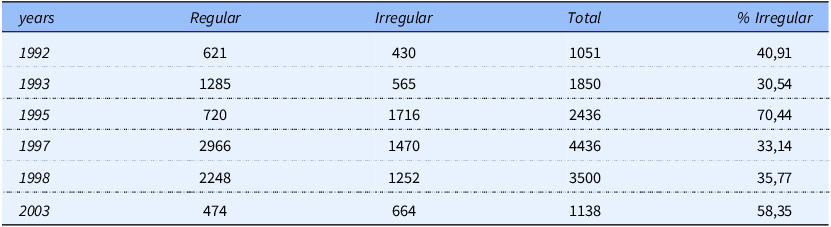
It is difficult to assess irregular migrant employment in agriculture in the continental Mezzogiorno. Sources are scarce and discontinuous for both legal and illegal employment (Caritas 2001: 302). As far as possible, the objective of this paragraph is to analyse the phenomenon over time. The Dossier Statistico Immigrazione is one of the most accredited studies in Italy. Since its first publication in 1991, it has dedicated a section to irregular work. It includes data on controls on companies carried out by the Ministry of Labour. Unfortunately, it is not possible to reconstruct the annual trend because since the year 2000, regionally disaggregated data are no longer available. Despite this, the available values identify until the 1990s that the percentage of irregular migrants fluctuates on average between 30% and 40%: in 1995 there is a peak of 70% and then the level is around 60% at the beginning of 2000 (Table 1). The findings depend on the number and type of companies inspected. Therefore, they represent a limited reality because the number of companies inspected depends on the reports from the Ministry.
Regular and irregular immigrants in Southern Italy by year

Source: elaboration by the authors on data from the Ministry of Labour reported in «Dossier Statistico Immigrazione».
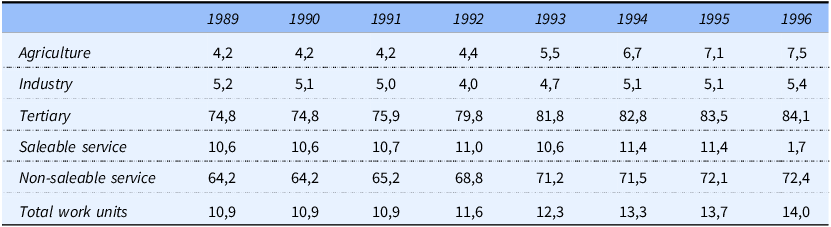
Since the mid-1980s, the National Institute of Statistics (ISTAT) has been the only public agency that has produced an estimate of irregular workers in Italy (Table 2), presented in the dossier for the first time in 1996 (Caritas 1996: 273). It must be said that ISTAT’s important findings, which photograph the constant increase in the number of irregular workers in the 1990s, (Chart 1) are – by the very admission of the dossier editors – overestimated, due to some inconsistencies with the data about regularisations and the Ministry’s own inspection activities.
ISTAT estimate: % of irregular immigrants in labour market (1989–1996).
Source: elaboration by the authors on data from «Dossier statistico immigrazione 1997».

ISTAT estimate: % of foreign irregular immigrants by productive sector (1989–1996)

Source: «Dossier statistico immigrazione 1997».
In the 21st century undeclared work, particularly in the agricultural sector, has grown in importance. According to data from the National Social Security Institute (INPS) on the category of ‘agricultural workers’ reported in the CREA report entitled Il contributo dei lavoratori stranieri all’agricoltura italiana, the period between 2008 and 2017 showed unprecedented growth. In 2008, the number of foreign agricultural workers was 268,273, a figure that increased to 364,385 in 2017. However, among them, there was a sharp increase in fixed-term contracts, from 245,773 to 343,977, while permanent workers decreased from 26,559 to 23,222. At the same time, the share of Italian agricultural workers decreased from 74,13% in 2008 to 65,62% in 2017 (Macrì Reference Macrì2019). Data from the IDOS study and research centre confirm the exponential growth of foreigners in the agricultural sector: they show that the increase was constant until 2018 and then suffered a contraction in 2020 due to the pandemic crisis, which greatly reduced the regularly registered workforce. In recent years, the trend has become positive again (Chart 2). It is therefore clear that the participation of foreigners in the domestic agricultural market is a structural factor in the primary sector.
Foreign agricultural workers: national absolute values (2013–2022).
Fonte: elaboration by the authors on data by IDOS.

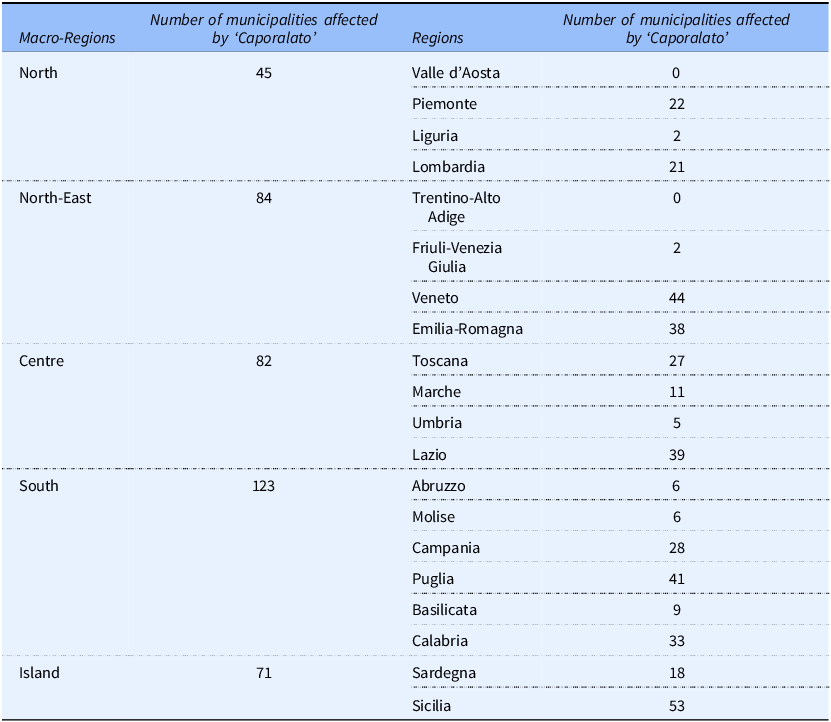
Number of municipalities affected by ‘caporalato’ by region and Macro-Regions (2020–2021).
Source: Authors’ elaboration on data from Osservatorio Placido Rizzotto – FLAI-CGIL, 2020–2021 (quoted in Dossier Statistico Immigrazione 2023).

Migrants’ working conditions were extreme. In 2005, a survey by Médecins sans Frontières took a snapshot of agricultural seasonal workers’ conditions in the Mezzogiorno: they were people without work permits (6,3% were refugees and 18,9% held a permit for reasons other than seasonal work, e.g. study or family). 36% lived in overcrowded spaces, more than 50% did not have running water where they lived, 30% had no electricity, 43,2% did not have toilets; the majority only managed to eat once a day, mostly in the evening. Labourers only worked a few days a week, which is why 53,7% were able to send money back home. For 30% of the people approached the ‘caporale’ and transport to the place of work cost EUR 5 per day. The harsh working conditions quickly led to the onset of illnesses already a few months after arrival in Italy: 1 in 10 needed assistance already after one month and for most after less than six months. The vast majority had no health care, despite being legally entitled to it (IDOS 2005: 305).
Law No. 199 laying down provisions on combating undeclared work, labour exploitation in agriculture and wage realignment in the agricultural sector came into force in 2016. Up to 2021, it has produced more than 260 judicial enquiries in Italy (IDOS 2021: 286), bringing attention to a now central issue. A 2016 ISTAT survey showed that 3,8% of the entire Italian and foreign-employed workforce was employed in the primary sector. Of these, a significant percentage (35,2%) were foreigners. The same study defined the Mezzogiorno as a ‘laboratory of caporalato’ and emphasised that Puglia was the region most affected (at least 30,000 exploited labourers between Italians and foreigners during the tomato harvesting season) and with obvious problems for foreigners imprisoned in ghettos scattered along the Tavoliere (at least 10,000 non-EU and neo-EU foreigners) and in the lower Salento. A phenomenon comparable to mafia in terms of its scale and ability to be accepted and sometimes even supported by local population (IDOS 2016: 282).
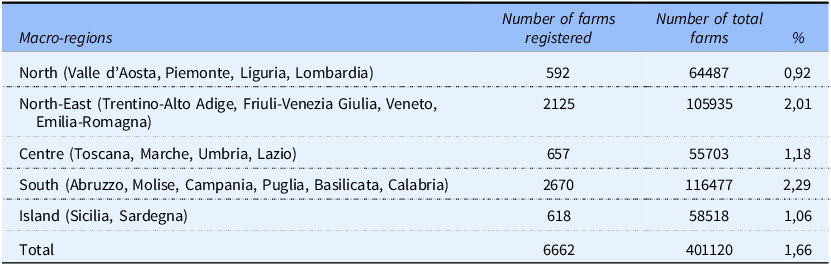
In 2019, the Agromafie e Caporalto report by the Placido Rizzotto association estimated between 400,000 and 430,000 agricultural workers exposed to the risk of being hired illegally and under a ‘caporale’. Of these, more than 130,000 were in a condition of serious social vulnerability. Moreover, only 3,600 farms out of 200,000 (less than 2%) were registered in the Rete del lavoro agricolo di qualità (i.e. Quality agricultural work network), set up on the INPS portal to select companies and other entities indicated by the regulations in force that, upon presentation of a special application, stand out for their compliance with labour, social legislation, income tax, and value-added tax regulations. Latest data released by the INPS certify that as of 15 January 2025, the number of registered companies had risen to 6,662. They are still a minority, especially considering that the number of companies has also increased, and the percentage has remained below 2% (Table 3).
Macro-regions: number of farms registered in the network of quality agricultural work (15 January 2025)

Source: elaboration by the authors on data by INPS.
In 2020, the immigration dossier showed that the COVID-19 pandemic, together with the inherent contradictions of government measures that attempted to regularise the legal position of migrant workers (Decree-Law No 34/2020), reinforced the structural nature of exploitation, particularly in the agricultural sector. Even though the intention of the regularisation process was to fight ‘caporalato’ and decrease the vulnerability of migrants, it highlighted the contradictions in the political debate: migrants’ emancipation is addressed as a marginal issue, subordinated to the priorities of economic development and security, in a sovereignist perspective rooted in the political, economic and social context of the country. (IDOS 2020: 288). Indeed, data from Centro Studi Tempi Moderni noted during the pandemic phase an increase between 15% and 20% of exploited immigrant workers in the Italian countryside. In absolute terms, COVID-19 thus resulted in an increase of approximately 40–55,000 exploited persons. According to the centre’s estimates, the irregularity rate in the agricultural market increased from 39% to 48%. Many employers have perceived the pandemic as an opportunity to multiply their licit and illicit profits, reorganising labour in a very short time and with a deterioration of fundamental freedoms. Finally, there is an increased surrender to the immutability of one’s condition in the face of the seriousness of health situation. Many migrants could have filed a complaint, but preferred to give up because they did not consider their claim serious enough in the face of the national emergency.
Data from the fourth report published by Laboratorio sullo sfruttamento lavorativo e la protezione delle sue vittime created by L’altro diritto and FLAI-CGIL confirm these trends. Indeed, the number of investigations initiated for labour exploitation rose from 214 in 2019 to 458 in 2022; an increase of 114%. These are indicative estimates, which only partially cover the investigations: however, the increase indicates that investigators’ attention to the phenomenon is growing. In 2022, the agricultural sector is predominant, and the territorial distribution is fairly homogeneous (138 in Northern Italy, 138 in Central Italy and 182 in Southern Italy). In addition, the trend towards the exploitation of foreigners in the majority of cases is confirmed: out of 391 investigations in which the nationality of the victim was ascertained, 293 involved non-EU foreigners and 26 involved both non-EU and EU foreigners.
In 2023, the Osservatorio Placido Rizzotto produced an updated map (Table 4) in which it surveyed all over the country the municipalities where employment dynamics managed by illegal practices are registered. The South of Italy remains one of the areas where the presence of this phenomenon is greatest, even though the North is extremely affected too. In fact, adding the two areas of the North and North-East together, there are 129 cases, exceeding the 123 in the South. Similar considerations can be made for the breakdown by regions: Sicilia is in first place with 53 cases, followed by Veneto (44) and Puglia (41). In short, if we consider that the number of workers employed in the agricultural sector in the South is just under 600,000 – almost double the number employed in the North (332,250) – the issue of ‘caporalato’ and exploitation in the agricultural sector now requires greater attention from the institutions (Chart 3).
Macro-regions and regions related to ‘Caporalato’ (2020–2021)

Fonte: Osservatorio Placido Rizzotto – FLAI-CGIL, 2020–2021 (quoted in Dossier Caritas 2023).
In conclusion, the analysis of the phenomenon of irregular work and the exploitation of migrants in agriculture highlights a complex and widespread reality, which has deep roots and well-established dynamics. Despite progress, data continue to outline a critical scenario, worsened by factors such as the pandemic crisis and the difficulty in guaranteeing adequate protection for workers. Only a coordinated and structural commitment can effectively tackle this scourge, transforming it from a social emergency to a national priority.
Labour exploitation in international and Italian law
For a long time, ‘caporalato’ has been a widespread phenomenon in the labour market within the agricultural sector in Italy. According to estimates by Osservatorio Placido Rizzotto, at least 200,000 workers are employed illegally in SMEs in the agricultural sector. They account for approximately 30% of employees, and foreign workers account for over 34% of agricultural employment days (Osservatorio Placido Rizzotto 2024). ‘Caporalato’ is an organisational structure that recruits labour and places it in the fields in agreement with landowners using criminal and extortionist methods. This is a paradigm of illicit intermediation that revived in the Southern countryside after the Second World War (Castagna Reference Castagna2024). In this scenario, the various forms of exploitation were determined by the quality of the relationship between the employer and the worker, which was often characterised by severe asymmetry. The employer’s decision-making power over working hours and pay emerged as a fundamental aspect of subordination, with serious violations of fundamental human rights.
This kind of abuse that continues to this day and, based on studies carried out by L’altro Diritto and FLAI-CGIL, has progressively spread to many countryside locations (Maccarone Reference Maccarone2022). On this topic, a fundamental reference is the analysis of the International Labour Organisation (ILO), which over time has drawn up increasingly detailed guidelines to identify exploitation. Article two of Convention 29/1930 defined forced labour as any type of work or service that, regardless of its legal nature, is performed as the direct or indirect effect of extortion or the threat of punishment (ILO 1930). In 1957, a new Protocol on the Abolition of Forced Labour supplemented this provision: States ratifying the text committed themselves to fight exploitation as a method of labour mobilisation and as a measure of racial, social, national, or religious discrimination (ILO 1957). In this document, reference was made, for the first time, to the possibility that the spread of para-slavery labour relations could be combined with racial discrimination and result in the growing segregation of labour market, with an increasingly pronounced correlation between the tasks performed and the geographical origin of workers.
Further updates to the definition of forced labour were agreed with the Palermo Protocol, signed in 2000. An important innovation is the provision that entry into the ‘para-slavery’ condition can occur either by an act of force or violence or because of a consensual agreement between the parties, as a result of threats or other means of coercion (UN 2000). This was a fundamental step forward against ‘caporalato’, which takes into account the possibility that exploitation can also be characterised by the apparent consent of the worker. In most cases, victims of illegal labour management systems are foreign labourers, who are only partially aware of the asymmetry in the relationship with their employers because they are not informed about regulations that can protect them. They are often already accustomed to working for low wages and in harsh conditions in the agricultural sector, without the possibility of asserting their rights and improving their living conditions. Moreover, for migrants, agriculture is considered a ‘refuge’ sector when one has just arrived in Italy or has been dismissed from employment in other areas of production, as indeed happened after the 2008 crisis.
In sum, the idea prevails that it is a transitory occupation, while waiting for other professional opportunities. For this reason, the sector is characterised by high employment turnover (Devole Reference Devole2011). More recently, the Warsaw Convention of 2005 extended the commitment of signatory States to the provision of social, psychological, health and care interventions, as well as protection and support for the reintegration of victims of exploitation into the social and labour fabric. It provided for the possibility of issuing residence permits for humanitarian reasons to allow possible cooperation with the judicial authorities under safe and regular conditions. In the same year, ILO published an important report containing a partial list of the ways in which forced labour can appear globally (ILO 2005). These include slavery resulting from kidnapping, forced labour in agriculture and remote areas with coercive recruitment practices, servile domestic work and employment resulting from human trafficking. In correlation with United Nations (UN) agencies, the European Union (EU) has passed several directives identifying measures against labour exploitation. The 2009 EU Directive No. 52 introduced a system of sanctions for individual employers who repeatedly violate labour rights regulations, illegally recruit third-country nationals and force workers to suffer because their fundamental rights are not respected (EU 2009).
Secondly, Directive 2011/36 provided for awareness-raising measures to reduce people’s vulnerability and to assist victims of ‘caporalato’. Ultimately, Directive 2014/36 sets common standards in relation to entry, housing conditions and equal treatment for foreign workers. It requires that applications for admission for seasonal work exceeding 90 days must be accompanied by an employment contract, health insurance, proof of adequate accommodation and sufficient resources to maintain oneself without recourse to social assistance schemes. However, the legislation demands Member States to define seasonal entry quotas on the basis of the needs identified for the different productive sectors. Article 20 recommends requiring proof of accommodation, with rent that shouldn’t be deducted from the worker’s salary. The Italian Parliament has only recently updated the legislation against ‘caporalato’ with the approval of Law No. 199 of 2016, which reformulated Article 603-bis of the Penal Code. In compliance with the new text, a person whose state of vulnerability is such that it strongly compromises his or her freedom of choice, inducing him or her to accept unfair conditions as a result of coercion by intermediaries who take advantage of the state of need, is considered a victim of labour exploitation.
Furthermore, the law stated that ‘caporali’ are to be punished with imprisonment from one to six years and a fine of five hundred to one thousand euro for each exploited worker. The punishment increases to eight years and the fine to two thousand euro for cases where recruitment occurs through violence or threats. In line with international agreements, Italy has also incorporated the UN Convention against Transnational Organised Crime (UNTOC) into its legal system in 2006. However, it has not ratified the UN Convention on the Protection of the Rights of All Migrant Workers and Members of Their Families (CRMW), approved in 2003, missing an important opportunity to guarantee better protection for foreign workers (Scaturro Reference Scaturro2021). The summary of the main regulations that regulate seasonal work and define the presence of ‘slavery’ conditions also makes it possible to identify factors of vulnerability to which foreign workers are exposed and types of recruitment with criminal forms of ‘caporalato’. The historical reconstruction of events related to labour exploitation in the agricultural sector deepens the analysis of fundamental characteristics of rural economy in continental Southern Italy and the role of foreign workers in the agro-food chain, denouncing the conditions of serious irregularity and exploitation made sadly known by the repeated occurrence of massacres and the organisation of strikes for the protection of labourers’ rights.
The origins of ‘caporalato’ in the continental Mezzogiorno
After the Second World War, most of the irregular workers were Italian, even before foreigners were widely employed in the agricultural sector. Employed for about twelve hours a day for pitiful wages, they were hired by landowners looking for seasonal or daily workers. Exploited labour was used on a massive scale to have a large number of workers available quickly and to maximise earnings from harvests. Surveys carried out in the years following the Second World War described widespread poverty in Southern Italy and highlighted the conditions of serious backwardness in the rural sector (Scotellaro Reference Scotellaro1955). The absence of mechanisation and the poor specialisation of techniques made it necessary to employ many labourers, whose work ensured that the harvest took place quickly and at low cost (De Martino Reference De Martino2008). ‘Caporalato’ established itself as a criminal pyramid organisation, matching labour supply and demand and leading to exploitative conditions for workers. The revival of this illegal intermediation is confirmed by the purchase of Anglo-American allied trucks by the ‘caporali’ after the liberation from German occupation. In this way, they were able to intensify the transport of workers to the fields, as well as to manage recruitment (Dandolo Reference Dandolo2023: 57).
Some aspects of the illegal recruitment system were modernised: in the 1960s and 1970s, informal agencies operated for most of the day and until late in the evening, so that the intermediaries were trusted and always available (Ferrarese Reference Ferrarese2024; Castagna Reference Castagna2024). ‘Caporali’ became key figures in the organisation of productive structures within Southern agriculture and exploitation represented the widespread form of labour management in the fields. Law No. 83 of 11 March 1970 tried to eliminate the functions they performed, but with little success. In fact, newspaper investigations in the Southern countryside revealed that the provision of unemployment and social security benefits for two years after fifty-one days of work generated adverse effects in the fight against illegal recruitment (Dandolo Reference Dandolo2023: 57).
During this period, the phenomenon of falsi braccianti (i.e. fake farm workers) became widespread, the scam whereby Italians were only nominally employed in agriculture but carried out different jobs, while those who really worked in the fields were subjected to extremely exploitative conditions. At the end of the 1970s in the province of Naples alone, about seventy per cent of workers registered at employment offices had never been in the fields. Therefore, the ‘mafia of cheap labour’ intensified, targeting foreigners, mainly because they were living on Italian territory illegally and without any possibility of asserting their rights. Abuses went beyond the low salaries: ‘caporali’ employed women and children indiscriminately, often without paying them any wages and forcing them to work endless hours, from four in the morning to nine at night.
The symbols of this system of managing relations in the labour market were the Castel Volturno and Villa Literno areas, the Sele Plain, the ‘Capitanata’ in Apulia and the Gioia Tauro Plain in Calabria. Here, the substitution of foreign instead of local labour took place gradually: in fact, the risks linked to work in the fields carried out in inhuman conditions led to a progressive abandonment of the countryside, especially after repeated massacres. The first occurred in the Salerno area on June 22nd 1963, when a vehicle fell into a river. Four workers died and sixty-two were injured. The deceased were three women and one man (Dandolo Reference Dandolo2023: 58). This accident, which was widely reported in the national press and exposed the hazardous conditions of farm labourers during transport to the fields, convinced more and more Italian workers to refuse agricultural employment, encouraging the practice of recruiting foreign labourers. Investigations showed that the spread of ‘caporalato’ was due not only to the violence of the employers but to the state of need and irregularity in which people were driven into the countryside for harvesting operations. There was no alternative to inhuman labour: a dilemma in which so many migrants recruited by the day in the early hours of the morning at the ‘slave roundabouts’, as happened to Jerry Masslo, still find themselves today, representing a ‘secular plague’ (Festa Reference Festa1978) for the rural economy of Southern Italy.
The ‘contract’ types and the roles of the ‘caporale’
Labour exploitation in the agricultural sector occurs in various forms. In most cases, migrants establish illegal labour relations with employers through the mediation of a ‘caporale’. The activities may be occasional or fixed-term and are often ‘occasional long-term’ employment relationships: the employer knows the migrants and enrols them on a permanent basis for some time. Wages are low, hours long and there is no guarantee of accommodation near the workplace. Investigations carried out in the Mezzogiorno by newspapers, trade associations, trade unions and religious organisations reveal that these are relationships in which the entrepreneurs regularly pay the agreed wages in the first few months and then towards the end of the work period begin to delay payment, threatening the workers who demand the agreements to be respected. Payment of social security contributions, even when workers have residence permits, is systematically violated. This infringement prohibits access to unemployment benefits during periods of inactivity (Devole Reference Devole2011).
The other most common type of relationship concerns occasional activities, which the employer undertakes without intending to hire the worker in the medium to long term. This is done by recruiting workers once or twice a week, when particularly heavy tasks need to be performed (Carchedi et al. Reference Carchedi, De Marco, Forlino and Forti2015: 134–135). In these cases, the impossibility of obtaining a residence permit is combined with precarious employment, which leads to conditions of extreme economic, housing and social poverty for foreign workers. This is what often happened in the countryside of southern Italy: entrepreneurs paid extremely low wages and in many cases refused to pay the workers they hired. By doing so, they could take advantage of the situation of administrative irregularity, knowing that workers without a residence document could not report the violence they suffered (Amoroso Reference Amoroso, Dandolo and Mosca2020: 82).
As organisations working against ‘caporalato’ have long reported, the main vulnerability factor favouring illegal recruitment is the interaction between the residence permit and the need to prove the existence of a work contract. This procedure has been in force since the approval of Law No. 189 of 30 July 2002 (the so-called ‘Bossi-Fini’ law) and still restricts the possibility of obtaining a residence permit. Therefore, the ‘caporale’ is strengthened by the bridging function he performs between migrants and companies in the agricultural districts. He deals with logistical aspects related to the organisation of work in the fields and ensures the constant availability of workforce to entrepreneurs. In some cases, he manages the payment of labourers in a discretionary manner. Entrepreneurs hand him a sum to pay the workers and he can choose to increase his profit margin by charging lower wages and retaining a higher percentage for intermediation. When a relationship of trust is established with the owners, ‘caporali’ perform broader tasks, often becoming factotums who take care of multiple aspects of crop management. One factor influencing the classification of different types of ‘caporali’ is their direct involvement in work activities alongside the recruited team. Studies carried out in regions where illegal work is most widespread identify five different types of ‘caporali’.
-
a) The ‘caporale-worker’: during the day he performs the same tasks as other labourers in the field. He is regarded as an ‘ally’, who shares the labour pains and does not impose his managerial power on the workplace. He is in charge of coordinating the activities because the entrepreneur trusts him.
-
b) The ‘caporale-driver’: he transports labourers to their place of work and returns to pick them up at the end of the day. He performs a transport service, for which he is paid by the employer, but is practically absent from the fields.
-
c) The ‘caporale-seller’: he provides transport and is engaged in the forced sale of basic necessities to migrants. The cost is arbitrarily decided and often directly deducted from the daily wage. For foreign workers, buying what they need from the ‘caporale’ is a condition for continuing to be hired.
-
d) The ‘caporale-persecutor’: he increases his profit margin by imposing ‘survival wages’ and sets transport costs according to the length of the road to be travelled. He uses violent methods, practising threats and blackmail to reinforce his control over the labour force.
-
e) The ‘caporale-manager’: he manages the entire harvesting phase autonomously, after having received indications from the entrepreneur on how to organise the work in the fields. Again, these are harsh and violent ‘caporali’, often colluding with criminal organisations (Carchedi et al. Reference Carchedi, De Marco, Forlino and Forti2015: 48–49).
Overall, the strong rooting of the illegal recruitment system in the continental Mezzogiorno is evident. The evolution of the agricultural sector has been conditioned for decades by the presence of ‘caporalato’, which represents a ‘secular plague’ for this area (Dandolo Reference Dandolo2023: 57). The history of agriculture in Southern Italy is marked by repeated strikes and violent revolts by foreign workers who took to the streets to demand respect for fundamental rights and an end to ‘slavery’ exploitation. Events only marginally considered, but essential for the scientific interpretation of evolutionary trends for the agricultural sector and migration flows.
‘Black strikes’
Masslo’s death brought to light the plight of migrant workers’ suffering. It became unbearable to be paid ‘piecework’, without an exact daily working schedule being defined. Many people, without residence permits, preferred to move elsewhere, intimidated by acts of violence. In just a few days, the informal settlements where Masslo slept went from thirty to five labourers. Among the migrants who remained, however, there was a desire for their rights as land workers to be respected. In the evenings, after work in the countryside, they began to meet in crowded assemblies to discuss the statute of the association called Coordinamento degli immigrati della Campania (i.e. Coordination of migrants in Campania), one of the first forms of trade union associationism promoted in Italy by migrants (Santonastaso Reference Santonastaso1989).
There was, however, no intention to oppose the local population: they were aware that the respect of fundamental human rights concerned everyone, Italians and migrants. Indeed, from the very first lines of the final document approved, the attitude of openness and willingness was evident: ‘We want to share Italian culture to defend our identity’. The first ‘black strike’ was organised during those assemblies: a month after Masslo’s death, the meeting was in Villa Literno at 6.30 a.m. at the ‘slaves roundabout’. Many Africans from other Italian regions crowded the square and compactly declared: ‘It is not for the residence permit, it is for the respect to our lives’. Once the assembly was over, they started a silent procession made of poor banners with watchwords such as ‘Solidarity with Jerry Masslo’ and ‘No to racism’ (Nardini Reference Nardini1989). During following days other meetings were planned in various Italian cities, which led to the great demonstration in Rome on October 7th 1989, organised by about eighty-five associations and with the participation of over two hundred thousand people (De Cesaris and Impagliazzo Reference De Cesaris and Impagliazzo2020). The issue of migrants’ exploitation in the Italian countryside took on great relevance: Masslo’s friends opened the impressive procession with the banner: ‘Never again dark nights like the one in Villa Literno’ (Di Luzio Reference Di Luzio2016). Despite the protest and strong reports, the condition of migrants would remain unchanged. This was proved by the numerous migrants’ strikes in some strategic areas of the Italian countryside.
The busiest protests occurred in Apulia and Calabria. In Nardò in 2011 the lower harvest volume compared to previous years, limited work opportunities, and the excessive demands by ‘caporali’ pushed labourers to occupy the streets to demand an intervention from the institutions. The watermelon harvest had just ended and the tomato harvest was starting. Only three hundred hectares of land were dedicated to vegetables and thus the worst working conditions: 3,5 euro per box for endless harvesting days (Amoroso Reference Amoroso, Dandolo and Mosca2020: 91). The twenty-one euros earned on average by filling the boxes had to be subtracted from payments to the ‘caporale’ for hiring and transport to the fields (Leogrande Reference Leogrande2011). The protest began on the morning of July 28th: people crossed their arms and refused any type of job offered (Sagnet Reference Sagnet2012). The strike was followed by a public assembly and a document was signed with clear demands: to have real labour contracts; to increase the price for each box; to eliminate the ‘caporalato’ system; to open an office in the fields; to provide a transport service; and to guarantee medical assistance for the excessive heat (Leogrande Reference Leogrande2011).
In short, it was not a strike generated only by the repetition of racist attacks, but a mature protest against the exploitative conditions in the agricultural sector, where foreign labour was predominant. Workers showed the ability to organise themselves, to enforce the value of their labour, on which local businesses and the supply of food for entire Italian regions depended (Amoroso Reference Amoroso, Dandolo and Mosca2020: 93–94). However, in the weeks following July 28th, participation faded. Threats from the bosses forced the migrants to return to work, but meetings were obtained with representatives from the province, the region and some companies operating in the area. An agreement was signed between employer associations, local institutions and trade unions to create reservation lists. This was an important result, but was still insufficient in the fight against labour exploitation.
In the same years, a violent uprising occurred in Rosarno, in the Gioia Tauro plain. On the afternoon of January 7th 2010, unknown persons fired a gun, hitting three workers returning from the fields: a Moroccan, an Ivorian and a Togolese. The same evening, the first clashes between groups of migrants and the police took place and in the following days a civil war almost broke out. It is remembered as the ‘revolt of intolerance’ (Macrì Reference Macrì2010), the reaction of foreign workers to the abuse they suffered in the Calabrian countryside. About two thousand labourers first blocked the State highway No. 18 and then moved to the centre of Rosarno, where bins and cars were set on fire and shop windows destroyed (Amoroso Reference Amoroso, Dandolo and Mosca2020: 100). The reaction of the inhabitants was immediate and violent: autonomous patrols and lynch mobs were organised against the foreigners. Four Africans were shot and barbed, others hit by cars.
The reaction of the institutions was paradoxical. Interior Minister Roberto Maroni declared that the riots were the result of the excessive tolerance with which illegal immigration had been accepted over the decades and ordered the transfer of migrants to reception centres in Crotone and Bari. An ‘ethnic cleansing’ took place, legitimising the violence of ‘caporali’, the citizens and the police. The uprising left a tangible mark in the newspapers, which defined the days of the protest as a ‘migrant hunt’ and collected testimonials from the assaulted labourers: Ahmed R., a 34-year-old Moroccan engineering graduate and representative of the community in the area, declared that the foreign workers were only asking for equality, but had been sent away because they were threatened to be killed. At the end of the revolt, many migrants returned to Castel Volturno, where they lived for most of the year. They were hosted at the Centro Fernandes, the reception facility that has been an essential reference point for foreigners over decades. They recalled the tragic events of Villa Literno in 1989, when the death of Jerry Masslo had triggered the reaction of African labour communities in Campania (Amoroso Reference Amoroso, Dandolo and Mosca2020: 102–103). In general, trust in the Constitution and institutions prevailed on these occasions: as was the case during the recent demonstration in the Pontine countryside immediately after Satnam Singh’s death, when the president of the Italian Sikh Union Bajwa Satwinder Singh stated that ‘justice, legality and rights must be guaranteed for all agricultural workers, migrants and Italians alike’ (Singh 2024). More than 20 years later, nothing has changed and the climate of racial hatred is fuelled even by institutional representatives. The conditions of farm labourers are destined to worsen, as is evident if one considers the precarious housing conditions they face in the rural areas of Southern Italy.
The ‘ghettos’
From Masslo’s case, it was clear that there was a serious lack of decent housing for migrant farm workers (Sagnet and Palmisano Reference Sagnet and Palmisano2015). The issue, however, is far from resolved. Even today many farm labourers live in degraded conditions: their dwellings are often shacks, abandoned cottages, tents, caravans, lacking water and sanitation. The growing need for agricultural workers during harvesting periods increases informal settlements, which turn into ‘ghettos’. In these places, the clear separation from inhabited centres immediately stands out. It is a real social segregation, which has drawn the attention of humanitarian organisations. A survey carried out in 2015 by ‘Medici per i Diritti Umani’ (MEDU) showed that slums and cottages represented an alarming feature of the Southern countryside (Barbieri et al. Reference Barbieri, Bari and Peca2015). According to some statistics, out of the 58,000 to 63,000 estimated migrants between 12,500 and 17,500 live in informal settlements (Ciniero, Reference Ciniero2018a).
Overall, the Associazione Nazionale dei Comuni Italiani (ANCI) has pointed out that there are more than ten thousand migrant farm workers living in 150 ghettos across Italy, especially in the Mezzogiorno (Centro Astalli 2022). This map is functional to the interests of the ‘caporalato’ that, by enclosing migrants in these settlements, easily disposes of abundant labour to recruit for exploitation in the fields (Palmisano Reference Palmisano2016). At the same time, the network of ‘caporali’ throughout the country can transfer hundreds of migrants from one ghetto to another in relation to harvest times: potatoes, vegetables, tomatoes, citrus fruits, grapes, and olives (Ciniero, Reference Ciniero2018b). The concept of seasonal worker has thus been transformed, no longer understood as a migrant who stays for a limited period of time in Italy, but as a person who moves from one ghetto to another depending on the times imposed for the harvesting of agricultural products.
The first time the issue of poor living conditions in the ‘ghettos’ exploded in Italy was again in Villa Literno. We therefore return to the places where Masslo died. An agglomeration of shacks was built in 1990: about one thousand five hundred Africans were housed there amidst rubbish mountains, without electricity and with few public fountains. They cooked with the dozens of gas cylinders packed in and out of the shacks, with the risk of causing a massacre. The only oasis was the mosque, a shack paved with ten carpets and lit by neon, much frequented in the evenings by migrants returning from work. In August 1994, an intense press campaign made the ghetto a national case because of the poor hygienic conditions due to severe heat. For this reason, a delegation from the Social Affairs Commission of the Chamber of Deputies went to the site. Immediately afterwards, very well-attended assemblies were held: the general secretary of the CGIL, Sergio Cofferati, participated in a meeting. The Anti-Racist Forum, which brought together the network of associations defending migrant labourers, formulated two demands: better housing conditions and a residence permit. The demands were not accepted by the government. In mid-September 1994, the ghetto was destroyed by a fire: the causes remained obscure. Fortunately, there were no victims because the labourers had moved for the olive harvest in the Apulian countryside (Dandolo Reference Dandolo2023: 157–163). However, a new location had to be found to give hospitality to the few who remained. The collaboration of ecclesiastical structures was decisive: in particular in Casal di Principe, the parish of Don Giuseppe Diana, a priest killed by the Camorra on March 19th 1994, was among the first to provide a reception facility (Dandolo and Mosca Reference Dandolo and Mosca2020a). Recently, interest has focused on the ghetto of Borgo Mezzanone, in Apulia, in the countryside between Foggia and Manfredonia: it is estimated that during the summer season about three thousand migrant labourers concentrate in this ghetto for the tomato harvest (INTERSOS 2024). And it is here that several workers have died when their shacks were set on fire (Mira Reference Mira2023).
White deaths in agriculture
Indiscriminate exploitation, lack of essential services in ghettos, and overheating temperatures due to climate change are the main causes of deaths in the fields. According to updated data from the «Federazione agricola, alimentare e ambientale industriale» (FAI) of the Confederazione italiana sindacati lavoratori (CISL), in the first half of 2024 alone, there were fifty-two fatal accidents in agriculture, an increase of 6.11% compared to 2023 when 47 deaths were recorded in the same period (FAI-CISL 2024). This is a trail of blood that claims innocent victims, especially among foreigners. This trend is indeed confirmed by the statistics of the «Istituto nazionale per l’assicurazione contro gli infortuni sul lavoro» (INAIL): compared to Italians, the risk of death for migrants is almost three times higher and there are 55.6 deaths for every million employed compared to 20.5 for Italians (Vega Engineering 2024). The ferocity of ‘caporali’ exposes workers to the risks linked to non-compliance with regulations protecting safety at work, to suffering caused by temperatures that are either too hot or too cold in the countryside, and to the consequences of pathologies that emerge due to excessive fatigue and lack of hygiene in the ghettos.
Deaths in the fields are another ‘secular plague’ for Southern Italy: Jerry Masslo’s grave in the Villa Literno cemetery has been flanked over the decades by the anonymous tombstones of workers who died during months of work. It has not been possible to find their documents, to know their names, to retrace their stories, to reach their families to express the distress caused by their disappearance. Those are forgotten deaths, which call civil society and institutions to assume their responsibilities. In recent years, investigations by «Medici con l’Africa» (CUAMM) have estimated that from 2013 to 2019 over one thousand five hundred foreign workers died in the Italian countryside (Fulvi Reference Fulvi2019). A silent massacre, caused by the increasing downward speculation on the cost of labour to produce food at competitive prices. Sometimes, survival wages are justified by the low profitability of farms, but recent surveys reveal that these companies have accumulated considerable profits in recent years (Mangano Reference Mangano2020).
Significant health risks are also determined by the absence of basic health services. During the working day, which extends from ten to twelve hours, it is not possible to complain about any discomfort, nor to ask for a rest or to perform less strenuous tasks. The ghettos also lack any kind of assistance, and voluntary organisations and trade unions are the only points of contact for reporting situations of distress. The most widespread diseases among migrants are often related to the gruelling work they are forced to do: in summer, dehydration is among the most common causes of death, while in winter, pneumonia, bronchitis, and other cold diseases claim further victims (Fulvi Reference Fulvi2019). This was tragically discovered in 2020, when COVID-19 spread with shocking speed among foreign workers, who were forced to continue harvesting without compliance with safety measures and without the possibility of ascertaining infection or receiving adequate treatment. However, it was precisely during those months that the work of migrants in the countryside became indispensable, so much so that the government led by Giuseppe Conte passed an amnesty law.
The cruelty of ‘caporali’ indiscriminately affects workers of all nationalities: in fact, while it is true that for migrants the risk of losing their lives is higher – also in correlation with the precarious housing conditions – for years many Italian workers have been exploited in the fields. A direct consequence of growing poverty and the absence of effective placement strategies in the poorest areas of the country. And it is not surprising that Italian citizens are also dying in the fields: on July 13th 2015 Paola Clemente died at the age of 49 in Andria, while working under a marquee at the grape milling. She was killed by an illness she had been suffering from since the beginning of the working day, at three o’clock in the morning on a bus that was taking her from San Giorgio Jonico to Andria, about one hundred and thirty kilometres away. Together with two hundred other labourers, she had started work at 5.30 am. When around seven o’clock she fainted during her coffee break, there was no one at the «Ortofrutta meridionale» farm who could help her and the ambulance arriving more than an hour later could only pronounce her dead. In 2023, the only defendant, the entrepreneur owner of the company Luigi Ferrone, was acquitted at first instance, and to date, Paola Clemente’s death remains unpunished, pending the higher levels of judgement (De Monte Reference De Monte2023).
In recent years, Apulia has confirmed itself as the region of the Mezzogiorno where the most serious cases of exploitation and numerous massacres occur: on August 6th 2018, twelve people – all migrants – died in an accident that occurred at 3 pm on the State road No. 16, in the territory of Lesina in the province of Foggia. They were returning from work in the countryside, where they were harvesting tomatoes, when their van collided head-on with a truck loaded with animal feed. Initial findings established that the workers were travelling on their feet and that the victims had regular residence permits (Fulvi Reference Fulvi2018; Borrillo Reference Borrillo2018). Only two days earlier, in another similar accident, four other young African labourers had died: Amadou Balde, 23 years old from Guinea, Ceesay Aladje, 20 years old from Gambia, Moussa Kande, 27 years old from Guinea and Ali Dembele, 30 years old from Mali (Fulvi Reference Fulvi2018). Lives cut short by poverty, fatigue, severe heat and the cruelty of ‘caporalato’, a ruthless evil whose disappearance depends on the spread of a new culture of entrepreneurship, work and equality. In this way, agricultural work can be a decent and remunerative occupation for labourers dedicated to the land and harvest.
Conclusions
Exploitation in the agricultural sector is an inescapable feature to understand labour market in the continental Mezzogiorno. The most up-to-date research proves that foreigners are the main victims of the cruelty of ‘caporalato’. Jerry Essan Masslo and Satnam Singh’s stories show that for over thirty years nothing has changed: many migrants work in conditions of ‘slavery’, are exposed to serious health risks, live in precarious housing or in ghettos, and are targets of racial discrimination without the possibility of regularising their presence on Italian territory. Investigations into deaths in the fields and illegal labour recruitment reveal that the role of ‘caporali’ is strongest in the agricultural sector, where there is the highest number of complaints about irregular practices by local businesses. Indeed, already after World War II and again in recent years, cases of exploitation also involve Italian workers. The high degree of informality and the presence of criminal organisations managing access to labour market make it difficult to estimate the incidence of ‘caporalato’, which becomes central to the organisation of rural economy. However, studies by trade unions, foundations, and religious associations show that the continental South and the North-East are the areas where the most serious cases of exploitation occur. Therefore, the history of agriculture in Southern Italy is intertwined with the events related to the fight against ‘caporalato’ and the integration of foreign workers into the productive fabric. In fact, the protests organised after tragic events and during periods of the most intense exploitation led to the updating of immigration legislation and the introduction of forms of protection to fight illegal recruitment systems.
This is a difficult battle, which has not yet achieved significant results: this is proved by the numerous deaths that still occur in the Southern countryside and the widespread irregularity that emerged when it became necessary to approve the amnesty in 2020 after the spread of the COVID-19 pandemic. The study from a historical perspective allows us to investigate the development dynamics of the agricultural sector in the continental South and to denounce the serious conditions of exploitation that foreign and Italian workers have been forced to endure for decades. Today it is essential to remember the stories of women and men who have lost their lives in the fields to call on the institutions to intervene to put an end to the cruelty of ‘caporali’. A commitment that must also take root in civil society organisations for the dissemination of a new entrepreneurship style, based on respect for fundamental human rights and the recognition of equal rights for workers of all sectors and nationalities.
The development of rural economy in Southern Italy – the successful emblem of Italian exports – cannot be tarnished by these crimes that are detrimental to people’s dignity. Companies must radically change their production model and market expansion strategies. It is necessary to promote models of social entrepreneurship, following successful examples already established in the Southern, Italian and international scenario. New paradigms emerge precisely in border areas, where ‘caporalato’ continues to claim victims, but the social fabric develops innovative ideas capable of restoring centrality to the most marginal territories of the Italian rural economy (Baldascino Reference Baldascino2016; Baldascino-Mosca Reference Baldascino and Mosca2012; Baldascino and Mosca Reference Baldascino, Mosca, Dandolo and Mosca2020; Dandolo and Mosca Reference Dandolo and Mosca2020; Mosca Reference Mosca2018; Mosca and Musella Reference Mosca and Musella2016).
The research presented in this paper therefore makes an important contribution to the study of rural history, highlighting points of considerable interest in a number of areas of investigation. First, the study offers a long-term review of estimates that were mostly collected in a fragmented way, showing how the ‘caporalato’ system has evolved in the countryside of Southern Italy, which hasn’t been looked at much from a scientific point of view until now. From a long-term perspective, it is confirmed that migrants represent an increasingly large percentage of workforce employed in the agricultural sector. As shown by data processed and presented in paragraph 5, Mezzogiorno is a ‘laboratory’ for ‘caporalato’, with over 400,000 workers at risk of being illegally hired in rural areas. This danger has become increasingly frequent in the last few years: in fact, the most recent surveys published on the occasion of the so-called ‘COVID-19 regularisation’ have highlighted a further increase of between 15% and 20% in the number of foreign workers exploited in the agricultural sector at national level. With this in mind, this paper provides an updated quantification of the phenomenon and traces its long-term evolution, summarising little-known data and offering a valid basis for further scientific research.
Second, this paper clarifies that ‘caporalato’ is now a structural feature of the organisation of labour market in the agricultural sector in Southern Italy. For this reason, it offers an analysis based on scientific data, as well as sociological and humanitarian research, to draw attention to the need for more effective and up-to-date regulation of the sector, emphasising that activities that are fundamental to the country’s economic development cannot tolerate the existence of such widespread and obvious phenomena of illegal exploitation.
Third, this research confirms that the presence of migrants in Italy, and in particular in the South, is no longer a phenomenon to be managed as an emergency, but a structural process to be addressed with a view to the full and total integration of new citizens into the social fabric and the labour market. Immigration is now a fundamental part of the demographic changes taking place in the country, making it necessary to evolve the legislation governing entry into Italy, residence and the acquisition of citizenship. In this context, the analysis of trends in the agricultural labour market is an effective proxy for capturing broader dynamics concerning demographic and social changes on which the future of younger generations depends.
Finally, this paper also aims to offer an important ‘methodological’ contribution to the study of phenomena relating to rural and labour history. In fact, the study restores importance to the qualitative dimension of research and to the telling of personal stories for the historical reconstruction of long-term processes. When studying migration, it is important to know the names, stories and aspirations of the women, men, and children who embark on complex life journeys in search of a better future, alongside statistical data. This is even more important when it comes to processes that are difficult to quantify due to current regulatory gaps and in which crime plays a significant role. For this reason, it is considered essential to trace and collect events that have marked the history of migration in Southern Italy, drawing attention to the respect for fundamental human and workers’ rights.
Given its multidisciplinary nature, this contribution aims to stimulate new ideas and research questions to be investigated from a scientific perspective:
-
• How can the protection of foreign workers in the agricultural sector be improved?
-
• What forms of regularisation can contribute to the fight against the ‘caporalato’ system?
-
• What methods can facilitate a real quantification of the phenomenon of labour exploitation?
-
• What are the economic mechanisms underlying labour exploitation?
-
• How can greater awareness of work ethics and respect for fundamental rights be spread in the business sector?
These are just some of the new questions that the research raises for scholars of rural history and which the authors of this paper continue to investigate with the aim of furthering research and offering new insights into human and economic processes that are highly complex but fundamental to the understanding of the contemporary world. This article is part of a broader research project and summarises the results of investigations that have been carried out for several years and will continue with the aim of highlighting features of an economic system in which people’s fundamental rights are formally recognised, but in the labour market, particularly in agriculture, situations of ‘slavery’ are functional.




 Open access

