




In 1661, one year after the Restoration of King Charles II to the English throne, John Evelyn (1620–1706) published a provocative treatise, Tyrannus, or, the mode in a discourse of sumptuary lawes, lambasting England’s fascination with foreign apparel.Footnote 1 Three decades later, he posthumously published his eldest daughter Mary’s (Mall, 1665–85) pointed satire of contemporary fashions, the Mundus muliebris: or, the ladies dressing-room unlock’d (1690), following her death from smallpox.Footnote 2 With shared authorship but markedly different tones, these texts expose an increasing preoccupation with the social, economic, and moral concerns tied to elite women’s clothing. Simultaneously, they intimate the paradoxical sartorial behaviours of the Evelyn family, whose personal preferences in dress aligned with the very model of consumption they publicly critiqued.
As a Surrey gentry family closely tied to the Stuart court, the Evelyns are well situated to assess the dichotomy between contemporary publications on elite female fashionability and genuine consumer behaviour. Examining the Mundus muliebris alongside manuscript records, this article interrogates the Evelyns’ biographies to untangle these contradictions.Footnote 3 It focuses on the accounts, bills, and correspondence of John Evelyn’s wife, Mary (1635–1709), and his daughters – Mall, Elizabeth (Betty, 1667–85), and Susannah (Susan, 1669–1754) – revealing their significant interest and investment in clothing. This comparison highlights the complex sartorial negotiations enacted within the household alongside the multi-faceted ways in which elite women conceptualized and achieved a fashionable appearance. Simultaneously, the unlikely survival of the Evelyns’ manuscript and published work on dress elevates them as exemplars of late seventeenth-century cultural behaviours. The family epitomizes how elite consumers separated public rhetoric decrying women’s excess from widely accepted, socially mandated practice. Critical analysis of polemical texts likewise demonstrates that, while accurately describing the latest fashions, they did little to curtail their spread.
By 1660, elite English consumers had sustained knowledge of and access to luxury textiles and foreign fashions, alongside the financial resources to purchase them. These economic trends consequently imbued their apparel with social and cultural meaning.Footnote 4 Indeed, the English economist Gregory King posited in 1688 that, at £10,992,500 annually, dress was the second-highest expense in contemporary households, after food.Footnote 5 King’s assessment, corroborated by economic historians, identifies the pivotal role of women within the consumer marketplace; twelve of the forty categories listed in his ‘Table of apparel’ are unique to women, totalling over 7,850,000 individual items and costing £200,000.Footnote 6
This conclusion corroborates Michael Kwass’s assessment that women were ‘vanguard consumers’ of apparel in the long eighteenth century.Footnote 7 However, relatively little scholarly attention has been paid to female clothing consumption in the decades before 1700.Footnote 8 While Lorna Weatherill’s assessment of probate records emphasized women’s distinct material desires, Jane Whittle and Elizabeth Griffiths’s exploration of the gentlewoman Alice Le Strange between 1614 and 1654 remains the only extended commentary on elite female consumption in the seventeenth century.Footnote 9 Moreover, these studies typically consolidate dress alongside other luxuries and consumables, rather than as a separate, socially charged commodity. Dress historians, by contrast, consistently consider gender alongside the political, social, and embodied role of apparel in early modern society.Footnote 10 This is particularly pertinent when considering late seventeenth-century England; galvanized by overlapping anxieties regarding courtly immorality, Francophilia, and popery, appearance was integral to assessing cultural mores.Footnote 11 Dress was also inherently performative, allowing courtiers to demonstrate allegiance to the Stuart monarchs and advance socially.Footnote 12 This correlated England’s luxury consumer revolution in the early seventeenth century with elite identity and national pride.Footnote 13 However, despite assiduous contemporary scrutiny of Charles II’s mistresses and female courtiers for their perceived ostentation, little scholarly enquiry foregrounds the specific role of women’s dress within these cultural debates.Footnote 14 Bridging this gap, the following article uses the Evelyn women to access fashionable society. It demonstrates how their status and sartorial ingenuity directly shaped their contribution to public discourse, rendering the publications ineffectual critiques of elite female behaviours.
The Evelyn family did not fit neatly into late seventeenth-century social hierarchies. Their wealth, originating from gunpowder production, fluctuated throughout the 1660s and ’70s, sparking disputes with the treasury and their extended family as they sought remuneration.Footnote 15 However, through their diverse connections, the Evelyns remained enmeshed with the Restoration court, urban institutions like the Royal Society, and the country gentry.Footnote 16 John Evelyn’s most recent biographer, Gillian Darley, astutely observed the inherent conflict between his gentry upbringing in Surrey, his affinity for continental travel, and his precarious role at court, where he briefly served as a commissioner for sick and wounded seamen, the royal mint, foreign plantations, and the privy seal.Footnote 17 Frances Harris further emphasized this point, acknowledging Evelyn’s discomfort within courtly milieus and his self-moniker as ‘a man of the shade’.Footnote 18 However, the Evelyns’ social fluidity and periodic financial insecurity make them the ideal case to assess the cultural resonance of fashion within elite families. John Evelyn was a keen observer and reluctant participant in court life, aware of the profound importance of dress as social currency. Yet, personal and professional losses fostered his disillusionment with the king and court; comparably, his perspective on elite women’s clothing and culture progressively mirrored public discontent with their frivolity and excess. To assess these shifts, the following analysis focuses on Evelyn’s female relatives, showcasing their autonomy as consumers and social actors who reconciled their fashionability alongside John Evelyn’s increased cultural conservatism.
Unlike her husband, Mary Evelyn possessed a natural inclination towards court life, inherited by her daughters. While the existing scholarship on the Evelyn women has highlighted their piety, artistic skills, and domestic achievements, their relationship to dress and fashionable society remains unexplored.Footnote 19 An exception is Melinda Alliker Rabb’s 2022 essay on the Mundus muliebris, positing that the satire was ‘empowering’ to women. However, though Rabb notes that ‘the poem’s implied author must have had thorough familiarity with the fashionable world’, there remains no sustained discussion of Mall’s clothing, wider family dynamics, and the Evelyns’ publications.Footnote 20 Correcting this omission, consideration of the Evelyns’ accounts, bills, and correspondence reveals that Mary Evelyn, largely overlooked in Rabb’s analysis, intrinsically shaped the family’s public sartorial image. In addition to social and financial literacy, she was adept at securing the latest styles for herself and her daughters. These behaviours link her to the same community of consumers criticized by her husband and satirized by Mall, positioning her as a key arbiter of taste within the home.
Mary’s affinity for the fashionable world initially appears at odds with the Mundus muliebris and its satirical denunciation of women’s appearance and conduct. Unravelling these contradictions requires a close reading of the text alongside the family’s extant manuscripts. Similar combinations are frequently used by dress historians to reduce reliance on contemporary publications.Footnote 21 Moreover, this article’s biographical approach exemplifies how personal papers recover ‘the processes, experiences, and reasoning’ behind sartorial choices and their cultural significance.Footnote 22 Kate Strasdin and Hilary Davidson previously translated the sociological concept of ‘sartorial biography’ to historical research, crafting narratives of seminal nineteenth-century figures that are ‘simultaneously a biography of the objects’.Footnote 23 Davidson particularly demonstrates how analogous visual and material sources work alongside textual ego-documents to construct sartorial biographies when extant garments are lost and subject interviews are impossible. While the limited survival of seventeenth-century clothing inherently favours textual analysis, extant objects and images highlight the material literacy that Mary Evelyn and her daughters developed while navigating the satirically rich layers of women’s fashion. Where possible, comparable textiles, accessories, and French fashion prints are used to illustrate and expand the vivid, often mystifying, descriptions of female apparel in the Mundus muliebris and Evelyn manuscripts.Footnote 24
The survival of the Evelyns’ public and private writings on dress additionally demonstrates that increasing published debate on women’s apparel bore little impact on the enduring social expectation and desire to participate in fashionable society. Indeed, one required fashionable knowledge to comment upon it, creating a self-perpetuating discourse driven by consumers. The seemingly dichotomous perspectives of Mary and Mall Evelyn therefore demonstrate the inherent risks of accepting printed rhetoric without considering the lived experiences of their authors and subjects. Nevertheless, economic, intellectual, and literary studies on foreign commodities and luxury in late seventeenth-century England rely almost exclusively on these published tracts, situating mounting anxieties surrounding women’s consumption within wider economic and moral trends.Footnote 25 This perspective overemphasizes the gravity of such texts within an elite culture that, despite scrutinizing and mocking these behaviours, ultimately accepted them as social statements. Historians should take caution before assuming a direct correlation between printed rhetoric and practised behaviour without first consulting public and private records.
These methodological quandaries are explored through the article’s structure. Section I begins by assessing the Mundus muliebris and Tyrannus as reflections of late seventeenth-century attitudes towards luxury consumption. Section II turns to the Evelyn family, examining correspondence linking Mary Evelyn and her daughters to fashionable society. Section III explores how the family accounted for apparel, revealing the diversity of Mary’s purchasing habits. Finally, section IV discusses key details of the Mundus muliebris alongside the Evelyn women’s acquisition of similar styles, relating both to broader debates surrounding fashionable purchasing.Footnote 26 The Evelyn women’s consumption epitomizes late seventeenth-century sartorial discourse. Ultimately, their public denunciation and private embrace of these novel styles reveal how fashion continuously triumphed over public scrutiny as prerequisite for acceptance within elite milieus. The prevalence of such discourse suggests that this was not atypical, rendering the debate surrounding women’s luxuries as performative as their adoption of the latest styles.
I
Mall Evelyn’s Mundus muliebris does not neatly fit archetypal late seventeenth-century narratives surrounding luxury consumption, as it alludes to her flexibility surrounding contentious fashions. Treatises were typically ethically or economically charged, responding to anxieties regarding moral and financial degradation. Reflecting a tradition of religious diatribes against apparel, anonymous tracts such as England’s vanity, or the voice of God against the monstrous sin of pride, in dress and apparel (1683) protested the transgression of social and national boundaries through the sartorial excesses of ‘court, nobility, gentry, city and country’. Gendered concern surrounding the invasion of effeminate French fashions permeated the text, which noted with dismay that ‘our very Ladies Mantoes, Petticoats, Points, Shoes, Hoods and Laces, be not of the French Fashion onely, but the very Productions of the Countrey’.Footnote 27
Concurrently, a burgeoning body of literature examined England’s social and civic well-being and improvement to support or discredit luxury imports.Footnote 28 These debates were intrinsically linked to trans-European politics, economic conflict, and competition; intermittent war between England and France and fears of popish influences acted, after 1689, alongside William III’s ‘reformation of manners’, to influence the tone and circulation of these texts.Footnote 29 Overlapping narratives by John Houghton, Nicholas Barbon, and others questioned whether England’s domestic production and prosperity relied on the importation and consumption of foreign goods.Footnote 30 This initiative towards improvement was closely linked to the Royal Society through the legacy of Samuel Hartlib, the Trades Project, and the 1690 publication of William Petty’s Political arithmetik, the same year as the Mundus muliebris.Footnote 31 As such, they were likely known to John Evelyn as he posthumously released his daughter’s work.
Evelyn’s Tyrannus (1661) is a thematic predecessor to these publications, responding to concerns surrounding the Restoration of Charles II to the throne by suggesting England disavow French tailors and commodities.Footnote 32 While Tyrannus was likely unprofitable, running to only one edition, Evelyn presented it to the king to curry favour, promote his writing abilities, and cater to a post-Restoration narrative of renewed English stability.Footnote 33 Laden with classical allusion, the text compared ‘a French Taylor with his Ell in his hand’ to the Homeric enchantress Circe, likening her transformation of Odysseus’s men into pigs to a French tailor who ‘changes [men] into as many forms’.Footnote 34 Evelyn equally scrutinized French imports’ political and economic value, concerned that ‘no lesse then two Millions of Treasure (as I am inform’d) has in so short a time been lost in Gold and Silver Lace’. Equating dress and nationhood, Evelyn sought to improve the country’s international reputation and independence through sartorial prudence. He pleaded for the ‘great Persons of England but owne their Nation … by making choice of some Virile, and comely Fashion’, calling upon Charles II to ‘fix a Standard at Court’ so that they will need ‘no Sumptuary lawes to represse and reforme the Lux which Men so much condem in our Apparrel’.Footnote 35
Unwittingly, John Evelyn’s practical and ethical opposition to French fashion reveals his entrenchment within the fashionable world. Despite confessing to ‘love the French well’, he ‘would be glad to pay my respects in any thing rather then my Clothes’. However, his desire for ‘variety’ and clothing ‘put on with reason’ presents him as an astute commentator on domestic and foreign fashions.Footnote 36 Quick to ‘descend to some particulars’ of his proposed universal, seasonal male wardrobe across three consecutive pages, Evelyn favoured modish clothing like the loose riding habit and hose adopted by the king.Footnote 37 This familiarity is unsurprising, considering Evelyn’s gentry upbringing, continental travels during the Civil Wars, and early participation at court. He endeavoured to serve the nation by critically applying this material literacy. His interest in ‘variety’ suggests that he did not oppose fashion entirely but preferred domestically produced English clothing to continental excess. Evelyn’s professed disdain for Restoration frivolity positions him as a begrudging adopter and observer of trends as part of the expected social display required to secure advancement and royal patronage.
Tyrannus’s moral and economic overtones endured throughout the century, alongside the apparent hypocrisy of elite commentators critiquing their peers. Similar themes arise in the Mundus muliebris, though the impetus behind its publication remains ambiguous. While the text was commercially successful, garnering two editions and a second printing in 1700, it is unclear whether Mall ever desired public readership. John Evelyn first described the work as ‘vain trifles’ on the ‘immense variety of the modes and ornaments belonging to the sex’. However, Malinda Alliker Rabb interprets the private circulation and subsequent publication of the Mundus muliebris as Evelyn’s paternal glorification of Mall’s piety and intellect to excuse her frivolous, feminine pursuits.Footnote 38 Though exerting some personal and editorial influence over Mall, John’s initial disdain for the text suggests that he harboured little interest in its more fashionable descriptions. While this interference partially obscures her true motivations, it is generally presumed that the Mundus muliebris represents Mall’s sardonic reflections on the current styles and elite lifestyle she participated in alongside her mother and sisters.
Divided into a ‘Preface’, ‘A voyage to Marry-land or, the ladies dressing-room unlock’d’, and the ‘Fop’s dictionary’, the Mundus muliebris engaged in each section with contemporary women’s fashion and consumption habits, marking a decisive shift towards explicitly ridiculing female consumption. The ‘Preface’, widely agreed to have been written by John Evelyn, most directly critiqued women’s sartorial excess.Footnote 39 While in 1661, Tyrannus excused ‘Fair Ladies’ from criticism because ‘what you now wear is so decent, and so becoming’, the ‘Preface’ mocked men’s obligation to praise their lovers with ‘how well the Mode becomes her, though it ne’er so Fantastical and Ridiculous’.Footnote 40 Evelyn nostalgically recalled when ‘things of use were natural, Plain, and Wholesome nothing was superfluous, nothing necessary wanting’ and women behaved virtuously, rather than ‘read so many romances, see so many plays, and smutty farces set up visits, and have their days of Audience and Idle Pass-time’.Footnote 41 Akin to contemporaneous texts like England’s vanity, Evelyn’s personal disenchantment with fashionable women reflected a wider rhetorical shift driven by women’s public positions at court, London society, and the consumer marketplace. They impeded men’s continental education, as young gentlemen travelled not ‘to gain such experience, as rendered him useful to his Prince and Country’, but rather ‘to count steeples and bring home Feather, and Ribbon, and the Sins of other Nations’. The ‘Preface’ concluded that the world was irrevocably altered ‘since Foreign Manners, the Luxury … has universal obtain’d among us, corrupting ancient simplicity’, explicitly linking women’s preference for imported goods to national decay.Footnote 42 It critiqued not just the clothing of wealthy young women and their gentleman companions, but also the corrupting lifestyle of frivolous fashionability. As will be observed, Mary Evelyn’s determination to align her family with these behaviours suggests her freedom to pursue social advancement, contrary to John’s opinion.
Attributed by scholars to Mall and the burgeoning genre of satire, the ‘Voyage to Marry-land’ and the ‘Fop’s dictionary’ comment irreverently on women’s fashionable proclivities with less overt criticism. Save for the final line of the ‘Voyage’, on how the fashionable young woman ‘Does with her Vanity confound’, it largely accepts fashionability as a precondition for elite social success, suggesting that sartorial knowledge aided in courtship and pleasuring female companions. The text elucidates the complexity of women’s wardrobes, alongside the intrinsic link between clothing, the toilette, and fashionable venues where women demonstrated their sartorial command. The Mundus muliebris therefore encapsulates the varied and often conflicting attitudes surrounding sartorial excesses. It demonstrates that, while women became polemical targets, general concessions rendered fashion a widely adopted, socially directed imperative.
II
Mall’s sartorial knowledge stemmed from her mother, Mary Evelyn. Mary’s background, consumption habits, and relationships exemplify the contrasting opinions of the Mundus muliebris and the inefficacy of these debates when measured against women’s enduring investment in fashionable society. The daughter of Charles I’s ambassador to France, Sir Richard Browne, Mary was raised among royalist exiles in Paris, where she first encountered John Evelyn in 1646.Footnote 43 The pair married the following year, aged twelve and twenty-seven respectively, so John could support the insolvent Brownes through the Civil War.Footnote 44 Though legally wed, Mary remained in Paris to complete her education, while John travelled between England and France, managing his father-in-law’s affairs.
In 1652, at the age of seventeen, Mary joined her husband at their Deptford estate, Sayes Court, previously owned by the Brownes. Sayes Court provided proximity to London and, from 1660, the court of Charles II.Footnote 45 Quickly adapting to Restoration life, on 19 May John summoned Mary to London, the princess royal’s attendance at the festivities meaning ‘the presence of the Ladys will be required’.Footnote 46 Months later, on 24 December 1660, Mary presented herself to Princess Henrietta Anne at Whitehall, delivering a report of her beauty and virtue that was received with ‘particular thankes and a very great compliment’.Footnote 47 This initial success continued, as, on 27 December 1661, Mary reported that ‘the king is sufficiently satisfied concerning me’.Footnote 48
Upon Charles II’s 1662 marriage to Catherine of Braganza, the Evelyns unsuccessfully sought to install twenty-seven-year-old Mary as a member of the queen’s household. Friends recommended that Mary remind the king of her familial loyalty should she ‘continue her desiere to the queen’s service’, later recording that Charles II thought her ‘very capable of it’.Footnote 49 An adept courtier, Mary actively pursued social advancement, receiving commendation from Samuel Tuke for having ‘made some progress in your presentations at Court since my departure’.Footnote 50
Mary’s involvement at court has traditionally been regarded as a manifestation of her husband’s ambitions.Footnote 51 However, with mounting disdain for the behaviours of Restoration courtiers, John Evelyn evidently sought to keep his family from court, telling Mary that he was ‘once or twice afraid of making you a Lady; but (I thank God) I got most dexterously off’.Footnote 52 Yet as Ralph Bohun, tutor to the Evelyns’ son John Jr, eloquently put it, ‘is it not something odd to consider that a Lady who has been applauded in two great courts, prays’d and admir’d, and her friendship desir’d of all … shoud now wholly be abandon’d to the conduct of her domestic affairs’.Footnote 53 Stifled in Deptford, Mary yearned to become reinvolved in ‘something of the worldly affairs’, even complaining that ‘it is soe long since I visited the Court … that I have almost forgot the learned instructions’.Footnote 54 Instead, her popularity drew people to Sayes Court, where she entertained the queen and other notable women.Footnote 55 This suggests that it was Mary’s prerogative, rather than her husband’s, to install herself within elite circles.
Vitally, Mary also facilitated her daughters’ ingratiation within fashionable milieus. Mall’s unpublished manuscripts highlight that, contrary to the Mundus muliebris’s warnings against the ‘Idle Pass-times’ of the town, she enjoyed the recreational activities of London, including gaming and visiting the theatre and park.Footnote 56 Mary’s correspondence corroborates this, revealing that Mall resided with the Lady Falkland, ‘a pretty lady and very civill’.Footnote 57 Mall’s participation in London’s fledgling social season and her patronage by titled women like Lady Falkland place her firmly within the network of the urban elites she satirized.Footnote 58
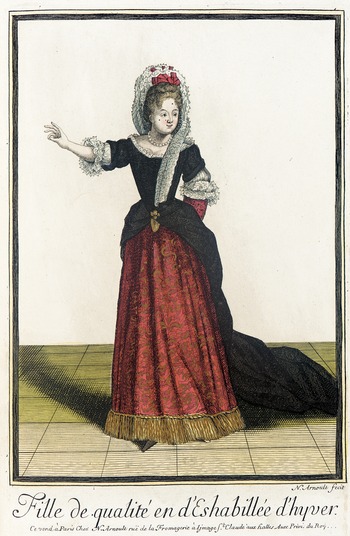
Reinforcing these connections, Mary attempted to orchestrate her daughter’s appointment as a maid of honour to Princess Anne. Advised by Mary Tuke, a dresser to Queen Catherine, the pair discussed the clothing Mall would require, including a ‘Crape gowne and petitcoate, some pretty short peticoates … and plain linning which is as neat as one would wish’.Footnote 59 Short petticoats, some ‘pure’, others featuring ornate textiles and trims, also appear in the ‘Voyage to Marry-land’. A 1685 French fashion print titled ‘Fille de qualité en d’Eshabillée d’hyver’ showcases the model’s short, fringed, red and gold petticoat, revealing the tips of her pointed shoes. The petticoat complements her black gown, but would have been interchangeable with other garments, likely resembling the several short petticoats Mall was expected to purchase (Figure 1).Footnote 60 Further mirroring the expansive wardrobe detailed in the Mundus muliebris, Tuke suggested that ‘it must put you to some expense, for tho [Mall] is in morning I doe suppose it will be expected she shall have a coloured gowne and petticoat to dance in’.Footnote 61
Nicholas Arnoult, Recueil des modes de la cour de France, ‘Fille de qualité en d’Eshabillée d’hyver’, Paris, 1685, hand-coloured engraving on paper; sheet: 14⅜ × 9⅜ in. (36.51 × 23.81 cm); composition: 11⅛ × 7⅛ in. (28.26 × 18.10 cm).

Despite objections by John Evelyn, re-emphasizing his aversion to courtly frivolity, Mary’s plan was not wholly abandoned. An alternative strategy proposed that Mall appear at court for several months, earning the pension granted to maids of honour, while ‘in the interim Betty may learne to dance and be better fitted for her sisters place’.Footnote 62 Mary’s attempts to elevate her daughters placed them within the sartorially charged environment of the court and town, where, as intimated by their letters and the Mundus muliebris, their apparel would be closely scrutinized. Mary therefore had to carefully consider the family’s appearance to promote their position in fashionable society, despite her husband’s misgivings.
III
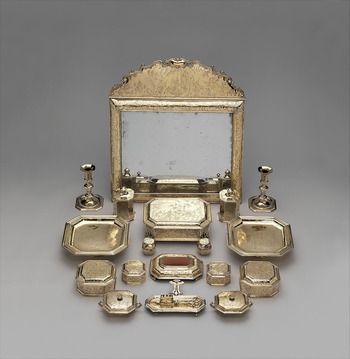
Recalling his first impressions of Mary, John Evelyn described ‘the pretynesse & innocence of her Youth’, having ‘found a Pearle in a place as un-likely to produce them as the Desarts [of] The Louvre, & Whitehall’. He equally valued her ‘early steadiness’ and how, even at an age where she still played with dolls, she diligently learned to take accounts and govern a house.Footnote 63 However, the couple’s tastes and attitudes towards luxury goods sometimes diverged. Aged seventeen, Mary wrote to her husband from Paris promising to spend ‘as frugally as is possible’, as they had already made significant investments on finery for their new home.Footnote 64 But she immediately recommended what silver plate they should purchase, emphasizing its use ‘by people of the greatest quality here’.Footnote 65 To be ‘of quality’ reflected not only status but also cultural awareness and cosmopolitan consumer prowess.Footnote 66 Mary affiliated herself with those of ‘quality’ through her purchasing habits, using her knowledge of trans-European fashions to assert her elevated social position. Four decades later, the Mundus muliebris makes similar comparisons, specifically referencing ‘A Pair of Silver Candlesticks;/Snuffers, and Snuff-dish’. These imagined dressing-room trappings perhaps resembled the silver gilt toilette set produced by W. B. London in the 1680s, embossed with fashionable floral and Asian-inspired motifs (Figure 2).Footnote 67 Mary and Mall’s shared appreciation for fine silverware reaffirms the enduring link between social quality, apparel, and furnishings while curating an all-encompassing, fashionable lifestyle.
W. B. London, toilette service, London, late seventeenth century, silver gilt.

However, the Evelyns’ financial insecurity and commitment to supporting Mary’s father curtailed her desires.Footnote 68 Initially, Mary could not fathom subsisting on £200 a year, including diet, clothing, and servants’ wages; she suggested they remain in France where their money extended further.Footnote 69 She also forfeited promises of fashionable gifts, including a pearl necklace, to afford costly necessities like a carriage.Footnote 70 Exacerbated by Richard Browne’s ongoing debts and conflict with their extended family, similar concerns resurfaced decades later surrounding Mall and Betty’s appointment to the royal household. Mary Tuke warned that the £200 salary paid from the exchequer to maids of honour was unreliable ‘and some addition you must make or your Daughter will never maintaine herselfe’ at court, particularly for clothing, which would ‘put you to some expense’.Footnote 71 Mary carefully navigated between competing needs for fiscal prudence and sartorial display, distinguishing herself from published mockery of elite women’s excessive spending as she fashioned herself and her daughters appropriately.
These financial considerations manifested in the Evelyns’ accounting practices. In his Codex expensi, dated between 1673 and 1678, John Evelyn meticulously tabulated the family’s annual expenditure. Unlike the 1650s, their spending totalled between £1,000 and £1,400, including taxes, building work, gardening, and other necessities. John also recorded an annual budget of approximately £100 for Mary ‘to clothe herself and the children’.Footnote 72 Between 1674 and 1677, he further subdivided money ‘besides to his wife’ from payments to the tailor and draper, extraordinary expenses, and ‘settling his wife’s book’.Footnote 73 These extraordinary expenses likely included extraneous costs such as jewellery, pin money for Mary and the children, and travel to fashionable locales.
These budgetary limits initially suggest that married women without independent incomes were impeded from making financial decisions under their husbands’ authority.Footnote 74 Indeed, the Mundus muliebris indicates that free-spending women faced contempt; the ‘Voyage to Marry-Land’ scathingly recommended
She a rich Pulvil Purse must get,
With Guineas fill’d, on Cards to lay,
…
For should the bank be so importune,
To rob her of her glittering Store,
The amorous Fop will furnish more.Footnote 75
However, an alternative reading of the ambiguity in the Evelyn accounts highlights financial independence and sartorial awareness among Mary and her peers, contrasting with the Mundus muliebris’s scepticism. In particular, the Codex expensi’s limited specificity regarding Mary’s clothing and extraordinary expenses, constituting up to 10 per cent of the family’s annual expenditure, highlights her autonomy to attire herself and her children as she deemed fit.
Mary’s detailed records of purchases for apparel, accessories, and textiles corroborate her fiscal prudence and sartorial confidence. These accounts illuminate how she disbursed the funds allocated within the Codex expensi, challenging published assertions that a fashionable appearance necessitated excessive, unscrupulous spending. Two lists in Mary’s hand detail ‘My owne expences in clothes and my 3 girls beginning at Midsomer 1669’ and the late 1670s. Comprising 960 entries averaging £1 18s., they comprehensively outline the clothing that Mary, Mall, Betty, and Susan owned, and its cost.Footnote 76 Mary distinguished her personal expenses from the children’s, like ‘A sute of gray lace cornets for myself’ costing £1 9s., and the subsequent entry of 16s. for ‘A sute of cornets for Mall’.Footnote 77 This attests to her sustained interest in fashionable apparel and her approach to clothing her daughters; the concurrent placement of these entries suggest that the cornets were purchased together and of similar quality, despite their cost disparity.Footnote 78
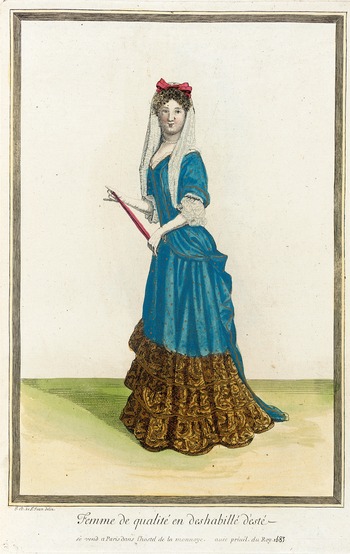
Perhaps deliberately, Mall later defined cornets in the ‘Fop’s dictionary’ as a hanging headdress ‘dangling about the Cheeks, like Hounds Ears’, akin to the white lace accessory depicted in a 1683 French fashion print depicting a ‘Femme de qualité en deshabillé d’esté’ (Figure 3).Footnote 79 Despite her unflattering description, owning cornets further linked Mall and her mother to the continental modes circulated through print and favoured by ‘women of quality’. The overlap between fashion prints, the Mundus muliebris, and the Evelyns’ consumption demonstrates how Mall’s writing was directly influenced by her family’s tastes. The adoption of these French accessories was sufficiently widespread to warrant their inclusion in the ‘Fop’s dictionary’ as a crucial component of a fashionable wardrobe.
Jean Dieu de Saint-Jean, ‘Femme de qualité en deshabillé d’esté’, Paris, 1683, hand-coloured engraving on paper; sheet: 14⅜ × 9⅜ in. (36.51 × 23.81 cm); composition: 11½ × 7½ in. (29.21 × 19.05 cm).

Under their mother’s purview, the Evelyn girls were dressed from childhood according to their social station. Mary recorded 275 specific purchases for Mall, Betty, and Susan, individually or collectively, costing 14s. 11d. on average. Of these, sixty-eight items, a quarter of the total purchases, were ‘accessories’. They included various gloves, knots, and scarves matching the diverse accessories, including hoods ‘by the dozens’, detailed in the Mundus muliebris.Footnote 80 The Evelyn women indeed owned dozens of hoods: sixty-five in total, including a ‘spotted yellow gauze hood’, a ‘white sarsnet hood’, a ‘double laced hood’, and many others in several colours and fabrics.
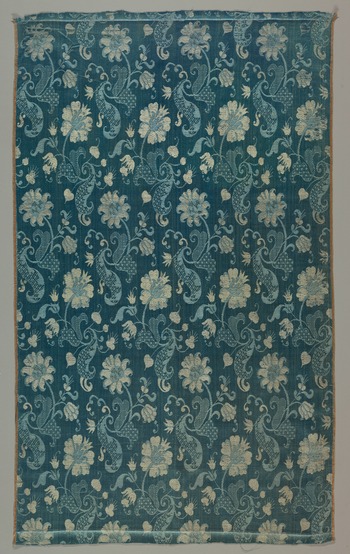
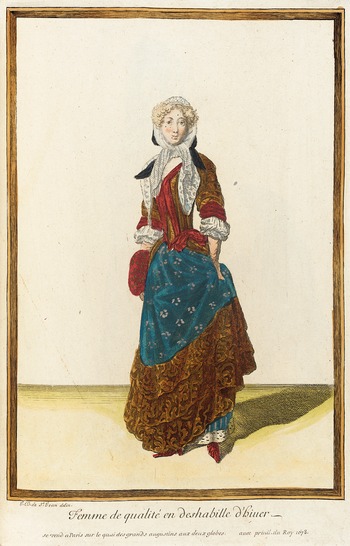
As the eldest daughter, Mall received the highest number of new goods, being named 136 times in the accounts. While earlier entries combined purchases for her and her sisters, a notable shift in the quality and cost of her apparel correlates to Mall’s likely entrance into society at the age of fourteen. However, as early as May 1677, Mary invested £6 12s. on 11 yards of blue flowered silk for twelve-year-old Mall, alongside 12s. for lace for her petticoat. A surviving blue silk with woven floral motifs held by the Smithsonian exemplifies this style, combining light-toned flowers and scrollwork on a teal base (Figure 4). When constructed into a wearable garment with lace trim and accessories, the ensemble would have been striking, perhaps resembling the near-contemporary 1678 fashion print of a ‘Femme de qualité en deshabille d’hiuer’ (Figure 5). Though it would have been seasonally inappropriate, the model wears a blue floral petticoat, accented by wide gold lace ruffles and accessorized with a muff, laced scarf, and white hood. Mall’s most expensive entry, dated to February 1679/80, totalled £9 2s. 9d. for ‘8 yds and half of Silver tabby’.Footnote 81 This coincided with payments for fine lace and peak for her, several pairs of new shoes, and to ‘Mrs Alexander for making 2 mantaus for M and fetching some of the lining’.Footnote 82 Mrs Alexander, a dressmaker, also appears in the accounts of Queen Catherine of Braganza, tangibly linking Mall’s wardrobe to the Stuart court several years before Mary attempted to install her within Princess Anne’s household.Footnote 83
Unknown maker, blue silk, seventeenth century, 36¼ × 21⅝ in. (92 × 55 cm).

Jean Dieu de Saint-Jean, Recueil des modes de la cour de France, ‘Femme de qualité en deshabille d’hiuer’, Paris, 1678, hand-coloured engraving on paper; sheet: 17⅞ × 9⅜ in. (45.40 × 23.81 cm); composition: 11⅜ × 7½ in. (28.89 × 19.05 cm).

This reference to Mrs Alexander suggests that Mary collaborated with prominent retailers, tailors, and tradespeople to ensure her family’s wardrobes matched the current modes. Numerous bills and receipts addressed to ‘The Honourable Mrs Evelyn’ or ‘My Lady Evelyn’ affirm these relationships.Footnote 84 While excluded from her accounts, these bills reveal the specific goods Mary purchased, their purpose, and her considerable investment in her and her daughter’s wardrobes. For instance, a surviving bill from 6 February 1679 lists Mary’s numerous purchases from the lacewoman Jane Yarwood, including ‘A pees of fine point for a cravat’ and ‘3 yards of fine lace for ruffles’ costing £14 and £5 5s. respectively.Footnote 85 The significant expense of this lace in relation to the £100 budget allocated in the Codex expensi indicates that Mary, like her peers, prioritized purchases of high-quality lace, fringe, and other trimmings to visibly display her wealth, taste, and sartorial knowledge.Footnote 86
Indeed, women’s immersion within an expanding consumer marketplace necessitated significant knowledge of the variety and cost of accessories, fabrics, alterations, and construction of new garments.Footnote 87 The challenges presented by the ever-growing number of fashions are encapsulated in the ‘Fop’s dictionary’. Directed at men ignorant of the latest modes, the need to define these novel, mainly foreign, styles reflects an increasingly complex sartorial landscape. Mary Evelyn was adept at traversing this sea of new fashions, listing payments for textiles, trims, accessories, and garment construction individually in her accounts. In October 1669, for instance, she recorded buying ‘three hoods for the three girls’, followed by separate expenses for ribbon and lace for their borders.Footnote 88 Noting each element of these hoods suggests her intimate involvement in the fashioning process, while personally attaching the trims emphasizes her material literacy and mastery of needlework. Her careful selection and domestic craftsmanship ensured that hoods were appropriate, cost effective, and fashionable, correlating to the litany of richly trimmed hoods, coifs, and head coverings detailed by Mall.
While the Mundus muliebris ridicules the diversity and excessive embellishment of women’s apparel, private purchasing habits reveal the artful combination of these details to display one’s fashionability and social position. Mary Evelyn’s strategic investment in fine lace, textiles, and accessories, all described by her daughter, represented a calculated attempt to circumvent certain financial limitations to ensure their suitable presentation. The notable absence of John Evelyn in these records indicates that he witnessed her consumption but did not actively participate or prevent it. Alongside her interest in courtly milieus, Mary’s accounting practices reframe the family’s relationship with apparel by placing her keen desire for social advancement and sartorial display alongside the possible barriers she faced. Showcased through the parallels between her purchases for herself and her daughters and the Mundus muliebris, these behaviours undoubtedly shaped Mall’s understanding of fashionable appearances. This invariably influenced the tone and content of her satire, reflecting how publicly debated sartorial practices entered the home and prevailed over moral and economic scrutiny.
IV
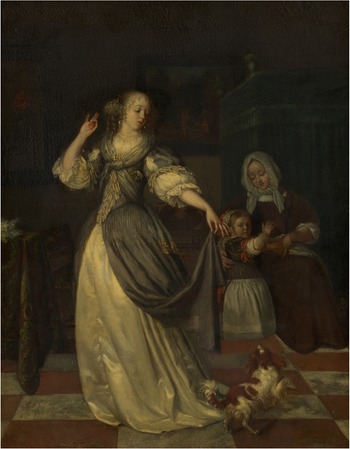
Overlap between the Evelyns’ published and private descriptions of fashionable clothing reveals how Mary’s consumption actively facilitated public debate over women’s apparel. Simultaneously, her purchase of these ridiculed styles emphasizes that this critique had limited success in undermining the social mandate to dress fashionably. Perhaps the item most emblematic of these contradictions is ribbon, a ubiquitous element of men’s and women’s clothing. Tyrannus and the Mundus muliebris each compare the fashionable elite festooned in ribbon to a boat. However, the shifting gender of the targeted figure alludes to increased scrutiny of women’s sartorial excess.Footnote 89 While, in 1661, John Evelyn likened a beribboned gentleman to ‘A Fregat newly rigg’d’, Mall re-gendered the analogy by transforming fashionable ladies into the ships taken on these dangerous journeys.Footnote 90 The ‘Voyage to Marry-land’ warns the male pilot, ‘If you begin to rig them out with all their Streamers, Nor are they ever sufficiently adorned, or satisfy’d, that you have done enough to set forth.’Footnote 91 Reflecting contemporary English styles, details from a Dutch genre painting by Eglon van der Neer from about 1670 showcase this extensive ribbon ‘rigging’. A tangle of pale yellow ribbon loops runs down the front of the grey gown worn by the elegantly dressed woman in the foreground, while two additional rows of ribbons accentuate her voluminous sleeves. Even the young girl in the back is adorned with coral-coloured ribbons along her sleeves, cap, and pearl earrings (Figure 6).
Eglon van der Neer (1634–1703), Lady playing with a dog, c. 1670, oil on canvas, (19⅛ × 1415/16 in. (48.5 × 38.0 cm).

While the popularity of ribbons extended across the Channel, readers of the Mundus muliebris likely linked the ribbon–ship analogy to England’s quest for ‘Improvement’, recognizing the nautical reference to the nation’s naval prowess and expansion into Asia and the Atlantic.Footnote 92 Alternatively, domestic and imported ribbons increased hostility between ribbon and broadloom silk weavers and between immigrant and English-born craftspeople.Footnote 93 These concerns often surrounded the increasing availability of ribbon to diverse consumers, affording them access to fashion within restricted means. However, the Mundus muliebris retains its elite focus. Its sardonic tone suggests that the quantity and quality of women’s ‘streamers’ signified status and desirability, serving as tokens of affection and symbols of their ceaseless pursuit of fashionability.
Ribbon’s persistence in published discourse exemplifies how these debates, though driven by authentic consumer behaviour, proved fruitless in eliciting change. In fact, black, white, blue, pink, and green ribbons appear ninety-five times in Mary’s accounts, in textiles including satin, taffeta, and sarsenet, costing on average 4s. 11d. Ribbons in additional hues feature on twenty-three occasions within her bills, such as a 1692/3 purchase for ‘a yd ⅞ of orange, black and silver ribbon’, ‘2 yds ⅝ of scarlet, black and silver ribbon’, and ‘a yd ½ of white gold and purple ribbon’.Footnote 94 Even a 1665 tailoring bill from Thomas Cobb to John Evelyn, one of the rare documents detailing his apparel, ‘for a suit for me and my Son John’, includes multiple payments for ribbon adornments.Footnote 95 Despite mocking the ‘fine silken thing … that had as much Ribbon on him as would have plundered six shops’, even John carefully arbitrated his appearance for social display, adhering to courtly standards of appearance in the 1660s when he regularly visited Whitehall.
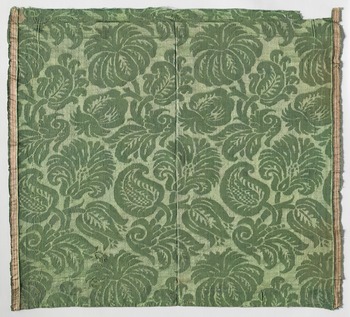
Mary’s more extensive sartorial records demonstrate how, unlike her husband, she wholly embraced contested, often foreign, fashions as a material investment and declaration of her social position and cosmopolitan tastes. Alongside ribbon, her accounts commonly reference her consumption of imported textiles and accessories, including several purchases of Venetian silk for herself, Mall, and Betty, which may have resembled the green silk damask held at the Metropolitan Museum of Art, with woven floral motifs creating vibrant contrast between its lustrous and matte faces (Figure 7).Footnote 96 While known for its high quality and briefly mentioned in Tyrannus, Venetian silk had lost its modish quality by the late seventeenth century and is absent from the Mundus muliebris.Footnote 97 Instead, the ‘Preface’ of that work excoriated English East India Company imports and Asian goods as ‘the final Ruine of the Greatest, Wisest, and most Noble Monarchy upon Earth’.Footnote 98 Contemporaries equally supported and discouraged the East India Company’s cultural and economic hegemony, particularly when juxtaposed against long-contentious French textiles and accessories. While Company promoters believed that it drove consumer demand to the nation’s financial benefit, fear for the domestic textile industry culminated in the first Calico Act of 1700, banning the importation of many Indian silks and cottons.Footnote 99 However, contrary to expectations, the Evelyns invested in the East India Company until the publication of the Mundus muliebris; John’s Codex accepti from 1689 recorded an adventure of £125 principal in the Company and he later received payment from them upwards of £207.Footnote 100
Unknown maker, green silk damask, Italian (Venice or Genoa), second half of the seventeenth century, 19¾ × 22¼ in. (50.2 × 56.5 cm).

Through female retailers known as ‘India-women’, the East India Company actively solicited elite female consumers. This included prominent courtiers like Charles II’s fashionable mistresses, reinforcing the polemical link between Asian textiles and fashionable women.Footnote 101 Mary Evelyn’s purchases and the Mundus muliebris’s references to ‘three Night-Gowns of Indian stuff’, and petticoats of ‘Japan’ and ‘Chine’ stuff, corroborate this interest.Footnote 102 From the 1670s, Mary’s accounts increasingly included ‘Indian’ silks, damasks, calicoes, and accessories, including a printed Indian fan.Footnote 103 Such luxury purchases often denoted special occasions, like the Indian damask used to construct stays for Susan Evelyn’s 1693 wedding.Footnote 104 As stays were typically visible through the open front of fashionable 1690s gowns, this conspicuous textile choice is unsurprising. Indian goods likewise featured prominently in gift exchanges between the family. In 1680, Richard Browne purchased ‘Indian silke for a gowne’ for his daughter, while John similarly gifted Susan an ‘Indian Gowne’ following the birth of her first child in 1693.Footnote 105
While recent scholarship has challenged the apparent fervour for printed calicoes described by seventeenth-century public discourse, Indian silks and more commonplace calicoes in solid colours, stripes, or checked patterns were still desired by fashionable women.Footnote 106 These were not all considered equal, however, as Mary lamented to Susan in 1695 that ‘I have bin all about for calicoe and can find none right Indian’.Footnote 107 The notion that there was a ‘right’ Indian fabric, and Mary’s frustration at being unable to acquire it, confirms the necessity of securing the correct textile, even if it required searching multiple venues. While scholars have been misled by the overexaggerated craze for chintz in contemporary publications, the Mundus muliebris accurately portrays the pervasive desire to source culturally relevant textiles, inadvertently aggrandizing the debate over foreign luxuries. However, these nuances remain obscured without careful consideration of the text alongside private dialogue on the same styles.
Mary’s Parisian upbringing and preference for French styles similarly contrast with John Evelyn’s critique of the ‘Armies, and Swarmes’ of French merchants invading the country and comparable concern in the Mundus muliebris.Footnote 108 Despite Mall’s remark in the ‘Voyage to Marry-land’ that the eponymous fashionable woman ‘despises Colbertine’, her mother’s accounts and bills regularly included the imported lace, named after the reforming French minister Jean-Baptiste Colbert.Footnote 109 Mary similarly acquired other French commodities, including Avignon silk, scented gloves, and a ‘riche French laced scarfe’ for £8.Footnote 110 She also used her father’s French agent DuBarry, who accompanied him to England, as a proxy shopper, trusting his continental tastes.Footnote 111 Richard Browne wrote to Mary about the items DuBarry sent to Sayes Court, including suede stockings and ‘the black silk hoode (of this new fashion)’.Footnote 112 Two weeks later, he expressed his pleasure that Mary was ‘satisfied with DuBarry’s performance of her commissions’.Footnote 113 Relying on DuBarry’s shrewd eye to select the appropriate fashions without viewing them herself allowed Mary to remain at the forefront of ever-shifting fashions. This social statement and personal preference defied her husband’s candid disdain for French modes. However, to economic theorists favouring the importation of French luxuries, Mary’s stylistic preference benefited the English economy by increasing the flow of currency and the demand for new goods, and by fostering healthy competition.
As noted, many commentators believed that France’s sartorial hegemony threatened England’s national identity and degraded women’s morals. The ‘Fop’s dictionary’ playfully addressed these concerns by outlining the litany of obscure French terms for contemporary women’s fashions to uneducated male readers. It concluded with a desire to see ‘this Elegant Science is improv’d, especially since we have submitted to, and still continue under the Empire of the French, (for want of some Royal or Illustrious Ladies Invention and Courage, to give the Law of the Mode to her own Country, and to vindicate it from Foreign Tyranny)’.Footnote 114 This parting insight directly implicates elite women, yet inadvertently undermines its own argument. Suggesting that only women’s abstention from French luxuries would prevail over ‘Foreign Tyranny’ gave them the ultimate sartorial authority, and they would not abandon continental styles. Even Mall herself was susceptible to the allure of French fashions; a letter from her brother John Jr took particular care to note the ‘world of fine petticoats to show’ in Paris, implying that she shared her mother’s interest in foreign tastes.Footnote 115
An active participant in fashionable society, Mall embraced the fashions she satirized, while her mother eagerly solicited advice from her and encouraged her sartorial knowledge. While Mall spent the 1683 season in London, Mary questioned whether she was appropriately attired for social functions or required new clothing. She even suggested that ‘being upon the place, you should visit the Black Lyon, and learne there and of friends what is worne or will be and when is best to buy for I am ready at your summons to write you and my selfe upon this necessary account’.Footnote 116 Her mother’s encouragement to visit a fashionable locale among elite friends ingratiated Mall within sartorial networks connecting knowledgeable artisans and savvy consumers. Notably, Mary also benefited from her daughter’s connections, acknowledging that she would provide money to get them both the newest styles. While few letters explicitly recount Mall’s personal taste, Mary’s correspondence confirms her trust in Mall as a proxy shopper, additionally asking her daughter to purchase ready-made gauze sleeves and flowers to assemble at home.Footnote 117
Mall and Betty’s unexpected deaths in 1685 and Mary’s retirement to Surrey in 1694 meant she would eventually rely on her surviving daughter, Susan, for sartorial knowledge. Correspondence between the pair outlined what goods Mary desired and recorded their arrival. Susan also appeared to fashion goods for her mother, including a girdle for her new mantua, a style referenced in the Mundus muliebris as ‘mantau girdle with a ruby buckle’.Footnote 118 A 1695 letter centres this role reversal, as Susan dictated the current styles to her mother. After suggesting that there was no English silk ‘fitt for you to wear’, Susan described the recent trends to her mother, including petticoats with a long train, and gowns with short sleeves and three rows of double ruffles. This ruffled style likely had continental origins, closely resembling the short-sleeved, trained, and heavily ruffled gown depicted in a 1680 French fashion print (Figure 8). Susan’s letter continued to recommend what fabric should be used, suggesting that the lining fabric Mary provided would ‘hardly be long enough’ for the train, and displaying a clear preference for foreign textiles.Footnote 119
Henri Bonnart, Recueil des modes de la cour de France, ‘Fille de qualité’, Paris, 1680, hand-coloured engraving on paper; sheet: 14¾ × 9¾ in. (36.51 × 23.81 cm); composition: 10¾ × 7¾ in. (27.31 × 19.69 cm).

Comparisons between this new style of gown, the 1680 fashion print, and the Mundus muliebris are plentiful, exemplifying the texts’ accurate descriptions of the fashion but limited influence over them. Highlighting the need for imported silk to recreate this complicated new style, trained petticoats long enough for ‘Page to hold up’, ‘Pin-up Ruffles now she flaunts … By our Fore-fathers call’d Cuffs’, and engageants, defined as ‘Deep double Ruffles, hanging down to the Wrists’, also featured prominently in the ‘Voyage to Marry-land’ and ‘Fop’s dictionary’, harking back to Mary’s consumption of Colbertine and other fine lace.Footnote 120 If her later preferences were consistent with the previous decade, Mary’s influence on the fashionable woman at the centre of the Mundus muliebris is clear. While Mary was responsible for the early purchases of stylish goods for her children, it was her surviving daughter who ultimately became responsible for facilitating the spread of fashion to her mother. Inadvertently, Mall’s legacy endured as well, as her vibrant description of women’s fashions in the Mundus muliebris continued to resonate with her family’s purchasing habits in the decades following her death.
V
The Mundus muliebris represented a definitive shift in the luxury debate towards consideration of women’s frivolity and excess. The text’s popularity is reaffirmed by the subsequent debate it inspired, namely an anonymous rebuttal titled the Mundus foppensis: or, the fop display’d (1691). Claiming to be the ‘Ladies Vindication’ of their fashionable lifestyles, the Mundus foppensis defended women’s desire for the latest modes by implicating men’s fashionable pursuits. Incorrectly, it assumed the Mundus muliebris was written by a man, professing that ‘it was no less indecent in him to expose your wardrobes to the world’.Footnote 121 This sustained dialogue calls into question whether women’s luxuries were truly a moral or economic threat, or merely a convenient scapegoat for masculine frivolity. Though Mall would never witness this discourse, her astute commentary resonated with elite men and women on all sides of the luxury debate, who remained ignorant of the paradox between the amusing appraisal of dress in the Mundus muliebris and its young author’s consumption habits.
A biographical study of Mall Evelyn, her mother, Mary, and their family’s fashionable proclivities paints the Mundus muliebris in a new light, showcasing how competing narratives surrounding women’s apparel translated into practice. The nuanced nature of the Evelyns’ private purchasing reconciles their close relationship with the court, elite society, and continental sensibilities with a need to demonstrate fiscal prudence and John Evelyn’s published apathy for frivolity. Mary Evelyn, in particular, exemplified women’s sartorial authority by curating her daughters’ wardrobes and skilfully ingratiating them in fashionable networks. Her indirect impact on the Mundus muliebris manifested in the close correlation between the text and the family’s accounts, bills, and correspondence. This reading of the Evelyns’ published discourse alongside their personal papers renders them a paradigm of the competing attitudes surrounding elite consumer behaviour in late seventeenth-century England, with the inevitable conclusion that fashionable apparel was a contentious yet unavoidable facet of women’s lives.
The Evelyns’ example reveals that the luxury debate encompassed a series of moral and social dilemmas negotiated within families as they positioned themselves for entry into fashionable society. Failure to consider these personal choices by exclusively examining public discourse not only undermines women’s active role in the consumer marketplace but falsely represents the veracity of these polemical sources. The Mundus muliebris is undoubtably an underutilized resource illuminating the latent concerns of late seventeenth-century society surrounding elite women. Its value only increases when considering the private life of Mall Evelyn and her family, showcasing how the text’s accuracy in depicting her family’s consumption undermines the critical aims ascribed to it. Debate surrounding luxury fashions existed in tandem with its consumption, but did not dissuade elite women from adopting these styles as an active declaration of their social position and cultural acumen. Indeed, parallels between women’s private consumption and written descriptions of apparel reveal that criticism of elite female fashions reinforced their social significance. Only by considering published rhetoric alongside private records can these contradictions be truly unravelled.
Acknowledgements
I would like to extend sincere thanks to the editorial team and reviewers for their thoughtful and constructive feedback on this article. I am particularly appreciative of my supervisors, Professor Gabriel Glickman and Professor Ulinka Rublack, for encouraging my interest in the Evelyn family. Their insight and comments on this research throughout its development constantly challenged my thinking and broadened my perspective.
Competing interests
The author declares none.


 Open access

