


Introduction
Bushmeat describes any non-domesticated terrestrial mammal, bird, reptile or amphibian harvested for food (Nasi et al., Reference Nasi, Brown, Wilkie, Bennett, Tutin, van Tol and Christophersen2008). It represents a valuable non-timber forest product across tropical Africa, Asia and the Neotropics (Robinson & Bennett, Reference Robinson and Bennett2004). Since the mid 1990s there has been an important transition from subsistence to commercial hunting (e.g. Wilkie & Carpenter, Reference Wilkie and Carpenter1999; Fa & GarciaYuste, Reference Fa and Garcia Yuste2001), and the bushmeat trade is now considered to be one of the most important threats to biodiversity in the tropics (Milner-Gulland & Bennett, Reference Milner-Gulland and Bennett2003; Harrison, Reference Harrison2011).
In tropical Africa bushmeat is a significant source of animal protein (Bennett & Robinson, Reference Bennett and Robinson2000; Wilkie et al., Reference Wilkie, Starkey, Abernethy, Effa, Telfer and Godoy2005) and is a vital component of food security and income for rural communities (Fa et al., Reference Fa, Currie and Meeuwig2003; Nasi et al., Reference Nasi, Brown, Wilkie, Bennett, Tutin, van Tol and Christophersen2008; Mbete et al., Reference Mbete, Banga-Mboko, Racey, Mfoukou-Ntsakala, Nganga and Vermeulen2011). Although illegal in many countries, the bushmeat trade is a flourishing economic activity. Following socioeconomic transformations, including increased pressures from burgeoning human populations and commercial logging, and the generalized use of firearms, bushmeat hunting has reached unsustainable levels for many mammalian species (Nasi et al., Reference Nasi, Brown, Wilkie, Bennett, Tutin, van Tol and Christophersen2008; Jenkins et al., Reference Jenkins, Keane, Rakotoarivelo, Rakotomboavonjy, Randrianandrianina and Razafimanahaka2011) relative to their rarity and distribution (Fa et al., Reference Fa, Olivero, Farfán, Márquez, Vargas, Real and Nasi2014), leading to the local extinction of vulnerable species (Oates et al., Reference Oates, Abedi-Lartey, McGraw, Struhsaker and Whilesides2000; Cowlishaw et al., Reference Cowlishaw, Mendelson and Rowcliffe2005). One of the main economic factors driving the exponential increase in bushmeat offtake is the increasing demand for wild meat in urban areas, which has resulted in the establishment of urban bushmeat markets supplied by a multitude of, sometimes remote, hunting sites (e.g. Edderai & Dame, Reference Edderai and Dame2006).
In western Africa aggressive politics of agricultural expansion and logging have resulted in the loss of c. 80% of the original rainforest cover, which is now fragmented into vulnerable, isolated patches (Norris et al., Reference Norris, Asase, Collen, Gockowksi, Mason, Phalan and Wade2010). In such a context bushmeat hunting and habitat loss are the major drivers of extinction in wildlife populations, a trend that has not been counterbalanced by the existence of protected areas (Brashares et al., Reference Brashares, Arcese and Sam2001; Fa et al., Reference Fa, Peres and Meeuwig2002).
Despite all types of hunting being forbidden in Côte d'Ivoire since 1974, the illegal bushmeat trade is widespread (Caspary et al., Reference Caspary, Koné, Prouot and De Paw2001; Gonedelé Bi et al., Reference Gonedelé Bi, Koné, Bitty, Béné, Akpatou and Zinner2012). Caspary (Reference Caspary1999) estimated that 120,000 t of wild game (compared with 45,000 t of domestic meat) were consumed annually, representing a parallel economy of c. FCFA 77 billion (i.e. the equivalent of 1.7% of the country's gross domestic product). Bushmeat is particularly sought after for cultural and social purposes as well as for its taste (Caspary et al., Reference Caspary, Koné, Prouot and De Paw2001), and urban bushmeat markets have proliferated and tend to be connected with the country's main forest reserves (Caspary et al., Reference Caspary, Koné, Prouot and De Paw2001).
Although the risk of zoonotic diffusion from bushmeat activities has received a certain level of attention in Côte d'Ivoire (e.g. Liégeois et al., Reference Liégeois, Lafay, Formenty, Locatelli, Courgnaud, Delaporte and Peeters2009), quantitative data on the exploitation of bushmeat by local communities are scarce and outdated. Bushmeat surveys have focused on western and northern areas (Korhogo, Taï National Park and Toumodi; Caspary et al., Reference Caspary, Koné, Prouot and De Paw2001; Bassett, Reference Bassett2005), and thus the bushmeat activities affecting the coastal forests are virtually unknown.
The environmental situation in coastal Côte d'Ivoire is becoming critical as almost 80% of the protected forests have been transformed into cocoa plantations (Bitty et al., Reference Bitty, Gonedelé Bi and McGraw2013; Gonedelé Bi et al., Reference Gonedelé Bi, Bitty, Ouatara and McGraw2014). The diverse Dassioko Sud Forest Reserve, a coastal evergreen forest, has been designated a wetland of international importance (Ramsar, Reference Ramsar2005) and is home to a number of threatened species. However, a decade of political and social instability in Côte d'Ivoire has resulted in a lack of enforcement of conservation policy and a lack of efficient protection efforts. As a consequence the Reserve is now subject to considerable anthropogenic pressures, including agriculture and intense and uncontrolled hunting activities, which have led to the degradation of the forest ecosystem and the rarefaction or extirpation of several mammalian taxa (Bitty et al., Reference Bitty, Gonedelé Bi and McGraw2013). We characterize and quantify the supply of bushmeat in the vicinity of the Reserve based on a 6-month survey, and attempt to answer the following questions: (1) Which species are hunted and traded around the Reserve? (2) Is the wild game hunted within or outside the Reserve? (3) What hunting techniques are used to supply the market? (4) What is the biomass of the bushmeat offtake? (5) What is the commercial income derived from the bushmeat trade around the Reserve? We discuss the contribution of our results in terms of the conservation and sustainable use of wildlife in coastal Côte d'Ivoire.
Study area
Dassioko Sud Forest Reserve (c. 80 km2; Fig. 1) is one of the last protected forest fragments of coastal Côte d'Ivoire. The climate is equatorial, characteristic of the general climate of south-western Côte d'Ivoire, with heavy rainfall and temperatures of 20–33°C throughout the year. The vegetation is evergreen rainforest of the Guinean forest block, which includes lowland forests from eastern Liberia to the Bandaman River in Côte d'Ivoire. The forest provides habitat for rare mammalian taxa endemic to the Upper Guinean forest ecosystem, including the Endangered white-naped mangabey Cercocebus atys lunulatus, the Critically Endangered roloway diana monkey Cercopithecus diana roloway, the Critically Endangered western chimpanzee Pan troglodytes verus, the Vulnerable forest elephant Loxodonta africana cyclotis and the Endangered Jentink's duiker Cephalophus jentinki.
The three survey sites near Dassioko Sud Forest Reserve, coastal south-eastern Côte d'Ivoire.

Methods
Bushmeat survey
The bushmeat trade was surveyed during a 6-month period in 2012 encompassing the late dry (January–March) and early rainy (April–June) seasons in three villages around the Reserve: Dassioko, Dagbégo 2 and Lélédou (department of Sassandra, south-eastern Côte d'Ivoire; Fig. 1). These villages were chosen based on their proximity to the Reserve and on information that bushmeat was being sold in restaurants, which appeared to be the main trading centres for almost all the wildlife killed within the catchment area (SGB, pers. obs.).
No formal bushmeat markets exist in the study area and bushmeat is mostly sold in the local restaurants run by women. Nine restaurants (three in Dassioko, four in Dagbégo 2 and two in Lélédou) were visited during 07.00–12.00 once per week, on market days, to identify and quantify the species sold as bushmeat. All animals reported here were observed directly, identified whenever possible (not including sex) and weighed (in the case of fresh carcasses). For animals that could not be weighed directly, mean body mass information was extracted from Kingdon (Reference Kingdon1997). We asked restaurant owners the following questions: (1) What are the names of the species on sale? (2) What are the final prices of the species on sale? (3) How often per week do you have each species for sale? (4) What is the geographical origin of the hunted species? Occasionally, hunters encountered in the restaurants were asked about their hunting practices and areas. Traders were informed of the objective of the study. They participated in the survey on a voluntary basis, having indicated their willingness to reflect on the difficulties they face. Participants were assured that their identities would not be revealed.
In total we conducted interviews with 16 hunters, 10 traders, nine restaurant owners and 32 consumers from the three villages to identify the geographical origin of the bushmeat, the various hunting practices used and the number of animals hunted. SGB, AB, AKY and AK visited each village with a local person and conducted interviews in the local language, using the vernacular names of the species. We gathered data on the number of animals received per day by the traders and restaurant owners, the weapons and techniques used in hunting (based on visual observation of the carcasses and/or from information gathered from the hunter whenever possible), and the final agreed market prices of bushmeat, by interviewing restaurant owners and, whenever possible, the bushmeat traders. Our data represent a minimum estimate of the volume of bushmeat in the market chain as we were working with restaurant owners, who are on the second or third levels of the chain. Trade was monitored at the level of restaurants because they were accessible, and restaurant owners were more willing than hunters to share information.
Data analysis
We recorded species’ scientific names and conservation statuses following the IUCN Red List (IUCN, 2015). We collected data on numbers of species brought to the market, and pooled the data weekly. Prices of species/carcasses were calculated as the mean of daily sale prices over the study period, and were extrapolated for the whole year. Biomass for each species was calculated by multiplying the recorded number of carcasses by the mean body mass calculated from weighed individuals or from Kingdon (Reference Kingdon1997). The biomass and monetary value of the annual harvest were extrapolated from the mean number of animals killed per week. Where carcasses were cut into pieces we elicited information on the number of animals directly from the restaurant owners. When they could not give a precise answer, as a conservative estimate the processed meat was considered to represent a single individual. We estimated the number of animals sold annually at the restaurants by multiplying the number recorded per day by the weekly frequency of the market supply, then multiplying this weekly figure by 52 to extrapolate to a whole year.
Statistical analyses were carried out using SPSS v. 17.0 (SPSS Inc., Chicago, USA). We used multiple regression analysis to identify combinations of variables (proportion of animals killed, mean body mass, total biomass, cost of carcass, cost per body mass, hunting practices used) that influenced poaching pressure. These variables were log transformed as needed to improve normality. For the second set of regression the response variable was number of animals sold. Covariates investigated included the number of residents in the village and the distance between the village and the Reserve. The Spearman rank correlation coefficient (two tails) was used to test correlation trends between the hunting practices used and the body mass of hunted species. The numbers of carcasses observed in the dry season and the rainy season were compared using F statistics.
Results
Species hunted around Dassioko Sud Forest Reserve
During the 24 weeks of the survey a total of 376 mammals (98%) and eight reptiles (2%) were received in the nine restaurants surveyed (Table 1). We recorded a total of 19 species (14 animals could not be identified to the species level because they were smoked or cut into pieces), which were classified into eight main taxonomic groups: Artiodactyla (n = 3 species), Carnivora (n = 3), Pholidota (n = 2), Hyracoidea (n = 1), primates (n = 3), Rodentia (n = 5), Squamata (n = 1) and Crocodilia (n = 1). Rodentia was the most frequently sold taxon by number of individuals (64%), followed by primates (11%), and Artiodactyla (10%) and Carnivora (10%) (Fig. 2).
Percentage of taxonomic groups found in nine restaurants around the Dassioko Sud Forest Reserve (Fig. 1).

Details of the species sold in restaurants in the villages of Dassioko, Dagbégo 2 and Lélédou, in the vicinity of the Dassioko Sud Forest Reserve, Côte d'Ivoire (Fig. 1), with numbers sold in each village, total number (and percentage), mean biomass, total biomass, mean price, and mean price per kg.

Giant pouched rats Cricetomys sp. (38%), the marsh cane rat Thryonomys swinderianus (16%), Maxwell's duiker Philantomba maxwelli (6%) and the brush-tailed porcupine Atherurus africanus (6%) were the most harvested species, representing more than half of the entire offtake (66%). Of the 19 species identified, three are of conservation concern, categorized as Vulnerable on the IUCN Red List: the tree pangolin Phataginus tricuspis, the long-tailed pangolin Uromanis tetradactyla and the West African dwarf crocodile Osteoleamus tetraspis. No more than two individuals of each of these species were sold during the survey period.
Geographical origin of bushmeat, and hunting techniques used
Based on interviews with bushmeat stakeholders we estimate that a greater percentage of the animals (54%) were killed in the Reserve than on nearby farms (36%) or fallows (i.e. non-cultivated old farms; 10%).
Based on the direct count of carcasses observed, a mean of 125.33 ± SD 35.15 animals per village (range 87–156) was recorded during the study period. No significant differences were detected among the mean numbers of animals captured per village (F = 0.62, df = 42.39, P = 0.541). A marginally significant correlation was detected between offtake (number of animals captured in each village) and village size (r = 0.97, n = 3, P = 0.091). There was no significant correlation between the distance separating the villages from the Reserve and the number of animals captured in each village (r = – 0.78, n = 3, P = 0.43). The number of carcasses in the dry season was not significantly different from that in the rainy season (F = 2.281, P > 0.05).
Local hunters used four techniques to kill animals: snares (65%), machetes (7%) and wood sticks (1%), which are traditional hunting techniques, as well as guns (27%). The use of guns was not correlated with the mean body mass of the target species (r = 0.066, P = 0.769), nor was the use of snares (r = 0.152, P = 0.525).
Bushmeat offtake and commercial income
The total weight of bushmeat sold in the restaurants during the survey was 2,179 kg, with the highest proportion (44% of total weight) representing artiodactyls, followed by rodents (677 kg; 31%). In terms of species the bushbuck Tragelaphus scriptus contributed the highest proportion by weight (641 kg; 29% of total weight), followed by the marsh cane rat (241 kg; 16.5%), Maxwell's duiker Philantomba maxwelli (240 kg; 11%) and the giant pouched rat (203 kg; 9%) (Table 1).
The bushbuck had the highest price per carcass (FCFA 19,200 ± SD 1,304, USD 37.6), followed by the bay duiker Cephalophus dorsalis (FCFA 18,500 ± 707, USD 36). The least expensive species was the striped ground squirrel Euxerus erythropus (FCFA 900 ± 141, USD 1.80). In general the most commonly hunted species were among those sold at the highest prices per body mass.
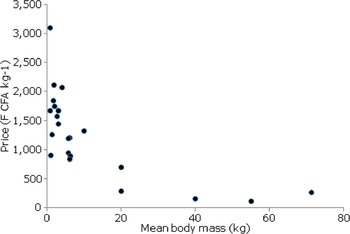
The proportion of animals sold around the Reserve was significantly, negatively correlated with body mass (r = –0.96, P = 0.003). Furthermore, prices divided by body mass were significantly negatively correlated with mean body mass (r = –0.98, P = 0.000), with larger species having a lower price per kg than smaller species (Fig. 3); for example, the bushbuck had one of the lowest prices (FCFA 269.5 kg−1). Conversely, most of the smaller species approached or exceeded the mean price per kg (FCFA 1,260, USD 2.5; Supplementary Table S1); for instance, the cusimanse mongoose Crossarchus obscurus had the highest price per kg (FCFA 3,094, USD 5) and is among the species with the lowest mean body mass (0.85 kg).
Correlation between mean body mass and price per kg for the various species sold as bushmeat in restaurants near Dassioko Sud Forest Reserve (Fig. 1). Values for mean body mass were extracted from Kingdon (Reference Kingdon1997) and from our own survey.
The estimated total number of animals sold at the restaurants around the Reserve was c. 5,518.50 during 6 months. Extrapolated to 1 year this is c. 11,886 with a total biomass of 40,428.03 kg and an annual monetary value of FCFA c. 47,728,516 (USD 93,485.75) for the bushmeat traders in the three villages (Table 1). Given our estimate of the proportions of animals killed within the Reserve (53%) we speculate that a minimum of 6,300 animals, representing a biomass of 21,426.86 kg, are extirpated annually from the protected area.
Discussion
Species composition and geographical origin of bushmeat
Our 6-month survey revealed that rodents comprised the highest proportion of mammals sold in restaurants in villages around Dassioko Sud Forest Reserve. Small prey (including giant pouched rats, marsh cane rats, Maxwell's duikers and brush-tailed porcupines) were the primary targets of poachers in the region, in contrast with other parts of tropical Africa, where hunters target large or medium-sized prey (FitzGibbon, Reference FitzGibbon and Caro1998; Fa & Peres, Reference Fa, Peres, Reynolds, Mace, Redford and Robinson2001). Although this finding may be biased by the fact that we surveyed restaurants, which are at the end of the bushmeat trade chain, our results are similar to previous findings in the region of Toumodi, central Côte d'Ivoire (Caspary, Reference Caspary1999), and Liberia (Anstey, Reference Anstey1991; Béné et al., Reference Béné, Gamys and Dufour2013). A higher proportion of carcasses of small vs medium-sized species was also recorded in the Takoradi market in Ghana (Cowlishaw et al., Reference Cowlishaw, Mendelson and Rowcliffe2005).
Our findings indicate that small mammalian prey is characteristic of the bushmeat sold in restaurants around the Reserve, although large prey species are generally more profitable to hunters (Peres, Reference Peres1990; Fa et al., Reference Fa, Garcia Yuste and Castelo2000). In line with reports of faunal decline within the coastal and other forests of Côte d'Ivoire (Gonedelé Bi et al., Reference Gonedelé Bi, Koné, Bitty, Béné, Akpatou and Zinner2012; Bitty et al., Reference Bitty, Gonedelé Bi and McGraw2013), similar declines in the availability of large and medium-sized mammals for sale on bushmeat stalls have been reported in tropical Africa (Fa & Garcıa Yuste, Reference Fa and Garcia Yuste2001; Ohl-Schacherer et al., Reference Ohl-Schacherer, Shepard, Kaplan, Peres, Levi and Yu2007). Such declines are not necessarily attributable to hunter preference for larger mammals, as vulnerable taxa such as habitat-specialized, larger mammals with K reproductive strategies can be depleted rapidly in hunting areas (Cowlishaw et al., Reference Cowlishaw, Mendelson and Rowcliffe2005). In contrast, ecologically versatile, smaller mammals (e.g. rodents and small antelopes; Happold, Reference Happold1987) with r reproductive strategies may persist in heavily hunted areas and agricultural landscapes (Kűmpel et al., Reference Kümpel, Milner-Gulland, Cowlishaw and Rowcliffe2010). Thus, the species composition of the bushmeat sold in restaurants around the Reserve probably reflects the cumulative effects of habitat degradation and hunting pressure on mammals in the area. There has been rapid forest degradation in the Reserve as a result of lack of enforcement of conservation policy, following a decade of political and social instability exacerbated by the 2010 electoral crisis (Bitty et al., Reference Bitty, Gonedelé Bi and McGraw2013; SGB, pers. obs.).
Our results indicate that the majority (53%) of the bushmeat found in the local restaurants originated in the Reserve, where there is increased poaching pressure, persistent lack of management, and increased accessibility to the forested area. Our analyses showed that poaching pressure is not correlated to the geographical location of the village, contrary to the conclusions of several other studies in tropical Africa (Muchaal & Ngandjui, Reference Muchaal and Ngandjui1999; Fa & Garcia Yuste, Reference Fa and Garcia Yuste2001; McNamara et al., Reference McNamara, Kusimi, Rowcliffe, Cowlishaw, Brenyah and Milner-Gulland2015). The Reserve is the only remaining forest fragment in the south-eastern coastal region of Côte d'Ivoire and may therefore constitute the last source of wild game in the area, and rural communities are heavily dependent on natural resources, including bushmeat (SGB, pers. obs.). As hunting activity is not dependent on the distance between villages and the Reserve borders, all householders are potential harvesters of faunal resources within the Reserve.
There was a marginal correlation between the numbers of animals sold in the markets and the size of the villages involved in the bushmeat trade. This indicates a possible influence of the level of demand (village size) on the volume of bushmeat consumed (Robinson & Bennett, Reference Robinson and Bennett2000; Fa et al., Reference Fa, Olivero, Farfán, Márquez, Duarte and Nackoney2015). A significant proportion of the landscape around the Reserve is used for agriculture and settlement. As human population density increases near protected areas, more land is needed for livelihood maintenance (Wittemyer et al., Reference Wittemyer, Elsen, Bean, Burton and Brashares2008). This has increased hunting pressure on the Reserve, as confirmed by hunters who reported that capturing animals was easier inside than outside the Reserve (SGB, pers. obs.).
Our survey did not indicate seasonal variation in the bushmeat offtake and we are aware that simply multiplying a 6-month study by two to obtain an annual estimate may overlook temporal or seasonal variations. Hunting may depend on the seasonal availability of, or preference for, alternative livelihoods (Kümpel, Reference Kümpel2006); for example, it can be an important fall-back livelihood during the agricultural lean season or in periods of crisis (de Merode et al., Reference de Merode, Homewood and Cowlishaw2004).
Sustainable use of wild game?
Rodents and ungulates together represented 74% of the carcasses sold in the bushmeat restaurants around the Reserve. These taxa have been reported as having a similar magnitude of importance in other regions of Côte d'Ivoire (Caspary et al., Reference Caspary, Koné, Prouot and De Paw2001) and West Africa (78% in the Republic of Guinea, Brugière & Magassouba, Reference Brugière and Magassouba2009; 67% in Ghana, Ntiamoa-Baidu, Reference Ntiamoa-Baidu1998; 79% in Nigeria, Fa et al., Reference Fa, Seymour, Dupain, Amin, Albrechtsen and Macdonald2006, Okiwelu et al., Reference Okiwelu, Ewurum and Noutcha2009; 78% in Liberia, Béné et al., Reference Béné, Gamys and Dufour2013), and in Central Africa (71% in Cameroon, Fa & Brown, Reference Fa and Brown2009; 68–78% in Kisangani, Democratic Republic of the Congo, van Vliet et al., Reference van Vliet, Nebesse, Gambalemoke, Akaibe and Nasi2012). At the species level our data showed that the bushbuck and the marsh cane rat contributed the highest proportion of the total biomass of bushmeat sold in restaurants, which is probably attributable to the conversion of forest habitat into farmland. Surveys of bushmeat markets in West Africa have confirmed that both species are among the top five species sold, in terms of biomass (Ntiamoa-Baidu, Reference Ntiamoa-Baidu1998; Béné et al., Reference Béné, Gamys and Dufour2013), supporting the view that restaurant sales are a usable proxy for the spectrum of bushmeat items sold in markets.
Our conservative estimate of annual harvest of bushmeat around the Reserve represented a total biomass of c. 40,428.03 kg (c. 11,886 animals) and an annual monetary value of c. FCFA 47,728,516 (c. USD 93,485.75), as derived from the nine restaurants surveyed (Supplementary Table S1). This yields an annual income of USD c. 10,387.31 per person, exceeding more than tenfold the mean annual income of cocoa farmers (c. FCFA 466,032, c. USD 932; Gnamian, Reference Gnamian2008). Thus, the sale of bushmeat in restaurants appears to be a highly profitable activity compared to cocoa farming, which is one of the most important agricultural activities and sources of revenue in Côte d'Ivoire.
Given our estimate of the proportions of animals killed inside the Reserve (53%) we speculate that a minimum of 6,300 animals, representing a biomass of 21,426.86 kg, are extirpated annually from the protected area to supply the nine restaurants in the three villages. These estimates are greater than the annual offtake of 4,982 animals reported by Béné et al. (Reference Béné, Gamys and Dufour2013) in the nearby Nimba region in Liberia based on direct monitoring of the hunting activity in five localities. As we limited our survey to restaurants, our estimates are probably underestimates. Hunters are key stakeholders in the bushmeat commodity chain, selling their products to the highest bidder; further investigations around the Reserve should target this group.
We estimate that the mean value of bushmeat sold in the surveyed restaurants was USD 2.52 kg−1, similar to the estimate of USD 1.5–2.5 kg−1 for the rural markets of Cameroon and Nigeria (Macdonald et al., Reference Macdonald, Johnson, Albrechtsen, Seymour, Dupain, Hall and Fa2012). Our estimates greatly exceed the prices reported for conservancy areas in Eastern Africa (USD 1.33 in Zimbabwe, 0.93 in Malawi, 0.75 in Kenya; Ndibalema & Songorwa, Reference Ndibalema and Songorwa2008), suggesting that demands and practices in the bushmeat trade may not be equivalent in the rainforest and savannah zones. Prices per kg of hunted species were significantly negatively correlated to mean body mass, in contrast with findings in rural markets in Cameroon (Macdonald et al., Reference Macdonald, Johnson, Albrechtsen, Seymour, Dupain, Hall and Fa2012). This may be partly explained by the fact that bushmeat is sold per individual rather than per kg around the Reserve. Thus, the metric link between the animal and its monetary value may not be fully understood by the stakeholders operating in the bushmeat chain.
It would be premature to draw conclusions about the sustainability of the bushmeat trade occurring around the Reserve, particularly as the prevalence of r strategists such as rodents and small antelopes in restaurants is not necessarily an indicator of sustainability. Moreover, there is evidence from this study and other surveys that several medium-to-large species (e.g. the diana monkey, the king colobus Colobus polykomos, the western red colobus Piliocolobus badius, Jentink's duiker, the giant pangolin Manis gigantea, and the leopard Panthera pardus) have already been extirpated from the Reserve (Gonedelé Bi et al., Reference Gonedelé Bi, Bitty, Ouatara and McGraw2014). However, most of the species found in restaurants were not of conservation concern, except for the Vulnerable tree and long-tailed pangolins and West African dwarf crocodile. Similar results were found in south-eastern Côte d'Ivoire (Caspary et al., Reference Caspary, Koné, Prouot and De Paw2001). This does not necessarily mean that hunters distinguish between species on the basis of their conservation status; rather, the most plausible explanation is the rarity of these species in the area, the market generally reflecting the current status of the fauna that it continues to deplete (Olayemi et al., Reference Olayemi, Oyeyiola, Antunes, Bonillo, Cruaud and Gaubert2011).
The use of cable snares as the dominant hunting technique (65%) in the vicinity of the Reserve hampers any attempts at sustainable hunting (Robinson & Bennett, Reference Robinson and Bennett2004). Cable snares are probably the most widely used hunting method among African forest hunters (Noss, Reference Noss1998, Reference Noss, Robinson and Bennett2000), being affordable, easy to implement and effective compared to hunting with guns (Noss, Reference Noss1998), but non-selective. Although most West African countries have officially banned the use of cable snares (Fa & Garcia Yuste, Reference Fa and Garcia Yuste2001), hunters continue to use them, and they have not been banned in Côte d'Ivoire.
Conclusions
Traditional communities depend on wildlife as a source of food and income. Our survey of the restaurants around Dassioko Sud Forest Reserve identified an intense and regular bushmeat trade affecting a wide spectrum of mammals. It is likely that future studies monitoring hunter activities directly would yield a finer estimate of the poaching pressure in the area. The lack of effective protection exposes the Reserve to multiple illegal activities, including hunting, forest encroachment and illegal settlement and farming, a situation exacerbated by the political crisis in 2010. The increasing demand for bushmeat from large urban markets has also created incentives for the illegal commercial exploitation of the Reserve, which is not under appropriate management. Thus, we consider that there is a need to develop projects to improve people's knowledge about wildlife conservation in the area. We passed our conclusions based on this survey to the local authority in charge of the surveillance of Dassioko Sud Forest Reserve and to the Ivorian authorities responsible for Parks and Reserves, in 2013, but received no response. However, since the Ebola outbreak in West Africa in 2014 prohibition measures in relation to hunting and bushmeat sales have been reinforced in Côte d'Ivoire and may have temporarily slowed down activities related to the bushmeat trade.
Acknowledgements
This research was funded by the International Foundation for Science, grant number D-5050. We thank the Minister of Scientific Research of Côte d'Ivoire for the research permit, the Swiss Centre for Scientific Research for logistical support, the Forest Development Authority and the Ivorian Office of Parks and Reserves for the permit to access the protected area, and the local communities around the surveyed forests, and the field guides, for their assistance. We acknowledge the editor and anonymous reviewers for providing valuable comments.
Biographical sketches
Sery Gonedelé Bi is a geneticist and conservation biologist leading the conservation of Dassioko Sud and Port Gauthier Forest Reserves in coastal Côte d'Ivoire. Inza Koné is a primatologist and conservation biologist with interests in biodiversity and food security. Jean Claude Béné is a primatologist and conservation biologist. He has conducted bushmeat surveys in Côte d'Ivoire and Liberia. E. Anderson Bitty is a primatologist and conservation biologist leading the conservation of Dassioko Sud and Port Gauthier Forest Reserves. Kouassi Aymar’s research interest is in genetics, and he was involved in the bushmeat market survey around the Dassioko Sud Forest Reserve. Yao Kouassi Alphonse is conducting an inventory of large mammals around the Dassioko and Port Gauthier Forest Reserves. Philippe Gaubert is an evolutionary biologist interested in conservation biogeography and the bushmeat trade throughout tropical Africa.



