





Abandon and Replace
The methods for adopting new gods in the early Roman empire were various. While there is plenty of research on the different modes of turning to Christ in the fourth and fifth centuries,Footnote 1 so far pre-Constantine evidence of communicating with Christ is approached with an analytic overlay that treats acts of continued communication with the Roman gods as unconventional. Indeed, the dramatic transformation that Paul idealized—“flee from service to idols!” (1 Cor 10:14)—is often taken to be the default for non-Jews who turned to Christ in the principate.Footnote 2 In this study, I find that there is so much that is anomalous to the current “abandon and replace” paradigm that the alternative—that is, continued worship of Roman gods —was probably normative for individuals who turned to Christ in the early centuries of the Roman empire. In assessing the actual variations of “Christian polytheism,” I highlight as typical interpretatio and various other forms of integrating cult for Christ within ongoing religious practices.
The Historiography of Abandon and Replace
Paul’s abandon and replace model—that is, the act of venerating new god(s) exclusively (i.e., replacing traditional gods with new one[s])—is rarely self-reported outside a minority of Christian spokespersons.Footnote 3 There are also spokespersons for and against Christ-worship who cite abandon and replace as normative or the ideal for others.Footnote 4 The latter cannot be accepted without scrutiny because the attribution of abandon and replace to others tends to be made for ideological purposes, such as when authors are critical of religious innovations. In such cases, we find classical authors formulating the charge that innovators are un-Roman.Footnote 5
Similarly ideological is the depiction of turning to Christ in Christian martyrdom narratives, as has been highlighted by other researchers. Authors of these accounts portray abandon and replace as normative for practitioners of Christ-worship.Footnote 6 While martyrdom narratives were mostly composed after Constantine’s reign and so beyond the scope of the present study, even the earlier ones tell us more about the cultural values of the authors (e.g., dying a virtuous death, trusting god) and internal Christian rivalries than historically verifiable or realistic executions of individuals who abandoned and replaced. Martyrdom accounts were constructed to give certain intellectuals the upper hand over their rivals; they each need not be “yoked to any historically verifiable persecution.”Footnote 7
Nuanced reconstructions as to why some practitioners of Christ-worship were punished are now available.Footnote 8 They allow us to see behind spokespersons’ rhetoric of abandon and replace, and indicate that Justin, for example, would have been punished whether or not he abandoned and replaced: as a self-authorized religious expert, he was targeted by the urban prefect for a variety of concerns related to his presence and influence in Rome.
Indeed, the legal context of Christ-worship is more nuanced than is sometimes allowed in analyses of martyrdom literature. While the supposed legal peril faced by individuals who worshipped Christ is often foregrounded,Footnote 9 what tends to be overlooked is that such individuals could simply deny “the name.” Justin, for instance, highlights that this was happening in second-century Rome:
. . . ἐὰν μέν τις τῶν κατηγορουμένων ἔξαρνος γένηται τῇ φωνῇ μὴ εἶναι φήσας, ἀφίετε αὐτὸν ὡς μηδὲν ἐλέγχειν ἔχοντες ἁμαρτάνοντα, ἐὰν δε τις ὁμολογήσῃ εἶναι, διὰ τὴν ὁμολογίαν κολάζε (1 Apol. 4.6)
. . . if there was any denier among the accused, one who asserted with their voice that they were not (a Christian), you dismissed them because you had nothing to put the wrong-doer to shame, but if anyone should admit to be (a Christian), you punished them on account of their admission.Footnote 10
Christian spokespersons marginalized practitioners of Christ-worship who denied the nomen Christianum (e.g., Justin, 1 Apol. 26.1–8; cf. 16.8–14), yet this denial would have weighed less heavily on the practitioner than spokespersons claimed. We might ask whether a polytheist whose cult practices included veneration of Christ would even have actually found a sense of belonging in the nomen Christianum. This name itself had been curated from the beginning by representatives of Roman law, as well as by Christ-followers of specific behavioral scruples that were not shared by all.
Birgit van der Lans and Jan Bremmer document how the name “as an insider designation took off slowly and did not become more widely used before the second half of the second century.”Footnote 11 Even in second-century Rome, the nomen Christianum did not embody the identity of an intellectual circle around Marcellina which worshipped Christ, Pythagoras, Plato, Aristotle and others. Marcellina’s group “observ[ed] rites around [images of] these [objects of devotion] similar to the manner the nations do” (Irenaeus, Haer. 1.25.6).Footnote 12 Marcellina and her group “called themselves Gnostics” (“Gnosticos se autem vocant”; Irenaeus, Haer. 1.25.6), not Christiani.Footnote 13
Rusticus, Pliny, and other Roman authorities acquitted Christians who denied the name and made a sacrifice (Pliny, Ep. 10.96; Acts of Justin A 5; Martyrdom of Perpetua 6; Martyrdom of Polycarp 9–11).Footnote 14 Into the early third century, Tertullian knows of Christ-followers who denied the name, thinking it had no bearing on the actual practice of venerating Christ (Tertullian, Scorp. 9.9–13). Cyprian complains that practitioners of Christ-worship who were willing to sacrifice in compliance with Decius’ edict were in the majority (Cyprian, Laps. 7; epist. 11.1.2),Footnote 15 and earlier spokespersons also had moments when they too realized they were out of touch with most who practiced cult for Christ (see e.g., Paul in his Corinthian correspondence; Tertullian, Scorp. 1.1–11). Tertullian, in his letter to Scapula, proconsul of Africa (212/213 CE), names several officials who acquitted Christians: Cingius Severus (while proconsul of Africa, 195–196 CE?) coached Christians how to answer his interrogation so that they would be acquitted; Vespronius Candidus (while proconsul of Numidia, 174–176 CE?) dismissed a Christian who was apparently apprehended for behaving disorderly (tumultuosus); Gaius Julius Asper (while proconsul of Africa in 209–210 CE?) was annoyed at having to torture a Christian into making a sacrifice, and upon succeeding (rather easily, Tertullian sneers) decided nonetheless to release the individual without compulsion to sacrifice; Gaius Valerius Pudens (while proconsul of Africa 210–211 CE?) acquitted a Christian because the accuser was extorted into bringing forward a charge by someone motivated by personal enmity (Tertullian, Scap. 4.2–4).Footnote 16 Ignatius, moreover, strongly suspects that acquittal would have been available to him. Yet spokesperson to the end, he sought to control the narrative: his death provided ultimate proof that he indeed abandoned and replaced (e.g., Ignatius, Rom. 4.1–2).
Despite the various modes of turning to Christ that would not put one in legal peril (some have been seen already), the upshot of the traditional historical narrative, which focuses on Roman execution of abandon-and-replacers such as Justin, is that “being a Christian was illegal from the moment it could be classified as a distinct form of social affiliation.”Footnote 17 As I have suggested, the legal setting of Christ-worship actually appears to have been quite a bit more complicated when we consider all variances of Christ-worship.
To be sure, abandon and replace, as a mode of adopting new gods, can appear in less ideologically-charged contexts, particularly when an individual simply moves from one house to another, and so replaces old gods of place with new ones (e.g., Plautus, Merc. 830–837; Martial, Epigr. 10.92). Overall, though, Paul, Justin, and other spokespersons’ exhortations to abandon old gods and replace them with ChristFootnote 18 amounted to a comparatively hazardous way to adopt a new god, and one that was neither necessary nor common—nor apparently appealing.Footnote 19
In the historiographic context, abandon and replace is tied up in the modern discourse of “conversion.” Arthur Darby Nock contended in 1933 that conversion (as he defined it) was the general mode for adopting a new god for practitioners of Christ-worship, while correctly recognizing that there was “no possibility of anything which can be called conversion” in antiquity outside “Judaism and Christianity.”Footnote 20 Ramsay MacMullen found fault in Nock’s notion that Christians converted as a result of an intensely personal “body and soul” reorientation,Footnote 21 and instead shifted the focus to other factors such as fear, compulsion, and amazement in the skills of Christian wonder-workers. But he nonetheless upheld the abandon and replace model. For example, MacMullen offers the following comparative remarks:
Stories of wonders wrought by other deities certainly circulated as much, making believers in just as large numbers (if we total up the new devotees of Sabazius, Jupiter of Doliche, Mithra, and so forth during the second and third centuries); but these new devotees were thenceforth not lost to paganism. They only focused a particular conviction and gratitude on one more god. Christian converts, by contrast, denied the name and even the very existence of all those gods, from the moment of believing.Footnote 22
The lack of analogies to abandon and replace, highlighted by both Nock and MacMullen, continues to be verified in more recent examinations of conversion in antiquity.Footnote 23 And so abandon and replace has functioned to set apart rites for Christ from Roman religious rites as well as cult activity practiced by adherents to philosophical teachers. As for analogies in accounts of non-Jews abandoning their old gods when they turn to the Jewish deity, we lack first-hand witnesses.Footnote 24
Accounting for why many interlocutors have zeroed in on, and generalized abandon and replace as the default model for adopting Christ in antiquity is difficult. Perhaps it is merely familiar. John Scheid, at any rate, has suggested this explanation (familiarity) for depictions of Roman religion that emphasize aspects of religiosity in modern Protestant contexts (i.e., subjective experience of the individual as opposed to institutions; emotion, interiorization, contemplation, timelessness).Footnote 25 More recently, Daniel Barbu, in tracing the historiography of idolatry, has shown how anti-idolatry rhetoric (i.e., idealizations of and instructions to abandon and replace) became a tool for Paul and subsequent interlocuters to set apart the practice and identity of Christ-followers from others, both in antiquity and in the modern context.Footnote 26 In this way, aversion to idols has come to define Christ-followers’ relationship to non-Jewish gods, and establish the abandon and replace model as the normative mode of adopting Christ in antiquity, without really ever being scrutinized.
Interpretatio Christiana
Moving forward, if abandon and replace is discarded, the act of turning to Christ will need to be set in the context of known, and less legally and socially consequential, models for embracing new gods. One attested option is interpretatio Christiana. The act of interpretatio Graeca,Footnote 27 interpretatio Romana,Footnote 28 and other such interpretations were sufficient for rendering intelligible the gods of other places to new adherents. There was a long tradition of interpretatio that identified the Jewish god with gods of other cultures, including Jupiter, Sol, and Bacchus—and both non-Jews and Jews participated in this discourse.Footnote 29
Paul’s teaching to non-Jews was likely understood in this framework. Specifically, when non-Jews heard from Paul that the Jewish god had a son, they would likely interpret Christ as one of the sons of Jupiter, whom many other non-Jews already equated with the Jewish deity. And so Paul’s instructions to replace all their gods with Christ and the Jewish deity likely went against the instinct of people who did not need to be taught how to add a new god to their pantheons, or interpret a new god.
Paul’s further identification of Christ as a savior deity who conquered death would have narrowed how non-Jews might intuit this new god’s identity and significance. These two details of the Christ myth rendered the Dioskouroi, twin sons of Zeus, as likely candidates for interpretatio.Footnote 30 Myths about the Dioskouroi varied, but in the classical formulation the twins shared a single fate of both death and immortality—alternating between Olympus and Hades each day, though one was mortal (Castor) and the other divine (Polydeuces).Footnote 31 As Castor neared death, Polydeukes chose this common fate for the two, rather than the alternative Zeus offered (death for Castor, unlimited immortality for Polydeukes). In making his chose, Polydeukes embodied “fraternal love” (φιλαδελφία). Moreover, the Dioskouroi are salvation gods, especially for seafarers (e.g., Homeric Hymn 33 to the Dioskouroi 1–17). The twin brothers might have come to mind when non-Jews heard the Christ myth, not only because of Castor’s victory over death, but also the twins’ role as salvation deities.
Indeed, since both Paul and Luke mention the Dioskouroi to audiences whose local topographies featured the twin brothers prominently, it would seem that local frames of reference and broader mythic tropes were important aids for explaining and comprehending the new god Christ. For his part, Paul brought to the fore his Thessalonian audience’s concept of “fraternal love” (φιλαδελφία) as “taught by god” (θεοδίδακτος, 1 Thess 4:9). Specifically, fraternal love (φιλαδελφία) likely brought to mind the Dioskouroi as it is in reference to their brotherly harmony that the term was typically deployed at this time, an observation about Paul’s text made originally by John Kloppenborg (e.g., Philo, Legat. 86–87, 92; Lucian, Dial. d. 26.2).Footnote 32 Another interesting word choice in this verse is θεοδίδακτος, which Paul and his co-writers coined here for some reason. Perhaps it too relates to the Dioskouroi, for, as Kloppenborg also observes, the Dioskouroi had a visible presence in the city during Paul’s time, both on coins and monumental architecture.Footnote 33 Charles Edson even supposed, in light of this evidence, that the twin brothers were “thought of as the tutelary deities of the city.”Footnote 34 Specifically, residents might well understand themselves to have been instructed by the Dioskouroi (θεοδίδακτος) on this virtue (φιλαδελφία) that was so closely associated with the twin brothers in the principate.
Why, though, Paul had it in mind to draw his audience’s attention to their own expertise on the Dioskouroi (through their exposure to artistic depictions of the twin brothers and the relevant mythology) at this point in the letter is fascinating. I would suggest that the twin brothers provided a mythological framework for Paul to make comprehensible Christ as a son of a high god who is himself also a savior deity who defeated death. An interpretatio of the Dioskouroi seemingly helped Paul root his teaching about fraternal harmony in Greek myth (specifically the mythology of the Dioskouroi [as Christ]).
Luke also makes a curious reference to the Dioskouroi (Acts 28:11).Footnote 35 In the final chapter of Paul’s journey to Rome, while on Malta he boards “an Alexandrian ship with the Dioskouroi as its emblem” (Ἀλεξανδρίνῳ, παρασήμῳ Διοσκούροις; Acts 28:11). This is the only ship on which Paul sails to which Luke ascribes a sign. It is this ship that finally brings Paul to Rome, and so Paul’s Christ arrives in Rome under the protection (and guise?) of the Dioskouroi (Acts 28:14).Footnote 36 Again, the Dioskouroi would resonate with the audience in mind, in this case Roman: there were two temples dedicated to the Dioskouroi in Rome, in the Forum Romanum—where the temple of Castor was among the most prominent structures—and the Circus Flaminius. Moreover, the city promoted the Dioskouroi as saviorsFootnote 37 and models of fraternal love to be imitated by imperial heirs. The Dioskouroi were useful in Rome for assuaging fears that imperial heirs might disrupt peace.Footnote 38 For Luke, perhaps the Dioksouroi were useful for his making the equivalent claim about Christ.
The most direct evidence of interpretatio in the New Testament is in Acts 17:22–24 where Luke places Paul in Athens on the Areopagus saying, famously:
ἄνδρες Ἀθηναῖοι, κατὰ πάντα ὡς δεισιδαιμονεστέρους ὑμᾶς θεωρῶ· διερχόμενος γὰρ καὶ ἀναθεωρῶν τὰ σεβάσματα ὑμῶν εὗρον καὶ βωμὸν ἐν ᾧ ἐπεγέγραπτο, ἀγνώστῳ θεῶ. ὃ οὗν ἀγνοοῦντες εὐσεβεῖτε, τοῦτο ἐγὼ καταγγέλλω ὑμῖν. ὁ θεὸς ὁ ποιήσας τὸν κόσμον καὶ πάντα τὰ ἐν αὐτῷ, οὗτος οὐρανοῦ καὶ γῆς ὑπάρχων κύριος οὐκ ἐν χειροποιήτοις ναοῖς κατοικεῖ. . .
Athenian men, I observe that you are most pious in every way. For when I went through (your city), and carefully examined your sacred objects, I even found an altar on which “to the unknown god” had been engraved. Really, what you worship as unknown, this I announce to you: The god who made the world and all things in it, this one who is lord of heaven and earth, does not dwell in hand-made temples. . .Footnote 39
Livy, Lucan, or both, likewise claimed that the Jewish deity was an unknown god.Footnote 40 Into the second century, Plutarch and Tacitus also expressed uncertainty about the precise Roman equivalent to certain other foreign deities.Footnote 41 So, Luke’s Paul made an equation (Jewish god = unknown other god) that was not unique, and could well have resonated with his audience.Footnote 42
Already by the middle of the second century, spokespersons such as Justin would try to shut down interpretatio Christiana, and later, so would Clement of Alexandria and Origen.Footnote 43 By Justin’s time, aspects of Christ’s biography were comprehended in association with several gods other than the Dioskouroi. These included Hermes, Dionysos, Herakles, Perseus, and Asklepios—again, sons of Jupiter and deities who defeated death in some sense or were associated with the underworld (Justin, Apol. 1.54). It is well-known that Justin’s response to these translations of Christ was to claim that Hebrew prophets, who pre-dated Homer and Hesiod, had foretold aspects of Christ’s biography in preparation for his birth. Daimones then inspired the Greek poets to write their myths of Zeus’ death-conquering sons. The reason these diamones did this was so that by the time of Christ (and thereafter), when these Greek myths were regarded as “marvellous tales,” audiences would regard the Christ tale to be as historically-vacuous as tales of similar gods. But by digging beneath Justin’s raison d’être for responding to claims of Christ’s similarities to Greek gods (intellectual rivalry), we learn what aspects of Christ’s biography invited interpretatio Christiana of Greek gods: Christ and Dionysos (sons of high gods; associated with wine, death and resurrection), Perseus (virgin birth), and Asklepios (healing ability), for instance.
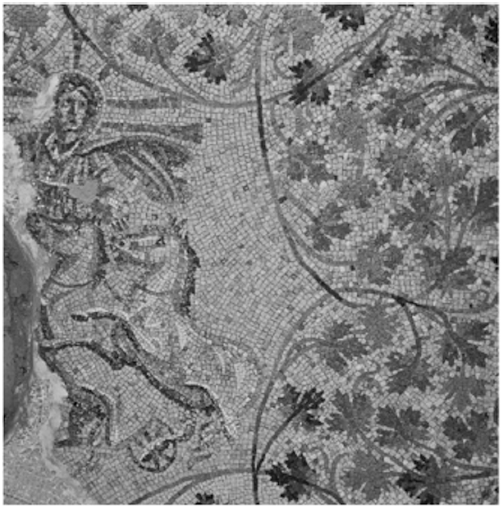
By the third century, we likely start seeing artistic evidence of interpretatio Christiana in funerary art. A famous early instance of possible interpretatio is from mausoleum M, the tomb of the family of Julius Tarpeianus built in the late-second/early-third century CE (CIL 6.20293), of the Vatican necropolis, under St. Peter’s Basilica. The mosaic on the ceiling, likely painted in the middle of the third century but definitely before 320 CE, is now commonly called the Christ-as-Sol mosaic (see Fig. 1). It features a four-horse chariot (only two horses are still visible) driven through grapevines by a rider grasping a blue cup. The charioteer is wearing a tunic and cloak, and the sun’s rays beam from his head.
Christ-as-Sol Invictus Mosaic, Mausoleum M (Vatican necropolis).
From “Art in the Christian Tradition,” a project of the Vanderbilt Divinity Library, Nashville, TN, https://diglib.library.vanderbilt.edu/act-imagelink.pl?RC=49946 (retrieved 6 September 2023). Original source: https://commons.wikimedia.org/wiki/File:Christus_Sol_Invictus.jpeg.

Based on the iconography, the charioteer can be identified as the Roman solar deity, Sol. The walls of the tomb were painted with scenes associated with literature about, or otherwise associated with, Christ—including a fisherman on the north wall (cf. Matt 4:19), a shepherd on the west wall (cf. Luke 15:1–8), and figures in a boat devoured by a sea monster on the east wall (Jonah). Based on these other mosaics in the tomb, the majority opinion is justifiable, namely, that the Sol painting was commissioned by a Christ-follower and represents Sol “[a]ppropriated as a Christian figure. . . represent[ing] Christ.. . . Functionally, this was a way of assigning or even transferring the solar deity’s attributes to Jesus”—essentially, interpretatio of Sol.Footnote 44 What makes this interpretation more reliable is that literary depictions of Jesus as the “great light” (φῶς. . . μέγα; Matt 4:16; cf. Isa 60:1–3), the “sun” (τὸν ἥλιον αὐτου) whom God makes rise (ἀνατέλλει) over all people (Matt 5:45; cf. Mal 4:2), the “sun of righteousness who rides over all” (ὁ γὰρ τὰ πάντα καθιππεύων δικαιοσύνης ἥλιος; Clement of Alexandria, Protrep. 11),Footnote 45 and the “sun of the resurrection” (ὁ Χριστὸς κύριος ὁ τῆς ἀναστάσεως ἥλιος; Clement of Alexandria, Protrep. 9 [LCL 92:186]; cf. Eph 5:14) would have invited associations between Christ and Sol that would eventually lead to artistic illustrations such as the Christ-as-Sol mosaic. Christian rituals in some locales, moreover, such as singing hymns at dawn, praying to the east, and feast days on Sunday, generated the notion that Christians worshipped the sun (Pliny, Ep. 10.96; Tertullian, Nat. 1.13).
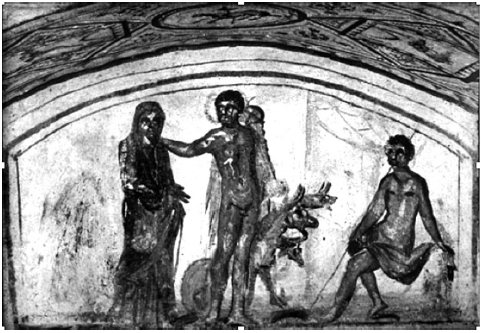
More artistic evidence of interpretatio can be cited from the first half of the fourth century. Cubiculum N, in the hypogeum under the Via Dino Compagni (the New Catacomb of Via Latina) in Rome, is located between two cubicula (O and M) that are adorned with Christian imagery, and all three chambers were painted around the same time by the same artist (ca. 320–350 CE). What stands out from cubiculum N are the painted scenes of Herakles’s labors in the arcosolium of the room.Footnote 46 These scenes include an illustration of Herakles’ rescue of Alkestis and defeat of Kerberos/Hades (see Fig. 2).
Painting from Cubiculum N, Via Latina Catacomb.
From left to right: Alkestis, Herakles, Kerberos/Hades.
Open access from https://commons.wikimedia.org/wiki/File:Alcestis-Catacomb.jpg.

By the first half of the fourth century, Herakles’ suffering and apotheosis were regularly associated with Christ’s death and resurrection,Footnote 47 and so we may well have in this burial chamber an interpretatio of Herakles from a Christian perspective given the art in its vicinity.Footnote 48
These are only two examples of wide-scale artistic depictions of Jesus as, or with the attributes of, other gods. This broader artistic practice shows that Christ was being equated with minor Roman gods, demi-gods, apotheosized heroes, and gods associated with magic, the underworld, healing, and violent deaths.Footnote 49
Several other strategies for rendering new gods comprehensible resemble interpretatio and are worth mentioning briefly prior to concluding this section. For instance, philosophical teachings often render old gods intelligible in the student’s new model for understanding divinity (e.g., Plutarch, Def. orac. 16–19).Footnote 50 This includes Christian teachers’ innovative re-arrangements of divine hierarchies.Footnote 51 Likewise approximate to interpretatio is the strategy of asserting the new god’s universal relevance or appeal.Footnote 52 Paul’s general approach to making the Jewish deity and Christ intellectually accessible to non-Jews aligns well with these approaches. For example, when writing to his Roman recipients, he asks rhetorically (and answers): “Is god only the god of Jews? Not also of the ethnē? Yes, also of the ethnē” (Rom 3:29).Footnote 53
Mixture of Rites
Interpretatio could be practiced alongside other manners of integrating Christ into an individual’s religious life. Among the latter include worshipping Christ together with an individual’s pantheon of other gods, as practiced by Marcellina and her group in Rome (see above). As early as the 50s CE, spokespersons provide hints about the ways that individuals incorporated Christ into their religious routines.Footnote 54 Later, we hear from the practitioners themselves. For instance, in a terse, formulaic votive from second-century Rome, whose dedicant I have shown elsewhere to be more likely than not a Christ-follower, Jupiter Optimus Maximus is invoked as follows (CIL 6.390a = 30752; heretofore, CIL 6.30752):Footnote 55
Domini metuens | I(ovi) O(ptimo) M(aximo) l(ibens) m(erito) | sacr(um)
A worshipper of the Lord gladly (dedicates this). Sacred to Jupiter Optimus Maximus, greatly deserving.
Today, this small votive altar (arula), adorned with swags and bucrania, is plastered into a shield in the Courtyard of the Columns at the Palazzo Medici Riccardi in Florence.Footnote 56 The CIL editors of the fascicles where the inscription appeared did not propose a date, but Ada Gunnella has more recently suggested the second century CE on paleographical and archaeological grounds.Footnote 57
This stone invites further study into the dedicant’s relationship to Roman gods. The original setting and circumstance of this votive is not easy to place. Would it have been set up in an assembly where Christ was venerated? That might seem likely since the dedicant identifies as a Christ-follower. Alternatively, perhaps a precinct for Jupiter would have been more appropriate since Jupiter is the recipient. Either way, the God-fearer mixed Christ into cult for Jupiter, rather than keeping rites for Christ separate from other religious activities. The religious practices of individuals were in a constant state of flux—adding Christ to the mix likely necessitated little explanation or self-critical thought.Footnote 58
This votive invites consideration of “visiting gods” (cf. Pausanias 5.17.1–5). By visiting god, I mean cult for one god in the precinct of another. Individuals could place terracotta figurines, altars, statues, votives, and other objects of devotion for visiting gods in sanctuaries open to such visitors. Brita Alroth has helpfully documented the phenomenon of visiting gods in Greek contexts, from pre-historical periods to the Hellenistic era, particularly figurines of visiting deities given as gifts to the host deity.Footnote 59 Evidence of visiting gods in the Roman West is documented in various studies. The following list is a selection: 1) statues of Diana, Hercules, Apollo, Mithras, as well as various images of Egyptian and Dolichene gods in the precinct of Jupiter Dolichenus on the Aventine (Rome);Footnote 60 2) representations of Sarapis, Venus, Fortuna, Hecate, Dionysus, and Asclepius in the Mithraeum of S. Prisca (Aventine, Rome);Footnote 61 3) in the second-century precinct for Jupiter Optimus Maximus Heliopolitanus (the so-called “Syrian Sanctuary”), various other Syrian deities are venerated, including Hadad, to whom an altar was dedicated (CIL 6.36803), and also a certain “Artemis” also known as “Sidonia of Cyprus” dedicates a marble alter to both Zeus Keraunios and also the Nymphs of Furrina (CIL 6.36802; late 2nd cent. CE);Footnote 62 4) statues of Bacchus, Venus, Ceres, and Pan visit the precinct of Magna Mater in OstiaFootnote 63 (Vermaseren 1977–1989, 3.107–119); 5) statuettes of Venus and Dionysos at a precinct for Isis in Pompeii;Footnote 64 6) various visitors to the sanctuary to Mephitis Utiana in Rossano di Vaglio (Lucania, Italy) including two marble statues of Artemis-Diana;Footnote 65 7) votives for Aphrodite, Ares, Artemis, Athena, Hera, and Herakles in the sanctuary of Mephitis in Ansanto (Campania, Italy);Footnote 66 8) bronze statuettes of Mercury and Victory in what seems to be a sanctuary for Mars in Kruishoutem (Gaul).Footnote 67 More generally, Giulio Vallarino has argued that precincts in Trebula Mutuesca were largely open to visiting gods, and Jean-Claude Lacam has made this same point about central Italy more generally.Footnote 68
It is fascinating to find that in and around Rome, gods often visited the precincts of new or foreign deities such as Magna Mater, Isis, Mithras, Jupiter Dolichenus, and Jupiter Optimus Maximus Heliopolitanus. Having traditional Roman gods visit these precincts might help link new or foreign gods more closely to the Roman state and Roman pantheon. With this in mind, it seems more likely that the Jupiter votive from second-century Rome was set up in a precinct for Christ than in a sanctuary for Jupiter.
Whereas visiting gods represent a transient type of cult mixing, new gods could be added to older cult sites in a more permanent fashion, too. Cicero had in mind ongoing cult to new gods in his prescribed norms for adopting new deities. These prescriptions did not carry weight in Rome among the majority (who adopted new gods intuitively) and are ideologically charged. However, they are worth quoting if only because such prescriptions are relatively rarely found. Specifically, Cicero’s dialogue on civil law, De legibus, advises against what seems to have been orthopraxy:
Separatim nemo habessit deos, neve novos neve advenas, nisi publice adscitos. Privatim colunto quos rite a patribus <cultos acceperint> (Cicero, Leg. 2.19.3–4).Footnote 69
Let no one have gods separately, whether new or foreign, unless they have been ordained publicly. Privately, let them revere those whom they have received that have been worshipped in the usual manner by their ancestors.
These two clauses pertain to religious activities outside those “publicly” (publice) financed, namely, those practiced by individuals, families, non-public collegia. In them, Cicero tacitly acknowledges the agency of individuals to add whichever new gods they would like to their pantheons. His rule, though, is functionally a limitation on this liberty: choose only state-sanctioned and ancestral gods venerated collectively by other members of the household. This proscription can be found, albeit adapted, in later texts by Plutarch and Cassius Dio.Footnote 70 Cicero additionally advises individuals against adopting new or foreign gods (“deos aut novos aut alienigenas”) by means of a “mixture of rites” (“confusionem. . . religionum”), old and new (Cicero, Leg. 2.25).Footnote 71
Cicero’s religious conservatism—and also his efforts to categorize what were intuitive practices—would not rule the day, for vibrant religious change in Rome was driven in part by adoption of new gods by means of integration. Collective worship of assemblages of mixed gods, in fact, would likely have been instinctive for practitioners of Christ, as the Jupiter votive illustrates. An example can be cited from the Historia Augusta, which offers a probably-fictional example of domestic cult for Christ. Though fictional, it nonetheless represents the actual variety of household gods worshipped by kin members, and the practice of continually adding new gods rather than replacing old ones when new gods are adopted. Specifically, in the biography of Severus Alexander, the lararium of the emperor is said to have included the statuettes of his Penates. These included ancestral deities but also images of Christ, Orpheus, Abraham, and Apollonius of Tyana (Scriptores Historiae Augustae, Severus Alexander 29.2). In a second lararium, the emperor had images of more additions to his ancestral domestic gods: Vergil, Cicero, Achilles, Alexander the Great, and others (Scriptores Historiae Augustae, Severus Alexander 31.4).
In contrast to this realistic (though likely fictional) depiction of a lararium, house-based Christ-worship tends to be framed around the novel concept of the monotheistic “house church,” and so presumes replacement of old gods with new ones. The practicality of moving out a statuette or other object from, say, Stephanas’ house in Corinth (1 Cor 16:15), or the meeting place of the Corinthian assembly prior to Paul’s arrival is rarely considered. Such a drastic act might require a formal invitation to the god(s) to move out (evocatio), presumably a practice reserved for emergencies or other extreme situations, not adoption of a new god.Footnote 72 In the third century, Ulpian highlights that:
sacrarium est locus, in quo sacra reponuntur, quod etiam in aedificio privato esse potest, et solent, qui liberare eum locum religione volunt, sacra inde evocare. (Ulpian, Dig. 1.8.9.2).Footnote 73
A shrine (sacrarium) is a place where sacred objects are situated, which can be even in a private edifice, and those who want to free that place from obligation towards the gods (religio) are accustomed to call forth the sacred objects from it.
An invitation to a god to move out of its precinct would likely require the god’s tacit approval for the individual to feel confident they are acting appropriately. The individual would then need to live with looming questions about whether the god rejected their request.Footnote 74 It would be a delicate situation and one that was unnecessary in the occasion of adopting a new god.
Christ-worship might be added not only to the domestic cult, but also to networks of people who were connected on different bases, as in the case of associations.Footnote 75 One possible instance of adding cult for Christ to the religious practices of an association is from third century Emerita Augusta (Spain). At the time of Decius’s edict in 250 CE, Martial was bishop of Emerita Augusta.Footnote 76 Cyprian of Carthage provides an account of Martial’s behaviour leading to a synod that banned him from the episcopate in 254 CE (Ep. 67). At this meeting of thirty-seven bishops, Martial’s religious preferences, as well as his membership in a collegium, were determinative of the council’s ex-communication of the bishop. The charges were as follows:Footnote 77
Martialis quoque praeter gentilium turpia et lutulenta convivia in collegio diu frequentata et filios in eodem collegio exterarum gentium more apud profana sepulcra depositos et alienigenis consepultos, actis etiam publice habitis apud procuratorem ducenarium obtemperasse se idololatriae et Christum negasse. (Ep. 67.6)Footnote 78
Martial, also, in addition to long partaking in the foul and vile banquets of the nations in a collegium, and his sons being placed in the same collegium, in the custom of foreign nations and being buried in profane tombs with strangers, himself now too conforms with acts carried out publicly before a ducenaria procurator, of idol-worship, and denying Christ.
As a Christ-follower, Martial might have motioned that his collegium should consider adopting Christ in addition to its traditional gods. His colleagues likely listened. Martial was a longstanding member of the collegium apparently, and had brought some level of stability to it even just by recruiting his children.
The context of the quoted text is also relevant for present purposes. Reports emerged that Martial received a fake certificate (libellus) falsely documenting his conformity to Decius’ edict of 250 CE that all inhabitants of the empire sacrifice and eat of sacrificial meat, charges to which he would later admit (Ep. 67.1, 6). As a result of this, and also the charges mentioned in the quoted text, it was decided at the Council of Carthage (254 CE) that Martial’s community in Emerita behaved appropriately when they removed him from his office and replaced him with a certain Felix (67.1). Nonetheless, Martial continued to identify as a bishop (Ep. 67.6) and apparently continued to preside over a local community (Ep. 67.9). Later, the bishop of Rome, Stephanus (254–257 CE), would restore Cyprian to his bishopric. Barbara Borg observes that “Cyprian’s [condemnation of Martial’s behaviour] was a partisan rather than a majority view.”Footnote 79
For the purpose of showing that the practice of mixing rites for different gods is attested as a mode of adopting a new god in an association, an oft-cited inscription from Philadelphia (Lydia) is useful. This inscription memorializes the expansion of a household cult (TAM 5.1539 = Syll 3 985 = GRA 2.117; late-2nd cent. BCE/early 1st-cent. BCE).Footnote 80 On this marble slab, regulations are inscribed by Dionysios, the owner of the house. Seemingly, he recently added several Greek gods to an older cult site formerly devoted to Agdistis, a Phrygian deity. Rather than replacing the older god, Dionysios added these new gods and had them worshipped alongside Agdistis, who perhaps even afforded credence to the new gods by association.Footnote 81 Indeed, Agdistis’s primacy appears to have been unfazed by the expansions: the new regulations for the association were to be stored near Agdistis’s statue (ἐτέθησαν παρὰ Ἄγγδιστιν, l.51), and the goddess, moreover, is called the “guardian” (φύλακα) of the house (l.52). The Greek deities for whom Dionysios adds altars in the time of expansion are mainly personified virtues and other abstractions, including Arete, Eudaimonia, Mneme, Ploutos, and Hygeia. It has been highlighted that at least seven of these new gods were very rarely attested elsewhere in Lydian inscriptions (some not at all).Footnote 82
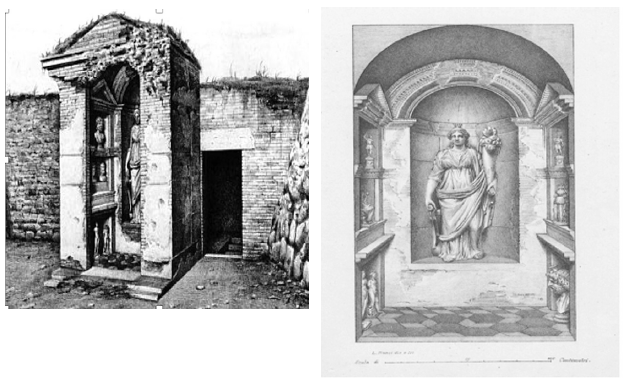
The garden shrine of a Roman house on the Esquiline might offer a good visual model for this instance of cult expansion and entanglement in Philadelphia (and for house-based collegia that worshipped Christ). The Roman house was discovered at Via Giovanni Lanza 128 (Esquiline Hill) in 1883. It featured an aedicular shrine or small temple (aedicula), around three meters in height, for Isis-Fortuna, built in the second century.
In the third or fourth century, it would appear, several other gods were added to this courtyard shrine, and it had become a garden lararium featuring statuettes of Lares, Serapis, Zeus, Aphrodite, and more. This shrine was destroyed shortly after its discovery, but prior to its demise Carlo Visconti printed illustrations (see Fig. 3). The history and transformation of this private cult site is uncertain but for present purposes we can note that the Isis-Fortuna statue remained throughout the precinct’s transformation. New gods were added, but cult for the old one endured.Footnote 83
Illustrations of lararium in an Isis-Fortuna temple in the courtyard of a Roman house on the Esquiline Hill (ca.300 CE).
Right: Visconti 1885, Plate 3 (https://digi.ub.uni-heidelberg.de/diglit/bcom1885/0238/image,info,thumbs). Left: Visconti 1885, Plate 4 (https://digi.ub.uni-heidelberg.de/diglit/bcom1885/0239/image,info,thumbs).

As additional evidence that practitioners of Christ-worship would have by default mixed Christ into the ongoing religious practices in their households and other networks, we can observe with Tertullian and other writers some general behaviours practiced by Christ-followers. By the late second/early third century, Tertullian reveals not only that practitioners of Christ-worship continued to communicate with other gods but that they did so because it helped ensure that the name (nomen) not be reviled (ne. . . blasphemetur) by non-practitioners (Idol. 14.1).Footnote 84 Tertullian, moreover, knew of some practitioners of Christ-worship who took part in Roman festivals (Idol. 12.5–14.7): specifically, we learn from Tertullian that individuals, after adding Christ to their pantheons, celebrated Saturnalia, the Kalends of January, and other Roman festivals (Idol. 14.6), as well as honored the emperor with wreaths and lamps on their doors (Idol. 15.2–4). Tertullian also criticizes practitioners of Christ-worship who were making vows to other gods and swearing oaths “so that you may not be discovered” (ne intellegaris; Idol. 20.5–21.2).Footnote 85 Overall, the general impression one gets from Tertullian is that his version of being a Christianos was a burden, yet the actual practice of adding Christ to one’s religious activities was attractive.
Conclusion
Practitioners of Christ-worship are often generalized as having abandoned and replaced their old gods with new ones. Yet very few individuals actually self-report to have abandoned their old gods when they adopted new ones and, moreover, narratives of people abandoning and replacing tend to be politically and ideologically motivated. Overall, abandon and replace was overly socially consequential and too ill-attested to now be depicted as the default “model” of turning to Christ. Displacing it from modern accounts of ancient Christianity allows us to recognize that participation in Christ-worship need not have entailed a comprehensive or exclusive Christianity identity.
Current discussions of Roman religion could also benefit from integrating evidence for Christians’ continued relations to the Roman gods: not only does the relevant textual and physical evidence illustrate underexplored religious options in the principate, but it also helps illuminate the broader phenomena of domestic religion, neighborhood religion, and collegium religion. This is not to suggest that pre-Constantinian Christian evidence has been omitted in previous discussions of Roman religion, Footnote 86 but the specific issue of Christian relations to the Roman gods is often narrowly construed as usually monotheistic (and the like). To help lay the foundation for further incorporation of the relevant database of textual and physical evidence into the scope of studying Roman religion, this study has compiled some of the earliest evidence of individuals who turned to Christ while maintaining communications with Roman gods.

 Open access



