


Premise. Early Roman priesthood: visual culture and social imagery
Thanks to the testimony of ancient authors and iconographic sources, it is possible to reconstruct the vestments and ritual instruments associated with some of the principal Roman priesthoods.
The literary and figurative evidence available for reconstructing the visual aspects and ceremonial instruments of these priests dates to the late Republican and Imperial periods. As such, these sources provide a terminus ante quem for the moment when these items became integrated into Roman religious practice and acquired sacral connotations within the Roman cultural imaginary. The precise moment – or moments – at which this process occurred, as well as its underlying mechanisms, remains a subject of scholarly debate. This issue is intrinsically linked to broader questions concerning the chronological framework and socio-political context in which the Roman religious system – cults, festivals, leges, and priestly institutions – was formally structured. The historiographical debate on this matter has long been characterized by divergent and often contrasting interpretations. One school of thought argues that traditions attributing the origins of Rome’s major religious institutions to the city’s earliest history are late Republican constructs, devoid of historical validity and developed ex post for etiological purposes. In contrast, other scholars contend that these traditions preserve a genuine historical substratum, indicative of a long and complex formative process underlying the Roman religious system. Within this framework, priestly colleges have been interpreted as embodying a link between the new social design and the ancient pre-civic roots of Rome.Footnote 1 Given the wide-ranging implications of this discussion, the present study does not seek to provide an exhaustive treatment of the topic. Instead, it focuses on two specific aspects: first, the semantic and symbolic values associated with the vestments and ritual implements of three major Roman priesthoods – the Flamines, the Vestal virgins, and the Salii – as inferred from textual and iconographic sources; second, an examination of the cultural processes that led to their early establishment and subsequent integration into the religious traditions of Latin communities.
Previous scholarship has noted that certain grave goods recovered from Latin and Etruscan funerary contexts, dated between the Late Bronze Age and the Early Iron Age, include objects whose forms bear a striking resemblance to ritual paraments and instruments attested in historical Roman priesthoods.Footnote 2 The expansion of archaeological datasets in recent years permits a systematic reassessment of this material, contextualizing these artifacts within their broader funerary assemblages and taking into account variables such as the gender and age of the deceased, tomb typologies, and associated burial practices. Such an approach is essential for refining our understanding of the social roles and potential political-religious functions held by the deceased with these objects.
It is important to clarify that the objective of this study is not to establish a direct, linear continuity between Roman priests of the Republican and Imperial periods and individuals holding politico-religious roles in early Latin communities. Rather, the focus is on tracing the processes through which these communities began to develop social agents, symbolic systems and ritual practices indicative of increasingly complex religious structures and shared cultural imaginaries. Furthermore, the study considers how these symbols were subsequently codified within Roman religious praxis and whether their semantic connotations were preserved, transformed, or reinterpreted over time. The religious significance of each ritual object or vestment was inherently tied to its capacity to evoke specific meanings among those who observed or participated in the ritual, within a framework of collective social discourse shaped by religious experience and cultural memory. From this perspective, the visual and semantic attributes distinguishing each ceremonial garment or implement constituted integral components of an evolving shared imaginary. These elements can only be meaningfully interpreted through a diachronic approach that situates them within their respective socio-cultural contexts.
In the following pages, a critical analysis will be conducted on the documentary sources related to the literary, epigraphic, and iconographic evidence concerning the vestments and ritual instruments associated with each of the priesthoods under examination (§ 2). Subsequently, particular attention will be devoted to an archaeological analysis of funerary contexts in which objects identified as ritual implements, or those bearing ideological or religious connotations evocative of the instruments used by Roman priesthoods, have been documented. These contexts will be examined considering all relevant factors, including the gender and age of the deceased, the complexity of the burial assemblage, and the characteristics of the tomb (§ 3). Before proceeding, however, it is essential to situate this analysis within the broader and most recent scholarly discourse on the role and the social and political implications of the priesthoods under investigation (§ 1).
1 Early Roman priesthood in context
The framework for the development of long-term or permanent roles defined by their involvement in religious communication, that is, performing or supporting ritual action addressed at “divinities,”Footnote 3 was an ongoing process of urbanization and state formation.Footnote 4 Rome was neither an assemblage of villages nor a tribal society (Fig. 1). For the rich landowners who formed the incipient Roman aristocracy, the attribution of an urban status to the settlement at the Tiber crossing and hub of exchange was important. It served as a means of controlling and appropriating commerce and technology, the creation of a shared, “public” space that mobilized inputs from the clans as well as local inhabitants, and the reward and space of consumption itself of the (very slowly) growing urban amenities.
Central Italy with proto-urban settlements and major roads of the Roman time. (Drawn by F. Fulminante).

Fig. 1 Long description
A map of Central Italy displaying proto-urban settlements and major roads from Roman times. The map includes rivers, terrestrial reconstructed networks, and major Roman roads. Key locations such as Cassii, Clodia, Aurelia, Flaminia, Salaria, Labicana, Praenestina, and Latina are labeled. Sites larger than 15 hectares are marked with white dots, while rivers are depicted in blue lines. Terrestrial reconstructed networks are shown with black dashed lines, and major Roman roads are indicated with red lines. The Tyrrhenian Sea is visible to the west.
At Rome – as in other central Italian sites – religious practices played an important role in that process. Topographically, the slow monumentalization of the Forum hindered the continuation of family tombs in its central area, and the burials of the very inhabitants of the area and the villas along the later Via Sacra were driven out. A growing and differentiated set of shared cults were added to family and local cults. The latter always remained in the gray area around central administration and were from time to time the subject of top-down systematization or recognition by bottom-up authorities. This can very occasionally be seen in the cases of curiate organizations and the curiones, or the vici and their vicomagistri much later.Footnote 5 Top-down additions to family cults can be seen only under exceptional circumstances, namely in the cases of the Pinarii’s cult of Hercules and the Julian gentile cult at Bovillae.
It must be underlined that permanent religious roles attributed the dignity of “priesthoods” (a concept that comprised different Latin terms, including sacerdotes, Flamines and Flaminicae, and rex and regina sacrorum Footnote 6 ) did not rise in connection with religious architecture, temples in particular. In the cosmological visions probably entertained in early Rome, contact with gods was vital in many situations, especially during risky actions. This was true for technicians such as weavers and smiths, for pregnant women, for heads of families officiating over burials, and for political and military leaders.Footnote 7 The visibility of and competition associated with such actions, typically in dense and growing settlements but also at regional or super-regional meeting points, led to growing investment in and increased appropriation of such sites and practices. Such “sacralisations outside of religion”Footnote 8 were not opposed to but were the basis of a differentiation of religion as a field of practices and roles establishing its own rules. Evidently, this was not just an area dependent on and useful for political purposes. The dialectics of religion as an independent field of social action were constitutive of subsequent Roman history. On the one hand, acting religiously attributed agency to gods and was hence able to counter other authorities; on the other hand, it was also a major source of political legitimation and social power performed in large-scale rituals, meat distribution, and entertainment.Footnote 9
It is comparative analysis, as suggested here, rather than reliable evidence from Rome, that helps elucidate the early centuries of development. Roman tradition attributed the institutionalization of several priesthoods to the first kings. In this tradition, the Roman polity was interpreted as the king’s household writ large. As a family’s cult was focused on the hearth, the king’s daughters (anticipating the priesthood of the Vestal virgins) cared for the city’s hearth in the aedes Vestae and guaranteed an eternal fire, annually renewed. In this model, ritual tasks that might once have been the duty of the king were in the post-monarchic state performed by the pontifex maximus and the “king of the sacrifices” (rex sacrorum).Footnote 10 Latin tradition developed the figure of the charismatic seer, embodied in the Augur Attus Navius, as an opponent to the power of the king. In general, such figures indicated the degree of differentiation of the religious fields. They were involved in conflicts rather than smoothly empowering political leaders. The high prestige of the college of Augurs in the early Republic strongly suggests their institutionalization had already taken place during the regal period. Early institutionalization likewise renders probable the restriction of this role to patricians. The right to the auspices seems to have been a kernel of patrician self-definition.Footnote 11
The existence of an unknown number of religious specialists can be reasonably assumed. They were not necessarily all male, and they cared for individual cults and probably cult places. In later texts, such Flamines were discerned by adjectives like Dialis, Martialis, Quirinalis, or Carmentalis. Their distinctive clothing marked a specifically religious role. The cooperation of different Flamines in the sanctuary of Fides, representing the correct behavior towards inferiors, and the obligation to be married in archaic forms might point to religious roles within different clans, addressed to deities rather than ancestors.Footnote 12 For the patricians as a group, the particular dress and the behavioral norms of these priests illustrated the specific religious competence of the patriciate, even if individual officeholders tried to extend their spatial and social movements.Footnote 13
Groups of aristocratic youths might well have had the duty of caring for some important cults constructed as the trans-clan area of urbanity and political “public.” The Vestal virgins would fit such a pattern, as would the Salii (“the dancers”) and the poorly attested Salian virgins in the cults of Vesta and Mars.Footnote 14 A decorative development might offer a clue to the institutional development of the Salians. If the initiation into banqueting as offered by the Salian priests in the Republican period was in fact given to an organized “public” group, this might well be related to “the disappearance at the end of the sixth century of terracotta friezes depicting banqueting scenes.”Footnote 15
It is interesting that the groups most prominent in the evidentiary record, namely the Salii and Vestal virgins, existed outside the political realm proper. They were unqualified for political office by reason of sex or age and hence did not threaten political competitors. Thus, the small number of Vestal virgins could be highly visible, as they were living and working in the center of the city, moving in the triangle between their proper villa, the temple, and the symbolic royal palace. The latter, the Regia just opposite the temple, was a cultic site, not the seat of a ruler and his family.Footnote 16 Judging by extant literary sources, they were probably the priesthood that received the most attention in “urban talk.”Footnote 17 If we compare the number of names transmitted for Roman priests before 300 BCE, regardless of their historicity, we register 11 individuals among the Vestal virgins. There is the same number of Augurs (including Romulus, Remus, and Attus Navius) and of pontiffs, if we take normal pontifices and pontifices maximi together. In comparison, we only know of one rex sacrorum, two Flamines, three fetiales, and not a single Salius.Footnote 18
Religious power was much more diffused among the 12, and later 24, Salians, who generally left for higher offices after a few years of membership. Without stressing a structuralist interpretation, it is interesting to see the Salians’ distinct pattern of ritual occasion and spatial movements, so different from that of the Vestal virgins. The latter performed a pre-urban family cult symbolically loaded as precondition for urban continuity, occasionally cooperating with adult females. The former instead mobilized the whole city as spectators for their dances and processions and probably covered substantial parts of the city through these performances. Symbolism included military gestures and armor, including the famous shields – 11 indistinguishable replicas of the first, fallen from heaven – which were kept in the same building, the Regia.
Flamines, Vestal virgins, and Salii shared iconic dress and paraphernalia from the apex to the figure eight-shaped ancilia. In a history of religious differentiation, these were the roles that performed the independence and the specific rules of the religious field. Historically, inter-role conflicts regarding the individual carriers of the political and religious roles – in family, sex, territorial, political, and behavioral aspects – were used to discuss the relation of religion to different themes in periods of crises and accelerated political and urban developments. The apices falling from a Flamen’s head, the luxury of Salian meals, the burying alive of young Vestals were the imagined or observed scenes that made such conflicts iconic and drew public attention. It is against this background that the more powerful colleges of Augurs and pontiffs (and later (quin-)decimviri sacris faciundis and septem/decem viri epulonum), filled by leading magistrates, argued and acted under the umbrella of the same “religion.” And it is against such a background that the iconographic documentation of these priesthoods must be analyzed.
2 Ritual attire and ceremonial implements of the priesthoods. Literary sources and iconographic dossier
2.1 Virgines Vestales
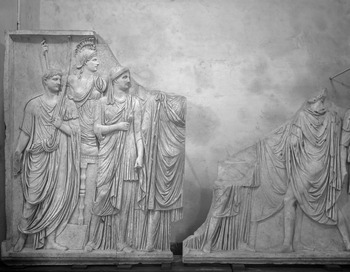
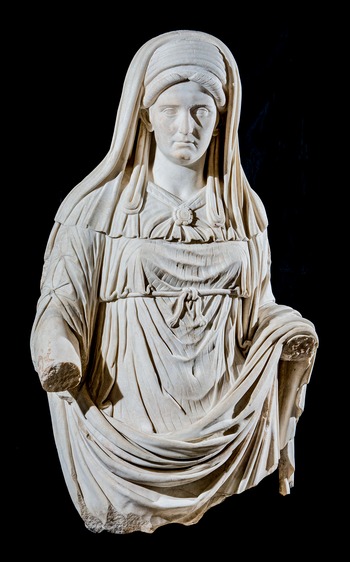
The ritual attire of the Vestal virgins, as documented in late Republican sources, consisted of a long, white stola that covered the body from the shoulders to the feet.Footnote 19 The priestesses’ heads were wrapped in a veil that extended to the shoulders. This garment, known as the suffibulum, was white and adorned with a purple border. It differed from the veil of the Flaminica Dialis – the flammeum – only in color, as the latter was red. The suffibulum was an essential component of the Vestal virgins’ dress during sacrificial rituals,Footnote 20 a requirement corroborated by iconographic evidence.Footnote 21 Beneath the suffibulum, they wore a distinctive and complex hairstyle. According to Festus, their hair was arranged in the style known as seni crines: senis crinibus nubentes ornatur quod is ornatus vetustissimus fuit, quidam quod eo Vestales virgines ornantur, quarum a castitatem viris suis † sponoe <…> a ceteris.Footnote 22 However, this specific hairstyle is not easily identifiable within the existing iconographic corpus associated with the priestesses.Footnote 23 Mario Torelli has suggested that the seni crines style can be discerned in certain votive terracotta statues from Lavinium depicting young women (novae nuptae). Their hair appears as shaved and arranged in three braids on either side of the head, giving rise to the term seni crines, meaning hair divided into six plaits. This iconographic representation reflects an ancient hairstyle associated with hair-cutting rituals and the use of helikes, small metal spirals used to secure braids. These items are documented in both Latin and Etruscan tombs dating from the 10th to the 7th c. BCE. From the second half of the 4th c. BCE, depictions of the seni crines hairstyle disappear from Lavinium’s terracottas, replaced by a new arrangement featuring more elaborate curls of larger size.Footnote 24 The extent to which Festus and/or his sources were familiar with the original form of this ornatus vetustissimus and its evolution over time remains unclear. However, iconographic evidence strongly suggests that Vestals were required to wear their hair very short (Fig. 2), once again aligning with customs associated with future brides.Footnote 25 It is likely that these short braids were arranged by them using cloth headbands called vittae, which secured their hair. This arrangement was then wrapped in red and white woolen bands known as infulae and covered by the suffibulum.Footnote 26 This intricate hairstyle is consistently depicted in representations of the Vestals, where a turban-like arrangement of overlapping bandages (the infula) is visible beneath the suffibulum (Fig. 3). In some cases, long strips (the vittae) extend down to the shoulders.Footnote 27
So-called Palazzo della Cancelleria marble relief with vestal (detail). Rome, Vatican Museum. (Courtesy Deutsches Archäologisches Institut Rom, D-DAI-ROM, 1 2007.0011).

So-called Vestale Massima. Rome, Roman National Museum of Palazzo Altemps. (Su concessione del Ministero della cultura - Museo Nazionale Romano. Foto L. Mandato, S. Sansonetti, inv. 639.)

Another essential component of the Vestals’ ritual attire, absent from ancient literary sources but evident in visual representations, is the cingillum or Herculaneum knot. This woolen girdle was tied in a knot below the priestess’s breasts to secure the stola. According to Festus, the cingillum was traditionally worn by brides on their wedding day and untied by their husbands on the first night to promote fertility.Footnote 28 This practice bears a striking resemblance to the ritual running performed by the Luperci priests during the Lupercalia festival. As part of that ceremony, the Luperci ran around the Palatine Hill, striking women with strips of goat-hide wool to promote health and fertility. The cingillum appears frequently in visual representations, such as the relief on the so-called Palermo base,Footnote 29 statues from the Atrium VestaeFootnote 30 and the Antiquarium Forense in Rome,Footnote 31 and the well-known statue of the Vestal Maxima housed in the National Museum of Palazzo Altemps (Fig. 3).Footnote 32
For a long time, scholars have analyzed the juridical and religious status of the Vestal virgins from various perspectives.Footnote 33 Within this tradition, the study of the ritual costume of these priestesses has played a crucial role in understanding their social and religious significance. The attire of the Vestal virgins incorporated both garments associated with matronly status and elements symbolizing the virginal condition of a new bride. This duality has led some scholars to emphasize the semantic connections between the Vestals and the broader theme of female transition to adulthood, interpreting them as “perpetual nubendae.” Conversely, others have highlighted the elements of social honor and modesty associated with the role and status of the Roman matron. From a long-term historical perspective, it is plausible that these different aspects of the Vestal priesthood evolved in significance over time, with particular traits gaining or losing emphasis depending on historical contexts. Certain archaic elements associated with the transitional nature of the Vestal priesthood may have been preserved within ritual practices and visual representations even as their original functions – linked to the earliest phases of Latin society – were altered in form and meaning.
2.2 Salii
The ritual attire of the Salii priests is described in detail by several ancient authors.Footnote 34 It comprised a headdress known as the apex, a short tunica, a mantle (trabea), and a breastplate. Additionally, the Salii carried ritual instruments and weaponry, including a sword, a ceremonial staff, and a distinctive shield known as the ancilium.
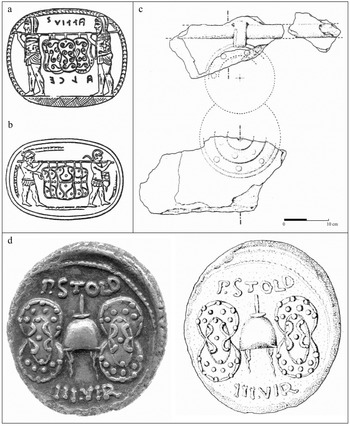
As suggested by its name, which is the same as that of the headdress of the Flamines, the Salian headdress in the historical period featured a conical shape with a vertical element. However, unlike the Flamen’s headdress, the Salian apex was crafted from bronze, resembling a war helmet.Footnote 35 The military connotations and probably Archaic origins of this headpiece, recorded by Plutarch and Festus, are further emphasized by its association with the soldiers of Turnus, the Rutulian king.Footnote 36 From an iconographic perspective, few representations provide a clear depiction of this helmet.Footnote 37 It appears on certain denarii issued by Licinius Stolo (Fig. 4) and Antoninus Pius, where its identification with the Salian headdress is supported by its association with the ancilia (Table 1). Another significant piece of evidence is a youthful head, believed to be a portrait of a Salian priest, housed in the Ducal Palace in Mantua (Fig. 5a–b). This sculpture depicts an apex-helmet adorned with motifs referencing the religious sphere. Although the apex itself is not preserved, it was likely positioned atop the headdress.Footnote 38
(a) Drawing of a gem with an Etruscan inscription and the carrying of shields (ancilia?) and (b) drawing of a Roman-Italic gem with the carrying of shields (ancilia?) (from Torelli Reference Torelli1999, figs. 1–2); (c) fragments of the architectural decoration of the Regia in the Roman Forum (36 BCE) with ancilia (from Torelli Reference Torelli1999, fig. 4); (d) denarius of P. Licinius Stolo with two ancilia and an apex (from Colonna Reference Colonna1991, fig. 22).

Fig. 4 Long description
Panel A: Drawing of a gem with an Etruscan inscription and figures carrying shields. Panel B: Drawing of a Roman-Italic gem with figures carrying shields. Panel C: Fragments of architectural decoration from the Regia in the Roman Forum, showing shields. Panel D: Denarius coin featuring two shields and a helmet.
Mantua, Palazzo Ducale Museum. Bust of Salian priest. (Reference SchäferSchäfer 1980, figs. 13, 15).

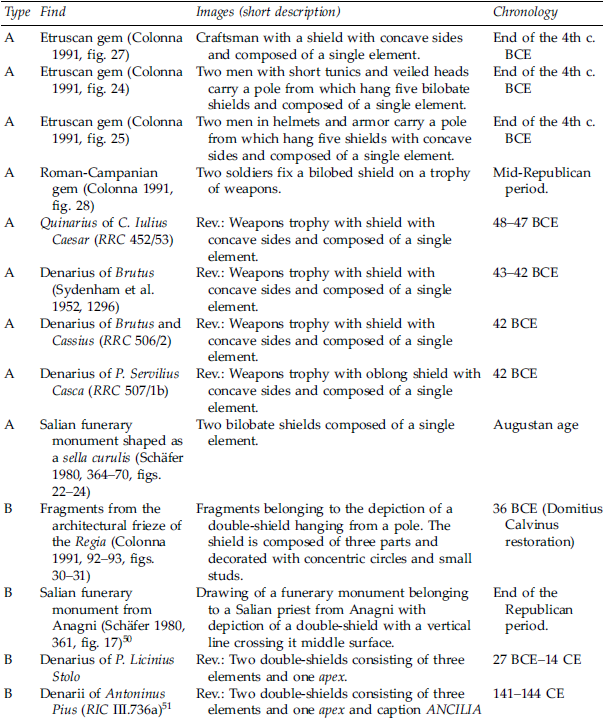
Etruscan and Roman double-shields iconographic documents.

Table 1 Long description
The table has four columns: Type, Find, Images (short description), and Chronology. It contains 12 rows, each describing a different artifact. Row 1: Type A, Find Etruscan gem (Colonna 1991, fig. 27), Images Craftsman with a shield with concave sides and composed of a single element., Chronology End of the 4th c. BCE. Row 2: Type A, Find Etruscan gem (Colonna 1991, fig. 24), Images Two men with short tunics and veiled heads carry a pole from which hang five bilobate shields and composed of a single element., Chronology End of the 4th c. BCE. Row 3: Type A, Find Etruscan gem (Colonna 1991, fig. 25), Images Two men in helmets and armor carry a pole from which hang five shields with concave sides and composed of a single element., Chronology End of the 4th c. BCE. Row 4: Type A, Find Roman-Campanian gem (Colonna 1991, fig. 28), Images Two soldiers fix a bilobed shield on a trophy of weapons., Chronology Mid-Republican period. Row 5: Type A, Find Quinarius of C. Julius Caesar (RRC 452/53), Images Rev.: Weapons trophy with shield with concave sides and composed of a single element., Chronology 48-47 BCE. Row 6: Type A, Find Denarius of Brutus (Sydenham et al. 1952, 1296), Images Rev.: Weapons trophy with shield with concave sides and composed of a single element., Chronology 43-42 BCE. Row 7: Type A, Find Denarius of Brutus and Cassius (RRC 506/2), Images Rev.: Weapons trophy with shield with concave sides and composed of a single element., Chronology 42 BCE. Row 8: Type A, Find Denarius of P. Servilius Casca (RRC 507/1b), Images Rev.: Weapons trophy with oblong shield with concave sides and composed of a single element., Chronology 42 BCE. Row 9: Type A, Find Salian funerary monument shaped as a sella curulis (Schäfer 1980, 364-70, figs. 22-24), Images Two bilobate shields composed of a single element., Chronology Augustan age. Row 10: Type B, Find Fragments from the architectural frieze of the Regia (Colonna 1991, 92-93, figs. 30-31), Images Fragments belonging to the depiction of a double-shield hanging from a pole. The shield is composed of three parts and decorated with concentric circles and small studs., Chronology 36 BCE (Domitius Calvinus restoration). Row 11: Type B, Find Salian funerary monument from Anagni (Schäfer 1980, 361, fig. 17)0, Images Drawing of a funerary monument belonging to a Salian priest from Anagni with depiction of a double-shield with a vertical line crossing its middle surface., Chronology End of the Republican period. Row 12: Type B, Find Denarius of P. Licinius Stolo, Images Rev.: Two double-shields consisting of three elements and one apex., Chronology 27 BCE-14 CE. Row 13: Type B, Find Denarii of Antoninus Pius (RIC III.736a)51, Images Rev.: Two double-shields consisting of three elements and one apex and caption ANCILIA., Chronology 141-144 CE.
The tunic worn by the Salii, referred to as the picta, was distinguished by its decorative purple borders. This garment is thought to have been the precursor of the toga picta, which was later worn by individuals granted the honor of celebrating a triumph.Footnote 39 According to Dionysius of Halicarnassus, the tunica picta was of Etruscan origin and was introduced to Rome during the reign of the Tarquin kings.Footnote 40 Like the tunica picta, the Salian trabea was edged with purple and fastened at the shoulders with a fibula. The presence of purple embellishment underscores its high symbolic value and suggests its antiquity, linking it to kingship and the vestis regia. Footnote 41 The Salian attire was further complemented by a bronze breastplate (aeneum pectori tegumen),Footnote 42 a sword,Footnote 43 the ancile shield, and a ceremonial staff.Footnote 44 The exact nature of this staff remains uncertain, as Dionysius’s and Plutarch’s descriptions of it are ambiguous, but it was likely a form of sceptrum.Footnote 45 According to ancient tradition, one of the ancilia was a divine token (pignus) sent by Jupiter to Numa Pompilius as a sign of his favor toward Rome.Footnote 46 To prevent its theft, 11 identical copies were created. Numa is also credited with establishing the priesthood of the Salii Palatini, to whom these sacred shields were entrusted.Footnote 47 Unlike other ritual garments and instruments associated with Roman priesthoods, the ancilia were not merely insignia – symbols of specific religious roles – but were instead sacra, objects of veneration in their own right. This distinctive characteristic suggests an exceptionally ancient religious and chronological context, still marked by aniconic worship practices. According to ancient sources, the ancilia resembled a scutum breve with curved edges, akin to Thracian shields.Footnote 48 Scholars have noted the similarity between the ancilia, as known from iconographic and archaeological evidence, and shields of Aegean origin from the Minoan-Mycenaean period.Footnote 49 However, iconographic sources are not entirely consistent in defining the precise shape of these objects. Two principal shield types can be distinguished: Type A, a single-piece elongated shield with carved sides, and Type B, a double-shield design, possibly incorporating an ovoid plate in the central section (Table 1 and Fig. 4).
Type ‘A’ iconographies are attested significantly earlier than Type ‘B’, dating back to the 4th c. BCE. These representations appear to align most closely with the literary descriptions of the ancilia, which refer to the Thracian shield. In contrast, Type ‘B’ iconographies become more prevalent from the late Republican period and continue into the Imperial era (Fig. 4). This latter group seems to bear a closer resemblance to actual artifacts dating to the 9th–8th c. BCE (see below), which may be regarded as the archetypal model of what would later evolve into the Roman ancile. Nevertheless, it should be emphasized that both iconographic types can plausibly be considered representations of ancilia. Type ‘A’ shields are depicted on Etruscan gems, which appear to illustrate the ritual of carrying shields suspended from the lorum, and they also appear on the funerary monument of a Salius priest (Fig. 4). Type ‘B’ representations, on the other hand, are found in the Augustan frieze from the Regia – where the ancilia were housed – and are further documented on coins from the reign of Antoninus Pius, where they are explicitly identified by the inscription ANCILIA. To account for this duality, Giovanni Colonna proposed that the two iconographic variations corresponded to the two distinct colleges within the Salian priesthood: the Salii Palatini and the Salii Collini.Footnote 52 Alternatively, Elisabetta Borgna suggests that the Type ‘A’ shield was initially employed in war trophies before being subsequently integrated into ritual practice.Footnote 53 Another possible explanation for the duality considers it in a historical and processual perspective: the proliferation of depictions of the earlier shield/ancilia type during the Augustan period may be interpreted within the broader framework of Augustus’s strategy to revive Archaic Roman traditions.
The ancilia held a central role in the ritual activities of the Salii, and as previously noted, the foundation of the Palatine sodalitas was intrinsically linked to the aition of these sacred instruments. The Salian festivals primarily took place in March and involved processions conducted in various public and private locations throughout the city.Footnote 54 Scholars have underscored the connection between Salian rites and the transition from childhood to adulthood. At the same time, the triumphal connotations of these rites – linked to the military aspects of kingship – are reflected in the attire of the priests.Footnote 55 It has been suggested that Salian dances were ritual reenactments of martial conflict.Footnote 56 The performance of these dances likely aimed to represent, on the one hand, a struggle between two groups of ὅμοιοι (hómoioi, or equals) and on the other, the acquisition of power through military victory. Within this interpretative framework, the ancilia – conceived as the pignora imperii bestowed by Jupiter – visually encapsulate this concept. The display of the ancilia, suspended from the lorum, their transportation, and their subsequent exhibition by priests dressed in the military insignia of the rex can be interpreted as allusions to an ancient victory ritual preceding the later “Etruscan triumph.”Footnote 57 It is noteworthy that, while iconographic representations of this type of procession are widespread,Footnote 58 no depictions of the amptruatio have survived.Footnote 59 This absence may suggest that the codification of the semantic values associated with Salian vestments – connected to the military prerogatives of the rex and his exaltation as a victorious leader – developed concurrently with the increasing legitimization of royal authority through the Roman “Religion of Victory.”
A particularly significant ritual in which the Salii may have participated is the Equirria festival (March 14). According to Furius Philocalus, in addition to the public festivities, a separate ritual, not included in the official Roman calendar – the Mamuralia – was also observed on this day.Footnote 60 Servius states that during this ceremony, animal skins were ritually beaten,Footnote 61 while Minucius Felix, in his description of Salian religious activities, affirms that the priests struck skins as they danced.Footnote 62 Furthermore, John Lydus recounts that on March 15, an old man clad in goat skins and referred to as Mamurius was expelled from the city with blows from wooden sticks.Footnote 63 According to a well-documented tradition, Mamurius Veturius was the artisan commissioned by Numa to craft the 11 replicas of the ancile, the sacred pignus of Roman power. In recognition of his work, Mamurius’s name was incorporated into the Salian carmen.Footnote 64
From an iconographic perspective, two mosaics, both part of the so-called figured calendars and dated to the 3rd c. CE, have been tentatively associated with the Salii and the Mamuralia ritual. The first mosaic, of uncertain provenance, depicts three male figures wearing short, multicolored tunics and striking an animal skin with thin sticks under the watchful gaze of a statue of Mars (Fig. 6). The second mosaic, originating from Thysdrus, presents a similar scene; however, instead of a statue of Mars, it includes an inscription indicating the month in which the rite occurred: MARTIAS. Both scenes exhibit elements that are unmistakably linked to the cult of Mars and, as such, suggest points of connection with Salian rituals. However, both iconographies also contain problematic aspects that preclude a definitive identification of the figures as Salii priests.Footnote 65 Another artifact of relevance is a funerary base from Anagni, on which a bilobed shield is depicted alongside a thin stick resembling those illustrated in the mosaics.
Mosaic with so-called figured calendars. Detail of the month of March with three male figures striking an animal skin with thin sticks under the gaze of Mars. Rome, Galleria Borghese Museum. (From Reference SchäferSchäfer 1980, fig. 18).

Despite the association between Mamurius Veturius and the ancile, no ancient source explicitly links the Salii to the Mamuralia. However, if the three figures in the mosaics are indeed Salii, it follows that these priests were responsible for performing the ritual. Scholars have proposed that this festival symbolized the transition from winter to spring. Some have further suggested that it coincided with the New Year in an earlier Roman calendar structured around 10 months. Within this framework, the connection to the festival of Anna Perenna, celebrated on March 15, would be particularly meaningful.Footnote 66 The “old” Mamurius may thus represent both the departing winter and the conclusion of the old year, while the Mamuralia itself may have functioned as a corresponding purification rite for the city.
2.3 Flamines
The ritual attire of the Flamines Maiores,Footnote 67 as attested in a large range of sources from the late Republic and later, comprised a distinctive headdress known as the apex, a toga praetexta, and a woolen cloak referred to as the laena. Among these garments, the apex appears to be the most emblematic of this priesthood, as it frequently appears in iconographic representations of the Flamines, as well as independently on both reliefs and coinage (Fig. 7).Footnote 68 The apex worn by the Flamines differed from that of the Salii, which bore the same name.Footnote 69 According to Cicero and Livy, the apex was originally an attribute of the rex, particularly the Etruscan reges.Footnote 70 Further evidence of the connection between the attire of the Flamen and that of the king can be found in Festus (Fest. 101 L):Footnote 71
Flaminica Dialis eo cincta dicebatur quod in ea rica qua tutulus eius cingebatur quaedam corona erat, cui arculo nomen fuit. Quae corona non, ut adfirmatum est, e pinea virga sed e malo Punica conficiebatur. Igitur non castitatis servandae sed fecunditati fovendi causa ea flaminica utebatur. Arculum autem cum flaminis apice comparandum est […] Denique quod regis quoque apex, reginae sacrorum arculum insigne erat, argumento est flamonium et regnum priscis temporibus inter se coniuncta esse.
So-called Hartwig Relief with head of a Flamen in front of a temple. Rome, Museo Nazionale Romano. (Su concessione del Ministero della cultura – Museo Nazionale Romano. Photo, A. De Luca inv. 310251).

Festus suggests that the similarity between the sacred garments of the Flamen Dialis, the rex sacrorum, and the rex himself can be explained by the original relationship that linked this priesthood with kingship. The apex was composed of three distinct elements: a skullcap, known as the galerus, crafted from the hide of a sacrificial lamb, exclusively white in the case of the Flamen Dialis,Footnote 72 likely recalling the white bull offered by the 30 Populi Albenses to Jupiter Latiaris on the Alban Mount;Footnote 73 a small olive wooden rod, termed the virgula, affixed to the top of the galerus, Footnote 74 symbolizing the sacred nature of the Flamen;Footnote 75 and finally, a woolen thread wrapped around the virgula, which was the only permissible knot for the Flamen.Footnote 76 Indeed, he was prohibited from wearing rings, belts, or any other form of binding, including oaths.Footnote 77 According to Varro and Servius, the Flamines derived their name from this filum.Footnote 78 Whether or not this etymology is accurate, it underscores the symbolic significance of the filum within Roman religious thought.
Similarly, both the toga praetexta and the laena were required to be made of wool. The toga was a crucial marker of the priest’s social status: datum id cum toga praetexta et sella curuli ei flamonio esse. Footnote 79 The laena, a short red cloak, was conferred upon the Flamen at his inauguratio during the Comitia Calata, which is why it was also referred to as amictus auguralis.Footnote 80 This cloak was worn folded twice and fastened with a fibula.Footnote 81 Both garments had to be woven by the Flamen’s wife, the Flaminica, emphasizing the domestic aspect of the Flamen’s religious role.Footnote 82 This domestic connection is further reflected in the ritual practices associated with the priesthood: during religious ceremonies, the Flamen could only be attended by the Flaminica and his children (camilli and camillae). Should he become widowed, he was required to relinquish his office.Footnote 83 Divorce was forbidden, and his marriage to the Flaminica had to be conducted exclusively through the ancient rite of confarreatio.Footnote 84 These prescriptions suggest a religious framework deeply intertwined with domestic structures, reflecting a proto-political social organization, as does the prohibition against taking fire from the domus of the Flamen Dialis.Footnote 85 Additionally, the garments of the Flamines could only be fastened using bronze fibulae.Footnote 86 The association between the flaminate and bronze is recurrent, particularly where it concerns the Flamen Dialis, whose beard, hair, and nails could only be trimmed with a bronze razor, and only by a free man. The hair, once cut, had to be buried beneath an arbor felix. Footnote 87
The primary duty of the Flamines – and, in the case of the Flamen Dialis, virtually the only one – was to perform sacrifices to the deity to whom they were specifically dedicated, and from whom they derived their cognomen. The primary ritual instrument for these sacrifices was a knife referred to in ancient sources as the secespita. This knife could only be used by the Flamen and Flaminica, the Vestal virgins, and the pontifices. A detailed description is provided by Antistius Labeo, as cited in the mutilated codex of Festus (472 L):
…….……… S>ecespitam esse Antisti-
<us Labeo ait cultrum> ferreum, oblongum, mani-
<brio eburneo rotund>o, solido, vincto ad ca-
<pulum argento auroque,> fixum clavis aeneis, ae-
<re Cyprio, quo flami>ṇes, flaminicae, virgi-
<nes pontificesque ad sa>crificia utuntur. Ea
……………………………a in sacrario utuntur
…………………… pro aediculo aeneo olim
……………………………tubae relictae sunt.
………………………….am tangere licet est
…………………………sed et aliis in locis, et
…………………quẹṃdam ita secespitae di-
<cebantur. Secivum libum> est, quod sece<s>pita secatur.
It has been noted that the secespita described by Antistius represents a late and particularly refined version of the original ritual knife, with the bronze nails possibly serving as vestigial elements of its earlier form.Footnote 88 No known iconographic representations of the Flamines depict these priests holding the secespita, nor can the knife be identified with certainty in extant images, unlike the ancilia (see above). However, several depictions of ritual knives exist, allowing for potential identification of a type corresponding to the secespita described in Festus. The iconographic corpus of these ritual instruments reveals three distinct types of knives: a) large knives with an irregularly contoured blade;Footnote 89 b) large knives with a broad and regularly contoured blade;Footnote 90 and c) small to medium-sized knives with either a regular or a slightly undulating blade profile.Footnote 91 The first category corresponds to a well-known ritual knife called the machaira, which has been documented since the Archaic period and is recognized as a descendant of the Caracupa type. The second type may be identified with another ritual knife, the clunaculum (Fest. s.v.), characterized by an exceptionally broad blade. Neither of these types aligns with the secespita described by Antistius. Type (c) knives can be further classified into two subtypes: one featuring a small step at the junction between the blade’s edge and the tang, and another – depicted on the coinage of Sulpicius GalbaFootnote 92 – distinguished by the absence of this step and a particularly linear and elongated blade profile. Due to its elongated shape and the cylindrical form of its handle, the latter subtype may plausibly represent an iconographic depiction of the secespita. As further analysis of material evidence will demonstrate, this hypothesis warrants additional consideration (see infra).
3 Origin and features of garments and instruments of early Roman priesthoods: an archaeological perspective
Can we follow the suggestions of ancient authors about the high age of the priestly institutions and their paraphernalia? In the following section, we present a systematic survey of pre- and proto-urban funerary contexts selected according to two specific criteria: first, the inclusion among the grave goods of items – both paraments and tools – whose formal and functional characteristics evoke the paraphernalia associated with the Roman priests examined in this study; second, the identification of the tombs’ occupants as individuals endowed with particular religious prerogatives and/or authority, based on the features of the funerary context and the composition of the grave goods assemblages.
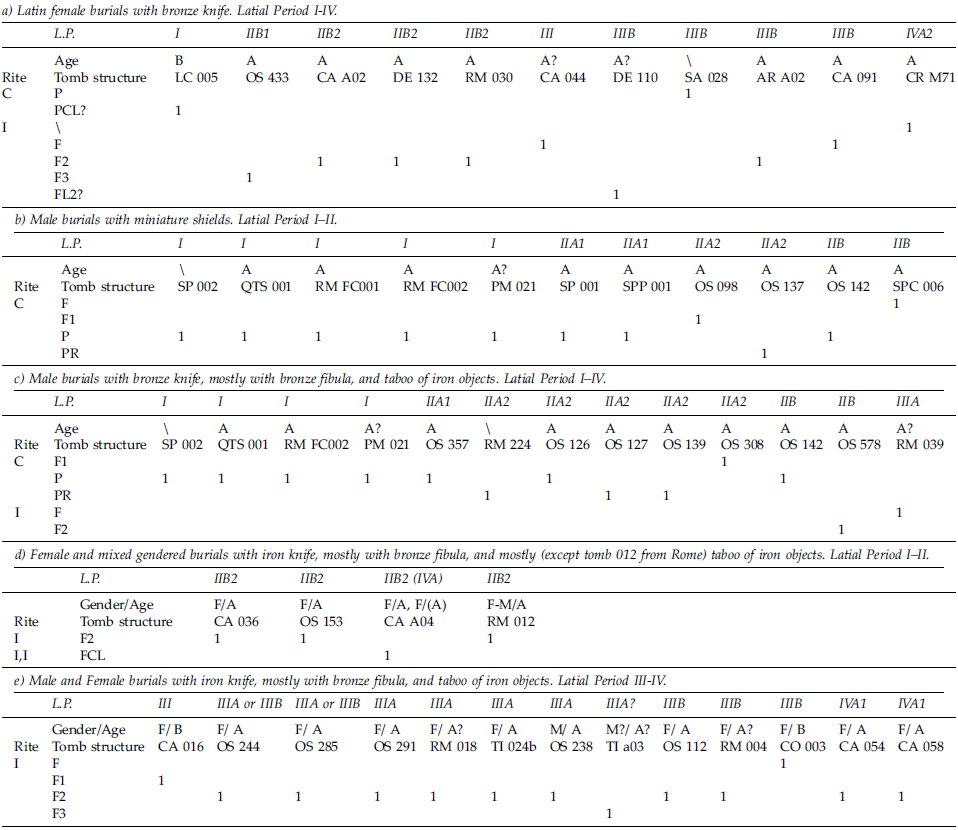
For the sake of conciseness, the composition and associations characterizing each set of grave goods are systematically classified in tables (Tables 2–3, see below), which comprehensively illustrate their structure and organization.
Contexts considered

Table 2 Long description
The table lists tombs with various artifacts and their associations. It has 11 columns: L. P., Tombs, Gender, Age, Bronze knife, Double shields, Round-breast-plate, Helikes, Bronze fibula, Iron fib-ula, Iron knife, Iron sword, Calefattio, and Terracotta figurine. The table contains 77 rows with specific entries for each column. Each row provides detailed information about the tombs and the artifacts found within them.
Tomb Structures.

Table 3 Long description
The table categorizes different burial rites and tomb structures, focusing on age, gender, and period. It is divided into five sections: a) Latin female burials with bronze knives during Latial Period I-IV, b) Male burials with miniature shields during Latial Period I-II, c) Male burials with bronze knives, mostly with bronze fibula, and taboo of iron objects during Latial Period I-IV, d) Female and mixed-gendered burials with iron knives, mostly with bronze fibula, and taboo of iron objects during Latial Period I-II, and e) Male and female burials with iron knives, mostly with bronze fibula, and taboo of iron objects during Latial Period III-IV. Each section lists specific tomb structures, age, and gender/age categories, along with the corresponding Latial Period. The table includes detailed entries for each burial type, specifying the tomb structure and period. Panel a) lists Latin female burials with bronze knives, detailing tomb structures and periods. Panel b) lists male burials with miniature shields, detailing tomb structures and periods. Panel c) lists male burials with bronze knives, detailing tomb structures and periods. Panel d) lists female and mixed-gendered burials with iron knives, detailing tomb structures and periods. Panel e) lists male and female burials with iron knives, detailing tomb structures and periods.
L.P.= Latial Period I–IV. Age: B = Subadult (< 10–12 years); A = Adult (> 10–12 years); Gender: M = Male; F = Female; F-M= Mixed gender; Rite: C = Cremation; I = Inhumation; Tomb structure: P = round pit; PCL = round pit with lithic box/cist; PR = circular pit with a step; F = trench tomb; F1 = trench tomb shorter than 1 m; F2 = trench tomb longer than 1m but shorter than 2 m; F3 = trench tomb longer than 2 m; FL2 = trench with lateral niche (loculus) longer than 1 m shorter than 2 m.
3.1 Male tombs with knives
BRONZE KNIVES – In an effort to identify a group of priestly figures exhibiting characteristics akin to those of the Flamines and Flaminica, we first isolated male and female individuals who were buried with a bronze knife and fibulae, but without iron objects, given the known taboo associated with this metal and this priestly order. Regarding female burials, the results of this selection closely matched individuals from historical periods who displayed attributes and garments similar to those of the Vestal virgins (Table 2). For male burials, the first three cases – Pratica di Mare, tomb 21; Rome, Forum of Caesar, tomb 2; and Santa Palomba, tomb 2; along with Osteria dell’Osa, tomb 142 – had already been distinguished as possessing attributes resembling those of the Salii (Table 2). This is not surprising, as in this pre- and proto-urban phase, religious roles had not yet undergone full differentiation. Within aristocratic families, the same individual could assume multiple ritual functions, suggesting that religious roles had not yet been rigidly defined. Consequently, different religious duties and responsibilities likely shared similar attributes, which only later became specialized and distinct.
The individuals buried in tombs 126 and 142 at Osteria dell’Osa also possessed a terracotta statuette of the type previously associated with the Salii. Additionally, tomb 224 from Rome is exceptional due to its potentially isolated location beneath the House of Livia, within the settlement area: an unusual feature for this period. Overall, these tombs exhibit considerable wealth, containing numerous vases, objects, and weapons. Furthermore, they have hut urns or cinerary lids in a conical shape with an apex, which, according to Anna De Santis and Anna Maria Bietti Sestieri, may symbolize either a soldier’s helmet or the roof of a hut-like dwelling.Footnote 93 Both hut-shaped cinerary urns and conical lids with an apex likely indicate that the individual within was a pater familias of the community.Footnote 94
The only male Latin tomb from Latial Period III containing a bronze knife, a bronze fibula, and no iron objects is tomb 89 from the Esquiline cemetery. This burial also includes a double vase (vaso doppio), which, according to Alessandro Guidi, may have had a ritual or religious function. However, the tomb itself appears incomplete. The individuals preliminarily associated with attributes that would later be characteristic of the Flamines do not exhibit particularly elaborate or monumental tomb structures that distinguish them from typical burials (Table 3c).
IRON KNIVES – Querying the burials containing an iron knife yields further significant results. Only one male burial from the earliest phases of the Iron Age contains an iron knife – Osteria dell’Osa, tomb 39 – although this context is incomplete (Table 2). This is unsurprising, as objects made of this metal are relatively uncommon in the earliest period(s?).
When examining burials from the later phases of Latin culture, we identify two male individuals buried with an iron knife but exhibiting a taboo against other iron objects. The first, an elderly male from Osteria dell’Osa, tomb 238, presents no other particularly notable or distinctive characteristics. The second, tomb Tia03 from Tivoli, is exceptional due to its location within the settlement area.
Among burials featuring an iron knife but a prohibition on other iron objects and resembling individuals displaying attributes suggestive of religious roles or functions, we observe remarkable tomb structures. In earlier periods, these include cremation burials within trenches exceeding 1 m in length, as well as trenches containing lithic slab coffins (Table 3d). In later periods, burial structures continue to include large trenches, occasionally incorporating lithic slabs or coffins (Table 3e).
3.2 Female burials with knives and helikes
WITH BRONZE KNIVES – In order to identify priestly roles among Latin female burials dated between the 10th and 7th c. BCE, the first step was to isolate all female burials containing a knife. Since this object is relatively rare in funerary contexts, it may have had a ritual function. This selection allowed us to identify a homogeneous subset of female burials (Table 2) equipped with a bronze knife, including a specific type characterized by a sinuous blade. This type, referred to in the archaeological literature as the so-called Caracupa-type knife (see Fig. 9d), has already been suggested by M. Torelli to have had a sacral and ritual function.Footnote 95
A detailed analysis of these burials and their associated grave goods reveals that they are all exceptional and particularly rich. Notable examples include tomb 5 from Le Caprine, which is especially remarkable as it belonged to a child of approximately two years of age (Latial Period I), as well as the tombs Osa 433 (Latial Period IIB), Decima 132 (Latial Period IIB), Decima 110 (Latial Period IIIB), and Crustumerium 71 (Latial Period IV).Footnote 96 These burials frequently contain rare objects such as spits (Osa 132, Roma 30, Decima 110) or bronze vessels (Decima 132 and Ardea Colle del Noce 2). In some cases, traces of a veil are also present (Decima 153, possibly Decima 132 and 110; see Fig. 8), which, according to literary sources, was part of the ceremonial attire of both the Vestal virgins and the Flaminicae. Additionally, remnants of cloth have been identified in Osa 433.
The dress of the female deceased of tomb 153 of the necropolis of Castel di Decima. (From Reference Pallottino, Colonna and VillardPallottino et al. 1977, pl. CLIII).

Tomb 2 at the Sanctuary of Colle della Noce in Ardea: a) the context; b) the tomb; c) the pottery; d) metal vases, tools, and ornaments; e) tools and ornaments (including gold). (From AAVV, Ardea: immagini di una ricerca 1983, figs. 40–88.)

Fig. 9 Long description
The image consists of five panels labeled a to e, each depicting different aspects of the archaeological findings from Tomb 2 at the Sanctuary of Colle della Noce in Ardea. Panel A: A detailed diagram showing the layout and context of the tomb. Panel B: A photo of the tomb itself, highlighting the bronze knife and other artifacts. Panel C: A diagram illustrating various pottery items found in the tomb. Panel D: A collection of photos showing metal vases, tools, and ornaments discovered in the tomb. Panel E: A series of photos and diagrams depicting additional tools and ornaments, including gold items.
All selected burials containing knives from Latial Periods I and II, with the exception of Roma 30 (which is incomplete), included bronze spirals (helikes) used as hair adornments. Iconographic sources indicate that these spirals were often part of the seni crines hairstyle mentioned in literary texts (see above). In the later phases (III and IV), only tomb 2 from Ardea contains gold hair spirals (see Fig. 9e), but it should be noted that the other selected burials have only been published in preliminary and incomplete form. Furthermore, hair spirals are not exclusive to these exceptional burials, but also appear in more common burials of younger individuals. As suggested by M. Torelli, these adornments may be associated with the ritual decoration of the nubendae. As noted above, the Vestal virgins were the nubendae par excellence, permanently designated for ritual virginity.Footnote 97
In certain cases, such as Ardea Colle del Noce, tomb 2 (Fig. 9a–b) and Valvisciolo-Caracupa 2, these burials are found in sacred contexts, such as temples (Ardea) or votive deposits (Caracupa) within inhabited areas and within the city walls, areas typically subject to a religious taboo that only the Vestals were permitted to disregard.Footnote 98 The burial structures themselves are generally of rare types and required skilled labor or significant effort to construct. Examples include the lithic cist within a pit in Le Caprine, tomb 5, and the large rectangular trenches (fossae) of other burials from Latial Periods III and IV, which generally exceed 2 m in length (Table 3a, F2)Footnote 99 or, in some cases, extend even further (Table 3a, F3).
WITH IRON KNIVES – Female burials containing an iron knife but lacking other iron objects are numerous in the later phases of the Early Iron Age within the Latial culture. The type and quantity of objects typically suggest an intermediate level of status and wealth. However, should these individuals also be considered as holding a religious role?
Some of these burials appear to reflect exceptional prerogatives. For instance, Tomb 153 at Osteria dell’Osa belongs to a mature woman of relatively high status, while Tomb 36 at Caracupa is remarkable as a double burial, containing a later male interment from Latial Period IVA. Additionally, Tomb A04 at Caracupa, a double tomb with two females, stands out due to its location within the settlement area at Caracupa Valvisciolo: a location typically reserved for Vestals (Table 2). Furthermore, female burials containing iron knives tend to feature more elaborate and/or larger tomb structures than the norm (see Table 3d–e).
Tomb 012 from the Esquiline cemetery in Via Giovanni Lanza is exceptional because it has both weapons (bronze spear and iron sword) and female and male ornaments, a suspension ring and beads but also a bronze drago fibula. This burial, because of the iron sword, ignores the taboo against iron objects. Recent research by one of the authors is emphasizing that these mixed-gender burials are more common than previously thought and that past Bronze and Iron Age societies were not so binary as previously assumed.Footnote 100 However, it is also common that these ambiguous definitions of gender are specific to individuals with religious roles, such as the Galli priests of Republican and Imperial times from the Magna Mater cult, although that came later and from the Near East (see also below with references).
3.3 Tombs with double shields
In the early 1990s, G. Colonna proposed identifying the miniature double shields primarily found in Latin male burials from the Late Bronze Age and the earliest phases of the Early Iron Age as the archaeological precursors of the ancilia of the Salii, previously discussed above. Colonna applied the same interpretation to multiple round shields discovered in Etruscan and Latin burials from the later phases of the Early Iron Age (Fig. 10). These miniature double shields have been documented in tomb 21 at Pratica di Mare (Fig. 10a) and in several burials from the earliest phases of Latin culture, including those at Osteria dell’Osa, Santa Palomba, and the Forum of Caesar (see Table 2). These sites were excavated and analyzed by Anna de Santis and Anna Maria Bietti Sestieri,Footnote 101 who identified the interred individuals as the political and religious leaders of the pre-urban communities of Rome and its neighboring settlements.Footnote 102
a) Tomb 21 from Pratica di Mare and b) Tomb 1036 from Casale del Fosso, Veii. (From Reference ColonnaColonna 1991, reproduced also in Guidi Reference Guidi, Attema, Seubers and Willemsen2016, fig. 2.)

The identification of miniature double shields in tombs 137 and 098 remains uncertain due to their incomplete state. However, tomb 142 at Osa and tomb 6 at Santa Palomba are particularly noteworthy for containing terracotta statuettes. These figurines have been recognized as ritual objects, yet their precise interpretation remains ambiguous. Various hypotheses have been put forward, one suggesting that the statuettes represent the deceased individuals themselves.Footnote 103
In some instances, the statuettes appear to depict figures with breasts, leading to the alternative hypothesis that they symbolize a female deity, possibly engaging in a form of sacred hierogamy with the deceased.Footnote 104 While this interpretation is intriguing and compelling, it remains unproven and may not be universally applicable, given that certain statuettes also exhibit faint indications of phallic attributes. A more plausible approach may be to consider these figures as sexually ambiguous or androgynous, a characteristic often associated with sacred or ritual objects. This notion finds a parallel in the sexual ambiguity of the Gallus priests – or followers (adeptus)Footnote 105 – in the cult of Magna Mater, though that cult emerged later and was likely introduced from the East.Footnote 106
Most burials containing miniature double shields also include spears and swords. Another significant artifact frequently found in male burials, and occasionally in female ones, is a small trapezoidal fused cylinder, often discovered in pairs or trios. This object may have been associated with wooden canes and could have played a sonic role within priestly paraphernalia, foreshadowing a feature later characteristic of the Salii. In the late 8th c. BCE, we also find double shields at full size, in tomb 1036 from Casale del Fosso at Veii (Fig. 10b), probably the tomb of the main chief or even the king of the city, with both political and religious power in his hands (see also conclusions below).
In the case of male burials exhibiting religious attributes similar to those of the historical Salian priests, the tomb structures tend to be exceptional (Table 3b). However, this pattern is not evident in the earliest phases, when burials were generally reserved for society’s highest-ranking individuals, and almost all graves featured extraordinary grave goods and structures. In the later phases of Latial culture, burials containing multiple shields and weapons are commonly associated with chamber tombs, pseudo-chamber tombs, or expansive trenches measuring up to 3-4 m in length, often featuring a lithic slab cist for the deceased and a monumental tumulus covering the grave.
A notable example is the Heroon of Lavinium (Fig. 11), possibly the tomb of a male individual (scattered bones remains were found), adorned with both drago fibulae and arch fibulae, and equipped with shields with pendants, offensive and defensive weapons, a knife, an incense burner, residues of a chariot and horse bridle, some horse bronze decorations, a “Phoenician” wine amphora, and many pottery vases, including symposium and banquet equipment and some imports. This burial, dated by the excavators to 670–660 BCE and by Federica Cordano to 720–710 BCE, is particularly significant as it was reopened in the 6th c. BCE, likely plundered, then subsequently subject to ritual expiation through a libation offering evidenced by the bucchero jug and amphora deposited within the tomb. In the 4th–3rd c. BCE, the site underwent further monumentalization with the erection of a monolithic tuff-carved door. Due to the extensive ritual and architectural activity surrounding the tomb, the structure has been identified as a Heroon, while the original burial is believed to have belonged to the founder of Lavinium, at least in the perception of the community responsible for its construction and veneration.Footnote 107
Heroon of Aeneas at Pratica di Mare, Lavinium: a) plan; b) section (from Reference Carandini and CappelliCarandini and Cappelli 2000); c) Orientalizing slab tuff cist coffin; d) Archaic votive deposit; e) Archaic monument/tumulus with tuff door (from https://www.aeneasroute.org/tour/lavinium, accessed 20 April 2022).

Fig. 11 Long description
Panel A: An illustration showing various ancient shields and artifacts. The shields are depicted with concave sides and composed of a single element. Panel B: A diagram showing a section view of an archaeological site. The diagram includes detailed cross-sections of structures and artifacts. Panel C: A photo of an Orientalizing slab tuff cist coffin. The coffin is made of large stone slabs and is situated in an outdoor setting. Panel D: A photo of an Archaic votive deposit. The deposit includes various pottery items, such as a pitcher and a large vase. Panel E: A diagram showing an Archaic monument or tumulus with a tuff door. The monument is depicted with a detailed plan view, showing the layout and structure of the tumulus.
4 Some concluding remarks
The Romans of historical times were well aware of the great antiquity of their religious institutions, as demonstrated by the etiological explanations offered by authors such as Varro and Festus for the names and origins of ritual garments and instruments associated with the Roman priesthood. To Romans of the Republican and Imperial periods, the major priesthoods likely appeared as tangible and enduring monuments (monumenta), functioning as embodiments and agents of collective memory. Their distinctive attributes served as evocative elements that underscored the ancient roots of these institutions and their ties to Rome’s earliest traditions, thereby endowing them with a deeply sacred character.
This study seeks to explore when and through what mechanisms objects and garments began to constitute the distinctive visual prerogatives of early Roman priests. Figure 12a illustrates how the principal political and religious symbols identified among Latin grave goods were particularly prevalent during Latial Periods I and II. These items include miniature metalwork artifacts such as knives, swords, composite shields, and round breastplates,Footnote 108 as well as ceramic objects like the so-called calefattoio, which appears exclusively in incineration tombs. Other items, such as fibulae and helikes, when associated with these ritual instruments, may be interpreted as components of the ceremonial attire of individuals endowed with religious prerogatives. After Latial Period II, several significant ritual instruments – such as swords, composite shields, and round breastplates – disappear from documented funerary contexts (Fig. 12b). Concurrently, certain items, such as the helikes, exhibit a gradual decline. During this period, objects made from different materials, such as iron knives, begin to appear (Fig. 12a–c).
Distribution of objects with religious and political significance considered in this study in Iron Age and Orientalizing Latial culture tombs: a) general framework; b) male tombs; c) female tombs.

Considering these status indicators in relation to gender, we observe that the disappearance of the most significant male-associated symbols of political and religious prerogatives in Latial Period II coincides with an increasing presence of religious artifacts among female grave goods, particularly in Latial Period III (Fig. 12b–c). The widespread distribution of these instruments in female tombs, as well as their presence in a number of male burials during this period, suggests a shift in the representation of religious symbolism within Latin communities and possibly the emergence of a specialization process regarding roles and functions. Notably, during the same period, some early ritual weapons are documented at full size in the so-called princely tomb – number 1036 – at Veii, Casale del Fosso.Footnote 109 This tomb contained two double composite shields, a bronze kardiophylax, and a staff, which may be identified as the sceptrum used by the Salii to strike their ancilia during ritual dances.Footnote 110 A comparable burial context is found in tomb 21 at Castel di Decima, where probable double shields were also placed atop the deceased.Footnote 111 Similar shields, although information is lacking on their original context, have been discovered at Norchia.Footnote 112 Tomb A from the Casa Nocera necropolis (Casale Marittimo), dated to the early 7th c. BCE, represents another significant example.Footnote 113 This incineration tomb contained a complex assemblage of grave goods inspired by the Homeric model, arranged according to a precise ideological framework reflecting function and meaning. Among the high-status symbols within the tomb were a lituus and a sacrificial knife, the latter closely resembling the secespita described by Antistius Labeo (see above).Footnote 114 Both of these burials have been identified as belonging to royal figures, and in the case of the Casale Marittimo tomb, the presence of a lituus suggests that the deceased held the position of Rex-augur.Footnote 115
In conclusion, some key observations can be made.
-
a) The transition from the Late Bronze Age to the Early Iron Age represents a pivotal period in our understanding of religious practices and ritual features in central Italy. During this time, garments and ritual instruments imbued with religious and political semantic values emerged, reflecting a process of role specialization within a changing social structure. In the same period, significant archaeological evidence of cult activities has been identified.Footnote 116 Funerary contexts suggest a gradual reduction in the widespread use of religious symbols, leading to their concentration among a select few individuals, based on gender and social status. Initially, these items were distributed among a broader segment of the community, sometimes associated with political and military insignia, while in other cases, they appear to have been linked to religious practices associated with domestic and/or biotic domains (see above).Footnote 117
-
b) Latial Period III marks a transformation in religious symbolism and the beginning of a new process of “semantization” within central Italian communities. As funerary practices evolved, early miniature items disappeared. However, the presence of composite shields, specialized knives, and other symbols of religious prerogatives in tombs from Veii-Casale del Fosso (Fig. 10b), Casale Marittimo, and presumably Norchia indicates the persistence of early models into the 8th and early 7th c. BCE. This period appears to have been crucial in the codification of religious symbols and meanings that later characterized early Roman priesthoods, as attested in ancient literary sources and iconographic evidence.Footnote 118 The association of these status symbols with individuals possessing high-ranking political and religious authority (principes/reges) is particularly significant. These figures represent both the culmination of the elaboration of political and religious symbols from Latial Periods I–II and the onset of a new socio-political landscape characterized by greater complexity and more specialized religious roles.
-
c) This phenomenon must be contextualized within the broader transformations affecting settlement patterns and socio-political organization in mid-Tyrrhenian communities during the early stages of urbanization (beginning in Latial Period IIIB1), which we have not studied in this article. In Rome, this shift is reflected in a fundamental reorganization of the settlement, involving the obliteration of older residential and funerary spaces and the construction of new monuments and areas designated for collective religious and socio-political functions.Footnote 119 In at least one case, the destruction of proto-urban huts was directly associated with the foundation of a cultic site in the same location.Footnote 120 Furthermore, archaeological evidence attests to the establishment of new sanctuaries in Rome dedicated to the cults of Vesta and the Lares.Footnote 121 From a regional perspective, Latial Period IV witnessed the foundation of numerous temple-huts at sites across Latium and Etruria, including Ardea, Satricum, Lanuvium, Velletri, Tarquinia, Cerveteri, and Orvieto.Footnote 122
The disappearance of archaeological evidence relating to religious instruments and garments from funerary contexts during Latial Period IV appears to coincide with the final specialization of religious roles and figures, who now functioned primarily within a templar organizational framework. While religious offices continued to be occupied by members of the most prominent families, individual representation and competition within the funerary sphere became less relevant in comparison to civic competition expressed through monumental architecture and the collective performance of ritual practices, which served to reinforce civic identity and individual citizenship.Footnote 123
Appendix 1. Tombs bibliography








 Open access

