


Equol (EQ) is a metabolite produced by intestinal bacteria through the chemical reduction of the soya isoflavone (IFL) daidzein (DE)(Reference Setchell, Borriello and Hulme1, Reference Franke, Halm, Kakazu and Fraga2) and has been hypothesised to play an important role in the health benefits observed from soya or IFL consumption(Reference Setchell and Clerici3). These benefits include protection against breast, prostate, lung and colorectal cancer, osteoporosis and cardiovascular disorders, as well as alleviation from menopausal symptoms(Reference Yan and Spitznagel4–Reference Trock, Hilakivi-Clarke and Clarke11). Recent epidemiological studies have provided strong evidence about the protective effect of soya or IFL exposure against breast cancer in the adulthood(Reference Goodman, Shvetsov and Wilkens10, Reference Zheng, Dai and Custer12, Reference Chen, Zheng and Custer13), particularly when exposure occurs at an early age(Reference Thanos, Cotterchio and Boucher14–Reference Lee, Shu and Li18); however, the role of EQ in this respect remains uncertain.
The prevalence of EQ producers (EP) has been estimated to be 30–35 % in Western populations(Reference Lampe, Karr and Hutchins19–Reference Morton, Wilcox and Wahlqvist21) and up to 60 % in vegetarians(Reference Setchell and Cole22) or Asians(Reference Akaza, Miyanaga and Takashima23). However, it is widely debated as to whether the ability to produce EQ is stable over time and results necessarily in favourable health outcomes(Reference Franke, Halm and Ashburn24–Reference Atkinson, Frankenfeld and Lampe26). Previous studies have indicated that EQ production is stable not in all, but only ‘in most individuals over 1–3 years’(Reference Frankenfeld, Atkinson and Thomas27), or only ‘over 1 year’(Reference Nagata, Ueno and Uchiyama28, Reference Wu, Oka and Ezaki29), or ‘in 85 % of individuals over 1·5 years’(Reference Akaza, Miyanaga and Takashima23).
Diet has been suggested to influence an individual's ability to produce EQ(Reference Lampe, Karr and Hutchins19, Reference Rowland, Wiseman and Sanders20, Reference Hedlund, Maroni and Ferucci30, Reference Miyanaga, Akaza and Takashima31); however, this could not be confirmed(Reference Setchell and Cole22, Reference Hutchins, Slavin and Lampe32–Reference Lampe, Skor and Li37). Recently, we observed a relatively high prevalence (up to 35 %) of postmenopausal women who became EP (crossers (CR)+) in a well-controlled intervention study with isolated soya protein containing a daily IFL dose of approximately 90 mg(Reference Franke, Lai and Halm38). Unexpectedly, more CR+ occurred in the placebo group exposed to soya foods from the habitual diet v. the treatment group exposed to soya protein.
In the present study, we aimed to evaluate the role of soya food consumption and a reduced IFL dose on EP status by determining the consistency of urinary EQ excretion over time in a cohort of pre-menopausal women challenged with a high-soya and a low-soya diet each for 6 months, separated by a 1-month washout period, in a cross-over design intervention. To maintain consistency and facilitate comparison with our previous study, determination of EP status was performed using a urinary EQ:DE ratio of 0·018 in combination with a DE excretion threshold (2 or 5 nmol/mg creatinine) or an absolute urinary EQ excretion (0·5 or 1·0 nmol/mg creatinine).
Methods
Study design
The Breast, Estrogens and Nutrition (BEAN) study was a randomised, 2 × 6-month cross-over soya trial with a 1-month washout period; all details have been reported previously(Reference Maskarinec, Morimoto and Conroy39). Briefly, ninety-six pre-menopausal women (aged 18–50 years) who consumed five or fewer servings of soya per week completed diet and anthropometric questionnaires followed by randomisation into two groups: group A (n 48) began the study with high soya consumption and, following the 1-month washout, switched over to low soya consumption, whereas the order of diets was reversed in group B (n 48). During the high-soya diet period, participants added two servings of selected soya foods per d to their regular diet, which approximated to 50 mg IFL(Reference Franke, Hankin and Yu40), an amount comparable with daily intakes reported for some Asian countries(Reference Messina, Nagata and Wu41). All soya foods were provided to the participants at the beginning and middle of the high-soya diet period. There was no restriction on further soya food consumption during the high-soya diet period and no time regimen on daily soya food consumption was imposed. During the low-soya diet period, participants maintained their usual diet but were asked to limit their soya intake to less than three servings per week and consume no soya-containing supplements. A total of eight overnight urine (OU) specimens (at months 1, 3, 6, 8, 10 and 13 plus at baseline and washout) were collected during the study and used for the present analyses. For these OU specimens, subjects voided their bladders before retiring to bed, and then collected urine during the entire night including the first morning void. All except two urine specimens were delivered to the laboratory on the morning of the last collection and were immediately processed followed by storage at − 80°C until analysis. The two urine specimens not delivered were sent by mail; these samples consisted of only morning urine.
Adherence to the study regimen was assessed by urinary IFL analyses and several unannounced telephone 24 h dietary recalls during each diet period. Compliance was defined as consuming >40 and < 10 mg IFL during the high-soya and low-soya diet periods, respectively. Before cessation of the study, fourteen women (15 %) dropped out. Of the remaining eighty-two individuals, seventy-nine provided a complete set of the six OU specimens relevant to the study periods (those collections without baseline and washout samples), which were subsequently used for IFL analyses. For comparisons between the high-soya and low-soya diets, only six OU specimens were considered, as baseline and washout time periods were deemed invalid for evaluating differences in EQ status. The present study was conducted according to the guidelines laid down in the Declaration of Helsinki and all procedures involving human subjects were approved by the Committee on Human Subjects at the University of Hawaii and by the participating clinics. All participants signed an informed consent form. A Data Safety Monitoring Committee annually reviewed study progress, reasons for dropouts and any reported symptoms.
Biochemical analyses
Urinary creatinine concentrations were measured using a Roche-Cobas MiraPlus Chemistry autoanalyser (Roche Diagnostics Corporation, Indianapolis, IN, USA). DE, EQ, genistein and O-desmethylangolensin levels were analysed by liquid chromatography tandem MS as detailed previously(Reference Franke, Halm and Kakazu42). IFL excretion is expressed as nmol/mg creatinine to convert OU concentrations to an excretion value and to adequately adjust for variable urine volume.
Statistical analysis
As proposed in our previous study(Reference Franke, Lai and Halm38), determination of EQ status in OU was performed using four different methods based on previous suggestions in the literature, which included using a relative EQ:DE cut-off ratio of 0·018(Reference Setchell and Cole22) but – as detailed previously – with a DE threshold exceeding either 2 or 5 nmol/mg creatinine (hereafter referred to as EQ:DE 2 or EQ:DE 5, respectively). Thus, the EQ:DE cut-off ratio to define EP v. non-producer (NP) was only considered among subjects who reached the given DE threshold. Alternatively, EQ status was also determined using absolute EQ concentration cut-off points of either 0·5 or 1·0 nmol/mg creatinine (hereafter referred to as EQ 0·5 or EQ 1·0, respectively), which are cut-off points used variably in the literature(Reference Nagata, Ueno and Uchiyama28, Reference Hutchins, Slavin and Lampe32). Individuals whose OU concentrations remained above or below the cut-off points for all six OU measurements during the BEAN study were defined as either EP or NP, respectively. Individuals who changed between EP and NP status were defined as CR and, within this CR group, those switching over from NP to EP status were defined as CR+, while those switching in the opposite direction were defined as CR − . The SAS statistical package (SAS Institute, Cary, NC, USA) was used for analysis.
Results
Of the ninety-six women who entered the study, we included data for seventy-nine after excluding those who dropped out (n 14) or had incomplete OU collections (n 3). Table 1 shows the absolute number and percentage of EP, NP and CR for these seventy-nine individuals during the high-soya and low-soya diet periods after each of the relative (EQ:DE 2, EQ:DE 5) and absolute (EQ 0·5, EQ 1·0) cut-off points were applied. Using the relative cut-off points (which included a DE threshold), we observed 23–24 % EP during the high-soya diet and 9–19 % EP during the low-soya diet. When the absolute cut-off points were applied (no DE threshold), we observed a similar proportion of EP during the high-soya diet (16–22 %) but much fewer EP (3–4 %) during the low-soya diet. The percentage of CR was higher (10–18 %) and the percentage of NP was lower (65–67 %) during the high-soya diet compared with the low-soya diet (6–11 and 75–86 % for CR and NP, respectively) among all EQ status cut-off points.
Equol (EQ) producers (EP), EQ non-producers (NP), crossers (CR)* and all subjects in the high-soya and low-soya diet periods using different EQ cut-off methods†

DE, daidzein.
* Changing from EP to NP, or vice versa.
† Subjects considered only if they provided a complete set of six overnight urine specimens for the relevant data point during the study.
‡ Cut-off method for EP status: EQ:DE 2, ratio of EQ:DE ≥ 0·018 and DE threshold of ≥ 2 nmol/mg creatinine; EQ:DE 5, ratio of EQ:DE ≥ 0·018 and DE threshold of ≥ 5 nmol/mg creatinine; EQ 0·5, EQ excretion of ≥ 0·5 nmol/mg creatinine; EQ 1·0, EQ excretion of ≥ 1·0 nmol/mg creatinine. Sum of percentage of EP, NP and CR within each cut-off method may deviate from 100 due to rounding.
§ Relative to total n within each EQ cut-off method.
CR status was determined very consistently between the four EQ status classification methods during both the low-soya diet (concordance 0·93–1·00, overall reliability 0·99; Table 2) and the high-soya diet (concordance 0·96–1·00, overall reliability 1·00; Table 2). During the low-soya and high-soya diet periods, crossings occurred an average of 1·2 times per CR and were similarly distributed between CR+ and CR − (data not shown). EQ status changed seven to seventeen times during the high-soya diet depending on which cut-off point was applied and ten to eleven times during the low-soya diet when the absolute cut-off points were applied. When the relative cut-off ratios (EQ:DE) were used during the low-soya diet, only one crossing (CR+) was observed (data shown in part in Table 1).
Concordance between equol (EQ) cut-off points for crosser classification in the high-soya and low-soya diet periods*
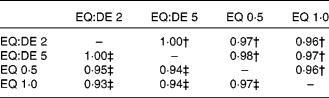
DE, daidzein; for cut-off abbreviations, see Table 1.
* Intra-class correlation (overall reliability) for high-soya (1·00) and low-soya (0·99) using all six relevant collection.
† For the high-soya diet period.
‡ For the low-soya diet period.
When comparing the low-soya with the high-soya diet period using the EQ:DE 2 cut-off ratio, we identified thirteen women who retained the same EQ status during both diet periods: eleven maintained NP status and two maintained EP status. Additionally, we identified two women who changed EQ status not only within one of the diet periods but also between these periods: one woman was a CR+ in the low-soya period and an EP in the high-soya period, while the other woman was CR+ in the high-soya period and an EP in the low-soya period (data not shown). When considering both diet periods, we found fifteen EP (20 %), forty-nine NP (65 %) and twelve CR (16 %; 3CR+, 5CR − , and four women crossing more than once; data not shown).
No significant changes in mean EQ production over time (P>0·30) were observed during the low-soya diet period; however, we observed significant decreases (P < 0·01) in mean EQ production during the high-soya period, irrespective of which EQ status cut-off was applied (data not shown).
Discussion
Over recent years, considerable attention has centred on EQ production strictly on the basis of whether individuals produce or not produce EQ. However, little interest has focused on individuals capable of changing EP status over time. Consequently, EQ production has been viewed as a relatively stable phenomenon(Reference Wu, Wan and Hankin17, Reference Akaza, Miyanaga and Takashima23, Reference Frankenfeld, Atkinson and Thomas27, Reference Nettleton, Greany and Thomas43), with four reports even proposing that individuals are unable to change EP phenotypes(Reference Lampe, Skor and Li37, Reference Nettleton, Greany and Thomas43–Reference Vedrine, Mathey and Morand45).
Findings from the present study and a few others(Reference Frankenfeld, Atkinson and Thomas27, Reference Franke, Lai and Halm38, Reference Ko, Tsai and Lin46), anecdotally in Halm et al. (Reference Halm, Franke and Ashburn47) and undiscussed in Lu et al. (Reference Lu, Lin and Grady48), however, seem to challenge this view. In a study by Frankenfeld et al. (Reference Frankenfeld, Atkinson and Thomas27), 11 % of subjects were found to change EP status from a NP to an EP, while 8 % changed in the opposite direction. Similarly, Lu et al. (Reference Lu, Lin and Grady48) observed NP to EP changes in three of their six volunteers after chronic soya milk ingestion, and Ko et al. (Reference Ko, Tsai and Lin46) reported that eight of twenty NP converted to EP after twice-weekly consumption of soya milk for 16 weeks. Equally, we reported changes in EP status over time from anecdotal evidence in a previous report(Reference Halm, Franke and Ashburn47) and also very recently from a well-controlled 2·5-year soya intervention study with 350 postmenopausal women(Reference Franke, Lai and Halm38). In the latter study, we observed a relatively high proportion of individuals (up to 35 %) who were CR (either CR+ or CR − ). These EP status changes were unexpectedly not associated with antibiotic use, except for selected groups when antibiotic use correlated with CR+. These findings(Reference Franke, Lai and Halm38) are comparable with those in the present study where 6 and 11 % CR were found during the low-soya and high-soya diet periods, respectively, and where EP status was evaluated using the same matrix (OU) and the same EP status cut-off definitions.
Previous studies have suggested an uncertain role of diet on EQ production; some reports have claimed that diet influences an individual's ability to produce EQ while conflicting findings exist from observational and feeding studies. In two studies, it has been reported that long-term and repeated soya ingestion could convert NP to EP(Reference Ko, Tsai and Lin46, Reference Lu, Lin and Grady48), while four others stated otherwise(Reference Lampe, Skor and Li37, Reference Nettleton, Greany and Thomas43–Reference Vedrine, Mathey and Morand45). Another study has even proposed that ‘once an EP, always an EP’(Reference Setchell, Faughnan and Avades49). Furthermore, Frankenfeld et al. (Reference Frankenfeld, Atkinson and Thomas27) found no apparent association between diet and changes in EQ production when comparing EP status among the same individuals 1–3 years apart. Discrepancies among these findings may, in part, be related to factors such as small sample size(Reference Setchell, Borriello and Hulme1, Reference Lu, Lin and Grady48), matrix differences (faeces v. serum/plasma v. urine), study design and duration(Reference Frankenfeld, Atkinson and Thomas27, Reference Hedlund, Maroni and Ferucci30, Reference Miyanaga, Akaza and Takashima31, Reference Ozasa, Nakao and Watanabe35, Reference Lampe, Skor and Li37), differences in defining EP(Reference Setchell and Cole22, Reference Akaza, Miyanaga and Takashima23, Reference Nagata, Ueno and Uchiyama28, Reference Wu, Oka and Ezaki29, Reference Miyanaga, Akaza and Takashima31–Reference Frankenfeld, Atkinson and Thomas33, Reference Lampe, Skor and Li37, Reference Bonorden, Greany and Wangen44, Reference Kelly, Nelson and Waring50), and/or type and form of soya foods consumed(Reference Hutchins, Slavin and Lampe32, Reference Bonorden, Greany and Wangen44, Reference Coward, Barnes and Setchell51, Reference Xu, Wang and Murphy52).
Our most recent findings from a well-controlled soya protein intervention study(Reference Franke, Lai and Halm38) led to the hypothesis that changes in EP status may have been attributable to differences in absolute IFL exposure and/or dietary intake. While the placebo group in that study was exposed to relatively low levels of IFL owing to their habitual diet (e.g. native and/or natural soya foods), the treatment group consumed approximately 90 mg IFL during the study period; an amount almost twice the daily intake reported by Asians(Reference Messina, Nagata and Wu41), about 7·5 times the median intake by Asian-Americans(Reference Wu, Wan and Hankin17) and about 30–90 times the average intake of Americans(Reference Chun, Chung and Song53). It was, therefore, of interest to evaluate the role of native soya foods presented at physiologically relevant levels of intake on EP status. To maintain consistency with our previous study, we utilised the same EP status definitions (see the Methods section) to facilitate accurate comparisons between studies.
Previously, the cut-off points to determine EP status and the matrices used for EP analyses have varied markedly across studies. EP cut-off points, such as serum EQ concentrations above the lower limits of the detection system(Reference Akaza, Miyanaga and Takashima23), the ability to convert DE to EQ in faeces after 96 h incubation(Reference Wu, Oka and Higuchi54), >10 % conversion of DE into EQ in faeces(Reference Wu, Oka and Ezaki29), or, in urine, EQ concentrations >0·182 nmol/ml(Reference Frankenfeld, Atkinson and Thomas33), >0·68 nmol/ml(Reference Liu, Qin and Liu55), >1 mg/ml(Reference Lampe, Skor and Li37), >900 nmol/24 h(Reference Bonorden, Greany and Wangen44), DE thresholds >10 nmol/mg creatinine(Reference Nagata, Ueno and Uchiyama28) or use of a log-transformed urinary EQ:DE ratio of − 1·75, absolute ratio of 0·018(Reference Setchell and Cole22), have made the comparisons of the percentage of EP across studies difficult, if not impossible. Inter-study comparisons are further complicated when arbitrary thresholds are used to distinguish a ‘good’ or ‘high’ EQ excretor from a ‘poor/low’ or ‘non’-EQ excretor because some individuals may inevitably fall into an intermediary position, as suggested previously(Reference Setchell and Cole22). Using various EP cut-offs may be especially problematic when defining EP status ‘changes’ (e.g. identifying CR), as EP cut-offs set very low (e.g. using the limits of the detection system) would theoretically and erroneously lead to a greater prevalence of CR than when EQ cut-offs are set higher. For consistency, it is, therefore, necessary to standardise the EP cut-off method. Moreover, using urine as the matrix for that purpose is most attractive, as urine integrates changes over time and obtains an accurate measure of overall IFL exposure. Use of blood as the matrix for EP classification is less informative than urine and may lead to erroneous results due to the fast elimination of EQ and the differences in elimination half-lives between DE and EQ, as discussed in detail previously(Reference Franke, Lai and Halm38).
A definition for EQ status in urine has recently been proposed and is based on the product:precursor ratio (i.e. EQ:DE ratio) in order to account for variable IFL intake(Reference Setchell and Cole22). Using a ratio in urine is advantageous, as concentrations can be used directly without the need to convert to excretion values(Reference Franke, Lai and Halm38). In our previous study(Reference Franke, Lai and Halm38), we refined the product:precursor definition by including a DE threshold with a value of 2 nmol/mg creatinine (e.g. EQ:DE 2). Doing so assured sufficient substrate exposure and produced a reliable product:precursor measurement and calculation, which resulted in a more robust and dependable method of classifying EP status. This refined method of classifying EP status also avoided erroneous findings that may have resulted from external EQ exposure such as cows' milk (products) or EQ supplements(Reference Franke, Lai and Halm38).
Using the EQ:DE 2 cut-off ratio to define EQ status – notwithstanding differences in soya type, soya dose and study duration – we found 6–11 % CR in the present study of pre-menopausal women consuming native soya foods and 14–35 % CR in our previous study of postmenopausal women consuming soya protein isolate(Reference Franke, Lai and Halm38). The lower prevalence of CR in the present v. our previous study may be due to the much shorter study duration (6 v. 30 months, respectively) and/or because CR between diet periods were not considered in these numbers (as also shown in Table 1).
The cross-over design of the present study allowed comparisons between the low- and high-soya diet periods. Using the EQ:DE 2 cut-off ratio, sixteen women reached the DE threshold during the low-soya diet period (Table 1) but only fifteen of these sixteen women reached the DE threshold also during the high-soya period. Of these fifteen women, two (13 %) changed EQ status between the two diet periods from EP to CR+; one woman during the low-soya to the high-soya diet transition and the other woman during the high-soya to the low-soya diet transition. Consequently, for these two women, being CR+ in one diet period meant that they not only changed EP status between but also within the diet periods. Moreover, one woman was identified as both a CR+ and CR − during the high-soya period. Considering the two diet periods of the present study and including crossings between and within the diet periods, we identified altogether 16 % CR. This is higher than the percentage of CR shown in Table 1, which displays crossings exclusively within each diet period. This indicates that the IFL dose plays an uncertain role in EQ status. Consequently, other factors need to be considered as causes for EQ status changes. These findings merit consideration when evaluating the health benefits and effects of soya and/or IFL consumption.
There are a number of strengths of the present study, which include the following: relatively large number of participants, relatively long study duration, multiple sample collection and measurements, use of a cross-over design (which reduces the effect of confounding covariates as individuals served as their controls), use of a free-living homogeneous cohort of pre-menopausal women, utilisation of the OU matrix (which helps to ensure both integration of time for IFL accumulation and high compliance), measurement of IFL using state-of-the-art liquid chromatography tandem MS methodology, and use of the EQ:DE 2 as a method to determine EP status, which confirms the presence of CR that could be directly compared with the findings from our previous study. However, the present study with pre-menopausal women precludes generalisation of our findings to other populations such as males and non-healthy females. Thus, such populations require further investigation. Nonetheless, this is the first study to examine EP status in a large cross-over design trial using native soya foods presented at physiologically relevant IFL levels of intake, thus representing a more realistic scenario than previous studies using supra-nutritional or pharmacological IFL doses. Additionally, assignment of EP status was determined using OU and a newly proposed robust method of defining EQ status, two factors which facilitated a direct comparison and confirmation with our recently published study using postmenopausal women(Reference Franke, Lai and Halm38). EP definitions have varied and continue to vary tremendously across studies. Therefore, we suggest using one EP cut-off definition across studies, preferably the one we present here and previously(Reference Franke, Lai and Halm38), as doing so allows unambiguous comparisons regarding EQ production between studies. Lastly, from the present findings, we conclude that a single measurement point may not be sufficient to evaluate EQ status.
In summary, we observed 19 and 24 % EP in our population of seventy-nine pre-menopausal women who underwent a 6-month low-soya and a 6-month high-soya diet, respectively, using a EQ:DE ratio of 0·018 with a DE threshold of 2 nmol/mg creatinine (EQ:DE 2), which we conclude to be a most robust method to define EP status. Notably, using this method, we found that 6–11 % of our participants changed EP status within the duration of each study period while 16 % changed between the two study periods when consuming physiologically relevant IFL levels of intake; a finding which concurs with our previous study in postmenopausal women (14–35 % CR) and challenges the widely held belief that EQ production remains stable over time. However, the precise factors that contribute to changes in EQ status, to date, remain elusive and warrant further investigation.
Acknowledgements
We thank Laurie Custer (University of Hawaii Cancer Center) for the skilful performance of the liquid chromatography tandem MS assays. This study was supported by the National Institutes for Health, the National Center for Research Resources (S10-RR020890) and the National Cancer Institute (R01 CA 80843 and P30 CA 717890). A. A. F. had the overall lead of the study and, together with J. F. L., wrote the manuscript. I. P. and Y. M. performed the statistical analyses. G. M. designed the original BEAN study and was involved in the editing of the manuscript. None of the authors has any conflict of interest.



