





Introduction
The commercialization of florpyrauxifen-benzyl in 2018 for use on rice was followed by complaints of off-target movement to soybean, varying levels of rice tolerance, and difficulty controlling some barnyardgrass biotypes (Beesinger et al. Reference Beesinger, Norsworthy, Butts and Roberts2022; Wright et al. Reference Wright, Norsworthy, Roberts, Scott, Hardke and Gbur2020). Florpyrauxifen-benzyl is a synthetic auxin herbicide (categorized as a Group 4 herbicide by the Herbicide Resistance Action Committee and Weed Science Society of America)] labeled at 30 g ai ha−1 for use on rice, mostly applied at the preflood or postflood timing for control of an array of weeds, including barnyardgrass, broadleaf signalgrass [Urochloa platyphylla (Munro ex C. Wright) R.D. Webster], Amazon sprangletop [Diplachne panicoides (J. Presl.) McNeil], large crabgrass [Digitaria sanguinalis (L.) Scop.], northern jointvetch [Aeschynomene verginica (L.) Britton, Sterns & Poggenb.], hemp sesbania, pitted morningglory (Ipomoea lacunosa L.), Palmer amaranth (Amaranthus palmeri S. Watson), yellow nutsedge, rice flatsedge (Cyperus iria L.), and smallflower umbrella sedge (Cyperus difformis L.) (Anonymous 2018; Miller and Norsworthy Reference Miller and Norsworthy2018a). Some biotypes of barnyardgrass have been identified as being tolerant to florpyrauxifen-benzyl and are better controlled by applying multiple residual herbicides or herbicides with multiple sites of action (Barber et al. Reference Barber, Butts, Boyd, Cunningham, Selden, Norsworthy, Burgos and Bertucci2022; Hwang et al. Reference Hwang, Norsworthy, Gonzalez-Torralva, Piveta, Priess, Barber and Butts2022; Takano et al. Reference Takano, Greenwalt, Ouse, Zielinshi and Schmitzer2023).
Generally, most pure-line, long-grain rice cultivars are more tolerant to florpyrauxifen-benzyl than hybrid, long-grain cultivars (Wright et al. Reference Wright, Norsworthy, Roberts, Scott, Hardke and Gbur2020). Rice injury from florpyrauxifen-benzyl has been linked to environmental factors such as soil moisture, air temperature, and light intensity, with certain cultivars being better able to tolerate the herbicide than others (Beesinger et al. Reference Beesinger, Norsworthy, Butts and Roberts2022; Wright et al. Reference Wright, Norsworthy, Roberts, Scott, Hardke and Gbur2020). Butts et al. (Reference Butts, Kouame, Norsworthy and Barber2022a) also determined that florpyrauxifen-benzyl off-target movement was a concern among growers and consultants. When comparing multiple row crops, soybean was the most sensitive to florpyrauxifen-benzyl, exemplifying the increased likelihood of injury following an off-target movement event when rice and soybean are grown nearby (Butts et al. Reference Butts, Fritz, Kouame, Norsworthy, Barber, Ross, Lorenz, Thrash, Bateman and Adamczyk2022b; Miller and Norsworthy Reference Miller and Norsworthy2018b). With the off-target movement of florpyrauxifen-benzyl and varying rice tolerance being the main concerns for applying the herbicide, it became necessary to develop a safer alternative application method for industry professionals and researchers to continue supporting the continued use of florpyrauxifen-benzyl.
Rice is an economically important crop in Arkansas, accounting for 480,800 ha and an annual value of US$1.2 billion (USDA-ERS 2022; USDA-NASS 2022). However, rice requires more intensive management than other Arkansas row crops, and additional expenses for herbicide applications and water management. Rice is typically grown in flood-irrigated paddies. However, incorporating an alternative irrigation system that uses furrows and polyethylene pipes to irrigate rice has become increasingly common in Arkansas (Hardke Reference Hardke2021). However, flood-irrigated rice still accounts for most of the rice grown in the state, with more than 80% of rice hectares being flood-irrigated in 2021 (Hardke Reference Hardke2021). Once the rice is established and reaches the 5-leaf growth stage, a 5- to 7.5-cm flood depth produces an environment in which rice, along with aquatic and semiaquatic weeds, can flourish, creating additional challenges for weed control (Henry et al. Reference Henry, Daniels, Hamilton and Hardke2018; Smith Reference Smith1988). In this flooded culture, barnyardgrass and Cyperus species [rice flatsedge, yellow nutsedge, smallflower umbrella sedge, and white-margined flatsedge (C. flavicomus Michx.)] were ranked as the most problematic weeds of Arkansas rice (Butts et al. Reference Butts, Kouame, Norsworthy and Barber2022a). A spray application of florpyrauxifen-benzyl effectively controls most of these weeds (Miller and Norsworthy Reference Miller and Norsworthy2018a), albeit a safer application for minimizing off-target movement of the herbicide may be through coating it onto urea particles because urea may have a lower likelihood to move off target than water droplets. Unfortunately, the effectiveness of florpyrauxifen-benzyl coated onto urea relative to a spray application of the herbicide is unknown.
Fertilizers have been previously evaluated as herbicide carriers for weed control in crops. Kells and Meggett (Reference Kells and Meggitt1985) observed more uniform herbicide coverage in conservation tillage systems from coating herbicides onto granular fertilizer, thereby improving crop canopy and plant residue penetration. However, concerns over decreased precision and accuracy of applications that could lead to increased crop injury or decreased weed control come with this application method (Wells and Green Reference Wells and Green1991). Generally, reduced coverage is a potential concern of using fertilizer as a herbicide carrier compared to liquid sprays. However, coating bensulfuron onto fertilizer proved to be an effective method for controlling ducksalad [Heteranthera limosa (Sw.) Willd.] but less effective on difficult-to-control weeds such as junglerice [Echinochloa colona (L.) Link] (Braverman Reference Braverman1995). Factors surrounding applications such as timing and other events, should also be evaluated when analyzing alternative application methods. This application method will likely also require timely interaction of the coated urea with floodwater to allow the herbicide to turn into a solution to be active. Florpyrauxifen-benzyl is not expected to be active in the soil because it is immobile in the soil (APVMA 2018).
Urea (46-0-0) is a nitrogen fertilizer that could be used as a carrier for florpyrauxifen-benzyl on rice crops because it is applied to most fields before flood establishment. Currently, a single preflood application of urea is one of two options for fertilizing rice in which 100% of the season’s total nitrogen requirement is applied at the preflood timing and would be an optimal time to coat florpyrauxifen-benzyl onto urea prills (Hardke and Mazznati Reference Hardke and Mazzanti2022). Florpyrauxifen-benzyl at a rate of 30 g ai ha−1 is recommended to coat a minimum of 112 kg ha−1 of fertilizer (Anonymous 2021). However, urea is prone to losing ammonia via volatilization when not coated with a urease inhibitor or if the field is not promptly flooded based on soil texture and pH (Norman et al. Reference Norman, Wilson, Slaton, Griggs, Bushong and Gbur2009). Flood timing can also influence weed control and crop tolerance to herbicides. For example, a preflood application of penoxsulam to rice was more injurious to the crop when flooded 1 and 7 d after treatment (DAT) than when flooded 14 DAT, because flooding soon after herbicide application increases the herbicide availability (Willingham et al. Reference Willingham, McCauley, Senseman, Chandler, Richburg, Lassiter and Mann2008). Additionally, the flood must be established within 7 DAT following an imazethapyr application to achieve at least 95% control of red rice (Oryza sativa L.) because an early flood is vital for enhancing the herbicide activity of imazethapyr (Avila et al. Reference Avila, Senseman, McCauley, Chandler and O’Barr2005). Hence, finding the right amount of time between herbicide application and flood establishment is important for providing adequate weed control while reducing the risk for crop injury.
One key to rice water management success is to maintain a continuous flood for the entire season (Henry et al. Reference Henry, Daniels, Hamilton and Hardke2018). However, extenuating circumstances such as rice injury, nutrient deficiencies, or a levee failure may cause the floodwater to be relinquished. Likewise, the effect of flood loss and its impact on preflood applications of florpyrauxifen-benzyl are unknown. Under greenhouse conditions, a flood loss of 2 cm per day after applying ipfencarbazone resulted in a comparable dry shoot weight of Echinochloa species compared to no flood loss, which explains that a small amount of flood loss equated to little herbicide loss or reduction in efficacy (Kasahara et al. Reference Kasahara, Takeuchi, Koyama and Kuzuma2018). However, a flood loss in a commercial rice field would likely lead to large amounts of water being lost and potentially losing any herbicide that might have been applied depending on the route of water loss. Moreover, the parent compound, florpyrauxifen-benzyl, has a half-life of <3 d under anaerobic conditions, with the main source of degradation being aqueous photolysis in shallow waters such as those in flooded rice and hydrolysis being a second, slower source of degradation (Anonymous 2019). However, the acid metabolite of florpyrauxifen-benzyl degrades much more slowly than the parent compound with a half-life of 6.3 to 18 d (Anonymous 2019). With a short half-life, reduced weed control could be expected when flood loss occurs closer to the florpyrauxifen-benzyl application.
Limited research has been conducted in recent years on coating fertilizers with herbicides, especially florpyrauxifen-benzyl, as an alternative application method. Additionally, there is a lack of literature describing the impact of time until flood establishment and flood loss effects on florpyrauxifen-benzyl effectiveness. Hence, an experiment was conducted to assess the effectiveness of florpyrauxifen-benzyl as influenced by flood establishment timing after application with the herbicide applied to urea prills or pellets, or as a spray. An additional experiment was conducted to examine the influence of flood loss timing after establishment on the effectiveness of florpyrauxifen-benzyl coated on urea.
Materials and Methods
Flood Timing Experiment
An experiment on flood establishment timing following spray-applied and fertilizer-applied florpyrauxifen-benzyl was conducted at the Pine Tree Research Station (PTRS) near Colt, Arkansas, in 2020 and 2021. In both years, the soil texture was a Calloway silt loam, consisting of 0.7% sand, 83% silt, and 16.3% clay, with 2.3% organic matter, pH 7.7. Plot sizes were 1.8 m by 5.2 m with a 1-m alley between replications. The previous crop was rice, and the seedbed was prepared using conventional tillage. A quizalofop-resistant rice cultivar ‘PVL01’ (Provisia®; BASF, Florham Park, NJ) was drill-seeded (Hege Company, Waldenburg, Germany) in nine rows with 19-cm row spacings at a 1.3-cm depth on May 5, 2020, and May 14, 2021, at 72 seeds per meter row. Clomazone (Command 3ME; FMC, Philadelphia, PA) at 168 g ae ha−1, one-half of the recommended rate, was applied across the entire experiment immediately after rice planting to provide early-season weed control during rice establishment. The lower-than-labeled rate of clomazone was intended to provide some early-season weed suppression yet allow for enough weeds to evaluate the effectiveness of the florpyrauxifen-benzyl treatments.
The experiment was conducted as a randomized complete block design with a factorial arrangement of treatments and four replications. Nontreated plots were included in the study to provide a representation of herbicide-free check but excluded from statistical analysis. The two factors included the number of days until flood establishment (0, 5, and 10 d after herbicide treatment) and florpyrauxifen-benzyl (Loyant™; Corteva Agrisciences, Indianapolis, IN) application method (spray applied or coated onto urea). Florpyrauxifen-benzyl applications were initiated when the weeds at the 10-d preflood timing had reached approximately 8 cm in height. Florpyrauxifen-benzyl at 30 g ai ha−1 was applied as a liquid spray that included 0.58 L ha−1 of methylated seed oil or coated onto urea. Urea was applied at 317 kg ha−1, either with or without the herbicide at each florpyrauxifen-benzyl timing. Sprays were applied using a CO2-pressurized backpack sprayer calibrated to deliver 140 L ha−1 with a hand-held boom containing four TeeJet AIXR 110015 nozzles (Spraying Systems Co., Glendale Heights, IL) spaced 48 cm apart. Urea fertilizer was coated using an electric motor-driven mixer in batches of 23 kg. To match the desired herbicide rate, 2.18 g ai of florpyrauxifen-benzyl was measured and applied as a mist onto the 23 kg of urea via a plastic spray bottle. A blue dye was added to the mixture to provide a visual representation of the evenness of the herbicide coat. The urea, florpyrauxifen-benzyl, and dye were then mixed continuously for 5 min to ensure even coating and to provide sufficient time for the herbicide to dry. The coated urea was then stored in plastic totes and used within 1 wk of mixing. The first preflood applications occurred 10 d before flooding and when targeted weeds reached 7.5 to 10 cm tall. Applications at each respective timing were sprayed and spread on the same day. The preflood applications at 0 and 5 d before flood establishment were based on the 10 d before flooding application (Table 1). At each respective preflood application, weed densities (1 m2) were taken from each plot immediately before application. Levees were constructed to maintain bays with a 5- to 7.5-cm flood depth following preflood applications until crop maturity. Rice was managed using direct-seeded, delayed-flood cultural management practices (Henry et al. Reference Henry, Daniels, Hamilton and Hardke2018).
Table 1. Dates of preflood florpyrauxifen-benzyl applications at respective preflood time intervals and weed densities in 2020 and 2021. a,b
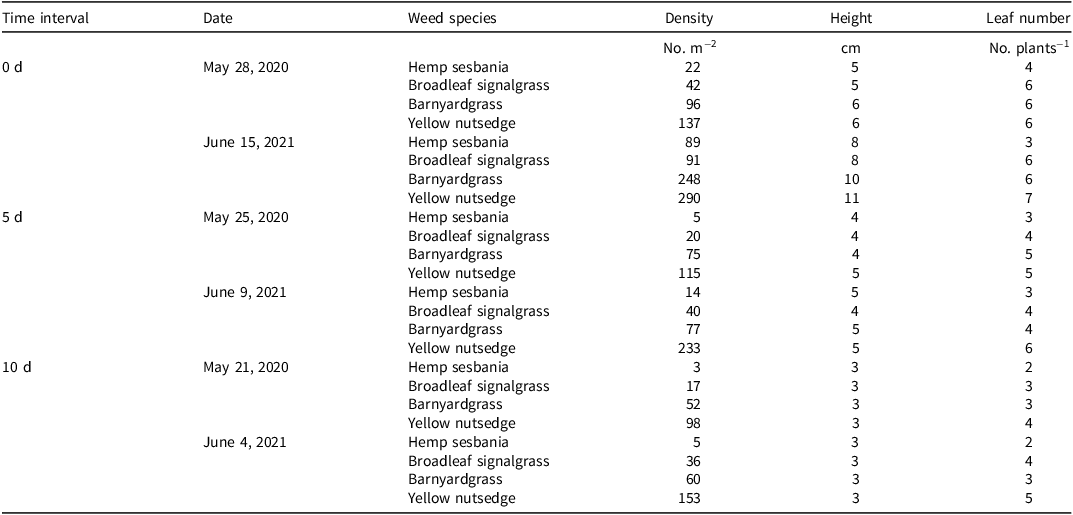
a Preflood application occurred at ±2 d before the targeted application timing.
b Flooding of all plots occurred at the “0 d” time interval.
Visual evaluations of weed control were rated at 3 and 5 wk following the final flooding event on a scale of 0 to 100, where 0 represents no weed control, and 100 represents complete weed control (Frans and Talbert Reference Frans and Talbert1986). When present at the test site, visible weed control ratings were taken for hemp sesbania, yellow nutsedge, broadleaf signalgrass, barnyardgrass, and ducksalad. Plots that were not treated with florpyrauxifen-benzyl were treated with clomazone at 168 g ai ha−1 at planting and were used to compare the efficacy of florpyrauxifen-benzyl and yield impacts. Visual evaluations of weed control ratings were based on aboveground biomass, stunting, leaf malformations, mortality, and overall ground cover. Rough rice grain was harvested from the four rows in the center of each plot using a small-plot combine (Kubota Corporation, Naniwa-ku, Osaka, Japan). Rough rice grain yield was calculated, and moisture was adjusted to 12%.
Data were analyzed with SAS software (v.9.4; SAS Institute Inc., Cary, NC) using the GLIMMIX procedure. Percent visible weed control 3 and 5 wk after final treatment (WAFT) was determined to follow a beta distribution, and grain yield followed a normal distribution based on corrected Akaike information criterion (AICc) and Bayesian information criterion (BIC) values in the distribution platform were determined with JMP Pro 16 software (SAS Institute). A two-factor ANOVA was used to assess application method and flood timing following application. Block and year were considered random effects, with block nested within year. By considering block and year to be random effects, they are assumed to be uncorrelated with the individual main effects. Means were separated using Tukey’s honestly significant difference (HSD) test (α = 0.05). Additionally, the SLICEDIFF function was used within the GLIMMIX procedure to test pairwise differences between application methods where application timing was a fixed level.
Flood Loss Experiment
An experiment was conducted at the PTRS near Colt, Arkansas, in 2020 and 2021 to evaluate the influence of flood loss and the varying application of florpyrauxifen-benzyl coated onto urea and the resulting weed control in rice plots. In both years, the soil texture was the same as that described for the previous experiment. Plot size, tillage, cultivar, planting dates, and clomazone overspray were the same as those described in the previous experiment.
The experiment was conducted as a randomized complete block design with four replications. Four losses of the established flood were evaluated following a preflood application of florpyrauxifen-benzyl coated onto urea: no loss of flood; and loss occurring at 2 h, 24 h, and 7 d after application. Flood loss was considered to be complete drainage of the plot. Plots took approximately 2 h to flood and approximately 30 min to drain. Plots were flooded from a single inlet. Additionally, a no–florpyrauxifen-benzyl treatment was included. Florpyrauxifen-benzyl was coated onto urea prills using the method described for the previous experiment. Florpyrauxifen-benzyl at 30 g ai ha−1 was coated onto urea, and the fertilizer was applied at 317 kg ha−1. Florpyrauxifen-benzyl applications were prepared and applied using the same methods explained previously. Flood water release timings were initiated following flood completion on June 1, 2020, and June 15, 2021. Following each flood loss timing, bays were reflooded 24 h after flood waters were removed and remained flooded until the crop reached maturity.
Visual evaluations of weed control ratings were based on aboveground biomass, stunting, leaf malformations, mortality, and overall ground cover and were made relative to a plot that lacked herbicide treatment. Visual evaluations of barnyardgrass, yellow nutsedge, and hemp sesbania control was rated similarly to the previous trial at 4 and 5 wk following the final flooding loss event (Frans and Talbert Reference Frans and Talbert1986). Plots that were not treated with florpyrauxifen-benzyl were treated with clomazone at 168 g ai ha−1 at planting and were used to compare the efficacy of florpyrauxifen-benzyl and yield impacts. Rice grain was harvested at crop maturity and reported as rough rice yield after adjusting to 12% moisture.
Data were analyzed with SAS software (v. 9.4) using the GLIMMIX procedure. Percent visible weed control at 4 and 5 WAT was determined to follow a beta distribution, and grain yield followed a normal distribution based on AICc and BIC values in the distribution platform of JMP Pro 16 software. A single-factor ANOVA was used to assess flood loss timing effects following application. Block and year were considered random effects, with block nested within year. By considering block and year as random effects, they are assumed to be uncorrelated with the individual main effects. Means were separated using Tukey’s HSD test (α = 0.05).
Results and Discussion
Flood Timing Experiment
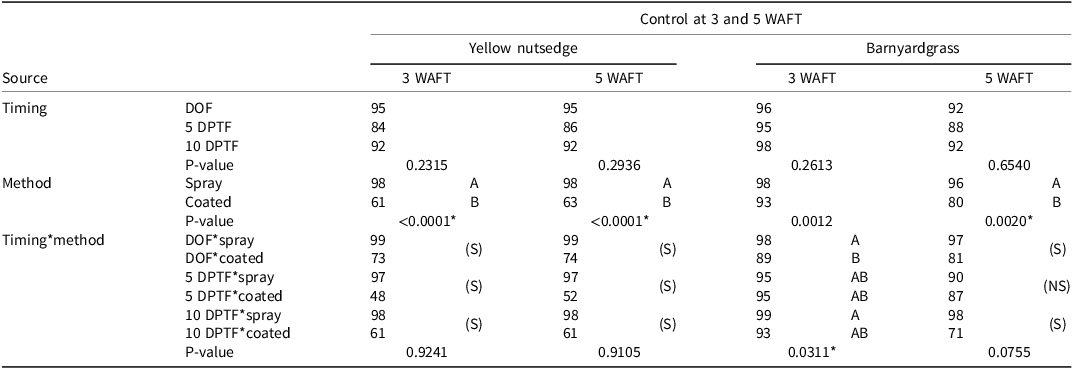
The main effect of application method was significant yellow nutsedge control at 3 WAFT (Table 2). Additionally, the interaction between timing until flood and application method was significant for barnyardgrass control at 3 WAFT. At 3 WAFT, coated and sprayed applications of florpyrauxifen-benzyl provided at least 98% control of hemp sesbania (data not shown). Additionally, spraying florpyrauxifen-benzyl at 30 g ai ha−1 provided 37 percentage points greater control of yellow nutsedge at 3 WAFT than when the herbicide was coated on urea and applied (Table 2). At 5 WAFT, the main effect of application method was significant for yellow nutsedge barnyardgrass (Table 2).
Table 2. Effects of timing until flood and florpyrauxifen-benzyl application method on visible weed control estimates in rice at 3 and 5 WAFT. a–g
a Abbreviations: DOF, day of the flood; DPTF, days before the flood; WAFT, weeks after the final treatment.
b Applications of florpyrauxifen-benzyl were initiated when weeds reached approximately the 3-leaf growth stage, and subsequent applications were applied based on the single flood timing.
c All plots were treated with clomazone at 168 g ae ha−1 (1/2× rate) at planting.
d Data were included from 2020 and 2021.
e Pairwise differences are signified by (S) for significant, adjusted P-value < 0.05; and (NS) for nonsignificant, adjusted P-value > 0.05, as compared within each application timing.
f P-values followed by * are significant (P < 0.05).
g Means within the same column not containing the same letter are different according to Tukey’s honestly significant difference test (α = 0.05).
Like results at 3 WAFT, an application method difference occurred with yellow nutsedge at 5 WAFT, when florpyrauxifen-benzyl coated on urea provided 63% control, and spraying the herbicide provided 35 percentage points greater control (Table 2). Coating florpyrauxifen-benzyl onto urea likely did not provide adequate coverage to control yellow nutsedge at high plant densities (Table 1), and florpyrauxifen-benzyl tends to provide variable control of yellow nutsedge across environments, an indication that the weed is not highly sensitive to the herbicide. Additionally, differences in application methods were compared at each respective flood establishment timing at 3 and 5 WAFT. At both observation times, spraying florpyrauxifen-benzyl provided greater yellow nutsedge control when compared using a pairwise test to coating the herbicide on urea at all application timings (Table 2).
Like the high levels of hemp sesbania control, coating florpyrauxifen-benzyl at 30 g ai ha−1 onto urea still provided 98% or greater control of broadleaf signalgrass at 3 WAFT (data not shown). Likewise, the same level of broadleaf signalgrass control was observed at 5 WAFT (data not shown).
Differences at 3 WAFT in barnyardgrass control were best explained by the significant interaction between timing until flood and application method (Table 2). Coating florpyrauxifen-benzyl onto urea and applying it on the day of flooding resulted in the lowest barnyardgrass control (89%) at 3 WAFT when the level of control was lower than control provided by sprayed florpyrauxifen-benzyl at the day of flooding and 10 d prior to flooding application timings. However, only the main effect of application method elicited differences in barnyardgrass control (Table 2). Spraying florpyrauxifen-benzyl provided 96% barnyardgrass control, whereas coating the herbicide on urea provided only 80% barnyardgrass control. However, when comparing the pairwise differences in application methods at each respective flood establishment timing at 5 WAFT, spraying florpyrauxifen-benzyl resulted in greater barnyardgrass control when applied at 0 and 10 d prior to flood establishment (Table 2).
Any differences between application methods regarding yellow nutsedge or barnyardgrass control were likely attributed to the weeds not taking up enough florpyrauxifen-benzyl to prove fatal when the herbicide was dispersed in the flood water via being coated on urea. Prior to this research, it was unknown whether yellow nutsedge and barnyardgrass were sensitive enough to florpyrauxifen-benzyl to be controlled by an application method that has little foliar interception at application. Weeds such as hemp sesbania and broadleaf signalgrass that are more sensitive to florpyrauxifen-benzyl are easier to control by coating urea with florpyrauxifen-benzyl at 30 g ai ha−1. Sensitivity to florpyrauxifen-benzyl appeared to be one of the main issues with coating the herbicide onto urea. Based on research by Miller and Norsworthy (Reference Miller and Norsworthy2018a), barnyardgrass and yellow nutsedge are generally harder to control with florpyrauxifen-benzyl than hemp sesbania. As exhibited in Table 1, weed density at the time of herbicide application and flooding appeared to play a role in variable weed control of tougher-to-control weeds. Herbicide dose and weed density have proved to go together when modeling rice-weed competition. Generally, as weed densities increased, more herbicide was needed to eliminate the weed population (Moon et al. Reference Moon, Kim, Cho, Park, Song and Kim2014). Hence, florpyrauxifen-benzyl coated on urea at 30 g ai ha−1 was not enough herbicide to control the populations of yellow nutsedge and barnyardgrass based on the weed densities listed in Table 1.
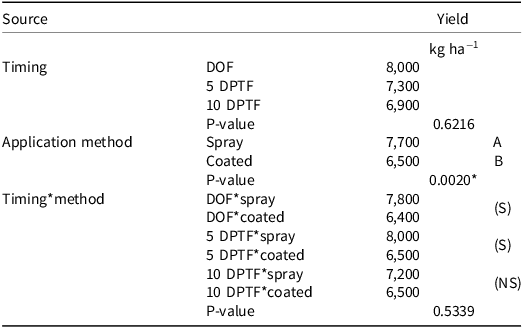
Weed control variability, primarily highlighted by barnyardgrass control at 3 and 5 WAFT, provided by florpyrauxifen-benzyl coated on urea, helped explain why differences in yield were apparent for the main effect of application method (Table 3). Rice yields harvested from plots that were treated with a sprayed florpyrauxifen-benzyl application were, on average, 7,700 kg ha−1. However, plots treated with florpyrauxifen-benzyl coated on urea produced a lower rice yield of 6,500 kg ha−1. Typically, as rice weed populations increase, lower rice yields are observed (Smith Reference Smith1968). Plots not containing florpyrauxifen-benzyl were overtaken with weeds and produced a rice yield of only 3,300 kg ha−1. Pairwise tests comparing application methods within each application timing provided indications that plots sprayed with florpyrauxifen-benzyl at 0 and 5 d prior to flood produced higher yields than those treated with florpyrauxifen-benzyl coated onto urea prills (Table 3). Historically, as barnyardgrass control increases, rice yield components increase, explaining the importance of barnyardgrass control in rice (Ottis and Talbert Reference Ottis and Talbert2007). Likewise, weeds such as barnyardgrass are a main source of nutrient removal in flooded rice fields (Saudy et al. Reference Saudy, El-Metwally and Shahin2021). Generally, lower weed control was directly associated with lower rice yield. While an economic yield loss was apparent following applications of florpyrauxifen-benzyl coated on urea, the potential safety from adjacent soybean injury may outweigh the economic losses in specific scenarios. Additionally, other herbicides paired with florpyrauxifen-benzyl coated on urea may help bridge the gap in weed control and economic losses.
Table 3. Effects of timing till flood and florpyrauxifen-benzyl application method on rough rice grain yield. a–h
a Abbreviations: DOF, day of the flood; DPTF, days before the flood; WAFT, weeks after the final treatment.
b Applications of florpyrauxifen-benzyl were initiated when weeds reached approximately the 3-leaf growth stage, and subsequent applications were applied based on the single flood timing.
c All analyzed plots were treated with clomazone at 168 g ae ha−1 (½× rate) at planting.
d Data were included from 2020 and 2021.
e Nontreated plots resulted in a yield of 3,300 kg ha−1, averaged between 2020 and 2021.
f Pairwise differences are signified by (S) for significant, adjusted P-value < 0.05; and (NS) for nonsignificant, adjusted P-value > 0.05, as compared within each application timing.
g P-values followed by * are significant (P < 0.05).
h Means within the same column not containing the same letter are different according to Tukey’s honestly significant difference test (α = 0.05).
Flood Loss Experiment
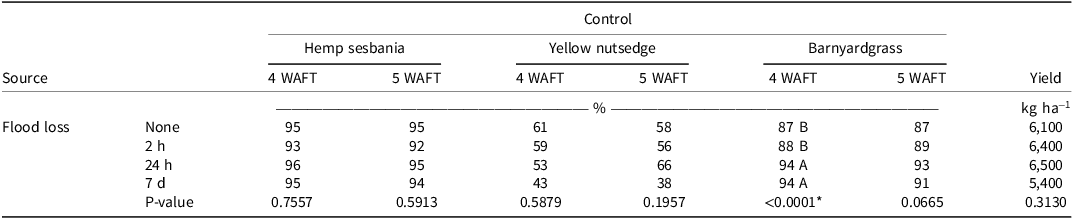
When visual evaluations of weed control were made following a loss of flood water event at 4 and 5 WAFT, no differences between flood loss timings occurred for hemp sesbania, yellow nutsedge control, or rice yield (Table 4). Likewise, there was no difference in barnyardgrass control between any flood loss timing at 5 WAFT. However, barnyardgrass control at 4 WAFT was the only instance in this experiment that elicited a flood loss difference (Table 4). No flood loss and flood loss 2 h following flood establishment caused 87% and 88% barnyardgrass control, respectively. However, following a flood loss event at 24 h and 7 d after flood establishment, florpyrauxifen-benzyl provided 94% barnyardgrass control at 4 WAFT. Florpyrauxifen-benzyl undergoes hydrolysis at a rapid pace and is a primary degradation method of the herbicide molecule, along with photolysis (Anonymous 2019). The rapid hydrolysis of florpyrauxifen-benzyl explains why barnyardgrass control was less following a flood loss 2 h after flood establishment when the herbicide is at a higher concentration in the flood water compared to later flood loss timings when less hydrolyzed herbicide is present. The overall lack of statistical differences in hemp sesbania and yellow nutsedge was explained by the overall sensitivity of the weed to florpyrauxifen-benzyl. Hemp sesbania is very sensitive to florpyrauxifen-benzyl, whereas yellow nutsedge is not as sensitive to it as other broadleaf weeds are (Miller and Norsworthy Reference Miller and Norsworthy2018a). Additionally, yellow nutsedge control with florpyrauxifen-benzyl coated on urea suffered from the stand-alone preflood application, likely because the weed is a perennial with varying densities across the test site and it has lower sensitivity to florpyrauxifen-benzyl than other weeds (Miller and Norsworthy Reference Miller and Norsworthy2018a). Coating florpyrauxifen-benzyl onto urea provided less yellow nutsedge control than was reported in previous research when florpyrauxifen-benzyl was spray-applied at 30 g ai ha−1 (Miller and Norsworthy Reference Miller and Norsworthy2018a).
Table 4. Effects of flood loss timing on rice weed control 4 and 5 WAFT and rough rice grain yield. a–e
a Abbreviation: WAFT, weeks after the final treatment.
b All analyzed plots were treated with florpyrauxifen-benzyl at 30 g ae ha−1 coated on urea at the 4- to 5-leaf rice growth stage and subsequently flooded 24 h later, when flood drainage commenced following the completion of the initial flooding.
c All analyzed plots were treated with clomazone at 168 g ae ha−1 (½× rate) at planting.
d Plots not treated with florpyrauxifen-benzyl resulted in yields of 5,800 and 3,000 kg ha−1 in 2020 and 2021, respectively, and were treated with clomazone at 168 g ae ha−1with no flood loss.
e Means within the same column not containing the same letter are different according to Tukey’s honestly significant difference test (α = 0.05).
No differences in rice yield were observed in this experiment. Florpyrauxifen-benzyl has a relatively short half-life in water with the acid metabolite having a longer half-life, and its primary decomposition pathways are hydrolysis and photolysis (APVMA 2018). Hence, longer time intervals between a florpyrauxifen-benzyl application and a flood loss event were expected to lower the effect on weed control. However, this relationship was only highlighted by slight differences in barnyardgrass control. Additionally, the underlying ideas of variable weed sensitivities and densities may have affected the overall efficacy of florpyrauxifen-benzyl coated on urea. Moreover, flooding depth may have an overall effect on the in-water florpyrauxifen-benzyl concentration leading to potential differences in rice weed control.
Practical Implications
Developing an alternative method for applying florpyrauxifen-benzyl was imperative for more safely applying florpyrauxifen-benzyl. For that reason, finding a way to safely apply florpyrauxifen-benzyl to rice with a reduced risk of off-target movement is critically necessary for continued use of the herbicide because soybean crops are highly sensitive to florpyrauxifen-benzyl (Miller and Norsworthy Reference Miller and Norsworthy2018b). However, based on these experiments, the alternative application method of coating florpyrauxifen-benzyl onto urea comes with costs. Because this application method relies solely on activation by flood water or large rainfall events, research was conducted to determine the associated effects. The time interval between application and flooding proved less important on difficult-to-control weeds such as yellow nutsedge and barnyardgrass. Coating florpyrauxifen-benzyl at 30 g ai ha−1 onto urea does not appear to effectively control yellow nutsedge and barnyardgrass without using preemergence residual herbicides or alternative postemergence herbicides. However, additional research may be needed to identify the correct herbicide programs that incorporate florpyrauxifen-benzyl coated on urea to effectively control yellow nutsedge and barnyardgrass. Intervals between flooding and florpyrauxifen-benzyl applications should be minimized to prevent extra growth in weed size during that time. Once flood water is established, the best approach to maximizing weed control is to maintain a flood without loss. Aside from herbicide loss with flood loss, nitrogen losses through volatilization should be expected following flood losses if the herbicide is applied before flood establishment. Florpyrauxifen-benzyl alone coated on urea struggles to effectively and consistently control barnyardgrass, and preemergence residual herbicides should be applied to provide additional grass control. A program approach should be used with florpyrauxifen-benzyl coated on urea to offer greater control of barnyardgrass, yellow nutsedge, and hemp sesbania. Future research is needed to identify herbicide routines in which florpyrauxifen-benzyl can be used for preflood or postflood weed control. Additionally, research is needed to observe any potential interactions of urease inhibitors with florpyrauxifen-benzyl when coated on urea.
Acknowledgments
This research was conducted in cooperation with Corteva Agriscience. Facilities and equipment were provided by the University of Arkansas System Division of Agriculture.
Funding
Corteva Agriscience provided partial research funding and the florpyrauxifen-benzyl herbicide. Additional funding for this research was provided by the Arkansas Rice Checkoff Program administered by the Arkansas Rice Research and Promotion Board.
Competing Interests
The authors declare they have no competing interests.


 Open access

