




1. Introduction
Design for sustainability is a design process and resulting product that incorporates the environmental, social and economic sustainability concerns into product design and development (Crul, Diehl & Ryan Reference Crul, Diehl and Ryan2009). It is an umbrella concept that comprises a variety of sub-fields, including sustainable design at the product level (e.g., green design and EcoDesign), product-service system level (e.g., sustainable product and service system design), spatial-social innovation level (e.g., design for social innovation) and socio-technical innovation system level (e.g., design for system innovations and transitions) (Ceschin & Gaziulusoy Reference Ceschin and Gaziulusoy2016). All these sub-fields are established on the transformative nature that design has on human doings. Nowadays, as many socio-ecological issues are caused by individuals’ undesired consumption patterns, the need to guide people to adopt a sustainable lifestyle has become prominent in design (Thorpe Reference Thorpe2010).
Over the past decade, the field of design for sustainability has witnessed a significant shift of research focus from technical-centric and product-oriented design to socio-technical centric and people-oriented design (Ceschin & Gaziulusoy Reference Ceschin and Gaziulusoy2016). Under this trend, design for sustainable behaviour (DfSB), which specifically aims to reduce the negative environmental and social impacts of products and services by influencing users’ behaviour, has gained a growing amount of research interest (Wever & Vogtländer Reference Wever and Vogtländer2015). Theoretical knowledge and practice-relevant contributions in the form of design strategies and techniques (see, e.g., Bhamra, Lilley & Tang Reference Bhamra, Lilley and Tang2011; Tromp, Hekkert & Verbeek Reference Tromp, Hekkert and Verbeek2011; Daae, Chamberlin & Boks Reference Daae, Chamberlin and Boks2018; Maccioni, Borgianni & Pigosso Reference Maccioni, Borgianni and Pigosso2019; Kim et al. Reference Kim, Cluzel, Leroy, Yannou and Bris2020) and toolkits (see, e.g., Lockton, Harrison & Stanton Reference Lockton, Harrison and Stanton2010; Daae & Boks Reference Daae and Boks2014; Colusso, Do & Hsieh Reference Colusso, Do and Hsieh2018; Hoolohan & Browne Reference Hoolohan and Browne2020) have been developed to guide design researchers and practitioners to make more informed decisions in sustainable behaviour design. Various conceptual models derived from behaviour change theories have been applied to investigate empirical phenomena and guide sustainable design explorations (see, e.g., Wever, van Kuijk & Boks Reference Wever, van Kuijk and Boks2008; Lilley Reference Lilley2009; Bhamra et al. Reference Bhamra, Lilley and Tang2011; Daae et al. Reference Daae, Chamberlin and Boks2018). To a large extent, these models are established on the view that the undesired interaction between users and designed artefacts may lead to underlying socio-ecological sustainability issues. Consequently, a better modelling and understanding of user-product/service interaction can be applied to solve these potential issues (Boks Reference Boks2012).
However, design for sustainability research is currently evolving from perceiving sustainability as a static goal towards a dynamic target (Faber, Jorna & Van Engelen Reference Faber, Jorna and Van Engelen2005; Joore & Brezet Reference Joore and Brezet2015), from focusing on single products and services towards making changes at a complex socio-technical system level (Adams et al. Reference Adams, Jeanrenaud, Bessant, Denyer and Overy2016). Facing this trend, two critical challenges have emerged in the sub-field of DfSB: first, existing studies appear to focus on addressing sustainable behaviour change problems from a short-term perspective (Brynjarsdottir et al. Reference Brynjarsdottir, Håkansson, Pierce, Baumer, DiSalvo and Sengers2012). For example, some behaviour change strategies such as feedback can only draw people’s attention to the environmental impacts of their behaviour for a limited time. The long-term dynamic perspective regarding how people might transform their behaviour over time has seldom been taken into account in empirical analysis and design explorations (van Dam, Bakker & van Hal Reference van Dam, Bakker and van Hal2010; Coskun, Zimmerman & Erbug Reference Coskun, Zimmerman and Erbug2015). Second, most of the commonly used sustainable behaviour change design models tend to narrowly focus on applying design techniques to influence the way how individuals interact with a specific product, thus neglecting the importance of understanding the complexity of why and how a specific behaviour is performed in the broader context of people’s everyday life. Such complexity is not only determined by the usability problems situated within the interaction between a user and a designed artefact but also shaped by the interdependency between individuals and macro socio-technical systems, in which products function with other products and other people, forming an interconnected network (Mankoff et al. Reference Mankoff, Blevis, Borning, Friedman, Fussell, Hasbrouck, Woodruff and Sengers2007; Wever et al. Reference Wever, van Kuijk and Boks2008). Consequently, due to its primary focus on how design can be used to influence people’s behaviour, the current behaviour-based theoretical perspective might not always be sufficient to deal with these challenges.
As a response, many literature review studies suggested that future DfSB research needs to expand from solely focusing on users’ specific behaviour to incorporating the long-term dynamic, multi-level, and complex features of people’s everyday doings into consideration (Ceschin & Gaziulusoy Reference Ceschin and Gaziulusoy2016; Costa et al. Reference Costa, Diehl and Snelders2019). Such expansion would require support from a theoretical lens that systemically contextualizes the interplay between users and designed artefacts in a real-life setting (Boon et al. Reference Boon, Wever and Quist2015). Among a variety of theoretical perspectives such as practice theory (see, e.g., Shove Reference Shove2007; Pettersen Reference Pettersen2013; Kuijer Reference Kuijer2014) and the theories of transitions and system innovations (see, e.g., Ceschin Reference Ceschin2014; Gaziulusoy & Brezet Reference Gaziulusoy and Brezet2015), activity theory (AT), with its focuses on understanding the role of artefacts (and design of artefacts) in purposeful need-based human activity, is regarded as one of the leading candidates to solve the challenges faced by DfSB identified above. Three theoretical features of AT: historical and developmental sensitivity, attention to complex systems, and reality-based solutions can be especially useful to understand the context of sustainability issues from a design perspective (Kaptelinin & Nardi Reference Kaptelinin and Nardi2006). Some recent works also pointed out that AT is a promising theoretical lens in DfSB research (Selvefors Reference Selvefors2017; Renström Reference Renström2019). However, despite the application of AT as a theoretical lens in the design field, especially in human–computer interaction design (see, e.g., Bødker Reference Bødker1989), how the theoretical features of AT can be employed to support design researchers in understanding and addressing complex sustainability issues remain ill-addressed.
To bridge this gap, the present study aims to systematically explore the potential use of AT as a theoretical lens for guiding empirical analysis and design explorations in DfSB. Two overarching research questions guide our research investigation: (1) how have AT and its theoretical principles been applied in existing studies to guide the empirical analysis and design explorations for tackling design-related sustainability challenges? (2) how might the findings be translated to theoretical and practice-relevant implications for design researchers in the DfSB field to apply? To achieve this goal, a theory-generating qualitative meta-synthesis approach (Finfgeld-Connett Reference Finfgeld-Connett2018) is adopted to synthesize results from the existing relevant studies. An overview of the research process and paper structure is illustrated in Figure 1.
An overview of the research process in the present study.

2. AT theoretical background and applications in design
The conceptual origins of AT can be traced back to the work conducted by psychologist Lev Vygotsky and Sergei Rubinshtein in the 1920s and 1930s when they were in search of an understanding of how the complex relationship between human mind and society manifests itself in human activities (Kaptelinin & Nardi Reference Kaptelinin and Nardi2006). According to Vygotsky (Reference Vygotsky1978), human activities are purposeful need-based relationships between the subject and the object mediated by the use of artefacts. Established on Vygotsky’s AT model, a variety of models have been developed in different research fields. As illustrated in Figure 2, Leontiev’s hierarchical structure model (Leont’ev Reference Leont’ev1974, Reference Leont’ev1978) (also referred as the second generation of AT model) and Engeström’s cultural–historical AT model (Engestrom Reference Engestrom1987) (also referred as the third-generation AT model) have been widely accepted and applied in the current research.
Leontiev’s hierarchical structure model (adopted from Leont’ev Reference Leont’ev1978) and Engeström’s cultural–historical AT model (adopted from Engestrom Reference Engestrom1987).

Originating from a socio-cultural tradition in psychology, two distinguishing features make AT applicable for design research: First, unlike most of the behavioural and psychological theories that provide researchers with models to predict people’s behaviour, AT aims at supporting design researchers in formulating sensible inquiries based on the descriptive accounts of why and how people carry out a specific activity in a specific context to achieve a specific goal (Li & Landay Reference Li and Landay2008; Bødker & Klokmose Reference Bødker and Klokmose2011; Kaptelinin Reference Kaptelinin2014). In this respect, AT works as a theory-based conceptual framework for structuring design research inquiries rather than a theory in the traditional sense (Karanasios Reference Karanasios2014). Second, as Engeström (Reference Engeström1999, p. 29) noted that ‘AT has the conceptual and methodological potential to be a pathbreaker in studies that help humans gain control over their own artifacts and thus over their future’. AT’s particular focus on the role that artefacts play in people’s activity system is in accordance with the design tradition of product and service design in understanding and shaping human–artefact relationships (Duignan, Noble & Biddle Reference Duignan, Noble and Biddle2006; Kuutti Reference Kuutti2011). To narrow the scope down, in the present study, we mainly focused on the use of AT for guiding empirical analysis and design explorations.
Five key theoretical principles of AT have become the cornerstones that underpin the application of AT in design research (Kaptelinin, Nardi & Macaulay Reference Kaptelinin, Nardi and Macaulay1999). In the following part of this section, we briefly introduce each theoretical principle with a special focus on its specific implications for addressing design for sustainability challenges.
2.1. Mediating effects of artefacts
The theoretical principle of artefact mediation plays a central role in AT. According to Vygotsky (Reference Vygotsky1978), all purposeful interaction between the subject and the world is mediated by the use of artefacts. The mediating artefacts used in activities include both external material tools (e.g., hammers, computers and digital interface) and internal immaterial tools (e.g., language, symbols and models) (Kaptelinin Reference Kaptelinin2014). This conceptualization of artefact aligns with the classic definition that Herbert Simon made that an artefact can take any form on the continuum between abstract and concrete and act as a bridge between an internal and external environment (Simon Reference Simon1969). From a design for sustainability perspective, we are interested in how the concept of mediating artefacts may guide the design of sustainable products and services in people’s activity systems (hereinafter referred to as M-1).
2.2. Subject–object relationships
The theoretical principle of subject–object relationships is regarded by many theorists as the most fundamental notion that underpins AT. In the view of AT, subjects can be both individual (e.g., individual users) and collective (e.g., different stakeholders, organizations and communities). Correspondingly, the object involves both tangible biological (e.g., eat food) and intangible psychological (e.g., comfortable living) aspects of human life. When a specific need of a subject is coupled with a specific object, a motive is formed, and at the same time, an activity emerges. AT argues that it is the subject–object relationship, rather than the individual component of subject or the object, that determines how an activity is carried out (Gay & Hembrooke Reference Gay and Hembrooke2004). As Kaptelinin & Nardi (Reference Kaptelinin and Nardi2006) indicated, when used in product and service design, this principle can enable designers to expand the scope of analysis from users’ interaction with a specific product or service to how subjects carry out a meaningful motive-oriented activity (hereinafter referred to as SO-1).
2.3. Tensions and contradictions
Tensions and contradictions are broadly defined as misfits, problems, incoherencies and inconsistencies that subjects encounter in the targeted activity systems (Kuutti Reference Kuutti1996). When this theoretical principle was applied in design research, in some cases, it was only used to identify product usability problems. However, that is an oversimplification as tensions and contradictions do not only exist in the interaction between users and artefacts but also can be found within and between different components of an activity system. It is due to this reason that understanding tensions and contradictions might provide design researchers with a systemic perspective of how sustainability problems take place at different levels of an activity system (hereinafter referred to as T&C-1).
2.4. History and development
When the subject begins to cope with the tensions and contradictions within and between activity systems, the activity system may undergo a development process (Engeström Reference Engeström1999). This development process does not just last for a certain time. On the contrary, in the view of AT, activities are under constant development and evolution (Kuutti Reference Kuutti1996). Two features of this theoretical principle are relevant to be used for design for sustainability studies: First, when certain tensions and contradictions become materialized at a given point of time, the subject of the activity system may attempt to find temporary solutions to address the contradictions, it is under these moments that the activity undergoes a transformation process (Blackler, Crump & McDonald Reference Blackler, Crump and McDonald1999; Boer, van Baalen & Kumar Reference Boer, van Baalen and Kumar2002) (hereinafter referred to as H&D-1). Second, AT postulates in its theoretical nature that a typical way to induce intentional changes is through re-mediation, that is, redesigning artefacts (such as products and services) to influence the way how subjects achieve the original object (Nardi Reference Nardi1996; Bødker & Andersen Reference Bødker and Andersen2005) (hereinafter referred to as H&D-2).
2.5. Socio-cultural contexts
Gay & Hembrooke (Reference Gay and Hembrooke2004) connects AT to an ecological perspective and posit a human activity at three levels: the micro-level represents independent activities carried out by each individual, the meso-level represents collective activities carried out by a group of individuals or a community, the macro-level represents large social contexts. They went on and argued that when an activity system is analysed at one particular level or context, its relations with activities at other contextual should also be taken into account. From a design for sustainability perspective, the sustainability effects of a product and service should not be limited to its environmental performance or its influence on individual user behaviour. Instead, it is vital for design researchers to analyse or envisage the potential impacts of a particular sustainable design intervention on different socio-cultural levels, covering individual to larger social contexts (hereinafter referred to as SC-1). Moreover, the theoretical principle of socio-cultural contexts also highlights the importance of understanding people’s behaviour in real-life settings rather than task-based laboratory settings (Kaptelinin & Nardi Reference Kaptelinin and Nardi2006, p. 35) (hereinafter referred to as SC-2). A summary of the design for sustainability related insights extracted from AT’s five key theoretical principles is shown in Table 1.
Activity theory’s key theoretical principles and insights related to design for sustainable behaviour

3. Methods and methodology
3.1. Theory-generating qualitative meta-synthesis
In order to synthesize findings from each independent primary study into generalizable theoretical understandings that can be applied beyond the original study sample, a qualitative meta-synthesis approach was adopted in this study (Stern & Harris Reference Stern and Harris1985; Sandelowski, Docherty & Emden Reference Sandelowski, Docherty and Emden1997). Qualitative meta-synthesis is a hermeneutic approach seeking to generate understanding about phenomena by integrating, comparing and translating original findings from a number of interrelated qualitative studies into coherent ones (Walsh & Downe Reference Walsh and Downe2005). Previously, this approach has been applied in the studies conducted by Stewart et al. (Reference Stewart, Baker, Chaney, Hashimov, Imafuji, McNely and Romano2012) and Clemmensen, Kaptelinin & Nardi (Reference Clemmensen, Kaptelinin and Nardi2016) to investigate the use of AT in the field of human–computer interaction. Integrating their methodological reflections with the research aim of this study, we adopted and adapted the theory-generating qualitative meta-synthesis methodological guidelines developed by Finfgeld-Connett (Reference Finfgeld-Connett2018) to guide the qualitative data collection, extraction, analysis and synthesis process. This guideline was chosen due to its clear methodological procedures on theory development and higher level abstraction.
3.2. Identification of literature
To identify the relevant primary studies, we set the meta-synthesis scope to the existing studies that applied AT models (the first-, second- and third-generation model) and its key theoretical principles (as indicated in Section 2) to understand or address socio-ecological challenges from a design for sustainability perspective. Following the qualitative meta-synthesis guideline suggested by Finfgeld-Connett (Reference Finfgeld-Connett2018), we systematically searched relevant literature in Scopus and Web of Science Core Collection. Building upon a non-exhausted literature review that we conducted in a pilot study (see Chu, Glad & Wever Reference Chu, Glad and Wever2021), two groups of search terms were adopted in the literature identification process (as presented in Table 2). Peer-reviewed conference papers, journal articles and book chapters were included in the literature search. The literature search was conducted in May 2020. After removing duplicated search records, the literature search resulted in 621 articles.
Search scope, search string and the corresponding search records

3.3. Study selection and quality assessment
Following qualitative meta-synthesis literature screening procedures proposed by Barroso et al. (Reference Barroso, Gollop, Sandelowski, Meynell, Pearce and Collins2003), the selection process in the present study is divided into four stages (see Figure 3). By assessing all the identified articles against the criteria listed in Table 3, 18 articles were included in the final review stage while 603 articles were excluded.
Literature identification and screening process implemented in this study.

Literature screening steps and criteria

3.4. Data extraction and synthesis
Two types of data were extracted from the included primary studies: (a) basic study characteristics and (b) findings related to the use of AT. Basic study characteristics include research aims and questions, specific goals concerning sustainability and design, data collection and analysis methods and main study outcomes. Findings related to the use of AT were extracted based on the following themes:
(i) Purposes or rationales for adopting AT.
(ii) Engagement with AT models and theoretical principles.
(iii) Author(s)’ reflections on the use of AT.
(iv) The specific unit of analysis in the study.
(v) The specific usage of AT concerning the investigation of sustainability problems.
(vi) Implications to design.
The data synthesis method memoing was used to explicate the relationships among different studies while avoiding decontextualizing the data. First, the extracted data were distilled into descriptive statements in the form of within-study memos. Following that, the within-study memos were grouped and reconstructed into cohesive cross-study memos (as illustrated in Figure 4). These within-study and cross-study memos were then synthesized into different themes from a bottom-up (based on their emergent characteristics) and a top-down manner (based on their coherence with the five key AT theoretical principles). The data synthesis process was conducted in a test–retest iterative manner. Moreover, to a better synthesis of the results, we first sorted the included articles according to two characteristics: the main study outcomes and the overall engagement with AT. The included primary studies were divided into two sub-categories based on their main study outcomes: (a) studies that focus on analyzing empirical findings of a sustainability-related phenomenon and (b) studies that focus on formulating AT-based analytical frameworks or models to guide the investigation of a specific empirical phenomenon.
The analysis and synthesis of the insights extracted from the included primary studies.

4. Results
Table 4 presents an overview of the articles mapped into different subgroups. Two themes emerged from the results. Theme 1 comprises eight articles that used AT to analyse the causes of sustainability issues and inform sustainable design interventions. Theme 2 comprises ten articles that used AT to evaluate the sustainability or unsustainability effects of the proposed design interventions implemented in the studies.
Included articles mapped according to the study outcomes and engagement with AT

Although the specific use of AT in each study varies across different research contexts, they can generally be summarized as (1) Investigating sustainable effects of mediating artefacts, (2) Directing sustainable subject–object relationships, (3) Uncovering tensions and contradictions within and between activity systems, (4) Understanding the dynamism of activities from a history and development perspective and (5) Incorporating socio-cultural sustainability into design consideration. Table 5 gives an overview of AT’s theoretical principles applied in the included studies. A detailed summary can be found in Appendix Table S1.
An overview of the key AT theoretical principles employed in each included primary study

4.1. Investigating sustainable effects of mediating artefacts
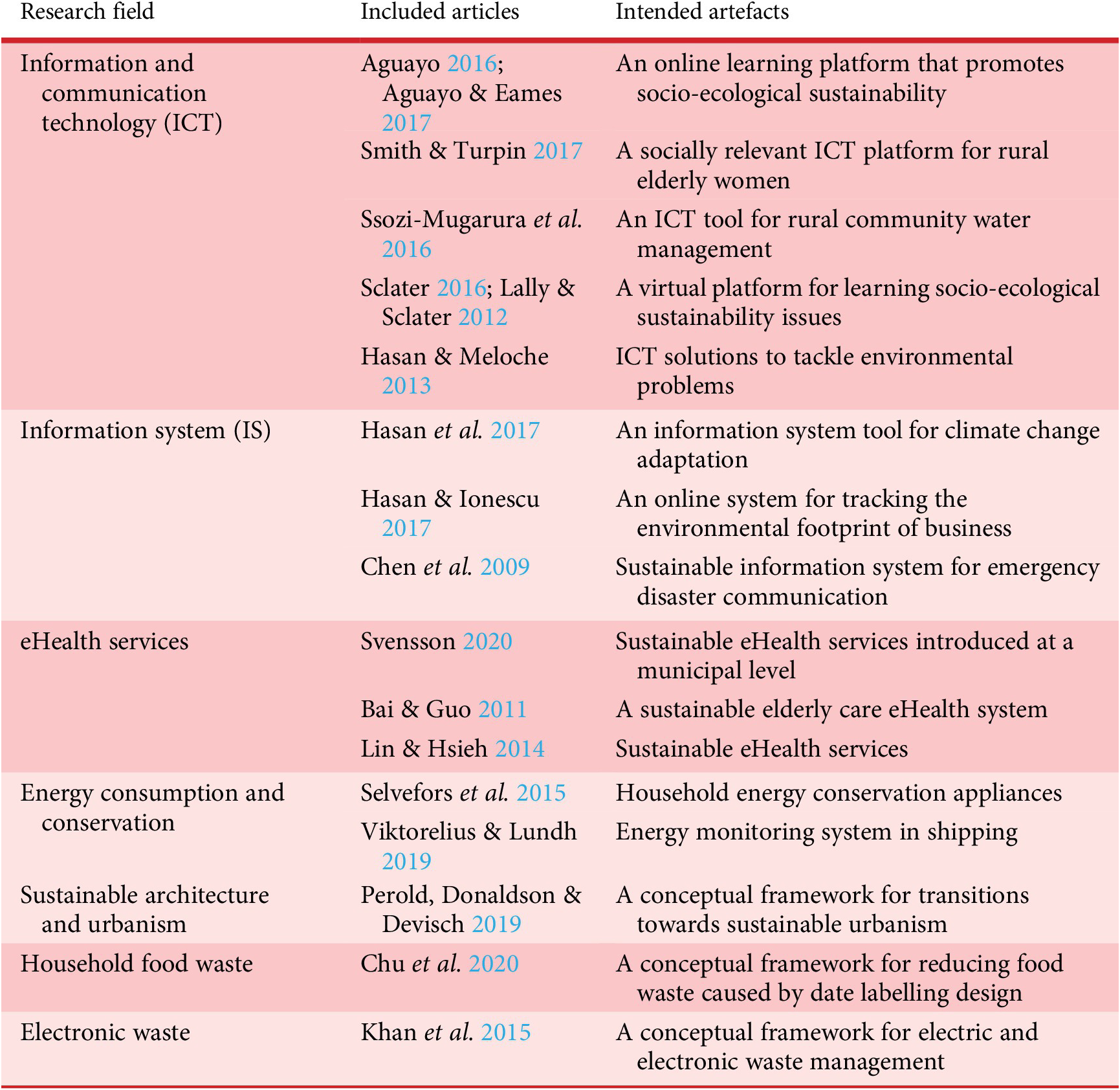
The primary theoretical understanding we used for structuring the results in this sub-category revolves around how the concept of mediating artefact may guide the design of products and services to facilitate the transformation of users’ whole activity system towards sustainability (see M-1 in Section 2.1). The results showed that all the included articles applied the theoretical principle of mediating artefact in their studies. However, the way how this principle was used varied across each study (as presented in Themes 1 and 2 in the following paragraphs). As shown in Table 6, most of the included studies propose and evaluate digital design interventions to address socio-ecological sustainability challenges, which is not surprising given that AT has already been widely applied in the research field of ICT and HCI.
The research field and intended artefacts analysed in the included primary studies
Theme 1. As presented in Section 2.1, the artefact mediation process consists of a network of interconnected mediators involving both internal and external artefacts. This concept of internal and external artefacts is applied in the identified study to inform sustainable design interventions that facilitate more fundamental behaviour transformation of users’ activity system. For example, Hasan et al. (Reference Hasan, Smith and Finnegan2017) pointed out that artefacts can influence activities in two dimensions. External tools such as computers and machines can produce changes in material dimensions, while internal tools such as signs and models can produce changes in user behaviour. Based on this understanding, they proposed a series of design interventions that involved both material and behavioural dimensions (e.g., web-based user-oriented applications with social media campaigns) for exploring potential information system design opportunities to tackle climate change adaptation challenges (Hasan & Meloche Reference Hasan and Meloche2013; Hasan et al. Reference Hasan, Smith and Finnegan2017). Moreover, with the goal to reduce date labelling-related household food waste, Chu et al. (Reference Chu, Williams, Verghese, Wever and Glad2020) applied the concept of internal and external mediating artefacts for identifying potential opportunities for design to intervene in the interaction between consumers and on-pack date labelling. The findings showed that although date labels (such as ‘Best-before’ date and ‘Use-by’ date) are used as external tools that assist consumers in judging food quality and safety, the lack of the corresponding internal mediation tool on the consumer side, such as confusion on the meaning of different types of labels, conflicts between the usage of labels and consumers’ sensory perceptions in food edibility assessment activities, can still lead to potential problems associated with household food waste in consumers’ food edibility assessment systems.
Theme 2. Studies categorized in Theme 2 also highlighted that to achieve the intended sustainable behaviour transformation, solely focusing on improving the sustainability aspects of external artefacts or interventions is likely to be insufficient, the question of how users might perceive and incorporate the introduced sustainable design intervention into their existing activity systems should also be considered. For example, Viktorelius & Lundh (Reference Viktorelius and Lundh2019) used AT to investigate the effects of a newly installed energy monitoring system on improving crew members’ shipping energy operation efficiency. The original design intention is to replace crew members’ experience-based intuitive understanding of energy efficiency with data-informed decisions. However, since the crew lacked the necessary knowledge and skills as internal mediating tools to interpret and transform the massive amount of data provided by the system into their actual work practices. As a result, the system ended up not being used by any crew members after installation. Similarly, in her investigation of the effects of a newly introduced eHealth service system, Svensson (2020) also noted that users’ lack of knowledge and skills of how to apply the new eHealth service in their existing healthcare activity systems is one of the main reasons that affect the intended sustainability effects of the design.
4.2. Directing sustainable subject–object relationships
As mentioned in Section 2.2, AT’s theoretical principle of subject–object relationships suggests that rather than taking subjects (users) and objects (motives and goals) as independent and separate components in a design process, studying the relationships between these two components within an activity system might be able to provide design researchers with a holistic lens to direct the subject to fulfill the intended objects in a sustainable way (S&O-1). In general, the review results of our study provided detailed suggestions to make this theoretical insight more specific.
Theme 1. First, to outline the causes of sustainability issues and inform sustainable design implications, the principle of subject–object relationships was used to reveal connections between subjects’ primary motives in an activity system and the corresponding sustainable or unsustainable actions that the subject performed. The most representative case of how this theoretical principle was used can be found in the study conducted by Selvefors et al. (Reference Selvefors, Karlsson and Rahe2015). By looking at household energy consumption from a goal-oriented perspective, Selvefors et al. (Reference Selvefors, Karlsson and Rahe2015) investigated why people do, or do not, prioritize energy conservation in household contexts. They indicated that people’s motives and goals in everyday life contexts can influence which activities and energy-consuming artefacts they would use. Based on this insight, they suggested that to effectively support energy conservation, only focusing on improving the energy efficiency attributes of artefacts is not enough, artefacts should also be designed to better support users in attaining their primary motives and goals in everyday life contexts.
Theme 2. When the principle of subject–object relationships was used to evaluate the sustainability effects of design interventions, findings from the meta-synthesis suggest that, in some cases, the introduced sustainable design intervention failed to achieve its anticipated outcomes as the subject lacked certain motives to adopt the design into their existing activity systems. For instance, Svensson (2020) used AT to evaluate the effects of a newly implemented eHealth service on the existing healthcare practices at a municipality level. The original object of the eHealth service was to bring economic, social and ecological sustainability to the local society. However, some healthcare workers reported that they lacked motivations to use the system in their work practices, thus leading to unwanted waste of resources. In contrast, a successful design case was reported by Aguayo (Reference Aguayo2016) and Aguayo & Eames (Reference Aguayo and Eames2017), in which an ICT platform was developed to facilitate socio-ecological behaviour transformation at a community level. In their pre-design phase, AT’s subject–object relationships enabled them to develop an in-depth understanding of the conditions of the local community and the needs of community members. Based on this understanding, the ICT platform was designed to incorporate the local socio-ecological sustainability goals into the needs of each individual in the local community. This design strategy was proven successful as participants reported that the platform prompted new motivations, which later made them take direct or indirect actions to solve the local socio-ecological issues in the community. In a similar vein, in Ssozi-Mugarura et al. (Reference Ssozi-Mugarura, Rivett and Blake2016)’s study, AT was adopted to evaluate the effects of an ICT-based mobile water management application in the context of rural communities in Uganda. The principle of subject–object relationships was used as a dimension to develop an understanding of what motivates and demotivates people in rural communities to use the application. The results showed that a close match between users’ needs and the functionality of the application created motivations for users to adopt the application and thus change their existing water management practices. In summary, the principle of subject–object relationships highlighted the importance for design researchers to understand subjects’ existing motives and goals embedded in the targeted activity system and carefully consider how sustainable design interventions can be compatible with these existing motives and goals, especially in the early-stage design process.
4.3. Uncovering tensions and contradictions of the user activity system
Theme 1. Most of the included studies categorized in Theme 1 used the theoretical principle of tensions and contradictions to reveal the existing conflicts and mismatches within and between different components of a targeted activity system. For example, as mentioned in the preceding section, Selvefors et al. (Reference Selvefors, Karlsson and Rahe2015) concluded that a variety of conflicting motives in people’s daily life contexts, such as conflicts between ensuring well-being or reducing effort, on the one hand, and reducing energy consumption, on the other hand, can hinder people from prioritizing energy conservation. In a similar vein, to understand the connection between consumers’ usage of on-pack date labels and household food waste issues, Chu et al. (Reference Chu, Williams, Verghese, Wever and Glad2020) investigated tensions and contradictions that consumers encounter when using date labels and sensory perceptions to assess food quality and safety.
Theme 2. When the principle of tensions and contradictions was used to evaluate the sustainability effects of design interventions, all the studies included in this category focused on investigating why interventions particularly designed to promote people’s sustainable behaviour failed to achieve the intended sustainability outcomes. For example, in Viktorelius & Lundh (Reference Viktorelius and Lundh2019)’s study about how a newly installed energy monitoring system onboard ships may affect the energy efficiency of crew members’ work practice operations, it was reported that although the energy monitoring system was designed to help crew members to better understand their daily work energy consumption, several existing tensions and contradictions, such as the ambiguity related to energy efficiency (tension between crew members and the newly introduced system) and lack of technical support from shore (tension between the object of saving energy and division of labour) remained unsolved. At the same time, new tensions, such as the lack of energy data analysis skills (tension between crew members and the newly introduced system) and information overload (tensions between the newly introduced system and the object of saving energy), emerged due to the implementation of the system. Similarly, in Svensson (2020)’s study about the sustainability effects of a newly developed eHealth service, it was found that although the implementation of the new service had radically changed the existing work practices conducted by health workers, however, several problems, such as the lack of proper knowledge to use the eHealth service and the concerns about healthcare resource efficiency at the municipality level, emerged when the new services were introduced to the existing healthcare activity systems. Furthermore, from an information system design perspective, Hasan et al. (Reference Hasan, Smith and Finnegan2017) used contradictions as a dimension to explore the design opportunities for tackling climate change adaptation challenges. They noted that the theoretical principle of tensions and contradictions is particularly useful for understanding the evolving nature of the human activity and how it is influenced by the evolution of technology. Furthermore, Lin & Hsieh (Reference Lin and Hsieh2014) used tensions and contractions for understanding the factors that affect the sustainability outcomes of three newly deployed telehealth service systems. Reflecting on the use of AT, they noted that the theoretical principle of tensions and contractions ‘helps to reflect on design strategies that can accommodate all interests and thus fulfill the stakeholders’ objectives and satisfy their needs’ (p. 116). Smith & Turpin (Reference Smith and Turpin2017) also pointed out that tensions and contradictions can allow researchers to identify the mismatches between the goal of the sustainable design intervention and the needs of different stakeholders in the context of an activity system.
4.4. Understanding the dynamism of user activities from a history and development perspective
As tensions and contradictions reveal how different types of conflicts manifest in the targeted activity system, the theoretical principle of history and development uncovers how subjects cope with the tensions and contradictions and how this can lead to changes in the existing activity system (see H&D-1 in Section 2.4). Findings from the reviewed study showed that this theoretical concept was used to illustrate how activity develops over time and what sustainability challenges, along with potential design opportunities, may emerge in the development process. For instance, Selvefors et al. (Reference Selvefors, Karlsson and Rahe2015) found that as participants encountered contradictions between energy conservation and other competing goals in everyday life, they had searched various strategies, ranging from increasing family members’ energy consumption awareness to investing in new household energy efficiency technologies, to better resolve the contradictions. Putting this developmental view of people’s energy consumption behaviour in longer time spam, they noted that ‘people’s energy use rarely has a purpose of its own; it is embedded in the actions and activities that form everyday life. People’s energy demanding activities thus co-evolve over time with, for instance, people’s preconditions, available technologies, the socio-cultural setting, and the goals people find relevant to pursue’ (p. 5974). In addition, the principle of history and development was also used to conceptualize people’s life event transition process. Sclater (Reference Sclater2016) designed and evaluated a virtual platform for young people to better cope with social and emotional challenges in life event transitions. In their study, the development perspective of AT was directly used to understand how the virtual platform may work as a mediating artefact for participants to form new motivations with a range of problem-solving skills, including potential skills to deal with socio-ecological sustainability challenges that they are going to face in the future.
Some of the included studies also used the principle of history and development to unfold how desired or undesired changes take place in the targeted activity system due to re-mediation (see H&D-2 in Section 2.4). Aguayo & Eames (Reference Aguayo and Eames2017), for example, noted that the implementation of an ICT platform in a community resulted in the development of a network of subsequent activities for the community members to solve the local sustainability challenges, such as adopting sustainable lifestyle at home or workplace, taking direct measures to help improve the community’s environment and educating kids about local sustainability problems (Aguayo & Eames Reference Aguayo and Eames2017). The desired sustainable behaviour changes described above were enabled by incorporating the long-term developmental perspective into the early-stage design phase of the ICT platform as Aguayo indicated ‘The EfS website was regarded then as being part of a dynamic and expansive activity system nurtured by the EfS website itself, this being one of the expected goals from the design process’ (p. 7). The importance of taking the development perspective in sustainable behaviour design explorations was also highlighted in the study conducted by Ssozi-Mugarura et al. (Reference Ssozi-Mugarura, Rivett and Blake2016), in which this theoretical principle was used to assess whether and how behaviour changes in terms of water management took place at both individual level and community level after the deployment of an ICT-based design intervention.
However, the re-mediation of activity systems does not always necessarily lead to intended sustainable behaviour changes in people’s activity systems. As mentioned previously, in Viktorelius & Lundh (Reference Viktorelius and Lundh2019)’s study, an energy monitoring system was introduced to re-mediate the relationships between crew members’ shipping operation practices and the object of improving energy efficiency. However, the system ended up not being used by any crew members and thus had no effects on crew members’ existing energy consumption behaviour. By employing the theoretical principle of tensions and contradictions with the development perspective, they found that caused by the lack of systemic understanding of crew members’ energy consumption activities in the design process, the fundamental reason for the unsuccessful behaviour transformation lies in the fact that the energy monitoring system was not designed to fit into crew members’ existing working routines in the first place.
4.5. Incorporating user activities’ socio-cultural context into sustainable design considerations
Theme 1. Results from the meta-synthesis show that when AT is used to analyse the causes for sustainability issues and inform sustainable design interventions, it can help design researchers to interpret and connect individuals’ needs in relation to the context of the targeted activity system (see SC-1 in Section 2.3). For example, in his sustainable community-based ICT platform design project, Aguayo (Reference Aguayo2016) found that individuals’ motivations for performing sustainability actions are directly related to the surrounding socio-cultural contexts. Such motivations can be more meaningful to users when they are linked with users’ socio-cultural reality. Based on this finding, he emphasized that individual users’ characteristics and needs cannot be fully understood if they were analysed separately from the social, cultural and historical context of the activity system. Khan et al. (Reference Khan, Lodhi and Akhtar2015) employed AT as a theoretical framework to solve the environmental management issues of electric and electronic waste based on AT’s particular attention on connecting individual actions to socio-cultural factors. The study results indicated that addressing complex sustainability issues requires all the relevant actors, including administrations, government agencies, business partners and individuals, to be taken into account in the problem-solving process. Moreover, they pointed out that in such problem-solving process, AT’s socio-cultural dimension can provide a theoretical basis for guiding not only the changes at the individual behaviour level but also transformation at the societal level. Furthermore, in Hasan et al. (Reference Hasan, Smith and Finnegan2017)’s study, AT was used as an analytical lens to investigate problems that existed in climate change adaptation activities. The identified problems were analysed at three levels, from global concerns to local governments’ measures to individual behaviour change. They argued that taking an activity theoretical perspective helps find the analytical balance to investigate sustainability issues between individual behaviour and the broader socio-cultural context.
Theme 2. Most of the studies in this category pointed out that the main reason for adopting AT in the design evaluation process lies in its capacity to analyse the sustainability effects of design interventions in reality-based socio-cultural contexts rather than lab settings (see SC-2 in Section 2.3). These studies indicated that the multi-level analysis informed by AT can help design researchers not only understand the effects of sustainable design interventions on individuals but also inform design opportunities regarding how the interventions might be potentially incorporated into the targeted activity system on a larger scale. For example, in their study about co-designing an ICT design intervention to empower the status of elderly women of a rural community in South Africa, Smith & Turpin (Reference Smith and Turpin2017) used AT to take the social and political dynamics of the local community into the design considerations. Their reflections showed that the theoretical principle of socio-cultural contexts helped them identify the potential impacts that unvoiced social and political issues may have on the sustainability effects of the design interventions. Lin & Hsieh (Reference Lin and Hsieh2014) adopted AT to assess the use of sustainable eHealth services in healthcare practices. They mapped the socio-cultural contexts and identified contradictions between different components of the healthcare activity system at three levels of analysis: micro-individual level, meso-group(community) level and macro-institutional level. They stressed that ‘AT helps to adequately maintain the relationship between the individual and social levels in the objects to be studied, particularly to understand emergent features in individual and social transformation’ (p. 116). Similarly, the same socio-cultural contextual mapping appeared in Ssozi-Mugarura et al. (Reference Ssozi-Mugarura, Rivett and Blake2016)’s study about evaluating an ICT-based design intervention for sustainable water management in rural communities. Drawing on their results, they noted that this mapping of socio-cultural levels provided them with the flexibility to look at different aspects of the design intervention, such as the purpose that the design intervention serves, the users, the context that the user situates in and the relationship between the above three aspects.
5. Discussion
Building upon the meta-synthesis results presented above, in the discussion part, first, we summarize the key insights extracted from the results to answer the RQ1: how have AT and its theoretical principles been applied in existing studies to guide the empirical analysis and design explorations for tackling design-related sustainability challenges? After that, we focus on synthesizing AT-based theoretical and practice-relevant design implications to address the RQ2: how might the findings be translated to theoretical and practice-relevant implications for design researchers in the DfSB field to apply?
5.1. AT as a systemic approach for guiding empirical analysis and design explorations to cope with complex sustainability challenges
As presented in the result section, many included studies pointed out that the AT lens can guide the development and evaluation of design interventions to accommodate the complexity of sustainability challenges. This capacity of coping with complex sustainability phenomena is one of the main reasons for authors in some of the included studies to select AT as the overarching theoretical perspective in the design research process. For instance, Hasan & Meloche (Reference Hasan and Meloche2013) noted that ‘AT supports a holistic perspective which can be used to address wicked problems such as climate change and other complex environmental challenges so that more innovative solutions can be found’ (p. 336). The complexity of sustainability challenges comprises not only the technical aspect, such as the usability and applicability of the design intervention for enabling subjects to fulfill a specific object, but also the social aspects of design, such as the relationships between different actors involved in an activity system and the actual implementation of the introduced design intervention in real socio-cultural environments. For instance, Lin & Hsieh (Reference Lin and Hsieh2014) and Svensson (2020) adopted AT to model how coordination between different stakeholders, objectives, environments, tools and outcomes form a complex activity system that may affect the sustainability of the newly implemented eHealth system. Aguayo (Reference Aguayo2016) and Smith & Turpin (Reference Smith and Turpin2017) evaluated how local community members used ICT platforms to solve sustainability issues in their real social-cultural contexts.
Reflections from the included studies showed that, when being used in design, AT can provide design researchers with a systemic approach for understanding the complex socio-technical sustainability challenges. Aguayo (Reference Aguayo2016), for example, pointed out in their design process that ‘a dilemma arose in how to make sense of data comprising social, cultural, educational, ecological and technological components, while embracing a systems thinking approach. It is in this context that AT provided conceptual elements in the form of a meta framework that informed and guided data analysis and sense-making’ (p. 4). Khan et al. (Reference Khan, Lodhi and Akhtar2015) also noted that when facing complex electric and electronic waste management issues, AT’s particular strengths in problem modeling and solution modeling can guide design researchers to find a design solution at a system level to ‘deal with broad spectrum instead of finding short-sighted technical solutions’ (p. 87). Furthermore, in Aguayo (Reference Aguayo2016) and Hasan et al. (Reference Hasan, Smith and Finnegan2017)’s study, AT was applied in combination with complexity theory to develop an in-depth understanding of how system behaviour emerges through the interaction of a number of interrelated components. They indicated that AT works as a useful theoretical lens to interpret sustainability phenomena in complex socio-technical contexts.
Moreover, we also found that AT’s emphasis on higher level motive-oriented activities is particularly helpful for uncovering the interdependency of different components at an activity system level. For instance, Lin & Hsieh (Reference Lin and Hsieh2014) noted that ‘AT is suitable for understanding the design and analysis of complex systems, such as service innovation, in which it strongly emphasizes the interactions between subjects with different environments to achieve their objects and result in different outcomes’ (p. 116). Selvefors et al. (Reference Selvefors, Karlsson and Rahe2015) also concluded that AT’s particular focus on how people carry out their actions and activities can help researchers become more aware of the complexity embedded in people’s everyday life energy consumption practices: ‘Instead of exploring energy behaviours and their determinants in isolation from each other, it could be beneficial to study people’s actions in relation to other actions and everyday priorities with which they coexist, interact, and compete’ (p. 5965).
Furthermore, AT’s theoretical principle of history and development is another feature that allows design researchers to view users’ activity systems as a changing entity and develop sustainable interventions that keep evolving with users’ activity systems. For example, Bai & Guo (Reference Bai and Guo2011) suggested that a key factor in achieving system sustainability in eHealth solutions is allowing eHealth services to continuously evolve to integrate new users and applications into the system. In a similar vein, Viktorelius & Lundh (Reference Viktorelius and Lundh2019) used AT to examine the situated complexities that emerged in crew members’ shipping practices by investigating how the existing energy operation may undergo a transformation process when a new energy monitoring system was introduced. The reflection from both studies showed that AT can direct design researchers’ attention towards the dynamism of the targeted activity system that changes over time rather than viewing activity as a static frame. A summary of how the key AT theoretical principles are employed for guiding empirical analysis and design explorations in the included primary studies can be found in Table 7.
Activity theory’s key theoretical principles and their applications summarized from the results of the meta-synthesis

5.2. Theoretical implications: design for sustainable activity
As indicated in the preceding section, AT focuses on understanding the interaction between users and artefacts in a broader context: users’ activity systems. Building upon this theoretical nature of AT, findings from this study reveal that when AT was used to analyse the causes of sustainability issues or evaluate the effects of sustainable design interventions, its unique strength lies in its capability to incorporate the complex spatial and temporal context of users’ activity systems into the design process. More precisely, all the reviewed articles take the entire activity system, which comprises three dimensions as an integrated unit of analysis.
(i) The fundamental constituents of the activity system including subjects, objects and mediating artefacts.
(ii) The dynamic development and transformation of the relations between subjects, objects and mediating artefacts over time.
(iii) The relations between these constituents in different levels of analysis, including individual, collective and socio-cultural levels.
These three dimensions also indicate that AT treats design for sustainability-related challenges as wicked problems that are complex and keep evolving. Solving these problems would require a network of interrelated design solutions (Bennett, Cassim & van der Merwe Reference Bennett Cassim and van der Merwe2017). In response to the dimensions presented above, a key insight extracted from our results is that the AT theoretical lens can enable design researchers to navigate their sustainable design solutions based on the following analytical perspectives:
(i) Mediating subject–object relationships in a sustainable direction.
(ii) Moving from focusing on static behaviour to dynamic activities.
(iii) Analyzing individual behaviour at different socio-cultural levels.
Furthermore, to highlight the unique theoretical contribution of AT lens, it makes sense to compare and differentiate the theoretical features of AT from the other theoretical lenses used in the field. As indicated in the introduction section, the field of DfSB is evolving. The widely adopted behaviour-based theoretical lens might not be sufficient to deal with the challenges that recently emerged in the field. Therefore, revealing the differences and overlaps between the two theoretical perspectives can allow us to better discuss the potential strengths and limitations that the AT theoretical lens might be able to bring to the DfSB field.
The behaviour-based lens explicitly focuses on analyzing the interaction between users and artefacts and the corresponding sustainable or unsustainable behaviour generated from the interaction (Tromp Reference Tromp2013; Kuijer Reference Kuijer2014). As illustrated in Figure 5, the analysis is often conducted by first deconstructing a system into different elements (e.g., user behaviour and attributes of artefact) and then making inferences about the relations between a specific user behaviour and a specific attribute of the designed artefact (Jackson et al. Reference Jackson, Begg, Darnton, Davey, Dobson, Ekins, Garnett, Gatersleben, Hallsworth, Holdsworth, Jacobs, Jager, Jones, Lee, Leveson-Gower, Levett, Lucas, Manoochehri, Massey, Michaelis, Palmer, Pepper, Pomfret, Restorick, Rutter, Ryder, Shaxson, Stagl and Uzzell2005). The goal for design thus is either to promote a specific desired user behaviour or to change an undesired and unsustainable behaviour of the user (Niedderer et al. Reference Niedderer, Cain, Clune, Lockton, Ludden, Mackrill and Morris2014). To achieve this goal, behaviour change models are adopted and adapted in design to help researchers and practitioners identify how relevant behaviour determinants can influence the targeted behaviour. Consequently, in some cases, it can be argued that it is these design strategies and techniques that are imposed on the artefact, rather than the design of the artefact itself, that creates sustainability effects on users’ behaviour.
The focus of behaviour-based lens in DfSB.

By contrast, according to Kaptelinin & Nardi (Reference Kaptelinin and Nardi2006), when it comes to forming design solutions, an AT theoretical perspective often suggests that ‘the attributes of individual components are of little consequence when the components are integrated within a higher-level unit’ (p. 40). Building upon this argument, findings from this study also show that when AT is specifically applied to address design and sustainability issues, it views sustainability as a system property embedded in the complex socio-technical context of people’s everyday life rather than an independent element or attribute added onto the designed artefact. It implies that the socio-ecological impacts of a product and service should not be oversimplified and interpreted as a sum of users’ sustainable or un-sustainable behaviour. Rather, the human activity, that is, the need-based artefact-mediated interaction of users (subjects) with the world (objects), should be taken as the fundamental unit of analysis for design to understand and tackle the complex sustainability challenges. In other words, while the behaviour-based lens focuses on designing the attributes of an artefact in a way to adapt user behaviour to a set of specific pre-defined sustainability standards, the AT-based lens takes a bottom-up approach and asks: how the users’ activity system can be improved by the design of artefacts towards achieving sustainability goals.
Note that despite the behaviour-based lens, the use of practice theory in Design for Sustainability studies has also gained increasing interest in the recent decade. A holistic comparison between the behaviour-based lens, the practice-based lens and the activity-based lens can be found in Daae (Reference Daae2014) and Selvefors (Reference Selvefors2017). However, given the primary scope of this study, we only intend to compare the AT lens with the behaviour-based lens. It is worth mentioning that the intention behind the comparison presented here is not to argue which theoretical lens is more applicable or useful. Instead, the goal of the comparison is to better discuss the potential strengths and limitations of AT. In this regard, Table 8 summarizes the differences and overlaps between the behaviour-based lens and the AT-based lens.
Differences and overlaps between the behaviour-based lens and the AT-based lens

5.3. Practice-relevant design implications regarding the use of AT theoretical lens in DfSB
Given the theoretical implications of AT for sustainable behaviour design presented above, in the following sections, we intend to translate the AT-based theoretical insights described in Tables 7 and 8 into practice-relevant design implications.
Mediating subject–object relationships towards a sustainable direction
In line with the theoretical nature of AT, results from this meta-synthesis confirmed that taking activity as the basic unit of analysis can help design researchers expand their analysis scope from users’ behaviour generated in the interaction with single products or services to users’ meaningful motive-oriented activities. Although users’ interaction with specific artefact inevitably influences the sustainable or unsustainable behaviour of individual users, from the perspective of AT, such interaction is not the root cause of sustainability issues. Instead, many studies included in this meta-synthesis argued that the way how the subjects use different artefacts as mediating tools to fulfill their objects/goals is what lies behind the sustainability issues. To be more specific, as illustrated in Figure 6, how a user carries out an activity is governed by the needs and objects that the user has within the activity system. In most cases, multiple needs and objects may co-exist within the user’s activity system (presented as need-a to need-c and object-1 to object-3 in Figure 6). A successful sustainable design intervention thus needs to aim to facilitate the user to couple a specific need with a desired sustainability-related object (see Figure 6). The study conducted by Selvefors et al. (Reference Selvefors, Karlsson and Rahe2015) on people’s energy consumption behaviour in household laundry activities can be used here as an example to better illustrate this argument. An individual may have different general needs such as wearing clean and dry clothes. At the same time, the individual also may have various context-specific objects such as limiting the time spent in laundry, reducing energy consumption during laundry, increasing comfort and reducing effort. A washing machine with a quick eco-draining mode thus may have a higher possibility to facilitate the user to effectively connect their needs of getting clean and dry clothes to the objects of reducing energy consumption and limiting the time and effort spent in laundry activities. Incorporating this insight with the theoretical implications on how to design for users’ sustainable activity presented in the preceding section, we argue that if a sustainable design intervention does not fit into the needs and objects of the user’s activity systems, it would only lead to limited desired sustainability effects on users’ behaviour.
AT’s view of mediating subject–object relationships towards a sustainable direction.

However, taking activity as the basic unit of analysis does not necessarily mean that users should be de-centralized in the design process. After all, the user-centered design (UCD) approach is what underpins the development of the DfSB field (Wever et al. Reference Wever, van Kuijk and Boks2008). In AT, Don Norman noted ‘a deep understanding of people is still a part of activity-centered design. But activity-centered design is more: It also requires a deep understanding of the technology, of the tools, and of the reasons for the activities’ (Norman Reference Norman2005, p. 16). In other words, AT’s theoretical principles of subject–object relationships and mediating artefacts suggest that a user is more than just an individual who use the designed artefacts, as illustrated in Figure 6, the user should be regarded as a participant in different activities which are socially constructed and developing over time (Williams Reference Williams2009). Since products and services solely driven by user needs may end up in rapid obsolescence (Blevis Reference Blevis2006), AT’s primary focus on activity might shed some light on balancing the relations between users’ needs and sustainability aspects of the corresponding activity system. In summary, we suggest that AT can bring the analytical strength for design researchers and practitioners to:
Implication 1. Inform design interventions that take both the technological/functional aspects of design and the behaviour impacts on users into consideration, thus improving both the artefacts’ performance and the user behaviour associated with the use of the artefact in users’ activity system.
Implication 2. Incorporate design interventions into users’ existing motives and goals in the targeted activity system, evaluate the extent to which the proposed design intervention might facilitate or constrain the users to attain their primary motives and goals in the targeted activity system.
Temporal lens: moving focus from users’ static behaviour to dynamic activities
As mentioned in the preceding section, AT emphasizes the importance of understanding the dynamism of an activity system rather than viewing it as a static construct (Kaptelinin et al. Reference Kaptelinin, Nardi and Macaulay1999; Döweling, Schmidt & Göb Reference Döweling, Schmidt and Göb2012). In the view of AT, behaviour transformation often occurs when subjects attempt to find temporary solutions to address tensions and contradictions that emerged in the activity system. The transformation process does not follow a linear fashion; instead, it follows a cyclical pattern (Blackler et al. Reference Blackler, Crump and McDonald1999). As tensions and contradictions manifest themselves in the activity system, subjects would then search for tentative solutions such as improvising the use of artefacts or adjusting the original objects and goals to solve these tensions and contradictions. The solutions that the subjects developed may also bring new tensions and contradictions to the activity system. Therefore, sustainability problems in an activity system cannot be fully understood without analyzing how the activity has developed into the present form. Since artefacts used in an activity system carry with them the socio-cultural knowledge of the past and also reflect the problems of the present (Kuutti Reference Kuutti2011), insights generated from AT’s temporal lens thus may help to inform design implications to address the long-term dynamic sustainability challenges embedded in people’s activity system.
Looking at sustainable behaviour design from the temporal lens that AT offers, we suggest that a successful sustainable design intervention needs to co-evolve with the activity system. We suggest that AT’s temporal lens can bring the analytical strengths for design researchers and practitioners to:
Implication 3. Investigate what sustainability-related problems and design opportunities may emerge as users cope with the existing tensions and contradictions in their activity systems. This understanding can help locate the appropriate window of opportunity for design to intervene in the targeted activity system.
Implication 4. When facing the window of opportunity, new motivations, along with new tensions and contradictions, may emerge as the design intervention is introduced to the existing activity system. A successful sustainable design intervention thus needs to consider its potential influences on both the present and the subsequent activities the user may carry out.
Implication 5. Explore design inspirations by learning from how the activity was carried out in the past.
Implication 6. Identify the potential conflicts that the user may encounter in the existing form of the activity and the anticipated more sustainable version of the activity.
Spatial lens: analyzing individual behaviour at different socio-cultural levels
The meta-synthesis results show that when used for addressing design ad sustainability challenges, the spatial lens of AT can enable design researchers to understand people’s sustainable or unsustainable doings in real-life contextual settings rather than task-based laboratory settings. This theoretical feature provides two strengths for analyzing complex DfSB issues.
First, it positions individuals’ behaviour in the higher level meaningful contexts of an activity system and connects individual users with other artefacts and other people in their socio-cultural contexts. As Kaptelinin & Nardi (Reference Kaptelinin and Nardi2012) highlighted that ‘individual human person does not disappear in AT; rather, this person is defined – through the principles of mediation, development, and internalization–externalization – indivisibly in relation to culture and other people’ (p. 74), our results also show that individuals’ sustainability-related motivations behind an activity system are often directly related to their socio-cultural contexts, making such motivations meaningful to the individual thus might facilitate the transformation of the entire activity system towards sustainability.
Second, the causes of sustainability issues are always interconnected across different levels: product level, product-service system, spatio-social level and socio-technical system level (Ceschin & Gaziulusoy Reference Ceschin and Gaziulusoy2016). In this respect, AT’s spatial lens can help design researchers and practitioners to zoom in and zoom out to find the most appropriate level of analysis that fits the particular goal of each specific design project. At the same time, it also allows design researchers and practitioners to envisage and evaluate the potential impacts of the proposed sustainable design intervention beyond individual users at a broader socio-cultural level. In summary, looking at sustainable behaviour design from the spatial lens of AT, we suggest that AT can provide design researchers and practitioners the analytical strength to:
Implication 7. Identify the contradictive motives of different actors involved in the targeted activity system and their impacts on the sustainability outcomes of the activity system. Formulate sustainable design strategies that accommodate the needs and objects of different actors involved in the targeted activity system.
Implication 8. Zoom in and zoom out to analyse the sustainability impacts of the targeted activity system at different levels ranging from individual behaviour to socio-cultural contexts. Uncover how different components of the targeted activity system such as motives and the use of mediating artefacts link to the broader socio-ecological sustainability concerns.
Implication 9. Analyse the effects of sustainable design interventions at an individual level, at the same time, considering how the interventions might be incorporated into the targeted activity system on a larger scale.
Implication 10. Envisage how the proposed design intervention might lead to desired or undesired changes associated with the sustainability challenges at the individual, collective and societal levels in the user activity system.
Figure 7 provides a visual presentation of the three analytical dimensions and the corresponding practice-relevant design implications inspired by the AT theoretical lens. These implications have the potential to be used in designers’ early-stage ideation process to understand empirical phenomena and generate initial sustainable design concepts that take users’ dynamic and complex activity systems into account. Following the conceptual framework for generating sustainable behaviour-based intervention design developed by Lambe et al. (Reference Lambe, Ran, Jürisoo, Holmlid, Muhoza, Johnson and Osborne2020), we believe the theoretical and practice-relevant implications developed in this study can be useful to be applied in the first three stages of the sustainable design intervention process – defining the sustainability problem area, identifying the underlying causes of the problem and mapping the entire system.
A visual presentation of activity theory’s three analytical dimensions and the corresponding practice-relevant design implications.

5.4. Limitations of the study
Some limitations of the study should be noted. First, in terms of the meta-synthesis results, 18 articles were included in the final synthesis stage. This sample size might be considered small; however, these articles were carefully screened and assessed based on a systematic selection process. Totally, 621 articles were identified in the initial literature search phase. They were later excluded in a rigorous literature selection process. The limited number of the included articles in a way reflects the rigidness of the study.
Second, in Section 5.2, when comparing an AT-based theoretical perspective with a behaviour model-based theoretical perspective, questions such as which theoretical perspectives are more effective when used for sustainable product and service design may arise. We hold the opinion that there is no universal answer to this question. Instead, it depends on the research scope and focuses of each design project. For example, if a project aims to improve the design of a specific artefact to change an un-sustainable behaviour, the behaviour model-based perspective would be more appropriate as it has a particular focus on identifying and addressing the sustainability problems caused by the interaction between the user and the specific attributes of the artefact. By contrast, if a project centres around how to shape or re-design the way that users carry out a specific doing in an everyday life context, for example, changing individual’s unsustainable energy or food consumption doings or facilitating community’s ecological actions, the AT-based theoretical perspective would be a more suitable candidate for guiding the empirical analysis and design explorations. Furthermore, the behaviour model-based perspective and AT-based perspective are not entirely incompatible with each other. Both theoretical perspectives originated from psychology and were later adopted and adapted in product and service design. More importantly, both theoretical perspectives are established on the user-centred design approach and emphasize the importance of understanding human-product interaction as the prerequisite for sustainable behaviour design. It may be interesting from a design research perceptive to explore the possibility of integrating these two theoretical lenses into one unified sustainable design strategy; however, it is out of the scope of this paper to discuss this point.
6. Conclusions and future work
This paper explores the use of AT as a potential lens for guiding empirical analysis and design explorations in DfSB studies. In doing so, we presented a meta-synthesis of design for sustainability relevant articles that draw on AT. We found that AT was employed in the included studies to (a) outline causes of sustainability issues and inform concepts of sustainable design interventions and (b) evaluate the effects of design interventions on solving the identified sustainability challenges. Furthermore, we found that a potential match between AT’s key theoretical principles and their capabilities in solving current challenges that emerged in the field of DfSB do exist. Consequently, we proposed AT-based theoretical and practice-relevant implications based on our reflections on the analysis of the meta-synthesis results.
The present study contributes to the DfSB field by investigating the potential use of AT as a guiding theoretical perspective. The key message of the study is that shifting focus from user behaviour to user activity can enable design researchers to take activity as a unit of analysis and incorporate the long-term dynamic, multi-level and complex user behaviour phenomena into product and service design considerations. Furthermore, we find that three key theoretical dimensions of AT: mediating subject–object relationships, temporal lens and spatial lens are especially useful for supporting design researchers in better framing and addressing design challenges concerning users’ sustainable behaviour in the context of users’ activity systems. Finally, we summarized the abstract theoretical insights into ten practice-relevant design implications, which can be further developed into more concrete activity-centred sustainable design strategies in the future work.
Despite the rich theoretical nature and a potential match to solving the current challenges faced by the DfSB field, AT still provides little support for assisting designers in their real design practices. Therefore, we suggest that future work should investigate how to enable design practitioners with limited or no prior knowledge of AT to apply the theoretical lens in their design practices. More research is needed to better incorporate AT’s theoretical concepts and principles into more descriptive design solutions. One option we are currently exploring is incorporating the AT theoretical and practice-relevant implications proposed in this study into a toolkit for designers to use in their early-stage ideation process. Following this option, the next step is to develop, test and validate a framework and a toolkit based on insights from some of our case studies which adopt AT as the main theoretical lens in DfSB.
Acknowledgments
The corresponding author’s research in this paper is supported by the Division of Product Realisation at Linköping University in Sweden and a scholarship from the China Scholarship Council.
Competing interests
The authors declare none.
Supplementary Materials
To view supplementary material for this article, please visit http://dx.doi.org/10.1017/dsj.2021.17.


 Open access

