





Introduction
Cover crops (CCs) are increasingly integrated into crop production systems to improve soil health, reduce nutrient losses, and suppress weeds (Blanco-Canqui Reference Blanco-Canqui2023; Wallander et al. Reference Wallander, Smith, Bowman and Claassen2021). Among these functions, weed suppression is one of the most immediately observable benefits to producers and has gained importance as the number of herbicide-resistant weeds continues to increase across the United States (Kumar et al. Reference Kumar, Obour, Jha, Manuchehri, Dille, Holman and Stahlman2020, Reference Kumar, Singh, Thapa, Yadav, Blanco-Canqui, Wortman, Taghvaeian and Jhala2025a). CCs compete with weeds for essential resources such as water, nutrients, space, and light and can modify soil temperature and reduce weed germination and growth (Mirsky et al. Reference Mirsky, Ryan, Teasdale, Curran, Reberg-Horton, Spargo, Wells, Keene and Moyer2017; Silva and Bagavathiannan Reference Silva and Bagavathiannan2023; Smith et al. Reference Smith, Atwood, Pollnac and Warren2015). Moreover, the allelopathic potential of certain CC species is well documented (Otte et al. Reference Otte, Rice, Davis, Schomberg, Mirsky and Tully2020; Silva and Bagavathiannan Reference Silva and Bagavathiannan2023; Sturm et al. Reference Sturm, Peteinatos and Gerhards2018). Furthermore, CC can reduce the number of weeds exposed to herbicides, thereby reducing the selection pressure for the evolution of herbicide-resistant weeds (Bunchek et al. Reference Bunchek, Wallace, Curran, Mortensen, VanGessel and Scott2020; Hand et al. Reference Hand, Randell, Nichols, Steckel, Basinger and Culpepper2021; Kumar et al. Reference Kumar, Obour, Jha, Manuchehri, Dille, Holman and Stahlman2020).
The success of CCs as a weed management tool, however, largely depends on the biomass attained at the time of termination, which in turn is strongly influenced by termination timing and environmental conditions (Kumar et al. Reference Kumar, Singh, Thapa, Yadav, Blanco-Canqui, Wortman, Taghvaeian and Jhala2025a; Nichols et al. Reference Nichols, Martinez-Feria, Weisberger, Carlson, Basso and Basche2020; Osipitan et al. Reference Osipitan, Dille, Assefa, Radicetti, Ayeni and Knezevic2019; Weisberger et al. Reference Weisberger, Bastos, Sykes and Basinger2023). Delaying termination allows additional growing degree days, thereby promoting greater CC biomass production (Kumar et al. Reference Kumar, Singh, Flessner, Reiter, Kumari, Price, Kuhar and Mirsky2025b; Mirsky et al. Reference Mirsky, Curran, Mortensen, Ryan and Shumway2011). However, later termination can delay cash crop planting, potentially compromising stand establishment and yield (Balkcom et al. Reference Balkcom, Duzy, Kornecki and Price2015; de Sanctis and Jhala Reference de Sanctis and Jhala2025; Nunes et al. Reference Nunes, Wallace, Arneson, Johnson, Young, Norsworthy, Ikley, Gage, Bradley, Jha, Lancaster, Kumar, Legleiter and Werle2024; Reed et al. Reference Reed, Karsten, Curran, Tooker and Duiker2019). Identifying management strategies that extend CC growth and maximize biomass without hindering timely planting of the subsequent crop is therefore essential for optimizing the balance between CC benefits and crop production risks.
One practice that has gained increasing attention is “planting green” (PG), which involves planting the main crop into a living CC stand and terminating the CC at or after crop planting. This practice effectively extends the CC growth period without delaying cash crop establishment, offering a means to achieve higher biomass and potentially greater weed suppression (Dearden Reference Dearden2022; Grint et al. Reference Grint, Arneson, Arriaga, DeWerff, Oliveira, Smith, Stoltenberg and Werle2022; Stephens et al. Reference Stephens, Blanco-Canqui, Knezevic, Rees, Kohler-Cole and Jhala2024). For instance, Stephens et al. (Reference Stephens, Blanco-Canqui, Knezevic, Rees, Kohler-Cole and Jhala2024) reported 12,032 kg ha−1 of cereal rye (Secale cereale L.) biomass when terminated 2 wk after soybean [Glycine max (L.) Merr.] planting compared with 2,350 kg ha−1 when terminated 2 wk before soybean planting in Nebraska. This increase in biomass has translated into improved weed suppression. Nunes et al. (Reference Nunes, Wallace, Arneson, Johnson, Young, Norsworthy, Ikley, Gage, Bradley, Jha, Lancaster, Kumar, Legleiter and Werle2024) found 33% reductions in Amaranthus spp. weed density with PG compared with termination of cereal rye 2 wk before soybean planting.
PG can sometimes result in reduced yield due to early-season competition for moisture and/or nutrients, challenges with crop stand establishment requiring knowledge of planting equipment settings, allelopathic effects, or other environmental interactions (Almeida et al. Reference Almeida, Robinson, Matthiesen-Anderson, Robertson and Basche2024; de Sanctis and Jhala Reference de Sanctis and Jhala2025; Grint et al. Reference Grint, Arneson, Arriaga, DeWerff, Oliveira, Smith, Stoltenberg and Werle2022; Liebl et al. Reference Liebl, Simmons, Wax and Stoller1992). For example, Liebl et al. (Reference Liebl, Simmons, Wax and Stoller1992) documented a 21% soybean yield reduction due to reduced soybean stand count when cereal rye was terminated at soybean planting compared with termination 2 wk earlier, likely due to incorrect planter settings. Similarly, Grint et al. (Reference Grint, Arneson, Arriaga, DeWerff, Oliveira, Smith, Stoltenberg and Werle2022) observed a 22% corn (Zea mays L.) yield reduction at one site when cereal rye was terminated after planting due to reduced nitrogen availability, although no yield differences occurred at another site. In contrast, some studies have reported neutral effects of PG on crop yield (Reed et al. Reference Reed, Karsten, Curran, Tooker and Duiker2019; Ruis et al. Reference Ruis, Blanco-Canqui, Jasa, Slater and Ferguson2023).
The variability in yield response to PG highlights that agronomic outcomes are highly context dependent, influenced by interactions among CC growth, soil moisture, nutrient availability, and management practices among others (Blanco-Canqui and Jhala Reference Blanco-Canqui and Jhala2024). Actively growing CCs can deplete soil moisture by extracting water from the soil profile, which may result in moisture stress for cash crops during critical periods of germination and early seedling establishment, particularly in dryland systems (Blanco-Canqui Reference Blanco-Canqui2023; Mendis et al. Reference Mendis, Udawatta, Anderson, Nelson and Cordsiemon2022). However, following CC termination, the retained surface residue can reduce soil evaporation and help conserve soil moisture during early cash crop growth (Blanco-Canqui Reference Blanco-Canqui2023; Chakraborty et al. Reference Chakraborty, Singh, Singh and Kumar2022). This balance between early-season moisture competition and post-termination moisture conservation underscores the importance of integrating PG within regionally adapted management systems. In Nebraska, which is one of the leading states in irrigated corn–soybean production systems (USDA-NASS 2023), supplemental irrigation could potentially mitigate moisture competition issues common in dryland production, providing a more favorable environment for achieving high CC biomass and stable yields. However, empirical evidence for performance of PG approach under irrigated conditions is limited.
While the agronomic outcomes of PG are variable and context dependent, economic considerations remain central to grower decision-making. Farm profitability is often the most critical factor influencing the adoption of CCs (Bergtold et al. Reference Bergtold, Ramsey, Maddy and Williams2019; Blanco-Canqui Reference Blanco-Canqui2023; Duzy et al. Reference Duzy, Price, Balkcom and Aulakh2016). The costs of CC seed, planting and termination, potential yield losses, and management complexity is weighed against benefits resulting from reduced weed pressure, reduced herbicide input and application cost, and potential long-term soil health and other benefits. Few studies, however, have comprehensively evaluated how PG interacts with herbicide programs to influence both agronomic and economic outcomes in corn production systems.
Moreover, most prior PG research has defined CC termination timing based on fixed calendar intervals (e.g., 1 or 2 wk after planting) (Almeida et al. Reference Almeida, Robinson, Matthiesen-Anderson, Robertson and Basche2024; Stephens et al. Reference Stephens, Blanco-Canqui, Knezevic, Rees, Kohler-Cole and Jhala2024). Aligning termination timing with specific corn growth stages may offer a more practical and agronomically relevant framework for field implementation. Given that cereal rye is the predominant CC species in Nebraska (Oliveira et al. Reference Oliveira, Butts and Werle2019) and corn is the dominant cash crop, this study was conducted to evaluate the effects of cereal rye termination timing under a PG system and varying herbicide programs on cereal rye CC biomass accumulation, weed suppression, corn yield, and economic returns under irrigated conditions in Nebraska. By linking termination timing with both agronomic and economic outcomes, this study aims to provide region-specific recommendations to guide the adoption of integrated CC and herbicide management strategies for sustainable weed management and profitable corn production.
Materials and Methods
Study Location
The field experiments were conducted from October 2023 to October 2025 at the University of Nebraska–Lincoln’s South Central Agricultural Laboratory near Harvard, NE (40.52°N, 98.05°W). The soil at the site was a Hastings silt loam (fine, smectitic, mesic Udic Argiustolls, 58% silt, 17% sand, 25% clay), with 3.4% soil organic matter and a pH of 6.8. The field was managed under a linear sprinkler-irrigated no-till corn–soybean rotation before the study and was transitioned to no-till continuous corn during the study period. The experimental site had a natural population of glyphosate-resistant Palmer amaranth (Amaranthus palmeri S. Watson), ensuring uniform weed pressure across treatments.
Experiment Design and Study Establishment
The experiment was arranged in a completely randomized split-plot design with four replications and repeated in time. The main plot factor was cereal rye termination timing at different five corn growth stages, including: (1) planting (VP), (2) emergence (VE), (3) first collared leaf (V1), (4) second collared leaf (V2), (5) third collared leaf (V3), and (6) no CC (NCC). The subplot factor was four herbicide programs: (1) nontreated, (2) preemergence-only, (3) postemergence-only, (4) preemergence followed by (fb) postemergence (PP). The individual main plot size was 12 m by 7 m and subplot size was 3 m by 7 m. Herbicides used for preemergence-only treatment were acetochlor + mesotrione + clopyralid (Resicore® XL), postemergence-only were Resicore® XL + glyphosate (Roundup PowerMax® 3) and preemergence fb postemergence were Resicore® XL fb Roundup PowerMax® 3 + glufosinate (Liberty®) (Table 1). Postemergence-only and PP treatment included crop oil concentrate (10 ml L−1) + liquid ammonium sulfate (30 ml L−1). Herbicide use rates, manufacturers, and active ingredients are listed in Table 1.
List of herbicide products, their active ingredients, application rates, estimated cost, and manufacturer used for the experiments conducted near Harvard, NE in 2024 and 2025.

a Herbicide cost was averaged from three Nebraska retailers: Central Valley Ag Cooperative, Frontier Cooperative, and Nutrien Ag Solutions.
Cereal Rye Planting and Termination
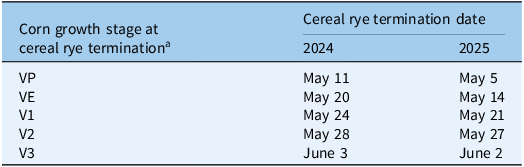
Cereal rye (‘Elbon’, Green Cover Seed, Balden, NE) was planted on October 23, 2023, and October 24, 2024. In both years, cereal rye was drilled at a 90 kg ha−1 seed rate under no-till conditions at 2.5-cm depth and 19-cm row spacing using a no-till drill. Cereal rye was terminated at each termination timing treatment using glyphosate (Roundup PowerMax® 3) at 1,343 g ae ha−1 + crop oil concentrate (10 ml L−1) + liquid ammonium sulfate (30 ml L−1). Cereal rye termination date for each termination timing for each year is provided in Table 2.
Cereal rye cover crop termination dates for different termination timings for field experiments conducted in 2024 and 2025 near Harvard, NE.

a Abbreviations: VP, corn planting; VE, corn emergence; V1, first collared leaf; V2, second collared leaf; V3, third collared leaf.
Corn Planting and Management
Corn (NK1354–DV–EZ1, NK Seeds, Syngenta, Greensboro, NC) was planted using a four-row planter on May 11, 2024, and May 5, 2025, at 87,000 seeds ha−1, 4.4-cm depth, and 76-cm row spacing. The corn hybrid planted was glyphosate and glufosinate resistant. Preemergence herbicide was applied on May 11, 2024, and May 5, 2025. The postemergence herbicides were applied on June 20, 2024, and June 18, 2025. All the herbicide applications were made using a CO2-pressurized backpack sprayer fit with an XR 11002 five-nozzle boom, spaced 50.8 cm apart. The spray boom was delivering 140 L ha−1 spray mix at 276 kPa. Corn was fertilized with 200 kg N ha−1. The fertilizer was applied in a three-split application: 160 kg N ha−1 injected in soil in mid-April as anhydrous ammonia, 10 kg N ha−1 as starter fertilizer in form of 10-34-0 at corn planting, and 30 kg N ha−1 in mid-June as liquid urea ammonium nitrate (300 g N kg−1) when corn was at V6-V7 growth stage. Corn was irrigated six times with a total of 182.3 mm of water during the 2024 season, and five times with a total of 137.4 mm water during 2025 (Table 3).
Mean air temperature, precipitation, and irrigation application for each month from beginning of experiment (October 2023) to end of experiment (September 2025) near Harvard, NE.

Data Collection
Cereal rye aboveground biomass was collected at each termination timing by randomly placing a 1.0-m2 quadrat within the plot. Samples were oven-dried at 60 C for 1 wk and weighed to determine dry biomass. Amaranthus palmeri density and biomass were assessed at the time of postemergence herbicide application and 4 wk after postemergence herbicide application using a 1.0 m2 quadrat, sampled from locations distinct from those used for cereal rye biomass collection. Samples were dried at 60 C for 1 wk and weighed for biomass estimates. Amaranthus palmeri female plant density was recorded from a 1.0-m2 area from each plot at corn harvest, and seed heads were harvested. The seed heads were dried and threshed to remove seeds following the procedure outlined by Kaur et al. (Reference Kaur, Rogers, Lawrence, Shi, Chahal, Knezevic and Jhala2024). Weight of 1,000 seeds (0.36 g) was recorded and used to estimate the number of A. palmeri seed production per square meter. At maturity, the center two rows of each four-row corn plot were harvested using a research plot combine. Grain yield was adjusted to 15.5% moisture content.
Economic Analysis
Profitability of cereal rye CC and herbicide programs was evaluated with gross profit and benefit–cost ratio using Equations 1 and 2, respectively (Sarangi and Jhala Reference Sarangi and Jhala2019): ${\rm{\;Gross\;profit\;}}\left( {{\rm{US\$ }}} \right) = {\rm{GR}} - {\rm{CW}}$
where GR is the gross revenue, and CW is the cost of cereal rye CC and herbicide program. ${\rm{Benefit {-} cost\;ratio}} = {\rm{\;}}{{{{\rm{GRt}} - {\rm{GRc}}}} \over{{{\rm{CW}}}}}$
where GRt is the gross revenue of individual cereal rye termination timing and herbicide program combination, GRc is the gross revenue for the NCC without herbicide treatment, and CW is the cost of cereal rye and herbicide program. Gross revenue was estimated by multiplying corn yield (kg ha−1) by the average harvest-time corn price for 2024 and 2025 (US$0.17 kg−1; U.S. Department of Agriculture–Agricultural Marketing Service, https://www.ams.usda.gov/). Cost components included cereal rye seed (US$0.66 kg−1; Green Cover Seeds); seeding operation (US$49.15 ha−1; Plastina Reference Plastina2024); and herbicides, adjuvants, and application costs (US$17.29 ha−1; Plastina Reference Plastina2024). Herbicide and adjuvant prices were averaged from three Nebraska retailers: Central Valley Ag Cooperative, Frontier Cooperative, and Nutrien Ag Solutions. Adjuvants were estimated at US$10 ha−1; herbicide costs are detailed in Table 1.
Data Analysis
Data were analyzed using the PROC MIXED model in SAS v. 9.4 (SAS Institute, Cary, NC). ANOVA was conducted to evaluate the effects of cereal rye termination timings and herbicide programs on cereal rye biomass; A. palmeri density, biomass, and seed production; corn yield; and economics. Data normality was assessed using the Shapiro-Wilk test and quantile–quantile plots. When necessary, data were transformed to meet ANOVA assumptions, followed by back-transformation to present original means.
Amaranthus palmeri density and biomass were measured before postemergence herbicide application to assess the effect of cereal rye termination timings and herbicide programs. At this data-collection point, only preemergence herbicide had been applied; therefore, subplot treatments were categorized within each main plot as follows: (1) with preemergence herbicide applied (preemergence-only and PP) and (2) without preemergence herbicide applied (nontreated and postemergence-only). A contrast analysis was then conducted to compare plots with and without preemergence herbicide application. For A. palmeri density and biomass data collected after postemergence herbicide application, split-plot analysis was performed without grouping the subplot treatments. When year by treatment interaction was significant, analyses were performed separately by year; otherwise, data from both years were pooled. In the mixed model, cereal rye termination timings and herbicide programs were treated as fixed effects, and replication was considered a random effect. Means were separated using Tukey’s honest significant difference (HSD) test at α < 0.05.
Results and Discussion
Cereal Rye Biomass
Year by treatment interaction for cereal rye biomass was significant (P < 0.001); therefore, data were analyzed separately for 2024 and 2025. Average cereal rye biomass across termination timings was notably higher in 2024 (9,140 kg ha−1) compared with 5,278 kg ha−1 in 2025. Year-to-year variation is likely attributed to differences in environmental conditions, particularly precipitation. From cereal rye planting to the first termination timing (at corn planting), total precipitation in 2025 was 123 mm, 50% lower than in 2024 (247 mm). Similarly, cumulative precipitation from cereal rye planting to the last termination timing (V3) was 188 mm in 2025 compared with 316 mm in 2024 (Table 3).
In addition to precipitation differences, the preceding cash crop likely influenced cereal rye biomass production. In fall 2023, cereal rye was planted following soybean, a leguminous crop that contributes nitrogen to the soil through biological fixation, whereas in fall 2024, it was planted after corn, a heavy nitrogen consumer. Because cereal rye is also a nitrogen-demanding CC species, limited residual nitrogen availability following corn may have contributed to lower biomass in 2025. Moreover, CCs tend to accumulate more biomass after low-residue crops like soybean, due to warmer spring soil temperatures compared with high-residue crops like corn (Blanco-Canqui Reference Blanco-Canqui2023). In a review analysis for CC biomass across temperate agroecozones, Ruis et al. (Reference Ruis, Blanco-Canqui, Creech, Koehler-Cole, Elmore and Francis2019) found that CCs generally produce higher biomass after soybean compared with after corn.
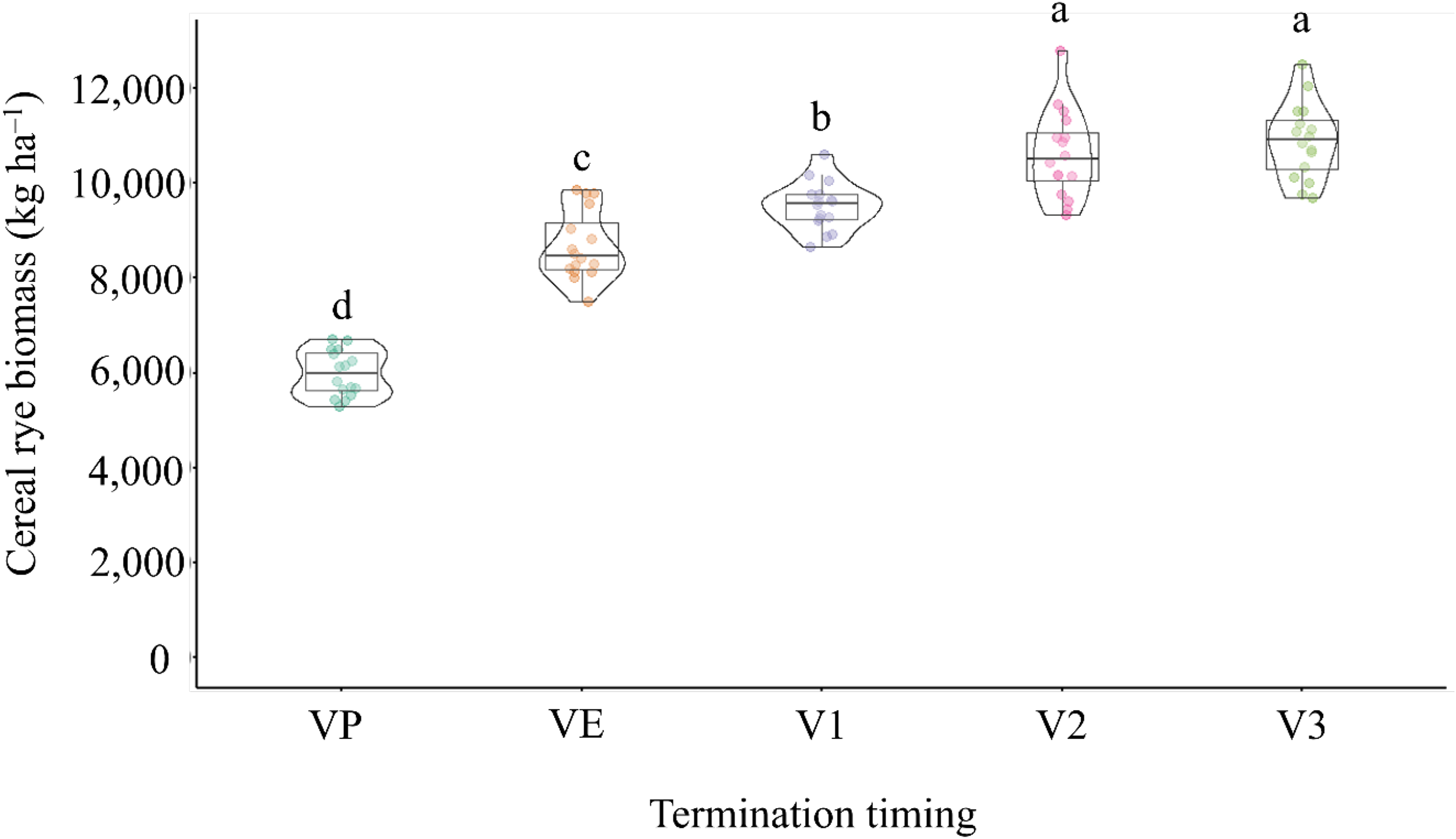
In 2024, cereal rye biomass increased steadily with delayed termination. When terminated at VP, biomass was 5,992 kg ha−1, which increased by 45% at VE, 59% at V1, 77% at V2, and 82% at V3 corn growth stage (Figure 1). Cereal rye biomass at V2 and V3 corn growth stage terminations was significantly greater than at earlier termination timings (Figure 1). In 2025, a similar trend was observed. Cereal rye biomass increased from 2,941 kg ha−1 at VP termination to 7,007 kg ha−1 at V3 termination, a 138% increase (Figure 2). Terminations at VE (4,391 kg ha−1) and V1 (5,692 kg ha−1) resulted in intermediate biomass level, while terminations at V2 (6,360 kg ha−1) and V3 (7,007 kg ha−1) were statistically similar but higher than earlier termination timings (Figure 2).
Effect of cereal rye termination timings on biomass accumulation in 2024 for field experiment conducted near Harvard, NE. The outer shape shows the probability density of the data at different values. The wider the shape at a given point, the more data points are concentrated around that value. The center black line in the box represents the mean. Mean cereal rye biomass followed by the same letter above plots is not different based on Tukey’s honest significant difference (HSD) (α = 0.05). Abbreviations: VP, corn planting; VE, corn emergence; V1, first collared leaf; V2, second collared leaf; V3, third collared leaf.

Effect of cereal rye termination timings on biomass accumulation in 2025 in field experiment near Harvard, NE. The outer shape shows the probability density of the data at different values. The wider the shape at a given point, the more data points are concentrated around that value. The center black line in the box represents the mean. Mean cereal rye biomass followed by the same letter above plots is not different based on Tukey’s honest significant difference (HSD) (α = 0.05). Abbreviations: VP, corn planting; VE, corn emergence; V1, first collared leaf; V2, second collared leaf; V3, third collared leaf.

These findings align with previous research showing increased cereal rye biomass accumulation with delayed termination. For example, in experiments conducted at same location, Stephens et al. (Reference Stephens, Blanco-Canqui, Knezevic, Rees, Kohler-Cole and Jhala2024) reported biomass gain of 9,000 to 10,000 kg ha−1 by delaying the cereal rye termination by 4 wk. In Pennsylvania, Mirsky et al. (Reference Mirsky, Curran, Mortensen, Ryan and Shumway2011) documented an increase of approximately 2,000 kg ha−1 in cereal rye biomass for every 10-d delay in termination between May 1 and June 1. Every 100 growing-degree increase resulted in an additional 880 kg ha−1 of cereal rye biomass in Virginia (Kumar et al. Reference Kumar, Singh, Flessner, Reiter, Kumari, Price, Kuhar and Mirsky2025b). Higher CC biomass is associated with multiple agroecosystem benefits, including improved soil protection, reduced soil erosion, enhanced nutrient cycling, and weed suppression (Blanco-Canqui Reference Blanco-Canqui2023; Kumar et al. Reference Kumar, Singh, Thapa, Yadav, Blanco-Canqui, Wortman, Taghvaeian and Jhala2025a; Thapa et al. Reference Thapa, Mirsky and Tully2018). There was no effect of herbicide program on cereal rye biomass, indicating that use of preemergence herbicide (acetochlor + mesotrione + clopyralid) did not affect cereal rye biomass accumulation; however, other preemergence herbicides may have different effects on cereal rye biomass.
Amaranthus palmeri Density and Biomass at Postemergence Herbicide Application
Year by treatment interaction was significant (P < 0.01) for A. palmeri density and biomass at the time of postemergence herbicide application; therefore, data were analyzed separately for 2024 and 2025. The observed year-to-year variation in A. palmeri suppression may be attributed to differences in cereal rye biomass production, with higher biomass in 2024 leading to lower A. palmeri density and biomass. Moreover, interaction between cereal rye termination timing and herbicide programs for A. palmeri density (P < 0.01) and biomass (P < 0.01) were significant in 2024 and 2025.
In 2024, the highest A. palmeri density (142.5 plants m−2) and biomass (67.28 g m−2) were observed in the NCC without preemergence herbicide treatment. Inclusion of preemergence herbicide in the NCC treatment reduced A. palmeri density by 78% and biomass by 94% (Table 4). In the VP termination without preemergence herbicide treatment, A. palmeri density was reduced by 97% and biomass by 99% compared with the NCC without preemergence herbicide. In contrast, delaying termination to the V1 to V3 corn growth stages resulted in 99% to 100% reduction in density and biomass, regardless of herbicide program (Table 4).
Effect of cereal rye termination timing and herbicide program on Amaranthus palmeri density and biomass at the time of postemergence herbicide application for field experiments conducted in 2024 and 2025 Harvard, NE a .

a Abbreviations: PRE, preemergence; VP, corn planting; VE, corn emergence; V1, first collared leaf; V2, second collared leaf; V3, third collared leaf.
b Without PRE (included nontreated and postemergence-only treatment); with PRE (included preemergence-only and preemergence followed by postemergence treatment).
c Mean A. palmeri density and biomass within a column followed by the same letter are not different based on Tukey’s honest significant difference (HSD) (α = 0.05).
In 2025, a similar trend was observed. The NCC without preemergence herbicide exhibited the highest A. palmeri density (126.25 plants m−2) and biomass (36.73 g m−2). Amaranthus palmeri density in the NCC treatment was statistically similar to that of cereal rye termination at VP regardless of herbicide program (Table 4). Cereal rye termination at VE without preemergence herbicide reduced A. palmeri density by 74% and biomass by 75% compared with NCC without preemergence herbicide. However, cereal rye termination at VP and VE corn growth stages combined with preemergence herbicide resulted in A. palmeri density and biomass similar to the NCC with preemergence herbicide. Cereal rye terminated at V2 and V3 corn growth stage with and without preemergence herbicide reduced A. palmeri density and biomass compared with the NCC (Table 4). These findings indicate the importance of cereal rye biomass on A. palmeri density and biomass reduction without preemergence herbicide.
Cereal rye terminated at VP combined with a preemergence herbicide reduced A. palmeri density compared with the no preemergence herbicide treatment in 2024. A similar trend was observed in 2025, where cereal rye termination at VP, VE, and V1 corn growth stages, paired with a preemergence herbicide, consistently resulted in lower A. palmeri densities than the no preemergence herbicide treatment. These results underscore the importance of including a preemergence herbicide when CC biomass is limited, as A. palmeri suppression provided by the CC alone may not be sufficient (Aulakh et al. Reference Aulakh, Price, Enloe, van Santen, Wehtje and Patterson2012; Norsworthy et al. Reference Norsworthy, Korres, Walsh and Powles2016).
However, for cereal rye termination from VE through V3 corn growth stages in 2024 and at V2 and V3 growth stages in 2025, no differences in A. palmeri density or biomass were observed between with and without preemergence herbicide treatments, suggesting that when cereal rye biomass is relatively high (>6,000 kg ha−1), the added benefit of a preemergence herbicide may be negligible. Under such conditions, growers may consider omitting preemergence herbicide to reduce input cost and herbicide selection pressure without compromising A. palmeri control. The lack of a preemergence herbicide effect under high cereal rye biomass conditions aligns with previous findings by Burgos and Talbert (Reference Burgos and Talbert1996), who observed similar suppression of redroot pigweed (Amaranthus retroflexus L.) in high CC residue systems in Arkansas, and by Dearden (Reference Dearden2022), who reported reduced waterhemp [Amaranthus tuberculatus (Moq.) Sauer] emergence in Iowa under high CC biomass conditions.
Despite the potential to reduce herbicide inputs under high CC biomass systems, the decision to omit a preemergence herbicide should be made on a field-by-field basis. Weed pressure, species composition, environmental conditions, and residue distribution can vary widely across fields and growing seasons. In some cases, even under high CC biomass, preemergence herbicides have provided significant additional weed control, particularly where weed infestations were severe (Hand et al. Reference Hand, Randell, Nichols, Steckel, Basinger and Culpepper2021; Nunes et al. Reference Nunes, Arneson, Wallace, Gage, Miller, Lancaster and Werle2023).
While A. palmeri was the dominant weed species in this study, other fields may be infested with different or more diverse weed communities that are less susceptible to suppression by cereal rye alone. Kruidhof et al. (Reference Kruidhof, Gallandt, Harmoto and Bastiaans2010) reported that the effectiveness of CC mulch in suppressing weeds is negatively correlated with weed seed size, emphasizing that species with larger seeds are more likely to penetrate mulch layers and establish successfully. For example, tuber or large-seeded species such as yellow nutsedge (Cyperus esculentus L.), common ragweed (Ambrosia artemisiifolia L.), and morningglory species (Ipomoea spp.) possess greater reserves, enabling them to emerge through thick CC residues (Kumar et al. Reference Kumar, Singh, Flessner, Reiter, Kumari, Price, Kuhar and Mirsky2025b; Mirsky et al. Reference Mirsky, Curran, Mortensen, Ryan and Shumway2011). This variability highlights the limitations of relying solely on physical suppression from CCs. Therefore, while high CC biomass can substantially reduce reliance on herbicides, comprehensive weed management plans must still account for species-specific responses to residue and chemical control.
It is important to consider that dense CC residues will physically intercept soil-applied herbicides, reducing their movement into the soil and subsequent efficacy. For instance, Whalen et al. (Reference Whalen, Shergill, Kinne and Bish2020) reported a greater than 44% reduction in soil concentration of sulfentrazone when applied over cereal rye residue compared with NCC treatments. Similar outcomes were noted by Nunes et al. (Reference Nunes, Arneson, Wallace, Gage, Miller, Lancaster and Werle2023) across multiple states (Illinois, Kansas, Pennsylvania, and Wisconsin), and by Maia et al. (Reference Maia, Armstrong, Kladivko, Young and Johnson2025) in Indiana, where cereal rye residue intercepted preemergence herbicides and reduced their soil concentration. To mitigate this effect, applying irrigation after herbicide application, when feasible, can help wash some herbicides off the residue and enhance soil activation (Khalil et al. Reference Khalil, Flower, Siddique and Ward2019; Sperry et al. Reference Sperry, Ferguson, Bond, Kruger, Johnson and Reynolds2022). Additionally, selecting herbicides with higher water solubility, such as mesotrione or cloransulam-methyl, may be more effective under high-residue conditions compared with lower-solubility herbicides such as S-metolachlor or trifluralin (Khalil et al. Reference Khalil, Flower, Siddique and Ward2019).
Amaranthus palmeri Density and Biomass at 4 Weeks Postemergence Herbicide Application
A significant treatment by year effect (P < 0.01) was observed on A. palmeri density and biomass at 4 wk after postemergence herbicide application; therefore, data were analyzed separately for 2024 and 2025. There was a significant interaction effect between cereal rye termination timing and herbicide programs for A. palmeri density (P < 0.01) and biomass (P < 0.01) in 2024 and 2025.
In 2024, the NCC without herbicide treatment had the highest A. palmeri density (114.5 plants m−2) and biomass (255.79 g m−2), followed by NCC with either preemergence-only (38 plants m−2) or postemergence-only (32 plants m−2) herbicide treatments. Cereal rye termination at VP without herbicide reduced A. palmeri density to 11.5 plants m−2 (90% reduction) and biomass to 16.21 g m−2 (94% reduction) compared with NCC without herbicide (Table 5). Later cereal rye termination (VE, V1, V2, and V3 corn growth stages) further suppressed A. palmeri, with V1 to V3 termination without herbicide showing A. palmeri densities ≤1.5 plants m−2 and biomass ≤1.31 g m−2 (>99% reduction) compared with NCC without herbicide. Cereal rye without herbicide regardless of termination timing had lower A. palmeri density and biomass compared with the preemergence-only and postemergence-only herbicide treatments in the NCC system (Table 5).
Effect of cereal rye termination timing and herbicide program on Amaranthus palmeri density and biomass at 4 wk after postemergence herbicide application and A. palmeri seed production at the end of season in field experiments conducted in 2024 and 2025 near Harvard, NE a .

a Abbreviations: PRE-only, preemergence-only; POST-only, postemergence only; PP, preemergence followed by postemergence; VP, corn planting; VE, corn emergence; V1, first collared leaf; V2, second collared leaf; V3, third collared leaf.
b Mean A. palmeri density, biomass, and seed production followed by the same letter within a column are not different based on Tukey’s honest significant difference (HSD) (α = 0.05).
In 2025, the NCC without herbicide treatment had the highest A. palmeri density (132 plants m−2) and biomass (259.57 g m−2) (Table 5). Cereal rye termination at VP resulted in similar A. palmeri density (81.5 plants m−2) and biomass (178.80 g m−2) compared with the corresponding herbicide program in the NCC system, indicating limited additional suppression at this termination timing. In contrast, cereal rye terminated at VE without herbicide reduced A. palmeri density by 61% and biomass by 43% compared with the NCC without herbicide treatment (Table 5). Delaying cereal rye termination from VP or VE to the V1 to V3 corn growth stages further increased A. palmeri suppression. Moreover, across all cereal rye termination timings, except NCC and termination at VP, utilizing postemergence-only and PP herbicides resulted in similar A. palmeri density and biomass (Table 5).
These results demonstrate the substantial influence of cereal rye termination timing and herbicide program on A. palmeri density and biomass in irrigated corn. Early cereal rye termination at VP corn growth stage, which results in relatively low cereal rye biomass, was associated with higher A. palmeri density and biomass compared with later termination timings, where cereal rye biomass was considerably higher. Higher A. palmeri density and biomass under low cereal rye biomass conditions is likely due to the insufficient physical barrier resulting from early-terminated cereal rye, which fails to adequately suppress A. palmeri emergence and growth. These findings are consistent with a recent meta-analysis by Kumar et al. (Reference Kumar, Singh, Thapa, Yadav, Blanco-Canqui, Wortman, Taghvaeian and Jhala2025a) that reported an inverse relationship between Amaranthus spp. density/biomass and CC biomass accumulation across temperate cropping systems. Reduction in A. palmeri density with increasing cereal rye biomass has been reported by Sias et al. (Reference Sias, Bamber and Flessner2024) and Price et al. (Reference Price, Monks, Culpepper, Duzy, Kelton, Marshall and Nichols2016).
The PG approach enhances weed suppression through two primary mechanisms. First, PG means the CC is still actively growing at the time of cash crop planting, which affects not only light quantity but also light quality (Silva and Bagavathiannan Reference Silva and Bagavathiannan2023). Green, photosynthetically active CCs absorb red (R) light and reflect more far-red (FR) light, reducing the R:FR light ratio at the soil surface (Silva and Bagavathiannan Reference Silva and Bagavathiannan2023; Teasdale Reference Teasdale1996). Amaranthus palmeri germination is known to be inhibited under low R:FR conditions (Jha et al. Reference Jha, Norsworthy, Riley and Bridges2010). This physiological response was demonstrated by Ballaré et al. (Reference Ballaré, Sánchez, Scopel, Casal and Ghersa1987), who found that light reflected from living cereal rye had an R:FR of 0.31 compared with 1.01 for dead cereal rye residue, highlighting the greater inhibitory potential of green CC plants.
In addition, PG allows for extended CC growth, resulting in greater biomass accumulation (Grint et al. Reference Grint, Arneson, Arriaga, DeWerff, Oliveira, Smith, Stoltenberg and Werle2022; Sias et al. Reference Sias, Bamber and Flessner2024; Stephens et al. Reference Stephens, Blanco-Canqui, Knezevic, Rees, Kohler-Cole and Jhala2024). This dense biomass acts as a mulch layer, blocking sunlight from reaching the soil surface (Mirsky et al. Reference Mirsky, Ryan, Teasdale, Curran, Reberg-Horton, Spargo, Wells, Keene and Moyer2017; Sias et al. Reference Sias, Bamber and Flessner2024), a critical factor, as A. palmeri germination is light dependent (Jha et al. Reference Jha, Norsworthy, Riley and Bridges2010; Sosnoskie et al. Reference Sosnoskie, Webster, Culpepper and Kichler2011). By reducing light availability at the soil surface, cereal rye residue inhibits A. palmeri germination.
Among herbicide strategies, the value of combining preemergence followed by postemergence herbicide diminished, as postemergence-only herbicide achieved similar suppression compared with PP, especially under high cereal rye biomass scenarios (termination at V1, V2, and V3 corn growth stages). Similar A. palmeri suppression with postemergence-only herbicide compared with PP herbicide with CC integration have been reported by Hand et al. (Reference Hand, Randell, Nichols, Steckel, Basinger and Culpepper2021) in Georgia and Tennessee and Price et al. (Reference Price, Monks, Culpepper, Duzy, Kelton, Marshall and Nichols2016) and Aulakh et al. (Reference Aulakh, Price, Enloe, van Santen, Wehtje and Patterson2012) in Alabama. It is important to note that in low-biomass situations (e.g., early termination), the combination of preemergence and postemergence herbicides was essential for effective control, reinforcing the need for herbicide integration under suboptimal CC performance and highlighting the limitations of relying on CC alone under such conditions.
The results underscore the flexibility and adaptability of CC-based A. palmeri management systems, where CC termination timing can be strategically used to influence the need for and effectiveness of herbicides. While PP remains the most reliable strategy across many different management scenarios for A. palmeri suppression, our findings demonstrate that well-managed CC, especially with delayed termination, can reduce the need for additional herbicide application, a valuable tool in resistance management and sustainable crop production systems.
Amaranthus palmeri Seed Production
There was a significant interaction (P < 0.01) between treatment and year for A. palmeri seed production; therefore, data were analyzed separately for each year. Significant interaction between cereal rye termination timing and herbicide program was determined for A. palmeri seed production in both years. In 2024, the highest seed production occurred in the NCC without herbicide treatment (151,070 seeds m−2), followed by NCC with preemergence-only (46,050 seeds m−2), NCC with postemergence-only (36,130 seeds m−2) treatments, and without herbicide plots where cereal rye was terminated at VP (33,500 seeds m−2) and VE (18,340 seeds m−2) corn growth stages (Table 5). Delaying cereal rye termination until later corn growth stages (V1 to V3) reduced A. palmeri seed production by more than 99% compared with earlier terminations and NCC treatments (Table 5). Cereal rye termination at V1 to V3 corn growth stages had statistically similar seed production across herbicide programs, likely due to greater cereal rye biomass production (Figure 1) and comparable A. palmeri density at 4 wk after postemergence herbicide application (Table 5).
In 2025, the highest A. palmeri seed production occurred in the NCC without herbicide treatment (152,890 seeds m−2). Use of preemergence-only and postemergence-only herbicide programs in NCC reduced A. palmeri seed production by 60% and 69%, respectively, compared with the NCC without herbicide treatment (Table 5). Unlike 2024, where all herbicide programs for V1 to V3 cereal rye termination timings resulted in similar A. palmeri seed production, herbicide programs within the V1 termination timing in 2025 varied significantly, with nontreated (15,110 seeds m−2) and preemergence-only (7,730 seeds m−2) resulted in more seeds than postemergence-only (450 seeds m−2) and PP (0 seeds m−2) (Table 5). This difference was likely due to lower cereal rye biomass production in 2025 compared with 2024. In contrast, cereal rye termination at V2 and V3 corn growth stages had similar seed production across herbicide programs, with more than 99% reduction compared with NCC without herbicide (Table 5). Across both years, A. palmeri seed production in the PP herbicide program was similar among NCC and different termination timings, indicating consistent control and a strategy for A. palmeri seedbank reduction (Table 5).
Similar reductions in A. palmeri seed production following adoption of cereal rye CC have been reported by Stephens et al. (Reference Stephens, Blanco-Canqui, Knezevic, Rees, Kohler-Cole and Jhala2024) in Nebraska. Likewise, Dearden (Reference Dearden2022) observed reductions in A. tuberculatus seed production under cereal rye cover compared with NCC, supporting the broader applicability of cereal rye for limiting Amaranthus spp. fecundity. Reducing A. palmeri seed production can have major implications for long-term management and cropping system sustainability. A single A. palmeri plant can produce several hundred thousand seeds, meaning that even a few A. palmeri plants that survive control measures can rapidly replenish the soil seedbank (Kaur et al. Reference Kaur, Rogers, Lawrence, Shi, Chahal, Knezevic and Jhala2024; Sellers et al. Reference Sellers, Smeda, Johnson, Kendig and Ellersieck2003). By minimizing seed rain, CC may limit seedbank recruitment and can suppress subsequent weed flushes, reducing the need for intensive herbicide use and lowering management costs (Striegel and Jhala Reference Striegel and Jhala2022). Over multiple seasons, this integrated approach might contribute to gradual depletion of the seedbank and improved system resilience.
Furthermore, restricting seed production from surviving plants is a critical component of herbicide resistance management. Seed output from resistant individuals can directly increase the frequency of resistance alleles in the population and facilitate their spatial spread (Norsworthy et al. Reference Norsworthy, Ward, Shaw, Llewellyn, Nichols, Webster, Bradley, Frisvold, Powles, Burgos, Witt and Barrett2012). The combination of CC competition with herbicide programs, as demonstrated in this study, reduces the number and reproductive potential of A. palmeri plants that survive control measures and thereby may lower selection pressure for resistance evolution. Integrating cereal rye into weed management programs thus provides dual benefits, immediate short-term suppression of A. palmeri growth and long-term containment of resistant biotypes.
Corn Yield and Economic Analysis
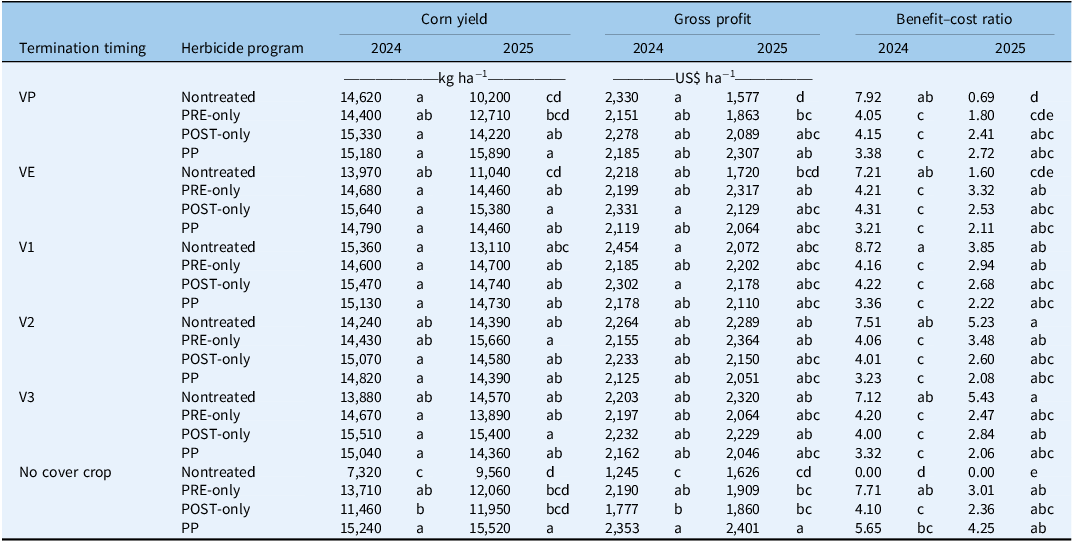
A three-way interaction among cereal rye termination timing, herbicide program, and year was significant for corn yield, gross profit, and benefit–cost ratio. Therefore, data were analyzed separately for each year. In 2024, interaction between cereal rye termination timing and herbicide program was significant for corn yield, gross profit, and benefit–cost ratio. The NCC without herbicide treatment produced the lowest corn yield (7,320 kg ha−1) and gross profit (US$1,245 ha−1) followed by the NCC with postemergence-only herbicide treatment in 2024 (Table 6). No differences in corn yield and gross profit were observed among the remaining treatments. The highest benefit–cost ratios were observed in cereal rye (termination at VP, VE, V1, V2, and V3 stages) without herbicide treatments and the NCC with preemergence-only herbicide treatment (Table 6). Inclusion of herbicide programs with cereal rye reduced the benefit–cost ratio, likely due to the additional cost of herbicide and adjuvants without a corresponding increase in yield or gross profit.
Effect of cereal rye termination timing and herbicide program on corn yield, gross profit, and benefit–cost ratio in field experiments conducted in 2024 and 2025 Harvard, NE a,b .

a Abbreviations: PRE-only, preemergence-only; POST-only, postemergence only; PP, preemergence followed by postemergence; VP, corn planting; VE, corn emergence; V1, first collared leaf; V2, second collared leaf; V3, third collared leaf.
b Mean corn yield, gross profit, and benefit–cost ratio followed by the same letter within a column are not different based on Tukey’s honest significant difference (HSD) (α = 0.05).
A similar interaction between cereal rye termination timing and herbicide program was observed in 2025. The lowest corn yield and gross profit occurred in the NCC without herbicide (9,560 kg ha−1 and US$1,626 ha−1), cereal rye terminated at VP without herbicide (10,200 kg ha−1 and US$1,577), and terminated at VE without herbicide treatments (11,040 kg ha−1 and US$1,720 ha−1) (Table 6). Corn yield and gross profit in 2024 for the treatments when cereal rye was terminated at VP and VE without herbicide were similar to those observed in the corresponding herbicide-treated plots. However, in 2025, without herbicide plots at VP and VE cereal rye termination timings produced lower corn yield and gross profit compared with herbicide-treated plots within the same termination timings (Table 6). This reduction in corn yield and gross profit was likely associated with lower cereal rye biomass production and higher A. palmeri densities observed in these treatments during 2025 (Figure 2; Table 5). These findings indicate that the integration of herbicide is particularly critical under conditions of limited CC biomass accumulation, as the suppressive effects of CC residues alone may be insufficient to ensure consistent A. palmeri control (Kumar et al. Reference Kumar, Obour, Jha, Manuchehri, Dille, Holman and Stahlman2020).
The previous studies evaluating corn PG into cereal rye have reported mixed outcomes, although predominantly negative effects on corn yield. For example, in a review analysis, Blanco-Canqui and Jhala (Reference Blanco-Canqui and Jhala2024) found that among nine studies reporting corn yield when PG into cereal rye CC, four observed yield reductions, one reported no effect, and four showed mixed effects (negative or no effect). None of those studies reported a yield increase. Yield reduction as much as 76% has been reported for corn PG into cereal rye (Almeida et al. Reference Almeida, Robinson, Matthiesen-Anderson, Robertson and Basche2024). These reductions are commonly attributed to early-season nitrogen immobilization, moisture stress under low precipitation, poor soil–seed contact, seedling diseases, and cool temperatures during and shortly after planting corn (Almeida et al. Reference Almeida, Robinson, Matthiesen-Anderson, Robertson and Basche2024; Blanco-Canqui and Jhala Reference Blanco-Canqui and Jhala2024; Reed et al. Reference Reed, Karsten, Curran, Tooker and Duiker2019).
In contrast, in the present study, delaying cereal rye termination to later corn growth stages (V1 to V3) did not reduce corn yield. This response might be due to the split nitrogen applications and supplemental irrigation provided, when necessary, which minimized competition for nutrients and moisture between cereal rye and corn. However, management practices like split nitrogen application and supplemental irrigation may differ from those typically used by growers who do not include CC in their production systems, as such growers often rely on a single nitrogen application and may not use supplemental irrigation to offset early-season competition.
Visual differences in corn growth were observed between cereal rye and NCC during early growth stages; these differences diminished as the season progressed (personal observation). Cereal CCs, such as cereal rye, have a high C:N ratio that can temporarily immobilize nitrogen (Nevins et al. Reference Nevins, Lacey and Armstrong2020). However, in-season nitrogen applications combined with irrigation can stimulate microbial activity, accelerating residue decomposition and nitrogen mineralization (Al-Kaisi et al. Reference Al-Kaisi, Kwaw-Mensah and Ci2017; Thapa et al. Reference Thapa, Tully, Reberg-Horton, Cabrera, Davis, Fleisher, Gaskin, Hitchcock, Poncet, Schomberg, Seehaver, Timlin and Mirsky2022), thereby promoting corn recovery and growth. However, further research is warranted to better understand how split nitrogen applications and irrigation influence CC residue decomposition, nitrogen release from CC residues, and yield outcomes.
Cereal rye terminated at VE with preemergence-only herbicide and terminated at V1 corn growth stage without preemergence herbicide achieved corn yield and gross profit comparable to the best-performing treatments in 2025. They also had substantially high A. palmeri seed production (Tables 5 and 6), illustrating a critical management trade-off: maintaining yield without preventing A. palmeri seed return can compromise long-term system sustainability. In contrast, later cereal rye termination timings (V2 to V3) consistently reduced A. palmeri seed production by more than 99% across herbicide programs, demonstrating the impact of high cereal rye biomass on reducing A. palmeri fecundity (Table 5). Furthermore, cereal rye with reduced herbicide input (preemergence-only or postemergence-only) achieved gross profit similar to that of the NCC with PP herbicide program. Although CCs did not provide an immediate economic advantage, their integration with reduced herbicide use can have long-term benefits by reducing the evolution of herbicide-resistant weed populations (Bunchek et al. Reference Bunchek, Wallace, Curran, Mortensen, VanGessel and Scott2020; Hand et al. Reference Hand, Randell, Nichols, Steckel, Basinger and Culpepper2021; Kumar et al. Reference Kumar, Obour, Jha, Manuchehri, Dille, Holman and Stahlman2020). These findings highlight the potential of integrating CC with PG approach into corn production systems as a sustainable tool for maintaining profitability while reducing reliance on herbicides.
Practical Implications
This study evaluated cereal rye CC termination timings and herbicide programs for their effects on cereal rye biomass production, A. palmeri suppression, corn yield, and economics under PG conditions. Delaying cereal rye termination to the later corn growth stages (V2 and V3) substantially increased biomass accumulation. It is important to note that cereal rye termination timing should be determined primarily by the amount of biomass produced rather than solely by corn growth stage. While corn growth stage provides a practical reference for field operations, CC biomass is the key driver influencing weed suppression, soil moisture dynamics, and potential interactions with the cash crop. Therefore, termination decisions should balance biomass accumulation with agronomic considerations to optimize weed control while minimizing negative impacts on corn establishment and yield. The increased biomass improved A. palmeri control and seed production; however, beyond a certain growth stage, additional biomass did not provide further A. palmeri control benefits. Under high-biomass conditions (>6,000 kg ha−1), cereal rye CC provided greater than 99% A. palmeri control even without herbicide usage. However, the decision to eliminate herbicide use entirely should be based on site-specific factors such as CC biomass production, existing weed infestation and species, and management conditions. In contrast, under low CC biomass conditions, integrating herbicide programs remains essential for effective A. palmeri control.
Cereal rye reduced A. palmeri seed production as low as 0 seeds m−2 when terminated at V2 and V3 corn growth stages, which can have long-term implications for reducing A. palmeri seedbank in subsequent seasons. Importantly, delaying cereal rye termination did not reduce corn yield, likely due to effective nutrient and water management through split nitrogen applications and supplemental irrigation. Additionally, corn PG in actively growing cereal rye with reduced herbicide inputs (postemergence herbicide-only) achieved similar gross profit (US$2,064 to US$2,364 ha−1) as the NCC with PP herbicide program (US$2,353 to US$2,401 ha−1), while offering the added advantage of reducing herbicide usage and, consequently, the selection pressure for herbicide-resistant weeds.
The results of this study highlight that with proper nitrogen and irrigation management, PG with delayed cereal rye termination can enhance biomass production and A. palmeri suppression without compromising corn grain yield or profitability. Further research is needed to better understand the interactions among nitrogen application timing, irrigation, residue decomposition, and subsequent nutrient release from CC residues to optimize short-term productivity and long-term system sustainability.
Acknowledgments
We thank Alex Chmielewski, Ankit Yadav, Mandeep Singh, Peter Dossen, and Michael Schlick for their assistance in this project. We thank the associate editor and reviewers for their comments and edits to improve quality of this article.
Funding statement
We thank USDA NIFA Crop Protection and Pest Management award number 2024-70006-43500 “Nebraska Extension Implementation Program” for supporting this project.
Competing interests
The authors declare no conflicts of interest.





 Open access

