



Poor eating patterns, in combination with less physical activity and higher sedentariness, can contribute to excess energy intake and higher risks of obesity and associated lifestyle diseases( Reference Lobstein, Baur and Uauy 1 ). Trajectories of health behaviours and obesity suggest that these may track from childhood into adulthood, with poorer childhood behaviours and earlier development of obesity contributing to poorer health and higher obesity rates in adulthood( Reference Juhola, Magnussen and Viikari 2 – Reference Suppli, Due and Henriksen 5 ). Therefore, fostering better health behaviours from childhood, such as regular physical activity and healthier dietary patterns, may contribute to better health behaviours in adulthood. Socio-economic gradients in health indicate that children of low socio-economic position (SEP) are more likely to be overweight and obese and have poorer quality of dietary intake than children of high SEP( Reference Rasmussen, Krølner and Klepp 6 – Reference Cameron, Ball and Pearson 8 ). In particular, children of low SEP may be more likely to consume non-core foods high in fat and sugar( Reference Cameron, Ball and Pearson 8 – Reference Sweeting and West 10 ), sweetened drinks( Reference Haerens, Craeynest and Deforche 11 ) and fast foods( Reference Ball, Macfarlane and Crawford 12 ) than children of high SEP.
Differences between socio-economic groups in intrapersonal and environmental predictors may provide some explanation for socio-economic gradients in children’s diet( Reference Zarnowiecki, Ball and Parletta 13 ). Cognitive factors such as nutrition knowledge, self-efficacy and attitudes to health behaviours have been shown to mediate associations of SEP with diet( Reference Ball, Macfarlane and Crawford 12 , Reference Moore, Tapper and Murphy 14 , Reference O’Dea and Wilson 15 ). Environmental factors such as lower availability of fruits and vegetables and higher availability of non-core snack foods and sweetened drinks in low-SEP homes may contribute to differentials in food intake between socio-economic groups( Reference Ball, Macfarlane and Crawford 12 , Reference Bere, Van Lenthe and Klepp 16 – Reference Macfarlane, Crawford and Ball 18 ). Low-SEP adolescents may receive less support for healthy eating from their family, which may mediate SEP differences in fruit intake( Reference Ball, Macfarlane and Crawford 12 , Reference Sandvik, Gjestad and Samdal 19 ). Parents of low SEP may also employ different feeding practices compared with parents of high SEP, including exerting more restriction, pressure to eat and monitoring of food intake, which may contribute to non-core food intake( Reference Hupkens, Knibbe and Van Otterloo 20 , Reference Loth, Maclehose and Fulkerson 21 ).
SEP may act as a moderator of the predictors of children’s dietary intake by influencing the strength and direction of relationships between predictors and dietary intake( Reference Fairchild and Mackinnon 22 ). Few studies have considered the role of SEP as a moderator in children with mixed findings. Home fruit availability was significantly related to 11–12-year-old children’s fruit intake in high SEP but not in mid and low SEP, whereas self-efficacy was most strongly associated with intentions to eat fruit in low-SEP children( Reference Sandvik, Gjestad and Samdal 19 ). Low-SEP adolescents may be more susceptible to the influence of their peer groups and fast-food availability in their neighbourhood, which may contribute to higher consumption of snack foods and fast foods( Reference Ho, Wong and Lo 23 , Reference Wouters, Larsen and Kremers 24 ). Adolescents’ snack food intake was positively related with peer snack food intake in low-educated adolescents but not high-educated adolescents( Reference Wouters, Larsen and Kremers 24 ). In low-affluence but not high-affluence families of Hong Kong adolescents, the presence of more fast-food shops was associated with increased consumption of junk foods and soft drinks, whereas lower restaurant availability of fruits and vegetables was associated with lower fruit and vegetable intake( Reference Ho, Wong and Lo 23 ).
These studies provide some preliminary evidence of the role of SEP as a moderating variable for predictors of children’s dietary intake; however, these studies are few and evaluate a number of different SEP indices across varied predictor–diet relationships. It is difficult to compare these studies, necessitating further evidence to provide better understanding of the drivers of socio-economic disparities in children’s diets and to inform tailoring of health promotion strategies and interventions to specific needs of socio-economic groups. This is important, as to date strategies for improving children’s dietary intake appear to provide only small or short-term improvements( Reference Waters, De Silva-Sanigorski and Hall 25 ). A considerable body of literature has identified that a combination of intrapersonal and environmental factors influence children’s dietary intake( Reference Rasmussen, Krølner and Klepp 6 ) and studies conducted to date suggest that both intrapersonal and environmental dietary determinants may be moderated by SEP. Therefore a social ecological framework was employed in the present study. The social ecological paradigm emphasises that environmental contexts have a key role in determining health behaviours, but acknowledges that intrapersonal factors determine an individual’s response to his/her environments( Reference Sallis, Owen and Fisher 26 ). The aim of the present study was to determine if SEP moderated associations of personal and environmental predictors with children’s non-core food and sweetened drink intakes and unhealthy dietary behaviours.
Methods
The present study was a cross-sectional investigation of personal and environmental determinants of 9–13-year-old children’s dietary intake. Data collection was conducted in Adelaide, South Australia from February to November 2010, and involved two phases: in phase 1, children completed the Child Nutrition Questionnaire (CNQ); and in phase 2, parents completed computer-assisted telephone interviews (CATI). Other findings from the present study, including a detailed description of the methods, have been published previously( Reference Zarnowiecki, Ball and Parletta 13 , Reference Zarnowiecki, Parletta and Dollman 27 ).
Participants were recruited from grade 5 to grade 7 classes of primary schools in Adelaide. The School Card Register (SCR), a ranking representing the proportion of students receiving means-tested Government assistance to meet the cost of school attendance, was used to rank and classify schools into SEP tertiles. Schools were randomly selected from each SEP tertile and invited to participate in the study. Oversampling in low-SEP schools was necessary to achieve an equal sample size across socio-economic groups, as the response rate from participants was lower (43 %) compared with high-SEP schools (56 %). Eighty-two schools were approached with information about the study and twenty-seven schools participated in the study (32·9 % response rate). All children and parents who were able to communicate in English with sufficient fluency to complete questionnaires and interviews were eligible to participate. In total, 2575 children received study information and 1257 parents consented to participate (48·8 % response rate), of which 1201 children were present at school on the day of data collection. Of participating children, 1059 completed the CNQ and were eligible for their parents to complete the CATI in phase 2. Participants from phase 1 were stratified by SEP and randomly selected to participate in the CATI. It was necessary to contact 525 participants (76·2 % response rate) to achieve the required sample size of 400 participants (multivariate regression analysis with fifteen to twenty variables, powered at 0·08 with α of 0·05). It was not possible to include all participants from phase 1 due to funding limitations. Five children were excluded as their responses to the CNQ were found to be incomplete, providing n 395 sets of matched data from children and parents for the current analysis.
Protocol
Phase 1 data collection was conducted at schools, utilising school computer facilities. Children completed online questionnaires in groups ranging from ten to thirty students, guided by research assistants. Phase 2 CATI were conducted at the completion of phase 1 data collection. Parents of children completing the CNQ in phase 1 were contacted by telephone and invited to participate in phase 2. The CATI was completed by the parent primarily responsible for their child’s food provision.
Study measures
The CNQ is an existing nutrition questionnaire which has been shown to be valid and reliable( Reference Wilson, Magarey and Mastersson 28 ). The CNQ utilises a semi-quantitative FFQ to measure children’s usual intake of non-core foods and sweetened drinks, and unhealthy eating behaviours. Non-core foods are those which are not considered to be core components of a healthy diet and are deemed as discretionary foods or ‘extras’ in dietary guidelines, including chips, chocolate, lollies, biscuits, takeaway and fast foods. Two scales measuring sweetened drink intake and non-core food intake were implemented as described in the original questionnaire( Reference Wilson, Magarey and Mastersson 28 ) (Table 1). The scoring of the original scale measuring children’s engagement in eight eating behaviours( Reference Wilson, Magarey and Mastersson 28 ) was modified for the present study into two scales with improved internal consistency representing ‘healthy behaviours’ (Cronbach’s α=0·54) and ‘unhealthy behaviours’ (Cronbach’s α=0·57), of which only the unhealthy behaviours scale is reported herein.
Questionnaire items for variables assessed in the Child Nutrition Questionnaire (CNQ) and computer-assisted telephone interview (CATI; n 395)

ICC, intra-class correlations used to determine test–retest reliability of CATI scores in a sub-sample of thirty-one parents who completed the CATI on two occasions approximately one week apart. Unless indicated below, scales were developed for the present study and psychometric properties were evaluated using confirmatory factor analysis and Cronbach’s α, as presented in table. Psychometric properties were re-evaluated for scales noted below as ‘adapted’ from original instrument.
*P<0·05; **P<0·001.
† Dietary scores utilised from Wilson et al.( Reference Wilson, Magarey and Mastersson 28 ). Refer to reference for psychometric properties of dietary intake scores.
‡ Non-core food items measured were: potato crisps, chocolate, lollies, muesli bars, savoury biscuits, sweet biscuits, ice cream/ice block, hot chips, pie/pasty/sausage roll, hot dog and pizza. Sweetened drinks measured were: fruit juices, cordials, soft drinks, sports drinks and energy drinks. Unhealthy behaviours measured were: consumption of dinner/snacks in front of the television and fast-food consumption.
§ Scale adapted from Ball et al.( Reference Ball, Crawford and Mishra 59 ).
|| Scale adapted from Williams et al.( Reference Williams, Ball and Crawford 60 ).
¶ Scale from Jackson et al.( Reference Jackson, Bee-Gates and Henriksen 61 ).
†† Scale from Birch et al.( Reference Birch, Fisher and Grimm-Thomas 43 ).
Predictors of children’s dietary intake were measured in section two of the CNQ and in the parent CATI. Within social ecological frameworks, personal and environmental factors symbiotically influence children’s eating behaviours, whereby the environment may facilitate an individual’s engagement in eating behaviours, while personal attributes determine individual responses to environmental factors( Reference Sallis, Owen and Fisher 26 ). Twenty-six predictors were measured, of which eight were from children’s responses to the CNQ and eighteen were from parent CATI responses. Where appropriate, scores were derived from existing validated instruments, while some scores were developed for the present study using confirmatory factor analysis and Cronbach’s α to form scales with appropriate properties. More detailed information about the scales, including the psychometric properties for scales developed and psychometrically tested in the present study, is provided in Table 1.
Demographic information was reported by parents in the CATI. Maternal education, occupation and employment, and household income were tested as moderating variables. Mother’s education rather than father’s was used as it has been consistently associated with children’s food intake( Reference Rasmussen, Krølner and Klepp 6 ) and most mothers still have primary responsibilities in the household for feeding children( Reference Hannon, Bowen and Moinpour 29 ). Education level was reported on an eight-point scale ranging from 1=never attended school to 8=completed postgraduate education. Occupation has been associated with predictors of children’s dietary intake and may moderate predictor–diet associations( Reference Sandvik, Gjestad and Samdal 19 ). Mother’s job title was coded using the eight-tier Australian and New Zealand Standard Classification of Occupations (ANZSCO) which hierarchically groups occupations requiring similar levels of skills, education, responsibility and experience( 30 ). An additional category was created for individuals ‘not in the labour force’, comprising individuals engaged in full-time home duties, retired persons, unemployed and students. Where insufficient information was provided in the job title to accurately classify an individual, for example ‘public servant’, these data points were not coded and treated as missing data. An additional variable representing maternal employment was created, dichotomised as ‘not in the labour force’ and ‘employed’. Income was tested as it has been consistently associated with poorer dietary outcomes among youth, but to the best of our knowledge has not been tested as a moderator of dietary predictors in children of this age. Annual gross household income, including pensions and government assistance, was reported using seven income brackets ranging from 1=up to $AU 12 000 to 7=more than $AU 100 000.
Data analysis
All analyses were conducted separately for boys and girls as initial bivariate analyses along with previous studies indicate that there may be differences between boys and girls in dietary predictors. First predictors of diet were identified using correlated component regression (CCR), and subsequently the identified predictors were tested for moderation by SEP using partial least squares structural equation modelling (PLS-SEM).
CCR (XLSTAT 2012) employs cross-validation with a step-down algorithm, reducing the number of predictors in the final model by partitioning sample data using bootstrapping into smaller subsets used in multiple regression rounds( Reference Madigson 31 ). This regression approach is suited to application within a social ecological framework as it allows for many independent variables to be considered simultaneously, including variables with mixed scale types and those which are correlated with one another( Reference Madigson 31 ). All predictor variables were entered simultaneously into the CCR model along with education, income, occupation and employment. Potential demographic covariates, child age, marital status, mother’s age and SEIFA (Socioeconomic Index for Areas, an area-level measure of socio-economic status determined from home postcode) were included in all CCR models.
Following identification of dietary predictors in CCR, structural equation models were built for each dietary intake variable with corresponding predictors, testing for moderation by each of the socio-economic predictors. Only variables identified by CCR analysis to predict the corresponding dietary outcome were tested for moderation to limit the number of tests conducted. Covariates identified as predictors (i.e. mother’s age, SEIFA) were not tested for moderation. This stepwise procedure was employed to reduce the risk of Type I errors that may arise from conducting multiple moderation analyses with a large number of predictor variables. Moderation was conducted using PLS-SEM (using Warp3 PLS, by WarpPLS2·0) as it is more powerful for detecting small moderation effects than regression, particularly where the sample size is small. Resampling was conducted by jack knifing and missing data imputed by the Warp program as column averages.
A sample size of 100–150 was needed, therefore the sample size was sufficient to conduct separate analyses by gender. Using PLS-SEM allowed the detection of moderating effects of small magnitude which may not have been identified using regression. To interpret significant moderation effects, predictor variable scales were rescored into tertiles of participant responses and means of the dietary variable within each tertile of the predictor score were graphed. An α level of 0·05 was used for all statistical tests.
Results
Participants were distributed evenly across socio-economic strata for all SEP indices except occupation, where fewer mothers were employed as technicians, tradespeople or labourers than other occupation types (Table 2). Most parents who completed the CATI were female (87·1 %), indicating that in this sample mostly mothers were responsible for their children’s food provision. There were no significant differences between boys and girls for any of the dietary outcomes (Table 1).
Demographic characteristics of participants: children aged 9–13 years and their parents, Adelaide, South Australia, February–November 2010
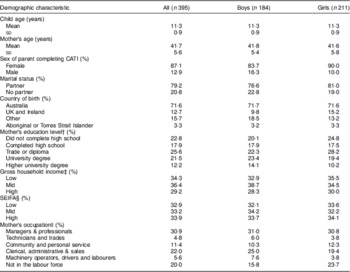
CATI, computer-assisted telephone interview.
Data are reported as mean and standard deviation or as percentage, as indicated.
† Education level measured on an eight-point scale ranging from ‘never attended school’ to ‘higher university degree’. For ease of reporting, categories 1–4 are combined.
‡ Gross household income reported in $AU per annum, for all household income before tax, including wages, salaries, pensions and allowances. Low, <$AU 60 000 per annum; mid, $AU 60 001–100 000 per annum; high, >$AU 100 000 per annum. Missing income responses (n 22) ‘refused to answer’ or ‘unsure’.
§ SEIFA, Socioeconomic Index for Areas, is an area-level measure of socio-economic status determined from home postcode.
|| Mother’s occupation coded into categories according to Australian and New Zealand Standard Classification of Occupations (ANZSCO)( 30 ). Additional category for not in the labour force included individuals engaged in full-time home duties, retired persons, unemployed and students. Missing occupation responses (n 16) where participants provided insufficient information for accurate occupation coding.
Predictors of outcome measures
Predictors of non-core dietary intake were varied and different for boys and girls (Table 3). The only predictor of girls’ non-core food intake was children’s attitude to fruit, whereby better attitude to fruit predicted lower non-core food intake. Ten predictors explained 4·0 % of variance in boys’ non-core food intake. Higher availability of non-core foods at home predicted higher non-core food intake in boys. Employing more restrictive feeding practices predicted higher non-core food intake among boys, whereas more monitoring of food intake predicted lower non-core food intake. Counterintuitively, boys of parents with stronger self-efficacy for healthy eating were more likely to eat non-core foods. The strongest predictive model was obtained for girls’ sweetened drink intake, whereby sixteen predictors explained 11·8 % variance. Lower sweetened drink intake was predicted by higher self-efficacy, attitudes to fruits and vegetables, children’s cooking skills, a more supportive home environment for healthy eating, higher availability of healthy foods and higher parent nutrition knowledge. Unhealthy behaviours among boys and girls were predicted by less supportive home environments for healthy eating; and less unhealthy behaviours in girls were predicted by a more supportive home environment.
Predictors of non-core dietary outcomes, identified using correlated component regression, among children aged 9–13 years (n 395), Adelaide, South Australia, February–November 2010

SEIFA, Socioeconomic Index for Areas.
† Cross-validated predictor count. Represents the number of occasions the variable appeared as a predictor in rounds of cross-validated regression models. For instance, a value of 100 indicates predictor appeared in every round of analyses, a smaller value indicates predictor appeared less frequently. Provides an indication of ‘magnitude’ of association in addition to beta coefficient.
‡ R 2, variance explained by initial model prior to cross-validation; R 2(CV), variance explained by final optimised predictive model; sd (CV), standard deviation of R 2(CV).
Moderation of predictors of children’s non-core food intake, sweetened drink intake and unhealthy dietary behaviours by socio-economic position
Full moderation results are shown in Table 4 and only those relationships with significant moderation effects across multiple socio-economic indices are described in detail below (see online supplementary material, Supplemental Figure 1 for additional results on moderation not described in detail in the text). In brief, a number of intrapersonal, parent and home environment predictors of children’s non-core food intake were moderated by SEP, with different moderation effects observed for boys and girls. For girls, attitudes to healthy eating, self-efficacy, cooking skills, parental pressure to eat and unhealthy food availability at home were moderated by SEP. Parent’s nutrition knowledge and healthy food availability at home were not moderated by SEP. For boys, parents’ self-efficacy, monitoring and unsupportive home environments for healthy eating were moderated by SEP, whereas no moderation was observed for cooking skills, restriction and non-core food availability at home.
Moderation of predictors of non-core dietary outcomes by socio-economic position, using partial least squares structural equation modelling, among children aged 9–13 years (n 395), Adelaide, South Australia, February–November 2010

β, path coefficient for interaction term; se, standard error of the path coefficient for interaction term; R 2, explained variance of the interaction model.
Significant moderation effects are indicated in bold font.
Moderation of self-efficacy by socio-economic position
The association of child self-efficacy as a predictor of girls’ sweetened drink intake was moderated by education and occupation (Fig. 1(a) and (b)). There was no relationship between girls’ sweetened drink intake and child self-efficacy in the high-educated group, whereas in girls of low- and middle-educated parents sweetened drink intake was lower among girls with higher self-efficacy. Lower sweetened drink intake was associated with higher self-efficacy for all four occupation groups, but this effect was small in the white collar and professionals groups. The moderator effect appeared to be due to a stronger association between self-efficacy and sweetened drink intake in the not in the labour force group compared with the other occupation groups. It should be noted that the results of the blue collar group are difficult to fully interpret as no girls in this group reported high self-efficacy.
Moderation by socio-economic position of the associations of child and parent self-efficacy for healthy eating with non-core food and sweetened drink intakes among children aged 9–13 years and their parents (n 395), Adelaide, South Australia, February–November 2010. (a, b) Moderation of child self-efficacy and girls’ sweetened drink intake by (a) maternal education and (b) maternal occupation; moderation effects significant at P≤0·05. (c, d, e) Moderation of parents’ self-efficacy and boys’ non-core food intake by (c) maternal education, (d) maternal occupation and (e) maternal employment; moderation effects significant at P≤0·01. Tertiles of participant scores: child self-efficacy (low=6–22; mid=23–26; high=27–30); parents’ self-efficacy (low=4–13; mid=14–15; high=16)

The association of parent self-efficacy as a predictor of boys’ non-core food intake was moderated by education, occupation and employment (Fig. 1(c) to (e)). Among low-educated mothers, higher parent self-efficacy was positively associated with boys’ non-core food intake, whereas there was no association between parents’ self-efficacy and non-core food intake in the mid and high education groups. There was no association of parents’ self-efficacy with boys’ non-core food intake in mothers employed in blue collar, white collar and professional occupations. In boys of mothers not in the labour force, self-efficacy was positively related with non-core food intake.
Moderation of parent feeding practices by socio-economic position
The association of pressure to eat with girls’ sweetened drink intake was moderated by all four socio-economic variables (Fig. 2(a) to (d)). The same moderation pattern was observed for education and income, whereby more pressure to eat was associated with higher sweetened drink intake in low SEP, and there was no relationship in middle and high SEP. The moderating effect of occupation was due to differences between not in the labour force and other occupation groups. In girls with mothers not in the labour force, more pressure to eat was associated with higher sweetened drink intake. The white collar group followed a similar trend, but the association was not as strong, and there was no association for blue collar and professionals groups. Examining the effect of employment confirmed that the moderating effect was due to differences between employed mothers and those not in the labour force.
Moderation by socio-economic position of the associations of parent feeding practices with non-core food and sweetened drink intakes among children aged 9–13 years and their parents (n 395), Adelaide, South Australia, February–November 2010. (a, b, c, d) Moderation of pressure to eat and girls’ sweetened drink intake by (a) maternal education, (b) household income, (c) maternal occupation and (d) maternal employment; moderation effects significant at P≤0·01. (e, f, g) Moderation of monitoring and boys’ non-core food intake by (e) maternal education, (f) maternal occupation and (g) maternal employment; moderation effects significant at P≤0·01. Tertiles of participant scores: pressure to eat (low=4–6; mid=7–11; high=12–20); monitoring (low=4–15; mid=16–19; high=20)

The association of monitoring as predictor of boys’ non-core food intake was moderated by education, occupation and employment (Fig. 2(e) to (g)). Monitoring was not associated with non-core food intake in the low education group. Contrastingly, there was an inverse relationship between monitoring and non-core food intake in boys of high-educated mothers, whereas the relationship between non-core food intake and monitoring was positive in the mid education group. There was no relationship between monitoring and non-core food intake for boys of mothers employed in blue collar and white collar occupations. At higher levels of monitoring non-core food intake was lower among boys of mothers employed in professional occupations. Contrastingly, higher monitoring was associated with higher non-core food intake among boys with mothers not in the labour force, which was also observed upon comparing moderation by employment status.
Moderation of home environment variables by socio-economic position
Associations of boys’ non-core food intake and unhealthy behaviours with unsupportive home environments were moderated by education, income, occupation and employment (Fig. 3(a) to (d)). For both education and income, the association between dietary outcomes and unsupportive home environments was stronger for high-SEP groups compared with middle and low SEP. Unsupportive home environments for healthy eating were positively related with boys’ non-core food intake and unhealthy behaviours in high SEP, but not in low SEP. There was no overall association between unsupportive environments and non-core food intake in the low education group, whereas in middle and high education groups, unsupportive environments were positively related with boys’ non-core food intake.
Moderation by socio-economic position of the associations of home environment with non-core food and sweetened drink intakes and unhealthy dietary behaviours among children aged 9–13 years and their parents (n 395), Adelaide, South Australia, February–November 2010. (a, b) Moderation of unsupportive family environment and boys’ non-core food intake by (a) maternal education and (b) household income; moderation effects significant at P≤0·05. (c, d) Moderation of unsupportive family environment and boys’ unhealthy behaviours by (c) household income and (d) maternal occupation; moderation effects significant at P≤0·01 (c) and P≤0·05 (d). (e, f) Moderation of girls’ non-core food and drink availability and sweetened drink intake by (e) maternal occupation and (f) maternal employment; moderation effects significant at P≤0·01 (e) and P≤0·05 (f). Tertiles of participant scores: unsupportive family environment (low=4–9; mid=10–12; high=13–20); non-core food and drink availability (low=5–11; mid=12–14; high=15–20)

Association of home non-core food and drink availability and girls’ sweetened drink intake was moderated by occupation and employment (Fig. 3(e) and (f)). There was no effect of availability on sweetened drink intake in the professional, white collar and blue collar groups. Conversely, sweetened drink intake was positively associated with non-core availability in girls of mothers not in the labour force.
Discussion
The present study used a social ecological framework to identify whether intrapersonal and environmental predictors of children’s non-core food intake, sweetened drink intake and unhealthy dietary behaviours interact with SEP. A large number of personal and home environment factors, but no peer or neighbourhood factors, predicted dietary intake; and SEP moderated a number of the identified predictor–diet relationships. Education, income, occupation and employment all acted as moderators of the predictors of children’s diet. Moderation effects were identified for children’s attitudes to fruit and vegetable intake, self-efficacy and cooking skills, parent feeding practices, unhealthy food availability at home and unsupportive home environments for healthy eating. The strongest moderation effects across multiple indices of SEP were identified for associations of non-core food intake with parent self-efficacy, monitoring and unsupportive home environments, and associations of sweetened drink intake with pressure to eat and unhealthy food availability. Mother’s education, occupation and employment were the most prominent moderating SEP variables. In particular, mother’s occupation and employment moderated many predictors of children’s diet; however, this moderation effect appeared to be mostly due to time spent in employment (being employed v. not in the labour force) than due to socio-economic factors.
A combination of child- and parent-reported factors predicted unhealthy eating, and predictors varied considerably between boys and girls. Contrastingly, predictors of healthy eating were consistent for boys and girls across different domains of healthy eating( Reference Zarnowiecki, Parletta and Dollman 27 ), suggesting that the drivers of unhealthy eating may be more complex and gendered than those of healthy eating. This is consistent with findings of Johnson et al.( Reference Johnson, Van Jaarsveld and Wardle 32 ), who determined that the only common predictor of 11-year-old children’s core and non-core food intake was mothers’ intake. It has been proposed that cognitive factors are more important predictors of healthy eating, whereas food availability is more important for the consumption of energy-dense snacks and fast foods( Reference Ball, Macfarlane and Crawford 12 ). It may be that not just availability, but a range of environmental factors determine non-core food consumption, as is reflected in the findings of the present study. Differences in dietary predictors between boys and girls may arise from gender differences in health beliefs and attitudes. From an early age, girls are socialised differently with regard to food and this may result in more concern for weight, differences in health beliefs, attitudes and weight perceptions which may translate into different dietary patterns( Reference Cohen, Brownell and Felix 33 – Reference Wardle, Haase and Steptoe 35 ).
A moderation effect was observed for the association of parents’ self-efficacy with boys’ non-core food intake, but opposite to what would be expected, boys had a higher non-core food intake if their parents had higher self-efficacy. This moderation effect occurred only in the low education group, with no association in boys of middle- and high-educated mothers. It may be that despite feeling confident to make healthy food choices, low-educated parents do not have adequate nutrition knowledge and this is reflected in more non-core food intake by their children( Reference Gibson, Wardle and Watts 36 , Reference Hendrie, Coveney and Cox 37 ). Rimal( Reference Rimal 38 ) found that parents’ self-efficacy was predicted by their health knowledge, which in turn was independently predicted by education and income. This may also indicate that low-SEP parents reported they were more confident in preparing healthy foods for their family than they actually were, driven by social desirability in responding( Reference Van Otterloo 39 ).
The most prominent moderation by SEP was observed for parent feeding practices, in particular monitoring and pressure to eat. The association of monitoring with boys’ non-core food intake was moderated by education. At higher levels of monitoring, boys of high-educated mothers had lower non-core food intake; conversely in the middle education group non-core food intake was higher with more monitoring. Monitoring may reflect how much parents oversee the types of foods their children consume, and can therefore determine the types of practices parents employ to control and restrict the types of foods consumed( Reference Birch and Davison 40 ). Monitoring and control of food intake may be done by ‘overt’ or ‘covert’ methods, and these may be differentially associated with children’s eating( Reference Ogden, Reynolds and Smith 41 ). Covert control is conducted by controlling the environment within which the child accesses food in a way that is not detected by the child and may be associated with less unhealthy snacking behaviours( Reference Ogden, Reynolds and Smith 41 , Reference Brown, Ogden and Vögele 42 ). Overt control can be detected by the child and is conducted by direct instruction and restriction of food intake( Reference Ogden, Reynolds and Smith 41 ). The results of the present study suggest that mothers of high education may be employing more covert methods of monitoring, which may be associated with lower non-core food intake, while the middle-educated group may have employed more overt practices. The Child Feeding Questionnaire monitoring score measures how often parents monitor children’s intake of snack foods and drinks, but does not capture the ways in which parents monitor intake( Reference Birch, Fisher and Grimm-Thomas 43 ). Future studies should consider whether differences exist among parents from different socio-economic groups in the manner in which they monitor children’s food intake.
In children of low-educated mothers, non-core food intake remained fairly constant across all levels of monitoring, suggesting that monitoring of unhealthy eating was low in this group and therefore did not have an effect on intake; or that another factor exerted a stronger influence on non-core food intake. The first hypothesis is consistent with a study conducted in 3–6-year-old children which showed mothers of low education reported less monitoring of their children’s food intake than high-educated mothers( Reference Kröller and Warschburger 44 ). Alternatively, in low-SEP families, more availability of non-core foods compared with middle- and high-SEP families may exert a stronger influence on intake than feeding practices. The availability of energy-dense snack foods at home was found to be the strongest mediator of the relationship between SEP and snack food consumption in adolescents( Reference Ball, Macfarlane and Crawford 12 ). Children were more likely to consume snack foods and soft drinks if they were easily accessible at home, and this may have displaced fruit and vegetable intake( Reference Haerens, Craeynest and Deforche 11 , Reference Ball, Macfarlane and Crawford 12 , Reference Boshoff, Dollman and Magarey 45 , Reference Campbell, Crawford and Salmon 46 ). In the current study, associations of home environment variables were moderated by SEP. Opposite to what would be expected, in high-income families associations of boys’ non-core food intake and unhealthy behaviours with unsupportive family environments were stronger than for low-income families. In family environments more supportive of healthy eating, boys of low-income families reported higher non-core eating scores than middle- and high-income boys. The relationships of SEP with the home environment and other drivers of unhealthy eating are complex and likely due to complex interactions between a range of factors (for instance feeding practices). The present study was cross-sectional and there may be other unmeasured variables that are influencing this relationship. This area warrants further research to gain a clearer understanding of how SEP differences in unsupportive home environments for healthy eating may impact children’s eating.
The positive association of pressure to eat with girls’ sweetened drink intake was found only for girls of low SEP. To the best of our knowledge, no other studies have investigated the moderating effects of SEP on associations of feeding practices and diet in children of this age, and few studies have measured socio-economic differences in feeding practices in other age groups. Loth et al.( Reference Loth, Maclehose and Fulkerson 21 ) determined that parents of low education and income reported exerting more pressure to eat on middle- and high-school adolescents. In contrast, the use of pressure did not differ between low-, middle- and high-educated European mothers of pre-school aged children( Reference Vereecken, Keukelier and Maes 47 ). Applying more pressure to eat may reflect parents’ concerns that their children are not eating enough. Australian girls of low SEP were more likely to skip breakfast regularly than their middle- and high-SEP counterparts( Reference O’Dea and Caputi 34 ). Families with limited financial resources may apply added pressure on children to consume food when it is readily available if they have experienced periods of food insecurity in the past. Kuyper et al.( Reference Kuyper, Smith and Kaiser 48 ) found that low-income and low-educated mothers of young children who had experienced food insecurity in the past reported less monitoring of their children’s sweet and snack food intake, although pressure to eat was not related with food insecurity.
Many moderation effects were due to the effect of time spent in employment by mothers rather than mother’s occupation. Differences in work hours are likely to present different challenges for providing food for children. In children of mothers who were not in the labour force, non-core food and sweetened drink intakes were positively related with monitoring and pressure to eat, whereas there was no relationship with these feeding practices in children with employed mothers. Mothers who are not employed may spend more time with their children during meals and therefore may have more opportunities to monitor and control their children’s food intake( Reference Cawley and Liu 49 ). Children of employed mothers may spend more time in alternative care arrangements, such as after-school hours care, friends’ or grandparents’ homes, where they may consume meals and snacks( Reference Crepinsek and Burstein 50 ). In care arrangements mothers have less or no control of the types of foods that their children consume and may also have less opportunity to monitor their children’s food intake.
The cross-sectional nature of the present study means that causal pathways cannot be fully determined from the results. For instance, it may be that children’s eating habits and behaviours determine the foods that parents purchase or feeding practices they employ. Longitudinal data may provide a better understanding of the directionality of these associations, as well as providing insights into how eating and associated predictors may evolve in older adolescents. Self-reported data may be subject to misreporting and socially desirable response bias, and this may affect responses non-randomly across SEP groups. Individual SEP may predict participation in research, with lower participation rates among individuals of low SEP, and non-responders to dietary surveys may differ from responders on dietary intake behaviours and attitudes( Reference Berg, Jonsson and Conner 51 , Reference Turrell, Patterson and Oldenburg 52 ). A self-selection bias for individuals more interested in health and nutrition is a common limitation encountered in nutrition research and may be more pronounced in non-responders of low SEP( Reference Berg, Jonsson and Conner 51 ). Incentives (supermarket vouchers) were offered to participants in order to recruit participants who were not interested in health and nutrition, but nevertheless potential respondent bias may be a limitation of the present study and may have implications for the identified moderation effects. Some additional limiting factors may have contributed to difficulties with interpreting the moderating effects of mother’s occupation. The distribution of participants within the occupation groups was unbalanced: the numbers of participants who were not in the labour force (n 79) and blue collar employees (n 22) were quite small. Most mothers reported being employed in white collar occupations (n 151). There is a risk that few scores may have a large effect on the mean for groups with fewer participants, thereby obscuring the true effects or showing a false moderation effect.
School and participant recruitment presented a challenge in the study. At the time of the study there was a difficult environment for conducting research within schools in South Australia, which is reflected in the low school response rate. Schools were hesitant to participate in research studies due to an oversaturation of research within schools in previous years (ethics officer, South Australian Department of Education and Children’s Services, personal communication), the release of government numeracy and literacy targets for schools to meet( 53 ), and the initiation of a school-based Obesity Prevention and Lifestyle (OPAL) programme by South Australian government which excluded a number of schools from participation in the current study( 54 ). The response rate in our study is consistent with a steady decline in South Australian school participation in research from 85 % in 2000 to 45 % in 2008( Reference Dollman, Ridley and Magarey 55 , Reference Zarnowiecki, Sinn and Petkov 56 ). The participant response rate was also low; however, it was consistent with or higher than that in other studies using school-based recruitment approaches in Australia, in which response rates have ranged from 34 % to 46 %( Reference Ball, Macfarlane and Crawford 12 , Reference Timperio, Ball and Roberts 57 , Reference Campbell, Crawford and Hesketh 58 ). The average parent response rate across all socio-economic groups was influenced by a lower response rate among parents of low SEP (43 %) and mid SEP (44 %) compared with high SEP (56 %). However, oversampling was employed to achieve a sample that was relatively evenly distributed across socio-economic groups and comprising participants recruited from diverse regions of metropolitan Adelaide. This type of sampling does not provide a sample representative of the population, but was necessary to undertake comparisons between socio-economic groups.
The present study is one of few considering the moderating effects of SEP on the predictors of children’s dietary intake, building on previous research by focusing on non-core dietary outcomes and comparing a number of socio-economic indicators. Due to a lack of a comprehensive literature base from which to draw evidence about the predictor and SEP variables that should be included in the analysis, the present study included multiple comparisons and was largely exploratory in nature. As a result, multiple comparisons were conducted that may have may have led to Type I errors, and therefore most confidence can be placed in moderation effects seen across multiple SEP indicators. To reduce the number of comparisons made, a theoretically driven stepwise statistical approach was employed, which first identified significant predictors of dietary intake before conducting moderation analyses. Using CCR allowed for comparison of multiple indicators within a social ecological framework to identify predictors of each dietary outcome before testing for moderation of relevant predictor variables by SEP. The survey instruments were psychometrically tested and were shown to have good reliability and internal consistency. Evaluating the moderating effects of four SEP indices provided a better understanding of the role of SEP as a moderator of children’s dietary predictors. However, there are numerous SEP indicators, including paternal SEP indicators, which may exert different moderating influences from the maternal SEP variables evaluated in the study. Future research should consider the role of maternal v. paternal SEP variables on predictors of children’s dietary intake.
Conclusion
The present study found that children’s non-core food intake is influenced by a complex range of variables at intrapersonal and home environment levels of a social ecological framework, and that these predictors of non-core food intake may be moderated by SEP. No social or neighbourhood environment factors predicted children’s non-core eating. Education, income, occupation and employment all moderated dietary predictors, indicating that there may be some benefit in tailoring health promotion strategies and interventions for different socio-economic groups. Mother’s occupation and employment moderated many of the predictors of children’s diet; however, these moderation effects were difficult to interpret and warrant further investigation to understand how circumstances of employment and occupation may differentially influence parents’ food provision. Moderation effects identified consistently across multiple SEP indicators may be proposed as features of health promotion and interventions targeted for improving dietary intake of different SEP groups. Interventions best suited for improving the dietary intake of children from low-SEP families may focus on helping parents to create supportive home environments for healthy eating by targeting feeding strategies, availability of foods, and parents’ discussion and encouragement of nutrition and healthy eating with children, which may help to foster better attitudes and self-efficacy among children.
Acknowledgements
Acknowledgements: The authors acknowledge the contribution of Keren Kneebone who coordinated the study and conducted data collection. They would also like to thank the schools, children and parents who gave their time to participate in this research. Financial support: This study was supported by an Australian Research Council (ARC) Linkage Grant with SA Health (grant number LP 0883949). N.P. is supported by National Health and Medical Research Council (NHMRC) Programme Grant funding (grant numbers 320860 and 631947). D.M.Z. is supported by NHMRC Programme Grant funding (grant number 631947). ARC and NHMRC had no role in the design, analysis or writing of this article. Conflicts of interest: None. Authorship: Data collection was conducted by D.M.Z. All authors contributed to the study design, data analysis and writing of the manuscript, and have read and approved the final manuscript. Ethics of human subject participation: This study was conducted according to the guidelines laid down in the Declaration of Helsinki and all procedures involving human subjects/patients were approved by the Human Research Ethics Committees of the University of South Australia and the South Australian Department of Education and Children’s Services. Written informed consent was obtained from all subjects/patients.
Supplementary Material
To view supplementary material for this article, please visit http://dx.doi.org/10.1017/S1368980015001081



