


Introduction
Conventional rice is often grown in close proximity to glyphosate-resistant soybean [Glycine max (L.) Merr.] and imidazolinone-resistant rice in Midsouth cropping systems. This policy––along with poor herbicide application techniques, especially of glyphosate and imazethapyr ––can lead to off-target movement of herbicides onto conventional rice. Several factors determine the severity of the drift event and the concentration of herbicide drift, such as wind speed, distance from targeted area, droplet size, and application method (Smith et al. Reference Smith, Bode and Gerard2000). Glyphosate drift of 800 m can occur with a 3.46 m s–1 wind when applied with an airplane, as opposed to less than 100 m when properly sprayed with a ground sprayer during similar wind speeds (Yates et al. Reference Yates, Akesson and Bayer1978). Depending on rice growth stage, concentration, and herbicide, injury can range from barely noticeable to complete necrosis and plant death (Ellis et al. Reference Ellis, Griffin, Linscombe and Webster2003; Kurtz and Street Reference Kurtz and Street2003).
Glyphosate use has increased significantly since the release of glyphosate-resistant crops (Benbrook Reference Benbrook2016). Glyphosate is a nonselective systemic herbicide that causes chlorosis followed by necrosis that eventually leads to plant death. Glyphosate inhibits 5-enolpyruvyl-shikimate-3-phosphate synthase, preventing the production of amino acids that are necessary for plant growth (Senseman Reference Senseman2007). Since the introduction of glyphosate-resistant crops in 1996, glyphosate has been primarily used as a POST-applied herbicide to control a wide range of both broadleaf and grass weeds. The widespread adoption of glyphosate-resistant crops in the Midsouth includes soybean, corn (Zea mays L.), and cotton (Gossypium hirsutum L.). Adoption of genetically modified rice was never accepted globally, causing other herbicide options to be utilized in rice production.
In rice production, an imidazolinone-resistant line, developed through conventional breeding techniques, has been widely adopted since introduction in 2002 (Croughan Reference Croughan1994; Hardke Reference Hardke2015). The most widespread herbicide used in the imidazolinone-resistant rice is imazethapyr. Imazethapyr is an acetolactate synthase inhibitor that primarily ceases plant production of isoleucine, leucine, and valine (Shaner Reference Shaner1991). Symptomology caused by imazethapyr usually consists of chlorosis in the meristematic region followed by chlorosis and necrosis throughout the plant within 7 to 14 d after exposure (Shaner Reference Shaner1991).
In the southern United States, rice is an important agronomic crop in Arkansas, Louisiana, Mississippi, Missouri, and Texas. These states account for a majority of the rice hectares produced in the United States. Arkansas is the largest producer of rice in the United States with more than 50% of the rice hectares often planted to imidazolinone-resistant varieties (Norsworthy et al. Reference Norsworthy, Bond and Scott2013; NASS 2016). Arkansas also ranks 11th in US soybean production, with nearly 1.3 million ha planted in 2015. Nearly 98% of these planted hectares were herbicide-resistant, with most being glyphosate-resistant (NASS 2016).
Glyphosate and imazethapyr drift onto a conventional rice crop can cause adverse effects (Ellis et al. Reference Ellis, Griffin, Linscombe and Webster2003; Kurtz and Street Reference Kurtz and Street2003; Hensley et al. Reference Hensley, Webster, Blouin, Harrell and Bond2012). Rice injury up to 94% has been reported from glyphosate at 140 g ae ha–1 when applied at the two- to three-leaf growth stage, subsequently leading to a 56% yield reduction (Ellis et al. Reference Ellis, Griffin, Linscombe and Webster2003). The same glyphosate rate applied at panicle differentiation caused no more than 35% visible injury and 31% yield reduction. In another study, a similar rate of glyphosate caused up to 35% injury when applied at panicle initiation and 45% injury when applied at the three- to four-leaf growth stage (Kurtz and Street Reference Kurtz and Street2003).
Similar studies have been conducted to determine the effects of imazethapyr drift onto conventional rice. In an experiment evaluating rice response to simulated imazethapyr drift at 1/8 and 1/16 of the 70 g ai ha–1 rate, injury was greatest early in the season when the drift event occurred on one-tiller rice, yet yield loss was greatest when simulated drift occurred at the boot stage (Hensley et al. Reference Hensley, Webster, Blouin, Harrell and Bond2012).
Studies have been conducted to determine the effects of low rates of imazethapyr and glyphosate onto rice, and some have determined that thiamethoxam can partially safen rice to glyphosate and imazethapyr drift (Miller et al. Reference Miller, Scott, Lorenz, Hardke and Norsworthy2016); however, further research is needed to understand if safening occurs across insecticide seed treatments. The objective of this research was to determine if three commercially available insecticide seed treatments would lessen rice injury from low rates of glyphosate and imazethapyr exposure and whether possible injury reduction would be influenced by time after planting.
Materials and Methods
Two field studies were conducted in the summers of 2014 and 2015 to determine the effects of glyphosate and imazethapyr drift onto conventional rice. The first experiment evaluated different insecticide seed treatments (referred to as the seed treatment study). The second experiment evaluated the timing of rice exposure to low rates of glyphosate and imazethapyr (referred to as the drift timing study).
Seed Treatment Study
The seed treatment study was conducted at the Rice Research and Extension Center located near Stuttgart, AR (34°28′01.39″ N, 91°24′11.74″ W) (hereafter referred to as Stuttgart) and the University of Arkansas Pine Bluff farm located near Lonoke, AR(34°50′54.60″ N, 91°52′56.21″ W) (hereafter referred to as Lonoke). Studies at Stuttgart were conducted on a Dewitt silt loam soil (Fine, smectitic, thermic Typic Albaqualfs), whereas the studies at Lonoke were conducted on a Calhoun silt loam soil (Fine-silty, mixed, active, thermic Typic Glossaqualfs). Plot sizes at Stuttgart and Lonoke were 1.9 by 5.2 m and 1.9 by 7.6 m, respectively. Each plot contained 10 drill rows spaced 19 cm apart and was planted to ‘Roy J’ rice at 375 seed m–2. Planting dates, herbicide application dates, and permanent flood establishment dates are provided in Table 1. Plots were fertilized according to the University of Arkansas System Division of Agriculture recommendations for both locations (Hardke Reference Hardke2012). Plots were kept weed free throughout the growing season using conventional POST herbicides to avoid any additional injury (Table 2).
Planting dates, application dates of herbicides, and permanent flood dates for seed treatment experiment.

Herbicides used to maintain weed-free plots.
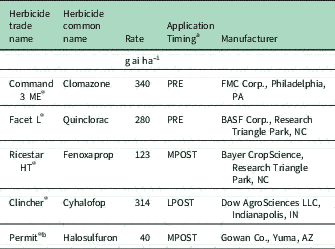
a Abbreviations: LPOST, application applied after establishment of permanent flood; MPOST application applied prior to establishing permanent flood; PRE, application applied at planting.
b Applied only at the Stuttgart location.
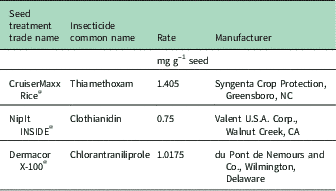
In each year at each location, the experimental design was a randomized complete block with a two-factor factorial treatment arrangement with four replications. The two factors were herbicide and insecticide seed treatments. The three levels of herbicide treatments were (1) glyphosate (Roundup PowerMax®, Monsanto Co., St. Louis, MO) at 126 g ae ha–1 (1/10× rate labeled for glyphosate-resistant soybean), (2) imazethapyr (Newpath®, BASF Corp., Research Triangle Park, NC) at 10.5 g ai ha–1 (1/10× rates for labeled for imidazolinone-resistant rice), and (3) a nontreated control (no herbicide). It is difficult to know the exact drift rate with off-target movement of these herbicides under field conditions; however, the drift rates in this research are similar to those evaluated by Bond et al. (Reference Bond, Griffin, Ellis, Linscombe and Williams2006) for imazethapyr on rice and Hensley et al. (Reference Hensley, Webster, Blouin, Harrell and Bond2013) for glyphosate on rice. Other researchers have evaluated even higher rates of glyphosate on rice (Davis et al. Reference Davis, Scott, Norsworthy and Gbur2011; Koger et al. Reference Koger, Shaner, Krutz, Walker, Buehring, Henry, Thomas and Wilcut2005). Herbicide applications were made at the two- to three-leaf (V2 to V3) growth stage (Counce et al. Reference Counce, Keisling and Mitchell2000). The four levels of insecticide seed treatments included thiamethoxam, clothianidin, and chlorantraniliprole at labeled rates listed in Table 3, along with no insecticide seed treatment. All treatments (including the no insecticide seed treatment) received a fungicide seed treatment of azoxystrobin at 0.071 mg g–1 of seed, mefenoxam at 0.088 mg g–1 of seed, and fludioxonil at 0.015 mg g–1 of seed.
Insecticide seed treatments and rates evaluated in seed treatment experiment.
Rice water weevil (Lissorhoptrus oryzophilus Kuschel) counts were taken in each plot 3 wk after the permanent flood was established at both locations for 2015 only. Three 10-cm-diam soil cores were taken from each plot and washed to count the number of rice water weevil larvae in each core.
Drift Timing Study
The drift timing study was conducted in a manner similar to the seed treatment study. The drift timing study was conducted only at Stuttgart in 2014 and 2015 with soil texture, planting dates (Table 4), plot size, and application equipment and setup similar to the seed treatment study. This study was also kept weed free in a manner similar to the seed treatment study.
Planting date and application dates of herbicides for drift timing experiment at the Rice Research and Extension Center near Stuttgart, AR.
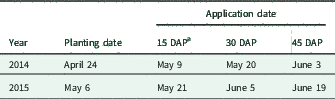
a Abbreviation: DAP, days after planting application.
In each year, the experimental design was a randomized complete block with four replications. The three factors were seed treatment (two levels), herbicide (three levels), and timing of the herbicide application (three levels), with all combinations completely randomized within each block. All insecticide-treated seed contained thiamethoxam at 1.405 mg g–1 of seed (referred to as “treated seed”). All seeds, including the insecticide-treated seeds, were treated with the fungicides azoxystrobin at 0.071 mg g–1 of seed, mefenoxam at 0.088 mg g–1 of seed, and fludioxonil at 0.015 mg g–1 of seed. The seed receiving only the fungicide seed treatments will be referred to as “nontreated seed.” Herbicide applications were 15, 30, and 45 d after rice planting (DAP).
Methods Common to Both Studies
All herbicides were applied using a CO2-pressurized backpack sprayer calibrated to deliver 140 L ha–1 using a six-nozzle, 2.5-m spray boom, with AIXR 110015 nozzles. Rice injury was assessed visually 1, 3, and 5 wk after the herbicide treatment (WAT) on a scale of 0 to 100, with 0 being no injury and 100 being plant death. Rice groundcover was estimated using Sigma Scan Pro® (Systat Software, Inc., 501 Canal Blvd. Suite E, Point Richmond, CA 94804) by determining the percentage of green pixels in photographs of each plot. Photographs of each plot were taken 5 WAT using a 1.8-m monopod (Purcell Reference Purcell2000). Plots were harvested at maturity using a small-plot combine, and rough rice yields were recorded and adjusted to 12% moisture.
All data for both studies were analyzed in JMP Pro 12 (SAS Institute Inc., Cary, NC). Site-year and replication nested within site-year were included in the model as random effects. Means were separated using Fisher’s protected LSD test at α=0.05.
Results and Discussion
Seed Treatment Study
Only rice water weevil numbers had a significant interaction between seed treatment and herbicide. For all other evaluations there was no significant interaction; however, the main effects of seed treatment and herbicide were significant.
Averaged over the glyphosate and imazethapyr herbicide treatments, plants in all insecticide seed treatment plots had at least 18% injury 1 WAT, but injury was less for all insecticide seed treatments than that observed in plots without an insecticide seed treatment (Table 5). At 1 WAT, thiamethoxam safened rice to a greater extent than did clothianidin or chlorantraniliprole. By 3 WAT, rice treated with thiamethoxam and clothianidin (27% and 29% injury, respectively) were both injured less than the rice not treated with insecticide (39% injury). Injury to chlorantraniliprole-treated rice 3 and 5 WAT was comparable to the rice not treated with insecticide. By 5 WAT, rice plants had begun to recover from injury caused by the herbicides, with ranking of insecticide seed treatments similar to earlier ratings. Evaluation of green pixels in photographs taken 5 WAT also revealed a reduction in damage to the crop, as indicated by greater groundcover for thiamethoxam- and clothianidin-treated rice than for plots without an insecticide seed treatment (Table 5). The reduction in early-season damage to rice when seeds were treated with thiamethoxam or clothianidin, pooled over herbicides, translated into a 700 to 810 kg ha–1 yield improvement over plots without an insecticide seed treatment that received a low rate of the herbicides (Table 5). In addition to protecting yield, it is likely that the quicker canopy formation caused by the seed treatments would aid weed control, because weed interference is largely a function of the rate of canopy formation (Miller et al. Reference Miller, Scott, Lorenz, Hardke and Norsworthy2016).
Main effect of insecticide seed treatment on observable injury, groundcover, and rough rice yield pooled over herbicides (glyphosate and imazethapyr) and the 2014 and 2015 growing seasons near Lonoke and Stuttgart, AR.
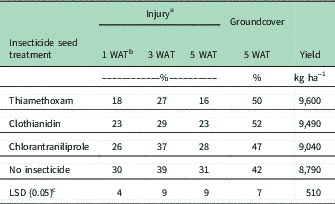
a The “no herbicide” treatment was excluded from the injury evaluations, because no injury was observed; thus, the analysis for injury involved four levels of insecticide seed treatment by two levels of herbicide treatment.
b Abbreviation: WAT, weeks after treatment.
c Fisher’s protected LSD is for comparing means within a column.
The 1/10× rates of imazethapyr (10.5 g ai ha–1) and glyphosate (126 g ae ha–1) had different effects on the rice after application. Overall, glyphosate caused more injury than imazethapyr to the rice at all three ratings (Table 6). Damage to rice from glyphosate at 3 WAT averaged 42% over seed treatments, similar to the levels observed by Hensley et al. (Reference Hensley, Webster, Blouin, Harrell and Bond2013) when applied to one-tiller rice. Rice injury was 24% following imazethapyr at 3 WAT averaged over insecticide seed treatments. Injury from glyphosate and imazethapyr seemed to have a direct effect on groundcover 5 WAT (Table 6). Glyphosate, which caused the most injury, resulted in rice having the least groundcover (45%) averaged over insecticide seed treatments, whereas the imazethapyr-treated plots had 51% groundcover. In comparison, the plots that were not treated with herbicide averaged 59% groundcover. Based on previous neonicotinoid research in Asian honey bees (Apis cerana cerana) (Ming et al. Reference Ming, Zhang, Feng, Xiaobo, Li and Baohua2016), we speculate that a possible upregulation of stress genes from the neonicotinoids could explain the lower herbicide injury and an overall healthier rice plant.
Main effect of herbicide on visible injury, groundcover, and rough rice yield for the seed treatment experiment, pooled over insecticide seed treatments and the 2014 and 2015 growing seasons near Lonoke and Stuttgart, AR.

a Abbreviation: WAT, weeks after treatment.
b The “no herbicide” treatment was excluded from the injury evaluations, because no injury was observed; thus, the analysis for injury involved four levels of insecticide seed treatment by two levels of herbicide treatment.
c Fisher’s protected LSD is for comparing means within a column.
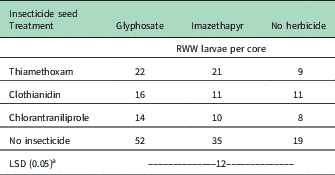
Rice water weevil samples were taken for both locations in 2015. Pooled over locations, rice water weevil numbers were greatest when rice was treated with a low rate of imazethapyr or glyphosate in the absence of an insecticide seed treatment (Table 7). All three insecticides performed equally well in reducing rice water weevil numbers. Previous research has found thiamethoxam and clothianidin to provide comparable rice water weevil control (Everett et al. Reference Everett, Lorenz, Slaton and Hardke2015), but these two insecticide seed treatments are sometimes less effective than chlorantraniliprole (Taillon et al. Reference Taillon, Lorenz, Plummer, McCullars, Cato and Black2018). Research also showing that a decrease in groundcover can cause an increase in rice water weevil larvae (Stout et al. Reference Stout, Harrell, Tindall and Bond2009) may explain the high counts in the plots exhibiting the greatest damage in the absence of the insecticide seed treatment.
Average number of rice water weevil (RWW) larvae found per 10-cm-diam core in 2015 seed treatment studies averaged over experiments near Lonoke and Stuttgart, AR.
a Fisher’s protected LSD is for comparing any two means.
Drift Timing Study
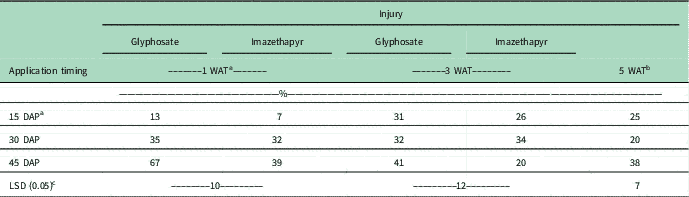
At 1 and 3 WAT, there was a significant interaction between herbicide and application timing (Table 8). For glyphosate 1 WAT, as application timing was delayed, injury to rice increased, probably because the safening effect of the insecticide seed treatment was most effective soon after planting. However, imazethapyr at 1 WAT caused 39% injury when applied 45 DAP compared to 67% for glyphosate. There was no difference in injury between glyphosate and imazethapyr within application timings of 15 and 30 DAP. At 3 WAT, there were no differences in the timing of glyphosate applications. Imazethapyr applied 45 DAP caused less injury than when applied 30 DAP but was not different from imazethapyr applied 15 DAP. For both herbicides, injury increased from 1 WAT to 3 WAT for the 15-DAP application but stayed nearly the same for the 30-DAP application and decreased for the 45 DAP. At 5 WAT, herbicide effect was no longer significant and only application timing was significant. Applications 45 DAP caused more injury than the 15 and 30 DAP applications.
Effects of application timing and herbicide on observable injury to rice pooled over 2014 and 2015 at Stuttgart, AR.
a Abbreviations: DAP, days after planting; WAT, weeks after treatment.
b Herbicide effect was not significant 5 WAT.
c Fisher’s protected LSD is for comparing means within a column.
Seed treatment also played a role in injury to the rice. At all three ratings, plots having the thiamethoxam-treated seed exhibited less injury than those without the insecticide seed treatment (Table 9)––a finding similar to those of other research (Miller et al. Reference Miller, Scott, Lorenz, Hardke and Norsworthy2016).
The effects of seed treatment on observable injury to rice pooled over 2014 and 2015 at Stuttgart, AR.

a Abbreviation: WAT, weeks after treatment.
b Fisher’s protected LSD is for comparing means within a column.
Groundcover images were taken 5 wk after final treatment for all plots and later converted to percentage of green pixels using Sigma Scan. The main effects of timing and seed treatment had no effect on groundcover; however, the herbicides applied did have an effect. There was no difference between the herbicides; however, the herbicides did reduce groundcover when compared to plots that did not receive any herbicide. There was a 13 to 15 percentage point decrease in groundcover when the drift rate of either imazethapyr or glyphosate was applied (Table 10).
The effects of reduced herbicide rates on groundcover and rice yield pooled over insecticide seed treatment, application timing, and the 2014 and 2015 growing season at Stuttgart, AR.

a Fisher’s protected LSD is for comparing means within a column.
Similar to groundcover, the only factor that affected yield was the application of imazethapyr or glyphosate. Plots without any herbicide treatment yielded 11,670 kg ha–1, whereas the application of glyphosate and imazethapyr reduced yields to 10,610 and 10,810 kg ha–1, respectively (Table 10).
Rice plants receiving a thiamethoxam seed treatment showed reduced damage from glyphosate and imazethapyr along with some rice water weevil protection. This reduction in injury protected some of the yield potential of rice when the glyphosate or imazethapyr exposure occurred soon after planting. Clothianidin-treated seed reduced injury and provided yield protection in the presence of glyphosate or imazethapyr as well as rice water weevil protection. Chlorantraniliprole provided rice water weevil protection but did not provide significant protection against glyphosate or imazethapyr. It is important to note that the insecticide seed treatments did not completely alleviate the risk for injury from imazethapyr or glyphosate but instead reduced the damage and subsequent yield loss caused by early-season exposure of rice to these herbicides.
Acknowledgments
The authors appreciate the funding for this research provided by the Arkansas Rice Research and Promotion Board. There are no conflicts of interests to disclose.


 Open access

