




Introduction
During the period 1200–450 BC, the Chełmno land in north-central Poland was home to one of the northernmost communities of the Lusatian culture—an archaeological culture that formed part of the North European Bronze Age and continued through the Urnfield culture into the Early Iron Age. Traditionally, the Chełmno group people are thought to have been largely unaffected by the social and economic developments of the Urnfield period and the subsequent Hallstatt culture and, in contrast with the widespread metal-hoarding seen in Lusatian regions that gravitated towards the Nordic zone and Danubian-Alpine centre of the south, metal does not appear to have featured prominently in the social and ritual activities of the Chełmno community (Gackowski Reference Gackowski2012). But this image of disinterested metal movement and consumption in the region was challenged in early 2023 when metal detectorists of the Kujawsko-Pomorska Grupa Poszukiwaczy Historii located metal deposits and stray finds in a dried-up lake in the village of Papowo Biskupie. Subsequent rescue excavations, conducted by the Provincial Office for the Protection of Monuments in Toruń, recovered more than 550 bronze artefacts, human bones and other archaeological material, rendering the site at Papowo Biskupie one of the most eloquent testimonies of ritual activity from the Lusatian period in Poland.
Palaeoenvironmental setting and chronology
The archaeological site at Papowo Biskupie (Chełmno district, Kuyavian-Pomeranian province) is located in a kettle hole—a crater formed by retreating glaciers as buried ice melts and overlying sediment collapses in—with a maximum depth of 7m. It is flanked by a moraine plateau overlooking fertile black earths and lessive soils, approximately 30km north of Toruń (Figure 1A). Until the second half of the eighteenth century AD, the kettle hole was filled by an unnamed lake that covered an area of approximately 30ha. The lake was drained in the nineteenth century and again in the 1980s for agricultural use. It is now dry land utilised as an agricultural area.
Topography of the site at Papowo Biskupie, with reconstruction of the dried-up lake (A) and in situ views of the metal deposits (D–F). Draining of the lake in the late nineteenth century AD also revealed a metal hoard (C) (Semrau Reference Semrau1917). The area over which human bones have been recovered is indicated by the hatched lines. Radiocarbon dates (B) were calibrated in OxCal v4.4.2 (Bronk Ramsey Reference Bronk Ramsey2009), using the IntCal20 calibration curve (Reimer et al. Reference Reimer2020) (site plan by P. Molewski and M. Sosnowski; Digital Terrain Model data courtesy of Główny Urząd Geodezji i Kartografii).

A test trench and drilling core were opened near the location of the metal deposits to inspect the palaeoenvironmental conditions of the site. Vertical stratigraphy consists of colluvial sediments deposited on organic soil composed of peat and gyttja, indicating periodic waterlogging of eutrophic fen mire (Figure 2B). The pollen record between 0.26 and 0.31m depth (Figure 2A) correlates with the Lusatian period and reveals an increase in wetland vegetation. The presence of preserved leaves from nenuphar (Nuphar/Nymphea) and bulrushes (Typha latifolia) suggests that the artefacts were deposited during the seasonal waterlogging of the fen. Moreover, plant macrofossils from the metal deposition context suggest that the bronze offerings were packed into baskets made of birch bark (Figure 2C & D) and lined with moss (Drepanocladus and/or Cratoneurum; Figure 2E–H).
Vertical stratification of the test trench (B) and pollen diagram from a drilling core taken near the location of the metal deposits (A). Taxonomical identifications for the plant macrofossils (C–D) are in the text (photographs by D. Kamiński and A. Podgórski; A by A.M. Noryśkiewicz; B by M. Jankowski).

Radiocarbon dating on human bones (Figure 1B) returned an age range of 1040–780 cal BC at 95.4%, probability roughly corresponding with the Montelius IV and V periods of the Northern Bronze Age. An antler artefact accompanying one of the metal deposits (Figure 1F) dates to 760–410 cal BC at 95.4% probability and may signal a temporal distinction between depositional events involving human corpses and metal. The timing of metal deposition may be further refined to 600–500 BC due to the presence of nail-like earrings in the assemblage.
Archaeological finds and their significance
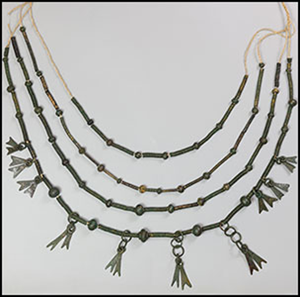
Over 550 bronze artefacts were recovered from the site, comprising primarily arm and neck ornaments and other female-gendered objects, as well as horse gear and metal waste (Figure 3). Prominent among the finds is a multi-turn necklace (Figure 4) composed of oval-shaped and tubular beads interspersed with several swallow-tail pendants and a single glass bead (Ringaugenperle). The bead is made of low-magnesium glass that can be traced from its source in the Eastern Mediterranean, through workshops in present-day Italy, Slovenia and Croatia, and along the trading route running through eastern Germany during the Hallstatt D period spanning 600–450 BC (Purowski et al. Reference Purowski, Syta and Wagner2020). The necklace was found in association with four large metal pins and other jewellery that may have formed part of a female outfit (Figure 5). Nail-like earrings (Figure 3A), probably originating from western Ukraine, were also recovered. Remote sensing has revealed dozens of additional non-ferrous signals, allowing anticipation of further metalwork deposited at the site. Other finds include a flint spearhead and antler artefacts, one of which was fixed in an iron socket and decorated with leaded bronze inlays (Figure 6), adding to the body of evidence that cervids were ideologically important to the Lusatian people.
Bronze metalwork deposited at Papowo Biskupie (photographs by A. Piasecka).

Hypothetical reconstruction of the necklace recovered from Papowo Biskupie (A & B). Swallow-tail pendants (E) that were part of the necklace are paralleled by finds from Pomerania and Brandenburg (C). D shows the magnesium and potassium content of the bead in comparison to other glass beads found in Poland (photographs by A. Fisz; D adapted from Sprockhoff Reference Sprockhoff1956; E by T. Purowski).

Hypothetical reconstruction of a female outfit based on metal dress fittings and jewellery deposited at Papowo Biskupie (photograph by A. Fisz).

Artefacts and human bones accompanying the metalwork deposited at Papowo Biskupie (A, B & H). No specific age-at-death category dominated the human assemblage (G). Traceology revealed bronze inlays (E–F) at the base of an antler artefact (B), which also displays a combination of technological marks and subsequent hand-held use-wear (C–D) (photographs by W. Lorkiewicz, W. Ochotny and G. Osipowicz; G by W. Lorkiewicz).

The site at Papowo Biskupie is exceptional in yielding the skeletal remains of at least 33 human individuals, including infants, children, adolescents and adults (but not those over 50 years old) of both sexes. The bones have a bog patina and are severely fragmented but have no direct evidence of perimortem blunt or sharp force trauma (Figure 6G–H). Although the bones were disarticulated, the stratigraphic and geohistorical context of the site and comparison to mortuary treatment from the wider region provide evidence for linking the human remains with sacrificial practices. Except for a few potsherds, no other accompanying artefacts were found with the human bones. There is also nothing in the archaeological record of the region to suggest that human bog sacrifice continued into the Early Iron Age and the site at Papowo Biskupie may thus reflect a shift from human sacrifice to metal offerings in the local wetland landscape during the cultural conversion of the Lusatian power elites to Hallstatt culture (cf. Kossack Reference Kossack1999). The consequences of this development are seen in the contents of the metal deposits at the site—the female ornaments accompanied by horse-related accessories belong to a wider pattern of Hallstatt finds, which are often taken as evidence that women were an important medium in votive depositions (Kristiansen Reference Kristiansen1998).
To sum up, Papowo Biskupie opens a new window for exploring the social and ritual practices of the Lusatian era in Poland and demonstrates the potential of this place to offer a better understanding of the complex interplay between votive depositions and human sacrifice.
Funding statement
This work was supported by the Kujawsko-Pomorskie Centrum Dziedzictwa w Toruniu and the National Science Centre, Poland, under grant agreement no. 2022/45/N/HS3/04212.


 Open access

