


INTRODUCTION
How do populist, authoritarian, ethnocentric leaders gain power in democratic polities? Explanations for the rise of such candidates in the United States have mainly focused on the white working class (Mutz Reference Mutz2018b; Reny, Collingwood, and Valenzuela Reference Reny, Collingwood and Valenzuela2019; Sides, Tesler, and Vavreck Reference Sides, Tesler and Vavreck2019). Many studies find that Donald Trump drew support particularly from white Americans with lower education and less privilege (Cramer Reference Cramer2016; Mutz Reference Mutz2018b; Sides, Tesler, and Vavreck Reference Sides, Tesler and Vavreck2019).Footnote 1
Yet scholarship on power has emphasized the importance of a very different demographic: the wealthy. When the preferences of the affluent diverge from the rest, the affluent have much more influence in politics (Bartels Reference Bartels2018b; Gilens Reference Gilens2012). This outsize power may matter for the rise of populism. According to influential theories of American party politics, wealthy donors can play a critical role in the electoral fortunes of candidates (La Raja and Schaffner Reference La Raja and Schaffner2015). As Page and Gilens (Reference Page and Gilens2020) put it, most candidates “have had to rely heavily on money from wealthy contributors…[and] have had to take certain pro-wealthy stands on policy to get the money needed to run for office” (104). Moreover, according to cross-national scholarship, authoritarian candidates’ electoral gain often hinges on whether they receive backing from wealthy, center-right elites (Gidron and Ziblatt Reference Gidron and Ziblatt2019; Levitsky and Ziblatt Reference Levitsky and Ziblatt2018; Ziblatt Reference Ziblatt2017).
To help adjudicate between these contrasting theories of right-wing populism–––one centering on the working classes and the other on the wealthy establishment–––we ask: how much financial support for Trump came from the most economically powerful sectors of society? How does this support compare to their support for mainstream candidates? How does wealthy support compare to support by the non-wealthy? In posing these questions, we consider a more nuanced narrative about populism and democratic erosion, integrating both the discontent of the working classes and the behavior of the wealthy.
Existing scholarship has been unable to fully address these questions due to limited data about the wealthy. The literature on money in politics has long highlighted the role of wealthy interests, but has struggled to measure wealth (Barber et al. Reference Barber, Canes-Wrone, Clinton and Huber2022; Bonica and Rosenthal Reference Bonica and Rosenthal2015). As Magleby, Goodliffe, and Olsen (Reference Magleby, Goodliffe and Olsen2018) note, “most of the money raised by presidential candidates comes from individual donors” (1); yet the literature lacks comprehensive data on wealthy individual donors. We advance this literature by using nationwide property values to measure wealth, and linking wealth to itemized contributions. This approach avoids the measurement difficulties of self-reported income and of imputed wealth, and does not tautologically equate wealth with contribution size–––the three most common approaches in the study of money in politics.
We combine this merged dataset with nationwide voter files from L2, Inc. The result is an individual-donation level dataset of itemized contributions, wealth, and demographics among property owners who registered to vote from 2012 to 2020. This dataset includes 232 million observations representing 108 million unique individuals over three election cycles. A key advantage of this dataset is the large number of individuals at the very top of the wealth distribution, who are too scarce and difficult to sample in surveys (Bonica and Rosenthal Reference Bonica and Rosenthal2015; Cook, Page, and Moskowitz Reference Cook, Page and Moskowitz2014; Page, Bartels, and Seawright Reference Page, Bartels and Seawright2013). This is arguably the largest and most comprehensive dataset of wealthy individual political behavior to date, with 146,711 unique individuals in our top 0.1%.
We compare the top 0.1%, 1%, and 10% of our wealth distribution (the “wealthy”) against the bottom 90% (“non-wealthy”). We also compare support for Trump with support for various Republicans and his Democratic opponents, to account for time and to compare across parties. Finally, by including both donors and non-donors across cycles, our longitudinal dataset enables us to examine Trump’s relative ability to retain prior donors—who are central to theories of the party establishment—and to recruit new donors to replace establishment defections.
We find notable weakness in wealthy Trump support, and unusually robust support from the non-wealthy. In 2016, the wealthy gave Trump far less than they gave other presidential candidates of the decade. By contrast, the non-wealthy gave him only somewhat less than other candidates. That is, Trump underperformed especially among the wealthy. By 2020, Trump regained ground among the wealthy, by some measures, but his rebound was much stronger among the non-wealthy. In fact, in 2020, the non-wealthy supported him more than any other candidate in our data. In sum, in both years, Trump relied on weak but still substantial support from the wealthy coupled with unusually strong support from the non-wealthy. This pattern holds whether we measure contributions by donor counts, per capita dollars, total dollars, or relative campaign shares.
We then examine prior donors, a subset of the donorate identified as vital in theories of establishment party politics. On two measures of establishment retention—retaining prior donors, and converting primary opponent donors—Trump performed worse than other candidates, regardless of donor wealth. That is, Republican donors of all wealth groups abandoned him. He compensated with massive numbers of new donors, most of whom were non-wealthy. The overwhelming majority of Trump’s donorate was new, especially among the non-wealthy.
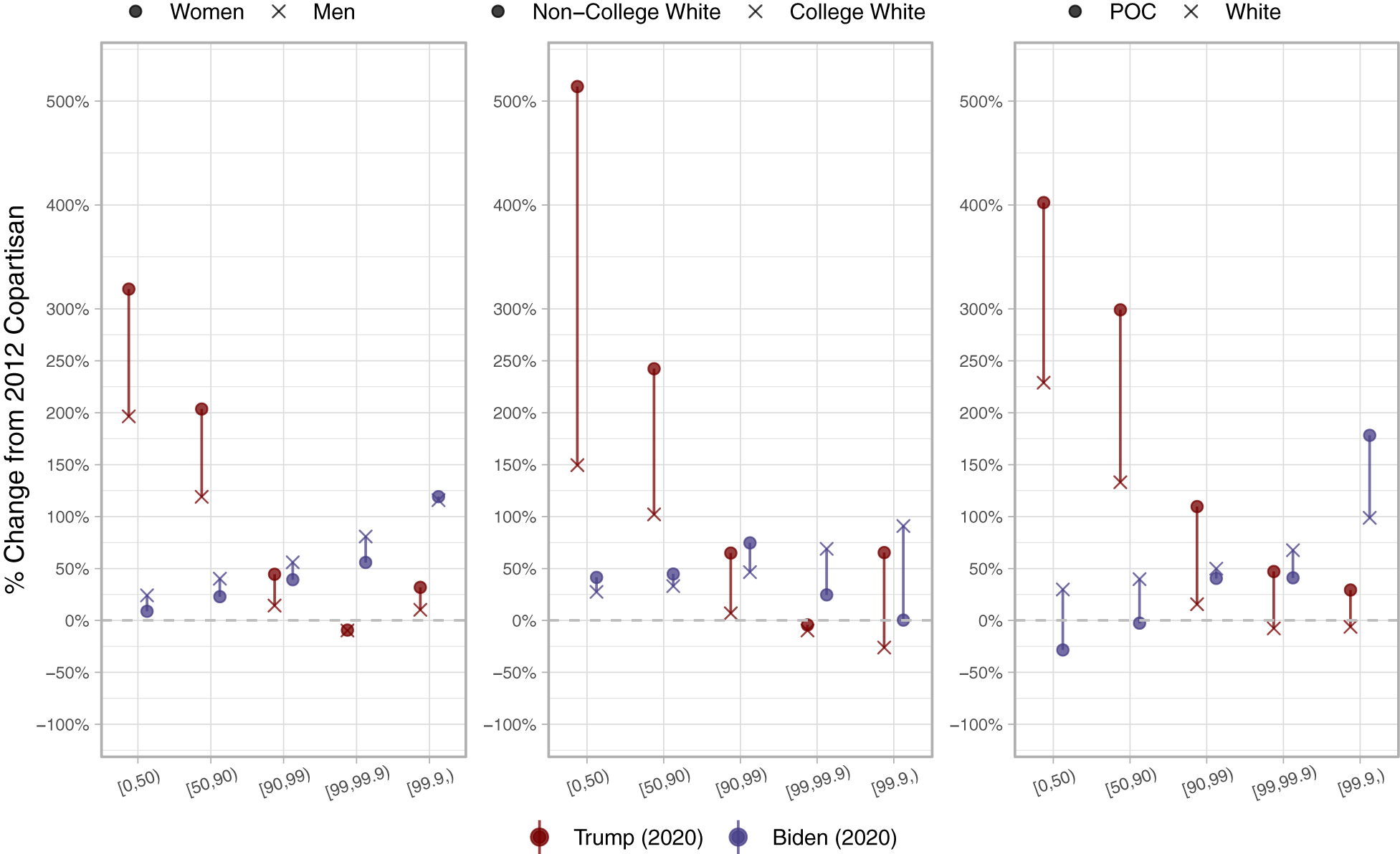
Finally, while the “left behind” studies locate Trump support largely among white, male, noncollege voters, we find a somewhat different pattern among donors. To be sure, Trump’s donorate was disproportionately white and male, as was his electorate. However, Trump achieved his largest percentage gains in 2020 from women, people of color (POC), and noncollege whites. In that sense too, Trump shifted the donorate away from the Republican establishment.
These findings suggest that Trump raised viable financing despite comparatively weak support from the wealthy party establishment. The electoral threat to American democracy does not seem to depend as heavily on the wealthy establishment as theories of democratic erosion or of wealth and party politics might expect.
That said, despite his relative weakness among the wealthy, Trump nevertheless depended on their contributions. Approximately, 55% of Trump’s itemized 2020 dollars came from the top 10%. While this is the lowest of the candidates we analyze, it is still a vastly disproportionate share.
These results suggest a “plutopopulism” model, one that integrates the discontent of broad swaths of the mass public with the power of the wealthy few (Baker Reference Baker2004; Pierson Reference Pierson2017; Schlozman and Rosenfeld Reference Schlozman and Rosenfeld2024). Trump was financed by both the top and the middle of American society, complicating theories of wealthy dominance and studies of working class populism alike. In the conclusion, we discuss implications for the role of wealth in the rise of right-wing authoritarianism in established democracies.
RELATED WORK AND EXPECTATIONS
The main explanations of Trump’s viability focus on voting by the “left behind.” However, they potentially miss the importance of money in elections, an arena in which the wealthy traditionally dominate. We first consider the role of white working Americans in the rise of Trump. We then generate expectations for wealthy Americans’ support for Trump.
The “Left Behind” Thesis
Donald Trump won the 2016 presidential election as a populist, ethnocentric, authoritarian candidate. Scholars have largely explained his appeal using theories of economic distress and decline and theories of identity and status threats. For example, the decline in the economic fortunes of workers affected by free trade has been linked to a shift from Obama in 2012 to Trump in 2016 (Morgan and Lee Reference Morgan and Lee2018; but see Mutz Reference Mutz2018a). In addition, Trump supporters disproportionately endorse ethnocentric attitudes about identity and status, especially regarding race and immigration (Hopkins and Washington Reference Hopkins and Washington2020; Mutz Reference Mutz2018b; Reny, Collingwood, and Valenzuela Reference Reny, Collingwood and Valenzuela2019; Schaffner, Macwilliams, and Nteta Reference Schaffner, Macwilliams and Nteta2018; Sides, Tesler, and Vavreck Reference Sides, Tesler and Vavreck2019). They also tend to be distrustful of mainstream institutions and to believe they have been “left behind” by government and the political establishment (Cramer Reference Cramer2016).
Consistent with these findings, several studies report that white Americans without a college degree evidenced particular enthusiasm for Trump (Kitschelt and Rehm Reference Kitschelt and Rehm2019; Reny, Collingwood, and Valenzuela Reference Reny, Collingwood and Valenzuela2019; but see Carnes and Lupu Reference Carnes and Lupu2021). Trump’s message may have appealed to working class voters because it departed from the traditional Republican ideology of limited government and fiscal conservatism and emphasized conflict between the “elite” and the “real people” (Bartels Reference Bartels2018a). In addition, right-wing attitudes about racial or immigrant outgroups tend to be more prevalent among groups with less education (Mutz Reference Mutz2018b; Reny, Collingwood, and Valenzuela Reference Reny, Collingwood and Valenzuela2019; Sides, Tesler, and Vavreck Reference Sides, Tesler and Vavreck2019). Trump’s appeals to racial and nativist sentiments may have particularly appealed to white people without a college degree (Hopkins and Washington Reference Hopkins and Washington2020; Mutz Reference Mutz2018b; Sides, Tesler, and Vavreck Reference Sides, Tesler and Vavreck2019).
What unites many of these explanations for Trump’s victory is their focus on the (white) working classes. According to these studies, Trump’s base consists of people with less education and fewer resources, who feel they are collectively losing ground to outsiders and not getting their fair share.
Wealthy Americans and Their Financial Influence
While useful, this focus on the “left behind” can obscure the role other groups may play in the rise of authoritarian leaders. The degree of wealthy support may help explain these candidates’ electoral success, and ultimately, the health of the American political system.
The role of the wealthy in the health of democracy has been the focus of recent influential studies in comparative politics (Gidron and Ziblatt Reference Gidron and Ziblatt2019; Levitsky and Ziblatt Reference Levitsky and Ziblatt2018; Ziblatt Reference Ziblatt2017). According to this literature, the rise and resilience of democracy depends not only on the mobilization of the working and middle classes, but also on the actions of the most politically and economically powerful. Pluralist electoral democracies are vulnerable to anti-democratic candidates when center-right elites enable them (Levitsky and Ziblatt Reference Levitsky and Ziblatt2018). By giving them the means to obtain power, center-right wealthy actors may play a key role in the rise of populist, authoritarian, ethnocentric leaders and the downstream breakdown of democratic norms.
The conditions that would allow the wealthy to play this pivotal role are well-established in the United States. The top 1% of the income distribution own roughly 32% of the wealth (Smith, Zidar, and Zwick Reference Smith, Zidar and Zwick2022). The increasing concentration of economic resources allows wealthy Americans to have vastly disproportionate influence over government, shifting policy on taxation and regulation rightward (Bartels Reference Bartels2018b; Gilens Reference Gilens2012; Hacker and Pierson Reference Hacker and Pierson2010; Page and Gilens Reference Page and Gilens2020).Footnote 2
Like these studies of “affluent influence,” a number of theories of American parties and of organized leadership networks also emphasize the importance of the wealthy elite, and posit that they have outsize influence over candidates’ electoral fortunes (Page and Gilens Reference Page and Gilens2020, chap. 4; Winters and Page Reference Winters and Page2009). These donors may carry influence not only in their role as party “gatekeepers” in primaries (Hassell Reference Hassell2017), but also through their financial support for party nominees whom they perceive as ideologically aligned (Barber, Canes-Wrone, and Thrower Reference Barber, Canes-Wrone and Thrower2019). There is causal evidence that donors have much more access to politicians (Kalla and Broockman Reference Kalla and Broockman2016). Observational evidence suggests wealthy donors especially leverage that access (Page and Gilens Reference Page and Gilens2020). Wealthy donations are also associated with policymakers’ increased priorities on pro-wealthy policies (Witko et al. Reference Witko, Morgan, Kelly and Enns2021). Wealthy individuals may have influence through their own direct donations (Canes-Wrone and Gibson Reference Canes-Wrone and Gibson2019) and through their connections with other wealthy citizens. Conservative elites are especially effective in coordinating political activities, including campaign donations (Hertel-Fernandez, Skocpol, and Sclar Reference Hertel-Fernandez, Skocpol and Sclar2018). Such activities “may help to explain the increasingly-extreme economic positions espoused by most GOP candidates and officeholders” (Skocpol and Hertel-Fernandez Reference Skocpol and Hertel-Fernandez2016, 682).
What is left unanswered is what wealthy establishment donors actually did to promote or undermine Trump’s candidacy. If wealthy Americans gave Trump the same disproportionate financing they gave other Republicans, then the electoral fortunes of right-wing extremism in the United States are not explained solely by the behavior of the “left behind.” But if wealthy Americans actually gave less financial support to Trump than to other Republicans—and gave Trump less than the non-wealthy—then the rise of Trump poses a puzzle for theories positing the crucial role of the wealthy establishment.
This question cannot be adequately addressed with available data. Most survey data show an association between income and self-reported Trump voting (Kitschelt and Rehm Reference Kitschelt and Rehm2019; Ogorzalek, Piston, and Puig Reference Ogorzalek, Piston and Puig2019). However, these data present two methodological difficulties. First, the top income category lumps together groups ranging from the middle class to the very wealthy (typically, it is $150,000 per year or more). Second, self-reported Trump support has substantial measurement error (Clinton et al. Reference Clinton, Agiesta, Brenan, Burge, Connelly, Edwards-Levy and Fraga2020; Kennedy et al. Reference Kennedy, Blumenthal, Clement, Clinton, Durand, Franklin and McGeeney2018).
More fundamentally, a focus on voting behavior misses the essential role of wealth in campaign contributions. Candidates’ funding comes largely from a very small number of donors (Bonica et al. Reference Bonica, McCarty, Poole and Rosenthal2013). The gap between the top and bottom socioeconomic quintiles is larger for the likelihood of donating to a campaign than for any other form of political behavior (Bonica et al. Reference Bonica, McCarty, Poole and Rosenthal2013; Schlozman, Verba, and Brady Reference Schlozman, Verba and Brady2012). The question, then, is to what extent wealthy and non-wealthy donors contributed to Trump.
Expectations for Wealthy Support
The wealthy face competing motivations in deciding whether to support Donald Trump. Partisanship and economic self-interest might incline wealthy elites to support candidates like Trump who, on the whole, back their core interests. At the same time, Trump’s anti-elite, anti-globalist, and ethnocentric rhetoric likely alienated some potential wealthy donors. We evaluate these motivations in greater detail below. We build on studies showing that presidential donors tend to be motivated by ideology and by candidate messaging and messenger characteristics (Magleby, Goodliffe, and Olsen Reference Magleby, Goodliffe and Olsen2018).
First, wealthy donors may support candidates such as Trump because of partisanship. Most wealthy individuals are Republican (Bonica and Rosenthal Reference Bonica and Rosenthal2015; Cohen et al. Reference Cohen, Hazan, Tallarita and Weiss2019; Page, Bartels, and Seawright Reference Page, Bartels and Seawright2013).Footnote 3 In today’s highly polarized environment, wealthy Americans may not give much weight to any specific issue so long as the candidate is a copartisan.
Second, they may support Trump because of economic self-interest (Barber et al. Reference Barber, Canes-Wrone, Clinton and Huber2022). Economic elites may donate to candidates in order to gain access and advance policies that serve their socioeconomic group (Barber Reference Barber2016b; Barber, Canes-Wrone, and Thrower Reference Barber, Canes-Wrone and Thrower2017).Footnote 4 This distinguishes them from other donors, who are more likely to be motivated by overall ideological affinity (Barber Reference Barber2016a; Barber, Canes-Wrone, and Thrower Reference Barber, Canes-Wrone and Thrower2017; Bonica Reference Bonica2014). Donors are more extreme than rank and file partisans (Hill and Huber Reference Hill and Huber2017) including non-donor wealthy partisans (Barber et al. Reference Barber, Canes-Wrone, Clinton and Huber2022).Footnote 5 $ {}^{,} $
Footnote 6 In this telling, the wealthy will support candidates who are more likely to supply them with material goods than the candidate’s opponent.
$ {}^{,} $
Footnote 6 In this telling, the wealthy will support candidates who are more likely to supply them with material goods than the candidate’s opponent.
The wealthy likely especially valued Trump’s tax and regulation policies. Though he was rhetorically unorthodox, Trump’s main economic policies hewed to his party’s focus on tax cuts and deregulation (Pierson Reference Pierson2017). Trump’s proposals in 2016 would have substantially cut the overall tax burden of the wealthy (Nunns et al. Reference Nunns, Burman, Rohaly and Rosenberg2015, as cited by Page and Gilens Reference Page and Gilens2020, fn. 36, 100). And by 2020, Trump had kept his word on tax and deregulation policies (Schlozman and Rosenfeld Reference Schlozman and Rosenfeld2024).
Trump’s conservative tax and deregulation policies became evident in 2020. In office, he oversaw tax cuts that disproportionately went to wealthy Americans, and moved aggressively to deregulate commerce and industry. These policies are the core of wealthy Americans’ economic agenda (Hacker and Pierson Reference Hacker and Pierson2010). The only truly dissonant stance for wealthy Americans’ interests is Trump’s protectionist trade policies (Sides, Tesler, and Vavreck Reference Sides, Tesler and Vavreck2019). However, overall, wealthy Americans may put less weight on this issue than on tax cuts and deregulation (Schlozman and Rosenfeld Reference Schlozman and Rosenfeld2024, 247).
On the other hand, self-interest could instead pull the wealthy away from candidates like Trump. At the heart of Trump’s message is anti-elite rhetoric (Müller Reference Müller2016). The wealthy may be reluctant to embrace a candidate who focuses attention on the “left behind” and working class grievances (Page and Gilens Reference Page and Gilens2020). They likely regard with suspicion any candidate who may disrupt a political-economic system from which they have profited immensely.
Another reason why the wealthy may oppose Trump is his ethnocentrism. Trump’s nativist, anti-globalist, and ethnocentric messages were less likely to appeal to the wealthy than to the non-wealthy. Wealthy Republicans are more pro-globalist than the average Republican voter (Broockman and Malhotra Reference Broockman and Malhotra2020). This rejection may be due to education. In general, the wealthy are better educated, and education is negatively associated with Trump support (Reny, Collingwood, and Valenzuela Reference Reny, Collingwood and Valenzuela2019; Sides, Tesler, and Vavreck Reference Sides, Tesler and Vavreck2019). The college gap in Trump support is mostly explained by attitudes about race and undocumented immigration (Sides, Tesler, and Vavreck Reference Sides, Tesler and Vavreck2019, 179). This suggests that the wealthy may give Trump less financial support than they give other Republicans, and less than Trump received from the non-wealthy.
While Trump’s ethnoracial and authoritarian messages were probably less appealing to wealthy citizens than to others, there may be important heterogeneity among the wealthy. Wealthy individuals who are men, white, and have lower education—three correlates of ethnoracial and authoritarian attitudes—may have found Trump appealing, at least as much as their non-wealthy counterparts did.Footnote 7
Taken together, the wealthy face a conflicting set of potential motivations. Did wealthy Republican donors maintain their support when Trump came along, in line with comparative theories of center-right collaboration? If these establishment donors withheld their typical level of support, did that undermine Trump’s overall financing, as theories of inequality in American parties would predict? If it did not, from whom did Trump make up the shortfall—what was the role of new donors, and were new donors disproportionately wealthy or non-wealthy?
Measuring Wealth
Previous attempts to measure the donation behavior of the wealthy typically take one of five approaches, each with significant limitations. The first approach uses a list of the most wealthy individuals in the United States (Bonica and Rosenthal Reference Bonica and Rosenthal2015); those who serve(d) as leaders of large corporations (Bonica Reference Bonica2016; Cohen et al. Reference Cohen, Hazan, Tallarita and Weiss2019); or participants in Koch consortia (Hertel-Fernandez, Skocpol, and Sclar Reference Hertel-Fernandez, Skocpol and Sclar2018). However, this limits inferences to a small number of ultra-wealthy individuals.
A second approach uses Federal Election Commission (FEC) data on contributors’ self-reported occupations, such as “CEO” (Bonica Reference Bonica2016; Heerwig and Murray Reference Heerwig and Murray2018). However, this excludes many occupations associated with significant wealth (and retirees). Moreover, there is substantial missingness in FEC occupation data.
The third approach uses large donations as a proxy for wealth itself (e.g., Bonica et al. Reference Bonica, McCarty, Poole and Rosenthal2013). This approach uses the dependent variable to infer the predictor, introducing a tautology of sorts. Larger amounts are attributed to “large” donors even though non-wealthy individuals could make them, and any small amounts the wealthy give are misattributed to non-wealthy individuals.
The fourth approach uses surveys with self-reported income. This approach has several problems. First, surveys are hampered by the dearth of wealthy respondents. For example, in the 2020 Cooperative Election Study, the largest national probability survey of political behavior, only 610 respondents would fall into the top 1% by income, and even fewer of them are donors. In addition, self-reported income is susceptible to substantial measurement error from imprecise recall and social desirability bias (Angel et al. Reference Angel, Disslbacher, Humer and Schnetzer2019; Hariri and Lassen Reference Hariri and Lassen2017). Finally, income is a problematic measure of wealth; income is a far smaller proportion of assets for the wealthy than the non-wealthy, introducing error into the estimate of wealth (Eisinger, Kiel, and Ernsthausen Reference Eisinger, Kiel and Ernsthausen2021). Income also varies substantially over time even when underlying resources remain steady.
The final approach uses income or wealth estimates from commercial voter files (Barber et al. Reference Barber, Canes-Wrone, Clinton and Huber2022). However, this measure is top-coded at values that pool the wealthiest and the upper middle class. For example, in 2020, L2’s top category of net worth pools the wealthiest 5%.Footnote 8 Section C.2 of the Supplementary Material shows this top coding obscures key findings, including incumbent Trump’s continued underperformance among the wealthy.
We propose an alternative means of measuring wealth. We use the value of individuals’ interstate real estate portfolios, binned by percentile. Home ownership is a key measure of wealth (Ansell Reference Ansell2014). Most Americans derive a majority of their wealth from property assets, alongside pensions (Smith, Zidar, and Zwick Reference Smith, Zidar and Zwick2022).Footnote 9 Though this approach excludes non-homeowners, it likely captures most wealthy individuals, because nearly all wealthy individuals own a home. Specifically, among the top 25% of the wealth distribution in the Federal Reserve’s Survey of Consumer Finances, over 95% report being homeowners (and should appear in our dataset as such).Footnote 10 We detail the data and validate the measure below. Later, we present robustness checks.
Using property values has several advantages over existing approaches (Li Reference Li2023). First, we can include many more types of wealthy donors, not only CEOs, billionaires, or those giving the largest donations. Second, we avoid measurement error from self-reports and from income. Third, we capture a large set of wealthy Americans. To the best of our knowledge, this is the largest dataset of wealth and political behavior in the United States to date.
To be sure, there are potential downsides to the use of real estate values. First, real estate alone likely underestimates the total assets of the ultra-wealthy, who rely on financial instruments such as stocks and S-corporations (Kopczuk Reference Kopczuk2015; Saez and Zucman Reference Saez and Zucman2016; Smith, Zidar, and Zwick Reference Smith, Zidar and Zwick2022). Second, we may over-estimate the wealth of the non-wealthy by ignoring what they owe on the property. However, wealth from real estate holdings is monotonically increasing across nationwide percentiles of wealth from all assets (Smith, Zidar, and Zwick Reference Smith, Zidar and Zwick2022, Figure VI.E). Our use of percentile rank, which requires us only to rank-order individuals correctly (in expectation), addresses both of these concerns.
DATA
To assemble the dataset, we merged itemized federal campaign contributions to nationwide property ownership and tax records and commercial voter files within and across an eight-year, three-election-cycle period (2012, 2016, and 2020). This section describes the data and record linkage procedures.Footnote 11
Data Sources
Our contribution data come from the FEC, which requires that federal candidates report all contributions from individuals whose election cycle-to-date contribution total exceeds $200.Footnote 12 These itemized transactions disclose the full name and address of the donor, and the transaction date and amount. We obtain every itemized individual contribution to every federal entity—that is, candidate committees, party organizations, and political action committees (PACs)—between 2012 and 2020. We include contributions to each presidential candidate’s principal campaign committee, their joint fundraising committee(s), and all major super PACs spending nearly exclusively in support of their candidacy. Section A.5 of the Supplementary Material lists these committees and our inclusion criteria. Because the FEC does not provide unique donor identifiers, we generate our own. Section A.1 of the Supplementary Material justifies differences between our method and those of Bonica (Reference Bonica2024) and Bouton et al. (Reference Bouton, Cagé, Dewitte and Pons2022).
To measure individual-level wealth, we calculate the total assessed value of every property owner’s nationwide property holdings in each of 2012, 2016, and 2020 for those individuals we match between CoreLogic and L2. We use parcel-level ownership and assessed value data sourced from public property tax records by CoreLogic, Inc. in each year. Each property record includes the owner name(s) and mailing address(es) (if any), the site address of the property, the property’s assessed value, the year of the assessment, and the value of any imposed property tax. The dataset includes any parcel on which property taxes are paid, and thus covers primary domiciles, second homes, vacation properties owned by individuals, undeveloped parcels, and commercial or investment properties owned by an individual. (See Hall and Yoder Reference Hall and Yoder2022; Hall, Yoder, and Karandikar Reference Hall, Yoder and Karandikar2021; Li Reference Li2023; Yoder Reference Yoder2020 for other applications of these data.) To track property portfolios over time, we generate unique identifiers for each person–address pairing in the dataset in a manner similar to the FEC donor identification procedure. We then aggregate the assets of each identified person–address for each year.
To analyze demographic heterogeneity among the wealthy, and to improve the accuracy of our merge, we also obtain four concurrent snapshots of a nationwide commercial voter file from L2, which includes the universe of registered voters in the United States. This dataset provides voter-level demographics from state and/or commercial sources (Section B.1 of the Supplementary Material), stable registered voter identifiers over time, and many registrants’ mailing addresses.Footnote 13 The latter improves our identification of unique individuals who donate from or own multiple properties, as described below.
Having created unique identifiers within the FEC and CoreLogic datasets, we assemble our final, individual-level dataset by merging three panels: (1) the donor-level contribution panel, (2) the panel of property values and their owners, and (3) the registered voter panel.
Record Linkage
Our record linkage method identifies fuzzy matches on name and address between the three panels, within and across each year (2012, 2016, and 2020). We then use observation-level co-occurrences of residential and mailing addresses in the L2 and CoreLogic data to aggregate person–address matches across all datasets and years to the person level. In doing so, we aggregate total assessed values up to the individual, and match these owners to the voter file and any campaign contributions they made from any of their associated addresses.Footnote 14 This fuzzy record linkage procedure used splink (Linacre et al. Reference Linacre, Lindsay, Manassis, Slade, Hepworth, Kennedy and Bond2022), an unsupervised Fellegi-Sunter record linkage procedure detailed in Enamorado, Fifield, and Imai (Reference Enamorado, Fifield and Imai2019) (Section A.1 of the Supplementary Material). In all, our dataset contains 108 million unique property-owners who registered to vote between 2012 and 2020, representing 232,627,552 individual–cycle observations.
Match Validation
Across campaigns and contribution amounts, we match between 41% and 58% of contributions to both L2 and CoreLogic. In Section A.7 of the Supplementary Material, we explain how our match rates suggest that the vast majority of donors are homeowners. Our rates are comparable to estimates from the 2020 Cooperative Election Study after adjusting for survey over-reporting (Section A.4 of the Supplementary Material).Footnote 15 Match rates vary by campaign and contribution size either minimally or in ways that make for a conservative test of our findings; see below and Section A.7 of the Supplementary Material. In Section A.2 of the Supplementary Material, we compare our overall match rates to those from other approaches that use similar data (Yoder Reference Yoder2020). We explain how their higher overall match rates are likely due to underestimates of false positive matches rather than a more accurate linkage procedure.
Excluded Contributions
Our dataset necessarily omits three types of contributions. Our findings would be sensitive to any such omissions that vary significantly by campaign or by wealth group. Analyzing variation in known summary statistics and our match rates, we find that our omissions are likely only to yield underestimates of the associations we find between wealth and contributions.
First, we exclude “dark money” raised and spent by 501(c) groups that do not disclose their (predominantly large) donors to the FEC (e.g., Oklobdzija Reference Oklobdzija2024) and “gray money” transferred from these non-disclosing groups to super PACs. Our findings would be threatened if wealthy Republican donors increasingly hid their donations through dark or gray money at a higher rate than their Democratic counterparts. Section A.7 of the Supplementary Material reports evidence showing that such money instead increasingly favored Democrats.
Second, we exclude itemized contributions we are unable to match to observations in both L2 and CoreLogic. We are unable to match these contributions because their donors are not registered voters or are not homeowners, or they disclose an address we could not match to L2 or CoreLogic. In Section A.7 of the Supplementary Material, we show that including these contributions would likely only increase the magnitude of the relationships we observe. Specifically, among Republicans, we likely underestimate Romney’s relative fundraising from the wealthiest donors and underestimate incumbent Trump’s fundraising from the less wealthy.
Third, we exclude small contributions that campaigns, joint fundraising committees, and super PACs do not itemize. These may disproportionately come from the less wealthy. In Section A.7 of the Supplementary Material we show that, were unitemized contributions included in our analysis, it would likely strengthen our observed relationships, as incumbent Trump raised the most from this source.
Wealth Measurement Validations
Our key wealth measure is derived from nationwide, assessed property value rank in each of 2012, 2016, and 2020. We validate it in four ways. First, our wealth measure is highly correlated with other individual-level economic variables in L2, including estimated home market values for matched individualsFootnote 16 and modeled commercial estimates of household income and net worth (though these are binned and top-coded, and derived from unknown sources). Section A.6.1 of the Supplementary Material presents these correlations and justifies the use of our measure over those from L2.
Second, in Section A.6.2 of the Supplementary Material, we aggregate our measure to the tract level and compare our tract-level median net worth for homeowners to tract-level median income for homeowners in the Census Bureau’s American Community Survey (ACS). The high correlation between these measures—derived from different data sources—suggests that both capture a similar underlying affluence dimension.
Third, in Section A.6.3 of the Supplementary Material, we compare the distribution of our wealth measure to summary statistics from aggregated individual-level Treasury filings (Smith, Zidar, and Zwick Reference Smith, Zidar and Zwick2022). Our dataset generates a similar distribution of housing wealth and property tax burden, including for the 0.1% wealthiest Americans (Smith, Zidar, and Zwick Reference Smith, Zidar and Zwick2022, Figure A.3 B). Our measure accurately captures the distribution of nationwide wealth, and has the advantage of transparency and variation among the wealthiest Americans.
Finally, if campaigns differ in their donors’ homeownership rates, our measure could systematically exclude some campaigns’ donors. To address this concern, Section C.2 of the Supplementary Material replicates our main results using L2’s net worth and income measures (for both homeowners and non-homeowners). Relationships between wealth and contributions are similar across the observable range of each measure, up to the 95th percentiles, beyond which L2’s measures are top-coded. The wealthy have nearly universal homeownership, so the exclusion would only exclude the non-wealthy. Our main findings for the non-wealthy are therefore unaffected by the exclusion of non-homeowners.
RESULTS
How much did the wealthy and non-wealthy enable Trump? We analyze this question in five ways. First, we ask whether contribution behavior differs between Trump and other candidates, and whether such differences vary between the wealthy and non-wealthy. We measure this with per capita dollars and donation rates. (All analyses use inflation-adjusted dollars.)
These donor-level outcomes may obscure important campaign-level patterns. To address this problem, our second analysis asks: does the proportion of Trump’s total dollars from each wealth group differ from other candidates? This reveals whether Trump’s funding exhibited less reliance on the wealthy.
Third, we examine changes in the partisan balance of each wealth group’s total contributions. We compare the Republican (Democratic) tilt of wealthy and non-wealthy donations over time. This accounts for the spurious effect of cycle-level changes in total fundraising.
Fourth, we use panel data to examine two components of “churn”: Trump’s failure to retain “establishment” donors—a conceptually important subset—and his success in mobilizing new donors. We again benchmark Trump against comparable candidates. Throughout, we compare wealthy and non-wealthy donors.
Finally, given that Trump used language widely described as ethnocentric (Schaffner, Macwilliams, and Nteta Reference Schaffner, Macwilliams and Nteta2018), for the last analysis we ask: did the demographics of Trump’s donorate shift relative to Romney’s? We focus on three demographics associated with ethnocentrism: sex, ethnorace, and education.
Across these analyses, we emphasize comparisons between Trump and four non-Trump candidates: most importantly, Mitt Romney in 2012, and the three Democratic candidates in this period (Obama, Clinton, and Biden). Clinton and Biden offer comparisons to contemporaneous general election presidential candidates. We use Republican congressional and presidential primary candidates as additional comparisons later. These additional comparisons guard against the possibility that Romney is an unusual Republican baseline.
All results use our measure of nationwide ranked wealth unless otherwise noted. We use unequally-sized bins to capture finer variation at the top of the wealth distribution, where a disproportionate share of contribution dollars originate. For clarity, some analyses coarsen this wealth distribution. Results for the full wealth distribution are in the Supplementary Material.
Donation Behavior by Wealth
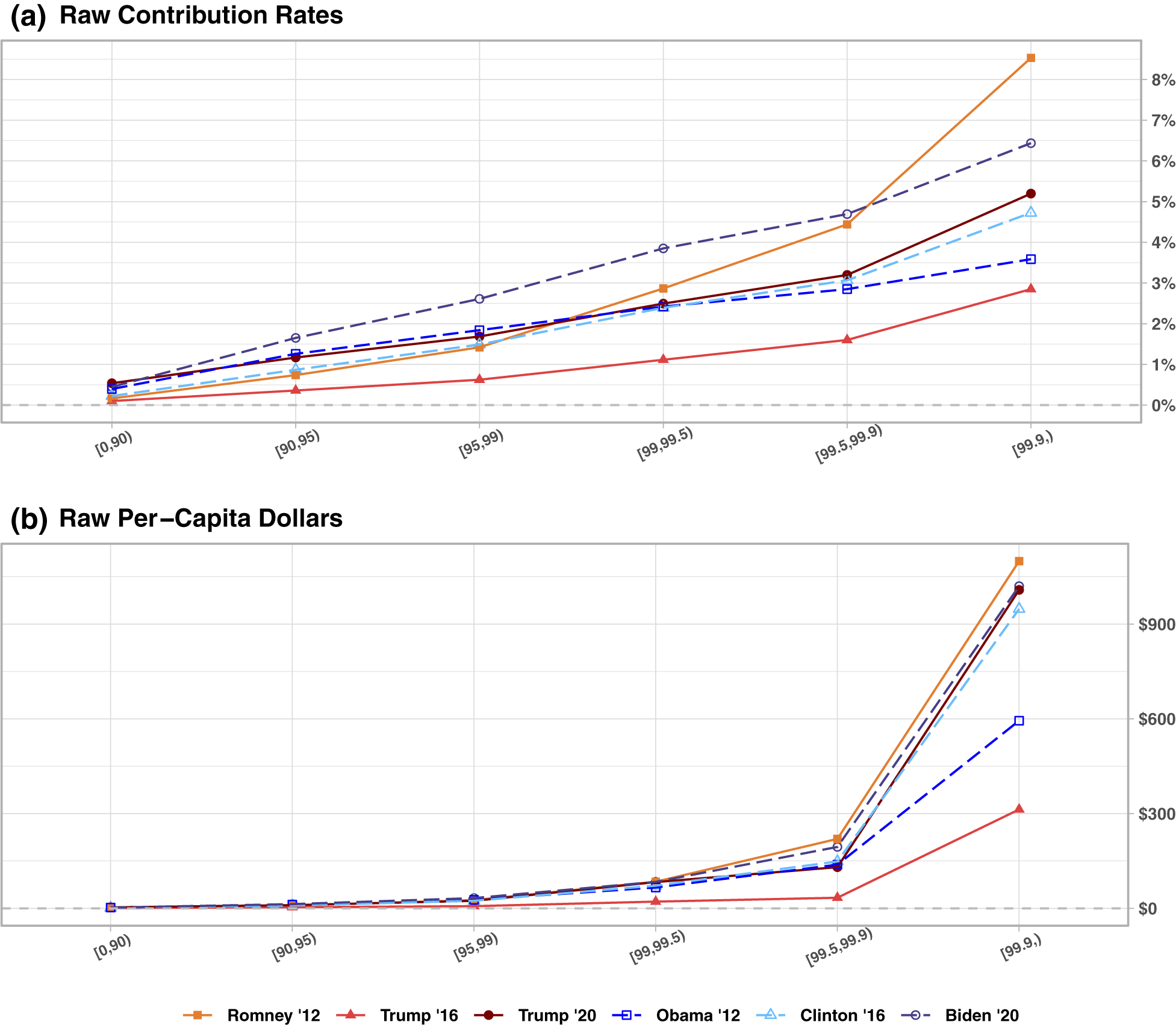
Did wealthy donors treat Trump differently than contemporaneous presidential candidates? If so, did they reduce support for him more than the non-wealthy? We begin by describing the raw association between wealth and itemized donations by campaign, using cross-sections. Figure 1 presents two plots. Panel (a) displays the percentage of donors in each wealth rank that contributed to each of the six campaigns (i.e., Democratic and Republican nominees in 2012, 2016, and 2020).Footnote 17 Panel (b) displays the per capita dollars from each wealth bin, by campaign (including those who donate nothing).
Association between Percentile Wealth Bins (x-Axis) and: (a) Contribution Rate, (b) per Capita Contribution Amount

As Figure 1 shows, the association between wealth and contributions is approximately exponential. The wealthiest are much more likely to contribute, and the wealth gradient is even steeper in dollars because the top 0.1% contribute very large sums. This is one of the most robust findings in the campaign finance literature, but the figure demonstrates it with considerably more precision. By measuring wealth independently of contribution size, we avoid misattributing smaller contributions to non-wealthy donors and underestimating wealthy dollars.
Most relevant to our analysis, Figure 1 compares the wealth gradients for Trump versus other candidates. In 2016, compared to other candidates, Trump’s wealth gradient is far flatter, because Trump elicited far fewer wealthy contributors and per capita dollars. For example, among the top 0.1%, Trump’s donors and per capita dollars represent about one third of Romney’s. While Trump did worse than all other candidates among nearly all wealth groups, that deficit was larger among the wealthy. In short, in 2016, wealthy donations to Trump are low compared to other presidential candidates.
In 2020, Trump’s performance among the wealthy improved considerably over 2016 (Figure 1). Consider donation rates (Panel a). Among the wealthiest 0.1%, for example, Trump roughly doubled his rate, though he still significantly lagged Biden and Romney. He did even better in per capita dollars (Panel b) than in rates. Specifically, among the top 0.1%, his deficit with all candidates nearly vanished.
While Trump’s wealthy resurgence is notable, he improved even more among the non-wealthy. Among the bottom eight deciles, Trump exceeded all candidates (Section C.1 of the Supplementary Material). This holds for rates and for per capita dollars.
A potential concern with our measure of wealth is that it omits property-less donors, and they may be disproportionately non-wealthy. As a robustness check, Section C.2 of the Supplementary Material replicates Figure 1 using L2’s income and net worth estimates. That analysis includes individuals who match to L2 but not CoreLogic (i.e., non-property owners). Because L2’s measures are top-coded, this exercise does not capture variation within the top 5% of wealth, and so, is not as complete a picture of wealth. Nevertheless, it replicates the relationships from Figure 1 across the observable distribution of wealth. That is, the results are not biased by selective omission of propertyless non-wealthy donors.
To summarize, in 2016, Trump attracted far less support than other candidates in every wealth group, but this shortfall was larger among wealthy Americans. In 2020, he nearly recovered Romney’s wealthy per capita dollars while lagging Romney’s wealthy rates, making for mixed success among the wealthy. His support from the non-wealthy recovered more strongly and consistently.
Campaign Reliance on the Wealthy
Figure 1 presented individual-level donation by wealth, and so, cannot reveal a campaign’s relative reliance on a given wealth group. To that end, we ask which wealth groups accounted for Trump’s dollars, and how Trump’s wealth composition compares to other candidates.
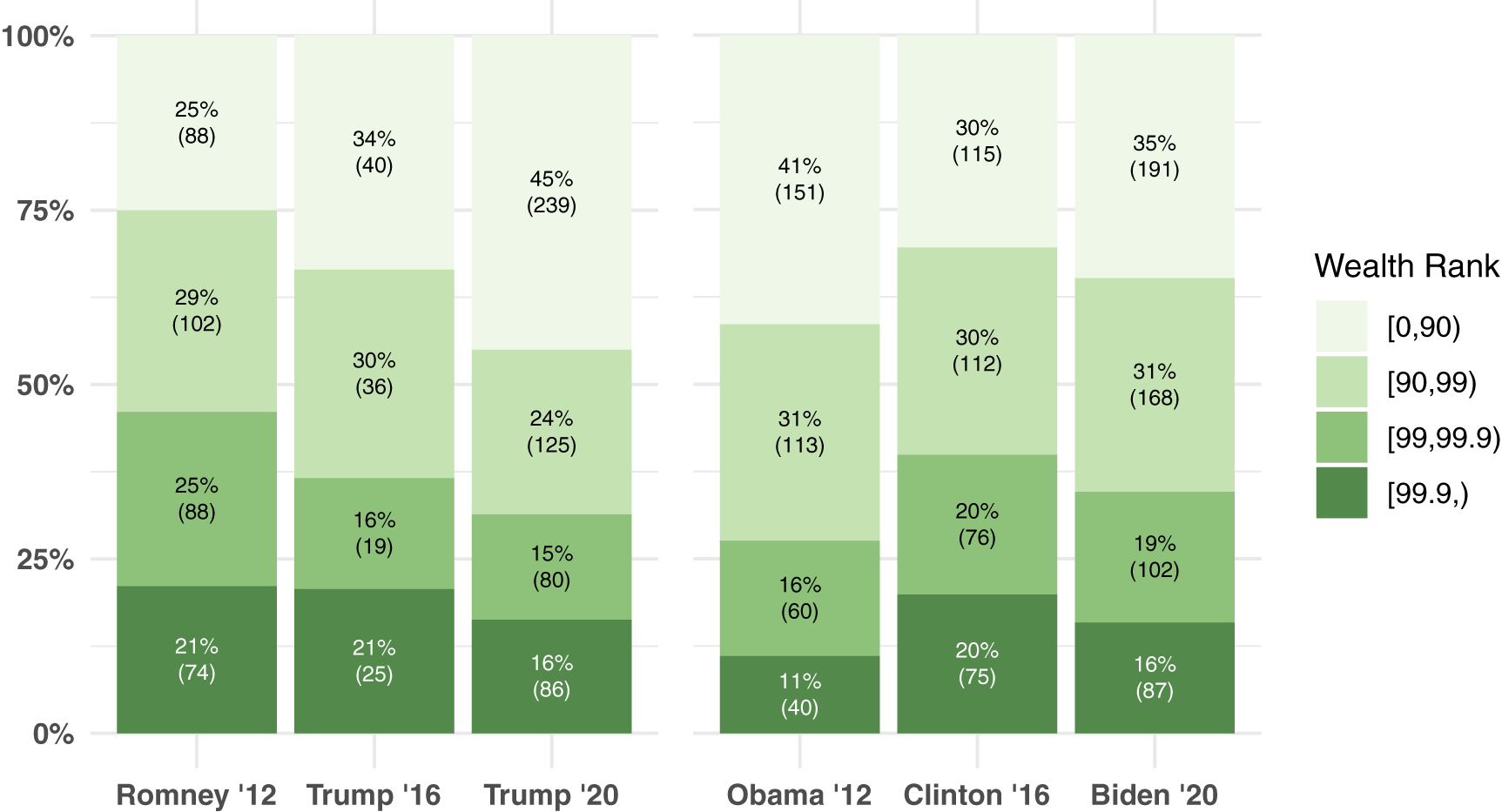
To measure the proportion of a campaign’s itemized total from each wealth group, Figure 2 displays the data from Figure 1b, in stacked bar charts. Each bar represents a candidate-year, with segments showing the percentage of total dollars that come from each of four wealth bins. We compare the bottom 90% with fine-grained bins at the top of the wealth distribution. Matched dollars (in millions) are in parentheses.
Proportion of Matched Dollars, by Candidate-Year and Wealth Bin
Note: Matched dollars in millions are given in parentheses.

In both 2016 and 2020, Trump was much less reliant on the wealthy than Romney. Compared to Romney, Trump’s share of dollars from the bottom 90% is 9 percentage points higher in 2016, and 20 percentage points higher in 2020. In dollar terms, Trump got 2.7 times more dollars than Romney from the bottom 90% (in 2020). Likewise, Trump’s share from the top 1% (the sum of the top two bins) is 9 and 15 percentage points lower than Romney’s. To be sure, most of Trump’s dollars still came from the wealthy. Even in 2020, the wealthiest 10% gave him 55% of his dollars. However, the bottom 90% nearly matched them. To put this in sharp relief, the candidate with a wealth distribution of dollars closest to Trump’s in 2020 is Obama.Footnote 18
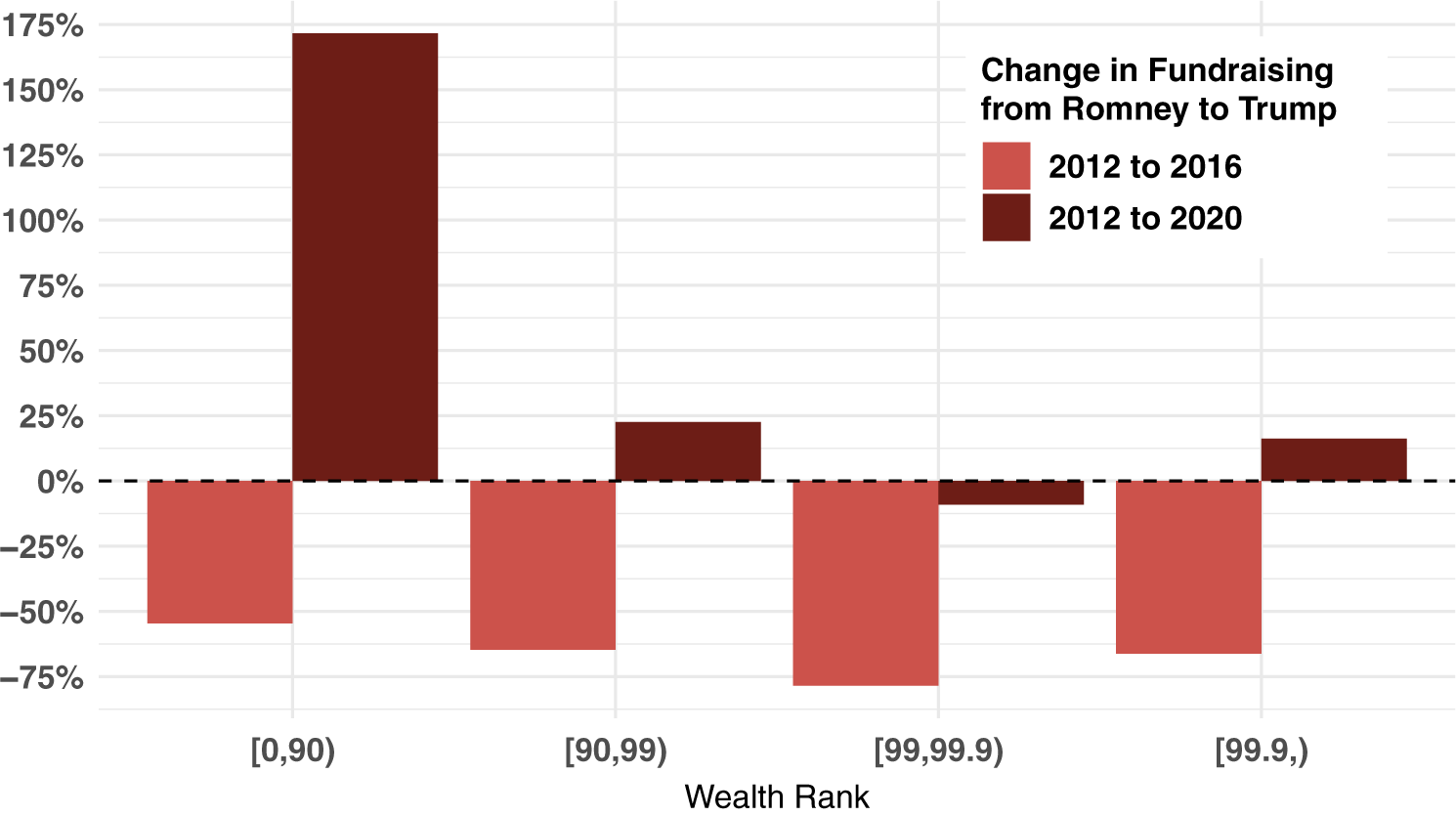
In Figure 3, we see a similar pattern when we calculate the percentage of Romney’s dollars that Trump lost (calculated from the dollars in Figure 2). In 2016, Trump lost 73% of Romney’s dollars from the top 1%, but lost only 55% of Romney’s dollars from the bottom 90%. In 2020, Trump recovered among the wealthy: the top 1% contributed similar totals to Trump and Romney, and the top 0.1% gave Trump 16% more than Romney. However, the most striking result from 2020 is Trump’s increased fundraising from the non-wealthy. The bottom 90% gave him 172% more than Romney.
Percent Change in Fundraising between Romney in 2012 and Trump in 2016 and 2020, by Wealth Rank

These findings reveal that Trump’s financing depended much less on the wealthy than did Romney’s. To be sure, Trump fully recovered wealthy dollars in 2020. But he more than recovered non-wealthy dollars. Trump’s non-wealthy dollars and shares are dramatically larger than Romney’s (and the largest in the figure).
Though we cannot rule out other time-varying explanations for these changes from 2012, we can compare Trump to his contemporaneous Democratic opponents. And we do not see such changes for the Democratic nominees in Figure 2. For them, 2020 resembles 2012. The pattern in the figure is consistent with a Trump effect rather than some temporal trend common to both parties.
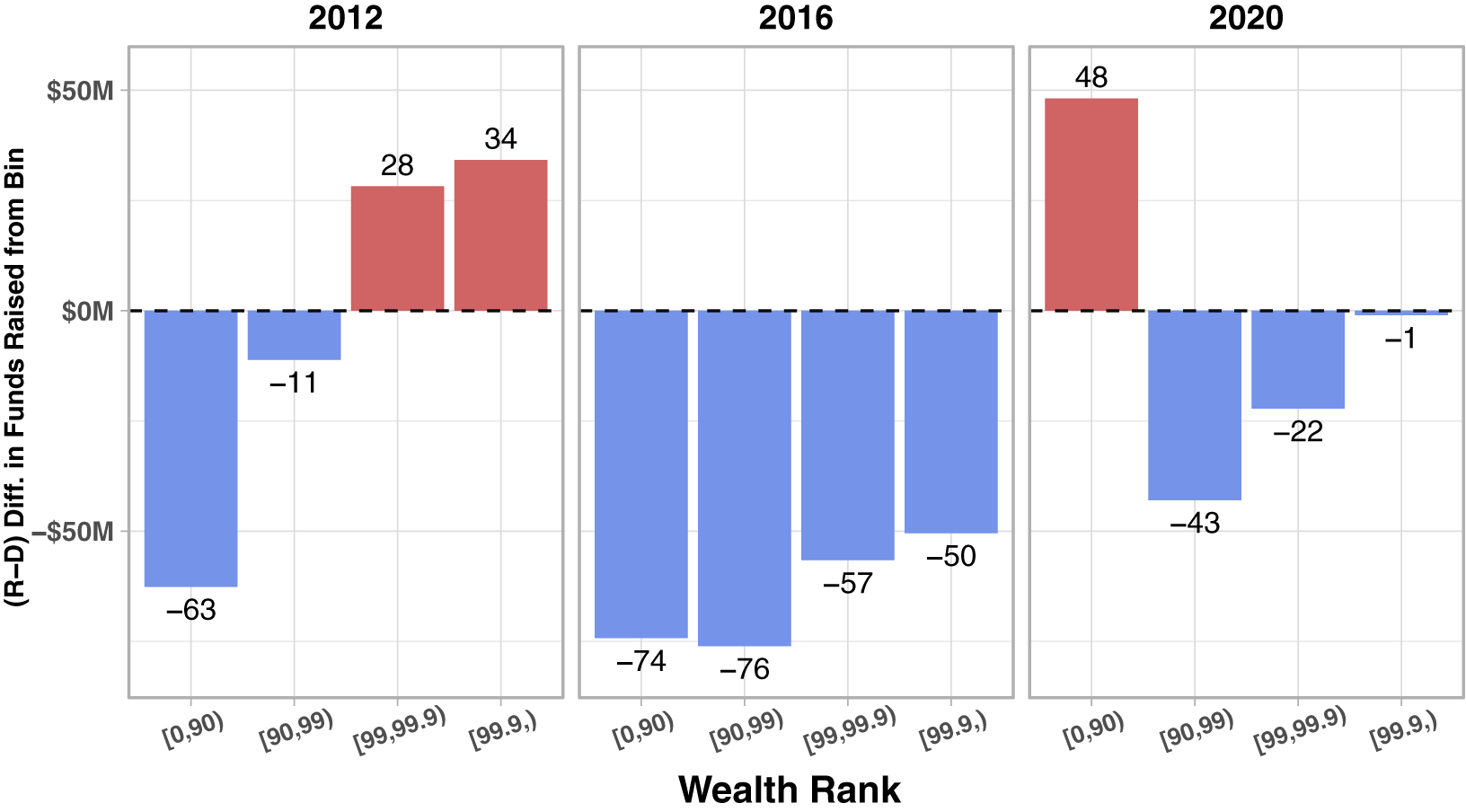
To more clearly demonstrate these patterns, Figure 4 shows the same dollars as Figure 2, but as a difference between partisan opponents. In 2012, Obama substantially out-raised Romney among the bottom 90%, while Romney out-raised Obama among the top 1%. In 2016, Clinton out-raised Trump among the bottom 90%, but also out-raised Trump in every wealthy bin. That is, Trump’s partisan balance of dollars was much worse than Romney’s in every wealth group. Finally, in 2020, Trump had a remarkable partisan advantage among the bottom 90%, nearly flipping the Democrats’ typical advantage. And while he largely attenuated his 2016 disadvantage among the wealthy, he fails to reach Romney’s wealthy partisan advantage. Even the top 0.1% have a slight Democratic tilt. These results again point to Trump’s weakness among the wealthy and unusual non-wealthy support.
Partisan Difference in Matched Dollars, by Cycle and Wealth
Note: Bars above $0 indicate Republican advantage (in red)

Donor Retention and Churn: The Wealthy Establishment Exits as Non-Wealthy New Donors Enter
To what extent are these trends driven by donors exiting or entering the donorate? Thus far, we examined cross-sections over time. While informative, cross-sections can mask fluctuations in the composition of donorates. Next, we use longitudinal analysis to assess Trump’s relative attrition of wealthy establishment donors, and his relative success with new non-wealthy donors.
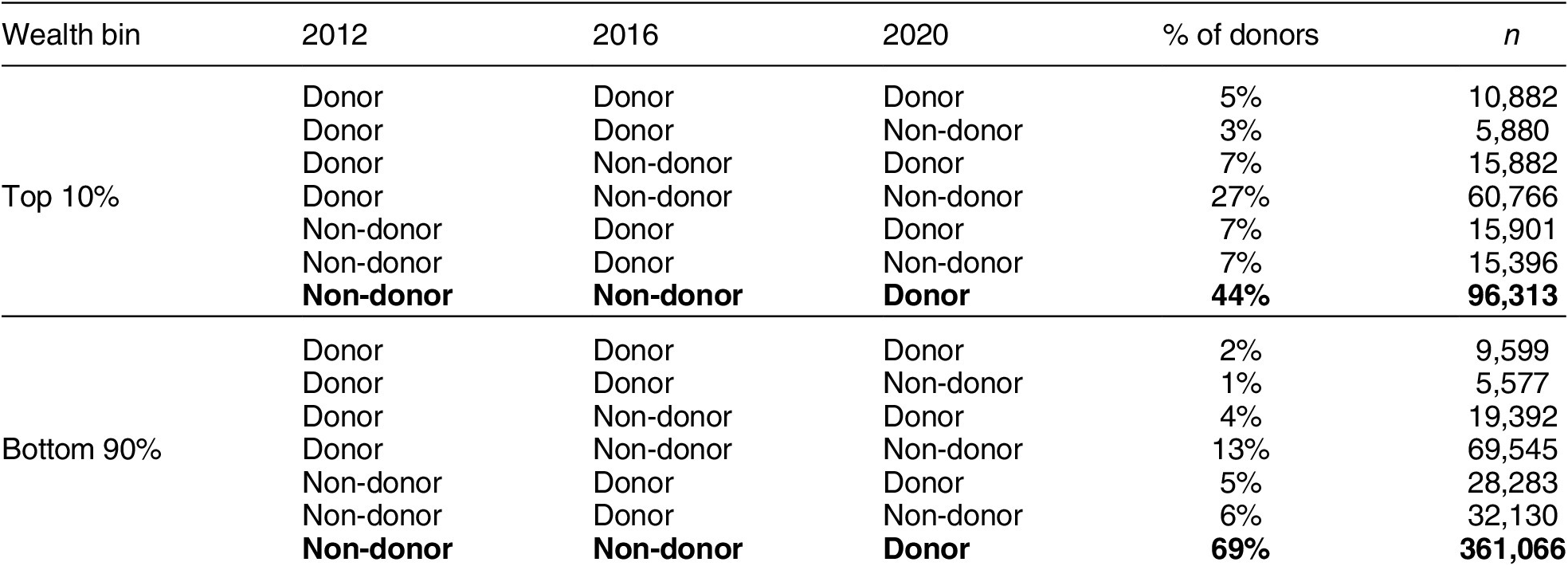
First, we consider the distribution of donors who gave at least one itemized contribution to Romney or Trump (Table 1). We compare the bottom 90% and top 10%. Percentages sum to 100% within wealth groups.Footnote 19 By far the largest group of Republican donors are the 69% of non-wealthy who did not support Romney and became new 2020 donors to Trump (bolded). This is not simply the result of donors donating only to one candidate: only 13% of non-wealthy donors gave to Romney and not Trump. Among the wealthy, new 2020 Trump donors are also the largest group at 44%. But new Trump donors are a much larger share of the non-wealthy than of the wealthy. Incumbent Trump’s donors are disproportionately new and from the bottom 90%.
Percent of Republican Donors Giving in One, Two, or Three Cycles, by Wealth Bin

This is not simply a time effect. As Section C.3 of the Supplementary Material shows, Trump’s new donors exceed his Democratic rivals’ new donors.Footnote 20 That is, incumbent Trump’s mobilization of new, non-wealthy donors is unique, and represents the most notable trend in the period.
Trump Underperforms among Wealthy Prior Republican Donors
To better understand Romney donors, we next home in on them. The behavior of wealthy establishment donors, that is, people who regularly donate to the party’s nominee, is of particular importance to theories of parties. For example, Magleby, Goodliffe, and Olsen (Reference Magleby, Goodliffe and Olsen2018) find that “continuing [presidential] donors [from 2008 to 2012]” are wealthier, “have stronger partisan ties and are more ideological than lapsed donors” (156–7). Did wealthy 2012 donors maintain support for Trump in 2016? Did they do so more, or less, than non-wealthy prior donors? Do other candidates exhibit the same pattern by wealth?Footnote 21
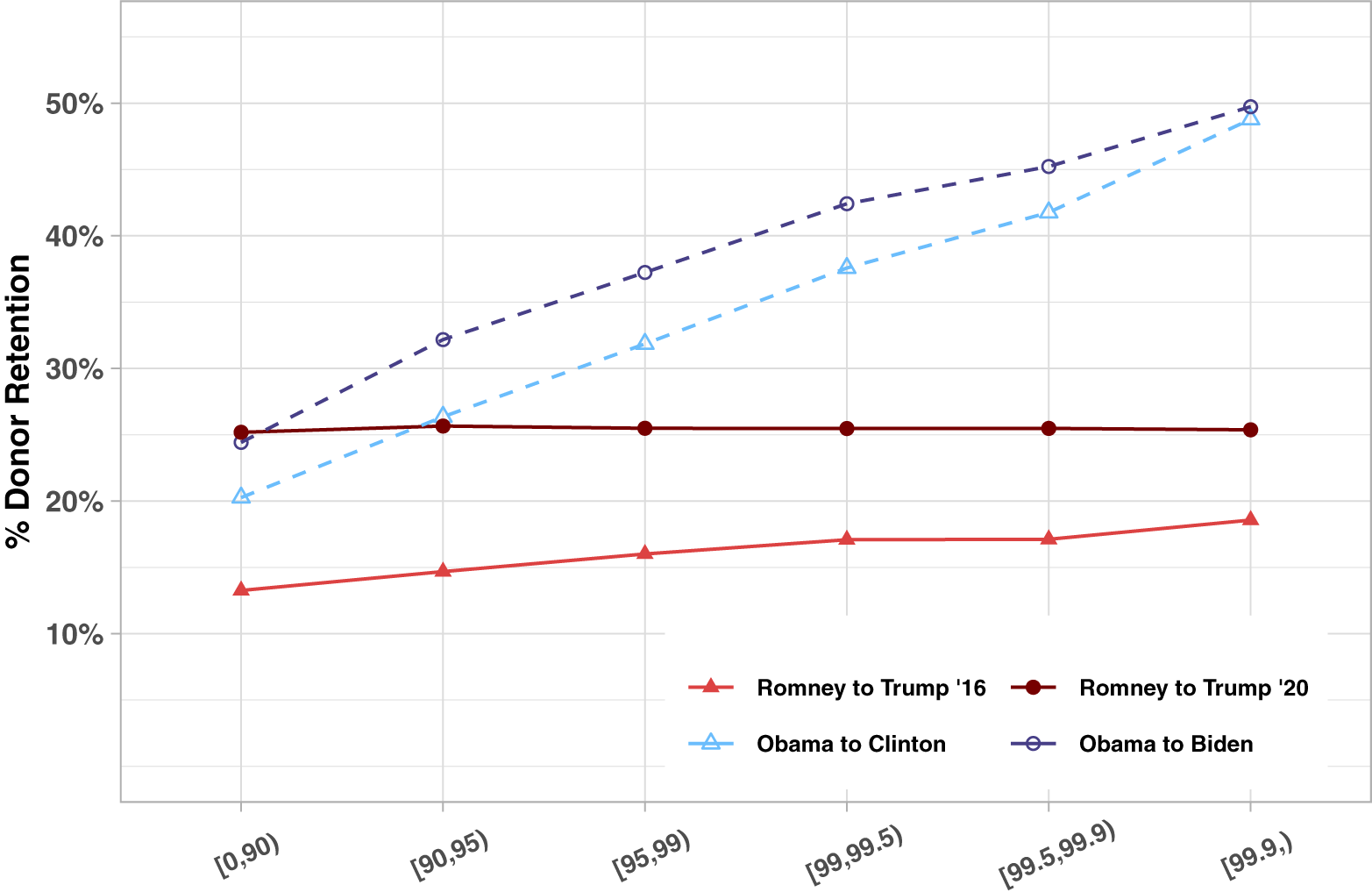
Figure 5 omits new Trump donors, directly compares Trump to his Democratic rivals (presenting Trump’s retention side by side with Clinton’s and Biden’s retention of 2012 Obama donors), and displays the bottom 90% and the top wealth bins, including the top 0.1%.Footnote 22
Cross-Cycle Donor Retention by Party, Wealth Bins

As Figure 5 shows, Trump’s wealth gradients in 2016 and 2020 are remarkably flat—unlike the Democrats’ wealth gradients. While Trump retained Romney donors at similar rates across wealth, Clinton and Biden’s retention of Obama donors increases dramatically with wealth. Figure A11 in the Supplementary Material shows a similar pattern when retention is measured by prior donors’ dollars.
Taken together, these results, along with the prior section on churn, show that most of Trump’s wealthy recovery in 2020 is driven by new wealthy donors. It is not driven mostly by wealthy Romney donors “coming home” to Trump. These results suggest “differential churn” between the parties. Only Trump’s donorate exhibits high drop-off among prior wealthy donors and substantial influx of new, non-wealthy donors.
Republican Donor Retention in Other Elections
The prior analysis shown in Figure 5 does not preclude the possibility that the composition of the wealthy Republican donorate is simply less stable over time. Perhaps wealthy Republican donors are less likely to make subsequent contributions to any other Republican campaign. To address this possibility, we compare Trump to contemporaneous and copartisan candidates.
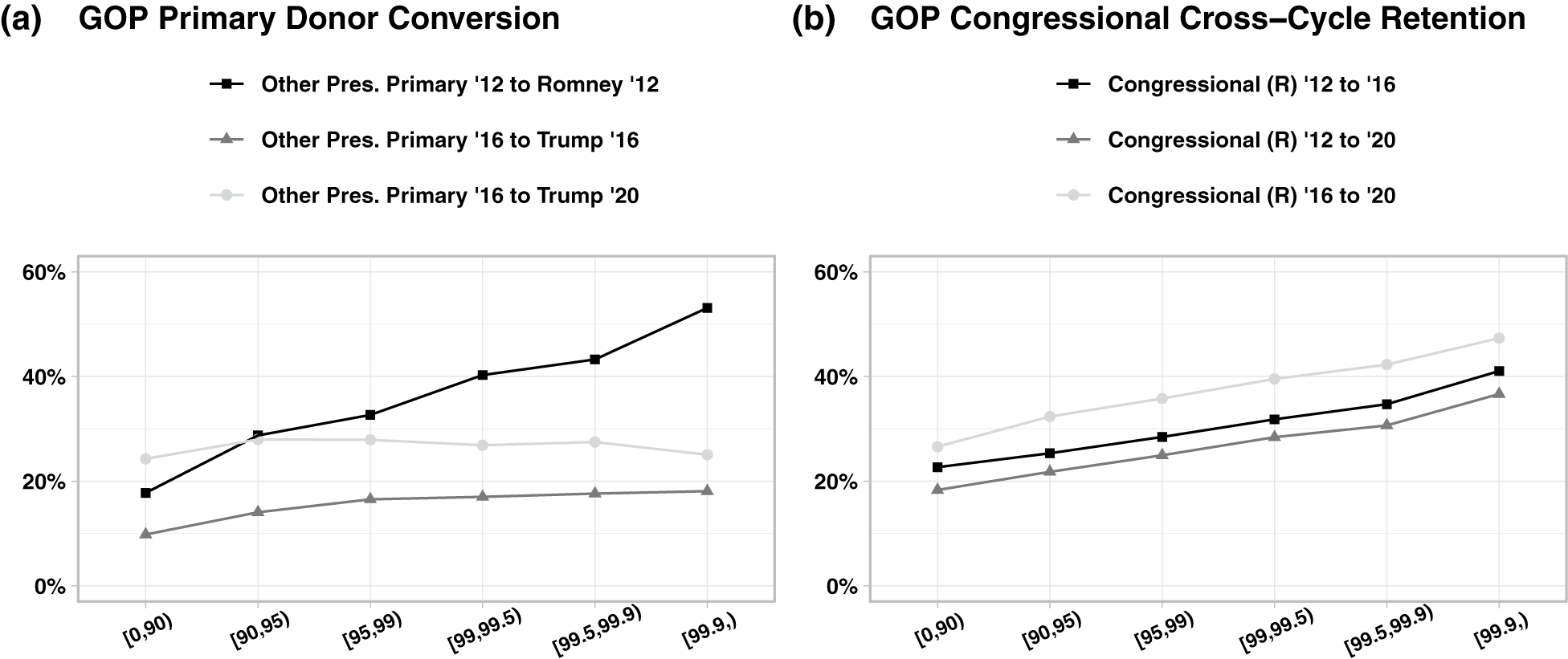
Figure 6a compares Trump’s and Romney’s success in retaining their primary opponents’ donors in the general election.Footnote 23 (We use Trump’s 2016 opponents for 2016 and 2020.) Again, retention rates are shown for the bottom 90% and the top wealth bins, with full distributions in Section C.1 of the Supplementary Material.
Panel (a): Rates at Which Donors to Republican Primary Losers Convert to General Election Nominees; Panel (b): Cross-Cycle Donor Retention Rates for Republican Congressional Donors

As Figure 6a shows, Trump’s 2016 conversion rates are worse than Romney’s across wealth, but this underperformance is much more severe among the wealthy. Among the wealthiest, he falls short of Romney’s conversion rate by more than 30 percentage points.
Figure 6b offers a different comparison point: Republican candidates for Congress. It displays the rates at which donors to at least one 2012 Republican congressional campaign subsequently gave to at least one such 2016 campaign, along with comparable rates for 2016 and 2020. Unsurprisingly, wealthier Republican congressional donors are more likely than their non-wealthy counterparts to give in subsequent congressional elections. More importantly, this wealth gradient for congressional campaign retention contrasts sharply with Trump’s retention of his primary opponent donors in Figure 6a. That is, Trump’s wealthy retention deficit is not a cycle effect—GOP House and Senate candidates running in the same cycle as Trump had no such trouble. Thus, we see yet again that Trump’s retention of the wealthiest Republican donors falls below the benchmark set by his copartisans.
In sum, according to our longitudinal analyses, Trump uniquely struggled to retain, revert, and convert wealthy donors. By contrast, the rates for all non-Trump candidates—across party, elections, and office level—increase nearly exponentially in donor wealth. Further, though incumbent Trump retained more non-wealthy prior donors than his Democratic opponents, his strength there is similar to other Republicans. As we saw earlier, his unique strength was instead to bring new non-wealthy donors to the Republican donorate.
Changes in the Demographics of Partisan Donorates
Did Trump repel particular identity subgroups of wealthy donors relative to Romney? We consider cross-sectional changes in the parties’ donorates by three demographics: sex (female, male), education (noncollege white, college white), and race (POC, white).
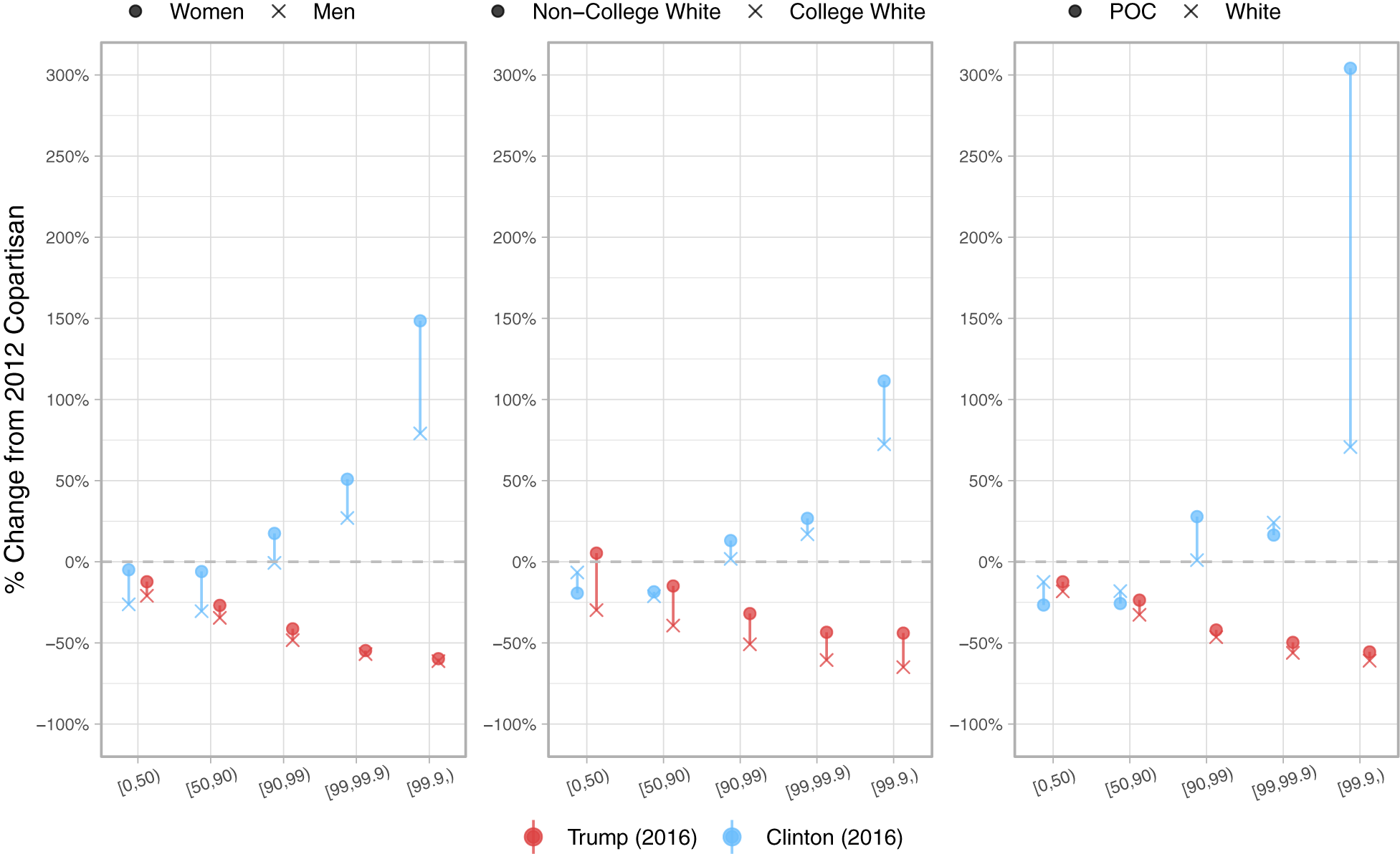
Figure 7 shows the relationship of wealth to change in itemized dollars from 2012 to 2016. Each panel presents a contrast between two demographic groups, by wealth bin.Footnote 24 In 2016, Trump lost somewhat fewer dollars from female than male donors (left panel), fewer dollars from POC than white donors (right panel), and notably fewer dollars from noncollege-educated white donors than college-educated white donors (center panel). To be sure, these gender, race, and education gaps in Trump’s losses are small. He lost nearly every demographic. Nevertheless, because he lost less from women, POC, and noncollege whites, Trump’s dollars were somewhat more demographically representative than Romney’s. That is, Trump did better among historically disadvantaged than advantaged groups.
Percent Change in 2016 Partisan Dollars from 2012 Copartisan Candidate, by Wealth Bin
Note: Legend for × and $ \bullet $
is at the top of each panel. Points above 0% indicate a positive change from 2012. Panels present information separately by sex (left), education among whites (center), and ethnoracial subgroups (right).
$ \bullet $
is at the top of each panel. Points above 0% indicate a positive change from 2012. Panels present information separately by sex (left), education among whites (center), and ethnoracial subgroups (right).

These gaps are similar across wealth. In each wealth bin, Trump performed somewhat better among women, POC, and noncollege whites.Footnote 25
Figure 8 presents the same analysis for 2020, and the same demographic pattern emerges. While Trump raised more than Romney from nearly every group, his gains were higher still among women, noncollege whites, and POC donors. That year, the demographic gaps were far larger among the non-wealthy: the gaps are dramatic among the bottom 90%, but shrink with wealth, nearly disappearing among the top 1%. We saw earlier that the top 1% gave Trump weak support; here, we find this weakness holds across gender, education, and ethnorace. Trump’s mobilization of disadvantaged social groups came mostly from the non-wealthy.Footnote 26
Percent Change in 2020 Partisan Dollars from 2012 Copartisan Candidate by Wealth
Note: See Figure 7 for more on legend and scales.

These demographic changes are unique to Trump. His opponents did not have such uniform relative advantage with all three disadvantaged social groups in either year (Figures 7 and 8). And in 2020, his opponent did not enjoy the striking success among these disadvantaged groups of non-wealthy donors (Figure 8).Footnote 27
This pattern does not neatly support an ethnocentrism interpretation. While Trump did better among noncollege whites (in line with ethnocentrism theories), he also did better among groups generally less likely to hold ethnocentric attitudes—POC, and women (Kinder and Kam Reference Kinder and Kam2010). Likewise, this pattern does not clearly support an authoritarianism explanation: POC and women are not, on average, more authoritarian (Federico and Tagar Reference Federico and Tagar2014).
Instead, the pattern is consistent with the overall theme of our findings: Trump found particular success outside the traditional wealthy Republican establishment. These groups were especially mobilized by Trump’s reelection, but in both years, the demographic groups most uniquely attracted to Trump were women, POC, and noncollege whites.
In line with this interpretation, the huge demographic gaps among the non-wealthy coupled with tiny demographic gaps among the very wealthy suggest that Trump’s anti-establishment image did not appeal to the very wealthy. His appeal to groups outside the establishment did not extend to the top 0.1%. Groups marginalized by gender and education still gave him less than Romney as long as they were very wealthy.
To be sure, in absolute terms, Trump’s donorate remained overwhelmingly male, college educated, and white. Though he made substantial inroads outside the wealthy GOP establishment, Trump’s contributions still came disproportionately from white, male, and college-educated donors. Of Trump’s 2020 dollars, 89% came from whites, 62% from college-educated whites, and 67% from men.Footnote 28 In that sense, the story of Trump’s financing is his unique hybrid of new, non-wealthy “left behind” donors—who are somewhat more demographically diverse—joined by unusually low yet still hefty sums of establishment money.
CONCLUSION
Who supports and enables right-wing authoritarian populism? This question has long preoccupied scholars of politics. It has gained urgency with the rise of populist leaders in established democracies. Perhaps no contemporary case is more important than Donald Trump, who won the presidency of the most powerful established democracy in the world.
The primary focus of scholarship on Trump support has been on the “left behind.” However, the wealthy political establishment also plays a key role in electoral democracy, and exercises outsize political power in determining the fate of candidates. Wealthy conservatives are thought to have the will and the capacity to either obstruct or enable insurgents. Their financial resources are a central element of this role. For example, corporate actors may use campaign contributions to punish democratic backsliding (Li and DiSalvo Reference Li and DiSalvo2023).
To date, however, the micro-level financial behavior of most wealthy Americans has been difficult to analyze. A comparison of wealthy and non-wealthy donors has not been possible. Our study goes beyond existing studies of Trump support and of donor behavior by assembling all the necessary ingredients: a measure of wealth, a separate measure of dollars donated, enough wealthy individuals for reliable analysis, and a panel structure that follows individuals over time.
This study advances these literatures with new data measuring the wealth of all American property holders and linking it with their itemized donations across time. While there are high-profile cases of ultra-wealthy Republicans choosing not to support Trump, this is the first large-scale systematic analysis of wealthy preferences toward Trump. Understanding Trump’s base requires an understanding of both his electorate and his donorate. And understanding campaign finance requires identifying wealthy donors rather than inferring their identity from large donations. Our results highlight the problem with using donation size to measure wealthy behavior: that measure is systematically biased against finding smaller contributions from wealthy people, and cannot tell us when wealthy people substantially change the size of their donations.
Our findings complicate the expectations from comparative theories of democratic backsliding and theories of American party establishments. Both center the wealthy. But the story of Trump’s financing is not only a story of this powerful group. The wealthy compose a disproportionate share of Trump’s contributions, but by some important measures, Trump’s wealthy support was barely higher than his non-wealthy support. And his wealthy support fell behind a variety of comparison candidates. Even in 2020, while Trump’s wealthy support resembled other presidential candidates on some measures, he showed unprecedented strength among the non-wealthy on all measures.
Given the theoretical importance of party establishment donors, we also specifically examined the behavior of prior donors. Trump uniquely failed to recruit people who had donated to other Republicans. Instead, in 2020, he recruited a large new cadre of donors, who were predominantly non-wealthy.
Finally, despite rhetoric that alienated many women and POC, incumbent Trump outperformed Romney among these groups. He also substantially outperformed Romney among noncollege whites. Trump’s donors were still overwhelmingly white, male, and college educated; but relative to Romney’s, less so.
What do these results imply about the role of campaign finance in democratic backsliding in American elections? We caution that we cannot say what explains Trump’s victory or loss. Trump clearly drew on many potential electoral advantages, including personal wealth, celebrity, and free media. It is impossible to isolate the relative impact of wealthy donors. And the changes we documented across elections could be explained by a variety of factors. For example, as an incumbent, Trump may have appeared more viable and likely to win in 2020 than in 2016. Whether such factors mattered for his fundraising, and whether they were enough to override countervailing developments, goes beyond the scope of our data.
Our data also do not allow us to test the many potential explanations for wealthy donor behavior toward Trump. As discussed in the literature review, those explanations include partisanship, economic interests, and a number of other motivations. Likewise, we cannot say why the wealthy increased their support for Trump from 2016 to 2020; they may have done so because of his viability, or because he delivered Republican policy victories (regressive tax cuts, deregulation, and conservative appointments), or for other reasons.
We do find suggestive evidence against the ethnocentrism explanation. Trump did not uniquely draw from demographic groups who typically have higher levels of ethnocentrism, with the exception of noncollege whites. If anything, women and POC were more likely to support him than Romney. Similarly, just as Trump’s disproportionate support from POC and women is not consistent with ethnocentrism, it is not consistent with authoritarianism, which tends to be more prevalent among white men (Federico and Tagar Reference Federico and Tagar2014). He uniquely increased his support among POC, women, and noncollege whites, groups that differ considerably but have in common an outsider status in establishment party politics. Nevertheless, we cannot definitively conclude in favor or against any explanation.
Instead, we make a different sort of contribution: our findings complicate theories of American campaign finance and of democratic backsliding, and point toward the existence of varieties of authoritarian pathways to power in established but economically unequal democracies. Trump’s donorate is quite different than the donorates in the literature on Republican campaign finance. In fact, in terms of wealth, it most resembles Obama’s donorate (though it is much more white and less educated). By implication, then, a broader-based donorate is not necessarily a sign of a healthier democracy. To be sure, all else equal, a more representative pool of donors makes a more democratic election, by definition. However, a key argument of this paper is that anti-democratic leaders can have an unusually large and demographically diverse donor pool. A more democratic donorate does not necessarily make a more pro-democracy donorate. This insight comes from the new data in this study, and contributes to the nascent literature on the relationship of campaign funding and democratic backsliding (Li and DiSalvo Reference Li and DiSalvo2023).
Our contribution also lies in speaking to the alternative pathways to authoritarianism in democracies. Trump’s donorate represents a departure from the typical paths to power identified in the comparative literature on democratic backsliding. In that literature, the wealthy play a pivotal role that can either keep right-wing authoritarians from office or enable their rise. However, according to our results, Trump relies much less on the wealthy than comparable candidates, and drew almost equal strength from the non-wealthy.
These findings invite a substantial revision of a common understanding of populism. Populists arise not only when the mass public experiences distress or decline. Nor do they win only when decisively backed by wealthy, powerful conservative actors. Instead, they can become electorally viable despite heavy defections from wealthy establishment donors, with a combination of a few wealthy establishment donors and a surge of mostly non-wealthy new donors. Right-wing authoritarian candidates can assemble a coalition of both wealthy and non-wealthy sectors of society, what some call “plutopopulism” (Baker Reference Baker2004; Schlozman and Rosenfeld Reference Schlozman and Rosenfeld2024) or a “strange merger of populism and plutocracy” (Pierson Reference Pierson2017). Here, we have fleshed out how this coalition finds expression in the campaign-finance regime of the United States. Specifically, it relies on wealthy financiers but can also mobilize ordinary people (Magleby, Goodliffe, and Olsen Reference Magleby, Goodliffe and Olsen2018). That may reflect uniquely American campaign finance laws and practices, which enable both unlimited, large donations by the wealthiest Americans and broad participation among the non-wealthy. Pierson labels this odd coalition an “American hybrid” (Pierson Reference Pierson2017). Whether such a coalition is especially suited to explaining the electoral fortunes of American right-wing populists is a question for future research. Our study’s main contributions are to demonstrate the existence and viability of this new hybrid coalition of populists and plutocrats in the Republican party, and to highlight its relevance for scholars of inequality, campaign finance, and democratic backsliding.
SUPPLEMENTARY MATERIAL
To view supplementary material for this article, please visit https://doi.org/10.1017/S0003055425000061.
DATA AVAILABILITY STATEMENT
Research documentation that support the findings of this study are openly available at the American Political Science Review Dataverse: https://doi.org/10.7910/DVN/XF3LHN. Limitations on data availability are discussed in the Dataverse.
ACKNOWLEDGEMENTS
The authors wish to thank Martin Gilens, Jay Goodliffe, Jake Grumbach, Zhao Li, Nicholas Short, and participants in the Money in Politics and Individual Campaign Contributors Panel at the 2023 APSA Conference for their consideration and thoughtful comments on earlier drafts of this paper. Tali Mendelberg thanks the Center for the Study of Democratic Politics, University Committee for Research in the Humanities and Social Sciences, and Department of Politics at Princeton University for funding for postdoctoral and graduate student research assistance, and the Radcliffe Institute for Advanced Study at Harvard University and the John Simon Guggenheim Memorial Foundation for fellowships that supported the project.
FUNDING STATEMENT
This research was funded by the Center for the Study of Democratic Politics, the University Committee for Research in the Humanities and Social Sciences, and the Department of Politics at Princeton University, as well as the Radcliffe Institute for Advanced Study at Harvard University and the John Simon Guggenheim Memorial Foundation.
CONFLICT OF INTEREST
The authors declare no ethical issues or conflicts of interest in this research.
ETHICAL STANDARDS
The authors affirm this research did not involve human participants.





 Open access


Comments
No Comments have been published for this article.