



LEARNING OBJECTIVES
After reading this article you will be able to:
• describe the diagnostic features of the three clusters of personality disorder
• outline the key features of CBTs in the treatment of personality disorders
• differentiate the core therapeutic strategies and skills in schema therapy, cognitive interpersonal therapy and dialectical behaviour therapy for personality disorders.
Personality disorders are a group of mental conditions that involve long-term dysfunctional cognitive, affective, behavioural and interpersonal patterns that cause emotional suffering and impairment in several life domains, including relationships, work and self-relation. Personality disorders affect not only the individual but also their family, friends and relationships in general (American Psychiatric Association 2022).
A meta-analysis reported a prevalence of 12.2% for personality disorders in the general population of Western countries (Volkert Reference Volkert, Gablonski and Rabung2018). Another review indicated a worldwide pooled prevalence of any personality disorder of 7.8% in the community (Winsper Reference Winsper, Bilgin and Thompson2020). In psychiatric out-patients, this prevalence increases, and in psychiatric in-patients it may reach 76% (Kovanicova Reference Kovanicova, Kubasovska and Pallayova2020).
People with personality disorders have a shorter life expectancy than people without, living on average 18.3 years less (Fok Reference Fok, Hayes and Chang2012). Evidence shows that as many as 57% of suicide victims had a personality disorder diagnosis, especially young adults (Lesage Reference Lesage, Boyer and Grunberg1994). Suicide attempts are particularly prevalent in cluster B personality disorders (i.e. borderline, antisocial, histrionic and narcissistic) (Ansell Reference Ansell, Wright and Markowitz2015). Personality disorders are often associated with other factors related to early death, such as accidental injury (e.g. car accidents) (Räisänen Reference Räisänen, Hakko and Riipinen2019), criminal behaviour (Fakhrzadegan Reference Fakhrzadegan, Gholami-Doon and Shamloo2017) and substance use (including alcohol, cannabis and nicotine) (Hasin Reference Hasin, Fenton and Skodol2011; Fakhrzadegan Reference Fakhrzadegan, Gholami-Doon and Shamloo2017), and also with poor functioning in the workplace (Sansone Reference Sansone and Sansone2010). Taken altogether, people with personality disorders face multiple disease burdens that imply negative social impacts. A study conducted in The Netherlands estimated that the economic burden of personality disorders on society was €11 000 per patient per year, due to direct (e.g. mental health service use, psychopharmacological treatments and hospital admissions) and indirect (e.g. lower work productivity) costs (Soeteman Reference Soeteman, van Roijen and Verheul2008).
Classification of personality disorders
The DSM and ICD are the most widely used classification systems for mental disorders. DSM-5-TR (American Psychiatric Association 2022) maintains a categorical approach to diagnosis, but includes the dimensional Alternative Model for Personality Disorders. ICD-11 (World Health Organization 2019/2021), on the other hand, uses a new model focusing on severity of disorder (mild, moderate or severe), based on distress or impairment in various life domains. This article will cover both the categorical and dimensional perspectives; thus, we will mostly use the DSM-5-TR approach.
The ten (plus two) personality disorders
The diagnosis of a personality disorder first requires meeting a general criterion of an enduring pattern of inner experience and behaviour that deviates markedly from the expectations within the individual's culture. This pattern is manifested in two (or more) of the following areas: cognition (i.e. ways of perceiving and interpreting one's self, other people and events), affectivity (i.e. the range, intensity, lability and appropriateness of emotional response), interpersonal functioning (i.e. social relationships) and impulse control. The pattern is also inflexible and pervasive across a broad range of personal and social situations and it tends to be stable and long-lasting (chronic course). Its onset can usually be traced back at least to adolescence or early adulthood, ultimately leading to clinically significant distress or impairment in social, occupational or other important areas of functioning (American Psychiatric Association 2022).
DSM-5-TR (American Psychiatric Association 2022) classifies ten personality disorders, divided into three clusters (A, B and C) based on similar characteristics among personality disorders within each cluster. Cluster A comprises paranoid personality disorder, schizoid personality disorder and schizotypal personality disorder. These disorders are related to odd and/or eccentric behaviour. Individuals with these disorders tend to experience interpersonal difficulties due to behaviour socially perceived as peculiar, suspicious or detached. Cluster B comprises antisocial personality disorder, borderline personality disorder, histrionic personality disorder and narcissistic personality disorder. These are characterised by dramatic or erratic behaviour, intense emotions and impulsive, theatrical, promiscuous or transgressive behaviours. Lastly, cluster C encompasses avoidant personality disorder, dependent personality disorder and obsessive–compulsive personality disorder, which are marked by anxiety and/or fearfulness. These ten personality disorders are summarised in Table 1.

Two further personality disorder diagnoses exist for individuals who meet the general criteria for personality disorder and have significant life impairment, but do not meet the criteria for any of the specific personality disorders. If the clinician diagnoses personality disorder but has a reason for not identifying one of the ten specific disorders, the assigned diagnosis would be ‘other specified personality disorder’, with a note added to the diagnosis explaining the reason (e.g. the person displays mixed personality traits). If the clinician cannot identify specific reasons for the displayed personality functioning, the diagnosis would be ‘unspecified personality disorder’. These two might be the most prevalent personality disorder diagnoses (American Psychiatric Association 2022).
Diagnosis
The categorical approach
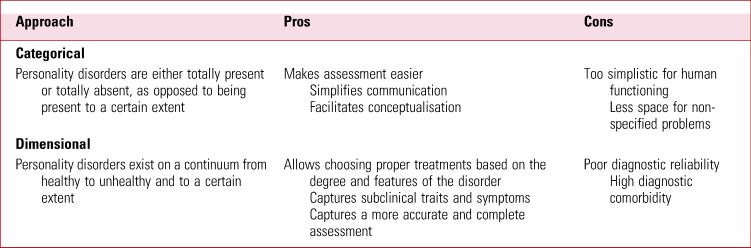
The categorical approach to diagnosis of personality disorders has a long history, following the traditional medical view of classifying pathologies as present or absent. According to this approach, a person has a particular disorder if they meet a certain number of associated criteria (American Psychiatric Association 2022). The categorical approach suggests that personality disorders are qualitatively distinct and constitute discrete clinical syndromes. Although this diagnostic approach might be too simplistic for the documented complexity of personality functioning (e.g. comorbidities), some authors state that this approach simplifies the assessment and clinical decision-making processes and facilitates communication and case conceptualisation (e.g. Trull Reference Trull and Durrett2005).
The dimensional approach
In section III of DSM-5-TR the American Psychiatric Association (APA) proposes its Alternative Model for Personality Disorders, which endorses a dimensional approach to clinical diagnosis (American Psychiatric Association 2022). This perspective has been gaining relevance in recent years, considering the evolving manifestations of personality disorders, their frequent comorbidity with other disorders (e.g. configurations of two or more personality disorders; co-occurrence with emotional disorders) and the high prevalence of cases that do not meet criteria for any specific personality disorder but the symptoms lead to impairment (Brown Reference Brown and Barlow2005).
The APA's dimensional approach asserts that personality disorders reflect degrees of dysfunction of personality traits that vary on a continuum from healthy to unhealthy. This perspective recognises the heterogeneity of symptoms and the difficulty in establishing clear limits between discrete nosological diagnoses. The dimensional model requires the evaluation of impairment of personality functioning related to the self (e.g. identity and self-direction) and others (e.g. empathy and intimacy). A person with healthy personality functioning has a positive sense of self, with regulated affect and a fulfilling social life, whereas impairment of functioning results in a disorganised or unclear sense of self, with dysregulated affect and social difficulties. Moreover, the dimensional model also calls for the assessment of personality traits that are grouped into five polarised domains (negative affectivity versus emotional stability; detachment versus extraversion; antagonism versus agreeableness; disinhibition versus conscientiousness; and psychoticism versus lucidity). These five personality trait domains comprise a total of 25 more specific personality facets (e.g. submissiveness, anxiousness, grandiosity). Although the dimensional approach to personality disorder diagnosis has been gaining relevance, there is still some resistance to adopting this proposal, mostly because of its complexity.
Table 2 summarises pros and cons of the categorical and dimensional approaches.
Pros and cons of the categorical and dimensional approaches to personality disorders
After American Psychiatric Association (2022).
Genetics, onset and development
Genetic epidemiological studies have suggested that all personality disorders show some degree of heritability, typically ranging from 21 to 77% (Reichborn-Kjennerud Reference Reichborn-Kjennerud2010). The only published population-based multivariate twin study that included all personality disorders (Kendler Reference Kendler, Aggen and Czajkowski2008) showed that the three identified genetic risk factors for personality disorders do not mirror the cluster A, B and C typology. Instead, one genetic factor indicates a general susceptibility for personality disorder and/or negative emotions, whereas the other two are more specific and linked to high impulsiveness/low agreeableness and introversion. Interestingly, the clusters grouping is strongly reflected in environmental risk factors, indicating that environmental factors may be behind the co-occurrence of cluster A, B and C personality disorders.
It is well-established that personality disorders typically have onset in adolescence or early adulthood. Adolescence seems to be a crucial period for the emergence of personality disorder, possibly because of the cognitive, emotional and social developmental changes typical of this period (e.g. improvement in abstract thinking and reasoning, development of a sense of self, importance of peers and interpersonal relationships outside the family, autonomy from parents, puberty and body changes). Personality traits in childhood and adolescence seem to show continuity into adulthood, despite being dynamic throughout life. Moreover, personality disorders show a significant variability in rates and directions over time, making it difficult to predict consistent trajectories (Wright Reference Wright, Pincus and Lenzenweger2011).
DSM-5-TR (American Psychiatric Association 2022) allows for the assignment of a personality disorder diagnosis to individuals under the age of 18, although many clinicians are hesitant to do so. Despite evidence of the existence of personality disorders in adolescents and their recognition by most psychologists who work with this population, less than 10% of them diagnose personality disorders in adolescents (Laurenssen Reference Laurenssen, Hutsebaut and Feenstra2013). This reluctance may be due to dysfunctional features that overlap with typical adolescent behaviour, as well as the stigmatising effect of labelling an adolescent with a personality disorder diagnosis (Laurenssen Reference Laurenssen, Hutsebaut and Feenstra2013). With the exception of antisocial personality disorder, which is preceded by conduct disorder in adolescence, the other personality disorders can be identified at an early age (American Psychiatric Association 2022). A justified diagnosis in adolescence, when features have been present for at least 1 year, can be useful to identify adolescents for appropriate treatment and prevent the evolution of pathological traits into a more severe condition (Laurenssen Reference Laurenssen, Hutsebaut and Feenstra2013).
Adverse childhood experiences and neurobiology of personality disorders
Adverse childhood experiences (ACEs) such as physical, sexual or emotional abuse or household dysfunction have been shown to have a negative impact on personality development and to increase the risk for personality disorders (Solmi Reference Solmi, Dragioti and Croatto2021). Considering that personality disorders have a developmental course, the familial context and interactions can work as models of how to perceive the world, other people and the self. Secure attachment can have a protective effect, promoting positive relational development, self-esteem and clarity of self-concept (Kawamoto Reference Kawamoto2020). ACEs have been linked to structural and functional changes in the brain, including alterations in the development of brain regions involved in the regulation of emotions, cognition and stress sensitivity (Herzog Reference Herzog and Schmahl2018). These changes may be related to the development of personality disorders, since various and distinct brain regions and neurocircuits are involved and interrelated in these cases.
Evidence has supported the complementarity of brain regions particularly in personality functioning. Briefly, the prefrontal brain regions are important in understanding personality, as they are recruited for the most high-level cognitive tasks (Fuster Reference Fuster2008). Prefrontal brain regions are involved in language, attention, memory, response conflict, novelty processing, temporal ordering, explicit memory, reality monitoring and metamemory. These regions are also connected to the limbic system (MacNamara Reference MacNamara, Phan, Schmahl, Phan and Friedel2018). In turn, the dorsolateral prefrontal cortex is associated with working memory, behavioural modification to pursue goals, representation of past events, future planning and prediction, and emotion regulation (Corbetta Reference Corbetta, Patel and Shulman2008; MacNamara Reference MacNamara, Phan, Schmahl, Phan and Friedel2018). The ventrolateral prefrontal cortex is implicated in semantic processing, object categorisation, response selection and response inhibition (Corbetta Reference Corbetta, Patel and Shulman2008). Moreover, the medial prefrontal cortex is often recruited for emotional tasks and processing (Phan Reference Phan, Wager and Taylor2004) and the dorsomedial prefrontal cortex is related to self-awareness, perspective-taking and effective social behaviour (Miller Reference Miller and Cummings2007). Other brain regions that appear to make important contributions to personality include the cingulate cortex and insular cortex. The cingulate cortex has been associated with the default mode network (e.g. daydreaming, retrieving memories), as well as with emotional valence and autobiographical memory retrieval (Maddock Reference Maddock, Garrett and Buonocore2003).
Psychological treatments for personality disorders
For a long time, personality disorders were said to be untreatable. Borderline personality disorder, in particular, was a debilitating condition, among the most difficult to treat. However, four therapeutic interventions have shown evidence of efficacy for personality disorders: two are based on the psychodynamic model – mentalisation-based treatment and transference-focused treatment – and two are based on the cognitive–behavioural model – dialectical behaviour therapy and schema therapy (Cristea Reference Cristea, Gentili and Cotet2017). Cognitive–behavioural therapy (CBT) has also produced noteworthy outcomes in working with families of individuals with personality disorders, particularly in the cases of antisocial, narcissistic (Wang Reference Wang, Zhu and Huang2008) and borderline personality disorders (Darrow Reference Darrow, Maliken and Piatigorsky2022). Table 3 compares the evidence base for these therapies in the treatment of personality disorders. Cluster B personality disorders have received more attention than the other clusters. Intervention studies for the treatment of cluster A disorders are scarce, perhaps because individuals with these disorders may be less inclined to seek treatment. Overall, studies suggest that more intensive approaches may be helpful for people with cluster A personality disorders (Johnson Reference Johnson, Clouthier, Rosenstein, Zeigler-Hill and Shackelford2020). The same applies to cluster C personality disorders, although few studies have focused on therapeutic interventions for these patients (Johnson Reference Johnson, Clouthier, Rosenstein, Zeigler-Hill and Shackelford2020). In this article, we will focus on interventions based on the cognitive–behavioural model.
Evidence base for psychological treatments for personality disorders

Cognitive–behavioural therapy for personality disorders
CBT understands human behaviour in terms of the interaction between the person and their multiple/diverse contexts. The way a person thinks, and most of all how information is processed and interpreted, is key to CBT. In CBT, thoughts, emotions and behaviours are considered to be interdependent, with behaviours being based on interpretations of reality and related emotions. Additionally, CBT asserts the importance of the development of cognitive structures throughout life, and especially during early years, and how these cognitive structures influence the way information about the self and the world is processed, resulting in more or less biased perceptions of the world (Beck Reference Beck, Davis and Freeman2015).
Patients with personality disorders tend to require long-term therapy because they present rigid and pervasive patterns of thinking, feeling and behaving that are difficult to counteract and challenge in the clinical setting. They also tend to avoid or block painful emotional experiences, and interpersonal difficulties can be an obstacle when trying to build a fruitful therapeutic relationship (Young Reference Young, Klosko and Weishaar2003). Some heuristic signs that may point to the presence of personality disorders are described in Box 1.
Heuristic signs that may point to the presence of personality disorder
• The patient (or a significant other) reports that they ‘have always been like this’.
• The patient do not adhere to the therapeutic programme/protocol. Although non-adherence is common in many disorders, persistent non-adherence should be taken as a clue indicating the need for further exploration of personality disorder features.
• Therapy seems to have come to a sudden stop for no apparent reason. A clinician working with a patient with a personality disorder (very often, undiagnosed) can often help them to reduce symptoms of anxiety or depression, but the patient can block further therapeutic work.
• The patient seems entirely unaware of the effect of their behaviour on others. Such individuals report the responses of others but fail to address any provocation or dysfunctional behaviour on their part.
• The patient agrees with the tasks of therapy by expressing interest and intention to change but fails to follow through on agreed actions. The importance of change is acknowledged, but the patient manages to avoid making any actual changes.
• The patient's personality problems appear to be acceptable and ‘natural’ for them. The patient sees the problems as a fundamental aspect of ‘themselves’ and makes statements such as ‘This is who I am – this is how I have always been. I cannot imagine being any other way’ (egosyntonic behaviours).
(Adapted from Beck, Reference Beck, Davis and Freeman2015)
Given the challenges that come with treating individuals with personality disorders, guidelines on CBT can be helpful when working with this population. Such guidelines (e.g. Young Reference Young, Klosko and Weishaar2003; Beck Reference Beck, Davis and Freeman2015) include:
• collaborative case conceptualisation of the individual's functioning, which results in more effective intervention
• the therapist and the patient working in collaboration to achieve goals (some patients present vague and hard-to-define goals)
• establishing a solid therapeutic relationship, which is key to the process: this can be challenging with people with personality disorder, often turning this goal into a primary focus in therapy
• gradually increasing the patient's self-efficacy appraisals
• finding creative ways to encourage patients to do homework assignments
• guiding and teaching patients to be aware of their automatic thoughts and to express and report their feelings, which will be helpful to the therapeutic process
• ensuring that therapists monitor their own cognitions and emotions throughout the therapeutic process.
Several CBTs have proved to be effective in treating people with personality disorders (Beck Reference Beck, Davis and Freeman2015). Here we will focus on schema therapy, cognitive interpersonal therapy and dialectical behaviour therapy.
Schema therapy
Schema therapy revolves around five schema-related constructs: basic emotional need, early maladaptive schemas, schema domains, schema processes (surrender, avoidance, and overcompensation) and schema modes. For further information, see Young et al (Reference Young, Klosko and Weishaar2003).
Needs, early maladaptive schemas and schema domains
Five core emotional needs are postulated as universal and required to be met for psychologically healthy development: safety and nurturance; autonomy and competence; freedom to express needs and emotions; spontaneity and play; and realistic limits and self-control. If any of these needs is not met in a stable and predictable way during childhood, one or more early maladaptive schema may result. Early maladaptive schemas are dysfunctional and extremely stable patterns of cognition, memories and body reactions regarding oneself and others that serve as a guide to interpreting the world in several domains. These schemas are developed at an early age and elaborated across the life course, becoming the core of the individual's self-concept; through distorting relevant information processing, early maladaptive schemas are self-perpetuating and resistant to change.
In total, 18 early maladaptive schemas have been proposed, grouped into five broad schema domains corresponding to the five core emotional needs that may not have been properly met: disconnection and rejection; impaired autonomy and performance; impaired limits; other-directedness; and, finally, over-vigilance and inhibition (some examples are given in Table 4; for additional information see Young (Reference Young2012)). Young et al (Reference Young, Klosko and Weishaar2003) proposed that biology and temperament and the interaction with early life experiences play a role in the development of these schemas. For example, a more shy, inhibited and anxious child, raised in an overprotective family that does not encourage independent functioning, has an increased likelihood of developing the belief that they are unable to handle everyday responsibilities competently without the help of other people.
Examples of maladaptive schemas, organised by domain and unmet needs

Schema processes: surrendering, avoidance and overcompensation
The three distinct schema processes of surrendering, avoidance and overcompensation allow an understanding of how schemas work and are perpetuated over time. Schema surrendering involves reinforcing an early maladaptive schema through cognitive distortions and self-defeating behaviours (including the maladaptive selection of a partner). Schema avoidance occurs when the schema is activated or about to be activated and the individual avoids schema-related contents to reduce or avoid the arousal of negative emotions and/or experience of schema-related thoughts and memories. Thoughts can be avoided (cognitive avoidance, e.g. blocking memories that trigger the schema), as can emotions (emotional avoidance, e.g. self-harm to numb emotional pain) and behaviours (behavioural avoidance, e.g. social isolation, quitting a job). Schema overcompensation is observed in cognitive or behavioural styles that appear the far opposite of the early maladaptive schema that is being compensated. For example, people who have a failure schema (belief that they are a failure, will inevitably fail or are less successful than others) might compensate for that by being overdisciplined and overstudying/overworking to achieve the best grades and performance among peers (Young Reference Young, Klosko and Weishaar2003).
The fictitious case vignette in Box 2 describes Sam, a 35-year-old man whose early maladaptive schemas are defectiveness/shame, failure and emotional deprivation.
Case vignette: early maladaptive schemas of defectiveness/shame, failure and emotional deprivation
Sam is 35 years old and the second of two male siblings. From an early age, his father has always been very critical and abusive. Sam always tried hard at school to achieve good marks, but his father never recognised his efforts, constantly saying that he ‘could do better’. When he did something like breaking a glass or being late, his father would say ‘You're a mess! Don't be such a **** idiot! Boy, you're no good’, particularly when his father was drunk, which happened often. On these occasions and unpredictably, he would physically beat Sam. He had not wanted another child when his wife became pregnant with Sam, and he would say that Sam was not his son. Besides the frequent criticism, Sam's father often drew comparisons between the siblings: ‘You two are so different that you don't seem to be sons of the same father’. He repeatedly said that Sam's brother was a perfect son owing to his academic excellence, popularity among peers and promising achievements in rugby. This continuous comparison, along with the constant criticism and physical aggression, led Sam to feel himself to be unlovable, inferior and unworthy, and he sometimes had thoughts about ending his own life. He constantly strove to meet his father's expectations and gain his approval, which never happened. Sam's mother presented long-term depressive symptoms, and although she was caring and loving, she did not defend Sam from his father's criticism and she was often emotionally unavailable. She was herself a victim of her husband's verbal aggression.
Sam tried very hard to achieve and he was a good student (although highly anxious and perfectionistic) at university. He graduated in economics and today he has a high position in a recognised international firm. He has never married or been in a long-term relationship. He lives for his work and seldom goes out with friends. He believes that something is wrong about him and that no one will like him or love him for who he is (defectiveness/shame schema). Moreover, and regardless of his professional success, he believes that his work is never good enough (failure schema) and that sooner or later people will find out that he is a fraud. In his romantic relationships he believes that his needs will never be met (emotional privation schema). Sam is highly perfectionistic, especially on his work (unrelenting standards schema and schema overcompensation). When he does not meet his self-imposed high standards, he becomes very self-critical and hard on himself (schema surrendering) and he isolates from others, sometimes failing to go to work (schema avoidance). He has never had long and meaningful romantic relationships because he thinks that people will reject him if they really get to know him. His relationships are mostly superficial and he often avoids social interactions (schema avoidance). He lives alone and often feels sad and lonely for not having a partner or children. When he is romantically interested in a woman, he lies about himself to appear more intelligent and confident than he believes he is, trying to impress her (schema overcompensation). Sam feels happy when women show an interest in him, but he later feels anxious, worrying that they will find out about his true self and be disappointed. Sam sought a therapist because, since he was promoted 7 months ago, he has been increasingly anxious and more perfectionistic than ever. This perfectionism, adherence to rigid rules and order, and reluctance to delegate tasks are now making him fall behind his deadlines. Sometimes he does not go to work and he has already been told off by his superiors. Additionally, he feels lonely and sad most of the time, with recurrent ideas that life lacks value.
In the first psychotherapy sessions, Sam shared superficial details about himself, and predominantly expresses feelings of anxiety and deep sadness. He fills criteria for major depressive disorder (moderate, single episode). He fails to see how his perfectionism and coping strategies are getting in the way, and his understanding is that his problems have to do with being unable to effectively handle all the work and demands of his new position. He criticises himself for being depressed. He says he has no time to come to therapy and worries that it will make him fall even further behind his deadlines. In the therapeutic relationship he seems a bit detached and he states that he does not see how the therapist may help him, as he is ‘the one who has to help himself’.
Schema modes
Given the resistance and challenges encountered when working with patients with more severe, rigid and unstable personality functioning, particularly those with specific cluster B features, schema therapy was enlarged to include schema modes. Schema modes are defined as global styles of functioning in specific contexts that aggregate early maladaptive schemas and schema processes. In other words, schema modes describe an individual's temporary emotional, cognitive and behavioural state at a given moment in time. Four categories of schema mode are proposed: innate child modes (e.g. vulnerable child, angry child, impulsive/undisciplined child and contented child), maladaptive parent modes (e.g. punitive parent, demanding or critical parent), maladaptive coping modes (e.g. compliant surrender, detached protector and over-compensator) and the healthy adult mode (Young Reference Young, Klosko and Weishaar2003).
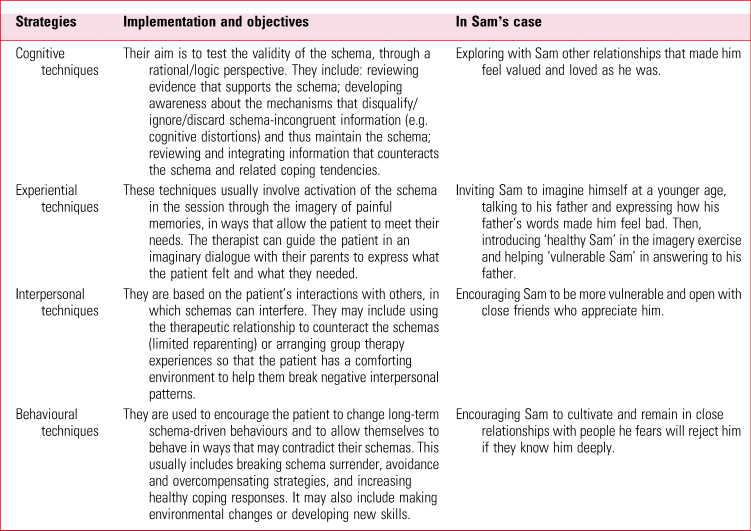
The goal of schema therapy is to help patients learn how to get their core needs met in a healthy way. With this aim, schema therapy seeks to enhance schema flexibility and schema change, blending cognitive, experiential, interpersonal and behavioural therapeutic strategies. In terms of schema modes, the aim of meeting emotional needs in a balanced way with these four therapeutic techniques is achieved, strengthening the healthy adult mode. This mode will then take care of the vulnerable child mode, set limits to the angry and impulsive child modes, and moderate strategies derived from maladaptive coping and parent modes. Substantial evidence has been gathered for the efficacy of schema therapy delivered individually, in groups or with couples in the treatment of personality disorders (Bakos Reference Bakos, Gallo and Wainer2015).
Therapeutic techniques of schema therapy
The four types of therapeutic technique are briefly described in Table 5, along with examples of techniques to weaken the defectiveness/shame schema of Sam, the patient in our clinical vignette. Interwoven with the four types of technique are two prominent processes concerning the therapeutic relationship and considered distinctive features of schema therapy: limited reparenting and empathic confrontation. Limited reparenting involves shaping the therapeutic relationship (within the boundaries of a professional relationship) in a way that it meets core emotional needs that had not been met in early childhood. Empathic confrontation consists of validating and empathising with the individual's beliefs and, at the same time, confronting them with their distorted and dysfunctional patterns of thinking and behaviour, emphasising the need to change their behavioural patterns to interrupt negative cycles and suffering (Young Reference Young, Klosko and Weishaar2003).
Psychotherapeutic strategies used in schema-focused therapy to weaken early maladaptive schemas, with reference to the clinical vignette
Cognitive interpersonal therapy
CBT for personality disorders is firmly based on intervening in dysfunctional interpersonal processes (Safran Reference Safran and Segal1990). These processes depend on internal cognitive models about how the self should be in relationships with others, and those models usually originate in dysfunctional early relational experiences with significant others. These internal working models are called dysfunctional interpersonal schemas (Safran Reference Safran and Segal1990). Perceptions resulting from the activation of these dysfunctional interpersonal schemas typically lead to maladaptive attitudes and behaviours towards others, which elicit behaviours from others that reinforce the pre-existing interpersonal schema. These maladaptive interpersonal processes have been conceptualised as dysfunctional cognitive interpersonal cycles (Safran Reference Safran and Segal1990).
Cognitive interpersonal cycles
As therapy occurs in an interpersonal context, the therapist may become involved in cognitive interpersonal cycles, elicited by the relational behaviour of the patient. When this occurs, the rigid and/or maladaptive behaviour of the patient triggers specific emotions in the therapist, leading to tendencies to react in a certain manner. If the therapist is not aware of the negative emotions and tendencies to react that are elicited by the patient's interpersonal behaviour, the possibility that the therapist will be controlled by a dysfunctional interpersonal cycle increases and the therapeutic relationship become just another problematic context in the patient's life. For example, people with narcissistic personality features may behave with the therapist in an arrogant manner, criticising the therapy and the therapist. This behaviour usually triggers feelings of anger in the therapist. If they react accordingly, becoming defensive towards the patient, this will reinforce the patient's schema (e.g. that other people are abusive and they must defend themselves) and it will certainly affect in the quality of the therapeutic alliance.
To avoid getting caught in dysfunctional cognitive interpersonal cycles, therapists should cultivate a self-observant attitude and be trained to identify their own emotional reactions to the patients’ behaviours. Acting in a way that is opposite that elicited by the patient's interpersonal cycle will offer the patient the possibility of experiencing new healthy ways of interacting with people that can then be generalised and used outside therapy. In this context, ruptures in the therapeutic relationship may represent an opportunity for metacommunication about what has happened, and the repair of the therapeutic rupture and relationship may provide important disconfirming information (Safran Reference Safran and Segal1990).
The therapeutic process
Cognitive interpersonal therapy revolves around disconfirming the patient's dysfunctional interpersonal schemas by establishing a relationship that offers the patient an experience of new and healthy interpersonal behaviour within a safe relationship. Initially, the therapist should elicit detailed autobiographical episodes, search for links between thoughts, emotions and actions, and collect autobiographical memories to understand the underlying interpersonal schemas. Then, collaboratively with the patient, the therapist forms a hypothesis about the schemas and plans for change. The efficacy of metacognitive interpersonal therapy for personality disorders has been shown in a sample of young adults (Popolo Reference Popolo, Macbeth and Canfora2018).
Dialectical behaviour therapy
Dialectical behaviour therapy (DBT) was initially proposed by Marsha Linehan to help women with chronic suicidal behaviours who met criteria for borderline personality disorder (Linehan Reference Linehan1993). Nonetheless, DBT skills training may be helpful and effective in several disorders, particularly those with acute emotion dysregulation (Linehan Reference Linehan1993). This approach is included in CBT interventions, extending the clinical focus on cognitive restructuring and behaviour modification to evidence-based transdiagnostic processes such as acceptance, mindfulness, commitment and self-compassion. DBT case conceptualisation is based on biosocial theory, which posits that emotion dysregulation is a product of a reciprocal interaction between biological and environmental factors (Linehan Reference Linehan1993). That is, some people might be more biologically prone to experience heightened emotional reactivity and some environments can exacerbate that tendency. These environments are usually marked by experiences of invalidation in early life, when caregiving adults communicated that the child's emotions and internal experiences were wrong, inadequate, pathological or exaggerated. The interaction between being emotionally sensitive and living in a context that does not understand or does not validate one's emotional states leads to difficulties in tolerating distress, establishing realistic goals and oscillating between emotional inhibition and extreme emotional displays (Linehan Reference Linehan1993).
Dialectics
Generally, ‘dialectics’ means that an essential idea (thesis) implies an opposite position (antithesis). The process of change happens in the resolution of these opposites into a synthesis. Although people can talk about opposite parts independently, they cannot make sense of the reality without considering the whole, because reality is holistic. A dialectical view of the world defines the theory and underlies the practice of DBT. For example, the characteristic behaviours of borderline personality disorder can be conceptualised in terms of three dialectical dimensions: emotional vulnerability versus self-invalidation; unrelenting crises versus inhibited grieving; and active passivity versus apparent competence. The intense discomfort at the extremes of each dimension leads to a dialectical dilemma, or a persistent vacillation between the extremes, with a concomitant inability to achieve balance or synthesis.
In terms of therapy, a dialectical focus affects therapist–patient interactions at two levels: (a) the therapist is aware of the dialectical tensions and balances that occur in the therapeutic relationship and carefully integrates opposing strategies and therapeutic positions in each therapeutic interaction; (b) the therapist teaches the patient dialectical reasoning and behaviour by questioning the individual in ways that open up new avenues of thinking and acting, by presenting alternatives ways of thinking or by modelling dialectical behaviour. The therapist must use dialectical strategies to lead the patient to attain a balance between both opposites. Such strategies also involve opposites: validation versus problem-solving; acceptance versus change; and irreverence versus reciprocity (Linehan Reference Linehan1993). DBT applies various CBT techniques (e.g. behavioural assessment, exposure, cognitive modification, contingency management) and, at the same time, focuses on dialectical work, radical acceptance of events and situations, change, therapy-interfering behaviours and the therapeutic relationship.
Stages and delivery of DBT
DBT follows a staged model of treatment that prioritises the problems that should be addressed in therapy, considering how they affect the patient's life. In the pretreatment, the therapist and the patient clarify treatment boundaries (e.g. commitment to attend sessions, payment, ethical framework) and agree to collaborate in pursuing essential goals. The objective of the pretreatment is to assure engagement in therapy. The subsequent four stages of DBT treatment are presented in Table 6 (Linehan Reference Linehan1993).
Stages of dialectical behaviour therapy

Standard DBT is a multifaceted approach comprising group sessions, individual therapy, telephone coaching in emergency, engagement of family members, and consultation teams for therapists. DBT skills are taught in four modules: emotion regulation, distress tolerance, interpersonal effectiveness and mindfulness. These are the areas identified as the ones in which people with borderline personality disorder usually have most difficulties (Linehan Reference Linehan1993). A description of each skill domain can be found in Table 7. DBT is viewed as a treatment system in which the therapist delivers DBT to the patient, while a supervisor or consultation team delivers DBT to the therapist. Thus, consultation-to-the-therapist and consultation-to-the-patient strategies are considered an integral part of this model. The effectiveness of DBT for borderline personality disorder has been consistently recognised, and some evidence has also been shown for other personality disorders (Feigenbaum Reference Feigenbaum, Fonagy and Pilling2012).
Dialectical behaviour therapy skills put into practice

Discussion and conclusions
People with personality disorders present pervasive and rigid cognitive, affective and behavioural patterns that should be the focus of therapeutic efforts. Working with personality disorders can be highly challenging, and therapists should be aware of the specificities of these disorders and should acquire adequate training and supervision. Clinicians can assess personality disorders according to categorical or dimensional approaches, both of which have pros and cons. The assessment and subsequent identification of personality disorders is essential to refer people to suitable psychotherapeutic treatment. Despite the usefulness of identifying general treatment recommendations across personality disorders, further research on individual personality disorders would be beneficial to enhance the existing body of research.
CBT models focus on cognitions, emotions and dysfunctional behavioural patterns that people have experienced throughout their lives. Among the approaches to personality disorders, three CBT approaches stand out. Schema therapy emphasises unattended emotional needs, early maladaptive schemas and schema modes and involves work on schema processes (surrender, avoidance and compensation) and the development of the healthy adult mode to enhance schema flexibility. Cognitive interpersonal therapy is focused on disconfirming patients’ dysfunctional interpersonal schemas through gradual development of healthy social relationships. DBT is a multifaceted treatment approach committed to teach essential skills for coping with emotion dysregulation and interpersonal difficulties. A summary of these therapies can be found in Table 8.
Three cognitive–behavioural models to treat personality disorders

CBT has proven to be effective in reducing symptoms and improving functioning in various personality disorders. Nevertheless, further research is warranted to ascertain its efficacy for specific disorders or clusters of disorders and to clarify the mechanisms of change involved.
Data availability
Data availability is not applicable to this article as no new data were created or analysed in this study.
Acknowledgements
C.C. is particularly grateful to Professor Dr Cristina Canavarro and Dr Ana Dias da Fonseca for their continuous encouragement and support, and to Professor Dr Ana Paula Matos for her continuing supervision in CBT.
Author contributions
D.C.: conceptualisation, writing (original draft); P.C.: conceptualisation, writing (review and editing), validation, supervision; D.R., M.d.C.S. and C.C.: conceptualisation, writing (review and editing), validation.
Funding
This study was supported by the Center for Research in Neuropsychology and Cognitive and Behavioral Intervention (UIDB/PSI/00730/2020), University of Coimbra.
Declaration of interest
C.C. is a member of the BJPsych Advances editorial board but did not take part in the review or decision-making process of this paper.
MCQs
Select the single best option for each question stem
1 Which of the following is not a core advantage of the dimensional approach to diagnosing personality disorders?
a Providing a more accurate assessment of personality functioning
b Facilitating communication between mental health professionals
c Capturing subclinical symptoms
d Informing the design of tailored treatments
e Allowing greater understanding of the severity and range of symptoms.
2 When working with people with personality disorders, the cognitive–behavioural therapist should not:
a cultivate the therapeutic relationship as an active ingredient of treatment
b challenge the function of maladaptive schemas
c define therapeutic goals for the patient
d assign homework
e explore the developmental pathways underlying symptom configuration.
3 Within the schema therapy framework, which of the following is not a classification domain of early maladaptive schemas?
a Disconnection and rejection
b Internalised social put-down
c Impaired autonomy and performance
d Impaired limits
e Other-directedness.
4 According to Young's schema theory, the main schema processes present in people with personality disorders are:
a schema aetiology, surrender and transformation
b schema differentiation, integration and transformation
c schema distortions, avoidance and perpetuation
d schema comparison, dissonance and pervasiveness
e schema surrender, overcompensation and avoidance.
5 Which of the following is not a key feature of CBT for personality disorders?
a The use of cognitive, behavioural and interpersonal techniques
b A focus on modifying maladaptive patterns of thinking and behaviour
c Building a healthy therapeutic relationship
d The identification of defence mechanisms
e Collaborative case conceptualisations.
MCQ answers
1 b 2 c 3 b 4 e 5 d




eLetters
No eLetters have been published for this article.