




Introduction
Rural electrification processes are important because they are closely linked to the economic and social development of any country. Since the 1970s, some international institutions, such as the World Bank, have been considering universal access to electrical energy as a fundamental requirement to promote development, particularly in the rural world, where the electrification processes have been usually incomplete and deficient. Within this context, there is an abundance of reports and academic research on the topic that highlight the many positive effects that electrical energy can offer to the rural world (i.e., World Bank, 1975 and 2008; Zomers, Reference Zomers2001; Niez, Reference Niez2010; Riva et al., Reference Riva, Ahlborg, Hartvigsson, Pachauri and Colombo2018). First, they indicate the importance of electrification to mechanise agricultural tasks and rural industries, contributing to increasing productivity and generating new business opportunities, which, in short, help to improve the income of the rural inhabitants (Bonan et al., Reference Bonan, Pareglio and Tavoni2017). They also indicate that electrification can have indirect effects on the improvement in education (freeing up work time to dedicate it to training, improvement in schools) and health (improvement in healthcare facilities and materials, elimination of harmful emissions from combustion in homes). Furthermore, positive environmental effects have also been found through the possibility of using clean energy, which reduces the use of forest resources for heating and cooking, thereby contributing to the conservation of forests (Kanagawa and Nakata, Reference Kanagawa and Nakata2008). From all of these perspectives, learning about the historical processes of rural electrification is important to better understand the development path of any country.
However, the topic is much more complex. Although electrification and rural development are usually contemplated together, the causal relationships between the two variables do not always have to go from electricity to development but can also function in the opposite direction. For example, the greater or lesser success of a rural electrification process can depend on the prior existence of a certain level of development that generates demand for electricity in rural areas and which creates the conditions necessary so that the inhabitants of these areas are able to afford the consumption tariffs (Riva et al., Reference Riva, Ahlborg, Hartvigsson, Pachauri and Colombo2018). It has also been shown that the effects of electrification will be more positive if the use of this resource is generalised across the population, that is, if affordable tariffs are established that enable access in good conditions to all of the inhabitants of the area and not only a minority (Moonga Haanyika, Reference Moonga Haanyika2006). At the same time, rural electrification can generate greater effects on development if, in parallel, other infrastructures are created (roads, urban restructuring, schools, medical centres, etc.) that enhance the performance of energy innovation (Cook, Reference Cook2011). If these conditions prevail, a virtuous circle can arise between electrification and development, which will consolidate and increase electricity consumption, deploying all of its potential (Riva et al., Reference Riva, Ahlborg, Hartvigsson, Pachauri and Colombo2018). In fact, in some cases it is suggested that the areas of a country that were electrified early on may have advantages related to the accumulation of human capital over the very long term, even after electrification had been generalised to other areas (Brey, Reference Brey2021).
Based on these considerations, this article analyses the historical process of rural electrification in Spain. Although many economic history studies on the Spanish electricity sector have been published since the 1980s, both on a national and regional scale, practically all of them focus on the urban and industrial contexts, which have, undoubtedly, been the most affected from a quantitative point of view due to the electrification process and the development of electricity businesses.Footnote 1 On the contrary, the electrification of the Spanish countryside has remained in the shadows and both its development and effects were, until now, practically unknown. This article seeks to cover this gap, providing an overview of rural electrification in Spain to understand the extent to which it contributed to the process of rural development throughout the twentieth century.
The Spanish case is particularly interesting because until the 1950s its economy was largely based on agriculture and the majority of the population was engaged in this sector (Collantes and Pinilla, Reference Collantes and Pinilla2011). From then, the following decades witnessed an enormous rural exodus, which occurred in parallel with the modernisation and mechanisation of the agricultural and livestock sectors and the associated processing food industries. We know that at the end of this process of change, electricity was present throughout the whole of Spain’s rural world and fully integrated into the production processes. But when did the expansion begin and at what pace did it move over time? Was this energy change fundamental for agricultural modernisation by contributing to the mechanisation and improvement of the living conditions of the rural population or, on the contrary, did it come late and play a secondary role? In short, was rural electrification a cause or a consequence of the process of agricultural change in the Spanish case?
In order to answer these questions, this study fundamentally focuses on three aspects. Section 1 reviews the international literature that analyses rural electrification from a historical perspective to identify the main problems of the topic and to analyse the process in Spain from a comparative perspective. The second section detects the principal milestones of the territorial expansion of Spain’s rural electrification and identifies the causes that can explain this pace throughout the twentieth century. Section 3 estimates the evolution and composition of agricultural electricity consumption and analyses its changes in order to formulate hypotheses regarding the effects that electrification had on the modernisation of the sector. The final section draws the main conclusions.
1. Rural electrification from a historical perspective: a brief state of the art
There are very few studies that analyse rural electrification from a historical perspective. Therefore, the state of the question is fairly brief. Some of these studies address the rural electrification policies developed in the United States within the framework of the New Deal, with the creation of the Rural Electrification Administration (Malone, Reference Malone2008; Archambault, Reference Archambault2010; Kitchens and Fishback, Reference Kitchens and Fishback2015). Others focus on providing a general overview of the advance of rural electrification in several countries around the world, particularly in Europe over the long term (Zomers, Reference Zomers2001), or on analysing specific cases, such as that of France (Berthonnet, Reference Berthonnet2003; Nadaud, Reference Nadaud2005). More recently, we can refer to a monographic study on the topic that makes an in-depth analysis of rural electrification in the United Kingdom from the beginning of the twentieth century (Brassley et al., Reference Brassley, Burchhardt and Sayer2017a), and two chapters on the topic for Sweden (Martiin, Reference Martiin2017) and Canada (Sandwell, Reference Sandwell2017). Generally speaking, all of these studies highlight the delay of rural electrification in relation to urban and industrial electrification. The principal explanation for this resides in the low level of profitability that can be gained from electricity investments in the rural world, as the unit cost of expanding the electricity grid across the territory increases exponentially as the population density decreases (Brassley et al., Reference Brassley, Burchhardt and Sayer2017a). Therefore, typically, private companies displayed little interest in providing their services in territories with few potential consumers. Cases such as Wales, for which this profitability has been quantified, show that it was very low (Moore-Colyer, Reference Moore-Colyer2017). Despite, the supply problems depended on the place and electricity generating system. In general, they were greater when electricity was generated through thermal coal-fired power stations located far away, requiring the development of an extensive network, as in the case of England (Brassley, Reference Brassley, Brassley, Burchhardt and Sayer2017). On the contrary, supply problems were reduced in cases where the generation of hydroelectricity was possible in points dispersed across the territory, such as in Sweden (Martiin, Reference Martiin2017) or Canada (Sandwell, Reference Sandwell2017).
In any case, it was not just a problem of supply. The demand of the rural world also played a role and, although it may seem surprising, this demand often remained low, at least during the first half of the twentieth century. The low quality of electrification meant that, in many cases, this source of energy could only be used for lighting, at a price that discouraged demand (Brassley et al., Reference Brassley, Burchhardt and Sayer2017a). On the other hand, the relative abundance of alternative energy sources at relatively competitive prices for cooking and heating, such as firewood, coal or even oil, could also have delayed the electricity demand (Sandwell, Reference Sandwell2017).
Taking these conditions into account, rural electrification can be considered a problem of market failure (Malone, Reference Malone2008), which requires some type of public intervention. In fact, the expansion of the electricity network across the territory depended largely on the ability of the existing institutional conditions to enable the execution of projects that were unattractive to private companies. State intervention in the financing of projects or the provision of subsidies for constructing the lines or for consumption tariffs was fundamental in the majority of cases (Zomers, Reference Zomers2001; Nadaud, Reference Nadaud2005). Also important was the existence of complementary institutional mechanisms able to drive the electrification processes and manage their maintenance in the long term. In some cases, such as Denmark, Sweden or the United States, rural electricity consumer cooperatives played an essential role in the expansion of electrification and in the management of supply (Zomers, Reference Zomers2001). This institutional arrangement meant that the interested parties participated in the process and mitigated the problems generated by small and fragmented markets, reducing, in some cases, the public subsidies necessary to undertake the projects (Yadoo and Cruickshank, Reference Yadoo and Cruickshank2010).
In general, most of the Western countries became concerned about the problem of rural electrification during the interwar period, although the interventions could vary significantly depending on the country. One of the most successful cases was that of the United States, which began rural electrification in the 1910s and 1920s, through agreements with private companies and the local authorities of some states (Hirsh, Reference Hirsh2018). However, the major boost was fuelled by the creation of the Rural Electrification Administration (REA) in the mid-1930s. Rural electrification was then used in the country as a lever to reactivate the economy and create jobs during the severe crisis of the 1930s (Malone, Reference Malone2008). This has led some authors to describe the creation of the REA as the most successful federal programme of all time (Archambault, Reference Archambault2010). Germany was another early starter during the 1930s but in a very different institutional framework, driven by the direct intervention of the authoritarian state of the Third Reich that had electrified 80 per cent of farms at the beginning of the 1940s (Zomers, Reference Zomers2001). New Zealand was another place with an early implication of the State with rural electrification, and positives outcomes in farm modernisation in the 1930s (Bertoni and Willebald, Reference Bertoni and Willebald2019). But in most of the countries, although the interventions could begin in the 1920s (Zomers, Reference Zomers2001; Berthonnet, Reference Berthonnet2003; Ditt, Reference Ditt2017), the effects of the policies arrived in the period following the Second World War.
A paradigmatic case is that of the United Kingdom, which nationalised the electricity network in 1948 with the objective, among others, of ensuring rural electrification at affordable prices (Sheail, Reference Sheail2017).Footnote 2 From this moment, and in a very short period of time, rural electrification expanded quantitatively and qualitatively and the electricity purchased by English farms measured in millions of kWh multiplied more than tenfold between 1945 and 1955 (Brassley, Reference Brassley, Brassley, Burchhardt and Sayer2017). France nationalised the industry in 1946 and, from then, rural electrification advanced considerably, reaching 91 per cent of the rural population in 1954 and 98.5 per cent in 1960 (Nadaud, Reference Nadaud2005). In other cases, the interventions were not so intense, but the regulations based on subsidies and incentives for electrification, sometimes promoting the creation of cooperatives, were common in many countries of north-west Europe. At the beginning of the 1950s, electricity reached more than 90 per cent of the municipalities and farms in Sweden (Martiin, Reference Martiin2017) and 85 per cent in Denmark (Zomers, Reference Zomers2001).
Concerning to the economic effects of rural electrification, the quantification of the results is scarce. The study by Kitchens and Fishback (Reference Kitchens and Fishback2015) for the case of the United States measures the effects of the expansion of the network in different states for the period 1930–40 and finds a close and significant relationship between this expansion, the increase in agricultural productivity and land revaluation, identifying the process as one of the key factors for the economic recovery of America’s rural world in this decade. In the rest of the cases, there is no quantification, although there are some qualitative clues. It seems, for example, that the effects of rural electrification could be felt earlier in some agricultural subsectors related to cattle breeding (dairy farms and later poultry and pig farms), which improved their technology thanks to the arrival of electricity (Bertoni and Willebald, Reference Bertoni and Willebald2019) and which only later were applied to the agrarian subsector, per se (Brassley, Reference Brassley, Brassley, Burchhardt and Sayer2017). In any event, the effects of electrification on the production and productivity of the agricultural sector after the 1950s have not been addressed until now and still remain unknown.
Another important aspect that has recently received attention is the effects that rural electrification had on employment. In the specific case of the United States, studies analysing this topic for the first phases of the distribution of electricity in the rural world find an increase in agricultural employment generated by greater activity in the sector (Gaggl et al., Reference Gaggl, Gray, Marinescu and Morin2019), although in the medium and long term, electrification contributed to the structural change and the reduction in employment in the primary sector (Lewis and Severnini, Reference Lewis and Severnini2020). Other studies conducted for the Nordic countries find an almost immediate effect in the structural change and mobility of the workers and, as a result, a reduction in agricultural employment (Leknes and Modalsli, Reference Leknes and Modalsli2020; Molinder et al., Reference Molinder, Karlsson and Enflo2021). In short, it seems that rural electrification did not prevent the rural exodus processes, although it could have made them more gradual in some cases (Brassley et al., Reference Brassley, Burchhardt, Sayer and Brassley2017b).
What does seem clear is that electrification had positive effects on the quality of life of the population who remained in the countryside, with particular emphasis on the work of the rural women who were able to use electrical appliances for domestic tasks (Sayer, Reference Sayer2017). In the case of the United States, it has been suggested that the freeing up of work time of rural women between 1930 and 1960 was associated with a considerable reduction in infant mortality and a slight decrease in fertility rates (Lewis, Reference Lewis2018).
The historical processes of rural electrification in Western countries followed different paths and had different effects, but in general, it seems that they began more or less successfully in the 1920s and 1930s, resumed in the period immediately following the Second World War and played an important role in the modernisation of the rural world. How does the Spanish case fit into these dynamics?
2. The expansion of the electricity network in the Spanish countryside
The historical sources available for the Spanish case do not allow us to observe the expansion of electricity on a farm scale, but some supply and consumption statistics indicate the specific villages that were electrified from the beginning of the twentieth century. Combining these data with the population censuses, we can also determine the number of rural inhabitants who had electricity and those who had no supply. Figure 1 summarises these data for four specific years for which we have information (1905, 1934, 1948 and 1973) and enables us to draw an outline of the evolution of rural electrification, which, in general, fits well in the overall trends of the Spanish economy.Footnote 3
Rural population and population without access to electricity (1905–07). (Percentages of the total population and absolute numbers of the population without access to electricity).
Sources: See text, note 4. M: Millions of inhabitants.

Although an industrialisation process had begun in Spain in the nineteenth century, in 1905, an agricultural-based economy still prevailed in the country, with almost 70 per cent of the population living in the countryside. Some of the rural areas closest to the cities already had an electricity supply at this time, but more than half of the population remained without access to electricity. From then, both the rural population and the population with no electricity supply decreased in three phases.
In the period 1905–34, the Spanish economy underwent a significant modernisation and urbanisation process that led to a decrease in the rural population, although only in relative terms, by 20 per cent. In the same period, the population without an electricity supply decreased even more sharply, which suggests that rural electrification was initially relatively successful during the first third of the twentieth century.
On the contrary, in the period between 1934 and 1948, we can observe that the decrease in the rural population was slightly slower and the pace of rural electrification also slowed, although to a lesser extent. This situation coincided with a very complicated period for the Spanish economy, including the Civil War (1936–9) and a postwar period that lasted for more than a decade and which was dominated by the autarchic policies of the Franco regime. Finally, in the period 1948–73, the reduction in the rural population was moderate, but the expansion of electricity across the countryside accelerated, and at the beginning of the 1970s only 1.5 per cent of the population did not have an electricity supply. This process ran parallel with rapid growth in the Spanish economy, particularly during the 1960s, with strong structural change and significant investments in infrastructure. However, going beyond this overview, what can explain the pace of rural electrification in each of these periods?
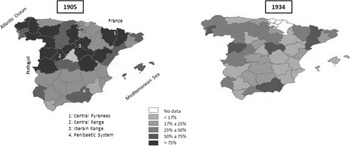
For the phase 1905–34, we have information on a provincial level that allows us to better understand the expansion of electrification across the territory. As we can observe in Figure 2, around 1905, there were many provinces where more than 75 per cent of the population did not have access to electricity. This situation can be explained by three basic variables. The first is related to the degree of urbanisation and industrialisation, as the most industrialised provinces had the highest level of electrification. The second variable refers to the type of settlement, whereby there was a lower incidence of electrification in the northern areas, where the population was more dispersed, with small villages of just a few hundred inhabitants scattered across the countryside. Finally, the third variable is related to the orography of the territory. The mountainous areas had a clear disadvantage in terms of electrification (the Pyrenees, the Iberian Range, the Central Range and the Penibetic Range, located inland in the north, centre and south of the country, respectively). In spite of this, if we consider the expansion that had occurred in around 1934, it seems that these restrictions had been overcome, at least partially, and that in all of the provinces, the percentage of the population without electricity was below 50 per cent. How can be explained this expansion?
Percentages of the population without access to electricity by province.
Sources: See text, note 4. By the year 1934, the Basque Country (now the Autonomous Region of Euskadi and the Autonomous Community of Navarre) was not included due to their different tax regimes.

Until the beginning of the twentieth century, electricity in Spain was obtained mainly by burning coal (thermoelectricity) and was concentrated exclusively in the cities where the provision of that fossil fuel was available in bulk by ship or by train, and where the demand for industrial activities or for street lighting was relatively high. But from then on, some technological innovations made possible some expansion throughout the countryside. The most relevant change was the implementation of alternating current – as opposed to direct current – in the transportation of electricity, which allows the distribution of high voltage electric current on a large scale to distant places from the production centres at economically affordable energy losses. Although the first inter-urban transmission of alternating current occurred in 1891 in the United States (close to Telluride, Colorado and months later in Lauffen, Frankfurt), its commercial implementation was carried out quite a lot later, in response to the demand for electricity of the different markets. In the case of Spain, the first commercial experience with high voltage was carried out in 1901 (Gallego, Reference Gallego1901). The second set of technological changes had to do with the introduction of new transport and construction techniques (including the use of reinforced concrete), which facilitated the production of electricity through water reservoirs and its waterfalls and allowed to build and start using rain-snow reservoirs (Pyrenees) or, later, rain reservoirs (over Duero, Ebro, Tajo, Guadiana and Júcar rivers) to a rapid replacement of thermoelectricity by hydroelectricity. The high cost of coal in Spain aggravated during the First World War and also in the 1920s, accelerated this process.
In this framework, until the 1930s, the development of the electricity markets was mostly due to the action of private businesses. Some important companies such as Hidroeléctrica Ibérica (Bilbao), Barcelona Traction (Barcelona), Hidroeléctrica Española (Madrid and Valencia) or Compañía Sevillana (Seville), were the first to undertake the technical development and to expand its production mainly to satisfy the growing urban and industrial demand. It is true that, in some cases, the process was extended to some rural areas because the optimisation of the huge investments could be complemented with the sale of energy to peripheral markets. But the bulk of the countryside remained outside the main distribution networks, as companies were not interested in areas with low population density. The distances from the production points, the rugged orography of many areas of the country and the low consumption of the rural consumers increased the cost per unit of Kw/h sold, and, in fact, the profitability of the investments in rural electrification was usually negative. Only some rural intensive farms, dedicated to the export of fruits (oranges and lemons) on the Mediterranean coast, using electricity for irrigation systems were of interest to the companies due to its location, normally not far from cities, and to its high consumption.
The state, for its part, did not take decisive action to electrify the countryside, probably because political instability and the usual weakness of budgetary policy did not allow it. From the 1920s on, a certain level of state involvement may be observed through the declaration of the supply of electricity as a ‘public service’ to the subscribers (R.D., 1924), which indicated that electricity was no longer a luxury good, but a basic good that the state could regulate as they used public resources. Nevertheless, neither public investment nor the regulation itself to promote rural electrification grew in this period. Only at the beginning of the 1930s, the governments of the Second Spanish Republic expressly contemplated the problem of rural electrification, involving the industrial engineers at their service and commissioning several of them to elaborate a report on the situation on an international scale to analyse and the possibilities of applying similar measures in Spain. Furthermore, rural electrification was included as one of the functions of the Institute of Agricultural Reform created in 1932 to redistribute land among the country dwellers.Footnote 4 But, in general terms, until the 1930s the expansion of a national network to the Spanish countryside had been very weak.
To face that lack, some rural industries dedicated to the transformation of food or raw materials, had chosen for the self-generation of electricity using small torrential watercourses. This solution was carried out by implementing tiny dynamos connected to turbines that powered small-scale and medium machines at an affordable cost. In fact, the proliferation of these electric engines enabled the benefits of electricity (versatility, flexibility and cleanliness) to be extended to many economic activities. The most well-known case is the conversion of many traditional flour mills scattered throughout the territory into the so-called ‘electro harineras’ (electric flour plants) that generated their electricity to drive the grinding machines. But this practice was extended to other industries producing olive oil or beet sugar, or also to sawmills. In some cases, these rural industries produced more electricity than they needed and sold the surplus to nearby towns that could use it mainly to replace oil or petrol lighting in town halls and small- and medium-sized workshops or shops. Indeed, the radius of action of these local networks was very short (less than two miles, normally) both for the reduced power of the electro-generators and for the high distribution costs, as networks, transformers and, fundamentally, distribution losses increase with distance.
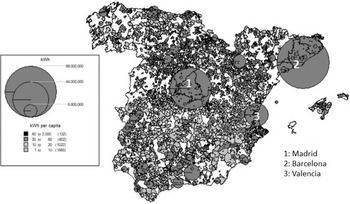
Taking all this into account, Figure 3 and Table 1 show the electrification advances by 1934. On the one hand, it is obvious that absolute consumption was mainly concentrated in large cities such as Madrid, Barcelona and Valencia and in the provincial capitals (all marked with green circles on the map), under the control of big companies. But we should also highlight the widespread diffusion of electrification throughout most of the municipalities, irrespective of their size. Of course, on average, consumption progressively decreased in accordance with the size of the municipalities (see Table 1) and, while in the towns with more than 200,000 inhabitants the average consumption per inhabitant was 49 kWh, in the municipalities with less than 2,500 inhabitants it was 15 kWh.
Domestic electrification (lighting) in Spain* on a municipal scale, 1934.
Source: See text, note 4. The Basque Country (now the Autonomous Region of Euskadi and the Autonomous Community of Navarre) was not included due to the different tax regimes.

Domestic consumption of lighting according to the size of the municipalities, Spain, 1934

Source: See text, note 4.
In other words, the large concentrations of population, with relatively low costs in infrastructure (networks), achieved a level of penetration unimaginable in the rural world. It is true that sometimes small- and medium-sized producers, making the most of their proximity to the hydraulic works, could provide a better and broader service to their customers than that provided to subscribers of other more densely populated cities.Footnote 5 But beyond these exceptions, the big picture indicates that a good part of the network installed in the countryside until the 1930s was weak and only able to provide lighting services and not always of good quality, as some studies conducted during these decades corroborate (Sintes and Vidal, Reference Sintes Clives and Vidal Burdils1933; Vidal, Reference Vidal Burdils1951). It is highly unlikely, therefore, that electrification during this period was expanded to the farm scale for agricultural or livestock management. Big companies were not interested, local networks did not have enough radiuses of action to reach farms and, far from the watercourses, the energy necessary to self-generate electricity was not accessible.
As already indicated, during the 1940s, the advances made in rural electrification were few, within a context of economic and energy hardship that the country suffered during the autarchic period. However, from the end of the 1940s, Franco’s government began to explicitly express an interest in extending the electricity network to rural areas, seeking to involve private companies in the operation. In 1948, in the framework of the National Congress of Rural Electrification organised by the corporative trade unions of the Franco regime, the urgency to electrify the Spanish countryside was manifested. In 1949, the General Director of the Industry Department requested the large electricity companies to study the issue of rural electrification.Footnote 6 However, the most significant step was taken in 1954, with the Decree ‘regarding the electrification of populations lacking electrical energy’ issued by the Ministry of Industry (BOE, 1954).Footnote 7 This Decree recognised that the contributions of both the state and the electricity companies could be highly necessary to both electrify areas that had no electricity and to improve the supply in areas where the local production and distribution were insufficient to cover the growing demand. Therefore, the Decree, on the one hand, called on the private companies to cooperate by covering 25 per cent of the installation cost, while the rest of the projects were financed by the state or other institutions. On the other hand, it authorised the possibility of adding special transitional surcharges on the price of energy, so that the companies could undertake the cost. In order to organise these matters, the Provincial Electrification Boards were established under the supervision of the Ministry of Industry.
The specific effects of this decree should be analysed in greater detail, but it seems that from the mid of the 1950s, the new framework drives the companies to become involved in the process, as a result of a ‘trade-off’ through which they carried out certain actions commissioned by the government in exchange for certain compensation. In fact, both the request to study the problem that the Minister issued to the companies in 1949, and the legislative modification of 1954 coincided with revisions in electricity tariffs by the state, which took advantage of this situation to ‘force’ the companies to collaborate in rural electrification. The situation was repeated at the beginning of the 1970s, as the implementation of the National Plan of Rural Electrification (PLANER, 1976) coincided with the updating of the ‘Integrated Energy Billing System’ of 1972. Our hypothesis is that in exchange for facilitating the extension of the network to the countryside, the big companies obtained advantages both in the application of tariffs and in the control of water reservoirs for hydroelectric uses.
Going beyond the possible trade-off, the advances made in extending the network between the 1950s and 1970s are evident. Table 2 shows the regional data (organised by the current autonomous regions) summarising territorial expansion of the network, but also differences in quality and levels of consumption. Although only 1.7 per cent of the population lacked electricity at this moment, we can observe that the percentages of the population receiving a deficient supply were very high, reaching in some cases almost half of the rural customers. This suggests that rural electrification occurred, at least, at two speeds. On the one hand, rural areas located within the most industrialised and dynamic regions (Catalonia, the Basque Country, Madrid and Valencia) show the value of the network per inhabitant, per area and per farm, or the power per subscriber much higher than those rural areas within less developed regions, both in the south (Andalucia and Extremadura) or in the north (Castille-Leon and Galicia or Aragón). It seems, therefore, that rural electrification had largely followed a similar pattern to that of the regional economies, being better and more widely installed in those areas with higher rates of economic growth.
Expansion and quality of rural electrification according to the PLANER

Source: PLANER (1976).
If, to finish this section, we compare the evolution of rural electrification in Spain along the twentieth century with other European countries, we can highlight some considerations. First, in Spain, as in the rest of Europe, the interest in rural electrification began in the interwar period with an early declaration of electricity as a public service, although beyond this, there was no direct involvement of the state in promoting rural electrification until much later. In fact, until the 1930s, the advances were made by incorporating, on a small scale, the technical innovations related to hydroelectricity, which enabled a more decentralised generation of electricity. The investments were mostly made by some food or raw materials transformation industries located in the countryside, which use electricity to operate and could sell the surplus to neighbour towns. But apart from some intensive business producing export crops, no electrification arrives on the bulk of the Spanish farms before the middle of the 1950s.
General thought changed from the 1960s when a more decisive involvement of the state and a possible trade-off with private companies extended networks across most of the territory, although with very big regional differences, particularly with respect to the quality of the service. The effects that this late and irregular expansion had on the living standards of the rural populations with respect to the electrification of household chores, and the improvement of schools or medical centres, are unknown. However, given the regional differences in the quality of supply, it seems that before the 1980s they were very weak and were centred on areas near urban or industrial centres that were better supplied.
3. The evolution of the agricultural uses of electricity and their effects
After establishing the pace of the territorial expansion of rural electrification, what can we say about the electricity consumption of the agricultural sector and its effects? Until now, the only study that has made long-term estimates of the electricity consumption of the Spanish agricultural sector is that of González de Molina et al. (Reference González de Molina, Soto Fernández, Guzmán Casado, Infante Amate, Aguilera Fernández, Vila Traver and García Ruiz2019), which uses the data of the INE (Spanish National Institute of Statistics), correcting them for the final stage with estimates of the twentieth century and the early decades of the twenty-first century. In our case, we also use data from the INE until 1957 and from then on, we used the Estadísticas de la Industria de la Energía Eléctrica (Electric Power Industry Statistics), as we consider them to be more reliable. In any case, differences in the estimates of González de Molina and ours until 2006 (the year when our series ends) are not significant.
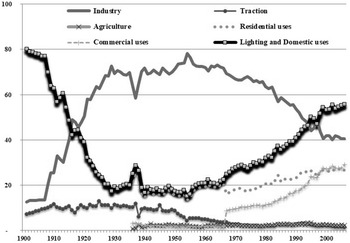
Following our estimate, Figure 4 shows the percentages of electricity consumption by economic sector, differentiating between industry, transport (traction), lighting and domestic uses, residential uses, commercial uses, and agricultural uses. This classification can help to pinpoint some specific problems. The annual data for total agricultural consumption are available from 1936. Between this year and 2006, the percentage of these activities over total electricity consumption remained practically constant at around a modest 2 per cent. It is, therefore, clear that the agricultural uses of electricity have traditionally been in a minority with respect to those of industry or the urban sector. In spite of this, if we take into account that total electricity consumption increased considerably in this period, the fact that the percentage described remained stable indicates that agricultural consumption grew at the same pace as total consumption. In fact, in absolute terms, it increased from 20 MWh in 1936 to 6,047 MWh in 2006, that is, it multiplied by approximately 300 (see Figure 5).
Evolution of electricity consumption in Spain by sector (%).
Source: INE Statistical Yearbook of Spain (1949–61) and Electric Power Industry Statistics, annual series (1958–2006). (Original sources in Spanish can be found at Anuarios Estadísticos del Instituto Nacional de Estadística (INE) and Estadísticas de la Industria Eléctrica.)

Electricity consumption in the agricultural sector (MWh) by uses (irrigation engines and other uses).
Sources: See Figure 4.

We should also remember that this figure does not include the part of consumption for lighting and domestic uses in the rural world or a part of the industrial consumption that could have been used in the countryside to transform primary products (for example, electro-flour mills, sawmills or any other agri-food industry). Our estimate in this section is limited to the uses strictly made in the production and extraction activities related to agriculture, cattle rearing and forestry.
Figure 5 outlines the stages of the evolution of this consumption, by disaggregating from the total the part dedicated to the extraction of water from the subsoil with irrigation engines and other agricultural uses. In 1936, total agricultural consumption was very low. This confirms that rural electrification during the first third of the twentieth century was used almost exclusively for lighting, as we commented in the previous section. From then, agricultural consumption grew constantly, although the pace was slow until the mid-1950s and then accelerated. With respect to the composition, we can detect how the use of electrical irrigation motors accounted for practically all of the consumption until as late as the mid-1980s. Only from then did electrical consumption for irrigation begin to stagnate while total agricultural consumption continued to grow. This indicates that electricity was used increasingly for different agricultural tasks. This composition should be considered normal in a country such as Spain, where water stress has traditionally been one of the factors limiting agricultural production and productivity (González de Molina, 2002) and where the expansion of the irrigated area has represented one of the principal elements of the modernisation of the agricultural sector (Duarte et al., Reference Duarte, Pinilla and Serrano2014). The importance that the housed livestock farming sector has gained in recent decades (Soto et al., Reference Soto, Infante-Amate, Guzmán, Cid, Aguilera, García and González de Molina2016) can explain the increase in agricultural consumption for uses other than irrigation.
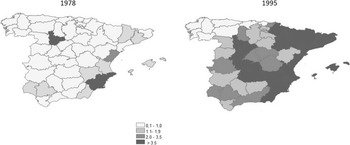
However, was this pace of electrification of the agricultural sector similar or different to that of the industrial sector? To answer this question, Figure 6 outlines the evolution of electricity consumption per worker in the two sectors (Figure 6a) and also shows the percentage by which electricity consumption per industrial worker was higher than that of the electricity consumption per agricultural worker (Figure 6b). Finally, Figure 7 carries out a similar exercise for the consumption of electricity per agricultural worker, showing the data on a provincial scale in 1978 and 1995, two dates when the information is sufficiently solid to do so. The reading of these figures enables us to contemplate interesting hypotheses regarding the electrification of the Spanish agricultural sector.
Electrical intensity (electricity consumption per worker) in agriculture and industry (1941–2005) (five-year moving averages).

Electricity consumption ratio per agricultural and industrial worker (%) (five-year moving averages).
Source: See Figure 4. Nicolau (Reference Nicolau2005) for annual estimates of agricultural and industrial workers.

Provincial consumption of MWh in agricultural activities per agricultural worker (1978–95).
Source: See Figure 4. Nicolau (Reference Nicolau2005) for annual estimates of agricultural workers.

The first idea that arises from this combination of data is that the electrification related to the Spanish economy in terms of consumption per worker was fairly low in all sectors until practically the 1950s. This fact, however, was more evident in the case of the agricultural sector, where the curve remains practically flat until the mid-1950s. In fact, the boom in electrification in the industrial sector took approximately ten years to reach the agricultural sector and only gained momentum from the beginning of the 1960s. This also coincided with the delay in rural electrification already mentioned and proves that electrification for production purposes (and not only lighting) began very late in Spain.
The big increase in the electricity used per agricultural worker in the 1960s can be explained by several reasons. First, we should take into account that this was a period of strong rural exodus, guided by the industrialisation of many urban areas of the country (Collantes and Pinilla, Reference Collantes and Pinilla2011). Therefore, the mere decrease in agricultural workers increased the electricity consumption per worker. However, the increase was not only relative but also absolute, which indicates that other forces were also at play. From the supply side, this is when the electricity companies, guided by the afore-mentioned trade-off with the state, were able to extend the network. From the demand side, according to the accepted explanations of the crisis in traditional agriculture in Spain in the 1960s (Naredo, Reference Naredo1996), we can say that the drop in labour available increased the wages, activating incentives for the mechanisation of agricultural tasks. And although petrol-fuelled machinery was the most important, the use of electrical engines, particularly to pump groundwater for irrigation was boosted as well (Calatayud and Martínez Carrión, Reference Calatayud and Martínez Carrión2005). From a geographical point of view, this explains that in 1978 the consumption per worker was higher in the Mediterranean area (Figure 7) where there was a strong tradition in irrigated fruit and vegetable crops. Even so, the advance made in electrification during these first dates was not enough to match industrial consumption and the differences in kWh per worker continued to be very high (Figure 6a).
The process of convergence with industry was reinforced from the 1980s, guided by two key elements. On the one hand, industry itself notably slowed electrification per worker within a context of the industrial crisis and the beginning of a hard, industrial reconversion. In parallel, agriculture continued to lose workforce, although more slowly (Collantes and Pinilla, Reference Collantes and Pinilla2011) but the sector was boosted thanks to the incorporation of Spain into the European Union, which facilitated the export of Mediterranean agricultural products to northern European markets. This process, together with the changes in diets and food consumption, reinforced the use of electricity both for irrigation and for other agricultural uses (electrical tools for agriculture and livestock uses) and by 1996, practically every Spanish province had reached very high levels of electrification per worker (Figure 7). The only exception was the north-western corner of the country, where the relative abundance of water meant that the use of irrigation engines was less necessary. Again, supply factors must have played a very important role. In fact, the implementation of the PLANER, together with the greater reticular size of the electricity network deployed by the private companies to connect urban centres, must have contributed to completing electrification, improving the quality of the networks in the countryside and facilitating the use of electricity for different agricultural activities. It is possible that technological changes in agricultural machinery also helped the process as they increased the possibilities of diversifying the use in different tasks. Therefore, it seems clear that in this stage of the end of the twentieth century and the beginning of the twenty-first century, electricity became a key element in the modernisation of many farms and helped to improve production to cover both national and international markets. This increased the demand for electricity from the farmers and probably increased also the interest of the electricity companies in growing rural demand.
Conclusions
This study traces the basic lines of the rural electrification process in Spain, opening a line of research that, until now, did not exist and which should be developed in the future. After this initial analysis, we can confirm that Spain’s rural electrification suffered from several setbacks. First, it was delayed with respect to the urban and industrial electrification of the country, within a dynamic that seemed to be common in the energy transition of all countries. Electricity was an energy source that was developed in close connection with the second industrial revolution and the urbanisation process that followed. Furthermore, the economies of scale gained from the high industrial and urban consumption facilitated a faster expansion in these areas than in the countryside. Moreover, in Spain, the costs of expanding the networks across the territory were high in relation to the low potential consumption of the rural inhabitants and this discouraged the supply provided by private companies. At the same time, there is no indication that electricity demand was high in the Spanish countryside at least before the 1960s, probably because of the medium size of the farms, the relatively low cost of abundant workforce and the low medium income of the farmers did not push electrification in previous stages.
Public intervention facilitating supply would have been essential to change that trend, but in Spain, no clear and decisive line of action was taken in this respect until very late. Even though electricity was declared a public service in 1924, and despite the interest of the authorities of the Second Republic in promoting the process at the beginning of the 1930s, specific actions were scarce and the advances in rural electrification were based on the implementation of relatively simple hydroelectrical systems that enabled the private initiative to generate electricity on a small scale. The economic and energy problems generated by the Civil War and Franco’s Autarchy notably slowed the process.
Therefore, while in many countries of western Europe there was a clear commitment to rural electrification during the period immediately following the Second World War based on institutional support, in Spain, advances were not made in this respect until the 1960s. At this time, although there was still no clear plan to promote electrification in the countryside, a trade-off between a dictatorial state and the big private companies gave rise, indirectly, to a certain expansion of supply, enabling power lines to reach the majority of the rural population at the beginning of the 1970s. In spite of this, the low quality of supply suggests that until then, electricity was associated almost exclusively with lighting and not with the modernisation of agricultural tasks.
With respect to strictly agricultural uses of electricity (excluding lighting and the rural agri-food transformation industries), the specificity of Spain resided in the use of engines to pump underground water to address, through irrigation, the water stress suffered by a large part of the country’s agricultural sector. Electrical irrigation started in some specific places in the 1920s, but as late as in the 1970s only the provinces on the Mediterranean coast dedicated to irrigated crops of fruit and vegetables had a high electric consumption per worker. Twenty years later, at the end of the 1990s, the consumption per worker in agriculture closed the enormous gap that had previously prevailed with respect to industry, and most of all, achieved the same rate of growth as this sector. We can therefore consider that at the end of the twentieth century the rural electrification process had been consolidated.
From this perspective, the Spanish case seems to be compatible with the perspective of some of the studies that highlight the importance of a certain level of economic and agricultural development prior to the consolidation of rural electrification (Cook, Reference Cook2011; Rivas et al., Reference Riva, Ahlborg, Hartvigsson, Pachauri and Colombo2018). In fact, in Spain, this electrification was completed very late and largely followed in the wake of the modernisation processes of agriculture, either with the arrival of the green revolution technologies in the 1960s or with a new modernisation wave related to the expansion of crop exports to European markets when Spain joint the EU in the mid-1980s. Obviously, from these dates the incorporation of electricity into the agricultural sector has had favourable effects on production and productivity and, very probably, improved the living standards of the rural population remaining in the countryside. However, rural electrification was not the driver of agricultural change. Rather, on the contrary, it seems that agricultural change, with the subsequent increase in income and demand for energy, was essential for a quality electricity supply to reach the countryside and facilitate its subsequent modernisation.
Acknowledgements
This article has received finance from project PGC2018-096640-B-I00, of Spain’s Ministry of Science, Innovation and Universities. A preliminary version was presented at the 12th International Congress of the Spanish Association of Economic History (6th–9th September 2017).






 Open access

