




Introduction
Domestic horses (Equus caballus) facilitated the emergence of highly mobile pastoral lifeways and the transcontinental equestrian empires of the steppes of Mongolia and eastern Eurasia. Although historical documents trace horse riding in East Asia only as far back as the mid-first millennium BC (Cooke Reference Cooke2000), widespread archaeological evidence in the region dates back centuries earlier, to the late second millennium BC (Fitzhugh Reference Fitzhugh and Bemmann2009). This was a period of major horse-related transformations in East Asia, including greater mobility of pastoral herders, the exploitation of horses for meat and milk and the dispersal of domestic horses into Central China (Yuan & Flad Reference Yuan, Flad and Mashkour2006; Taylor et al. Reference Taylor2020; Wilkin et al. Reference Wilkin2020). The available data make it difficult to assess whether these developments were linked to the innovation or adoption of mounted horseback riding, or to the initial dispersal of domestic horses into the region (Taylor et al. Reference Taylor2017).
We present unique damage patterns in early domestic horse remains from Mongolia, and suggest that early horse transport in the Eastern Steppe entailed fast gaits and shallow rein angles, along with a high frequency of ‘bit-grasping’ that would have hampered control by riders. Our findings imply that late second-millennium BC riding—if practised—probably entailed high risk to the rider. This may explain the preference for chariot transport and the apparent absence of mounted riding beyond the steppe in China and other parts of East Asia until the mid-first millennium, when advances in horse tack improved rider control.
The cart before the horse?
Recent arguments for the origins of horse domestication have centred on Botai sites in northern Kazakhstan dated to c. 3500 BC. These sites have yielded overwhelming quantities of equid remains, with some Equus przewalskii specimens exhibiting apparent damage to the dentition linked to the use of a bridle mouthpiece, or ‘bit’ (Outram et al. Reference Outram2009; Gaunitz et al. Reference Gaunitz2018). The earliest definitively domestic horses, however, are associated with the southern Trans-Uralian Sintashta Culture, dated to c. 2000 BC (Fages et al. Reference Fages2019). Sintashta horses are found in paired burials and are sometimes accompanied by chariot wheel remains and bridle components (Chechushkov & Epimakhov Reference Chechushkov and Epimakhov2018). Historical records and archaeological finds from the late second millennium BC reveal the proliferation of chariots across much of western Eurasia and North Africa, with only sparse reference to horse riding (Littauer & Crouwel Reference Littauer and Crouwel1979). Ridden horses only appear in western Eurasian historical records in the early first millennium BC (Littauer & Crouwel Reference Littauer and Crouwel1979). Nonetheless, many scholars (e.g. Littauer et al. Reference Littauer, Crouwel and Raulwing2002; Olsen Reference Olsen, Olsen, Grant, Choyke and Bartosiewicz2006a; Anthony Reference Anthony2007) believe that mounted horseback riding must have occurred long before this time in the steppes, where historical records are rare or absent and horse equipment is scarce.
Understanding early horse transport in East Asia
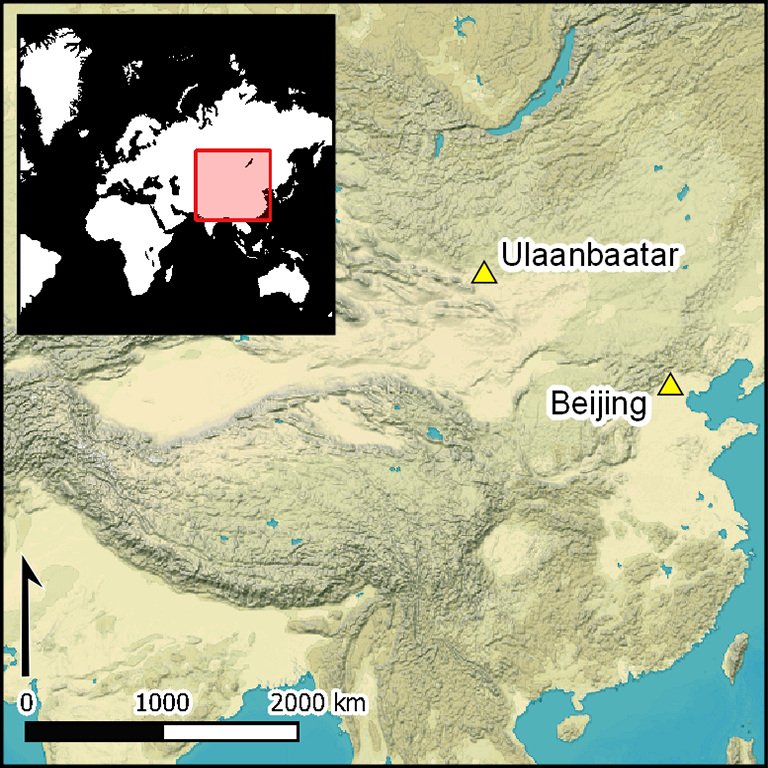
The chronology of chariotry and mounted riding is crucial to understanding pastoral prehistory in Mongolia, where horses historically underpinned highly mobile herding economies and one of the world's oldest ‘horse cultures’. Recent research suggests that the tending of pastoral livestock and dairy production using sheep, cattle and goats dates as far back as c. 3000 BC in the Eastern Steppes (Kovalev & Erdenebaatar Reference Kovalev, Erdenebaatar and Bemmann2009; Wilkin et al. Reference Wilkin2020). The earliest domestic horses so far identified in Mongolia, however, belong to the Bronze Age Deer Stone-Khirigsuur Complex (DSK), which emerged towards the end of the second millennium BC. This culture is named for its ritual standing stones (deer stones) and burial mounds (khirigsuurs) that are often surrounded by multiple horse burial features (Fitzhugh Reference Fitzhugh and Bemmann2009). DSK sites have yielded evidence for the ritual sacrifice and dietary exploitation of horses (Fitzhugh Reference Fitzhugh and Bemmann2009), while skeletal changes indicate that DSK horses were bridled and heavily exerted, and received sophisticated veterinary care (Taylor et al. Reference Taylor, Bayarsaikhan and Tuvshinjargal2015, Reference Taylor2018). The co-occurrence of the first DSK horses with the appearance of domestic horses at late Shang Dynasty sites in China suggests that these two processes were linked (Honeychurch Reference Honeychurch2015).
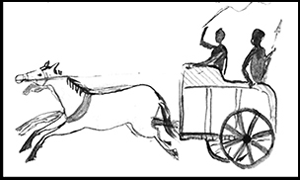
The role of horseback riding in DSK culture is less clear. Although we have previously hypothesised that mounted horseback riding may have stimulated the spread of DSK culture (Taylor & Tuvshinjargal Reference Taylor, Tuvshinjargal, Bartosiewicz and Gál2018), only chariots, not riders, are depicted on Mongolian deer stone carvings (Figure 1). Images of DSK horse-drawn vehicles depict a light, two-horse chariot with a platform situated over a central axle, with two animals under yoke (Figure 1: right) and, in one case, additional animals along the outside (Figure 1: middle). Archaeological discoveries from adjoining regions, such as trousers and horse burials from Xinjiang and horse skeletons exhibiting transport-related pathologies from Arzhan (to the north, in Tuva) (Benecke Reference Benecke2007; Wagner et al. Reference Wagner2011), suggest the emergence of horseback riding in the Altai region by the early first millennium BC. To date, however, the earliest unequivocal evidence for horseback riding in Mongolia comes from Pazyryk Culture burials in the western Altai Mountains (c. 400 BC), which have yielded horses equipped with pad saddles and elaborate regalia (Rudenko Reference Rudenko1970). Based on the current evidence, it is unclear how DSK horses were used for transport. Beyond the head, neck and hoof bones of sacrificed horses found at DSK sites, no other datasets are available to assess the use of horses in early East Asia.
Chariot images on central Mongolian Deer Stone-Khirigsuur Complex (DSK) monuments, including a two-horse (right) and a four-horse vehicle (middle); left) a typical DSK ritual head, neck and hoof burial (chariot drawings by W.T.T. Taylor modified after Volkov (Reference Volkov2002 [1981]: 93 & 218) and Nyambat and Odbaatar (Reference Nyambat and Odbaatar2010: 64)).

Horse transport and the equine skeleton
As our knowledge of the equine skeleton and its responses to human activity has expanded, new tools and approaches have emerged to reconstruct the use of horses in the past. Pioneering work by Clutton-Brock (Reference Clutton-Brock1974) and Anthony et al. (Reference Anthony, Telegin and Brown1991) revealed that bridle mouthpieces can cause recognisable damage to horse dentition in the form of uneven wear to the occlusal surface of the mandibular second premolar—otherwise known as ‘bit-wear’. Although bit-wear became a favoured tool to argue for early horse domestication, Olsen (Reference Olsen, Levine, Renfrew and Boyle2003) demonstrated that natural occlusion problems can also produce bevelling of the tooth surface in wild equids. Intentional modification of horse teeth through dentistry can also induce premolar bevelling (Cross Reference Cross, Bartosiewicz and Gál2018). Thus, individual teeth must be considered alongside opposing dentition when seeking to identify anthropogenic tooth modifications.
Several scholars (e.g. Bendrey Reference Bendrey2007; Cook Reference Cook2011; Taylor & Tuvshinjargal Reference Taylor, Tuvshinjargal, Bartosiewicz and Gál2018) have identified a suite of other changes to the dentition caused by bridle mouthpieces, including erosion of the anterior surface of the lower second premolar, bone spur development or bone loss along the diastema, chipping of the enamel and remodelling of the bone at the alveolar margin of the premolar, and even damage to the bones of the palate. These forms of damage are influenced by the type of bit and bridle used, the behaviour and technique of the horse and of the rider, the type and duration of activity performed, the shape of the horse's head and mouth and the age and sex of the horse (Bennett Reference Bennett, Baker and Easley2005; Manfredi et al. Reference Manfredi, Clayton and Rosenstein2005; Bendrey Reference Bendrey2007; Cook Reference Cook2011). This variability enables archaeologists to reconstruct important details about how horses were used, even in the absence of tack or other direct evidence.
Both riding and cart traction typically employ a bridle and bit. Hence, the presence of bit-wear alone cannot distinguish ridden horses from those used to pull carts (Dietz Reference Dietz, Renfrew and Levine2003), although other skeletal criteria can help differentiate these activities. Before the invention of the frame saddle in the first millennium BC, mounted horseback riding caused characteristic changes to the horse's lower back, which are typically more extensive/severe on the animal's left side (Levine et al. Reference Levine, Whitwell and Jeffcott2005; Li et al. Reference Li2020). In contrast, a sample of chariot horses from ancient China (Levine Reference Levine2005), along with early donkey/onager hybrids used in cart traction in the ancient Near East (Weber Reference Weber2008), shows higher pathological frequencies affecting the front shoulders and lower limbs, and less damage to the vertebrae. Schrader et al. (Reference Schrader, Smith, Olsen and Buzon2018) also report osseous changes, linked to chariotry, in the final cervical and first thoracic vertebrae, situated where the strain of a yoke is borne. Unfortunately, horse remains from DSK sites and many others from across the Eurasian Steppes comprise so-called ‘head and hoof’ features, either lacking neck vertebrae entirely or containing only the cervical vertebrae (Allard et al. Reference Allard, Popova, Hartley and Smith2007; Outram Reference Outram2011).
More commonly recovered from steppe archaeological contexts, horse crania may also yield useful osteological differences between chariotry and riding. The use of a bridle noseband often causes deformation of the nasal bones, which, in contemporary Mongolian horses, is biased towards the left side due to the predominance of left-handed reining (Taylor & Tuvshinjargal Reference Taylor, Tuvshinjargal, Bartosiewicz and Gál2018). Ossification of the nuchal ligament attachment site at the rear of the skull occurs in both ridden and driven animals—a feature that apparently reaches greater levels of ossification in ridden than in draught animals (Bendrey Reference Bendrey2008), and is generally absent in wild animals (Taylor et al. Reference Taylor, Bayarsaikhan and Tuvshinjargal2015). The degree of discrimination provided by these features in distinguishing transport types, however, remains unclear.
In summary, while chariotry and riding produce differential impacts on the equine skeleton—particularly the vertebral column—the most useful diagnostic differences often occur on skeletal elements not typically recovered from early domestic horse burials in Mongolia or elsewhere. To date, these approaches have therefore made little headway in clarifying the early trajectory of horse transport in prehistoric Central Asia. Here, we assess the possibility that damage patterns to the dentition, which frequently survive in the archaeological record, may help distinguish between prehistoric equine transport strategies.
Bit-wear, riding and chariotry
To assess whether meaningful osteological differences in dental wear may be found between chariot and riding horses, we analysed a sample of modern and ancient Chinese and Mongolian horses used for both types of transport. For each horse, we assigned a categorical score of 0–4 based on observed wear to the anterior and occlusal portions of both the upper and lower second premolars. A score of 0 represents no visible wear; 1 represents cementum abrasion but no enamel exposure; 2 corresponds to enamel exposure; 3 indicates visible erosion of exposed enamel; and 4 represents visible erosion of anterior enamel, paired with occlusal bevelling (see Anthony & Brown Reference Anthony and Brown1998). As we know that Bronze and Early Iron Age Mongolian horses were controlled using an organic (e.g. wood, leather, fibre, or bone) bit (Taylor et al. Reference Taylor, Tuvshinjargal and Bayarsaikhan2016), we did not attempt to distinguish ‘natural’ wear from ‘bit’ wear a priori based on the morphology of anterior enamel exposure (c.f. Bendrey Reference Bendrey2007). Examples of teeth in each of the four categories are provided in online supplementary material (OSM) 1.
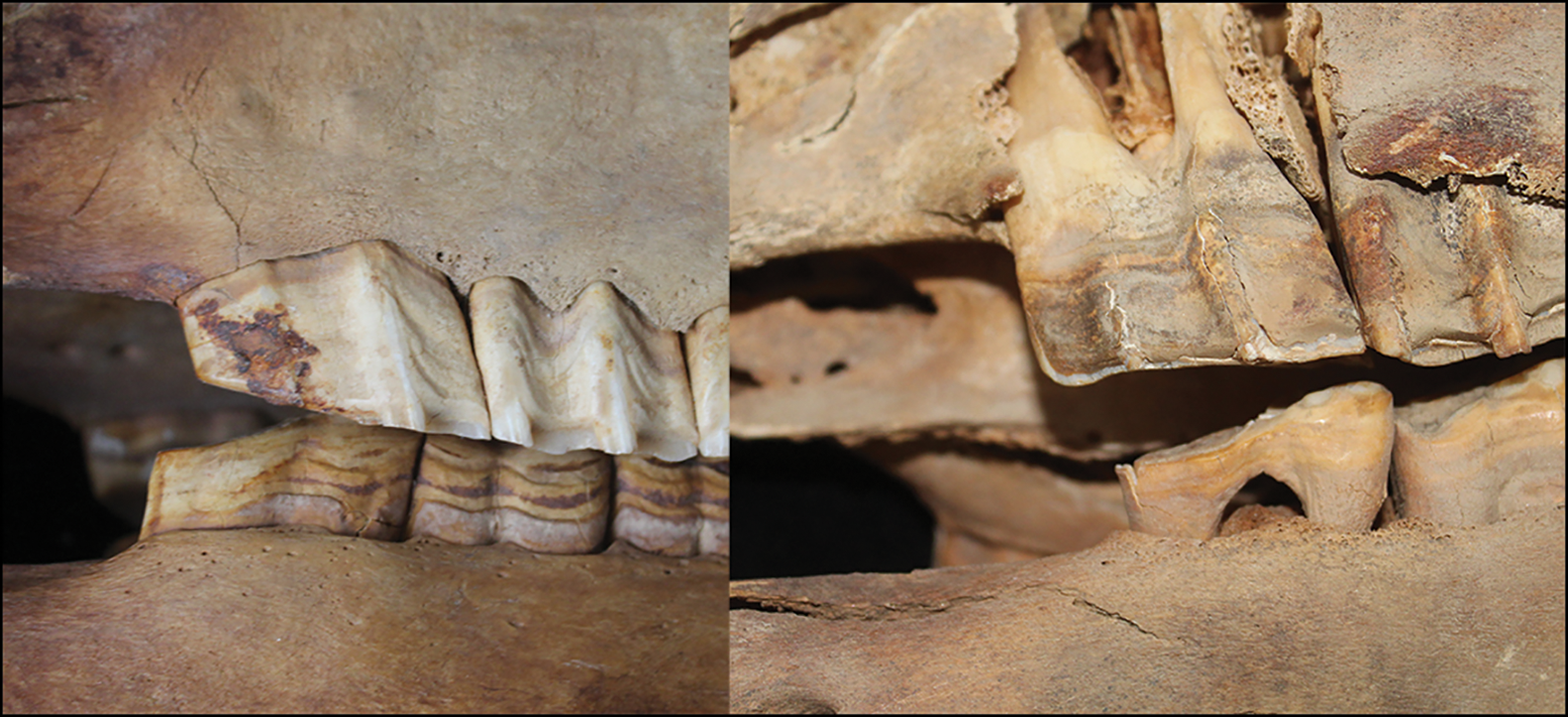
Our results show that in East Asia, mounted riding differentially impacts the lower dentition compared with the upper. In a sample of 23 analysed riding horse specimens, more than half exhibit exposed enamel on the lower premolars, with 4 being the most commonly assigned score for lower dentition. In contrast, more than half of the same analysed group showed limited or no damage to the upper dentition, with the most common score in this group being 0. Among those riding specimens that display damage to the upper dentition, this is always paired with more severe damage or erosion to the lower premolars (Figure 2: left).
Bit-wear to the upper and lower premolars in two riding horses from Turkic (fifth to eighth centuries AD; NMM 011) (left) and Pazyryk (fourth century BC; NMM 013) (right). Images show the pairing of upper premolar wear with severe lower premolar wear (figure by W.T.T. Taylor).
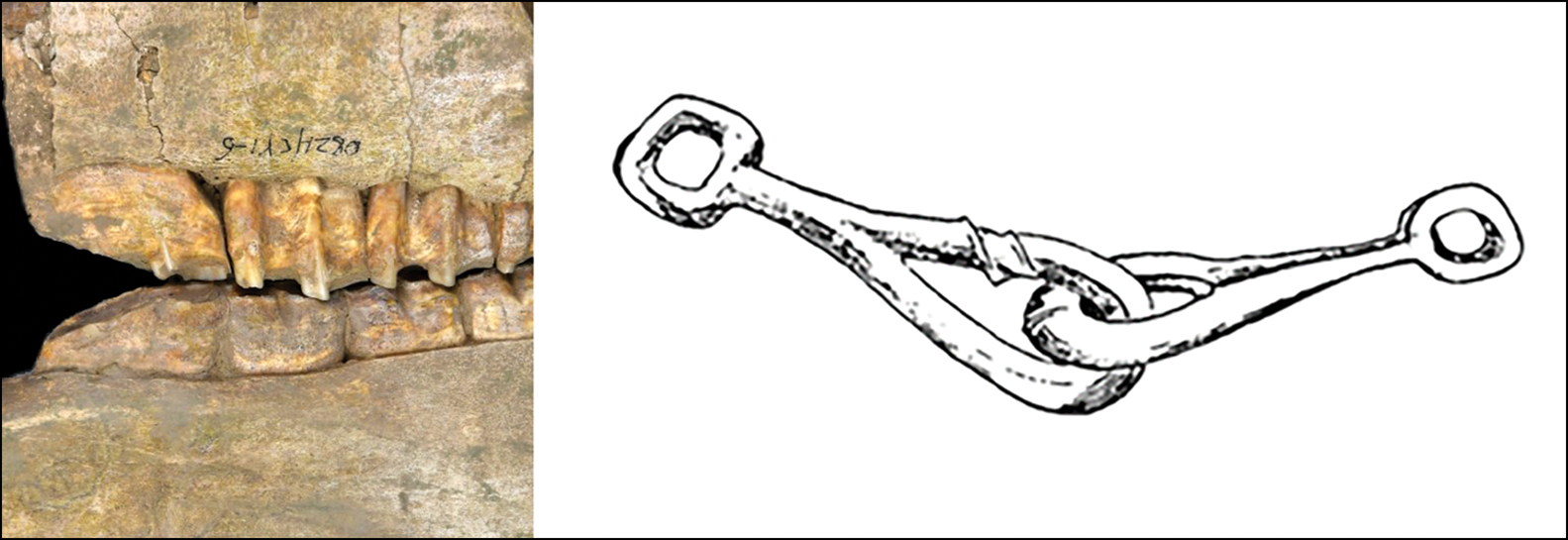
In contrast, our sample of chariot horses from first-millennium BC Chinese archaeological contexts lacks the clear patterning of damage seen in the modern and archaeological riding assemblage, suggesting that chariotry could produce more evenly-spread bit damage across both the upper and lower dentition. A large number of chariot horses have been recovered from Eastern Zhou Dynasty (770–256 BC) sites in Xinzheng City, near modern Zhengzhou (see OSM1). All of these horses were adult males, and archaeological research indicates that, as with our modern/archaeological riding assemblage, horses of this period were typically controlled using a jointed bronze/iron snaffle bit (Figure 3) in tandem with rein-rings (Wu Reference Wu2013: 81). Most of the 42 Xinzheng horses, however, exhibit scores of 2 or less, and few show any signs of occlusal bevelling. The Xinzheng chariot horses, however, exhibit meaningful levels of enamel erosion in neither their upper nor lower dentition. This could imply that the horses’ role as property of the social elite did not entail intense activity. Age may also have had a minor effect on these patterns; in both samples, horses over 10 years of age have a higher average wear score (~3.2 and 2.2 in the riding and chariot groups, respectively) than those younger than 10 years (~2.3 and 1.5, respectively). Our sample of riding horses exhibits a slightly higher average estimated age (~10.4 years) than that of the Chinese chariot sample (~8.1 years). Together, these osteological comparisons of East Asian riding and chariot horses suggest that mounted riding may produce more damage to the lower jaw, although limited pathology in the Chinese sample and age differences between sample groups limit our confidence in this assertion.
Left) bit damage to both lower and upper premolars caused by the use of a metal bit while pulling a chariot, from the Eastern Zhou Dynasty site of Cuiyuanxiaoqu (photograph by J. Cao); right) bronze bit from tomb 62, Xincun site (modified by W.T.T. Taylor after Guo (Reference Guo1998: 61)).
Comparative data in hand, we carefully reanalysed all adult DSK horses at the National Museum of Mongolia that retain complete (upper and lower) dentition (n = 19) for evidence of incongruous wear to the upper premolars that, upon refitting with the opposing jaw, could not be explained by natural malocclusion. Although a previous study (Taylor et al. Reference Taylor, Tuvshinjargal and Bayarsaikhan2016) found no evidence of bit-wear on the lower premolars, our reanalysis shows that eight of 19 specimens display bevelling of the upper second premolars (Table S1), most of which exhibit uneven wearing of the enamel and cementum—a feature sometimes referred to as the “Greaves effect” and taken as a sign of natural wear (Olsen Reference Olsen, Zeder and Smith2006b). Two specimens in the sample, however, have worn upper second premolars with even wear of the enamel and cementum, which contrasts with the wear seen elsewhere in the dentition (Figure 4). This implies that a material of similar hardness to tooth enamel, such as a bone bit, was responsible for the wear. In one case, wear on the upper second premolar is so severe that it also affects the upper third premolar (Figure 4: lower left).
Abnormal wear to the upper premolars in Deer Stone-Khirigsuur horses: top) 14–15-year-old female (NMM 002); lower left) >16 year-old female (NMM 095); lower right) >16-year-old of indeterminate sex (NMM 001) (figure by W.T.T. Taylor).

Five of the 19 DSK specimens also display an unusual type of wear, first noticed by Bartosiewicz and Gal (Reference Bartosiewicz and Gal2013: 134) in early medieval horses from Hungary, wherein the intercuspid space between the first and second cusp of the second or third lower premolar develops a rounded, scooped shape that is attributed to firm grasping of the bit between the teeth (Figure 5). On these five specimens, the location of this intercuspid, lower premolar wear corresponds with wear observed on the upper premolars. In the horse from the site of Morin Mort that exhibits wear extending deep into the third premolar, intercuspid wear is also found on the lower second premolar (Figure 5). These patterns suggest a bit being lifted over the lower teeth and ground upwards into the upper premolars. One horse even exhibits polishing around the intercuspid space, and nowhere else, which appears to have been caused by the bit (Figure 5: top left). Three of the five DSK horse specimens with mandibular intercuspid wear also exhibit deformations of the alveolar margin, where it appears that downwards pressure in gripping the bit has caused the tooth to bow laterally outwards (Figure 5: lower right; see OSM2).
Intercuspid wear of the lower jaw in Deer Stone-Khirigsuur horses: top left) polishing of the occlusal surface of a lower right second premolar (~6–7-year-old male; NMM 008); top right) wear to the lower third premolar (>16-year-old female; NMM 095). Several instances of bulging deformation of the mandibular margin of the lateral alveolar exterior surface near the affected teeth (>20-year-old of indeterminate sex (NMM 051, lower left) and male, 6–7 years (NMM 008, lower right)) (figure by W.T.T. Taylor).

Our analysis of DSK horses reveals a high frequency of damage to the upper premolars, paired with an absence of classic forms of lower premolar damage, along with an unusual form of intercuspid wear of the second premolar and deformation of the alveolar margins of the lower premolar row. These patterns appear to have resulted from chronic gripping of a bridle mouthpiece or bit, which was ground against the upper premolars by the lower jaw as the horse took the ‘bit between the teeth’. The uneven nature of wear caused by DSK bits across enamel and cementum (e.g. Figure 4: lower left) suggests that soft organic materials—perhaps fibre or leather—were often used for mouthpiece construction. Other instances of upper premolar wear to both enamel and cementum in our analysed sample imply the use of a hard bit (perhaps bone, antler or even metal), similar to equipment recovered from later first-millennium BC contexts in Mongolia (Chan Reference Chan2018: 87).
Discussion
Rein angle
While comparison of modern and archaeological riding and chariot horse dentition suggests that concentrated damage to the lower premolars might be an archaeological correlate of mounted horseback riding, the patterns identified in our DSK sample—with damage focused on the upper dentition—are more difficult to interpret. This pattern has no correlates in our comparative assemblage, and implies a shallow, near-horizontal angle between the reins and the horse's head.
To aid in understanding the relationship between rein angle and transport activity, we compiled a database of 227 side-on profile images of horses engaged in various forms of transport using a search of publicly available images. We selected images of modern Mongolian horseback riding (n = 96), English-style horseback riding (n = 21), jockey horse racing (n = 30), harness racing (n = 30), agricultural ploughing (n = 11), pulling carriages (n = 22) and reconstructed ancient chariots produced by Spruytte (Reference Spruytte1983; n = 17). We excluded any images depicting the use of a curb or leverage bit, along with any image in which the horse was stationary or not receiving guidance via the reins. For each category, we noted the gait/speed of the horse (stop, walk, trot or canter/gallop). Using the open-source software ImageJ, we measured rein angle as the angle formed by the reins and the bridle's cheek strap (which runs from the poll to the bit; see OSM3).
Our results indicate that rein angles differ meaningfully across types of transport. Traction animals (chariots, carriages and ploughs) yield a relatively consistent set of rein angles between 54 and 58 degrees. Reconstructions of ancient chariots (Spruytte Reference Spruytte1983) average a rein angle of 54 degrees (Figure 6). In contrast, some styles of mounted horseback riding, such as English riding, entail consistently high rein angles of around 90 degrees. Others, including contemporary Mongolian horse riding or jockey racing, in which the rider often stands in the saddle or holds the reins high, employ very shallow rein angles, with average values below 40 degrees (Figure 6). This variation implies that rider position is a key factor influencing rein angle.
Rein angle by transport category for modern horses (and reconstruction of ancient chariots shown in Spruytte (Reference Spruytte1983)) (analysed by W.T.T. Taylor using ImageJ).

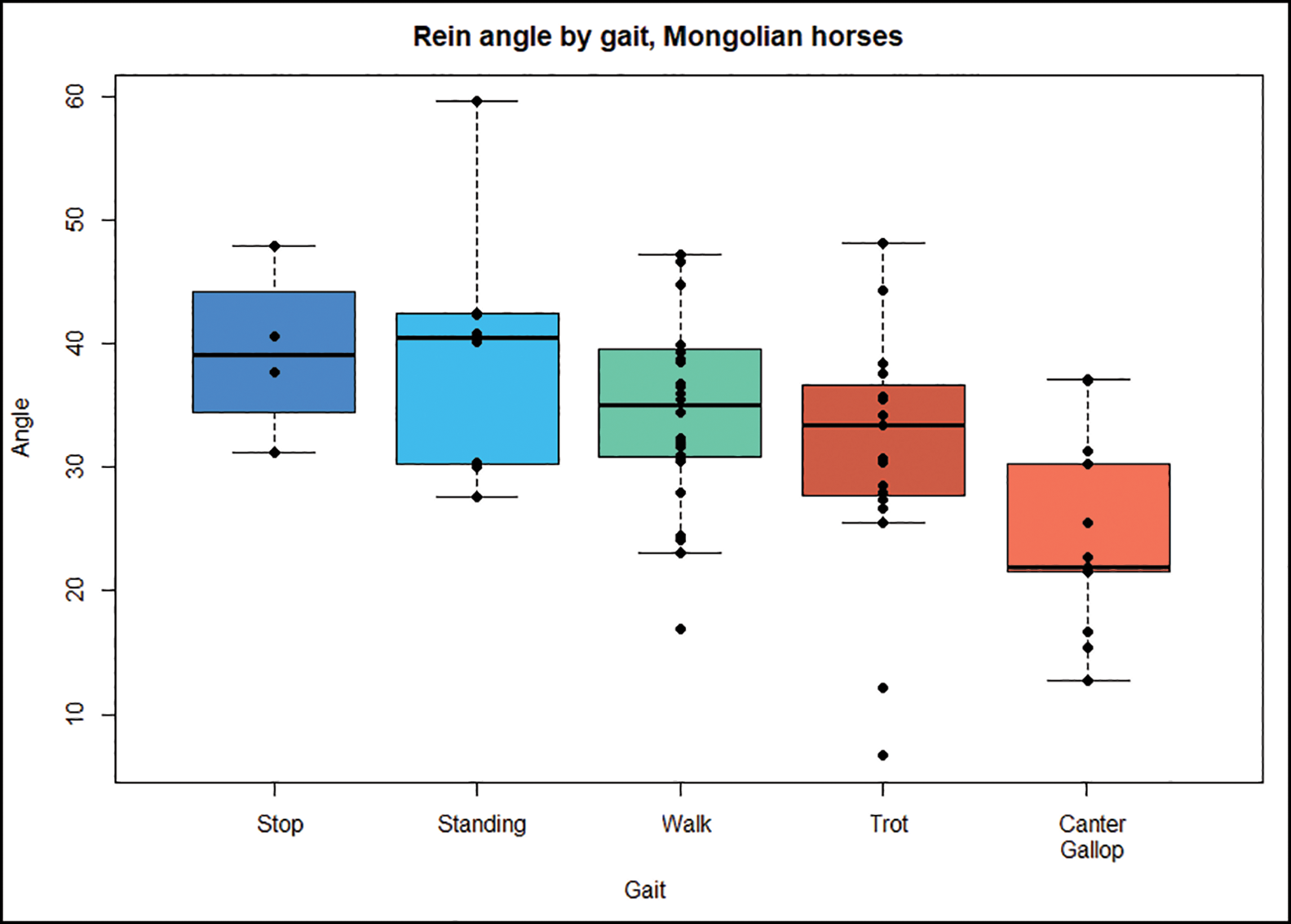
Consideration of horses at different gaits shows that rein angle also varies considerably according to speed. In Mongolian riding, which uses a simple bridle similar to those used in antiquity across East and Central Asia, rein angle becomes increasingly shallow with speed, as the horse achieves a greater degree of neck extension (Figure 7). There is a less clear relationship between speed and rein angle in traction horses, although the use of rein guides, which maintain a relatively consistent angle, could counteract the effect in our comparative sample.
Rein angles across different gaits, in Mongolian riding horses (figure by W.T.T. Taylor).
Bit type
Another potential contributor to the discrepancy between our DSK samples and comparative samples of riding and chariot horses is technological. In comparison to the jointed snaffle, which functions through pressure on the corners of the mouth, the straight-bar bit is more easily lifted between the teeth during riding (Manfredi et al. Reference Manfredi2009).
Archaeological evidence from Yanghai cemetery in Xinjiang indicates that leather, bone or antler bar bits were used for riding throughout much of the first millennium BC (Turfan City Bureau of Cultural Relics et al. 2019), and organic bar or rope bits appear to have been used to control most early steppe chariot horses. These bits, which function by placing pressure on the tongue, may cause comparatively less damage to the lower dentition. The high frequency of upper dentition damage in the DSK assemblage indicates that the bits were often taken ‘between the teeth’, with the neck fully extended—a dangerous scenario for mounted riders that often results in a loss of navigational control at high speeds (Cook Reference Cook1999). With the additional structure provided by a harness and a cart, the consequences of such bit-grasping would probably be less dire for a chariot team.
With no rein guides, the small stature of ancient Mongolian horses (often ~1.30m at the withers) could have contributed to a particularly shallow rein angle between chariot horses and standing drivers (Figure 8), while additional forces generated by rein leverage provide a potential mechanism for the severe tooth erosion seen in some DSK upper premolars. Alternatively, among horses that were clenching a bar bit between their teeth and receiving no downwards influence from the reins—a situation more likely in chariots than for mounted riders—the natural undulations of the body caused by running and breathing may have caused the mouthpiece to impact the upper dentition, resulting in preferential wear to the upper tooth row.
Schematic showing how shallow rein angles, used in tandem with a bar bit, might produce concentrated damage to the upper dentition (figure by W.T.T. Taylor and B.L. Morrison).

Riding or chariots?
Our results indicate that DSK horses were controlled at a rein angle sufficiently shallow to permit the bit to be regularly lifted onto the lower second premolars—likely at a consistently fast gait—and with backward rein tension or other forces significant enough to cause regular erosion of the upper second premolar. Our comparison with modern horses shows that both chariotry and riding at a fast gait are capable of producing shallow rein angles. Archaeological comparisons of East Asian riding and chariot assemblages show that neither provides a good match for the patterns observed in the DSK sample, perhaps due to the confounding influence of different equipment types (e.g. jointed metal snaffle vs organic bar bits) on the equine mouth. A pair of horses from the Petrovka Culture site of Novoil'inovskiy 2 in southern Russia, dated to c. 1800 BC, however, exhibit nearly identical erosion of the upper premolars to that seen in the DSK sample (Chechushkov et al. Reference Chechushkov, Usmanova and Kosintsev2020: figs 5–6). Future work could assess the osteological correlates of ancient riding and chariot horses controlled with an organic bar or bar-like bit, such as those from Yanghai and Sintashta. Another useful consideration is that DSK horses could have performed unique activities not considered in our comparative datasets, such as the transport of the large stones for DSK monuments that generated as-yet-unknown dental pathologies.
Implications
The DSK period is linked with the first appearance of the domestic horse in Mongolia and a variety of key social and economic changes, including the expanded use of dry, intermontane zones, increased dietary exploitation of horses and the emergence of horse rituals (Taylor et al. Reference Taylor2017). Our study suggests that, whether for driving, riding, or both, DSK horses were regularly driven at fast gaits, providing these early pastoralists with the speed and mobility that stimulated these key cultural changes.
Although we excluded juvenile specimens from our analysis, we also found upper premolar erosion and lower premolar intercuspid wear in horses as young as 2–2.5 years in the DSK sample, indicating that relatively young animals were used in transport. One such young horse from the site of Uguumur in Central Mongolia (Figure B1) was previously recognised as having undergone surgical modification of its incorrectly erupted deciduous incisors—the oldest known evidence for veterinary dentistry (Taylor et al. Reference Taylor2018). Our results suggest that use of horses in transport may have been a driving force behind this innovative veterinary care.
Available archaeological data support the notion that chariots were a practical part of subsistence and pastoral life in the Bronze Age Eastern Steppe. Chariots are typically depicted in petroglyphs as engaged in big-game hunting and other domestic scenes (Jacobson-Tepfer Reference Jacobson-Tepfer2015). One petroglyph from Mongolia shows a chariot ‘chasing’ a herd of horses (Littauer et al. Reference Littauer, Crouwel and Raulwing2002: 113). Given the high frequency of tooth damage caused by bit-grasping in the DSK assemblage—implying a regular loss of control for mounted riders—perhaps the additional structure provided by a yoke and harness, along with the calming presence of a second animal (Dietz Reference Dietz, Renfrew and Levine2003), gave paired cart transport key advantages over mounted riding.
The importance of chariot horses in DSK sites is clear in funerary architecture. DSK horses with transport-related osteological features are often recovered from rows of burial mounds (groups of four) along the east side of standing stones and burial mounds (Figure 9; Taylor Reference Taylor2017). Many khirigsuurs are surrounded by a stone ‘fence’, with a small stone circle at each corner (Figure 9: right). At large khirigsuurs, the heads of buried horses are oriented as if pulling the deceased towards the rising sun (Lepetz et al. Reference Lepetz2019). If the special row of transport horses were intended to represent a team of driving horses, the khirigsuur plan-view resembles a ger tereg or wheeled yurt cart (Figure 9). Mobile residences of this type were popular for leaders on campaign during the thirteenth to fourteenth century AD Mongol Empire (Andrews Reference Andrews1999), but have also been identified in rock art and other carvings dating back to the late first millennium BC (e.g. Miller Reference Miller2012).
Site plan of a Deer Stone-Khirigsuur burial at the site of Shatar Chuluu in Bayankhongor province, Central Mongolia (right), and its similarity to a wheeled ‘ger tereg’ led by a special row of horses (left) (figure by J. Bayarsaikhan and B.L. Morrison).

A model for the early DSK period in which either early horseback riding employed high-risk fast gaits and/or in which chariotry was the preferred form of transport would help explain why DSK sites appear concurrently with horses in Central China (Taylor et al. Reference Taylor2017). Horse riding was not widely adopted south of the Mongolian Steppe until the second half of the first millennium BC (Cooke Reference Cooke2000). By the time riding was adopted in China in the fourth century BC, the widespread availability of the jointed metal snaffle-bit may have given riders improved safety and control (Li et al. Reference Li2020).
Conclusions
While much remains unclear about the early history of horse transport, newly identified osteological patterns from archaeological contexts in Mongolia suggest that the earliest domestic horses identified in the region—those of the Late Bronze Age DSK—were controlled in a way that produced unique damage patterns to their upper dentition, probably resulting from a shallow rein angle and fast gait. Although both chariotry and riding using an organic bar bit could have contributed to these patterns, it is clear that DSK horses commonly took the ‘bit between the teeth’, which would have resulted in temporary lack of control for mounted riders. These findings imply an element of danger to mounted riding during the late second millennium BC that may help to explain the absence of equestrianism from early Chinese archaeological contexts, and could indicate an expanded practical role for chariots in early pastoral lifeways of the eastern Eurasian Steppe.
Acknowledgements
The authors would like to thank the National Museum of Mongolia, the Henan Provincial Institute of Cultural Heritage and Archaeology and our anonymous reviewers for helping to improve this manuscript.
Funding statement
The research was partially conducted with the financial support of the University of Colorado, and the Government of the Russian Federation (Igor Chechushkov) (project FENU-2020-0021).
Supplementary material
To view supplementary material for this article, please visit https://doi.org/10.15184/aqy.2021.146


 Open access

