


Subterranean caves provide important habitats for a variety of invertebrate and vertebrate fauna (Sagot & Chaverri, Reference Sagot and Chaverri2015; Medellin et al., Reference Medellin, Wiederholt and Lopez-Hoffman2017). Cave ecosystems are also rich in biodiversity and endemic species (Romero, Reference Romero2009), yet the ecology of caves is still relatively little studied. Cave ecosystems are often more sensitive, vulnerable and poorly studied than other ecosystems yet are often affected by human activities (Elliott, Reference Elliott, Wilkens, Culver and Humphreys2000; Silva et al., Reference Silva, Martins and Ferreira2015). This is problematic for conservationists and land managers wishing to balance the ecology of caves with tourist interest in visiting caves (Medellin et al., Reference Medellin, Wiederholt and Lopez-Hoffman2017; Biagioli et al., Reference Biagioli, Coleine, Piano, Nicolosi, Poli and Prigione2023).
Danial (also known as Gerde Kouh) Cave is the second longest river cave in Iran, with both terrestrial and aquatic environments, and it is open to tourists (Plate 1; Yusefinia, Reference Yusefinia2017). High visitor numbers and associated foot traffic, noise (e.g. loud talking and music) and light pollution, vandalism (e.g. graffiti and broken speleothems) and waste (batteries, cans and plastic bags) threaten Danial Cave and its fauna (Plate 2; Ghelich Khani, Reference Ghelich Khani2017). As a result of these threats, bat populations have declined over the past 30 years, and in recent years this decline has accelerated (Ghelich Khani, Reference Ghelich Khani2017). Such threats are common in cave ecosystems globally and threaten critical habitats for cave-dwelling bats in Iran (Benda et al., Reference Benda, Faizolâhi, Andreas, Obuch, Reiter and Ševčík2012) and elsewhere (Elliott, Reference Elliott, Culver and White2004; Silva et al., Reference Silva, Martins and Ferreira2015; Furey & Racey, Reference Furey, Racey, Voigt and Kingston2016), yet little has been done to manage or mitigate the increasing tourism pressures faced by such delicate cave ecosystems.
Views of various parts of Danial Cave and surroundings (Fig. 1): (a,b) stalactites and stalagmites inside the Rizan Chamber of the cave, (c) water outlet from the cave forming Danial Stream, (d) Danial Stream, and (e) entrance view and running water on the cave floor.

Impacts of visitors on Danial Cave: (a) cut stalactites, (b) graffiti on cave walls, (c) batteries and (e) plastic bag left by visitors, and (d) a freshwater crab killed underfoot.

Caves are critical to the survival of bats as they provide important diurnal roost, overwintering and maternity sites (Arita, Reference Arita1996; Furey & Racey, Reference Furey, Racey, Voigt and Kingston2016). Although some information exists on the invertebrates (Esmaeili-Rineh & Sari, Reference Esmaeili-Rineh and Sari2013) and bats (Ghelich Khani & Faizolahi, Reference Ghelich Khani and Faizolahi2016) of Danial Cave, the status of other faunal species has not been documented. Here we describe the vertebrate fauna of Danial Cave and their status and conservation needs, and the threats to them.
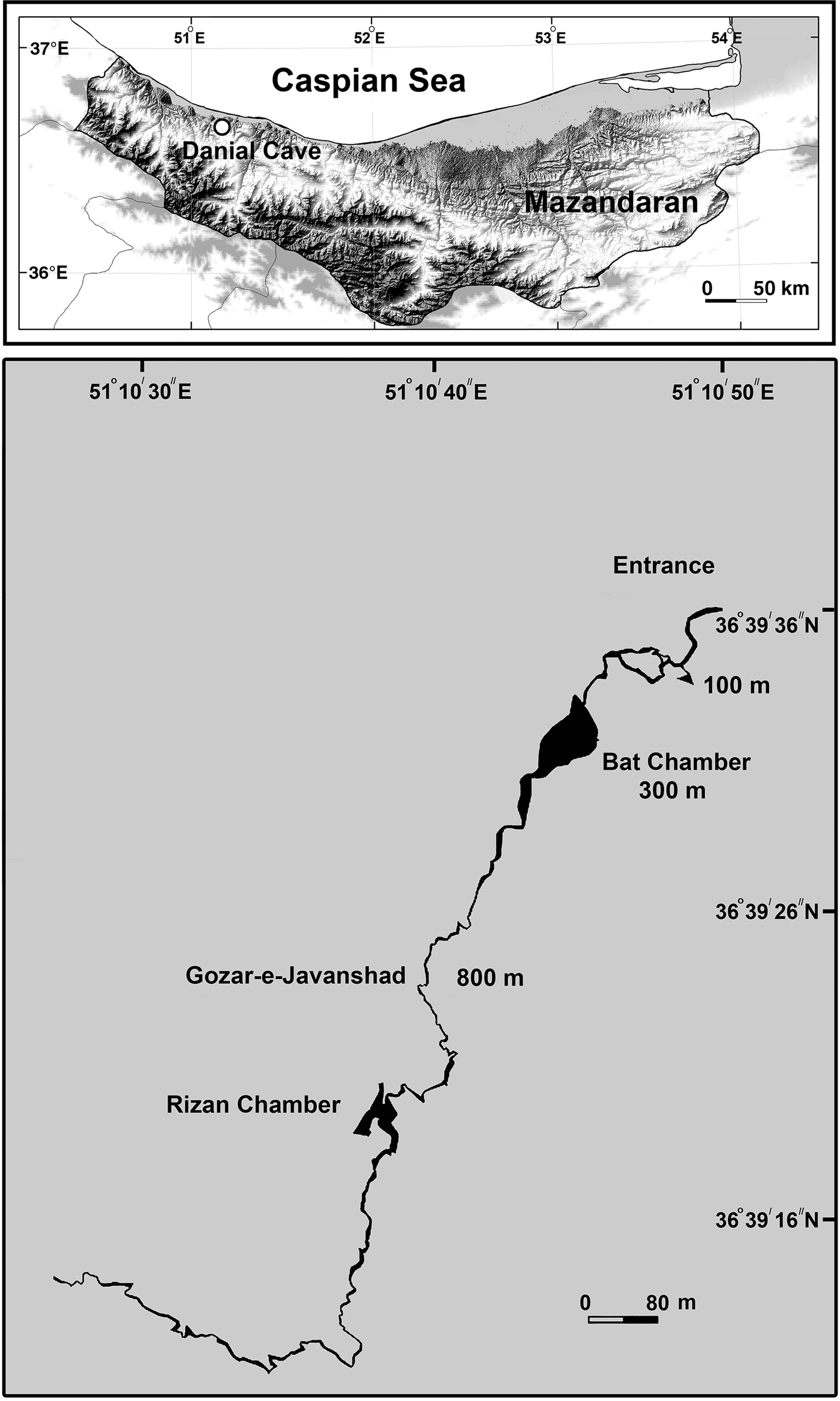
Danial Cave lies near Danial Village, Abbas Abad County, Mazandaran Province in the World Heritage-listed Hyrcanian forests of northern Iran (Fig. 1). It is a 2,158 m long karstic and riverine cave (Ghelich Khani, Reference Ghelich Khani2017; Yusefinia, Reference Yusefinia2017) with two large chambers: Bat Chamber and Rizan Chamber (Fig. 1). We surveyed Danial Cave during July 2013–June 2020. A team of 3–5 speleologists and ecologists searched for vertebrate fauna during each survey along the full length of the cave. We undertook a total of 33 surveys: eight in autumn (October–mid December), seven in winter (December–mid March), 10 in spring (mid March–late June) and eight in summer (early July–late September). We spent c. 4–21 h (mean 8 h) per survey searching for fauna in the cave. We used cameras and handheld flashlights to locate and record fauna during each survey. We identified the fauna species present using field guides (Aulagnier et al., Reference Aulagnier, Haffner, Mitchell-Jones, Moutou and Zima2009; Safaei-Mahroo & Ghaffari, Reference Safaei-Mahroo and Ghaffari2020).
Map of Danial Cave, near Danial Village, Abbas Abad County, Mazandaran Province, northern Iran, based on survey and documentation by S. Brooks and Damavand Mountaineering Club on 18–22 October 2008 (Mohamadifar, Reference Mohamadifar2011).
We recorded four mammalian and two amphibian species (Plate 3 & Table 1): the greater horseshoe bat Rhinolophus ferrumequinum, Blasius's horseshoe bat Rhinolophus blasii, the lesser mouse-eared myotis Myotis blythii, the Hyrcanian field mouse Apodemus hyrcanicus, the Hyrcanian wood frog Rana pseudodalmatina and the Eurasian marsh frog Pelophylax ridibundus (Supplementary Table 1).
Vertebrate fauna of Danial Cave: (a) Hyrcanian field Mouse Apodemus hyrcanicus c. 20 m inside cave, (b1,b2) Hyrcanian wood frog Rana pseudodalmatina c. 50 m inside cave, (c) a colony of the greater horseshoe bat Rhinolophus ferrumequinum in Bat Chamber, with two Blasius's horseshoe bats Rhinolophus blasii (arrows), (d) Blasius's horseshoe bat c. 100 m inside cave, (e) Eurasian marsh frog Pelophylax ridibundus c. 5 m inside cave, (f) greater horseshoe bat Rhinolophus ferrumequinum in Bat Chamber c. 300 m inside cave, and (g) the lesser mouse-eared myotis Myotis blythii c. 70 m inside cave.

Population size, IUCN Red List status (global and regional), whether listed on the Convention on the Conservation of Migratory Species of Wild Animals (CMS), and global/regional importance of the six vertebrate species recorded in Danial Cave, northern Iran (Fig. 1), during 2013–2020 (Ghelich Khani & Faizolahi, Reference Ghelich Khani and Faizolahi2016, Yusefi et al., Reference Yusefi, Faizolahi, Darvish, Safi and Brito2019). None of the six species recorded are listed on the CITES Appendices.

1 LC, Least Concern; NT, Near Threatened; VU, Vulnerable; NE, Not Evaluated.
The first record of the greater horseshoe bat was in the largest chamber (Bat Chamber), with a guano heap noted in September 2013. In autumn and winter, the bats were in hibernation and were recorded most often in cave crevices and corridors 300–400 m from the cave entrance. A breeding colony was present in late March every year, but we did not find any large colonies after October 2013, when we recorded the bat in small colonies, pairs or single individuals (Table 1 & Supplementary Table 1).
The first record of Blasius's horseshoe bat was in Bat Chamber in August 2013, with 1–2 individuals being recorded in each survey during September 2013, January 2014, autumn–winter 2016–2017 and March 2019 (Plate 3).
We recorded the lesser mouse-eared myotis during 2013–2020, in August 2013 (n = 2), September 2013 (n = 2), January 2014 (n = 3), and late September 2015–early March 2016, late September 2016–early March 2017 and March 2019 (one individual on each date and one survey in each month). We recorded a breeding colony of the lesser mouse-eared myotis on 18 June 2020, comprising > 500 individuals.
We recorded the Hyrcanian field mouse inside the cave during three surveys: the first and second records of the species were c. 100 m from the cave entrance on different days in July 2013 and the third record c. 20 m from the cave entrance in September 2013 (Plate 3). We recorded the Hyrcanian wood frog during each survey (1–2 individuals), from the cave entrance to c. 100 m away from the entrance during August 2013–March 2019 (Plate 3 & Supplementary Table 1). We recorded the Eurasian marsh frog during each survey, from the cave entrance to c. 20 m from the entrance, during July 2013–June 2020 (Plate 3 & Supplementary Table 1).
The lesser mouse-eared myotis and the greater horseshoe bat were the most abundant vertebrate species recorded, with our findings suggesting that Danial Cave is an overwintering and breeding site for these species (Table 1). Our surveys provide the first record of Blasius's horseshoe bat in the southern Caspian Sea. Furthermore, the presence of three species of horseshoe bat (our records in Danial Cave and the lesser horseshoe bat Rhinolophus hipposideros near Chalus) in the southern Caspian Sea is unprecedented (Benda et al., Reference Benda, Faizolâhi, Andreas, Obuch, Reiter and Ševčík2012; Ghelich Khani & Faizolahi, Reference Ghelich Khani and Faizolahi2016; Yusefi et al., Reference Yusefi, Faizolahi, Darvish, Safi and Brito2019). We also recorded an individual greater horseshoe bat 1,600 m from the cave entrance in September 2013. It is possible that the cave has an additional entrance that we are unaware of and that the bat had entered from there. In addition, we recorded lost or aborted foetuses of the lesser mouse-eared myotis on the Bat Chamber floor, possibly a result of human disturbance.
The Hyrcanian field mouse has limited presence in Azerbaijan, Iran and Turkmenistan as a subendemic species (Table 1), the Hyrcanian wood frog is endemic to the Hyrcanian forest and the Eurasian marsh frog is the most common amphibian species in Iran. The Hyrcanian field mouse and both these frog species are not cave-dependent but rather use the cave as a temporary habitat. However, the temporary habitat provided by Danial Cave may be just as important to these species as the cave is to fully cave-dependent species. All of the vertebrate species found in the cave are threatened by habitat loss, especially cave destruction and wetland drainage (Table 1).
Discoveries in Danial Cave (Esmaeili-Rineh & Sari, Reference Esmaeili-Rineh and Sari2013) suggest the cave also provides habitat for several endemic invertebrates that could be important for its ecosystem. The unique ecology and endemism of the fauna in the cave indicate the need for its conservation as a national natural monument, as for protected caves elsewhere in Iran. A lack of ecological knowledge has previously hindered the protection of Danial Cave, and our findings will inform conservation approaches to the management of the cave's sensitive fauna. Danial Cave would benefit from mitigation of the effects of increasing tourism, including management and conservation programmes, awareness signage around the entrance, guards, local guides and visitor management processes such as limiting visits during periods when bats are breeding. An action plan for the conservation of Danial Cave is also required.
Acknowledgements
We thank Petr Benda, Kaveh Faizolahi, Seyed Mahmoud Ghasempouri and Bahram Zehzad for species confirmation; Mahmood Soofi for his comments on an earlier version of this text; Taher Shahvari, Shohreh Alidoust, Mehrnaz Taati, Mehdi Rajabpour, Fatemeh Kargar Pishbijari, Aynaz Mashabaouji and Javad Faghih Abdollahi for help with fieldwork; and Saeid Naderi, Asghar Abdoli, Ali Javanshad, Nahid Ahmadi, Mahnaz Nategh Ahmadi and Habib Ghelich Khani for their support. This research received no specific grant from any funding agency or commercial or not-for-profit sectors.
Author contributions
Study design: ATQ; data collection: PG; writing: ATQ, HK.
Conflicts of interest
None.
Ethical standards
This research abided by the Oryx guidelines on ethical standards.


 Open access

