





Introduction
Externalizing behaviors, such as aggression, oppositional behavior, and disobedience, are part of normal child development, but can become problematic when elevated, predicting later emotional distress and academic or social impairments (Campbell et al., Reference Campbell, Shaw and Gilliom2000; Gilliom & Shaw, Reference Gilliom and Shaw2004; Mesman et al., Reference Mesman, Bongers and Koot2001; Scott et al., Reference Scott, Knapp, Henderson and Maughan2001). Parenting is a significant predictor of these behaviors (Duncombe et al., Reference Duncombe, Havighurst, Holland and Frankling2012; Lengua, Reference Lengua2006; Wiggers & Paas, Reference Wiggers and Paas2022). While negative parenting strategies, such as harsh discipline and inconsistent responses, exacerbate externalizing behaviors (Gershoff, Reference Gershoff2002; Harmon-Jones & Allen, Reference Harmon-Jones and Allen1997), positive parenting strategies, including warmth, acceptance, and emotional engagement, have been shown to reduce such behaviors (Dishion et al., Reference Dishion, Shaw, Connell, Gardner, Weaver and Wilson2008; Gardner et al., Reference Gardner, Shaw, Dishion, Burton and Supplee2007). Although extensive research has examined various positive parenting strategies—such as sensitive parenting, parental warmth, and context-sensitive parenting practices—less focus has been placed on the role of mindful parenting in reducing externalizing behaviors. Mindful parenting is defined as the capacity to be present, emotionally regulated, and non-judgmental in interactions with children (Kabat-Zinn, Reference Kabat-Zinn2003), and helps parents regulate their emotions, avoid reactive parenting, and foster constructive responses during challenging situations. Mindful parenting might be especially relevant in families where children exhibit high externalizing behaviors, because cycles of coercive interactions and heightened stress often develop (DuPaul et al., Reference DuPaul, Chunta, Ahn, Morris and Smith2022; Pettit & Bates, Reference Pettit and Bates1989; Rothbaum & Weisz, Reference Rothbaum and Weisz1994; Yan et al., Reference Yan, Ansari and Peng2021). Mindful parenting might disrupt these negative cycles by supporting better emotion regulation, and hence reduce externalizing behaviors (Bögels et al., Reference Bögels, Hoogstad, van Dun, de Schutter and Restifo2008). Studies have shown that mindful parenting is associated with fewer externalizing problems, improved social skills, better emotion regulation, and overall well-being (Burgdorf et al., Reference Burgdorf, Szabó and Abbott2019; Evans et al., Reference Evans, Bhide, Quek, Nicholson, Anderson, Hazell, Mulraney and Sciberras2020; Liu et al., Reference Liu, Calkins and Bell2021; Turpyn & Chaplin, Reference Turpyn and Chaplin2016; Zhang et al., Reference Zhang, Wang and Ying2019). However, it remains unclear whether all children are equally sensitive to these parenting strategies. Understanding individual differences in sensitivity is essential, as not all children may benefit equally from positive parenting approaches.
The Diathesis-Stress Model (Monroe & Simons, Reference Monroe and Simons1991; Zuckerman, Reference Zuckerman1999) offers one perspective, suggesting that certain vulnerability factors increase individuals’ susceptibility to negative outcomes under adverse conditions. However, this model does not address whether these vulnerabilities might also confer advantages in supportive environments, raising questions about whether more sensitive children may respond differently to positive parenting strategies. To better understand these differences, the Environmental Sensitivity Framework (Pluess, Reference Pluess2015) proposes that some individuals are inherently more sensitive to environmental influences than others. This framework integrates several influential models, including Differential Susceptibility, Vantage Sensitivity, Biological Sensitivity to Context, and the Sensory Processing Sensitivity model. The Differential Susceptibility Model (Belsky & Pluess, Reference Belsky and Pluess2009) highlights that sensitive individuals are more reactive to both negative and positive environments, benefiting more from supportive conditions but also being more adversely affected by negative ones. In contrast, the Vantage Sensitivity Model (Pluess & Belsky, Reference Pluess and Belsky2013) highlights that some individuals are particularly responsive to positive experiences, gaining more from favorable circumstances. The Biological Sensitivity to Context Model (Boyce & Ellis, Reference Boyce and Ellis2005) adds a physiological perspective, suggesting that biological factors, such as stress reactivity, shape how sensitive an individual is to environmental influences. Finally, the Sensory Processing Sensitivity Model (Aron et al., Reference Aron, Aron and Jagiellowicz2012) highlights heightened sensory processing as a key aspect of environmental sensitivity, with highly sensitive individuals experiencing and responding more intensely to their environment. Together, these models highlight that children differ in their sensitivity to environmental influences, including parenting strategies like mindful parenting. While some may be more receptive to the benefits of such positive approaches, others may be less affected.
One factor that might make children more sensitive to environmental influences is negative affect. Negative affect—characterized by emotional traits such as fear, sadness, and anger—is increasingly recognized as a key factor within developmental psychology and psychopathology, particularly within the Diathesis-Stress Model (Monroe & Simons, Reference Monroe and Simons1991; Zuckerman, Reference Zuckerman1999) and broader environmental sensitivity frameworks (Pluess, Reference Pluess2015). Traditionally viewed as a vulnerability factor, negative affect heightens an individual’s sensitivity to environmental influences, making children more susceptible to adverse experiences. Yet, contemporary research also highlights a more nuanced role: children who exhibit higher negative affect may possess a heightened sensitivity not only to negative stimuli but also to positive environments, thus potentially benefiting more profoundly from supportive contexts (Hartman et al., Reference Hartman, Belsky and Pluess2023). The critical role of negative affect becomes especially evident during early childhood, a developmental period characterized by rapid emotional and neurological changes (Kochanska et al., Reference Kochanska, Aksan and Joy2007; Rothbart, Reference Rothbart2011; Zhang et al., Reference Zhang, Sayler, Hartman and Belsky2022; van Zeijl et al., Reference van Zeijl, Mesman, Stolk, Alink, van Ijzendoorn, Bakermans-Kranenburg, Juffer and Koot2007). Meta-analytic evidence indeed indicates that from approximately the second year of life onward, children with elevated negative affect demonstrate increased vulnerability to negative parenting behaviors, such as inconsistent discipline, emotional unavailability, or harsh discipline, often resulting in heightened risk for behavioral and emotional difficulties (Slagt et al., Reference Slagt, Dubas, Deković and van Aken2016). However, this heightened sensitivity might simultaneously open developmental pathways through which children may become more receptive to beneficial influences, such as warmth, support, and responsive caregiving (Compas et al., Reference Compas, Jaser, Bettis, Watson, Gruhn, Dunbar, Williams and Thigpen2017; Ugarte et al., Reference Ugarte, Miller, Weissman and Hastings2023). For example, Parent et al. (Reference Parent, McKee, N.R. and Forehand2016) found that mindful parenting significantly reduced externalizing behaviors among preschoolers exhibiting high negative affect, demonstrating its protective and stabilizing potential. Such findings underscore the dual nature of negative affect, which may exacerbate vulnerability under adverse conditions but simultaneously amplify receptivity to positive parenting practices when these conditions are supportive. Thus, negative affect functions not merely as a static vulnerability but as a dynamic trait capable of moderating developmental outcomes.
This adaptive potential of negative affect may be partly attributed to neuroplasticity—the brain’s enduring ability to reorganize neural pathways in response to environmental input—and to children’s continued responsiveness to the quality of caregiving they receive throughout development. Neuroplasticity allows children’s emotional reactivity to remain malleable well beyond early childhood, facilitating positive adaptations through supportive caregiving experiences such as mindful parenting (Masten & Cicchetti, Reference Masten and Cicchetti2016). Therefore, rather than exclusively conceptualizing negative affect as a risk factor, current perspectives emphasize its role as a context-dependent trait that, under mindful and emotionally attuned parenting, may foster resilience and positive developmental outcomes (Bögels et al., Reference Bögels, Hellemans, van Deursen, Römer and van der Meulen2014; Duncan et al., Reference Duncan, Coatsworth and Greenberg2009). Building upon this understanding, a potential neurobiological mechanism facilitating its adaptivity is frontal alpha asymmetry (FAA)—a neural indicator of individual differences in emotional and motivational processing, based on the balance of activity between the brain’s left and right frontal regions (Fortier et al., Reference Fortier, Van Lieshout, Waxman, Boyle, Saigal and Schmidt2014). While negative affective tendencies often appear stable after the second year, FAA-related brain plasticity could support adaptive changes in emotional regulation when moderated by positive postnatal experiences, such as mindful parenting. This highlights the dynamic interaction between early neural predispositions and later environmental inputs in shaping emotional development.
FAA is typically assessed using electroencephalography (EEG) to measure alpha power. Although it is termed ‘frontal’ asymmetry, FAA predominantly reflects asymmetry in the prefrontal cortex, particularly in the dorsolateral prefrontal cortex, which is involved in emotion regulation and executive functioning (Davidson, Reference Davidson2004; Grimshaw & Carmel, Reference Grimshaw and Carmel2014). In EEG, lower alpha power reflects greater underlying neural activity in the respective brain region (Anaya et al., Reference Anaya, Ostlund, LoBue, Buss and Pérez-Edgar2021; Howarth et al., Reference Howarth, Fettig, Curby and Bell2016; Marshall et al., Reference Marshall, Bar-Haim and Fox2002; Marshall & Fox, Reference Marshall and Fox2007; Vincent et al., Reference Vincent, Xie and Nelson2021). FAA scores are calculated as the difference between right and left alpha activity over the frontal regions, as measured with electroencephalography (FAA = right alpha power minus left alpha power). FAA scores are interpretated along a continuum, with positive scores indicating greater left-sided FAA and negative scores indicating greater right-sided FAA (Smith et al., Reference Smith, Reznik, Stewart and Allen2017; van de Ven et al., Reference van de Ven, van den Heuvel, Bhogal, Lewis and Thomason2020). Greater left-sided FAA is typically associated with approach motivation, positive affect, and social engagement, whereas greater right-sided FAA is linked to withdrawal tendencies and negative affect (Davidson & Fox, Reference Davidson and Fox1982; Davidson, Reference Davidson1992; Harmon-Jones et al., Reference Harmon-Jones, Gable and Peterson2010; Sutton & Davidson, Reference Sutton and Davidson1997). However, these associations are context-dependent and not inherently adaptive or maladaptive. For instance, excessive left-sided FAA has been associated with heighted reactivity to both positive and negative influences, suggesting that FAA’s influence may vary depending on broader social and emotional contexts (Ellis et al., Reference Ellis, Kinzel, Salgari and Loo2017; Hale et al., Reference Hale, Smalley, Hanada, Macion, McCracken, McGough and Loo2009; Harmon-Jones & Gable, Reference Harmon-Jones and Gable2018; Harmon-Jones et al., Reference Harmon-Jones, Gable and Peterson2010; Keune et al., Reference Keune, van der Heiden, Várkuti, Konicar, Veit and Birbaumer2012).
Empirical research supports this context-dependency. Lopez-Duran et al. (Reference Lopez-Duran, Nusslock, George and Kovacs2012) found that FAA moderated the relationship between stressful life events and internalizing symptoms in children at familial risk for depression. Specifically, greater right frontal activation was observed in high-risk children during emotional tasks, while greater left frontal activation appeared to buffer the negative effects of stress, reducing the risk of developing internalizing symptoms (Lopez-Duran et al., Reference Lopez-Duran, Nusslock, George and Kovacs2012). Similarly, Mulligan et al. (Reference Mulligan, Palopoli, van den Heuvel, Thomason and Trentacosta2022) demonstrated that FAA in response to a stressor moderated the relationship between parenting hassles and child externalizing problems. Greater left-sided FAA during a frustration-inducing task was associated with increased externalizing behaviors in children experiencing higher levels of parenting hassles, while this association was absent in children with right-sided FAA. These findings highlight stress-induced FAA as a neural marker of susceptibility to environmental stressors. FAA has thus gained attention as a neural indicator of environmental sensitivity, suggesting that individual differences in FAA patterns may moderate how children respond to environmental influences (van de Ven et al., Reference van de Ven, van den Heuvel, Bhogal, Lewis and Thomason2020). Importantly, while meta-analytic and review evidence indicate no consistent direct link between FAA and externalizing behavior (Peltola et al., Reference Peltola, Bakermans-Kranenburg, Alink, Huffmeijer, Biro and van IJzendoorn2014; Reznik & Allen, Reference Reznik and Allen2018), research suggests that FAA moderates environmental effects, aligning with both the Diathesis-Stress Model and the Environmental Sensitivity Framework. For instance, children with high negative affect and greater left-sided FAA exhibit heightened reactivity to adverse environments, consistent with the Diathesis-Stress Model (Liu et al., Reference Liu, Calkins and Bell2021). Conversely, these same children may show greater developmental benefits when exposed to positive parenting, aligning with the Environmental Sensitivity Framework (Fortier et al., Reference Fortier, Van Lieshout, Waxman, Boyle, Saigal and Schmidt2014; Mulligan et al., Reference Mulligan, Palopoli, van den Heuvel, Thomason and Trentacosta2022). In conclusion, FAA’s role is inherently context-dependent, emphasizing that understanding its influence requires considering both neural patterns and environmental conditions. This perspective aligns with theoretical models that recognize variability in susceptibility to environmental experiences, highlighting FAA’s relevance in developmental psychopathology research.
This present study examines whether child frontal alpha asymmetry moderates the associations between negative affect and mindful parenting in predicting externalizing behavior. As a first step, we aimed to replicate the negative association between mindful parenting and child externalizing problems, hypothesizing that higher levels of mindful parenting will be associated with lower levels of externalizing problems in children. To strengthen existing research, we examined both maternal and partner-reported mindful parenting, as research on partner-reported mindfulness remains scarce. Throughout the paper, the term ‘partner’ is used to ensure inclusivity, as our sample included two same-sex female couples where the non-birthing parent identified as a woman. Second, we hypothesized that child negative affect would moderate the association between mindful parenting and child externalizing problems, such that children with higher negative affect would be more reactive to variations in parenting quality. Finally, a three-way interaction model tests whether children with greater left-sided FAA and high negative affect are most sensitive to levels of mindful parenting, aligning with the Environmental Sensitivity Framework. This approach investigates whether FAA serves as a neurobiological moderator that influences how mindful parenting affects children with temperamental differences in negative affectivity. By testing a three-way interaction, we provide a nuanced understanding of how negative affect and FAA jointly moderate children’s sensitivity to environmental influences.
Methods
Participants and study design
Data for this study were drawn from the longitudinal pregnancy cohort study Prenatal Early Life Stress (PELS) (e.g., van den Heuvel et al., Reference van den Heuvel, Donkers, Winkler, Otte and Van den Bergh2014). Families were recruited between the 9th–15th week of gestation (n = 178) or the 16th–23rd week of gestation (n = 12) through hospital visits during pregnancy at St Elisabeth Hospital and through four midwife practices in Tilburg and surrounding areas, The Netherlands. The mothers, their partners, and their children were followed during pregnancy and the postpartum period, and they continued to be followed. This study uses data from the follow-up wave when the children were 4 years old. Mothers and their partners (if involved) provided informed consent before participating. Most partners were fathers; two families consisted of two mothers.
In total, 190 pregnant women and their families were included in the cohort. Families dropped out for various reasons, including loss to follow-up, only wanting to participate during infancy, moving away, or their child having a (severe) handicap or passing away. At the 4-year follow-up, around the child’s 4th birthday, 128 mothers and 103 partners completed questionnaires. Of these, 107 children visited the lab with their parent(s), and EEG data were obtained from 100 children. One child was excluded due to cortical visual impairment, and four others were excluded due to non-compliance with task instructions (e.g., not paying attention or talking too much during the task), resulting in a final sample of 95 cases with usable EEG data.
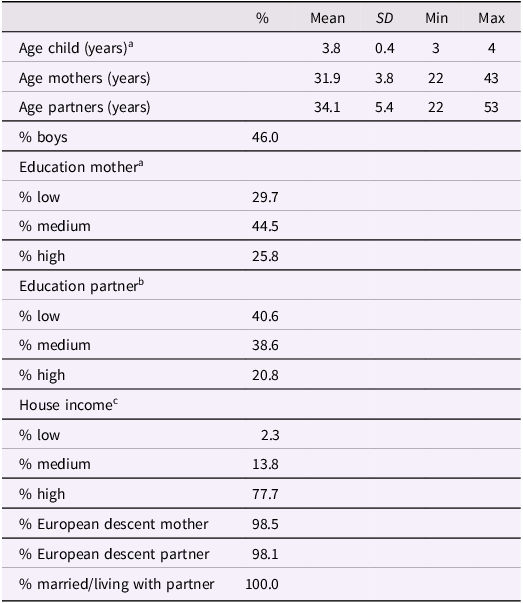
At study enrollment, 46% of the children were boys; 29.7% of mothers (and 40.6% of partners) had no more than a high school education; 16.1% of families had a low to medium income (≤ €3,600 monthly); and 1,5% of mothers and 1,9% of partners were of non-European descent (e.g., Moroccan, Turkish) (see Table 1).
Sociodemographic information at baseline reported by mothers (n = 128) and partners (n = 103)

Note.
a Mean age at EEG recording;
b low = completed high school or general vocational training; medium = completed higher vocational training; high = completed university or postgraduate qualification;
c low = ≤ €2.100; medium = € 2.200–€ 3.600; high = > €3.600.
Procedure
When the children were 4 years old, they participated in a 2-hour session in the lab that included behavioral testing and EEG measurements. The visit took place at the Baby Lab at Tilburg University, The Netherlands. For the current study, the EEG resting-state measurement was used. Both mothers and their partners completed three questionnaires at home about their child’s behavior and development, as well as their own emotions and parenting skills. These questionnaires were answered online via Qualtrics software. The original study was approved by the medical ethics committee of St Elisabeth Hospital, Tilburg, The Netherlands, and was conducted in full compliance with the Helsinki Declaration. The 4-year follow-up was approved by the Ethical Review Board of Tilburg University, The Netherlands.
Measures
Mindful parenting
Mindful parenting was assessed using the validated Dutch version of the Interpersonal Mindfulness in Parenting Scale (IM-P-NL) (de Bruin et al., Reference de Bruin, Zijlstra, Geurtzen, van Zundert, van de Weijer-Bergsma, Hartman, Nieuwesteeg, Duncan and Bögels2014). The IM-P-NL consists of 29 items, such as “I respond patiently to my child, even when I am frustrated” (1 = never true, 5 = always true). We calculated total IM-P-NL sum scores, with higher scores reflecting more mindfulness in parenting. Cronbach’s alpha was α = 0.85 for mothers and α = 0.84 for partners.
Child negative affect
To measure negative affect, mothers and their partners completed the Child Behavior Questionnaire – Very Short Form (Putnam & Rothbart, Reference Putnam and Rothbart2006), each providing ratings of their child’s negative affect. We used the “negative affect/emotionality subscale”, which consists of 12 items assessing the frequency of negative feelings and difficulty being soothed, using a 7-point Likert scale (1 = extremely untrue of your child to 7 = extremely true of your child). Higher scores indicate a more negative affect. Example items include: “Has temper tantrums when (s)he doesn’t get what (s)he wants” and “Gets mad when even mildly criticized.” Internal consistency was modest (α = .67 for mothers and α = .68 for partners), but within an acceptable range for research in young children.
Child externalizing behavior
Externalizing behavior was assessed based on reports from mothers and partners using the Child Behavior Checklist (CBCL 1.5-5) (Achenbach, Reference Achenbach1991), which includes 100 items across several subscales. The Externalizing domain is an aggregate measure of behavioral problems, including Attention Problems and Aggressive Behavior, measured on a 3-point Likert scale (1 = not true to 3 = very true). Higher scores reflect more externalizing behavior. Example items include: “Can’t stand waiting, wants everything now” and “Destroys things belonging to his/her family or other children.” Cronbach’s alphas were α = 0.87 for both mothers and partners.
Child frontal alpha asymmetry (FAA)
To assess frontal alpha asymmetry, resting EEG was recorded using a 64-electrode array with BioSemi ActiveTwo amplifiers and a sampling rate of 512 Hz. Electrodes were placed according to the international 10–20 system, referenced using the standard BioSemi CMS-DRL configuration. Additional electrodes were placed on the left and right mastoids. Resting-state EEG was recorded while the child passively watched a silent animation video from a popular Dutch television program (“Het Zandkasteel”) at a viewing distance of about 60 cm. The video lasted up to 3 minutes but was stopped earlier if the child became distracted. All recordings were reviewed to exclude datasets in which children moved excessively or spoke during most of the task. The remaining EEG datasets were processed using Brain Vision Analyzer 2 (Brain Products, Munich, Germany). A 50 Hz notch filter and a 0.1–30 Hz bandpass were applied. Ocular and muscle artifacts were removed using Independent Components Analysis, with components corresponding to blinks and eye movements identified and excluded. Data from two frontal electrodes—F3 (left frontal) and F4 (right frontal)—were extracted and segmented into two-second epochs with 50% overlap. Epochs were automatically rejected if they met any of the following criteria: voltage changes exceeding 200 μV within 200 ms, voltage steps greater than 75 μV, or activity below 0.2 μV for more than 100 ms. The remaining segments were subjected to Fast Fourier Transform to obtain spectral power. Mean alpha power was computed in the 6–9 Hz frequency range at electrodes F3 and F4, which is appropriate for children of this age due to developmental shifts in the alpha rhythm (Marshall et al., Reference Marshall, Bar-Haim and Fox2002; Marshall & Fox, Reference Marshall and Fox2004). Power values tend to be positively skewed and were therefore log-transformed (Allen et al., Reference Allen, Coan and Nazarian2004). FAA was calculated using a normalized asymmetry formula: (F4log− F3 log) / (F4log + F3log). This approach, used in prior developmental studies (Vincent et al., Reference Vincent, Xie and Nelson2021; van de Ven et al., Reference van de Ven, van den Heuvel, Bhogal, Lewis and Thomason2020), accounts for individual differences in overall alpha power magnitude and yields a relative index of asymmetry. An FAA score of zero reflects symmetrical activity across hemispheres, positive scores indicate greater left-sided FAA (approach orientation), and negative scores indicate greater right-sided FAA (withdrawal orientation).
Covariates
Potential covariates included in this study were child sex, family income, ethnicity, and maternal and partner educational level. These variables were selected based on their well-established theoretical and empirical associations with externalizing problems and child behavioral functioning, as demonstrated in previous research (Bradley & Corwyn, Reference Bradley and Corwyn2002; Crick & Zahn-Waxler, Reference Crick and Zahn-Waxler2003; Dearing et al., Reference Dearing, McCartney and Taylor2006). Child sex was obtained from birth records, while family income, maternal and partner education, and ethnicity were reported by mothers and partners during pregnancy. Educational level was categorized as high (university or postgraduate qualification), medium (high vocational training), and low (vocational training or less). Ethnicity was classified as either European or non-European decent. Family income was categorized as follows: low (≤ €2,100), medium (€2,200–€3,600), and high (> €3,600). Based on exploratory analyses, we selected family income as a covariate in the two-way interaction analysis of partners, as it was significantly correlated with partner-reported negative affect, ρ(127) = −.25, p = .015. Pearson correlations were used for continuous variables, and Spearman correlations were applied for ordinal variables, such as family income. Other potential covariates were inspected but not included in analyses since they were not significantly correlated with the study variables.
Analytic procedure
Multiple Regression Analyses were conducted in Mplus version 8.2 (Muthén & Muthén, Reference Muthén and Muthén1998–2017). In the initial two-way interaction model, we included the main effects of mindful parenting and child negative affect, as well as the interaction term Mindful parenting × Child negative affect for both mothers and their partners. To extend this analysis, a three-way interaction model was implemented, incorporating additional variables: Child FAA, Mindful parenting × Child FAA, Child negative affect × Child FAA, and the three-way interaction term Mindful parenting × Child negative affect × Child FAA. Variables were centered to reduce multicollinearity and enhance interpretability by making the main effects more meaningful and easier to interpret in the context of interaction terms (Lacobucci et al., Reference Lacobucci, Schneider, Popovich and Bakamitsos2017). Model fit is considered good if the root mean square error of approximation (RMSEA) is < .08 and mediocre if < .10. Comparative fit index (CFI) values should be > .90 (Hu & Bentler, Reference Hu and Bentler1999). Wald Chi-Square was used to assess whether individual regression coefficients (slopes) of variables/groups in the same linear regression model were significantly different from each other (Liao, Reference Liao2004). Data were collected from 128 mothers, 103 partners, and 95 children with usable EEG data. To handle missing data, Full Information Maximum Likelihood (FIML) in Mplus was applied, allowing all available data to contribute to the analyses without the need for imputing missing values (Enders & Bandalos, Reference Enders and Bandalos2001). FIML estimates model parameters using all observed data, reducing bias and maintaining statistical power. Consequently, analyses were conducted using the full maternal (n = 128), partner (n = 103) and EEG (n = 95) samples. involving mothers included data from 128 participants, partner analyses were based on 103 participants, and EEG analyses included the 95 children with usable data.
Results
Descriptive statistics and correlations
Means, standard deviations and correlations among model variables are illustrated in Table 2. Child FAA was not significantly correlated with any measurement, whereas mother- and partner-reported child negative affect was significantly correlated with each other (r = .45, p < .001), with mother-reported externalizing behavior (r = .23, p < .01 and r = .33, p = .001, respectively), and with partner-reported externalizing behavior (r = .33, p = .001 and r = .45 p < .001, respectively). Also, mother- and partner-reported child externalizing behavior was significantly correlated (r =.62, p < .001).
Statical measures and correlations between mother mindful parenting, partner mindful parenting, child frontal asymmetry and child externalizing behavior reported by mothers (n = 128) and partners (n = 103)
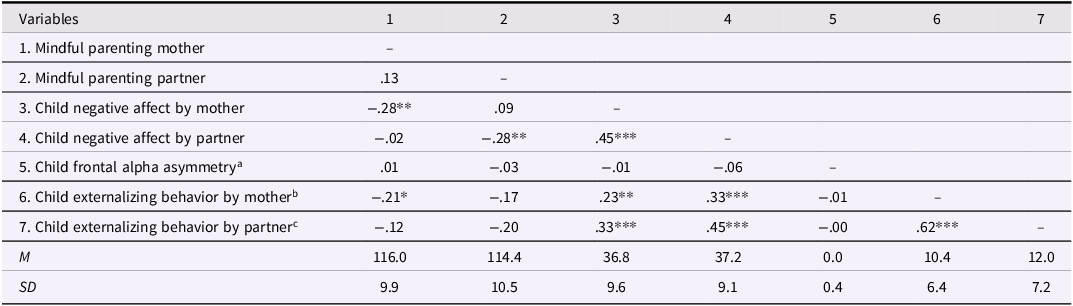
Note.
a Higher frontal alpha asymmetry scores indicate relative greater left frontal brain activity;
b The prevalence of externalizing scores in clinical range is 4.7%;
c The prevalence of externalizing scores in clinical range is 6.9%. *p < .05 **p < .01 ***p ≤ .001.
To assess whether combining mother and father reports into unified latent factors was methodologically sound, we conducted a follow-up analysis in Mplus. However, the model showed significant estimation issues—non-convergence, negative residual variances, and poor fit (CFI = 0.129, TLI = 0.000, RMSEA = 0.211, SRMR = 0.157)—likely due to low or negative correlations between parent reports (mindful parenting: r = −0.20, p = .059; negative affect: r = −0.28, p = .001; externalizing behavior: r = −0.08, p = .007). These findings indicated insufficient shared variance to support unified latent constructs. Given these constraints, we conducted separate analyses for mothers and fathers, ensuring valid model estimation and better reflecting the distinct contributions of each parent.
Mindful parenting × Child temperament effects
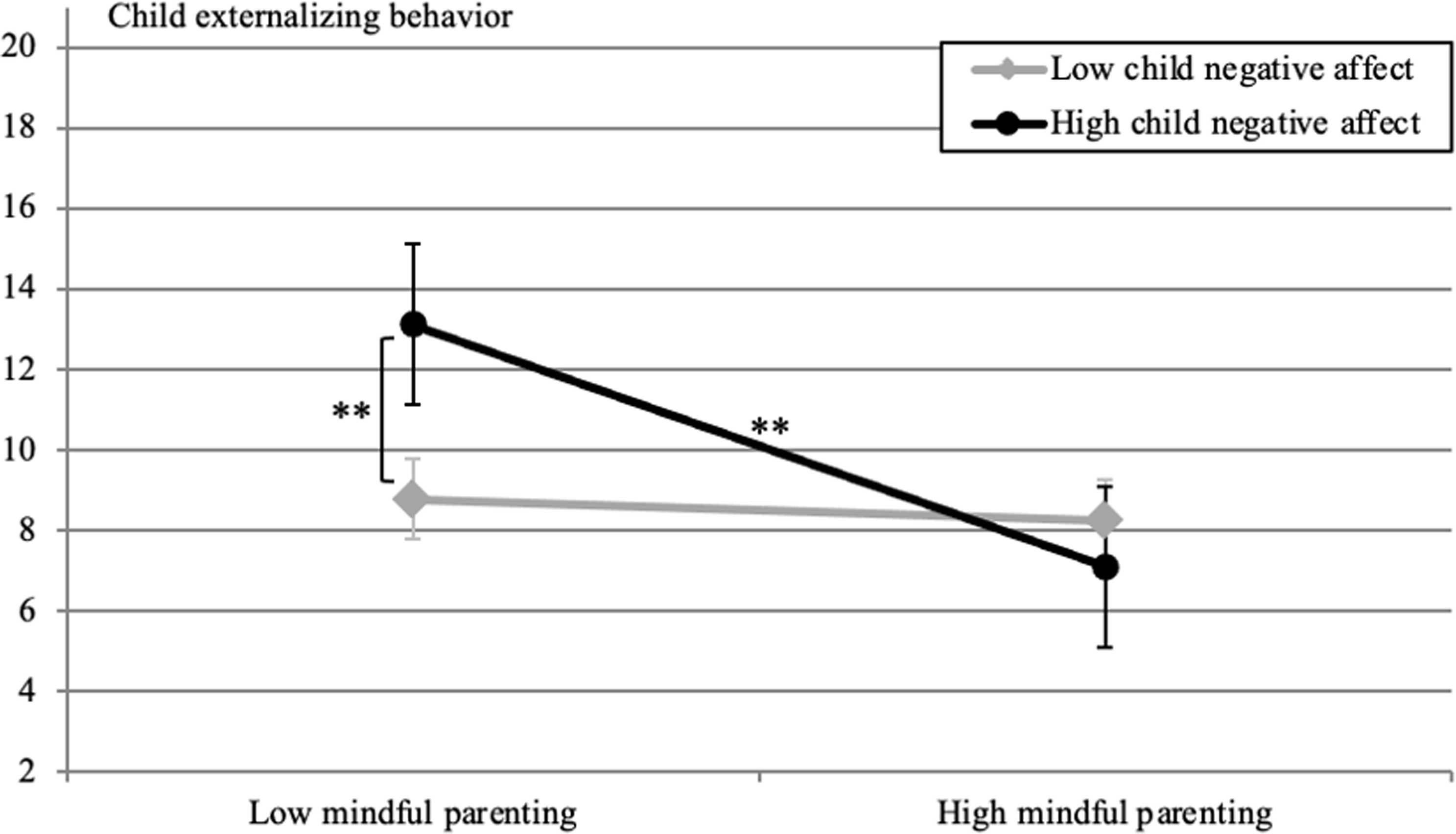
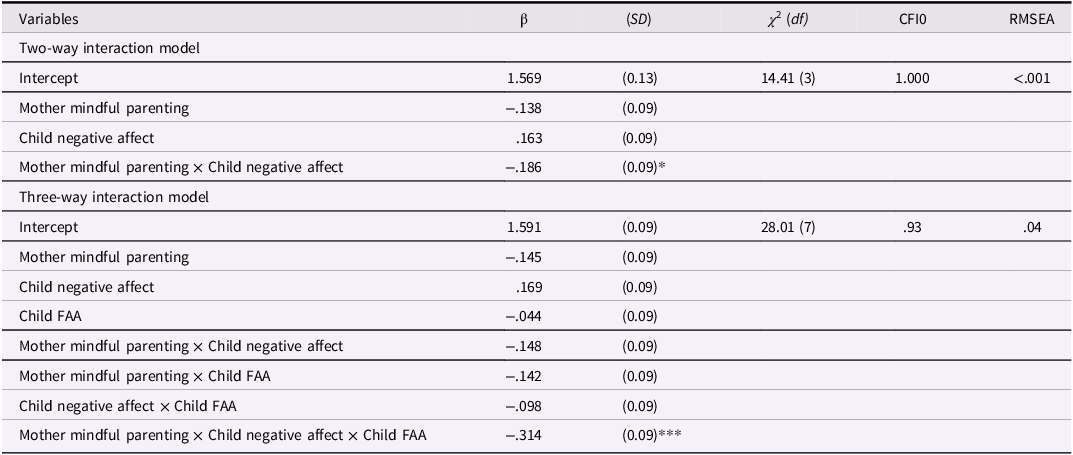
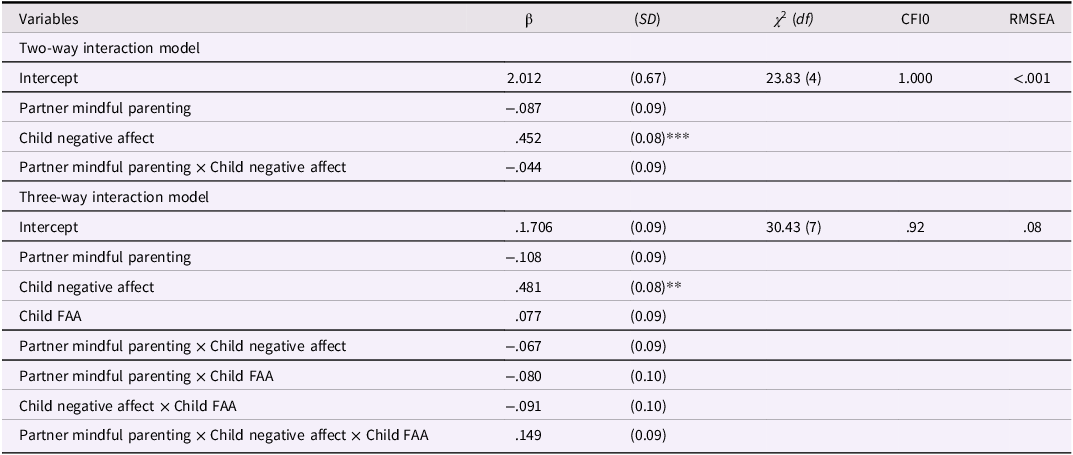
The interactions between mindful parenting and child temperament are illustrated in Tables 3 (mothers) and 4 (partners). The two-way interaction proved significant for mothers (β = −.186, p = .03; χ 2 [df = 3, n = 128] = 14.41, CFI = 1.00, RMSEA < .001), but not for partners (β = −.044, p = .63; χ 2 [df = 4, n = 103] = 23.83, CFI = 1.00, RMSEA < .001).This indicates that the relationship between mother-reported mindful parenting and externalizing behavior was moderated by child negative affect (see Figure 1). A Wald chi-squared test showed that children with high negative affect (+1 SD) exhibited significantly more externalizing behavior than those with low negative affect (−1 SD) (Wald χ2 (1) = 7.39, p = 0.007), in cases of low mindful parenting. Furthermore, only for children with high negative affect did mindful parenting make a difference, as high levels of mindful parenting reduced their externalizing problems. (Wald χ2 (1) = 12.65, p = 0.002). All other groups did not show significant differences. It is important to note that the groupings presented in the Figures were created solely to enhance clarity and interpretability. These groupings do not affect the statistical outcomes of the study, as Mplus compares estimates at specific values rather than forming discrete groups. In the partners’ analysis, a main effect of negative effect was found (β = .452, p < .001), indicating that those children who scored higher on negative affect exhibited more externalizing problems.
Mother-reported externalizing behavior for low mindful and high mindful parenting (−1 SD versus + 1 SD) and children with low or high negative affect (−1 SD versus + 1 SD); *p < .05 **p < .01 ***p < .001. Note. Groupings were created solely to improve clarity and interpretability, without affecting statistical outcomes.

Interactions between mindful parenting, child negative affect and child fontal asymmetry and on externalizing problem behavior rated by mothers (n = 128)

Note. β = standardized slope coefficient; SD = standard deviation; df = degree of freedom; CFI = comparative fit index; RMSEA = root mean square error of approximation; FAA = Frontal Alpha Asymmetry; *p < .05 **p < .01 ***p < .001.
Interactions between mindful parenting, child negative affect and child fontal asymmetry and on externalizing problem behavior rated by partners (n = 103)

Note. β = standardized slope coefficient; SD = standard deviation; df = degree of freedom; CFI = comparative fit index; RMSEA = root mean square error of approximation; FAA = Frontal Alpha Asymmetry; *p < .05 **p < .01 ***p < .001.
Mindful parenting × Child temperament × Child FAA effects
To assess whether including child frontal alpha asymmetry (FAA) improved overall model fit, we compared a two-way interaction model (mindful parenting × negative affect) with a more complex three-way interaction model (mindful parenting × negative affect × FAA) for both mothers and partners. In the maternal model, the two-way interaction model demonstrated good fit (χ2 [df = 3, n = 128] = 14.41, CFI = 1.00, RMSEA < .001), while the three-way interaction model showed acceptable fit (χ2 [df = 7, n = 128] = 28.01, CFI = .93, RMSEA = .04). Although the χ2 difference test indicated that the inclusion of the three-way interaction significantly improved model fit (Δχ2 [df = 4] = 13.60, p = .009), we acknowledge that such tests are more appropriate within structural equation modeling frameworks. Therefore, we also conducted a hierarchical regression analysis to examine whether the three-way model added explanatory power over the two-way model. This analysis revealed a significant increase in explained variance, ΔR2 = .07, F(4, 120) = 2.96, p = .023. Moreover, model comparison using the Akaike Information Criterion (AIC) and Bayesian Information Criterion (BIC) supported the inclusion of the three-way interaction, with lower AIC (4715.60 vs. 4433.53), BIC (4791.33 vs. 4491.03), and sample-size adjusted BIC (4709.08 vs. 4427.77) values for the three-way model compared to the two-way model. These results suggest that, despite its greater complexity, the three-way model provided a better balance between fit and parsimony. Furthermore, the three-way model explained more variance in externalizing behavior (R2 = .29) than the two-way model (R2 = .22), further supporting the added explanatory value of FAA as a moderator. Together, these findings indicate that the inclusion of FAA significantly contributed to the explanatory power of the maternal model, justifying the added model complexity. In the partner model, the three-way interaction model demonstrated poorer fit (χ2 [df = 7, n = 103] = 30.43, CFI = .92, RMSEA = .08) than the corresponding two-way interaction model (χ2 [df = 4, n = 103] = 23.83, CFI = 1.00, RMSEA < .001), indicating that adding FAA did not improve model fit for partner-reported data. This pattern was further supported by model comparison criteria: the two-way interaction model showed lower values on the Akaike Information Criterion (AIC = 3591.48 vs. 3840.66), Bayesian Information Criterion (BIC = 3649.29 vs. 3916.58), and sample-size adjusted BIC (3586.02 vs. 3834.33) compared to the three-way interaction model. To further examine the added value of FAA, we conducted a hierarchical regression analysis comparing the two- and three-way interaction models. This analysis revealed a modest increase in explained variance (ΔR2 = .07); however, the change did not reach statistical significance, F(4, 95) = 2.34, p = .060. These results suggest that the additional complexity introduced by FAA did not meaningfully improve model performance or explanatory power in the partner model. The three-way interaction proved significant in predicting mother-reported externalizing behavior (β = −.314, p = < .001), but not partner-reported externalizing behavior (β = .149, p = .11). A subsequent z-test confirmed that the difference in interaction effects between maternal and partner reports was statistically significant (Z = −3.64, p < .001), indicating that the moderation effect was specific to maternal reports. This indicates that the relationship between mother-reported mindful parenting and externalizing behavior was moderated by child negative affect and child FAA (see Figure 2). A Wald chi-squared showed that children with high negative affect (+1 SD) and greater left-sided FAA (+1 SD) exhibited more externalizing behavior under low mindful parenting and less under high mindful parenting (Wald χ2 (1) = 22.07, p < 0.001), compared to those with high negative affect and greater right-sided FAA exposed to low (Wald χ2 (1) = 5.15, p = 0.02) or high mindful parenting (Wald χ2 (1) = 5.18, p = 0.02). Planned comparisons showed that there were no further significant differences between groups. As a reminder, the groupings in the Figures were included solely to enhance their clarity and interpretability, without affecting the statistical outcomes. The interactions remained significant when family income was included as a covariate, in both the two-way interaction (β = −.195, p = .02; χ 2 [df = 4, n = 128] = 15.97, CFI = 1.00, RMSEA < .001) and three-way interaction (β = −.314, p = .02; χ 2 [df = 8, n = 128] = 15.97, CFI = .92, RMSEA = .04), as an additional check based on exploratory analysis, which had already identified family income as a relevant variable in the partner data.
Mother-reported externalizing behavior for low mindful parenting and high mindful (−1 SD versus + 1 SD), children with low or high negative affect (−1 SD versus + 1 SD) and children with left- or right-sided frontal alpha asymmetry (+1 SD versus −1 SD); *p < .05 **p < .01 ***p < .001. Note. Groupings were created solely to improve clarity and interpretability, without affecting statistical outcomes.

Sensitivity analyses
To evaluate the robustness and interpretation of the three-way interaction, we conducted two additional analyses, both of which supported our main findings. First, we calculated the Proportion of Interaction (PoI; Roisman et al., Reference Roisman, Newman, Fraley, Haltigan, Groh and Haydon2012), which yielded a value of 0.63—slightly above the typical differential susceptibility range of 0.40 to 0.60—suggesting that children with high negative affect and greater left-sided FAA experienced relatively stronger benefits under high mindful parenting than adverse effects under low parenting. A PoI around 0.50 reflects Differential Susceptibility, whereas values near 0.00 or 1.00 indicate Diathesis-Stress or Vantage Sensitivity patterns, respectively (Del Giudice, Reference Del Giudice2017; Roisman et al., Reference Roisman, Newman, Fraley, Haltigan, Groh and Haydon2012). Second, we applied a person-oriented approach using K-means clustering to identify distinct neuro-affective profiles. In line with the framework of Bergman and Magnusson (Reference Bergman and Magnusson1997), this approach focuses on patterns of individual differences rather than average effects. The analysis confirmed that children with high negative affect and left-sided FAA were particularly responsive to variations in parenting quality. Together, these complementary procedures strengthen the interpretation of the three-way interaction. Full methodological details and visualizations are available in the Supplementary Material (see Supplementary Figure S1 and S2).
Discussion
In this study, we examined whether child negative affect and child FAA moderated the effect of mindful parenting on externalizing behavior in 4-year-olds. We hypothesized that children with high negative affect would be more vulnerable to low mindful parenting, leading to more externalizing problems, consistent with the diathesis-stress model. We also explored whether child negative affect and greater left-sided FAA interacted, amplifying or modulating the effects of mindful parenting.
The results showed that high negative affect combined with low mindful parenting predicted higher levels of mother-reported externalizing behavior (not partners’), supporting the diathesis-stress framework (Monroe & Simons, Reference Monroe and Simons1991; Zuckerman, Reference Zuckerman1999). Notably, the prevalence of externalizing scores in the clinical range, as reported by mothers and partners, was relatively low at 4.7% and 4.4%, respectively (Tick et al., Reference Tick, van der Ende and Verhulst2007). While low mindful parenting involves emotional disengagement rather than the punitive control characteristic of harsh parenting, both negatively impact children by failing to provide emotional support, which can lead to increased externalizing behaviors and strained parent-child relationships, particularly when there is high negative affect. This effect may arise because mindful parenting helps children regulate emotions by constructively addressing negative feelings, thereby reducing the risk of externalizing behaviors (Eisenberg et al., Reference Eisenberg, Zhou, Spinrad, Valiente, Fabes and Liew2005). Consequently, children with high negative affect are more prone to externalizing behaviors under low mindful parenting. This is consistent with Slagt et al.’s (2016) meta-analysis, which identified negative affect as a vulnerability factor after 12 months of age. These findings also align with Hartman and Belsky’s (Reference Hartman, Belsky and Pluess2023) application of the broader theory of prenatal programming (Barker, 1990, 2004; Hanson & Gluckman, Reference Hanson and Gluckman2015) to the environmental sensitivity framework. Their work suggests that early—including prenatal—environmental cues may shape children’s sensitivity to later caregiving contexts. This is consistent with our results showing that neural sensitivity (FAA) and temperament interact to predict differential responses to parenting.
To conceptually extend our findings and situate them within broader prenatal programming theories (Barker, Reference Barker1990, Reference Barker2004; Hanson & Gluckman, Reference Hanson and Gluckman2015), we draw on additional insights from the PELS cohort (e.g., van den Heuvel et al., Reference van den Heuvel, Donkers, Winkler, Otte and Van den Bergh2014), which was also used in the current study. In doing so, we build on Hartman and Belsky’s (Reference Hartman, Belsky and Pluess2023) application of these theories to the development of environmental sensitivity, illustrating how early environmental influences may contribute to individual differences in child sensitivity. A key strength of the PELS cohort is its longitudinal design, which offers valuable opportunities to identify early indicators of environmental sensitivity across development. In line with prenatal programming theories, preliminary results from the PELS cohort indicate that early maternal stress and lower prenatal attachment affect are associated with heightened negative affect in infancy (van den Heuvel et al., Reference van den Heuvel, Johannes, Henrichs and Van den Bergh2015). Specifically, our data suggest that infants exposed to elevated prenatal stress levels demonstrated greater emotional reactivity and reduced regulatory capacity in early development, aligning with patterns described in a recent review (Van den Bergh et al., Reference Van den Bergh, Antonelli and Stein2024). Importantly, such early vulnerability marker may also reflect adaptive sensitivity, potentially laying the groundwork for heightened environmental responsiveness later in childhood. This developmental process may be moderated by neurobiological mechanisms such as child FAA, underscoring the dynamic interplay between early neural predispositions and postnatal environmental factors in influencing emotional development.
Building on these findings, we further examined whether the interaction between negative affect and mindful parenting was moderated by child FAA, consistent with the environmental sensitivity framework. The three-way interaction between mindful parenting, child negative affect, and child FAA aligns with the environmental sensitivity framework, (Pluess, Reference Pluess2015), suggesting that children with high negative affect and greater left-sided FAA are particularly responsive to the quality of mindful parenting as reported by mothers. These children exhibited greater externalizing behavior when mindful parenting was low but fewer externalizing problems when mindful parenting was high. Sensitivity analyses supported this interpretation: while the Wald chi-squared comparisons clarified differences across FAA levels, a Proportion of Interaction (PoI) value of 0.63 indicated heightened sensitivity to both adverse and supportive environments, consistent with a differential susceptibility pattern. This finding also aligns with the integrated model proposed by Ellis et al. (Reference Ellis, Sheridan, Belsky and McLaughlin2022), which posits that caregiving experiences interact with individual neurobiological and temperamental factors to influence behavioral outcome. Specifically, the combination of high negative affect and greater left-sided FAA in this study mirrors their model, illustrating how differences in environmental sensitivity may arise from neural and affective mechanisms that influence children’s responses to both adversity and support (Ellis et al., Reference Ellis, Sheridan, Belsky and McLaughlin2022).
Research suggests that mothers and fathers emphasize different aspects of their child’s behavior (Brown et al., Reference Brown, McBride, Bost and Shin2011; Solmeyer & Feinberg, Reference Solmeyer and Feinberg2011), which may influence how externalizing behaviors are reported. Although no significant differences in mindful parenting levels were found between mothers and partners, prior research suggests that mothers, as more common primary caregivers, may be more attuned to subtle shifts in emotional regulation, while partners may observe externalizing behaviors in different contexts, such as play or structured activities. Additionally, mothers may engage more actively in emotion regulation strategies, shaping how mindful parenting affects child behavior. Although the overall level of mindful parenting appeared similar between parents, the mechanisms through which it influences children may differ. Future research should further investigate how different caregiving roles may moderate the effects of mindful parenting on child behavior. It might also be that we had insufficient power to detect partner effects (see under limitations). Larger samples are therefore also needed to determine whether the absence of effects in the partner-reported data reflects methodological constraints, genuine differences in parental influences, or whether the significant effects observed in the mother-reported data represent a reliable finding rather than a false positive. Notably, in the present study, this pattern was specific to maternal reports, as confirmed by a statistically significant difference in the interaction effects across reporters. To further support and interpret our main findings, we conducted an exploratory, person-centered analysis using K-means clustering to identify meaningful neuro-affective profiles. This approach was used to examine whether combinations of negative affect and frontal alpha asymmetry (FAA) reflect distinct patterns of environmental sensitivity. Interpreting these profiles within the Fast–Slow–Defense (FSD) model (Del Giudice & Haltigan, Reference Del Giudice and Haltigan2023) offers insight into the possible adaptive significance of these individual differences. The resulting four clusters mapped onto FSD strategies. Cluster 1 (high negative affect, left-sided FAA) showed heightened sensitivity to mindful parenting quality, consistent with a Slow-Defense strategy marked by vigilance and responsivity. Clusters 2 and 3 (low negative affect with left- and right-sided FAA) exhibited relatively stable externalizing behavior across parenting levels, resembling a Slow strategy associated with emotional regulation and resilience. Cluster 4 (high negative affect, right-sided FAA) reflected a Fast strategy, characterized by reactivity and impulsivity, which may be adaptive in unpredictable environments but may also increase externalizing behavior in low-quality caregiving contexts. Together, these exploratory results complement our variable-centered analyses, illustrating that environmental sensitivity may manifest in distinct neuro-affective profiles that align with broader evolutionary strategies. These findings underscore the value of integrating dimensional and categorical approaches to better understand how children’s responses to parenting differ based on underlying biological and temperamental characteristics. These findings underscore that children’s sensitivity to parenting may vary depending on neurobiological and temperamental characteristics, and raise important questions about how specific neuro-affective profiles influence emotional engagement. Traditionally, greater left-sided FAA has been associated with approach motivation and positive emotions, while greater right-sided FAA is linked to withdrawal motivation and negative emotions (Harmon-Jones & Gable, Reference Harmon-Jones and Gable2018; Harmon-Jones et al., Reference Harmon-Jones, Gable and Peterson2010). This suggests the possibility of a third group in our study—children with negative affect but also greater left-sided FAA. These children may exhibit an approach motivation toward both positive and negative emotions, rather than simply withdrawing from negative ones. They may engage with negative emotions, possibly driven by curiosity, anger, or a desire to resolve distress, explaining their heightened sensitivity to low levels of mindful parenting. In contrast, in environments with high-quality mindful parenting, their approach motivation allows them to engage with positive influences, leading to greater benefits from nurturing interactions. Neurobiological mechanisms, including the plasticity of the prefrontal cortex and the regulation of the hypothalamic-pituitary-adrenal axis, may underlie flexible emotional responsivity (McEwen & Gianaros, Reference McEwen and Gianaros2011). Such mechanisms not only increase vulnerability in negative contexts but also enhance adaptive growth in positive ones. Therefore, children with negative affect and greater left-sided frontal alpha asymmetry (FAA) may be particularly poised for adaptive outcomes when exposed to high-quality, mindful parenting. This pattern, known as motivated engagement with both positive and negative stimuli, positions them as highly sensitive but not easily classified within a simple positive-negative dichotomy (Coan & Allen, Reference Coan and Allen2004). This interpretation highlights a nuanced view of emotional regulation, where FAA indicates how flexible and adaptive one’s emotional engagement can be, depending on the situation. It reinforces the understanding that emotional engagement is context-dependent rather than simply positive or negative, emphasizing that neurobiological and contextual factors jointly influence emotional outcomes. This context-dependent perspective on emotional regulation aligns with recent research on environmental sensitivity, which recognizes that sensitivity exists on a continuum. This suggests that children may vary in their responsiveness to both positive and negative environmental influences (Zhang et al., Reference Zhang, Widaman and Belsky2023). In this context, the variability in how children with different emotional and neural profiles (like negative affect and greater left-sided FAA) respond to mindful parenting could be seen as part of a broader spectrum of environmental sensitivity. Instead of categorizing children as simply ‘vulnerable’ or ‘sensitive’, this continuum suggests that all children are sensitive to some degree, but the degree and direction of their sensitivity may depend on individual traits and environmental contexts (Pluess, Reference Pluess2015). This approach aligns with recent research advocating for a more gradient-based understanding of developmental environmental sensitivity, which considers that contextual influences do not produce uniform effects across individuals, but instead manifest differently across a spectrum of environmental sensitivity (Belsky et al., Reference Belsky, Zhang and Sayler2022; Zhang et al., Reference Zhang, Widaman and Belsky2023). This perspective offers a more nuanced view of child development and could explain why some children benefit more than others from high-quality parenting or are more affected by its absence. This current study into child environmental sensitivity fits well with this emerging continuum model, which acknowledges gradual variation rather than sharp distinctions between ‘types’ of children.
Limitations
Despite the strengths of this study, including the use of temperamental and neural mechanisms and the inclusion of both parents, some limitations should be acknowledged. Although the sample size was relatively small, it remains notable within child psychobiology research, where high attrition rates are common. Additional analyses confirmed effects in the mother-reported data, yet the moderate overall sample size may still limit generalizability. Likewise, the lower statistical power in the partner-reported analyses suggests that null effects should be interpreted with caution.
To test the robustness of our findings, we varied covariate inclusion, with interaction effects remaining consistent across models. A post-hoc power analysis using G*Power 3.1 (Faul et al., Reference Faul, Erdfelder, Buchner and Lang2009) for a regression with 12 predictors indicated sufficient power for mother-reported data (n = 128; 1 − β = 0.81) for detecting moderate effects, though smaller effects (f2 ≤ 0.02) may have gone undetected. Excluding covariates (seven predictors) increased power for small effects (f2 = 0.02, power = 1.0) but reduced it for very small effects (f2 = 0.01, power = 0.58). Thus, while the study had adequate power for moderate to large effects, caution is warranted regarding subtle interactions.
While the results suggest that some children are more sensitive to the effects of high and low levels of mindful parenting, these findings should not be interpreted as evidence of long-term effects. Many children may show immediate responses to parenting interventions, but fewer exhibit lasting behavioral changes, which are central to environmental sensitivity theories (Belsky et al., Reference Belsky, Bakermans-Kranenburg and van IJzendoorn2007; Belsky & Pluess, Reference Belsky and Pluess2009, Reference Belsky and Pluess2013; Ellis et al., Reference Ellis, Boyce, Belsky, Bakermans-Kranenburg and van Ijzendoorn2011). Additionally, FAA may be related to negative affect without defining either as a fixed “trait,” opening the possibility of exploring FAA’s connection to other behavioral outcomes beyond just negative affect or externalizing problems. Future research should investigate how FAA interacts with a variety of behavioral measures to better understand its role in child development, moving beyond specific emotional or behavioral domains. This broader approach could provide a clearer view of how FAA influences individual differences in responses to environmental influences (Belsky et al., Reference Belsky, Zhang and Sayler2022).
Another potential empirical limitation of this study lies in the conceptualization of parenting effects. Unlike the bipolar approach recommended by Belsky and Pluess (Reference Belsky and Pluess2009), which spans from highly negative to highly positive parenting behaviors, this study focused exclusively on positive parenting, particularly mindful parenting, and only varied between low and high levels of this construct. This distinction is important because children who demonstrate the highest or lowest environmental sensitivity to positive parenting may not exhibit the same sensitivity to negative parenting. For example, in a rigorous study by Zhang et al. (Reference Zhang, Sayler, Hartman and Belsky2022), a bipolar measure of parenting was used to examine the interaction between temperament and parenting. They found that while more and less supportive parenting predicted fewer and more externalizing problems, respectively, this relationship was stronger for children with more difficult temperaments as infants, supporting a weak environmental sensitivity model. This suggests that including a broader range of parenting behaviors, both negative and positive, may offer a more comprehensive understanding of child outcomes.
Additionally, reliance on parental reports poses another limitation. It is possible that the findings could have differed if observational measures of parenting and child behavior had been available, as these are often considered more objective and can capture nuances that self-reports might miss.
Conclusion
This study emphasizes the role of child frontal alpha asymmetry (FAA) and negative affect in moderating the effects of mindful parenting on children’s externalizing behaviors. Children with high negative affect and greater left-sided FAA were found to be especially sensitive to both high and low levels of mindful parenting. These findings align with the environmental sensitivity framework and suggest that sensitivity to environmental factors exists along a continuum, rather than being tied to specific emotional or behavioral domains. This research highlights the importance of moving beyond a domain-specific approach, emphasizing a gradient-based understanding of child sensitivity across various environmental contexts. By recognizing that children’s responses to parenting can vary across a wide range of influences, future studies can explore how FAA and child temperament interact in shaping individual developmental outcomes across multiple behavioral dimensions. This broader perspective will offer a more nuanced understanding of how children adapt to their environments, fostering a more integrated view of development.
Supplementary material
For supplementary material/s referred to in this article, please visit https://doi.org/10.1017/S0954579425100291.
Data availability statement
Data supporting the findings of this are available upon reasonable request from the corresponding author.
Acknowledgement
We would like to thank the children and families who participated in this project, as well as the clinical and community-based healthcare providers who supported participant recruitment and data collection. We also thank the reviewers for their thoughtful comments and suggestions on earlier versions of this manuscript.
Funding statement
This research was funded by the European Science Foundation’s EuroSTRESS Program, the Netherlands Organisation for Scientific Research, and supported by grants from the European Commission (FP7), FWO - Vlaanderen, and COST Action CA22114.
Competing interests
The authors report no conflicts of interest.
Ethical standards
This study is approved by the Medical Ethical Committee of St Elisabeth Hospital, Tilburg, and Tilburg University’s Ethical Review Board for the 4-year follow-up.
Permission to reproduce material
Not applicable.


 Open access

