

1. INTRODUCTION
A dual-axis rotational Inertial Navigation System (INS) has been developed from Strapdown Inertial Sensing Unit Rotation (SISUR) technology (Fincke, Reference Fincke1978), which averages out drifts by rotating an Inertial Measurement Unit (IMU) about its azimuth and roll axes every few minutes. With the benefits of high performance and low cost, the dual-axis rotational INS is widely fitted to naval ships and submarines of the North Atlantic Treaty Organization (NATO) including the United States (Titterton and Weston, Reference Titterton and Weston2004; Levinson and Majure, Reference Levinson and Majure1987).
To enhance accuracy of the dual-axis rotational INS, many special techniques have been discussed in recent years. Levinson et al. (Reference Levinson and San Giovanni1980) introduced a dual-axis rotation scheme technique, self-calibration and position-fix reset (Levinson and Majure, Reference Levinson and Majure1987). Yuan et al. (Reference Yuan, Liao and Han2012) proposed a 16-position rotation scheme, where all the gyro drifts can be compensated without introducing extra system error accumulations. Yin et al. (Reference Yin, Yang, Song, Jiang and Wang2012) described some important issues of the dual-axis rotational INS, including error propagation characteristics and rotation scheme design. Song et al. (Reference Song, Cai, Yang and Yin2013) discussed errors caused by a dual-axis turntable.
The schemes and techniques mentioned above have solved some practical problems of the dual-axis rotational INS; however, to achieve higher accuracy, there are some important aspects that need to be investigated:
• Position-fix reset. For a general INS, stochastic errors of gyros introduce a position error and an azimuth error. Only the position error can be compensated by using a conventional position-fix reset method (Levinson and Majure, Reference Levinson and Majure1987). In fact, by optimising an attitude error model, not only the position error but also the azimuth error can be compensated in a dual-axis rotational INS.
• 16-position rotation scheme. Results of theoretical analysis and simulation indicate that a 16-positon rotation scheme is quite suitable for a dual-axis rotational INS, because all the gyro drifts can be compensated without introducing extra system error accumulations. Therefore, a performance advantage of the 16-position rotation scheme can be experimentally demonstrated by performing this scheme on a dual-axis rotational INS.
Considering the aforementioned demands, this paper contains two main contributions. First, a dual-axis rotational INS is designed for experimentally demonstrating the results of theoretical analysis. Second, a Twice Position-fix Reset (TPR) method, which corrects both the position error and the azimuth error introduced by the stochastic errors, is proposed.
The rest of this paper is organised as follows: the design of the rotational INS is described in Section 2 and an error model of a dual-axis rotational INS is provided in Section 3. The TPR method is provided in Section 4, results and analysis are shown in Section 5 and concluding remarks are in Section 6.
2. DESIGN OF A DUAL-AXIS ROTATIONAL INERTIAL NAVIGATION SYSTEM
An overall view and a functional diagram of the designed dual-axis rotational INS are shown in Figure 1 and in Figure 2, respectively. In the designed dual-axis rotational INS, a navigation grade IMU is developed using three dithered ring laser gyroscopes (0·005° h−1), three quartz accelerometers (100 µg), a low-cost dual-axis turntable (18 arc-sec in 1σ) and a shock isolation system. A turntable is designed by using two orthogonal gimbals, including an azimuth (inner) gimbal and a roll (outer) gimbal. On rotors of the gimbals, two electrical torques and two angle encoders are mounted to control rotations. In addition, two slip-rings are mounted on the gimbals to support cables connecting inertial sensors and outer circuits.
An overall view of the designed dual-axis rotational INS.

A functional diagram of the designed dual-axis rotational INS.
3. ERROR MODEL OF A DUAL-AXIS ROTATIONAL INS
Since the dual-axis rotational INS evolves from a strapdown INS, its error propagation equations should be the same as those of a general strapdown INS (Yuan et al., Reference Yuan, Liao and Han2012). Derivation of the INS error propagation equations has two equivalent approaches: a phi-angle-based approach and a psi-angle-based approach (Goshen-Meskin and Bar-Itzhack, Reference Goshen-Meskin and Bar-Itzhack1992; Benson, Reference Benson1975). In this work, we adopt the psi-angle error model to express error propagation characteristics of the dual-axis rotational INS.
 $$\eqalign{{\dot {\bf \rm \psi} ^n} = - ({{\rm \bf \omega} _{ie}^n }+ {{\rm \bf \omega} _{en}^n} ) \times {{\rm \bf \psi} ^n} - {{\bf \rm C}_b^n} {{\rm \bf \varepsilon} ^b}}$$
 $$\eqalign{\delta {\dot {\bf \rm \upsilon} ^n} & = {{\rm \bf f}^n} \times {{\rm \bf \psi} ^n} - (2{\rm \bf \omega} _{ie}^n + {\rm \bf \omega} _{en}^n ) \times \delta {{\rm \bf \upsilon} ^n} - (2\delta {\rm \bf \omega} _{ie}^n + \delta {\rm \bf \omega} _{en}^n ) \cr & \quad \times {{\rm \bf \upsilon} ^n} + \delta {{\rm \bf g}^n} + {\rm \bf C}_b^n {{\bf \nabla} ^b}}$$
 $$\delta {\dot {\bf \rm r}^n} = - {\rm \bf \omega} _{en}^n \times \delta {{\rm \bf r}^n} + \delta {{\rm \bf \upsilon} ^n}$$
where n, b, i and e represent a navigation frame, a body frame, an inertial frame and an Earth frame, respectively. Superscripts of the vectors denote frames to which the vectors are projected. ψn, δ υn and δ rn represent a psi-angle error (attitude error), a velocity error and a position error, respectively. fn is a specific force, ω represents an angular rate, and δ ω represents an angular rate error, the symbol ‘×’ denotes taking cross product of two vectors. Cbn represents a direction cosine matrix (DCM) of the n-frame with respect to the b-frame. εb and Δb denote a gyroscope drift error and an accelerometer drift error, respectively. Expanded forms of εb and Δb are given in following equations (Titterton and Weston, Reference Titterton and Weston2004).
 $${{\rm \bf \varepsilon} ^b}= {{\rm \bf b}_g}+ {{\rm \bf S}_g}{{\rm \bf \omega} ^b}+ {{\rm \bf N}_g}{{\rm \bf \omega} ^b}+ {{\rm \bf K}_g}{{\rm \bf f}^b}+ {{\rm \bf \nu} _g}$$
 $${{\bf \nabla} ^b}= {{\rm \bf b}_a}+ {{\rm \bf S}_a}{{\rm \bf f}^b}+ {{\rm \bf N}_a}{{\rm \bf f}^b}+ {{\rm \bf \nu} _a}$$
where bg and ba are constant biases, Sg and Sa are scale factor error matrices, Ng and Na represent misalignment error matrices, ωb is the angular rate projected to the body frame, fb is a specific force projected to the body frame, Kg is a g-dependent bias coefficient matrix, νg and νa denote stochastic errors.
The body frame b (as shown in Figure 3), which is an orthogonal coordinate frame associated with the gyro's sensitivity axes, is defined as follows: xb coincides with the xg gyro sensitivity axis, yb lies in the ygxg plane and zb constitutes a right-handed orthogonal frame with xb, yb.
Definition of the body frame (b frame).
As the misalignment errors are small angles, the misalignment error matrix of gyros can be written as:
 $${{\rm \bf N}_g}\, = \,\left[ {\matrix{ 1 & 0 & 0 \cr {{y^g} \cdot {x^b}} & {{y^g} \cdot {y^b}} & 0 \cr {{z^g} \cdot {x^b}} & {{z^g} \cdot {y^b}} & {{z^g} \cdot {z^b}} \cr}} \right]\, = \,\,\left[ {\matrix{ 1 & 0 & 0 \cr { - {\beta _{yz}}} & 1 & 0 \cr { - {\beta _{zy}}} & { - {\beta _{zx}}} & 1 \cr}} \right]$$
Similarly, the accelerometer sensitivity axes are not associated with the gyros' sensitivity axes, the misalignment error matrix of accelerometer can be written as (Song, Reference Song, Cai, Yang and Yin2013):
 $${\rm \bf N}_a = \left[ {\matrix{ 1 & {{\eta _{xz}}} & { - {\eta _{xy}}} \cr { - {\eta _{yz}}} & 1 & { - {\eta _{yx}}} \cr {{\eta _{zy}}} & { - {\eta _{zx}}} & 1 \cr } } \right]$$
4. TWICE POSITION-FIX RESET (TPR) METHOD
Position-fix reset is a general technique to deal with a position error introduced by stochastic errors of gyros, where a position of an INS is reset when position information is provided. The stochastic errors of gyros introduce both an azimuth error and a position error. However, the azimuth error is usually ignored in a conventional position-fix reset method (Bona and Smay, Reference Bona and Smay1966).
In this section, the characteristic of the azimuth error introduced by stochastic errors of gyros is studied, followed by a TPR method provided for compensating stochastic errors of a dual-axis rotational INS. Comparing with the conventional position-fix reset method, the main novelty and advantage of the TPR method are that both the azimuth error and the position error introduced by the stochastic errors of gyros are estimated and corrected.
4.1. Characteristics of the Azimuth Error Introduced by Stochastic Errors of Gyros
As mentioned above in Section 3, the phi-angle-based approach and the psi-angle-based approach are two equivalent approaches for derivation of error equations of an INS. The relationship between them is shown as follows (Goshen-Meskin, and Bar-Itzhack, Reference Goshen-Meskin and Bar-Itzhack1992):
 $${{\rm \bf \Phi} ^n} = \delta {\rm \bf \theta}^n + {\rm \bf \psi}^n$$
where Φ is the phi-angle error, and ψ is the psi-angle error. δ θ is the position error, which can be written as:
 $$\delta {{\rm \bf \theta} ^n} = {\left[ {\matrix{ {\delta {\theta _x}} & {\delta {\theta _y}} & {\delta {\theta _z}} \cr}} \right]^{\rm T}} = {\left[ {\matrix{ { - \delta L} & {\delta \lambda \cos L} & {\delta \lambda \sin L} \cr}} \right]^{\rm T}}$$
where L represents a local latitude, δL and δλ represent a latitude error and a longitude error, respectively.
With calibration, the characteristics of deterministic errors, such as the g-dependent biases, the scale factor errors and the misalignment errors, can be well investigated (Syed et al., Reference Syed, Aggarwal, Goodall, Niu and El-Sheimy2007; Nieminen et al., Reference Nieminen, Kangas, Suuriniemi and Kettunen2010; Fong et al., Reference Fong, Ong and Nee2008; Zhang et al., Reference Zhang, Wu, Wu, Wu and Hu2010; Li et al., Reference Li, Niu, Zhang, Zhang and Shi2012). The sensor error model can be simplified as follows:
 $${\rm \bf \varepsilon}^b = {\rm \bf b}_g + {\rm \bf v}_g$$
 $${\nabla ^b} = {{\rm \bf b}_a} + {{\rm \bf \nu} _a}$$
According to the principles of the dual-axis rotational INS (Levinson and Majure, Reference Levinson and Majure1987; Yuan et al., Reference Yuan, Liao and Han2012), the items bg and ba in Equations (4) and (5) can be averaged out, thus the stochastic error introduced by the gyros is the main error source in the dual-axis rotational INS. Thus, Equation (1) can be rewritten as follows:
 $${\dot {\bf \rm \psi} ^n} + {\rm \bf \omega} _{in}^n \times {{\rm \bf \psi} ^n} = {{\rm \bf \nu} _g}$$
For applications to a land vehicle, a ship or a submarine, which lasts for a long term, typically for several days, velocity damping is usually utilised to reduce navigation errors which propagate in a Schuler period, and hence the pitch error and the roll error are greatly attenuated (Gao, Reference Gao2012). However, the velocity damping is not effective in reducing the azimuth error.
4.2. The TPR method
To estimate and correct the azimuth error and the position error introduced by the stochastic errors, we propose an optimised position-fix reset method called Twice Position-fix Reset (TPR). It contains two steps:
a) Reset the position of the INS when first position information is available;
b) Estimate and correct the azimuth error and reset the position of the INS when second position information is available. The following are the details of the TPR method.
Considering ωien >> ωenn for low speed vehicles, the psi-angle-based equation in a dual-axis rotational INS can be simplified as:
 $${\dot {\bf \rm \psi} ^n} + {\rm \bf \omega} _{ie}^n \times {{\rm \bf \psi} ^n} = {{\rm \bf \nu} _g}$$
where ωien = [0 Ωcos L Ωsin L]T, Ω is the Earth's rate. From Equation (13), the characteristic period of psi-angle is:
 $${T_0} = \displaystyle{{2\pi} \over {\left\vert {\omega _{ie}^n} \right\vert}} = \displaystyle{{2\pi} \over \Omega} $$
In general, the stochastic errors of gyros slowly and accumulatively affect the propagation characteristic of the psi-angle in the characteristic period (T 0 = 24 hours), so the stochastic errors of the gyros need to be compensated in a long-term mission. A general azimuth error of the psi-angle propagates as shown in Figure 4.
Propagation characteristic of an azimuth error of the psi-angle.
The interval between the two resets is about 4–6 hours, which is much shorter than the characteristic period. As shown in Figure 4, within the initial 4–6 hours, the accumulated effect caused by the stochastic error is still limited. Therefore, within the interval between the two resets, the psi-angle with stochastic errors may be fitted by the psi-angle without considering the stochastic errors.
For example, a reset is performed at the 40th hour, and the fitting is performed between the 40th hour and the 46th hour. As shown in Figure 5, the curve of an azimuth error with a stochastic error is fit with the curve of the azimuth error without considering the stochastic error. The fitting is accurate enough for the short interval.
Fitting an azimuth error by ignoring the stochastic error between the 40th hour and the 46th hour.
According to Equation (14) for the psi-angle with the stochastic errors, Equation (15) is obtained for the psi-angle without considering the stochastic error, which can be written as follows:
 $${\dot {\bf \rm \psi} ^n} + {\rm \bf \omega} _{ie}^n \times {{\rm \bf \psi} ^n} = 0$$
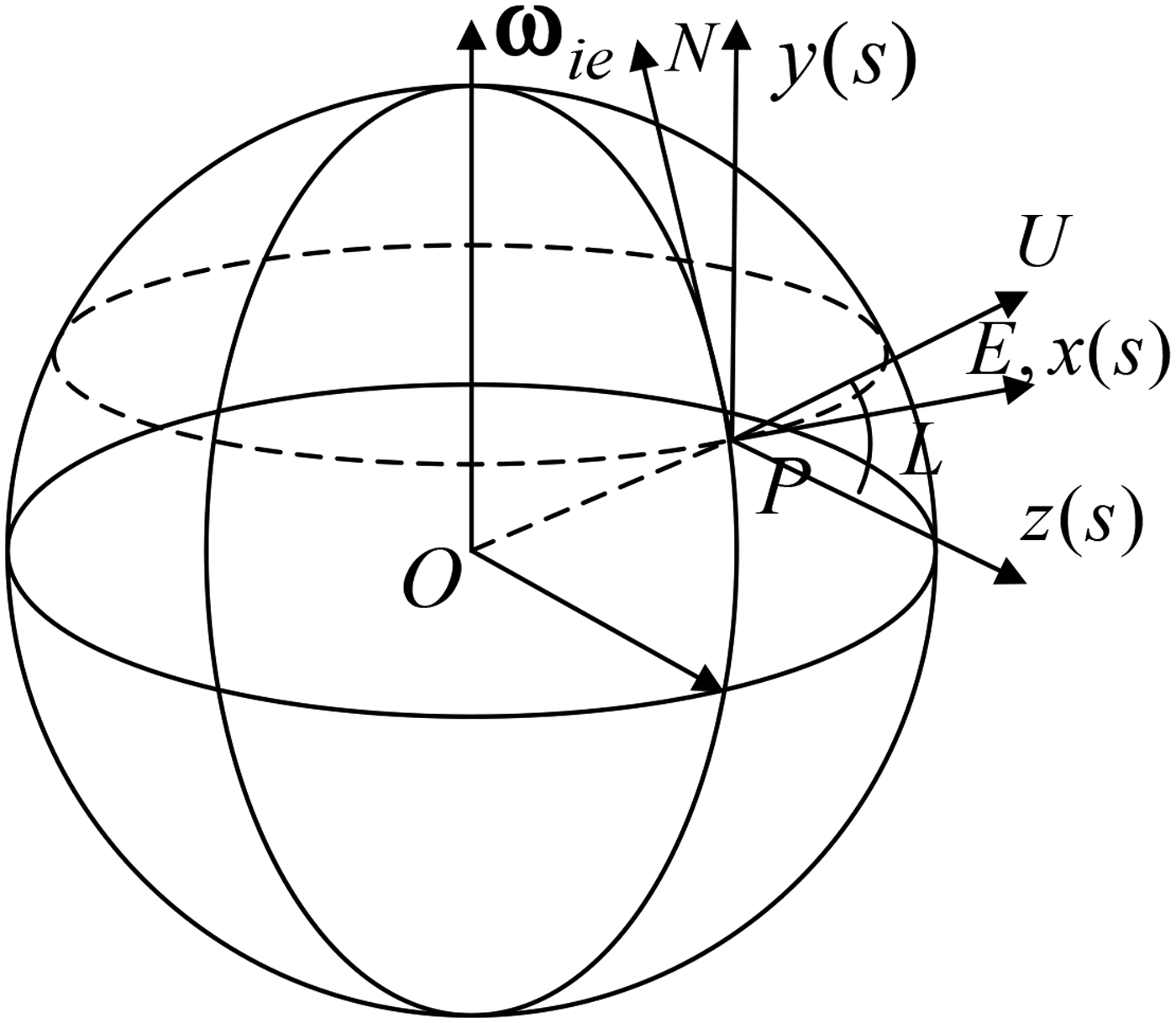
Because the latitude varies as vehicle moves, the ωien is not constant. To solve Equation (15), a right-handed frame called s-frame is defined. The s-frame has its origin at the location of the navigation system, and its x-axis and y-axis align with the directions of east and the Earth axis. The s-frame can be obtained by rotating the navigation frame by an angle (Latitude) about the x-axes. Figure 6 shows the relationship between the s-frame and the navigation frame.
The s-frame and the navigation frame.
The DCM of the navigation frame with respect to the s-frame is:
 $${\rm \bf C}_n^s = \left[ {\matrix{ 1 & 0 & 0 \cr 0 & {\cos L} & {\sin L} \cr 0 & { - \sin L} & {\cos L} \cr}} \right]$$
According to the DCM Cns, the psi-angle in the s-frame can be written as:
 $${{\rm \bf \psi} ^s} = {\rm \bf C}_n^s {{\rm \bf \psi} ^n}$$
Since s-frame is stationary respect to the n-frame, ωnss = 0. Substituting ψn in Equation (15) with ψs, the psi-angle-based equation in the s-frame gives:
 $$\left\{ {\matrix{ {\dot {\rm \psi} _x^s + \Omega \cdot {\rm \psi} _z^s = 0} \cr {\dot {\rm \psi} _y^s = 0} \cr {\dot {\rm \psi} _z^s - \Omega \cdot {\rm \psi} _x^s = 0} \cr}} \right.$$
The analytical solutions of Equation (18) are given by:
 $${{\rm \bf \psi} ^s}(t) = {\rm \bf T}(t \comma {t_0}) \cdot {{\rm \bf \psi} ^s}({t_0})$$
With
 $${\rm \bf T}(t \comma {t_0}) = \left[ {\matrix{ {\cos \Omega (t - {t_0})} & 0 & { - \sin \Omega (t - {t_0})} \cr 0 & 1 & 0 \cr {\sin \Omega (t - {t_0})} & 0 & {\cos \Omega (t - {t_0})} \cr}} \right]$$
According to the analysis in Subsection 4.1, the pitch error and the roll error can be greatly reduced by velocity damping, thus, it is sufficiently precise to assume the pitch error and the roll error are zero during a period of the two observations. Thus, Equation (8) can be written as:
 $$\left\{ {\matrix{ {{\rm \phi} _x^n = {\delta} \theta _x^n + {\rm \psi} _x^n = 0} \cr {{\rm \phi} _y^n = {\delta} \theta _y^n + {\rm \psi} _y^n = 0} \cr {{\rm \phi} _z^n = {\delta} \theta _z^n + {\rm \psi} _z^n} \cr}} \right.$$
Substituting Equations (8), (9), and (18) into Equations (21) yields:
 $$\left[ {\matrix{ {{\delta} L} \cr {{\delta} \lambda} \cr {{\rm \phi} _z^n} \cr}} \right] = \left[ {\matrix{ 1 & 0 & 0 \cr 0 & { - 1} & {\tan L} \cr 0 & 0 & {\sec L} \cr}} \right]\left[ {\matrix{ {{\rm \psi} _x^s} \cr {{\rm \psi} _y^s} \cr {{\rm \psi} _z^s} \cr}} \right]$$
By the first position information, Equation (19) can be rearranged as a first position-fix reset equation:
 $$\left[ {\matrix{ {{\delta} L({t_1})} \cr {{\delta} \lambda ({t_1})} \cr {{\rm \phi} _z^n ({t_1})} \cr}} \right] = \left[ {\matrix{ 1 & 0 & 0 \cr 0 & { - 1} & {\tan L} \cr 0 & 0 & {\sec L} \cr}} \right]\left[ {\matrix{ {{\rm \psi} _x^s ({t_1})} \cr {{\rm \psi} _y^s ({t_1})} \cr {{\rm \psi} _z^s ({t_1})} \cr}} \right]$$
Similarly, a second position-fix reset equation is given by:
 $$\left[ {\matrix{ {{\delta} L({t_2})} \cr {{\delta} \lambda ({t_2})} \cr {{\rm \phi} _z^n ({t_2})} \cr}} \right] = \left[ {\matrix{ 1 & 0 & 0 \cr 0 & { - 1} & {\tan L} \cr 0 & 0 & {\sec L} \cr}} \right]\left[ {\matrix{ {{\rm \psi} _x^s ({t_2})} \cr {{\rm \psi} _y^s ({t_2})} \cr {{\rm \psi} _z^s ({t_2})} \cr}} \right]$$
Following Equations (23) and (24), the relationship between the two observations can be written as:
 $$\left\{ {\matrix{ {{\rm \psi} _x^s ({t_2}) = \cos \Omega ({t_2} - {t_1}) \cdot {\rm \psi} _x^s ({t_1}) - \sin \Omega ({t_2} - {t_1}) \cdot {\rm \psi} _z^s ({t_1})} \cr {{\rm \psi} _z^s ({t_2}) = \sin \Omega ({t_2} - {t_1}) \cdot {\rm \psi} _x^s ({t_1}) + \cos \Omega ({t_2} - {t_1}) \cdot {\rm \psi} _z^s ({t_1})} \cr}} \right.$$
With the second position information, the item of ψxs(t 2) in Equation (24) can be calculated, and the items of ψzs(t 1) and ψzs(t 2) can be given by Equation (25). Substituting ψ zs(t 2) in Equation (24), we can get the azimuth error ϕzn(t 2).
As stated above, there are three assumptions: a) pitch error and roll error are zero; b) the constant bias errors of gyros are averaged out; c) ωien >> ωenn. In practice, the assumptions are not satisfied all over the period of position-fix reset, but the TPR method is fine to estimate most parts of the azimuth error for applications with low speed and low manoeuvres, which was verified by simulations (Section 4.3) and field tests (Section 5).
4.3. Simulation of the TPR Method
To verify the advantage of the proposed TPR method, the conventional position-fix reset method and TPR method are both simulated. A stationary simulation is carried out with the following conditions: (1) an initial alignment attitude error is (0′, 0′, 1′), (2) the stochastic error of the gyro is 3 × 10⁻³ deg h−1/2, the stochastic error of the accelerometer is 20 µg Hz−1/2, and (3) the twice position-fix resets are carried out at the 17th hour and the 21th hour, respectively, (4) the INS navigates with velocity damping.
Figure 7 shows a comparison of azimuth errors with velocity damping by using the TPR method and by using the conventional position-fix reset method. A comparison of position outputs by using the TPR method and by using the conventional method is shown in Figure 8. Both methods corrected the position error at the 17th hour. At the 21th hour, the azimuth error (phi-angle error) which include the psi-angle error and the position error are compensated by the TPR method, while only the position error is compensated by the conventional position-fix reset method.
Azimuth errors (phi-angle) with velocity damping by using the TPR method and by using the conventional method.
Position outputs with velocity damping by using the TPR method and by using the conventional method.
Radial-position errors compensated by the TPR method and by the conventional position-fix reset method are compared in Figure 9. It can be seen that the radial-position error is less than 100 m by using the TPR method, while it is more than 310 m by using the conventional method.
Radial-position errors with velocity damping by using the TPR method and by using the conventional method.
From the comparisons above, both the azimuth error and the radial-position error are significantly better corrected by the TPR method than by a conventional position-fix reset method under same conditions in simulations.
5. FIELD TEST
The TPR method was applied to the designed dual-axis rotational INS mentioned in Section 2 and a field test was carried out to verify the performances. Specifications of the designed dual-axis rotational INS are listed in Table 1.
Specifications of the designed dual-axis rotational INS.

The trajectory, which is shown in Figure 10, starts from a location at Wuhan (114·3494°E, 30·3947°N) and ended at a location Kaifeng (114·3680°E, 34·7920°N).
Trajectory of a test run (start position is denoted by a star).
This trajectory involves moderate swings and accelerations. The Global Position System (GPS) signal was continuous and experienced no outages during the 133 hours of the test run. GPS positions were not given to the INS until the position-fix reset was needed at the 72nd hour and the 76th hour during the test. In order to verify the advantage of the proposed TPR method, the vehicle continued to run another 51 hours after the resets.
To evaluate the TPR method, position information from GPS was treated as an external position reference, attitude information resolved by a GPS/INS loose integrated algorithm (Titterton and Weston, Reference Titterton and Weston2004) was treated as an external azimuth reference and the pitch, roll reference, and the raw IMU data was recorded in real-time with a frequency of 200 Hz for post-processing.
The procedure, which is used to evaluate the proposed TPR method, includes two steps:
(1) Align the IMU by using a multi-position alignment method and make the system navigate for 127 hours with velocity damping, where the system is reset by using the TPR method at the 72nd hour and the 76th hour during the test;
(2) Align the IMU by using the multi-position method and make the system navigate for 127 hours with velocity damping, where the system is reset by using the conventional position-fix reset method at the 72nd hour and the 76th hour during the test.
The pitch error and the roll error of the navigation results in step (1) are shown in Figure 11. With velocity damping, both the pitch error and the roll error are less than 0·1 arc-min, thus, it is sufficiently precise to assume the pitch error and the roll error are zero in Equation (19).
Pitch error and roll error with velocity damping in step (1).
The azimuth errors of the navigation results in step (1) and in step (2) are shown in Figure 12. At the 72nd hour, both methods corrected the position error, and at the 76th hour, the azimuth error which include the psi-angle and the position error are compensated by the TPR method, while only the position error is compensated by the conventional position-fix reset method. Thus, the residual azimuth error is less by using the TPR method than by using the conventional position-fix reset method. From Figure 12, it can be seen that the TPR method is fine to estimate the majority of the azimuth errors.
Azimuth errors with velocity damping by using the TPR method and conventional method.
Figure 13 shows comparisons of the longitude error and the latitude error in the latter 51 hours by using the proposed TPR method and by using the conventional position-fix reset method. The comparison of the radial-position error in the latter 51 hours is shown in Figure 14. It can be seen that the radial-position error by using the proposed TPR method is much smaller than that by using the conventional method, which is expected due to the correction of the azimuth error during the twice position-fix resets.
Longitude errors and latitude errors with velocity damping in the latter 51 hours by using the proposed TPR method and by using the conventional position-fix reset method.
Radial-position errors with velocity damping in the latter 51 hours by using the proposed TPR method and by using the conventional position-fix reset method.
6. CONCLUSION
To enhance accuracy of a dual-axis rotational INS for long-term navigation applications, a Twice Position-fix Reset (TPR) method is proposed in this paper. Specifically, the following contributions have been made:
With calibration methods and 16-position rotation scheme, stochastic errors of the inertial sensors are one of the main residual errors which lead the azimuth error and the position error to be divergent as a function of time. The TPR method is designed to compensate for the stochastic errors by estimating the azimuth error and the position error with two observations.
Field tests indicate that, compared with the conventional approach, the TPR method dramatically improved the performances of the dual-axis rotational INS.
ACKNOWLEDGEMENT
This work is supported in part by National Natural Science Foundation of China (Grant No: 61203199).