


INTRODUCTION
Influenza is a major cause of morbidity and mortality [Reference Thompson1]. Because deaths due to influenza and deaths due to other non-influenza-related diseases follow a similar temporal distribution, in the 1930s, Collins proposed that a causal relationship might exist between influenza and other non-respiratory causes of death [Reference Collins2]. A time-series analysis using 40 years of data on mortality from ischaemic heart disease, cerebrovascular disease, and diabetes mellitus strongly suggested that the excess winter mortality due to these diseases may be, in fact, attributable to influenza [Reference Reichert3]. Similarly, a recent time-series study using data from the UK, Wales, and Hong Kong confirmed an association between influenza and myocardial infarctions [Reference Warren-Gash4]. However, other independent studies, have resulted in contradictory conclusions regarding this association [Reference Corrales-Medina, Madjid and Musher5–Reference Warren-Gash, Smeeth and Hayward8].
The link between influenza and myocardial infarctions is thought to be mediated via inflammation [Reference Corrales-Medina, Madjid and Musher5, Reference Warren-Gash, Smeeth and Hayward8]. Acute inflammation caused by influenza and other respiratory infections is believed to cause local inflammation in atherosclerotic plaques within coronary arteries. This may in turn lead to plaque destabilization, plaque rupture, and ultimately, a myocardial infarction. In addition, the inflammation caused by influenza could result in an increase in metabolic demand, possibly leading to cardiac ischaemia if the period of increased demand is prolonged. With influenza, a lengthy period of elevated metabolic demand is commonplace, as patients can be febrile for days [Reference Warren-Gash4].
Ischaemic strokes, like myocardial infarctions, result from ischaemia secondary to the lack of blood flow. As with myocardial infarctions, investigators have proposed that acute infections, including influenza, can trigger events leading to ischaemic strokes [Reference Lindsberg and Grau9–Reference Naghavi11], and epidemiological investigations have proposed associations between influenza and stroke-related events [Reference Toschke12–Reference Nichol14]. Strengthening the biological plausibility of this association is a recently developed animal model demonstrating that infections by the influenza virus trigger cytokine cascades that can increase cerebral infarct size in mice with experimentally induced ischaemic strokes [Reference Muhammad15]. Finally, while several studies have suggested that influenza vaccinations may protect against myocardial infarctions [Reference Ciszewski16, Reference Gwini, Coupland and Siriwardena17], recent studies habe shown that influenza vaccinations are also protective against ischaemic strokes [Reference Grau18–Reference Phrommintikul20].
The purpose of this study is to use time-series regression modelling to determine whether the incidence of acute myocardial infarctions (AMIs) is associated with the seasonal variation in the incidence of influenza in the USA, to confirm recent studies based on data from other countries [Reference Warren-Gash4], and to address the same question for the incidence of ischaemic strokes. Time-series analytical techniques are increasingly being utilized in ecological epidemiology studies, especially in studies involving incidence data [Reference Fischer21–Reference Schwartz24]. A second goal of this study is to estimate the burden of AMI and ischaemic stroke attributable to influenza. Finally, the novel H1N1 influenza pandemic provided a natural experiment to examine the relationship between influenza and other diseases in the absence of traditional seasonal confounding factors. Thus, we built a forecasting model to determine if we could accurately forecast AMI using influenza activity during the second wave of the novel H1N1 pandemic.
METHODS
Data source
All data were extracted from the Nationwide Inpatient Sample (NIS), the largest all-payer database of national discharges in the USA. The database is maintained as part of the Healthcare Cost and Utilization Project by the Agency for Healthcare Research and Quality, and contains data from a 20% stratified sample of non-federal acute-care hospitals [25]. This sample includes academic medical centres, community hospitals, general hospitals, and speciality hospitals. It excludes long-term care facilities and rehabilitation hospitals. To adjust for yearly changes in the sampling design, we applied the weights provided by the Agency for Healthcare Research and Quality [26].
We first identified all hospitalizations over the period from January 1998 to November 2009 during which a primary or secondary diagnosis of AMI was received. For case ascertainment, we used the International Classification of Diseases, 9th Revision, Clinical Modification (ICD-9-CM) codes 410·0– 410·9. We then aggregated all cases by month to produce a national sample of cases of AMI over time. Cases were assigned to a calendar month on the basis of the date that the patient was admitted to the hospital. In a similar fashion, we identified all hospitalizations over the same time period during which a primary diagnosis of ischaemic stroke was received. For case ascertainment of strokes, we used the ICD-9-CM codes 433·01, 433·11, 433·21, 433·31, 433·81, 433·91, 434·00–434·91, and 436.
Seasonal models
To build a time series to reflect seasonal influenza activity, we identified all hospitalizations over the period from January 1998 to September 2007 during which a primary or secondary diagnosis of influenza was received, leaving the remainder of the data (October 2007–November 2009) as a validation sample for assessing the accuracy of our forecasts. We formulated this series to represent an overall environmental exposure to influenza. For case ascertainment we used the ICD-9-CM codes 487·0 (influenza with pneumonia), 487·1 (influenza with other respiratory manifestations), and 487·8 (influenza with other manifestations). Each time-series (AMI, ischaemic stroke, influenza) was first log-transformed and subsequently differenced to better meet the assumption of stationarity, allowing for the use of the traditional Box–Jenkins approach [Reference Box and Jenkins27]. Differencing the series accommodates the curvilinear temporal trends that are present in the AMI and stroke series.
To investigate the association of either AMI or ischaemic stroke with influenza at the national level, we computed a cross-correlation function (CCF) between the AMI and influenza series and between the ischaemic stroke and influenza series. Because cross-correlations between time series can be spurious due to the effects of common temporal patterns, we employed a pre-whitening process [Reference Cryer and Chan28]. The pre-whitening process involves the filtering of the two time series as a means of removing common temporal patterns. We were then able to detect correlations based on prominent local peaks or troughs in two time series that are temporally aligned, as opposed to coincidental correlations based on shared seasonal patterns. The former are representative of a legitimate association, whereas the latter are merely due to common cyclic behaviour. In our application, common yearly cycles are present in both AMI and ischaemic stroke series as well as the influenza series, since both are elevated during the winter months.
Clinical judgement would suggest that any temporal association between either the AMI or the stroke series and the influenza series would be instantaneous. The CCF was used to statistically validate (or negate) a contemporaneous relationship. We then formulated time-series regression models with autocorrelated errors, according to the steps outlined in section 5.5 of Shumway & Stoffer [Reference Shumway and Stoffer29]. The errors were described using seasonal autoregressive integrated moving-average (ARIMA) models. Such a time-series regression model can be written as
 $$y_{t} \equals \beta _{\setnum{0}} \plus \beta _{\setnum{1}} x_{t} \plus \varepsilon _{t} \comma $$
where yt is the outcome (AMI or stroke incidence), xt is influenza, and εt∼ARMA(p, q)(P, Q)12. Here, p and q represent the local autoregressive and moving average components, respectively, and P and Q represent the seasonal autoregressive and moving average components, respectively.
In the first national-level regression model, AMI incidence is the response series and concurrent influenza activity is the explanatory series. We included a moving-average and two seasonal autoregressive components to account for the temporal progression of the series. These components were identified by inspecting the autocorrelation function (ACF) and the partial autocorrelation function (PACF) for the residuals from an ordinary linear regression model fitted to the response and explanatory series.
In a similar fashion, we formulated a second national-level regression model where ischaemic stroke incidence is the response series and concurrent influenza activity remains the explanatory series. Using the ACF and the PACF for the residuals from a fitted ordinary linear regression model to guide model selection, we again included a moving-average component as well as two seasonal autoregressive components to account for temporal correlation.
Seasonal, regional and age analysis
The NIS data can be categorized by both geographical region and age. There are four geographical census regions: Northeast, Midwest, South, and West. Based on clinical judgement, we first chose to divide the data by age into those cases aged ⩽65 years and those aged >65 years. To further investigate the effect of advanced age, we created overlapping subsets of the >65 years age group defined by four criteria: >65, >70, >75, and >80 years. We fitted a time-series regression model for each region and each age group, as well as for every combination of region and age group. We performed the regional-specific analyses to account for the large temperature, seasonal and demographic differences among the four NIS-identified geographical regions of the USA. The age-specific analyses were performed to investigate the role of age as a moderator of the associations of interest.
Measures of attributable risk
A measure akin to an attributable risk was then calculated to assess the burden of influenza activity on AMI incidence. It should be noted that we did not attempt to measure risk at the individual level (by identifying subjects with a history of influenza prior to a myocardial infarction), since outpatient records were not available in our dataset. To compute the attributable risk measure for a specific year, we first found the peak influenza month during a 12-month period extending from July to June. We then calculated the ratio of (1) the average AMI incidence for the year, less the incidence during the peak influenza month, over (2) the average AMI incidence for the year. Our attributable risk measure represents the proportion of AMIs that could potentially be eliminated if it were possible to bring the level of influenza during the peak month of the influenza season down to the average level during the course of a given year. We used the same approach to compute an attributable risk measure for ischaemic strokes.
AMI forecasts for 2007–2008, 2008–2009 and the 2009 pandemic
To use the novel H1N1 pandemic as a natural experiment to further confirm the association between influenza and AMI, we used the same codes as listed earlier for both influenza and AMI to extend our time-series to November 2009. We made monthly predictions of AMI from the model we developed using seasonal influenza activity (from June 1998 to September 2007), and evaluated the performance of the model by comparing the forecast incidence of AMI with the actual observed incidence levels. We made predictions both with and without influenza activity as a covariate. In total, we compiled three different sets of monthly forecasts to capture the following: the 2007–2008 influenza season, the 2008–2009 influenza season (note that this also includes the ‘first wave’ of the pandemic), and finally the first part of the 2009 influenza season, which captured the ‘second wave’ of the 2009 novel H1N1 pandemic. Specifically, we defined these three time periods to be: (1) October 2007–June 2008, (2) July 2008–June 2009, and (3) July 2009–November 2009. Finally, we used mean squared prediction error to compare the two forecasts (with influenza and without influenza) for each observation period. All analyses were performed using R version 2.11.1 (R Foundation, Austria).
RESULTS
Seasonal models
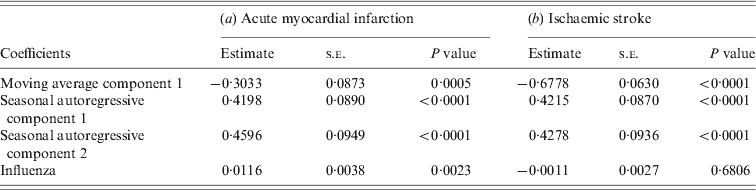
Figure 1 shows the AMI, ischaemic stroke, and influenza time series. The coefficients and corresponding standard errors for our national-level time-series regression models based on AMI and ischaemic stroke are shown in Table 1. We found the concurrent influenza covariate to be statistically significant in the model for AMIs but not in the model for ischaemic stroke. Thus, influenza is significantly associated with AMI, but not ischaemic stroke. Note that removal of the influenza covariate from the AMI model results in an increase of 8·2% in the estimated residual variance, accompanied by a considerable increase in the value of Akaike's Information Criterion (AIC) from −463·6 to −456·5. AIC is a widely used tool for statistical model selection based on predictive efficacy; optimal models correspond to smaller values for the AIC. The large increase in AIC that results from removing influenza from the model tells us that influenza is an important covariate in our AMI model. (A difference in AIC values of two or more is generally viewed as a meaningful difference.) Removal of the influenza covariate from the ischaemic stroke model results in an increase of 0·18% in the estimated residual variance, accompanied by a decrease in the value of the AIC from −514·1 to −516·0.
The raw time-series data for the incidence of acute myocardial infarction (AMI) (top), ischaemic stroke (middle), and influenza (bottom) from January 1998 to September 2007. All units reflect the weighted frequency of discharges as reported from the Nationwide Inpatient Sample (NIS).

Estimates, standard errors, and accompanying P values for the national level time-series regression models. (a) Acute myocardial infarction incidence serves as the response series and concurrent influenza activity as the explanatory series. (b) Ischaemic stroke incidence serves as the response series and concurrent influenza activity as the explanatory series
Since our raw incidence series are comprised of counts, we also performed the national-level analyses using a Poisson regression approach, where the models were fitted using generalized estimating equations and a simple autoregressive working correlation structure. The influenza covariate series was log transformed; the outcome series were not, but a log-link function was employed. To accommodate the curvilinear trends in the AMI and stroke series, linear and quadratic terms in the time index were included as covariates. Again, the influenza covariate was significantly associated with AMI, but not ischaemic stroke. The point estimates and model-based standard errors were quite close to those obtained using the time-series regression approach. The point estimates were only marginally affected by the removal of the linear and quadratic terms in the time index.
Seasonal, regional and age analysis
The AMI and ischaemic stroke analyses were then stratified by age group. Age-specific time-series regression models were fitted using the same model structure as that used for the overall national series. The influenza covariate estimates, along with their standard errors and P values, for the national-level age-specific AMI and ischaemic stroke analyses are shown in Table 2. The influenza covariate was found to be significant in the models of AMI for all age groups >65 years. In the ⩽65 years age group, no such association was found. In contrast, no group was found to have a significant influenza covariate in the age-specific models for ischaemic stroke. Based on these results, age-specific attributable risk measures were calculated for AMI; these measures are illustrated in Figure 2.
Attributable risk measures for influenza activity on acute myocardial infarction incidence for age groups ⩽65, >65, >70, >75, and >80 years. Note that the risk increases with age.

Estimates, standard errors, and accompanying P values for the influenza covariate in the age-specific time-series regression models with (a) acute myocardial infarction incidence and (b) ischaemic stroke incidence as the response series
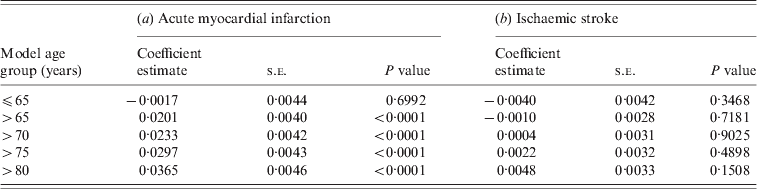
Table 3 shows the influenza covariate estimates, as well as their standard errors and P values, for our AMI and ischaemic stroke time-series regression models based on all combinations of age groups and regions. Note that the national pattern for AMI, where the influenza covariate was significant for all age groups except for those aged ⩽65 years, holds in all four geographical regions. The ischaemic stroke analyses show no pattern of significance. Using a conservative adjustment for multiple comparisons (the Bonferroni method), none of the ischaemic stroke tests were significant, while the pattern of significance for AMI in older populations remained significant.
Estimates, standard errors, and accompanying P values for the influenza covariate in the regional age-specific models of (a) acute myocardial infarction incidence and (b) ischaemic stroke incidence

AMI attributable risk measures
Figure 3 shows age-specific AMI attributable risk measures calculated for each region, categorized by age group. Again, the national pattern of risk increasing with age holds for each region.
Attributable risk measures for influenza activity on regional acute myocardial infarction incidence for age groups ⩽65, >65, >70, >75, and >80 years. Note that the risk increases with age within each region. (a) Northeast, (b) Midwest, (c) South, (d) West.

AMI forecasts for 2007–2008, 2008–2009 and the 2009 pandemic
Three sets of predictions were made, one for each influenza season and a third to examine the ‘second wave’ in autumn 2009. Each set of predictions included forecasts from the model with influenza included as a covariate and forecasts from the model without influenza. In 2008, the forecasts based on the model with influenza reflected a 34·5% reduction in mean squared prediction error vs. the forecasts based on the model without influenza. For the 2008–2009 influenza season (including the first wave in May of 2009), using our model with influenza we observed only an 8·6% reduction in mean squared prediction error vs. the model without influenza. It should be noted that this was a period of very mild influenza activity. Finally, when predicting AMI during autumn 2009 (coinciding with the second wave of the pandemic), using the model with influenza we observed a 70·1% reduction in mean squared prediction error compared to the model without influenza.
DISCUSSION
Our results show that in the USA, the incidence of AMI is associated with influenza activity. Specifically, we show that models incorporating influenza as a covariate predict AMI with much greater accuracy than models that omit influenza (i.e. the models that include influenza exhibit large decreases in AMI prediction error vs. the models that exclude influenza). The 2009 pandemic provided a unique opportunity to study the relationship between influenza and AMI because the pandemic peaked several months prior to traditional peaks in influenza activity. This allowed us to focus on the relationship between influenza and AMI in the absence of traditional potential confounders, e.g. weather. If the association with influenza and AMI was indeed spurious, it would be expected that the early peak in influenza would lead to poor predictive ability for those models incorporating influenza as a covariate. However, in contrast, we observed a substantial reduction in the observed error of our forecasts when we included influenza activity in our model, especially during the second wave of the 2009 influenza pandemic that did not occur during the traditional influenza season.
The association we found between influenza and AMI is, however, dependent upon age, as groups aged ⩽65 years did not produce a statistically significant result. This age-related risk may be why some investigators have not found an association between influenza and myocardial infarctions in previous studies. The observed association with age implies a dose– response, with an attributable risk of 0·5% for individuals aged >65 years, increasing to 0·85% for individuals aged >80 years. By categorizing the AMI and influenza series by census regions, we were able to demonstrate that our age-related findings were consistent across different temperature ranges, climates and demographics. That is, we observed the same dose–response association of age within each geographical region as was observed at the national level. Finally, in contrast to our findings for myocardial infarctions, we did not find a similar association for ischaemic strokes, even after adjusting for age.
We were surprised by the lack of association between influenza and strokes. A recent study showed that vaccination against influenza was associated with significant reductions in the risk of hospitalizations for heart disease and cerebrovascular disease [Reference Nichol14]. There are several possible reasons for this discrepancy in associations. First, it could be that imprecision in the diagnosis of stroke masks a true association. For example, respiratory infection appears to predispose to large vessel and cardioembolic stroke, but not to small vessel strokes (which represent the majority of strokes) [Reference Paganini-Hill30]. Note, we also examined the incidence of transient ischaemic attacks, but our results were also negative (data not shown). Second, use of medications for influenza symptoms may have selectively increased the risk for myocardial infarction (or presenting symptoms). Non-steroidal anti-inflammatory agents have been shown to increase risk of an AMI, but have little or no effect on stroke [Reference Choma31, Reference Bavry32]. Sympathomimetics such as decongestants increase cardiac workload and may cause coronary vasospasm, and may precipitate ischaemia or cardiac arrhythmia that leads to hospital admission. Third, the haemodynamic effects of infection (increased heart rate and stroke volume) could also precipitate myocardial ischaemia or arrhythmia. Fourth, influenza can causes abnormal EKG findings [Reference Hayden33] and sometimes myocarditis with increased cardiac enzymes [Reference Engblom34], both of which could lead to misdiagnosis of myocardial infarction. Fifth, there is increasing evidence from animal models that atherosclerosis has site-specific differences in susceptibility to changes in immune responses. Of particular relevance is evidence that lesions in mouse innominate arteries (which are strikingly similar to human carotid lesions) exhibit different responses to immune manipulation than coronary sinus and aortic lesions [Reference Reardon35, Reference Reardon36]. Murine innominate lesions also have strikingly different gene activation patterns for CD44 than do aortic lesions [Reference Bennett37]. Moreover, there is clinical evidence in humans that tissue propensity to accumulate cholesterol (i.e. presence of xanthelasma) predicts coronary disease but not ischaemic stroke [Reference Christoffersen38]. It is also possible that the positive findings in the previously mentioned stroke-influenza-vaccination study may instead be a reflection of other differences between subjects who chose vaccination compared to subjects who declined annual vaccination. Nevertheless, there are still many reasons for patients at risk for strokes to undergo annual vaccination against influenza.
Our attributable risk measure represents the proportion of AMIs that could be eliminated if it were possible to bring the level of influenza during the peak of the influenza season down to the average level during the course of a given year. This is a conservative assessment of burden because only the peak month of influenza activity, not the entire influenza season, is taken into account. In terms of public health impact, the proportion of myocardial infarctions attributable to influenza that are identified is relatively small. However, considering the tens of thousands of cases of AMIs that occur yearly, this represents a non-trivial number of myocardial infarctions.
The observed association between AMI incidence and influenza suggests a variety of strategies for reducing seasonal variation in myocardial incidence, beginning with the prevention of influenza via a seasonal vaccination. Second, as influenza vaccinations are often less effective in the elderly, there may be a role for social distancing during the influenza season, especially in severe influenza seasons. Finally, improving local influenza surveillance data may play a similar role. As the likelihood of contracting influenza increases with hospitalization, physicians may recommend that elective or non-imperative procedures occur outside the influenza season. However, in the USA the only universally available local influenza activity surveillance data is at the state level, and it is often 1–2 weeks old when it becomes available. Thus, expanding local surveillance data may lead to reduced numbers of influenza infections, thereby possibly reducing AMI incidence, or at least helping to anticipate the presentation of possible influenza-associated myocardial infarction cases.
Our study has several limitations. First, we used administrative data rather than clinical or microbiological data for case ascertainment. However, other studies have shown that ICD-9-CM codes have a reasonable sensitivity, specificity, and positive predictive value for detecting influenza, myocardial infarctions and strokes [Reference Marden-Haug39–Reference Birman-Deych41]. Second, other respiratory viral pathogens co-circulate during winter months, possibly contributing to AMI incidence; however, we did not find such a relationship with respiratory syncytial virus (data not shown). Third, our study is ecological. We used the aggregate incidence for each disease and did not study associations at the individual level; instead, we focused on influenza as an ‘environmental’ risk factor. Although it would be ideal to have data showing that individual subjects actually had influenza prior to an AMI or stroke, we cannot infer this from hospital discharge data. Even if we had linked outpatient data we would not have detected all cases since patients with influenza can present with atypical symptoms, especially the elderly.
Despite the limitations to our study, we found a strong statistical relationship between influenza and AMI, and our focus on the pandemic further strengthens this association. Although the relative attributable burden (i.e. clinical significance) is fairly modest considering all AMIs, our findings in the USA in conjunction with findings in other countries provide another reason for annual influenza vaccination. Our results also suggest that clinicians should have a high index of clinical suspicion when caring for patients presenting with cardiac symptoms during the influenza season, especially if they report recent exposures to influenza or report a recent or current history of influenza-like symptoms. Finally, myocardial infarctions and strokes are often categorized together; our results may provide insights to different pathways for these two different vascular diseases. Future work should focus on individual-level analyses and consider the possible effects of influenza in the setting of other cardiac risk factors.
ACKNOWLEDGEMENTS
Support for this research was provided in part by a grant from the National Institutes of Health (Research Grant K01 AI75089) as well as a National Institutes of Health Career Investigator Award (Research Grant K01 AI75089) (P.M.P.).
DECLARATION OF INTEREST
None.



