



Crossref Citations

This article has been cited by the following publications. This list is generated based on data provided by Crossref.
Wang, Hongping
Yang, Zixuan
Li, Binglin
and
Wang, Shizhao
2020.
Predicting the near-wall velocity of wall turbulence using a neural network for particle image velocimetry.
Physics of Fluids,
Vol. 32,
Issue. 11,
2020.
A study of a quasilinear model of the particles of a suspension that are aggregated and settled in an inhomogeneous field.
V. N. Karazin Kharkiv National University. Ser. Mathematics, Applied Mathematics and Mechanics,
Zhang, Jun
Yao, Siqi
Fei, Fei
Ghalambaz, Mohammad
and
Wen, Dongsheng
2020.
Competition of natural convection and thermal creep in a square enclosure.
Physics of Fluids,
Vol. 32,
Issue. 10,
Ye, Tao
Zhang, Hui
and
Wang, Xinguang
2021.
Big Data.
Vol. 1320,
Issue. ,
p.
31.
Yin, Zhenglong
Fan, Bo
Ding, Zijing
Wu, Zongyu
and
Chen, Yong
2021.
Comparative study of modal decomposition and dynamic equation reconstruction in data-driven modeling.
AIP Advances,
Vol. 11,
Issue. 8,
Zhao, Wenwen
Jiang, Lijian
Yao, Shaobo
and
Chen, Weifang
2021.
Data-driven nonlinear constitutive relations for rarefied flow computations.
Advances in Aerodynamics,
Vol. 3,
Issue. 1,
Jiang, Chao
Vinuesa, Ricardo
Chen, Ruilin
Mi, Junyi
Laima, Shujin
and
Li, Hui
2021.
An interpretable framework of data-driven turbulence modeling using deep neural networks.
Physics of Fluids,
Vol. 33,
Issue. 5,
Amroun, Hamdi
Ammi, Mehdi
and
Hafid, Fikri
2021.
Proof of Concept: Calibration of an Overhead Line Conductors’ Movements Simulation Model Using Ensemble-Based Machine Learning Model.
IEEE Access,
Vol. 9,
Issue. ,
p.
163391.
Xiao, Tianbai
and
Frank, Martin
2021.
Using neural networks to accelerate the solution of the Boltzmann equation.
Journal of Computational Physics,
Vol. 443,
Issue. ,
p.
110521.
Maslyaev, Mikhail
and
Hvatov, Alexander
2021.
Multi-Objective Discovery of PDE Systems Using Evolutionary Approach.
p.
596.
Chen, Zhao
Liu, Yang
and
Sun, Hao
2021.
Physics-informed learning of governing equations from scarce data.
Nature Communications,
Vol. 12,
Issue. 1,
Xu, Hao
Zhang, Dongxiao
and
Wang, Nanzhe
2021.
Deep-learning based discovery of partial differential equations in integral form from sparse and noisy data.
Journal of Computational Physics,
Vol. 445,
Issue. ,
p.
110592.
CUI, Zhiliang
ZHAO, Jin
YAO, Guice
ZHANG, Jun
LI, Zhihui
TANG, Zhigong
and
Dongsheng, WEN
2022.
Competing effects of surface catalysis and ablation in hypersonic reentry aerothermodynamic environment.
Chinese Journal of Aeronautics,
Vol. 35,
Issue. 10,
p.
56.
Song, Wenxiang
Shi, Liangsheng
Wang, Lijun
Wang, Yanling
and
Hu, Xiaolong
2022.
Data‐Driven Discovery of Soil Moisture Flow Governing Equation: A Sparse Regression Framework.
Water Resources Research,
Vol. 58,
Issue. 8,
Cao, Wenbo
and
Zhang, Weiwei
2022.
Data-driven and physical-based identification of partial differential equations for multivariable system.
Theoretical and Applied Mechanics Letters,
Vol. 12,
Issue. 2,
p.
100334.
Stefanov, Stefan
Roohi, Ehsan
and
Shoja-Sani, Ahmad
2022.
A novel transient-adaptive subcell algorithm with a hybrid application of different collision techniques in direct simulation Monte Carlo (DSMC).
Physics of Fluids,
Vol. 34,
Issue. 9,
Xing, Haoyun
Zhang, Jun
Ma, Wenjun
and
Wen, Dongsheng
2022.
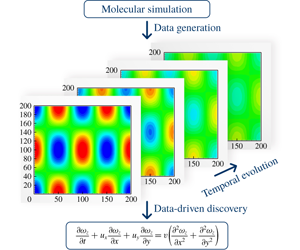
Using gene expression programming to discover macroscopic governing equations hidden in the data of molecular simulations.
Physics of Fluids,
Vol. 34,
Issue. 5,
Zhao, Qingyi
Jin, Guodong
and
Zhou, Zhideng
2022.
Deep learning method for the super-resolution reconstruction of small-scale motions in large-eddy simulation.
AIP Advances,
Vol. 12,
Issue. 12,
Alyousuf, Taqi
and
Li, Yaoguo
2022.
Inversion using adaptive physics‐based neural network: Application to magnetotelluric inversion.
Geophysical Prospecting,
Vol. 70,
Issue. 7,
p.
1252.
Boullé, Nicolas
Earls, Christopher J.
and
Townsend, Alex
2022.
Data-driven discovery of Green’s functions with human-understandable deep learning.
Scientific Reports,
Vol. 12,
Issue. 1,