


- PN
parenteral nutrition
- SIT
small intestinal transplantation
The short answer to this now frequently-asked question is yes, but only for certain patients in certain circumstances. Perhaps as a consequence of the exponential rise in the sophistication of medical treatments, patients with catastrophic loss of the small intestine, at least in the developed countries, are no longer treated in a palliative manner and are now offered salvage surgery and parenteral nutrition (PN) as a routine. The main concern in the art of intravenous feeding is getting the simple aspects consistently correct and paying attention to detail. It is a highly-skilled practice and is well established in the UK because of a relatively small number of dedicated clinicians. It is not, however, easily accessed by some patients in geographically-remote regions, and this lack of accessibility is currently the subject of much interest and debate. When used prudently and with care PN allows patients to have a good quality and length of life (Baxter et al. Reference Baxter, Fayers and McKinlay2006). Given this good profile of PN, why take the added risks of small intestinal transplantation (SIT)? From the patient's perspective life without dependency on the intravenous infusion of water and nutrients, often daily over 8 h, is very attractive as it opens up many life opportunities. However, from the clinician's point of view this optimism must be balanced against the associated dangers of the procedure and the clinician's need to help the patient take this often difficult and marginal choice. Currently, it is certainly not possible to advise all PN patients that SIT will improve their length of life; indeed, overall the opposite is probably the reality. If all those individuals currently on PN were transplanted there would be an overall reduction in longevity (Grant et al. Reference Grant, Abu-Slmagd, Reves, Tzakis, Langnas, Fishbein, Goulet and Farmer2005; Jones et al. Reference Jones, Stratton, Holden, Russell, Glencorse and Micklewright2005; Lloyd et al. Reference Lloyd, Vega, Bassett, Forbes and Gabe2006). However, certain patients would benefit, and not only experience a dramatic improvement in length of life but also a transformation in the quality of their lives (DiMartini et al. Reference DiMartini, Rovera, Graham, Furukawa, Todo, Funovitis, Lu and Abu-Elmagd1998; Rovera et al. Reference Rovera, DiMartini, Schoen, Rakela, Abu-Elmagd and Graham1998; Goulet et al. Reference Goulet, Jan, Lacaille, Colomb, Michel and Damotte1999; Cameron et al. Reference Cameron, Binnie, Jamieson, Pollard and Middleton2002). There is also a financial consideration, it is less expensive to transplant patients with small intestinal failure (a ‘one-off’ cost of approximately £70 000) than to maintain them on PN (approximate cost of £40 000/year). The cost per ‘quality of life’ year gained has not been reported, although it would be difficult to apply, as there is considerable variation between patients. However, if evaluated this cost might provide another factor in favour of earlier transplantation.
The risks associated with SIT have thus far prevented it from being considered in general as a means of improving quality of life if a patient is on uncomplicated PN. However, complications of PN or complicated underlying gastrointestinal disease that severely impairs quality of life are already being considered as major factors in support of transplantation in certain centres (Abu-Elmagd et al. Reference Abu-Elmagd, Reyes, Fung, Mazariegos, Bueno, Janov, Colangelo, Rao, Demetris and Starzl1999).
Currently, however, failing PN remains the indication for SIT, with the aim of increasing longevity. Here then is the challenge, the identification of those patients likely to experience PN failure at a stage early enough to offer them a reasonable chance of surviving transplantation. This process requires the knowledge of the likely prognosis of patients at each stage of their decline on PN and the prognosis if they were to undergo SIT. The prognosis of patients on PN is related to their underlying condition and PN-related complications. Clearly, those patients with severe complications of PN, such as major loss of intravenous access, will do worse than those who are in better physical condition. The psychological condition is also of considerable importance. To further complicate this balance of risks the prognosis of SIT is continuously improving, currently quite steeply, thus constantly changing the optimal time for transplantation.
Reviews of several large series of patients on PN have been published and they report 1-year survival rates of 86% (Lloyd et al. Reference Lloyd, Vega, Bassett, Forbes and Gabe2006) and 91% (Messing et al. Reference Messing, Lemann, Landais, Gouttebel, Gerard-Boncompain, Saudin, Vangossum, Beau, Guedon and Barmoud1995) and a 5-year survival rate of 73% (Lloyd et al. Reference Lloyd, Vega, Bassett, Forbes and Gabe2006). However, when considering these data it should be taken into account that the indications for establishing patients on PN vary considerably between centres. For example, certain series include a large number of patients with malignant disease (Howard & Ashley, Reference Howard and Ashley2003; Winkler, Reference Winkler2005), whilst others almost entirely consist of patients with benign disease (Messing et al. Reference Messing, Lemann, Landais, Gouttebel, Gerard-Boncompain, Saudin, Vangossum, Beau, Guedon and Barmoud1995; Pironi et al. Reference Pironi, Paganelli, Labate, Merli, Guidetti, Spinucci and Miglioli2003). The lack of homogeneity within each group should also be recognised; patients on stable PN have a far better prognosis than those with failing venous access or progressive liver disease. It becomes apparent, therefore, that each patient on PN should be assessed according to their individual circumstances and this evaluation of their prognosis and quality of life should be compared with that expected with SIT, with full consideration of their co-morbidity. There is currently very little data available to make these judgements, although recently the large intestinal failure centres have begun to focus on this area (Lloyd et al. Reference Lloyd, Vega, Bassett, Forbes and Gabe2006).
There is better outcome data following SIT, and risk assessment for patients appears to be more straightforward. However, the pre-operative condition of patients has such a profound influence on their prognosis that it would be inappropriate for all patients to be ascribed the group survival. Patients with loss of all standard intravenous access, for example, have a poorer survival chance than those with well-preserved major venous access. Those patients with co-morbidities such as complicated diabetes and extensive vascular disease that may be associated with the underlying intestinal pathology might also be expected to have more complications of surgery.
Risk assessment of patients on parenteral nutrition
The prognosis of subgroups of patients on PN has recently been explored by Lloyd et al. (Reference Lloyd, Vega, Bassett, Forbes and Gabe2006) in their extensive review of the UK referral centre at St Mark's Hospital (Harrow, London, UK) experience of patients on PN over a 20-year period. It is apparent that the primary-disease groups have markedly differing mortality rates (Table 1). This observation suggests that patients with primary diseases associated with poor prognosis might be more likely to benefit from transplantation. For example, patients with radiation enteritis and systemic sclerosis have a 5- and 10-year survival expectation similar to that for SIT. Patients with active neoplasia have the worst prognosis but are unlikely to benefit from transplantation, as the natural history of their primary disease will in most cases not be altered, and under immunosuppressive treatment it might also be adversely affected. There are, however, several examples of patients with neoplasia being successfully transplanted, with subsequent cure of their malignancy and long-term survival (Moon et al. Reference Moon, Selvaggi, Nishida, Levi, Kato, Ruiz, Bejarano, Madariaga and Tzakis2005). Here again, the individual assessment of each patient based on the precise nature of their circumstances is crucial.
Survival of patients according to primary disease and mechanism of intestinal failure subgroups (data from Lloyd et al. Reference Lloyd, Vega, Bassett, Forbes and Gabe2006)

N/A, not available.
* From Howard & Malone (Reference Howard and Malone1996).
Lloyd et al. (Reference Lloyd, Vega, Bassett, Forbes and Gabe2006) have also described the prognosis of patients subgrouped in terms of their mechanism of intestinal failure (Table 1). Those patients with failure as a result of intestinal obstruction or dysmotility have the worst prognosis, which is similar to that expected following transplantation. For these patients additional factors such as PN-related poor quality of life might make them candidates for transplantation. Conversely, the survival of patients with short-bowel syndrome seems to be very good (75% at 10 years; Messing et al. Reference Messing, Crenn, Beau, Boutron-Ruault, Rambaud and Matuchansky1999).
However, cause of death is commonly not a result of either intestinal failure or complication of PN, but is a consequence of the primary disease or related conditions, the progress of which will not be substantially altered by transplantation. Patients with Crohn's disease have a relatively favourable prognosis on PN, with 5-year survival rates of 80–90% (Messing et al. Reference Messing, Lemann, Landais, Gouttebel, Gerard-Boncompain, Saudin, Vangossum, Beau, Guedon and Barmoud1995; Vantini et al. Reference Vantini, Benini, Bonfante, Talamini, Sembenini, Chiarioni, Maragnolli, Benini and Capra2004; Winkler, Reference Winkler2005). Conversely, the patients with systemic sclerosis have about a 6-fold greater risk than those with Crohn's disease, and an estimated 5-year survival of 33% (Lloyd et al. Reference Lloyd, Vega, Bassett, Forbes and Gabe2006), with death mainly caused by progression of the underlying disease. Radiation enteritis also has a rather poor outcome (Winkler, Reference Winkler2005), with an estimated survival chance of about 52% (Lloyd et al. Reference Lloyd, Vega, Bassett, Forbes and Gabe2006) and half these deaths caused by recurrent malignancy. Pseudo-obstruction and mechanical obstruction have also been associated with poor survival (Messing et al. Reference Messing, Lemann, Landais, Gouttebel, Gerard-Boncompain, Saudin, Vangossum, Beau, Guedon and Barmoud1995; Winkler, Reference Winkler2005) and 5-year survival rates have recently been given as 70 and 50% respectively, whereas survival after mesenteric infarction has been found to be similar to that for Crohn's disease (Lloyd et al. Reference Lloyd, Vega, Bassett, Forbes and Gabe2006). Comparisons between studies are, however, restricted by demographic differences between study populations, such as the age distributions of the studied cohorts (Messing et al. Reference Messing, Crenn, Beau, Boutron-Ruault, Rambaud and Matuchansky1999; Winkler, Reference Winkler2005). Distinct from many other disease subgroups, patients with dysmotility (from visceral myopathy or neuropathy) have a poor prognosis because of associated liver disease and involvement of other organs, sometimes resulting in multiorgan failure. Transplantation not only offers relief from multiorgan failure, but also resolution of the primary problem that is usually intrinsic to the removed organ and rarely recurs in the graft.
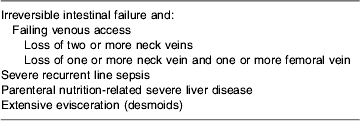
Although subgroups at high risk can be identified as target groups for potential transplantation, the fundamental indications for this procedure still apply (Table 2). Transplantation still cannot be considered as an alternative for patients on trouble-free PN. Candidates for transplantation are those with major complications of PN, such as failing line access and PN-related liver disease, whose primary disease is associated with a good prognosis. Clearly, those patients who have a progressive primary illness that will rapidly further deteriorate despite transplantation are not appropriate candidates. It is thus necessary to embrace a number of factors when evaluating the potential benefit of transplantation to the patient. These factors include the prognosis of the underlying disease process and other unrelated co-morbidity, the extent of PN-related complications and the patient's quality of life. These risks must then be weighed against those of transplantation surgery and subsequent immunosuppression. Only when this balance of risks favours transplantation and the overall surgical risks are reasonable should transplantation be considered.
Current indications for small intestinal transplantation in adults (Middleton & Jamieson, Reference Middleton and Jamieson2005)
The risks of intestinal transplant surgery
Survival following intestinal transplant surgery has considerably improved over the last decade. This improvement applies to intestinal grafting either alone, together with liver or as composite multivisceral grafting. Patient and graft survival are now similar to those for lung transplantation and are approaching those for heart and liver transplantations (Table 3). The main cause of transplant-related death is infection, which has become a greater problem than rejection following the introduction of powerful lymphocyte-depleting monoclonal antibodies such as Campath 1H (Tzakis et al. Reference Tzakis, Kato, Nishida, Levi, Tryphonopoulos and Madariaga2003; Middleton & Jamieson, Reference Middleton and Jamieson2005). To offset an augmented risk of infection, these new induction agents offer far lower rejection risks and seem to allow less powerful subsequent maintenance immunosuppression. These outcomes may be a consequence of better tolerance by the host of the graft, although the mechanism is not clear at present (Starzl et al. Reference Starzl, Murase, Abu-Elmagd, Gray, Shapiro and Eghtesad2003).
Patient and graft survival for patients receiving small intestinal and solid organ grafts

* Data given for first transplantation only. All other data include a small number of repeat transplantations (heart and lung 2%, intestine 7%), which are associated with a poorer outcome.
† 4-year survival rates given.
Trends of small intestinal transplantation
Intestinal transplantation is now undertaken as part of a routine clinical service in approximately sixty countries, with about 150 procedures performed in total per year (Grant et al. Reference Grant, Abu-Slmagd, Reves, Tzakis, Langnas, Fishbein, Goulet and Farmer2005). Most patients undergoing this surgery will have had established irreversible intestinal failure and will have been maintained on PN, which could not be continued. In the early 1990s there were only four countries that had achieved successful engraftment (USA, Canada, Germany and the UK), but over the relatively short intervening period the procedure has become virtually global.
Despite providing a major contribution to the development of SIT, the UK has subsequently seen slow acquisition of this technique into the clinical arena. Fifteen procedures have been performed in the UK, of which there were six lone small intestine, five multivisceral grafts, two small intestine and liver, one small intestine and colon and one patient died before engraftment (Starzl et al. Reference Starzl, Demetris, Trucco, Murase, Ricordi, Ildstad, Ramos, Todo, Tzakis and Fung1993). Survival rates are similar to the global experience, but the cohort of patients referred for consideration appears to be much smaller, with more advanced disease, than in countries such as the USA, Canada and Italy.
Developments with potential impact on small intestinal transplantation
The British Society for Parenteral and Enteral Nutrition maintains a comprehensive registry (British Artificial Nutrition Survey) of patients on PN (Glencorse et al. Reference Glencorse, Meadows and Holden2003). This registry allows review of the quality and accessibility of PN. The considerable geographical differences in the prevalence of PN, which tends to be most commonly employed near to intestinal failure centres, suggests inequality of access to PN. Correction of this situation might substantially increase the number of patients offered salvage surgery for intestinal catastrophe, such as superior mesenteric artery infarction, and consequently increase the number of patients on PN, some of whom may subsequently require transplantation.
New techniques such as the development of living related segmental intestinal transplantation (Benedetti et al. Reference Benedetti, Hollerman, Asolati, Di Domenico, Oberholzer, Sankary, Abcarian and Testi2006) will allow more timely transplantation and have a high success rate, with latest reports of 1- and 3-year survival rates of 100% and 82% respectively.
Conclusion
SIT surgery has substantially improved over the last decade and now has a 5-year survival similar to lung transplantation and approaching that of liver and heart transplantations. The recent 1-year survival rates from well-performing centres are as high as 93%. This procedure is now considered to be a routine clinical procedure in many countries and should always be considered for patients with irreversible intestinal failure who have complications of PN or other progressive co-morbidity that is potentially reversible by transplantation. Certain patient subgroups, according to the type of primary disease or mechanism of failure, can be targeted for close monitoring and earlier intervention. However, the risk assessment is complex and should be made by a multidisciplinary team composed of the many disciplines required to make a well-balanced recommendation about the likely benefits of surgery. For this purpose a national forum has been established by Addenbrooke's Hospital, Cambridge University, and St Mark's Hospital and Academic Institute. This forum convenes every 4 months and reviews new potential candidates, previously-transplanted patients and those who were thought to be unsuitable for transplantation. Clinicians wishing to refer patients to this forum are welcome to attend the meeting and present the patient or send the details to either Addenbrooke's or St Mark's. Those patients requiring optimisation of PN or complex intestinal failure should ideally be referred to St Mark's for evaluation before being assessed at Addenbrooke's, if they remain potential candidates for transplantation.



