




Introduction
Occasionally, the archaeological record allows us a glimpse beyond the mere material and into the mindset of people in the past. A cremation burial from the eastern necropolis of Sagalassos, south-west Turkey, provides one such opportunity, documenting funerary practices that clearly deviate from other contemporaneous burials at the site. Such irregular practices strongly suggest that a non-normative approach was taken to the burial of this particular individual, inviting us to seek an explanation based in ‘unsanctioned’ (Phillips Reference Phillips III, Faraone and Obbink1991: 262) or unconventional liturgy. Specifically, we look to a set of beliefs that the former inhabitants of Sagalassos would probably have labelled ‘magic’. But what purpose did magic fulfil in ancient communities in general, and in this case in particular? In this article, we seek to address these questions by deconstructing the unique characteristics of this particular burial and contextualising it within current research on non-normative burials and the materiality of ancient magical practices.
Background
While there is an established field of research dedicated to ‘magic in the ancient world’, the subject has long been an academic taboo because of its perceived “peripheral” and “sensationalist” nature (Houlbrook & Armitage Reference Houlbrook and Armitage2015a: 2). The inability to delineate the subject with precision as a result of the overlap between magical practices, household rituals and even conventional religion, as well as the use of contradictory definitions, limited its acceptance within mainstream scholarship. Ancient literary sources equally demonstrate differences of opinion on magical practices, with some regarded as secretive, evil and illegal, while those associated with healing or protection were widely accepted (Wilburn Reference Wilburn2012: 17–25). The fact that the term ‘magic’ has only been juxtaposed with religion since the late nineteenth century further complicates matters (Bremmer Reference Bremmer, Boschung and Bremmer2015: 11). The complexity of the issue is aptly illustrated by the title of Chadwick's (Reference Chadwick2012) article, Routine magic, mundane ritual, in which he cautions against modern dualistic thought regarding the subject. While several recent studies have argued for rejection of ‘magic’ as a term (Otto Reference Otto2011; Hanegraaff Reference Hanegraaff2012: 164–77), it seems counterproductive to eschew it altogether, given that it can be used to categorise a number of practices that share common traits. Indeed, since “beliefs in magic and the rituals that surround them are extensive as are their material manifestations”, avoiding them would be “to ignore a prevalent aspect of cultures worldwide” (Houlbrook & Armitage Reference Houlbrook and Armitage2015b: 1).
Historical research on the subject has focused on textual evidence and its categorisations of magicians and their ritual practices (an emic approach), rather than on the material correlates of magic (Bremmer Reference Bremmer, Boschung and Bremmer2015: 8). Studies that include artefacts used in magic are a recent phenomenon (e.g. Wilburn Reference Wilburn2012; Houlbrook & Armitage Reference Houlbrook and Armitage2015b; Boschung & Bremmer Reference Boschung and Bremmer2015; Hutton Reference Hutton2015) and can be understood as part of the so-called ‘material turn’ in archaeological studies that began in the 1980s (Bremmer Reference Bremmer, Boschung and Bremmer2015: 9). For current purposes, we adopt the methods set out in a number of recent publications. Wilburn (Reference Wilburn2012: 15) defends an object-centered approach for the study of magic, arguing that identifiable artefacts provide “empirical markers, evidence that we can see, or at least infer, from an object”. Inevitably, certain aspects of magic are elusive (e.g. spoken/sung incantations), but if an object is studied in wider context, a partial reconstruction of the ritual actions that led to its deposition can be reached. Well-documented archaeological contexts can therefore provide insights into potential magical practices. Ancient texts, on the other hand, can show us what to look for, but as textual evidence is only available for certain parts of the ancient world (e.g. the Egyptian spell papyri), our understanding of magical practices in many regions is all the more reliant on the archaeological record. Andrew Wilburn and Richard Gordon distinguish recurrent classes of ‘magic materials’ in ancient textual sources: written or inscribed objects and figurines, plants and animals, and repurposed household objects (Wilburn Reference Wilburn2012: 26; Gordon Reference Gordon, Boschung and Bremmer2015). The ideal case study, therefore, comprises multidisciplinary research of an in situ ensemble of artefacts and ecofacts, set within its archaeological and historical context, and linked to the textual sources. As places of transition at the interface between the living and the dead, cemeteries offer particularly good contexts in which to explore these issues. Ancient necropoleis were places where conventional funerary practices were intertwined with household rituals and possible magical activities.
The funerary context
The site of Sagalassos is located on a south-facing slope of the Taurus Mountains, in Burdur Province, south-west Turkey (Figure 1). The earliest evidence for permanent human occupation dates to the late fifth century BC (late Achaemenid period), and settlement appears to have been uninterrupted until the middle of the thirteenth century AD, even though the site was badly damaged by an earthquake in the seventh century AD. Following abandonment, the site was never intensively robbed for building materials and, since most archaeological contexts are sealed beneath protective layers of collapse, Sagalassos offers a significant albeit challenging opportunity for interdisciplinary research.
Location of Sagalassos in the Taurus mountains of south-west Turkey (© Sagalassos Archaeological Research Project).

In 2010, a new research project was initiated to explore the phenomenon of the urban periphery in antiquity, using the eastern suburbium proasteion (i.e. the built-up area immediately adjacent to the city centre) as a case study. This peri-urban area is located to the north-east of the city centre and covers a bowl-shaped plateau located at a higher elevation than the rest of the site (Figure 2). Its somewhat secluded location offered various advantages for the development of funerary, artisanal and public quarters, as their inherent nuisances, dangers and taboos could effectively be kept out of the central and residential quarters of the city.
Location of Site F within the eastern suburbium of Sagalassos (© Sagalassos Archaeological Research Project).

Site F covers several contiguous terraces on the steeper, northern slopes of the eastern suburbium (Cleymans et al. Reference Cleymans, Claeys, Van de Vijver and Poblome2021). While probably originally constructed due to a shortage of horticultural land in the immediate vicinity of the city, these terraces were gradually appropriated for funerary use from as early as the Hellenistic period (334–25 BC) onwards (Figure 3). The original trench, documented in 1990–1991, yielded an early Roman imperial vaulted family tomb containing the remains of at least seven individuals. This trench was reopened and extended in 2012 with the aim of documenting the immediate surroundings of this burial plot (Claeys & Poblome Reference Claeys, Poblome and Waelkens2013; Cleymans et al. Reference Cleymans, Claeys, Van de Vijver and Poblome2021). This work revealed evidence for a variety of burial practices—both inhumation and cremation—spanning at least six centuries, encompassing the late Hellenistic (c. 150–25 BC), early imperial (c. 25 BC–AD 100), middle imperial (c. AD 100–300) and Late Roman (c. AD 300–450/475) periods.
Map and aerial image of the upper trench at Site F, located on the northern terraces of the eastern suburbium: 1) terrace walls; 2) perpendicular (buttress?) wall with niche (3), potentially serving as charnel pit or columbarium (structure for the storage of cremation urns); 4) buried remains of (funerary) meals; 5) ash pit containing burnt bones and finds; 6) early imperial vaulted family tomb with remains of at least seven individuals; 7) late Hellenistic Π-shaped funerary monument; 8) Late Roman coffin burials; 9) middle imperial individual tombs; 10) middle imperial primary cremation; 11) late Hellenistic cremation urn; 12) fragments of an undecorated sarcophagus (© Sagalassos Archaeological Research Project).

The non-normative cremation under discussion here was discovered south of an ashlar Hellenistic burial monument (Figure 3, no. 7) and north of one of the terrace walls (Figure 3, no. 1). Stratigraphically, it post-dates the remains of a sunken Hellenistic pithos (storage container) and pre-dates the construction of two middle imperial-period tombs on its western edge (Figure 3, no. 9 & Figure 4). It consists of a roughly rectangular, superficial patch of burnt soil, identified as the remains of a funeral pyre (kaustra), which contained charcoal fragments and concentrations of burnt human bone (Figure 5). The total weight of the burnt bone fragments, representing all anatomical segments except for the feet, is 807g, with the majority (791g) measuring over 5mm in length. The distribution of the bone fragments in the burial was found to correspond generally to a correct anatomical position (Figures 5 & 6); this suggests that there was no intentional manipulation of the bones during or after cremation (McKinley Reference McKinley, Cox and Mays2000: 407).
Georeferenced orthophotography from the middle imperial primary cremation (east) and two (stratigraphically later) middle imperial individual tombs (west), showing two different phases of excavation: before (left) and after (right) removal of the covering bricks (© Sagalassos Archaeological Research Project).

Detail of the georeferenced orthophotography of the primary cremation context, with the indication of individual finds and the position in which the human remains were recovered. Full triangles = large nails; open triangles = small, pinched nails; plusses = worked bone; stars = glass; circle = coin. The numbers represent concentrations of burnt human remains that were collected separately. The dashed line represents the location of the 24 bricks that covered the burnt remains. The absence of nails along the western edge of the cremation can be explained by the erection of the adjoining individual tomb: four large, bent nails and five pinched nails were encountered while excavating its fill (© Sagalassos Archaeological Research Project).

Schematic representation of the recorded bone fragments recovered from the cremation burial. Fragments which could be identified with certainty are indicated in bold colours. Fragments where the identification with regard to side or location on the bone is uncertain are indicated in transparent colours. Different colours were used for different concentrations of collected bone, to indicate their spread across the cremated area (illustration based on: fiche de l'URA 376 CNRS, after T.S. Constandse-Westermann and C. Meikeljohn; modified by M. Guillon, P. Sellier and P. Courtaud; informatisation by M. Coutureau, AFAN).

Osteological analysis indicates the presence of a single individual; fusion in the epiphyseal fragments (ends of the long bones) suggests that the remains are of an adult (>18 years of age at death) (Scheuer & Black Reference Scheuer and Black2000). Cranial fragments, including the supra-orbital ridge, external occipital protuberance and zygomatic process, display male characteristics (Ferembach et al. Reference Ferembach, Schwidetzky and Stoukal1980). There are no pathological indicators, although given the inherent limitations of studying fragmented and incomplete burnt remains, this is not necessarily meaningful (McKinley Reference McKinley, Cox and Mays2000: 413). The fragments show uneven colour resulting from varying degrees of burning (Depierre Reference Depierre2013: 37), ranging from mostly charred to calcined (Holck Reference Holck2008: 90), varying both within and between anatomical areas and locations within the pyre (Figure 7; Table 1)). Evidence for warping and fissuring was observed but limited.
Overview of cranial and mandibular fragments recovered from concentration 110.1, illustrating the varied discolouration of bone within zones of the cremation area and anatomical segments (© Sagalassos Archaeological Research Project).

Overview of the general colouration of bone fragments per zone, with indication of the primary colours (most commonly observed) and secondary colours.

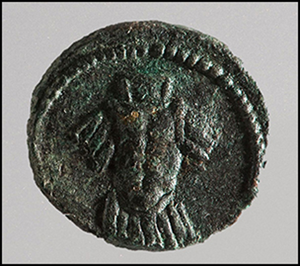
The charcoal fragments recovered are of pine (Pinus), as well as some cedar or fir (Cedrus/Abies); some charred remains of charcoal preserve textile imprints, which might relate to clothing or a shroud; fragments of a woven or plaited item, possibly a basket or bier, were also recovered. Archaeobotanical analysis attests the presence of almond, walnut and grape, as well as unidentifiable crusts containing cereal grains. Artefacts (Figure 8) include a second-century AD coin found among the cranial fragments (Stroobants et al. Reference Stroobants, Cleymans and Van de Vijver2019: fig. 11), a few partially reconstructable ceramic vessels (a small unguentarium for oil, a mastos (parabolical cup), a cooking vessel, a jar and a decorated cup) that date to the first century AD, one blown glass unguentarium, the base of a blown glass vessel and fragments of an unidentifiable worked bone item with bronze hinges. The stratigraphical position of the burial and the associated finds suggest a date in the first half of the second century AD.
Some of the content of the primary cremation: front centre) second century AD coin from Konana (detail on right); front right) burnt remains of an unidentified worked bone item; front centre left) some of the pinched nails; centre) sherds of a small glass flask; surrounding) some of the larger nails that were found around the kaustra (scale in cm) (© Sagalassos Archaeological Research Project).

Several dozen nails, of two types, were recorded along the edges of the burnt area: approximately 25 nails bent in a 90° angle with the heads pinched off (Figure 8) and 16 bent and twisted but complete nails (Figure 8 & Figure 9: left). Following the cremation, the pyre was covered with 24 bricks (each averaging 280 × 280 × 35mm), which were neatly arranged in four rows, covering a surface of 1.80 × 1.20m. The undersides of the bricks were discoloured, suggesting that they had been placed on top of the still-smouldering pyre. The bricks were subsequently covered with a layer of solidified lime (CaCO3), with remnants of slaked lime (Ca(OH)2), suggesting that their placement over the pyre was not a temporary measure to safeguard the cremains for future recovery, as was typical for cremations at Sagalassos (Köse Reference Köse2005; Cleymans et al. Reference Cleymans, Claeys, Van de Vijver and Poblome2021). Sealing the pyre site with lime effectively transformed its location into a permanent tomb for the cremains.
Upper left) bent and twisted nails from the primary cremation at Site F; lower left) nails from an ash pit with cremation remains at the same site; right) examples of coffin nails from two individual separate inhumations from the same site (© Sagalassos Archaeological Research Project).

‘Dead’ nails
There are many examples from cemeteries throughout the Roman Empire where the presence of one or more nails cannot be explained in purely utilitarian terms (e.g. as part of coffins, biers or grave goods). These nails appear to never have been used or, conversely, were unusable due to excessive size, unsuitable materials such as gold, silver or ceramic (‘imitation’ nails), old, dysfunctional (‘dead’) nails, and intentionally twisted nails. Most known examples, from both inhumations and cremations, are from Italy and the western and northern Roman provinces (Small et al. Reference Small2007: 146), although Alfayé Villa (Reference Alfayé Villa, Gordon and Marco Simón2010) records examples from Corinth, Athens, Olynthus, Pergamon and Jericho.
Almost all the nails recorded along the edges of the Sagalassos cremation clearly served no functional purpose, being either previously used nails or intentionally pinched and/or bent. These nails differ from the intact examples found elsewhere in the cemetery and used for practical purposes (Figure 9: right). Given that nails were not used in the construction of pyres, and their distribution in this particular context suggests that they did not originate from a funeral bier, coffin or any other wooden object (compare with the location of the grave goods in Figure 5), we argue that they were intentionally scattered around the burial.
Ancient literary sources provide accounts of nails being used in magical contexts as neutralising charms against a wide variety of evil influences (Dungworth Reference Dungworth, Forcey, Hawthorne and Witcher1998; Alfayé Villa Reference Alfayé Villa, Gordon and Marco Simón2010: 432–41). Pliny the Elder (AD 23–79), for example, recommended fixing nails from tombs into a threshold as a form of protection against nightmares (Natural History 34.4; Rackham et al. Reference Rackham, Jones and Eichholz1938–1969). There are also references to the potential of nails to ward off diseases: Livy (64 or 59 BC–AD 17) remarks how “a pestilence had once been assuaged by the dictator driving in a nail” (Ab urbe condita 7.3.3–8; Roberts Reference Roberts1912), while Pliny the Elder claimed that an iron nail could cure epilepsy when driven into the ground at the spot first touched by the patient's head (Natural History 28.63; Rackham et al. Reference Rackham, Jones and Eichholz1938–1969).
Recent excavations in Sagalassos have also recorded three dysfunctional nails around the pelvic area of a fourth-century AD inhumation located within a walled burial plot at the edge of the eastern suburbium. These nails could clearly be distinguished from the in situ coffin nails and were considered atypical by the excavators (Cleymans et al. Reference Cleymans2018: 153–54). Further afield, Almagro (Reference Almagro1955: 61–62) documents the presence of headless, bent nails at the necropolis of Ampurias and refers to similar observations from other excavations in Spain and Italy. Bérard (Reference Bérard1961: 156–58), meanwhile, interprets pinched nails scattered inside some of the Gallo-Roman tombs at the La Calade cemetery near Cabasse (Gallia Narbonensis) as “une véritable ceinture prophylactique” (“a proper prophylactic belt”), stating that they were intentionally pinched in half and that their presence could not be explained as functional. To our knowledge, however, there are few archaeological studies that document funerary contexts containing as large a set of bent nails with pinched-off heads as that encountered in the Sagalassos cremation. While it is possible that such artefacts have been overlooked during excavations, or their presence not recorded, this absence may also indicate the rarity of such a practice.
The intentional deforming and thus decommissioning of metal objects in the Roman world finds parallels across large swaths of prehistoric Europe (Åström Reference Åström and Laffineur1987; Fontijn & Fokkens Reference Fontijn, Fokkens, Haselgrove and Pope2007: 367–68), the Iron Age Eastern Mediterranean (Alexandridou Reference Alexandridou and Driessen2013), medieval Europe (Daniell Reference Daniell1997: 151), and even as recently as an eighteenth- to nineteenth-century AD burial in Lesbos (Tsaliki Reference Tsaliki and Murphy2008: 11–13). In some cases, this treatment of grave goods can be explained as an attempt to prevent looting. The use of old coffin nails or horseshoe nails, however, stems from their perceived prophylactic properties—a belief that persists in various (sub)cultures and religions today (Dungworth Reference Dungworth, Forcey, Hawthorne and Witcher1998: 153; Hutton Reference Hutton2015; How Reference How and Campbell2019).
Based on ancient textual sources and field observations, two hypotheses have been proposed for the presence of nails in Roman funerary contexts: either they were intended to protect the deceased from evil in the afterlife or to prevent the dead from harming the living (Small et al. Reference Small2007: 146; Alfayé Villa Reference Alfayé Villa, Gordon and Marco Simón2010: 427). These interpretations are not mutually exclusive; in both cases, nails are considered to possess the apotropaic power to protect the subject—be it the living, the dead, or both—from harm. The placement of nails in proximity to the deceased's remains might suggest the first of these two hypotheses. The fixing qualities of nails, however, may also have been used to pin the spirits of the restless dead (so-called revenants) to their final resting place, so that they could not return from the afterlife (Spitaels et al. Reference Spitaels, Laet and Doorselaer1972; Faraone Reference Faraone1991: 182 footnote 62 & 194 footnote 103; Small et al. Reference Small2007: 145–46; Alfayé Villa Reference Alfayé Villa, Gordon and Marco Simón2010: 445–48). The restless dead could result from premature or violent death, being left unburied or from living a life of deviancy (Alfayé Reference Alfayé, Marco Simón, Pina Polo and Remesal Rodríguez2009: 183–88). The practice of fixing the restless dead is probably closely linked to well-attested practices such as the pinning of effigies and the nailing of curse tablets in classical antiquity (Faraone Reference Faraone1991; Ogden Reference Ogden2002: 210–26). The latter were, not coincidentally, called tabellae defixionum (from the Latin verb defigere, meaning ‘to pin down’), and were associated with the idea of delivering someone to the powers of the underworld (Crawley Reference Crawley, Hastings and Selbie1911).
May the earth rest heavily upon you
Aside from the application of nails to symbolically fix the spirit, heavy weights were also used in an attempt to immobilise the physical remains of a potential revenant (Ogden Reference Ogden2002: 164–66; Alfayé Reference Alfayé, Marco Simón, Pina Polo and Remesal Rodríguez2009: 191–97). The curse ‘sit tibi terra gravis’ (‘may the earth rest heavily upon you’) was sometimes used in contrast to the epitaph ‘sit tibi terra levis’ (‘may the earth rest lightly upon you’) that was commonly reproduced in Roman funerary inscriptions in full or abbreviated (‘s.t.t.l.’) form (Tolman Reference Tolman1910: 5 & 21). Greek equivalents of the latter expression have been documented in the Roman East, albeit without a fixed formula (van der Horst Reference van der Horst1996: 54–55). Since the use of ‘light earth’ as a blessing only bears meaning when the reverse is considered detrimental, those in the Greek-speaking world must also have been aware of the concept of ‘heavy earth’ and its magical attributions within funerary contexts. The addition of various weights to Roman graves is attested in the contexts both of cremation and inhumation. In most cases, these weights were of stone, but the use of brick and tile is also reported (e.g. Soren Reference Soren, Soren and Soren1999: 518). This practice is often observed in combination with other indicators of necrophobia, such as face-down (prone) burials, bound limbs and decapitations (Tsaliki Reference Tsaliki and Murphy2008: 3 & tab. 1.2; Alfayé Reference Alfayé, Marco Simón, Pina Polo and Remesal Rodríguez2009).
The presence of a thick layer of lime covering the Sagalassos cremation (Figure 10) also deserves attention. Commonly referred to as ‘plaster burials’, the tradition of using a mixture of gypsum, chalk and/or lime (both quicklime (CaO) and hydrated lime (Ca(OH)2)), was widespread in the past, from the Pre-Pottery Neolithic period in the Near East onwards (for an overview, see Schotsmans et al. Reference Schotsmans, Van de Vijver, Wilson and Castex2015: 464–65). The extended use of this tradition reflects the various qualities atrributed to lime (e.g. forming a physical barrier against disease and contagion, reducing putrefactive odours, discouraging scavenging animals (Schotsmans et al. Reference Schotsmans2012: 51)). In the case of the Sagalossos cremation under discussion, however, there is no indication that lime was used in an aesthetic manner, or to preserve the physical integrity of the remains. Since animals would not have been an issue in a cremation context, it seems probable that this use of lime was an additional intervention aimed at protecting the living from the possible malevolent effects of this particular funerary context. While the effectiveness of lime as a disinfectant has been disproven by the World Health Organisation, the belief that illness and disease were caused by inhaling unhealthy mists and poisonous vapours (miasma) was historically common (Schotsmans et al. Reference Schotsmans, Van de Vijver, Wilson and Castex2015: 465–66). The addition of lime to burials was often prescribed up until the nineteenth century in an attempt to prevent the escape of miasma from the decaying corpses of those suspected of having died from contagious diseases (Morris Reference Morris1976: 31, 120, 165 & 173).
North-facing view of the eastern half of the Site F excavations (see also Figure 3). In the background are (from left to right) the vaulted tomb, Hellenistic monument and charnel(?) niche; in the foreground are two tombs, and the cremation covered with bricks and the remains of the lime cover (© Sagalassos Archaeological Research Project).

A ‘normal’, non-normative grave?
The rituals performed following the cremation under discussion deviate from what is generally understood as normative for contemporaneous burials at Sagalassos (Köse Reference Köse2005; Claeys Reference Claeys2016; Cleymans et al. Reference Cleymans2018, Reference Cleymans, Claeys, Van de Vijver and Poblome2021). Even though there are no strict guidelines to establish what counts as ‘normal’—even within a specific population and time-frame (Scott et al. Reference Scott, Betsinger, Tsaliki, Betsinger, Scott and Tsaliki2020: 3–6)—the archaeological record of ancient Anatolia suggests that contemporaneous cremations would typically either be allowed to collapse into a grave (bustum burials) or were collected from the pyre debris to be buried elsewhere in secondary depositions (McKinley Reference McKinley, Cox and Mays2000: 407; Ahrens Reference Ahrens, Brandt, Prusac and Roland2015: 188–89).
Contemporaneous secondary cremation contexts at Sagalassos include arcosolia (arched recesses in walls or cliffs) and stone (ostothekai) or terracotta cinerary containers; other less visible forms of deposition (e.g. pits, niches, remains wrapped in cloth) have yet to be discovered. Indeed, secondary burial contexts for cremated remains are prone to natural erosion or human disturbance. The terrace on which our case study burial was located has also yielded the badly preserved remains of a terracotta urn and an empty niche that may have served for secondary cremation burials.
In contrast, the human remains from the context under discussion were neither retrieved nor interred. Instead, following cremation, we observe a series of atypical interventions. The deposition of nails appears to form a magical barrier surrounding the remains of the funeral pyre. The conversion of the pyre site in the burial place, and the use of a brick/lime covering are also unique among the funerary practices at Sagalassos. Yet, these unusual funerary rites appear to have been executed with care. The deceased was awarded a pyre cremation within the necropolis, and accompanied by appropriate objects: a ‘Charon's obol’, perfume bottles, vessels containing food, and a shroud or clothing. A woven or plaited item might have been a basket (containing some of the fruits and nuts?) or a bier used to carry the deceased to their final resting place. Caution is obviously needed when venturing to reconstruct the motivations of the mourners, but they appear to have followed most of the rites associated with a normative burial, while simultaneously shielding the community from any possible harm from the restless dead, using nails, bricks and lime.
The funerary nature of the case study itself might also present us with an additional explanation. Graf (Reference Graf1997: 166) discusses two particular situations in which ancient people suspected the involvement of magic and, more precisely, ritual binding: “disease or sudden death that was medically inexplicable; and unexpected and inexplicable professional failure”. Fighting magic with magic is therefore a possible interpretation, although it is biased by circular reasoning. After all, both magic and superstition are polythetic terms, the use of which is debatable in almost all contexts (Hanegraaff Reference Hanegraaff2012: 157–73).
It is the combined practices, however, within their specific historical and regional setting, that narrow down the possible interpretations. The combination of nails and bricks designed to restrain the dead with the sealing effect of the lime strongly implies a fear of the restless dead. Regardless of whether the cause of death was traumatic, mysterious or potentially the result of a contagious illness or punishment, it appears to have left the dead intent on retaliation and the living fearful of the deceased's return.
The wider scope
Only the combination of a well-preserved context, careful excavation and the input of various specialists has facilitated the unexpected level of understanding about the case study in question. This approach offers us a potential glimpse into the thought processes behind these particular funerary practices, while attempting not to cross the line between scientific deduction and speculation. The diverse characteristics of this cremation help us gain insight into the relationship between magical practices and non-normative burials. In particular, we hope this example will contribute to the ongoing study of the materiality of magic (e.g. Boschung & Bremmer Reference Boschung and Bremmer2015; Houlbrook & Armitage Reference Houlbrook and Armitage2015b), as well as the meaning of non-normative burials (e.g. Betsinger et al. Reference Betsinger, Scott and Tsaliki2020). Such examples provide us with the data required to narrow the gap between the theoretical literature and our observations in the field.
This particular cremation burial also raises questions about the origin(s) of these unusual practices. Should they be regarded as belonging to a specific group that can potentially be geographically, socially or ethnically defined? Or are these the manifestations of an impromptu response to perceived ‘unnatural’ disease and death? In this respect, we note the duality between the observed post-cremation burial practices, which clearly set this context apart from what we currently understand as normative within contemporaneous funerary contexts at Sagalassos, and the care and respect of the cremation rites, thus demonstrating how a strictly binary approach (normative vs non-normative) can impede an objective discussion. It is, therefore, a prime example of why the previously favoured term ‘deviant’, with its negative connotations, does not adequately encapsulate the concept. Extraordinary contexts, such as the cremation burial from Site F, have the potential to provide insight into the belief structures of past societies that may complement or confront our established views of the Roman past.
Funding statement
The current research was supported by the Research Fund of KU Leuven and the Research Foundation - Flanders.


 Open access

