





Policy Significance Statement
The analysis conducted reveals that political stability, electricity and the empowerment of women are pivotal drivers of digital adoption within the African continent. It is unavoidable for African governments to prioritize the provision of fundamental utilities, notably electricity, to mitigate the digital divide and foster inclusive digital access. Additionally, governments need to enhance women’s participation in the digital economy, such as encouraging them to adopt smartphones and more educational opportunities. By focusing on policies that enhance infrastructure and gender equality, there is a big opportunity for African governments to excel in their digital transformation for a better future.
Introduction
The digital environment in Africa has changed considerably, emphasizing shifts in various aspects due to the growth of the Internet, mobile devices, electronic commerce, financial technology, startups, and digital skills (Chakravorti and Chaturvedi, Reference Chakravorti and Chaturvedi2019). The shifts have led to job creation, economic growth, efficiency, time savings, and improved standards of living among Africans. Digital technologies have also triggered the emergence of other digital economic activities, such as mobile money and digital finance (Anwar and Graham, Reference Anwar, Graham, Anwar and Graham2022). In terms of government transformation, digital technologies have changed how public sectors manage and offer services to citizens through a wide range of e-government (Baku, Reference Baku, Hinson, Madichie, Adeola, Bawole, Adisa and Asamoah2022).
Even though the Sub-Saharan Africa (SSA) region falls behind the global average in the digital technology adoption (Cariolle, Reference Cariolle2020), it has experienced significant growth in Information and Communication Technology (ICT) access and utilization in recent years. ITU reported that despite being the least connected continent, on average from year to year, SSA experienced a 13% growth rate in Internet penetration (ITU, 2022a). Internet Society (2022) noted an increase of 23% from 2019 to 2021 in terms of the number of individuals covered by the Internet. By 2022, the number had increased to 40% (ITU, 2022b). Besides, 61% of individuals in Africa owned mobile phones in 2022 (ITU, 2022c). The gap in the adoption of digital technology, however, was still noticed (Afolabi, Reference Afolabi2023), including the health industry in Africa (Megbowon and David, Reference Megbowon and David2023) and the construction industry in Africa (Idrissi Gartoumi et al., Reference Idrissi Gartoumi, Aboussaleh and Zaki2024).
Even though individuals’ internet use in Africa had risen to 40% (ITU, 2022b), this percentage was the lowest compared to other continents. Other researchers noted that many low-income countries in Africa cannot fully capitalize on the rapid growth of the digital economy. Mutsvairo and Ragnedda (Reference Mutsvairo and Ragnedda2019) noticed the divide in the usage of digital technologies, particularly the adoption of the Internet and broadband. Internet disparity is still a considerable issue that is seen among African countries, seen from a low percentage of online individuals. Lack of access to and utilization of the Internet can pose significant consequences for development in African regions, as the Internet could have a positive influence on household welfare, digital financial inclusion, and employment (Aker and Mbiti, Reference Aker and Mbiti2010; Hjort and Poulsen, Reference Hjort and Poulsen2019; Bahia et al., Reference Bahia, Castells, Rodriguez-Castelan, Masaki, Cruz, Pfutze, Winkler and Pedrós2020; Masaki et al., Reference Masaki, Ochoa and Rodriguez-Castelan2020).
An extensive number of studies have focused on adopting the Internet in the context of Africa. Some of them focused on the impacts of the Internet (Hjort and Poulsen, Reference Hjort and Poulsen2019; Bahia et al., Reference Bahia, Castells, Rodriguez-Castelan, Masaki, Cruz, Pfutze, Winkler and Pedrós2020; Masaki et al., Reference Masaki, Ochoa and Rodriguez-Castelan2020). Some others sought factors contributing to Internet divides (Fuchs and Horak, Reference Fuchs and Horak2007, Reference Fuchs and Horak2008; Akanbi and Akanbi, Reference Akanbi and Akanbi2012; Bornman, Reference Bornman2016;). However, only a few of them focus on modalities of access (such as mobile phones, fixed broadband, etc.), for example, Aker and Mbiti (Reference Aker and Mbiti2010) discussed the adoption of mobile phones and its effect on economic development in SSA, the work of Bahia et al. (Reference Bahia, Castells, Rodriguez-Castelan, Masaki, Cruz, Pfutze, Winkler and Pedrós2020) who investigated the correlation between mobile broadband and economic welfare in Nigeria, and the study by Chavula (Reference Chavula2013) who examined the impacts of telephone and mobile telephony on economic growth in Africa. Unfortunately, despite the fact that some researchers have examined access modalities and their effects on welfare and economic growth, there is a dearth of research on the factors that influence the adoption of particular access modes in Africa. Given the significant disparities in digital usage among African countries, it is crucial to explore the factors influencing the variations in technology adoption.
This paper aims to explore and compare the usage of the Internet and three digital technologies in SSA, including mobile phones, fixed broadband, and fixed telephones. Later, we investigate factors that influence the variability of the adoption of digital technologies in SSA. Therefore, the research question of this study is, “What are the factors that influence the adoption of digital technologies in Sub-Saharan Africa?” This is a panel study, as we use data from the whole 48 countries in SSA from 2006 to 2022. The data was obtained from the World Development Indicator’s Database by the World Bank (The World Bank, 2023).
First, this paper begins with the discussion of the current challenges of digital technology globally and specifically in Africa. Next, a review of the literature on the variables influencing the adoption of digital technology is covered. The subsequent sections present the methodology, results, and conclusion.
Literature review
This section discusses the existing literature on global digital adoption and various factors that influence its adoption. Starting with the discussion of various technologies or modalities, this section outlines the factors that are linked to the adoption of these modalities. Among many, this paper discusses five categories of factors, i.e., human capital, demographic, institutional, infrastructure, and economy. We begin by discussing each factor individually, followed by a presentation of how all the factors are interconnected in a conceptual model at the end of this section.
The adoption of digital technologies and its determinants
Internet adoption is closely related to the digital divide, especially the first and second levels of the digital divide. The first level, called the access divide, emphasizes the inequality between those with and without Internet access (Katz and Aspden, Reference Katz and Aspden1997; Compaine, Reference Compaine2001; Norris, Reference Norris2001). Pick and Sarkar (Reference Pick and Sarkar2016) emphasized that digital access includes digital disparities between people, their families, and the environment. Most research in this stream attempted to find influencing factors that decreased inequalities in Internet access, such as the role of infrastructure networks. The premise of most scholars in this stream is that in order to adopt the Internet, one needs to have access to the Internet. However, it was then noted that digital disparities were still found even among people with Internet access. As more regions were covered by Internet access, the definition of the digital divide was expanded to capture those who were not fully capable of using, utilizing, or adopting the Internet and digital resources (Servon, Reference Servon2008). Therefore, the second order of digital divides was proposed, emphasizing the inequality of Internet usage or adoption (DiMaggio and Hargittai, Reference DiMaggio and Hargittai2001). Starting from these two definitions of digital divides, studies about the digital divide have examined questions such as why people do and do not have access to the internet, as well as why people do and do not use the internet (Huxhold et al., Reference Huxhold, Hees and Webster2020; Reddick et al., Reference Reddick, Enriquez, Harris and Sharma2020; Lythreatis et al., Reference Lythreatis, Singh and El-Kassar2022). Due to the similarity of these questions, scholars often use similar references to investigate factors that influence the digital divide in terms of access and adoption.
Not only at the individual level, but scholars also focused on investigating the determinants at the national level through a cross-national comparison study. Among them, a number of scholars concentrated on developed countries (Hargittai, Reference Hargittai1999; Corrocher and Ordanini, Reference Corrocher and Ordanini2002; Kiiski and Pohjola, Reference Kiiski and Pohjola2002; Feurich et al., Reference Feurich, Kourilova, Pelucha and Kasabov2024), developing countries (Quibria et al., Reference Quibria, Ahmed, Tschang and Reyes-Macasaquit2003), underdeveloped countries (James, Reference James2004; Ndoya and Asongu, Reference Ndoya and Asongu2024), or all of them (Beilock and Dimitrova, Reference Beilock and Dimitrova2003; Bagchi, Reference Bagchi2005; Kraemer et al., Reference Kraemer, Ganley and Dewan2005; Crenshaw and Robison, Reference Crenshaw and Robison2006; Kuteesa et al., Reference Kuteesa, Akpuokwe and Udeh2024). To measure digital divides at the national level, many scholars use internet users as their dependent variable; some others use Internet hosts (Hargittai, Reference Hargittai1999; Kiiski and Pohjola, Reference Kiiski and Pohjola2002) and other technologies such as mobile telephones, PCs, and telephone mainline (Quibria et al., Reference Quibria, Ahmed, Tschang and Reyes-Macasaquit2003; Bagchi, Reference Bagchi2005). The predictors of Internet use and/or the use of other technologies comprise a country’s income, ICT infrastructure, demographic factors, human capital, institutional factors, regulation, cultures, international trade, etcetera.
Human capital factors
Human capital refers to individuals’ skills, knowledge, experiences, and capabilities. Several components of human capital are linked to technology adoption, such as the level of education (Hargittai, Reference Hargittai1999; Kiiski and Pohjola, Reference Kiiski and Pohjola2002), level of education and literacy (Chinn and Fairlie, Reference Chinn and Fairlie2007a), and knowledge and skills (Martinidis et al., Reference Martinidis, Komninos and Carayannis2022). Arion et al. (Reference Arion, Harutyunyan, Aleksanyan, Muradyan, Asatryan and Manucharyan2024) emphasized that digital literacy is one of the factors linked to technology adoption, including in Africa (Deen-Swarray, Reference Deen-Swarray2016). Nations with more highly educated populations are prone to show a higher Internet and technology diffusion compared to those with lower levels of education among their populations (Rogers, Reference Rogers2003; Deen-Swarray, Reference Deen-Swarray2016; Adam-Turner, Reference Adam-Turner2017; Elena-Bucea et al., Reference Elena-Bucea, Cruz-Jesus, Oliveira and Coelho2021; Cetindamar et al., Reference Cetindamar, Abedin and Shirahada2024). Years of schooling were also considered to contribute to increasing the Internet and technology penetration (Quibria et al., Reference Quibria, Ahmed, Tschang and Reyes-Macasaquit2003; Chinn and Fairlie, Reference Chinn and Fairlie2007b; Billon et al., Reference Billon, Crespo and Lera-Lopez2021). In addition, earlier studies also recognized the labor force as an important factor that correlates with the usage of technology (Azari & Pick, Reference Azari and Pick2005; Rogers, Reference Rogers2019). The labor force is linked to employment and digital skills that are integrated into their job. Therefore, countries with more labor participation might experience higher technology usage (Valberg, Reference Valberg, Maiti, Castellacci and Melchior2020; Nkoumou Ngoa and Song, Reference Nkoumou Ngoa and Song2021). Recent literature also acknowledged the role of women‘s labor force participation in technology adoption (Bose et al., Reference Bose, Jain and Walker2022). It marks women’s roles in employment as a salient factor in technology usage. We argue that the level of education, employment, and women’s roles is expected to influence the adoption of digital technologies in Africa.
Hypothesis 1: The level of education, employment, and women’s roles is expected to influence the adoption of digital technologies in SSA.
Demographic factors
Many studies showed the correlation between digital divides and some demographic factors, such as age, total population, urban/rural population, gender, etcetera (Hoffman and Novak, Reference Hoffman and Novak1998; Hindman, Reference Hindman2000; Elena-Bucea et al., Reference Elena-Bucea, Cruz-Jesus, Oliveira and Coelho2021; Greiman et al., Reference Greiman, Leopold, Ipsen and Myers2023). In addition, population characteristics such as population size, population density, and urban population are also linked to the global digital divide (Quibria et al., Reference Quibria, Ahmed, Tschang and Reyes-Macasaquit2003; Bagchi, Reference Bagchi2005; Kraemer et al., Reference Kraemer, Ganley and Dewan2005; Billon et al., Reference Billon, Marco and Lera-Lopez2009; Gallardo and Green, Reference Gallardo and Green2022; Greiman et al., Reference Greiman, Leopold, Ipsen and Myers2023; Laskar, Reference Laskar2023). Following urban density theory (Forman, Reference Forman2005), areas with high population density may experience greater advantages, as the costs of ICT adoption are likely to be lower for them. It pertains to significant investments in ICT infrastructure, demonstrating greater financial viability when deployed in urban areas with higher population density. This study expects that the population in cities significantly impacts technology adoption in Africa.
Hypothesis 2: The population in cities significantly impacts technology adoption in SSA.
Institutional factors
The world is experiencing digital transformation, which significantly affects political factors. ICT development has transformed both politics and political processes. Political development is essential in an open and transparent society, including government responses to achieve democratic goals. Digital transformation revolutionized how information is collected, disseminated, and accessed, which in turn transformed election results, and political campaigns, and drastically improved interaction between citizens and government (Pina et al., Reference Pina, Torres and Royo2010; Villao et al., Reference Villao, Vera, Duque and Mazón2023). Akinola and Evans (Reference Akinola, Evans, Mhlanga and Ndhlovu2023) established that ICT has a positive influence on political inclusion in Africa. This indicates that political factors influence digital transformation. ICT improves citizens’ political awareness and engagement, forcing the government to be efficient, effective, accountable, and citizen-oriented (Ndou, Reference Ndou2004; Relly and Sabharwal, Reference Relly and Sabharwal2009 Chun et al., Reference Chun, Shulman, Sandoval and Hovy2010; Distel and Lindgren, Reference Distel and Lindgren2023). Akinola and Evans (Reference Akinola, Evans, Mhlanga and Ndhlovu2023) established that ICT has a positive influence on political inclusion in Africa. The Kenyan’s digitalization of registry and big data analytics reform in the public sector represents an exemplary case of digital transformation (Ndemo and Weiss, Reference Ndemo and Weiss2017) and the anti-corruption public policy (Srivastava et al., Reference Srivastava, Teo and Devaraj2016). This shows the progress of digital technology in Africa in creating a positive and proactive political atmosphere. ICT provides tools for tackling human development challenges such as poverty, and social inequalities (Ndou, Reference Ndou2004; Sassi and Ben Ali, Reference Sassi and Ben Ali2017). Manda and Backhouse (Reference Manda and Backhouse2018) carried out a study to understand how South Africa’s government policies promote digital transformation and challenges in relation to digital access and inclusion. They established that South African policies promote digital inclusion and access via digital transformation goals addressing trust, privacy, security, and social transformations. Also, the ICT policies have paved the way for different economic reforms. They found various challenges, such as poor programs concerning digital transformation in government, and inequalities in access to ICT. Digital technology is an indispensable tool to fight poverty (Bach et al., Reference Bach, Wolfson and Crowell2018). Corruption and political stability are expected to influence the adoption of digital technologies in Africa.
Hypothesis 3: Corruption and political stability are expected to influence the adoption of digital technologies in SSA.
Infrastructure factors
Energy is the bedrock of basic and essential amenities needed in a country to enhance ICT development advancement (Bailey et al., Reference Bailey, Henry-Lee, Johnson-Coke, Leach, Clayton, Gee, Browne, Nielsen and Kimaro2019). Electricity usage is usually associated with ICT because information technologies cannot operate without electricity. Therefore, the more the government in a country drives energy as a major infrastructure in its communities, the more ICT development and digital literacy will increase. Increased electricity use improves quality of life and transforms citizens’ lifestyles (Wijaya and Tezuka, Reference Wijaya and Tezuka2013; Niu et al., Reference Niu, Jia, Ye, Dai and Li2016; Cravioto et al., Reference Cravioto, Ohgaki, Che, Tan, Kobayashi, Toe, Long, Oudaya, Rahim and Farzeneh2020; Chirwa and Odhiambo, Reference Chirwa and Odhiambo2020). Niu et al. (Reference Niu, Jia, Wang, He, Hu and Liu2013) established that electricity influences socioeconomic factors, including gender equality and economic growth, primarily in rural areas. The study argued that further increases in infrastructure, such as electricity and other infrastructural facilities, will have greater effects on digital transformation. The study argues that infrastructural development will positively impact digital transformation. It is expected that access to electricity and computers will influence the adoption of digital technologies in Africa.
Hypothesis 4: Access to electricity and computers will influence the adoption of digital technologies in SSA.
Economic factors
Technology adoption has a significant influence on the economic development of a country (Tambotoh et al., Reference Tambotoh, Manuputty and Banunaek2015). Countries’ economic landscapes are challenged by inflation and technology adoption (Greenstein, Reference Greenstein2022; Lin et al., Reference Lin, Chen and Jhang2023). The transformation of information technology has changed the world regarding business, services, and goods. Most proactive countries adopting technologies are more successful in the technology export manufacturing business (Hooks et al., Reference Hooks, Davis, Agrawal and Li2022). They further explained that an increase in cost, competitive product, and affluence of a country can influence the level of technology adoption. The rise in prices of goods and services has a significant impact on technology adoption. As new technologies are provided, they lower the cost of inputs in organizations. High inflation could also establish economic instability, which affects technology adoption. Therefore, the study expects that inflation in cities has a significant effect on technology adoption in Africa.
Hypothesis 5: Inflation in cities has a significant effect on technology adoption in SSA.
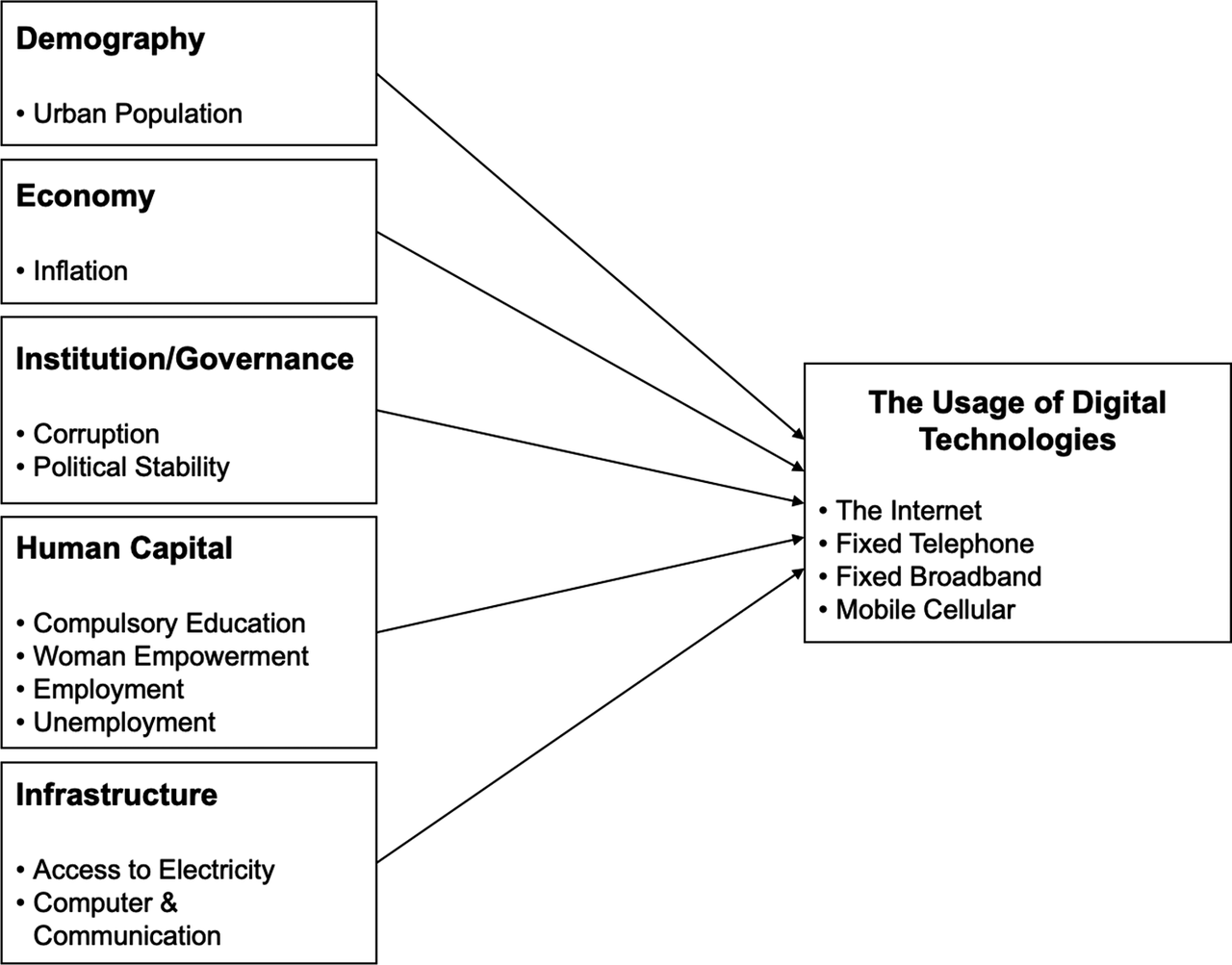
To sum up, while existing literature extensively explores factors influencing digital technology adoption, it largely focuses on developed nations, leaving developing regions like Africa underexamined. Previous studies emphasize human capital, infrastructure, and political stability but offer limited insight into how these factors interact within Africa’s unique socioeconomic and political context. This study addresses this gap by analyzing the determinants of digital technology adoption in Africa, especially in SSA. More specifically, this study examines the interplay of human capital, demographics, institutional frameworks, infrastructure, and economic conditions. Therefore, based on the gap and the proposed hypotheses as explained in the literature review, the conceptual model used in this study is depicted in Figure 1.
The conceptual model of the study.
Method
This paper is intended to explore the usage of the Internet and three digital technologies in Sub-Saharan Africa, including mobile phones, fixed broadband, and fixed telephones. Sub-Saharan Africa includes East, Central, Southern, and West Africa, excluding North Africa. We are interested in studying SSA and not the whole continent, given the higher economic prosperity of the North Africa region, so this study is expected to better understand phenomena in less prosperous areas of the continent. As a panel study, this research used all 48 countries in SSA according to World Bank, and multi-year data from 2006 to 2022 to allow us to capture long-term effects (Stock and Watson, Reference Stock and Watson2020), such as the effects of policies and policy changes, the economy, and other government interventions. The data was sourced from the World Bank’s Development Indicators (The World Bank, 2023), a comprehensive database that includes cross-country development data for 217 countries. The World Bank gathers this data from various primary sources, including national statistical agencies, central banks, and customs services worldwide.
In order to test the hypotheses as depicted in the conceptual model in Figure 1, this study uses variables listed in Table 1. The variables in the study are selected based on the availability of the data in the World Development Indicator’s database and the number of null values. There are ten independent variables within five categories. Technology usage comprises four variables, i.e., Internet, fixed telephone, fixed broadband, and mobile cellular—which represent the dependent variables in our study.
Variables and data types used in the study

The data is analyzed in two phases. We use R in conducting these two analyses. First, we conduct descriptive statistics and correlation analysis, and then second, we perform an inferential statistics analysis using a panel regression package in R called PLM. The descriptive analysis is performed to obtain the data summary, especially the dataset’s central tendency and dispersion. Correlation analysis is performed to check the relationships between variables. The inferential statistics analysis is conducted using a panel regression model because of the characteristics of the data, i.e., time series that indicate longitudinal data and cross-sectional or multi-countries. This panel data model covers three estimation methods: Pooled Ordinary Least Squares (OLS), Random Effects, and Fixed Effects. The Ordinary Least Squares (OLS) is a method in linear regression that finds the best-fitting line by minimizing the sum of squared differences between observed and predicted values. It is widely used for its simplicity and effectiveness in estimating relationships between variables. In random effects, the individual-specific error components are selected at random. In the fixed model, the individual specific is a random variable that can correlate with the explanatory variables (Hanck et al., Reference Hanck, Arnold, Gerber and Schmelzer2019). The PLM package has included the three estimation methods. The panel regression is run for the four scenarios: 1) factors that influence the individuals using the Internet, 2) factors influencing fixed telephone subscriptions, 3) factors influencing fixed broadband subscriptions, and 4) factors influencing the subscription of mobile cellular in SSA.
Results
The results are presented according to the two analyses. The first one is the description and correlation, where the summary of the data’s features is presented and the relationships among all variables in the model are checked. The correlation analysis serves as the basis for the next analysis, the inferential analysis, where factors influencing the usage of digital technologies in SSA are investigated.
Description and correlation analysis
Table 2 presents the descriptive statistics summarizing all variables used in this study. The table shows that all variables have a wide range of values, indicated by the smallest, maximum, and mean values. The dataset contains values that vary from a relatively low minimum to a significantly higher maximum. Regarding the dispersion of the data, it is indicated that there is significant variability. However, compulsory education is the only variable that shows a low variability in the data, as its standard deviation is relatively low relative to the mean.
Descriptive statistics

Figure 2 presents the mean of the usage of the three technologies per 100 people. The figure shows that among the three communication technologies, mobile phone subscribers surpass the subscriptions of other technologies. The number of mobile phone subscribers in SSA has grown significantly, from 20 subscribers per 100 people in 2006 to around 93 subscribers per 100 in 2022. In contrast, stagnation is seen in the subscribers of fixed telephones and high-speed Internet. Based on the figure, the number of subscribers of fixed broadband and fixed telephone was less than ten subscribers per 100 people in 2006. In 2022, the number did not vary significantly, with both technologies having less than ten subscribers per 100 inhabitants.
The subscribers of the three technologies from 2006 to 2022.

Considering that the growth of mobile phone subscribers has shown significant progress from year to year, it is also interesting to see how Internet access is progressing in SSA. Figure 3 portrays the percentage of individuals using the Internet from 2006 to 2022. We observed a comparable trend in mobile phone subscriptions, where the number of individuals using the Internet grew substantially from year to year. As the fixed broadband subscribers were relatively small, we can conclude that most Sub-Saharan Africans relied on mobile subscriptions to access the Internet.
The subscribers of the individuals using the Internet from 2006 to 2022.

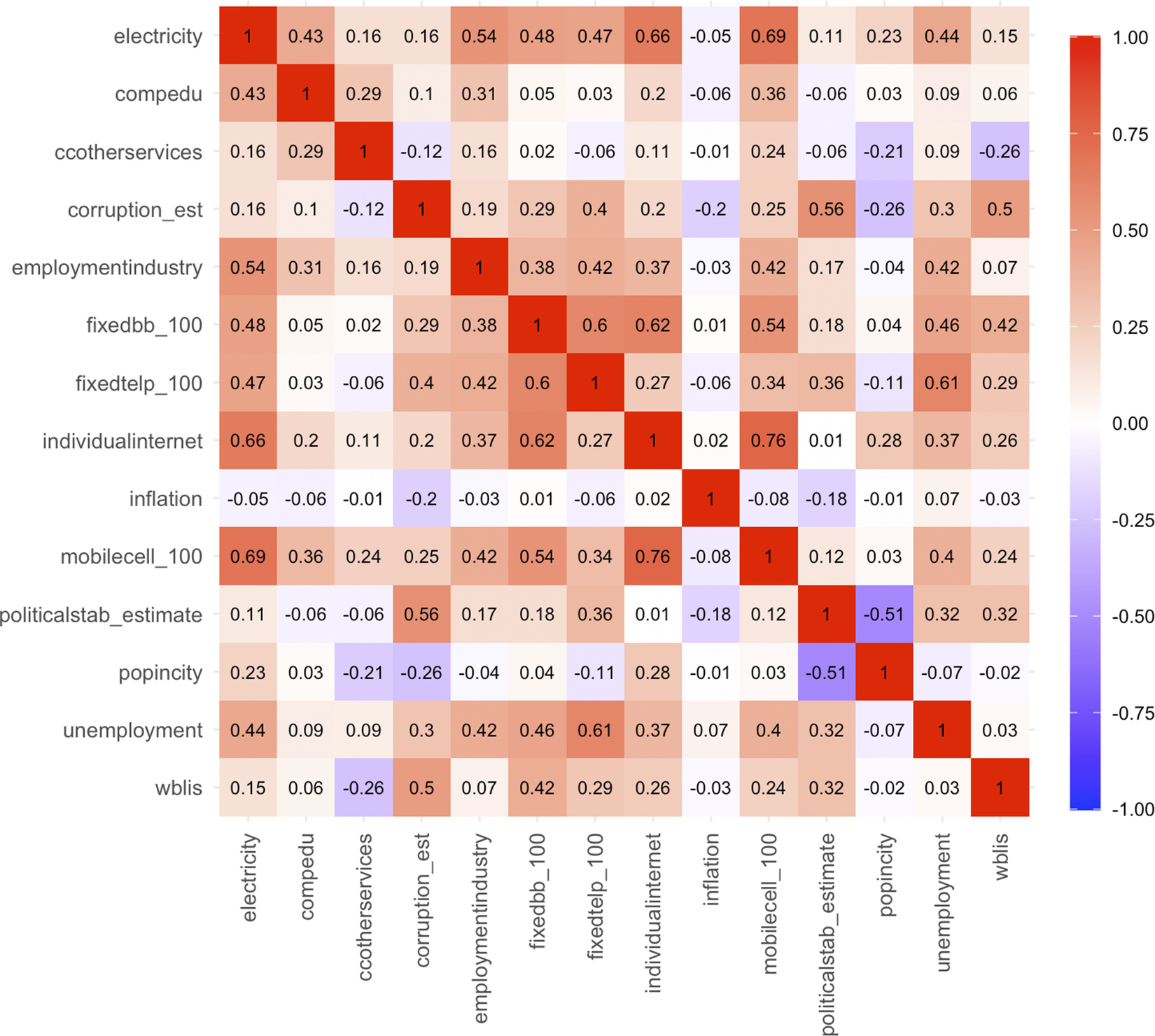
We performed a correlation analysis, as shown in Figure 4, to assess the relationships between the independent variables and check for multicollinearity—where two or more variables are highly correlated. While some studies use a threshold of 0.7 to indicate strong correlation (Tabachnick et al., Reference Tabachnick, Fidell and Ullman2018), we use 0.8 as our threshold. Political stability and corruption have a correlation coefficient of 0.72, which is below our threshold, so both variables are retained. Other predictors show weak correlations with each other.
The correlation among variables.
Inferential analysis
After performing the descriptive and correlation analysis, we conducted a panel regression to examine factors influencing digital technology usage in SSA, using three models available in the PLM package in R: Pooled Ordinary Least Squares (OLS), Random Effects, and Fixed Effects. To select the appropriate model, we conducted three tests: the LM test for Random Effects versus OLS, the LM test for Fixed Effects versus OLS, and the Hausman test for Fixed versus Random Effects (Hanck et al., Reference Hanck, Arnold, Gerber and Schmelzer2019; Hausman, Reference Hausman1978). The Hausman test, which evaluates whether the individual effects are correlated with the regressors, indicated that the Fixed Effects model was the most suitable for our analysis. Thus, based on the Hausman test results, we used the Fixed Effects model to perform the regression analysis. We summarized the results in Table 3. For each dependent variable—individuals using the Internet, fixed broadband, fixed telephone, and mobile phone—the p-value associated with the coefficient for the independent variables is reported.
Regression of factors influencing communication technology usage in SSA

Note. *** p < .001, ** p < .01, *p < .05.
According to Table 3, individuals using the Internet in SSA are influenced by several factors, including infrastructure, human capital, institutions, and demography. In the infrastructure category, having access to electricity and computers, communication, and other services is positively associated with SSA’s internet access. Human capital also plays an important role in addressing the access divide in SSA. The table indicates that education and women’s empowerment positively and significantly impact Internet access in SSA. Institutions’ role in controlling corruption is another positive contributor to increasing the number of individuals using the Internet. In addition, demography determines the access divide in SSA, as the population in the largest city significantly contributes to individuals using the Internet. The larger the population in the largest city, the larger the number of individuals using the Internet. Unexpectedly, inflation does not have any link to individuals using the Internet, and the same is true for the number of employed and unemployed individuals. Political stability also has no association with the access divide in SSA.
Only a few variables seem to be associated with the number of fixed broadband subscribers in SSA. Infrastructure and human capital are two categories with the strongest correlation, while social demography has a lower association with fixed broadband subscribers. The number of fixed broadband subscribers is determined by access to electricity, proving that infrastructure significantly contributes to fixed broadband subscriptions. The role of women in business is also a significant predictor, indicating the importance of human capital in high-speed Internet subscriptions. Although the association is quite low, political stability and unemployment are significant predictors of broadband subscribers. Other variables such as computers, telecommunication and services, education, inflation, control of corruption, employment in industry, and population in the largest city do not seem to be associated with the number of high-speed Internet subscribers in SSA.
Human capital, socio-demography, and infrastructure are significant contributors to fixed telephone subscriptions in SSA. Women’s contribution to business and law has a positive link to fixed telephone subscriptions, marking the importance of human capital to fixed telephone usage in SSA. Employment in an industry also positively influences the number of fixed telephone subscribers. The fixed telephone subscribers are also determined by unemployment in SSA. Computer, communication, and other services also have a positive correlation with fixed telephone subscriptions, as well as access to electricity. It underscores the role of infrastructure in increasing the adoption of fixed telephones in Africa. Meanwhile, other variables, including education, inflation, control of corruption, political stability, and population in the city, are not associated with the usage of fixed telephones in SSA.
Some factors, including infrastructure, human capital, institutions, and socio-demography, determine mobile phone subscribers. In the infrastructure category, access to electricity and computers, communication, and other services positively influence the number of mobile phone subscribers. Women empowerment also has a positive link to mobile subscribers, denoting the important role of human capital. The number of unemployment also has a positive correlation with the subscribers. The institution factor also highlights the contribution of political stability and control of corruption, as both have a positive association with the number of mobile phone subscriptions. In addition, the population size of the largest cities also contributes to mobile phone adoption in Africa.
The heat map as presented in Figure 5 presents the significance of factors affecting communication technology usage in SSA, using the negative log of the p-value (−log10(p-value) to allow for easier visual identification and enhance interpretability by transforming small p-values into larger values.
The heat map of regression significance levels.

Regarding the R-squared values to check how well the regression model fits the data, we realize the values are pretty low in several technologies, especially fixed broadband and fixed telephone, where the values are 25.77% and 18.81%, respectively. It means that only 25.77% of the variation in fixed broadband is explained by the variables, whereas the remaining 74.23% is not defined yet. The same case goes for fixed telephone subscriptions, where the model cannot explain 81.19% of variations. Nevertheless, we want to understand the association between the predictors and the outcome variable. Therefore, the low values of R-squared are not the concern of our study (Gelman and Hill, Reference Gelman and Hill2006).
Discussion
Building on the findings, this section discusses the implications of the key factors influencing digital technology adoption in SSA. Firstly, based on the panel data analysis, factors associated with the usage of the three communication technologies are different from one technology to another. However, our finding suggests that access to electricity and women’s role are the main contributors to digital adoption in SSA. The number of subscribers of fixed telephone, fixed broadband, and mobile phones is determined by access to electricity and women’s role, as these variables correlate positively to the subscriptions of the three technologies. The significant importance of electricity in our finding validates other previous scholars on global digital divides (Bagchi, Reference Bagchi2005; Cruz-Jesus et al., Reference Cruz-Jesus, Oliveira and Bacao2018; Houngbonon et al., Reference Houngbonon, Le Quentrec and Rubrichi2021; Shirazi and Hajli, Reference Shirazi and Hajli2021). As over 580 million Africans do not have access to electricity (Noumba and Nguea, Reference Noumba and Nguea2023), the African government should focus on this aspect in order to bridge the digital divide. In terms of women’s role, Africa is noted as the continent with the highest number of women entrepreneurs (Blake, Reference Blake2023). Our finding implies that the participation of women in industries must be promoted in improving access to the Internet and the three modalities. Thus, barriers to women’s participation in business, such as not being able to own a smartphone and lower levels of education (Porfido and Marks, Reference Porfido and Marks2020) should be addressed. Affordability and digital literacy should be the priorities of African governments in order to increase the participation of women in businesses.
Secondly, our finding shows that computers, communications, and other services positively influence the number of subscriptions to fixed telephones and mobile phones and the percentage of individuals using the Internet. Gulati and Yates (Reference Gulati and Yates2010) elucidated this as a sign of technological development due to several reasons. People can use them to access to more digital services and communication channels, which leads to an increase in the digital economy. Consequently, people’s reliance on digital technologies is likely to be heightened. The African government should create policies that boost innovation and competition in telecommunications industries.
Thirdly, human capital seems to influence the usage of some technologies. While employment in industry significantly influences the adoption of fixed telephones, interestingly, unemployment also correlates positively with the adoption of fixed broadband, fixed telephones, and mobile phones. It was reported that in 2018, the proportion of youth with employed and unemployed ones was 58%:43% (Statista, 2018). It implies that people without a job spend their time accessing technology. However, Ogbonna (Reference Ogbonna, Adediran, Oloko and Isah2023) found that technology adoption could also reduce unemployment.
Next, in the institution’s category, a factor that contributes uniquely to our study is corruption. We notice that most literature suggests that technology adoption plays a significant role in fighting corruption (Ben Ali and Gasmi, Reference Ben Ali and Gasmi2017; Sassi and Ben Ali, Reference Sassi and Ben Ali2017; Adam and Fazekas, Reference Adam and Fazekas2021). Technology tracks government spending and could be posted on government websites, where citizens could verify the accountability of their governments. Also, technology adoption helps to bring about open government, which brings about freedom of information and media access (Ayinde et al., Reference Ayinde, Astuti, Hussain, Herdiyanti, Sserwanga, Goulding, Moulaison-Sandy, Du, Soares, Hessami and Frank2023). This establishes government transparency, citizen engagement, public trust, and sustainability in the government (Adam and Fazekas, Reference Adam and Fazekas2021). Our findings, however, show that control of corruption also positively influences technology usage. A country with good control of corruption also matters to its technology adoption. However, Adam and Fazekas (Reference Adam and Fazekas2021) explained that the rule of law should be established to fight corruption levels in Africa in relation to the adoption of digital technology.
In the institution’s category, political stability is also considered a significant factor in increasing mobile phone subscribers. Our finding suggests that the good functioning of the governance system supports the usage of technology in Africa. This finding also validates previous studies that emphasized the effects of political instability on innovation (Bastian and Tucci, Reference Bastian and Tucci2009; Nadeem et al., Reference Nadeem, Liu, Ali, Younis, Bilal and Xu2020).
Finally, past studies have identified economic factors such as inflation as a barometer for technology adoption (Tambotoh et al., Reference Tambotoh, Manuputty and Banunaek2015). However, our study suggested that inflation might not be influential in digital adoption, especially in Africa. In other words, the higher inflation in African cities does not determine the level of digital technology adoption in terms of access to the internet, broadband devices, and telephones in Africa. Therefore, we argued that the government should identify the above factors explained in their study to drive digital transformation in Africa.
Conclusion
To sum up, our findings show that the use of digital technology in Sub-Saharan Africa could be boosted through their political stability, women’s economic involvement, and access to electricity. These factors help mobile phone, broadband, and fixed phone subscriptions, so highlighting the need to address infrastructural barriers and so promoting gender inclusion. The adoption of technology is contingent upon the stability of political situations and strong governance. Controlling corruption and providing access to technology services are also equally crucial, even though inflation and other economic factors are considered less important. Besides, African governments should give priority to infrastructure, women’s assistance, political stability, and anti-corruption initiatives in order to accelerate the pace of digital adoption.
Though the study provides insights on technology adoption in African settings, it has several limitations. This study used data from the World Bank Indicator’s database, from which the available variables that we could capture were limited. In the future, this research could be expanded by integrating other variables from different sources, therefore helping to better grasp the elements influencing technology acceptance in Africa. Moreover, adoption rates of high-speed broadband in Africa are still somewhat low, and it is still in the development phase. Given the increased interest of developed countries in investing in Africa, future research might, however, focus on tracking the evolution of broadband connectivity in Africa, assessing its usage among African populations, and projecting prospective trends in broadband acceptance. Moreover, this study may be enlarged to investigate the acceptance.
Data availability statement
This study used original data sourced from the World Bank Development Indicators at https://databank.worldbank.org/source/world-development-indicators, with selected indicators. The original dataset with the selected indicators and R scripts for preprocessing and data analysis are openly available in the Open Source Framework (OSF) repository at http://doi.org/10.17605/OSF.IO/ATRW9.
Author contribution
Hanim M. Astuti—Conceptualization, Data Curation, Methodology, Software, Formal Analysis, Visualization, Writing. Lateef Ayinde—Conceptualization, Methodology, Formal Analysis, Writing.
Competing interest
The authors declare no competing interests exist.
Funding statement
This work received no specific grant from any funding agency, commercial or not-for-profit sectors.


 Open access


Comments
No Comments have been published for this article.