





Introduction
Lowbush blueberries are produced on more than 67,000 ha in Canada and had a farm gate value of Can$47.4 million in 2017 (Anonymous 2019). Commercial fields are established from native stands in which blueberry plants spread through underground rhizomes and eventually become the dominant plant species (Eaton Reference Eaton1994; Hall Reference Hall1959; Yarborough and Bhowmik Reference Yarborough and Bhowmik1989). The crop is managed on a 2-yr cycle during which plants are pruned to ground level by flail mowing in the first year (nonbearing year) to stimulate new shoot growth and flower bud formation, and shoots flower and produce berries in the second year, or bearing year (Eaton et al. Reference Eaton, Glen and Wyllie2004). Lack of tillage and crop rotation promotes the occurrence of perennial weeds (Lyu et al. Reference Lyu, McLean, McKenzie-Gopsill and White2021; McCully et al. Reference McCully, Sampson and Watson1991), with perennial grasses becoming serious weeds due to natural tolerance or evolved resistance to several commonly used herbicides in lowbush blueberry (Burgess Reference Burgess2002; Jensen and Yarborough Reference Jensen and Yarborough2004; White Reference White2019; Yarborough and Cote Reference Yarborough and Cote2014).
Hair fescue is a tuft-forming perennial grass and is currently the fourth most common weed species in lowbush blueberry fields in Nova Scotia (Lyu et al. Reference Lyu, McLean, McKenzie-Gopsill and White2021). Tufts form dense sods that reduce lowbush blueberry yield (White Reference White2019; Zhang Reference Zhang2017) and inhibit harvest. Hair fescue was traditionally managed in lowbush blueberry fields with hexazinone, terbacil, and pronamide (Jensen Reference Jensen1985; Jensen and Yarborough Reference Jensen and Yarborough2004; Sampson et al. Reference Sampson, McCully and Sampson1990), though efficacy and economic viability of these herbicides has not remained consistent. Hexazinone no longer controls hair fescue (White Reference White2019; Zhang Reference Zhang2017) due to suspected, but as-of-yet unconfirmed, resistance (Jensen and Yarborough Reference Jensen and Yarborough2004; Yarborough and Cote Reference Yarborough and Cote2014). Terbacil kills hair fescue seedlings (White Reference White2018), but efficacy on established populations of larger tufts is variable in Nova Scotia (White and Zhang Reference White and Zhang2021a; Zhang et al. Reference Zhang, White, Olson and Pruski2018), and many growers no longer use this herbicide due to recent increases in product cost. Pronamide provides consistent control (>90%) of hair fescue (White Reference White2019; White and Zhang Reference White and Zhang2020; White and Zhang Reference White and Zhang2021a) but costs >Can$500.00 ha−1, which limits routine use of this herbicide by growers. Hair fescue is also tolerant to sethoxydim and fluazifop-p-butyl, the currently registered herbicides that inhibit acetyl-CoA carboxylase (White and Graham Reference White and Graham2021), forcing most growers to rely on postemergence (POST) applications of foramsulfuron and nicosulfuron + rimsulfuron to suppress hair fescue (White and Kumar Reference White and Kumar2017; White and Zhang Reference White and Zhang2020; Zhang Reference Zhang2017).
Foramsulfuron and nicosulfuron + rimsulfuron are sulfonylurea herbicides that control weeds by inhibiting the enzyme acetolactate synthase (ALS), which is required for catalyzing the first step in the biosynthetic pathway for the branch-chain amino acids isoleucine, valine, and leucine (Kishore and Shah Reference Kishore and Shah1988; McCourt et al. Reference McCourt, Pang, King-Scott, Guddat and Duggleby2006; Ray Reference Ray1984; Rhodes et al. Reference Rhodes, Hogan, Deal, Jamieson and Haworth1987; Zhou et al. Reference Zhou, Liu, Zhang and Liu2007). The resulting lack of these amino acids results in protein deficiency and other deleterious effects that cause injury or death in susceptible plant species (Bestman et al. Reference Bestman, Devine and Vanden Born1990; Gaston et al. Reference Gaston, Ribas-Carbo, Busquets, Berry, Zabalza and Royuela2003; Ray Reference Ray1984; Rhodes et al. Reference Rhodes, Hogan, Deal, Jamieson and Haworth1987). The ALS-inhibiting herbicides are among the only herbicides known to provide selective POST suppression or control of Festuca spp. (Derr Reference Derr2012; Ferrel et al. Reference Ferrel, Murphy, Waltz and Yelverton2004; Lycan and Hart Reference Lycan and Hart2004). This is further confirmed by recent confirmation of flazasulfuron efficacy on hair fescue (Zhang et al. Reference Zhang, White, Olson and Pruski2018) and subsequent registration of this herbicide in lowbush blueberry. Exclusive use of ALS-inhibiting herbicides for weed management, however, poses significant risk for the evolution of herbicide-resistant weed biotypes (Beckie and Reboud Reference Beckie and Reboud2009; Tranel and Wright Reference Tranel and Wright2002).
Herbicide resistance can be managed by chemical and nonchemical means (Norsworthy et al. Reference Norsworthy, Ward, Shaw, Llewellyn, Nichols, Webster, Bradley, Frisvold, Powles, Burgos, Witt and Barret2012), with use of mixtures of multiple effective herbicide modes of action being an important tactic in cropping systems that rely on herbicides for management of important weed species (Beckie and Reboud Reference Beckie and Reboud2009). Glyphosate and glufosinate are currently registered for use in lowbush blueberry and, like ALS-inhibiting herbicides, control weeds by inhibiting amino acid synthesis. Glyphosate inhibits the enzyme 5-enolpyruval-shikimate-3-phosphate synthetase (EPSPS), preventing formation of the aromatic amino acids phenylalanine, tyrosine, and tryptophan (Duke and Powles Reference Duke and Powles2008), whereas glufosinate inhibits the enzyme glutamine synthetase, which is required to convert ammonium plus glutamate to glutamine (Gill and Eisenberg Reference Gill and Eisenberg2001; Siehl Reference Siehl, Roe, Burton and Kuhr1997). Mixtures of amino acid–inhibiting herbicides can improve control of some weed species (Kudsk and Mathiassen Reference Kudsk and Mathiassen2004), but this has not been evaluated on hair fescue in lowbush blueberry.
The objective of this research was to evaluate spring nonbearing-year, fall nonbearing-year, and fall bearing-year applications of foramsulfuron, nicosulfuron + rimsulfuron, and flazasulfuron alone and in mixture with glyphosate and glufosinate for hair fescue management and crop tolerance in lowbush blueberry fields.
Materials and Methods
Experimental Design
The experiment was arranged as a 4 × 3 factorial arrangement of Group 2 herbicide (as classified by the Weed Science Society of America): none, foramsulfuron (Option 2.25 OD herbicide, Bayer CropScience, Calgary, AB, Canada), nicosulfuron + rimsulfuron (Ultim 75DF herbicide, Corteva Agriscience, Calgary, AB, Canada), flazasulfuron (Chikara herbicide, ISK Biosciences Corporation, Concord, OH, USA), and mixture (none, glyphosate [Roundup Weathermax herbicide, Monsanto Canada Inc., Winnipeg, MN, Canada], or glufosinate [Ignite herbicide, BASF Canada Inc., Mississauga, ON, Canada]) arranged in a randomized complete block design with four blocks and 2-m × 4-m plot size. Herbicides were applied in spring of the nonbearing year, fall of the nonbearing year, and fall of the bearing year, with each application timing conducted as a separate experiment. Foramsulfuron, nicosulfuron + rimsulfuron, flazasulfuron, and glufosinate were applied at 35, 13 + 13, 50, and 750 g ai ha−1, respectively. Glyphosate was applied at 902 g ae ha−1. Foramsulfuron was applied in conjunction with 2.5 L ha−1 of 28-0-0 liquid fertilizer adjuvant in both solitary and mixture applications. Nicosulfuron + rimsulfuron and flazasulfuron were applied in conjunction with 0.2% vol/vol non-ionic surfactant in both solitary and mixture applications.
The spring nonbearing-year experiment was established in two nonbearing-year lowbush blueberry fields located near Camden (45.300157°N, 63.183758°W) and Collingwood (45.590865°N, 63.812052°W), Nova Scotia, Canada. Trials were established on May 16 and May 17, 2019, at Camden and Collingwood, respectively. Herbicides were applied on May 17, 2019, at each site, POST to vegetative (non-flowering) hair fescue tufts and preemergence (PRE) to lowbush blueberry. Mean air temperature, relative humidity, and wind velocity at the time of herbicide applications were 11.6 C, 65.8%, and 2.4 km h−1, respectively, at Camden, and 9.8 C, 75.2%, and 3.2 km h−1, respectively, at Collingwood. The fall nonbearing-year experiment was established in two nonbearing-year lowbush blueberry fields located at North River (45.463923°N, 63.213010°W) and Earltown (45.605615°N, 63.183885°W), Nova Scotia. The trial was established at each site on October 22, 2020, and herbicides were applied at North River and Earltown on November 7, 2020, and November 20, 2020, respectively. Herbicide application timing was based on a 90% lowbush blueberry leaf drop threshold for fall glyphosate applications (Anonymous 2015), and mean lowbush blueberry percent leaf drop at the time of herbicide applications was 87% ± 2% and 99% ± 1% at North River and Earltown, respectively. Hair fescue was not exposed to herbicides prior to plot establishment and had therefore flowered during the summer and retained spent inflorescences by the time of fall nonbearing-year herbicide applications. Mean air temperature, relative humidity, and wind velocity at the time of herbicide applications were 8.9 C, 73%, and 3.2 km h−1, respectively, at Earltown and 22 C, 78%, and 1.6 km h−1, respectively, at North River. The fall bearing-year experiment was established in two bearing-year lowbush blueberry fields located at Camden (45.299551°N, 63.156692°W) and Greenfield (45.392551°N, 63.136464°W), Nova Scotia. Fields were pruned by flail mowing prior to trial establishment at each site, though hair fescue tufts retained green leaves after pruning because flail mowing does not cut plants completely to ground level. The trial was established at each site on October 24, 2019, and herbicides were applied at each site on October 29, 2019. Mean air temperature, relative humidity, and wind velocity at the time of herbicide applications were 14.4 C, 39%, and 1.8 km h−1, respectively, at Camden and 14.2 C, 55%, and 3 km h−1, respectively, at Greenfield. Herbicide treatments in all experiments were applied using a CO2-pressurized research plot sprayer equipped with four HYPRO ULD 120-02 nozzles and calibrated to deliver 200 L water ha−1 for each herbicide at a pressure of 276 kPa.
Data Collection
Nonbearing-year data collection for hair fescue in the spring nonbearing-year experiment included total tuft density at the time of herbicide applications, summer vegetative and flowering tuft density on June 26 and June 27, 2019, at Camden and Collingwood, respectively; tuft inflorescence number on July 3 and 4, 2019, at Camden and Collingwood, respectively; and fall total tuft density on October 15 and September 25, 2019, at Camden and Collingwood, respectively. Bearing-year data collection for hair fescue in this experiment included vegetative and flower tuft density on June 24 and June 25, 2020, at Camden and Collingwood, respectively.
Data collection for hair fescue in the fall nonbearing-year experiment included total tuft density at the time of herbicide applications; bearing-year vegetative and flowering tuft density on June 15 and June 23, 2021, at North River and Earltown, respectively; and bearing-year tuft inflorescence number on July 15, 2021, at each site.
Nonbearing-year data collection for hair fescue in the fall bearing-year experiment included total tuft density at the time of herbicide applications; summer vegetative and flowering tuft density on June 22 and June 23, 2020, at Camden and Greenfield, respectively; tuft inflorescence number on July 7 and July 9, 2020, at Camden and Greenfield, respectively; and fall total tuft density on October 15, 2020, at each site. Bearing-year data collection for hair fescue in this experiment included vegetative and flower tuft density on June 9 and June 17, 2021, at Camden and Greenfield, respectively.
Data collection for lowbush blueberry in the spring nonbearing-year and fall bearing-year experiments included stem density, height, and flower bud number per stem in the nonbearing year and yield in the bearing year. Stem density was determined in the spring nonbearing-year experiment on July 24 and July 22, 2019, at Camden and Collingwood, respectively; and in the fall bearing-year experiment on August 18, 2020, at both Camden and Greenfield. Stem height and flower bud number per stem were determined in the spring nonbearing-year experiment on October 16 and October 2, 2019, at Camden and Collingwood, respectively; and in the fall bearing-year experiment on October 15, 2020, at both Camden and Greenfield. Yield in the spring nonbearing-year experiment was determined on August 13 and August 17, 2020, at Camden and Collingwood, respectively; and in the bearing-year experiment on August 4, 2021, at both Camden and Greenfield. Data collection for lowbush blueberry in the fall nonbearing-year experiment was limited to yield, which was determined on August 9, 2021, at both North River and Earltown.
Hair fescue tuft density was determined in two 1-m × 1-m quadrats per plot and tuft inflorescence number was determined on 10 tufts per plot selected using a line transect method described by White and Kumar (Reference White and Kumar2017). Lowbush blueberry stem density was determined in three 0.3-m × 0.3-m quadrats per plot and stem height and flower bud number per stem were determined on 30 stems per plot selected using the line transect method indicated above. Lowbush blueberry yield was determined by hand raking all berries in two 1-m × 1-m quadrats per plot. Quadrat and transect-based data were averaged in each plot for use in the final analysis. Objective data were also supplemented with subjective visual injury ratings of herbicide injury on hair fescue and lowbush blueberry using a 0 to 100 scale where 0 = no injury and 100 = complete plant death. Ratings were determined based on chlorosis, necrosis, and reduced growth of both hair fescue and lowbush blueberry and were always conducted by the author to ensure consistency.
Statistical Analysis
The significance of Group 2 herbicide, mixture, and the Group 2 herbicide × mixture interaction on all hair fescue and lowbush blueberry response variables was determined using ANOVA in the MIXED procedure of SAS software (Statistical Analysis System, version 9.4, SAS Institute, Cary, NC). Main and interaction effects were modeled as fixed effects in the analysis, and blocks were modeled as a random effect. Main and interactive effects were considered significant at α = 0.05. Assumptions of normality and constant variance for all analyses were assessed using the UNIVARIATE procedure in SAS, and data were LOG(Y+1) or SQRT(Y+1) transformed where necessary to achieve normality and constant variance. Means separation, where necessary, was conducted using a Tukey’s test at α = 0.05.
Results and Discussion
Hair Fescue Response to Herbicide Treatments
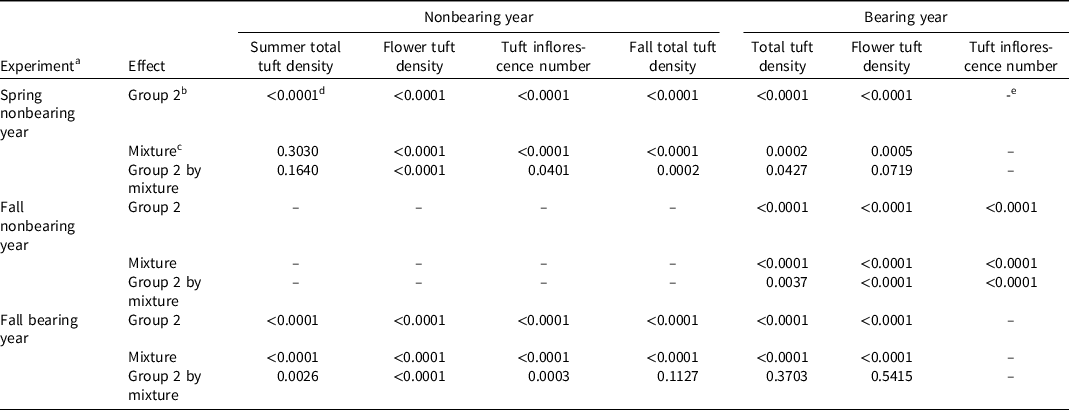
Significance of main and interactive effects of site varied across hair fescue response variables, but there was no site by Group 2 by mixture interaction effect on any hair fescue response variables in any experiment (P ≥ 0.05). Hair fescue response variables were therefore pooled across sites for analysis within each experiment. There was a significant Group 2 effect on all hair fescue response variables in each experiment, and a significant mixture effect on all hair fescue response variables except summer total tuft density in the spring nonbearing-year experiment (Table 1). There was also a significant Group 2 by mixture interaction effect on nonbearing-year flower tuft density, tuft inflorescence number, and fall total tuft density; bearing-year total tuft density in the spring nonbearing-year experiment; all hair fescue response variables in the fall nonbearing-year experiment; and all nonbearing-year response variables except fall total tuft density in the fall bearing-year experiment (Table 1).
Effect of Group 2 herbicide, mixture, and the Group 2 herbicide by mixture interaction on nonbearing and bearing-year hair fescue response variables.
a Spring nonbearing year herbicides were applied postemergence (POST) to hair fescue and preemergence (PRE) to lowbush blueberry on May 17, 2019, at Camden and Collingwood. Fall nonbearing-year herbicides were applied POST to hair fescue and lowbush blueberry but after approximately 90% lowbush blueberry leaf drop. Herbicides were applied on November 7, 2020, and November 20, 2020, at North River and Earltown, respectively. Fall bearing-year herbicides were applied after field pruning and POST to the retained hair fescue leaves on October 29, 2019, at Camden and Greenfield.
b Foramsulfuron, nicosulfuron + rimsulfuron, and flazasulfuron were applied at application rates of 35, 13 + 13, and 50 g ai ha−1, respectively. Foramsulfuron was applied in conjunction with 28-0-0 UAN (urea ammonium nitrate) liquid nitrogen fertilizer at an application rate of 2.5 L ha−1. Nicosulfuron + rimsulfuron and flazasulfuron were applied in conjunction with 0.2% vol/vol non-ionic surfactant.
c Glyphosate and glufosinate were applied at application rates of 902 g ae ha−1 and 750 g ai ha−1, respectively.
d P-values obtained from an ANOVA using the MIXED procedure in SAS software. All data were pooled across sites within each experiment prior to analysis due to a nonsignificant site by Group 2 by mixture interaction effect. Values are considered significant at α = 0.05.
e Response variable not assessed in experiment.
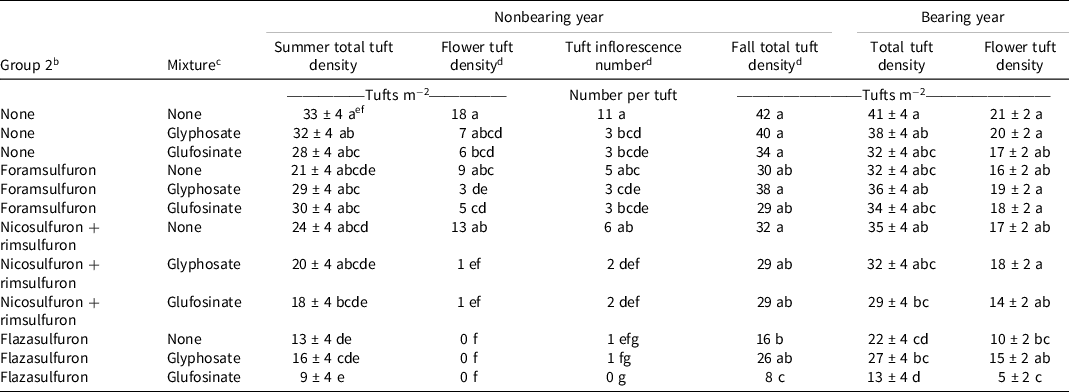
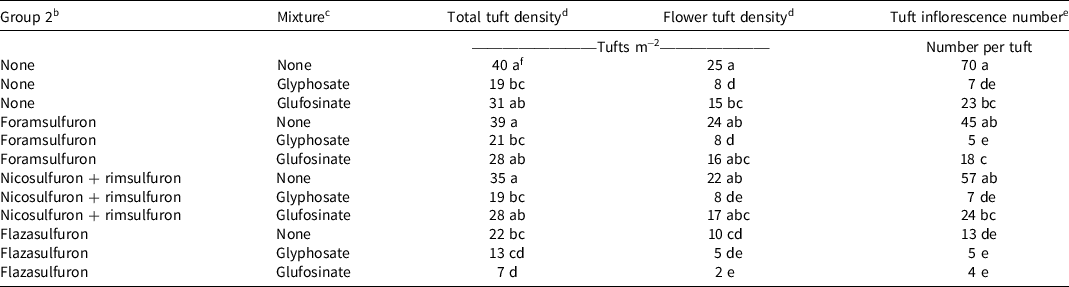
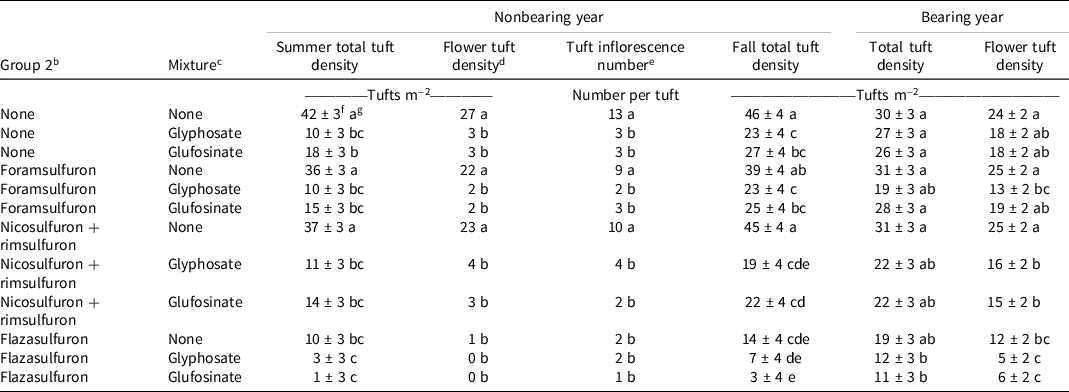
Flazasulfuron-based treatments were generally the most effective on hair fescue across all application timings (Tables 2, 3, and 4). Spring nonbearing-year flazasulfuron applications significantly reduced all nonbearing-year and bearing-year hair fescue response variables relative to no herbicide applications and provided greater hair fescue suppression than foramsulfuron and nicosulfuron + rimsulfuron (Table 2). Flazasulfuron was also more effective than foramsulfuron in previous research (Zhang et al. Reference Zhang, White, Olson and Pruski2018), but this is the first report of superior efficacy relative to nicosulfuron + rimsulfuron, glyphosate, and glufosinate. Fall applications of flazasulfuron were also effective with fall nonbearing-year flazasulfuron applications resulting in significantly reduced bearing-year total tuft density, flower tuft density, and tuft inflorescence number relative to no herbicide applications (Table 3) and fall bearing-year flazasulfuron applications significantly reducing all nonbearing-year hair fescue response variables and bearing-year flowering tuft density relative to no herbicide applications (Table 4). Zhang et al. (Reference Zhang, White, Olson and Pruski2018) reported similar efficacy of fall nonbearing-year flazasulfuron applications, and collectively these results suggest that flazasulfuron is effective as both a spring nonbearing year, fall nonbearing year, and fall bearing-year application on hair fescue.
Effect of spring nonbearing-year herbicides applied a alone and in mixture on nonbearing-year and bearing-year hair fescue response variables in lowbush blueberry fields in Camden and Collingwood in 2019 (nonbearing year) and 2020 (bearing year).
a Spring nonbearing year herbicides were applied postemergence to hair fescue and preemergence to lowbush blueberry on May 17, 2019, at Camden and Collingwood.
b Foramsulfuron, nicosulfuron + rimsulfuron, and flazasulfuron were applied at application rates of 35, 13 + 13, and 50 g ai ha−1, respectively. Foramsulfuron was applied in conjunction with 28-0-0 UAN (urea ammonium nitrate) liquid nitrogen fertilizer at an application rate of 2.5 L ha−1. Nicosulfuron + rimsulfuron and flazasulfuron were applied in conjunction with 0.2% vol/vol non-ionic surfactant.
c Glyphosate and glufosinate were applied at application rates of 902 g ae ha−1 and 750 g ai ha−1, respectively.
d Data were LOG(Y+1) transformed prior to analysis to meet assumptions of the ANOVA. Geometric means determined using the MEANS procedure in SAS software are presented.
e Values represent the mean ± SE.
f Means followed by the same letter are not significantly different according to a Tukey’s multiple means comparison test at α = 0.05.
Effect of fall nonbearing-year herbicides applied a alone and in mixture on bearing-year hair fescue response variables in lowbush blueberry fields at North River and Earltown in 2021. a
a Fall nonbearing-year herbicides were applied postemergence to hair fescue and lowbush blueberry but after approximately 90% lowbush blueberry leaf drop. Herbicides were applied on November 7, 2020, and November 20, 2020, at North River and Earltown, respectively.
b Foramsulfuron, nicosulfuron + rimsulfuron, and flazasulfuron were applied at application rates of 35, 13 + 13, and 50 g ai ha−1, respectively. Foramsulfuron was applied in conjunction with 28-0-0 UAN (urea ammonium nitrate) liquid nitrogen fertilizer at an application rate of 2.5 L ha−1. Nicosulfuron + rimsulfuron and flazasulfuron were applied in conjunction with 0.2% vol/vol non-ionic surfactant.
c Glyphosate and glufosinate were applied at application rates of 902 g ae ha−1 and 750 g ai ha−1, respectively.
d Data were SQRT(Y+1) transformed prior to analysis to meet assumptions of the ANOVA. Geometric means determined using the MEANS procedure in SAS software are presented.
e Data were LOG(Y+1) transformed prior to analysis to meet assumptions of the ANOVA. Geometric means determined using the MEANS procedure in SAS software are presented.
f Means followed by the same letter are not significantly different according to a Tukey’s multiple means comparison test at α = 0.05.
Effect of fall bearing year herbicides applied a alone and in mixture on nonbearing-year and bearing-year hair fescue response variables in lowbush blueberry fields at Camden and Greenfield in 2020 (nonbearing year) and 2021 (bearing year). a
a Fall bearing-year herbicides were applied after field pruning and postemergence to the retained hair fescue leaves on October 29, 2019, at Camden and Greenfield.
b Foramsulfuron, nicosulfuron + rimsulfuron, and flazasulfuron were applied at application rates of 35, 13 + 13, and 50 g ai ha−1, respectively. Foramsulfuron was applied in conjunction with 28-0-0 UAN (urea ammonium nitrate) liquid nitrogen fertilizer at an application rate of 2.5 L ha−1. Nicosulfuron + rimsulfuron and flazasulfuron were applied in conjunction with 0.2% vol/vol non-ionic surfactant.
c Glyphosate and glufosinate were applied at application rates of 902 g ae ha−1 and 750 g ai ha−1, respectively.
d Data were LOG(Y+1) transformed prior to analysis to meet assumptions of the ANOVA. Geometric means determined using the MEANS procedure in SAS software are presented.
e Data were SQRT(Y+1) transformed prior to analysis to meet assumptions of the ANOVA. Geometric means determined using the MEANS procedure in SAS software are presented.
f Values represent the mean ± SE.
g Means followed by the same letter are not significantly different according to a Tukey’s multiple means comparison test at α = 0.05.
Spring nonbearing-year, fall nonbearing-year, and fall bearing-year flazasulfuron mixtures with glyphosate generally did not improve hair fescue control relative to flazasulfuron alone (Tables 2, 3, and 4). Spring nonbearing-year flazasulfuron mixtures with glufosinate, however, gave greater reductions in nonbearing-year fall total tuft density than flazasulfuron alone and significantly reduced bearing-year total and flower tuft density relative to no herbicide applications (Table 2). This mixture also tended to provide the greatest reductions in all hair fescue response variables relative to the nontreated control and most other treatments (Table 2), suggesting that spring nonbearing-year applications of this mixture provide effective hair fescue suppression for the entire 2-yr production cycle. Fall nonbearing-year flazasulfuron + glufosinate applications also gave greater reductions in total and flowering tuft density relative to flazasulfuron and most other treatments (Table 3), further suggesting that this mixture is more effective than flazasulfuron alone. Fall bearing-year flazasulfuron + glufosinate mixtures, however, did not provide statistically significant reductions in nonbearing-year and bearing-year hair fescue response variables relative to flazasulfuron applications alone (Table 4), despite generally lower tuft density and flowering in the mixture treatments relative to flazasulfuron applications alone. Future research may therefore need to focus on comparison of the flazasulfuron treatments only and use increased replication to determine possible differences between mixtures and flazasulfuron applications alone.
Efficacy of other herbicides was limited or variable across application timings. Spring nonbearing-year glyphosate and glufosinate applications did not significantly reduce nonbearing-year summer or fall total tuft density relative to no herbicide applications but did significantly reduce flower tuft density and tuft inflorescence number (Table 2). Similar results were reported previously for spring nonbearing-year glufosinate applications on hair fescue (White Reference White2019; White and Kumar Reference White and Kumar2017; White and Zhang Reference White and Zhang2021b) and spring glyphosate applications reduced inflorescence number but did not kill any of 56 fineleaf turf fescues (Askew et al. Reference Askew, Askew and Goatley2019). In contrast, fall nonbearing-year glyphosate applications significantly reduced bearing-year total tuft density and fall nonbearing-year glyphosate and glufosinate applications significantly reduced bearing-year flower tuft density and tuft inflorescence number relative to no herbicide applications (Table 3). Similarly, fall bearing-year glyphosate and glufosinate applications significantly reduced all nonbearing-year hair fescue response variables relative to no herbicide applications (Table 4), suggesting that fall applications of these herbicides are more effective on hair fescue than spring applications. Fall glufosinate applications gave more consistent hair fescue suppression than spring applications in previous research (White Reference White2019; White and Zhang Reference White and Zhang2021b) and fall glyphosate applications were more effective than spring applications on red fescue (Festuca rubra L.; Comes et al. Reference Comes, Marquis and Kelley1985), further suggesting that these herbicides should be applied in fall rather than spring for hair fescue management. Hair fescue is also a cool-season grass that requires vernalization to flower (White Reference White2018). Tufts are therefore vegetative in fall and allocate resources to vegetative tillers, crowns, and roots (Jensen et al. Reference Jensen, Harrison, Chatterton, Bushman and Creech2014; Livingston 1991; Prud’Homme et al. Reference Prud’Homme, Gastal, Belanger and Boucad1993), possibly increasing susceptibility to herbicides relative to spring when plants are bolting and allocating resources to flowering.
Spring nonbearing-year, fall nonbearing-year, and fall bearing-year applications of foramsulfuron and nicosulfuron + rimsulfuron did not significantly reduce any hair fescue response variables relative to no herbicide applications (Tables 2, 3, and 4). Application of these herbicides in spring nonbearing years gave inconsistent hair fescue suppression in previous research (White and Kumar Reference White and Kumar2017; Zhang Reference Zhang2017; Zhang et al. Reference Zhang, White, Olson and Pruski2018), and these results further confirm this inconsistency. Foramsulfuron and nicosulfuron + rimsulfuron mixtures with glyphosate and glufosinate applied in spring nonbearing years, however, resulted in significantly reduced nonbearing-year flower tuft density and tuft inflorescence number relative to no herbicide applications (Table 2), with nicosulfuron + rimsulfuron + glufosinate also resulting in significantly reduced nonbearing-year summer total tuft density and bearing-year total tuft density relative to no herbicide applications (Table 2). Mixtures of foramsulfuron and nicosulfuron + rimsulfuron with glyphosate applied in spring also gave better control of annual ryegrass (Lolium multiflorum) than foramsulfuron, nicosulfuron + rimsulfuron, and glyphosate applications alone (Soltani et al. Reference Soltani, Shropshire and Sikkema2021), suggesting that mixtures of these herbicides may improve weed control. Application of foramsulfuron or nicosulfuron + rimsulfuron mixtures with glyphosate or glufosinate applied in the fall nonbearing year and fall bearing year gave similar reductions in tuft density and flowering as glyphosate and glufosinate applications alone (Tables 3 and 4), further indicating the limited efficacy of fall foramsulfuron and nicosulfuron + rimsulfuron applications on hair fescue.
Lowbush Blueberry Response to Herbicide Treatments
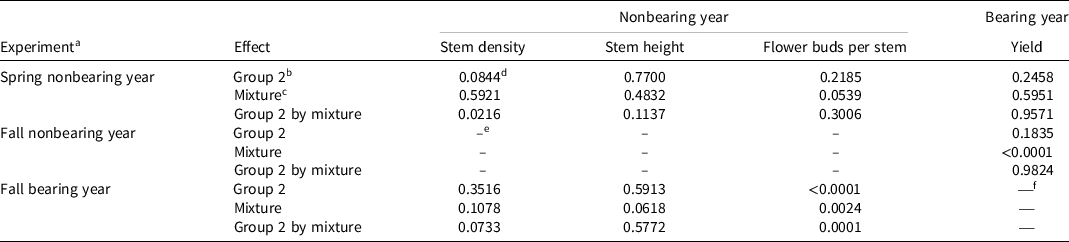
Significance of main and interactive effects of site varied across lowbush blueberry response variables, but there was no site by Group 2 by mixture interaction effect on lowbush blueberry stem density, stem height, or flower bud number per stem in any experiment or on yield in the spring nonbearing-year and fall nonbearing-year experiments (P ≥ 0.1131). These data were therefore pooled across sites for analysis. There was, however, a significant site by Group 2 by mixture interaction effect on lowbush blueberry yield in the fall bearing-year experiment (P = 0.0012) and these data were therefore analyzed separately across sites in this experiment.
There was no effect of Group 2, mixture, or the Group 2 by mixture interaction on lowbush blueberry stem height, flower bud number per stem, or yield in the spring nonbearing-year experiment (Table 5), with mean stem height, flower bud number per stem, and yield of 15.6 ± 0.3 cm, 4.2 ± 0.1 buds stem−1, and 3,217 ± 235 kg ha−1, respectively. There was, however, a significant Group 2 by mixture interaction effect on lowbush blueberry stem density (Table 5), with generally fewer stems in the glyphosate treatment relative to the other treatments (data not shown). Spring nonbearing-year glyphosate applications applied POST to red fescue but PRE to lowbush blueberry also reduced lowbush blueberry stem density (Sikoriya Reference Sikoriya2014), suggesting that glyphosate retention in the surface crop residue layer of lowbush blueberry fields may damage emerging lowbush blueberry stems. Glyphosate can remain in active form in crop residues left on the soil surface (Aslam et al. Reference Aslam, Iqbal, Lafolie, Recous, Benoit and Garnier2018), and lowbush blueberry growers should therefore use caution if considering spring nonbearing-year glyphosate applications for hair fescue management. It is unclear why hair fescue control (Table 2) failed to increase lowbush blueberry yield potential and yield in this experiment, but increases in these responses following spring nonbearing-year hair fescue suppression have been inconsistent in previous research (White Reference White2019; White and Kumar Reference White and Kumar2017; White and Zhang Reference White and Zhang2021a; Zhang et al. Reference Zhang, White, Olson and Pruski2018). Lowbush blueberry response to weed control can also take several years to manifest (Eaton Reference Eaton1994), and lack of statistical differences in lowbush blueberry response variables is not uncommon in trials limited to a single production cycle.
Effect of Group 2 herbicide, mixture, and the Group 2 herbicide by mixture interaction on nonbearing-year and bearing-year lowbush blueberry response variables in spring nonbearing-year, fall nonbearing-year, and fall bearing-year evaluations of herbicides applied alone or in mixture.
a Spring nonbearing-year herbicides were applied postemergence (POST) to hair fescue and preemergence to lowbush blueberry on May 17, 2019, at Camden and Collingwood. Fall nonbearing-year herbicides were applied POST to hair fescue and lowbush blueberry but after approximately 90% lowbush blueberry leaf drop. Herbicides were applied on November 7, 2020, and November 20, 2020, at North River and Earltown, respectively. Fall bearing-year herbicides were applied after field pruning and POST to the retained hair fescue leaves on October 29, 2019, at Camden and Greenfield.
b Foramsulfuron, nicosulfuron + rimsulfuron, and flazasulfuron were applied at application rates of 35, 13 + 13, and 50 g ai ha−1, respectively. Foramsulfuron was applied in conjunction with 28-0-0 UAN (urea ammonium nitrate) liquid nitrogen fertilizer at an application rate of 2.5 L ha−1. Nicosulfuron + rimsulfuron and flazasulfuron were applied in conjunction with 0.2% vol/vol non-ionic surfactant.
c Glyphosate and glufosinate were applied at application rates of 902 g ae ha−1 and 750 g ai ha−1, respectively.
d P-values obtained from an ANOVA using the MIXED procedure in SAS software. All data were pooled across sites within each experiment prior to analysis due to a nonsignificant site by Group 2 by mixture interaction effect unless otherwise indicated. Values are considered significant at α = 0.05.
e Response variable not assessed in experiment.
f Data were analyzed separately across sites due to significant site by Group 2 by mixture interaction effect. Significance is discussed in the text.
There was a significant effect of mixture but not Group 2 or the Group 2 by mixture interaction on lowbush blueberry yield in the fall nonbearing-year experiment (Table 5). Yield data were therefore pooled across mixtures for analysis. There was a significant mixture effect on yield (P < 0.0001), with mean yield in the no mixture, glyphosate, and glufosinate treatments of 1,200 ± 114, 345 ± 114, and 167 ± 114 kg ha−1, respectively. Visual observance of injury to lowbush blueberry from fall nonbearing-year glyphosate and glufosinate applications ranged from 9% to 91% with glyphosate injury occurring primarily as stems with stunted, chlorotic leaf growth and limited fruit number, and glufosinate injury occurring primarily as blackened stems with very few leaves or fruit. This injury, combined with yield reductions, likely precludes use of fall nonbearing-year glyphosate and glufosinate applications despite possible benefits in terms of hair fescue suppression.
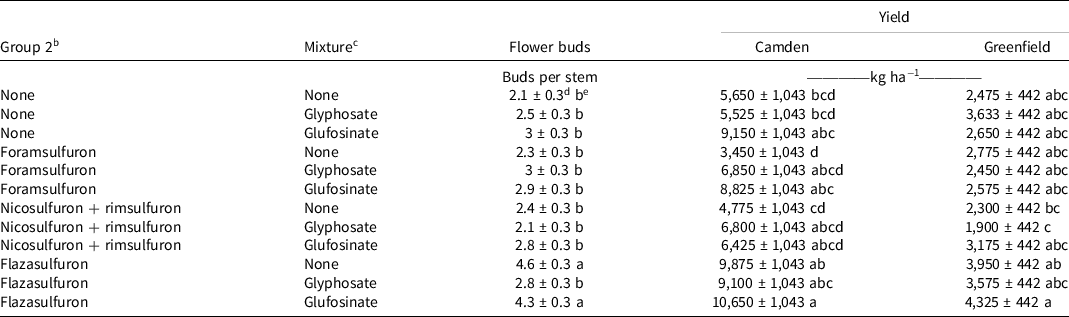
There was no Group 2, mixture, or Group 2 by mixture interaction effect on lowbush blueberry stem density or height in the fall bearing-year experiment (Table 5) with mean stem density and height of 506 ± 18 stems m−2 and 19.6 ± 0.2 cm, respectively. There was, however, a significant Group 2, mixture, and Group 2 by mixture interaction effect on lowbush blueberry flower buds per stem (Table 5) with 35% to 50% more flower buds per stem in the flazasulfuron and the flazasulfuron + glufosinate treatments relative to the other herbicide treatments (Table 6). There was also a significant Group 2 and mixture effect on yield at Camden (P ≤ 0.0004) and a significant Group 2 effect on yield at Greenfield (P = 0.0002). Application of flazasulfuron + glufosinate in the fall bearing-year experiment significantly increased yield relative to the nontreated control, glyphosate, foramsulfuron, and nicosulfuron + rimsulfuron treatments at Camden (Table 6). This yield increase reflects increased flower buds per stem in the flazasulfuron treatments (Table 6) and indicates that control of hair fescue with fall flazasulfuron applications may cause greater yield response from lowbush blueberry than spring flazasulfuron applications. Yield was generally highest in the flazasulfuron + glufosinate treatment at Greenfield as well, though overall yields at this site were lower, and differences were less pronounced relative to those at the Camden location.
Effect of fall bearing-year herbicides applied a alone and in mixture on nonbearing-year lowbush blueberry flower bud number per stem and bearing-year yield at lowbush blueberry fields in Camden and Greenfield in 2020 (nonbearing year) and 2021 (bearing year). a
a Fall bearing-year herbicides were applied after field pruning and postemergence to the retained hair fescue leaves on October 29, 2019, at Camden and Greenfield.
b Foramsulfuron, nicosulfuron + rimsulfuron, and flazasulfuron were applied at application rates of 35, 13 + 13, and 50 g ai ha−1, respectively. Foramsulfuron was applied in conjunction with 28-0-0 UAN (urea ammonium nitrate) liquid nitrogen fertilizer at an application rate of 2.5 L ha−1. Nicosulfuron + rimsulfuron and flazasulfuron were applied in conjunction with 0.2% vol/vol non-ionic surfactant.
c Glyphosate and glufosinate were applied at application rates of 902 g ae ha−1 and 750 g ai ha−1, respectively.
d Values represent the mean ± SE.
e Means followed by the same letter are not significantly different according to a Tukey’s multiple means comparison test at α = 0.05.
In conclusion, flazasulfuron-based herbicide treatments were the most effective on hair fescue. Applications of flazasulfuron in the spring nonbearing year, the fall nonbearing year, and the fall bearing year reduced hair fescue total and flowering tuft density, suggesting that this herbicide is effective as both a fall and spring treatment for hair fescue in lowbush blueberry. Flazasulfuron mixtures with glyphosate gave similar levels of hair fescue control as flazasulfuron alone across all application timings. Flazasulfuron mixtures with glufosinate, however, tended to provide greater reductions in total tuft density than flazasulfuron applications alone. This mixture would improve herbicide resistance management by providing two unique sites of action relative to flazasulfuron applications alone and is tentatively recommended as an effective mixture for spring nonbearing-year and fall bearing-year hair fescue management in lowbush blueberry fields.
Acknowledgments
Thanks to Chesley Walsh, Kevin McNutt, Steven Parks, Dale Downey, Bill Cox, Bragg Lumber Company, and Purdy Resources for providing field sites for this research. I am grateful for the field assistance of Jianan Lin, Lienna Hoeg, Vanessa Deveau, Hugh Lyu, Rakesh Menapati, Alicia Cattiaux-Fraser, and Janelle MacKeil. Funding for this research was provided by the Natural Sciences and Engineering Research Council (NSERC CRDPJ 500615), the Wild Blueberry Producers Association of Nova Scotia, Belchim Crop Protection Canada, and ISK BioSciences. No conflicts of interest have been declared.


 Open access

