




No CrossRef data available.
Article contents
Transparent carbon nanotube electrodes for electric cell–substrate impedance sensing
Published online by Cambridge University Press: 30 August 2019
Abstract
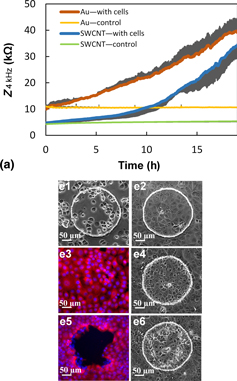
Electric cell–substrate impedance sensing is widely used to study cell behavior such as adhesion, migration, and cell toxicity. However, a simultaneous optical imaging of cells is limited by inefficient transmission of visible light through the gold electrodes. To overcome this limitation, we fabricated carbon nanotube (CNT) electrodes with high electrical conductivity as well as optical transmittance. The impedimetric monitoring of cell proliferation and migration by gold and CNT electrodes were compared and analyzed. Taking advantage of the optical transparency of CNTs, we demonstrated a simultaneous electronic and optical monitoring of MCF7 cells, with acquisition of high-resolution images.
Information
- Type
- Research Letters
- Information
- Copyright
- Copyright © The Author(s) 2019
References
1.Giaever, I. and Keese, C.R.: Use of electric fields to monitor the dynamical aspect of cell behavior in tissue culture. IEEE Trans. Biomed. Eng. 33, 242–247 (1986).10.1109/TBME.1986.325896CrossRefGoogle ScholarPubMed
2.Keese, C.R., Wegener, J., Walker, S.R., and Giaever, I.: Electrical wound-healing assay for cells in vitro. Proc. Natl. Acad. Sci. USA 101, 1554–1559 (2004).CrossRefGoogle ScholarPubMed
3.Ramuz, M., Hama, A., Huerta, M., Rivnay, J., Leleux, P., and Owens, R.M.: Combined optical and electronic sensing of epithelial cells using planar organic transistors. Adv. Mater. 26, 7083–7090 (2014).10.1002/adma.201401706CrossRefGoogle ScholarPubMed
4.Iijima, S.: Helical microtubules of graphitic carbon. Nature 354, 56–58 (1991).10.1038/354056a0CrossRefGoogle Scholar
5.Tîlmaciu, C.-M. and Morris, M.C.: Carbon nanotube biosensors. Front. Chem. 3, 59 (2015).10.3389/fchem.2015.00059CrossRefGoogle ScholarPubMed
6.Abdolahad, M., Taghinejad, M., Taghinejad, H., Janmaleki, M., and Mohajerzadeh, S.: A vertically aligned carbon nanotube-based impedance sensing biosensor for rapid and high sensitive detection of cancer cells. Lab. Chip 12, 1183–1190 (2012).10.1039/c2lc21028bCrossRefGoogle ScholarPubMed
7.Zanganeh, S., Khodadadei, F., Tafti, S.R., and Abdolahad, M.: Folic acid functionalized vertically aligned carbon nanotube (FA-VACNT) electrodes for cancer sensing applications. J. Mater. Res. Technol. 32, 617–625 (2016).Google Scholar
8.Liu, Y., Zhu, F., Dan, W., Fu, Y., and Liu, S.: Construction of carbon nanotube based nanoarchitectures for selective impedimetric detection of cancer cells in whole blood. Analyst 139, 5086–5092 (2014).10.1039/C4AN00758ACrossRefGoogle ScholarPubMed
9.Andrade, C.A.S., Nascimento, J.M., Oliveira, I.S., De Oliveira, C.V.J., De Melo, C.P., Franco, O.L., and Oliveira, M.D.L.: Nanostructured sensor based on carbon nanotubes and clavanin A for bacterial detection. Colloids Surf. B Biointerfaces 135, 833–839 (2015).10.1016/j.colsurfb.2015.03.037CrossRefGoogle ScholarPubMed
10.Chen, C., Jin, T., Wei, L., Li, Y., Liu, X., Wang, Y., Zhang, L., Liao, C., Hu, N., Song, C., and Zhang, Y.: High-work-function metal/carbon nanotube/low-work-function metal hybrid junction photovoltaic device. NPG Asia Mater. 7, e220 (2015).CrossRefGoogle Scholar
11.Loghin, F., Colasanti, S., Weise, A., Falco, A., Abdelhalim, A., Lugli, P., and Abdellah, A.: Scalable spray deposition process for highly uniform and reproducible CNT-TFTs. Flexible Printed Electron. 1, 045002 (2016).10.1088/2058-8585/1/4/045002CrossRefGoogle Scholar
12.Chen, L.Y., Chen, Y.J., and Chang, C.S.: Electric current distribution of a multiwall carbon nanotube. AIP Adv. 6, 075216 (2016).CrossRefGoogle Scholar
13.Tinkham, M.: Energy gap interpretation of experiments on infrared transmission through superconducting films. Phys. Rev. 104, 845–846 (1956).10.1103/PhysRev.104.845CrossRefGoogle Scholar
14.Falco, A., Cina, L., Scarpa, G., Lugli, P., and Abdellah, A.: Fully-sprayed and flexible organic photodiodes with transparent carbon nanotube electrodes. ACS Appl. Mater. Interfaces 6, 10593–10601 (2014).10.1021/am5022123CrossRefGoogle ScholarPubMed
15.Fujigaya, T. and Nakashima, N.: Non-covalent polymer wrapping of carbon nanotubes and the role of wrapped polymers as functional dispersants. Sci. Technol. Adv. Mater. 16, 024802 (2015).10.1088/1468-6996/16/2/024802CrossRefGoogle ScholarPubMed
16.Tenent, R.C., Barnes, T.M., Bergeson, J.D., Ferguson, A.J., To, B., Gedvilas, L.M., Heben, M.J., and Blackburn, J.L.: Ultrasmooth, large-area, high-uniformity, conductive transparent single-walled-carbon-nanotube films for photovoltaics produced by ultrasonic spraying. Adv. Mater. 21, 3210–3216 (2009).10.1002/adma.200803551CrossRefGoogle Scholar
17.Zhou, Y. and Azumi, R.: Carbon nanotube based transparent conductive films: progress, challenges, and perspectives. Sci. Technol. Adv. Mater. 17, 493–516 (2016).10.1080/14686996.2016.1214526CrossRefGoogle Scholar
18.Vaisman, L., Wagner, H.D., and Marom, G.: The role of surfactants in dispersion of carbon nanotubes. Adv. Colloid Interface Sci. 128, 37–46 (2006).10.1016/j.cis.2006.11.007CrossRefGoogle ScholarPubMed
19.Imaninezhad, M., Schober, J., Griggs, D., Ruminski, P., Kuljanishvili, I., and Zustiak, S.P.: Cell attachment and spreading on carbon nanotubes Is facilitated by integrin binding. Front. Bioeng. Biotechnol. 6, 129 (2018).10.3389/fbioe.2018.00129CrossRefGoogle ScholarPubMed
20.Lee, J.-R., Ryu, S., Kim, S., and Kim, B.-S.: Behaviors of stem cells on carbon nanotube. Biomater. Res. 19, 3 (2015).10.1186/s40824-014-0024-9CrossRefGoogle ScholarPubMed
21.Namgung, S., Baik, K.Y., Park, J., and Hong, S.: Controlling the growth and differentiation of human mesenchymal stem cells by the arrangement of individual carbon nanotubes. ACS Nano 5, 7383–7390 (2011).10.1021/nn2023057CrossRefGoogle ScholarPubMed
22.Ren, J., Xu, Q., Chen, X., Li, W., Guo, K., Zhao, Y., Wang, Q., Zhang, Z., Peng, H., and Li, Y.-G.: Superaligned carbon nanotubes guide oriented cell growth and promote electrophysiological homogeneity for synthetic cardiac tissues. Adv. Mater. 29, 1702713 (2017).10.1002/adma.201702713CrossRefGoogle ScholarPubMed
23.Price, R.L., Ellison, K., Haberstroh, K.M., and Webster, T.J.: Nanometer surface roughness increases select osteoblast adhesion on carbon nanofiber compacts. J. Biomed. Mater. Res. A 70, 129–138 (2004).10.1002/jbm.a.30073CrossRefGoogle ScholarPubMed
24.Perepelytsina, O.M., Ugnivenko, A.P., Dobrydnev, A.V., Bakalinska, O.N., Marynin, A.I., and Sydorenko, M.V.: Influence of carbon nanotubes and its derivatives on tumor cells in vitro and biochemical parameters, cellular blood composition in vivo. Nanoscale Res. Lett. 13, 286 (2018).10.1186/s11671-018-2689-9CrossRefGoogle ScholarPubMed
25.Namgung, S., Kim, T., Baik, K.Y., Lee, M., Nam, J.M., and Hong, S.: Fibronectin-carbon-nanotube hybrid nanostructures for controlled cell growth. Small 7, 56–61 (2011).10.1002/smll.201001513CrossRefGoogle ScholarPubMed
26.Rahman, G., Najaf, Z., Mehmood, A., Bilal, S., Shah, A.U.H.A., Mian, S.A., and Ali, G.: An overview of the recent progress in the synthesis and applications of carbon nanotubes. C 5, 3 (2019).Google Scholar
27.Warburg, E.: Polarization capacity of platinum. Ann. Phys. 6, 125–135 (1901).10.1002/andp.19013110910CrossRefGoogle Scholar
28.Wegener, J., Keese, C.R., and Giaever, I.: Electric cell–substrate impedance sensing (ECIS) as a noninvasive means to monitor the kinetics of cell spreading to artificial surfaces. Exp. Cell Res. 259, 158–166 (2000).CrossRefGoogle ScholarPubMed
29.Aval, L.F., Ghoranneviss, M., and Pour, G.B.: High-performance supercapacitors based on the carbon nanotubes, graphene and graphite nanoparticles electrodes. Heliyon 4, e00862 (2018).CrossRefGoogle ScholarPubMed
30.Stolwijk, J.A., Matrougui, K., Renken, C.W., and Trebak, M.: Impedance analysis of GPCR-mediated changes in endothelial barrier function: overview, and fundamental considerations for stable and reproducible measurements. Pflugers Arch 467, 2193–2218 (2015).10.1007/s00424-014-1674-0CrossRefGoogle ScholarPubMed

Teymouri et al. supplementary material
Figures S1-S6

File
2.4 MB