

Introduction
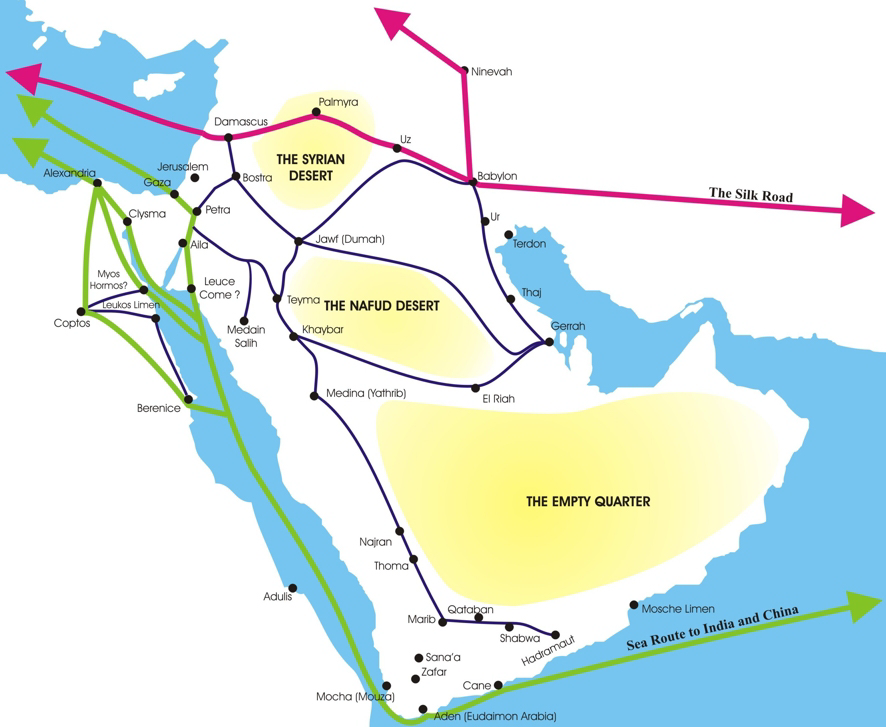
The trade and exchange of goods, people and technologies in antiquity along the Silk Roads have been the subject of numerous studies in recent decades (e.g. Hansen Reference Hansen2017; Hildebrandt Reference Hildebrandt and Gillis2017). We seek to contribute to this global history through a study of the textile finds from a small village and way station in the Negev Desert in southern Israel. The village, Nahal Omer, located at the western edge of the ancient land routes, consists of 17 dwelling structures and a mosque, and can be dated to the Early Islamic period (sixth to ninth centuries AD) (Ben-Michael et al. Reference Ben-Michael, Israel and Nahlieli2017). The site is situated at the intersection of the ancient route from Petra to Gaza and the Red Sea, and the Judean Mountains, Jerusalem and northern Israel (Figure 1). The site's importance derives from its excellently preserved organic materials, the majority of which were found in rubbish middens near the settlement houses (Figure 2). Pilot excavations in 1991, and more recently in 2020 and 2022, yielded an exceptionally diverse assemblage of organic remains, including numerous textiles, and human faeces and hair, revealing these middens as ‘social archives’ (Bar-Oz et al. Reference Bar-Oz2022). They reflect the trans-regional interconnectedness and complex transportation networks between diverse economic agents and different cultures during the transition from the Late Byzantine to the Early Islamic periods.
a) Main trade routes during the first millennium AD (blue: Incense Roads, green: Maritime Roads, red: Silk Roads) (Sapir Haad after Gibson (Reference Gibson2011): https://upload.wikimedia.org/wikipedia/commons/3/3c/NABATAEAN_TRADE_ROUTES.png, CC BY-SA 4.0, via Wikimedia Commons); b) and c) location of Nahal Omer and nearby contemporaneous sites (red circles: rubbish middens; Sapir Haad after Bing maps aerial view (b); Sapir Haad after J. Ben-Michael et al. 2017 (c)); d) aerial view of the site and surrounding landscape (photograph: B. Hildebrandt).

Examples of textiles (a) and rope (b) in situ on the surface of rubbish middens (photographs: N. Shamir).

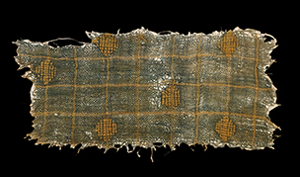
Nahal Omer is exceptional for textile researchers in being amongst the first archaeological sites at the western end of the Silk Roads to have yielded a great number of cotton textiles, along with linen, wool and goat-hair fabrics, and even some pieces of silk (Baginski & Shamir Reference Baginski and Shamir1995). To date, approximately 400 textile fragments of various sizes and shapes have been catalogued, and the new excavation in 2022 has yielded over 1000 more (Figures 3 & 4).
Textile fragments from Nahal Omer (all after cleaning and preservation, other than (c)): a) wool; b) linen; c) cotton, scarf; d) cotton, with ikat design; e) cotton, with supplementary weft; f) silk (photographs: D. Gazit (a & c), O. Negnevitsky (b, d, e & f); courtesy of the Israel Antiquities Authority).

Microscopic view of selected textiles from Nahal Omer: a) wool; b) cotton; c) cotton; d) cotton (photographs: N. Shamir).

These fragments are being analysed from April 2022 to 2025 in the course of our project, which operates in the framework of a research collaboration programme between Lower Saxony and Israel (Niedersächsisches Vorab).
Most of the textile fragments were cut or torn and show traces of multiple uses prior to being discarded. The majority had probably belonged to garments. Linen fragments with stains and burn marks, once part of a cut-to-shape linen tunic, constitute an exceptional example (Figure 5). Such tunics were typical of the Early Islamic period onwards and represent the transition from the earlier woven-to-shape tunic of Roman and Byzantine times to new methods of production (Shamir & Baginski Reference Shamir and Baginski2017).
Cut-to-shape tunic from Nahal Omer (photograph: C. Amit; courtesy of the Israel Antiquities Authority).

Other outstanding finds from Nahal Omer include cotton fragments with warp-ikat patterns, probably made in Central Asia or India. These are not only rare for this period, but represent one of the earliest archaeologically documented occurrences of this type of textile, together with a similar cotton textile find from the sanctuary of Lot in Jordan (Granger-Taylor Reference Granger-Taylor and Politis2012). In addition, the four silk fragments found at Nahal Omer are the only ones from this period so far discovered in Israel.
One of our project's main aims is to determine the origin of the fragments’ raw materials, where they were woven and, where applicable, embellished: in one of the known silk-weaving centres in the Eastern Mediterranean, or even from regions further east, in Asia?
Objectives
Two excavations in 2022 and 2024 aim to expand the textile assemblages and illuminate their contexts. We will also re-examine the previously excavated textiles. For that, we will adopt a comparative and inter-disciplinary approach in order to explore the production, trade and (re-)use of silk and cotton fabrics at Nahal Omer, both diachronically and synchronically. We will therefore combine textual and iconographic sources from the Western and Eastern Mediterranean, and bioarchaeological analyses of finds and methods of textile archaeology, in order to answer four main questions:
1. Where did the raw materials for the silk and cotton fragments found at Nahal Omer originate? What can cutting-edge biogeochemistry methods, such as isotope analyses (Ryan et al. Reference Ryan2021), taxonomic identification using proteomic methodologies (for silk: Lee et al. Reference Lee, Pires, Pollard and McCullagh2022), and residue analyses of dyestuffs, add to the information available in the ancient written sources and the microscopic analysis of the textile materials?
2. Where were the silk and cotton fabrics produced, and how were they manufactured? What can fibre analysis and technical characteristics such as spinning directions, weaving techniques, patterns, and embellishments such as embroidery, reveal about the locations of textile production, and the original shapes and different uses of the fabrics? What can this information tell us about Nahal Omer's local textile production in comparison to contemporaneous sites (Shamir Reference Shamir2001, Reference Shamir2022) and the import of textiles?
3. What do these textiles reveal about the identity of the people at Nahal Omer? Since many of the textiles show signs of wear, we assume that the silk fragments derive from fabrics that were worn or used, either by the settlement's inhabitants, or by the traders who rested at this way station before continuing on their journey through the desert.
4. Which insights into the trading and consumption patterns of the as-yet unstudied organic materials in the exchanges between East and West do the organic finds from Nahal Omer enable? What can they tell us about the origins of the transporters and trade assemblages? Since textiles take up little space, we assume, based on ancient texts, that they were often part of cargo loads that included other goods, such as spices and aromatics (e.g. frankincense and myrrh).
Combining textual and iconographic sources with bioarchaeological and technical analyses of ancient textiles, this project will interweave the different expertise and skills of researchers from the humanities and sciences, in order:
(a) to trace continuities and changes in the silk and cotton trade along the peripheral arteries of the Silk Road, as well as to determine the production and consumption of silk and cotton textiles in the Early Islamic period;
(b) to shed light on the cultural identity of the ‘silk people’ of Nahal Omer. Our findings will be compared with textual information regarding different cultural groups in the Eastern Mediterranean; and
(c) to investigate the flow of organic commodities during these periods, when the connections between the Arabian Peninsula and the Eastern Mediterranean flourished, particularly in the Early Islamic period.
Conclusion
The various organic finds and especially the diversity and abundance of textiles from Nahal Omer, compared with other contemporaneous sites in the region, attest to the wide and inter-regional cultural and geographic trade networks between East and West. They can thus provide valuable insights not only into the economy and culture of a road on which exotic goods were transported to the Mediterranean and the larger systems of connectivity, but also into the everyday life in a small way station along the Israeli Silk Road in the Early Islamic period.
Funding statement
This project is financially supported by the State of Lower Saxony, Germany.


 Open access