





Highlights
-
• Adults routinely encounter novel words that they consolidate in long-term memory.
-
• Memory models suggest this process should unfold over time and a period of sleep.
-
• Bilingual adults’ novel word consolidation variably followed this expectation.
-
• Novel word consolidation was jointly impacted by word-, person-, and task-based factors.
-
• People’s L1/L2 use (language entropy) patterned with their preferred learning style.
1. Introduction
Between the ages of 20 and 60 years, the average English speaker learns approximately 6000 novel words, or about one novel word every 2 days (Brysbaert et al., Reference Brysbaert, Stevens, Mandera and Keuleers2016). A wealth of research on memory consolidation for novel words reveals a highly variable time course (see Palma & Titone, Reference Palma and Titone2021, for a review). This may arise from individual differences in language experience that shape vocabulary growth throughout adult life (e.g., Gollan et al., Reference Gollan, Montoya, Cera and Sandoval2008, see also Brysbaert et al., Reference Brysbaert, Stevens, Mandera and Keuleers2016; Keuleers et al., Reference Keuleers, Stevens, Mandera and Brysbaert2015, for discussions). In this article, we address these issues in bilingual adults by investigating the lexicalization of novel words (e.g., bloksom) that are derived from existing English words (e.g., blossom) across a 24-h interval that included sleep. Grounded by an influential model of novel word learning (the Complementary Learning Systems model, McClelland et al., Reference McClelland, McNaughton and O’Reilly1995), we were particularly interested in how word- and task-related factors jointly impact performance as a function of individual differences in language entropy, which indexes individual differences in compartmentalized versus integrated bilingual language use.
1.1. The complementary learning systems model and novel word learning
The Complementary Learning Systems model predicts that novel word learning depends on two distinct memory systems – a hippocampal/episodic memory system, and a neocortical/semantic system (McClelland et al., Reference McClelland, McNaughton and O’Reilly1995). Accordingly, novel words are initially dependent on hippocampal/episodic activity (e.g., Yassa & Stark, Reference Yassa and Stark2011) and progressively become abstracted from their learning context and represented in semantic memory (our “mental thesaurus,” Tulving, Reference Tulving, Tulving and Donaldson1972; see Davis & Gaskell, Reference Davis and Gaskell2009). The integration of novel semantic representations with existing ones is proposed to arise from offline consolidation, where episodic memories are reactivated and interleaved with existing memories (Tamminen & Gaskell, Reference Tamminen and Gaskell2013). This process occurs primarily during sleep, where the cognitive system is not engaged in processing novel information (though memory consolidation may occur during rehearsal or reminiscence, see McClelland et al., Reference McClelland, McNaughton and O’Reilly1995, or wakeful rest, see Carr et al., Reference Carr, Jadhav and Frank2011; Schapiro et al., Reference Schapiro, McDevitt, Chen, Norman, Mednick and Rogers2017). During slow-wave sleep, in particular, hippocampal representations are reactivated and prime related neocortical representations (e.g., Euston et al., Reference Euston, Tatsuno and McNaughton2007; Nir et al., Reference Nir, Staba, Andrillon, Vyazovskiy, Cirelli, Fried and Tononi2011). Importantly, while learning words requires the acquisition of the form and meaning, it also includes the process of lexicalization, in which the novel word is integrated and interacts with existing words (Bakker et al., Reference Bakker, Takashima, Van Hell, Janzen and McQueen2015; Liu & van Hell, Reference Liu and van Hell2020). For instance, consolidated novel words (e.g., cathedruke) compete with similar existing words (e.g., cathedral) for activation like known words (see Davis & Gaskell, Reference Davis and Gaskell2009). Competition is thought to reflect the transition of novel words from hippocampus (episodic) dependence to neocortical (semantic) dependence, which is thus operationally defined as lexicalization (Bakker et al., Reference Bakker, Takashima, van Hell, Janzen and McQueen2014, Reference Bakker, Takashima, Van Hell, Janzen and McQueen2015).
The time- and possibly sleep-dependent dynamics of the Complementary Learning Systems are thought to block “catastrophic interference” that can arise when new knowledge overwrites preexisting stable knowledge that is dramatically different within the neocortex. However, there are relevant word- and task-related factors that can influence the time course of novel word lexicalization. In this regard, influential findings on the neurobiology of learning (Tse et al., Reference Tse, Langston, Kakeyama, Bethus, Spooner, Wood and Morris2007, Reference Tse, Takeuchi, Kakeyama, Kajii, Okuno, Tohyama and Morris2011) led to a revised version of the Complementary Learning Systems model (McClelland, Reference McClelland2013; McClelland et al., Reference McClelland, McNaughton and Lampinen2020), where newly acquired knowledge that is consistent with already stored prior knowledge can be integrated more rapidly at the neocortical level, with differential outcomes depending on the learning context or experience. Within this view, prior knowledge is represented as “schemas” – networks of interconnected neocortical/semantic representations that influence information processing (van Kesteren et al., Reference van Kesteren, Ruiter, Fernandez and Henson2012; van Kesteren et al., Reference van Kesteren, Beul, Takashima, Henson, Ruiter and Fernandez2013). If the new knowledge (i.e., a novel word) is consistent with existing schemas (e.g., an already known word), the neocortical/semantic system should integrate it more quickly or directly; however, if new knowledge is inconsistent with prior knowledge schemas (e.g., it is unlike any known word or similar to a lesser known word), the hippocampus/episodic system will initially process this new knowledge, and “train” the neocortical/semantic system to integrate this new knowledge into existing schemas over time and possibly sleep (see also Tamminen et al., Reference Tamminen, Payne, Stickgold, Wamsley and Gaskell2010).
Relevant to this study, the time course of novel word learning has been predominantly investigated in (presumed) monolingual individuals (Gaskell & Dumay, Reference Gaskell and Dumay2003; Tamminen & Gaskell, Reference Tamminen and Gaskell2008; Tham et al., Reference Tham, Lindsay and Gaskell2015; Wang et al., Reference Wang, Savage, Gaskell, Paulin, Robidoux and Castles2017). Several studies have highlighted a potential advantage for novel vocabulary learning in bilingual adults, who possess simultaneous knowledge of multiple languages (e.g., Escudero et al., Reference Escudero, Mulak, Fu and Singh2016). It has been proposed, as well, that bilingualism may lead to more integrated lexical and semantic networks (Kaushanskaya & Rechtzigel, Reference Kaushanskaya and Rechtzigel2012), higher phonological memory, especially for more difficult tasks (Escudero et al., Reference Escudero, Mulak, Fu and Singh2016; Kaushanskaya, Reference Kaushanskaya2012; Papagno & Vallar, Reference Papagno and Vallar1995), or enhanced cross-language interference/language inhibition abilities (Bartolotti & Marian, Reference Bartolotti and Marian2012; Bogulski et al., Reference Bogulski, Bice and Kroll2018; Bradley et al., Reference Bradley, King and Hernandez2013; Kaushanskaya & Marian, Reference Kaushanskaya and Marian2009a, for a review, see Hirosh & Degani, Reference Hirosh and Degani2018). If, as per the revised Complementary Learning Systems Model, learners’ prior knowledge modulates the interplay between the episodic and semantic systems (McClelland, Reference McClelland2013), a question worth pursuing is how different bilingual experiences influence the timeline of novel word learning and lexicalization.
1.2. Word- and task-related factors in novel word learning
In addition to the considerations on the role of sleep, a second related question concerns which word- and task-related factors regulate novel word integration in bilingual adults. By word factors, we refer to aspects that modulate the features of lexical representations themselves and thereby impact novel word learning. These include properties that affect lexical quality (Perfetti, Reference Perfetti2007; Perfetti & Hart, Reference Perfetti, Hart, Verhoeven, Elbro and Reitsma2002), which could include word frequency, cross-language cognate status, and the like. By task factors, we refer to features of the overall learning experience, which could include whether people are deliberately learning words or not. This could include whether the task involves explicit or implicit learning, or whether each learning instance requires inferential processing during encoding. We now elaborate on each in turn.
In terms of word factors, we previously found that the lexical quality of preexisting word representations was an important internal force driving episodic memory for and lexicalization of novel words in bilingual learners operating in their L1 (Palma et al., Reference Palma, Marin, Onishi and Titone2022). High-quality lexical representations are defined as representations that include well-defined and partially redundant orthographic and phonological representations, as well as flexible representations of meaning, which can be reliably retrieved during processing (see also Schwartz et al., Reference Schwartz, Yeh and Shaw2008). As mentioned earlier, the revised Complementary Learning Systems model (McClelland, Reference McClelland2013) posits that similarity with preexisting schemas might facilitate rapid neocortical integration of novel words. Accordingly, we reasoned that bilingual (e.g., English–French) adult learners might have an easier time lexicalizing novel word (e.g., torato) that were similar to existing words and, even more so, when the existing words are in both of bilingual learners’ known languages (e.g., English tomato – French tomate). Such words are likely to have higher subjective frequency due to their repeated exposure across languages, which may further support their integration into the bilingual lexicon as consequence of easier processing (Dijkstra & van Heuven, Reference Dijkstra and van Heuven2002; Friesen et al., Reference Friesen, Whitford, Titone and Jared2020; Perfetti et al., Reference Perfetti, Wlotko and Hart2005; Schwartz et al., Reference Schwartz, Yeh and Shaw2008; Tarin et al., Reference Tarin, Hernández-Rivera, Iniesta, Palma, Whitford and Titone2025; Titone et al., Reference Titone, Libben, Mercier, Whitford and Pivneva2011; Whitford & Titone, Reference Whitford and Titone2012, Reference Whitford and Titone2017, Reference Whitford and Titone2019).
With respect to task factors, the specific learning context also has the potential to impact the interplay between the hippocampal/episodic memory system and the neocortical/semantic system during the process of novel word integration. Learning contexts can differ in many ways, one of the most obvious being the extent to which people believe that a particular situation requires them to “memorize” new information and that a long-term memory demand is required. This difference is often referred to as explicit versus implicit learning. Explicit learning is characterized as intentional learning that involves conscious awareness of the information to be remembered. Implicit learning is characterized as incidental and may or may not engage conscious awareness. A rich history of cognitive and cognitive neuroscience research affirms the distinction between explicit and implicit learning, which has been shown to rely on different neural mechanisms (see Hanslmayr & Staudigl, Reference Hanslmayr and Staudigl2014). Thus, the explicit versus implicit nature of a learning context could impact both novel word learning and the speed of lexicalization. However, studies employing implicit training paradigms are relatively fewer compared to those focused on explicit word learning (see Palma & Titone, Reference Palma and Titone2021; Schimke et al., Reference Schimke, Angwin, Chang and Copland2021), and have reported results that conflict with the predictions of the Complementary Learning Systems model (e.g., Fernandes et al., Reference Fernandes, Kolinsky and Ventura2009; Szmalec et al., Reference Szmalec, Page and Duyck2012, see Palma & Titone, Reference Palma and Titone2021 and Schimke et al., Reference Schimke, Angwin, Chang and Copland2021, for reviews).
Moreover, the learning context can vary in important ways within the subcategories of implicit versus explicit learning, as reflected by experimental paradigms that vary inferential encoding processes (e.g., Coutanche & Koch, Reference Coutanche and Koch2017), probabilistic exposure (Fernandes et al., Reference Fernandes, Kolinsky and Ventura2009), or Hebb repetition learning (e.g., Szmalec et al., Reference Szmalec, Page and Duyck2012). Here, we focus on a learning context that requires an implicit inferencing process based on the linguistic and nonlinguistic context that surrounds a novel word (Carey, Reference Carey2010). Such a locally implicit learning context has been referred to as fast mapping in the developmental literature, as it is thought to enable rapid mapping novel words to referents with limited exposure. This has been proposed as a crucial word-learning strategy not only for children (e.g., Vlach & Sandhofer, Reference Vlach and Sandhofer2012) and adults (e.g., Halberda, Reference Halberda2006) but also for other mammals (e.g., Reichmuth Kastak & Schusterman, Reference Reichmuth Kastak and Schusterman2002). Relevant here, inferential learning thought to produce fast mapping may enable adults to acquire new words independently of the hippocampal/episodic memory system (e.g., Atir-Sharon et al., Reference Atir-Sharon, Gilboa, Hazan, Koilis and Manevitz2015; Merhav et al., Reference Merhav, Karni and Gilboa2015; Sharon et al., Reference Sharon, Moscovitch and Gilboa2011).
Coutanche and Thompson-Schill (Reference Coutanche and Thompson-Schill2014) studied this by showing adult participants a novel animal paired with a familiar one and asked to infer the novel name (e.g., “Are the antennae of the Torato pointing up?”). This fast-mapping condition was compared to two control conditions: an implicit encoding condition, where participants saw only the novel animal, and an explicit encoding condition, where participants were explicitly told to remember the novel name. The study revealed that participants in the fast-mapping condition exhibited rapid lexicalization (i.e., signs of lexical competition). Contrastive inference can be essential for rapid lexical integration during novel word learning (see also Halberda, Reference Halberda2006).
Interestingly, subsequent findings on fast mapping have been mixed. On one hand, two different teams corroborated these findings by showing that novel word learning through inference-based fast mapping may not be dependent on a consolidation period including sleep (Himmer et al., Reference Himmer, Müller, Gais and Schönauer2017), and that it may be less susceptible to decay over time (Li et al., Reference Li, Hu and Yang2020). On the other hand, controversy exists about the efficacy of incidental learning for novel word learning in adults generally (e.g., Sobczak & Gaskell, Reference Sobczak and Gaskell2019), and about the efficacy of fast mapping as a word learning procedure specifically (see Cooper et al., Reference Cooper, Greve and Henson2019a, Reference Cooper, Greve and Henson2019b; Gaskell & Lindsay, Reference Gaskell and Lindsay2019; Zaiser et al., Reference Zaiser, Meyer and Bader2019). Several authors have also hypothesized that individual differences (both in participants and items) may crucially shape the outcome of fast mapping (e.g., Coutanche & Koch, Reference Coutanche and Koch2017; Zaiser et al., Reference Zaiser, Meyer and Bader2019, Reference Zaiser, Bader and Meyer2022), a consideration that has not been systematically investigated in past work and to which we turn next.
1.3. Novel word learning and individual differences in bilingual language experience
As a final consideration in understanding novel world learning, individual differences across learners may also modulate the key contributing factors previously described (i.e., sleep, word-related and task-related factors). Previous studies have shown that lexicalization can be accelerated by prior language learning experience (see Liu & van Hell, Reference Liu and van Hell2020). In this section, we focus on individual differences arising from bilingual language experience, a factor that has gained increasing recognition as a valuable lens for investigating the cognitive and memory systems involved in word learning (e.g., Palma et al., Reference Palma, Marin, Onishi and Titone2022). Although prior research on bilingual word learning has not typically been framed within the Complementary Learning Systems model, this framework is relevant for understanding how different memory systems contribute to learning in this population, especially considering that bilingual experience can directly influence the representational quality of prior linguistic knowledge, as well as the language learning contexts and demands to which individuals have adapted.
Accumulating evidence shows that language context shapes bilingual language use (Elston-Güttler & Gunter, Reference Elston-Güttler and Gunter2009; Kreiner & Degani, Reference Kreiner and Degani2015; Tiv et al., Reference Tiv, Gullifer, Feng and Titone2020) and its consequences for broader cognition (Abutalebi & Green, Reference Abutalebi and Green2016; Beatty-Martínez et al., Reference Beatty-Martínez, Navarro-Torres, Dussias, Bajo, Guzzardo Tamargo and Kroll2020; Green & Abutalebi, Reference Green and Abutalebi2013; Gullifer et al., Reference Gullifer, Chai, Whitford, Pivneva, Baum, Klein and Titone2018; Tiv et al., Reference Tiv, Kutlu, Gullifer, Feng, Doucerain and Titone2022). Particularly relevant here, language diversity across social contexts plays a crucial role in regulating how languages are represented, accessed, and controlled (e.g., Gullifer & Titone, Reference Gullifer and Titone2020; Titone & Tiv, Reference Titone and Tiv2023; Tiv et al., Reference Tiv, O’Regan and Titone2021). Differential patterns of exposure are important for bilingual language acquisition (Carroll, Reference Carroll2017), as bilingual adults may be optimized for different learning contexts depending on how they have learned and currently use their languages within specific socioecological environments (reviewed in Gullifer & Titone, Reference Gullifer and Titone2020; Titone & Tiv, Reference Titone and Tiv2023). In highly diverse language contexts, bilinguals face language-related uncertainties and must adapt their neurocognitive systems accordingly (Beatty-Martínez et al., Reference Beatty-Martínez, Navarro-Torres, Dussias, Bajo, Guzzardo Tamargo and Kroll2020; Gullifer et al., Reference Gullifer, Kousaie, Gilbert, Grant, Giroud, Coulter, Klein, Baum, Phillips and Titone2021; Gullifer & Titone, Reference Gullifer and Titone2020).
Uncertainty in the learning environment encourages learners to explore alternative options and adjust their behavior to improve task performance (Hirsh et al., Reference Hirsh, Mar and Petersson2012; Yu & Dayan, Reference Yu, Dayan, Becker and Obermayer2003, Reference Yu and Dayan2005). For bilinguals, exposure to and use of different languages can enhance their ability to detect the parameters that vary when learning a new language, as they have encountered a broader range of linguistic input (Bice & Kroll, Reference Bice and Kroll2019; Weiss et al., Reference Weiss, Schwob and Lebkuecher2020). Input variability appears to support the detection of multiple structures, a process associated with implicit learning (Poepsel & Weiss, Reference Poepsel and Weiss2016). Frequency of exposure further contributes to implicit lexical and phonotactic knowledge, even when semantic knowledge is still limited (Oh et al., Reference Oh, Todd, Beckner, Hay, King and Needle2020; Panther et al., Reference Panther, Mattingley, Todd, Hay and King2023; Todd et al., Reference Todd, Youssef and Vásquez-Aguilar2023).
Bilinguals with high diversity in language usage, being exposed to a wide range of linguistic contexts, may be naturally more attuned to implicit or inferential learning mechanisms. Their habitual experience with variable, unpredictable input may foster a learning style that emphasizes pattern extraction and contextual inference rather than rule-based instruction (Gollan et al., Reference Gollan, Starr and Ferreira2015; Pelucchi et al., Reference Pelucchi, Hay and Saffran2009). In contrast, bilinguals with low diversity in language usage, exposed to more routine and predictable input, may rely more on explicit learning strategies, favoring direct instruction when acquiring novel words (Dunn & Fox Tree, Reference Dunn and Fox Tree2014; see Gullifer & Titone, Reference Gullifer and Titone2020, for a discussion). Some studies suggest that lower variability in linguistic input, by making the input more predictable, may indeed facilitate more explicit forms of learning, including object–label associations (Lavi-Rotbain & Arnon, Reference Lavi-Rotbain and Arnon2019).
A promising measure for capturing these experiential differences is language entropy, which indexes the relative balance or diversity in the use of two or more languages and has been used to distinguish compartmentalized from integrated language use. Language Entropy is computed using proportional information about people’s language use. The calculation is based on Shannon entropy ( $ H=-{\varSigma}_{\mathrm{i}=1}^n{P}_i{\log}_2\left({P}_i\right)\Big) $
, where n represents the number of languages (e.g., 2) and Pi is the proportion of time each language is used. Accordingly, when Language Entropy is low, language use is predictable because, for example, only one language is used within a given social setting. As Language Entropy increases, language use becomes less predictable, such that any language is equally likely to be used in a given context. Thus, lower Language Entropy indexes low language diversity and high compartmentalization, whereas higher Language Entropy indexes greater language diversity and more integrated language use.
$ H=-{\varSigma}_{\mathrm{i}=1}^n{P}_i{\log}_2\left({P}_i\right)\Big) $
, where n represents the number of languages (e.g., 2) and Pi is the proportion of time each language is used. Accordingly, when Language Entropy is low, language use is predictable because, for example, only one language is used within a given social setting. As Language Entropy increases, language use becomes less predictable, such that any language is equally likely to be used in a given context. Thus, lower Language Entropy indexes low language diversity and high compartmentalization, whereas higher Language Entropy indexes greater language diversity and more integrated language use.
Language Entropy has been shown to predict multiple aspects of bilingual language processing and control (Gullifer & Titone, Reference Gullifer and Titone2021a; Tiv et al., Reference Tiv, O’Regan and Titone2021). It has also recently been validated as a socially realistic indicator of language use distributions (Iniesta et al., Reference Iniesta, Yang, Beatty-Martínez, Itzhak, Gullifer and Titone2025). Despite these findings, its relationship with novel word learning remains unexplored. Therefore, a final open question in the study of bilingual word learning is the extent to which individual differences in language diversity (i.e., language entropy) may differentially optimize learning depending on task-related factors (e.g., implicit vs. explicit learning conditions, inferencing demands; Gullifer & Titone, Reference Gullifer and Titone2020; Titone & Tiv, Reference Titone and Tiv2023) and the influence of word-related factors (Tarin et al., Reference Tarin, Hernández-Rivera, Iniesta, Palma, Whitford and Titone2025).
1.4. The current study
This study investigated the time course of novel word learning and lexicalization in bilingual adults. Specifically, we examined how lexicalization of novel words in bilingual learners is impacted by (a) a consolidation interval including sleep; (b) word and task factors related to the learning context; (c) bilingual learners’ individual differences in language experience, specifically, language entropy (see Figure 1).
Research questions situated within the Complementary Learning Systems model, investigating consolidation in novel word learning. Specifically, we addressed three main research questions focused on novel word lexicalization: (a) What are the impacts of a 24-h consolidation period, including sleep? (b) How do word-related factors (e.g., base word frequency) and task-related factors (e.g., inferencing during encoding or fast mapping) influence lexicalization? (c) How do individual differences in language entropy (reflecting bilinguals’ compartmentalized or integrated language use) affect novel word learning under explicit (Experiment 1) and implicit (Experiment 2) conditions?
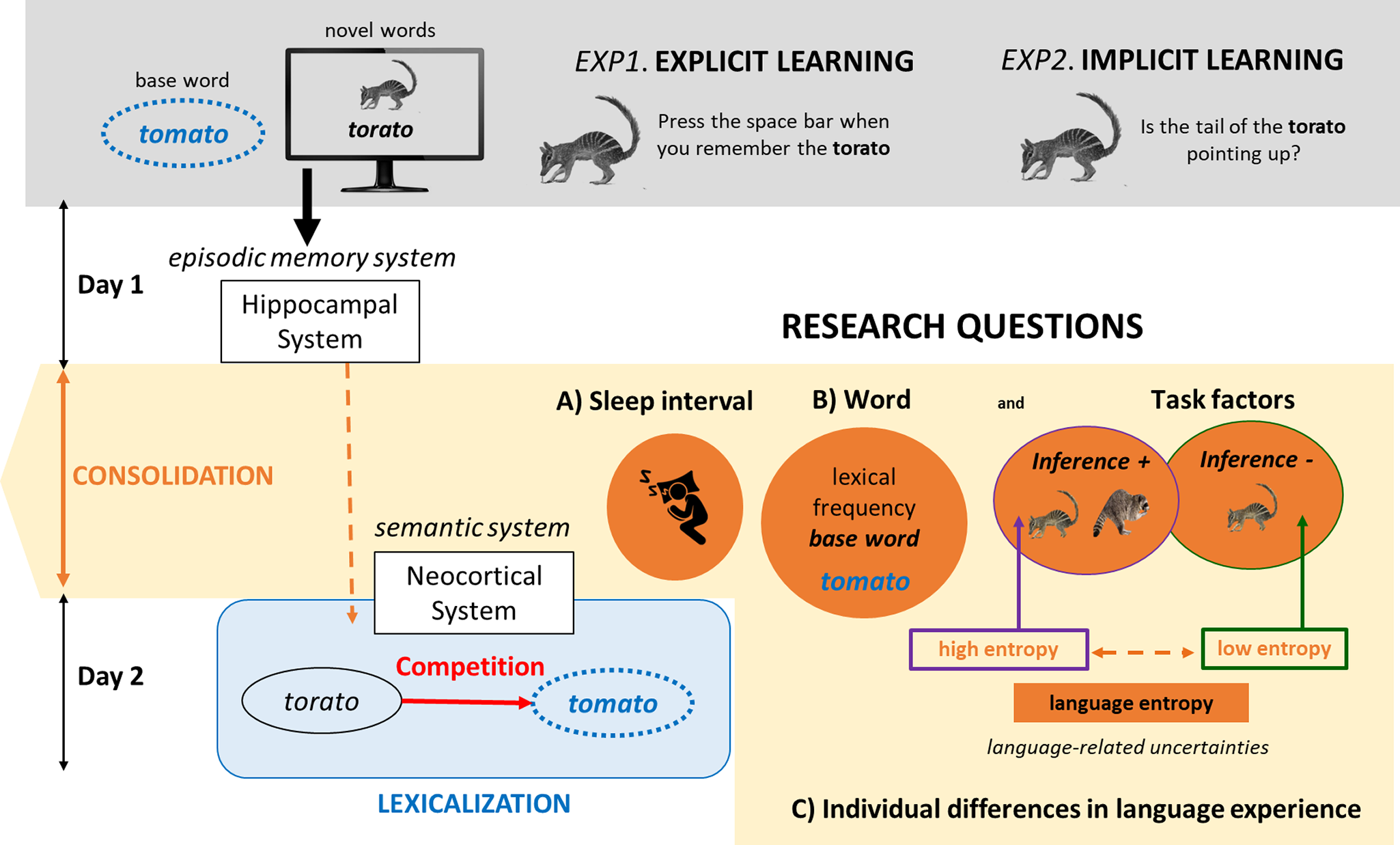
To address these questions, we investigated the evolution of novel word knowledge under different learning conditions in bilingual adults tested twice across a 24-h period that included a sleep interval. Participants were presented with novel words based on existing English words, paired with animal pictures serving as referents. We were particularly interested in novel word lexicalization, defined as the difference in reaction times between existing English words with a novel neighbor and those without a novel neighbor as evidence of competition (Bakker et al., Reference Bakker, Takashima, van Hell, Janzen and McQueen2014, Reference Bakker, Takashima, Van Hell, Janzen and McQueen2015).
To examine the effects of word factors, we investigated how word frequency modulates novel word lexicalization. In accordance with a usage-based view on language and the lexicon (Bybee, Reference Bybee2010; Goldberg, Reference Goldberg2006), we can expect that words that are more frequently encountered become more entrenched, stably represented, and easier to retrieve over time compared to lower frequency words (e.g., Broadbent, Reference Broadbent1967; Rayner & Duffy, Reference Rayner and Duffy1986), which can facilitate learning and lexicalization, embodying the cohesiveness and consistency between a word’s orthographic, phonological, and semantic representations (Hsiao & Nation, Reference Hsiao and Nation2018). Adult learners might have an easier time lexicalizing novel words that are similar to existing words and, even more so, when the existing words are present in both of bilingual learners’ known languages. Such words are likely to have higher subjective frequency due to their repeated exposure across languages, which may further support their integration into the bilingual lexicon as consequence of easier processing (Dijkstra & van Heuven, Reference Dijkstra and van Heuven2002; Friesen et al., Reference Friesen, Whitford, Titone and Jared2020; Perfetti et al., Reference Perfetti, Wlotko and Hart2005; Schwartz et al., Reference Schwartz, Yeh and Shaw2008; Tarin et al., Reference Tarin, Hernández-Rivera, Iniesta, Palma, Whitford and Titone2025; Titone et al., Reference Titone, Libben, Mercier, Whitford and Pivneva2011; Whitford & Titone, Reference Whitford and Titone2012, Reference Whitford and Titone2017, Reference Whitford and Titone2019).
To address task factors impacting bilingual word learning and integration, we extended the methods of Coutanche and Thompson-Schill’s (Reference Coutanche and Thompson-Schill2014) study. First, we manipulated whether word learning happened intentionally and consciously or incidentally and unconsciously. Thus, participants in Experiment 1 were instructed explicitly on novel word–picture pairings, while participants in Experiment 2 were exposed implicitly to novel word–picture pairings. In addition, within each experiment we manipulated if participants had to perform an inference when mapping a novel word to its referent (i.e., a fast-mapping condition), by presenting the novel word along the picture of two potential referents, or if no inference was required in that only one referent picture was shown with the novel word. Thus, our design included explicit fast-mapping conditions that had not been previously tested in the literature, in which participants were explicitly instructed to remember a novel word and had to identify its correct referent through contrastive inference.Footnote 1
Finally, we investigated how individual differences in bilingual experience, in particular, language entropy, modulated lexicalization of novel words. Earlier studies on this topic compared the learning performance of monolingual versus bilingual users or first-language (L1) versus L2 users at the group level (Bakker et al., Reference Bakker, Takashima, Fernandez, Janzen, McQueen and Van Hell2021; Kaushanskaya, Reference Kaushanskaya2012; Kaushanskaya & Marian, Reference Kaushanskaya and Marian2009a, Reference Kaushanskaya and Marian2009b; Tartaro et al., Reference Tartaro, Takashima and McQueen2021), therefore adopting a coarse and static characterization of participants’ language experience. We instead examined bilingual experience continuously, focusing on how people differ in distributing use of their languages in daily life, which should relate to the daily language learning contexts to which they are accustomed. To this end, we used general language entropy to index participants’ individual-level variability and unpredictability in daily language exposure (Gullifer & Titone, Reference Gullifer and Titone2020). This approach allowed us to capture more nuanced effects of bilingual experience and to assess how language diversity interacts with both task-related factors (e.g., implicit vs. explicit learning conditions, inferencing demands; Gullifer & Titone, Reference Gullifer and Titone2020; Titone & Tiv, Reference Titone and Tiv2023) and word-related factors (Tarin et al., Reference Tarin, Hernández-Rivera, Iniesta, Palma, Whitford and Titone2025) in shaping novel word learning outcomes.
All materials and procedures included in this study were approved by the McGill University Research Ethics Board (REB #196-1019).
2. Experiment 1: Explicitly instructed bilingual adults
In Experiment 1, we addressed three main research questions focused on novel word lexicalization: what are the impacts of (a) a 24-h consolidation period including sleep, (b) word factors such as base word frequency and task factors such as inferencing during encoding (i.e., fast mapping), and (c) individual differences in language entropy, when bilingual adults acquire novel words under explicit learning conditions (see Figure 1). We hypothesized that (a) novel word lexicalization should be greater on Day 2 versus Day 1 for all bilingual participants; (b) high base word frequency would enhance lexicalization overall, and encoding conditions that promote inferencing (the fast-mapping condition) should further support lexicalization; and (c) bilingual adults with higher language entropy would benefit more from an inferencing demand at encoding. Fast-mapping provides a locally implicit learning context that introduces greater uncertainty, which may particularly benefit bilinguals who navigate more diverse language contexts (Bice & Kroll, Reference Bice and Kroll2019; Oh et al., Reference Oh, Todd, Beckner, Hay, King and Needle2020; Panther et al., Reference Panther, Mattingley, Todd, Hay and King2023; Todd et al., Reference Todd, Youssef and Vásquez-Aguilar2023; Weiss et al., Reference Weiss, Schwob and Lebkuecher2020). In highly diverse language contexts, bilinguals are frequently exposed to language-related uncertainty (Beatty-Martínez et al., Reference Beatty-Martínez, Navarro-Torres, Dussias, Bajo, Guzzardo Tamargo and Kroll2020; Gullifer et al., Reference Gullifer, Kousaie, Gilbert, Grant, Giroud, Coulter, Klein, Baum, Phillips and Titone2021; Gullifer & Titone, Reference Gullifer and Titone2020). Their habitual experience with variable and unpredictable input may foster a learning style that emphasizes pattern extraction and contextual inference (Gollan et al., Reference Gollan, Starr and Ferreira2015; Pelucchi et al., Reference Pelucchi, Hay and Saffran2009; reviewed in Gullifer & Titone, Reference Gullifer and Titone2020; Titone & Tiv, Reference Titone and Tiv2023).
2.1. Methods
2.1.1. Participants
We recruited bilingual adults (N = 48) from the McGill undergraduate population and general Montreal community who were 18–33 years old, had normal or corrected-to-normal vision, and no self-reported history of speech, learning, hearing, neurological, psychiatric, or sleep disorders. One participant reported exclusive usage of English and was therefore excluded, yielding a sample size of 47. From the 47 bilingual participants, several participants also had knowledge of a third or fourth language, but all participants either had English or French as their dominant language. The average age of acquisition for English was 2.52 years old, while the average age of acquisition for French was 1.93 years old. For a summary table of participant characteristics, see Table 1. General language entropy scores ranged from 0.08 to 1.58 (mean = 0.82, SD = 0.32). Of note, several participants had general language entropy scores superior to 1 – a direct consequence of knowing more than two languages.
Characteristics of the participants
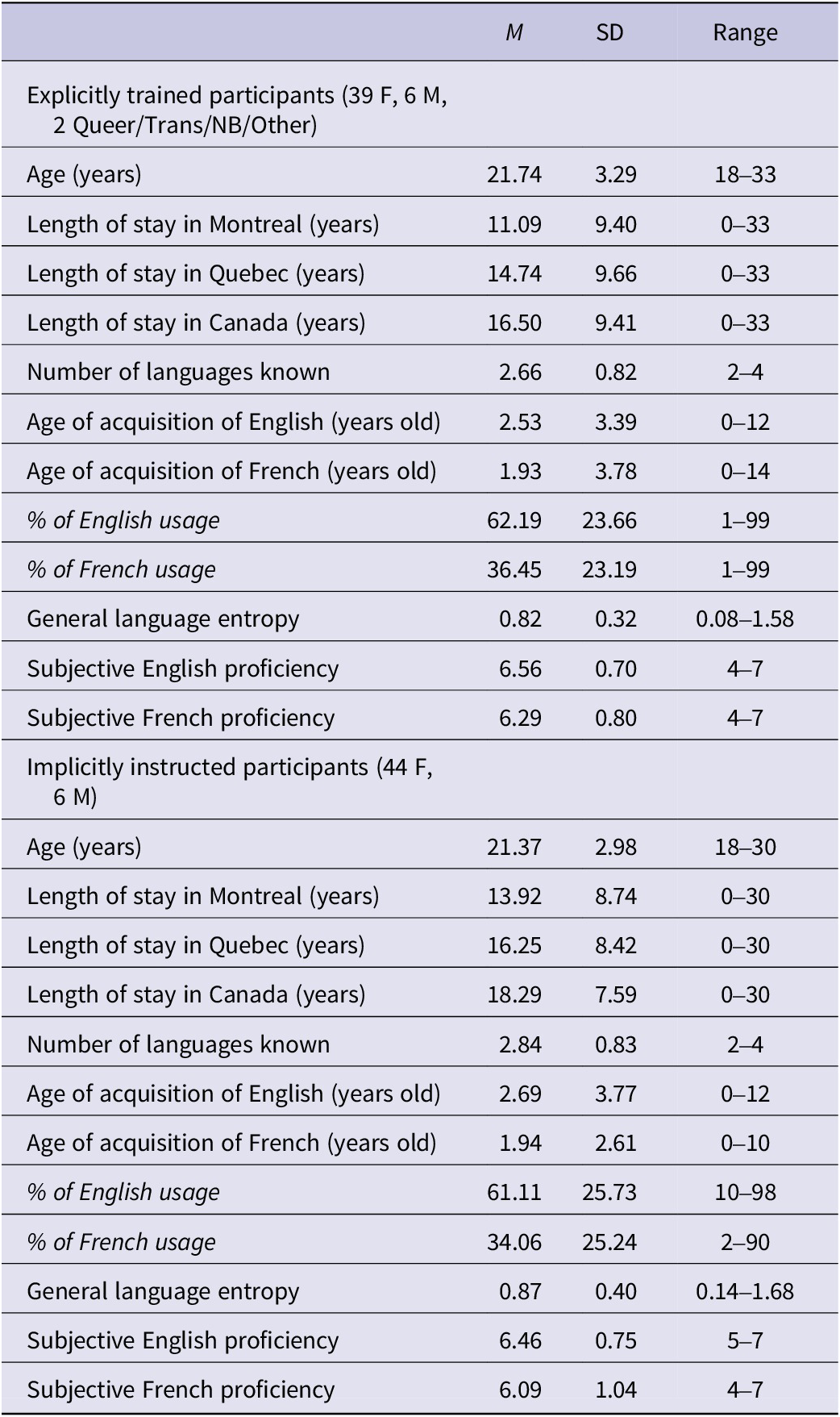
Notes. General language entropy was calculated using the proportion of time spent functioning in each language.
2.1.2. Materials
Base words. We selected 32 concrete English nouns using the CLEARPOND database (Marian et al., Reference Marian, Bartolotti, Chabal and Shook2012). These words were “hermits,” as they had no preexisting orthographic neighbors in English via the deletion, addition, transposition, or substitution of a single letter. The selected words were divided into two lists of 16 words, half of those referring to natural entities (e.g., banana), the others referring to human-made objects (e.g., violin). To examine word factors, we focused on word frequency per million extracted from CLEARPOND (Marian et al., Reference Marian, Bartolotti, Chabal and Shook2012). The selected words ranged from 0.56 occurrence per million to 21.18 occurrences per million. We also verified the selected words’ frequency values on the Zipf scale using the SubtlexUS database (Brysbaert & New, Reference Brysbaert and New2009; see van Heuven et al., Reference van Heuven, Mandera, Keuleers and Brysbaert2014, Brysbaert et al., Reference Brysbaert, Mandera and Keuleers2018, for details on Zipf word frequency). The selected words ranged from 2.33 to 4.26. Both lists were matched on frequency values. As Palma et al. (Reference Palma, Marin, Onishi and Titone2022) showed that cross-linguistic similarity of the base word may impact novel neighbor recognition and lexicalization, we also matched the two novel word lists on English–French Normalized Levenshtein Distance (NLD; defined as the minimum number of insertions, deletions, and substitutions needed to edit one word into the other, Schepens et al., Reference Schepens, Dijkstra and Grootjen2012). We also made sure that words that were similar in form across English and French were also similar in meaning, avoiding false cognates and interlingual homographs. Finally, because neighbors in all known languages may influence bilingual novel word learning, we also made sure that the lists were comparable in terms of number of French orthographic neighbors (Marian et al., Reference Marian, Bartolotti, Chabal and Shook2012). Aside from the French translation equivalent for cognates (e.g., tomato/tomate), base words had no orthographic neighbors in French.
Novel words. To create novel words, we changed one letter in each of the 32 base words, thereby creating 32 novel orthographic neighbors. Within each list, eight novel words were created by changing a vowel, eight by changing a consonant. The position of the changed letter varied across words. We aimed to keep novel words pronounceable in both English and French (e.g., balboo is a pronounceable neighbor word of bamboo). All the novel words were phonotactically acceptable in both English and French, as their average English and French bigram and letter positional probabilities were higher than 0, according to the CLEARPOND database (Marian et al., Reference Marian, Bartolotti, Chabal and Shook2012). The list of novel words, with their corresponding base words, may be found in Table S1 (Supplementary Materials).
Novel words were paired with unfamiliar animal pictures, which served as referents. We selected 16 normed pictures of little-known animals in various databases (Brodeur et al., Reference Brodeur, Dionne-Dostie, Montreuil and Lepage2010; Moreno-Martínez & Montoro, Reference Moreno-Martínez and Montoro2012). We also selected 32 pictures of familiar animals from the same databases and from various web sources. All images were closely cropped (i.e., contained no background) and were centrally placed on a white background. We further selected the pictures of four familiar animals to serve as practice trials.
2.1.3. Apparatus and procedure
The study spanned two experimental days separated by a 24-h consolidation interval, and it was moderated remotely. Participants were trained on novel word–picture pairings on the first day, then tested on their episodic memory of these pairings and on novel word lexicalization on both days. Communication between the experimenter and the participants was entirely in English. The training task, 3-alternative forced-choice task and semantic decision tasks were built in OpenSesame (Version 3.3.10, Mathôt et al., Reference Mathôt, Schreij and Theeuwes2012), hosted on JATOS, an open-source platform to run Javascript-based online studies (Lange et al., Reference Lange, Kühn and Filevich2015).
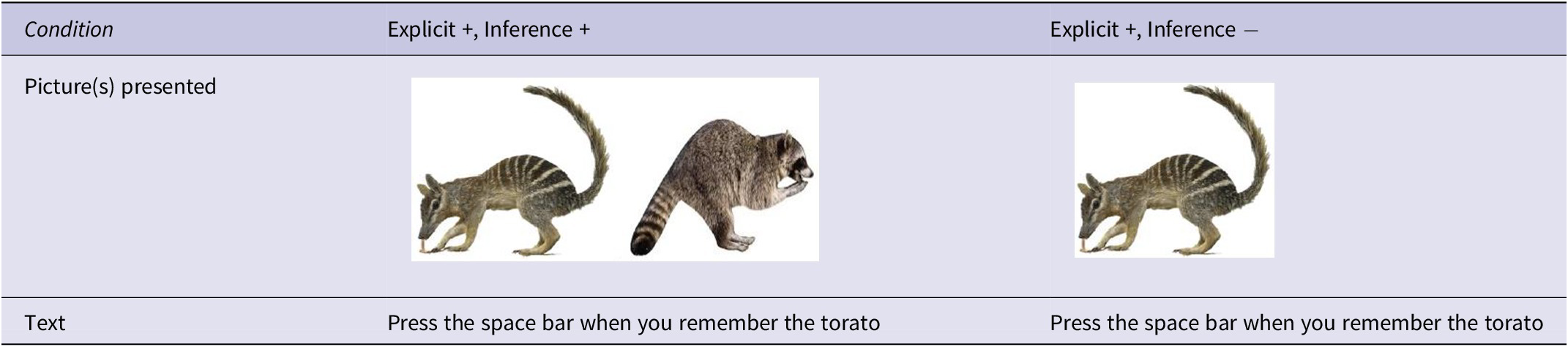
Training. Participants were instructed to attend to the words and pictures presented in each trial, and that they would subsequently be tested on their knowledge of the word–picture pairings. Each participant only learned 16 of the 32 novel words mentioned earlier, such that 16 English target words did not acquire a novel neighbor during training for each participant. The 16 words that did acquire a novel target (i.e., the novel words) were presented in two learning contexts, one corresponding to an explicit fast-mapping condition (i.e., requiring an inference between two pictures) and one corresponding to an explicit control condition (i.e., not requiring an inference between two pictures). For the explicit fast-mapping condition, eight words were presented in an Explicit +, Inference + (E+, I+) context; that is, participants viewed an image of an unfamiliar animal paired with an image of a familiar animal, along with the instruction to “press the space bar when [they] remember the X” (where X = novel word referring to the unfamiliar animal). Under this condition, participants were thus aware that they needed to remember the novel word-referent mapping, but they had to make an inference to determine which animal corresponded to the novel word. For the explicit nonfast mapping condition, eight novel words were presented in an Explicit +, Inference − (E+, I−) condition – participants viewed an image of an unfamiliar animal above an instruction to “press the space bar when [they] remember the X” (where X = novel word). Novel words in both conditions were presented twice. Training was blocked, such that all trials in the E+, I− condition were presented in one block, and all trials in the E+, I+ condition in another block. The order of blocks was counterbalanced across participants. A visual presentation of the explicit vocabulary training conditions may be found in Table 2. Of note, the E+, I− condition corresponds to the “explicit encoding” condition described in fast-mapping literature (e.g., Cooper et al., Reference Cooper, Greve and Henson2019a, Reference Cooper, Greve and Henson2019b; Coutanche & Thompson-Schill, Reference Coutanche and Thompson-Schill2014). We purposely avoid this term here because Experiment 1 in this study features two distinct explicit encoding conditions – an explicit encoding without inference, and another with an inference.
Explicit vocabulary training conditions (Experiment 1)
Testing. After training, we first assessed explicit recognition of the novel neighbor words learned during training (e.g., torato) through a 3-Alternative Forced-Choice task (3 AFC). Participants were asked to identify which of the three presented new animal pictures (all unfamiliar, to ensure that familiarity alone would not help) was associated to each novel word. Each animal picture was presented twice as a target and four times as a lure, for two other unfamiliar animals. The position of the target animal picture on the screen varied, such that a participant hitting the same key throughout the task would obtain a 33% score (chance level). We operationalized episodic memory as the accuracy in identifying novel word–picture pairing.
Crucially, to assess lexical integration of the novel neighbors, participants were tested through a semantic decision task on the 32 existing English base words described earlier. This task is a well-established paradigm for probing the structure of the mental lexicon (Elgort, Reference Elgort2011), which has been used in many studies on word learning (for reviews, see Palma & Titone, Reference Palma and Titone2021; Schimke et al., Reference Schimke, Angwin, Chang and Copland2021). Participants were instructed to indicate whether a word (e.g., tomato) referred to a human-made or natural item as quickly and as accurately as possible by pressing a key left or right of their keyboard. Key assignments were displayed at the bottom of the screen as a reminder. We presented 32 words – the 16 hermit words used to create the novel words learned by that participant (e.g., tomato), and the 16 hermit words we had not used for that participant. Each trial began with a fixation cross for 800 ms, followed by a blank screen for 350 ms, a word for 500 ms, and feedback (“Correct!” or “Incorrect.”) for 1 second. Response times to correct trials were analyzed. We operationalized lexical integration as the difference in correct reaction time in response to English base words that had acquired a novel neighbor during training, compared to those that had not acquired a novel neighbor.
As mentioned in Section 2.1.3, testing was repeated approximately 24 h after the initial session with no further novel word training. The order of tests was the same on each testing day.
2.2. Results
Given that we were most interested in the processes involved in novel word lexicalization, the results of the episodic task are presented in the Supplementary Materials. These results showed not significant main effects or interactions, suggesting that all participants learned the novel words comparably across both days.
To address research questions focused on novel word lexicalization regarding (a) a 24-h consolidation period including sleep and (b) word factors such as base word frequency and task factors such as inferencing during encoding (i.e., fast-mapping), we constructed a linear mixed effects model to predict correct reaction times on the semantic decision task (Baayen, Reference Baayen2008) as a function of the intercurrence of a consolidation period including sleep, the presence of inference during word encoding, base word frequency, and their interactions. Fixed effects included day (1 vs. 2), inference, and English base word frequency. Their interactions were also included. Day was effects coded (−.5 vs. .5) to allow for the interpretation of main effects. Base word frequency was standardized with mean of 0 and standard deviation of 1. We further controlled for normalized Levenshtein distance, which we had identified as an important predictor of novel word learning in bilingual individuals (Palma et al., Reference Palma, Marin, Onishi and Titone2022). As we had carefully matched the materials on several parameters, we did not add other control variables to the model, in order to avoid overparameterization.
The variable “inference” was a three-level predictor. We compared base words with a novel neighbor learned with an inference at encoding, base words with a novel neighbor learned without an inference at encoding, and base words with no novel neighbors (henceforth, “control” words). To the extent that novel neighbors (e.g., torato) have been lexicalized, these should compete for activation when the participant tries to access the base word (e.g., tomato), resulting in longer correct reaction times. Helmert coding of this predictor yielded two orthogonal a priori contrasts (Schad et al., Reference Schad, Vasishth, Hohenstein and Kliegl2020). The first contrast was the difference between the base words with a novel neighbor acquired with an inference at encoding (the implicit fast-mapping condition) and base words with a novel neighbor acquired without an inference at encoding (Inference + vs. Inference −); the second was the difference between the base words with no novel neighbor and the mean of the other two conditions (control vs. mean of Inference + and Inference −).
We used the package buildmer (Voeten, Reference Voeten2022) to automatically implement likelihood ratio tests to find the maximal random effects structure (Barr et al., Reference Barr, Levy, Scheepers and Tily2013; Bates et al., Reference Bates, Maechler, Bolker and Walker2015; Matuschek et al., Reference Matuschek, Kliegl, Vasishth, Baayen and Bates2017). The final random effect structure included a random intercept by participants, a random intercept by items, a correlated random slope for day by participants, a correlated random slope for frequency by participants, and a correlated random slope for day by items.
The analysis was conducted in R (R Core Team, 2023) using the lme4 package (Bates et al., Reference Bates, Maechler, Bolker and Walker2015). The plots of the predicted data were generated using the effects package (Fox & Weisberg, Reference Fox and Weisberg2018) and the ggplot2 package (Wickham, Reference Wickham2016). Confidence intervals and effect sizes were extracted using the report package (Version 0.4.0; Makowski et al., Reference Makowski, Ben-Shachar, Patil and Lüdecke2020). We report both unstandardized beta estimates (b), as estimated (Bates et al., Reference Bates, Maechler, Bolker and Walker2015), and standardized beta estimates reported (b*), which are measures of effect size (Lorah, Reference Lorah2018). The significance of beta estimates was evaluated using Satterthwaite approximations from the lmerTest package (Kuznetsova et al., Reference Kuznetsova, Brockhoff and Christensen2017). We removed participants below 65% accuracy on the semantic decision task, who were potentially distracted during the task (n = 3). This cutoff was in keeping with the one applied in earlier studies on semantic decision tasks (e.g., Coutanche & Thompson-Schill, Reference Coutanche and Thompson-Schill2014). The presence of French-dominant bilingual participants, less exposed to English, in the sample motivated us to apply a more generous RT cutoff compared to prior studies (e.g., 300–1500 ms in Bowers et al., Reference Bowers, Davis and Hanley2005 and Coutanche & Thompson-Schill, Reference Coutanche and Thompson-Schill2014). We removed trials below 300 ms and above 2000 ms. Finally, we removed incorrect trials and log-transformed reaction times to correct for skew.
Before proceeding to the results, we inform the readers that all model summaries for this paper are reported in the Supplementary Materials.
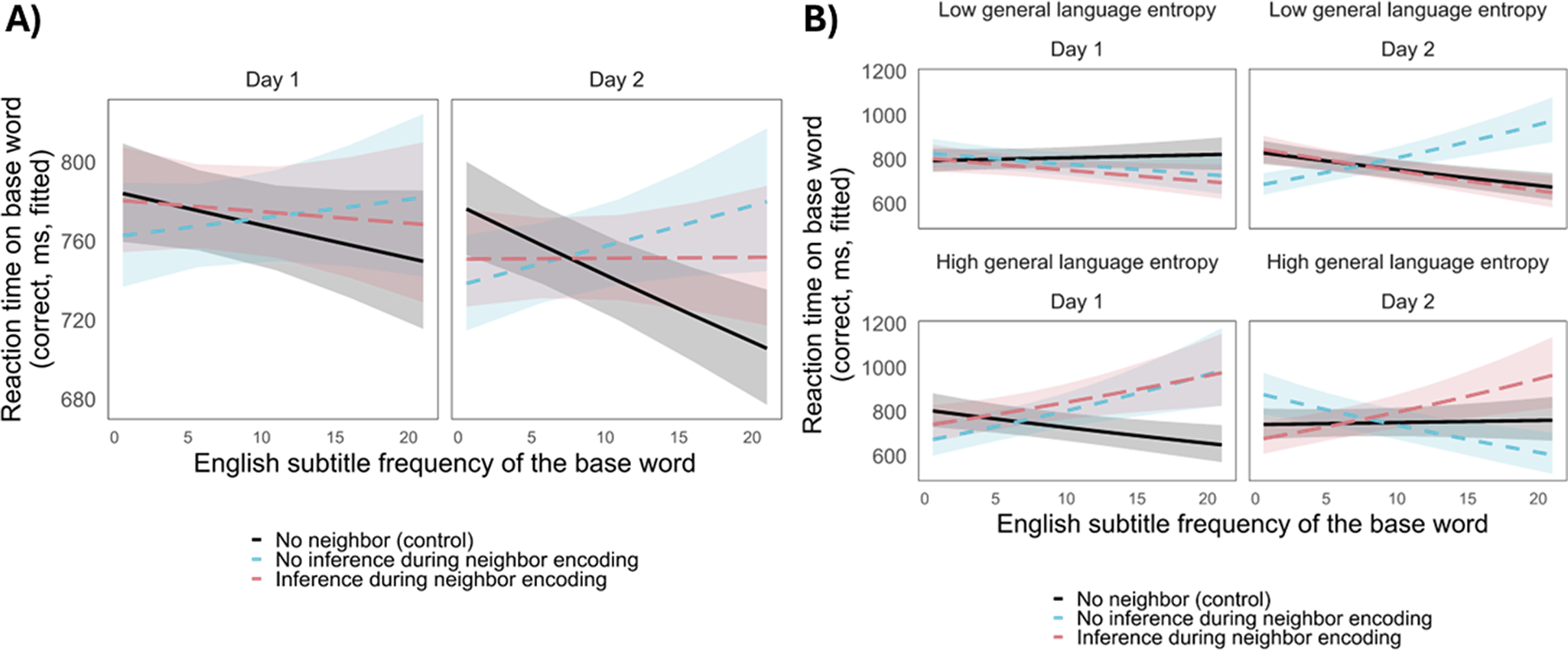
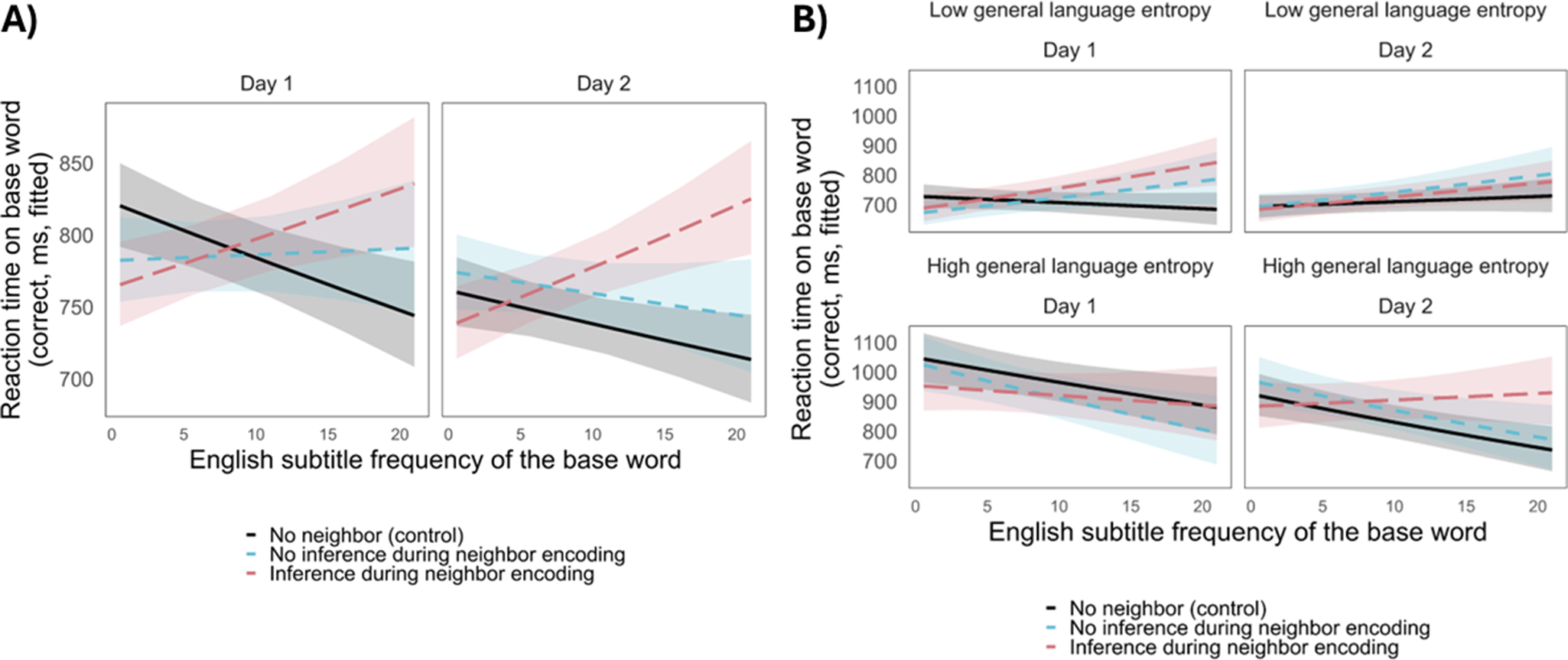
Model 1 – Semantic decision base model (research questions a and b). Although none of the main effects were significant, there was a significant interaction between inference (second contrast, control vs. mean of Inference + and Inference −) and frequency, b = −0.007, SE = 0.002, t = −2.879, p = .004, 95% CI [−0.01, −0.002], b* = −0.03, 95% CI [−0.05, −0.01]. In Figure 2a, we represented this interaction across Day 1 and Day 2, to show how stable this interaction was across the 24-h consolidation interval. Learning a novel neighbor to a high-frequency base word was consistently associated with lexical competition, both on Day 1 and on Day 2. In contrast, learning a novel neighbor to a low-frequency base word was not associated with changes in reaction times when processing the base word, either on Day 1 or on Day 2.Footnote 2
Predictions of model 1 (reaction times on SDT) and 2 (individuals differences in reaction times on SDT for explicitly instructed participants (Experiment 1). Note. (a) Reaction time on English base words (correct, ms, fitted) in the semantic decision task, taken as reflecting the lexicalization of the novel words, as a function of time (Day 1, Day 2), novel neighbor encoding condition (No neighbor – control, No inference during neighbor encoding, Inference during neighbor encoding), and English subtitle frequency of the base word. (b) Reaction time on English base words (correct, ms, fitted) in the semantic decision task, as a function of time, novel neighbor encoding condition, English subtitle frequency of the base word, and general language entropy. While general language entropy was included as a continuous variable in the model, we represent it as a categorical variable to facilitate comprehension. Error bands are ±1 SEM.
To tackle our research question regarding (c) individual differences in language entropy on novel word lexicalization, we next built a linear mixed effects model like the base model described earlier that included interactions with general language entropy (standardized) among the fixed effects. A random intercept by participant and a random intercept by item were added to the model. Thus, in what follows, we attend specifically to effects involving general language entropy.Footnote 3
Model 2 – Semantic decision language-entropy model (research question c). We found two significant interactions involving general language entropy and the other predictors. First, the interaction between inference (first contrast, Inference + vs. Inference −), day, base word frequency, and general language entropy was significant, b = −0.029, SE = 0.013, t = −2.278, p = .023, 95% CI [−0.05, −0.004], b* = −0.05, 95% CI [−0.10, −0.0008]. Second, the interaction between inference (second contrast, control vs. mean of Inference + and Inference −), day, base word frequency, and general language entropy was significant, b = 0.013, SE = 0.010, t = 2.256, p = .024, 95% CI [0.001, 0.03], b* = 0.03, 95% CI [0.0003, 0.05].
As shown on Figure 2b, RTs to words that had acquired a novel neighbor were modulated by individual differences in general language entropy. For participants with low general language entropy, no competition was visible on Day 1 (i.e., before the 24-h consolidation period). Competition only emerged for these participants after the consolidation period (Day 2), and it was driven by RTs on high-frequency words that had acquired a novel neighbor without inference during encoding (corresponding to the “explicit encoding” condition described in Coutanche & Thompson-Schill, Reference Coutanche and Thompson-Schill2014). In contrast, for participants with high general language entropy, competition was visible on Day 1 (i.e., before the 24-h consolidation period), specifically for high-frequency words with novel neighbors. Competition was still visible on Day 2, and it was driven by RTs on high-frequency words that had acquired a novel neighbor with an inference during encoding (i.e., the explicit fast-mapping condition that we introduced in our design).
2.3. Summary of Experiment 1
Regarding the impact of word factors on lexicalization, we confirmed our prediction that high base word frequency enhances lexicalization overall. Higher frequency was associated with slower reaction times and greater differences between studied novel words and controls, which may reflect the expected transition from hippocampal (episodic) dependence to neocortical (semantic) dependence (Bakker et al., Reference Bakker, Takashima, van Hell, Janzen and McQueen2014, Reference Bakker, Takashima, Van Hell, Janzen and McQueen2015), as well as competition with similar existing words for activation (Davis & Gaskell, Reference Davis and Gaskell2009). Frequently encountered words become more entrenched, stably represented, and easier to retrieve over time compared to lower frequency words (Dijkstra & van Heuven, Reference Dijkstra and van Heuven2002; Friesen et al., Reference Friesen, Whitford, Titone and Jared2020; Perfetti et al., Reference Perfetti, Wlotko and Hart2005; Schwartz et al., Reference Schwartz, Yeh and Shaw2008; Tarin et al., Reference Tarin, Hernández-Rivera, Iniesta, Palma, Whitford and Titone2025; Titone et al., Reference Titone, Libben, Mercier, Whitford and Pivneva2011; Whitford & Titone, Reference Whitford and Titone2012, Reference Whitford and Titone2017, Reference Whitford and Titone2019), facilitating learning and lexicalization by embodying the cohesiveness and consistency of orthographic, phonological, and semantic representations (Hsiao & Nation, Reference Hsiao and Nation2018).
Regarding task factors, our hypothesis that encoding conditions promoting inferencing (i.e., the fast-mapping condition) would further support lexicalization was confirmed, but only for bilingual adults with higher language entropy. For these participants, competition effects were observed both on Day 1 and Day 2 and were driven by high-frequency words acquired with an inference during encoding (i.e., fast mapping). In contrast, for participants with low general language entropy, competition effects emerged only after the consolidation period (Day 2) and were driven by reaction times for high-frequency words that had acquired a novel neighbor without inference during encoding. Language diversity interacts with both task-related factors (e.g., inferencing demands; Gullifer & Titone, Reference Gullifer and Titone2020; Titone & Tiv, Reference Titone and Tiv2023) and word-related factors (Tarin et al., Reference Tarin, Hernández-Rivera, Iniesta, Palma, Whitford and Titone2025) in shaping explicit novel word lexicalization.
3. Experiment 2: Implicitly instructed bilingual participants
In Experiment 2, we examined the generality of Experiment 1 by addressing the same three main research questions focused on implicit novel word lexicalization: what are the impacts of (a) a 24-h consolidation period including sleep, (b) word factors such as base word frequency and task factors such as inferencing during encoding (i.e., fast-mapping), and (c) individual differences in language entropy, when bilingual adults acquire novel words under implicit learning conditions (see Figure 1). In parallel with Experiment 1 results’, we hypothesized that (a) novel word lexicalization should be greater on Day 2 versus Day 1 for all bilingual participants; (b) high base word frequency would enhance lexicalization overall, and encoding conditions that promote inferencing (the fast-mapping condition) should further support lexicalization; and (c) bilingual adults with higher language entropy would benefit more from an inferencing demand at encoding.
3.1. Methods
3.1.1. Participants
Participants (N = 53) were recruited from the McGill undergraduate population and general Montreal community. Two participants reported exclusive usage of English in their daily life and were excluded, yielding a sample size of 51. Language History Questionnaire (LHQ) data for one of the participants was missing, such that we report characteristics for 50 participants. Of the 50 participants, several participants also had knowledge of a third or fourth language, but all participants either had English or French as their dominant language. The average age of acquisition for English was 2.69 years old, while the average age of acquisition for French was 1.94 years old. General language entropy scores ranged from 0.14 to 1.68 (mean = 0.87, SD = 0.40). We verified that participants in the implicitly instructed condition were not statistically different from those in the explicitly instructed condition on all reported demographic characteristics using unpaired Wilcoxon two-samples tests (all ps > .05). For a summary table of participant characteristics, see Table 1.
3.1.2. Materials
We used the same materials as described in Experiment 1.
3.1.3. Apparatus and procedure
The apparatus and procedure were the same as those described in Experiment 1, including both the 3-Alternative Forced-Choice (3AFC), and the semantic decision tasks. The only difference from Experiment 1 was in the vocabulary training phase, which in this experiment provided an implicit learning context as described next.
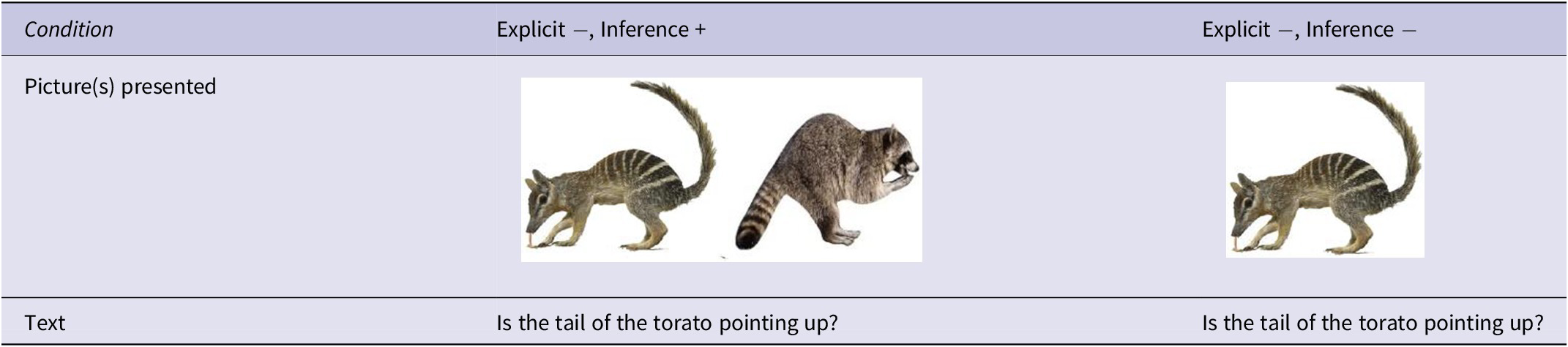
Training. The training task was framed as a visual perception task, and no mention was made of a subsequent memory test on the word-picture pairings. Each participant only learned 16 out of the 32 novel words mentioned earlier, such that 16 English target words did not acquire a novel neighbor during training for each participant. The 16 novel words under two different conditions. Eight novel words were presented in an Explicit −, Inference + (E−, I+) condition (i.e., implicit fast mapping). In that condition, which corresponds to the “fast-mapping” condition described in fast-mapping literature (e.g., Cooper et al., Reference Cooper, Greve and Henson2019a, Reference Cooper, Greve and Henson2019b; Coutanche & Thompson-Schill, Reference Coutanche and Thompson-Schill2014), participants were presented with an unfamiliar animal and a familiar animal, and a perceptual question containing a novel word (e.g., Is the tail of the torato pointing up?). The familiar animal possessed the feature in the question (e.g., a tail, although in the opposite state – i.e., down). Participants had to infer that the referent of the novel word was the unfamiliar animal in order to answer the question correctly. The unfamiliar animal was equally likely to appear on the left or right, and the correct answer was equally likely to be “yes” or “no.” Eight novel words were presented in an Explicit −, Inference − (E−, I−) condition (implicit nonfast mapping). In that condition, which corresponds to the “incidental encoding” condition described in fast-mapping literature (e.g., Cooper et al., Reference Cooper, Greve and Henson2019a, Reference Cooper, Greve and Henson2019b; Coutanche & Thompson-Schill, Reference Coutanche and Thompson-Schill2014), participants were asked the same kind of perceptual questions as in the E−, I+ condition (e.g., Is the tail of the torato pointing up?), but were only presented with the picture of an unfamiliar animal. As in E−, I+ condition, participants were not made aware that they needed to remember the association between novel words and referents, but here they also did not have to make an inference to determine the correct referent. Novel words in both E−, I+ and E−, I− condition were presented twice. We therefore created 64 perceptual questions in total. As for participants in Experiment 1, training was blocked, and the order of blocks was counterbalanced. A visual presentation of the implicit vocabulary training conditions may be found in Table 3.
Implicit vocabulary training conditions (Experiment 2)
3.2. Results
Given that we were most interested in the processes involved in novel word lexicalization, the results of the episodic task are presented in are presented in the Supplementary Materials. These results showed that general language entropy was associated with differences in accuracy after the 24-h consolidation period. Participants with high general language entropy benefitted more from learning novel neighbors when inference was involved during encoding, whereas participants with low general entropy benefited more from learning without inference. In what follows, we assess how these encoding effects persisted to novel word lexicalization, which was our main interest.
To address research questions regarding (a) a 24-h consolidation period including sleep, (b) word factors such as base word frequency and task factors such as inferencing during encoding (i.e., fast-mapping), we constructed a linear mixed effects model to predict correct reaction times on the semantic decision task (Baayen, Reference Baayen2008) as a function of the intercurrence of a consolidation period including sleep, the presence of inference during word encoding, base word frequency, and their interactions. Fixed effects included day (1 vs. 2), inference, and English base word frequency. Their interactions were also included. We implemented the same cutoffs and built models using the same procedures and R packages as described in Experiment 1.
Before proceeding to the results, we inform the readers that all model summaries for this article are reported in the Supplementary Materials.
Model 3 – Semantic decision base model (research questions a and b). Although none of the main effects were significant, 3 two-way interactions were significant. First, the interaction between inference during neighbor encoding (second contrast, control vs. mean of Inference + and Inference −) and day was significant, b = −0.013, SE = 0.006, t = −2.273, p = .023, 95% CI [−0.02, −0.002], b* = −0.23, 95% CI [−0.05, −0.03]. The interaction between inference during neighbor encoding (second contrast, control vs. mean of Inference + and Inference −) and frequency was also significant, b = −0.010, SE = 0.003, t = −3.397, p < .001, 95% CI [−0.02, −0.004], b* = −0.04, 95% CI [−0.06, −0.02]. Moreover, the interaction between inference during neighbor encoding (first contrast, Inference + vs. Inference −) and base word frequency was significant, b = −0.014, SE = 0.006, t = −2.190, p = .029, 95% CI [−0.03, −0.001], b* = −0.06, 95% CI [−0.10, −0.007].
Collectively, these interactions indicated that competition between newly acquired neighbors and their base words was visible only for high-frequency base words, and that it was driven by novel words learned with an inference during encoding (the fast-mapping condition in Coutanche & Thompson-Schill, Reference Coutanche and Thompson-Schill2014). As shown on Figure 3a, participants were generally slower when making decisions on base words that had acquired a novel neighbor, compared to base words that had not acquired a novel neighbor – a pattern consistent with the notion that newly acquired neighbors (e.g., torato) compete with existing words (e.g., tomato) during retrieval, for high-frequency base words. The interaction with day suggested that competition was stronger on Day 2 compared to Day 1.Footnote 4
Predictions of model 3 (reaction times on SDT) and 4 (individual differences in reaction times on SDT) for implicitly instructed participants (Experiment 2). Note. (a) Reaction time on English base words (correct, ms, fitted) in the semantic decision task, taken as reflecting the lexicalization of the novel words, as a function of time (Day 1, Day 2), novel neighbor encoding condition (No neighbor – control, No inference during neighbor encoding, Inference during neighbor encoding), and English subtitle frequency of the base word. (b) Reaction time on English base words (correct, ms, fitted) in the semantic decision task, as a function of time, novel neighbor encoding condition, English subtitle frequency of the base word, and general language entropy. While general language entropy was included as a continuous variable in the model, we represent it as a categorical variable to facilitate comprehension. Error bands are ±1 SEM.
To tackle our research question regarding (c) individual differences in language entropy on novel word lexicalization, we next built a linear mixed effects model like the base model described earlier, including interactions with general language entropy (standardized) among the fixed effects. A random intercept by participant and a random intercept by item were added to the model.
Model 4 – Semantic decision language-entropy model (research question c). There was a significant interaction between general language entropy and base word frequency, b = −0.014, SE = 0.005, t = −2.646, p = .008, 95% CI [−0.02, −0.005], b* = −0.05, 95% CI [−0.08, −0.001]. As shown in Figure 2b, participants with high general language entropy appeared to have generally faster RTs on English base words with high frequency, whereas the effect of base word frequency on RT was smaller for participants with low general language entropy. This finding suggests that language entropy modulates how efficiently high-frequency lexical items are processed during semantic decisions.
However, to further characterize this interaction, we conducted a post hoc analysis by splitting participants into lower and higher entropy groups based on a median split (median general language entropy = 0.88). Although no interactions with neighbor encoding conditions reached significance, visual inspection of the data suggested distinct patterns between low- and high-entropy participants. This follow-up analysis allowed us to more precisely characterize how language entropy shaped lexicalization patterns, and to test whether our predictions from Experiment 1 extended to implicit learning. In participants with lower general language entropy, we found no significant main effects or interactions. In contrast, participants with higher general language entropy showed more variability in their data beyond a simple effect of frequency, which included the two significant interactions highlighted earlier at the group level that involved base word frequency. As shown in Figure 3b, competition emerged for these participants on Day 2, driven by an increase in RT for high-frequency English base words that had acquired a novel neighbor with an inference at encoding (corresponding to a fast-mapping condition).
3.3. Summary of Experiment 2
Regarding the impact of 24-h consolidation period including sleep on lexicalization, we confirmed our prediction that novel word lexicalization was greater on Day 2 versus Day 1. Regarding the word factors on lexicalization, we confirmed our prediction that high base word frequency enhances lexicalization overall. Higher frequency was associated with slower reaction times and greater differences between studied novel words and controls, which may reflect the expected transition from hippocampal (episodic) dependence to neocortical (semantic) dependence (Bakker et al., Reference Bakker, Takashima, van Hell, Janzen and McQueen2014, Reference Bakker, Takashima, Van Hell, Janzen and McQueen2015), as well as competition with similar existing words for activation (Davis & Gaskell, Reference Davis and Gaskell2009).
Regarding task factors, we confirmed our hypothesis that encoding conditions promoting inferencing (i.e., the fast-mapping condition) would further support lexicalization. However, post hoc exploration revealed that only the participants with high general language entropy showed competition that emerged on Day 2, driven by an increase in RT for high-frequency English base words that had acquired a novel neighbor with an inference at encoding. Thus, language diversity interacted with both task-related factors (e.g., inferencing demands; Gullifer & Titone, Reference Gullifer and Titone2020; Titone & Tiv, Reference Titone and Tiv2023) and word-related factors (Tarin et al., Reference Tarin, Hernández-Rivera, Iniesta, Palma, Whitford and Titone2025) in shaping implicit novel word lexicalization.
4. General discussion
In this study, we investigated the evolution of novel word knowledge under different learning conditions in bilingual adults tested twice across a 24-h period that included a sleep interval. Participants were presented with novel words (e.g., bloksom) based on existing English words (e.g., blossom), paired with animal pictures serving as referents. We were particularly interested in novel word lexicalization, defined as the difference in reaction times between existing English words with a novel neighbor, and those without a novel neighbor as evidence of competition (Bakker et al., Reference Bakker, Takashima, van Hell, Janzen and McQueen2014, Reference Bakker, Takashima, Van Hell, Janzen and McQueen2015). We aimed to test specific hypotheses inspired by the Complementary Learning Systems model (Davis et al., Reference Davis, Di Betta, MacDonald and Gaskell2009; McClelland et al., Reference McClelland, McNaughton and O’Reilly1995) and its revised version (McClelland, Reference McClelland2013; McClelland et al., Reference McClelland, McNaughton and Lampinen2020). Specifically, we examined how lexicalization of novel words was influenced by a consolidation interval that included sleep, by word- and task-level factors related to the learning context, and by individual differences in language experience (see Figure 1).
The Complementary Learning Systems model (Davis et al., Reference Davis, Di Betta, MacDonald and Gaskell2009; McClelland et al., Reference McClelland, McNaughton and O’Reilly1995) suggests that sleep plays a crucial role in integrating novel semantic representations with existing ones. However, previous studies on novel word lexicalization have yielded inconsistent evidence on this point. On one hand, studies employing intentional learning paradigms, such as phoneme or letter monitoring, have found evidence of postsleep lexicalization (Bakker et al., Reference Bakker, Takashima, van Hell, Janzen and McQueen2014; Dumay et al., Reference Dumay, Gaskell and Feng2004; Wang et al., Reference Wang, Savage, Gaskell, Paulin, Robidoux and Castles2017). On the other hand, studies using incidental learning paradigms, such as statistical learning, Hebb learning, and implicit fast mapping, have reported immediate lexicalization (Coutanche & Thompson-Schill, Reference Coutanche and Thompson-Schill2014; Fernandes et al., Reference Fernandes, Kolinsky and Ventura2009; Geukes et al., Reference Geukes, Gaskell and Zwitserlood2015; Szmalec et al., Reference Szmalec, Page and Duyck2012).
We found evidence of novel word lexicalization both before and after a consolidation period including sleep, as evidenced by competition during the processing of existing words (e.g., blossom) that had acquired a novel neighbor (e.g., bloksom). Thus, our data suggest immediate lexicalization in both explicitly and implicitly trained bilingual participants. Of note, although for implicitly trained participants the effect of novel word lexicalization was stronger on Day 2, it was nonetheless observed on Day 1 as well. Existing literature on word integration in bilinguals does not provide conclusive evidence regarding postsleep lexicalization and has focused primarily on novel word acquisition in the L2 (Elgort, Reference Elgort2011; Qiao & Forster, Reference Qiao and Forster2017). Our results align with Lindsay and Gaskell’s (Reference Lindsay and Gaskell2013) observation that sleep may be a “sufficient but not necessary” condition for lexicalization.
However, the presence of lexicalization on Day 1 was modulated by word factors. First, we found that high-frequency lexical representations drove lexicalization in bilingual adults, both before and after the consolidation period and across both experiments, like findings by Palma et al. (Reference Palma, Marin, Onishi and Titone2022). This aligns with the Complementary Learning Systems prediction and empirical evidence suggesting that consistency with preexisting schemas can accelerate the integration of new knowledge (Fernandes et al., Reference Fernandes, Kolinsky and Ventura2009; Havas et al., Reference Havas, Taylor, Vaquero, de Diego-Balaguer, Rodriguez-Fornells and Davis2018; McClelland, Reference McClelland2013). When bilingual adults process a novel word with an existing high-frequency neighbor (e.g., shatow, neighbor to shadow), the lexicalized trace of that existing word, represented neocortically, may be activated in parallel (Davis & Gaskell, Reference Davis and Gaskell2009). High-frequency words are more entrenched, stable, and easier to retrieve than lower frequency words (Broadbent, Reference Broadbent1967; Rayner & Duffy, Reference Rayner and Duffy1986), which can facilitate learning and lexicalization by reinforcing the consistency of orthographic, phonological, and semantic representations (Hsiao & Nation, Reference Hsiao and Nation2018). Adult learners might have an easier time lexicalizing novel words that were similar to existing words with higher subjective frequency as consequence of easier encoding processes (Dijkstra & van Heuven, Reference Dijkstra and van Heuven2002; Friesen et al., Reference Friesen, Whitford, Titone and Jared2020; Perfetti et al., Reference Perfetti, Wlotko and Hart2005; Schwartz et al., Reference Schwartz, Yeh and Shaw2008; Tarin et al., Reference Tarin, Hernández-Rivera, Iniesta, Palma, Whitford and Titone2025; Titone et al., Reference Titone, Libben, Mercier, Whitford and Pivneva2011; Whitford & Titone, Reference Whitford and Titone2012, Reference Whitford and Titone2017, Reference Whitford and Titone2019).
In addition, task-level factors also played a modulatory role. Although we found no significant difference between inference conditions overall, we observed an interaction between inference during neighbor encoding and base word frequency in Experiment 2. Competition effects were stronger for novel words learned with an inference, suggesting that having two potential referents during encoding promoted stronger mapping of novel words to referents under implicit instruction. This inference-based learning is consistent with prior research on fast mapping, which suggests that rapid mapping with limited exposure can anchor new knowledge in existing knowledge (Atir-Sharon et al., Reference Atir-Sharon, Gilboa, Hazan, Koilis and Manevitz2015; Coutanche & Thompson-Schill, Reference Coutanche and Thompson-Schill2014; Merhav et al., Reference Merhav, Karni and Gilboa2015; Sharon et al., Reference Sharon, Moscovitch and Gilboa2011; Zaiser et al., Reference Zaiser, Bader and Meyer2022).
Finally, participants’ individual characteristics also modulated the effects of sleep, and word-level and task-level factors on novel word lexicalization. We used general language entropy as a measure of bilingual experience, capturing the degree of sociolinguistic uncertainty a bilingual individual encounters. Differential patterns of exposure are important for bilingual language acquisition (Carroll, Reference Carroll2017), as bilingual adults may be optimized for different learning contexts depending on how they have learned and use their languages within specific socioecological environments (reviewed in Gullifer & Titone, Reference Gullifer and Titone2020; Titone & Tiv, Reference Titone and Tiv2023). In highly diverse language contexts, bilinguals face greater language-related uncertainties. Navigating these uncertainties may shape the neurocognitive system (Beatty-Martínez et al., Reference Beatty-Martínez, Navarro-Torres, Dussias, Bajo, Guzzardo Tamargo and Kroll2020; Gullifer et al., Reference Gullifer, Kousaie, Gilbert, Grant, Giroud, Coulter, Klein, Baum, Phillips and Titone2021; Gullifer & Titone, Reference Gullifer and Titone2020).
Participants with explicit instruction and high language entropy showed immediate lexicalization on Day 1 (Experiment 1), with further enhancement when words were presented with an inference during encoding (i.e., fast mapping). In contrast, those with low language entropy showed competition effects only after the consolidation period (Day 2), and these effects were driven by reaction times for high-frequency words acquired without inference during encoding. These results were complemented by those for participants who received implicit instruction (Experiment 2). We found competition emerging after the 24-h consolidation period in participants with high entropy, driven by words acquired with an inference during encoding. This suggests that bilinguals in linguistically diverse environments may be especially skilled at learning under uncertain or unpredictable conditions (Onnis et al., Reference Onnis, Chun and Lou-Magnuson2018). They may also develop cognitive skills, such as enhanced phonological working memory (Escudero et al., Reference Escudero, Mulak, Fu and Singh2016; Kaushanskaya, Reference Kaushanskaya2012; Papagno & Vallar, Reference Papagno and Vallar1995), executive functioning (Bartolotti & Marian, Reference Bartolotti and Marian2012; Bogulski et al., Reference Bogulski, Bice and Kroll2018; Bradley et al., Reference Bradley, King and Hernandez2013; Kaushanskaya & Marian, Reference Kaushanskaya and Marian2009a), and integrated lexical networks (Kaushanskaya & Rechtzigel, Reference Kaushanskaya and Rechtzigel2012), that facilitate novel word learning.
Therefore, although sleep did not considerably impact the timeline of novel word lexicalization when analyzing all bilingual participants together, we still found instances of postsleep lexicalization for certain learners under specific learning conditions. Specifically, we observed postsleep lexicalization, in accordance with the tenets of the Complementary Learning Systems model (McClelland et al., Reference McClelland, McNaughton and O’Reilly1995), for low-entropy bilingual learners trained explicitly, in the case of words acquired noninferentially, and for high-entropy bilingual learners trained implicitly, in the case of words acquired inferentially. Although this evidence suggests that sleep might play a role in novel word lexicalization under specific circumstances, it must be kept in mind that our experimental design does not allow to fully tease apart the effect of sleep from that of the mere passage of time. Moreover, as noted in a previous review on the same topic (Palma & Titone, Reference Palma and Titone2021), the behavioral nature of our data prevents us from verifying whether sleep indeed activates specific neurobiological processes that directly impact consolidation or whether it simply protects new memories from interference (see Ellenbogen et al., Reference Ellenbogen, Payne and Stickgold2006; Nemeth et al., Reference Nemeth, Gerbier and Janacsek2019). A noteworthy aspect of these results is that even the explicit fast-mapping encoding condition, which was tested here for the first time, proved beneficial for immediate lexicalization, but only for participants with more balanced language use (i.e., high general language entropy).
While our focus was on lexicalization, we also assessed episodic memory using a recognition task (see Supplementary Materials). All bilinguals recognized novel words and their referents in the 3-alternative forced-choice task across both days, regardless of word- or task-level factors. Sleep did not affect episodic memory, supporting theories that emphasize its role in semantic integration rather than episodic memory (McClelland et al., Reference McClelland, McNaughton and O’Reilly1995; Palma & Titone, Reference Palma and Titone2021). As detailed in Section 4.1 and Supplementary Materials, episodic memory was significantly higher for explicitly trained participants (91%) compared to implicitly trained ones (59%), with implicit fast mapping (58%) and incidental encoding (60%) showing similar recognition accuracy. These findings align with Coutanche and Thompson-Schill (Reference Coutanche and Thompson-Schill2014), who reported comparable declarative memory for fast-mapping and incidental encoding, both lower than explicit encoding.
At the individual level, differences in implicit learning emerged, with high entropy bilinguals showing enhanced recognition for novel words learned through inference after consolidation. In contrast, low entropy bilinguals benefited more from learning without inference. These findings suggest again that uncertain learning conditions, such as implicit instruction combined with inference during encoding, are especially advantageous for bilinguals who report using multiple languages in daily life. High entropy environments encourage exploration and adaptation, fostering skills that promote successful vocabulary learning (Hirsh et al., Reference Hirsh, Mar and Petersson2012; Yu & Dayan, Reference Yu, Dayan, Becker and Obermayer2003, Reference Yu and Dayan2005).
Multimodal enrichment enhances learning performance in recall and recognition tasks (Mathias & von Kriegstein, Reference Mathias and von Kriegstein2023; Mayer et al., Reference Mayer, Yildiz, Macedonia and von Kriegstein2015; Suanda et al., Reference Suanda, Smith and Yu2016) and facilitates the lexicalization of novel words (Lei et al., Reference Lei, Liu and Van Hell2022), effects that can be amplified in immersive virtual reality environments (Jiao et al., Reference Jiao, Lin, Schwieter and Liu2025; Liu et al., Reference Liu, Mao, Wang, Zhou and Li2024). High entropy contexts, characterized by variability, unpredictability, and diverse informational cues, can themselves function as a form of multimodal enrichment. By introducing uncertainty, such contexts prompt learners to explore alternative interpretations, flexibly adjust strategies, and strengthen task performance (Hirsh et al., Reference Hirsh, Mar and Petersson2012; Yu & Dayan, Reference Yu, Dayan, Becker and Obermayer2003, Reference Yu and Dayan2005). For bilinguals, habitual exposure to linguistically diverse and unpredictable input may sharpen their sensitivity to variable parameters in new languages (Bice & Kroll, Reference Bice and Kroll2019; Weiss et al., Reference Weiss, Schwob and Lebkuecher2020). This experience with fluctuating input encourages a learning style centered on pattern extraction and contextual inference (Gollan et al., Reference Gollan, Starr and Ferreira2015; Pelucchi et al., Reference Pelucchi, Hay and Saffran2009). Uncertain learning conditions may therefore constitute a “desirable difficulty” for bilingual individuals, who are routinely exposed to sociolinguistic uncertainty in their daily lives (Gullifer & Titone, Reference Gullifer and Titone2021b; see also Bjork & Kroll, Reference Bjork and Kroll2015; Bogulski et al., Reference Bogulski, Bice and Kroll2018).
4.1. Limitations
While this study is clear in suggesting to what extent sleep, word-level characteristics, learning conditions, and learners’ language background regulate novel word learning in bilingual users, several potential limitations should be noted. First, the different learning trajectory of explicitly and implicitly instructed participants was only analyzed informally, without being directly compared within the same statistical models. The rationale for doing so was to avoid building models that were too complex to interpret, since including learning awareness as an additional factor would have resulted in a five-way interaction (i.e., between day, inference in encoding, base word frequency, language entropy, and learning awareness). However, at the reasonable request of an anonymous reviewer, we ran additional models including learning awareness as a factor, whose results are presented and briefly discussed in the Supplementary Materials. Importantly, these additional models provided statistical support that the effects and interactions of main experimental variables (day, inference in encoding, frequency, general language entropy) that we separately observed in Experiment 1 and Experiment 2 were also significantly different between explicitly and implicitly instructed participants.
A second potential limitation is that participants’ language experience was only modeled continuously and at the individual level through the variable of general language entropy. As shown in the Supplementary Materials, the distribution of general language entropy scores differed between English L1 and English L2 users in our sample. While English L1 users generally reported lower entropy scores, a large portion of English L2 users reported medium entropy scores, which indicate a greater balance in the usage of all the languages known by a participant. To verify if the language entropy effects observed in previous models could be simply driven by group-level differences between English L1 and English L2 users, we ran additional models, reported in the Supplementary Materials, where language entropy was replaced by language group as a categorical variable (i.e., English L1 vs. English L2). Importantly, the effects that emerged in these models between English L1 and English L2 users do not seem to match the differences that were observed between participants with low and high general language entropy in previous models. Related to this, another potential limitation is that our analyses on the effect of individual differences in language entropy were correlational in nature, as we did not directly control or manipulate participants’ language backgrounds when recruiting or training them. Future studies should thus strive to provide more unambiguous evidence on the effect of learners’ individual language experience by directly controlling it as an experimental factor.
Finally, as suggested by an anonymous reviewer, our findings could be partially explained by a repetition effect (Burt et al., Reference Burt, Kipps and Matthews2014; Forster & Davis, Reference Forster and Davis1984; Scarborough et al., Reference Scarborough, Cortese and Scarborough1977; Versace & Nevers, Reference Versace and Nevers2003). Accordingly, the repeated encounter of a given word during a language task might result in facilitated processing for that word, especially if its general frequency of occurrence is low. In this study, participants completed the different task components in a fixed order, and each novel or base word was repeated a fixed number of times across the overall study (twice during training, twice per day in the AFC task, once per day in the semantic decision task). As a result, we cannot fully determine to what extent the episodic memory and lexicalization effects observed over the course of the experiment were due to the target word having already appeared earlier in the experiment rather than to the other variables of interest (e.g., experimental day or inference in encoding). Therefore, future investigations should manipulate the order in which participants are exposed to the experimental tasks, as well as the number of repetitions of each target word in the training and testing input.
To conclude, this study reports evidence that the time course of novel word learning and lexicalization for bilingual adults are jointly modulated by sleep, learning, and encoding conditions, variation in the frequency of lexical representations (e.g., Palma et al., Reference Palma, Marin, Onishi and Titone2022), and individual differences in daily language experience. This has implications for the application of the Complementary Learning Systems model to the study of novel word learning, as well as our general understanding of second-language learning and memory.
Supplementary material
The supplementary material for this article can be found at http://doi.org/10.1017/S1366728926101059.
Acknowledgments
This research was supported by a Natural Science and Engineering Research Council of Canada (NSERC) Discovery Grant and Canada Research Chair awarded to Debra Titone, as well as a NSERC-CREATE Graduate Award awarded to Pauline Palma. The authors thank current and past members of the Language and Multilingualism Lab for insightful feedback.
Competing interests
The authors declare no competing interests.
Data availability statement
The data that support the findings of this study and Supplementary Materials are openly available on the Open Science Framework platform at https://osf.io/8xdr7/overview?view_only=043e6461d25f4e73a6761bf46224d2ad.



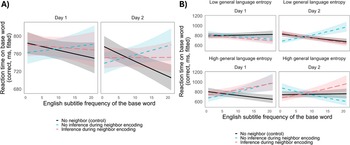

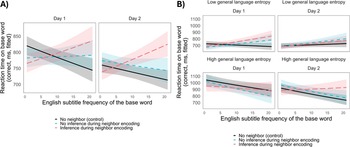


 Open access

