

We begin with an intentionally provocative question: Compared with other periods, why is there so little gender archaeology for the European Neolithic? A recent encyclopaedic, 1,166-page overview of the Neolithic (Fowler et al. Reference Fowler, Harding and Hofmann2015) involving 88 authors from 45 countries mentions gender on only 6 pages! Other recent reviews of gender in European archaeology (Whitehouse Reference Whitehouse and Nelson2006) underline the meager harvest from this period. Why should this be so? It cannot be due to theoretical innocence: Neolithic archaeologists have been at the forefront of theoretical explorations, and feminist critiques of “goddess” meta-narratives (e.g., Goodison and Morris Reference Goodison, Morris and Bolger2013) underline Neolithic theorists’ acuity and awareness of gender. Is it for lack of material evidence? No: gender is often developed through houses, villages, burials, and monuments, and Neolithic archaeologists have excavated an abundance of these. Even relevant Neolithic imagery is far more commonplace than many archaeologists realize. But this plethora of evidence has not translated into a well-developed archaeology of Neolithic gender. Why not?
The dominant narratives of gender archaeology, particularly in European prehistory, have been conceptually static in recent years. Although work in queer theory and feminist philosophy is developing new approaches to identity (e.g., Geller Reference Geller2009; Joyce Reference Joyce2000, Reference Joyce, Meskell and Preucel2004, Reference Joyce2008; Schmidt Reference Schmidt, Casella and Fowler2005; Voss Reference Voss2000, Reference Voss, Casella and Fowler2005, Reference Voss2008), within the European Neolithic, at least, our understanding of gender in past societies has not moved substantially beyond the conceptual basis established in the 1980s–1990s. We need to build upon these new ideas to move beyond a narrow focus on gender attribution (Conkey Reference Conkey and Bolger2013; Joyce Reference Joyce, Meskell and Preucel2004; Schmidt Reference Schmidt, Casella and Fowler2005). This is an experimental paper, intended to help jar the study of Neolithic gender from its current impasse. We argue that interpretation has reached the limits of current mainstream conceptualizations of gender. This appears above all with Neolithic gender, which challenges our concepts in ways later gender does not. Through an overview of the evidence for Neolithic gender, we argue that the reason there is very little Neolithic gender archaeology is because we are not recognizing Neolithic gender for what it was, a form of identity qualitatively different than gender throughout later prehistory, and indeed through the last 5,000 years up to the present. The third millennium BC was thus a major turning point in the history of gender in European society, and given the way that Europe's historical heritage has formed the matrix for much of academic thought, one of global importance.
The State of Mainstream Gender Archaeology
Gender archaeology has made profound contributions to the discipline. Gender archaeologists not only opened our eyes to the possibilities of writing different kinds of narratives about the past; they paved the way for now-mainstream discussions of identity and personhood. Like gender history, gender archaeology was founded on the classic premise—still taught as axiomatic—that gender was the cultural elaboration of biological sex (Conkey and Gero Reference Conkey, Gero, Gero and Conkey1991:8; Conkey and Spector Reference Conkey and Spector1984:15; Rubin Reference Rubin and Rapp Reiter1975; cf. Voss Reference Voss2000:182). Drawing inspiration from second-wave feminism and Simone de Beauvoir's (Reference de Beauvoir1972 [1949]:295) cri de coeur that one is not born, but rather becomes, a woman (cf. Fuglestvedt Reference Fuglestvedt2014:53), gender archaeology analyzed the different ways of being men and women that existed in the past. This formulation opened up a new realm of inquiry—above all, finding women in the past while distancing gender from biological determinisms that equated women with their bodies. The inescapable key evidence for gender was thus grave goods and iconography; both supplied cultural representations that could be linked with sexable bodies (either skeletons whose sex could be determined, or representations depicting bodies with sexual characteristics). We assumed that we knew what kind of thing gender is; the challenge became determining how its “content” changed in each period or context.
Thirty years later, standard gender archaeology has matured into comfortable middle age. It is “normal science;” if its revolutionary edge feels softened, it has become accepted as mainstream. Yet this acceptance has sidestepped a persistent, unanswered problem. The original formulation posited a simple dichotomous relationship between biological sex and cultural gender. Soon after this dichotomy was formulated, feminist theorists pointed out the elephant-in-the-room issue: building upon an Enlightenment model in which the person is conceptualized in two parts, as a material mechanism inhabited by a psyche or soul (Marshall Reference Marshall and Bolger2013; Robb and Harris Reference Robb and Harris2013), the sex/culture dichotomy represents the imposition of the oft-critiqued nature/culture dichotomy, with “sex” representing “nature” and “gender” “culture” (Fuglestvedt Reference Fuglestvedt2014:51). Feminist critics of this include Braidotti (Reference Braidotti1994), Butler (Reference Butler1993), Irigaray (Reference Irigaray1985), Grosz (Reference Grosz1994), and Haraway (Reference Haraway1991); many readers will be most familiar with Butler's argument that “biological” sex is also a performative categorization rather than a preexisting “natural” state. This approach has been used in some gender archaeology, particularly through Joyce's work (Reference Joyce2000, Reference Joyce, Meskell and Preucel2004, Reference Joyce2005, Reference Joyce2008). Yet, even as theorists have increasingly criticized such dichotomies (e.g., Harris and Cipolla Reference Harris and Cipolla2017; Jones Reference Jones2002; Thomas Reference Thomas2004; Witmore Reference Witmore2007), this comprehensive critique has had little impact on the normal practice of gender archaeology. Of the feminist authors cited above, only Butler's work has been extensively discussed in gender archaeology (e.g., Joyce Reference Joyce2000, Reference Joyce2008; Perry and Joyce Reference Perry and Joyce2001; Schmidt Reference Schmidt, Casella and Fowler2005; Voss Reference Voss, Casella and Fowler2005, Reference Voss2008), and mostly to cite her emphasis on performativity rather than her analysis of the emergent nature of sex and matter itself. Relatedly, dominant approaches to gender that treat it as a straightforward binary system show little influence from other views, sometimes inspired by important work in queer theory, that move toward a relational, contextually salient gender (e.g., Alberti Reference Alberti2001, Reference Alberti and Bolger2013; Geller Reference Geller2017; Ghisleni et al. Reference Ghisleni, Jordan and Fioccoprile2016; Moral Reference Moral2016; Strathern Reference Strathern1988; Voss Reference Voss2008; Weismantel Reference Weismantel, Stryker and Aizura2013). Wider work on sexuality in archaeology (e.g., Geller Reference Geller2009; Schmidt and Voss Reference Schmidt and Voss2000; Voss Reference Voss, Casella and Fowler2005, Reference Voss2008) also remains to be integrated into mainstream gender archaeology. These various works effectively problematize the basic parameters of gender and sexuality as historically contingent dimensions of social life, but have made little inroads into how gender archaeology is practiced. To give this line of thought greater “reach,” we need well-documented case studies, particularly using archaeological materials from deep prehistory (see Marshall Reference Marshall2008), which explore not only difference, but differences in difference. This study is a step in this direction.
The study of gender in European prehistory has followed a similar pattern in many regions (Chapman and Palincaş Reference Chapman, Palincaş and Bolger2013; Diaz-Andreu and Monton-Subias Reference Diaz-Andreu, Monton-Subias and Bolger2013; Edwards and Pope Reference Edwards, Pope and Bolger2013; Hitchcock and Nikolaidou Reference Hitchcock, Nikolaidou and Bolger2013; Sørensen Reference Sørensen and Bolger2013a; Whitehouse Reference Whitehouse and Bolger2013). A pioneering, feminist first generation in the 1980s–1990s succeeded in accumulating case studies throughout Europe. Gender is now a widely accepted element of the field, particularly for the Bronze and Iron Ages (see below). However, in spite of insightful theoretical forays, there has been little theoretical elaboration beyond the original sex/ gender platform, and efforts to get beyond binary approaches within the Neolithic and Bronze ages (e.g., Stratton Reference Stratton2016; Yates Reference Yates and Tilley1993) have yet to have the impact they deserve. They have supplied a platform for critiquing normative views of gender, particularly as applied to grave goods (Arnold Reference Arnold2016; Jordan Reference Jordan2016; Stratton Reference Stratton2016). Yet they remain principally at the level of critique rather than charting a way forward. Indeed, archaeologists wary of imposing essentialist approaches have largely moved away from discussing gender at all, preferring personhood as a relational way of understanding identity (e.g., Chapman Reference Chapman2000; Fowler Reference Fowler2001, Reference Fowler2004; Marshall Reference Marshall and Bolger2013). Overall, gender archaeology in European prehistory continues to be widely accepted, but without generating many new interpretations; the impression is that we have had the big ideas and what remains is to work out the details. Yet such complacency is unjustified. Progress has been patchy; there are well-developed gender archaeologies for some periods (particularly later prehistory) and for some materials (particularly burials), but large blind spots for others—the Mesolithic and Neolithic, material culture and lifeways. This implies that we have now explored most of the archaeological territory accessible through the ideas of traditional gender archaeology; we cannot advance further without critical examination of our basic concepts and methods. We need to incorporate the insights of work from other parts of the world (e.g., Joyce Reference Joyce2000; Perry and Joyce Reference Perry and Joyce2001) and to work at a scale of analysis not previously attempted.
The Archaeology of Gender: A View from the Bronze Age (and Later)
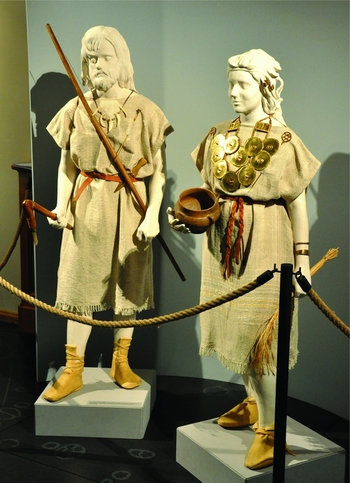
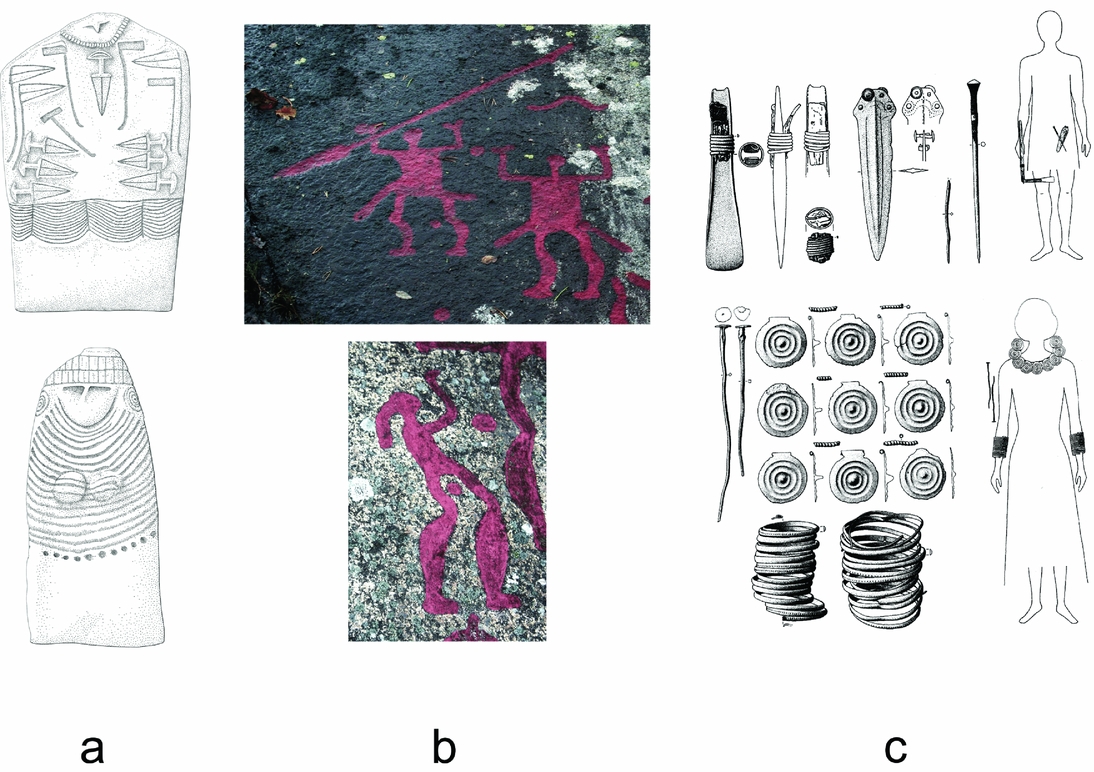
To investigate Neolithic gender, let's begin, counterintuitively, by looking briefly at Bronze Age gender. From the third millennium BC onward, there is a substantial and well-developed archaeology of gender (Back Danielsson and Thedéen Reference Back Danielsson and Thedéen2012; Brück Reference Brück2009; Sofaer Derevenski Reference Sofaer Derevenski, Moore and Scott1997a; Sørensen Reference Sørensen1997, Reference Sørensen and Nelson2006, Reference Sørensen, Fokkens and Harding2013b). Commonly cited evidence includes the following (Figures 1 and 2):
-
• Metal ornaments are often found with burials, and particular forms often appear to have been gendered. Habitually worn, contributing to appearance, movement, and sound, and possibly important biographical items, they may have formed part of a gendered habitus (Sørensen Reference Sørensen1997, Reference Sørensen, Fokkens and Harding2013b).
-
• Where clothing survives, this too follows demarcated patterns of male and female dress that map onto the biological identities of the people wearing it (Sørensen Reference Sørensen, Fokkens and Harding2013b).
-
• Weapons are commonly deposited in male burials, and in imagery they often define maleness and the warrior as a Bronze Age kind of person. They formed a type of male jewelry for performing masculine identities in multiple contexts (Harding Reference Harding, Carman and Harding1999, Reference Harding2007; Kristiansen Reference Kristiansen2002; Robb Reference Robb1994; Treherne Reference Treherne1995).
-
• When we can correlate skeletal sex with burial treatment, burial often displays clear gender dichotomies of grave goods or funerary practice. As Holst (Reference Holst, Fokkens and Harding2013:107) remarks, “the standardised burial equipment in this way appears first and foremost to express widespread and generalised social roles. Among these roles, gender distinction particularly stands out.” Male and female identity provided “a dominant structure in burials” (Holst Reference Holst, Fokkens and Harding2013:107) across Bronze Age Europe.
-
• Human body representations in various media (particularly statue-stelae, but also clay and metal figurines and rock art) often show males and females, clearly gendered through anatomical traits, posture, dress, or diacritic objects such as weapons.
Bronze Age gender: male and female bodies with gendered material culture. Reconstruction, Plsen Museum, Czech Republic. Photo: John Robb.
Bronze Age gender. (a) Male (top) and female (bottom) Copper Age statue-stelae, Lago di Garda, Italy. Drawings: Vicki Herring. (b) Rock art, Tanum, Sweden. Top: males with weaponry. Bottom: woman, with hairstyle and dot between legs. Photos: John Robb. (c) Typical gendered burial assemblages, Wolnzach-Neiderlauterbach, Germany (top: male; bottom: female; Jockenhövel Reference Jockenhövel, Fokkens and Harding2013:Figure 40.3). With kind permission of Dr. Albrecht Jockenhövel.
In other words, Bronze Age gender is in sharp focus: we know who the boys and the girls are. This clarity persists through the Iron Age, and on through the early medieval period, during which male and female gendered burials often show a clear concordance with skeletal sex and with gendered objects and personas in life.
Was Bronze Age gender binary? The assumption that gender is inherently binary has come under broad, well-considered critique (e.g., Arnold Reference Arnold2016; Ghisleni et al. Reference Ghisleni, Jordan and Fioccoprile2016; Joyce Reference Joyce2008; Schmidt Reference Schmidt, Casella and Fowler2005; Voss Reference Voss, Casella and Fowler2005), building strongly on Butler (Reference Butler1990). As Weismantel (Reference Weismantel, Stryker and Aizura2013:322) points out, most gender archaeologies have problematically assumed that gender is fundamentally binary. We fully agree that archaeological analysis should problematize essentialist and binary approaches to gender. However, we must also remain open to the possibility that, in particular historical contexts, ancient people essentialized their own gender and imposed normative binarism on themselves. The archaeological evidence for often quite clear and explicit gender structures suggests this was the case in the European Bronze Age; our argument below that Neolithic gender differed from this pattern should suffice to show that such a configuration of gender is neither universal nor inevitable. We also do not claim that Bronze Age gender was exclusively and narrowly binary. No gender system can ever be simple and totalizing, and there is evidence of divergent or contradictory identities in these periods (Alberti Reference Alberti2001; Hjørungdal Reference Hjørungdal1994; Nordbladh and Yates Reference Nordbladh, Yates, Bapty and Yates1990; Yates Reference Yates and Tilley1993). Moreover, even when general, widespread gender patterns exist, exceptions may tell us about their fluidity (Arnold Reference Arnold2016; Jordan Reference Jordan2016). Indeed, paradoxically, it seems likely to us that clearly recognized third (and fourth, and so on) genders may emerge more often in societies such as those of Bronze Age Europe, characterized by strongly prescribed gendered behavior, than when gender is more fluid and more latitude is tolerated; the multiple genders of North American Plains Indians, among whom normative male gender was marked by a strong emphasis on performing male prowess, may exemplify this. In any case, while the European Bronze Age, like any gender system, must have produced individuals who challenged and subverted its norms, the overall ideal of binary, complementary male and female genders forming stable lifelong identities remains unambiguous.
Note the chain of interpretation here. As reviewed above, gender is usually defined as the cultural elaboration of biological sexual difference. This means that we need to start with evidence that can be tied to sexable bodies. In Bronze Age gender archaeology, as elsewhere in the world, the key data anchoring a plausible, coherent system of widespread binary gender symbolism are sexable skeletons buried with grave goods, and iconographic representations of bodies with sexual anatomies. Once we locate such gender identities, we find that they were relevant across many contexts through life and death, creating redundant, readily interpreted archaeological signaling. Gender was politically salient, corresponding to complementary, important social roles for men and women. The Bronze Age picture thus conforms well to the traditional definition of gender; it provides a socially important system of identities founded upon biological difference. Indeed, it conforms so well—along with Iron Age, Classical, and medieval gender, which share much the same underlying pattern—that such situations have created the paradigm for how archaeologists should investigate gender. We automatically seek redundant symbols anchored in “sexable” data that define major patterns of stable, lifelong identities across contexts, without reflecting about whether this picture may fit all configurations of human gender.
Gender in the European Neolithic
In contrast to the Bronze Age, Iron Age, and medieval periods, there is surprisingly little work on the archaeology of Neolithic gender. While traditional archaeologists sometimes uncritically gendered the new objects and activities offered by the Neolithic (e.g., axes, making pottery, gardening, plowing), most archaeologists have rightly been more cautious. Among explicitly theoretical work, there has been deconstruction of “Goddess” interpretations (e.g., Goodison and Morris Reference Goodison, Morris and Bolger2013; Meskell Reference Meskell1995), and interpretations of figurines, both in Europe and in the related but different contexts of the Neolithic Near East (Bailey Reference Bailey2005, Reference Bailey and Bolger2013; Chapman and Gaydarska Reference Chapman and Gaydarska2006; Meskell et al. Reference Meskell, Nakamura, King and Farid2008; Nakamura and Meskell Reference Nakamura and Meskell2009; Nanoglou Reference Nanoglou2008). Hodder (Reference Hodder1990) attempted a Bourdieuesque post-structuralist interpretation of Neolithic habitus, but developed it little further (cf. Whittle Reference Whittle1996). Whitehouse (Reference Whitehouse1992, Reference Whitehouse, Barrowclough and Malone2007) argued for a male power grounded in secret ritual knowledge (cf. Pluciennik Reference Pluciennik and Whitehouse1998; Skeates Reference Skeates1994). The rest is a deafening silence.
We summarize here the varied material that could bear on Neolithic gender. The evidence has to be understood as representing two chronological moments. The Neolithic begins around 6500 cal BC in southeasternmost Europe and around 4000 BC in northwestern Europe. From there to about 3500 cal BC, it is an entirely Neolithic world. In contrast, the period from about 3500 cal BC through the advent of the Bronze Age around 2400 cal BC is not only terminologically confusing, known as the “Neolithic,” “Copper Age,” or “Early Bronze Age” in adjacent areas; it also represents a period of deep social change, a millennium-long transition between Neolithic social order and Bronze Age social orders (Robb and Harris Reference Robb and Harris2013). The Neolithic pattern of gender continues to prevail in Britain and Scandinavia, while in southern, central, and eastern Europe the Bronze Age pattern of gender emerges.
If evidence of gender is interdependent with what gender is definitionally, then what data are relevant may change throughout history. We return to this below. However, since one goal of this review is to evaluate Neolithic gender against the traditional criteria of gender archaeology, we use the same evidential standards that furnish such a clear picture with the gender of later periods—anything that can be associated with bodies sexed skeletally or via the iconographic depiction of physical difference.
The Evidence for Neolithic Gender: Imagery
A recent systematic review of prehistoric art in Europe (Robb Reference Robb2015) reveals at least 50 Neolithic corpora of art that include some human body representations. Figurines comprise about half of these; they also include statuary, cave art, rock art, representations on pottery, metalwork, architectural decoration, and carved stone objects. What do they tell us about gender?
Figurines provide the most obvious evidence of gender (Figure 3). Small figurines, usually of clay, are common in southeastern Europe; they are also found in the central Mediterranean and central Europe, particularly the Hungarian basin (Bailey Reference Bailey2005; Chapman and Palincaş Reference Chapman, Palincaş and Bolger2013). In many traditions, most figurines unquestionably represent women. Traditionally, archaeologists have interpreted Neolithic figurines as an iconography relating women's fertility to agriculture; in the fullest version (Gimbutas Reference Gimbutas1989, Reference Gimbutas1991), they represent the Goddess worshipped by matriarchal Neolithic societies. Others critique this view as gender-biased, essentializing, and incorporating anachronistic ideas of both religion and women (Goodison and Morris Reference Goodison, Morris and Bolger2013; Meskell Reference Meskell1995). However, perhaps shunning the topic as dangerously value-laden, with few exceptions (e.g., Chapman and Gaydarska Reference Chapman and Gaydarska2006:53–70), archaeologists have avoided discussing what figurines actually do imply about gender. The issue need not be difficult if we stop fetishizing figurines as keystones of a sweeping ideological system. As material culture, Neolithic figurines were generally moderate-skill, low-cost objects relevant to a specific context and used, broken, and discarded almost expediently, as Nakamura and Meskell (Reference Nakamura and Meskell2009:206) have argued in a similar but non-European context (see also Meskell et al. Reference Meskell, Nakamura, King and Farid2008). As a special-purpose, disposable ritual tool, they may have been more like a medical technology than a work of “art” embodying a general ideal. They probably served as paraphernalia for a particular ritual moment involving women's bodies, perhaps a life-cycle transition. As such, they may have provided gendered representations that helped develop women's subjectivity about their own bodies (Nanoglou Reference Nanoglou2005; cf. Meskell and Joyce Reference Meskell and Joyce2003 for similar views in Egypt and Mesoamerica).
Neolithic figurines. (a) Macedonia. Drawing: Vicki Herring, after Naumov (Reference Naumov2015:T31 3a). (b) Cucuteni-Tripolye style, Romania (Robb and Harris Reference Robb and Harris2013:Figure 26c; after Bailey Reference Bailey2005:Figure 5.11). (c) Hungary. Drawing: Vicki Herring. (d) Vinča style figurine, Belgrade, Serbia. Drawing: John Robb. (e) “Volumetric” style figurine, Sardinia. Drawing: Vicki Herring. (f) Abruzzo, Italy. Drawing: Vicki Herring. (g) Calabria, Italy. Drawing: Vicki Herring. (h) Linearbandkeramik figurine, Slovakia. Drawing: Vicki Herring, after Hofmann (Reference Hofmann, Ursu and Terna2014:Figure 3) and Hansen (Reference Hansen2007:Plate 504).
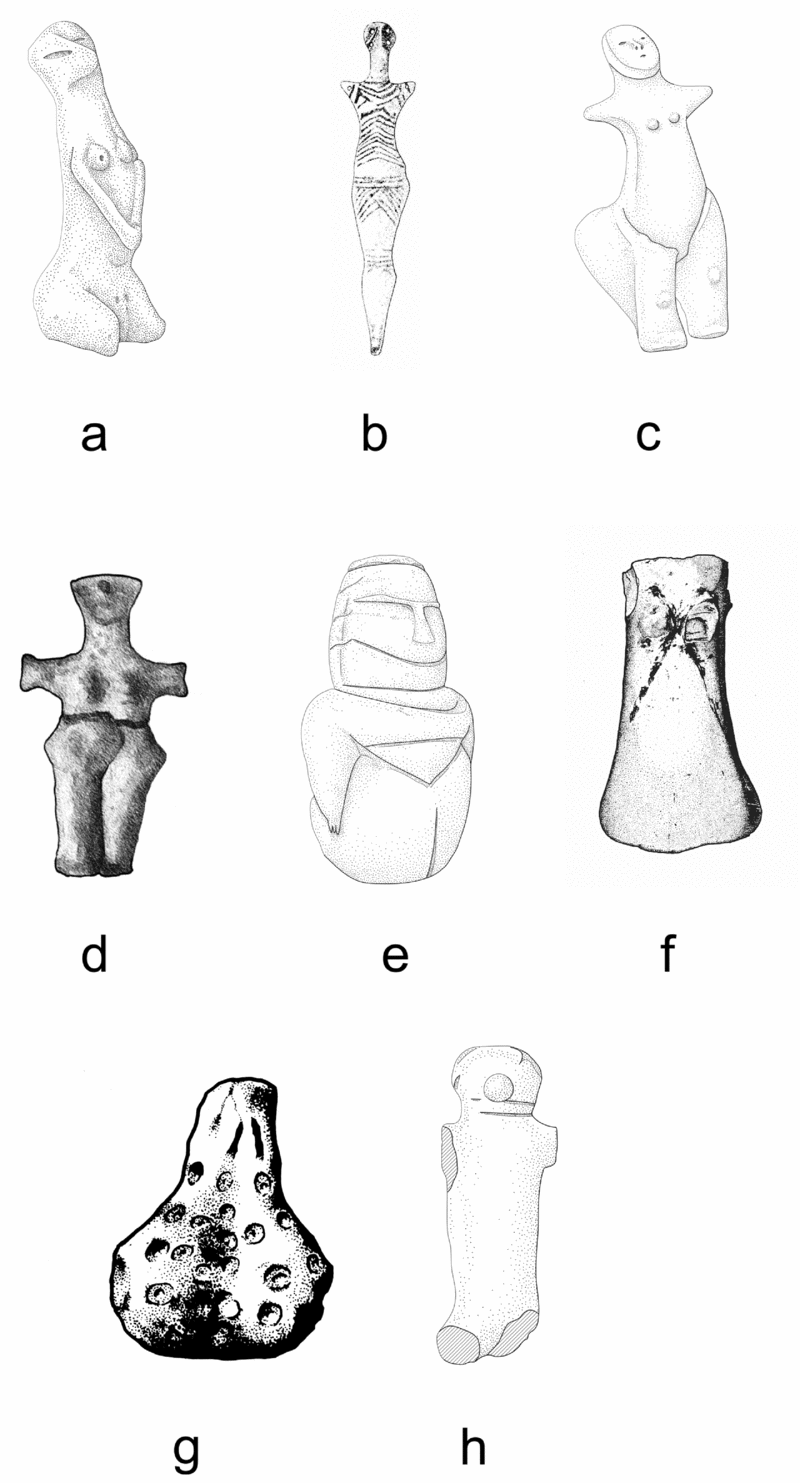
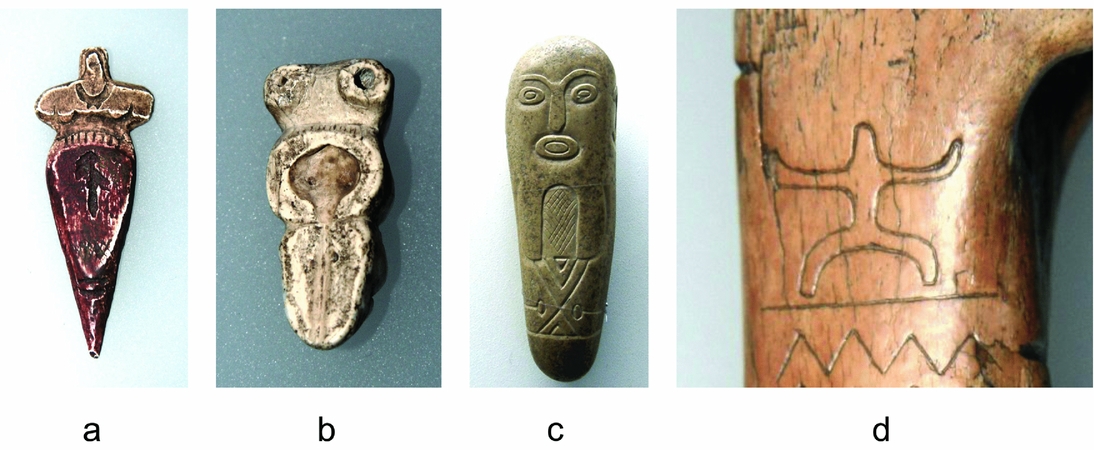
Figurines are of interest not only for what gender is represented but for how it is represented. Although most are female, many corpora include at least a few male figurines, often in unusual postures or activities. Most corpora also include not only fragments whose sexual characteristics may simply have broken off, but also complete figurines that lack sexual features. Even if the latter were implicitly understood as gendered, or gendered through signs other than anatomical references, this would nevertheless suggest that gender was not a simple, obvious binary system anchored in anatomy and obligatory to mark on all bodies. Moreover, the gender ascribed to some examples may be doubtful. In particular, Maltese “fat ladies” (Vella Gregory and Cilia Reference Vella Gregory and Cilia2005) and Sardinian “volumetric” figurines (Lilliu Reference Lilliu1999) have traditionally been considered female simply because they represent massively corpulent people; clothed in elaborate costumes, it is more likely that their corporeality signified their status as senior ritual celebrants or cosmological beings. Ambiguous figurines include examples from the Balkans (Chapman and Gaydarska Reference Chapman and Gaydarska2006) and Italy (Holmes and Whitehouse Reference Holmes, Whitehouse and Whitehouse1998) that represent either erect phalli or a female with globular buttocks and a simple, shaft-like body. Stylistically, European Neolithic figurines are extremely heterogeneous. They vary wildly in what parts of the body they emphasize or even represent, what postures they adopt, and how much the body is clothed or decorated. Figure 4 gives one example, from Riparo Gaban in Alpine Italy. Four human body images have been found at the site: two female and two not overtly gendered. Even within one site, they highlight as important quite different qualities from the body. Even when the body is gendered, unlike the clear Bronze Age model, there is no consensus about what anatomical or cultural features essentially constitute a Neolithic gendered body.
Heterogeneity in microcosm: Neolithic human imagery from Riparo Gaban, Italy (for context, see Pedrotti Reference Pedrotti, Kruta, Poppi, Lička and Magni2009; images courtesy of Lila Janik, Annaluisa Pedrotti, and Fabio Cavulli). (a) Female figurine, worked bone. Photo: Lila Janik. (b) Female figurine, pig tooth. Photo: Lila Janik. (c) Anthropomorphically carved pebble. Photo: John Robb. (d) Anthropomorph on carved bone. Photo: Lila Janik.
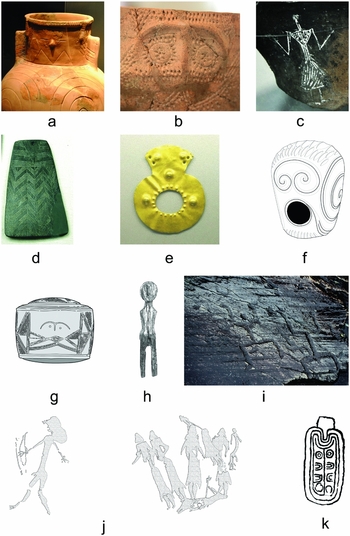
Other Neolithic body imagery is even more varied (Figure 4). Neolithic rock art in Italy includes males (depicted with phalli) hunting deer, and probable females (denoted by a dot between the legs) in dancing postures (Graziosi Reference Graziosi1980). In Spanish rock art, men are shown hunting and fighting, while women are shown dancing and in other activities; it has been suggested that gender was performative rather than narrowly prescribed (Dowson Reference Dowson2009). A lakeside house in Germany was ornamented with a pair of breasts, Macedonian clay models show houses with female torsos growing out of their top, and breasts also turn up on Balkan gold “ring idols.” Carved phalli of flint and chalk are known from Britain (Teather Reference Teather, Larsson and Parker Pearson2007), and a stone model of three conjoined phalli comes from Malta. In such examples, the gendered body is a free-floating anatomical diacritic that is applied to different contexts of action. Two wooden statues from Britain are either ambiguously gendered or hermaphroditic (Figure 5h gives one example). More elaborate bodies without evident gendering include the anthropomorphic designs from Breton megalithic tombs, thought to be an ancestral or spirit figure, possibly semi-skeletonized (Thomas and Tilley Reference Thomas, Tilley and Tilley1993). Like the massive Maltese and Sardinian figures noted above, these may suggest an association between death, cosmological power, and beings without—or beyond—gender. Neolithic body imagery also includes ungendered, free-floating particulate anthropomorphism: schematic anthropomorphs, a face, or even simply a pair of eyes are known from all over Europe (Figure 5).
Other Neolithic body representations. (a) Face on pot, Budapest, Hungary. Photo: John Robb. (b) Face on pot, TRB vessel, Copenhagen, Denmark. Photo: John Robb. (c) Human figure on Impressed Ware vessel, Sardinia. Photo: John Robb. (d) Gold “ring idol,” Zagreb, Croatia. Photo: John Robb. (e) Copper Age anthropomorphic plaque, Spain. Photo: John Robb. (f) Anthropomorphic mace head, Knowth, Ireland. Drawing: Vicki Herring. (g) Anthropomorphic carved chalk object, Folkton, England. Drawing: Aaron Watson. With kind permission of Andrew Jones. (h) Carved wood sculpture, legible as male or female, Dagenham, England. Drawing: John Robb. (i) Anthropomorphic, possibly female, figures in rock art, Valcamonica, Italy. Photo: John Robb. (j) Men and women in Levantine art, Spain. Male archer, Abrigo del Milano; females dancing, Roca del Moros. Drawings: Vicki Herring, after Hernández Herrero (Reference Hernández Herrero1998:22,50). (k) Anthropomorphic being, megalithic tomb, Brittany, France. Drawing: John Robb, after Shee Twohig (Reference Shee Twohig1981:Figure 146).
In sum, the simple pattern in Neolithic gender imagery is that there is no simple pattern. A lot of body imagery exists, and it exhibits a huge range of variety. When gender is represented, it is shown heterogeneously; ambiguously gendered bodies are known, as are ungendered bodies and free-floating anthropomorphic motifs. With so much evidence, this heterogeneity is not simply a failure of data to reveal a clear pattern that must once have been there. Instead, how gender was understood probably varied contextually, and there were contexts of action for which gender was not particularly relevant. That this is a meaningful pattern is clear by contrast with what happens from about 3500 cal BC onward, when new patterns emerge. While older traditions of imagery—particularly female figurines—persist and even intensify along the southern margin of Europe (Cyprus, Crete, the Aegean, Malta, and Sardinia), across much of continental Europe a new imagery arises: statue-stelae (Robb Reference Robb2009). Statue-stelae show clearly identified males and females in a highly standardized form, with males identified by weaponry and females by breasts and necklaces. If statue-stelae represent ancestral figures, as is usually maintained, then for the first time it had become important to maintain gender in death. Echoed in other imagery such as Copper Age rock art, as well as in grave goods and material culture, this heralds the new cross-context pattern of gender symbolism typical of the Bronze Age.
The Evidence for Neolithic Gender: Burials
Neolithic deathways were rarely clearly gendered. Before the late fourth millennium BC, deathways do not generally involve formal cemeteries of individual burials. In the Balkan Early Neolithic, in occasional inhumations in settlements, men are slightly more frequently represented than women, but there is little difference in position or grave goods (Borić Reference Borić, Fowler, Harding and Hofmann2015:931). In Early-Middle Neolithic Hungary, there is no explicit gender differentiation regarding grave goods or orientation (Chapman Reference Chapman, Moore and Scott1997:138). In the central Mediterranean, well-preserved single burials are exceptional, and even when they are found there is little formal marking of male-female difference. In northwestern Europe, monuments with commingled depositions are constructed from the Early Neolithic onward. In both southern Scandinavia and Britain, megalithic burial coexisted with single graves, secondary burial, cremation, and other practices; bodies were deposited in long barrows and megalithic tombs whole and subsequently mixed through postdepositional practices. Neither area shows systematic gender differentiation (Fowler Reference Fowler2010; Sjögren Reference Sjögren, Fowler, Harding and Hofmann2015). The Iberian Early Neolithic featured collective inhumations in cave sites among other practices; again, gendered differentiation in funerary practice or grave goods is difficult to detect (Oms et al. Reference Oms, Daura, Sanz, Mendiela, Pedro and Martínex2017).
There are only two well-investigated cases of clear gender differentiation in Neolithic burial. One is a minority of Linearbandkeramik (LBK) cemeteries in central Europe (5500–5000 cal BC) where males were sometimes buried with axes. However, this represents a complex situation. At Nitra, Slovakia, Spondylus shells, beads, and arm-rings occurred in different frequencies in male and female burials, but were not categorically associated with one gender (Whittle et al. Reference Whittle, Bentley, Bickle, Dočkalová, Fibiger, Hamilaton, Hedges, Mateicuicová, Pavúk, Bickle and Whittle2013:154). Age also formed an important variable (Whittle et al. Reference Whittle, Bentley, Bickle, Dočkalová, Fibiger, Hamilaton, Hedges, Mateicuicová, Pavúk, Bickle and Whittle2013:154). At Aiterhofen, Germany, among 20–40-year-olds, Spondylus shells are preferentially found with men, but for older age groups, grave goods increasingly overlap (Hofmann Reference Hofmann, Hofmann and Bickle2009:225; Hofmann and Whittle Reference Hofmann, Whittle and Jones2008:293). Moreover, isotopic analysis shows that, at some cemeteries, it is specifically locally born men who were more likely to be buried with axes (Hedges et al. Reference Whittle, Bentley, Bickle, Dočkalová, Fibiger, Hamilaton, Hedges, Mateicuicová, Pavúk, Bickle and Whittle2013:368). The other notable case of gender-differentiated burials is the Cerny group of the Paris Basin around 4500 cal BC. Here, arrowheads are exclusively buried with men (Chambon and Thomas Reference Chambon and Thomas2010:4), linking hunting and male identity. Beyond these two cases, even when sporadic male-female differences exist, they tend to be statistical matters of degree rather than category. For example, the chambered tombs and earthen long barrows of southern Britain tended to have more men than women buried in them, but the pattern is not clear-cut (Edwards and Pope Reference Edwards, Pope and Bolger2013:463–464; Smith and Brickley Reference Smith and Brickley2009:88). Similarly, in Late Neolithic (5400–4500) Hungary and Slovakia, polished stone tools were found with both men and women, though more often with the former (Borić Reference Borić, Fowler, Harding and Hofmann2015:936). On the whole, throughout Neolithic Europe, burial shows very little gender distinction; when it does, it is rarely a clear-cut binary categorization but a matter of degree and overlap, sometimes polythetically combined with factors such as age and localness.
This picture changes slowly as we move into the later Neolithic and Copper Age. The first hints of the gendered patterns to come appeared in the Balkans (mid-late fifth millennium BC). For example, at Gomolova, Serbia, all burials were potentially male (Borić Reference Borić, Fowler, Harding and Hofmann2015:937). Similarly, at Tizsapolgár-Basatanya, Hungary, burial position became increasingly gendered, with men's heads facing to the right and women's to the left (Borić Reference Borić, Fowler, Harding and Hofmann2015:942; Sofaer Derevenski Reference Sofaer Derevenski1997b). More clearly gendered grave goods began to emerge in the later fourth millennium BC in the central and western Mediterranean Copper Age in eastern and central Europe with the Globular Amphora and Corded Ware groups (3300 cal BC onward) and in Western Europe with the Bell Beakers (2500 cal BC onward). In all of these, burial was increasingly characterized by consistent sets of gendered grave goods (Vander Linden Reference Vander Linden, Fowler, Harding and Hofmann2015:610–611). This set the pattern: while it contained local variation and occasional exceptions that violated binary separations (e.g., Chapman and Palincaş Reference Chapman, Palincaş and Bolger2013:425), Bronze Age burial reflected a straightforward, widespread set of differences between men and women. The contrast with the Neolithic pattern is unmistakable.
The Evidence for Neolithic Gender: Activities and Bodies
What about evidence for gender distinctions in daily life? It is hard to gender most material culture. We do not know who made pottery or knapped flints. Spondylus ornaments turn up in the graves of males, females, and children. Axes may be the best bet for a gendered item associated with males (as suggested by the LBK burials mentioned above), but evidence is scrappy. A second key set of evidence comes from isotopic analysis of diet and mobility, though data are patchy. At a European scale, it appears that men consumed more animal protein (Schulting Reference Schulting, Fowler, Harding and Hofmann2015:373). Paralleling this, differential caries rates in the LBK (Hedges et al. Reference Whittle, Bentley, Bickle, Dočkalová, Fibiger, Hamilaton, Hedges, Mateicuicová, Pavúk, Bickle and Whittle2013:371) suggest that women may have consumed more cereal products (Hedges et al. Reference Whittle, Bentley, Bickle, Dočkalová, Fibiger, Hamilaton, Hedges, Mateicuicová, Pavúk, Bickle and Whittle2013:371). This trend is not absolute, however. At specific sites, like the causewayed enclosure of Hambledon Hill in Britain, more women than men had access to animal protein (Richards Reference Richards, Mercer and Healy2008:527). Overall, while across Europe more men ate more meat, there are clearly some women eating more meat than some men. Again, we see no clear-cut separation of genders. With mobility, the best data come from the LBK once more. Both generally and at specific sites such as Nitra and Vedroviče, women show greater residential mobility during their lifetimes than men, possibly suggesting patrilocality (Hedges et al. Reference Whittle, Bentley, Bickle, Dočkalová, Fibiger, Hamilaton, Hedges, Mateicuicová, Pavúk, Bickle and Whittle2013:367). However, outside the LBK, there is almost no evidence from the rest of Neolithic Europe. Specific women engaged in long-distance movement, for example at Monkton-up-Wimborne in Britain (Montgomery et al. Reference Montgomery, Budd and Evans2000) and at Hazleton North, also in Britain, where people of all kinds shared mobility regimes over a 40 km or greater range (Neil et al. Reference Neil, Evans, Montgomey and Scarre2016; Whittle Reference Whittle and Topping1997).
Skeletally, male-female differences in leg morphology existed, perhaps related to differing practices of farming or mobility, but these became notably more pronounced in the Bronze Age (Macintosh et al. Reference Macintosh, Pinhasi and Stock2014:385). This suggests that the sexual differentiation of labor became greater or more formalized after the Neolithic than during it. Skeletal evidence also suggests that young boys sometimes experienced intensive physical activity (Macintosh et al. Reference Macintosh, Pinhasi and Stock2016). In Switzerland, Germany, and France, men were doing more throwing, possibly associated with hunting (Villotte and Knüsel Reference Villotte and Knüsel2014:171). At West Kennet long barrow in Britain, men showed greater rotary action with the right shoulder, and perhaps greater bilateral movement of the upper limbs, while women extended and rotated their forearms more (Wysocki and Whittle Reference Wysocki and Whittle2000:594–595). However, the same study also revealed that gendered activities may have differed between sites rather than being widespread.
Finally, while it is usually assumed that violence was practiced by men, there is no direct evidence for this. What we can say is that all groups of the population—males and females, adults and juveniles—experienced violence. Evidence ranges from the common, healed depressed cranial fractures found in all skeletal collections to occasional large-scale massacres as at the LBK sites of Talheim (Germany) and Asparn-Schletz (Austria). In the LBK, adult females and juveniles suffer more violence than men (Hedges et al. Reference Whittle, Bentley, Bickle, Dočkalová, Fibiger, Hamilaton, Hedges, Mateicuicová, Pavúk, Bickle and Whittle2013:371). In other regions such as Scandinavia, the pattern is reversed, while in Britain the numbers are about equal (Schulting and Fibiger Reference Schulting, Fibiger, Whittle and Bickle2014a:294). Across Europe as a whole, more men may have been shot with projectiles, but there was regional variation, and women also suffered violence regularly (Schulting and Fibiger Reference Schulting, Fibiger, Schulting and Fibiger2014b:14). In terms of body modifications, throughout Europe both men and women display trepanations (Germanà and Fornaciari Reference Germanà and Fornaciari1992). A pattern of deliberate tooth removal among women in Italy (Robb Reference Robb1997) was not shared elsewhere in Europe, revealing a local construction of bodily identity.
Overall, in much of Europe, there are hints of social distinction related to sexual difference, but patterns are subtle and varying. Differences in diet sometimes applied to some men and some women. Patterns of movement were gendered in certain areas but not in others, and the pattern was mixed. Violence was experienced across both sexes. Even within the LBK, the best-studied area, evidence for systematic gendered difference is far from clear cut. In well-studied regions elsewhere in Europe such as Britain, Italy, and Scandinavia, even the hints of gender patterning seen in the LBK are missing. Of course, there are the lines of evidence to which we have little access. These include those related to embodied processes such as menstruation, childbirth, and lactation that would also have affected how some people lived and worked at different times and at different points in their lives. No doubt there were real differences here, and the absence of clear symbolism should not lead us to conclude that these bodily differences never mattered. Nonetheless, it is important to realize what the increasingly substantial evidence from across Neolithic Europe does not reveal: clear-cut patterns of difference relatable to stable gendered identities.
Neolithic Gender: It's about Contextual Difference
So what is the overall message for Neolithic gender? Our expectation of what gender should look like archaeologically is based on Bronze Age and later forms of gender, whose very clarity creates a methodological paradigm. As discussed above, the analytical pathway starts with things that can be associated with biological referents—principally “sexable” burials and iconography. Archaeologists then try to associate these with objects, tasks, and places to build up a coherent picture of how biological difference was elaborated into cultural difference. The picture of Bronze Age gender reveals a mostly binary system expressed through material performance involving dress, material things, life, and death and through a few heavily redundant symbolisms appearing across contexts. All of these conform closely to what we expect gender to be like, confirming our methodological expectations. But this analytical tactic rarely works for the Neolithic. When we try it, no clear picture emerges.
From this point, we can draw two possible conclusions. One is simply to say that evidence for European Neolithic gender is defective; the archaeological record just does not supply us with “the right materials” to say anything about gender. Caution is certainly justified, particularly in a field so dogged by modernist and sexist preconceptions. But as archaeological evidence accumulates and still refuses to meet our expectations, at what point do “gaps in the evidence” actually connote meaningful absences? There are now as many or more Neolithic body representations known as there are Bronze Age ones. For many regions, the Neolithic record of funerary practices, households, and skeletal analyses is as good as that for the Bronze Age. The body of material culture and scientific data on Neolithic human lives is large and steadily increasing. In all of these, gender could have been clearly expressed, but it was not. How many cemeteries that do not display neatly gendered burials do we need to excavate before we can recognize that, in fact, Neolithic burials usually were not neatly gendered, and that this may be telling us something important about Neolithic gender?
In fact, the real problem is not lack of evidence; the real problem is that the evidence does not behave as we expect or want it to. Epistemologically, evidence is defined within disciplinary expectations that are interrelated with the theoretical propositions the evidence supports (Chapman and Wylie Reference Chapman and Wylie2016; Wylie Reference Wylie1992). We thus inevitably normalize the archaeological record to address our tacit expectations. Neolithic gender provides a textbook case of such a process. Despite critical reconceptualizations of gender (e.g., Joyce Reference Joyce2008; Schmidt Reference Schmidt, Casella and Fowler2005; Voss Reference Voss, Casella and Fowler2005), Neolithic archaeologists have considered only data that conforms to our a priori expectations of what gender should look like. (Conversely, when we find a case where things look “right,” as with gendered LBK burials, we tend to breathe a sigh of relief—and to reproduce the fact more often than is perhaps warranted). Furthermore, because the definition of gender precedes creating the data used for a history of gender, this precludes questioning whether the definitional form of gender itself may have varied historically.
Thus, we would suggest a second possible conclusion: there has been little gender archaeology for the Neolithic because we have been looking for the wrong thing. Neolithic people were gendered, but in a different way than we expect them to be, in a way which creates patterns that do not look like traditional data for gender archaeology. The following pattern thus emerges:
-
• Gender is consistently present. Almost all archaeological records from Neolithic Europe yield some acknowledgement of bodily differences between males and females; real material differences in bodies were socially recognized. In some, these take the form of iconographic representation of bodies. In others, they appear in differential burial positions or practices, or isotopic evidence for different movement in life, or skeletal evidence of differentiated activities. Neolithic people everywhere acknowledged, referenced, made use of, and sometimes created biological differences between males and females.
-
• At the same time, these differences do not indicate a consistent, systematic, or widespread pattern of gender difference. No Neolithic societies show archaeological differences in more than one or two dimensions of gender. This is not simply due to negative evidence, to archaeological silences. It was possible to make clearly gendered clay figurines or to bury people in gendered ways everywhere. But most people did not do so. Moreover, which dimensions show difference varies. Where iconography shows clearly gendered bodies, gender was not important to funerary practice; where funerary practices are gender-divided, iconography often represents bodies as unsexed, or ambiguously sexed. And so on. There is no visible standard, consensus, or consistently redundant pattern in representing or enacting gender. What we observe is heterogeneity.
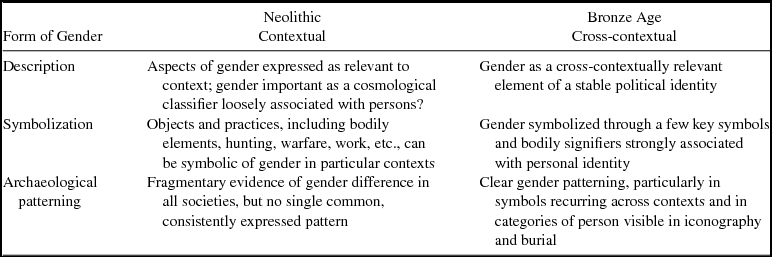
We suggest a different model for Neolithic gender, one of contextually relevant gender (Table 1). In the Bronze Age, and in later societies, consistent ideas of maleness and femaleness were referenced repeatedly across different contexts, both in life and in death, acquiring a stable ideological density through redundancy of iconography and practices. In the Neolithic, gender may have been important in some contexts, and secondary or irrelevant in others. Moreover, different contexts may have referenced different dimensions of gender, and individuals may have been gendered unstably or differently across contexts. In this model, the Neolithic body world was founded on the contextual production of difference (Robb and Harris Reference Robb and Harris2013). Gender may have emerged in different ways at different moments of social life, much as in Highland New Guinea, where gender can be both a fixed and strongly enforced abstract principle (Knauft Reference Knauft and Feher1989) and invoked and applied to individuals situationally and relationally (Strathern Reference Strathern1988). Without simply reading a Melanesian model into European prehistory (cf. Jones Reference Jones2005), such a model helps us imagine the possibility of gender systems that differ fundamentally from our own.
Contrasting Models for Neolithic and Bronze Age Gender.
This, at least, is the pattern from the beginning of the Neolithic through about 3500 cal BC. Between 3500 and 2400 cal BC, Europe presents a mixed picture, with older patterns persisting along the Atlantic and Mediterranean coasts and a new world of stable, binary gender symbolism emerging throughout much of the continent. By 2400 cal BC, with the Bronze Age, the new pattern was set everywhere. We argue elsewhere (Robb and Harris Reference Robb and Harris2013) that the third millennium BC saw shifts in how prehistoric Europeans understood personhood, with the emergence of politicized persons. It is clear that stable, cross-contextual gender was a key element of such personhood; this is why gender snaps into such clear focus archaeologically. How this transition happened is beyond the scope of this article, but there are some hints. When hunting and fighting are gendered in the Neolithic, they are associated with males, but they seem not to be part of a widely politicized identity. The same may be true of patrilocality. Hence, the transition from Neolithic to Bronze Age may have involved a continuity of specific behaviors and beliefs, but a new social configuration of gender: perhaps a shift from something you did to something you were.
Conclusion
Neolithic gender may have operated according to very different principles than gender in later periods in European history, from the Bronze Age to the present. If this argument is correct, it has deep implications not only for European prehistory, but also for gender history and theory. Most work in gender archaeology, and in gender studies more widely, assumes that the definitional form of gender—the cultural elaboration of sexual difference into a system of values and personal identities—has remained stable for as long as we have been a gendered species; what varies is the “content” of gender. Thus, history should consist of a succession of periods in which one idea of masculinity or femininity gives way to another. Despite critique from feminist philosophers (e.g., Butler Reference Butler1993; Grosz Reference Grosz1994) and archaeologists (e.g,. Perry and Joyce Reference Perry and Joyce2001; Voss Reference Voss2008), this remains the default assumption among European prehistorians. But this is patently not the case. Bronze Age gender was not the same kind of thing as Neolithic gender, just enacted through different symbols, identities, and values. Bronze Age weapons and ornaments did not replace earlier symbols that occupied an analogous role in defining gender; earlier periods had no symbols of comparable centrality, importance, and widespread use. Instead, the third millennium BC may have seen a transition from an unfamiliar (to us), contextually salient form of gender to the stable form organized around cross-contextual social personas that lies at the heart of our conventional definitions. It is thus the nature of gender itself that changed.
As this implies, aspects of gender systems that we take as axiomatic, universal, or definitional are instead historically specific (Schmidt Reference Schmidt, Casella and Fowler2005:80–81). This has two major implications for gender archaeology. One is methodological. What constitutes evidence for gender? The answer must be this: what is evidence for gender depends on what gender actually consists of in the particular historical context studied. For example, in contrast to a Bronze-Age-through-modern gender archaeology, an archaeology of gender for Neolithic Europe might emphasize the following:
-
• Less reliance upon key icons of personal identity in burials and art
-
• More evidence for difference in daily life practices: activity, mobility, diet, etc.
-
• More contextual interpretation for gendered iconography and practices, with less expectation of clear, overarching patterns (how things were used may have been more important than what they represented)
-
• A possible use of gender as an abstract classificatory principle not anchored in specific sexed bodies
-
• An openness to ambiguities and discrepancies in evidence as informative rather than problematic
This is not to replace one hegemonic “archaeology of gender” with another or to set up dichotomized ideal types contrasting the “modern” with the “pre-modern” (Shryock and Smail Reference Shryock and Lord Smail2013). We imagine the past as containing many forms of gender, which moreover may have shaded into each other and into non-gender. We simply suggest that we need to broaden our theoretical imagination (perhaps drawing on queer theory and other areas, e.g., Schmidt Reference Schmidt, Casella and Fowler2005), and to vary our methodologies and evidential criteria creatively if we want to capture the differences inherent in the worlds that we hope to interpret.
The other implication concerns how we tell the history of gender on the largest scale. The end of the Neolithic was a pivotal period for the history of gender, a transition from one form of gender to another. What we take as a “normal” gender system may in fact have a specific European historicity extending only a few thousand years. Although rarely discussed in gender archaeology, this is the historical counterpart to the emphasis many feminist scholars place on difference in the production of contemporary gender (Braidotti Reference Braidotti1994; Grosz Reference Grosz1994; Irigaray Reference Irigaray1985). This has implications for how we theorize gender. Conkey (Reference Conkey and Bolger2013:109) argues that gender archaeology as a whole is based within a particular, Eurocentric perspective on the experience of gender, which it projects not only in the European past but also worldwide. In other words, if Strathern (Reference Strathern1988) is right in arguing that gender is understood and experienced differently in Melanesia than in Euro-America, a gender theory and gender archaeology invented by a native Melanesian thinker would look very different.
If so, we need to localize and historicize gender, and to suit our gender theory deeply to the context we study. Though this conclusion runs counter to traditional and mainstream gender history and archaeology, which posit a single definitional entity for “gender” across all contexts, it extends the insights of feminist theorists. It is, moreover, logically inescapable once we accept that we cannot reify the present as a quasi-universal state. Gender must be historicized in deep history, even evolutionary time. It cannot be definitionally fixed but must always be coming into being. Indeed, how otherwise could humanity evolve from a non-gendered species to a gendered one?
Acknowledgments
Early versions of this paper were presented at Northwestern, Syracuse, Edinburgh the Neolithic Studies Group and Bradford, and we are grateful to colleagues at all of these for their insightful questions and discussion. We also thank Yvonne Marshall for helpful discussion of feminism and gender, and the three anonymous reviewers for their comments. Funding for some of this research was provided by the Wellcome Trust (Grant 096510/Z/11/Z). We are grateful to Fabio Cavulli, Lila Janik, Albrecht Jockenhövel, Andrew Jones, and Annaluisa Pedrotti for permission to use their imagery, and to Vicki Herring for her drawings. Marta Díaz-Guardamino kindly translated the Spanish abstract. We would like to dedicate this paper to remembering Joan Gero. Joan reviewed the first paper on gender one of us wrote (Robb Reference Robb1994), critiquing it strongly but in a uniquely supportive way. As well as being someone from whom we have learned a lot about gender, she remained a warm, open-minded, and inspirational colleague throughout her life.
Data Availability Statement
This paper is based upon information freely available from the published works cited.



