





There is now an increasing expectation that public health nutrition supports the adoption of sustainable dietary patterns in addition to longstanding health and well-being objectives(1–Reference Martini, Tucci and Bradfield4). Sustainability is a broad and multi-dimensional concept(Reference Drewnowski, Finley and Hess5). Already in Australia, and elsewhere, the formulation of dietary guidelines encompasses the availability, affordability, safety and cultural acceptability dimensions of sustainability(6). The additional consideration of environmental sustainability is new and also challenging due to the potential trade-offs with nutrition. For example, many diets with lower greenhouse gas emissions have poorer nutritional and health indicators(Reference Payne, Scarborough and Cobiac7–Reference Ridoutt, Baird and Hendrie9). Much of the responsibility for improving the environmental sustainability of the food system rests with food producers. Nevertheless, there is now ample evidence that some dietary patterns have lower environmental impacts than others(Reference Blackstone, El-Abbadi and McCabe10–Reference Scheelbeek, Green and Papier13), indicating scope for dietary interventions also.
Several approaches are currently being recommended to reduce the environmental impacts of food consumption. The first relates to addressing the high levels of food waste occurring in households and commercial food service(Reference Tonini, Albizzati and Astrup14,Reference Hall, Guo and Dore15) . Though difficult to quantify, this waste could be as high as one-third of purchased food in developed countries(16). The second approach focusses on moderating the intake of energy-dense/nutrient-poor discretionary foods that inflate dietary environmental impacts(Reference Perignon, Sinfort and El Ati17–Reference Hendrie, Baird and Ridoutt19). These foods also contribute to excessive dietary energy intake and can displace the adequate intake of healthy core foods, including vegetables(Reference Marchese, Livingstone and Woods20,Reference Sui, Wong and Louie21) . A third approach involves excluding or limiting animal-sourced foods, particularly those from ruminant livestock such as beef, lamb and goat meats and dairy foods(Reference Willett, Rockström and Loken22–Reference Graça, Truninger and Junqueira24). This third approach is perhaps the most controversial as it has the potential to impact the nutritional adequacy of the total diet, especially in regions, like Australia, where animal-sourced foods have traditionally formed part of the diet and are important sources of nutrients such as Ca, Mg and Zn that tend to be widely under-consumed(Reference Macdiarmid and Whybrow25–Reference Dave, Hodgkinson and Roy28).
In Australia, a subgroup of 1700 adult daily diets was isolated from the National Nutrition and Physical Activity Survey (NNPAS) component of the Australian Health Survey(Reference Ridoutt, Baird and Hendrie29). These daily diets were characterised as having higher compliance with Australian Dietary Guidelines(30) and lower environmental impacts. This subgroup of diets is considered important to study because it represents the food choices of Australian adults with more desirable dietary characteristics. As these diets are prevalent in the community, they can be considered culturally relevant and realistically able to be adopted by Australians whose diets are of lower quality and/or have higher environmental impacts. In this study, we further evaluate these 1700 diets by assessing the variety of food choices within the ‘Fresh meat and alternatives’ food group described in the Australian Dietary Guidelines(30). This food group, which includes protein-rich foods such as eggs, nuts, tofu and legumes in addition to meats, is of particular interest because it is most likely to be impacted by sustainability strategies that encourage a transition to plant-based diets. Our goal was to evaluate implications for nutritional adequacy, within the context of the total diet, that could be relevant to inform future dietary guidelines.
Methods
Background data
Dietary intake data, covering 9341 Australian adults (19 years and above), were obtained from the NNPAS component of the Australian Health Survey(31) as described previously(Reference Ridoutt, Anastasiou, Baird, Navarro Garcia and Hendrie32). This survey, undertaken by the Australian Bureau of Statistics, used a 24-h recall process administered though face-to-face interviews by trained assessors, and a complex sampling design to estimate dietary intake for the total population as well as demographic subgroups(33). As part of the national survey, a second 24-h recall was also completed, but this included only 64 % of the original sample and reported significantly lower energy intakes. As this study describes population dietary estimates rather than usual intakes, only data from the first larger 24-h recall were used. In previous studies, each of these diets was scored for level of compliance with the Australian Dietary Guidelines(30) and environmental impact, and cluster analysis was used to isolate a subsample of 1700 higher diet quality and lower environmental impact (HQLI) diets(Reference Ridoutt, Baird and Hendrie29). Briefly, diet quality was assessed using the Diet Quality Index of Golley and Hendrie(Reference Golley and Hendrie34). Environmental impact was assessed using currently available life cycle assessment results for food items in the Australian food system(Reference Ridoutt, Anastasiou, Baird, Navarro Garcia and Hendrie32,Reference Ridoutt, Baird and Hendrie35–Reference Ridoutt, Baird and Navarro37) . Detailed information about the data, equations and modelling assumptions is available in the associated references. Compared to the population estimate, the HQLI subgroup of adult diets had 39 % higher diet quality score, 53 % lower climate footprint, 24 % lower water-scarcity footprint, 29 % lower cropland-scarcity footprint and 34 % lower pesticide toxicity footprint.
Analysis of protein variety
For each of the 1700 HQLI diets, the number of servings of the ten different types of foods within the ‘Fresh meat and alternatives’ food group was assessed. This food group includes fish and other seafood; beef and lamb; poultry; pork; eggs; nuts and seeds; tofu and processed meat analogues; legumes; wild meats and offal. This food group excludes processed meats which are considered discretionary foods according to dietary guidelines(30). Intake was assessed in serves, based on Australian Dietary Guideline descriptions(30) because serving size is not defined uniformly across this food group. For example, a serve of red meat is described as 65 g (cooked) and a serve of poultry 80 g (cooked). This compares to 30 g for nuts and seeds, 120 g for eggs and 170 g for tofu(30). A variety score (out of 10) was then calculated for each diet based on the number of different categories included regardless of the amount consumed. For example, if a diet included multiple servings of only chicken, the variety score was 1. If a diet included nuts, eggs and chicken, the variety score was 3.
The 1700 HQLI daily diets were subsequently divided into subgroups based on variety within the ‘Fresh meat and alternatives’ food group (Table 1). In addition, two additional categorisations were performed to assess the nutritional impact of intakes with different combinations of animal and/or plant-Ssourced proteins. The first involved dividing the HQLI daily diets into subgroups according to whether food choices within the ‘Fresh meat and alternatives’ food group were only animal meats, a combination of animal meats and alternatives, or only alternatives (Table 1). Secondly, HQLI daily diets that included a combination of animal meat and alternatives were further divided into subgroups depending on whether they included ruminant meat (i.e. beef or lamb), non-ruminant meat (e.g. poultry, pork, fish), or a combination of ruminant and non-ruminant meats.
The higher diet quality/lower environmental impact (HQLI) subgroup of adult (19 years and above) daily diets in Australia: intake from the ‘fresh meat and alternatives’ food group (serves) and variety score (n 1700)

* A variety score was applied to each daily diet(1–Reference Blackstone, El-Abbadi and McCabe10,51) as the number of different types of food from the ‘Fresh meat and alternatives’ food group regardless of the amount consumed. The ten types of food were fish and other seafood; beef and lamb; poultry; pork; eggs; nuts and seeds; tofu and processed meat analogues; legumes; wild meats and offal.
Nutrient profiling
The nutrient content of each HQLI diet was assessed relative to the estimated average requirements (EAR) published by the National Health and Medical Research Council in Australia(38), using data obtained from the Australian Food Composition Database(39). Statistical analyses were performed using IBM SPSS statistical software package version 26. Population weighting factors were applied to the data prior to running summary estimates, with an additional weighting factor applied to correct for uneven representation of data across days of the week. One-sample t-tests were used to test for differences in nutrient composition between subgroups. Correlation analysis was used to assess the relationship between variety score and total intake of ‘Fresh meat and alternatives’ after controlling for total energy intake.
Results
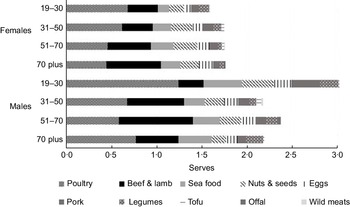
For Australian adult diets of HQLI diets, poultry was the most popular protein choice within the ‘Fresh meat and alternatives’ food group defined in the Australian Dietary Guidelines (Fig. 1). This was followed by beef and lamb, and then seafood. The most popular meat alternatives were nuts and seeds, followed by eggs (Fig. 1). Consuming one type of food from the ‘Fresh meat and alternatives’ food group per day was most common (Table 1), and based on previous exploration of these data, this is known to occur predominantly during the evening meal. Greater variety is often associated with inclusion of a ‘Fresh meat and alternatives’ food choice during lunch or during an in-between meal snack (e.g. nuts). Overall, there was a moderate to strong correlation between variety of meat and alternatives reported and total number of serves from the ‘Fresh meat and alternatives’ food group (r = 0·52, P < 0·001). For HQLI diets that included foods from the ‘Fresh meat and alternatives’ food group, the majority (> 80 %) included animal meat of some type, and of these 28 % included ruminant meat (beef or lamb) (Table 1). Most HQLI diets did not meet the recommended minimum number of serves from the ‘Fresh meat and alternatives’ food group (60·5 %), which ranges from two to three serves depending on age and gender(30).
The higher diet quality/lower environmental impact (HQLI) subgroup of adult (19 years and above) daily diets in Australia: Intake from the ‘Fresh meat and alternatives’ food group (average serves) by age and gender (n 1700)

HQLI diets that did not include foods from the ‘Fresh meat and alternatives’ food group (i.e. non-consumers) had the poorest nutrient composition, with an EAR score of 11, meaning on average this group met 11 of the 16 EAR (Table 2). With increasing variety, significant improvements in nutritional composition were observed (P < 0·001), with HQLI diets including three or more types of foods from this food group having an EAR score of 13·2 (Table 2). The nutritional benefits of increased variety were also observed when comparing HQLI diets with and without animal meat, whereby diets without animal meat scored 11·8 compared to diets containing a variety of animal meat and alternatives that scored 13·0. Diets including non-ruminant meats, ruminant meats, and those containing a combination of ruminant and non-ruminant meats scored 12·8, 13·2 and 13·7, respectively (Table 2). Most individual nutrients that differed between groups followed this overall pattern where a diet including a combination of animal meat choices with alternatives scored higher than other variations (Table 2).
The higher diet quality/lower environmental impact (HQLI) subgroup of adult (19 years and above) daily diets in Australia: percent meeting nutrient estimated average requirements (EAR) according to food choice within the ‘fresh meat and alternatives’ food group (n 1700). NC = non consumers; V1, V2, V3+ refer to variety scores of 1, 2 and 3 or above; NA = no animal meat; AO = animal meat only (including fish); C = combination of animal meat and alternatives, ER = excluding ruminant meat; IR = including ruminant meat; CM = combination of ruminant and non-ruminant meats

* EAR defined by the national health and medical research council in Australia(38).
† Niacin equivalents.
‡ Dietary folate equivalents.
§ Retinol equivalents.
‖ Average number of EAR met.
Discussion
Eating a variety of nutritious foods each day is a universally recognised principle of good nutrition(Reference Ruel40) that applies both across food groups and within food groups. This is because each food has its own particular nutritional composition and eating diversely increases the likelihood that all necessary nutrients are obtained. Also, no two individuals are identical in nutrient needs. Variety is so fundamental that it is mentioned almost fifty times in the Australian Dietary Guidelines(30). Yet this is a principle that is being challenged when recommendations to improve the sustainability of the food system call for avoiding or limiting certain foods perceived to be of higher environmental impact, such as replacing animal-sourced protein-rich foods with plant-based alternatives(Reference Tukker, Goldbohm and de Koning41–Reference Clark, Springmann and Hill43). Oftentimes, these recommendations are based on evidence comparing the environmental impacts of individual foods deemed to be substitutable. However, frequently this evidence does not consider the implications for overall dietary composition and the impacts of reduced dietary diversity on nutritional adequacy. What this study has shown is that higher quality Australian diets with substantially lower environmental impacts (i.e. HQLI diets) can include higher levels of variety within the ‘Fresh meats and alternatives’ food group defined in the Australian Dietary Guidelines. Furthermore, HQLI diets with higher levels of variety were more nutritionally complete than diets with less variety from the ‘Fresh meat and alternatives’ food group. As such, strategies to achieve healthy sustainable diets in Australia should reinforce, and not undermine, the importance of variety within this food group. HQLI diets with the least likelihood of achieving nutrient EAR were diets that did not include animal meats. It may therefore be necessary for dietary guidelines and regulations concerning food labelling and marketing to more explicitly consider the nutritional risks associated with plant-based substitution of traditional animal-sourced foods, which is an issue that is being increasingly discussed(Reference Kraak44–Reference Moreno, Meyer and Donovan46). Plant-based alternatives may have lower environmental impacts; however, they are not nutritionally equivalent(Reference Singh-Povel, van Gool and Rojas47–Reference van Vliet, Bain and Muehlbauer49), and in the Australian context can be lacking in nutrients such as Ca, Mg and Zn that tend to be under-consumed across the population(Reference Ridoutt50).
All that said, it is necessary to acknowledge that this study was based on population estimates of Australian daily diets, not habitual food intake over longer periods. It is likely that for some individuals their food intake and variety may differ from day to day, counteracting to some extent the differences observed in this study. Nevertheless, these results suggest greater variety within the ‘Fresh meats and alternatives’ food group, as recommended by Australian Dietary Guidelines(30), is nutritionally beneficial and that lower environmental impact diets in Australia can include three or more food selections within this food group, including foods that are of animal origin, and those from ruminant livestock production systems. Also, it is important to note that this study has been conducted entirely within the context of the Australian food system, using Australian dietary intake data and Australian nutrient reference values. Therefore, the specific results may not be applicable in other regions, although the general finding that variety in food choices, including protein choices, is beneficial is likely to be generalisable.
Acknowledgements
Acknowledgements: None. Financial support: This study was funded, in part, by CSIRO, Australia’s national science agency, and in part by the Human Nutrition Research Programme of Meat and Livestock Australia (https://www.mla.com.au/), grant number D.NRE.2009. Authorship: Formulating research questions: B.G.R. and G.A.H.; designing the study: B.G.R., D.B. and G.A.H.; data analysis: B.G.R. and D.B.; B.G.R. wrote the first draft and all authors have critically revised and approved the final manuscript. Ethics of human subject participation: Ethics approval was not required as the study involved secondary analysis of data published by the Australian Bureau of Statistics.
Conflicts of interest:
Regarding funding sources, no conflicts of interest are declared. The authors exercised freedom in designing the research, performing the analyses, and making the decision to publish research results. Meat and Livestock Australia did not have any role in undertaking the study and the decision to publish was made prior to funding and before the results were known. M.L.A. had no role in the preparation of the manuscript. B.G.R. has undertaken food systems research related to environmental issues for a variety of private sector organisations and Australian government agencies. D.B. and G.A.H. have worked on public health nutrition research projects funded by a variety of industry bodies, as well as public and private sector organisations.



 Open access

