


This paper contains supplementary material that can be found online at http://journals.cambridge.org
Introduction
Education is often viewed as an unalloyed good and consequently there have been few empirical studies on the costs and benefits of different forms of environmental education. Environmental education is often only considered in terms of formal learning undertaken in schools or higher education. However, Agenda 21, drawn up at the Rio Earth Summit in 1992, states that both formal and non-formal education are indispensable to changing people's attitudes (UNESCO, 1992). Environmental education should be considered to include public awareness-raising (e.g. media campaigns), school environmental clubs and transfer of indigenous knowledge as well as training and formal education.
Studies quantifying the effect of formal education on conservation outcomes are limited and explore the influence of existing, formal educational provision rather than targeted educational programmes. Generally they agree that it has a beneficial effect (Godoy & Contreas, Reference Godoy and Contreas2001; Alix-Garcia, Reference Alix-Garcia2007) but the effect is non-linear and there is a point of inflection beyond which the returns from education decrease (Van, Reference Van2003). It has been argued that non-formal education is a necessary supplement to formal education (Weladji et al., Reference Weladji, Moe and Vedeld2003) and that it may have a more immediate impact and be better able to absorb and utilize local knowledge than traditional, formal education (Nyhus et al., Reference Nyhus, Tilson and Tilson2003). Studies exploring non-formal education in the agricultural field have shown that while formal education is not a significant factor in agricultural productivity, non-formal education is (Kalirajan & Shand, Reference Kalirajan and Shand1985; Parra-Lopez et al., Reference Parra-Lopez, De-Haro-Grumenez and Calatrava-Requena2007).
For an education programme to contribute to conservation success a change in attitudes, behavioural intention and, ultimately, behaviour has to occur. Education has been shown to influence attitudes. A study on manatee Trichechus manatus latirostris conservation showed that greater knowledge about manatees was positively correlated with support for manatee protection (Aipanjiguly et al., Reference Aipanjiguly, Jacobson and Flamm2002). Formal education level, even when not specifically tailored to conservation, also correlates with positive attitudes to conservation (Mehta & Heinen, Reference Mehta and Heinen2001). For example, undergraduates' formal knowledge of conservation biology correlates with the environmental opinions they hold (Caro et al., Reference Caro, Pelkey and Grigione1994).
However, knowledge of environmental issues alone are not sufficient to elicit positive environmental behaviour (Hungerford & Volk, Reference Hungerford and Volk1990; Palmer & Birch, Reference Palmer, Birch, Johnson and Mappin2005). Inferring a causative relationship between educational initiatives and behavioural changes through an attitudinal assessment requires careful consideration of potentially confounding social, economic and cultural factors (Holmes, Reference Holmes2003). The Theory of Planned Behaviour states that human action is governed by behavioural beliefs, normative beliefs and control beliefs that interact to give rise to perceived behavioural control (Ajzen, Reference Ajzen1991), where a belief is an individual's opinion about an object and, where a particular behaviour has occurred, the consequences of that behaviour for the object (Bateman & Willis, Reference Bateman and Willis2001).
The north-west Pre-Caspian region of the Russian Federation is one of the poorest regions of the country. The dissolution of the USSR in 1991 resulted in high levels of unemployment in the area (Grin, Reference Grin2000). The consequent poverty and collapse in hunting controls drive the illegal hunting of the saiga antelope Saiga tatarica (Kühl et al., Reference Kühl, Balinova, Bykova, Esipov, Arylov, Lushchekina and Milner-Gulland2009). The saiga is a nomadic ungulate of the Central Eurasian rangelands, hunted both for its horn, used in traditional Chinese medicines, and for meat for local consumption (Milner-Gulland et al., Reference Milner-Gulland, Kholodova, Bekenov, Buhreeva, Grachev, Amgalan and Lushchekina2001). Post-Soviet over-hunting led to a dramatic population reduction from > 1 million to < 50,000 (Milner-Gulland et al., Reference Milner-Gulland, Kholodova, Bekenov, Buhreeva, Grachev, Amgalan and Lushchekina2001) and in 2002 the species was categorized on the IUCN Red List as Critically Endangered (IUCN, 2010).
In 1990 the Chernye Zemli Biosphere Reserve was established in the Autonomous Republic of Kalmykia, followed by the Stepnoi Reserve in the neighbouring Astrakhan Province in 2000. Both reserves undertake monitoring and protection of the saiga, emphasizing traditional so-called fences-and-fines conservation. In 2003 a UK Darwin Initiative saiga project began in Kalmykia, including biological research and social surveys, to elucidate the prevalence and drivers of poaching, and public engagement activities. This was followed in 2006 by a DEFRA-funded Small Environmental Projects Scheme to provide cows to two villages in Kalmykia. The aim of this project was to provide alternative livelihoods for the poorest members of society and also involved a general media campaign in local newspapers and TV that reached the rest of Kalmykia.
The Darwin Initiative project was awarded post-project funding in 2006 to examine the effect of the preceding conservation interventions on attitudes and to continue the public awareness campaign in Kalmykia. The villages in neighbouring Astrakhan province are geographically, administratively and ethnically separated from the Kalmykian villages, and throughout the period were exposed only to the traditional conservation activities of the Stepnoi Reserve. Because of the pervasive nature of media in the region, by controlling for potential leakage and potentially confounding socio-economic and cultural factors we are able to test the hypothesis that media-based public awareness campaigns are an effective tool for producing positive, long-term attitudinal changes and behavioural intentions towards conservation. This study analyses the effectiveness of public awareness campaigns carried out in this region over the period 2003–2007. The aim was to understand how such interventions work in practice and to provide useful guidelines for the effective use of future public awareness campaigns for environmental conservation.
Study area
This study was conducted in eight villages in southern Russia (Fig. 1). Four villages in the Autonomous Republic of Kalmykia (Utta, Erdnevskiy, Molodozhnye and Adyk) were exposed to a targeted media campaign, through regional and local papers and local TV. Two villages in Kalmykia (Khulkhutta and Tavn-Gashun) were targets for social engagement and also exposed to the media campaign. By contrast, two villages in the Liman region of Astrakhan Province (Bacy and Zenzeli) were exposed only to the Stepnoi Reserve's traditional fences-and-fines conservation (Table 1). The villages ranged in size from 415 people (Municipal Administration of Tavn-Gashun, 2007) to 3,112 people (Municipal Administration of Zenzeli, 2007). Unemployment was generally high and employment was in the livestock sector or in unskilled and temporary work.
The location of Kalmykia and Astrakhan within the Russian Federation showing the eight study villages. The white shaded area indicates the Chernye Zemli Reserve in Kalmykia and the black area the Stepnoi Sanctuary. Utta, Khulkhutta, Tavn-Gashun, Adyk, Erdnevskiy and Molodozhnye were exposed to the media campaign, Khulkhutta and Tavn-Gashun were involved in the social engagement project, and Bacy and Zenzeli were under traditional conservation intervention (adapted from OpenStreetMap, 2011).

Conservation interventions for the saiga antelope Saiga tatarica carried out between 1990 and 2006 in Kalmykia and Astrakhan (Fig. 1).

1 Department for Environment, Food and Rural Affairs
2 UN Educational, Scientific and Cultural Organization
3 International Association for the promotion of cooperation with scientists from the independent states of the former Soviet Union
Methods
Data collection
Data were collected during September–October 2006, with 250 respondents chosen using systematic transects of each village. This methodology could potentially be biased if the houses are not representative of the village as a whole but because of time constraints it was the best method to obtain as random a sample as possible. Depending on size, 25–40 households (5–35% of the resident population) were interviewed in each village. This was the minimum sample size to ensure adequate power in subsequent analyses (Kirk, Reference Kirk1995). The representativeness of the sample was validated by comparison with a previous study in the same region (Kühl et al., Reference Kühl, Balinova, Bykova, Esipov, Arylov, Lushchekina and Milner-Gulland2009) and with official demographic statistics.
Questionnaires contained structured and semi-structured questions to obtain breadth and depth of information (Bernard, Reference Bernard2002). Questions assessed interviewee exposure to the saiga, knowledge of population trends and local and national conservation projects. Respondents were also asked to reply to three statements regarding the saiga and its conservation to gauge their general opinion of the species and conservation. Amount pledged for conservation of the saiga was used a measure of behavioural intention to contribute to conservation (Mitchell & Carson, Reference Mitchell and Carson1989; Bateman et al., Reference Bateman, Carson, Day, Hanemann, Hanley and Hett2002; Howe et al., Reference Howe, Medzhidov and Milner-Gulland2011). A closed payment ladder, coupled with a voluntary payment scenario, was used to elicit amount pledged (Mitchell & Carson, Reference Mitchell and Carson1989; Bateman et al., Reference Bateman, Carson, Day, Hanemann, Hanley and Hett2002). The scenario used to elicit amount pledged was developed to be locally appropriate, taking into consideration the means of payment and form of action to be undertaken (Fischhoff & Furby, Reference Fischhoff and Furby1988). Respondents making zero bids were asked to give a reason based upon a list developed in consultation with local colleagues. Interviews were conducted in person by Caroline Howe (CH) and Ruslan Medzhidov (RM), together with a trained translator (Appendix 1).
Data analysis
People's knowledge about saiga conservation projects in the area (conservation knowledge) and whether they remembered receiving public awareness materials were used as response variables to explore how knowledge was acquired and retained. Asking interviewees whether they remembered receiving materials allowed us to ascertain the impact of the targeted media campaign taking into consideration information already available. Their change in opinion towards the saiga and its conservation over the last 3 years (opinion change over time) and the amount pledged for saiga conservation were used as response variables representing attitudes and behavioural intention respectively (Howe et al., Reference Howe, Medzhidov and Milner-Gulland2011). The explanatory variables were the type of intervention (media campaign, social engagement + media campaign, and traditional conservation), ethnicity, wealth, village, geographical area (Kalmykia or Astrakhan), level of formal education, exposure to the saiga, residence time in the village and knowledge about saiga population status (population knowledge). Those who remembered receiving public awareness materials were also asked open-ended questions on when they remembered receiving the materials (date), what media format (media) they came in (e.g. newspaper or television), subject matter (subject), and whether the materials had had an immediate effect (did the respondent recall undergoing a change in awareness upon receiving the materials). Several of these variables were scored subjectively (Appendices 1 & 2).
Three factors were spatially confounded: administrative area (Kalmykia and Astrakhan), village and conservation intervention. Area did not provide any explanatory power over and above village and intervention, and was therefore not used in the final models. A priori, the inclusion of ethnicity into the model may take into account possible area effects because the Kalmykian villages are dominated by ethnic Kalmyks and the Astrakhan villages by ethnic Russians, while being less confounded with intervention. To separate the effect of conservation intervention and village, linear mixed effects (LME) models were used with intervention and village treated as random effects. Because of our particular interest in the recalled effects of public awareness materials whether people remembered receiving materials, or aspects of this variable such as date or subject, were always included in the saturated model. By treating intervention and whether people remembered receiving materials and/or village as fixed and random effects respectively allowed us to compare villages exposed to the media campaign with those not exposed whilst taking potential leakage effects (non-targeted media) into consideration.
We fitted an LME model using the lme4 package in R (R Development Core Team, 2008) with binomial errors for whether or not people remembered receiving some form of media material and an LME model with binomial errors for whether or not people had some knowledge of saiga conservation projects in the region. Because of the potential confounding effects of other explanatory variables on attitudes and opinions (Holmes, Reference Holmes2003; Howe et al., Reference Howe, Medzhidov and Milner-Gulland2011), the amount pledged for saiga conservation, as a measure of behavioural intention, and opinion change over the last 3 years, were modelled against whether people remembered receiving public awareness materials (instead of using a direct comparison between villages exposed to the media campaign with those not exposed). The models were then re-run with only those people who had remembered receiving information, to investigate the effect of subject matter, date of receiving public awareness materials, and medium. Opinion change was coded as +1 for those who had changed from a negative or indifferent position to a positive one and as 0 for those who had remained negative or indifferent. Those remaining positive throughout were excluded. A generalized linear model (GLM) with binomial errors was used, as the random effects were not significant (using the nlme package in R). For amount pledged for saiga conservation an LME with Gaussian errors was used, using log of amount pledged. The random effect variables, intervention and village, explained 5.03 and 2.76% of the variation respectively, and thus the LME was retained.
Explanatory variables to include in each model were chosen first by using exploratory statistics to eliminate any highly correlated variables and then by using a tree model (Crawley, Reference Crawley2007). Two-way interactions between explanatory variables that a priori could be of interest were added. Stepwise deletion was carried out based on non-significant P values (5 and 10%), with largest P values and two-way interactions removed first. Non-significant main effects were removed only if not involved in two-way interactions. After each removal of each variable the model was checked with an ANOVA or F-test (where overdispersion occurred) to assess the significance of the subsequent increase in deviance (Crawley, Reference Crawley2007). Fixed effects were analysed using maximum likelihood and random effects using restricted maximum likelihood. In those cases where the random effect explained little or no variation, a GLM was tested against the LME, using ANOVA, and accepted as the minimum adequate model if there was no significant difference between the two models. Residuals versus fitted values plots were used for informal exploration and the Breusch–Pagan test used to test for heteroscedasticity.
Results
Public attitudes
Two-thirds of respondents agreed that they had more important things than the saiga to think about, although they were more likely simply to agree rather than strongly agreeing with this statement. However, 89% said they would mind if the saiga was lost from Russia and 94% strongly agreed that the saiga should be protected now, for future generations (Table 2).
Interviewee responses to a series of statements regarding the saiga and its conservation.

Forty-two percent of interviewees had always had a positive opinion towards the saiga and saiga conservation and had retained this over time, 47% had changed from being either negative or indifferent towards the saiga to positive, and 12% remained indifferent or negative over the same period of time. When asked to pledge an amount for saiga conservation, only 18% of respondents bid a zero value. Of those who made a bid, the amount pledged was RUB 141–630 (USD 5.26–23.52, respectively, at 2006 rates).
Who is receiving and remembering public awareness materials?
Seventy-six percent of those interviewed remembered receiving some form of public awareness. Of those exposed only to the media campaign 83% remembered receiving some form of media material. Ninety-three percent of those exposed to both the social engagement and media campaign said they had received some form of media material, compared to only 53% of those exposed to traditional conservation.
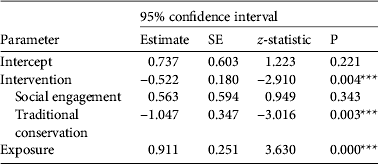
The minimum adequate model for whether people remembered receiving public awareness materials or not revealed that those exposed to social engagement were more likely to remember receiving public awareness materials, followed closely by those targeted by the media campaign (Table 3). The probability of remembering receiving public awareness materials increased with increasing exposure to the saiga (how recently and often they had seen the species). Ninety-eight percent of those with the highest exposure to the saiga remembered receiving public awareness materials compared to 65% of those with the lowest exposure.
Minimum adequate model (fit by GLM with binomial errors) for ‘remembered having received public awareness materials’ (n=250). Significant explanatory variables are intervention and exposure to saigas. Exposure to the saiga is an ordered factor and intervention is nominal. Estimate of the nominal factor represents differences in effect between intervention types, where the media campaign is the baseline.
*** significant at 1%
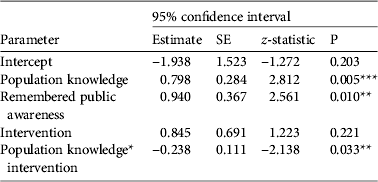
The minimum adequate model for whether people had some knowledge of conservation activities in the region includes both intervention and remembering having received public awareness as significant explanatory variables, alongside knowledge about the saiga population (Table 4). The random effect of village explained 68% of the variation in this model, suggesting that knowledge of conservation was strongly dependent on village. Those exposed just to the media campaign were more likely to know about conservation in the region if they also had a high level of knowledge about population status. However, the conservation knowledge of those exposed to traditional conservation was unrelated to their population knowledge of saigas. All of the respondents who had been exposed to social engagement knew something about conservation and therefore population knowledge was not a significant covariate in this case.
Minimum adequate model (fit by LME model with binomial errors) for whether a respondent has some or no knowledge of conservation projects (n=250). Significant explanatory variables are knowledge of saiga population status (population knowledge) and remembering having received public awareness information, and an interaction between population knowledge and conservation intervention.
**, ***, significant at 5% and 1%, respectively
What type of information was received and when?
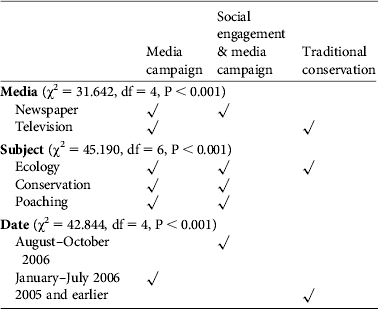
Those who had not been targeted by the media campaign tended to have received their information earlier than 2006 and mostly via television (Table 5). In most cases the information was about the ecology and life history of the saiga. Those exposed to the media campaign received an even coverage from both newspapers and television. However, those exposed to the social engagement (rotating cows) project remembered receiving their information most recently (i.e. in 2005 and 2006) despite conservation interventions in their villages starting in 2003. Those exposed to the media campaign alone did not generally recall receiving their information during the height of this campaign, August–October 2006, but earlier.
χ2 tests of the medium respondents recalled seeing, the subject of the material and the recalled date of receiving public awareness, for the different interventions (n=191). For each intervention the most common outcomes are shown with a tick.
The results also indicate that women tended to read less about conservation than men (χ2=8.986, P=0.029, df=3). Ethnic Russians and other nationalities (i.e. not Kalmyks) tended to receive their information via television and learnt more about ecology than other subjects (χ2=9.856, P=0.043, df=4; χ2=17.535, P=0.008, df=6, respectively). However, 73% of ethnic Russians interviewed lived in villages exposed to traditional conservation, and therefore were a priori more likely to have received their information through the medium of television and on the subject of ecology.
How does public awareness affect attitudes and behavioural intention?
The immediate effect of information (whether respondents recalled undergoing a change in awareness on receiving the information) was influenced by the sex of the individual and the medium of the information (χ2=4.066, P=0.044, df=1; χ2=5.914, P=0.049, df=2, respectively). Television was reportedly a more effective medium than reading materials and men watched more television than women. Although not significant, there was a slight effect of subject matter on the direct effect of information, with ecology and conservation materials producing a more positive response than information about poaching.
Opinion change over the previous 3 years was highly influenced by remembering having received public awareness materials, with those receiving information being much more likely to become positive about the saiga and saiga conservation (Table 6). Opinion change was more likely if an individual also reported that the information had had an immediate effect when it was received. Once again the occurrence of reinforcement was observed, with opinion change also being strongly influenced by an individual's exposure level to saigas.
Minimum adequate models (fit by GLM with binomial errors) for opinion change over the previous 3 years. When remembering receiving information is an explanatory variable it is significant alongside conservation knowledge. When only those who recalled receiving information were considered, exposure to saigas and the recalled immediate effect of information received were also significant explanatory variables. Conservation knowledge and exposure are ordered factors; remembering receiving information and immediate effect of information received (if respondents recall undergoing a change in awareness on receiving the information) are binomial factors.
**, ***, significant at 5% and 1%, respectively
In the case of amount pledged for saiga conservation, both wealth and length of time the respondent had been living in the village (residence time) had a positive effect on amount pledged, when controlling for village and intervention, whilst age had a negative influence (Table 7). Higher levels of conservation knowledge strongly increased the amount pledged when no public awareness materials had been received, and remembering having received information led to consistent levels of amount pledged regardless of conservation knowledge. When respondents recalled receiving information, amount pledged for saiga conservation was dependent on an interaction between the date the materials were received and age. For information received between January and October 2006 amount pledged was greatest for those age 26–46. However, if the materials were received in 2005 or earlier, amount pledged was greatest for those aged 18–25 and declined with age.
Minimum adequate models (fit by LME model with Gaussian errors) for amount pledged for saiga conservation. When remembered receiving information is an explanatory variable it is significant alongside wealth, age, residence time and conservation knowledge. When only those who recalled receiving information were considered, recalled date of receiving the information also became significant. Wealth is continuous; length of time resident in the village (residence time), age, conservation knowledge and date information received are ordered factors; remembers receiving information is binomial. Random effects of intervention and village explained 5.03 and 2.76% of the variation respectively.

**, ***, significant at 5% and 1%, respectively
Discussion
The results indicate that the population of the north-west Pre-Caspian is, in general, positive about the saiga and its conservation. The Kalmyk people have always held the saiga in high regard and respondents characterized the saiga as ‘a symbol of the steppe’, ‘a beautiful animal’ and ‘godly creatures’. This attitude provided a positive background for the media campaign, with people already predisposed to be interested in, and respond to, the material provided. Analysis of the public awareness campaign illustrates that in this region media such as newspapers and television are readily available to most of the population and are interested in publishing stories about conservation issues. This may explain why 50% of interviewees not targeted by the media campaign recalled receiving saiga-related material and illustrates the benefits of using established information delivery systems to provide an effective media campaign. Subject matter was evenly spread across ecology, conservation and poaching and the media campaign was broad and evenly-based, utilizing both written and visual media.
Previous studies have shown that as much as 50% of the variation in people's attitudes towards conservation can be explained by having received conservation education (Kideghesho et al., Reference Kideghesho, Roskaft and Kaltenborn2007). This finding is corroborated by our results, which show that remembering having received public awareness materials is a significant variable explaining attitudes. Although it has been suggested that attitudes can be a useful proxy for behaviour in those situations where assessing behaviour is difficult (Infield & Namara, Reference Infield and Namara2001), most studies are non-committal about the link between the conservation programme being analysed, the resultant attitudes and any reported behavioural changes (Abbot et al., Reference Abbot, Thomas, Gardner, Neba and Khen2001). We used amount pledged for saiga conservation as a measure of behavioural intention but, as giving money for conservation is different from desisting from poaching, the link to behavioural change cannot be made based on these results. However, the propensity for the young to pledge more and the better penetration of the media campaign among men (particularly via television) suggest that young men, the demographic group containing most poachers, may have been effectively reached by the campaign.
A key finding of this study is the importance of reinforcement. Our results suggest that direct exposure to the saiga, to different forms of knowledge and to more intensive conservation interventions serve to reinforce one another, making a change in opinion or behavioural intention more likely to occur. Research on health campaigns has revealed that success is often dependent on whether an issue has been a previous or current concern of the target audience and, in the case of tobacco, whether a person has smoked or not (Glascoe et al., Reference Glascoe, Oberklaid, Dworkin and Trimm1998; Pinkleton et al., Reference Pinkleton, Austin, Cohen, Miller and Fitzgerald2007). It could therefore be useful to use reinforcement strategically within conservation interventions, to effect positive change.
Our study also highlights the importance of understanding the demography and socio-cultural aspects of the focal audience. Taking advantage of factors that may already have raised, or may be able to raise, the receptiveness of the target group is an effective approach. In this region there is an ongoing campaign of raising exposure of the general public to the saiga through visits to the local captive breeding centre and the Stepnoi Reserve. The receptiveness of people who are already regularly exposed to saigas is being exploited by instituting a participatory monitoring scheme focused on those living on remote farms (who also have the most opportunity to poach). There have been few studies in conservation that investigated the effectiveness of using different approaches to public awareness for different target groups and much could be learnt from research in medicine, communication and advertising (Glascoe et al., Reference Glascoe, Oberklaid, Dworkin and Trimm1998; Pinkleton et al., Reference Pinkleton, Austin, Cohen, Miller and Fitzgerald2007).
Our results indicate that media campaigns are effective and can lead to declared positive changes in attitude and behavioural intention. Importantly, through the use of mixed effects models that allowed us to control for confounding factors, we were able to demonstrate that these changes were additional to those occurring in a nearby control population, and that they were reinforced in areas where an additional conservation intervention was taking place. We were also able to place the changes in attitude in time relative to the onset of the campaign, to strengthen the inference that there was a relationship between the campaign and observed attitudinal and behavioural changes. Any changes in attitudes and behavioural intention in the control population of Astrakhan are likely to be the result of receiving public awareness materials by leakage effects and/or confounding variables such as pre-existing knowledge of the saiga and its conservation and exposure level to saigas.
Without effective evaluation at both the case study and global levels conservation will continue to fail to achieve maximum returns on investment (Brooks et al., Reference Brooks, Franzen, Holmes, Grote and Borgerhoff-Mulder2006; Underwood et al., Reference Underwood, Klausmeyer, Morrison, Bode and Shaw2009). Evaluating the outcomes of a project is a key requirement of the Darwin Initiative, and this evaluation is a contribution to this requirement. Although this is a case-specific example it demonstrates how an adaptive approach to conservation interventions could increase the effectiveness of ongoing media campaigns, to take full advantage of the socio-economic and experiential factors that make people more or less responsive to a particular public awareness programme.
Acknowledgements
This study was financially supported by ESRC/NERC and the Darwin Initiative (Project EIDP018). EJMG acknowledges the support of a Royal Society Wolfson Research Merit Award. We gratefully acknowledge the support and advice of Anna Lushchekina, Ruslan Medzhidov, Iuri Arylov and the Centre for Wild Animals of the Republic of Kalmykia, Anatoly Khludnev and the Stepnoi Reserve. We thank Tanya Mudzhaeva and Khongir Mandzhiev for their assistance during data collection, Aline Kühl and Nils Bunnefeld for advice during analysis, and the 250 residents of the study villages for their hospitality and patience in answering our questions.
Appendices 1–2
The appendices for this article are available online at http://journals.cambridge.org
Biographical sketches
Caroline Howe is concerned with how the needs of local communities can be successfully integrated into conservation planning and in exploring methodologies for the quantitative evaluation of conservation outcomes that consider both socio-economic and biological aspects. Olga Obgenova is the Kalmykian team leader on the Darwin Initiative project ‘Evaluating approaches to public engagement in saiga conservation’ and provides on the ground support for saiga conservation in Kalmkyia. E.J. Milner-Gulland has a broad interest in the relationship between human decision-making and conservation success and is Chair of the Saiga Conservation Alliance (http://www.saiga-conservation.com).



