




Recent identity movements in both South Korea (hereafter Korea) and Taiwan reflect complex tensions between local cultural integrity and the forces of globalization, particularly evident in the cultural backlash against transnational migration. In Korea, for example, a pivotal moment occurred in 2018 when public opposition to Yemeni asylum seekers on Jeju Island ignited nationwide protests, culminating in an online petition opposing the Refugee Act that attracted over 200,000 signatures with concerns about cultural preservation and social cohesion (Park Reference Park2018). Taiwan has likewise faced its own debates over asylum legislation, driven by political sensitivities surrounding relations with China and national security concerns; in particular, there is widespread apprehension about potential infiltration by Chinese agents posing as refugees (Kironska Reference Kironska2022). These parallel cases exemplify how accelerating global integration through trade, migration, and digital connectivity (Beck Reference Beck2000) can provoke localized anxieties over national identity (Inglehart and Norris Reference Inglehart and Norris2016).
Scholarship suggests that such localized identity movements have been mobilized through social media, which accelerates the dissemination of misinformation about refugees and magnifies collective anxieties about national security, economic stability, and cultural integrity (Laaksonen et al. Reference Laaksonen, Pantti and Titley2020; Lee and Kim Reference Lee and Kim2024; Rauchfleisch and Kaiser Reference Rauchfleisch and Kaiser2020). While digital connectivity continues to reshape social relationships and cultural boundaries (Bennett Reference Bennett2012; Castells Reference Castells2015), these platforms increasingly facilitate the emergence of localist identities that resist transnational integration as “a question of having a sense of belonging, or recognition of commonality and differences with others” (Kim Reference Kim2013, 37). In this regard, the Yemeni refugee case highlights the need to analyze broader patterns in how individuals negotiate the intersection of local and transnational identities amid the increasing use of social media.
Certainly, however, characterizing social media merely as an echo chamber driving exclusionary attitudes (Bakshy, Messing, and Adamic Reference Bakshy, Messing and Adamic2015; Sunstein Reference Sunstein2007) oversimplifies its complex role in identity formation. Crucially, the influence of social media on identity politics is moderated by individuals’ existing social capital configurations. Those possessing substantial bridging social capital, which manifests through diverse cross-group networks and heterogeneous social ties, demonstrate greater receptivity to cosmopolitan narratives and inclusive discourse (Levitt and Schiller Reference Levitt and GlickSchiller2004; Williams Reference Williams2006). Conversely, those whose social capital is predominantly bonding—characterized by dense, homogeneous networks—are more susceptible to in-group reinforcement and exclusionary rhetoric (Putnam Reference Putnam2000; Lin Reference Lin, Lin, Cook and Burt2001). This differential impact underscores the necessity of examining how social media’s role in localized identity movements is fundamentally conditioned by the structure and intensity of users’ social capital.
Given these points, this study conducts a comparative analysis of Korea and Taiwan to examine how social media use shapes the dynamic interplay between localist and transnational identities, focusing on social capital’s moderating role. Although both societies share a Confucian cultural background that has historically shaped interpersonal relationships and notions of social duty (Huang Reference Huang2024), their national identities have diverged considerably over time. Korea’s identity emphasizes ethnic nationalism, undergirded by a strong sense of cultural homogeneity and collective memory rooted in shared ancestry (Han and Lim Reference Han and Lim2023; Shin Reference Shin2006). Such an ethnic focus fosters bonding social capital tied to blood relations, reinforcing exclusionary attitudes and resistance to globalization (Kim Reference Kim2013). Taiwan’s national identity, by contrast, evolved in a different geopolitical context, where asserting sovereignty from mainland China led to an emphasis on democracy, human rights, and legal autonomy (Fetzer and Soper Reference Fetzer and Soper2012; Kwan Reference Kwan2016; Tsai Reference Tsai2016). This civic orientation cultivates a more inclusive form of social capital, encouraging contact between local identity and transnational elements (Chu and Lin Reference Chu and Lin2001; Lynch Reference Lynch2002). The contrasting roles of nationalism in the social capital structures of Korea and Taiwan provide a valuable lens for understanding the conditions under which social media use reinforces exclusionary responses to globalization.
Building on this comparative approach, we adopt a nuanced conceptualization of transnational identity negotiation that acknowledges the simultaneous existence of local and global attachments. Rather than positioning nationalism and cosmopolitanism as mutually exclusive forces, we conceptualize identity negotiation along intersecting continua that accommodate both place-bound and global affiliations (Haller and Roudometof Reference Haller and Roudometof2010). This framework challenges the traditional view that globalization erodes national identity and instead suggests that individuals can maintain strong local ties while embracing global cultural and economic integration (Faist Reference Faist2000; Held et al. Reference Held, McGrew, Goldblatt, Perraton, Pierson and Tormey2000).
This study advances the literature on transnational identity negotiation in two key ways. First, by comparing Korea’s and Taiwan’s distinct pathways to reconciling nationalism with global integration, it reveals how different configurations of social capital shape identity politics in the digital age. Second, by examining how social capital moderates global–local tensions in social media use, it provides crucial insights into the mechanisms through which digital platforms either facilitate or impede transnational identities in East Asia.
Literature review
Conceptualizing transnational identity negotiation
The concept of transnational identity was introduced in studies investigating how immigrants form and maintain social, familial, economic, cultural, and political ties across national borders (Levitt and Schiller Reference Levitt and GlickSchiller2004; Portes Reference Portes, Kalb, van der Land, Staring, van Steenbergen and Wilterdink2000). While these early studies focused on how diaspora communities develop hybrid identities through simultaneous engagement with host societies and countries of origin, the framework has evolved to encompass a broader range of identity negotiations as cross-border flows of labor, goods, information, and cultural symbols intensify and international migration expands (Bradatan, Popan, and Melton Reference Bradatan, Popan and Melton2010; Çaglar Reference Çaglar2001). This evolution is consistent with the argument that the erosion of nation-state boundaries fosters cosmopolitan citizens with fluid identities (Beck Reference Beck2000; Norris Reference Norris2002). Contemporary understandings of transnational identity, therefore, refer to a sense of belonging that goes beyond place of residence or national affiliation and is fluid and adaptive depending on the individual’s circumstances (Roudometof Reference Roudometof2005). From this perspective, transnational identity results from a negotiation between ideological loyalty to the local community and international adaptation, which is contextualized through the interplay of local culture and global forces.
By examining transnational identity negotiation, we aim to illuminate the active and dynamic processes through which individuals construct and adapt their identities in response to the complex interplay of local and global forces, moving beyond static notions of identity to explore the fluid and contextual ways in which belonging is reshaped in an increasingly interconnected world. This conceptualization aligns with Roudometof’s (Reference Roudometof2016) view of globalization as a negotiation of identity characterized not only as a top-down institutionalization or social movement but also as a bottom-up process that emerges from individual attitudes and behaviors. In particular, globalization has eroded nation-state boundaries, enabling the emergence of cosmopolitan citizens with fluid, multi-layered identities that accommodate diverse cultural and economic environments (Beck Reference Beck2000; Norris Reference Norris2002). In this process, individuals continuously negotiate multiple layers of transnational identity that are shaped by global connectivity and multicultural encounters (Bradatan, Popan, and Melton Reference Bradatan, Popan and Melton2010).
Based on the above discussion, this study adopts a multidimensional framework that examines transnational identity negotiation through a two-dimensional model: local–global, which measures geographic attachment and ties; and protectionist–openness, which assesses place-independent attitudes (Olofsson and Öhman Reference Olofsson and Öhman2007). The local–global dimension measures the extent and nature of geographic attachments and ties, from strong local community ties and national loyalties to broader identification with global communities and international networks (Roudometof Reference Roudometof2005). The protectionist–openness dimension assesses place-independent attitudes toward cultural and economic exchange, from preferences for protecting domestic interests and maintaining cultural distinctiveness to embracing international integration and multicultural influences (Olofsson and Öhman Reference Olofsson and Öhman2007).
These two dimensions of transnational identity are not mutually exclusive, allowing for nuanced combinations. Olofsson and Öhman (Reference Olofsson and Öhman2007) identify four archetypes—local protectionists, open globals, global protectionists, and open locals—illustrating the multi-dimensional nature of identity negotiation and its policy implications. Local protectionists oppose globalization and prioritize preserving culture and protecting their economies based on their local attachments. Open globals favor cultural and economic integration, embracing multiculturalism and reforms with minimal ties to specific local identities. Global protectionists engage globally for economic benefits but resist cultural integration, emphasizing local identity preservation. Open locals maintain strong local ties while embracing global exchanges to enrich and sustain their traditions. This framework highlights that individuals can support multiculturalism and global integration without compromising local identity (Haller and Roudometof Reference Haller and Roudometof2010), demonstrating that globalist orientations can complement rather than undermine national ties (Faist Reference Faist2000; Held et al. Reference Held, McGrew, Goldblatt, Perraton, Pierson and Tormey2000).
Comparing identities in Korea and Taiwan
Anderson’s (1983) concept of “imagined community” describes nationalism as a socially constructed phenomenon, transmitted through language, media, and education. In both Korea and Taiwan, cultural heritages rooted in Confucian values—emphasizing social hierarchy, community harmony, familial loyalty, and patriarchal governance—have historically shaped national communities (Chang Reference Chang2019; Kim Reference Kim2013; Shin Reference Shin2006; Wang Reference Wang2011). These ideals legitimized strong state ideologies by reinforcing top-down governance and prioritizing collective interests over individual rights (Cumings Reference Cumings1997; John Reference John2015). Consequently, nationalism in Korea and Taiwan has served as a mechanism for integrating local identities into broader national narratives, often framing tensions between local and global forces as contests between national and transnational identities.
Nonetheless, Confucianism’s role in these identities is far from uniform. At times, Confucianism has served as a moral compass that bolsters state authority, yet it also upholds universal ethical principles—such as ren (benevolence) and yi (righteousness)—which can transcend national boundaries (Bell Reference Bell2014). Owing to this dual character, some scholars view Confucianism as integral to understanding nationalism in East Asia (Pyle Reference Pyle2007; Shin Reference Shin2006), while others contend that Western democratic ideals have been more influential, particularly in Taiwan—thereby questioning Confucianism’s contemporary relevance (Fetzer and Soper Reference Fetzer and Soper2012). From this perspective, two models of nationalism—ethnic nationalism rooted in cultural and kinship ties, and civic nationalism founded on shared political values (Kohn Reference Kohn1944)—offer a compelling comparative lens for examining how identity negotiations unfold in Korea and Taiwan.
In Korea, national identity is principally anchored in ethnic nationalism, emphasizing shared bloodlines and cultural heritage (Kim Reference Kim2013; Shin Reference Shin2006). Intertwined with Confucian notions of familial loyalty and social hierarchy (e.g., xiao, or filial piety), Korean nationalism portrays the nation as an “ethnic family” (Park and Cho Reference Park and Cho1995), constructed around shared ancestry and a moral obligation to preserve the unity and purity of the ethnic lineage (Han and Lim Reference Han and Lim2023). Educational narratives about Japanese colonial rule have reinforced this ethnic identity, while the political context of a divided Korean peninsula has further solidified the importance of ethnic solidarity (So, Kim, and Lee Reference So, Kim and Lee2012). Consequently, Korea’s ethnic nationalism, shaped partly by Confucian ideals of heritage preservation and family unity, has fostered a defensive stance toward globalization, promoting exclusionary attitudes and skepticism toward external influences (Shin Reference Shin2006).
By contrast, Taiwan has cultivated a form of civic nationalism deeply influenced by its unique geopolitical and historical relationship with mainland China (Kwan Reference Kwan2016; Tsai Reference Tsai2016). In asserting national sovereignty, Taiwan has emphasized democratic values, civil rights, and the rule of law as core elements of its national identity, standing in opposition to the “One China” policy (Chu and Lin Reference Chu and Lin2001; Wong Reference Wong2001). Under this framework, Confucian values—such as social justice and civic responsibility—have been reinterpreted to align with democratic norms (Bell Reference Bell2014; Fetzer and Soper Reference Fetzer and Soper2012). According to Fetzer and Soper (Reference Fetzer and Soper2012), however, Western democratic ideals have played a more decisive role in shaping Taiwan’s civic orientation, as Confucian influences appear to have waned over time. Moreover, Shen and Wu (Reference Shen, Wu and Peter2008) show that Taiwan’s civic nationalism emerged through the convergence of two historically distinct groups—native Taiwanese and mainlanders—spurred by increased public engagement in democratic processes, generational change, and shared experiences of economic growth. This inclusivity allows transnational elements to be incorporated into Taiwan’s national identity without undermining social cohesion (Chu and Lin Reference Chu and Lin2001; Lynch Reference Lynch2002).
Taken together, these contrasting nationalisms in Korea and Taiwan highlight how Confucian legacies, democratic ideals, and geopolitical factors shape divergent approaches to identity negotiations under globalization. Against this backdrop, we pose our first research question:
-
RQ1: How do Koreans and Taiwanese negotiate transnational identity along the dimensions of local–global attachment and protectionist–open attitudes?
The effects of social media on transnational identity
The negotiation of transnational identities is closely tied to the nature and intensity of individuals’ social relationships, given that identity formation is deeply embedded in social interaction (Coleman Reference Coleman1990; Lin Reference Lin1999; Putnam Reference Putnam2000). According to social identity theory, individuals derive their sense of self from the roles and norms that emerge within their social networks, reinforcing a sense of belonging by distinguishing themselves from out-groups (Abrams and Hogg Reference Abrams and Hogg1990; Hogg, Abrams, and Brewer Reference Hogg, Abrams and Brewer2017; Tajfel and Turner Reference Tajfel, Turner, Austin and Worchel1979). In digital contexts, social media significantly shapes social identities by providing a unique environment for diverse social relationships; importantly, it enables community formation across physical boundaries and fosters novel forms of social engagement (Howard Reference Howard2010). However, how social media affects transnational identity negotiations remains empirically underexplored, and there are differing claims in the literature.
On one hand, social media is understood to facilitate interactions in transnational spaces by connecting individuals through loosely structured, extensive networks rather than through traditional organizations. This view highlights how social media links broader, more heterogeneous networks (Ellison, Steinfield, and Lampe Reference Ellison, Steinfield and Lampe2011), expanding opportunities for exposure to diverse civic voices (Gil de Zúñiga and Valenzuela Reference Gil de Zúñiga and Valenzuela2011). By connecting diverse communities, social media introduces new norms, values, and behaviors that might otherwise remain inaccessible within tightly knit, homogeneous groups (Shirky Reference Shirky2011; Soon and Cho Reference Soon and Cho2014). The resulting communicative environment supports the adaptation of multiple identities, allowing individuals to participate in broader communities that transcend geographic and cultural boundaries (Bennett Reference Bennett2012). In this sense, social media provides a space for users to engage with transnational social arenas where local, national, and global forces converge (Castells Reference Castells2015). Through these mechanisms, social media connects people from diverse backgrounds, encourages participation in global communities, and fosters hybrid identities that extend across borders.
On the other hand, social media use reinforces social divisions within insular network structures, thereby strengthening homogeneity and exclusion (Bakshy, Messing, and Adamic Reference Bakshy, Messing and Adamic2015). This argument notes that recommendation algorithms, by design, prioritize exposure to content that aligns with users’ existing tastes and preferences, creating “filter bubbles” in which individuals are trapped in a cycle of exposure to similar information (Pariser Reference Pariser2011). This selective exposure then creates an “echo chamber,” reinforcing existing beliefs and potentially amplifying social divisions (Sunstein Reference Sunstein2007). Empirical evidence indicates not only that social media use is higher among those harboring negative sentiments toward out-groups (Rathje, Van Bavel, and Van der Linden Reference Rathje, Van Bavel and van der Linden2021), but also that this use intensifies tendencies to avoid conflicting information and seek out supportive viewpoints, thus driving ideological polarization (Bail et al. Reference Bail, Argyle, Brown, Bumpus, Chen, Fallin Hunzaker, Lee, Mann, Merhout and Volfovsky2018). From this perspective, social media inhibits cross-cultural interaction, fosters insular communities, and exacerbates affective polarization between in- and out-groups (Iyengar, Sood, and Lelkes Reference Iyengar, Sood and Lelkes2012), ultimately solidifying local identities at the expense of transnational affiliations.
Given these competing dynamics within social media, it is essential to investigate empirically how social media use influences the negotiation of local, national, and transnational identities. Accordingly, this study poses the following research question:
-
RQ2. How does social media use affect the negotiation between local, national, and transnational identities in Korea and Taiwan?
The moderating effects of social capital on identity negotiation
The relationship between social media use and identity negotiation depends on the nature and extent of a user’s social capital. Social capital—which functions as networks, norms, and social trust that facilitate mutual benefit through coordination and cooperation—influences how individuals use social media to construct communities and negotiate identities. This is because social capital, which encompasses the resources and benefits derived from social networks, plays a pivotal role in how individuals engage with social media by shaping the context in which the media is used for relationship maintenance and social interaction (Ellison, Steinfield, and Lampe Reference Ellison, Steinfield and Lampe2011; Lee, Kim, and Ahn Reference Lee, Kim and Ahn2014). As Christoforou (Reference Christoforou2013) argues, social capital enables individuals to develop multiple, overlapping identities through participation in various social networks and institutions (see also Kramer Reference Kramer2006); however, the level of access to and utilization of social capital depends on the density of the networks to which individuals belong and the strength of their connections (Lin Reference Lin1999).
Furthermore, whether social capital is bridging or bonding in nature further conditions its role in identity negotiation. Bridging social capital, characterized by trust and networks connecting individuals across different social groups, facilitates engagement with different cultural frameworks and fosters broader identities and reciprocity (Putnam Reference Putnam2000; Vertovec Reference Vertovec2001). In transnational contexts, these cross-cultural exchanges enable individuals to integrate elements of local and global identities, thereby enhancing transnational identity formation (Portes and Rumbaut Reference Portes and Rumbaut2001). In this way, social media users with diverse and extensive networks are more likely to participate in heterogeneous communities, which fosters an openness to an inclusive identity that transcends traditional group boundaries. By contrast, bonding social capital prioritizes exclusive social identities and homogeneous ties that reinforce existing group divisions (Paxton Reference Paxton2007). High levels of bonding social capital thus promote narrower selves, emphasizing internal homogeneity and cohesion (Putnam Reference Putnam2000).
In this context, this study seeks to discern how social capital operates in the context of East Asia, where Confucian values continue to influence social norms and role perceptions (Cao et al. Reference Cao, Zhao, Ren and Zhao2015; Huang Reference Huang2024). In particular, the relationalist nature of Confucian culture, which emphasizes the norms of harmony with self and others and reciprocity within the family and group, promotes strong in-group ties, providing individuals with a supportive network and thus facilitating the formation of a bonding social identity (Shi Reference Shi2014). However, it can also hinder the integration of out-group members, potentially leading to difficulties in cross-cultural integration. This dynamic is particularly evident in Korea, where the traditional emphasis on ethnic homogeneity and kinship has come into tension with increasing cultural diversity due to globalization, leading to what Kim (Reference Kim2013) characterizes as a crisis of national identity. This bonding configuration of social capital is reflected in the high correlation between ethnic identity and generalized trust (Tan and Tambyah Reference Tan and Tambyah2011). In this way, social capital in Korea operates through a complex interweaving of ethnic-based relational networks, centered around inmaek (personal ties) and yeongo (affiliation), and emerging forms of civic identity, which emphasize trust in strangers and institutions (Lee Reference Lee2008; Yee Reference Yee2015). The resulting form of social organization represents an ongoing negotiation between traditional bonding networks that reinforce ethnic identity and modern institutional structures that embrace globalization (Kim Reference Kim2013; Han and Lim Reference Han and Lim2023).
Of course, social capital in these two countries does not derive solely from Confucian cultural traditions; rather, it has evolved in tandem with broader processes of democratization and socio-economic development. Particularly in Taiwan, relationship-oriented traditional values have evolved to serve as bridging social capital (Jhang Reference Jhang2022), as evidenced by the convergence of historically distinct groups on a shared Taiwanese identity (Shen and Wu Reference Shen, Wu and Peter2008). In this context, social capital functions as a key mechanism through which informal interpersonal relationships (guanxi) facilitate public participation in democratic institutions (Marsh Reference Marsh2003). Chang and Chang (Reference Chang and Chang2019) explain that this bridging configuration of social capital creates a “third space” in which social media users actively negotiate multiple identities through strategic engagement with various social networks and institutions. Thus, social capital in the Taiwanese context demonstrates how traditional relationship-based structures complement democratic institutional frameworks, thereby fostering a flexible approach to integrating local and global identities.
Given these structural differences between Korea and Taiwan, it is crucial to examine how transnational identity negotiations in the context of social media use are moderated by social capital, categorized as either bridging or bonding. we therefore pose the following two research questions:
-
RQ3-1. What are the moderating effects of bridging social capital on the relationship between social media use and transnational identity negotiation in Korea and Taiwan?
-
RQ3-2. What are the moderating effects of bonding social capital on the relationship between social media use and transnational identity negotiation in Korea and Taiwan?
Method
Data
This study uses data from the World Values Survey Wave 7 (WVS 7), which includes questions on globalization, social capital, the frequency of internet and social media use, as well as respondents’ socio-demographic characteristics. The WVS 7 data were collected in 2018 in Korea and 2019 in Taiwan, which can sufficiently capture the effects of social media diffusion while being uninfluenced by the COVID-19 pandemic, making it suitable for comparing transnational identities. This project was conducted among adults aged 18 to 85 years who were randomly selected from each household, with the sample selected by stratified or proportional probability sampling. The target sample size was 1,200 for each country, while response rates were 36.88 percent for Korea and 29.65 percent for Taiwan (Haerpfer et al. Reference Haerpfer2022).
Dependent Variables
We measured transnational identity negotiation using Olofsson and Öhman’s (Reference Olofsson and Öhman2007) two-dimensional model, which drew upon Roudometof’s (Reference Roudometof2005) localism–cosmopolitanism continuum and separated the dimension of protectionism versus openness from the geographic place-attached attitudes dimension. To measure the local–global dimension, we utilized five questions (Q255–Q259) from the WVS 7 regarding the degree of closeness to different geographic places (city, state, country, continent, world). For the protectionism–openness dimension, we chose four questions (increased crime rate: Q124; increased terrorism risk: Q126; increased unemployment: Q128; social conflict: Q129) measuring respondents’ agreement with the proposition that migration causes social problems (Table 1). Although these questions do not perfectly match previous studies’ operationalizations, we believe they are sufficiently comprehensive to measure two dimensions of transnational identity: place- and non-place-attached attitudes (Olofsson and Öhman Reference Olofsson and Öhman2007).
Indicators of Local–Global and Protectionism–Openness
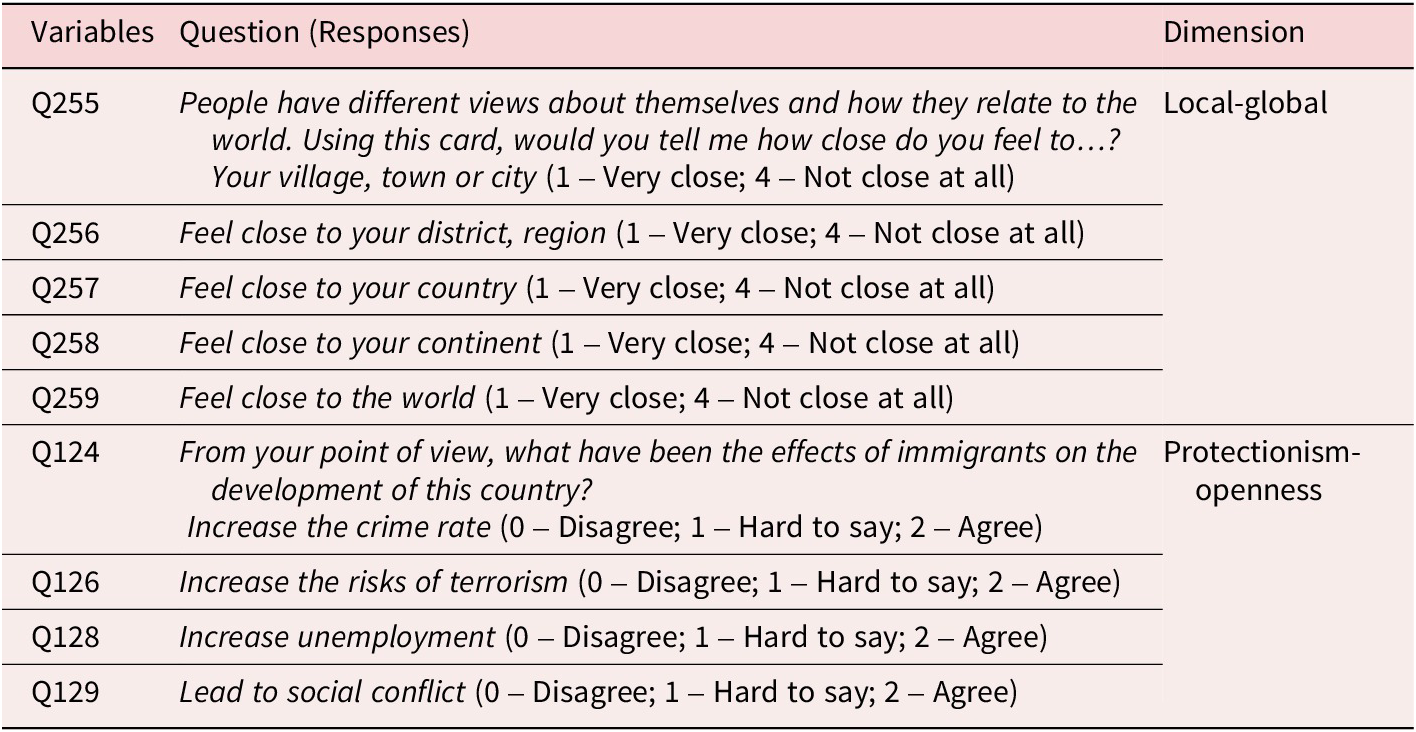
Data from: World Values Survey Wave 7.
We employed latent class analysis (LCA) to identify potential subgroups of transnational identity based on respondents’ response patterns measured by discrete variables with different scale types. To determine the optimal number of classes that best explain the response patterns, we estimated different class models using LCA and evaluated the model fit according to the Bayesian Information Criterion (BIC). Based on the optimal model, we compared the classes’ response distributions to situate each class within the dimensions of local–global and protectionism–openness. Finally, we estimated the probability of the respondents being assigned to each class and classified them. We used the poLCA package in the R environment, and each model was run 5,000 times to avoid local maxima (Linzer and Lewis Reference Linzer and Lewis2011).
Ultimately, we found the five-class solution to be the optimal model for both countries, given the model’s parsimony and overfitting, striking a balance between goodness of fit and complexity (Table 2). We also used a multinomial log-linear regression model to estimate the factors influencing the five-class classification of transnational identities. Using the derived classes as the dependent variable, we estimated a series of models including social capital, social media use, and their interaction. Because transnational identity is influenced by society-level factors (i.e., there is macro-level heterogeneity) and social capital is considered a contextual attribute of individuals’ communities (Putnam Reference Putnam2000), we estimated models for Korea and Taiwan separately.
Latent Class Analysis, Model Fit Statistics for Different Class Solutions
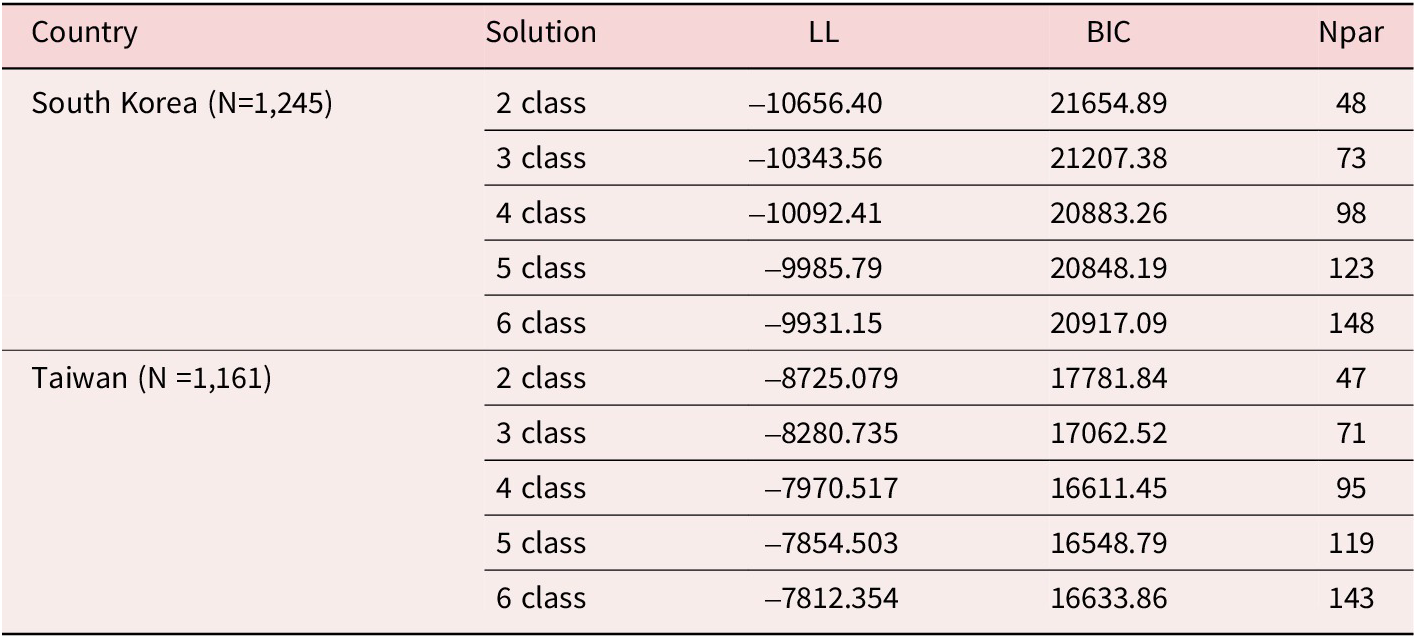
Note: Log-Likelihood (LL): Higher (less negative) values mean better fit. Bayesian Information Criterion (BIC): Lower values indicate a better fit, balancing model complexity to avoid overfitting. Number of Parameters (Npar): More parameters can improve fit but may lead to overfitting.
Independent and control variables
The independent variables were organized into two clusters. The first cluster is social media use. We used an item (Q207) that measured how often respondents used social media (Facebook, Twitter, etc.) to stay informed about their country and the world (Daily, Weekly, Monthly, Less than monthly, Never) to differentiate those who used it daily or weekly from those who did not. We also included internet use (Q206), which was categorized in the same way to measure the marginal effects of social media use.
The second includes variables that measure bridging and bonding social capital. Because social capital is a complex concept that includes trust, cooperation, the density of networks, and the strength of connections within a community, it has been measured in a variety of ways at the individual level (La Due Lake and Huckfeldt Reference La Due Lake and Huckfeldt1998; Lin Reference Lin1999). In this study, we measure social capital along two dimensions: organizational affiliation and interpersonal trust.
Regarding the former, because voluntary organizations “instill in their members habits of cooperation, solidarity and public-spiritedness” (Putnam, Leonardi, and Nanetti Reference Putnam, Leonardi and Nanetti1994, 89–90), belonging to an organization provides a personal-level context in which social capital can be accessed and used. In other words, organizational affiliation strengthens social relationships through real and tangible interactions between members (Newton Reference Newton1997). However, organizational affiliation has different effects when the scope of participation is narrow versus broad: for example, multigroup affiliation increases access to a more inclusive social network (Fukuyama Reference Fukuyama1995; Putnam Reference Putnam2000), whereas single-group affiliation reinforces homogeneity and raises barriers to outsiders (Verba, Schlozman, and Brady Reference Verba, Schlozman and Brady1995). Thus, we measured organization affiliation using 12 items (Q94–Q105) regarding respondents’ membership in voluntary organizations, categorized as 1) not a member, 2) belong to a single organization, and 3) belong to two or more organizations.
Next, interpersonal trust is categorized into in-group and out-group trust (Newton Reference Newton1997; Putnam Reference Putnam2000). In-group trust refers to trust in close social relationships, such as family, friends, and coworkers, which facilitates cooperation and support with members of one’s own group (Brewer Reference Brewer1999). By contrast, out-group trust refers to one’s level of trust in individuals who are perceived as not belonging to one’s own group, defined according to, e.g., race, nationality, culture, or social background, and it plays an important role in promoting social integration and diversity (Putnam Reference Putnam2000). Thus, while in-group trust acts as bonding social capital that creates strong ties in closed, intimate relationships, out-group trust is a form of bridging social capital that promotes the inclusion of strangers and cooperation in organizing heterogeneous communities (Stolle and Rochon Reference Stolle and Rochon1998).
Interpersonal trust was measured using items (Q58–Q63) assessing respondents’ level of trust in people from different groups (Trust completely, Trust somewhat, Do not trust very much, Do not trust at all), separating in- and out-group trust. Factor analysis indicated that the two-factor model fit the data well in both countries, with trust in one’s own neighborhood (Q59) and people one knows personally (Q60) being related to one factor, and trust in people you meet for the first time (Q61), people of different religions (Q62) and people of different nationalities (Q63) being related to another factor (Table 3). We combined these 4-point scale items from each factor to create an index of in-group trust in close people and an index of out-group trust in socio-culturally different people.
Factor Analysis, Data Sets from WVS 7, of the Questions of Interpersonal Trust
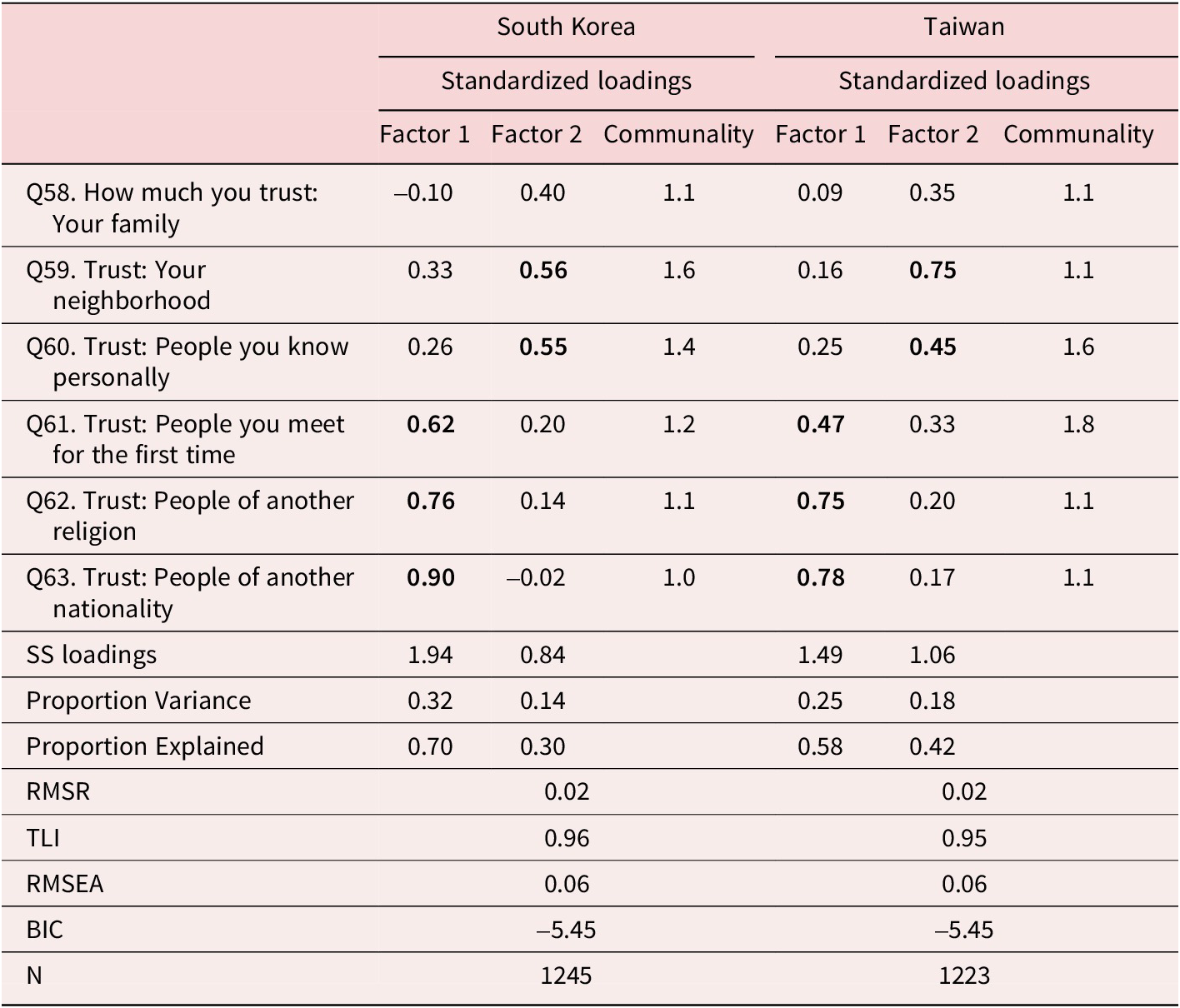
Note: Minimum residual solution with varimax rotation.
Finally, we included gender (Q260), age (Q262), education (Q275), income level (Q288), and political orientation (Q240) as control variables, as these are assumed to influence personal identity (Inglehart and Welzel Reference Inglehart and Welzel2005; Olofsson and Öhman Reference Olofsson and Öhman2007). Appendix A presents summary statistics for these explanatory variables.
Results
For RQ1, we employed LCA to categorize respondents into five distinct classes based on their orientations along the Local–Global and Protectionist–Open dimensions. We then identified various identity types by examining the probability patterns of item responses within each class. The results indicate that in both Korea and Taiwan, citizens with different identities can be differentiated according to place-attached attitudes and protectionist inclinations, which serve as two key pillars in transnational identity negotiations.
First, we categorized the five latent classes derived from the Korean data into “Locals,” “Open Locals,” “Local Protectionists,” “Protectionists,” and “Open Globals” (Figure 1). On the Local–Global dimension, Locals had a very high probability of answering “Very close” for regions within the country (Items 1–3) and “Close” and “Not very close” for regions beyond the country (Items 4–5), while on the Protectionism–Openness dimension, “Hard to say” was their most likely answer for all but Item 1. This class exhibited a clear sense of closeness to region and country but no specific attitudes on protectionism. Similarly, Open Locals had relatively stronger psychological ties to the national level than beyond and a higher probability of “Hard to say” responses for all Protectionism–Openness items. Local Protectionists, like the Open Locals, are characterized by strong ties to national borders but also have strong protectionist attitudes, with the highest probability of “Agree” responses for all Protectionism–Openness items. Protectionists exhibited strong protectionist attitudes but no particular geographic ties. Lastly, Open Globals exhibited strong openness attitudes, with the highest probability of “Disagree” responses for all Protectionism–Openness items, and the least variation in place attachment compared to the other types.
Estimated class-conditional response probabilities of five-class model for transnational identity in South Korea. Predicted class population shares (Class 1 = 33.16%; Class 2 = 27.64%; Class 3 = 22.70%; Class 4 = 10.13%; Class 5 = 6.38%).
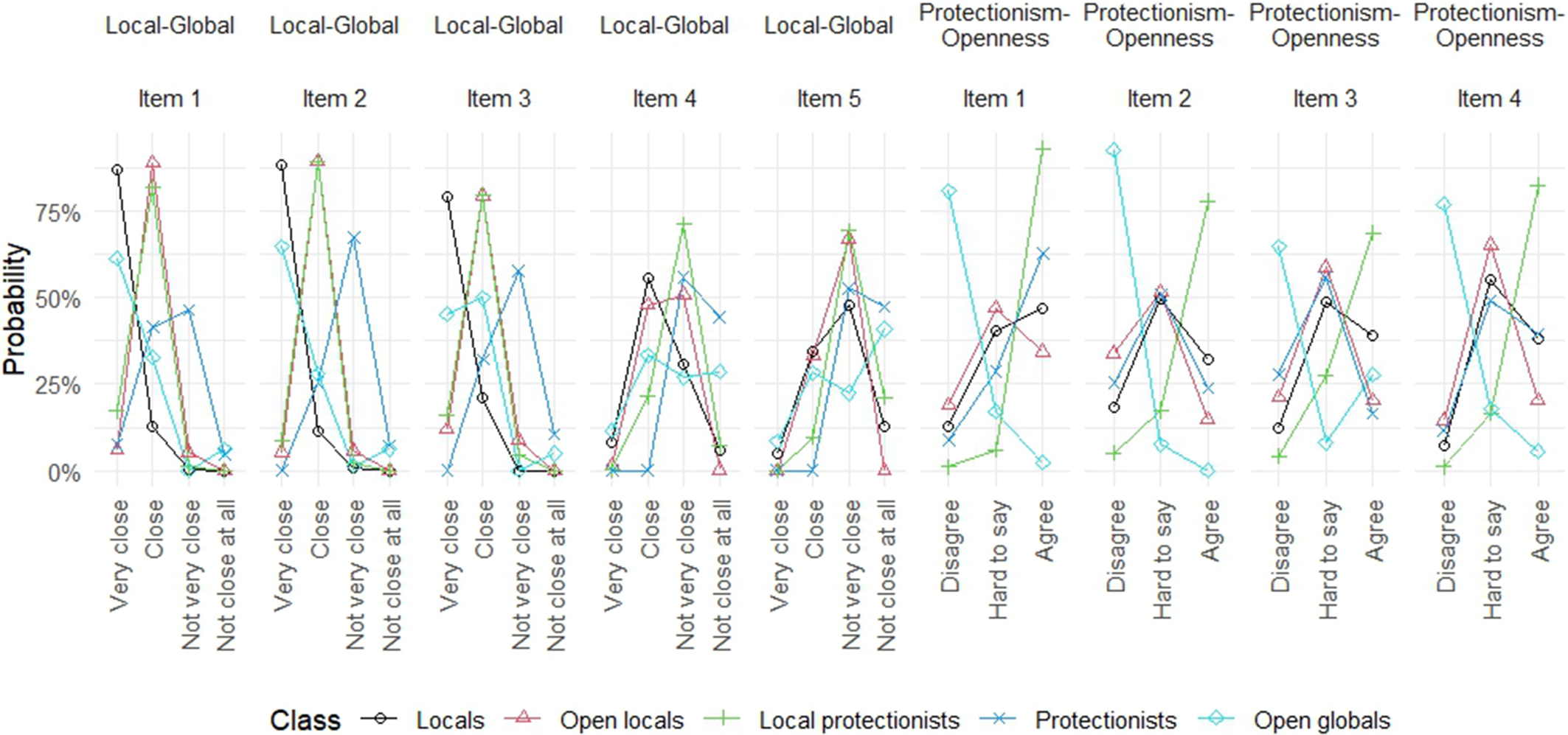
To summarize, Korea’s Locals group, characterized by strong ties to national borders but no stance on immigrants’ social, economic, or cultural impact, comprises the highest percentage of respondents at 33.2%. Korea’s Open Locals are also characterized by ties to national borders but are relatively open to immigration, comprising about 27.6% of respondents. Korea’s Local Protectionists feature strong attachments to the local area and country and strong protectionist tendencies, comprising about 22.7% of respondents. The first three groups show bonds that are limited to national boundaries, with over 80% of respondents identifying with the nation-state, indicating that most Koreans identify with the nation-state. The fourth group, Protectionists, includes about 10.1% of respondents; they have no geographical ties but show partial protectionist tendencies on immigration issues. Finally, Open Globals, who demonstrated a strong openness and connections to Asia beyond the nation-state, had the fewest members at 6.4%.
Figure 2 presents the Taiwanese LCA results. Ultimately, we identified five classes: “Local Protectionists,” “Open Globals,” “Global Protectionists,” “Protectionists,” and “Open Locals.” The Local Protectionists showed high solidarity within national boundaries and strong protectionist tendencies, while the Open Globals demonstrated high connectedness beyond national borders and high openness. The Protectionists did not show region-based ties but had the strongest protectionist tendencies. The Global Protectionists showed strong ties to Asia and the world beyond national borders but were more likely to be protectionist than open. Finally, the Open Locals showed strong ties to their immediate neighborhoods but were open to immigration issues.
Estimated class-conditional response probabilities of five-class model for transnational identity in Taiwan. Predicted class population shares (Class 1 = 34.80%; Class 2 = 18.47%; Class 3 = 17.46%; Class 4 = 14.69%; Class 5 = 14.58%).
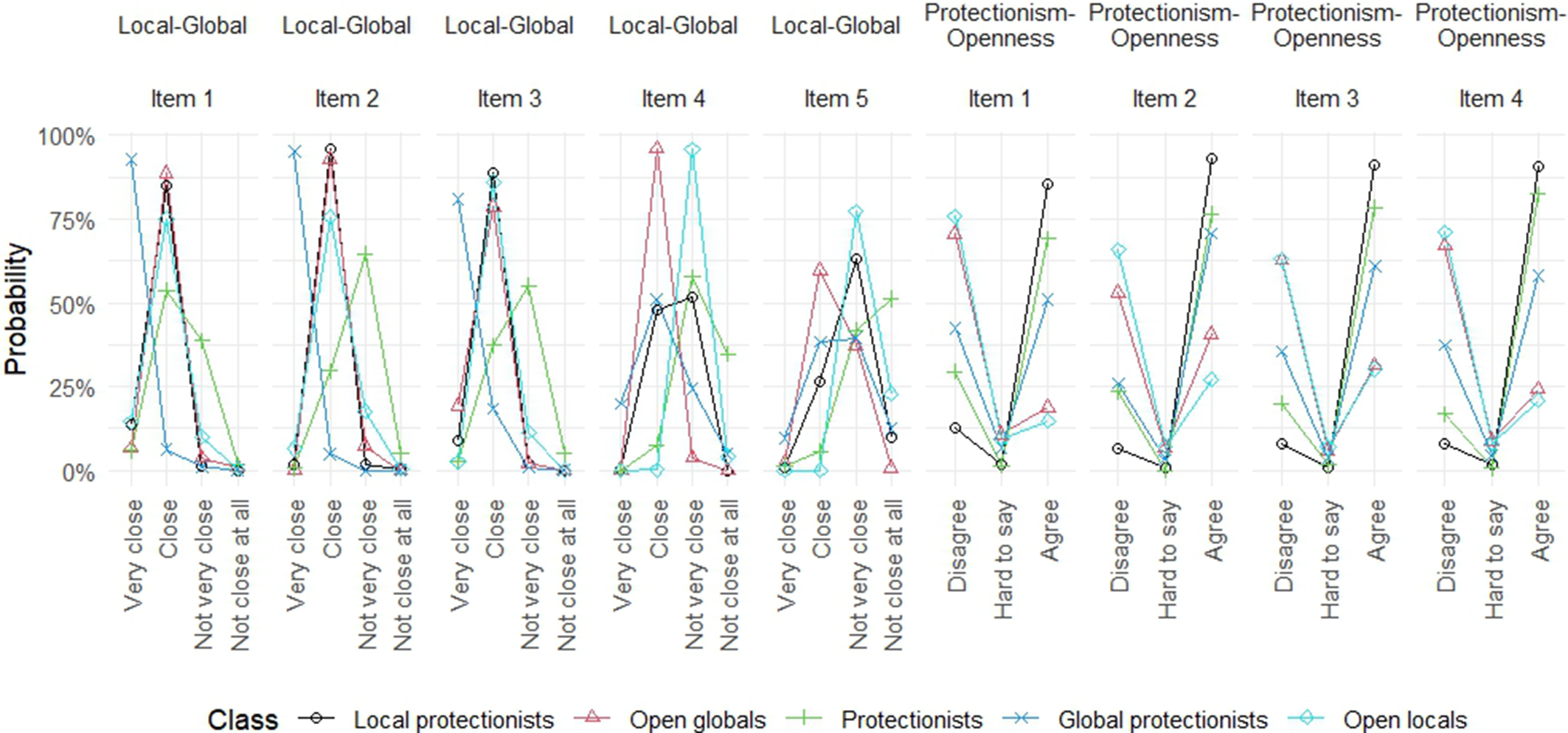
To summarize, Local Protectionists, comprising the largest proportion (34.8%) in Taiwan, have strong ties only to national boundaries and negative attitudes toward immigrants. The second largest group is Open Globals (18.5%), who, unlike Local Protectionists, have strong ties to Asia and the world and are open to immigration issues. In Taiwan, these types each contained over 10 percent more respondents than they did in Korea. The third largest group is Protectionists (~17.5%), who have no ties to the region, the country, Asia, or the world and strong negative attitudes toward immigration. Global Protectionists, who feel close to their region, their country, Asia, and the world but have relatively negative attitudes toward immigration, comprise 14.7%. Lastly, Open Locals (14.6%) feel closeness only to national borders yet have relatively favorable attitudes toward immigration.
Next, to address RQ2, we employed a multinomial log-linear regression model to examine the effects of social media on belonging to the five classes of transnational identity in both countries. The reference category for the dependent variable was Local Protectionists, which was the class with the strongest national attachment and protectionist tendencies. Table 4 presents the results of a three-stage model predicting the probability of belonging to the other classes relative to Local Protectionists in Korea. In Model 1, which predicts the dependent variable with only control variables, we found that higher income levels increased the odds of belonging to Locals and Open Globals compared to Local Protectionists. Additionally, having a right-leaning political orientation was associated with higher odds of belonging to Open Locals and Open Globals.
Fitting results of multinomial log-linear model in Korea
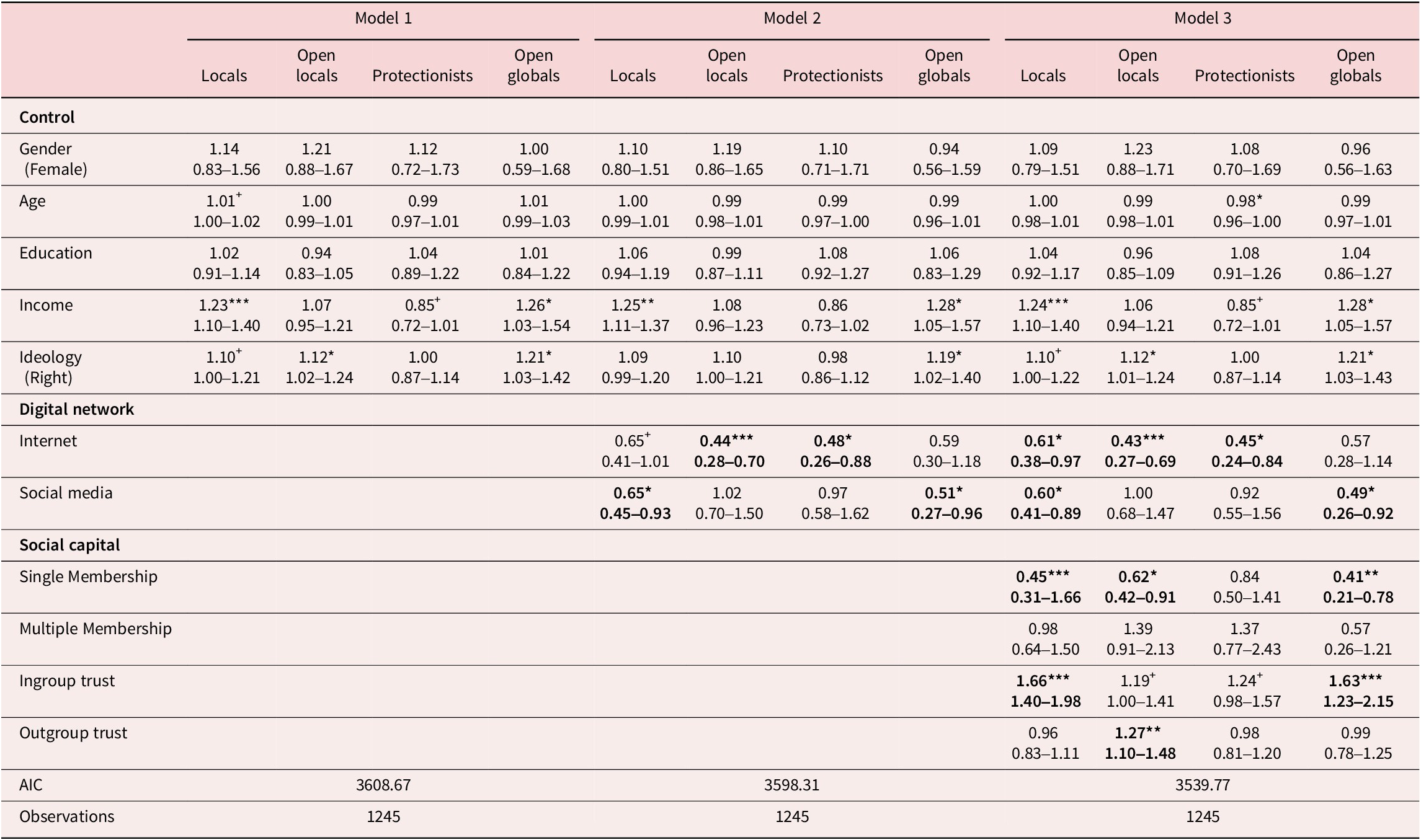
Note: + < 0.1, * < 0.05, ** < 0.01, *** < 0.001; Entries are odds ratios with 95% confidence intervals below. Reference class is “local protectionists”. Reference categories for gender and membership are “Male” and “No membership,” respectively.
In Model 2, where we added internet and social media use as independent variables, we found that internet use lowered the odds of belonging to Open Locals and Protectionists, while social media use lowered the odds of belonging to Locals and Open Globals. In Model 3, where we added social capital factors as independent variables, we found that belonging to a single organization lowered the odds of belonging to Locals, Open Locals, and Open Globals compared to not belonging to any organization. Interpersonal trust also had a significant effect, with higher in-group trust being associated with a higher probability of belonging to Locals or Open Globals and higher out-group trust being associated with a higher probability of belonging to Open Locals.
Next, Table 5 presents the results of the multinomial log-linear regression models predicting membership in the five classifications among the Taiwan data. Model 1, comprising only control variables, indicates that as age increased, the probability of belonging to either Protectionists or Open Globals decreased compared to that of belonging to Local Protectionists. In addition, higher education and higher income increased the odds of belonging to Open Locals and Global Protectionists, respectively. Regarding political orientation, being more right- than left-leaning was associated with a higher probability of belonging to Protectionists.
Fitting results of multinomial log-linear model in Taiwan
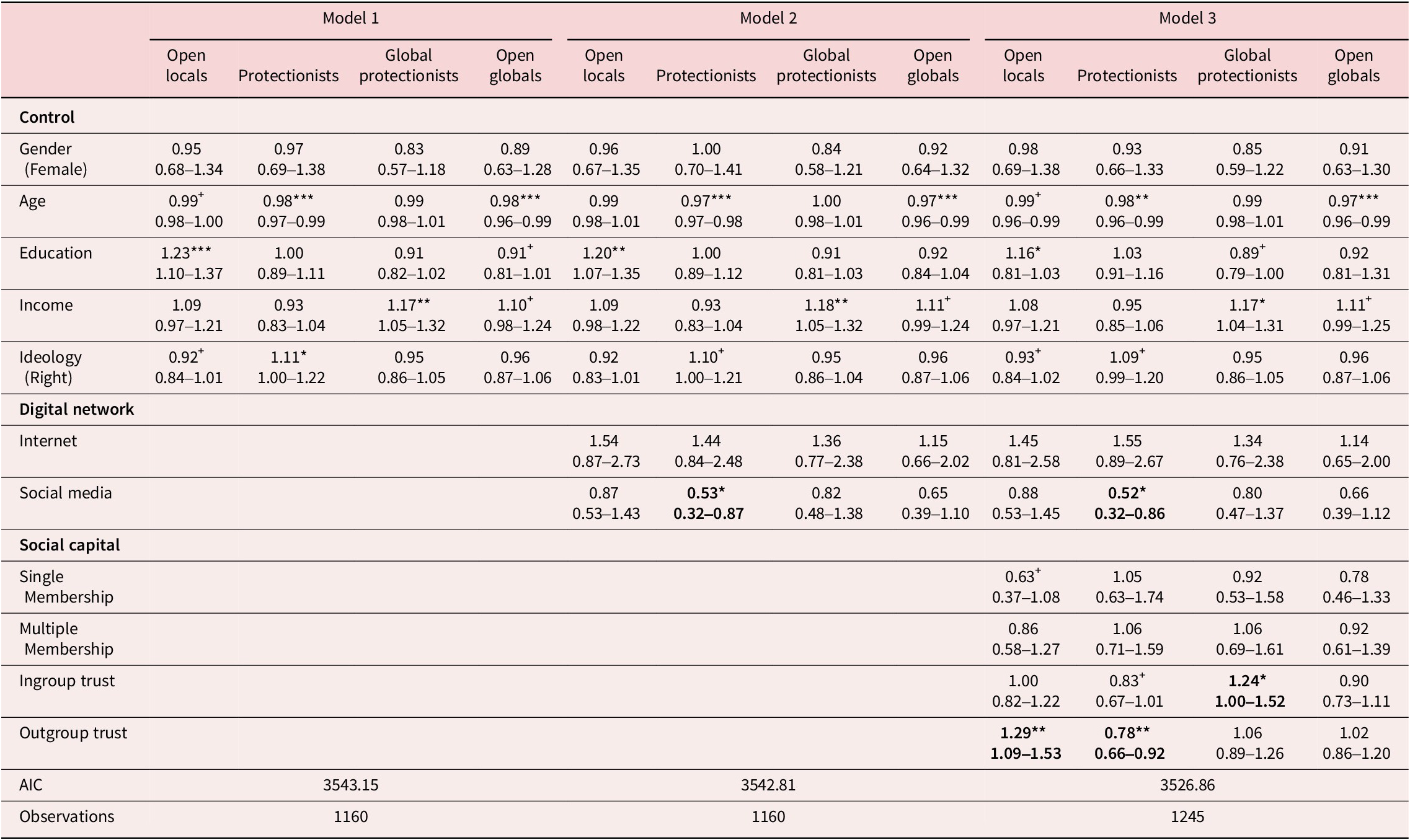
Note: + < 0.1, * < 0.05, ** < 0.01, *** < 0.001; Entries are odds ratios with 95% confidence intervals below. Reference class is “local protectionists”. Reference categories for gender and membership are “Male” and “No membership,” respectively.
In Model 2, we examined the effects of internet and social media use and found that social media use was associated with lower odds of belonging to Protectionists relative to Local Protectionists. In Model 3, we estimated the effect of social capital, and while we found no significant effect of group affiliation, higher in-group trust increased the odds of belonging to Global Protectionists, and higher out-group trust increased the odds of belonging to Open Locals but decreased the odds of belonging to Protectionists.
A common finding in both countries is that higher out-group trust increased the odds of belonging to Open Locals compared to Local Protectionists, which suggests that, in both countries, out-group trust was positively related to openness to immigrants but not to local or national ties. However, the effect of social media use on transnational identity differed between the two countries: Korean social media users were less likely to be Open Globals, while Taiwanese users were less likely to be Protectionists. In other words, whether social media expands ties or strengthens protectionist tendencies in the context of individuals’ transnational identity negotiations depends on macro-level social conditions.
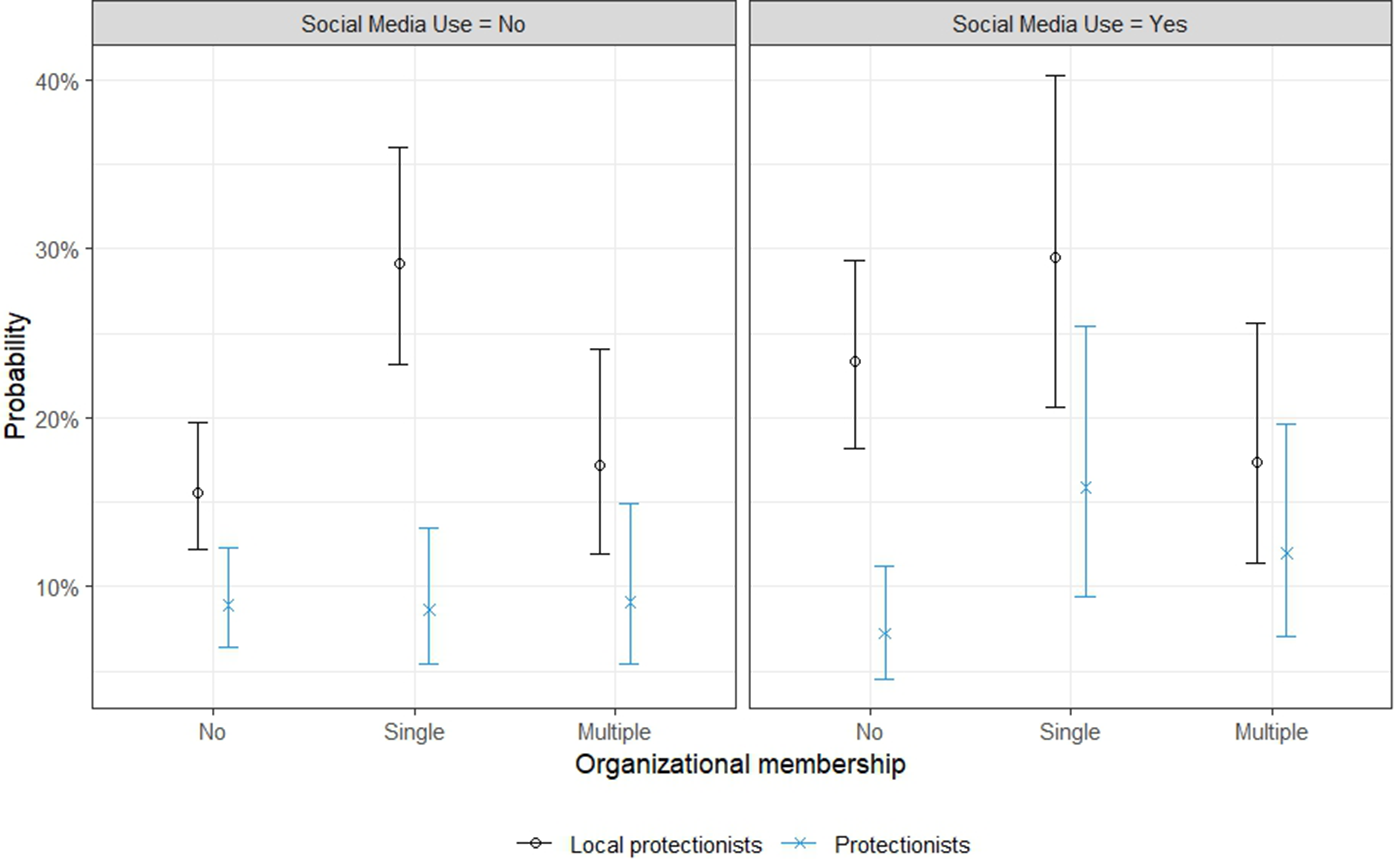
To address RQ3-1 and RQ3-2, we analyzed the interaction effect between social media use and social capital. The results of Model 4 indicate that in Korea, the effect of social media use on reducing the odds of belonging to the Protectionists group relative to Local Protectionists varied depending on affiliation with a single organization (see Table 6). As shown in Figure 3, without social media use, the odds of belonging to Local Protectionists (29.1%) were significantly higher than those of belonging to Protectionists (8.7%) for members of a single organization. However, with social media use, the odds of belonging to Local Protectionists (23.3%) were significantly higher than those of belonging to Protectionists (7.2%) only when there was no organizational affiliation. Overall, social media use increased the odds of belonging to Local Protectionists when there was no organizational affiliation, which suggests that the bonding social capital effect of belonging to a single organization can be replaced by social media use.
Fitting results of multinomial log-linear model for interaction effect of social capital and social media use in Korea
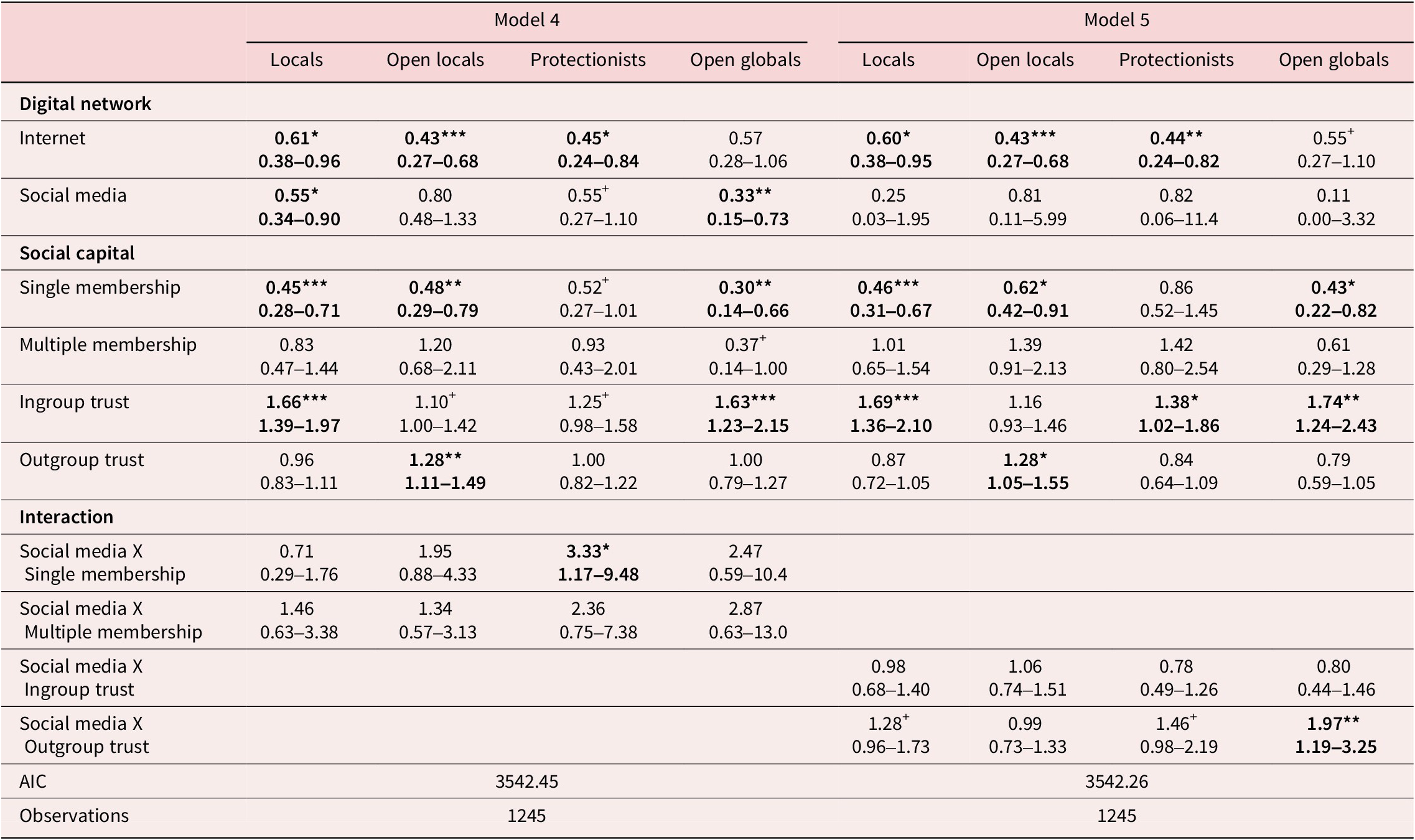
Note: + < 0.1, * < 0.05, ** < 0.01, *** < 0.001; Entries are odds ratios with 95% confidence intervals below. Reference class is “local protectionists”. Reference categories for gender and membership are “Male” and “No membership,” respectively.
Marginal Effects of Organizational Affiliation and Social Media Use in South Korea (95% Confidence Intervals).
Model 5 estimates the interaction effect of social media use and interpersonal trust on transnational identity (see Table 6). The results indicate that the effect of social media use on the probability of belonging to the Open Globals group varied significantly depending on the level of out-group trust. Without social media use, the probability of belonging to Local Protectionists was not significantly different between the lowest and highest levels of out-group trust (see Figure 4). However, the probability of belonging to Open Globals dropped from 10.5% at the lowest level to 2.3% at the highest level of out-group trust.
Marginal Effects of Out-group Trust and Social Media Use in South Korea (95% Confidence Intervals).
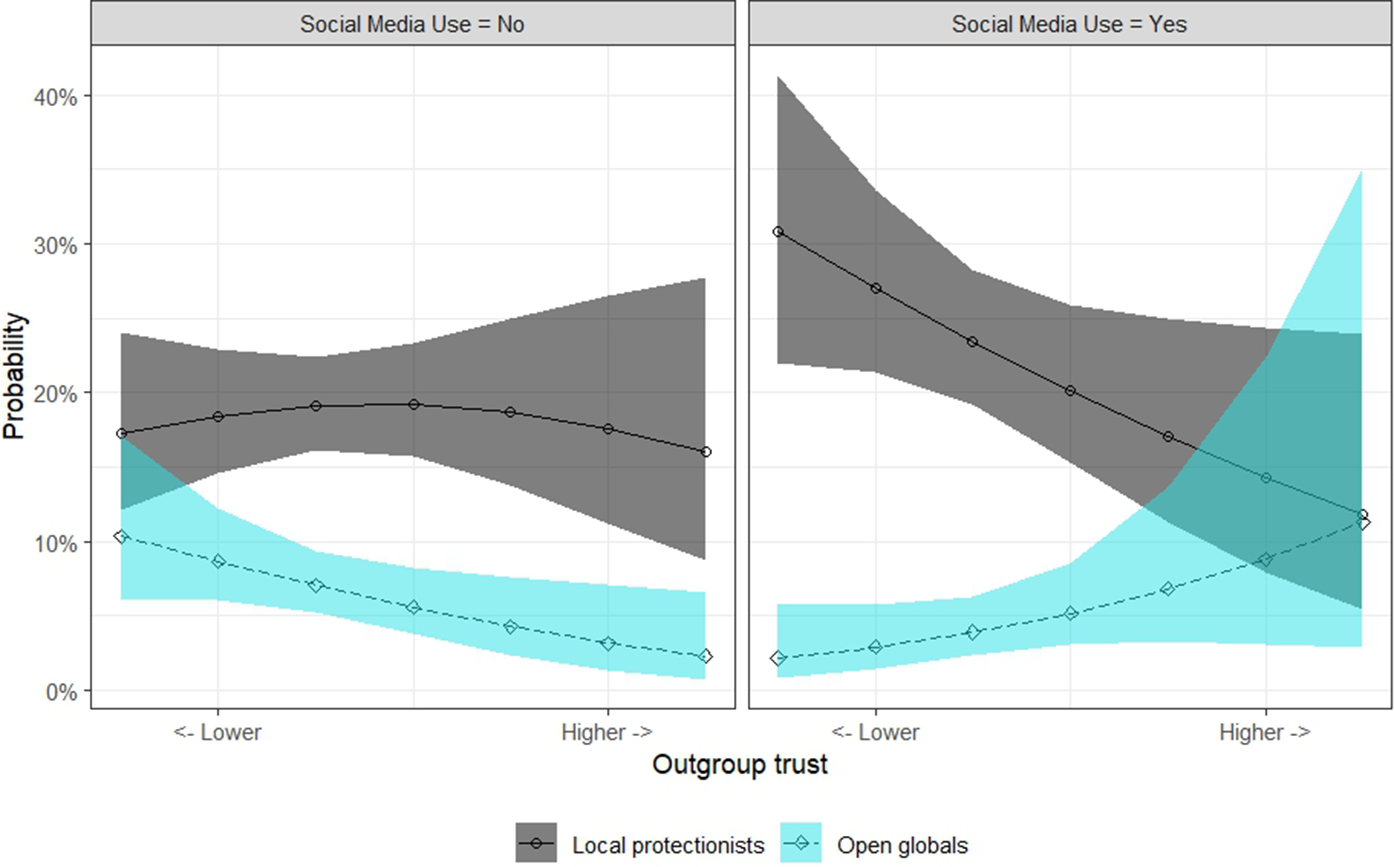
The effect of out-group trust on social media use reveals the opposite pattern. When moving from the lowest to the highest levels of out-group trust, the odds of being categorized as Local Protectionists decreased significantly, from about 30.8% to 11.8%, while that of being categorized as Open Globals increased from about 2.1% to 11.3%. Interestingly, higher out-group trust decreased the likelihood of being categorized as Open Globals for non-social media users but increased this likelihood for social media users, which suggests that when out-group trust is high, social media use may expand the geographic scope of ties while weakening protectionist attitudes.
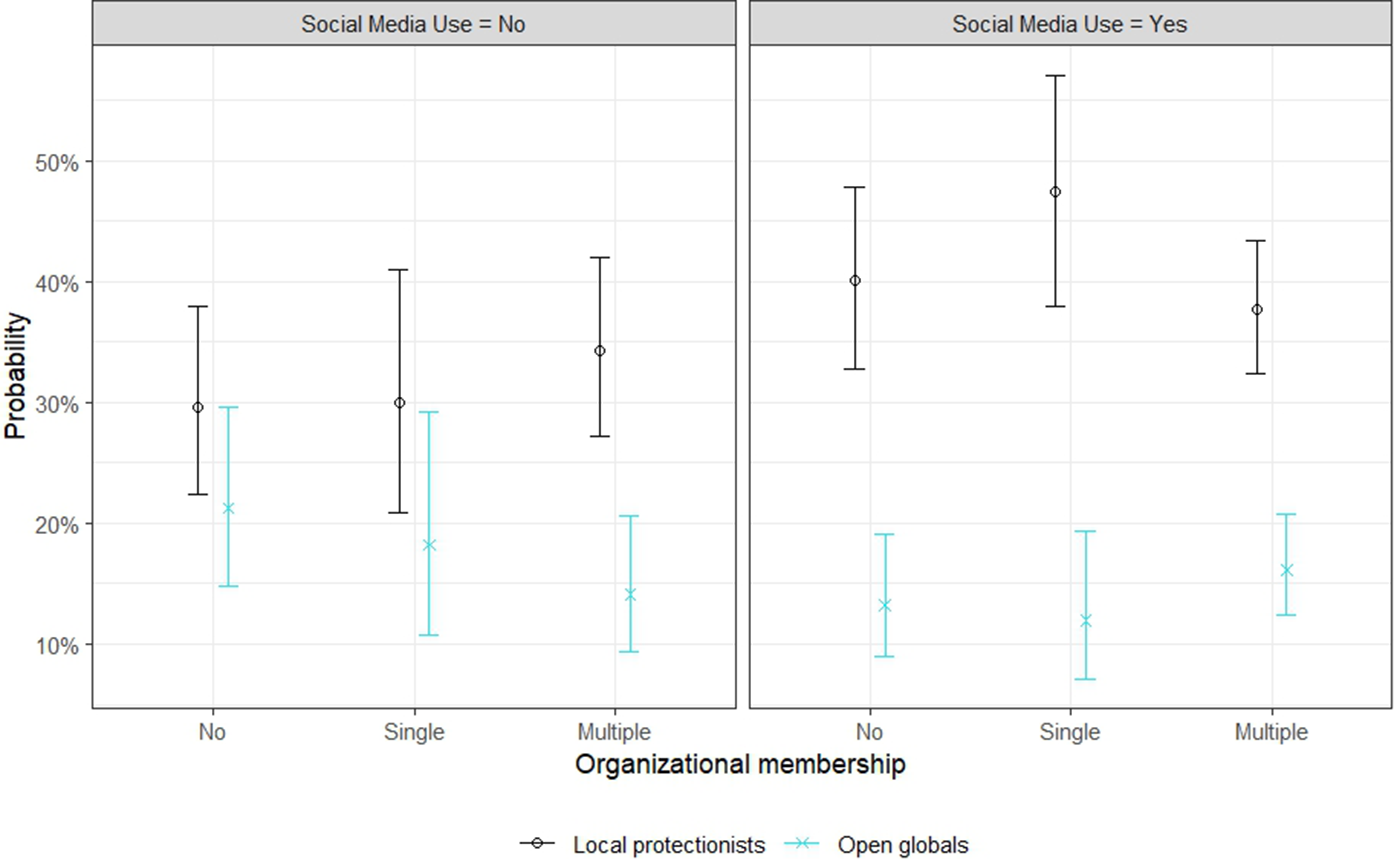
Table 7 presents the interaction effects between social media use and social capital in Taiwan. Model 4 indicates that multi-group affiliation moderates the effect of social media use on the probability of belonging to Open Globals. In addition, social media use was associated with lower odds of belonging to Open Globals compared to Local Protectionists, regardless of organizational affiliation (see Figure 5). However, multi-group affiliation was associated with lower odds of belonging to Open Globals, even among non-social media users. This result suggests that social media use substitutes the effect of multi-group affiliation on increasing local ties and protectionist tendencies.
Fitting results of multinomial log-linear model for interaction effect of social capital and social media use in Taiwan
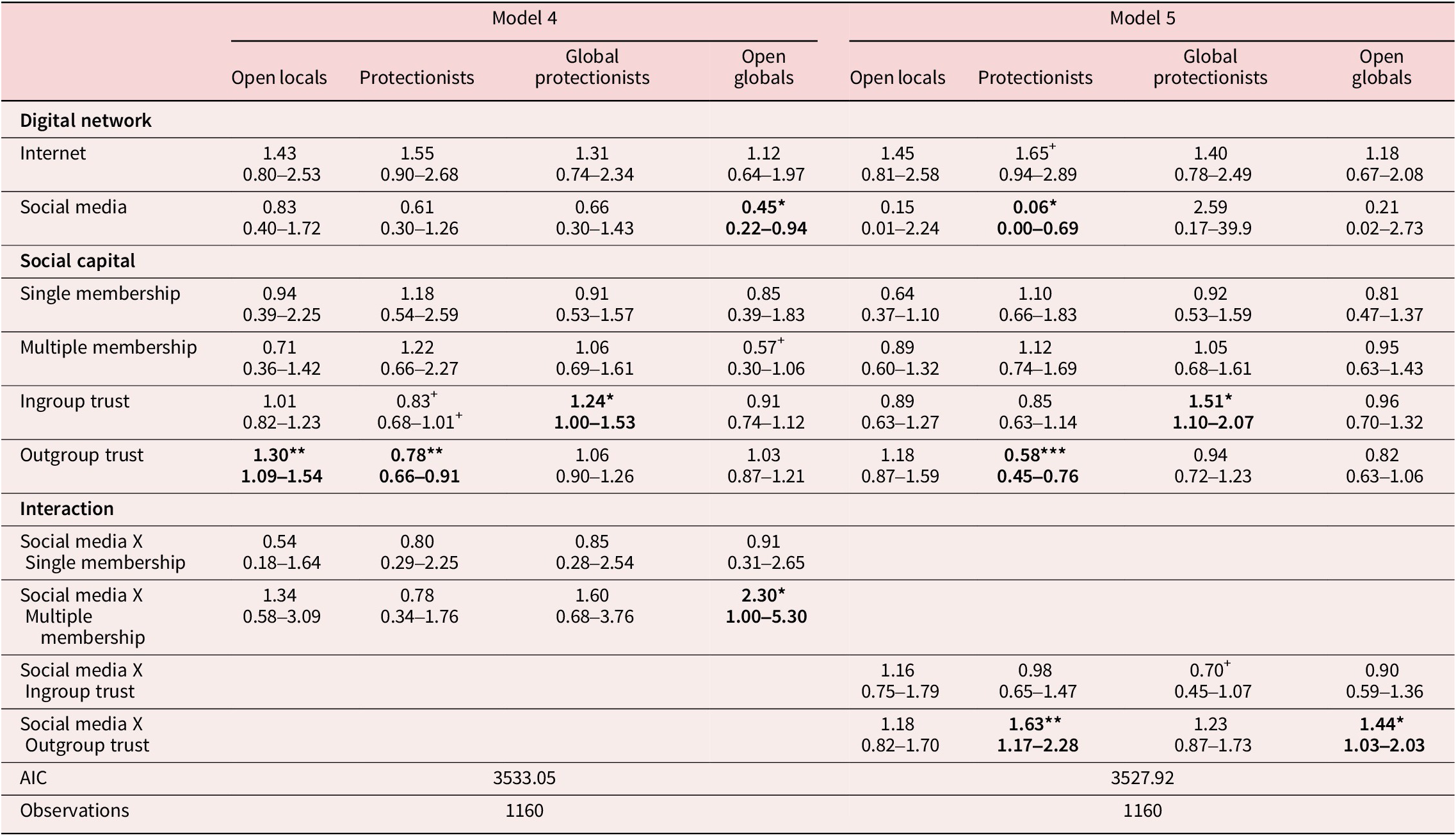
Note: + < 0.1, * < 0.05, ** < 0.01, *** < 0.001; Entries are odds ratios with 95% confidence intervals below. Reference class is “local protectionists”. Reference categories for gender and membership are “Male” and “No membership,” respectively.
Marginal Effects of Organizational Affiliation and Social Media Use in Taiwan (95% Confidence Intervals).
Lastly, Model 5 reveals that the effect of social media use on transnational identity in Taiwan is moderated by out-group trust (see Table 6). As shown in Figure 6, among those who do not use social media, higher out-group trust increased the probability of belonging to Local Protectionists (from 17.6% at the lowest level of trust to 38.4% at the highest) but significantly decreased the probability of belonging to Protectionists (from 50.2% at the lowest level of trust to 4.3% at the highest). The probability of belonging to Open Globals also gradually decreased with increasing out-group trust (from 17.6% at the lowest level of trust to 11.5% at the highest).
Marginal Effects of Out-group Trust and Social Media Use in Taiwan (95% Confidence Intervals).
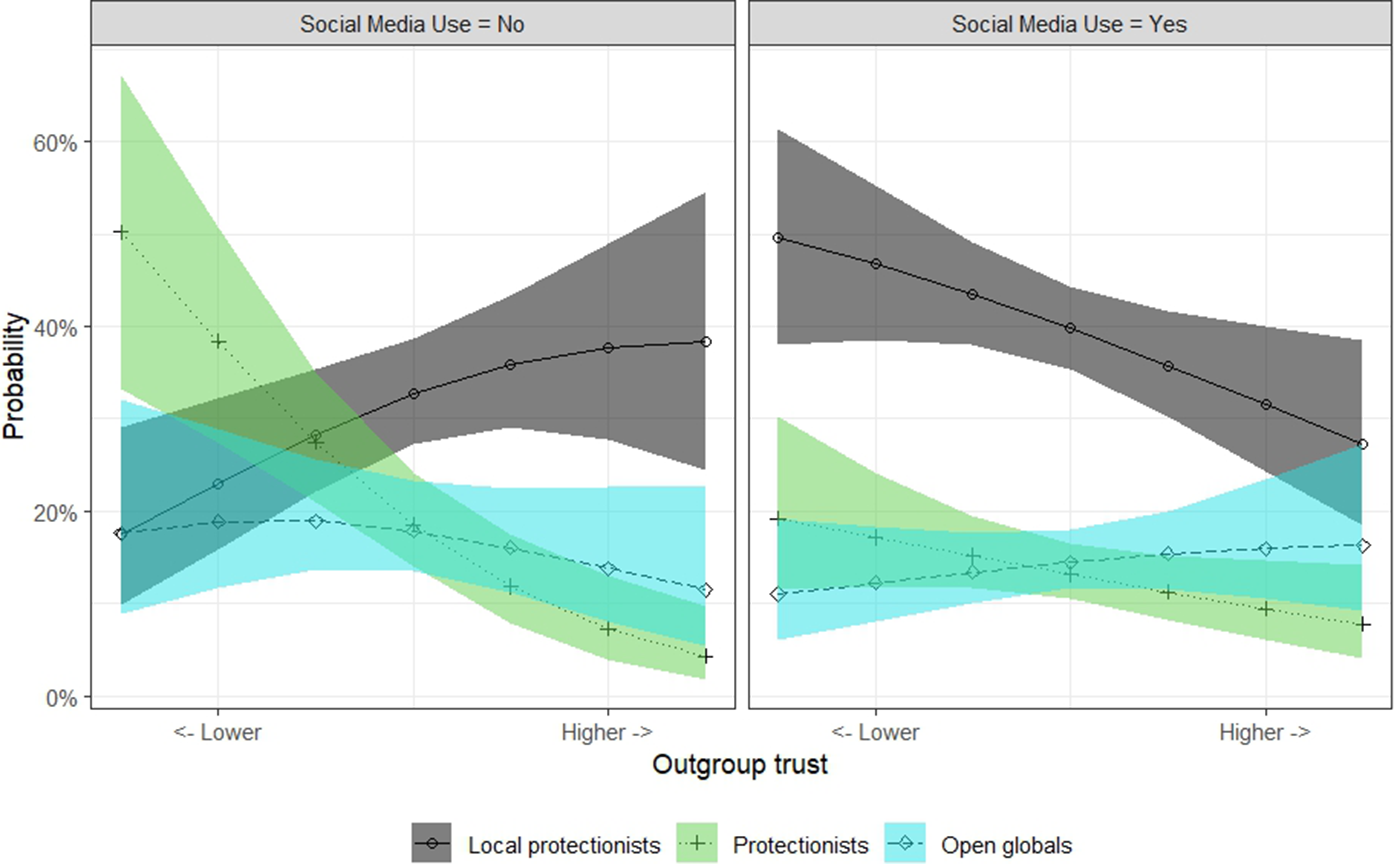
Among social media users, on the other hand, the effect of out-group trust differed significantly: as out-group trust increased, the probability of belonging to Local Protectionists and Protectionists dropped from 49.7% to 27.3% and from 19.2% to 7.8%, respectively. However, these decreases were significantly smaller than they were among non-social media users. Furthermore, the probability of being categorized as Open Globals increased from 11.0% to 16.3%, which suggests that social media users’ increased out-group trust leads to greater global ties and openness.
Discussion
Recent research suggests that the algorithmic nature of social media can deepen existing social divisions and conflicts (Bakshy, Messing, and Adamic Reference Bakshy, Messing and Adamic2015; Bail et al. Reference Bail, Argyle, Brown, Bumpus, Chen, Fallin Hunzaker, Lee, Mann, Merhout and Volfovsky2018; Rathje, Van Bavel, and Van der Linden Reference Rathje, Van Bavel and van der Linden2021), challenging the claim that digital networks facilitate the organization of transnational identities in civil society by extending social relations beyond physical limits (Castells Reference Castells2015; Howard Reference Howard2010). These debates have inspired scholarly discussions on how social media use contributes to social division and polarization within the context of in-group–out-group dynamics from the perspective of social identity theory (Nordbrandt Reference Nordbrandt2023) and highlight the need to discuss how the conflict between globalism and localism plays out in the context of identity negotiation.
To fill this gap, this study examines WVS 7 data from Korea and Taiwan to derive a latent typology of transnational identities and examine the effects of social media use on this typology, enabling a more nuanced understanding of the current social and political divisions in East Asia. Korea and Taiwan are similar in that strong nationalism plays a role in individuals’ identity negotiation due to state-led economic growth and unification discourse, and both have experienced the development of a networked civil society on the cutting edge in terms of opening markets and building digital infrastructure along liberal democratic lines (S. H. Lee and Fu Reference Lee and Fu2019). However, in Korea, where ethnic nationalism is deeply entrenched, there are strong sentiments of exclusion and hatred toward migrants of other ethnicities (K. H. Kim and Choi Reference Kim and Choi2023), while in Taiwan, there has been a strong tendency to emphasize solidarity with the outside world, promoting democratic rights and civic values based on civic nationalism against the influence of mainland China (H.-R. Kim and Oh Reference Kim and Oh2011). This difference has important implications for understanding the negotiation of transnational identities in East Asia.
First, we analyzed how Koreans and Taiwanese negotiate their transnational identities along two dimensions: local–global and protectionist–openness. LCA analysis revealed that five classes were optimal in both Korea and Taiwan, confirming the multidimensionality of transnational identity (Olofsson and Öhman Reference Olofsson and Öhman2007). In particular, the local–global and protectionist–openness dimensions facilitated a more sophisticated analysis of the negotiated transnational identities of Koreans and Taiwanese and proved to be a useful analytical framework for understanding social divisions.
Regarding the types of identities, we found that the scope of regional ties tended to be limited to the nation-state. This suggests that nationalism is a decisive factor in transnational identity negotiation in both societies. However, compared to Korea, Taiwanese are much more likely to feel connected to Asia and the world beyond their national borders. In contrast, Koreans are more likely to be Locals, who are not protectionist but have strong ties only to the national boundaries, a pattern not observed in Taiwan. This difference suggests that civic nationalism plays an important role in the negotiation of transnational identity in Taiwan, unlike in Korea, where an ethnocentric identity is more prevalent. This also explains why the Global Protectionists group, characterized by global ties and protectionist tendencies, was observed only in Taiwan.
In addition, a distinct pattern emerged in Taiwan where the localism–globalism dimension was divided along the protectionism–openness dimension: Local Protectionists with attachment to the local and national and protectionist tendencies, and Open Globals with a sense of closeness to the world beyond their borders and openness to foreign forces, comprised the majority. This suggests that attitudes toward immigrant policies are deeply embedded in citizens’ transnational identity negotiations in Taiwan. However, in Korea, most respondents were Locals or Open Locals, who were reluctant or selective in expressing their stance on immigration issues. While they did not hold negative attitudes toward global culture or openness, they did strongly identify with the traditional nation-state based on ethnic nationalism. This finding supports the notion that the growth of cultural globalism, driven by structural changes in the global flows of capital, goods, people, and ideas, does not necessarily lead to weakening national identity (Norris Reference Norris, Nye and Donahue2000).
Interestingly, both countries included a group that did not identify with any geographic boundaries: Protectionists. These individuals do not identify within traditional nation-state boundaries and are able to form flexible social identities but also have protectionist tendencies that are antagonistic toward immigrants. These results suggest that the immigrant-exclusionary cultures in Korea and Taiwan cannot be explained solely by strong nationalism. Accordingly, future research should further analyze how protectionism, manifested in attitudes toward immigrant issues, is linked to identity negotiation processes. For example, it is worth examining why a model of transnational identity negotiation that is unbound by the homogeneity and cohesion within nation-state boundaries yet supports a localized culture and order (Faist Reference Faist2000; Held et al. Reference Held, McGrew, Goldblatt, Perraton, Pierson and Tormey2000) has emerged only in Taiwan.
Regarding the relationship between social media use and transnational identity, in this study, Koreans were less likely to be categorized as Locals or Open Globals, and Taiwanese were less likely to be categorized as Protectionists. As the reference category was Local Protectionists, this result implies that Korean social media users are more nationalistic and protectionist than non-users and that Taiwanese users are more nationalistic than non-users, which is consistent with previous studies indicating a correlation between social media use and the intensification of negative sentiment toward outgroups (Bail et al. Reference Bail, Argyle, Brown, Bumpus, Chen, Fallin Hunzaker, Lee, Mann, Merhout and Volfovsky2018; Rathje, Van Bavel, and Van der Linden Reference Rathje, Van Bavel and van der Linden2021). In the algorithmically mediated digital networks of social media, Koreans and Taiwanese reinforce nationalist-based, exclusive social identities rather than expanding their social relationships and circles of trust transnationally. While this study does not test the causal relationship between social media use and nationalist identity, it does reaffirm that the expansion of digital networks can result in unfriendly attitudes toward global influence and undermine transnational solidarity.
The WVS 7 data also reveal the nuanced effects of social capital on transnational identity negotiation in both countries. In Korea, belonging to a single organization is associated with strong national attachment and immigrant exclusion, suggesting that bonding social capital in the context of transnational identity reinforces ethnic nationalism and protectionism. This finding supports previous studies (Wollebaek and Selle Reference Wollebaek and Selle2002; Putnam Reference Putnam2000) suggesting that the cohesion and solidarity experienced when group activities are concentrated in single organization can lead to the exclusion of out-groups and limited access to bridging social capital. In Taiwan, we did not observe differences in transnational identity based on such group affiliations, which calls for further exploration of the macro-level structures that mediate social capital’s effects. For example, these effects on transnational identity may be culturally embedded, as cultural norms and civic values shape how individuals form and maintain social networks and how trust is developed within these networks (Igarashi et al. Reference Igarashi, Kashima, Kashima, Farsides, Kim, Strack, Werth and Yuki2008).
By contrast, interpersonal trust significantly affects transnational identity negotiation in both Korea and Taiwan. More importantly, we observed opposite effects between in- and out-group trust. In Korea, higher in-group trust increased the probability of belonging to Locals and Open Globals, suggesting that in-group trust can increase not only localism but also global ties and openness. In Taiwan, in-group trust helped expand the geographic scope of ties by increasing the probability of belonging to Global Protectionists. This finding highlights the need to consider Confucian culture when examining how in-group trust as bonding social capital operates in Korea and Taiwan (Cao et al. Reference Cao, Zhao, Ren and Zhao2015).
On the other hand, out-group trust had a positive effect on prioritizing inclusiveness toward immigrants over protectionism by increasing the probability of belonging to Open Locals in both countries. However, we also found a selective effect whereby increasing trust in out-group members did not expand the geographic dimension of place attachment. These results suggest that in- and out-group trust operate differently in transnational identity negotiation across local–global and protectionism–dimensions rather than unidimensionally: while in-group trust expands the geographic dimension of place attachment, out-group trust increases openness in the cultural and economic dimension. This finding contributes to our understanding of the complex effects of social capital on transnational identity negotiation.
Our results highlight that the effect of social media use depends on users’ access to social capital, as represented by out-group trust. In both countries, social media use increased the probability of belonging to Open Globals when out-group trust increased. The proportion of Open Globals differed significantly between the two countries, but as social media users’ out-group trust increased, the likelihood of being categorized in this group increased in common. While social media itself is an environment where many people prioritize nationalism and protectionism, higher out-group trust was associated with increased identification with transnational solidarity and inclusive attitudes toward immigrants. These results suggest that regardless of the differences between ethnic and civic nationalism, social media use works to promote global connections and open-mindedness when individuals’ out-group trust is high. By contrast, the other social capital factors, in-group trust and organizational affiliation, did not show clear and consistent effects on inclusive transnational identity.
Overall, our findings indicate that social media use often fosters division or inward cohesion rather than integration and connection across community boundaries. Nevertheless, interpersonal trust can help mitigate such divisive effects. Specifically, we suggest that the expansion of digitally networked transnational communities depends on users’ access to and utilization of social capital, with out-group trust offering a decisive opportunity at the individual level. In the case of Korea, we show that in-group trust can support globalized ties and openness, rather than merely reinforcing bonding social capital. However, the fact that social media use does not amplify the inclusive potential of in-group trust underscores an aspect of Confucian culture in which bonding social capital, even in a digitized social environment, does not readily extend community boundaries beyond national borders (Shi Reference Shi2014).
Further inquiry into the role of trust in shaping individuals’ sense of community in East Asia is warranted, particularly in light of a recent study suggesting that key values of Confucian culture—familism and collectivism—may be incompatible with democratic ideals (Huang Reference Huang2024). Future research should also examine the characteristics of individuals and groups that enhance social capital as a contextual factor capable of overcoming conventional territorial divides. Moreover, given that “imagined communities” (Anderson Reference Anderson1983) may form differently among various social media users, it is worth exploring how platform affordances might shape emerging transnational identities.
Supplementary material
The supplementary material for this articlecan be found at http://doi.org/10.1017/jea.2025.10.
Competing interests
The author declares none.
Shin Haeng Lee is an associate professor in the School of Media and Communication at Chung-Ang University, South Korea. He earned his PhD in communication from the University of Washington. His research focuses on digital media, algorithmic culture, and online political discourse, employing both computational approaches and quantitative methods. His recent publications have appeared in Journalism Studies, International Journal of Communication, and Journal of East Asian Studies, examining issues related to social media algorithms and political polarization in East Asia.


 Open access

