

I. Introduction
Time poverty is a gendered issue, with relatively more women than men considered to be time poor.Footnote 1 At issue is the disproportionately large amount of time that women spend in unpaid work, which constrains their ability to engage in other spheres. Women’s total work burdens are often higher than those for men and they perform relatively more unpaid housework and care work. A similar argument holds for children, with girls spending more time than boys on unpaid work. On average, globally, women spend four hours and thirty-seven minutes per day on unpaid care work, with men doing less than half that amount, and in no country do women and men share the unpaid care work equally.Footnote 2 Gender disparities in unpaid work are even larger in lower-income countries where women and girls do the bulk of water and fuel collection. In sub-Saharan Africa, it takes an average of thirty-three minutes round trip to collect water in rural areas; in Asia, it takes twenty-one minutes.Footnote 3 Globally, on any given day, women and girls spend a total of 200 million hours collecting water—the equivalent of 22,800 years—so their families can survive.Footnote 4 These are hours that could have been devoted to paid employment, school, and basic needs. If we want to lift people out of poverty, we need to take seriously these kinds of constraints and incorporate the realities of time-poor individuals into poverty-reduction strategies.
Many discussions of poverty see the basic resource needed to achieve well-being as income. However, resources must include not only earned income, but also time. People require both money and time to live above the poverty line. Those facing deprivations of either of these resources are more vulnerable to living a life of oppression. Just like income, time is a scarce resource that impacts well-being; individuals with insufficient time to meet their basic needs can also have impoverished lives. If poverty is only measured in terms of money metrics, then the academic and policy discourse on poverty has not progressed. We need to consider other intangible factors such as agency and choice, especially within the household, and how intra-household inequalities can result in time deprivations that have a profoundly negative impact on the quality of lives, particularly those of women and girls who do the bulk of unpaid work within the home.
Those who examine time poverty generally agree that it involves conflicting claims on people’s limited time that restrict their freedom to allocate their time toward activities that maximize well-being.Footnote 5 A closely related definition of time poverty is the need to work long hours, without choice, because the individual or household is income poor or risks falling into poverty if they were to reduce their working hours below a certain threshold.Footnote 6 The underlying problem behind being time poor is long working hours that do not allow for sufficient rest and leisure. Those working hours include both paid work in the labor market as well as unpaid work at home, engaging in activities such as childcare, domestic work, and (in low-income countries) collecting water and fuelwood. In such a context, people living in time poverty have no choice but to work long hours and they have little agency in determining how they spend their time.
Income poverty is a major risk factor for time poverty, especially for low-wage workers and unpaid family workers who need to engage in multiple economic activities in order to support their families, thus further exacerbating their long hours of labor. Time poverty also constrains one’s ability to escape being income poor, a predicament particularly acute for working parents, especially single parents. Not only are income poverty and time poverty mutually reinforcing, but they can also sap energy and impede effective decision-making, thus perpetuating the state of poverty.Footnote 7 Without adequate time to engage in meeting one’s personal needs, it is likely that the productivity and health of individuals facing time poverty is lower than those who do not face this constraint. People who do not have time to take care of their health are less healthy, so time poverty reinforces and exacerbates health inequities.
Those in a state of income poverty are often time poor, but the relationship between income poverty and time poverty is not so straightforward. One can be income rich and also time poor, such as people working eighteen-hour days in high-paying jobs. One can be time rich and income poor, such as people living below the poverty line who are unemployed or not in the labor force. Moreover, as is the case in so many countries, individuals may be living above the official income-poverty line, but they do not have enough time to fulfill their unpaid work demands at home and do not have enough money to outsource their childcare and domestic-work tasks without falling below the poverty line. These people, the “hidden poor,” are technically not income poor, but when their time deficits are monetized, their poverty becomes visible.
Although studies on time poverty and time use have grown rapidly, there is no standard measure of time poverty, nor is there a readily available cross-country data source on time-poverty rates by gender. The purpose of this essay is to provide a clear conceptualization of time poverty that consolidates and reconciles various concepts and measures introduced in previous scholarship. I also collect information on time poverty by gender in developing countries, examining policies with demonstrable effects on reducing time poverty. Time poverty is a form of deprivation that warrants not just careful scrutiny, but also rectification with effective policy actions that free up time, improve access to economic resources and opportunities, and promote overall well-being. This essay’s conceptual framework and systematic comparison of time poverty rates by gender should prove useful for scholars and practitioners who are working to improve poverty measures and looking for evidence to support increased investment in poverty-reduction strategies.
II. Conceptualization and Measures
The concept of time poverty, first introduced by Clair Vickery, refers to the notion that to stay above a nonpoor level of consumption, households need a minimal amount of time in addition to income.Footnote 8 According to Vickery, households need resources to stay above the poverty line; these resources include assets as well as time to earn income in the marketplace and to engage in nonmarket (household) production. The ability of households to translate time into consumption depends on how productive they are in generating an income and in performing household work, so resources will vary across households, even if they have the same amount of available time. Quantifying these household resources requires accounting for the number of hours spent in both market and nonmarket production and then assigning a value to that time based on wages and the value of time outside the marketplace.Footnote 9 This approach to measuring household resources provides a more accurate depiction of household well-being and poverty status than earned income alone.
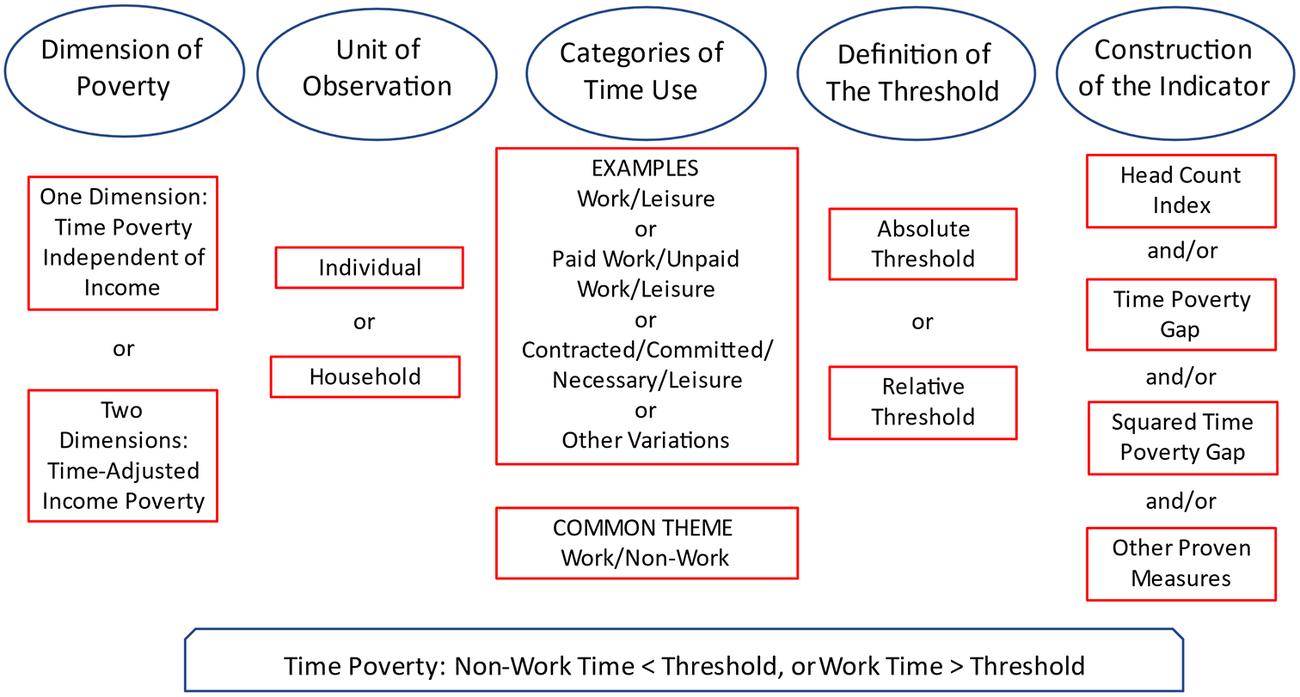
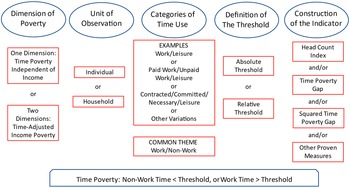
Since Vickery’s seminal study, scholarly interest in time poverty has grown as data sources measuring time use became more readily available. However, despite this attention paid to time poverty, there is still no common framework to conceptualize time poverty and no single method to measure it. In their call for a more consistent and transparent operationalization of time poverty, Jason Williams and colleagues provide a helpful review of existing frameworks and a set of questions to consider when formulating a measure of time poverty.Footnote 10 To better disentangle the complexities of conceptualizing time poverty, I suggest an amended five-step approach. The first step is to decide on the dimension of the time poverty concept. The second step is to consider the unit of observation (that is, individual versus household). The third is to categorize the types of time use. The fourth is to define the threshold. The fifth is to construct the indicator. Although each of these steps can be stated concisely, the processes for implementing them are anything but concise, as highlighted in Figure 1 and discussed in the remainder of this section.
Conceptualization of Time Poverty.Footnote 11
These steps collectively contribute to the formulation of a quantifiable indicator that differentiates time poverty from other concepts such as time scarcity and time constraints. Making decisions associated with this process necessitates stepping back and considering the notion of time poverty itself. Some researchers may prefer to focus more on long working hours, which translates into insufficient rest and leisure and hence imbalance between work and personal life. Others may want to examine command (or lack thereof) over one’s use of time, with too much time devoted to required activities and insufficient time to activities chosen at one’s discretion. Researchers may also vary in the outcome measures in which they are interested, whether it be an indicator of well-being or an adjusted measure of income poverty.
As shown in Figure 1, step one entails deciding whether to consider time poverty by itself or in conjunction with income. As a single-dimensional concept, time poverty is measured in isolation, independent of income, consumption, or expenditures.Footnote 12 A key advantage of this approach is that the data requirements are relatively easier to satisfy with a focus only on time; the researcher does not need data on income. The main rationale for this approach is that time poverty in and of itself is a risk factor for living in a state of deprivation regardless of one’s income level. However, the relationship between income poverty and time poverty is not straightforward, as some individuals may be time poor but not income poor, while others may be income poor but not time poor. For this reason, a number of authors have studied time and income poverty using a two-dimensional, time-adjusted income-poverty approach.Footnote 13 Using the approach employed by Ajit Zacharias as well as Rania Antonopoulos and Emel Memis, the time-adjusted income-poverty measure (y 0) is defined as:
 $$ \mathrm{Equation}\ (1):\hskip0.5em {y}^0=\overset{\sim }{y}-\min \left(0,X\right)p $$
The notation ỹ denotes the conventional income-poverty threshold, X represents the time deficit or surplus, and p is the unit price of market substitutes for activities involved in household production.Footnote 14 Calculating this unit price p is a thorny issue, as market substitutes for many activities might not exist in a developing country context; even if the relevant market exists, the household may not be able to acquire the required amount of substitutes at a reasonable price. In any event, the unit price p can be approximated by, alternatively, a country’s minimum wage, the opportunity cost of the household member’s time who is engaged in nonmarket production, or a weighted average of the measured wages of different occupations (such as childcare provider, housekeeper, and cook) that provide the relevant services in the marketplace.
The time deficit or surplus, X, is defined as the available time, A, in excess of or in deficit of time devoted to labor for income generation, L, as follows:
 $$ \mathrm{Equation}\ (2):\hskip0.5em X=A-L $$
and
 $$ \mathrm{Equation}\ (3):\hskip0.5em A=168-\overline{C}-\overline{D}-\overline{R} $$
In Equation (3), the notation $ \overline{C} $
is personal care time,
$ \overline{C} $
is personal care time, $ \overline{D} $
is non-substitutable household production time, and
$ \overline{D} $
is non-substitutable household production time, and $ \overline{R} $
is substitutable household production time required to subsist at the level of income poverty. A household production activity that is substitutable means that the household can purchase a service to replace that activity in the market. The bars represent thresholds determined by the researcher rather than actual recorded time and 168 is the number of hours in a week.
$ \overline{R} $
is substitutable household production time required to subsist at the level of income poverty. A household production activity that is substitutable means that the household can purchase a service to replace that activity in the market. The bars represent thresholds determined by the researcher rather than actual recorded time and 168 is the number of hours in a week.
Intuitively, in this approach, an individual or household needs to have both income and time for household production in order to reach at least the income-poverty level of consumption. The income-poverty measure is thus adjusted by a dollar amount that consists of the replacement cost of any household production that is foregone because of the time deficit. As an example of this approach, in Buenos Aires, the official income-poverty rate in 2005 was relatively low compared to the rest of the country, at 6 percent of households and 9 percent of individuals, but after monetizing household time deficits and adding that value to the standard income-poverty line, Antonopoulos and coauthors calculated a time-adjusted income-poverty rate of 11 percent for households and 16 percent for individuals.Footnote 15 Monetizing the value of time deficits thus uncovered a large “hidden poor” segment of the population, with people who had incomes exceeding the official poverty line but were still living in deprivation, unable to meet their unpaid care and domestic work requirements.
Step two—considering the unit of observation—may appear to be straightforward, but it is not. The unit of observation for most data collected through time-use surveys and diaries is the individual, so in the case of the single-dimensional time-poverty approach, the decision point would more so be the age of the individual, with most researchers using ages 15–64. For researchers following the time-adjusted income-poverty approach, this second step is more complicated. Although individual-level income is collected in some time-use surveys, the data are often provided in ranges and therefore are not precise.Footnote 16 Even if household income and expenditure surveys provide exact household income, it can be difficult to link this data with the time-use data. Moreover, simply dividing household income evenly between all adults in the household and aggregating time across adults in a household, bumps up against the relatively contentious issue of how resources and household tasks are distributed within a household.
Much of the earlier research on income poverty relies on metrics based on household income (or consumption) data and assumptions that resources (and consumption goods) are distributed equitably within a household. Not only was income assumed to be distributed evenly within households, but so was the allocation of household work. The unitary-household model has since encountered much resistance, largely by scholars examining power differentials within the household.Footnote 17 This more recent body of work provides more careful scrutiny of motivations and factors that affect bargaining and household decision-making. Tracking poverty with income data collected at the household level does not permit a proper assessment of intrahousehold welfare, thus making it difficult to accurately measure income poverty at the individual level and how income poverty differs between men and women. Similarly, measuring time poverty at the household level also does not properly track unequal distribution of unpaid household work, contributing to misleading conclusions about individuals’ time poverty. Gender differences in the allocation of unpaid work within the household are a key determinant of intrahousehold inequalities by gender in access to time for paid work as well as time for leisure; ultimately, this uneven intrahousehold allocation of labor manifests as observed gender differences in income poverty and time poverty.Footnote 18
Researchers using a time-adjusted income-poverty approach need to account for intrahousehold disparities and be transparent in how they measure poverty at the individual level. Zacharias and coauthors handle this problem by constructing a time-adjusted income-poverty measure using household-level income data matched with individual-level time-use data, thus allowing for time poverty to be explicitly defined at both the individual level and the household level.Footnote 19 The matched data facilitates using the individual as the unit of analysis while also considering the household in setting the threshold for required hours of household production. There can be individuals who are not time poor living in time-poor households, so this approach avoids the strong assumption that individuals with a time surplus will allocate some of their surplus to household production, thus eliminating the time deficits of others in the household.Footnote 20 Access to individual-level time-use data also facilitates examining time poverty rates for children. Given the policy importance of child poverty, this data feature is enormously useful for calculating the poverty status of children.
Step three entails deciding on the relevant categories (or buckets) of activities that should be used in the analysis of time poverty. This step involves deciding which activities should be accounted for when measuring time poverty and the manner of activity classification. Some surveys and time-use diaries record activities using detailed labels, which need to be aggregated. However, some time-use data, especially those collected by specifying a particular set of activity categories, are broad. The problem here is that the categories are not uniform in detail or in aggregation across different countries. Although an International Classification of Activities for Time Use Studies (ICATUS) exists, countries do not necessarily abide by or follow this scheme.Footnote 21
The end result is lack of consistency in activity aggregations (buckets) across studies. Some have just two buckets (say, work and leisure), some have three (say, paid work, unpaid work, and leisure), and some have four (say, contracted time, which is typically paid work and schooling; committed time, which is usually household production; necessary time, which is often personal care; and leisure).Footnote 22 Others have even more categories, such as the five-bucket scheme comprised of market work, household production, volunteer and community service, leisure, and personal care.Footnote 23
Although the number differs across these schemes, in principle the buckets can be consolidated into an aggregate considered “necessary” and an aggregate considered “discretionary.” Necessary time is the time absolutely needed for people to spend in unavoidable activities of paid employment, unpaid household production, and personal care. Discretionary time is the amount of time left over after these necessary tasks have been completed.Footnote 24 The total amount of time dedicated to either one of these aggregates is then compared to a stipulated threshold. Time poverty is then defined as the excess of necessary time over the relevant threshold or the deprivation of discretionary time short of the relevant threshold. Note that this issue of discretion can be subjective. Whether an activity is considered necessary versus discretionary can vary depending on who is making this decision, the researcher or the respondent, and it can vary among researchers and respondents. For example, if the determination is from the perspective of a female respondent who has internalized gender norms, then there may be a blurring of what constitutes necessary versus discretionary activities.Footnote 25 Moreover, this distinction can be too simplistic. For example, a woman working a difficult job on an assembly line—the pressure is enormous and she has to work very fast—is doing necessary labor, as is a woman who is raising a child full-time at home. Even though they are both doing necessary labor, the work is not comparable. These classifications of time facilitate the calculation of time-poverty estimates, but they do not tell us how much control a person has over her work, the intensity of that work, or her subjective work satisfaction.
The fourth step involves identifying the critical threshold and comparing estimates of an individual’s time use in these buckets and aggregates with the threshold. Some researchers have used an absolute threshold, which is essentially a fixed amount of time deemed critical by the researcher for meeting one’s basic needs or for maintaining a household based on underlying assumptions and scientific evidence. These thresholds vary by country and also by household characteristics, such as number of children, number of adults, and employment status. Although the time for meeting basic needs also varies across individuals by characteristics such as age and gender, these granular variations are often not taken into account when setting the critical thresholds. For example, Vickery determines, based on survey data for the United States, that the minimum amount of time someone needs to maintain their mental and physical well-being (that is, time devoted to sleeping, resting, eating, personal hygiene, and leisure) is eighty-one hours per week (or about 11.6 hours per day).Footnote 26 Using a similar approach, Robin Douthitt assumes that an employed single parent with two children needs at least two hours per day for household production (including child care, cleaning, cooking, and laundry).Footnote 27
To avoid the potential of having inaccurate assumptions about the minimum time required for these basic needs, other researchers use a relative time-poverty threshold in which the time aggregate is compared to an amount of time determined by the dataset being used in the analysis, usually some percentage of the mean or median of the sample. For example, Charlene Kalenkoski and coauthors perform calculations using 50, 60, and 70 percent of the median discretionary time for their total sample and for various subsamples.Footnote 28 These percentage benchmarks are fairly representative of the relative-threshold approach. Other examples include Michael Bittman, who uses 50 percent of the median leisure time as the relative thresholdFootnote 29; Elena Bardasi and Quentin Wodon, who compare individuals’ working time against a relative threshold of 1.5 times the median of the working hour distribution for all individuals in the sampleFootnote 30; Abhilasha Srivastava and Maria Floro, who compare a person’s working hours against a relative threshold of the seventy-fifth percentile of the total working hours distributionFootnote 31; and Robert Goodin and coauthors, who use one standard deviation below the mean for strictly necessary time.Footnote 32 This approach is more flexible but requires robustness checks since there is no particular percentage of the sample mean or median determined a priori or justified by outside sources.
The fifth step involves deciding on the computation for an aggregate measure of the population. In parallel to the three most basic Foster-Greer-Thorbecke measures of income poverty, the head-count time-poverty index sums up the number of individuals whose total hours of necessary time or hours spent working exceeds the critical benchmark or whose total hours engaged in discretionary time or hours spent in nonwork activities is less than the critical benchmark.Footnote 33 The time-poverty gap measure accounts for the distance each person is from the critical threshold and is calculated as the average distance that the population is from the time-poverty line. All non-time-poor individuals are assigned a distance of zero, with the implication that individuals who are income poor but non-time-poor are still living below the official income-poverty line. The squared time-poverty gap takes the square of that distance and places a higher weight on individuals whose working hours are extreme outliers.Footnote 34
These steps are then applied to time-use data, which typically come from two sources: stand-alone time-use surveys and modular time-use surveys that are part of a major national effort such as a labor-force survey or household-income-and-expenditure survey.Footnote 35 Stand-alone surveys are more common in higher-income countries, while lower-income countries tend to conduct modular time-use surveys. Regardless of the source, the researcher typically has access to three data components: (1) background and socioeconomic information about the individual and/or household; (2) time spent by individuals on different types of activities, usually in the past twenty-four hours or in the past week; and (3) the context in which the person engages in the activities, such as where the activities took place, who else was present, and whether or not the activity was paid.
As of 2020, over 100 countries had conducted at least one time-use survey, with more expected to come on board.Footnote 36 However, the surveys vary considerably in what gets measured and how they measure it, making it exceedingly difficult to compare time-use statistics across countries with a single time-use activity classification. Hence, not only are measures of time poverty sensitive to different baselines and underlying assumptions of the conceptualization, but the application of these measures entails using heterogenous types of data sets as well as limitations on the information that may be available in those data sets. Keeping these data constraints in mind, we next turn to the question of gender differences in time poverty across countries.
III. Gender Differences in Time Poverty
One of the most salient features of gendered labor patterns around the globe is women’s disproportionate amount of time allocated to unpaid work.Footnote 37 Women spend relatively more time than men engaged in domestic responsibilities such as childcare, cooking, and cleaning. Fuel and water collection are particularly time-intensive activities that can occupy a substantial portion of a woman’s working hours, especially in low-income countries with poor infrastructure. In addition, rates of nonremunerative productive work on the farm tend to be higher for women than men, often due to the need to combine productive farm work with childcare.Footnote 38 These gender differentials exist for a variety of reasons, including long-standing sociocultural norms that dictate gender relations in the household and sanction the manner in which women are expected to engage in the marketplace.
Time-poverty rates are likely to differ not only between the genders, but also among women and among men, depending on the contexts in which they live, such as where they are in the life cycle, their wealth and income status, whether they live in an urban or rural setting, and their access to basic physical and social infrastructure. In an effort to compare gendered time-use patterns across countries using data in a standardized format, Eliana Rubiano-Matulevich and Mariana Viollaz construct a time-use dataset for nineteen countries across different regions for the 2006–2014 period using a harmonization process that permits accurate cross-country comparisons.Footnote 39 They use this data to construct the time-use profiles in Figure 2.
Time Spent in Market Work and Unpaid Domestic Work (Hours per Day).Footnote 40
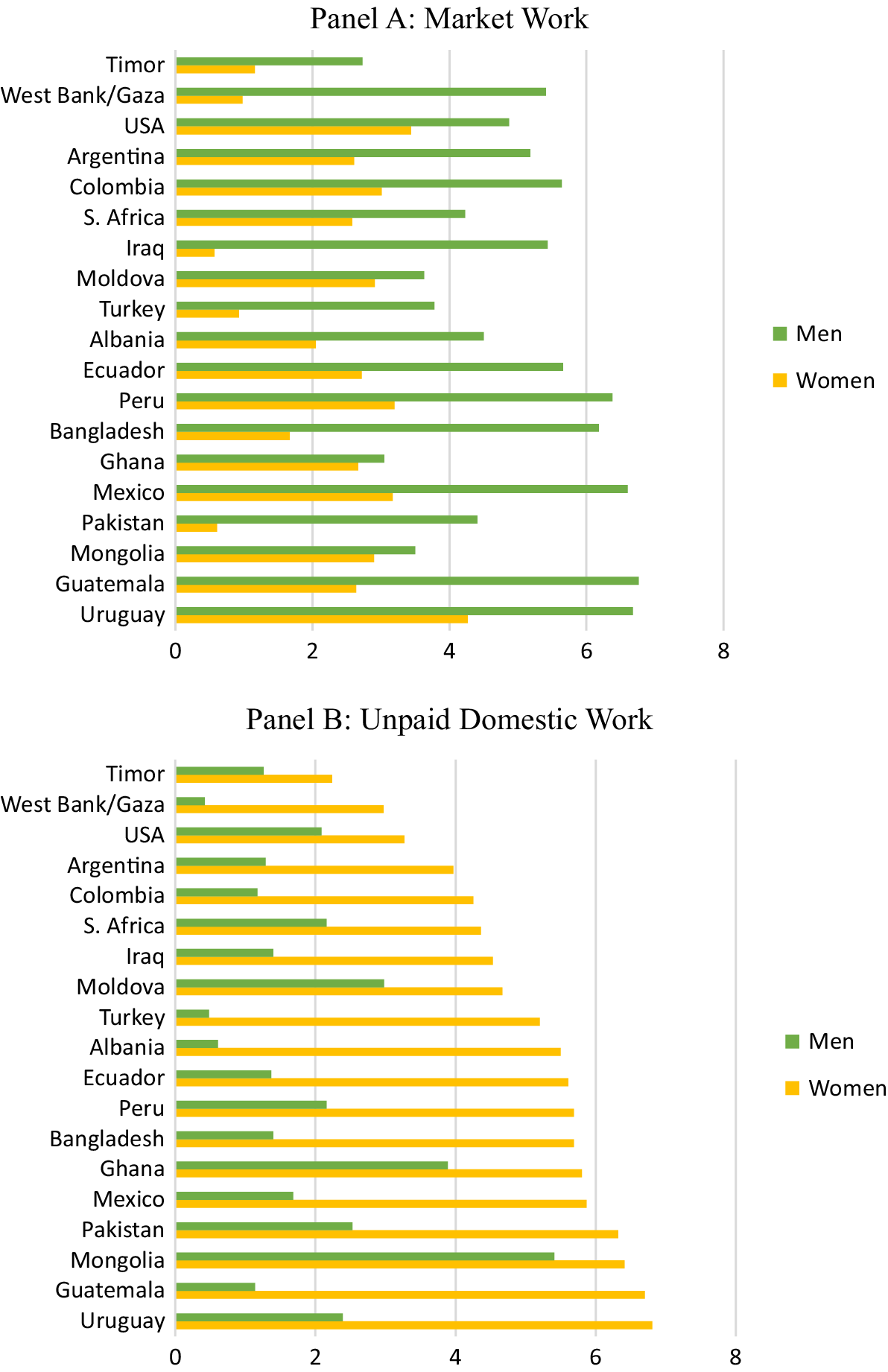
As illustrated, women perform less market work and more unpaid domestic work than men in every country in the sample. On average in this sample, women engage in 2.7 fewer hours of market work per day and 3.2 more hours of unpaid domestic work per day than men. The unpaid-work differential is largest in Guatemala, where women engage in 6.7 hours of unpaid domestic work per day compared to 1.1 hours for men.
In most but not all countries in this sample, women work more total hours than men, with an average additional workload for women of thirty minutes per day. Among the six countries for which this is not true, the gender gap in total work time is small except for the West Bank and Iraq, where men have a total excess workload (paid work plus unpaid domestic work) relative to women of almost two hours per day due to their considerably greater number of hours allocated to paid work. Women have low attachment to the labor force in both of these countries, helping to explain the difference. In the West Bank, the labor-force participation rate for women is 18 percent for women compared to 70 percent for men; in Iraq, it is 12 percent for women and 74 percent for men.Footnote 41 These results suggest that even though women have higher unpaid working hours than men around the globe, gender differences in overall time-poverty rates may be more complicated, depending on employment patterns and women’s attachment to the labor force.
Men tend to experience a fairly stable time-use profile over their lifetimes, while women experience more variable paid and unpaid workloads as family structures change. The differences between men and women are largest during women’s peak childbearing and childrearing ages. This stylized fact is supported with regression results in Rubiano-Matulevich and Viollaz’s study showing that having children is associated with an increase of 1.6 hours/day of unpaid domestic work for women ages 20–44, but an increase of only 12 minutes/day in unpaid domestic work for men.Footnote 42 Similarly, having children reduces time allocated to market work for women of prime childbearing age by 11 minutes per day, while there is no statistically significant impact for men on their market work.Footnote 43
Closely related to the concept of time poverty is the notion of work intensity, often referred to as multitasking, when some work activities are performed simultaneously with another activity. People who are time poor are more likely than those who are not time poor to engage in a stress-inducing overlap of work activities, which can also involve frequent switching between tasks within a certain time period.Footnote 44 A common form of work intensity is care provision while engaging in paid work, such as a parent caring for a child while working at home. Also common, especially in the rural sector of developing countries, is engagement in multiple paid activities simultaneously since a single agricultural activity often does not provide adequate compensation. Another example is supervising children as a secondary activity during what otherwise would be the primary activity of leisure. Coupled with domestic responsibilities, simultaneous paid work activities further increase total working hours and the intensity of work. These secondary activities are often not captured by time-use data, with the implication that time-poverty measures that do not take into account secondary work activities may not be accurate. What data there are indicate that these forms of work intensity are more characteristic of women’s time use compared to men.Footnote 45
The gender gap in unpaid work grew during the COVID-19 pandemic in numerous countries, both developed and developing. The pandemic exposed and exacerbated gender inequities in the labor market and the work of caring for the sick, children, and elderly. The evidence shows that global lockdowns, school closures, and stay-at-home orders resulted in an increase in care work that has fallen disproportionately on the shoulders of women.Footnote 46 Spread of the COVID-19 virus also amplified the need for caring labor within the home due to the large number of people contracting the virus and requiring care at home. In developing countries, the return of migrant workers to rural villages meant more people to care for, with most of that work falling on the shoulders of women. Not only were women doing more care work than men, but they were also more likely than men to leave the labor force altogether due to increased demands in the household.Footnote 47
Time-use patterns are not the same as time-poverty rates, so we next turn to a deep dive into relevant research to provide insight into time-poverty rates for women and men across countries. This kind of comparison is complicated because most time-poverty calculations for individual countries are based on different conceptualizations, methods, and survey designs with varying underlying structures. This lack of standardization makes it difficult to gauge how time poverty varies across countries in a systematic way. In addition to methodological and conceptual differences, country-level aspects can also influence the levels of time poverty and differences between men and women in those countries. For example, low-income countries in sub-Saharan Africa with poor physical infrastructure are likely to have higher overall time-poverty rates and larger gender gaps. Also, middle-income and higher-income countries in the Middle East and North Africa with social norms that restrict women’s engagement in paid employment are likely to have lower time-poverty rates and smaller gender gaps.
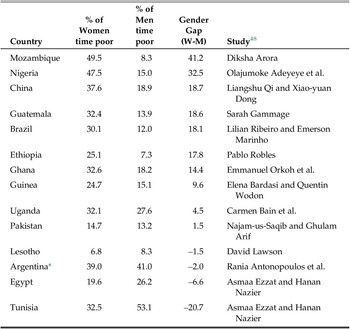
Table 1 reports time-poverty rates from fourteen developing-country studies published since 2008. In the majority of countries, the overall time-poverty rate for women exceeds that of men, with the differential as high as 41 percentage points in Mozambique and 33 percentage points in Nigeria. However, this relative disadvantage for women is not universal. In Lesotho, the rate is slightly higher for men, largely due to men’s considerably higher rates of employment in farming and livestock herding.Footnote 49 Buenos Aires also sees higher time-poverty rates for men among the poor, although this difference reverses for the nonpoor.Footnote 50 Time-poverty rates are considerably higher for men than women in Tunisia and Egypt, mostly because women in these two countries have very low labor-force participation rates in absolute and relative terms.Footnote 51
Time Poverty Rates by Country and Gender, Selected Developing Countries
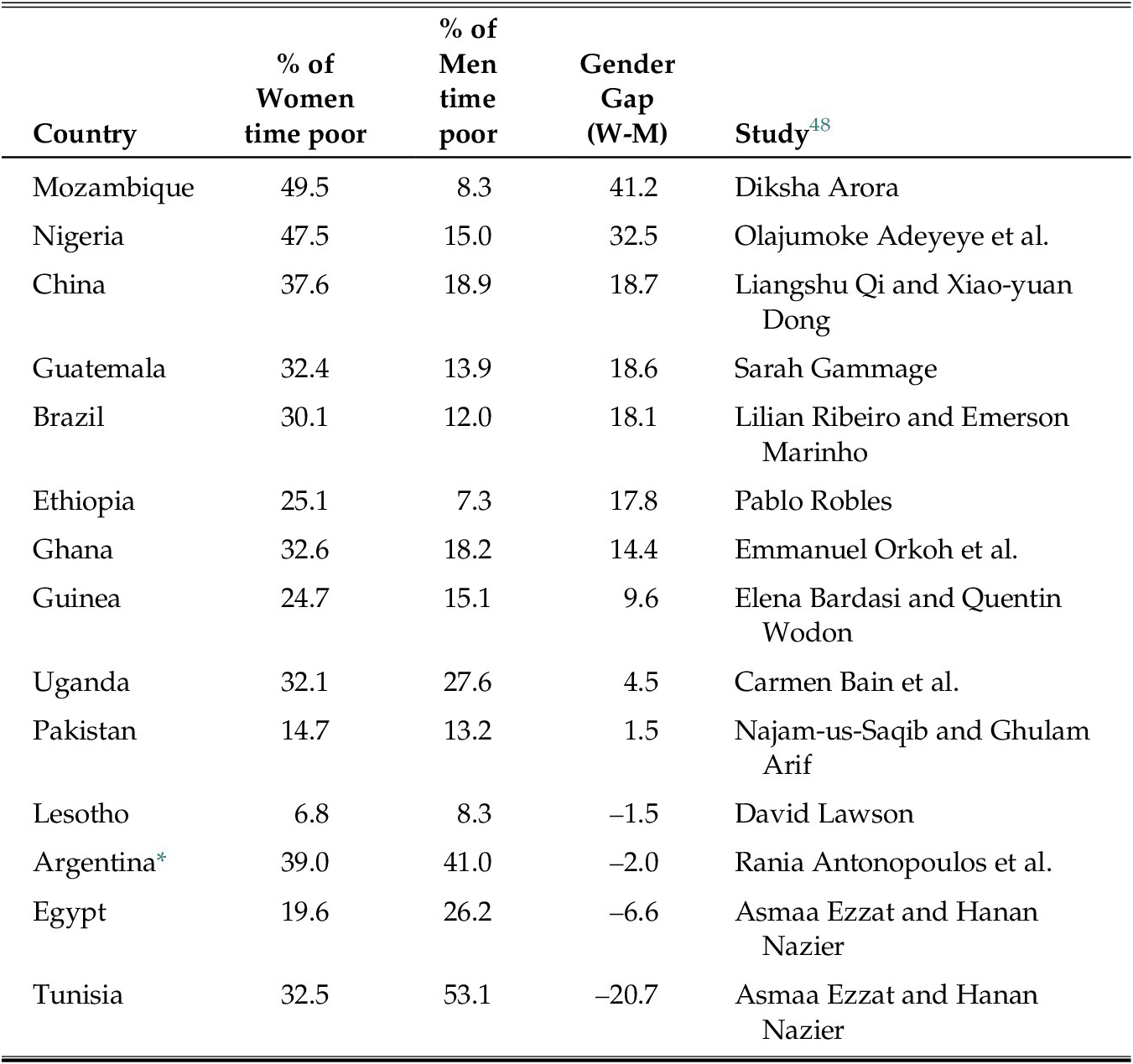
* Evidence for Argentina is specific to Buenos Aires.
Time-poverty studies often focus on adults, with the assumption that children require care and take up a portion of the hours that adults allocate toward household production. Lack of individual-level data on children’s time use is another reason why many studies focus on adults. A notable exception is Elena Bardasi and Quentin Wodon’s study of Guinea, which finds a time-poverty rate of 26 percent for girls and 20 percent for boys when using a threshold of at least nine working hours per week. They find considerable variation among children based on their schooling status; children who do not attend school worked an average of seventeen hours per week in paid work, while children in school worked almost no hours in paid employment.Footnote 52 Moreover, children both in and out of school spent non-negligible amounts of time in unpaid domestic work, especially collecting fuelwood and water.
One major exception to the variation across countries in the methodology used to estimate time poverty is a set of studies conducted using the Levy Institute Measure of Time and Income Poverty (LIMTIP) method. This two-dimensional measure of time poverty takes into account intrahousehold differentials in the distribution of resources and tasks and has been applied to time-use surveys from numerous countries.Footnote 53 This method includes the monetized value of time deficits in the poverty calculation of households and it allows for there to be time-nonpoor individuals in time-poor households; it thus incorporates gender differences in the division of household production into the measurement of poverty. A summary of these results on time poverty rates is reported in Figure 3 for nine countries.
LIMTIP* Method Time-Poverty Rates among Employed Persons by Country, Sex, and Weekly Hours of Employment.Footnote 54
*LIMTIP denotes the Levy Institute Measure of Time and Income Poverty.
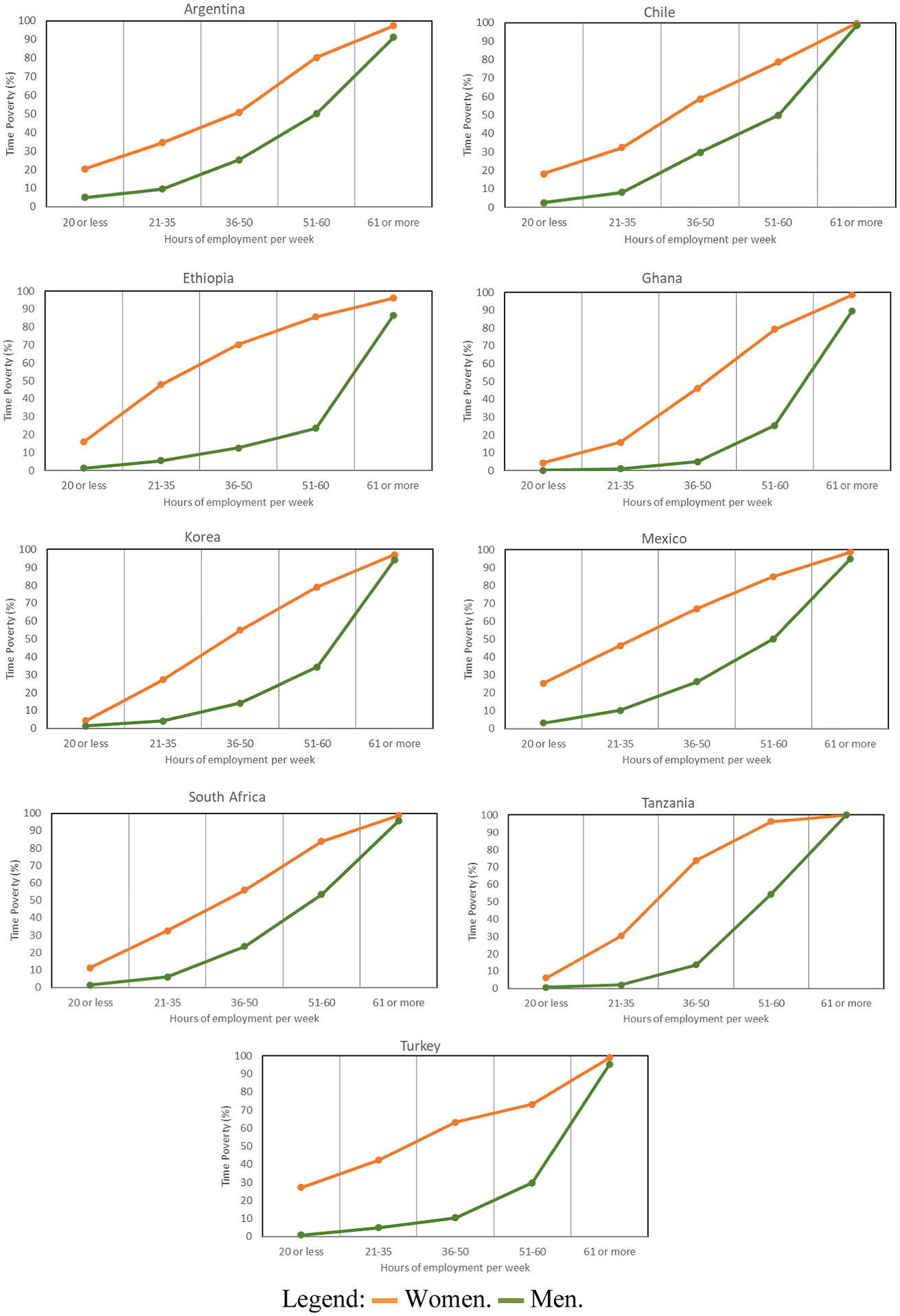
Figure 3 shows that overall, in every country, women’s time-poverty rates exceed those of men. However, the differential between women and men varies according to the extent to which individuals engage in paid employment. At very low levels of paid employment (twenty hours or fewer per week), the gender gap in time-poverty rates is either close to zero (in the case of Ghana, Korea, and Tanzania) or considerably smaller than at employment levels of thirty-six to fifty hours per week. At the other extreme, at very high levels of paid employment (over sixty hours per week), almost 100 percent of both women and men are considered time poor. Underlying these results are women’s relatively greater hours in unpaid household production that remain high even among women who work long hours in their paid jobs.
IV. Policy Strategies to Reduce Time Poverty
It should be clear from the discussion thus far that when time deficits are incorporated into poverty calculations, countries around the globe have a substantial number of “hidden poor,” that is, people living above the conventional income-poverty line but still facing a life of deprivation because they have insufficient time to meet their basic needs. We also see that, in most countries, relatively more women than men are time poor. People who are income nonpoor but time poor have been marginalized because this kind of poverty has largely escaped conventional antipoverty strategies. Increasing the visibility of this hidden poverty by incorporating time deficits into calculations of the poverty rate will facilitate the design of more effective policy strategies to combat poverty. This section focuses on policy strategies with demonstrable effects on time use for paid employment and household production in developing countries. These strategies can be classified into three broad areas: (1) physical infrastructure and technology improvements, (2) minimum wage and cash transfers, and (3) care infrastructure.
A. Physical infrastructure and technology improvements
A key determinant of time poverty in low-income countries is poor physical infrastructure. Policies that would save time by reducing unpaid domestic work and care work include infrastructure improvement to provide piped water, electrification, road construction, better transportation options, and sanitation services. These needs are especially stark in rural areas.Footnote 55 One of the biggest determinants of women’s time in unpaid labor in low-income countries is the state of public infrastructure, including roads and electrification, and ease of access to drinking water and firewood. These areas are usually the domain of women, many of whom have commensurately less time to work for pay, even if they are able, given the time-intensive nature of water and firewood collection.
Projects that include digging wells and programs that supply households with new technologies such as energy-efficient cooking stoves and ovens have helped to reduce some of women’s domestic-work burdens. For example, in Burkina Faso, initiatives to construct wells, supply carts to villages for hauling wood, build fuel-efficient ovens, and introduce hullers and grain mills to convert grain into flour all helped to reduce women’s workloads and reallocate their time to create new businesses.Footnote 56 In South Africa, the widescale rollout of electricity to rural areas resulted in a 9 to 9.5 percentage-point increase in women’s employment, mostly because household electrification served as a labor-saving technology (largely through electric lighting and cooking) and reduced women’s time spent in home production.Footnote 57 Similarly, in rural communities in the Philippines, Uganda, and Zimbabwe, access to an improved water source reduced women’s average unpaid care workloads by one to four hours per day.Footnote 58 In India, reliable electrification has a causal effect in reducing weekly minutes spent on fuel and water collection for both men and women, with a relatively larger decrease for women; having ten additional hours of electricity reduces time spent on fuel and water collection by thirty-nine minutes per week for men and sixty-nine minutes per week for women.Footnote 59
Improving access to information, communication, and technology (ICT) services also has the potential to reduce time poverty, especially for women, through gains in wage employment and income. In principle, the key mechanism is through an improvement in women’s fallback positions and their bargaining power at home, which can contribute to a more equitable distribution of household work and/or the ability to pay for market substitutes. However, the jobs must be quality jobs with decent wages and benefits rather than low-paying jobs with long working hours that exacerbate women’s time deficits. There is some evidence that mobile phones have had disproportionately positive effects for women. For example, internet access has been linked with increases in women’s labor-force participation and household well-being in sub-Saharan AfricaFootnote 60 and Mexico.Footnote 61 The spread of ICT services has also facilitated innovations in financial technology, mobile financial services, and mobile money, which have helped to promote poverty reduction and income redistribution in a number of countries.Footnote 62 Digital and cellular technology can also prolong working hours, both paid and unpaid, so the spread of ICT services is not a sufficient condition to shrink time deficits. To the extent that income gains enable women to reallocate their unpaid domestic work to others in the home or to purchase market substitutes, these advances in ICT should contribute to reduced time poverty for women.
B. Minimum wage and cash transfers
One of the most important policy levers for lifting the incomes of poor workers is the minimum wage. Because the female earnings distribution falls to the left of the male earnings distribution in most economies, a policy that raises the legal minimum wage, if properly enforced, should help to close the male-female earnings gap and potentially help to close the gender gap in time-poverty rates. If it is binding, a minimum wage increase will raise formal-sector wages, with the strongest impact close to the legislated minimum and declining effects further up the distribution. In a type of “lighthouse effect,” wages in the informal sector may also rise, if workers and employers see the legislated minimum as a benchmark for their own wage-bargaining and wage-setting practices. Critics argue that employment losses from minimum wage-induced increases in production costs are substantial. Advocates, however, argue that employment losses are small and any reallocation of resources that occurs will result in a welfare-improving outcome through the reduction of poverty.Footnote 63
Conditional cash transfers (CCTs) and other types of cash-grant programs constitute another popular and powerful tool across low-income countries for poverty reduction. Cash disbursements are made conditional on households undertaking certain actions, usually related to children’s school enrollment and visits to healthcare providers for checkups and vaccinations. These programs aim to reduce both current income poverty through cash transfer and intergenerational poverty through promoting health and education outcomes of children; some programs include support for women’s education, training, and employment. However, CCTs may result in an increase in women’s overall workloads as the responsibility for meeting the conditions—such as taking children to clinics, receiving health education, and attending community meetings—often falls on the shoulders of women.Footnote 64 Cash transfers may be more effective in reducing time poverty, if they are accompanied by affordable childcare or other features that reduce unpaid household work.
C. Care infrastructure
Policies that boost women’s employment are ineffective in reducing time poverty, if they do not reduce women’s time spent performing unpaid domestic labor. A crucial way to do so is to strengthen the care infrastructure, especially through the provision of affordable care services.Footnote 65 Deficits in the care infrastructure—especially insufficient access to affordable childcare, eldercare, and health care—are a key determinant of time poverty. This issue gained increasing attention during the COVID-19 pandemic, as the need for childcare provision and homeschooling rose dramatically when schools closed. Containment policies and the spread of the virus contributed to greater unpaid workloads for both women and men, but the increased care work and housework responsibilities fell disproportionately on the shoulders of women. Priorities for strengthening the care infrastructure to respond to the pandemic and, in the longer term, to reduce rates of time poverty, especially for women, include providing paid family leave and paid sick leave, creating universal free childcare and long-term eldercare, boosting pay equity and job creation in nursing, and improving pay and working conditions for paid care providers. Investing in more schools will help to close educational inequities, with the caveat that the optimal placement of those schools needs to take into account social restrictions on mobility that girls may face.Footnote 66 The private sector also needs to play a role in strengthening the care infrastructure, especially with workplace policies that allow for greater flexibility by structuring the terms of employment around the realities of nondiscretionary unpaid labor. Also needed is a shift in group-level social norms, so that individuals can be unconstrained by stigmas around a more equitable distribution of unpaid work in the home.
Investing in health and education can grow employment in ways that reduce unpaid work burdens, meet basic needs, and reallocate women’s time from unpaid to remunerated work. In a growing number of countries, participatory processes are put in place to ensure that government expenditures and tax policies are gender equitable. There is preliminary evidence that this kind of fiscal policy promotes gender equality.Footnote 67 This lesson took on even greater relevance during the COVID-19 pandemic, with emerging evidence that countries that prioritized social spending before the crisis, especially spending on health care capacity and social security, did better in terms of limiting the number of cases and deaths.Footnote 68
V. Conclusion
Much of the scholarly and policy discourse on poverty and inequality has traditionally relied on metrics—especially the Foster-Greer-Thorbecke measures of absolute poverty—that were based on household income or consumption data. However, research challenging the unitary-household model and the assumption that resources and consumption goods are distributed equitably within a household have made it clear that tracking poverty and income equality with income or consumption data collected at the household level does not permit assessment of intrahousehold welfare. Alternative ways to measure and conceptualize poverty were needed to accurately measure poverty at the individual level and to show how poverty differs between men and women. The concept of time poverty has evolved to meet this objective. When individuals and households face constraints on their time, such as the time demands of household production, then they are constrained in their ability to consume items that would improve their well-being. An individual or household is time poor if their total hours of time in market and household production exceeds a critical threshold or if their total hours engaged in personal and leisure time is less than a critical threshold. In the context of income poverty, if they cannot afford to cover their time deficit by purchasing market substitutes, then the official threshold for income poverty would underestimate what is needed to reach a minimum standard of living. Hence, time is a key input into consumption and serves as a de facto “currency” for achieving equality and well-being.Footnote 69
This essay’s comparison of available data on time-use and time-poverty rates indicates that time-poverty rates are generally higher for women, largely because women continue to perform more hours of housework than men, with the greatest disparity occurring during prime childbearing and childrearing ages. Exceptions to this pattern have been documented in some countries where women have low attachment to the labor market. Although the proportion of time in housework varies across regions, a large part of the unequal distribution of unpaid labor in the household stems from the perpetuation of social and cultural norms dictating that childcare and housework is primarily a woman’s domain. Together with high economic activity rates for women in very poor countries, these patterns underline a double work burden for women. Framing the double work burden as a time-poverty issue couches these gender differences in the more compelling language of deprivation and increases the importance of finding ways to eliminate them.
Reducing time poverty, in turn, matters not only for individual well-being, but also has important ramifications for increasing investment in human capital, improving psychological and economic health, and promoting overall development.Footnote 70 Strategies for achieving this goal must include changes that raise the value of unpaid work and practices that redistribute the burden of care and housework. It is crucial to implement public works programs that build and improve time-saving infrastructure—especially electrification and the provision of piped water—and improvements in care infrastructure—especially the provision of on-site childcare facilities—that allow time-poor individuals to engage in work in a meaningful manner.
This essay has uncovered several knowledge gaps. First, there is some evidence that greater availability of ICT services has helped to improve women’s employment opportunities and reduce overall poverty, but more research is needed on the extent to which ICT services can contribute to a reduction in time poverty. In addition, more work is needed to develop the concept of time poverty and facilitate the adoption of a common methodology to measure it. Finally, additional research and more effective policies require better time-use data, including data at the individual level that can be matched with household information, thus allowing the construction of time-adjusted income-poverty rates for men and women as well as girls and boys. Time-use data can also be improved by better distinguishing between work and nonwork activities and between necessary and discretionary activities. Paying attention to these questions and spending resources on time-use data will go a long way toward understanding time poverty and implementing the appropriate policies to promote economic well-being and a healthier work-life balance.


 Open access

