


Introduction
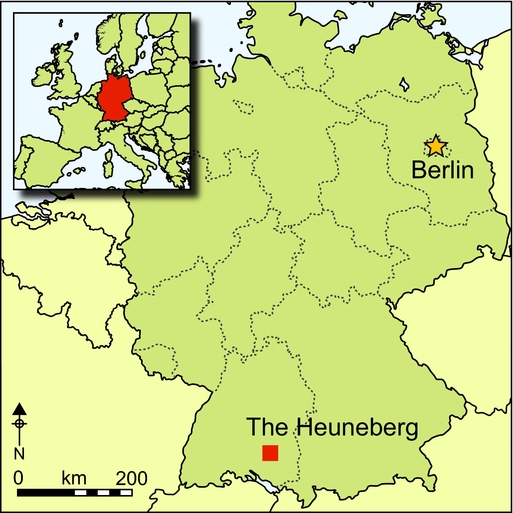
The Heuneburg is one of the most important and best-researched Iron Age sites in Central Europe. Systematic work on the Late Hallstatt princely seat began in 1950, and large-scale excavations continued until 1979 (Kimmig Reference Kimmig and Gersbach1989). These excavations were extremely successful, leading to the discovery of the earliest proto-urban settlement north of the Alps, and producing often sensational results such as the famous Mediterranean-style mud-brick architecture of the fortification, yet they only scratched the surface. Since the 1990s, it has become clear that the Heuneburg itself is merely the core of a much larger and extremely complex settlement that, in the sixth century BC, covered an area of some 1km2 (Kurz Reference Kurz2000; Fernandez-Götz & Krausse Reference Fernandez-Götz and Krausse2013). During the course of a research project funded by the German Research Foundation (Krausse Reference Kurz and Krausse2008, Reference Kurz and Krausse2010) from 2003–2010, excavation and survey work was carried out for the first time in the lower town and the outer settlement, and in the surroundings of the Heuneburg (Kurz Reference Kurz and Krausse2008, Reference Kurz and Krausse2010; Krausse et al. Reference Krausse, Kretschmer, Hansen and Fernandez-Götz2015: 73–84). In autumn 2005, a fragment of a gold-plated bronze fibula was discovered during field-walking some 2.4km south-south-east of the Heuneburg (Figure 1).
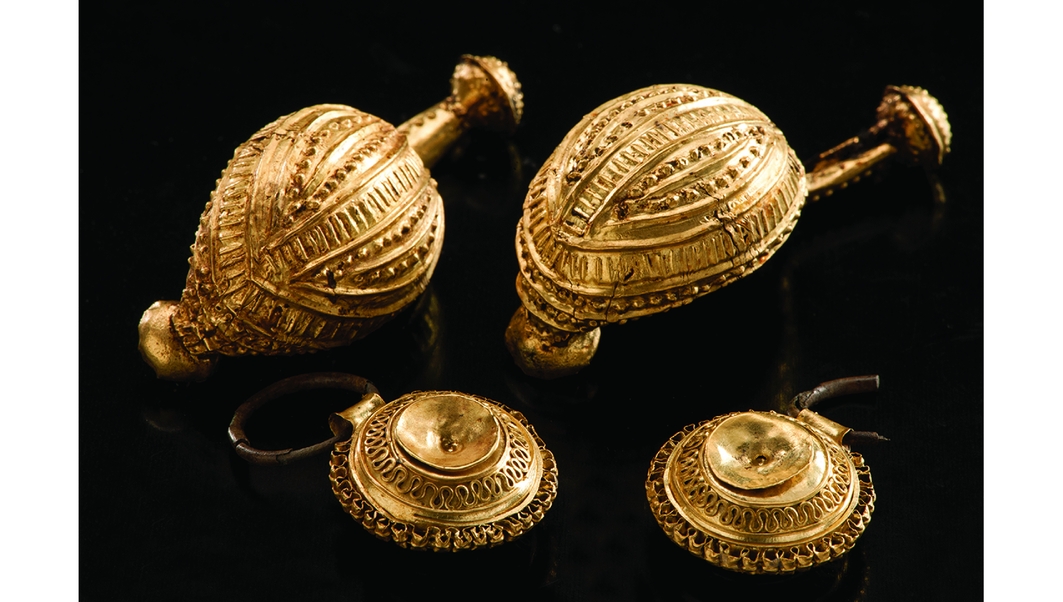
The gold-plated Hallstatt bronze fibulae (length: 50mm) and the pendants (diameter: 20mm) from the child's burial.
The Bettelbühl necropolis and the discovery of the child's burial
The fibula fragment was found in the vicinity of mound 4 of what is known as the Bettelbühl necropolis. The name is derived from the Bettelbühl, a tumulus that has survived to a height of around 3.7m and a diameter of 65m. The cemetery is situated in an unusual position in the plain below the Heuneburg, on the opposite side of the River Danube, and is traversed by the Bettelbühlbach, a stream that regularly floods the area. A topographical survey of the site revealed that there were originally seven tumuli of various sizes here, all of which—with the exception of the Bettelbühl itself—have been levelled by centuries of agriculture. Only 300m west of the necropolis, there is evidence for an Iron Age settlement. This is known only from surface finds, so it is unclear whether it is associated with the graves (Kurz Reference Kurz2007: 130). An excavation carried out in 2005 showed that the fibula came from a child's grave that was, unusually, richly furnished, and the bottom of which lay almost directly beneath the ploughsoil. Some of the grave goods, including the fibula fragment, had been scattered by the plough. The in situ artefacts included two gold-plated, navicella-type, boat-shaped fibulae and a pair of golden pendants decorated with filigree (Figure 1), the shape and position of which suggest that they were ear or head decorations (Kurz Reference Kurz and Krausse2008: 181–83). The age of the child at the time of death was determined to be two to four years (Kurz & Wahl Reference Kurz and Wahl2006: 78–82). The excavation revealed that the child's grave was in fact a secondary burial situated directly next to the shaft of a larger, central grave.
The en bloc recovery of the central shaft grave
As mound 4 was threatened by agricultural activity, and there were possibly further secondary burials and other archaeological features directly beneath the ploughsoil, the area was systematically examined, beginning in August 2010. The mound, once more than 4m high with a diameter of around 40m, survived to a height of around 0.2–0.3m at the centre, becoming progressively lower towards the edges. In the centre, an unusually large, nearly square, grave shaft could be recognised, measuring 6.6 × 5.8m and aligned north–south. The shaft was filled with homogeneous, dark brown humus surrounded by a ring of light, sterile gravel: the remains from the digging of the grave shaft or of the primary burial mound. Test drilling revealed that the lower part of the shaft was situated in waterlogged levels, suggesting good preservation of organic materials. Given that the drill core contained the remains of compact timbers, there was a strong possibility that the timbers of the burial chamber had survived and could provide a dendrochronological date for the structure. Drilling also indicated that the bottom of the burial chamber lay no more than 1.1m beneath the modern surface. Taking into consideration the threat to the research potential of the dendrochronologically dated timbers of the burial chamber from both agricultural activity and illegal excavations, it was decided, in October 2010, to excavate the central grave. This decision was further taken on the assumption that the contents of the grave had been disturbed because all central burials beneath monumental tumuli excavated previously in the area surrounding the Heuneburg had been found to have been looted in antiquity (Kurz & Schiek Reference Kurz and Schiek2002: 35–36).
The excavation of two trial trenches uncovered the remains of a rectangular, timber burial chamber, oriented north–south. Although the trenches were small, amber and jet grave goods were found in situ only 0.1m above the timbers. Further doubts as to whether the grave had been disturbed in antiquity were raised by the discovery of several gold objects on the floor of the timber chamber.
In order to guarantee a scientifically satisfactory recovery and analysis of the burial and the finds, the entire burial chamber was removed en bloc (Krausse & Ebinger-Rist Reference Krausse and Ebinger-Rist2011). The resulting block, which measured 6 × 7 × 1m and weighed 80 tonnes, was transported to the laboratories of the Archaeological State Office of Baden-Württemberg (Figure 2). Other areas with a concentration of finds were encased in plaster together with the timber beneath them. A total of 14 blocks were removed in this way, and 3D X-ray images were produced of them with a CT scanner (GE vtomex 450) (Ebinger-Rist et al. Reference Ebinger-Rist, Peek, Stelzner, Gauss, Mardikian, Chemello, Watters and Hull2011).
An aerial view taken on 28 December 2010 of the 80-tonne block being raised.

The burial chamber
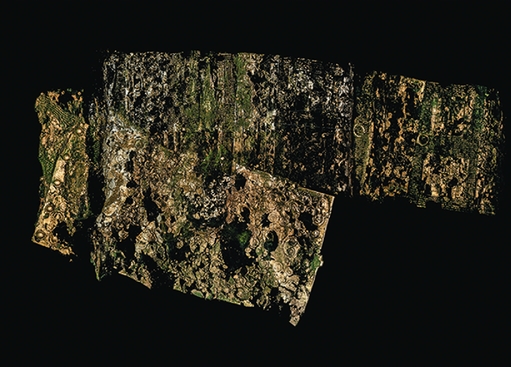
The wooden floor and the remains of the side walls of the chamber were excavated. It was almost square in plan, measuring 4.6 × 3.8m, and was aligned north–south (Figure 3). The floor was constructed from nine oak and two silver fir planks that were laid parallel to the long sides of the chamber, i.e. north–south (Figure 4). They rested on two supporting timbers of oak, aligned east–west. The planks were 0.33m wide, up to 0.12m thick and 5m long, and extended beyond the transverse timbers.
A three-dimensional view of the burial chamber taken with a terrestrial laser scanner. Plan of the burial with the location of the main grave goods.

Distortion-free composite pictures of the grave timbers from a bird's-eye perspective. Relevant dates are indicated with arrows. DC = dendrochronological number; B = number of the plank; W = date with waney-edge (last tree-ring before tree was felled); S = date with sapwood based on the number of sapwood rings.

The boundary between waterlogged and aerated soil was only 0.1–0.2m above the surface of the chamber floor, so that no timbers or organic materials were preserved above this level. All that survived of the lining of the chamber walls was the lowest layer of timbers, with some of the layer above also preserved on the western side. The chamber walls, as with the floor, consisted of split planks, 0.1m thick. Both vertical layers consisted exclusively of oak. The roof of the chamber, as with the upper layers of the walls, was located in aerated soil and so had not survived, although in two places within the chamber, the remains of the roof had collapsed and been pressed by the weight of the earth flat onto the floor.
The majority of the grave goods lay compressed in a layer only a few centimetres thick, directly on the planks of the chamber floor. Although the waterlogged conditions meant good preservation of the wood and other organic materials, it was extremely detrimental to the iron and bronze objects. It is thus no surprise that few iron objects were found.
Some of the human remains and grave goods were displaced from their original positions as a result of natural processes. We must assume that, in the years and decades after the construction of the grave, the area was subjected to seasonal flooding from the nearby stream, and that the burial chamber was regularly filled with water that trickled slowly into it. Some of the grave goods will have floated, and this, together with the processes of decomposition and settling, meant that the lighter objects in particular will have been displaced on several occasions. The collapse of the roof of the chamber will have moved additional objects around. Even though there were no traces in the fill of the grave shaft of any secondary intrusion, the possibility cannot be excluded that the burial chamber was reopened at a later time. The fact that numerous objects remained in the grave—including gold, amber and solid bronze—clearly precludes profane grave looting as an explanation for the position of the skeletal remains.
The main burial
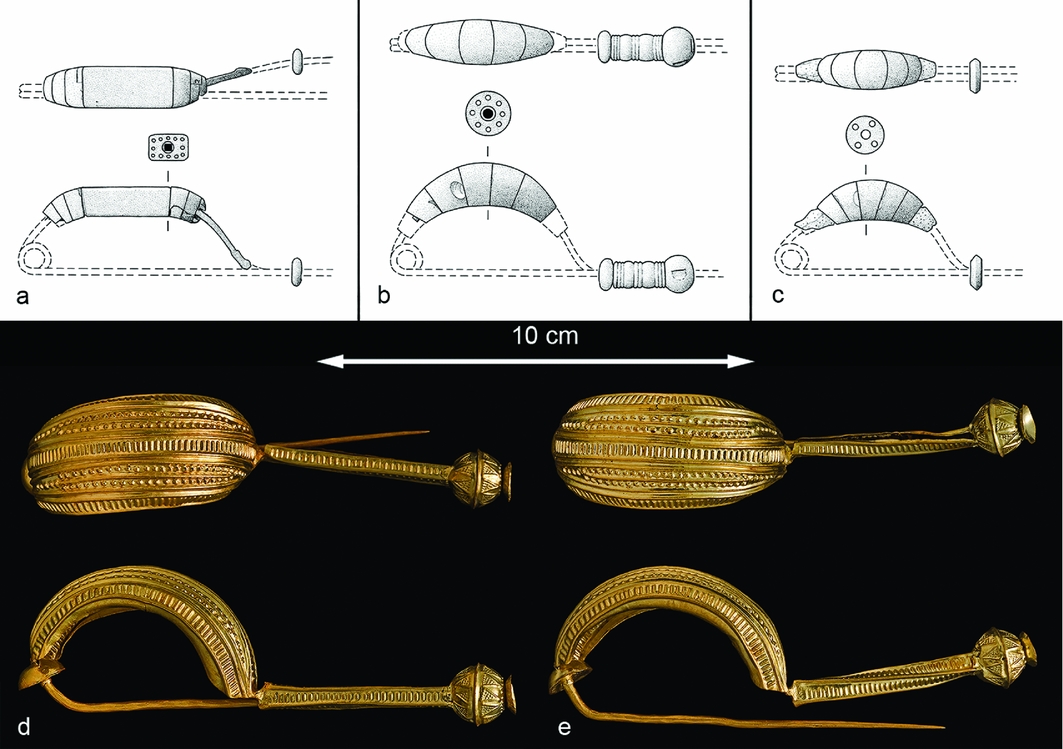
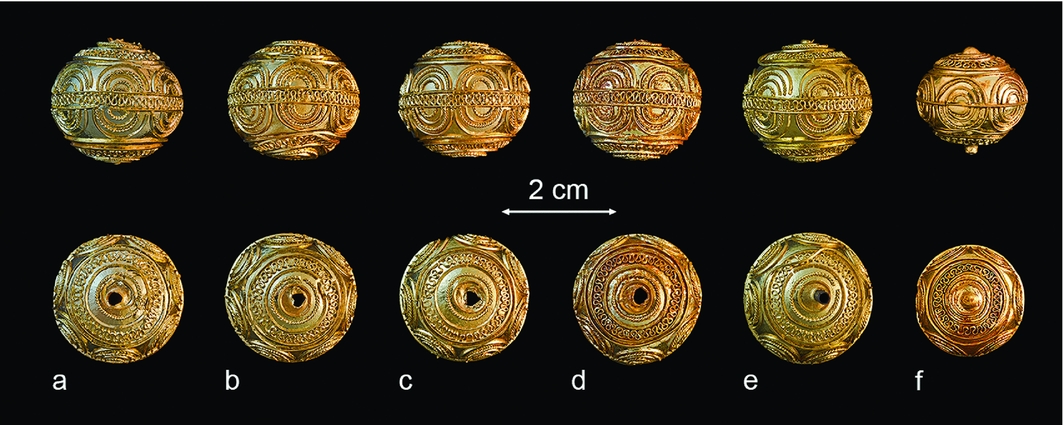
The skeleton (individual 1) in the main burial was laid out in full extension on its back with the feet to the north, by the west chamber wall (Figure 3C). The deceased was firmly identified as female, based on scientific methods and features of gender determination (e.g. Grupe et al. Reference Grupe, Harbeck and McGlynn2015). Her age at the time of death can be estimated at 30–40 years, and she was 1.6–1.62m tall. The unusually rich grave goods indicate that she was a member of the social elite. Two large, navicella-type gold fibulae were located to the south of the level of her shoulders (Figures 3.3 & 5d–e). In addition, four bronze fibulae and three with amber decoration on their bows (Figure 5a–c) were preserved at her chest (Figure 3.5). In the area of the upper torso, five gold spheres decorated with filigree were also found (Figure 3.4), which, together with 26 ribbed, gold tubular beads and numerous amber beads of various sizes, were part of an elaborate necklace. The gold spheres are similar to those from Ins and Jegensdorf (Switzerland) and, although probably inspired by numerous gold beads known from Central Italy from the seventh and sixth centuries, were locally produced (Éluère Reference Éluère2004: 93, 571). Granulation was used in the manufacture of at least some of the Etruscan originals and the spheres from Jegensdorf and Ins, but only the filigree technique was used for the examples from the burial at Bettelbühl (Figure 6a–e).
The three amber fibulae (a–c) and two gold navicella-type-fibulae (d–e) were found at various places on the upper body of the main burial.
The five gold spheres (a–e) and the gold pinhead (f).
The fact that no gold neck ring or bronze vessels were found in the grave is not an indication of looting. As Steffen (Reference Steffen2012: 59–61) recently showed, gold neck rings do not occur in female burials of the early sixth century BC, and bronze vessels are only very rarely found in female burials of this period in south-western Germany.
Amber jewellery in the form of a large pendant lay by the woman's left hip. She wore a richly decorated belt around her waist, the front of which consisted of a sheet of bronze, while the back was formed from a leather band decorated with bronze bars and thousands of bronze staples (Figures 3.7 & 7).
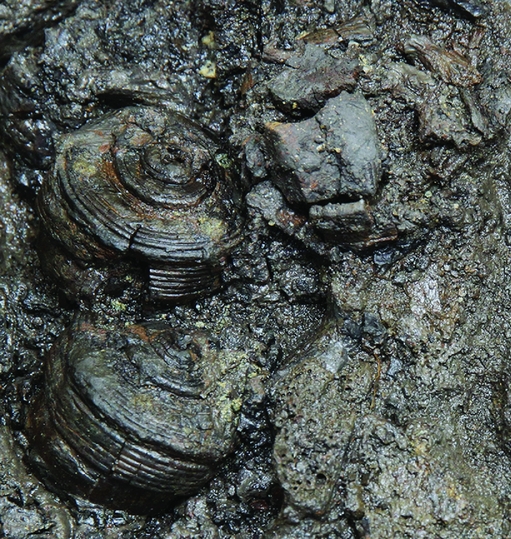
Her forearms were adorned with a total of seven jet bracelets (Figure 3.6), while near her navel, turned wooden objects of boxwood were found; their purpose is still puzzling (Figure 8). Around each of her ankles, the woman wore a solid bronze foot ring (Figure 3.8).
The post-cranial skeletal remains of the deceased were found in almost complete anatomical composition in an extended dorsal position (Figure 3C). The shoulder area hadbeen disturbed, and the skull and the left humerus were not found in situ. According to the determination of gender and age, the calvarium found at the east wall of the chamber (Figure 3A) and the post-cranial skeletal remains belong to one individual. The long bone that was found near the calvarium could well be the left upper arm of this adult female. Her lower jaw was situated near the middle of the north wall of the chamber (Figure 3B), at a considerable distance from the calvarium.
The finds along the north wall of the chamber
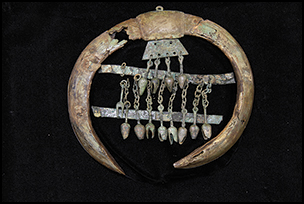
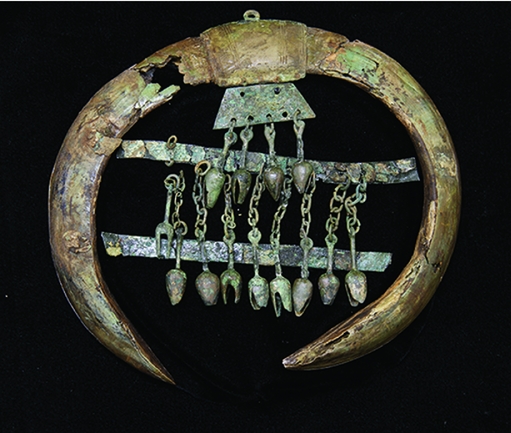
The best conditions for preservation, both for bronze objects and for organic materials, occurred along the north wall of the chamber. Decorated bronze sheets, of uncertain purpose, were uncovered in the north-east corner (Figure 3c). Two pairs of teeth—‘fangs’ or ‘tusks’—from the lower jaws of male wild boar are particularly well preserved. Each pair consists of the left and right canines of an individual, the bases of which are fitted into decorated, tubular bronze-sheet settings to make semi-circular ornaments (Figures 3b & 9). The length of the teeth (curvature around 0.2m), and the length of the abrasion facets created by the occlusion with the upper canines, reveal that the animals were at least 6–7 years old and had attained a weight of between 160 and 190kg.
The bronze settings each have small suspension loops at their upper ends. At the lower end of each, there is a trapezoidal plaque from which hang tulip-shaped bells. Two stripsof bronze had been attached between the tusks; further bells were attached to the upper transverse strip. Boars’ tusks, occasionally with bronze mounts, are known from burials of the late seventh and sixth centuries BC in south-west Germany. They have sometimes been identified as part of horse tack, sometimes as part of female attire (Riek & Hundt Reference Riek and Hundt1962: 150–53; Kurz & Schiek Reference Kurz and Schiek2002: 57–58); no parallels to the pairs of boars’ tusks from Bettelbühl mound 4 are, however, known from the Early Iron Age. We must turn to the first century BC and late Celtic and early Roman complexes in south-west Germany and Switzerland to find similar pairs of boars’ tusks that have been convincingly interpreted as breast ornaments for horses (Fingerlin Reference Fingerlin1981).
Sizeable patches of organic layers had been preserved in the area of the north wall of the chamber, including plant-based textiles and fragments of fur (Figure 3h), and severalgold-ribbed, tubular beads, identical to the specimens from the upper part of the body of the main burial. Numerous beads, a gold pinhead (Figure 6f) and five amber pendants similar to the somewhat larger examples deposited by the hips of the main burial were found in the same area. Together, the objects found directly on or by the body, and those along the north chamber wall, form a cohesive ensemble of jewellery.
Three-dimensional illustration of the bronze belt made using XCT (X-ray computer tomography).
Three turned box-wood objects in situ.
Mounted boars’ tusks with tulip-shaped bronze pendants mounted on a trapezoid pendant and two transverse bronze strips (length of the teeth: approximately 200mm).
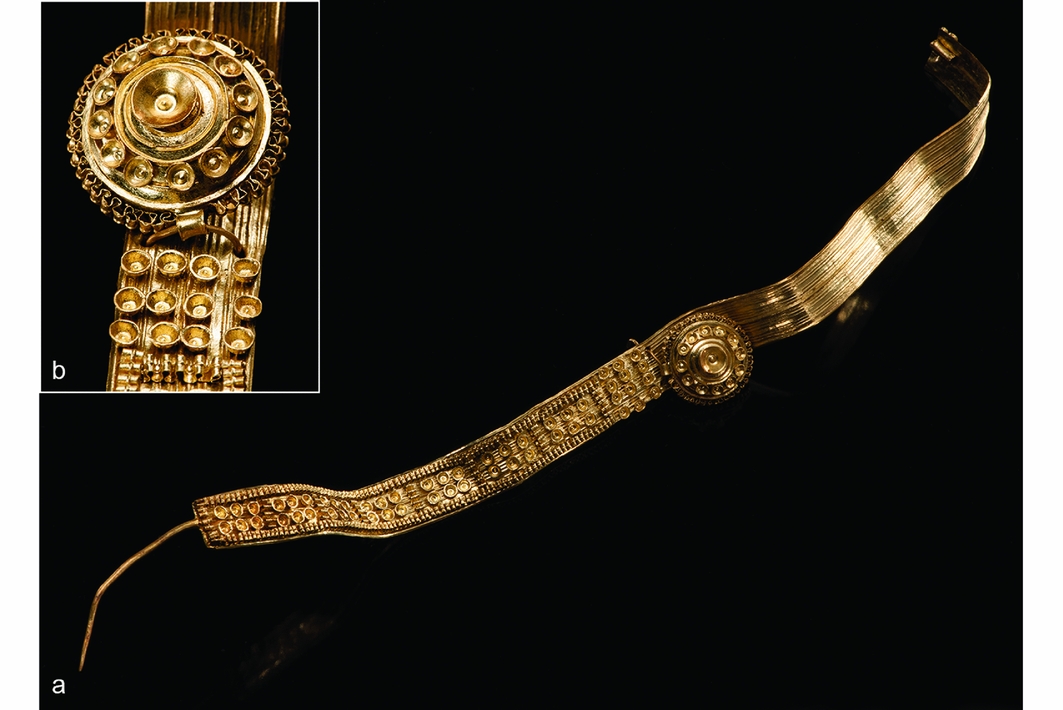
An elaborately decorated gold strip earring, 285mm in length and found approximately 1m north-east of the feet of the deceased (Figure 3.2), is almost certainly displaced; it has asymmetrical decoration and a finely worked gold pendant suspended from the middle (Figure 10). The gold earring lay in a secondary position over the remains of the skeleton of a pig that was around six months old at the time of death—a food offering placed in the grave (Figure 3e). The pig probably lay where it was originally deposited, as indicated by the presence of a carving knife that was found close by to the east (Figure 3f).
a) Golden strip earring (length: 285mm); b) detail of the filigree decorated pendant (diameter: 20mm).
A group of objects having features characteristic of amulets was also found by the north wall of the chamber (Figure 3g). These include two petrified objects: an ammonite and the fossil of a sea-urchin that had been worked. The ensemble further comprises jewellery in the form of two glass beads (the only glass finds in the burial). Very nearby lay two fragments of rock crystal, two worked fragments of iron oxide, a heart-shaped piece of goethite and a reddish, marble-like ball of red haematite. Three polished stones were found too, including a possible Neolithic artefact of banded quartzite or hornstone. Similar assemblages are known from other rich female burials of the late Hallstatt and early La Tène periods (Pauli Reference Pauli1975: 126–33; Arnold Reference Arnold, Anreiter, Bánffy, Bartosiewicz, Meid and Metzner-Nebelsick2012).
Companion or secondary burial?
During excavation of the burial chamber, the remains of a second skeleton (individual 2) were found in the south-east corner (Figure 3D). The cranium had survived, together with most of the post-cranium, which was found slightly displaced from its anatomical position. The state of preservation of the bones was extremely poor so that, apart from the enamel of the teeth, only a few criteria could be employed to determine age and gender (size, proportions, individual epiphyseal plates). Individual 2 was an adult, more probably female than male, and around 1.56–1.57m tall. In stark contrast to the main burial, this person was accompanied by a very simple set of jewellery. The only grave goods identified were two plain bronze rings made of wire found on the wrists, and the remains of a spiral bronze ornament located near the head. It is not yet clear whether this second burial represents a ‘companion’ who was placed in the chamber at the same time as the richly furnished burial, or a secondary burial inserted at a later date.
Further interdisciplinary research, especially concerning the relationships between the three individuals, will be carried out using palaeogenetics and stable isotopes. Also required is a more detailed investigation of the taphonomic or other processes to explain the disturbance of the grave contents.
A unique find: chamfron with bit and cheek pieces
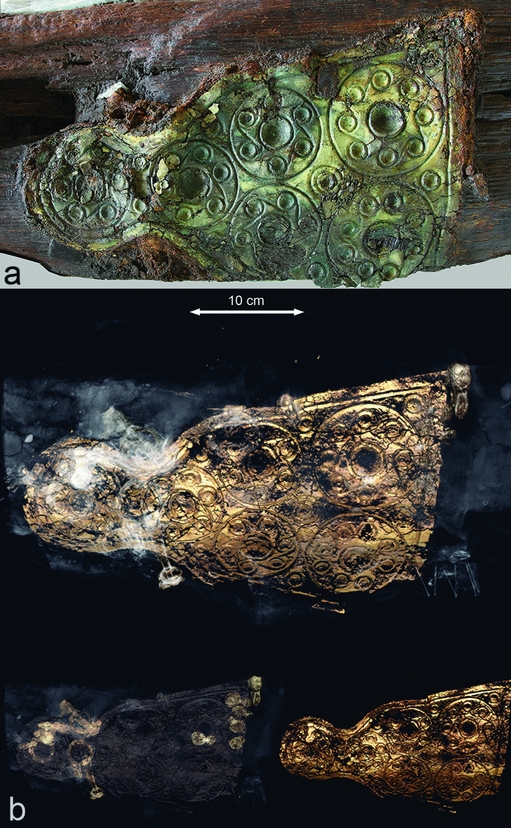
Near the feet of the second skeleton, a bronze sheet nearly 0.4m long was identified (Figure 3a; 11a). The sheet is decorated with six phalera-like circular elements each withcentral circular bosses. Smaller circles linked by tangential lines form rings around each boss. This motif is found only rarely in the central and western parts of the Hallstatt culture (Kilian-Dirlmeier Reference Kilian-Dirlmeier1972: pl. 94–95), but close parallels are known from Slovenia (Teržan et al. Reference Teržan, Lo Schiavo and Tramuž-Orel1985: 188, 245, 258 nos 1008, 1484, 1564; Gabrovec et al. Reference Gabrovec, Kruh, Murgelj and Teržan2006: 36 no. 83). Computer tomography showed the remains of an iron horse-bit with cheek pieces placed sideways beneath the southern extremity of the bronze sheet (Figure 11b), revealing its original function and explaining its peculiar shape: the flat, northern end would comfortably fit the forehead of the horse; the inward curves at the corners of the southern end would fit the bottom of the bridge of the horse's muzzle. The X-ray also revealed at least eight lens-shaped iron pendants that decorated the upper end of the sheet and the horse's forelock. Given this context, the traces of rough plant netting and the remains of fur that are preserved on much of the inside of the bronze sheet can be interpreted as padding for the bronze horse forehead armour or ‘chamfron’. To date, chamfrons are unknown for the Hallstatt culture. Apart from the very contentious interpretation of the ‘Torrs chamfrein’ (Briggs Reference Briggs, Gosden, Crawford and Ulmschneider2014: 341–55), there is no archaeological evidence for head-armour for horses from the entire region north and north-west of the Alps during the Iron Age. Such items were, however, in use from the ninth century BC in various parts of the Near East, especially in Assyria, and in the eighth and seventh centuries they appear as grave goods in high-status burials on Cyprus; for example, in Salamis (Littauer & Karageorghis Reference Littauer and Karageorghis1969). On the Greek mainland, chamfrons (prometopidia) are found sporadically from the seventh century BC (Kunze Reference Kunze1967), but are recorded more regularly in the seventh and sixth centuries in southern Italy (Nortmann et al. Reference Nortmann, Neuhäuser and Schönfelder2005: 176–77) and from the northern Pontic steppes, which were inhabited by mounted nomads for roughly the same period (Feld Reference Feld1999: 115).
a) The bronze chamfron in situ; b) 3 XCT views of the chamfron. In the bottom right of the image, the chamfron has been erased so that the iron bit and the forelock pendants are visible.
Dendrochronological dating of the grave
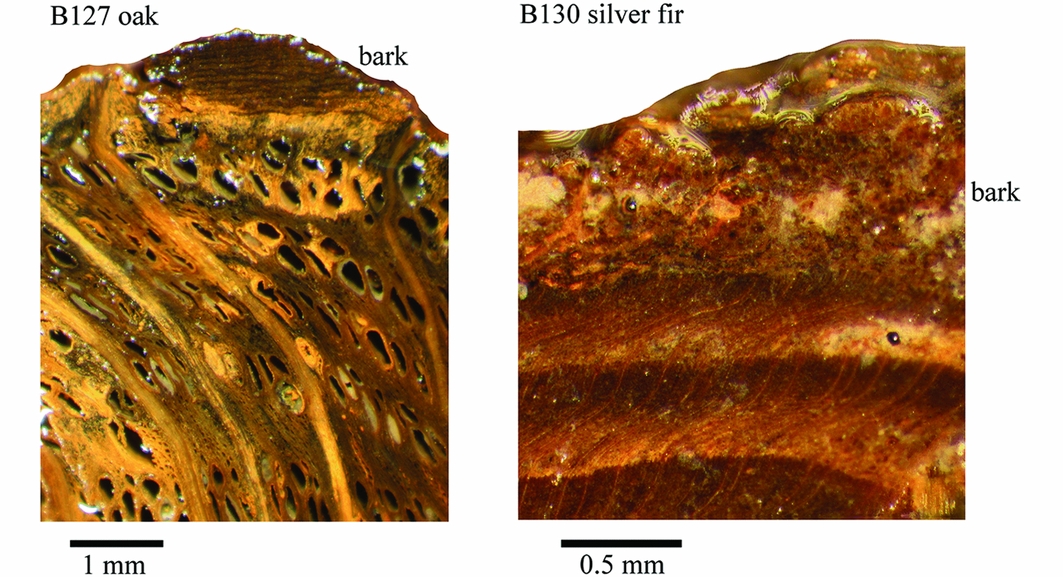
The real treasures in the grave are the 21 preserved oak and silver fir timbers of the burial chamber (Figure 4). Three-hundred-year-old oak trees had been felled and split. The tree-rings stretch back to the ninth century BC. Initial dendrochronological analyses on site using an increment borer dated the grave roughly to a period around the turn of the seventh to the sixth centuries BC. During the excavation of the grave in the laboratory, systematic sampling produced a total of 55 wood samples (43 wood slices and 12 core samples), allowing the building of tree-ring chronologies for oak (291 years from 873–583 BC) and silver fir (102 years from 684–583 BC). The final sample from oak timber (B127), obtained in March 2015, confirmed the date provided a year earlier by the silver fir timber with bark (B130) (Figures 4 & 12). The results revealed that the trees used to construct the burial chamber were felled in the second half of 583 BC (correlation with the River Main chronology (Hohenheim): t-value Baillie/Pilcher 9.8, 290 years overlap).
Cross-sections of one of the oak planks (left) and of the silver fir plank (right) with final tree-ring and bark dating to 583 BC.
The timbers are also an important palaeoecological archive, providing information about the climate, the development of forest and other environmental conditions during the Early Iron Age. Although a slight dating shift due to delayed timber use (e.g. log stapling or wind-fallen trees) of wood that had been stored for some time cannot be precluded absolutely, the presence of bark and traces of deep blows of an axe, cutting through wood fibres, on the northern end of B128 make clear for both tree species that the wood was freshly processed.
In contrast to the burial itself, with its rich grave goods, the timber construction of the grave appears improvised. The use of mature oaks of heterogeneous growth together with silver fir, which otherwise played only a supplementary role in the Heuneburg region (Billamboz Reference Billamboz and Krausse2008), suggests that there was a problem obtaining suitable timber at that time. Further analysis of the cockchafer signal found in some oak trunks (Billamboz Reference Billamboz2014), and of the tree-rings from a palaeoecological perspective, should provide more precise information on the reduction in tree cover and on land use.
Discussion
Assuming that the burial chamber was constructed soon afterwards, the death of this prominent member of Hallstatt society at the Heuneburg can be dated to 583 BC. This precious grave is thus a key element in the absolute chronology of the Early Iron Age in Europe, a chronology that has been the subject of much controversy (Trachsel Reference Trachsel2004; Krausse Reference Krausse2006: 70–96; Guggisberg Reference Guggisberg2007). The navicella-type fibulae, the strip earring and the jet bracelets position the main burial in phase Ha D1 (Krausse Reference Krausse2006: 73–78) of the relative chronology of the Late Hallstatt period and period IV of the Heuneburg (Sievers Reference Sievers1984; Kurz Reference Kurz2000). Yet the burial also contains a number of objects that have their closest parallels in regions to the south of the Alps. In addition to the gold spheres with filigree decoration, the amber fibulae from the grave in particular allow a detailed comparison with numerous Sanguisuga fibulae with amber decoration on their bows, which occur in many variants in Italy and Slovenia (Eles Masi Reference Eles Masi1986: 144–50; Glunz Reference Glunz1997: 70–74; Gabrovec et al. Reference Gabrovec, Kruh, Murgelj and Teržan2006: 33). The fact that the burial from Bettelbühl can be dendrochronologically dated to a specific year anchors the absolute chronology south of the Alps, which could previously draw on very few securely dated complexes from the seventh and the first half of the sixth centuries and was accordingly vague (Trachsel Reference Trachsel2004; Guggisberg Reference Guggisberg2007).
The burial from Bettelbühl is of particular significance in the debate regarding the socio-historical interpretation of the elite burials of the Hallstatt period (Krausse Reference Krausse, Karl and Stifter2007; Schier Reference Schier and Krausse2010). It marks the beginning (for now) of a series of rich and elaborate Hallstatt and early La Tène female graves with gold found north-west of the Alps (Metzner-Nebelsick Reference Metzner-Nebelsick, Bagley, Eggl, Neumann and Schefzik2009); it is almost 100 years older than the grave of the ‘dame de Vix’ (Rolley Reference Rolley2003), and some 200 years older than that of the ‘Fürstin von Reinheim’. The complex is of particular socio-historical interest due to the presence of the secondary burial of the two- to four-year-old child, the gold jewellery from which has close similarities with that from the privileged woman in the main burial. The size and form of the child's fibulae suggest that they were made especially for a small child, probably a girl. Husty (Reference Husty1990) has drawn attention to the increasing number of infant burials with rich grave goods during the Hallstatt and the early La Tène periods. The burial complex from Bettelbühl demonstrates for the first time that, as early as the beginning of the sixth century BC, female members of the social elite in the north-west Alpine Hallstatt culture—and even children—were buried in rich, ostentatious graves. It seems that similar processes also took place in the contemporary south-eastern Hallstatt culture, where rich female burials with gold grave goods appeared for the first time during the seventh century BC (Gustin & Preložnik Reference Gustin, Preložnik, Karl and Lescovar2005). In this regard, the rich female burial of Stična, barrow 68, grave 27, is of special interest: the gold jewellery from this grave shows remarkable similarities to the finds from Bettelbühl (Gabrovec et al. Reference Gabrovec, Kruh, Murgelj and Teržan2006: 32–36).
Schumann (Reference Schumann2015: 295–303) recently discussed in detail whether the filigree earrings from the richly furnished child's grave of Bettelbühl were status symbols or prestige objects. The complex provides new impulses and arguments for the core discussion concerning the social dimensions of the Hallstatt culture (Krausse Reference Krausse, Karl and Stifter2007; Schier Reference Schier and Krausse2010) that had otherwise come to something of a halt for lack of significant new material.
The results of the excavations at Bettelbühl also shed completely new light on the history and development of the Heuneburg itself. Previously, only elite burials that had been obviously looted were known from the period of the mud-brick wall—i.e. the first half of the sixth century BC—in the area around the Heuneburg (Kurz & Schiek Reference Kurz and Schiek2002: 35). The mud-brick architecture here seemed strangely isolated: Mediterranean imports from the settlement are all of a later date from the second half of the sixth century (Kimmig Reference Kimmig2000). The finds from the woman's and child's graves from Bettelbühl now demonstrate that the Mediterranean mud-brick architecture is only one indicator of the importance of the Heuneburg in the continental exchange of raw materials, goods, information and services across the Alps and beyond. It seems that, in the early sixth century, masterbuilders acquainted with masonry and mud-brick architecture were not the only craftspeople with knowledge of distant techniques working on the Heuneburg. The gold filigree objects, the amber fibulae and the horse's chamfron each demonstrate much closer connections with the area to the south of the Alps than was previously realised.



