




Introduction
Global scholarship on archaeology has invested heavily in debates about objects, their potential agency, and the implications for understanding past societies (Olsen et al. Reference Olsen, Shanks, Webmoor and Witmore2012; Knutson Reference Knutson2021). Regardless of their research preferences, many archaeologists working in Africa broadly agree that there is a need to account more effectively for how the human-object interface functions. The reality of archaeological research, however, does not always reflect this intention. In inland East and southern Africa, for instance, most projects are still site specific, obscuring human-object entanglements and wider systems of aesthetics and value. Research on the Middle Iron Age (AD 750–1250)—a period characterised by evidence of the increased circulation of objects within both regional and global networks—often emphasises cities and the consumption of foreign items, or ‘prestige goods’, in relation to the maintenance of political power (see Kusimba Reference Kusimba1999; Chirikure Reference Chirikure2020). Similarly, the African origins of raw materials, such as ivory, gold and rock crystal, are typically explored in relation to their potential for global exploitation. As a result, interior Africa and its mosaic of societies are reduced to a source of materials that are of value to global political economies, rather than as the origin for objects made, transformed, combined, repurposed and consumed. Thinking in novel ways about materials, agency and value in Africa during this period can alter and strengthen archaeologists’ understandings of power in the past.
With that in mind, we present data on material transformations of small, portable objects, including shells and beads, in hitherto widely overlooked contexts of inland East and southern Africa during the Middle Iron Age. We demonstrate three types of object transformations: (re)making, or the reconfiguration of an object from its original form or material; bundling, or the combination of objects into a new entangled form and meaning; and repurposing, or using an object in a new way distinct from that originally intended. We then articulate how this framework of transformation helps to recast political economy, before concluding with observations on some wider implications for theory and representation in African archaeology.
Background
Analyses of the trajectories of objects as they were produced, exchanged and consumed are central to archaeological reconstructions of the political economies of past societies (Kristiansen & Rowlands Reference Kristiansen and Rowlands2005). Studies of the political economy—broadly defined as the relations of power and economy—have historically been dominated by top-down, macro-scale analyses of production and distribution under elite control. Increasing attention, however, has shifted to bottom-up approaches encapsulating regional and local practices of production, exchange and consumption (Smith Reference Smith2004; Prestholdt Reference Prestholdt2008). Drawing on research that has sought to investigate a wide range of actors in distinct sectors of society, with particular attention on the domestic economy and practices of everyday life, bottom-up approaches can provide multiple rich and nuanced insights into the workings of power and economy (Furholt et al. Reference Furholt, Grier, Spriggs and Earle2020). Recent scholarship on the archaeology of Africa demonstrates that novel approaches to the study of people and material culture informed by local epistemologies can similarly transform archaeologists’ understandings of systems of value and political economies (Donley-Reid Reference Donley-Reid1990; de Luna Reference De Luna2012; Arthur Reference Arthur2018).
However, top-down approaches to the political economy of African societies, inherited from colonial-era archaeologists, continue to challenge regional practitioners (Monroe Reference Monroe2013). During the late first and early second millennium AD, southern and East Africa were variously integrated into global networks that spanned the Indian Ocean world. Early archaeological projects to investigate the political economy of ‘complex’ or ‘state’ societies during this period focused on sites with evidence of urbanism and external trade, for instance the Swahili city-states of the East African littoral and the stone-walled ruins of the Zimbabwe culture, both originally, and erroneously, interpreted as foreign foundations. Such value assumptions about long-distance exchange and foreign objects from the Indian Ocean region often still shape how the political economy of southern and East Africa has been understood and represented in archaeological research. While new and innovative scholarship at urban centres is now revealing their complex political economies (Wynne-Jones & LaViolette Reference Wynne-jones and LaViolette2018; Chirikure Reference Chirikure2020), a dearth of systematic research at other types of sites inhibits interpretations of the social value of locally made and introduced objects across the wider region (Moffett & Chirikure Reference Moffett and Chirikure2016; Klehm Reference Klehm2017; Walz Reference Walz2017a; Biginagwa et al. Reference Biginagwa, Mapunda and Ichumbaki2021).
The general absence of critical studies of object meanings derives partly from established archaeological practice. In African archaeology, excavation reports often categorise and discuss objects discretely according to material, with separate chapters for ceramics, metals, faunal remains and so forth. Descriptive culture-history sequences have further dominated the study of particular materials, such as ceramics, resulting in an overreliance on pottery in interpretations of identity and population movements. Interrogative object-oriented studies that employ different analytical techniques, such as archaeometric methods, are patchily applied. While glass beads (Wood Reference Wood2012), ivory (Coutu et al. Reference Coutu, Whitelaw, le Roux and Sealy2016) and, more recently, copper (Stephens et al. Reference Stephens, Killick, Wilmsen, Denbow and Miller2020) have been the focus of provenance studies, assessments of modification due to consumption patterns is often missing. Analysis of context, itineraries and affordances can elicit the intersection of value and power in the use, circulation and consumption of objects across different regions. This kind of scholarship requires us to treat objects not as isolated finds representative of a singular narrative, as is often the case with ‘exotic’ objects, but rather as fragments of a whole where meaning is embedded within an assemblage and within intra- and inter-societal relationships (Ogundiran Reference Ogundiran2009).
Building on this scholarship, our approach to objects, social embeddedness and political economy combines a novel conceptual framework and spatial focus, engaging with material transformations in archaeology to examine the relevance of this approach for richer reconstructions of political economy. We draw on, and bring into dialogue, two unique case studies of communities located in the inland regions of southern and East Africa during the Middle Iron Age. The ‘Middle Iron Age’, AD 750–1250, is the soft boundary between the Early and Late Iron Ages, a phase of transformation for almost all agricultural and many non-agricultural societies in Africa south of the Sahara, characterised by population growth and new political formations (Chirikure et al. Reference Chirikure, Mukwende, Moffett, Nyamushosho, Bandama and House2018; Kusimba & Walz Reference Kusimba and Walz2018). The geographical focus, on inland East and southern Africa, brings into conversation two regions that were linked to each other within the continent and to broader Indian Ocean networks (Figure 1).
Map of East and southern Africa with regions and archaeological sites under discussion noted (figure by Abigail Moffett).

We demonstrate the transformative potential of a socially embedded perspective on objects through an analysis of the circulation of small, portable objects, such as beads and shells, whose diverse uses have received little attention. By integrating an overall aesthetic that encapsulates ‘object itineraries’ (Joyce & Gillespie Reference Joyce and Gillespie2015), we explore the remaking, bundling and repurposing of these objects. We challenge basic interpretations that highlight urban centres and ‘prestige’ goods economies to understand power in inland East and southern Africa, and instead offer an alternative perspective by assessing objects within the context of everyday use. Adopting this approach reveals how different southern and East African communities were not passive recipients of objects and ideas from elsewhere but innovated their own material worlds that in turn had an influence on inter- and intra-regional social relations.
Object transformations in the region
Regional scholarship on object production and transformation traditionally emphasises ceramics and iron implements, which were important mainstays of African archaeology during the Middle Iron Age (e.g. Schmidt & Mapunda Reference Schmidt and Mapunda1997; Fredriksen Reference Fredriksen2011), but African communities also created and transformed a range of other objects in innovative ways. Small, portable objects, such as personal adornments made of shell, copper, iron, glass and bone are often classed as ‘complete’ or ‘finished objects’ in site reports, and their potential as transformed objects with more entangled and mutable uses and meanings is poorly researched. Focusing on these objects, we explore three specific categories of object transformation, which thus far are understudied in this area: remaking, bundling and repurposing. Archaeological examples may have multiple overlapping types of transformation; we outline these categories, providing examples of each, before composing a regional narrative that addresses how these approaches to object transformation can contribute new perspectives on political economy.
Remaking
Remaking is either disassembling and then reassembling in a different way components of a pre-existing object (or objects) or making an object in a substituted material. Textiles are a clear example of the former: in this case, an entanglement of ‘local’ and ‘foreign’ objects. In the early sixteenth century AD, Duarte Barbosa described the production of textiles by cloth manufacturers in Sofala, Mozambique (Freeman-Grenville Reference Freeman-Grenville1962: 128). Colourful cloth produced in India and acquired through maritime exchange was unravelled and rethreaded with locally spun white cotton, a fibre grown in coastal and inland regions of south-eastern Africa. In their new form, these foreign textiles were subsumed into a different cultural logic.
When considering small portable objects, glass beads are widely assumed to have been produced elsewhere and imported to southern and East Africa as ‘finished products’. Recent research in West Africa, however, has overturned the long-standing assumption that glass was not manufactured in pre-colonial Africa south of the Sahara (Babalola et al. Reference Babalola, Dussubieux, McIntosh and Rehren2018). In inland East and southern Africa, there is significant evidence to suggest glass objects were also remade. Evidence of Middle Iron Age glass working at K2 (AD 1000–1200) in northern South Africa demonstrates that glass beads were melted down and cast in specialist ceramic moulds to form a variety of large cylindrically shaped beads, known regionally as ‘garden roller’ beads (Wood Reference Wood2011). In this way, pre-existing objects were recast to meet local needs and uses.
It is useful to assess the links between glass remaking and other items that were remade in ceramic crucibles, such as bronze (a copper alloy). Bronze production—an innovation that appears from the early second millennium AD in inland southern Africa—involved the melting of tin and copper, two metals probably sourced from disparate locations. In a similar way to glass, copper and tin items were made, or remade, into a variety of new forms, including bangles, rings and beads, with new affordances, uses and meanings (Chirikure Reference Chirikure2015).
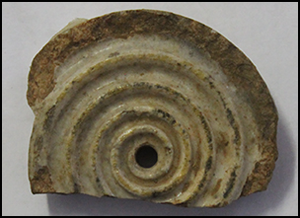
Inland African societies made other objects through material substitution, emulating one type of object, such as disc beads of marine shell, with objects bearing similar affordances (e.g. form, size and colour) made with locally available resources, in this case, the shells of local land snails: Lissachatina spp. (Walz Reference Walz2017a). Ease of access to each of these shell raw materials differed by area and thus they were utilised by relatively distinct communities. As mobile items and social markers, these beads of different materials but similar affordances helped to determine regional social relations as groups exchanged and/or emulated beads and also bundled them with beads of other materials. Remaking casts light on a range of processes, from the intimacy linked to the modification of an individual adornment, such as a bead, for personal use, to the agency within which other materials shaped the value of new objects. African objects were also remade by Europeans: ndoro—perforated Conus virgo shells—were remade in ceramic by Portuguese merchants in an attempt to copy, and thus enter into the trade of, this popular South-east African adornment (Pikirayi Reference Pikirayi2001; Figure 2).
A ceramic ‘ndoro’ pendant recovered from the site of Great Zimbabwe (photograph by Abigail Moffett).

Bundling
Bundling involves bringing previously disparate objects into proximity so that the multiple components combine to elicit new meaning. While often documented as individual objects, beads and other easily portable items, such as shells or shell parts, were rarely employed in isolation. There are many instances of bead strings (or segments), including those of interdigitated beads of local and external origin (Figure 3A). Some of these strings of beads show modification or use-wear that demonstrates these beads were bundled together. The beads were threaded into composite items or sewn into textiles or onto clothing, or embodied in coiffures. Bone awls and metal needles threaded textiles and animal skins, while metal wires and fibres fastened beads of glass, bone and other substances. Individual adornments were also inserted into one another to yield new multi-component objects (Figure 3B). Combinations created new sensory effects, from new colours or the play of light to strings of waist beads that made sounds as a person moved.
A) glass and shell beads recovered with a cowrie shell from a burial context at K2 in South Africa; B) a composite object made up of a copper cone and shell from Kwa Mgogo in East Africa; C) a bundle made of a snake vertebra and beads of carnelian, rock crystal and aragonite (glass beads not pictured; additional objects pictured), also recovered from Kwa Mgogo (photographs by Abigail Moffett (A) and Jonathan Walz (B and C)).

Objects reconfigured in bundles may have acquired new meaning. A bundle had the potential to change the relational fields between the objects in close association, but also to alter “the potential relationships and mediators of such fields” (Pauketat & Alt Reference Pauketat, Alt, Robb and Pauketat2013: 77). In shrine assemblages from West Africa, evidence of the repeated bundling of glass and carnelian beads, vertebrae from pythons, and iron and other objects reveals how bundles became implements of new ritual habits (Stahl Reference Stahl, Harrison-Buck and Hendon2018) and spiritual concepts (Kankpeyang et al. Reference Kankpeyang, Nkumbaan and Insoll2011). Similar bundles—particularly adornments comprised of modified snake vertebrae, and beads of glass, carnelian, rock crystal and/or aragonite, in association with whole land-snail shells—have been recovered from Kwa Mgogo in inland Tanzania, and interpreted in connection with healing practice (Figure 3C) (Walz Reference Walz, Winterbottom and Tesfaye2015, Reference Walz2017b). In southern Africa, bundles of glass, metal and shell beads placed in the neck and pelvic areas of juvenile burials acted to reconfigure relations between the living and the dead (Moffett & Chirikure Reference Moffett and Chirikure2016).
Repurposing
Repurposing relates to the use of an object for a purpose other than the one for which it was originally made. Studying an object's itinerary and this repurposing, through use-wear, residues, modifications and context, can reveal some of the ways in which purpose was articulated through an interplay of material affordances, physical constellations, and human sensory and emotive experiences.
Shells, and eggshells of animals, were used in ways that changed during their itineraries. Some whole shells, for instance of Lissachatina spp., were first used as containers for food, salt, mastics, cosmetics or hunting poisons. The shells were later made into perforated disc beads. This sequence of use is apparent from multiple residues on the inner surfaces of disc beads recovered from Kwa Mgogo, a transformative practice also evident among contemporary communities (Walz Reference Walz2017b). In general, land-snail shells satisfied multiple pragmatic and social uses, perhaps enabled by the unique affordance of a prominent spiral-like pattern in their whorl. Turning to marine shells, a cowrie with a highly worn ventral surface and a partially broken but unsmoothed dorsal surface may have been collected as beach wash and later formed part of a bundle used in ritual practice, while another shell with a broken and worn dorsal surface may have been worn as an adornment at one point in its itinerary (Moffett et al. Reference Moffett, Nyamushosho, Bandama and Chirikure2022) (Figure 4).
Top row: the dorsal and ventral surface of a highly worn cowrie with a partially broken, unworn dorsal perforation. Bottom row: the dorsal and ventral surface of a cowrie with a broken and highly polished dorsal perforation. Shells recovered from Shankare, South Africa (photographs by Abigail Moffett).

In other archaeological settings, shells or small ceramic sherds were repurposed in association with pyrotechnologies. For instance, unmodified land snail shells and objects made of this material sometimes were crushed and employed as flux for smelting iron. A few slags from Kwa Mgogo have impressions of land snail shell objects, including beads. Their use seems to have served a socio-technical purpose (Walz Reference Walz2017a). Meanwhile, slag residues from the iron-smelting process were used to temper some ceramic crucibles. In turn, the itineraries of those crucibles sometimes demonstrated use in other tasks including cooking (Bandama et al. Reference Bandama, Moffett and Chirikure2017). The repurposing of objects to meet different needs shows resourcefulness and ingenuity, an observation underappreciated to date because of the way that archaeological research tends to presume that objects have singular functions, rather than investigating them as artefact assemblages with variations in use and in relation to social context.
Realising political economy
Evidence of remaking, bundling and repurposing informs new narratives about the meaning and value of objects to Middle Iron Age communities. In this section, we explore the implications of these practices for the political economy of inland East and southern Africa. These inland regions, often deemed ‘peripheries’, fall outside the conventional focus of political economy in southern and East Africa during the Middle Iron Age.
Regional entanglements
Interpretations of the Middle Iron Age political economy of inland East and southern African communities draw on archaeological work conducted at a limited number of large, urban sites. The recovery of rare locally made items—such as bronze, and external or marine coastal items, such as glass beads, marine shells and residues from the new technology of cotton cloth production at these sites—has contributed to archaeological assumptions in which these objects functioned as symbols of status and wealth.
Research at sites located beyond the peripheries of southern Africa's early states and the Swahili city-states provides an important avenue for exploring networks of interaction and consumption. Recent investigations at Shankare, a copper production settlement in north-eastern South Africa dated to AD 900–1300, for example, has recovered objects conventionally classed as ‘prestige goods’, revealing some of the ways in which technologies and objects were reconfigured within domestic economies and regional social networks (Moffett et al. Reference Moffett, Hall and Chirikure2020; Figure 1). Glass beads of similar types to those used at the early urban centres of Mapungubwe (South Africa) were also identified alongside other ‘prestige items’, including cowrie shells (Monetaria annulus) and evidence for the technology of cloth production. These shells and glass beads did not replace other types of beads, such as ostrich eggshell beads or cupreous metal beads, but instead were used and deposited in similar domestic contexts, including middens and house floors. Many of the cowrie shells were reworked, with their dorsal surfaces removed, and show evidence of use through heavy polish on the dorsal breaks (Figure 4). This use pattern indicates that shells were attached to other items, such as cloth or leather to create a bundle, or attached directly to the human body in various sensory and aesthetic reconfigurations.
Similar patterns in the circulation of ‘foreign trade items’ in non-urban contexts appear in inland north-east Tanzania (Figure 1), where systematic, regional-scale archaeology in the lower Pangani Basin has recovered substantial evidence of local production, consumption and intra-Africa exchange. Circa AD 1000 communities of different food-producing and food-gathering strategies intersected in the Pangani Basin, with settled horticulturists being predominant within this social mosaic (Walz Reference Walz2017a). Cooperation and competition among these groups created systems of value partly structured by interactions through material culture (Mitchell Reference Mitchell2005: 24–5) and motivated by contextual risks (such as unstable climate scenarios). During the last quarter of the first millennium AD, the population of the river basin grew. There is evidence of semi-specialised craft production and more varied consumption. Larger settlements (>5ha) increased their production of iron and land snail beads, and demonstrate greater frequencies of non-local items of deep interior, highland, coastal and global origin; later, they developed more specialised pastoralism and terraced cultivation. Materials recovered from the site of Kwa Mgogo exemplify object (re)making, bundling and repurposing, especially in relation to adornments. Different ornament types were bundled, for instance, a pierced marine shell (Volvarina sp.) embedded in a copper cone or a glass bead embedded in the apex of a marine gastropod (Conus sp.; Figure 3). Disc beads of different types were strung into necklaces, with segments of up to 14 beads recovered during excavation. Adornments of shell, carnelian, rock crystal and glass were interdigitated on organic fibres. Multiple burials also included burned shell discs (Walz Reference Walz2017a).
The processes of remaking, bundling and repurposing beads and shells are further visible in burial practices across the southern African interior and in East Africa. Burial data from a range of sites in southern Africa dating to AD 750–1300, including so-called ‘elite’ and ‘commoner’ burials, show the ways in which different types of beads were brought together in new configurations. Investigations at a range of sites have recovered beads of glass, land snail, ostrich eggshell and metals (gold, copper and bronze) from the burials of infants, juveniles and adults (Moffett & Chirikure Reference Moffett and Chirikure2016). Many of these beads were deposited in the neck and waist areas, with evidence that some were once worked into organic materials that subsequently have decayed.
This regional pattern suggests beads of shell, glass and metal had affordances that enabled them to evoke similar affective responses in their users. Properties such as the small size of beads, the shiny patina and translucence of some glass, and the bright white of shells, in combination with their attachments to materials, such as cloth and leather, created a sensory aesthetic of belonging. As burial objects, the bundling of beads with pottery and bodies in this unique spatial format reconfigured the relational fields of these objects to the deceased by constituting a part of their personhood.
Patterns in the density and contextual distribution of bead varieties in north-east Tanzania vary, based on locality and association, providing an indication of differing interests. Small artefacts were portable, could be embodied, and were readily transformed leading to variations in their treatment and combination that enabled social signalling (Walz Reference Walz2017a; Walz & Dussubieux Reference Walz, Dussubieux, Dussubieux and Walder2022: 280). Combinations of ornaments of materials potentially sourced from even further inland (e.g. copper) with those from the Indian Ocean (e.g. early Asian glasses), signalled new relations in a shifting commercial scenario of an increasingly interactive character. For instance, a tradition of marine shell disc beads made at the Indian Ocean coast surged between AD 750 and 1100, exemplified by Shanga, an early Swahili town on the Kenya coast (Horton Reference Horton1996). At Kwa Mgogo, beads of glass from South-west Asia appear as early as the eighth century AD (Zhizo glass), perhaps showing an expanded interest by Swahili elites in Indian Ocean versus inland partners (Walz & Dussubieux Reference Walz, Dussubieux, Dussubieux and Walder2022). By the twelfth century, the popularity of marine shell disc beads at the coast had declined, followed by a brief surge in production of marine shell tube beads from the spires of Strombus spp. At Kwa Mgogo, marine shell disc beads and, in the immediately subsequent excavation levels, 16 marine shell tube beads, mirror these coastal trends in bead production, bolstering arguments for regional entanglement.
By AD 1000, semi-specialised production of land snail shell discs at Kwa Mgogo—evidenced by all stages of the production process—evinces a changed political economy. Land snail shell beads made by inland communities helped to establish and fortify interactive networks across the region among diverse communities, facilitating alliances and access to social networks that assuaged environmental and social risks. At first, Indian Ocean glass beads reinforced previously established bonds across the region, and thus were integrated into bundled adornments (e.g. necklaces). Thus, the wearing of land snail shell beads enabled intergroup social relations where communities and spheres of exchange intersected. These shell discs saw an expansion during a period when Swahili coastal communities may have turned increasingly to new oceanic partners. In other words, land snail disc beads had a value beyond simple use. Communities that participated in bead making, material substitution—the replacement of marine shell discs with land snail shell discs similar in appearance—and consumption, such as public adornment and rituals of discard, negotiated and benefitted from a wider social network.
The itineraries and the repurposing of these portable objects in individual burial contexts and within small sites, such as Shankare and Kwa Mgogo, illuminate mechanisms of power and economy in multiple ways. The recovery of spindle whorls, cowrie shells and glass beads from early second-millennium contexts beyond conventional urban centres indicates the widespread flow of these items within regional economies. The exchange of locally produced objects such as shell beads, iron, copper, salt, cattle and agricultural goods across these regions were embedded in social networks in inland East and southern Africa. The presence of new materials and knowledge, such as glass beads and technologies of cotton production, suggests these items were not limited to elite exchange and consumption but rather incorporated and reconfigured within these wider social networks of connectivity. Their varying and non-linear distribution underlines the fact that the exchange and use of these objects was not a result of ‘down-the-line’ exchange, but embedded in complex social relations, resulting in the objects’ varied and myriad uptake and use.
At the scale of the community, the integration of new materials and technologies, such as the spinning of cotton, into different domestic economies, reveals the degree of flexibility, adaptation and reconfiguration of materials and technologies on the part of producers and consumers. Finally, for individuals, the repurposing of shells at Shankare and Kwa Mgogo into objects of adornment reveals the agency of people to shape the meaning of these items in everyday practice.
Discussion and conclusion
Emerging research and reassessments of previous finds show that objects in the archaeological record of inland East and southern Africa are not rigid in their uses or meanings. Nor should items be simply categorised as geographically ‘internal’ or ‘external’. Objects have itineraries that are more fully understood through recognition of their potential to be (re)made, bundled with other objects and repurposed within systems of knowledge and meaning. Realising these transformations produces insights into the political economy, which helps elucidate daily life, power, agency and pasts in regional societies. Our concluding discussion elaborates what changes are needed in practice to address more effectively these object transformations and their social embeddedness.
A new approach to political economy—based on good-quality, systematic research—may inevitably encourage knowledge transfer between studies of southern and East Africa during the Middle Iron Age. Similarities in the treatments of materials at sites as far flung as South Africa and north-east Tanzania, are striking, for instance, with the insertion of single glass beads into the apex of Conus sp. shells. Affordances of objects should be closely documented: size, colour, translucence, patina, modification and so forth. Attention to the inter-artefactual domain (relations among objects within an assemblage), material substitution, bundling in specific feature types and evidence of local innovations and knowledge transmission across the region are essential if we are to grasp their variations and alignments. The dynamism and innovations indicated in materials should be married to evidence of performance and different modes of production and exchange, which might be done using artefacts or macro-patterns across landscapes, for instance, but where possible also should take into account evidence from cognate disciplines (e.g. oral traditions and historical linguistics; de Luna Reference De Luna2012; Walz Reference Walz, Winterbottom and Tesfaye2015). Research investing in these methodologies will help archaeologists to rethink power in areas formerly considered passive peripheries, and then enable them to vigorously explore the intersections among communities (e.g. food producers and food gatherers, rural and urban, and so forth) and reverberations at their frontiers (e.g. Kusimba et al. Reference Kusimba, Kusimba and Dussubieux2013).
Such an object-oriented approach—more fully realising transformations of objects and their relevance to political economy—will make for more human pasts and an Africa-informed archaeology (and not just an archaeology in Africa). In addition, if practised judiciously, studies of object transformations will reposition Africa and Africans within networks of power that linked the continent to other regions, while accounting for how Africans domesticated non-local objects exchanged from other areas of Africa or beyond. Prestholdt (Reference Prestholdt2008) has demonstrated how, in nineteenth-century East Africa, African consumer preferences dictated global markets. Similar patterns, discernible in the archaeological record in the form of reproductions of African objects by European manufacturers (such as the ndoro shell), point towards the unrealised power of African influence in earlier intra-regional and global interactions.
To achieve this goal necessitates interdisciplinary scholarship that assembles the full range of social and historical contexts and accounts for their change over time. Investigations of contemporary transformations to materials can provide exemplars or facilitate models to be carefully tested. Similarities and differences in the treatment of objects across space and through time, related to power and meaning, can discern cooperation or competition between communities, or causes of florescence or decline in societies. An approach that uses diverse methods and applies regional knowledge has the best chance to address in meaningful ways the trends and subtleties of object itineraries at the human-object-context interface.
Large, elaborately built sites, such as the Swahili stone towns or Great Zimbabwe, have attracted archaeologists and elicited interpretations of objects typically focused on origin, uniqueness and persistence. In contrast, archaeologies of object transformations are real but largely unrealised in the study of inland East and southern African societies c. AD 1000. In particular, African ideologies are less studied in the outlying landscapes of this period, and almost always address ceramic or iron artefacts and technologies. Through the concepts of remaking, bundling and repurposing, and through a focus on other objects—such as adornments—we have emphasised the new opportunities to investigate the dialectics of transformation, consumption and power.
Acknowledgements
We thank three anonymous reviewers for helpful comments on earlier drafts of the manuscript.
Funding statement
Abigail Moffett's research was supported by a British Academy Newton International Fellowship. Funding from the National Research Foundation of South Africa to support her doctoral research is acknowledged. Jonathan Walz's research in Tanzania was supported by a Fulbright-Hays Doctoral Dissertation Research Abroad Award from the US Department of Education. Funding from the US National Science Foundation facilitated analysis of glass beads from Tanzania.


 Open access

