


Impact statement
This review highlights the urgent need for a systemic transition toward a circular plastic economy, emphasizing that current mechanical recycling alone cannot meet regulatory or environmental goals. By analyzing the limitations of existing recycling practices and comparing emerging technologies such as thermal treatment, dissolution recycling, and chemical depolymerization, it provides a comprehensive assessment of pathways to close the loop on plastics. The article underscores that technological innovation must be coupled with stable regulatory frameworks, infrastructure investment and market development for recycled materials to compete with virgin resins. The review integrates lifecycle perspectives, showing how upstream design choices, such as simplifying material composition and reducing harmful additives, are as critical as downstream recycling efficiency. The discussion reinforces that reducing single-use plastics, promoting reuse and designing for recyclability are indispensable pillars of circularity. By bridging technical, economic and policy dimensions, this review offers an actionable roadmap to reduce plastic leakage and advance sustainability.
Introduction
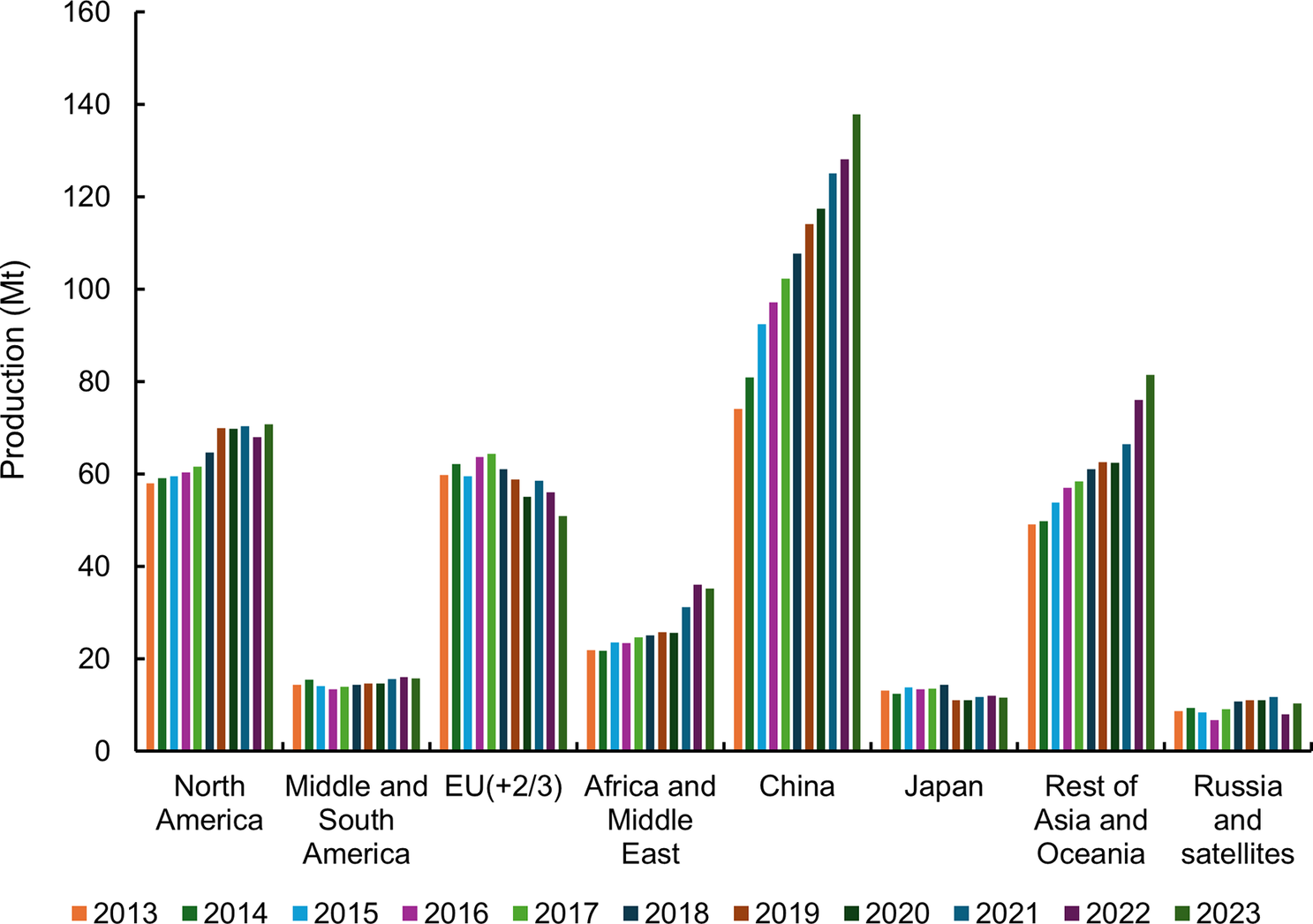
The worldwide production of plastic has experienced a steady increase over the past decades. According to data collected by the Organization for Economic Cooperation and Development, from 2000 to 2019, plastic production has doubled, rising from 234 million tons (Mt) to 460 Mt. (OECD, 2022a). The most recent figures provided by Plastics Europe show that total plastic production amounted to 413.8 Mt. in 2023, of which 374.2 Mt. were of fossil origin, with the remainder consisting of recycled materials and bioplastics (Plastics Europe, 2024b). Plastics Europe also provides data segmented by geographical regions that show a moderate increase in world plastic production during the last decade at an annual rate close to 2.3% in the last 10 years (2.0% considering the last 5 years), although with important regional patterns as shown in Figure 1. A considerable increase is clear in China and India, attributed to ongoing economic development in these countries. Conversely, the more developed countries, including the EU, USA and Canada peaked plastic production during the last decade.
Plastic production by region. Source: Plastics Europe, Plastics the Facts, Reports 2013 to 2024.

It is important to note that a decrease in production in one specific region does not necessarily correspond to lower plastic use due to the impact of international trade. In fact, the OECD Environment Statistics dataset on plastics use indicates a consistent increase across all regions, projecting a global rise of plastic use reaching 1,231 Mt. in 2060 (almost triple with respect to 2019), with an upward trend affecting all regions despite the differences in waste management policies and environmental awareness (OECD, 2022a, 2022b). This figure is probably overestimated. Based on the production data published by Plastics Europe over the past 5–10 years, plastic production has been growing at a rate of 2.0–2.3%. This would result in approximately 850 Mt. of plastic produced by 2060 and a 1.5-fold increase compared to 2019 levels. Additional projections evaluating different scenarios were provided by the OECD in their 2024 report (OECD, 2024a, 2024b). They concluded that, under a business-as-usual scenario, plastic production and use would increase by 70% between 2020 and 2040, corresponding to an annual growth rate of 2.6–2.7%.
The volume of plastic waste generated is intrinsically linked to plastic production, because the current plastic economy predominantly follows a linear model in which most plastic products rapidly become waste (OECD, 2022a). This pattern is driven by two main factors. First, a substantial proportion of plastics have short product lifespans, particularly those designed for single use, most notably in packaging, which represents the largest application of plastics. Second, recycling systems remain limited in scope and efficiency, resulting in most of the plastic waste being landfilled, incinerated, or leaking into the environment. Plastic is a persistent pollutant that accumulates over time due to its low decomposition rate in natural environments. It breaks down into microplastics and nanoplastics, which can remain in the environment for extended periods (Alava et al., Reference Alava, Jahnke, Bergmann, Aguirre-Martínez, Bendell, Calle, Domínguez, Faustman, Falman, Kazmiruk, Klasios, Maldonado, McMullen, Moreno-Báez, Öberg, Ota, Price, Shim, Tirapé, Vandenberg, Zoveidadianpour and Weis2023). There is growing evidence that a business-as-usual scenario would increase mismanaged plastic waste and environmental leakage and that partial measures improving waste management without implementing comprehensive policies would be unable to eliminate plastic pollution. Plastic not only refers to molded and extruded plastic products, but also to textiles, coatings and adhesives, which are not included in the Plastics Europe reports used to generate Figure 1. Specifically, 45.2 Mt. of polymers were used in 2020 for producing synthetic fibers and textiles represent a major contributor to plastic pollution, largely due to the rapid growth of inexpensive synthetic fibers driven by fast-fashion trends (OECD, 2024b).
In this context, the United Nations Environment Programme (UNEP) is promoting a treaty to address plastic pollution across its entire lifecycle, from production and product design to end-of-life management. This entails not only advancing recycling initiatives, but also reducing overall plastic production, restricting single-use plastics to essential applications, and redesigning products to enable reuse and enhance recyclability. While recycling technologies are central to the transition from a linear to a circular plastics economy, they remain insufficient if not accompanied by broader technical innovations and behavioral changes (Mederake, Reference Mederake2023). Despite their potential, both mechanical and chemical recycling face significant technical and economic obstacles. This review, therefore, summarizes the current state of technological solutions and complementary strategies, while acknowledging that such measures alone cannot achieve full plastic circularity.
The Global Plastics Treaty has undergone several rounds of negotiations, but an agreement has yet to be reached among participating states. The proposals under discussion cover a broad spectrum of measures, including reducing plastic production and consumption, phasing out problematic polymers and additives, promoting sustainable alternatives, strengthening producer responsibility schemes and ensuring financial support for waste management systems. However, negotiations are marked by significant disagreements, including divergent geopolitical and economic priorities. Some countries prioritize industrial development over environmental concerns, making it unlikely that plastic resin production will be limited in these regions. Other challenges include the difficulty of assuming transition costs in developing countries, allocating responsibilities among producers, consumers and governments, concerns about potential supply chain disruptions and establishing effective monitoring and enforcement mechanisms.
Recycling initiatives play a central role in the transition from a linear to a circular plastic economy. However, existing mechanical recycling technologies are unable to ensure a sufficient level of circularity. Although chemical recycling offers considerable potential, the diverse range of processes it encompasses continues to face substantial technical and economic barriers. This review summarizes the current state of the art in technological solutions aimed at advancing effective plastic circularity.
The life cycle of plastics
A life-cycle approach considers all activities related to the production and use of plastic materials, beginning with the extraction and processing of raw materials, primarily fossil fuels. These operations include drilling, refining, transportation and chemical transformations that produce the monomers used to create plastic polymers. The monomers are then polymerized to produce plastic resins, which are transferred to compounders, who mix them with additives, fillers and reinforcements to create customized plastic formulations with the desired properties through processes such as extrusion and injection molding. Plastic resins, commonly in the form of pellets (granules or beads), powders, flakes, or liquids, as well as additives, must be transported to manufacturing sites. The resulting plastic products are then used across industries such as packaging, construction, electronics, textiles and healthcare before reaching end users.
After use, plastic objects are discarded. Their lifespans vary from only a few months for single-use items to multiple decades for certain uses in construction. Depending on how they are managed, they may undergo recycling, landfilling, incineration, or directly leak into the environment as mismanaged waste. Moreover, plastics can also enter the environment at various stages of the supply chain, including production, processing, distribution, transportation and logistics, as well as during the use of plastic products. For example, fibers are shed from synthetic textiles during laundering. The fact that plastics can leak at every stage of their lifecycle underscores the need for effective policies that address all leakage points, not just waste management, to prevent plastic pollution at its source. Once in the environment, plastics fragment into progressively smaller pieces due to photochemical and mechanical processes, generating the so-called secondary microplastics, which are particles (fragments, fibers or films) with their largest dimension below 5 mm (GESAMP, 2019).
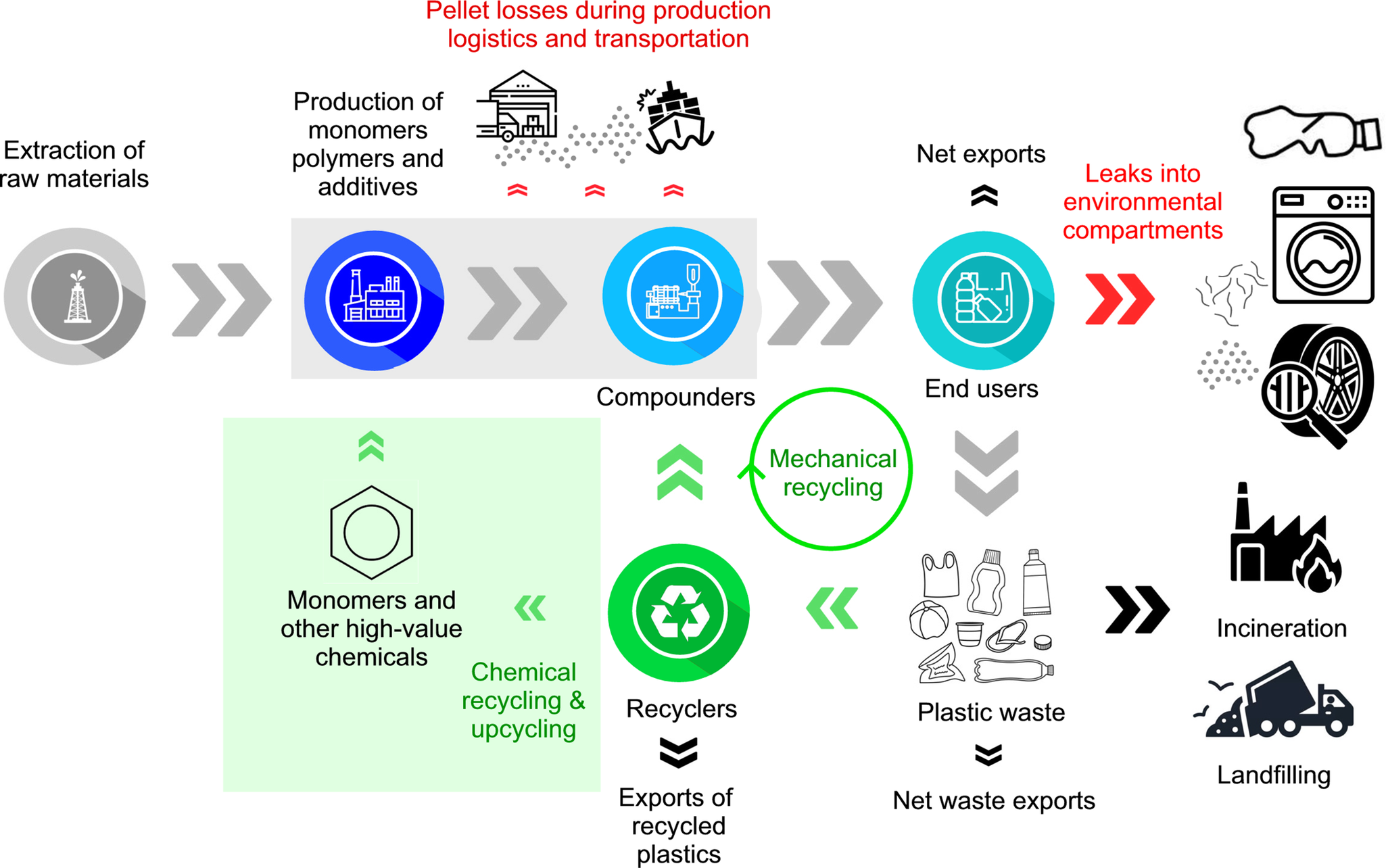
Every stage of the plastic lifecycle, from oil and gas extraction to the production of monomers, polymers and additives, as well as manufacturing, transportation and disposal, contributes to environmental impacts through different types of emissions (Figure 2). Pellet losses are a well-known source of pollution and are difficult to control, as they typically result from small spillages by numerous companies throughout the supply chain. These losses are particularly noticeable during transportation by cargo ships, trains and trucks. Estimating plastic leakage from lost marine containers is challenging due to the sporadic nature of such incidents and inconsistencies in reporting. However, when spills do occur, their impact is often highly visible and widely reported in the media. These events are not rare. According to the World Shipping Council, between 1,000 and 2,000 containers are lost at sea annually (World Shipping Council, 2022). Notably, pellet losses have been identified as the third-largest source of unintentional microplastic release in the European Union, with annual estimates ranging from 50,000 to 1,80,000 t. This evidence underlies the recent proposal COM(2023)645 by the European Parliament and Council, which aims to prevent plastic pellet losses.
Life cycle of plastics. Gray and black arrows represent the linear plastic production and disposal pathway, while green arrows indicate circular recycling loops. Red arrows highlight points where plastic leaks into the environment. (Larger arrows represent larger flows.)

During industrial manufacturing, monomers, polymers, plastics and chemical additives may leak into the air and water, especially in poorly regulated facilities. These processes generate trimmings, dust and defective plastic parts, which can escape into the environment if not properly contained. Plastic can also enter the environment during product use. This is the case of tire and road wear particles generated by vehicle movement, or from paint fragments detaching from road markings (Baensch-Baltruschat et al., Reference Baensch-Baltruschat, Kocher, Stock and Reifferscheid2020). Another example is the shedding of microplastic fibers from synthetic textiles during use and washing (Zhang et al., Reference Zhang, Lykaki, Alrajoula, Markiewicz, Kraas, Kolbe, Klinkhammer, Rabe, Klauer, Bendt and Stolte2021). Although the quantification of these sources remains controversial, their impact can be reduced through improved product design, which is an essential component of the circular economy for plastics.
However, the most significant source of plastic debris emissions to the environment is the improper management of plastic-containing materials after disposal. Once discarded, plastics may be landfilled, incinerated, or recycled into new materials, typically new plastic products. Inefficient waste collection, especially in regions with inadequate waste management infrastructure, often leads to plastic leakage into the environment. In its 2022 report, the OECD estimated that 22 Mt. of plastics were released into the environment in 2019, representing 5.1% of the global production for that year (OECD, 2022a). Approximately two-thirds of this plastic was estimated to end up in terrestrial environments, with the remaining one-third leaking into aquatic ecosystems, with a significant fraction reaching the ocean (Lau et al., Reference Lau, Shiran, Bailey, Cook, Stuchtey, Koskella, Velis, Godfrey, Boucher, Murphy, Thompson, Jankowska, Castillo Castillo, Pilditch, Dixon, Koerselman, Kosior, Favoino, Gutberlet, Baulch, Atreya, Fischer, He, Petit, Sumaila, Neil, Bernhofen, Lawrence and Palardy2020). It has been estimated that plastic waste discharged into the oceans via rivers amounts to 0.8–2.7 Mt/yr, with smaller contributions originating from coastlines or marine-based sources (Meijer et al., Reference Meijer, van Emmerik, van der Ent, Schmidt and Lebreton2021). In addition, the incineration of plastic waste, particularly when carried out in the open air, can produce harmful byproducts, potentially releasing toxic chemicals into the air and the surrounding environment.
In the EU27 + 3 region (the European Union plus Switzerland, Norway, and the United Kingdom), according to Plastics Europe reports, total plastic production amounted to 58.7 Mt. in 2022. This figure excludes polymers not used in the manufacture of plastic parts and products, such as those employed in adhesives, coatings, textiles, cosmetics and pharmaceuticals. Of this total, 6.8 Mt. corresponds to post-consumer plastic used in the EU, 3.2 Mt. to recycled pre-consumer plastics, and 0.7 Mt. to biobased polymers, leaving a net input of 47.9 Mt. of virgin fossil-based resin. For the same period, an estimated 32.3 Mt. of plastic waste were recovered through official collection schemes. Of this total, 16.0 Mt. were incinerated for energy recovery, 7.6 Mt. were sent to landfill, and 8.7 Mt. were delivered to recyclers, with approximately 1.0 Mt. lost during processing (Plastics Europe, 2023, 2024a).
Other outputs from the material cycle include net exports of parts and products, which amounted to 0.8 Mt. (plastic consumption minus plastic conversion), waste and recycled plastic exports (0.3 + 1.0 Mt), and leakages during production and transport, estimated at 160 kt according to the EU’s central estimates. The balance of inputs and outputs leaves an unexplained gap of 25.7 Mt., representing more than one-third of total plastic production. This discrepancy may partly result from net additions to in-use plastic stocks, as a portion of the material is temporarily stored in long-lived applications (e.g., construction and automotive) that remain in use or unrecovered for decades, thereby delaying any potential equilibrium in plastic stocks. Given the currently available data, it is difficult to quantify the extent to which this factor postpones the attainment of input–output equilibrium. The remaining difference can be attributed to leakages into the environment that occur during product use. These losses are partly unavoidable or difficult to prevent without extensive product redesign, such as emissions of tire particles or fibers from textiles during washing and wear. The gap also includes plastic waste improperly disposed of in the environment that escapes official collection systems.
Additionally, plastic production has a significant impact on greenhouse gas (GHG) emissions. It has been estimated that in 2020, plastic production, conversion and waste management generated 2.5 Gt of CO2 equivalent, which represents 5% of the industrial GHG emissions (Pottinger et al., Reference Pottinger, Geyer, Biyani, Martinez, Nathan, Morse, Liu, Hu, de Bruyn, Boettiger, Baker and McCauley2024). Projections indicate that, under a business-as-usual scenario, a global plastics industry could account for 20% of total oil consumption and 15% of the annual carbon budget by 2050 (World Economic Forum, 2016). Plastics contribute to GHG emissions through fossil fuel extraction and the production of monomers, polymers and additives in the petrochemical industry. Besides, plastic waste incineration amounts to 12.4 Mt. in the EU27 + 3 and represents 42% of the waste collected through official schemes (Plastics Europe, 2022). Finally, open burning also emits carbon dioxide and black carbon, a short-lived climate pollutant and a key component of fine particulate matter (PM2.5).
Plastic recycling
The increase in plastic usage has led to a constant rise in plastic waste generation. Geyer et al. estimated that the amount of primary plastic waste generated since the onset of its industrial production could surpass 25,000 Mt. by 2050, with 12,000 Mt. accumulating in landfills or dispersing into the natural environment (Geyer et al., Reference Geyer, Jambeck and Law2017). OECD projections indicate that by 2,060, only 14% of generated plastic waste would be effectively recycled, a ratio comparable to the 8.9% calculated by Plastics Europe (OECD, 2022b; Plastics Europe, 2024b). Therefore, under current practices, closing the plastic life cycle would not be possible in the near future.
Recycling can be achieved through different processes (Thiounn and Smith, Reference Thiounn and Smith2020). Primary recycling, also known as closed-loop plastic recycling, refers to a process in which recycled materials are repeatedly used to create new products of the same type. Closed-loop recycling systems are considered environmentally friendly because they help preserve resources, reduce energy consumption and decrease the amount of plastic ending up in landfills or the environment. An example is the recycling of polyethylene terephthalate (PET) bottles into new PET bottles through collection, cleaning, pelletizing and reprocessing. An advantage of this process is that the recycled material retains most of its original properties, so it can be used to produce the same product with less degradation, but it is generally limited to factory scraps or similar inputs.
Secondary or mechanical recycling involves the breaking down of mixed plastic waste into smaller pieces to be melted and remolded into new plastic products, usually, but not necessarily, of lower quality. This process includes the steps of collecting, sorting, shredding, washing and melting the plastic material before reprocessing. Due to its operational simplicity and effectiveness in handling widely used thermoplastics such as PET, high-density polyethylene (HDPE) and polypropylene (PP), mechanical recycling remains the predominant approach for recycling post-consumer plastic waste. However, this process has significant limitations. It requires efficient sorting to prevent cross-contamination from mixed resins, plastics degrade over multiple recycling cycles and unwanted additives may accumulate in the final products (Ragaert et al., Reference Ragaert, Delva and Van Geem2017). These unwanted additives are functional substances in the original materials that are not removed and end up in the recycled plastic. Additionally, it is difficult, or even impossible, to apply to heavily contaminated plastics or composites. Compliance with legal requirements for recycled plastics is challenging because high-quality recycled plastics are scarce, while overall demand remains weak since virgin plastics are sold at lower prices. As a result, many recycling companies cannot compete economically and are forced to close, despite policy targets for recycled content. This highlights a misalignment between policy ambitions and the economic dynamics that continue to dominate global plastics markets.
In tertiary or chemical recycling, plastic waste undergoes a decomposition process that breaks down the polymer into value-added chemicals. Chemical recycling includes the pyrolysis of plastic wastes to produce fuels and their solvolysis to give rise to monomers as starting points to produce new polymers. Chemical recycling can either regenerate the original polymer or produce entirely different products from the feedstock, classifying the process as closed-loop or open-loop recycling, respectively. Moreover, when chemical processes are used to generate new products of higher value than the original plastic waste feedstock (e.g., carbon nanotubes from polyethylene PE), the process is sometimes referred to as upcycling (Nicholson et al., Reference Nicholson, Rorrer, Singh, Konev, Rorrer, Carpenter, Jacobsen, Román-Leshkov and Beckham2022). Unlike mechanical recycling, which often produces downcycled plastics with degraded properties, chemical recycling has the potential to preserve or even improve polymer properties under favorable conditions. However, it is important to note that chemical recycling is not universally applicable to all plastic waste streams. Its successful operation depends on feedstock quality, process design and careful management of operational challenges. While some chemical recycling technologies have reached high technical maturity with commercial-scale plants, their performance is still limited to well-sorted or pretreated plastics, highlighting a key difference in technical readiness compared with mechanical recycling.
The life cycle of plastics may approach circularity by eliminating non-essential or trivial uses and by promoting reuse and recycling. Governing bodies are making significant efforts to tackle plastic pollution and advance a more resource-efficient plastics economy. This includes the implementation of stringent regulations and ambitious targets, particularly in key subsectors such as packaging and compostable plastics. Notably, approximately 36% of all plastic produced is used for packaging. In response, EU Regulation 2025/40, which came into force on February 11, 2025, mandates that all plastic used for packaging contain minimum percentages of recycled content sourced from post-consumer plastic waste, reaching up to 65% for non-contact-sensitive packaging by 2040. Additional measures include restrictions on unnecessary packaging materials and the mandatory implementation of deposit-return systems for plastic bottles and other containers.
The limits of recycling
Although most plastic materials are technically recyclable, the process faces significant limitations. One major challenge is the lack of efficient methods for identifying and sorting post-consumer plastics. There are many types of plastics with different properties and many objects consist of more than one resin. Another issue arises from material incompatibility caused by blending different types of plastics, each with unique physical and chemical properties. When incompatible plastics are mixed, they can compromise the quality of the final product, rendering it unusable (Luzuriaga et al., Reference Luzuriaga, Kovářová and Fortelný2011). In addition, food residues, dirt, labels and adhesives can hinder recyclability, requiring extensive cleaning. Plastic recyclability is constrained by the limited types of plastic waste collected, by sorting losses and by technical limitations. A material flow analysis estimated that, in the most optimistic scenario, up to 61% of plastic-to-plastic recycling is achievable (46% through mechanical recycling and 15% through chemical recycling; Lase et al., Reference Lase, Tonini, Caro, Albizzati, Cristóbal, Roosen, Kusenberg, Ragaert, Van Geem, Dewulf and De Meester2023). As a result, only about one-third of plastic waste is currently recycled, while another third is sent to landfills and the remainder is incinerated (Lim et al., Reference Lim, Ahn, Cho and Kim2022).
During the reprocessing of thermoplastic resins, polymer chains undergo degradation due to thermo-oxidative reactions and shear-induced scission, which reduces molecular weight and weakens mechanical properties (Zhou et al., Reference Zhou, T-G and Wang2023). Each recycling cycle further degrades the material and increases the likelihood of contamination with other polymer types, leading to a gradual decline in resin quality. To maintain performance, post-consumer plastics identified as excessively degraded must be replaced with virgin material. Consequently, a fraction of plastic waste is effectively unrecyclable through conventional mechanical recycling. While some mechanical recyclers exploit controlled degradation, for example, re-extruding mixed polypropylene waste to achieve higher melt flow rates suitable for injection-molded automotive or construction components, this approach is limited to a single cycle and further recycling would require chemical methods. However, the practical implementation of chemical recycling depends on effective collection and sorting, which remains a major limitation.
Additionally, the presence of unwanted additives, such as dyes, fillers, plasticizers and other compounds commonly found in post-consumer plastics, can hinder the separation process and negatively impact the properties of new objects made from recycled materials due to the accumulation of potentially harmful chemicals. Increasingly stringent concentration limits for unwanted substances are being introduced. Regulation (EU) 2022/1616, which governs recycled plastic materials intended for food contact, mandates that recycled plastics meet the same safety standards as virgin plastics. However, this hazard-based approach may hinder the circular economy by causing material losses, as a significant portion of recycled materials must be downcycled, incinerated, or sent to landfill. This, in turn, threatens the economic viability of recycling.
An important concern is the critical influence of packaging design on recycling performance. Although enhanced recycling strategies are necessary under current design practices, significant limitations arise from the widespread use of prints, pigments and tie layers, which contribute to the formation of non-intentionally added substances during reprocessing. Replacing direct printing with removable labels could enable more efficient sorting and yield higher-quality recycled materials. However, the adoption of such designs is often hindered by the higher costs of recyclable configurations and marketing requirements. Circularity, particularly in packaging waste, could be significantly improved if these design-related enhancements were implemented from the outset (Brouwer et al., Reference Brouwer, van Velzen, Ragaert and ten Klooster2020).
Moreover, there are significant challenges associated with recycling thermoset plastics and elastomers because they form permanent, covalent cross-links between polymer chains during curing that prevent remelting (Utekar et al., Reference Utekar, V K, More and Rao2021). Composite plastics, which combine polymers with non-plastic materials like fiberglass or carbon fiber, are increasingly used in industries such as automotive, aerospace and wind energy, but they also create significant limitations for recycling as separating the polymer matrix from fillers may not be feasible, especially in the case of non-thermoplastic resins. Mixed multilayer plastic recycling produces low-quality, potentially hazardous materials, although still done to meet legal recycling targets. Besides, it’s expensive, and the resulting products are mostly used in long-life, low-performance applications. The fact is that from the many types of plastic in the market, only the major thermoplastic resins PET, PP, HDPE and LDPE have been routinely recycled, and even these with low recovery rates, especially in countries with limited waste management infrastructure.
As a result of legal restrictions aimed at enhancing the circularity of plastics throughout their lifecycle, manufacturers are forced to include increasing volumes of recycled material that must meet strict specifications, often equal to those of virgin plastics, while maintaining comparable costs. On the supply side, limited recycling rates create a gap between the need for recycled plastic resins and their availability. Additionally, the reduced structural integrity of reprocessed resins negatively impacts their market value. The situation is further complicated by the increasing complexity of new materials entering the market and the difficulties associated with their separation, which makes recycling processes more intricate and costly (Singh and Walker, Reference Singh and Walker2024). Therefore, there is an urgent need to expand the reprocessing capacity of plastic waste through innovative technologies that can meet the demand for recycled plastics and help close the market’s circularity gap. However, this is not an easy task and the plastic recycling industry in the EU is currently facing a crisis, with domestic recycling output declining while imports of recycled and virgin polymers are increasing. This situation is driven by high energy costs, rising scrap prices and international competition, and is leading to the closure of numerous recycling facilities.
Technologies for the processing of non-mechanically recyclable plastics
Plastics that are difficult or impossible to recycle mechanically include: (i) thermosets and elastomers, which cannot be mechanically recycled; (ii) multi-layer and blended plastics that are difficult to separate; (iii) plastic waste contaminated with hazardous compounds or impurities; (iv) residues from mechanical recycling processes and (v) low-quality plastics that have degraded and lost their properties. The energy stored in these materials can be recovered, and chemical recycling can transform them into valuable products. These approaches help prevent or reduce the amount of plastic waste sent to landfills.
Incineration as transitional or last-resource technology
When considering methods for disposing of plastics that are difficult or impossible to recycle, incineration emerges as a state-of-the-art option. In fact, nearly one-fifth of plastic waste worldwide is incinerated (OECD, 2022b). In Europe, half of the post-consumer plastic waste, amounting to 16 Mt., was incinerated in 2022, reflecting an increasing trend driven by the need to reduce landfilling (Plastics Europe, 2024a). Incineration is widely recognized for its use of readily available industrial infrastructure and established processes, making it a viable waste management strategy even in countries with moderate technological capabilities.
Plastic waste incineration raises significant environmental concerns, primarily due to emissions such as carbon dioxide, which contribute to greenhouse gas (GHG) emissions. Particulate matter can further degrade air quality, and incomplete combustion may result in the release of aerosols containing polycyclic aromatic hydrocarbons, dioxins and other hazardous by-products (Cudjoe and Wang, Reference Cudjoe and Wang2022; Han et al., Reference Han, Chang, Wang, Tai, Karellas, Yan, Song and Bi2023). This issue is particularly relevant in developing regions, where plastic waste is often burned without regulation or adequate pollution controls, whereas modern incineration facilities are equipped with advanced flue gas cleaning technologies and adhere to strict emission standards (Cottom et al., Reference Cottom, Cook and Velis2024). Nevertheless, public concerns, particularly regarding dioxin emissions, persist and should be addressed through clear, transparent communication.
Plastic waste incineration enables partial energy recovery from the chemical bonds in plastics and helps reduce landfilling; however, it also eliminates a valuable feedstock that could otherwise support a circular economy. As municipal solid waste continues to grow, while landfilling becomes increasingly limited by legal constraints and the scarcity of suitable sites, incineration emerges as a useful transitional technology. Although the shift toward circular economy practices is expected to reduce reliance on incineration, it remains essential in the current waste management landscape (Makarichi et al., Reference Makarichi, Jutidamrongphan and Techato2018).
Thermal technologies
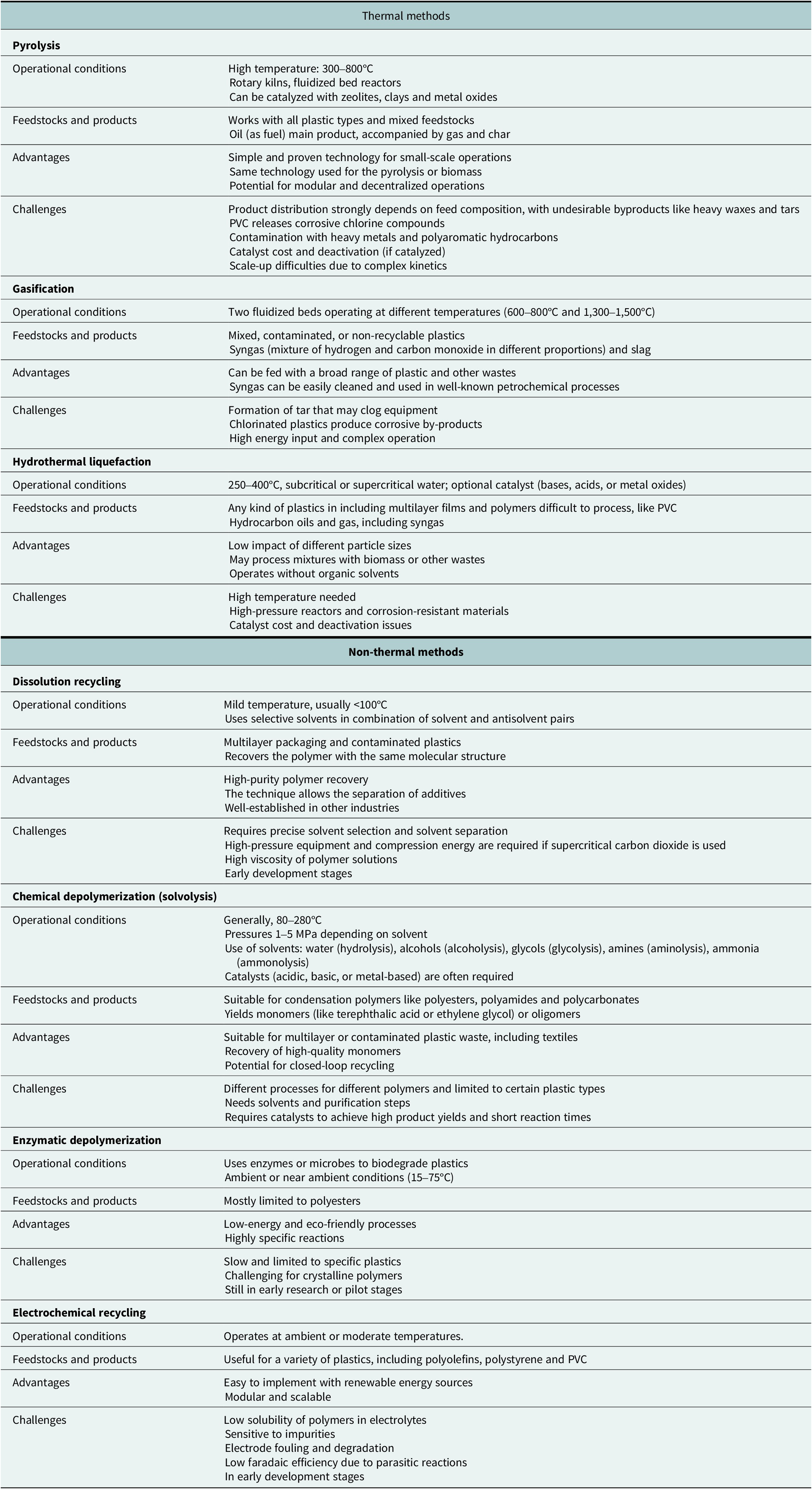
Non-recyclable plastics can be processed through various methods aimed at reducing the environmental impact of plastic use and generating new feedstocks for industrial applications. Both thermal and non-thermal processes can contribute to material recovery (recycling), resulting in products of equal, higher, or lower quality or value compared to the original materials. Thermal processing involves breaking plastics down into smaller molecules, which can then be used to manufacture fuels, lubricants, or new plastic products. The main processes of this type are (i) pyrolysis, (ii) gasification and (iii) hydrothermal liquefaction, all of which can effectively address plastic waste when mechanical recycling is not a viable option and alternatives such as biodegradable plastics are unavailable. Table 1 summarizes the key characteristics of thermal technologies used for processing plastic waste, also including non-thermal processes, which are to be described in the following section.
Comparison of thermal and non-thermal processing options for plastic wastes

Pyrolysis
During plastic pyrolysis, long-chain polymers are broken down into smaller hydrocarbons. The process involves heating plastics in the absence of oxygen at temperatures ranging from 300 to 800°C, producing gas, liquid and solid fractions, with the higher temperatures increasing gas yields. Pyrolysis gas has a high calorific value (22–30 MJ/m3) and can be used as a fuel either directly or after removing solid particles through cyclones and electrostatic separators. The resulting solid char, which contains both carbon and the mineral content of the original material, can be used for energy production or as a precursor for activated carbon. Waxes and liquids, typically accounting for 20–80% of the product, consist of a mixture of organic compounds (mostly C5–C20), with an increasing proportion of aromatics at higher temperatures due to their greater thermodynamic stability.
Plastic waste pyrolysis begins with feeding sorted, cleaned and dried plastic scraps or pellets, either in solid form via a screw conveyor system or in molten form. The feedstock may include mixed plastic types, sometimes blended with other materials such as sawdust or municipal solid waste. The feedstock is heated in the absence of oxygen in vessels, shaft reactors, rotary drums, or fluidized bed reactors, depending on the scale and operational parameters. For example, fluidized bed reactors offer higher productivity and more efficient heat transfer for high volume applications (Paavani et al., Reference Paavani, Agarwal, Alam, Dinda and Abrar2025). The residence times range from 10 to 60 minutes, although some systems proceed faster, particularly at higher temperatures.
Catalytic reactors are also being explored for plastic waste pyrolysis to improve product selectivity, increasing the yield of liquid hydrocarbons, and lowering reaction temperatures compared to conventional thermal pyrolysis. Catalytic processes typically produce lighter compounds. For instance, thermal pyrolysis of HDPE yields hydrocarbons primarily in the C13–C20 range, whereas catalytic pyrolysis generates products mainly in the C7–C12 range, with a significant proportion of gases (Anene et al., Reference Anene, Fredriksen, Sætre and Tokheim2018). The most commonly proposed catalysts for this process include zeolites, fluid catalytic cracking catalysts, clays and metal oxides (Budsaereechai et al., Reference Budsaereechai, Hunt and Ngernyen2019). The challenges of catalytic pyrolysis include catalyst deactivation due to coke formation and the high cost of catalysts, like other petrochemical catalytic processes.
Several commercial processes for plastic waste pyrolysis are currently in operation, with many companies specializing in technology licensing and projects at various development stages. A notable example is ExxonMobil, which has been operating its Exxtend technology at commercial scale since 2022 at its Baytown plant in Texas, where it processes approximately 40,000 t/yr. Plastic Energy uses its TAC process at its plants in Almería and Seville (Spain), which have been operational since 2016 and 2017, respectively. These plants handle 5,000 t/yr of highly contaminated, multi-layered plastic waste, primarily of agricultural origin, converting it into TACOIL, a hydrocarbon feedstock for further processing in steam crackers. 2GBiofuels, based in Ascó, Spain and operating since 2021, processes 9,000 t of plastic waste per year to produce pyrolytic oils for new plastic manufacturing under ISCC PLUS certification. Another recent development is the LyondellBasell Wesseling pyrolysis (MoReTec) plant, an industrial-scale demonstration unit that applies catalytic technology to process around 50,000 t of mixed plastic waste per year into feedstocks for new polymer production. Start-up is planned by the end of 2025, supported by a €40 million grant from the EU Innovation Fund.
The main challenges to the economic viability of commercial pyrolysis include the need for consistent feedstock quality and quantity, the incompatibility of certain plastic wastes with reactor designs, and the energy required to achieve complete conversion. This is why such plants are particularly suited to locations with a steady availability of uniform waste, such as agricultural byproducts in regions with industrial-scale agriculture. It is also the reason why most plants adopt a modular approach, progressing cautiously toward large-scale implementation (Saxena, Reference Saxena2025). Another challenge is the contamination of feedstocks with heavy metals and polyaromatic hydrocarbons. This necessitates either the use of cleaner input materials or additional petrochemical processing steps, which increase the cost of a process that was originally intended to handle low-value or marginal feedstocks (Quicker, Reference Quicker2023). Additionally, the scale-up of pyrolysis plants is challenging due to the complex kinetics of the processes involved (Chang, Reference Chang2023). Beyond these technical and operational limitations, political-economic factors further affect viability. Regulatory uncertainty in Europe, particularly the draft mass-balance rules under the Single-Use Plastics Directive, which might adopt a “fuel-use excluded” approach, could reduce the ability of chemical companies to credit pyrolysis outputs toward recycled content targets. As a result, many investors are postponing projects until the final implementation decision is released.
The fragmentation of hydrocarbon chains in plastics to produce fuel feedstocks is an obvious option, but transforming plastic waste into fuels is controversial as it might promote non-circular pathways, especially in regions with low recycling rates (Radhakrishnan et al., Reference Radhakrishnan, Senthil Kumar, Rangasamy, Praveen Perumal, Sanaulla, Nilavendhan, Manivasagan and Saranya2023). Additionally, as an energy-intensive process, pyrolysis has been criticized for potentially increasing GHG emissions. However, Life Cycle Analyses (LCA) show that pyrolysis can reduce GHG emissions compared to traditional waste disposal methods and the overall balance depends on the energy source and how pyrolysis products are used (Xayachak et al., Reference Xayachak, Haque, Lau, Parthasarathy and Pramanik2023). It is important to note that the products from plastic pyrolysis can be used as feedstock in petroleum refineries, where cracking and other processes may create new plastics or high-value products (Dai et al., Reference Dai, Zhou, Lv, Cheng, Wang, Liu, Cobb, Chen, Lei and Ruan2022). Pyrolysis can also be applied to bioplastics, particularly non-compostable ones, and is not limited to fossil-based hydrocarbons.
Gasification
When plastic waste is heated with steam in an oxygen-limited environment, it produces a gas mixture primarily composed of carbon monoxide, hydrogen and methane, known as syngas (synthetic gas), and the process is called gasification. Oxygen can be supplied via air, reducing costs but also lowering the calorific value of the resulting fuels due to the energy required to heat nitrogen. Steam is crucial, as it provides hydrogen, reduces tar formation and moderates temperature, preventing undesirable reactions or equipment damage. Additionally, steam plays a key role in adjusting the H2/CO ratio in syngas, which is essential for chemical syntheses that require specific hydrogen-to-carbon monoxide ratios.
After cleaning, the first gasification step involves the production of cracking products, similar to those obtained in pyrolysis, which are then further reformed through partial oxidation and steam reforming reactions:
 $$ {\mathrm{C}}_n{\mathrm{H}}_m\hskip0.33em +\hskip0.33em n\;{\mathrm{H}}_2\mathrm{O}\hskip0.33em \to \hskip0.33em n\;\mathrm{CO}\hskip0.33em +\hskip0.33em \left(\frac{m}{2}\hskip0.33em +\hskip0.33em n\right)\;{\mathrm{H}}_2\hskip0.82em \mathrm{endothermic} $$
 $$ {\mathrm{C}}_n{\mathrm{H}}_m\hskip0.33em +\hskip0.33em \frac{n}{2}\;{\mathrm{O}}_2\hskip0.33em \to \hskip0.33em n\;\mathrm{CO}\hskip0.33em +\hskip0.33em \frac{m}{2}\;{\mathrm{H}}_2\mathrm{O}\hskip0.82em \mathrm{exothermic} $$
A large number of reactions occur simultaneously, involving all substances in the system. However, the balance between H2, CO2 and CO is primarily determined by the interplay between the exothermic water-gas shift reaction and the endothermic Boudouard reaction, both of which are governed by the gasification temperature, typically ranging from 600 to 1,500°C (Bashir et al., Reference Bashir, Ji, Weidman, Soong, Gray, Shi and Wang2025):
Water-gas shift equilibrium: $ \mathrm{CO}+{\mathrm{H}}_2\mathrm{O} $
⇌
$ \mathrm{CO}+{\mathrm{H}}_2\mathrm{O} $
⇌ $ \mathrm{C}{\mathrm{O}}_2\hskip0.33em +\hskip0.33em {\mathrm{H}}_2\hskip1.12em \Delta \hskip0.1em {h}_{298\hskip0.1em \mathrm{K}}^{\circ }=-41.2\hskip0.33em \mathrm{kJ}/\mathrm{mol} $
.
$ \mathrm{C}{\mathrm{O}}_2\hskip0.33em +\hskip0.33em {\mathrm{H}}_2\hskip1.12em \Delta \hskip0.1em {h}_{298\hskip0.1em \mathrm{K}}^{\circ }=-41.2\hskip0.33em \mathrm{kJ}/\mathrm{mol} $
.
Boudouard reaction: $ \mathrm{C}+\mathrm{C}{\mathrm{O}}_2\to 2\;\mathrm{CO}\hskip0.82em \Delta \hskip0.1em {h}_{298\hskip0.1em \mathrm{K}}^{\circ }=+170.4\hskip0.33em \mathrm{kJ}/\mathrm{mol} $
.
$ \mathrm{C}+\mathrm{C}{\mathrm{O}}_2\to 2\;\mathrm{CO}\hskip0.82em \Delta \hskip0.1em {h}_{298\hskip0.1em \mathrm{K}}^{\circ }=+170.4\hskip0.33em \mathrm{kJ}/\mathrm{mol} $
.
The lower temperature boundary for the process, 600°C, is the minimum required for char gasification: $ \mathrm{C}\hskip2pt +\hskip2pt {\mathrm{H}}_2\mathrm{O}\hskip2pt \to \hskip2pt \mathrm{C}\mathrm{O}\hskip2pt +\hskip2pt {\mathrm{H}}_2\Delta {h}_{298\hskip2pt \mathrm{K}}^{\circ }=+131.2\hskip2pt \mathrm{k}\mathrm{J}/\mathrm{m}\mathrm{o}\mathrm{l} $
.
$ \mathrm{C}\hskip2pt +\hskip2pt {\mathrm{H}}_2\mathrm{O}\hskip2pt \to \hskip2pt \mathrm{C}\mathrm{O}\hskip2pt +\hskip2pt {\mathrm{H}}_2\Delta {h}_{298\hskip2pt \mathrm{K}}^{\circ }=+131.2\hskip2pt \mathrm{k}\mathrm{J}/\mathrm{m}\mathrm{o}\mathrm{l} $
.
Metal oxides and other impurities are recovered in the form of ash, which should be nearly carbon-free and can be used in construction. In industrial practice, plastic waste is typically gasified along with other waste streams in a two-stage process. The first stage uses a gasifier fed with oxygen and steam and operates at relatively low temperatures. In the second stage, with additional steam, the gas reaches approximately 1,500°C, yielding a gas primarily composed of H2 and CO (Al-Salem et al., Reference Al-Salem, Lettieri and Baeyens2010). This gas is rapidly cooled to prevent dioxin formation, particles are removed using electrostatic precipitators, and hydrogen chloride (from chlorinated plastics) is removed in a gas scrubber. The resulting syngas can be used as fuel or as a raw material to produce methanol or ammonia through well-established processes. Methanol, in particular, serves as a key raw material for producing petrochemicals traditionally derived from oil or natural gas (Afzal et al., Reference Afzal, Singh, Nicholson, Uekert, JS, ECD, Dutta, Carpenter, Baldwin and Beckham2023). Catalysts can be employed to enhance gas production efficiency, reduce tar formation and optimize syngas conversion. However, most available designs are non-catalytic due to high operational costs and the need to cope with catalyst deactivation issues.
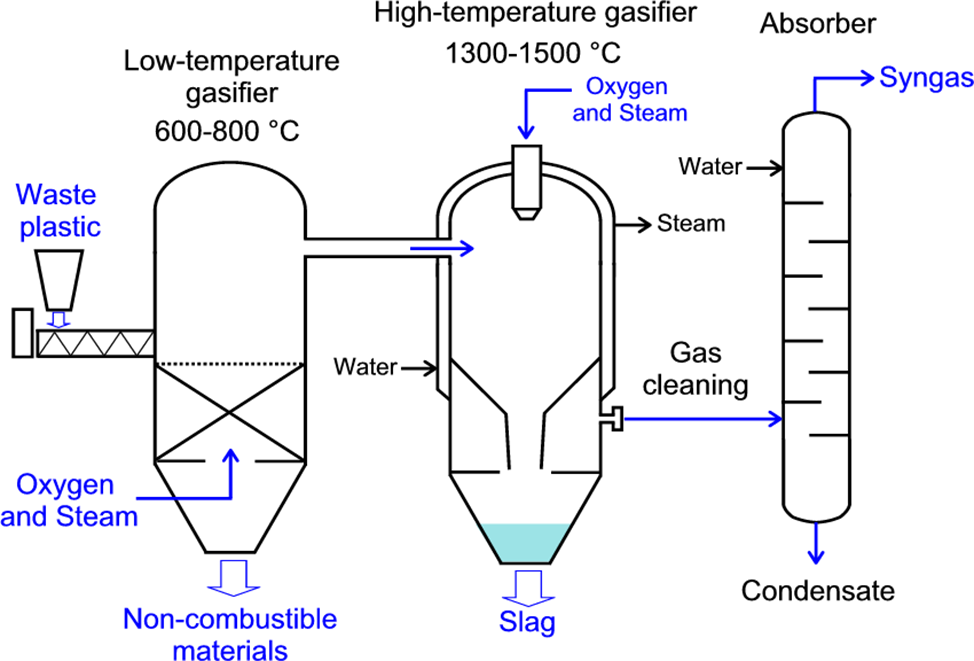
A few operational plants exist for plastic waste gasification, along with some designs available for licensing. The Ebara Ube Process (Figure 3) uses a two-stage system consisting of a low-temperature fluidized bed (600–800°C) followed by a high-temperature gasifier (1,300–1,500°C). Fly ash is recovered as molten slag and reused as a construction material. The system began operating in 2003, with a 195 t/d plant run by Showa Denko (renamed as Resonac in 2023) at Kawasaki City, Japan. It produces hydrogen gas for ammonia synthesis from mixed plastic waste, including both municipal waste and, since 2020, crushed and molded used plastics from industrial sources.
Ebara Ube Process for plastic waste gasification (Adapted from EBARA Environmental Plant Co., Ltd., technical information).

Other designs have reached various stages of development. Since 2008, Chalmers University of Technology has operated a biomass gasification pilot plant in Gothenburg, Sweden, to explore the gasification of automotive shredder residues and several plastic wastes. As early as the late 1990s, AkzoNobel was involved in a waste-to-chemicals initiative aimed at converting non-recyclable waste, including PVC-rich plastics, into methanol in collaboration with the Canadian company Enerkem. The process used two circulating fluidized bed reactors operating at atmospheric pressure, with sand used to transfer heat between them. The first unit was a gasification reactor operating at 700–900°C, while the second, fed with additional air, burned residual tar and provided heat for the gasification process (Tukker et al., Reference Tukker, De Groot, Simons and Wiegersma1999). Despite promising research, the project did not progress beyond the study phase. This outcome underscores the technological and economic uncertainties associated with plastic gasification, a complex process that is more dependent on feedstock quality than simpler methods like pyrolysis. A recent example is Repsol’s Ecoplanta, following a final investment decision made in early 2025, with start-up expected around 2028–2029. Located in Tarragona, Spain, the plant will be a waste-to-methanol facility designed to convert up to 4,00,000 t/yr of non-recyclable municipal solid waste, including mixed plastics, into circular methanol for chemical and fuel applications. The project is supported by over €800 million in investment and an EU Innovation Fund grant.
Hydrothermal liquefaction
The third thermal plastic waste processing option is hydrothermal liquefaction, which uses subcritical or supercritical water (250–400°C) to convert plastics into naphtha or waxes, which can then be further processed into fuels (Chen et al., Reference Chen, Jin and Linda Wang2019). Supercritical water (>374°C, >22.1 MPa) offers advantages due to its ability to act as a solvent for organic compounds, making it especially effective for treating hydrophobic plastics without the need for harmful or flammable organic solvents. Supercritical water is able to break the tight molecular packing of crystalline regions, acting also as a reagent in processes like the nucleophilic substitution of chlorine atoms from PVC (Nagai et al., Reference Nagai, Smith, Inomata and Arai2007). Additionally, hydrothermal liquefaction can be carried out with the aid of catalysts, which may include bases like NaOH to promote C-C and C-O bond cleavage, acids like HCl or zeolites to facilitate cracking and dealkylation, and metals or metal oxides to enhance dehydrogenation and gasification reactions (Yang et al., Reference Yang, Jan, Chen, W-T and Wu2022).
High temperatures and pressures accelerate thermal depolymerization and cracking reactions, making hydrothermal liquefaction an effective method for processing mixed plastic waste, including hard-to-recycle types like PVC and multi-layer films. These conditions, along with the presence of water, also help minimize coke formation. More severe reaction conditions favor the production of gaseous products, such as syngas, and lighter liquid fractions that can serve as raw materials for fuels or chemical feedstocks. However, operating at high temperatures requires specialized reactors and corrosion-resistant materials, particularly when processing halogenated plastics. Additional challenges include the high energy input required and the need to handle variable feedstock compositions to maintain economic viability (Lu et al., Reference Lu, Jan and Chen2022).
Commercial-scale hydrothermal liquefaction plants for plastic waste are still under development. Licella’s Cat-HTR (Catalytic Hydrothermal Reactor) uses supercritical water to process mixed waste, including plastics and is being commercialized by Mura Technology Ltd. under the name Hydro-PRS (Hydrothermal Plastic Recycling Solution). This process has been in operation since 2023 at ReNew ELP in Teesside, UK, the world’s first commercial-scale plastics recycling plant using hydrothermal liquefaction. The facility has a capacity of 20,000 t/yr of mixed post-consumer plastic waste and runs at 350–420°C and over 22 MPa with a residence time of 20–25 minutes using a non-disclosed solid catalyst (Li et al., Reference Li, Aguirre-Villegas, Allen, Bai, Benson, Beckham, Bradshaw, Brown, Brown, Cecon, Curley, Curtzwiler, Dong, Gaddameedi, García, Hermans, Kim, Ma, Mark, Mavrikakis, Olafasakin, Osswald, Papanikolaou, Radhakrishnan, Sanchez Castillo, Sánchez-Rivera, Tumu, Van Lehn, Vorst, Wright, Wu, Zavala, Zhou and Huber2022). A feature of Mura is its relatively strict requirements on PVC content in raw materials. Other companies are also developing hydrothermal liquefaction plants to treat combined biomass and mixed waste, with several projects in pilot or demonstration stages. The technology is expanding due to its ability to process various waste types, although significant challenges remain.
Non-thermal technologies
Several non-thermal processes are under development to process plastics without high-temperature reactions. These methods involve physical, chemical or biological transformations that convert plastics into reusable components, either with or without depolymerization.
Dissolution recycling
The most straightforward method is dissolution recycling, a purification process in which a polymer in mixed plastic waste is selectively dissolved in a solvent, allowing it to be separated and potentially recovered with high purity. Unlike the previously discussed thermal processes, and distinct from chemical depolymerization, which breaks polymers down into monomers or oligomers, requiring re-polymerization to create the same or similar products, solvent-based processes simply dissolve the polymer without altering its molecular structure. As a result, solvent approaches share similarities with mechanical recycling but offer the additional advantage of separating small molecules used as additives, improving product quality (Ügdüler et al., Reference Ügdüler, Van Geem, Roosen, Delbeke and De Meester2020).
The use of selective solvents is critical for recovering a specific polymer, even when mixed with other materials. In the solvent-antisolvent method, a dissolving solvent is heated with the plastic to the temperature needed to achieve a high recovery rate. After separating the non-dissolved materials, the solution is mixed with a cold antisolvent to induce precipitation. The polymer can then be separated, although the solvent and antisolvent must be purified before reuse. However, the process faces significant practical and economic challenges. Plastics dissolve only at low concentrations, requiring large amounts of solvent, and even then, the resulting solutions are viscous and difficult to handle. Contaminants in the feedstock, like printing ink resins, form gels, severely limiting the types of plastics that can be processed. Consequently, many dissolution operations cannot handle printed or multilayer packaging, and the high costs of solvent, recovery, and filtration make the technology economically sensitive.
An interesting variation uses supercritical CO2 as an antisolvent, as demonstrated in the dissolution of polystyrene in p-cymene, followed by precipitation with supercritical CO2 (Gutiérrez et al., Reference Gutiérrez, Rodríguez, Gracia, de Lucas and García2014). Alternatively, a single supercritical solvent can dissolve the polymer, and in this case, precipitation can be induced by reducing temperature, pressure or both, in a process called supercritical fluid extraction. This technique, although relatively new for plastic recycling, is already well-established in industries such as food, beverage, pharmaceuticals and cosmetics. Besides the advantage of having commercially viable industrial-scale plants, CO2 offers the advantages of being non-toxic, non-flammable and simple to use for the selective extraction of additives. However, it has not yet been implemented at full scale for plastic recycling due to the need for high-pressure equipment (>7.4 MPa) and the energy-intensive compression of CO2. An interesting variation is the temperature-swing method, which is similar to the solvent-antisolvent approach, with the difference that precipitation is induced by cooling instead of using an antisolvent. This method avoids the use of an antisolvent but requires more energy for the heating and cooling processes. Other methods, such as the use of ionic liquids, are still in the R&D stage (Mohan et al., Reference Mohan, Keasling, Simmons and Singh2022).
Solvent recovery of polymers is not a new concept. Sony’s Orange R-net was already in use in Japan in the 1990s for expanded polystyrene (EPS), using limonene as solvent, and was implemented in a full-scale plant in Ichinomiya that operated for several years A similar initiative was led by Solvay at the Vinyloop plant in Ferrara, aimed at recovering PVC from cables, with a capacity of 10,000 t/yr. However, they had to close due to challenges in separating EU-banned low molecular weight phthalate plasticizers. Other interesting development is Fraunhofer IVV’s CreaSolv Process, focused on recovering polystyrene (PS) from electronic waste and multi-layer packaging, using a proprietary solvent. Another example is PureCycle Technologies, which completed a commercial plant in Ironton, USA, in 2023. The facility is designed to process 50,000 t of recycled PP per year using a solvent-based method patented by Procter & Gamble in 2018, involving mixtures of aliphatic and olefinic hydrocarbons. Other initiatives are underway, although facing important challenges due to cost and regulatory issues.
Chemical depolymerization
Chemical depolymerization, also known as solvolysis, involves using chemicals, with or without catalysts, to break down polymer molecules into monomers or oligomers, primarily aimed at producing new plastics. These techniques are highly selective and, therefore, relatively insensitive to the presence of non-depolymerizable polymers, additives, or other contaminants. This selectivity can be advantageous in avoiding pre-processing stages (Clark and Shaver, Reference Clark and Shaver2024). The ability to recycle plastics that are mechanically non-recyclable makes solvolysis an attractive alternative to address the gap created by non-recyclable plastics. However, solvolysis is highly dependent on the chemical structure of the polymers, resulting in a wide range of processes with varying reaction conditions and products, depending on the raw plastic being processed.
Solvolysis is particularly effective for recycling condensation polymers such as polyesters, polyamides and polycarbonates. A well-known example is PET, which can undergo hydrolysis to produce terephthalic acid and ethylene glycol through nucleophilic attack on the carbonyl bonds. These are the original monomers used to synthesize PET, allowing them to be reintegrated into the polymer production cycle. PET can also undergo solvolysis with alcohols. For instance, methanolysis uses methanol to yield dimethyl terephthalate and ethylene glycol. Glycolysis involves ethylene glycol and produces bis(2-hydroxyethyl) terephthalate. When amines are used as reagent, the process is referred to as aminolysis, generating diamide compounds, while ammonia is used in ammonolysis to produce terephthalamide derivatives.
PET hydrolysis is typically carried out under alkaline, acidic, or neutral conditions at temperatures ranging from 100 to 250°C and pressures of 1–5 MPa. When hydrolysis is performed under neutral conditions (water only), higher pressures and temperatures are required, along with a large excess of water, due to the lower reactivity of water alone. PET melts at 250–260°C, and within this temperature range, depolymerization is favored. However, in many formulations, such as transparent water bottles, PET is essentially amorphous (which is why it is transparent), so it is not necessary to reach the high temperatures that would be required to process crystalline PET. In addition to acids (mineral acids, carboxylic acids, or acidic ionic liquids), metal salts like ZnI2 can be used, which are thought to act as Lewis acids (Pereira et al., Reference Pereira, Savage and Pester2024). Acids lead to additional purification steps and may be corrosive, but they also help reduce the temperature required for the process. Hydrolysis assisted by H2SO4 (>85%) can proceed at temperatures as low as 100–120°C. Alkaline hydrolysis requires less concentrated media (10–20% NaOH) but necessitates higher temperatures and longer reaction times (several hours).
Methanolysis can be carried out under similar conditions (180–280°C, 2–4 MPa) using various catalysts such as zinc or lead acetate, metal oxides and hydroxides and carbonates (Pham and Cho, Reference Pham and Cho2021). Relatively mild conditions (200°C, 0.1 MPa, near the boiling point of ethylene glycol) are also required for glycolysis, which has the added advantage of yielding bis(2-hydroxyethyl) terephthalate, a compound that can enter PET production already esterified. Catalysts help achieve reasonable yields in shorter times. López-Fonseca et al. used sodium carbonate as a catalyst and obtained 80% conversion to bis(2-hydroxyethyl) terephthalate in 1 hour at 196°C (López-Fonseca et al., Reference López-Fonseca, Duque-Ingunza, de Rivas, Flores-Giraldo and Gutiérrez-Ortiz2011). Ammonolysis and aminolysis can be carried out under milder conditions (<100°C) due to the higher nucleophilicity of amines and ammonia, though they require more expensive reagents. Regardless of the type of solvolysis used, the development of catalysts to increase the reaction rate, product yield and reduce the need for harsh conditions is an active area of current research, including the use of green catalysts, which are less environmentally concerning compared to metal salts. These include ionic liquids and deep eutectic solvents, though they have the drawback of higher operating costs (Kumar et al., Reference Kumar, Kumar and Bharti2024).
Solvolysis is also being studied for polyamides (PA) such as nylon, which can undergo hydrolysis, ammonolysis, or aminolysis, like PET and are favored by acids, metal catalysts and the use of supercritical water. Polyamides can also be depolymerized using hydrogen. Kumar et al. demonstrated that PA can be reverted to diols and diamines using ruthenium as a catalyst at 150°C and 7.0 MPa of hydrogen pressure with DMSO as solvent (Kumar et al., Reference Kumar, von Wolff, Rauch, Zou, Shmul, Ben-David, Leitus, Avram and Milstein2020). The same process is valid for polyurethanes (PU). However, high energy inputs, low product yields, the use of solvents and the need for purification steps pose safety and economic concerns, making the recovery of polyamides and other condensation polymers, other than PET, still under laboratory development.
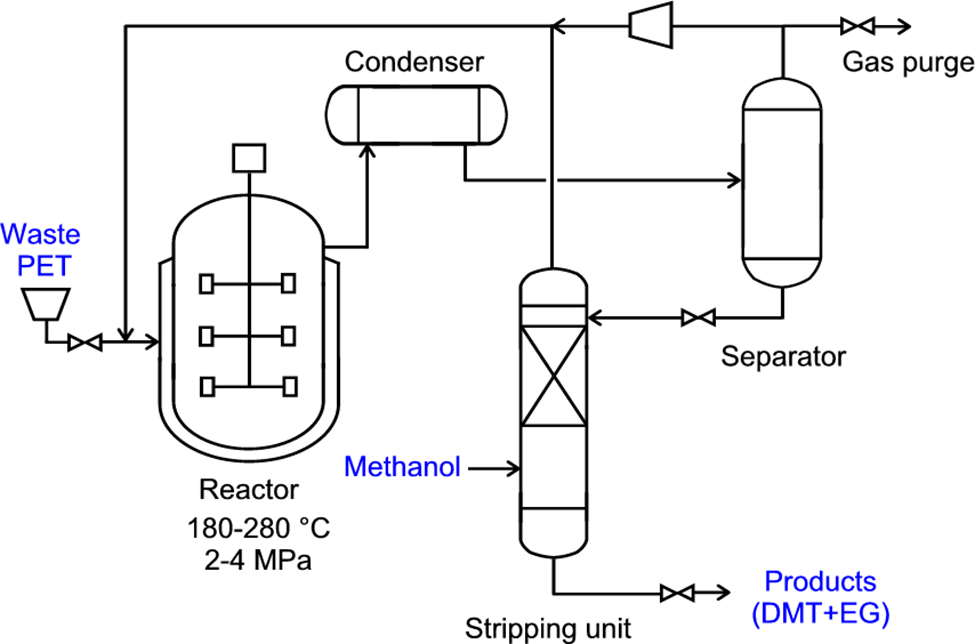
Commercial developments in PET recycling can be traced back to the 1990s when Eastman Kodak pioneered a methanolysis process to depolymerize post-consumer PET at its plant in Kingsport, Tennessee, USA. The plant, with a capacity of approximately 50,000 t/yr, operated at 180–280°C and 2–4 MPa to yield dimethyl terephthalate and ethylene glycol, which were then purified for the production of new PET (Figure 4). The process started with cleaning and shredding post-consumer waste, which was then fed into the depolymerization reactor. The reaction products were further purified through distillation or crystallization to achieve the desired purity levels for reuse. This process enabled the production of virgin-quality PET for polyester fiber or resin production, even from contaminated or colored post-consumer items that were unsuitable for mechanical recycling. The Kingsport plant was shut down in the early 2000s due to its complex logistics, high operational costs compared to mechanical recycling, and the declining prices of virgin PET resin, which made chemically recycled PET not competitive. Due to increased regulatory pressure, Eastman considered investing in an updated version of its original process; however, the project is reportedly on hold due to the current economic situation.
Eastman Kodak PET methanolysis process. Products: dimethyl terephthalate and ethylene glycol (Adapted from: Eastman Kodak technical information).

Other commercial initiatives are being planned in different parts of the world. Revalyu operates two commercial plants in Nashik, India, employing a glycolysis process to recycle 160 tons of PET waste per day into polyester polymers (a third one is in construction). The company has also begun constructing a new facility in the United States. Ioniqa was trying to run a demonstration pilot plant in the Netherlands using catalytic glycolysis of PET, but it went bankrupt in 2024. Garbo is building a plant in Cerano, Italy, to produce recycled bis(2-hydroxyethyl) terephthalate and chemically recycled PET, also using a glycolysis-based technology.
Solvolysis is particularly suitable for recycling plastics that are difficult to process mechanically, such as colored, multilayered, or contaminated materials. However, the method often requires high energy inputs and careful product purification, which can challenge its scalability and economic feasibility. Despite these limitations, solvolysis holds promise as part of a circular economy approach, especially when integrated with sustainable solvents and catalysts.
Enzymatic depolymerization
Enzymatic depolymerization uses microbial enzymes to break down plastics into their basic monomers. Closely related, biodegradation refers to the degradation caused by enzymatic processes resulting from the action of cells (excluding isolated enzymes). Both are biocatalytic approaches considered more environmentally friendly and potentially more efficient than conventional methods such as incineration or mechanical recycling. They require mild conditions (ambient temperature and pressure) and do not use solvents. However, enzymatic degradation and biodegradation are very complex processes. In particular, the degree of crystallinity affects the efficiency of enzymatic processes, as enzymes have difficulty accessing the crystalline domains of polymers (Ciuffi et al., Reference Ciuffi, Fratini and Rosi2024). Additionally, enzymes are highly specific, making them useless for many types of polymers. Specifically, polyolefins and polystyrene are particularly unsuitable and only polymers for which active enzymes are available, like polyesters or polyurethanes, can be broken down upon the action of esterases and urethanases.
Active research is focused on increasing efficiency, such as isolating microorganisms from the plastisphere, optimizing enzymes via protein engineering, or relying on microbial consortia rather than single species. However, in their current state, enzymatic degradation and biodegradation still require pretreatments such as thermal, oxidative, or mechanical processes, which can undermine their viability (Ali et al., Reference Ali, Elsamahy, Al-Tohamy, Zhu, Mahmoud, Koutra, Metwally, Kornaros and Sun2021). Concerning operational plants, there is an interesting case with Carbios in Longlaville, France, which has been trying to build the first industrial-scale enzymatic PET recycling plant. The process uses PET hydrolases that are expected to yield 90% conversion to terephthalate in 10 hours. The plant is still in the planning stages due to financing problems, which are largely dependent on public subsidies.
Electrochemical recycling
Finally, electrochemical recycling uses electricity to drive chemical reactions that break down plastics into valuable monomers, fuels or other chemicals, often under milder conditions than traditional thermal or chemical processes. The reaction occurs in a liquid electrolyte with additives or catalysts and may proceed through reductive or oxidative pathways, involving sacrificial or mediator species, such as anode-produced methoxide anions (Weber, Reference Weber2024).
However, electrochemical recycling faces significant challenges due to the low solubility of polymers in electrolytes, their high molecular weight, which limits the diffusion rate toward the electrode surface, and their low reactivity, especially in large particles, where the electrochemical reaction can only take place on the surface. These factors favor parasitic reactions that lower the faradaic efficiency of the process. This issue is the subject of intense research, including the development of electrodes with large pores, ionic liquid electrolytes and catalysts designed to improve the selectivity of electrochemical reactions (Li et al., Reference Li, Chen, Zhang, Matos, Wang and Yang2024).
The presence of impurities in waste streams is another critical problem if real waste plastics are to be used, as they may damage the electrodes or the membrane separating the anode from the cathode. Finally, separating the products from the electrolytes may be difficult or energy-intensive (Zhang et al., Reference Zhang, Killian and Thevenon2024). Despite recent innovations, such as coupled systems with biological or photochemical degradation and improved flow cell designs for continuous processing, electrochemical plastic recycling remains in a pre-competitive status.
Globally, the circular economy for plastics remains in its early stages, particularly in non-OECD countries, where recycling rates generally remain below 10%, with the notable exceptions of China and India, primarily due to limited infrastructure. Despite these challenges, the circular plastics economy has the potential to significantly reduce the demand for hydrocarbon feedstocks in the petrochemical industry, possibly resulting in negative growth in the sector over the next decade (Kapustin and Grushevenko, Reference Kapustin and Grushevenko2023). The OECD has outlined several potential scenarios for plastic waste management, depending on the intensity and coordination of regulatory efforts, but even under the most ambitious projections, the complete elimination of plastic leakage into the environment is not expected before 2040–2060. Moreover, achieving that goal would require coordinated action across all stages of the plastic life cycle, an outcome that currently appears unlikely.
Future pathways
There is an urgent need to address plastic pollution across its entire lifecycle. A systemic approach is essential, encompassing not only waste management but also the design, production, use, and recovery of plastics. This requires reducing overall plastic consumption by restricting single-use items to essential applications, promoting reuse and implementing more efficient recycling processes.
Concerning recycling, a combination of mechanical and chemical processes is needed to overcome the limitations of current mechanical technologies, which remain insufficient due to: (i) inefficient sorting and identification; (ii) contamination from food and other residues; (iii) blending of incompatible polymers; (iv) problematic additives; (v) resin degradation after multiple cycles and (vi) the inability to recycle thermosets, elastomers and composites.
There is an urgent need to advance chemical recycling, particularly through proven technologies that can handle complex waste streams. Although several methods are already available, including some well-established in the petrochemical industry, they struggle to compete with virgin resins and require risky, long-term investments in a context of shifting regulations.
Many chemical recycling initiatives fail because markets for their specific material qualities are limited. Recyclers operate with tight margins, and their products often cost more than virgin plastics. Addressing this challenge requires policy measures that create stable demand and enable seamless integration of recycled materials into existing value chains.
Product design plays a crucial role in enabling a circular economy by reducing plastic emissions during use, facilitating reuse and improving the separation and sorting of materials for recycling. For example, transferring prints from the main packaging components to removable labels can help avoid contamination with inks or label materials.
Reducing virgin plastic production should stem from a strategic shift driven by the growing availability of recycled materials. Rather than imposing scarcity through top-down measures, the goal should be to make recycled plastics economically viable.
Open peer review
To view the open peer review materials for this article, please visit http://doi.org/10.1017/plc.2025.10035.
Author contribution
The authors contributed equally to this work.
Financial support
This work received no specific grant from any funding agency, commercial or not-for-profit sectors.
Competing interests
The authors declare no competing interests.

 Open access


Comments
No accompanying comment.