

In the second courtyard of Istanbul’s Topkapı Palace in late December 1677, eight bags of money awaited trial. These eight bags of coins, each containing one hundred and twenty-five lion dollars, had arrived only hours earlier from Aleppo, an important Ottoman entrepot. They had been selected as a sample from chests containing two hundred thousand lion dollars imported by English merchants. The trial, witnessed by top Ottoman bureaucrats and European diplomats, was intended to answer a seemingly simple question: were the newly imported lion dollars “good money” or “false”?
In many economic histories, early modern coinage, like the lion dollars in Topkapı Palace, appears as a natural medium of exchange for anonymous and distant transactions. While among friends, neighbors, and business partners, bonds of social trust allowed for credit to flourish, coins’ stable metallic value gave them ready acceptance between groups and across distances.Footnote 1 The influx of Spanish American silver in the sixteenth and seventeenth centuries fueled global commerce, serving, in Fernand Braudel’s words, as “the open sesame” that propelled European merchants into the global arena.Footnote 2 For many scholars, increased global connectivity born of silver flows integrated disparate regions into an increasingly synchronized system—a hallmark of the early modern.Footnote 3 It did so as a universal equivalent, an homogenizing force through which the local was collapsed into the global—what Marx memorably described as the annihilation of space by time.Footnote 4 Money plays a key role in many of our central historical narratives: as a catalyst for globalization, as a synchronizing force giving rise to early modernity, and as an instrument of an expanding market in the history of capitalism.
Despite these narratives’ continued influence, scholars of China, England, France, and the Dutch Republic, among others, have shown that money was not a neutral, natural medium of global exchange but instead deeply political, socially contested, and dependent on specific measurement conventions.Footnote 5 Money, as an unavoidably human institution, was the site of fierce debate among a variety of monetary actors—debates that sociologist Geoffrey Ingham describes as “the power contests at the heart of money’s creation.”Footnote 6 One contentious aspect of these debates was money’s geography. Money did not flow frictionlessly across oceans and empires, effortlessly leading to a hegemonic form of global economic integration, but instead formed in particular circuits of exchange tied to particular people, places, and types of transactions, each with their own legal and socially based understandings of money and how it operated.Footnote 7 As money moved between currency circuits, different value assessments and measurement conventions, backed by competing authorities, clashed.Footnote 8
This article examines the different ways in which groups both within and outside the state sought to impose criteria of evaluation on money as it crossed borders through the trial of English merchants’ dubious lion dollars held in Ottoman Istanbul in 1677.Footnote 9 At the end of the seventeenth century, as prices rose across Europe and West Asia, and as bills of exchange moved money more quickly than ever before, mint frauds, mostly famously the Potosí mint fraud of the 1640s, radiated poor-quality coins around the globe; money’s value, ever fickle, seemed unnervingly unanchored.Footnote 10 The Ottoman Empire sat at the hinge of Eurasian trade, ruling over key commercial cities likes Izmir and Aleppo where European maritime trade from the west met Asian caravan routes leading east.Footnote 11 The Ottoman Empire also oversaw strategic routes like that through the Red Sea linking the Mediterranean and the Indian Ocean.Footnote 12 As the influx of American silver coinage in a time of warfare triggered debasements and monetary instability, Ottoman mints’ coin production came almost to a halt, and exchange shifted to imported European coinage, like lion dollars.Footnote 13 Although Western Europe, the Americas, and East Asia dominate histories of early modern money, Ottoman Istanbul provides a particularly illuminating glimpse at how money’s value was both assessed and made in an era of incomplete state power and growing interstate trade.
The trial of the lion dollars, reconstructed and contextualized through English, Ottoman, French, Dutch, and Venetian archival sources, shows how when coins’ credibility came into question, it could be renewed through a state ceremony that aligned competing understandings of money and restored confidence through a performance of measurement. Kara Mustafa Pasha produced credible coins through a public experiment, even when the standards for the trial were swapped backstage.Footnote 14 The ritual aspects of the trial resemble the medieval English Trial of the Pyx at which newly minted coins were weighed, tried by fire, and compared to a ceremonial trial plate, sometimes in the presence of the king, an event through which Simon Schaeffer describes the role of ritual and kingship in the establishment of public knowledge about measures. In pursuit of what he calls a “world history of science,” Schaeffer compares this practice to other kingly measurement rituals elsewhere.Footnote 15 At the trial of the lion dollars, however, instead of thinking comparatively between distinct polities, we see how early modern money was made “good” for a particular time and place through a far-reaching process. Credibility was achieved by aligning competing interests working across different geographies, each with their own particular concerns. Instead of either flowing as a commodity around the world or developing in isolation within a particular polity, early modern money was made and remade through a process of global circulation and interactions with political authority.
This article identifies the actors and their interests involved in the trial of the lion dollars in Istanbul to understand how early modern money was rendered good through a ceremony reflecting social relations including those reaching beyond the Ottoman Empire. The first two sections of this article break down European interstate mercantile and Ottoman imperial attempts to govern money. In doing so, they illuminate an enduring but increasingly pressing tension between state sovereignty over money and the growing power of interstate commerce in the last quarter of the seventeenth century.Footnote 16 Different European groups sought to sway the verdict to their advantage before the Ottoman grand vizier, who weighed their interests alongside domestic concerns. The trial ostensibly revolved around measurements of the lion dollars’ silver content, but its verdict depended on sovereignty, diplomacy, and reputation.
Although the trial was decided by an agreement between the Ottoman grand vizier and the English merchants who shipped in the suspect lion dollars, a public ceremony of measurement was necessary for the coins to have widespread validity, even if it meant drumming up one-hundred-year-old coins. The third section turns away from the monetary concerns of powerful merchants, diplomats, and bureaucrats to questions of money’s credibility beyond Topkapı Palace and appeals to a moral economy of Ottoman money. The painful disruptions and popular uprisings caused by dubious foreign currencies losing social acceptance show why a second trial of the lion dollars, with its ritualized measurements and markers of Ottoman sovereignty, was needed to establish and communicate the coins’ validity. By following the palace’s purveyor and chief jeweler, the final section shows how in local bazaars, too, much more mundane ceremonies of measurement presided over by experts allowed money to flow credibly between parties and across circuits of exchange. The trial of the lion dollar then represents an unusually well-documented instance of a commonplace process. In an era of multiple measures, coinages, and coordinates of value operating across interstate, imperial, and local circuits, every transaction was a performance played out before competing monetary authorities, a ceremony with currency itself on the altar. When it worked, it worked as a coup de théâtre, a charismatic performance that, through its verdict, made money “good.”Footnote 17 When it did not, exchange could grind to a halt.
The Trial
Even before the lion dollars’ arrival, accusations began to fly. Two hundred thousand lion dollars was a “vast and unaccustomed sum of new money,” easily four times the size of the largest coin shipments of the past.Footnote 18 Many, including the French and Dutch merchant communities, claimed the money was “false.” The Ottoman grand vizier, Kara Mustafa Pasha, soon heard reports of the shipment to Aleppo and had his suspicions raised further by an intercepted letter belonging to the English ambassador.Footnote 19 It would certainly not be the first time English merchants had introduced light money to the Ottoman market. European merchant shipments of coins, including those of dubious quality, were routine and well-documented in the second half of the seventeenth century. The lion dollar was particularly suspect, as it traded at a higher rate abroad than it did in the Dutch Republic and above other coins of similar metallic contents.Footnote 20 Merchants eager to make a profit traded in even lighter imitations of lion dollars produced in mints in Germany and Italy.Footnote 21 As the Franco-Dutch War (1672–1678) raged in Europe, French diplomats warned Ottoman officials that Dutch merchants secured “a considerable profit” from a trade in false coins and even urged Ottoman authorities to ban Dutch coinage altogether.Footnote 22 When Dutch merchants offered light lion dollars, they were able to outcompete French merchants and push up prices. Now, the French merchants feared, English merchants were attempting to do likewise with their two hundred thousand lion dollars.
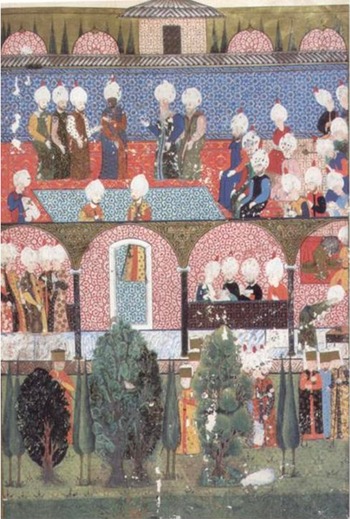
When the lion dollars arrived in Istanbul, Kara Mustafa Pasha lost no time. He convened a grand public trial in the second courtyard of Topkapı Palace, the heart of Ottoman imperial power. The courtyard was walled in by key administrative buildings, including the Council Hall, Public Treasury, kitchens, stables, and the Tower of Justice where the sultan observed proceedings from behind a high window. Stone paths crisscrossed a lawn dotted with cypress trees, ostriches, peacocks, songbirds, and deer. It was a grand ceremonial space where justice was dispensed and soldiers were paid, a majestic theater infused with the grandeur of the sultan even when he was rarely seen there.Footnote 23 His grand vizier, Kara Mustafa Pasha, dressed in a linen kaftan, stood inside the Council Hall and looked out through an iron lattice window upon an assembly of European ambassadors and esteemed Ottoman bureaucrats—including the minister of finance, the master of the mint, the chief customs officer, the palace’s purveyor, and the palace’s chief jeweler.Footnote 24 They stood underneath a portico before scales and a dome-topped furnace consisting of a large iron crucible with bellows that heated a clay hearth on which coins like the lion dollars could be tested (see figures 1 and 2).Footnote 25
A depiction of the furnace and scales under the portico of the Imperial Council Hall from an album of illustrations, ca. 1586, Vienna, Austrian National Library, Cod. 8615, f. 134v.

A similar view from the Süleymannâme, 1558, Topkapı Palace Museum, MS Haz 1517 f. 37b.

As he awaited the trial of the lion dollars imported by merchants under his authority, the English ambassador, Sir John Finch, was worried. What measure would Kara Mustafa Pasha use to determine whether the coins were “good” or “false”? In his last audience before the grand vizier, his voice had trembled as he sought to head off the trouble that he feared the lion dollars would bring.Footnote 26 At the trial, Sir John Finch refused a seat and stood attentively alongside the other officials as the sample of coins was weighed and then melted down in the coal-fueled furnace, purified, and weighed again. The mint experts found that the imported coins contained slightly less than 6.45 dirhem (19.81 grams) of silver each.Footnote 27 Another sample of one hundred lion dollars deemed good was then tested and found to contain 6.48 dirhem of silver each. The English ambassador sighed in relief, thinking that “by this Trial they had gained the Victory,” as the difference between the two samples of coins was small.Footnote 28 The Dutch resident, Justinus Colyer, however, disagreed, crying that the coins were seven percent below the “true value” of newly minted lion dollars and could not have come from a Dutch mint.Footnote 29 For Dutch diplomats, accusations of bringing in false money discredited them before Ottoman officials at a time when they were working to secure the renewal of the ahdnâme (known in English as the Capitulations) governing their trade from the Ottoman government.Footnote 30 Keen to appear honest, protect the reputation of Dutch coins, and limit the English merchants’ trade advantage, Justinus Colyer declared that if the coins were allowed to circulate, “none of the Dutch Nation would take any of them.”Footnote 31
Kara Mustafa Pasha agreed with Justinus Colyer that the imported lion dollars were deficient by the measure of the Dutch mint. He resolved to have the remainder of the “false” lion dollars sent from Aleppo to Istanbul. There he would have the coins melted and returned to the English merchants in the form of silver bullion. When the English merchants objected, Kara Mustafa Pasha offered them an alternative, which was communicated through the chief customs officer, Hüseyin Ağa, a statesman friendly with some of the English merchants in Istanbul.Footnote 32 If they gave him fifteen thousand lion dollars, he would let the lion dollars pass.Footnote 33 Upon hearing this, Sir John Finch convened the English Nation, an assembly of all the Englishmen in Istanbul, to discuss what should be done. The assembly unanimously agreed to give fifteen thousand lion dollars, a sum equal to seven and a half percent of the entire shipment, to Kara Mustafa Pasha if he would declare the coins “good.”Footnote 34 Losing this sum would be better than seeing their entire cargo of coins reduced to silver.
Kara Mustafa Pasha accepted the fifteen thousand lion dollars. The trial was then reconvened. Kara Mustafa Pasha himself was away from Istanbul with the sultan on pressing business, but the other Ottoman bureaucrats attended as before. This time, however, instead of using the Dutch standards for recently minted coins as the comparison, they measured the English merchants’ lion dollars against ten old, worn lion dollars which were still in circulation. Some of these coins were 106 years old according to English sources (and one-hundred-year-old coins according to an Ottoman source).Footnote 35 The silver in these coins had worn down through regular use and weighed around 8.7 dirhems and contained only 6.45 dirhems of purified silver, just like the English merchants’ lion dollars. The assembled Ottoman notables signed a paper certifying that the coins that had previously been condemned as “false” were actually “good.”Footnote 36 After the trial of the lion dollars, English merchants saw their payment to Kara Mustafa Pasha as a tyrannical exercise of power—nothing short of extortion—but his decision speaks to more than his supposed “rapaciousness.”Footnote 37 Through his ceremony of measurement, he exercised his authority to align competing notions of value and make money good for his empire in the age of global silver.
Sir John Finch, Foreign Merchants, and the Interstate Commerce in Coins
Sir John Finch, the English ambassador in Istanbul, found his position taxing. He had been more comfortable with his academic life at Cambridge, where he had studied and met Sir Thomas Baines, an older physician with whom Finch spent the rest of his life and eventually shared a grave.Footnote 38 Yet, Finch knew what was expected from him, coming from a prominent family of politicians and diplomats. Before him, two of his kinsmen had served as the English ambassador in Istanbul.Footnote 39 As ambassador, he found himself caught between various demands. He owed his appointment to the English Crown, but his salary was issued from the coffers of the Levant Company, a chartered, regulated company with a monopoly over English trade in the Ottoman Empire.Footnote 40 In his duties, he maneuvered between the demands of the Crown, the orders of an exacting Levant Company Board of Directors in London, and the exploits of frequently wayward English merchants operating within the Ottoman Empire. Finch complained that he was underpaid and that representing merchants was demeaning for a man of his education and background. The English merchants who Sir John Finch unwillingly served unsurprisingly found him self-important and obsessed with protocol.Footnote 41
The merchants under Sir John Finch’s reluctant watch profited from the different exchange value of coins in different places. The lion dollar offered merchants one such opportunity for arbitrage. The lion dollar (leeuwendaalder) contained the lowest amount of silver of all the large Dutch silver coins and was so crudely minted that the lion on its face was often confused with a dog.Footnote 42 Yet, despite the lion dollar’s low silver value, sellers in the Eastern Mediterranean readily accepted lion dollars at above their metallic worth, and shipments of coins were exempted from customs fees.Footnote 43 With the profits and popularity of lion dollars, mints elsewhere in Europe began to produce coins in imitation of these successful Dutch trade coins that would, at least initially, pass at the same rate as the original.Footnote 44
In his letter to the States General, the Dutch resident, Justinus Colyer, was at pains to stress that the coins were not the true product of a Dutch mint and that the English merchants’ claims that they had received the coins from English merchants trading in Holland must be false.Footnote 45 Dutch officials had warned their diplomats in the Ottoman Empire of substandard lion dollars produced in East Frisia in 1674.Footnote 46 They had also inspected samples of false lion dollars that an Armenian merchant in Izmir had received from a Frenchman, endeavoring to ascertain where they were produced, whether in France or in Izmir and its nearby islands.Footnote 47 The English merchants’ lion dollars were most likely substandard coins minted in imitation of the lion dollar in East Frisia in 1676.Footnote 48 In September of 1677, Dutch officials printed a notice warning of these coins and sent word to their diplomats in the Ottoman Empire.Footnote 49 Colyer knew that claims that Dutch mints were responsible for false coinage would hurt his countrymen’s commercial and diplomatic position in the Ottoman Empire. As the consul in Izmir acknowledged, if Dutch merchants were found hawking counterfeit coins, it would be “a very great blow” for Dutch “trade in general.”Footnote 50 Given the abundance of imitation lion dollars minted outside of the Dutch Republic, Colyer had grounds to cast blame for the lion dollars on the mints of other states.
After the trial, however, Finch reported on a conversation between an English merchant, William Black, and Colyer. Colyer allegedly informed Black that about five months before the trial in Istanbul, the Kampen mint had coined “false” lion dollars with insufficient silver content. Minting in the Dutch Republic occurred at fourteen different mints that were all to adhere to the same minting standards. In practice, however, regional mint workers like those at Kampen would often mint coins with a lower precious metal content and pocket the extra silver or gold.Footnote 51 Although these differences were undetectable in a single coin, they could yield a considerable profit across the entire mint output.Footnote 52 According to Finch’s account of the conversation between Black and Colyer, the Dutch state, in response to the mint fraud at Kampen, issued a warrant for the culprit to be “boiled in oil” and published a placard that showed the stamp of the “false” lion dollars against the “true ones.”Footnote 53 English merchants, Sir John Finch surmised, had then unknowingly shipped the new lion dollars minted in Kampen to Aleppo. Despite Finch’s account, Dutch mint placard collections do not contain a placard warning of false lion dollars from Kampen.Footnote 54 This story does, however, align with the timing of the placard warning of the false lion dollars minted in 1676 in East Frisia. The letter warning of these coins included a drawing of the coin that only featured the initials I&K for Jever und Kniphausen, not the mint’s name (see figure 3).Footnote 55 It is possible then that Finch incorrectly believed the suspect lion dollars to be from Kampen. Or, eager to present his merchants as beyond reproach in what the Levant Company Court of Assistants saw as the shameful trade in counterfeit coins, he chose to relate to them the most defensible story about the origins of the lion dollars.
Top: A drawing of the substandard lion dollar produced in East Frisia from the National Archive of the Hague, Archive of the Generaliteits Muntkamer, Register of incoming and outgoing correspondence, June 1673– 1680, “Proclamation,” 17 Sept. 1677, f. 143. Below: The same image from a printed notice held in Koninklijke Bibliotheek, Plano’s en plakkaten, KW, Plakk F 262 (1–61), Sept. 1677, f. 26.

For interstate merchants, like those in the Levant Company, the metallic contents of coins mattered. For the French and Dutch merchants trading in the Ottoman Empire, an English shipment of cheaply procured substandard coins would allow them to push up prices and outbid competitors.Footnote 56 Yet, coins circulating in the Ottoman Empire had value beyond their metallic contents. Otherwise, the English merchants’ willingness to pay fifteen thousand lion dollars rather than see their coins reduced to silver bullion makes little sense. In their estimation, seeing the lion dollars melted down would cost them three times as much as they paid to Kara Mustafa Pasha.Footnote 57 Despite the deficient metallic contents of the coins, the English merchants knew that they could count on the reputation and popularity of the lion dollar to pass off their coins to consumers with little ability or desire to establish the metallic contents of the coins particularly precisely. Early modern coins depended not just on silver and gold but also on reputation and trust.Footnote 58 Dutch diplomats were quick to distance themselves from coins that would damage their reputation, especially as they sought to secure a renewal of their trading privileges from the Ottoman state. Through their appeal, they represented themselves as honest and their profitable coinage as sound before Ottoman authorities, despite attempts by their competitors to discredit both.
None of the sources explain how those at the trial arrived at the sum of fifteen thousand lion dollars that secured the English merchants the second trial and the verdict that their lion dollars were “good.” However, that amount hovers just above the seven percent of silver by which the Dutch merchants declared the lion dollars to be deficient. In letting the coins pass, Kara Mustafa Pasha offered a concession to the English merchants who held prominent commercial positions in the empire.Footnote 59 The Dutch merchants must also have been content with this arrangement, as the English merchants lost any advantage over them in securing purchases that the light coin would have provided by making this payment. And if these coins were collected as taxes and then lost widespread credibility, the fifteen thousand lion dollars would compensate the Ottoman state for any loss the deficient metallic content would produce in paying armies and provisioners. Behind the spectacle of the trial of the lion dollars was a compromise between different power brokers that allowed them, as well as the coins themselves, to save face.
After the second trial, the English merchants received a certificate signed by top Ottoman bureaucrats declaring the coins “good.”Footnote 60 After receiving the certificate, the Levant Company’s treasurer, Dudley North, and Sir John Finch’s interpreter, Antonio Perone, sought “to take advantage” and press Hüseyin Ağa, the friendly chief customs officer, for a reduction in their payment, “asking what fault was committed” as the coins had proven to be “as good as the old dollars.” To this, Hüseyin Ağa “very angrily” replied that it was “the 15,000 dollars agreed upon [that had given them] this sort of trial and declaration, without which the money [would have been] declared bad.”Footnote 61 The central authority presiding over the trial of the lion dollars, setting the rules and the measure under which the money could be declared “good,” was not a European diplomat, but Kara Mustafa Pasha, the Ottoman grand vizier. Ottoman monetary authority, the power to weigh competing concerns, establish the rules governing trials, and issue a verdict, was then at the center of the trial of the lion dollars.
Kara Mustafa Pasha, the Ottoman State, and Imperial Money
The grand vizier’s origins were obscure. Official Ottoman accounts describe him as the son of a respectable cavalryman who died in the 1638 Ottoman siege of Baghdad.Footnote 62 According to others, however, Merzifonlu Kara Mustafa Pasha was born “among the dregs of the people.”Footnote 63 Whatever his origins, Kara Mustafa Pasha rose quickly. As a young man he joined the household of Mehmet Köprülü, the grand vizier, as a page, advancing first through his household and then through the Ottoman bureaucracy. He served as governor-general of Silistra, governor of Diyarbakir, grand admiral of the Ottoman navy, and deputy grand vizier, while his childhood friend from the Köprülü household, Grand Vizier Fazıl Ahmed Pasha, was away on military campaigns.Footnote 64 In these positions, he was known for his simple sartorial style, love of books, charitable giving, military prowess, and disciplined service to the state that occupied him late into the night.Footnote 65 Finally, in 1676, Kara Mustafa Pasha himself assumed the position of grand vizier. As the third grand vizier from the Köprülü household, Kara Mustafa Pasha was part of a household that increasingly filled important imperial positions that would previously have been held by the sultan’s household or military, marking a shift from a patrimonial administrative structure centered on the palace to one dominated by numerous households like the Köprülü household.Footnote 66 Kara Mustafa Pasha held the grand viziership until the unsuccessful Ottoman Siege of Vienna in 1683 ended his career and cost him his life.Footnote 67
As grand vizier, Kara Mustafa Pasha governed an empire that stretched from the Balkans to Baghdad, into the Arabian Peninsula, and across much of North Africa. The empire thus sat at the center of early modern Eurasian monetary flows. In addition to the longstanding overland caravan routes, the Ottoman 1517 conquests in the Levant, Egypt, and Arabian Peninsula propelled the Ottoman Empire into the world of Indian Ocean trade.Footnote 68 As coins were traded across the empire, bureaucrats increasingly collected taxes in money, and subjects, even in rural areas, employed money in their exchanges.Footnote 69 Rather than operate as a unified monetary system amidst a Eurasian trade in money, the Ottoman Empire incorporated regional currencies in recently conquered territories, thereby creating different currency zones: the akçe zone in the central Ottoman lands of Anatolia and the Balkans, the para zone in the more recently conquered Levant and Egypt, and the şâhî zone on the empire’s eastern border in former Safavid territory conquered in the 1530s. After the Safavid Empire debased the şâhî in 1553, the Ottoman Empire began minting lighter şâhî and akçe in the eastern provinces as a buffer zone to prevent the heavier ones from being smuggled to Safavid mints.Footnote 70
Interstate trade’s challenge to domestic monetary sovereignty intensified after the Ottoman-Spanish truce of 1580 as coins minted on American silver began to arrive in large volumes. The minting of lighter and heavier akçes in different parts of the empire after 1553 had opened up opportunities for arbitrage, but, as Mehmet Kuru has argued in a recent contribution to a longstanding debate over late-sixteenth-century Ottoman monetary history, before 1580 coinage was in such demand that most of it was used locally instead of being reserved for arbitrage.Footnote 71 The influx of coins minted from American silver, however, triggered inflation as the lighter and heavier akçe zones merged through arbitrage, creating a de facto debasement. In 1585, during costly war with the Safavid Empire, the Ottoman government responded by reducing the silver content of the akçe by forty-four percent and devaluing it against the Venetian gold ducat by one hundred percent.Footnote 72 Amidst this instability and subsequent debasements and coin corrections, people grew reluctant to hold akçe or to take bullion and foreign coins to Ottoman mints where they would be turned into Ottoman coinage.Footnote 73 Ottoman mines were also unable to compete with cheaper American silver.Footnote 74 Faced with a scant supply of silver, Ottoman provincial mints closed, and the central mint dramatically reduced its minting output between 1650 and 1687.Footnote 75 Ottoman coinage all but disappeared.
During this period, transactions within the Ottoman Empire relied on imported European coins like the lion dollar. The influx of foreign coinage deprived the Ottoman bureaucracy of potential mint revenues and control over the metallic content of coins but also provided their subjects with a popular medium of exchange during a volatile period. Imported European coins that had previously been mostly reserved for large-scale transactions especially in interstate trade began to denominate state budgets, and even small change arrived from abroad and passed from shopkeepers’ hands to the coffers of the state through tax payments.Footnote 76 Global coinage had become the money of the empire.
These disruptions have led scholars to describe Ottoman officials as disinterested in monetary matters.Footnote 77 Yet, in an empire of foreign coins, Kara Mustafa Pasha governed by controlling how these coins were measured if not how they were minted. As even the most astute user could only establish the weight and fineness of coinage to a certain degree, government officials like Kara Mustafa Pasha played a key role in establishing conventions for how coins should be measured in exchanges.Footnote 78 He had, in Sir John Finch’s estimation, “wholly applied himself to reforming the money of this empire”—establishing the rates of foreign coins and appointing officials to root out low-grade coins.Footnote 79
Kara Mustafa Pasha claimed monetary power by assuming the role of arbiter over coins introduced through foreign trade, the metallic content of which, whether low or high, was decided elsewhere. His government issued official values for different coins deemed “good” that would be accepted as taxes and updated these lists regularly, threatening harsh punishments for those who did not adhere to them.Footnote 80 Ottoman officials tested shipments of foreign coins at their port of arrival.Footnote 81 The government also appointed a muhtasib to inspect the marketplace daily to ensure moral behavior, enforce the government rates, collect taxes, and inspect the weights and quality of goods, including coins. Instead of the harsh punishments inscribed in law, the muhtasib often punished those deviating from established measures through social shaming rituals, parading them around the market with their head sticking through a board affixed with jingling bells that attracted attention as they walked. Heralds would follow the culprit shouting that this is how justice punishes those who cheat their clients in weight or measure.Footnote 82 These efforts seem to have met with remarkable success. According to some European observers, Ottoman subjects largely exchanged coins according to their nominal value and relied on tools like touchstones to assess the metallic contents of coins much less than their European counterparts.Footnote 83 Far from yielding monetary control, Ottoman officials like Kara Mustafa Pasha were key to making money “good” in the empire.
Despite the Ottoman state’s important regulatory role in making money in the empire, its authority across its vast empire was necessarily incomplete. Information traveled slowly and official rates were difficult to enforce. The very frequency of these orders listing the official rates and penalties for transgressions suggests they must often have been flouted.Footnote 84 Local bureaucrats also deviated from ostensibly empire-wide policies. As the quantity and quality of coinage fluctuated, Ottoman customers unilaterally decided to accept only certain currencies. One customer in Aleppo in 1666 accepted only “Seville and Mexico coins.”Footnote 85 Another in Izmir in 1686 accepted only Spanish reales and refused to accept lion dollars.Footnote 86 Both cities were foreign trade hubs frequented by European merchants who had access to different types of currencies and sought to use them strategically. They protested against the customers’ currency stipulation, as it limited their flexibility. Ottoman taxpayers, many with more limited money reserves, also fiercely guarded the right to pay taxes in particular currencies. For example, in 1672, when a local tax collector began accepting only lion dollars, the people of Siroz, a city on a major commercial route between Edirne and Thessaloniki, sent a petition through their local judge to assert their traditional right to pay taxes half in foreign coins, including lion dollars and Spanish piasters, and half in the lower denomination Ottoman coins, the para and akçe, presumably because these Ottoman coins were less useful in interstate trade.Footnote 87 Other subjects sought permission to pay their taxes in coins deemed light or “bad.”Footnote 88 Through contestation, the Ottoman state’s orders about acceptable coins became localized across the empire.
Kara Mustafa Pasha’s authority in determining if coins were “good” or “false” for the empire was on display at the trial of the lion dollars. He had to balance his commitment to currency reform with geopolitical concerns. He would have been sensitive to the needs of the Ottoman treasury after the heavy expenditure of the previous summer’s unsuccessful siege of Chyhyryn in modern Ukraine.Footnote 89 As grand vizier, he was expected to help meet the needs of the treasury during wartime. He also made charitable gifts befiting his station and maintained his own household of four hundred people as well as two military regiments of at least five hundred soldiers who accompanied him to war.Footnote 90 As he assessed the arguments of the Dutch and English merchants, he must have also considered the diplomatic importance of each state as the Franco-Dutch War (1672–1678) pitted France and England against the Dutch Republic and stymied Dutch trade in the Mediterranean.Footnote 91 In weighing these different concerns and issuing a verdict, Kara Mustafa Pasha’s role as judge provided him with considerable power.
A proverb circulating in the Ottoman Empire at the time said, “The sultan’s lead cannot sink.”Footnote 92 For those quoting this proverb, it seemed that the Ottoman government always acted to ensure that its treasury did not face a loss no matter how poor quality the coinage, passing the hardship on to others instead. Yet, in declaring the English lion dollars “good,” Kara Mustafa Pasha aligned other competing definitions of money not based on Ottoman state power with his verdict. The actions of those operating outside of the state, like the various European merchant groups, could sway social assessments of coins’ credibility. An English boycott of the new lion dollars in Izmir had previously succeeded in discrediting those coins there.Footnote 93 The threat of the Dutch boycott then was something with which to be reckoned. When merchants and other monetary authorities refused coins, their credibility could be undermined despite state acceptance, disrupting exchanges of many Ottoman subjects who could express their own ideas about money and justice in the streets.
The Townspeople of Istanbul and Currency Crisis
The Ottoman record of the trial of the lion dollars describes how the coins were assessed among the people (beyne’n-nâs). Sir John Finch’s account similarly describes the event as a public trial, but access to the second courtyard of Topkapı Palace, a key ceremonial site, was usually restricted to those with official business.Footnote 94 Whether or not Istanbul’s townspeople were present, they represented a key audience for the trial. After Kara Mustafa Pasha had accepted the English merchants’ fifteen thousand lion dollars, the second trial was performed to give them confidence in the lion dollars. Although their thoughts are difficult to recreate from surviving records, their actions suggest a moral economy of money in which exchange should be guided by traditional notions of justice and mutual obligation.Footnote 95 When Istanbul’s townspeople’s moral understanding of money was violated, their actions could force political change, but they were also positioned to lose the most should confidence in a coinage falter.
We can glimpse the townspeople of Istanbul’s monetary power and their precariousness through two events predating the trial of the lion dollars. First, in 1651, Ottoman finance officials and the janissary corps, a powerful quasi-military urban force, facing the costs of the Cretan War (1645–1669), devised a plan to profit from the state’s power over the measurement of money.Footnote 96 They acquired one hundred and twenty yük (a measurement equal to one hundred thousand akçes) worth of debased coins and planned to use their power to force Istanbul shopkeepers to accept them in exchange for gold coins at a fixed (and low) exchange rate. The bureaucrats and janissary leaders could then exchange the shopkeepers’ gold for Spanish pieces of eight through a merchant banker (sarraf) and use these coins to pay the arrears due to their soldiers.Footnote 97 As in other situations, they hoped that their exercise of monetary power in declaring coins “good” and forcing tradesmen to accept them would provide the profits necessary to alleviate the problems of an empty treasury. However, after being forced to accept coins that they believed to be “bad,” the guilds of Istanbul petitioned the grand vizier. When their demands were not met, they closed up their shops and marched on the palace.Footnote 98 Armed with cudgels, clubs, and fire-pokers, the crowd swelled to a large mass of people who saw the imposition of debased coins as unjust. In the face of such widespread dissent, the sultan demanded that the janissary commanders desist in their plans.Footnote 99 Sometimes, as in 1651, Istanbul’s townspeople succeeded in resisting policies that would leave them with debased coins that may have been refused by regional and interstate merchants and thus risked losing value entirely.
At other times, popular protests only ameliorated the harsh consequences of currency crises. A good example of this is the trade in coins known as temins, sümns, louis de cinq sous, luiginos, or five-sol pieces. Between 1656 and 1669, European merchants imported some 180 million temins into the Ottoman Empire along the Aegean coast, particularly to the Mediterranean port city of Izmir.Footnote 100 Temins were originally low denomination silver coins minted in France in 1643, but over time they were produced in as many as one hundred and twenty different European mints and were debased into coins made of copper and coated in a thin layer of silver.Footnote 101 This trade was quite profitable for interstate merchants because “all five sol pieces (called here temins) that were not worth above seventeen or fifteen for a dollar in Italy and at Marseilles; here they put them off at ten for a dollar.”Footnote 102 With scant supplies of money, particularly of small change, many people embraced the coins.Footnote 103 Temins were milled, marked with regular ribbed edges along their rims, and were therefore “pleasant and bright to the eye.”Footnote 104 A French traveler returning from the Safavid Empire reported that the women who served him food insisted on being paid in temins. Some of these poorer women fastened their headpieces with temins in a similar fashion to how wealthier women fastened them with gold coins.Footnote 105 Temins gained widespread acceptance in trade hubs like Izmir, and Ottoman troops laying siege to Crete reportedly demanded their payment be made only in temins.Footnote 106
Widespread acceptance gave temins value in local exchange despite their high copper content, but these value assessments were susceptible to boycotts and political decree. The exchange value of the coins began to fall early in 1666 as more people refused to accept them.Footnote 107 In 1667 in Izmir, Jewish merchants boycotted the debased coins, a boycott that lowered their value on the marketplace.Footnote 108 The English consul in Izmir predicted that “they will in short time become red and show themselves in their colours, by which means they will be no more current and so the whole country break at once.”Footnote 109 In addition to boycotts by different commercial groups including foreign merchants, the Ottoman state intervened in the temins trade. The judge in Izmir ordered that false temins should be subject to a high customs rate.Footnote 110 In 1669, the Ottoman state sent orders to local judges that “good” temins would be accepted at a rate of eight akçe, but “bad” temins would no longer be accepted in tax payments.Footnote 111 The “good” temins were countermarked to mark them as such (see figure 4).Footnote 112 One French merchant, Gaulin, who imported twenty-five thousand crowns worth of temins to Istanbul returned to the customs house to find that the chief customer had had the entire shipment reduced to silver.Footnote 113 Gaulin was among many European and Ottoman merchants whose engagement with the temins trade pushed them into ruin.Footnote 114
An Ottoman countermark on a 1664 Massa di Lunigiana Alberico II 8 Bolognini, from the Dr. Hans Wilski Collection of Ottoman & Islamic Coins, Part I, Monthly World and Ancient Coin Auction.

The urban poor who were left with the worst quality coins could, as in 1651, protest monetary policies that harmed their interests. When taxpayers who could not produce the desired coins were imprisoned, riots broke out in Bursa and Ankara.Footnote 115 The English ambassador wondered whether the sultan would be able to survive “such discontent.”Footnote 116 His consul in Izmir remarked that “it was strange to see, how [all of] a sudden all Trade ceased, no money being left in the Country, few Bargains were made but by Barters.”Footnote 117 A Venetian diplomat remarked that “the whole population is now aware of counterfeit money” and were thus cautious in their dealings.Footnote 118 In response to the violent protests, the state agreed to accept the coins at one third of their former value.Footnote 119 Yet, most Ottoman subjects distrusted temins too much for the state’s edict to overcome their misgivings. They refused to accept them in payment, and the Ottoman state ordered that the offending coins be brought to the mint where the holders would receive only the silver content of the coins.Footnote 120 Although their protests against the state’s monetary policies had successfully swayed its course, that would have been of scant comfort to the urban poor who saw the contents of their pockets reduced by more than two-thirds.
In the Ottoman Empire, as elsewhere, people at the bottom of the social hierarchy were often forced to accept clipped and debased coins, even when they knew them to be poor quality. These coins worked well and were usually accepted at their nominal value, but, when their validity was questioned, they could lose their currency and be worth nothing more than their metallic contents. At times of monetary instability when Ottoman monetary authority appeared shaky, concerns about just exchange translated into questions about the metallic contents of their coins. Almost a decade after temins were demonetized, that concern was on display at the trial of the lion dollars. Even as the standard against which the lion dollars were tested changed from new to old lion dollars, the mint workers dutifully separated out the silver content and weighed it in a public performance. Whether or not the measurements were particularly precise, a verdict required a ceremony of measurement revolving around the metallic content of the coins, suggesting the importance of this measure for their public credibility. Ceremonies like the trial of the lion dollars and their much more routine equivalents discussed in the following section sought to establish credibility for coins as they passed from interstate trade to the imperial treasury to city bazaars. When these ceremonies failed, some profited from a trade in coins while others found the value of their meager supplies of coinage further depleted.
Ceremonies of Measurement and Money between the Bazaar and Interstate Trade
Alongside Kara Mustafa Pasha and Sir John Finch, the minister of finance, the master of the mint, and the chief customs officer, two other officials witnessed the public trial: the palace purveyor and the palace’s chief jeweler. The palace’s purveyor and chief jeweler who witnessed the trial of the lion dollars are unnamed, but most holders of the positions were non-Muslims, usually Jews or Armenians.Footnote 121 The palace purveyor purchased foreign luxury goods, including the fine English woolen cloth that English merchants hawked, for the grandees of the Ottoman state. The palace’s chief jeweler supplied elites with jewelry and other precious metals that often arrived from outside the empire.Footnote 122 The palace’s purveyor and chief jeweler then operated as factors between foreign trade, imperial business, and local exchange—circuits that were often woven together through more mundane ceremonies of measurement than Kara Mustafa Pasha’s grand trial of the lion dollars.
Monetary practices were central to economic life, but as habitual practices that seemed almost second nature at the time, they are rarely dwelt on in archival records. A surprising source, however, allows us to glimpse how money was exchanged between foreign traders and Ottoman merchants in Ottoman bazaars. In 1709, Thomas Vaughan, an English merchant who had worked in Izmir, published an introduction to the Turkish language intended to equip outgoing merchants linguistically for business in the Ottoman Empire.Footnote 123 At the end of his text, Vaughan provided a series of dialogues showing common conversations useful for routine commercial practices. In one dialogue (figure 5), the imagined English merchant announces his intension to purchase Iranian carpets, muslins, and calicoes with the assistance of a local servant. The servant immediately asks, “What sort of money have you?” The merchant replies, “Small money.” The servant warns him that this money will not do, as “the Persians will not take other Money than Lyon-Dollars or Gold…because among small money there is much false.” Merchants trading to the east valued coins that were more likely to be accepted there because of a reputation for a purer precious metal content.Footnote 124 Later in the dialogues, the English merchant asks his Ottoman assistant to purchase an akçe’s worth of ink. But, as he has no small money, the servant must purchase it on credit.Footnote 125 Major Ottoman merchants like the palace purveyor would have reserved large coins like lion dollars for his dealings with long-distance merchants while using other, smaller or less widely accepted coins for local expenses.
A practice dialogue from Thomas Vaughan’s Grammar of the Turkish Language (London: 1709) held at the Princeton University Library.

Others opposed the construction of currency circuits that, like that of the Persian merchants who refused “small money,” restricted their ability to buy and sell. For example, a group of Istanbul shopkeepers including bakers, butchers, and candlemakers complained in a petition to the sultan that merchants bringing sheep and other provisions to Istanbul refused to accept the “old, good money” that these shopkeepers held.Footnote 126 Instead, they insisted that the shopkeepers take it to a sarraf to be exchanged for a different type of coin. Yet, when the shopkeepers did as the merchants suggested, the sarrafs similarly refused the coins. The exasperated shopkeepers resorted to petitioning the Ottoman state for redress, successfully arguing that since the Ottoman state finance department considered the old coins in their possession good, they should be able to use them to procure the sheep and other provisions.Footnote 127
Some coins like the shopkeepers’ “good, old money” were restricted to a particular circuit—in this case, the payment of taxes. Many other coins, however, operated across circuits. Lion dollars were the preferred coinage of merchants trading to the Safavid Empire, but they also demarcated Ottoman state budgets, fulfilled Ottoman subjects’ tax obligations, and passed from hand to hand in the bazaar.Footnote 128 Small change, like temins, was similarly imported by interstate merchants and then passed through the hands of Ottoman bureaucrats, merchants, and shopkeepers. Instead of operating in parallel, these different currency circuits intersected through the business of merchants like the palace’s purveyor and chief jeweler who worked between local, imperial, and interstate currency circuits. At the trial of the lion dollars, they then had an interest in ensuring that the coins they received from the palace in payment for their goods could be used across interstate commerce and local exchange.
Ceremonies and mutually intelligible conventions were necessary for different coins to flow within and across currency circuits. When coins entered Ottoman ports, the Ottoman chief customs official of the city, often along with the local judge, presided over a trial of the coins at a smaller scale than Kara Mustafa Pasha’s grand affair.Footnote 129 These ceremonies did not end once coins had passed into the Ottoman Empire. In Vaughan’s practice dialogues, the quality as well as the kind of coinage comes under dispute. The English merchant pulls out fifteen Spanish reales, but he fears he had mistakenly accepted counterfeit coins, because he did not “understand Money, whether it be good or bad.” The servant confirms that the money is indeed counterfeit money and recommends passing off as much as he can at the bazaar.Footnote 130 In the bazaar, though, the quality of merchants’ coins was assessed. A carpet merchant objected that one of the English merchant’s lion dollars was “copperish” and two more were “worn smooth.” The English merchant protested, claiming, “These are all good Lion Dollars: if you don’t believe it, let’s show them to the money-changer.”Footnote 131 What followed was then another sort of trial of lion dollars, one less well documented and more mundane. When the validity of coins came into question, a sarraf, a position not yet licensed by the state, would exercise his monetary authority in the bazaar by trying the coins and issuing his verdict.Footnote 132
As elsewhere in the early modern world, coinage in the Ottoman Empire was a knowledge-intensive technology and the subject of determined scrutiny.Footnote 133 Yet, with limited knowledge about the metallic content of the coins they carried and a pressing need for coin, people relied instead on legal decrees and customs, which, through repetition, became rituals. In Ottoman bazaars, a sarraf would mediate disputes over the quality of coins such as this one by weighing and testing the coins. When European merchants imported coins, this role was filled by Ottoman customs officials. The measurements of the sarraf and customs officials are examples of what Jane Guyer calls “mundane charisma,” everyday practices that allowed people to bring together valuation repertories from different circuits of exchange in either novel or established ways.Footnote 134 When currency circuits converged, the sarraf and customs official’s more routine “ceremonies of measurement” sought to establish information about the coin’s metallic content, restore elements of trust, and set the seller’s mind at ease.Footnote 135 With its witnesses and its ceremony, the trial of the lion dollars lays bare the process in which global coinage became imperial money through the vying valuations of groups before key authorities, even if these contests were usually less grand than the 1677 gathering in the courtyard of Topkapı Palace.
The Verdict
The trial of the lion dollar shows how coins’ value was forged and refashioned in an era of growing global trade and assertive but incomplete state power. Older narratives of silver flowing around the world as a natural, homogenizing force unleashing globalization leave little room for the cognitive work and political dimensions of money. As coins moved through space as material objects, they encountered, challenged, and reinforced political power. Coins offered a measurement with their validating information marks tied to a governing authority that made them distinct from raw silver.Footnote 136 They had long been bound up with notions of power, sometimes heavenly but often earthly, with sovereigns using coinage as a canvas on which to display the authority of the state.Footnote 137 Yet, as seen in Ottoman Istanbul, answers to the question what made money “good” were offered by actors outside the state—merchants engaged in long-distance trade and townspeople willing to defend a moral economy of money in the streets. Reconciling the monetary practices of different people with their own motivations and political concerns required constant brokerage, translation, and ceremony.Footnote 138 From this perspective, the familiar story of global silver traveling around the world as a commodity transforms into one of coinage assigned value through far-reaching social processes, carried across space via a series of linkages, convergences, and circulating monetary practices.
Even in the early modern period, money was a global phenomenon, produced and reproduced through a series of exchanges and interactions with competing monetary authorities. The trial of the lion dollars shows how the interests of actors—actors with different understandings of what made money good and working on different scales, including cross-border ones—were reconciled in a particular time and place. This history is then aligned with efforts to move from narratives of national, or even regional, divergence to an understanding of global entanglement, an approach that rejects notions of independent, nationally bound origins as well as the resulting fixed-point comparisons.Footnote 139 Ideas about money cannot be neatly contained within distinct “varieties of capitalism” nor did they simply develop within the European metropole to be exported to “the rest.”Footnote 140 Instead, the trial of the lion dollars should be seen through different geographies and circuits that reveal the global processes involved in seemingly local events.Footnote 141 Money worked through a co-creation among actors like Ottoman bureaucrats and sarrafs who were just as sophisticated in their monetary thinking as the European merchants and diplomats who sought to sway Kara Mustafa Pasha’s judgement. In an empire of global coinage, money was made before key authorities through ritualized ceremonies of measurements that reflected social relations and established public credibility. At the trial of the lion dollars, Kara Mustafa Pasha used his power to weigh competing monetary concerns with threads reaching far beyond his empire and bound them together within the specific local setting of Ottoman Istanbul. Through this process, a lion dollar could be declared “false” on one day and then subsequently be rendered “good.”
Acknowledgements
I would like to thank the participants in the American Society for Legal History Wallace Program, the Dartmouth History Institute, the Harvard Seminar in the History of Global Capitalism, the Mid-Atlantic Ottomanist Workshop, the Ottoman Political Economy Working Group, the Purdue History Working Group, and the Skilliter Centre for Ottoman Studies Conference as well as Anıl Aşkın, Ayşe Baltacıoğlu-Brammer, Sven Beckert, Lauren Benton, Fahad Ahmad Bishara, Lorenzo Bondioli, Lale Can, William Deringer, Christine Desan, Andrew Edwards, Kate Fleet, Richard von Glahn, Zoe Griffith, Antonio Iodice, Alejandra Irigoin, Akinobu Kuroda, Mehmet Kuru, Alan Mikhail, Nada Moumtaz, Paul Musselwhite, Albert Scheffers, Pepijn Trienekens, David Yoon, and the anonymous CSSH reviewers.



 Open access

