





Metabolic syndrome (MetS) is an increasingly prevalent issue, affecting between 12·5 % and 31·4 % worldwide and 31·5 % in Europe, depending on the study population characteristics and the diagnostic criteria(Reference Noubiap, Nansseu and Lontchi-Yimagou1). MetS corresponds to concomitant metabolic abnormalities representing risk factors for cardiovascular diseases. It is characterised by five criteria: hypertriglyceridaemia, elevated blood pressure (BP), hyperglycaemia, abdominal obesity and dyslipidaemia(Reference Alberti, Eckel and Grundy2). MetS is highly associated with diabetes and cardiovascular diseases and can be used clinically in primary prevention to identify individuals at high risk of cardiovascular diseases and mortality(Reference DeBoer and Gurka3,Reference Wang, Ruotsalainen and Moilanen4) or defined as a pre-morbid condition(Reference Simmons, Alberti and Gale5).
Numerous studies have highlighted the importance of diet as a modifiable risk factor for MetS and, more generally, cardiovascular diseases(Reference Lichtenstein, Appel and Vadiveloo6). More specifically, plant-based diets have gained significant popularity in recent years for their environmental and health benefits. Some studies and reviews have highlighted the benefits of diets rich in plant foods to reduce the risk of MetS(Reference Lichtenstein, Appel and Vadiveloo6–Reference Thomas, Calle and Fernandez8). Previous studies have shown that the nutritional quality of plant-based diets varies, which impacts their effectiveness in preventing cardiovascular disease(Reference Hemler and Hu9,Reference Satija, Bhupathiraju and Spiegelman10) . One study reported that unhealthy plant-based diets can have detrimental effects on certain factors such as HDL and TAG. It could be hypothesised that some individuals transitioning to plant-based diets may substitute animal foods with ultra-processed plant foods rich in carbohydrates and sugars and even saturated fats, inducing them to both a reduced HDL-cholesterol and an increased TAG blood level(Reference Heianza, Zhou and Sun11).
Several indices based on the contribution of plant foods to the diet compared with animal products have been proposed, and among them, plant-based diet indices (PDI) have been more frequently reported as associated with cardiovascular health(Reference Thomas, Calle and Fernandez8,Reference Satija, Bhupathiraju and Rimm12) . The healthy plant-based diet indices (hPDI) reflect to which extent a diet is characterised by a higher consumption of healthy plant foods, such as vegetables, fruit and whole grains and a lower contribution of animal foods, whereas the unhealthy plant-based diet indices (uPDI) reflect to which extent a diet is characterised by a higher consumption of unhealthy plant foods such as refined grains and sugary drinks(Reference Satija, Bhupathiraju and Rimm12). To our knowledge, very few studies have examined the link between these indices and MetS, especially in different gender groups. Most of these studies have been conducted in North America(Reference Jovanovic, Hoelscher and Chen13,Reference Bhupathiraju, Sawicki and Goon14) or Asia(Reference Kim, Lee and Rebholz15–Reference Huo, Cao and Liu17) and fewer in Europe: one large epidemiological study in Spain(Reference Oncina-Cánovas, Vioque and González-Palacios18) and a smaller one in Denmark(Reference Lanuza, Meroño and Zamora-Ros19), inducing a lack of results from this continent about the association between clinically measured risk factors of MetS and plant-based diets. Five of these studies reported that higher scores of hPDI were associated with a reduced risk of MetS(Reference Jovanovic, Hoelscher and Chen13,Reference Kim, Lee and Rebholz16–Reference Lanuza, Meroño and Zamora-Ros19) , and two others did not report any association(Reference Bhupathiraju, Sawicki and Goon14,Reference Kim, Lee and Rebholz15) . In three of the studies, higher scores of uPDI were associated with an increased risk of MetS(Reference Kim, Lee and Rebholz16,Reference Oncina-Cánovas, Vioque and González-Palacios18,Reference Lanuza, Meroño and Zamora-Ros19) , and three other studies did not report any association(Reference Bhupathiraju, Sawicki and Goon14,Reference Kim, Lee and Rebholz15,Reference Huo, Cao and Liu17) . As the nutritional quality of plant-based diets varies across countries due to different cultural settings and associated food habits, it remains important to add new knowledge regarding cardiovascular risk factors and these diets in Europe, in large cohort studies.
Therefore, this study aims to investigate the pooled cross-sectional associations between MetS, its components and healthy and unhealthy plant-based diet indices (hPDI and uPDI) by gender, using data from two cohorts: NutriNet-Santé and STANISLAS and one representative survey: Esteban.
Methods
Study population and design
This study is based on two cohorts: NutriNet-Santé and STANISLAS and a national representative survey of the French population: Esteban.
-
NutriNet-Santé:
The NutriNet-Santé cohort is a prospective online observational cohort launched in 2009. This study has been described in detail elsewhere(Reference Hercberg, Castetbon and Czernichow20).
This cohort study was conducted in accordance with the Declaration of Helsinki and approved, and all procedures were approved by the Institutional Review Board of the French Institute for Health and Medical Research (IRB Inserm number 0000388FWA00005831) and the National Commission on Informatics and Liberty (CNIL numbers 908450 and 909216). All participants gave their informed consent electronically. The clinical trial number is NCT03335644.
Between 2011 and 2014, NutriNet-Santé participants were voluntarily asked to undergo a clinical examination and biological sampling in one of the local centres located throughout France. Informed consent has been retrieved for all participants. All procedures were submitted for approval to the ‘Consultation Committee for the Protection of Participants in Biomedical Research’ (C09-42 on 5 May 2010) and to the CNIL (No. 1460707) for the protection of participants in biomedical research.
-
Esteban:
The Esteban survey is a representative cross-sectional study of French adults conducted between 2014 and 2016. The protocol for this survey has already been published(Reference Balicco, Oleko and Szego21). The study has been registered with the French National Agency for Medicines and Health Products Safety) (No. 2012-A00456-34) and has been approved by the Advisory Committee for the Protection of Individuals in Biomedical Research.
The Esteban study used a three-stage probabilistic sampling design. In the first stage, a stratified sample of primary units (PU) was drawn at random. In the second stage, households in each PU were selected at random by telephone sampling. In the third stage, a single individual (adult or child) was drawn from among the eligible members of the household.
Stratification was based on two variables: region (eight geographical areas) and size of the urban residence unit (five strata: rural; < 20 000 inhabitants; 20 000–100 000 inhabitants; > 100 000 inhabitants, Paris). This complex survey design was taken into account in the estimation of the initial weighting applied to each person who participated in the first visit. This weighting corresponded to the number of eligible persons in the household, multiplied by the inverse of the probability of drawing from the household and by the inverse of the probability of drawing from the PU(Reference Vay-Demouy, Lelong and Neudorff22).
-
STANISLAS:
The STANISLAS cohort is a population-based study of 1006 families each comprised of at least two parents and two children (4295 participants) from the Lorraine region (Eastern France) recruited during 1993–1995 at the Center for Preventive Medicine. The participants were of French origin and free of acute or chronic disease. They participated at three follow-up visits, each every 5 to 10 years. From 2011 to 2016, 1705 participants underwent their fourth examination. The STANISLAS study has been described in detail elsewhere(Reference Ferreira, Girerd and Bozec23). The present study focuses only on the fourth visit where a FFQ was administered.
The research protocols were all approved by the local Ethics Committee (Comité de Protection des Personnes Est III—Nancy—France) and all study participants gave written informed consent.
Clinical and biological data assessment and harmonisation
-
NutriNet-Santé:
During the clinical examination, trained staff measured systolic and diastolic BP three times at 1-minute intervals in the seated position after lying down for 5 min using a validated automatic device (HEM-7015IT; OMRON, Rosny-sous-Bois, 130 France). For the analyses, mean values were calculated according to the three catches.
Anthropometric data were also collected during this examination by trained staff with standardised procedures. Height and weight were measured once using a wall cloth and an electronic scale (BC-418MA; TANITA, Tokyo, Japan) respectively. The BMI (kg/m2) was calculated. Waist circumference was measured by taking the circumference halfway between the lower ribs and the iliac crests.
During the clinical examination, blood samples were taken after a fasting period of at least 6 h and centralised for analysis in a single laboratory (IRSA, Tours, France). Measurements included total serum cholesterol (cholesterol oxidase C8000, Abbott), HDL-cholesterol (direct accelerator C8000, Abbott), serum TAG (glycerol kinase C8000, Abbott) and fasting blood glucose (hexokinase on C 8000 automat, Abbott, Suresnes, France). LDL-cholesterol was calculated using the Friedwald formula(Reference Planella, Cortés and Martínez-Brú24).
Following the clinical assessment data regarding drug intakes were collected.
-
Esteban:
Biological samples and measurements were taken during the clinical examination. BP was measured according to the method used in the European Health Examination Survey protocol(Reference Tolonen25). BP was measured using a BP monitor (Omron 705-IT). Three measurements were taken 1 min apart, 30 min after the blood sample was taken and after 5 min of rest with no change in position.
Height and weight were measured once using a portable measuring (Leicester Tanita HR 001) rod and a scale (SECA 803 Clara), respectively. The BMI (kg/m2) was calculated.
Waist circumferences were measured, using a flexible tape measure placed midway between the last rib and the iliac crest in a horizontal plane. The measurement, in cm, was read at the end of a normal exhalation(Reference Balicco, Oleko and Szego21).
During the clinical examination, a fasting blood sample and urine were taken from all participants. A lipid profile (total cholesterol, HDL, calculated LDL, TAG), blood sugar levels and a complete blood count were carried out.
-
STANISLAS:
Anthropometric measurements, such as weight, height and waist circumference were performed during clinical examination. The BMI (kg/m2) was calculated. Office BP was also measured. After 10 min of rest in the supine position, systolic and diastolic BP were measured with an automatic device (Dinamap Pro 400, CRITIKON). Office BP was measured three times at 1-minute intervals and the mean of the three measures was considered. Blood samples were collected during the clinical examination and serum concentrations of the many biomarkers were measured including fasting glucose, HDL, calculated LDL-cholesterol and TAG(Reference Ferreira, Girerd and Bozec23).
In the three studies, data regarding drug intakes were collected during or following the clinical examination.
Definition of MetS:
MetS was defined in the three studies according to the International Diabetes Federation criteria(Reference Alberti, Eckel and Grundy2). MetS is attributed to individuals having three or more of the five following criteria:
-
elevated waist circumference (waist circumference ≥ 94 cm for men and ≥ 80 cm for women),
-
elevated BP (SBP/DBP ≥ 130/85 mmHg or antihypertensive drug treatment),
-
hypertriglyceridaemia (≥ 150 mg/dl or fibrate drug treatment),
-
low HDL (< 40 mg/dl for men or < 50 mg/dl for women),
-
hyperglycaemia (fasting glycemia > 100 mg/dl or antidiabetic drug treatment).
Clinical and biological data harmonisation enabled us to compute the components of MetS in each sample similarly.
Dietary data collection
-
NutriNet-Santé:
At baseline and every 6 months thereafter, dietary data were collected using 24-hour dietary recalls, randomly distributed over 2 weeks comprising two weekdays and one weekend day(Reference Lassale, Galan and Julia26). Participants who completed at least three 24-hour recordings at inclusion were included in this study. The analyses were performed on the recordings collected when the participants were included in the study. Food Propensity Questionnaire was used to gather information on the frequency of consumption of occasionally consumed foods and drinks over the 12 months preceding the study (e.g. for better estimation of fish intake)(Reference Subar, Dodd and Guenther27).
The participants reported all the foods they consumed throughout the day, which they chose from a list of approximately 3500 items of foods usually consumed in the French diet. Portion sizes were then estimated using purchase unit, household unit and photographs, derived from a previously validated picture booklet(Reference Moullec, Deheeger and Preziosi28). Daily intakes for energy, macro and micronutrients were estimated using the published NutriNet-Santé food composition table(29), weighted according to the day (week or weekend). Dietary underreporters were identified by the method proposed by Black(Reference Black30). These web-based dietary records have been validated in several studies against traditional dietitians’ interviews(Reference Touvier, Kesse-Guyot and Méjean31) and against biomarkers of nutritional status(Reference Lassale, Castetbon and Laporte32,Reference Lassale, Castetbon and Laporte33) . Dietary data were collected on mean 2 years and 1 month before the health examination (sd = 1 year and 2 months).
-
Esteban:
Dietary data from the 24-hour recall method was collected by telephone with a dietitian or by the Internet. In this study, we included participants with at least two 24-hour recalls. The 24-hour recalls were randomly selected (2 weekdays and one weekend day), and the participants were not informed in advance so that they could not modify their dietary habits. In addition to the 24-hour recalls, a Food Propensity Questionnaire was used to gather information on the frequency of consumption of occasionally consumed foods and drinks over the 12 months preceding the study (e.g. for better estimation of fish intake)(Reference Subar, Dodd and Guenther27).
-
STANISLAS:
Dietary intake was assessed using a validated FFQ(Reference Sauvageot, Alkerwi and Albert34). Over the past 3 months, participants reported their frequency of consumption and portion sizes for 133 foods and beverages. Frequency of consumption was recorded at six levels, ranging from ‘never or rarely’ to ‘2 or more times a day’. Portion sizes for each food or drink were estimated using standard portions and food models. Daily nutrient intakes were calculated in grams per day by multiplying the frequency of consumption of each item by the nutrient content of the selected portions. The nutritional data used was extracted from the French food composition database compiled by the Centre de Données sur la Qualité des Aliments (Ciqual).
Meat, plant-based foods and used indicators harmonisation and computation healthy plant-diet index and unhealthy plant-diet index
For all studies, foods and drinks were classified into eighteen food groups based on nutrients and culinary similarities, developed by Satija et al. (Reference Satija, Bhupathiraju and Rimm12), and were adapted for the three databases to better match with French consumption habits(Reference Gehring, Touvier and Baudry35) (online Supplementary 3). To compute dietary indices using the most similar methods as possible between the three sets of data, a first step of harmonisation work was carried out for the STANISLAS study. NutriNet-Santé and Esteban data sets were very similar in terms of food groups and dietary variables, whereas STANISLAS study used a different nutritional survey tool to estimate dietary intakes. Thus, for STANISLAS, some dishes such as sauerkraut and cassoulet evaluated by FFQ were converted into food groups, based on their composition estimated from generic recipes obtained from NutriNet-Santé and Esteban studies.
The hPDI and the uPDI were developed by the method of Sajita et al. (Reference Satija, Bhupathiraju and Spiegelman10,Reference Satija, Bhupathiraju and Rimm12) to reflect, respectively, the consumption of ‘healthy’ plant foods (hPDI) known to be associated with a lower risk for certain diseases and the consumption of ‘unhealthy’ plant foods (uPDI) known to be associated with a higher risk for certain diseases(Reference Satija, Bhupathiraju and Rimm12), respectively. The computation methods of these indices were applied similarly in the three dietary databases following previous work from the NutriNet-Santé study(Reference Gehring, Touvier and Baudry35). The mean daily intakes for each participant were compared with the quintiles of consumptions of the eighteen food groups, of each study sample, following a reverse scoring system for healthy or unhealthy plant foods and animal foods. A higher score on all indices reflects a lower dietary intake of animal products. Healthy and unhealthy PDI range from 18 to 90. A higher hPDI means that the diet favours healthy plant foods over unhealthy plant foods, and vice versa for an uPDI. Further details about the methodology of these dietary indices adapted for the NutriNet-Santé study were previously published (online Supplementary 2)(Reference Gehring, Touvier and Baudry35).
-
Animal/plant-based protein intake indices
Two other indicators, which were not taken into account for PDI computation, were used to assess the contribution of plant foods to the diet, in line with a previous study(Reference Colombet, Allès and Si Hassen36). The first is the percentage of non-alcoholic energy intake provided by plant proteins calculated as
Portion of plant proteins (g)/ Alcohol-free energy intake (kcal) $\, = \,{{{\rm{Plant\;protein\;}}\left( {\rm{g}} \right){\rm{\;}} \times {\rm{\;}}4{\rm{\;kcal\;}}}}\over{{{\rm{Alcohol}} - {\rm{free\;energy\;intake\;}}}}$
× 100
$\, = \,{{{\rm{Plant\;protein\;}}\left( {\rm{g}} \right){\rm{\;}} \times {\rm{\;}}4{\rm{\;kcal\;}}}}\over{{{\rm{Alcohol}} - {\rm{free\;energy\;intake\;}}}}$
× 100
The second is the animal/plant proteins ratio, calculated as
Animal/plant proteins ratio = ${{{\rm{Animal\;protein\;}}\left( {{\rm{g}}/{\rm{d}}} \right)}}\over{{{\rm{Plant\;protein\;}}\left( {{\rm{g}}/{\rm{d}}} \right)}}$
Covariates – data harmonisation
Data were collected using self-reported questionnaires for NutriNet-Santé and STANISLAS studies.
For Esteban study, data were mainly collected using questionnaires completed face-to-face by an interviewer visiting participants’ homes, and using self-administered questionnaires on paper or via Internet, depending on the choice made by the participants.
For the three studies, data collected included information on socio-demographic and socio-economic factors and lifestyle, such as gender, age, education (highest diploma obtained), household composition, socio-professional category and smoking habits. Place of residence was collected only for NutriNet-Santé and Esteban studies. Net monthly household income was assessed for all three studies, with categories differing between the three studies (Monthly household income categories: NutriNet-Santé: < 1430 €/ 1430–2000 €/ 2000–2700 €/ > 2700 €/ Refused to declare, STANISLAS: < 1499 €/ 1500–2249 €/ 2000–2700 €/ > 2700 €/ Refused to declare, Esteban: < 1300 €/ 1300–1900 €/ 1900–2500 €/> 2500 €).
Physical activity was assessed using the International Physical Activity Questionnaire(Reference Hagströmer, Oja and Sjöström37) for NutriNet-Santé and STANISLAS studies and by the recent Physical Activity Questionnaire(Reference Golubic, May and Borch38) for Esteban study.
A family history of myocardial infarction or sudden cardiac death before the age of 55 in the father and/or brother and/or son and before the age of 65 in the mother and/or sister and/or daughter was collected for Esteban study and a family history of infarction in the father, mother, brother and sister for NutriNet-Santé and STANISLAS studies.
In all three studies, participants were asked whether they were on a diet at the time the dietary data were assessed. In NutriNet-Santé and STANISLAS studies, a participant was considered to be on a diet for medical reasons or weight management (lose weight or keep it off or stay in shape). In Esteban study, a participant was considered to be on a diet for medical reasons/allergies/intolerances or weight management (to lose weight or keep it off or to gain weight/stay fit or out of conviction/other).
When the percentage of missing data was less than 2 %, we reclassified the missing data in the most represented category. Otherwise, a missing data category has been created.
Statistical analysis
First, for the three studies: socio-demographic, anthropometric, lifestyle and physical activity characteristics; dietary data, indicators, scores; MetS and its components were described. Dietary data were adjusted for age and total energy intake.
Second, to evaluate the association between the scores (hPDI, or uPDI), modelled as a continuous (per ten unit increase), and MetS or its components:
-
when the occurrence of the binary-dependent variable (MetS or syndrome component) was less than 10 %, we used logistic regression.
-
when the prevalence of the dependent variable exceeds 10 %, OR derived from standard logistic regressions are not deemed suitable proxies for relative risks. Therefore, we used Poisson regression with a robust error variance, an alternative method recommended by Zou et al. (Reference Zou39).
We estimated prevalence ratios (PR) or OR and 95 % CI and P-values. For the three studies, the models were stratified by gender. For NutriNet-Santé and Esteban studies, models are adjusted for age, height, education level, household composition, place of residence, net monthly household income, socio-professional category, physical activity, smoking status, energy intake without alcohol (kJ/d), alcohol consumption (g/d), family history and personal-specific restrictive diet followed. The same adjustment factors were used for the STANISLAS study, except for place of residence and socio-professional category, in line with previous work based on the STANISLAS cohort(Reference Wagner, Lioret and Girerd40). All the adjustment factors were selected based on the literature review.
Finally, we computed a pooled PR (overall PR) using random-effects or fixed-effects meta-analysis of PR or OR from each study. Statistical heterogeneity was assessed with the Cochran Q-test (P < 0·10) and I 2 statistic. A random-effects model was employed if the heterogeneity I² value exceeded 50 %; otherwise, a fixed-effects model was chosen.
All tests were two-sided, and P < 0·05 was considered statistically significant. Statistical analyses were performed with SAS (version 9.4, SAS Institute, Inc.) and R studio (R version 4.2.2).
Results
Characteristics of participants
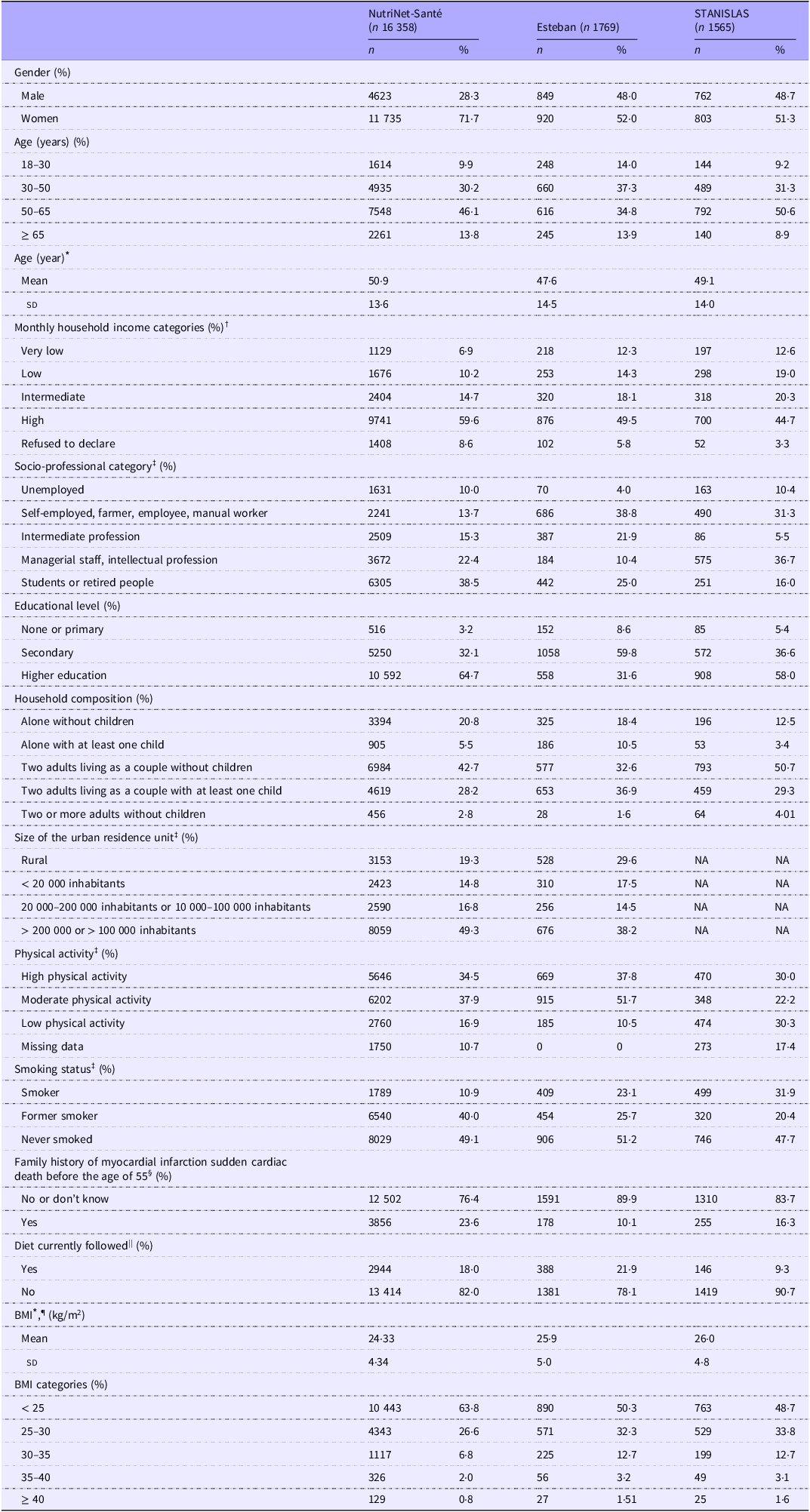
General characteristics of the three studies are shown in Table 1, and the selection for the study samples is presented in flowchart in supplementary data (online Supplementary 1A, B, C).
-
NutriNet-Santé (2009–2014):
Description of socio-demographic, anthropometric and lifestyle characteristics of the three studies, NutriNet-Santé (n 16 358), Esteban (n 1769) and STANISLAS (n 1565) studies (Numbers and percentages; mean values and standard deviations)

* Mean and sd.
† Monthly household income categories: NutriNet-Santé: < 1430 €/1430–2000 €/2000–2700 €/ > 2700 €/ Refused to declare, STANISLAS: < 1499 €/ 1500–2249 €/2000–2700 €/ > 2700 €/ Refused to declare and Esteban: < 1300 €/ 1300–1900 €/ 1900–2500 €/ > 2500 €. The median standard of living for people living in a household in mainland France is €1692 per month(Reference Argouarc’h and Cazenave-Lacrouts41).
‡ In NutriNet-Santé-Santé study, the socio-professional category missing data (n 81, 0·5 %) are reclassified in the most represented category.
In NutriNet-Santé-Santé study, the size of the urban residence unit missing data (n 133, 0·8 %) are reclassified in the most represented category.
In Esteban study, the physical activity missing data (n 22, 1·2 %) are reclassified in the most represented category.
In NutriNet-Santé-Santé study, the smoking status missing data (n 3, 0·02 %) are reclassified in the most represented category.
In NutriNet-Santé-Santé study, the size of the urban residence unit missing data (n 3, 0·02 %) is reclassified in the most represented category.
In Esteban study, the size of the urban residence unit missing data (n 8, 0·45 %) is reclassified in the most represented category.
§ Family history of myocardial infarction in the father/mother and brother/sister or sudden cardiac death before the age of 55 in the father/mother and/or brother/sister and/or son/daughter).
|| In NutriNet-Santé-Santé and STANISLAS studies, a participant was considered to be on a diet for medical reasons or weight management (lose weight or keep it off or stay in shape). In the ESTEBAN study, a participant was considered to be on a diet for medical reasons/allergies/intolerances or weight management (to lose weight or keep it off or to gain weight/stay fit or out of conviction/other.
Of the 19 609 participants who participated in the clinical examination, 19 507 had valid socio-demographic and biological data at inclusion and 16 358 had valid dietary data, which is our final sample (28·3 % men and 71·7% women). The mean age was 50·9 (13·6) years. A total of 59·6% declared a high monthly household income (> 2700€, for your information: the median income per consumption unit in mainland France in 2009 was €1692 per month(Reference Argouarc’h and Cazenave-Lacrouts41)). Among the participants, 22·4% were managers or in the intellectual profession, and 38·5% were students or retired people. A total of 49·3% lived in a city with more than 200 000 inhabitants. Among participants, 37·9% stated a high physical activity and 49·1% never smoked. A total of 23·6% had a family history of myocardial infarction. Among the participants, 18% followed a specific restrictive diet at the time dietary data was assessed. A total of 63·8% had a BMI < 25 kg/m2 and 26·6% had a BMI between 25 and 30 kg/m2.
-
Esteban (2014–2016):
Of the 2496 participants with complete socio-demographic data, 1828 had valid health and biological data and 1769 had valid dietary data, constituting the final study sample, with 48 % men and 52% women. The mean age was 47·6 (14·4) years. A total of 49·5% declared a high monthly household income. Among the participants, 10·4% were managers or in the intellectual profession and 25% were students or retired people. A total of 38·2% lived in a city with more than 100 000 inhabitants. Among participants, 37·8% stated a high physical activity and 51·2% never smoked. A total of 10·1% had a family history of myocardial infarction or sudden cardiac death. Among the participants, 21·9% followed a diet at the time of dietary data was assessed. A total of 50·3% had a BMI < 25 kg/m2 and 32·3% had a BMI between 25 and 30 kg/m2.
-
STANISLAS (2011–2016):
Of the 1632 participants with complete socio-demographic and dietary data, 1565 had valid health and biological data, constituting the final study sample (48·7 % men and 51·3% women). The mean age was 49·1 (14·0) years. A total of 44·7% declared a high monthly household income of more than 3000 euros. Among the participants, 22·5% were managers or in the intellectual profession and 38% were students or retired people. A total of 22·2% stated moderate physical activity and 47·7% never smoked. Among the participants, 16·3% had a family history of myocardial infarction. A total of 9·3% followed a diet at the time of dietary data was assessed. A total of 48·7% had a BMI < 25 kg/m2 and 33·8% had a BMI between 25 and 30 kg/m2.
Prevalence of metabolic syndrome and its components
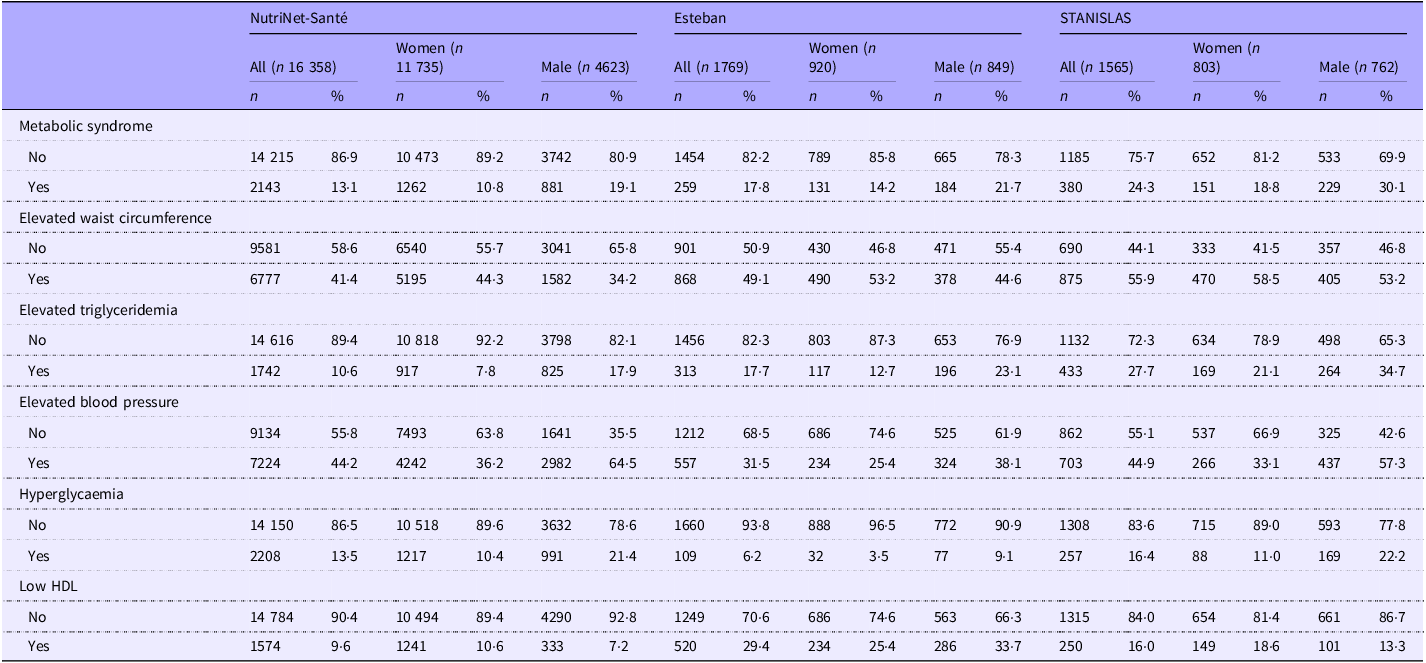
The prevalence of MetS and its components for the three studies are shown in Table 2.
Description of the metabolic syndrome according to the International Diabetes Federation criteria and its components in the three studies, NutriNet-Santé (n 16 358), Esteban (n 1769) and STANISLAS (n 1565) studies (Numbers and percentages)
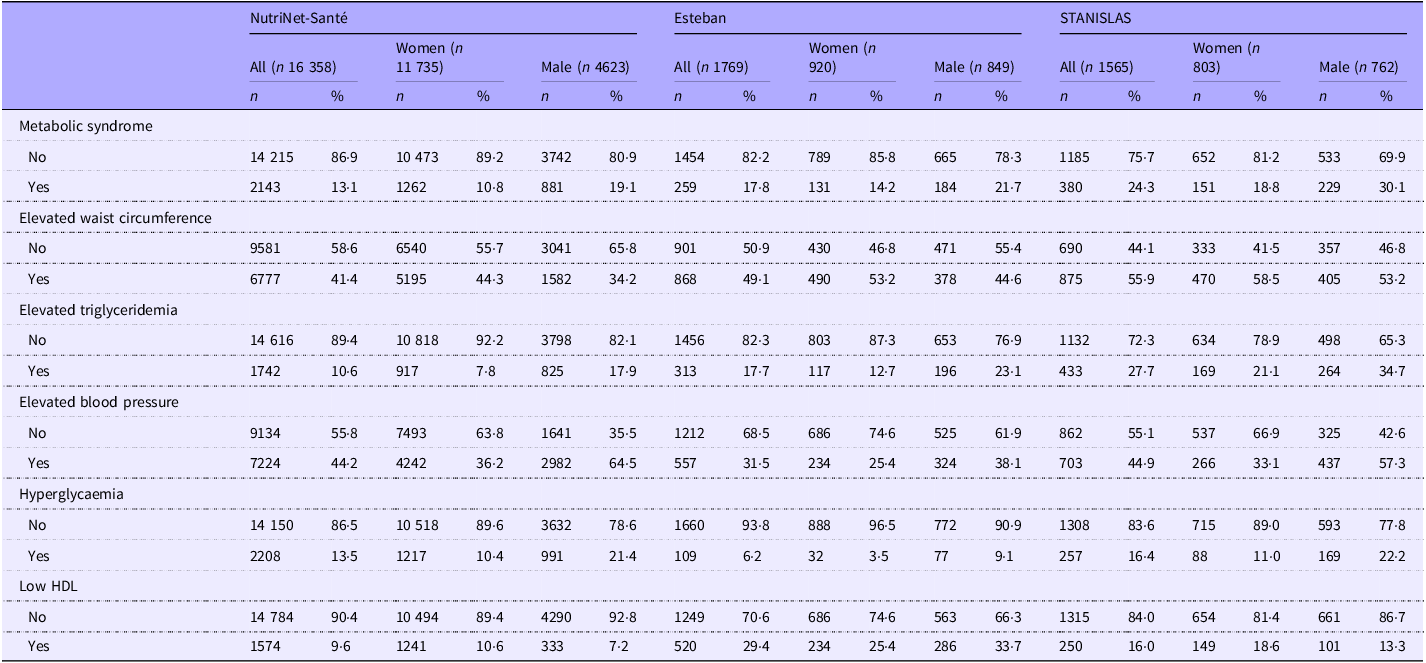
The prevalence of MetS was the highest in the STANISLAS study (24·3 %) compared with Esteban (17·8 %) and NutriNet-Santé (13·1 %) studies.
The participants of the STANISLAS study also had higher waist circumference (55·9 %), hypertriglyceridaemia (27·7 %), elevated BP (44·9 %) and hyperglycaemia (16·4 %) compared with Esteban and NutriNet-Santé studies.
The prevalence of elevated waist circumference (41·4 %) and hypertriglyceridaemia (10·6 %) were the lowest in the NutriNet-Santé study compared with Esteban and STANISLAS studies.
Esteban study had the highest prevalence of low HDL (29·4 %) compared with STANISLAS (16·0 %) and NutriNet-Santé (9·6 %) studies, and the lowest prevalence of elevated BP and hyperglycaemia.
Dietary data, indicators and scores
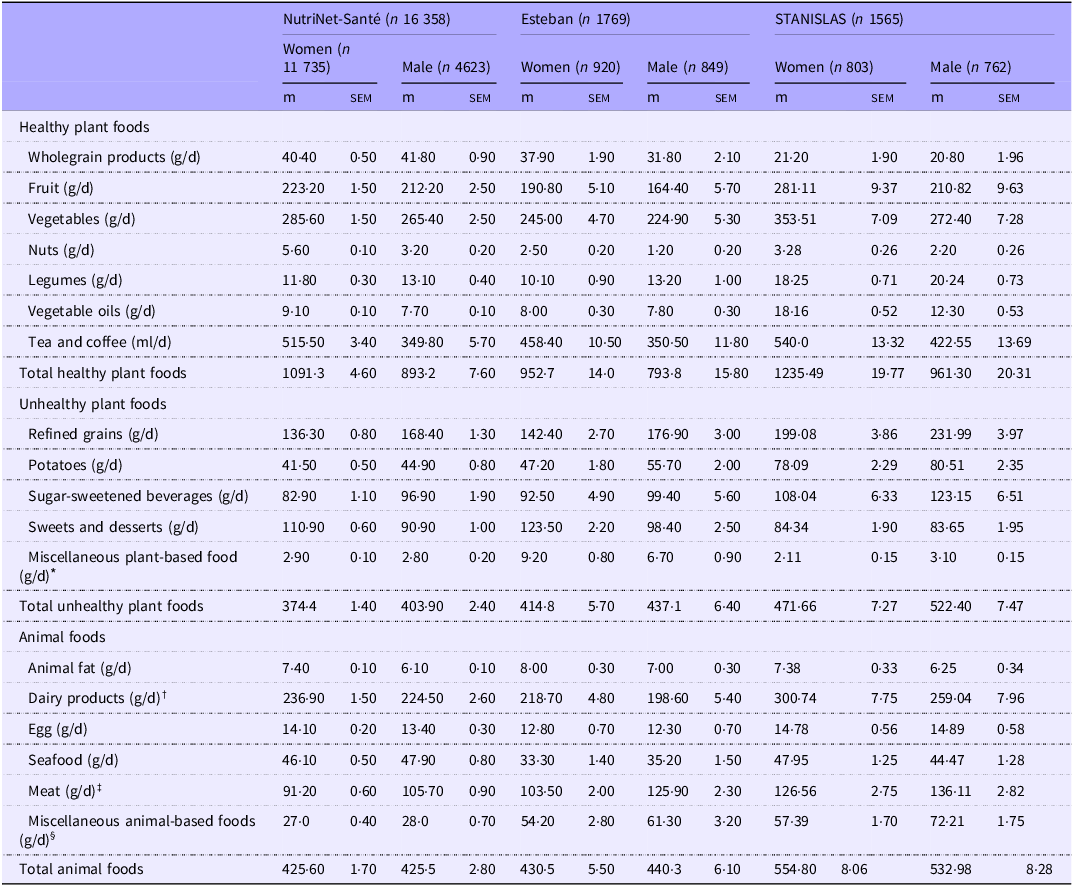
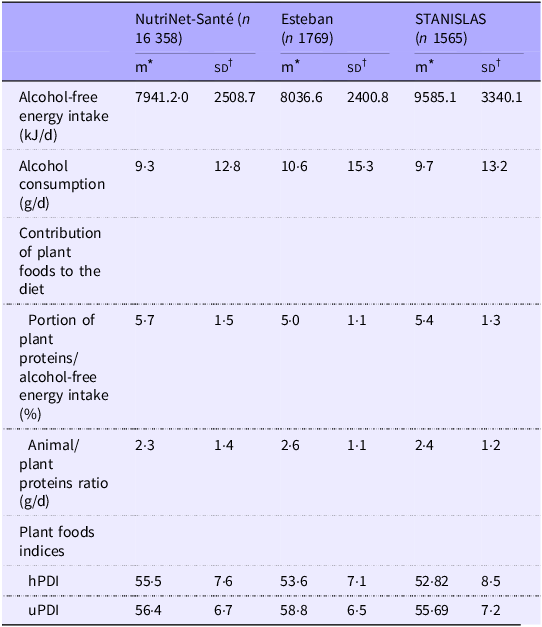
Description of the food groups consumption by the study is presented in Table 3. Indicators and scores of the three studies are presented in Table 4.
Description of the dietary data of the three studies, NutriNet-Santé (n 16 358), Esteban (n 1769) and STANISLAS (n 1565) studies (Mean values with their standard errors of the means)
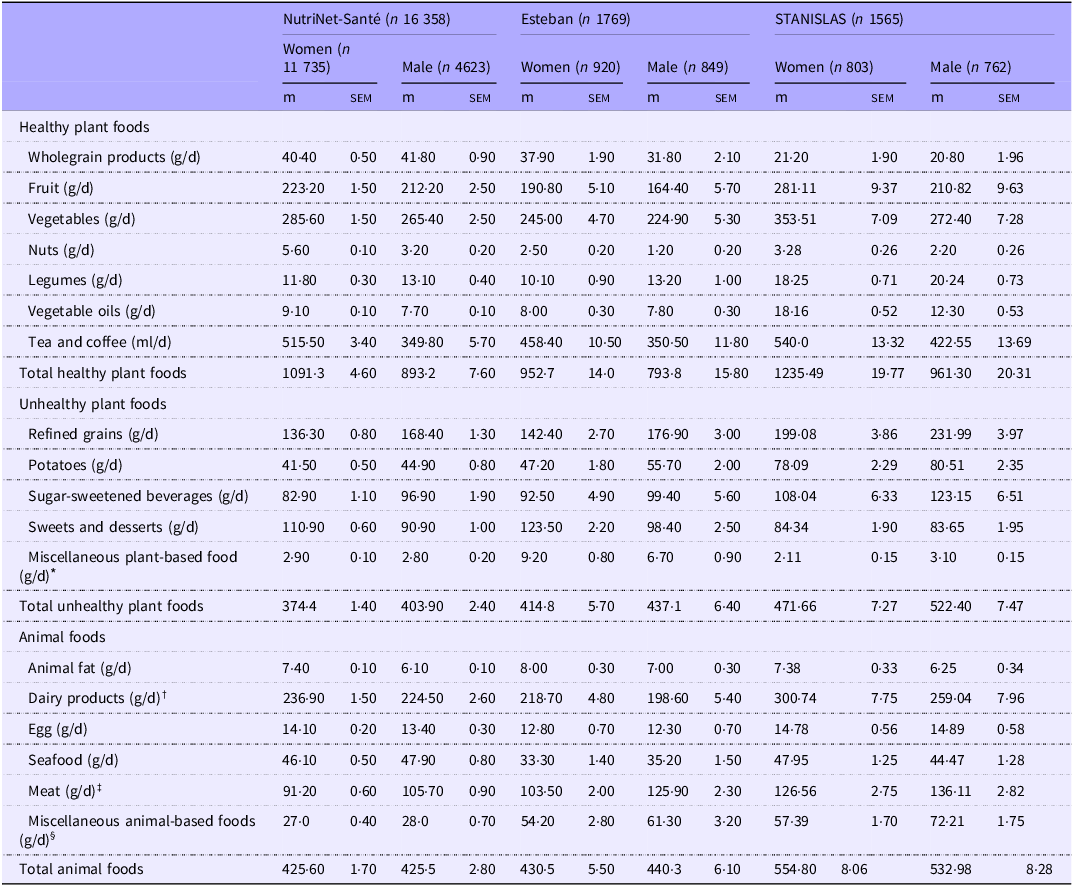
* Values are means adjusted for age and total energy intake; sem: standard error of the mean.
† ‘Miscellaneous plant-based foods’ group includes plant-based sugary or salty snacks.
‡ ’‘Dairy’ products group includes butter, milk, cheese, yoghurts, cottage cheese, petits suisse and dairy product desserts. ‘Meat’ group includes meat, offal, processed meat, poultry, pork and poultry ham.
§ ‘Miscellaneous animal foods’ group includes all dressings, sauces and animal-based salty snacks and fast foods.
Description of the indicators and scores of the three studies, NutriNet-Santé (n 16 358), Esteban (n 1769) and STANISLAS (n 1565) studies (Mean values and standard deviations)
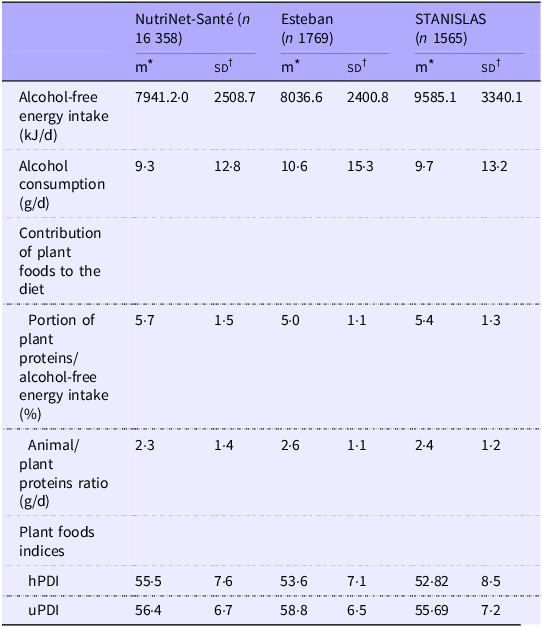
Range for hPDI in NutriNet-Santé: 30·0–84·0; uPDI: 32·0–80·0.
Range for hPDI in STANISLAS: 30·0–75·0; uPDI: 31·0–77·0.
Range for hPDI in Esteban: 28·0–82·0; uPDI: 38·0–76·0.
hPDI, healthy plant-based diet indices; uPDI, unhealthy plant-based diet indices.
* m: mean.
† sd: standard deviation.
Women in the NutriNet-Santé study had a fairly high consumption of wholegrain products and nuts; and men had a high consumption of wholegrain products, fruits, nuts and seafood.
Women in the STANISLAS study consumed high amounts of fruits, vegetables, legumes, vegetable oil, tea and coffee, refined grains, potatoes, sugar-sweetened beverages, dairy products, eggs, seafood, meat and miscellaneous animal-based foods; and men high amounts of vegetables, legumes, vegetable oil, tea and coffee, refined grains, potatoes, sugar-sweetened beverages, dairy products, eggs, meat and miscellaneous animal-based foods.
Women in the Esteban study consumed high amounts of sweets and desserts, miscellaneous plant-based food and animal fat; and men had high amounts of sweets and desserts, miscellaneous plant-based food and animal fat.
Even though the average values are close between the three studies, NutriNet-Santé represented the highest contribution of plant foods to the diet, with both the highest contribution of plant proteins and the lowest animal/plant proteins ratio.
Association between the hPDI and uPDI scores and MetS and its components
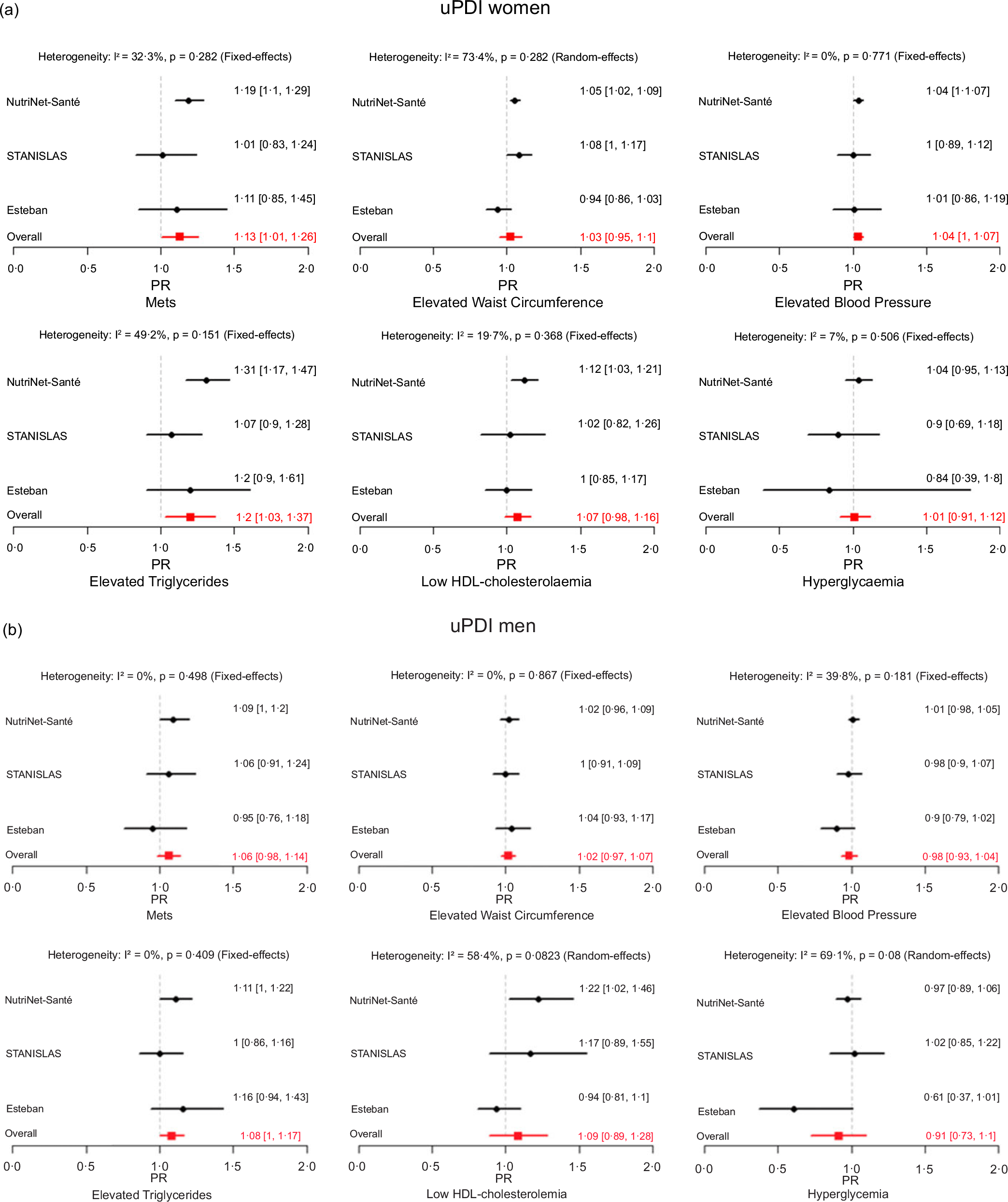
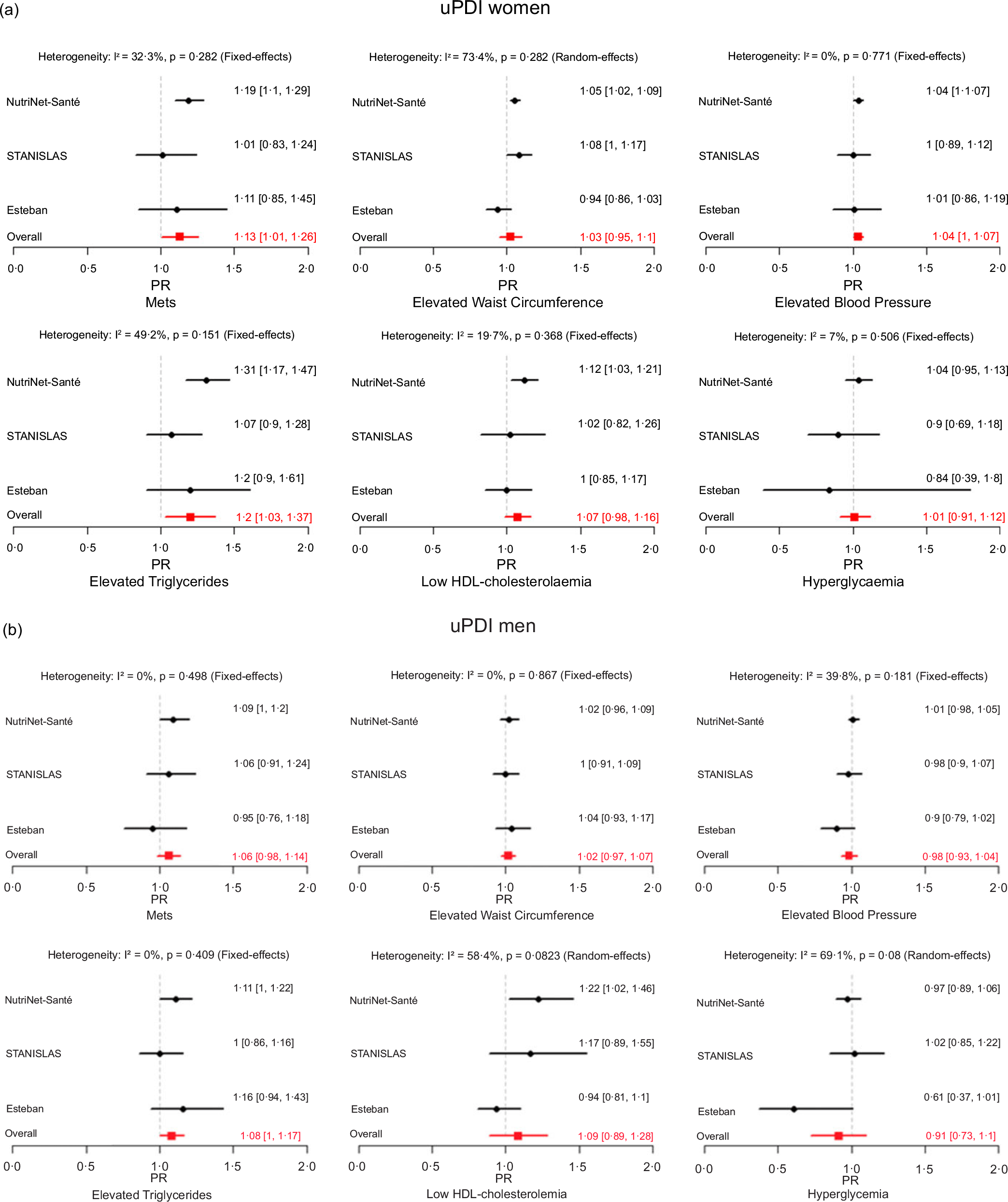
Multivariable PR or OR and 95 % CI, for each study, and from pooled meta-analyses, for MetS and its components according to the hPDI and uPDI scores in continuous with 10-unit increase are shown in Figure 1 and Figure 2.
(a) Forest plot of studies (NutriNet-Santé-Santé (n 11 735), Esteban (n 920) and STANISLAS (n 803) studies) examining the association between MetS and its components and hPDI in continuous with 10-unit in women using random or fixed-effects meta-analysis. PR, prevalence ratios; MetS, metabolic syndrome; PDI, plant-based diet. For NutriNets-Santé and Esteban studies, the model was stratified by gender and adjusted for age, height, education level, household composition, place of residence, net monthly household income, socio-professional category, physical activity, smoking status, alcohol-free energy intake (kcal/d), alcohol consumption (g/d), family history and diet followed. For STANISLAS study, model stratified by gender and adjusted for age, height, education level, household composition, physical activity, smoking status, alcohol-free energy intake (kcal/d), alcohol consumption (g/d), family history and diet followed. (b) Forest plot of studies (NutriNet-Santé-Santé (n 4623), Esteban (n 849) and STANISLAS (n 762) studies) examining the association between MetS and its components and hPDI in continuous with 10-unit in men using random or fixed-effects meta-analysis. PR, prevalence ratios; MetS, metabolic syndrome; PDI, plant-based diet. For NutriNets-Santé and Esteban studies, the model was stratified by gender and adjusted for age, height, education level, household composition, place of residence, net monthly household income, socio-professional category, physical activity, smoking status, alcohol-free energy intake (kcal/d), alcohol consumption (g/d), family history and diet followed. For STANISLAS study, the model was stratified by gender and adjusted for age, height, education level, household composition, physical activity, smoking status, alcohol-free energy intake (kcal/d), alcohol consumption (g/d), family history and diet followed.

(a) Forest plot of studies (NutriNet-Santé-Santé (n 11 735), Esteban (n 920) and STANISLAS (n 803) studies) examining the association between MetS and its components and uPDI in continuous with 10-unit in women using random or fixed-effects meta-analysis. MetS, metabolic syndrome; PDI, plant-based diet; PR, prevalence ratios. For NutriNets-Santé and Esteban studies: model stratified by gender and adjusted for age, height, education level, household composition, place of residence, net monthly household income, socio-professional category, physical activity, smoking status, alcohol-free energy intake (kcal/d), alcohol consumption (g/d), family history and diet followed. For STANISLAS study, the model was stratified by gender and adjusted for age, height, education level, household composition, physical activity, smoking status, alcohol-free energy intake (kcal/d), alcohol consumption (g/d), family history and diet followed. (b) Forest plot of studies (NutriNet-Santé-Santé (n 4623), Esteban (n 849) and STANISLAS (n 762) studies) examining the association between MetS and its components and uPDI in continuous with 10-unit in men using random or fixed-effects meta-analysis. MetS, metabolic syndrome; PDI, plant-based diet; PR, prevalence ratios. For NutriNets-Santé and Esteban studies, the model was stratified by gender and adjusted for age, height, education level, household composition, place of residence, net monthly household income, socio-professional category, physical activity, smoking status, alcohol-free energy intake (kcal/d), alcohol consumption (g/d), family history and diet followed. For STANISLAS study, the model was stratified by gender and adjusted for age, height, education level, household composition, physical activity, smoking status, alcohol-free energy intake (kcal/d), alcohol consumption (g/d), family history and diet followed.
After adjustments for potential confounding factors, in men and women, a higher contribution of healthy plant foods (higher hPDI mean scores) was associated with a lower prevalence of MetS (PRmen: 0·85; 95 % CI: 0·75, 0·94; I2 = 41·7 %, PRwomen: 0·72; 95 % CI: 0·67, 0·77; I2 = 0·1 %), elevated waist circumferences (PRmen: 0·85; 95 % CI: 0·75, 0·94; I2 = 68·9 %, PRwomen: 0·82; 95 % CI: 0·80, 0·85; I2 = 0·2 %) and elevated BP (PRmen: 0·96; 95 % CI: 0·93, 0·99; I2 = , PRwomen: 0·88; 95 % CI: 0·83, 0·94; I2 = 29 %).
In women, a higher hPDI was associated with a lower probability of having elevated TAG (PRwomen: 0·82; 95 % CI: 0·73, 0·91, I2 = 20·5 %), low HDL-cholesterolemia (PRwomen: 0·87; 95 % CI: 0·81, 0·93, I2 = 5·3 %) and hyperglycaemia (PRwomen: 0·83; 95 % CI: 0·76, 0·89, I2 = 0 %).
In women, a higher contribution of unhealthy plant foods (higher uPDI mean scores) was associated with a higher prevalence of MetS (PRwomen: 1·13; 95 % CI: 1·01, 1·26, I2 = 32·3 %) and elevated TAG (PRwomen: 1·20; 95 % CI: 1·03, 1·37, I2 = 49·3 %).
Discussion
Meta-analyses indicated that a higher contribution of healthy plant food was associated with a lower probability of having MetS, elevated waist circumferences and elevated BP, and only in women having elevated TAG, low HDL-cholesterolaemia and hyperglycaemia. We also observed in women that a higher contribution of unhealthy plant food was associated with a higher prevalence of having a MetS and elevated TAG.
Only two longitudinal studies investigated the association between MetS (and its components) and hPDI and uPDI. The first one is a Chinese study using data from the China Health and Nutrition Survey. The study included 10 013 participants with a median follow-up of 5 years. It reported that the highest quintile of hPDI had a 28 % risk of developing MetS and 20 % lower risk of developing abdominal obesity than those in the lowest quintile of hPDI. No statistically significant differences were found between hPDI and the other components of MetS(Reference Huo, Cao and Liu17). The second one is a South Korean prospective cohort study including 5646 participants with a median follow-up of 8 years. This study did not highlight any association between hPDI with MetS and its components(Reference Kim, Lee and Rebholz16).
Most cross-sectional studies investigating the associations between MetS (and its components) and plant-based diets reported results consistent with ours. A higher hPDI score was associated with a lower probability of having MetS in several studies, including the Danish MAX study(Reference Lanuza, Meroño and Zamora-Ros19), the PREDIMED-Plus cohort (Spain)(Reference Oncina-Cánovas, Vioque and González-Palacios18) and the NHANES study (USA)(Reference Jovanovic, Hoelscher and Chen13). Associations between higher hPDI and a reduced risk of elevated waist circumference were reported in the MAX study(Reference Lanuza, Meroño and Zamora-Ros19), the NHANES (Reference Jovanovic, Hoelscher and Chen13) study and in cross-sectional study including participants of South Asian ancestry conducted in the USA(Reference Bhupathiraju, Sawicki and Goon14). Similarly, the PREDIMED-Plus cohort found a link between a healthy provegetarian score (similar to hPDI) and a lower BMI and waist-to-hip ratio(Reference Oncina-Cánovas, Vioque and González-Palacios18). The MAX study(Reference Lanuza, Meroño and Zamora-Ros19) identified a protective association between hPDI and elevated BP. Two studies found that a higher hPDI was associated with a lower probability of presenting high LDL cholesterol or low HDL-cholesterol(Reference Bhupathiraju, Sawicki and Goon14,Reference Lanuza, Meroño and Zamora-Ros19) . The South Asian study found that higher hPDI scores were linked to lower glycated haemoglobin level(Reference Bhupathiraju, Sawicki and Goon14).
To the best of our knowledge, only one cross-sectional study in South Korea did not find any association between hPDI and MetS(Reference Kim, Lee and Rebholz15). Altogether, this confirms the external validity of our results, which add up new evidence that high intakes of healthy plant foods only, not all plant foods, may be protective against cardiovascular risk factors.
We found that in our study, the uPDI was associated with a higher prevalence of having a MetS and elevated TAG but only in women. The Chinese longitudinal study using data from the China Health and Nutrition Survey reported that those in the highest quintile of uPDI had a 36 % risk of developing incident abdominal obesity, compared with those in the lowest quintile of uPDI(Reference Huo, Cao and Liu17). No association between uPDI with MetS and its other components was found in this study. In the South Korean longitudinal prospective cohort, it was observed that those in the highest quintile of uPDI had a 50 % higher risk of developing incident MetS compared with those in the lowest quintile of uPDI and greater adherence to uPDI was significantly associated with abdominal obesity, hypertriglyceridaemia, low HDL-C and elevated BP(Reference Kim, Lee and Rebholz16).
The PREDIMED-Plus (Spain)(Reference Oncina-Cánovas, Vioque and González-Palacios18) and the cross-sectional Danish MAX(Reference Lanuza, Meroño and Zamora-Ros19) studies found that higher uPDI scores were associated with a higher likelihood of MetS and low HDL-C levels. Similarly, the South Asian study highlighted that higher uPDI scores were associated with lower LDL cholesterol. The PREDIMED-Plus study(Reference Oncina-Cánovas, Vioque and González-Palacios18) identified positive associations between uPDI and plasma TAG, diastolic BP and plasma glucose levels. Similarly, the South Korean study found that a higher uPDI score was associated with higher odds of hypertriglyceridaemia in men and abdominal obesity, high fasting glucose and hypertriglyceridaemia in women(Reference Kim, Lee and Rebholz15).
We hypothesise that cultures and related food habits vary between countries, possibly explaining discrepancies in results, especially between studies conducted in different continents. For example, the study which included participants of Korean adults did not report any association between healthy plant-based diets and MetS in contrast to our study (for the two cohorts)(Reference Kim, Lee and Rebholz15). This study also contrasts with other longitudinal studies which reported that healthy plant-based diets were inversely associated with weight gain, incident obesity, hypertension and type 2 diabetes(Reference Satija, Bhupathiraju and Spiegelman10 Reference Satija, Bhupathiraju and Rimm12 Reference Satija, Malik and Rimm72 Reference Gómez-Donoso, Martínez-González and Martínez73 Reference Kim, Rebholz and Garcia-Larsen74). The authors hypothesised that this may be due to cultural differences between Western populations and Asian populations who already have a diet rich in plant foods where vegetables are often incorporated into all meals as side dishes. In turn, differences in dietary intake measured by hPDI may be less pronounced than in the Western population, limiting the ability to detect an inverse association between hPDI and MetS. In some countries, it is more important and necessary to promote the diversification of plant-based products, while in other countries or regions, the emphasis should initially be on reducing meat consumption.
The meta-analysis conducted in our study reported low levels of heterogeneity between the studies. When comparing the associations between the three cohorts, we observed more statistically significant associations in the NutriNet-Santé cohort. We also observed that the direction of these associations was the same in the three studies. It is noteworthy that NutriNet-Santé contains nine times more participants than the two other studies, representing the largest statistical power. This could explain why the associations are more significant in this study. Another hypothesis relies on the fact that different eating habits between countries and regions have an impact on the heterogeneity of the results. In France, for example, it is known that French people living in the Grand-Est region (where the STANISLAS study was carried out) consume more meat, particularly pork, than the national average(Reference Wyndels, Dallongeville and Simon42). It is also difficult to compare these two samples because the participants in the STANISLAS study have high intakes of both healthy plant and animal products, whereas the participants in the NutriNet-Santé study have high intakes of healthy plant-based products, but lower intakes of animal products. In addition, we also observed that NutriNet-Santé had the highest mean contribution of plant foods to the diet. This result could be explained by individual characteristics such as level of education and socio-professional category. For example, we know that people with a higher level of education eat more fruit and vegetables and, manual workers eat more meat and animal products(Reference Méjean, Si Hassen and Lecossais43).
In our study, some associations between hPDI and uPDI and MetS or its components were only observed in women. Other studies have also highlighted this difference between genders. A previous study observed that the positive associations between uPDI and abdominal obesity, high fasting glucose and hypertriglyceridaemia were only observed in women(Reference Kim, Lee and Rebholz15). Another study found that the association between uPDI and MetS was stronger in women (OR: 1·62, IC à 95 % 1·26–2·09, P-trend = 0·01) than in men (OR: 1·35, IC à 95 % 1·03–1·76, P-trend = 0·02). In the same study, hPDI had a significant protective effect in women, but no significant results were found in men(Reference Huo, Cao and Liu17).
In our study, consumption of healthy plant foods was higher among women than men, while consumption of less healthy plant foods and animal products was lower among women. One possible explanation is that women are more likely to adopt healthy plant-based diets because they are more concerned about ethics and the environment(Reference Reuzé, Méjean and Carrère44).
We also observed only in women an association between a higher consumption of less healthy plant foods and increased prevalence of MetS, and higher TAG only in women from the NutriNet-Santé cohort. There are only very few studies investigating the association between MetS, its components and plant-based diets by gender. A previous study reported an interaction between gender and age in their model and did observe a protective effect of being a woman(Reference Jovanovic, Hoelscher and Chen13). This effect diminished in a group of women over 60 years(Reference Jovanovic, Hoelscher and Chen13). This is in line with the existing literature, which shows that the prevalence of MetS increases with age, and this increase is more marked in women(Reference Vishram, Borglykke and Andreasen45). The mechanisms associated with this increased risk of cardiovascular disease after the age of 50 are not yet well explained in the literature. The hypothesis of the impact of menopause is often put forward(Reference Pucci, Alcidi and Tap46,Reference Janssen, Powell and Crawford47) but remains controversial(Reference Tunstall-Pedoe48,Reference Rossouw49) .
Our results strengthen the current public health nutritional guidelines about the beneficial effect of healthy plant foods on pathophysiological mechanisms of cardio-metabolic outcomes. A healthful plant-based dietary patterns is rich in fibres found in vegetables, legumes, wholegrain cereals, among others and nutrients that increase satiety with a low-calorie intake(Reference Howarth, Saltzman and Roberts50), preventing increased waist circumference. Additionally, these compounds reduce cholesterol absorption, with a potential effect of reducing LDL cholesterol, and moderate postprandial insulin responses which will help to keep blood sugar levels stable(Reference Risérus, Willett and Hu51).
Some plant foods such as nuts, fruit, vegetables, spices and olive oil are particularly rich in antioxidants, particularly polyphenols, carotenoids and flavonoids, but also minerals involved in cardiovascular and circulation health such as potassium or Mg. Antioxidants can play several roles, such as protecting against oxidative stress, inhibiting platelet aggregation and reducing inflammation linked to visceral adiposity(Reference Tangney and Rasmussen52,Reference Quiñones, Miguel and Aleixandre53) . In addition, minerals in fruit and vegetables such as Potassium, for its beneficial effects on endothelial function and vascular homeostasis(Reference Aburto, Hanson and Gutierrez54,Reference Aaron and Sanders55) and Mg for its effects on carbohydrate metabolism, insulin sensitivity and anti-inflammatory, vasodilatory and anti-arrhythmic properties(Reference Kolte, Vijayaraghavan and Khera56,Reference Volpe57) would prevent elevated BP but also hyperglycaemia.
Eating healthy plant foods could also have a beneficial impact on the intestinal microbiota(Reference Thomas, Calle and Fernandez8,Reference Martinez, Meyer and Duca58) . Interactions between the microbiota and the human host can influence inflammation, nutrient metabolism, appetite regulation and the production of microbial metabolites, all important elements which were previously reported associated with the pathogenesis of MetS(Reference Thomas, Calle and Fernandez8,Reference Martinez, Meyer and Duca58) .
Healthy plant-based diets have also been shown to improve blood lipid profiles as rich in monounsaturated fatty acids instead of saturated fatty acids from animal foods (e.g. red and processed meat, which are rich in SFA. This may induce an increase in HDL-cholesterol levels and a reduction of LDL cholesterol levels. These PUFA will also improve insulin sensitivity and prevent type 2 diabetes by modifying the fatty acid composition of the cell membrane and acting on the inflammatory response(Reference Risérus, Willett and Hu51).
A higher risk of having MetS when consuming a high amount of unhealthy plant foods like sweets, fries and white bread, may be explained by the pathophysiological mechanisms due to a diet rich in simple carbohydrates, saturated fats and salt contained in these foods(Reference Hemler and Hu9). This diet also often results in lower levels of micronutrients, antioxidants, dietary fibre and unsaturated fats, which are known to be protective against cardiovascular health outcomes, for example through diets such as the Mediterranean diet(Reference Kastorini, Milionis and Esposito59). Additionally, higher levels of added sugars and a higher glycaemic load may be related to higher levels of inflammation (notably by IL-6, pro-inflammatory cytokines that have been associated with insulin resistance, type 2 diabetes(Reference Senn, Klover and Nowak60) and contribute to higher HDL levels(Reference Volpe57). It is noteworthy both in our study and in previous studies that hPDI was more frequently associated with MetS and its components than uPDI. A recent scoping review also reported that hPDI level was more frequently reported as associated with favourable outcomes whereas the uPDI was less frequently reported as associated with unfavourable outcomes for diabetes and cardiovascular diseases, consistent with our findings(Reference Rosenfeld, Juszczak and Wong61). These results suggest that public health messages should focus on promoting a balanced diet containing a majority of healthy plant foods, such as fresh fruit and vegetables, whole bread and cereals, and limiting consumption of less healthy plant foods without necessarily excluding them from the diet.
Strengths and limitations
The first limitation is the cross-sectional design of the study which limits our ability to establish causality and can lead to reverse causality.
Another limitation relies on the construction of the plant-based dietary indices (PDI): they do not consider plant-based meat analogues (e.g. soya burger patties, soya or almond milk, etc.). This category was not integrated into the PDI scores because of included foods which are highly heterogeneous in terms of nutritional quality and lack of knowledge regarding the impact on the health of these foods(Reference Flint, Bowles and Lynn62,Reference Mariotti63) . It is noteworthy that some of these plant foods are ultra-processed, a type of foods that has been associated with detrimental effects on health when consumed in excess(Reference Srour, Fezeu and Kesse-Guyot64,Reference Suksatan, Moradi and Naeini65) . A study has also reported that some of these products are high in nutrients that should be limited, such as salt and saturated fats(Reference Petersen and Hirsch66). It remains impossible with the current level of scientific evidence to categorise plant-based meat analogues within the healthy or unhealthy plant foods categories.
The studies have been performed in different time points which could have affected the results as dietary quality has shown declines currently compared with the past but these time points are very close (2009–2014 for NutriNet-Santé; 2014–2016 for Esteban and 2011–2016 for STANISLAS). It is possible that the nutritional quality of plant-based diets may have evolved and could be different from traditional diets. This may be due to the increasing availability of novel plant-based meat alternatives. However, a previous study carried out in the EPIC cohort reported that dietary quality and adherence to a healthy Mediterranean diet increased in most participants over time(Reference Nagel, Zoller and Ruf67). Thus, further studies could be conducted to assess whether changes in the nutritional quality of a plant-based diet over time may be associated with the risk of developing MetS. Although our analysis was based on the consensual definition of MetS, it did not take into account individual characteristics such as age, gender or smoking status(Reference Lemieux and Després68,Reference Samson and Garber69) . However, adjustment for the individual characteristics may have reduced the impact of this limitation in our analyses.
We can also mention that different dietary data collection tools were used in the three studies. For example, dietary data in the STANISLAS study was based on an FFQ which better captures the consumption of rarely consumed foods, but may also lead to over-reporting the intake for specific food groups such as vegetables and legumes compared with the 24-hour recall method(Reference Thompson, Subar, Coulston, Boushey, Ferruzzi and Delahanty70). NutriNet-Santé and Esteban used a 24-h record which is nearly identical to the Esteban dietary survey was developed based on the NutriNet-Santé 24 h dietary record tool. This tool enables to register a wide variety of foods and limits the risk of overestimating the intake of some food groups such as fruits or vegetables but in case on a limited number of record days may miss some rarely consumed foods such as legumes, nuts or shellfish. However, we can note that the direction of the associations was similar between the three studies.
Another limitation relies on the relatively lower statistical power in STANISLAS and ESTEBAN compared with NutriNet-Santé to detect statistically significant associations.
A strength of our study is that we carried out a careful harmonisation. The advantages of using three studies are similar to those of multicentric studies(Reference Riboli, Hunt and Slimani71). Also, the low heterogeneity observed reinforces the external validity of our pooled estimators.
Additional strengths include the use of validated dietary assessment tools (FFQ and 24-hour recalls) and the quality of the information gathered by qualified professionals during the clinical examination guaranteeing the accuracy of our results.
This study is the first French study on this subject. It contributes to the existing literature by differentiating the effects of healthy and unhealthy plant diets on MetS and its components, analysing gender differences and drawing on data from a variety of studies with a very large study sample for pooled analyses.
Conclusion
This study suggests that, among French adults, a greater adherence to healthy plant-based diets is associated with a lower probability of having a MetS. This protective effect was mostly observed with the components of MetS in women. These results are in line with other studies reporting that it is important to consider the nutritional quality of plant foods consumed in primary prevention for cardiovascular risk factors. Public health messages should focus on a diet with a high proportion of healthy plant-based foods, while limiting unhealthy plant foods, as they prevent cardiovascular risk factors such as MetS. Further longitudinal studies stratified by gender are required to confirm our results regarding the association of healthy plant-based diets with cardiovascular health outcomes and the potential protective effects against clinical damage to the heart and blood vessels.
Acknowledgments
STANISLAS:The authors deeply thank the Staff of the Clinical Investigation Center and other personnel involved in the management of the STANISLAS cohort: Biostatisticians: Fay R, Lamiral Z, Machu JL. Computer scientists: Boucenna N, Gallina-Müller C, Maclot PL, Sas T. Co-investigators: Chau K, Di Patrizio P, Dobre D, Gonthier D, Huttin O, Malingrey L, Mauffrey V, Olivier A, Poyeton T, Steyer E, Watfa G. Data managers: Cimon P, Eby E, Merckle L. Data entry operators: Batsh M, Blanger O, Bottelin C, Haskour N, Jacquet V, Przybylski MC, Saribekyan Y, Thomas H, Vallée M. Echocardiographists, echographists: Ben Sassi M, Cario S, Camara Y, Coiro S, Frikha Z, Kearney-Schwartz A, Selton-Suty C, Watfa G. Imaging engineer: Bozec E. Laboratory engineer: Nuée-Capiaumont J; and technicians: Fruminet J, Kuntz M, Ravey J, Rousseau E, Tachet C. Project managers: Bouali S, Hertz C. Quality engineer: Lepage X. Registered nurses: Giansily M, Poinsignon L, Robin N, Schmartz M, Senn M, MicorPatrignani E, Toutlemonde M. Hospital technician: Fleurot MT. Resident physicians: Alvarez-Vasquez R, Amiot M, Angotti M, Babel E, Balland M, Bannay A, Basselin P, Benoit P, Bercand J, Bouazzi M, Boubel E, Boucherab-Brik N, Boyer F, Champagne C, Chenna SA, Clochey J, Czolnowski D, Dal-Pozzolo J, Desse L, Donetti B, Dugelay G, Friang C, Galante M, Garel M, Gellenoncourt A, Guillin A, Hariton ML, Hinsiger M, Haudiquet E, Hubert JM, Hurtaud A, Jabbour J, Jeckel S, Kecha A, Kelche G, Kieffert C, Lauriere E, Legay M, Mansuy A, Millet- Muresan O, Meyer N, Mourton E, Naudé AL, Pikus AC, Poucher M, Prot M, Quartino A, Saintot M, Schiavi A, Schumman R, Serot M, Sert C, Siboescu R, Terrier-de-la-Chaise S, Thiesse A, Thietry L, Vanesson M, Viellard M. Secretaries: De Amorin E, Villemain C, Ziegler N. Study coordinators: Dauchy E, Laurent S; and all those not listed above who helped in the funding, initiation, accrual, management and analysis of the fourth visit of the STANISLAS cohort. The authors also thank the CRB Lorrain BB-0033–00035 of the Nancy CHRU for the management of the biobank. Steering committee: Pierre Mutzenhardt, Mehdy Siaghy, Patrick Lacolley, Marie-Ange Luc, Pierre Yves Marie, Jean Michel Vignaud. Advisory members: Sophie Visvikis Siest, Faiez Zannad. Technical committee: Christiane Branlant, Isabelle Behm-Ansmant, Jean-Michel Vignaud, Christophe Philippe, Jacques Magdalou, Faiez Zannad, Patrick Rossignol. Scientific committee: Laurence Tiret, Denis Wahl, Athanase Benetos, Javier Diez, Maurizio Ferrari, Jean Louis Gueant, Georges Dedoussis, François Alla, François Gueyffier, Pierre-Yves Scarabin, Claire Bonithon Kopp, Xavier Jouven, Jean-Claude Voegel and Jan Staessen. We also thank all of the Stanislas cohort participants and are grateful to the Department of Public Health of the University of Liège (Belgium) for allowing them to use their FFQ (https://www.dssp-uliege.be/FFQ) during the fourth visit. NutriNet-Santé:We thank, Cédric Agaësse, Alexandre De-Sa, Laure Legris (dietitians), Marine Ricau, PhD (operational coordinator), Selim Aloui (IT manager), Thi Hong Van Duong, Régis Gatibelza, Jagatjit Mohinder and Aladi Timera (computer scientists); Fabien Szabo de Edelenyi, PhD (manager), Julien Allegre, Nathalie Arnault, and Nicolas Dechamp (data-manager/statisticians); Merveille Kouam and Paola Yvroud (health event validators) and Maria Gomes and Mirette Foham (participant support) for their technical contribution to the NutriNet-Santé study. We warmly thank all the volunteers of the NutriNet-Santé cohort. The NutriNet-Santé study is supported by the following public institutions: Ministère de la Santé, Santé Publique France, Institut national de recherche pour l’agriculture, l’alimentation et l’environnement (INRAE), Institut National de la Santé et de la Recherche Médicale (Inserm), Conservatoire National des Arts et Métiers (CNAM) and Université Sorbonne Paris Nord. Funders had no role in the study design, the collection, analysis and interpretation of data, the writing of the report and the decision to submit the article for publication.ESTEBAN We thank Benoit Salanave for his help in data management and analyses conducted in the ESTEBAN survey. The authors thank the Centers for Health Examinations, the Cetaf and the laboratories involved in the collection, as well as the entire Esteban team and study participants. This work is a part of the CaPulCo project funded by a grant overseen by the French National Research Agency (ANR, ANR-22-CE36-0012).The NutriNet-Santé study is supported by the French Ministry of Solidarity and Health, the National Agency for Public Health (Santé Publique France), the National Institute for Health and Medical Research (INSERM), the National Research Institute for Agriculture, Food and Environment (INRAE), the National Conservatory of Arts and Crafts (CNAM), the Centre for Epidemiological Research and Statistics (CRESS) and Sorbonne Paris Nord University. The funders had no role in the design of the study, in the collection, analyses, or interpretation of data, in the writing of the manuscript, or in the decision to publish the results. The fourth examination of the STANISLAS study was sponsored by the Centre Hospitalier Régional Universitaire de Nancy (CHRU) and supported by the French Ministry of Health (Programme Hospitalier de Recherche Clinique Inter-régional 2013) and by the Contrat de Plan Etat-Lorraine and the ‘Fonds Européen de Développement Régional’ (FEDER Lorraine), and by a public grant overseen by the French National Research Agency (ANR) as part of the second ‘Investissements d’Avenir’ program FIGHT-HF (reference: ANR-15- RHU-0004) and by the French ‘Projet investissement d’avenir’ (PIA) project ‘Lorraine Université d’Excellence’ (reference ANR-15-IDEX-04-LUE). The STANISLAS study is also supported by the sixth European Union – Framework Program (EU-FP) Network of Excellence Ingenious HyperCare (#LSHM-CT-2006-037093), the seventh EU-FP MEDIA (Européen ‘Cooperation’ – Theme ‘Health’ / FP7-HEALTH-2010-single-stage #261409), HOMAGE (Heart ‘Omics’ in Ageing, 7th Framework Program grant #305507), FOCUS-MR (reference: ANR-15-CE14-0032-01) and FIBRO-TARGETS (FP7#602904) projects, and by ERA-CVD EXPERT (reference: ANR-16-ECVD-0002-02).The authors’ responsibilities were as follows: S. H., M. T., L. F. K. and E. K-G. were responsible for developing the design and protocol of the NutriNet-Santé study and led the underlying process of data acquisition. V. D. and C. V. were responsible for developing the design and protocol of the ESTEBAN study and led the underlying process of data acquisition. P. R. and N. G. were responsible for developing the design and protocol of the STANISLAS study and led the underlying process of data acquisition.B. A., S. W. and V. D. initiated and conceptualised the study. C. P., S. W., V. D. and B. A. were involved in data management. C. P. performed statistical analyses. C. P., B. A. and S. W. drafted the manuscript. C. P., B. A., S. W., E. K-G., J. B. and A. H. contributed to the statistical analyses and interpretation of data. All authors were involved in interpreting the results, critically reviewed the manuscript for important intellectual content and approved the final version to be published. B. A. and C. P. had primary responsibility for the final content and were the guarantors. Conflict of interest: N. G. received honoraria from AstraZeneca, Bayer, Boehringer, Echosens, Lilly, Roche diagnostics, Novartis. P. R.: reports consulting for Idorsia, G3P, honoraria from AstraZeneca, Bayer, Boehringer-Ingelheim, Cincor, CVRx, Fresenius, KBP biosciences, Novartis, NovoNordisk, Relypsa, Servier and Vifor Fresenius Medical Care Renal Pharma; and travel grants from AstraZeneca, Bayer, CVRx, Novartis and Vifor Fresenius Medical Care Renal Pharma; Cofounder: CardioRenal. Other co-authors have no conflicts of interest to disclose related to the submitted work. The other authors declare no competing interests. Data described in the article, code book and analytic code will be made available upon request pending application and approval. Researchers from public institutions can submit a collaboration request including information on the institution and a brief description of the project to collaboration@etude-nutrinet-sante.fr. All requests will be reviewed by the steering committee of the NutriNet-Santé study. If the collaboration is accepted, a data access agreement will be necessary and appropriate authorisations from the competent administrative authorities may be needed. In accordance with existing regulations, no personal data will be accessible.
Supplementary material
For supplementary material/s referred to in this article, please visit https://doi.org/10.1017/S0007114525000376



 Open access

