





Introduction
Owing to the development of rapid prototyping tools and low-cost sensor technology, makerspaces and maker communities are expected to facilitate advancements in active business strategies for companies aiming to achieve greater agility in the early stage of engineering design, which is also known as the fuzzy front end (FFE) (Böhmer et al., Reference Böhmer, Beckmann and Lindemann2015). User needs identified through user research are highly valued in the FFE as a type of requirement to be elicited (Zhang and Doll, Reference Zhang and Doll2001; Cooper and Edgett, Reference Cooper and Edgett2008; Sutcliffe and Sawyer, Reference Sutcliffe and Sawyer2013). When an in-house makerspace is regarded as a strategy in a company's overall multidisciplinary FFE work, the question arises as to how user research and user-related requirement elicitation could benefit from the in-house makerspace. Hence, through four practical case studies, this paper seeks to answer the following research question:
-
How can the activity of user research in the FFE benefit from access to a makerspace?
In other words, we reflect upon how the field of user research in the FFE can benefit from rapid prototyping methods and makerspaces. The four case studies were conducted in two university-based makerspaces at the Norwegian University of Science and Technology (Norway) and UC Berkeley (USA). By describing the insights elicited using the prototypes built in the four case studies, we provide a vision for how future user research can be conducted through access to a makerspace. Such accessibility allows experimental, functional, and explorative user research with quantitative, controlled, and repeatable setups.
The remainder of this paper is organized as follows. Section “Theoretical background” provides the background on makerspaces and classical user research to show why it is relevant to consider these areas in a new combined development context. Section “Methodology” describes the qualitative research methodology based on action research. Section “Four case studies of user research facilitated by access to makerspaces” presents the four case studies. Section “Analysis: comparison between traditional and makerspace-driven user research” compares the cases with three traditional user research methods, namely observation, prototyping, and user journey mapping. Section “Results and discussion” discusses the results and reflects upon the challenges of implementing makerspace-driven user research. Finally, Section “Conclusion: new possibilities for experimenting and repeatable user research” concludes the paper.
Theoretical background
Definition of makerspaces
The last decade has witnessed the rise of makerspaces (Mota, Reference Mota2011; Tanenbaum et al., Reference Tanenbaum, Williams, Desjardins and Tanenbaum2013; Kohtala, Reference Kohtala2017). The development and refinement of 3D printers and laser cutters has been accompanied by the emergence of a growing community of so-called makers. “Makerspace” did not exist as a term until 2005, when the MAKE magazine was first published by Dale Dougherty and Maker Media (Hepp, Reference Hepp2018). The term became associated with community workshops where members share tools, and it was coined in contrast to “hackerspaces”, which was more associated with computers and electronics (van Holm, Reference van Holm2014). However, the evolution of makerspaces has been accompanied by the development of smaller-sensor technology and micro-controllers such as Arduino and Raspberry Pi. Thus, most current makerspaces also have an electronic dimension (Jensen et al., Reference Jensen, Semb, Vindal and Steinert2016b). These electronic prototyping tools can be used to rapidly transform a physical project into controlled and flexible mechatronic systems.
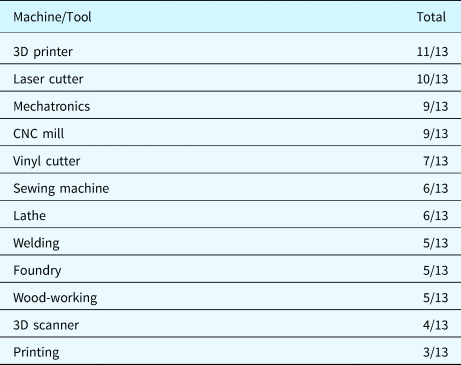
Other tools that characterize a makerspace include laser cutters, 3D printers of different qualities, and simple tools such as hammers, saws, and screwdrivers. A list of equipment provided by 13 makerspaces around the world is presented in Table 1 (Jensen et al., Reference Jensen, Semb, Vindal and Steinert2016b) to provide readers with an impression of what is meant by access to the tools of a makerspace.
Tools provided in the 13 makerspaces investigated by Jensen et al. (Reference Jensen, Semb, Vindal and Steinert2016b).
Jensen et al. (Reference Jensen, Semb, Vindal and Steinert2016b) concluded that a makerspace is just as much about the community built around the tools in the makerspace. This concept emphasizes that makerspaces are not established by a specific recipe requiring a specific list of equipment. Hence, the definition of “makerspace” used in this paper is as follows:
A place where people can come together to create or invent things, either using traditional crafts or digital fabrication technology. The space is not defined by the amount of tools or users, but the synergy created in the combination of users and tools.
Skills and mindsets in the makerspace
Makerspaces also support new ways of working and learning. A makerspace is often found combined with co-working facilities for start-ups, consultants, and other freelance workers in the fields of engineering, technology, design, and entrepreneurship (van Holm, Reference van Holm2014; Jensen et al., Reference Jensen, Semb, Vindal and Steinert2016b). An increasing number of libraries are implementing makerspaces, as they are regarded as a new type of knowledge that should be freely available to the public (Slatter and Howard, Reference Slatter and Howard2013; Michele Moorefield-Lang, Reference Michele Moorefield-Lang2014). All these stakeholders contribute toward the community feeling around specific makerspaces, as it is a part of the makerspace strategy to allow the users to set the direction of usage (Gershenfeld, Reference Gershenfeld2012).
This, in turn, results in a wide variety in the profiles of users of the makerspaces, from hobbyists with private projects to startups with commercial goals (van Holm, Reference van Holm2014) and from novices with little experience in fabrication tools to experts who extensively tinker with all the equipment available in the makerspace. All these user profiles find a purpose in makerspaces, leading to considerations regarding the skills that are required to use a makerspace, which go beyond profession or technical experience and project goals.
Hielscher and Smith (Reference Hielscher and Smith2014) defined the literacies of makers to be covered: craftsman skills, digital skills, mastery of rapid prototyping machines, knowledge of material selection, improvisation, and experimentation. Users need to master rapid prototyping machines, while a maker also needs to know how to design the digital input required by different machines. These inputs cover simple PowerPoint or 2D-vector-based drawing tools when using laser cutters or more advanced CAD modeling tools when using either 3D printers or mills. More advanced skills are needed when transforming the prototypes into digital functional artifacts using Arduino. Rapid prototyping tools and the Arduino platform have a massive online-based community that is easily mobilized through youtube.com, thingyverse.com, arduino.com, instructables.com, etc. (Prendeville et al., Reference Prendeville, Hartung, Brass, Purvis and Hall2017). Although these tools make the learning process easily accessible, they still require motivation and initiative from the user (Han et al., Reference Han, Yoo, Zo and Ciganek2017).
According to Hielscher and Smith (Reference Hielscher and Smith2014), a maker must also have the skills of improvisation and experimentation. Sometimes, a building part or desired feature may be out of stock. Hence, a maker might resort to “dumpster diving” or finding a way to produce the part with the tools available (Steinert and Leifer, Reference Steinert and Leifer2012). This opportunistic mindset illustrates the overall mindset of making. Dougherty (Reference Dougherty2013) described how the maker mindset can be compared with the growth mindset defined by Dweck (Reference Dweck2006). People with a growth mindset tend to believe that capabilities can be developed, improved, and expanded, those with a growth mindset tolerate risk and failure, and those with a fixed mindset avoid risk and its accompanying frustration (Dweck, Reference Dweck2006). Dougherty (Reference Dougherty2013) pointed out that it is obvious which mindset enables a person to adapt and contribute to a world that is constantly changing:
Dweck's growth mindset maps very well to the maker mindset, which is a can-do attitude that can be summarised as ‘what can you do with what you know?’ It is an invitation to take ideas and turn them into various kinds of reality. It is the process of iterating over a project to improve it.
User research in the industrial FFE
User research is a highly valued discipline in the field of industrial FFE work (Koen et al., Reference Koen, Ajamian, Burkart, Clamen, Davidson, D'Amore, Elkins, Herald, Incorvia, Johnson and Karol2001; McBride, Reference McBride2014; Jensen et al., Reference Jensen, Elverum and Steinert2017b; Lauff et al., Reference Lauff, Kotys-Schwartz and Rentschler2018). This paper mainly focuses on the activity of user research in an industrial context and with the intent of identifying user insights in the FFE, which is in contrast to more academic studies that focus on specific investigations of human behavior. In the industrial context, time becomes an important factor and the activity of user research must fit into project phases, such as the explorative phase and the design phase, according to the company's development process (Eppinger and Ulrich, Reference Eppinger and Ulrich2012; Sutcliffe and Sawyer, Reference Sutcliffe and Sawyer2013). The activity is a part of an overall strategy of creating human-centered design allowing not only technology to define the final product (Brown, Reference Brown2008). The aim of user research in the FFE is to understand the usage of a product/system and identify the unknown behavior and preferences of the user, user needs, and pain points in the context. In this paper, these findings fall under the overall category of user insights. Further, we define the actors eliciting user insights as user researchers conducting user research. User insights, considered as key performance indicators for a product, will later be transformed into well-described requirements used to design and validate the final product/system.
The field of user research is broad and several methods can be used to conduct user research (Martin and Hanington, Reference Martin and Hanington2012; Cross, Reference Cross2008). When conducted in the early explorative phase of product development, it is classically known to be qualitative in its focus, and human-centered design has strong ties with the fields of sociology and anthropology (Brown, Reference Brown2008; ISO, 2010; Jensen et al. Reference Jensen, Lozano, Steinert, Abrahamsson, Jedlitschka, Nguyen Duc, Felderer, Amasaki and Mikkonen2016a). These traditional methods employ several different tools for user observation and need-finding via semi-structured interviews, “follow the actor”, “be the actor”, user journey mapping, and other types of qualitative approaches (Buchenau and Suri, Reference Buchenau and Suri2000; Lindegaard and Rosenqvist, Reference Jørgensen U, Lindegaard and Rosenqvist2011; Martin and Hanington, Reference Martin and Hanington2012).
Industrial user research approaches the product from a holistic perspective, mapping out all stakeholders in the context (Callon, Reference Callon, Callon, Law and Rip1986; Latour, Reference Latour1996). Objects relevant in the use case might also be employed as a means for investigation (Martin and Hanington, Reference Martin and Hanington2012). This approach illustrates the breadth and extensiveness of a user study, where knowledge management is often a major part of the user researcher's work (Design Council, 2005; Gray et al., Reference Gray, Brown and Macanufo2010; Martin and Hanington, Reference Martin and Hanington2012). An example of a method used for knowledge management is the AEIOU framework. This framework serves the purpose of supporting the structuring of all observations and insights, and it enables the researcher to remain aware of the activities, environment, interactions, objects, and users (Wasson, Reference Wasson2000). Another method used in user research is prototyping (Brown, Reference Brown2008; Doorley et al., Reference Doorley, Holcomb, Klebahn, Segovia and Utley2010; Jørgensen et al., Reference Jørgensen U, Lindegaard and Rosenqvist2011). However, prototypes can have several different levels of fidelity, functionality, and purposes (Houde and Hill, Reference Houde and Hill1997; Jensen et al., Reference Jensen, Elverum and Steinert2017b; Lauff et al., Reference Lauff, Kotys-Schwartz and Rentschler2018). They help elicit thoughts from the users and encourage communication around critical elements of a design (Houde and Hill, Reference Houde and Hill1997; Lim et al., Reference Lim, Stolterman and Tenenberg2008). The types of prototypes to be employed with users in mind include low-fidelity prototypes created using simple materials, Wizard-of-Oz prototypes (faking a user experience), and experience prototypes (not working as the final product but creating the experience of the final product idea) (Martin and Hanington, Reference Martin and Hanington2012). The three above-mentioned prototypes aim to gain the users’ feedback and opinions on an idea or understand the user's daily life around the usage of a product. In this study, it is important to understand the concept of experience prototypes originally defined by Buchenau and Suri (Reference Buchenau and Suri2000) as follows:
… any kind of representation, in any medium, that is designed to understand, explore or communicate what it might be like to engage with the product, space or system we are designing.
In addition, they describe how experience prototypes can vary from simple forms such as roleplays or those made from cardboard to more advanced prototypes including functional aspects. The value of experience prototypes lies in how they enable others to engage directly in a proposed new experience to provide a common ground for establishing a shared point of view. This facilitates the development of an understanding about the essence of an existing experience: experience prototyping simulates important aspects of the whole or parts of the relationships between people, places, and objects as they unfold over time (Buchenau and Suri, Reference Buchenau and Suri2000).
Experience prototypes also serve as an example of the final parameter employed by several approaches in user research, namely the time perspective. One such example is the user journey mapping tool, where the start and endpoint of a user's interaction with a product is mapped out (Martin and Hanington, Reference Martin and Hanington2012). Other examples include workflow mapping, roleplays, video/analog diaries, and story boards (Lloyd, Reference Lloyd2000; Gray et al., Reference Gray, Brown and Macanufo2010; Martin and Hanington, Reference Martin and Hanington2012).
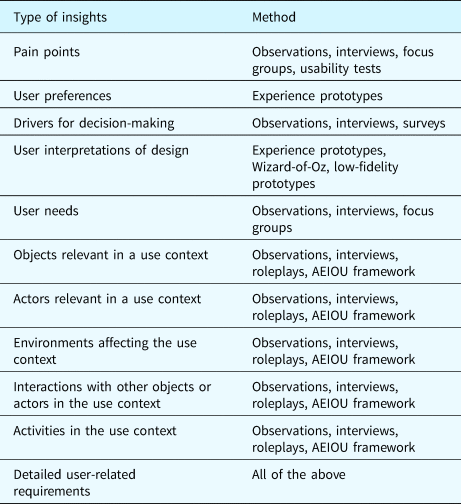
In summary, there are several approaches in the field of early-stage industrial user research that aim to provide user insights and eventually develop empathy for the end user. Table 2 lists some types of insights retrieved from user research in the FFE as well as the methods for achieving these goals; it is not comprehensive, but it serves as an illustration for readers who are not familiar with the various types of user insights of interest in an industrial context of product development.
Types of insights one searches for when conducting user research
Methodology
The research strategy of this project is to establish a comprehensive view of the opportunities for user research in the FFE, facilitated by access to a makerspace.
It is useful to apply the theory of action research and conduct qualitative case studies by actively employing the tools of makerspaces. Action research is defined as a participatory, democratic process concerned with developing practical knowledge in the pursuit of worthwhile human purposes, grounded in a participatory worldview. It seeks to harmonize action and reflection as well as theory and practice, in participation with others, in the pursuit of practical solutions to human issues of pressing concern, and more generally, the prosperity of individuals and their communities (Reason and Bradbury, Reference Reason and Bradbury2001).
This approach was found to be suitable for promoting the acquisition of applied knowledge and feedback on the various types of equipment available in the makerspace. Hence, four case studies were conducted, all of which included user-related requirement elicitation in university-based makerspaces, namely TrollLABS at the Norwegian University of Science and Technology (Norway) and Jacobs Hall at UC Berkeley (USA). One of the authors participated actively in all four case studies. The cases were chosen as they all involved an initial challenge of creating an interaction between a user and an object. Hence, there was potential for designing and experimenting with user research to seek user insights for further designing future user experiences. All the projects were documented through an academic paper or a project report (Erichsen et al., Reference Erichsen, Jensen, Gerstenberg and Semb2015; Jensen et al., Reference Jensen, Wulvik, Kriesi, Boe, Phillip, Jors and Steinert2016c, Reference Jensen, Blindheim and Steinert2017a, Reference Jensen, Zhang, Tian and SteinertIn review). The data and user insights were documented throughout the projects using notebooks, milestone presentations, and videos. To reflect upon the benefits and challenges when conducting makerspace-driven user research, we chose to compare the approaches in the cases with the following user research methods: observation, low-fidelity prototyping, and user journey mapping. These three methods were chosen as they were found to represent already defined important aspects of user research: user empathy (observation), experimentation and ideation (prototyping), and time (user journey mapping). The comparison did not intend to define the most efficient methods but to simply understand the impact of accessibility to makerspaces on the activities. Finally, we reflected upon the types of user insights listed in Table 2 that were elicited in the four case studies.
Makerspaces used in this study
This study involved two university-based makerspaces, namely TrollLABS at the Norwegian University of Science and Technology and the Jacobs Hall Institute of Design and Innovation at UC Berkeley. Both makerspaces provide students and researchers access to laser cutters, mills, 3D printers, electronics, and traditional working tools such as saws and drilling machines. Further, both fit the description of a state-of-the-art makerspace as defined by Jensen et al. (Reference Jensen, Semb, Vindal and Steinert2016b), providing light-filled design studios and equipment labs offering flexible space and access to tools for prototyping, iteration, and fabrication. From sketching to digital fabrication, the spaces facilitate a wide range of making practices. Detailed descriptions of the two makerspaces can be found in Appendix I and II.
Four case studies of user research facilitated by access to makerspaces
This section describes the four case studies of user research conducted in the makerspaces with the corresponding tools. All the prototypes presented had a maximum material cost of $500.
Case I: Digitizing an office chair for measuring user's sitting behavior
The initial challenge driving this case study was presented by the Norwegian high-end office furniture producer, Scandinavian Business Seating (SBS). They wanted to explore the opportunity spaces of sensor technology and machine learning principles in their context of office furniture as previously described by Jensen et al. (Reference Jensen, Wulvik, Kriesi, Boe, Phillip, Jors and Steinert2016c). Therefore, an analog office chair was rigged with several pressure sensors and included machine learning principles for processing data. Thus, the chair could be trained to identify and distinguish between different seating positions as well as to capture how long a user would sit in different positions (Fig. 1). Further, the team aimed to make the chair by considering physical actions based on user behavior and adapting it accordingly. This was achieved by enabling the chair to change its height automatically. Hereafter, this product idea will be referred to as CH.AI.R.
First experimental prototype of CH.AI.R: an analog office chair transformed into a data-tracking smart device.

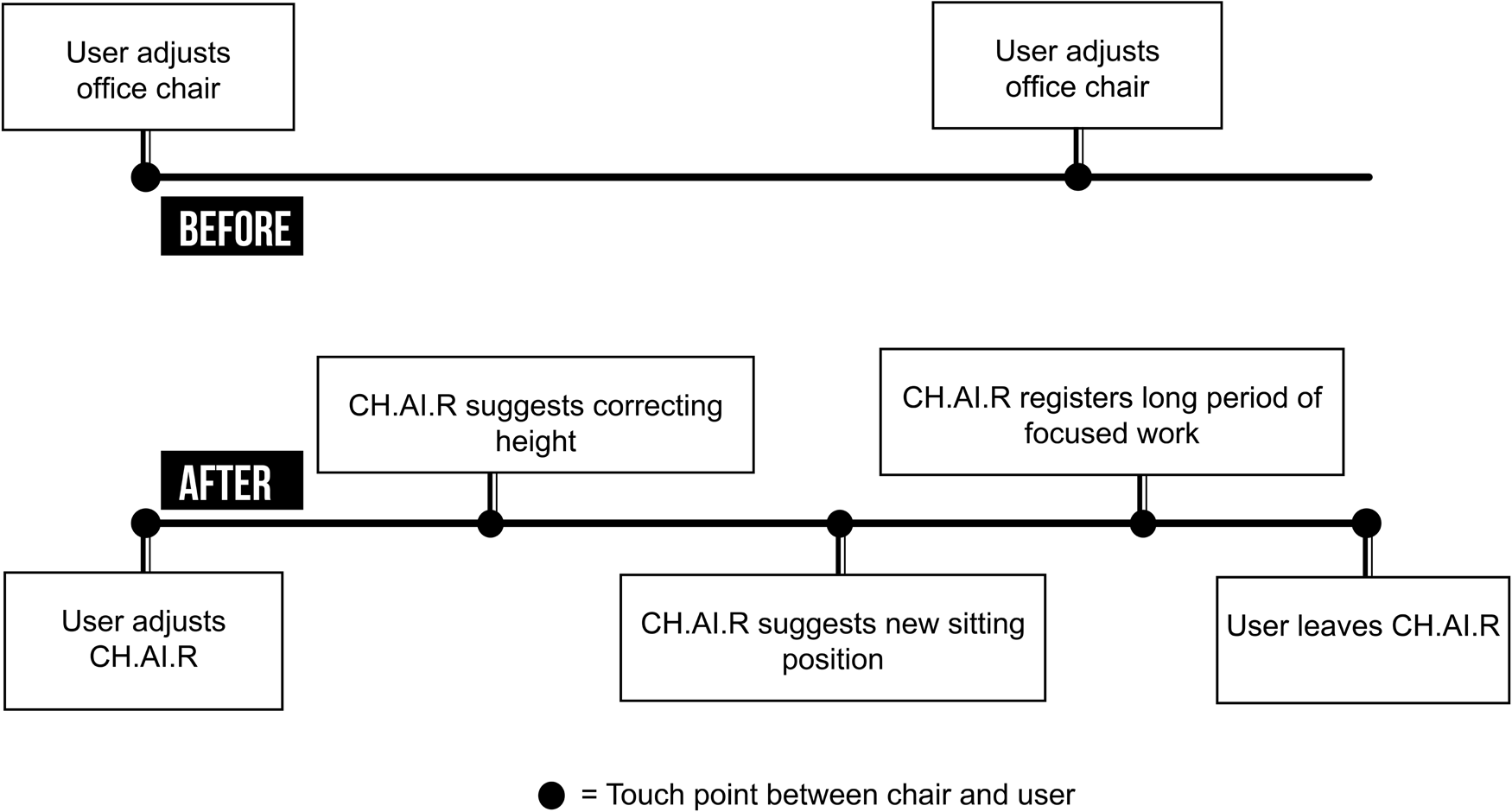
The data-tracking sensors combined with the height-changing capabilities allowed new interactions initiated by CH.AI.R, as illustrated by the old and new user journey in Figure 2. The chair could track the sitting position as well as the sitting time, and it could make assumptions about the user and usage. In the case of unintended sitting behavior (in this example, related to ergonomics), the chair was able to suggest changes.
Illustration of the fundamental differences between the user journey of an analog office chair and CH.AI.R.
Thus, this case study provides an example of how user researchers can create a controlled setup for measuring the sitting behavior while exploring an opportunity space of not only users’ sitting behavior over time but also new types of interactions initiated by the physical product itself.
In summary, this case study shows how user researchers can use the makerspace for rapidly building low-cost prototypes for tracking users’ active interaction with a product over time. The user insights consist of continuous quantitative sitting behavior.
Case II: Prototyping shape-changing interfaces
Shape-changing interfaces and semi-flexible materials have been suggested as new alternatives for products to interact with users (Hallnäs and Redström, Reference Hallnäs and Redström2002; Togler et al., Reference Togler, Hemmert and Wettach2009; Ende et al., Reference Ende, Haddadin, Parusel, Wüsthoff, Hassenzahl and Albu-Schäffer2011; Alexander and Holman, Reference Alexander and Holman2013; Nørgaard et al., Reference Nørgaard, Merritt, Rasmussen and Petersen2013; Kwak et al., Reference Kwak, Hornbæk, Markopoulos and Bruns Alonso2014). However, despite an increased focus on such interactions, the topic has mainly been approached from an implementation perspective, that is how to create such interfaces rather than considering users’ emotional responses to them (Rasmussen et al., Reference Rasmussen, Pedersen, Petersen and Hornbæk2012). The second case study considered a starting point in this observation. Shape-changing materials remain in their infancy. Hence, the research question is as follows: How can a user researcher prototype a shape-changing interface with high functionality and low fidelity? The main goal is to investigate users' emotional feedback to such interactions.
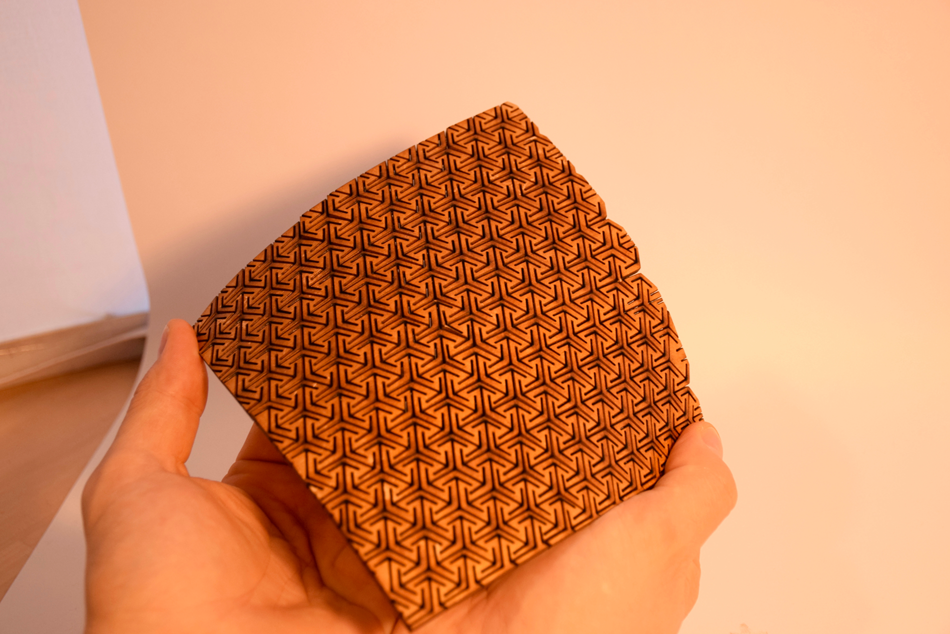
A well-known phenomenon in the world of maker culture is the so-called living hinge (Obrary, 2016). By laser-cutting a continuous pattern in a 3-mm medium density fiberboard (MDF), the otherwise firm plate attains flexible attributes, much like an advanced shape-changing interface (Jensen et al., Reference Jensen, Blindheim and Steinert2017a). The study evaluated the ability of nine different patterns to resemble a continuous organic shape-changing surface (Fig. 3).
Example of a laser-cut plate used to prototype a shape-changing interface.
Further, by providing the back of the plate with a servo and moving it from the back, the user researcher had a simple moving surface that could change in terms of the parameters of transformation and direction defined by Rasmussen et al. (2012). By changing the movement of the servo, the researcher could conduct experiments with a controlled independent variable and investigate the output differences, for example, users’ emotional responses, associations, or a specific match with a certain information type (Jensen et al., Reference Jensen, Blindheim and Steinert2017a). The evaluation and definition of the pattern that led to the most continuous and organic movement was then applied to a larger scale when milling the pattern in three 120 × 100 cm plywood sheets. Combined with a Novelda radar for measuring the breath of the spectator, the large sheet could now “breathe” in the same rhythm as the spectator. The final output of this case study was the Breathing Room presented at CHI 2018 (Sjöman et al., Reference Sjöman, Soares, Suijkerbuijk, Blindheim, Steinert and Wisland2018; Fig. 4).
The Breathing Room as presented at CHI 2018 (Sjöman et al., Reference Sjöman, Soares, Suijkerbuijk, Blindheim, Steinert and Wisland2018).

Case III: Increasing passengers’ trust toward future autonomous cars
This case study was conducted in collaboration with Renault Innovation Lab (Sunnyvale, California). The challenge was as follows: How can Renault design ambient interactions in a fully autonomous car to increase the trust between passenger and car? In this process, several user experiences were prototyped (Fig. 5). Each prototype explored a certain opportunity space and helped the group gain knowledge regarding the problem context rather than the final product.
Examples of prototypes. A simple car simulator (a1) was set up for testing whether air-blow could be used as a communication tool controlled by the simple Arduino-based control panel (a2). (b1 and b2) show the moving footrest implemented and tested in the car.

The project followed a detailed mechanical design course structure as described by Carleton and Leifer (Reference Carleton and Leifer2009). This involved several iterations and dead ends. Further, many prototypes were applied to non-autonomous cars and tested in the passenger seat. Subsequently, a moving footrest indicating the awareness of the car was evaluated as a way to increase trust toward fully autonomous cars. The prototype was built using cut wood, Arduino, and two hydraulic-driven pressure pumps (Fig. 6).
Example of a prototype of the footrest indicating the awareness of the autonomous car.

When developing the footrest capable of communicating information through incremental movement, the design question was as follows: what should be communicated to the user through the footrest? By implementing the prototype in a car and systematically changing the settings for movement, we identified the required information.
Initially the team had many ideas of several stages of the footrest position. Eventually when running several user experience tests in a car, it was found that actual awareness and the indication of the car was ready to break (but not necessarily going to break) was the only information needed to increase the trust between passenger and car. (Erichsen et al., Reference Erichsen, Jensen, Gerstenberg and Semb2015)
Case IV: A haptic experience in virtual environments
The last case study focused on the development of a haptic glove for virtual environments. This study was conducted through a collaboration between Samsung and the BEST Lab at UC Berkeley. The glove should provide haptic feedback in a virtual environment. Hence, the glove was equipped with actuators to provide feedback when a user encounters an object in a virtual environment. In this case study, two different haptic gloves were built. The first was a cotton glove with five actuators and based on Arduino (Fig. 7). The other glove was equipped with an ultrasonic sensor and an accelerometer, which enabled it to communicate with the Leap Motion system; thus, users could actually feel the feedback in their hands when “touching” an object in the virtual space presented on a screen next to them (Fig. 8).
The first prototype of the haptic glove (left). A user tests a glove providing haptic feedback in a virtual environment (right).

A user tests the glove connected to a display of three shapes. The user gets haptic feedback through the glove when ‘touching’ an object in the virtual world.

Despite the low fidelity compared to a final product, the two setups allowed 15 potential users to experience the glove concept and provide feedback on not only the overall experience but also five pre-designed feedback patterns. Thus, the user researcher gained qualitative feedback on the overall experience and could investigate interpretations of the feedback pattern in a controlled manner for statistical analysis and comparison. During these experiments, several unforeseen effects were identified. For example, the test participant would expect the glove to be much smarter than it actually was. Moreover, the number of vibrating actuators had an exponential effect when activated at the same time. Therefore, compared to activating one vibrator, activating five vibrators would have a stronger unintentional effect, and it was interpreted as much more intentional by the test participants.
Analysis: Comparison between traditional and makerspace-driven user research
In this section, the user research activities presented by the four case studies are first summarized in terms of the types of user insights they elicited in the specific projects in order to confirm whether the prototypes fall under the field of user research. Second, the cases are compared with three classical user research activities, namely observation and the AEIOU framework, prototyping, and user journey mapping. The comparisons were solely made by the authors.
Comparing the four cases and the types of insights elicited
The four case studies are summarized in terms of the types of insights in Table 2 that they could help identify.
As seen in Table 3, the footrest project and the haptic glove, both of which can be regarded as functional experience prototypes, enabled the team to elicit insights related to user preferences, drivers for decision-making in terms of future design, users’ interpretations of design, and detailed quantitative requirements for future design. The shape-changing interface can also be considered as a functioning experience prototype. The project did not involve detailed user interpretation studies for evaluating different types of shape-changing interfaces. However, the functioning aspects of the prototype can facilitate such studies in the future; hence, the (x) in Table 3.
Types of user insights individually elicited by the four cases
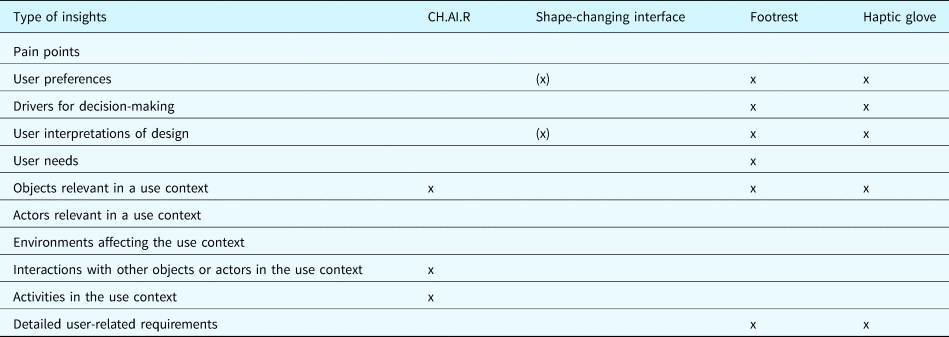
The CH.AI.R prototype can also be considered as an experience prototype, but it differs from the three other examples in terms of eliciting insights related to the categories in the AEUIO framework. In particular, the sensors in the chair can quantify sitting interactions. By analyzing such data, the team could distinguish sitting patterns (activities) from one another. Further, the relevant objects to be tracked in parallel with the chair interactions were identified, such as table or software interactions.
The insights gained from the CH.AI.R prototype are different from those gained from the three other cases. From the beginning, the CH.AI.R study openly addressed the following question: what if we install sensors in an office chair? By contrast, the three other cases had more specific project tasks. In the case of the footrest and the haptic glove, the design questions already evolved around a rather specific product idea. This shows how a user researcher can use the makerspace for different design questions while still building functional prototypes to explore the design space, that is the user researcher leads the prototyping direction rather than letting the tools dictate the process. This is the effect of the maker mindset defined earlier as an invitation to take ideas and transform them into various types of realities. It is the process of iterating over a project to improve it (Dougherty, Reference Dougherty2013).
Finally, none of the prototypes in the case studies were observed to provide new knowledge on pain points, actors relevant in a use context, and environments affecting the use context. These three types of user insights are holistic aspects of the product. Hence, it suggests that conducting user research in the makerspace and building prototypes entail the risk of user research conducted too close to the prototype and less focused on the actual use context. This does not mean that the prototypes cannot be tested in the actual use context, but that the user researcher must consider such testing as well.
The 4 cases compared to observations and the AEIOU framework
A classical user research method is in-field observation. The AEIOU framework serves the purpose of supporting the structuring of all observations and insights, and it enables the researcher to remain aware of the activities, environment, interactions, objects, and users (Wasson, Reference Wasson2000). This documentation will be in the list and themes related to the five overall topics. However, as with the example of CH.AI.R providing sensors to a context, it would allow user researchers to, for example measure how two users are interacting together or how often a user is interacting with a machine (Sjöman et al., Reference Sjöman, Steinert, Kress and Vignoli2015). Analyzing the data from such data tracking would enable the user researcher to see the bigger picture and identify not only individual topics on their own but also the interrelations among the user, objects, and interactions (Sjöman and Steinert, Reference Sjöman and Steinert2016).
This is a valuable resource, as most user researchers know the importance of being aware of the difference between what users say they do and what they actually do. Insights and quantitative data points on behavior and movement in an in-field context serve as a detailed starting point for analysis as well as further qualitative interviews.
In addition, a makerspace provides significant possibilities for conducting observation-based action research as defined by Schon (Cameron, Reference Cameron2009). In this approach, the researcher goes to the field to collect data, analyses the data, and defines a hypothesis for further testing in the field (Cameron, Reference Cameron2009). Access to a makerspace enables the user researcher to go out in the field with more suitable experiments for hypothesis testing. The case of the moving footrest in a fully autonomous car is a good example. Here, the different prototypes provided the team with insights into the concept of trusting an autonomous car and enabled them to evaluate actual ideas for implementation. Indeed, all four case studies illustrate the capability of building low-fidelity yet high-functionality prototypes ready for controlled testing by users. Hence, an action researcher can challenge his/her hypothesis in the field and learn in a controlled and repeatable way.
The 4 cases compared to prototyping
Prototypes as design tools have been used for decades in the FFE in various professional fields (Jensen et al., Reference Jensen, Elverum and Steinert2017b). However, in the light of user-involved activities and human-centered design, the prototypes are often of low fidelity and functionality, or so-called Wizard-of-Oz prototypes (Martin and Hanington, Reference Martin and Hanington2012). As seen in the four case studies, a makerspace provides user researchers with rapid prototyping tools, such as laser cutters, 3D printers, mills, standard construction sets, Arduino, and simple low-cost building materials, as the foundation for building impressive creations. Now, low-fidelity yet high-functionality prototypes can be built and tested further in a controlled manner by future users. Compared to previous prototype definitions, they fit into the category of experience prototypes. The main advantage is the performance repeatability of the prototype, which allows for more systematic and controlled exploration. The case of the moving footrest shows how an explorative approach remains controlled. Thus, it is easier to infer exact moving patterns. A low-fidelity prototype might only lead to a requirement of a “moving footrest”, but with a working experience prototype, the team can define quantitative specifications in terms of the length of a movement. This foundation is the main advantage of a makerspace from an FFE perspective. The ability to achieve high functionality in the early stages of product development in a rapid and low-cost manner allows for more specific requirement definitions in a shorter time. Compared with the case of low-fidelity and low-functionality prototypes, the user researcher can systematically explore areas of interest and gain new, unforeseen insights arising when users interact with the intended functionality. This was particularly relevant in the case of the haptic glove, where unexpected insights into the feedback pattern variations were identified.
The 4 cases compared to user journey mapping
The purpose of mapping a user journey is to gain a holistic view of the product in question. Who is interacting with whom? Which pain points arise in the product journey? Which use cases should the product functionality support? These questions can be answered by mapping a user journey (Martin and Hanington, Reference Martin and Hanington2012). In the context of makerspaces and the four case studies, prototyping does not provide a broad view of the product context in the same way as user journey mapping would. This might be one of the pitfalls of combining makerspaces and user research. Although the prototypes built in a makerspace as mentioned can have rather high functionality, they can also have a narrow focus in terms of the use case they are exploring. The footrest, the organic shape-changing interface, and the haptic glove focused on how a specific movement of a surface might lead to predictable user interpretations. CH.AI.R focused on measuring sitting behavior and exploring new interactions arising from such data.
Thus, the prototypes were built in the makerspace with a specific hypothesis or idea in mind. The aim of user journey mapping is to uncover unknown interactions and circumstances. Such insights can lead to the conclusion that building a low-fidelity yet high-functionality prototype requires the user researcher to balance his/her activities between exploring and uncovering a product in a holistic context rather than exploring a specific hypothesis connected to a product.
Results and discussion
This paper encourages user researchers to learn from makerspaces and cultivate the mentality that anything can be built. This opportunistic mindset will allow user researchers to build functional prototypes and conduct experiments to support explorative and repeatable user research. Nevertheless, the following concerns arise.
Will higher functionality affect requirement elicitation?
The main research question of this work is as follows: how does the activity of user research in FFE benefit from access to a makerspace?
The four case studies provided learning examples of how accessibility to an in-house makerspace creates new, exciting possibilities for user research activities in the FFE. With such equipment, new interaction systems and user experiences can rapidly be built in simple and low-cost yet functional ways. Such prototypes can be considered as functional and working experience prototypes, which will allow for more controlled and systematic exploration of the user's emotional response to interactions. Therefore, the main advantage of combining user research and makerspace resources is the ability to conduct functional user experience experiments that might include data tracking. This, in turn, leads to more systematic and controlled exploration, which will result in rapidly eliciting more detailed requirements and establishing repeatable setups that can be tested across countries.
However, previous research emphasizes that the fidelity and function of a prototype can influence the user feedback (Lim et al, Reference Lim, Pangam, Periyasama and Aneja2006; Blackler, Reference Blackler2009). As makerspaces become domesticated, it will be interesting to study whether increasing the functionality of a prototype while keeping its fidelity low in a similar way will affect the elicited user-related insights.
New skills for the user researcher
Unleashing the new potential of applying user research to a makerspace requires the user researcher to be confident of using the tools and machines in the makerspace. Hence, a strong empathy for the educating profession in terms of conducting user research is important for enabling user researchers to build functional experience prototypes. In the same way as mechanical and technical professions might require education in exploring requirements in the FFE, the user researcher will most likely require education on how to use the machines. According to Hielscher and Smith (Reference Hielscher and Smith2014), user researchers with a background in sociology and anthropology would most likely lack craftsman skills, digital skills, mastery of rapid prototyping machines, and knowledge of material selection, whereas they might be good at improvisation and experimentation. This is the case for any other profession besides engineers and technicians working in the FFE. Therefore, there is a need for an education task to ensure that all professions have the required maker skills.
Empathy in data harvesting user research
Data harvesting and repeatable user research experiments, as well as physical products tracking user behavior, can spark concerns in a field traditionally dominated by qualitative and empathetic research. “Where is the user empathy when turning everything into numbers and tracking the user's behavior?” Is it possible to have empathy for individual users rather than turning them into one big pool of data?
Another threat is the fact that the user researcher only obtains answers on what he/she measures. For example, when CH.AI.R measures the sitting behavior of the user, the output is obtained in numbers that measure mechanical pressure. Through machine learning, the chair can recognize different sitting variations; however, the actual use context is not explained. The activity taking place at the desk, for example whether the user is writing an email or thinking about what to cook for dinner, is not (yet) identified. Thus, the data harvesting part of user research in the FFE should be supported by qualitative research as well. Data harvesting software cannot ask the important “why” questions that a human user researcher can.
Conclusion: New possibilities for experimenting and repeatable user research
This paper sheds light on the new possibilities for user research activities facilitated by access to makerspaces. Specifically, we presented four case studies of user research conducted in two university-based makerspaces as examples of the new possibilities for conducting user research in makerspaces. Further, we compared the four cases with three traditional user research activities: observation, prototyping, and user journey mapping.
By employing sensors in observation studies, user researchers can gain insights into how users actually interact with products or other users over time. Thus, the researcher can collect data over a longer time, which is especially valuable in terms of the resources and longevity of the user studies. Furthermore, through cluster analysis, sensor-based observation studies might help identify interrelations and themes rather than normally structuring findings in predefined topics, as with the AEIOU framework. This can serve as a starting point for understanding a product context in greater detail and thus supplement classical observations (Ilmari et al., Reference Ilmari, Matias, Erichsen, Sjöman and Steinert2018).
In terms of the classical design activity prototyping, the makerspace allows for building functional prototypes in the FFE. Previous prototypes related to user requirement elicitation were of low fidelity (Lim et al., Reference Lim, Pangam, Periyasama and Aneja2006). Using makerspaces, a user researcher can build extreme user experiences, such as the Breathing Room, without resorting to Wizard-of-Oz methods. Thus, the researcher can repeat the setups by changing the parameters in a desirable manner and conduct more controlled experiments. These prototypes fall under the previously defined category of experience prototypes. With the equipment in a makerspace, new interaction systems and user experiences can rapidly be built in simple yet functional ways, which will allow for more controlled and systematic exploration of the user's emotional response to new product experiences.
In relation to holistic approaches such as user journey mapping, the cases presented seem to be of a narrow nature, exploring a rather specific area of interest. Therefore, we conclude that future user researchers should achieve a balance between exploratory holistic activities and hypothesis-driven activities.
Overall, the four cases illustrated how a makerspace can support user researchers in rapid learning processes and encourage future workers in the FFE to use a makerspace not only for specific product iteration but also for experimentation on functional user experiences. Through this study, we expect to encourage companies that aim to implement makerspaces as a part of their innovation strategy to consider the spaces as meeting points for all FFE activities involving user researchers and user research.
Appendix I The Makerspace TrollLABS
Location:
Norwegian University of Science and Technology (NTNU)
Faculty of Engineering (IV)
Department of Mechanical and Industrial Engineering (MTP)
Webpage: https://www.ntnu.edu/mtp/trolllabs#/view/about
Description:
TrollLABS is a research and prototyping laboratory, established in 2014. It is a part of the following research project:
TrollLABS - Skunk Works
Understanding the underlying principles of Skunk Works such as extreme ideation and concept creation projects.
The goal of the research project is to uncover and understand the underlying principles and paradigms of Skunk Works such as extreme product/service/system development projects. The overarching research question is as follows: How to make radical new product development teams faster, cheaper, and better in terms of project outcome quality and quantity? The research lab TrollLABS, originally founded by Prof. Martin Steinert, is researching all phase zero (pre-requirement fixation) aspects of intelligent product development, such as need-finding, conception, simulation, prototyping, testing, and preproduction and production automation. The lab especially focuses on creating critical human–system interactions. Its main contribution lies in fast mechatronics and mechanics prototyping and testing of both sensors and UIs in situ.
Target group and business model: The primary target group of the lab is researchers and industry partners of the lab. Secondary comes the students connected to the Department of Mechanical and Industrial Engineering. The lab is founded by research funding from the Norwegian Council of Research and Norwegian Industry Partners.
Tools and machines:
The lab has a wide variety of specialized machinery available:
• Various 3D printers
• Laser cutter
• Mills
• Ordinary tools such as hammers, saws, and screwdrivers
• Electronics lab
• Foundry
• Metal shop
Appendix II Jacobs Hall Institute of Design and Innovation
Location:
UC Berkeley (USA)
College of Engineering
Not connected to a specific department
Web page: http://jacobsinstitute.berkeley.edu/our-space/labs-and-equipment/all-purpose-maker-spaces/
Description:
Jacobs Hall is the Jacobs Institute's home and a site of diverse design activity. The building's light-filled design studios and labs offer flexible space as well as access to tools for prototyping, iteration, and fabrication. From sketching to cutting-edge digital fabrication, the building facilitates diverse making practices under one roof. Berkeley students, faculty, and staff can use the building's facilities for hands-on design, including all-purpose makerspaces, a CAD/CAM software lab, a wood shop, a metal shop, an electronics lab, an AV production lab, and an advanced prototyping lab.
Target group and business model:
The primary target group of the lab is engineering students. The business model is member-based and the students pay a semester fee to become a member of the maker space. Furthermore, they need to take courses in the specific machines before they are allowed to use them. Additionally, the lab receives funding from various industry sponsors.
Tools and machines:
Jacobs Hall has a wide variety of specialized machinery available:
• Various 3D printers
• Laser cutters
• Mills
• Electronics lab
• Ordinary tools such as hammers, saws, and screwdrivers
• Foil cutters
• Metal shop
• Visualization lab
• Sewing machines
Matilde Bisballe Jensen received PhD from the Norwegian University of Science and Technology and MSc in Engineering Design from the Technical University of Denmark. Currently working as a User Researcher in the Danish 3Shape. Here, she is conducting research in various areas of Human–Machine Interactions. Her main interest covers how user researchers can become better at building and testing extreme functional HMI prototypes in early stages of product development – the fuzzy front. This includes utilizing the accessibility to rapid prototype facilities such as makerspaces.
Martin Steinert is a Professor of Engineering Design and Innovation at the Department of Mechanical and Industrial Engineering at the Norwegian University of Science and Technology (NTNU). He teaches fuzzy front-end engineering for radical new product/service/system concepts and graduate research seminars for PhDs engaged in topics related to new product design and development. Various research projects are usually multidisciplinary (ME/CS/EE/Neuro- and Cognitive Sc.) and often connected with the industry. The aim is to uncover, understand and leverage early-stage engineering design paradigms with a special focus onto human–machine/object interactions.


 Open access

