




Non-technical Summary
Fossils that superficially resemble simple colonial corals have been found in a unit of rocks known as the Mural Formation, in west-central Alberta and adjacent east-central British Columbia. They date to the early Cambrian Period of geologic time about 515 million years ago, during a major diversification of marine life known as the Cambrian Explosion. These coral-like fossils represent organisms that lived mainly in reefs dominated by a group of extinct sponges. Some were attached to the sponges or less commonly to other surfaces, and some grew downward, apparently from overhangs or cavities in the reefs. The organisms that produced the coral-like skeletons belong to an extinct species characterized by a remarkable range of variability of external shape and internal skeletal features. Detailed study of the structure of the skeleton and the way it grew indicates that this species, and a few similar species from elsewhere in North America, were not really corals. They possibly represent a distinct group of Cambrian sponges that had skeletons superficially resembling those of simple colonial corals.
Introduction
Taxa of uncertain affinity with coral-like skeletons diversified during the Cambrian Explosion, reaching a small peak in Epoch 2 (late Early Cambrian of prior usage; Nielsen and Ahlberg, Reference Nielsen and Ahlberg2019). This was followed by an interval of very low diversity in the later Cambrian (Scrutton, Reference Scrutton1997; Elias et al., Reference Elias, Lee and Pratt2021). The morphology, skeletal development, intrataxon variability, and biologic affinity of these taxa are poorly understood in general, due in part to issues such as small sample size and diagenesis. The present paper is based on previously unstudied material from carbonate strata of the Mural Formation (Cambrian, Epoch 2) in the Rocky Mountains of Alberta and British Columbia (Fritz and Mountjoy, Reference Fritz and Mountjoy1975; Fritz et al., Reference Fritz, Cecile, Norford, Morrow, Geldsetzer, Gabrielse and Yorath1991; Pope et al., Reference Pope, Hollingsworth, Dilliard, Derby, Fritz, Longacre, Morgan and Sternbach2012, table 1) (Figs. 1.1–1.3, 2). Fieldwork at four localities and preliminary thin sectioning of lithologic samples revealed the presence of coral-like fossils. Subsequently, sets of closely spaced serial thin sections were prepared from a large number of samples, permitting the present comprehensive analysis.
(1–3) Location of studied stratigraphic sections of Mural Formation and sections of Rosella Formation where Rosellatana jamesi Kobluk, Reference Kobluk1984a was previously documented. (1) Map of Canada showing provinces of British Columbia (BC) and Alberta (AB). (2) Map of British Columbia and Alberta showing location of region with studied stratigraphic sections (red rectangle; see (3)), Geological Survey of Canada locality 96892 in Cassiar Mountains (green star) where type specimens of R. jamesi were collected (Kobluk, Reference Kobluk1984a), and GSC locality 98761 at Mount Blanchard (orange star) where another specimen of R. jamesi was collected (Mansy et al., Reference Mansy, Debrenne and Zhuravlev1993). (3) Google Earth image of Rocky Mountains of east-central British Columbia and west-central Alberta showing towns (blue) and localities with studied sections (yellow). (4) Locations and ages of Cambrian taxa with macroscopic, morphologically simple, modular skeletons (see Table 1), plotted on a paleogeographic map of Laurentia in the late early Cambrian (ca. 510 Ma). Equatorial position of Laurentia is based on Wu et al. (Reference Wu, Pisarevsky, Li, Murphy and Liu2024, fig. 7a); paleogeography is adapted from Lochman-Balk (Reference Lochman-Balk and Holland1971, fig. 9), Cocks and Torsvik (Reference Cocks and Torsvik2011, fig. 6), and Hammersburg et al. (Reference Hammersburg, Hasiotis and Robison2018, fig. 3). Locations: 1 = north-central British Columbia; 2 = west-central Alberta and east-central British Columbia; 3 = southwestern Alberta; 4 = southern Alberta and southeastern British Columbia; 5 = western Montana; 6 = southern Montana; 7 = southwestern Nevada; 8 = southwestern Virginia; 9 = southern Labrador and western Newfoundland. Ages of taxa: solid circle = Epoch 2; open circle = Miaolingian.

Lower and lower-middle Cambrian stratigraphy of southern Rocky Mountains of Canada. Mural Formation is highlighted (blue). Curving line tipped with arrow shows a “Grand Cycle” (Mount Whyte and Cathedral formations) consisting of shaly half-cycle overlain by carbonate half-cycle. Stephen Formation includes the Burgess Shale. Modified from Aitken (Reference Aitken, Stott and Aitken1993, fig. 4b.9).

Modular coral-like fossils from the Mural Formation can be placed with a group of Cambrian taxa characterized by simple macroscopic skeletons lacking tabulae and septa (Table 1). Three occurrences originally assigned to genera in this group are excluded. Vologdin’s (Reference Vologdin1959) report of Cambrophyllum problematicum Fritz and Howell, Reference Fritz and Howell1955 from Tuva has been questioned (Menner et al., Reference Menner, Pokrovskaya and Rozanov1960); the material is actually an archaeocyath (Zhuravlev, Reference Zhuravlev1999). Fomichev’s (Reference Fomichev and Tchernysheva1965, p. 232) report of “Cambrophyllum salairicum Sokolov sp. nov.” from Salair is unverified; the species has not been described or illustrated. Cambrotrypa sudetica Gunia, Reference Gunia1967 from Poland is excluded because it appears to have tabulae (Gunia, Reference Gunia1967). Also excluded are calcimicrobes with tiny modules (e.g., Bija Vologdin, Reference Vologdin1932). The taxa in Table 1 occur at North American localities that were situated in the paleocontinent Laurentia, which was positioned equatorially in the Cambrian (Wu et al., Reference Wu, Pisarevsky, Li, Murphy and Liu2024, figs. 5a, 7) (Fig. 1.4). Most of the taxa date to Epoch 2, but some are Miaolingian in age (Middle Cambrian of prior usage; Nielsen and Ahlberg, Reference Nielsen and Ahlberg2019).
Characters of Cambrian taxa with macroscopic, modular skeletons lacking tabulae and septa, based on descriptions and figures in the cited references. Abbreviations: — = unknown; ? = uncertain; avg. = average; Fm. = Formation; max. = maximum; mbr. = member; min. = minimum; Mt. = Mount; no. = number

Previous studies of the taxa in Table 1 have been limited in scope due to relatively small numbers of specimens and/or thin sections, so the species are poorly known. Furthermore, taxonomic issues clearly exist at the genus level. For example, Kobluk (Reference Kobluk1984b) demonstrated that the inclusion of Archaeotrypa secunda Fritz, Reference Fritz1947 in Archaeotrypa Fritz, Reference Fritz1947 cannot be justified because it differs fundamentally from the type species A. prima Fritz, Reference Fritz1947. The other occurrences of Archaeotrypa in Table 1 resemble A. secunda rather than A. prima, so their generic placement is also in question. During the course of our study, Labyrinthus Kobluk, Reference Kobluk1979 was found to be a junior homonym of Labyrinthus Beck, Reference Beck1837, which is a Cenozoic terrestrial gastropod (Roth, Reference Roth1988; Sei et al., Reference Sei, Robinson, Geneva and Rosenberg2017). Therefore, the generic assignment of L. soraufi Kobluk, Reference Kobluk1979, which is the type and only species of Labyrinthus Kobluk, Reference Kobluk1979, requires reconsideration. The present detailed study of material from the Mural Formation contributes to a better overall understanding of morphologically simple, macroscopic modular skeletons in the Cambrian.
Geologic setting
The Mural Formation is part of a discontinuous carbonate platform succession that was deposited along the present-day western margin of Laurentia during the latter part of the early Cambrian (e.g., Pope et al., Reference Pope, Hollingsworth, Dilliard, Derby, Fritz, Longacre, Morgan and Sternbach2012) during the first phase of the Sauk transgression (e.g., Morgan, Reference Morgan, Derby, Fritz, Longacre, Morgan and Sternbach2012). The outcropping Mural Formation of western Alberta and adjacent British Columbia extends from the Park Ranges immediately south of Mount Kerkeslin (Mountjoy and Price, Reference Mountjoy and Price2003), northwest to just beyond Pine Pass, British Columbia (Slind and Perkins, Reference Slind and Perkins1966; McMechan, Reference McMechan1987, Reference McMechan1990), over a distance of almost 550 km. The formation varies in thickness along and across strike (Campbell et al., Reference Campbell, Mountjoy and Young1973, fig. 1; McMechan, Reference McMechan1990). It is a mixed carbonate–siliciclastic unit in the northern half of its range, where archaeocyath-bearing bioherms have not been noted in the legends of geologic maps.
The Mural Formation is mostly a tripartite unit in the southern part of the outcrop belt. It comprises lower and upper carbonate members and a middle mudstone-dominated member, with the boundary between the Nevadella and Bonnia–Olenellus trilobite biozones falling in the lower part of the mudstone interval (Fritz and Mountjoy, Reference Fritz and Mountjoy1975; Fritz, Reference Fritz1992). The overlying predominantly siliciclastic Mahto Formation is also within the Bonnia–Olenellus Biozone (Fig. 2).
The Mural Formation was studied at four localities (Fig. 1.3). The southernmost section was measured at the top of a steep gully on the northwestern flank of Mount Kerkeslin, at 52°39’10"N, 117°50’35"W, 30 km south-southeast of Jasper, Alberta. This section is almost 1 km south of section AC-11 on the Athabasca Falls geologic map (Mountjoy and Price, Reference Mountjoy and Price2003), measured by J.D. Aitken. The Mount Kerkeslin locality is close to the southernmost extent of the formation.
The Mural Formation is widely exposed around Mount Robson (Mountjoy, Reference Mountjoy1978), which is more or less on strike with the exposure at Mount Kerkeslin (see also Price et al., Reference Price, Stott, Campbell, Mountjoy and Ollerenshaw1973). It was studied on glacially polished outcrops around 53°12’N, 119°02’W, ~2 km north of the snout of Coleman Glacier north of Mount Robson in Mount Robson Provincial Park, British Columbia, and 97 km north-northwest of Mount Kerkeslin. The Coleman Glacier locality is close to section III (Coleman Brook) of Fritz and Mountjoy (Reference Fritz and Mountjoy1975), which includes the type section and is also the section named “Type Tah Fm.” in Fritz (Reference Fritz1992, fig. 3), but is along strike to the east where the upper member is not dolomitized.
The Mural Formation was measured and sampled in detail on the east side of Celtic Peak, 24.5 km west-northwest of Mount Robson and 32 km west of the Coleman Glacier locality, at 53°11’N, 119°30’W (Celtic Peak is not shown on the 1:50,000 topographic map [Natural Resources Canada, 1981] and is not listed in the BC Geographical Names website). This area, up a tributary on the west side of Small River (Small Creek on the topographic map), has glacially polished outcrops (Lowe, Reference Lowe1983, fig. 6; Orwin and Smart, Reference Orwin and Smart2004). This area is now part of Small River Caves Provincial Park. The Small River locality is separated from the Coleman Glacier locality by the Resplendent thrust fault as it changes to an array of normal faults, and was ~18 km more outboard (Mountjoy, Reference Mountjoy1978).
The fourth locality examined, but not measured in detail, is in the Dezaiko Range 113 km north-northwest of McBride, British Columbia, 13.5 km northeast of MacGregor River (Pratt, Reference Pratt1990b), and ~152 km approximately along strike (Stott and Taylor, Reference Stott and Taylor1979) northwest of the Small River locality. The Mural Formation is exposed on the northeast side of a ridge leading southeast off Gleason Peak, at 54°10’N, 121°01’W (this name is not shown on the 1:50,000 topographic map [Natural Resources Canada, 1989] and is not listed in the BC Geographical Names website). The upper part of the formation is tectonically sheared at the Dezaiko Range locality, likely by a nearby, small thrust fault. Section FN-70-9 of W.H. Fritz (1972, unpublished Geological Survey of Canada Report C13-1972-WHF) was measured 40 km to the northwest in the Misinchinka Ranges near Overland Peak (another name not shown on the 1:50,000 topographic map [Natural Resources Canada, 1976] and not listed in the BC Geographical Names website). There, the Mural Formation is 321 m thick.
Stratigraphy and reefs
Mount Kerkeslin
The lower carbonate member of the Mural Formation is absent at this locality, and the middle mudstone member rests on shallow-marine sandstone of the McNaughton Formation. This member is 21.2 m thick and consists of siltstone with thin interbeds of medium- to coarse-grained sandstone that decrease in frequency up-section. The upper carbonate member is 22.2 m thick. At its base is an interval of sandy bioclastic grainstone 1.7 m thick, followed by 11.5 m of dolomite-mottled, dominantly bioturbated wackestone with locally interbedded grainstone and several small archaeocyath-bearing bioherms up to 30 cm in diameter and 20 cm thick. This is overlain by 7 m of mostly thin-bedded grainstone with meter-sized bioherms containing archaeocyaths and modular coral-like skeletons and capped by 2 m of dolomitized grainstone with intercalated siltstone laminae.
Coleman Glacier
The lower carbonate member of the Mural Formation is 90 m thick at this locality, consisting of a thick-bedded to massive, archaeocyath-bearing limestone overlain by thin-bedded limestone (Fritz and Mountjoy, Reference Fritz and Mountjoy1975; Fritz, Reference Fritz1992, fig. 3). The lower limestone is dominantly grainstone with archaeocyath-bearing bioherms; at the top are bioclastic grainstone and locally oolite. The middle mudstone member is 84 m thick (Fritz and Mountjoy, Reference Fritz and Mountjoy1975). It consists of variably interbedded sandstone and grainstone composed of trilobite sclerites. At the Mumm Peak section 10 km to the west, it contains archaeocyaths (Fritz, Reference Fritz1992, fig. 3). The Nevadella Biozone interval in the lower carbonate member and lower part of the middle mudstone member nearby also contains phosphatic brachiopods and small shelly fossils (Balthasar, Reference Balthasar2004, Reference Balthasar2007, Reference Balthasar2008, Reference Balthasar2009; Skovsted et al., Reference Skovsted, Balthasar, Vinther and Sperling2021). The mudstone member exhibits local poor-quality Burgess Shale-type preservation of soft tissues (Sperling et al., Reference Sperling, Balthasar and Skovsted2018). The upper carbonate member is almost 72 m thick (Fritz and Mountjoy, Reference Fritz and Mountjoy1975). It appears to be mostly dolomitized thin-bedded grainstone with scattered bioherms. At the top is a limestone interval ~4 m thick with an undulating upper surface conforming to variably coalesced bioherms separated by grainstone-filled inter-mound areas less than 1 m across. This interval was noted by Fritz (Reference Fritz1992, fig. 3). Small bioherms in the lower part contain only archaeocyaths, whereas the uppermost ~2 m comprise a large biohermal mass, probably more than 20 m across, containing archaeocyaths, variably common modular coral-like skeletons, and laminar and locally domical or hemispherical calcite skeletons (Fig. 3.1) interpreted as recrystallized stromatoporoid-grade hypercalcified sponges (Pratt, Reference Pratt1990a, Reference Pratt1991, Reference Pratt1994, Reference Pratt1995a, Reference Prattb). The inter-mound areas contain dislodged archaeocyaths and coral-like skeletons. The stromatoporoid-like skeletons, coral-like skeletons, and archaeocyaths are commonly encrusted by growths of clotted microbialite (Fig. 3.1). Locally, centimeter-scale masses of Epiphyton Bornemann, Reference Bornemann1886 are present. Growth-framework and laminar, stromatactis-like cavities are common (Fig. 3.1). The matrix ranges from bioclastic wackestone to packstone. Overhangs are present locally and contain laminated infill (Fig. 3.4).
Boundstone of uppermost Mural Formation. (1) Glacially polished and striated surface parallel to bedding, showing isopachous fibrous calcite cement-lined growth-framework cavities (arrows) and inclined, arcuate, laminar, recrystallized calcite fossils (whitish) thought to be stromatoporoid-grade hypercalcified sponges that had a primary aragonite mineralogy. These and small archaeocyaths are encased in microbialite of varying shades. Coleman Glacier. Lens cap, diameter = 6 cm. (2) Glacially polished and striated surface parallel to bedding, showing mostly upright archaeocyaths encased in microbialite (darker colored) and flanked by matrix lime mudstone and wackestone (lighter colored). Small River. Part of lens cap at lower left, diameter = 6 cm. (3) Glacially polished and striated surface parallel to bedding, showing mostly upright archaeocyaths encased in microbialite (darker colored) and flanked by matrix lime mudstone and wackestone (lighter colored). Large whitish area (lower left) consists of a mass of recrystallized acicular aragonite cement. Small River. Lens cap, diameter = 6 cm. (4) Surface cut perpendicular to bedding, showing an overhang under which accumulated mottled then laminated lime mudstone matrix, with remaining cavity spaces filled with isopachous fibrous calcite cement. Note downward-splaying modular coral-like skeleton (arrow). Coleman Glacier. (5, 6) Surface cut parallel to bedding (5), with tracing showing distribution of frame-building elements (6). Modular coral-like skeletons are unusually abundant in this sample. Small River.

Small River
The Mural Formation at this locality is not dolomitized. The lower carbonate member is 130 m thick. Just over half of its total thickness consists of archaeocyath-bearing biohermal masses ranging from 2 m to 16 m thick, flanked mostly by thin-bedded bioclastic grainstone. Intercalated non-biohermal intervals are sandstone and minor grainstone in the lower part and dominantly grainstone in the upper part. Oolite makes up most of the interval between 90 m and 102 m above the base of the lower member. The middle mudstone member is ~40 m thick. The upper carbonate member is ~170 m thick. Non-biohermal intervals are mostly grainstone, including 12 m of oolite at the base of the member and ~25 m of oncolitic oolite at the top. Meter-sized archaeocyath-bearing bioherms are present 15 m below the top. Large archaeocyath-bearing biohermal masses, up to several tens of meters across, are present at three levels: (1) the lowest, 0.5 m thick, at 12 m above the base of the member; (2) an interval between 35 m and 40 m above base; and (3) a 3 m thick interval at the top of the member. Glacially polished surfaces and local flanks of this topmost interval show that the margins of these masses are irregular to invaginated. These biohermal masses contain stromatoporoid-like skeletons and modular coral-like skeletons, which are also present as clasts in grainstone flanking the masses. In the boundstone (Fig. 3.5, 3.6), these elements are more densely encrusted by growths of clotted microbialite than they are at Coleman Glacier, and growth-framework cavities are more common, both bioclastic wackestone- and cement-filled (Fig. 3.2). Larger cavities and crevices are filled with mudstone and wackestone, and many contain large white masses of recrystallized radiating fans of elongate crystals (Fig. 3.3).
Dezaiko Range
The lower carbonate member at this locality is estimated to be ~150 m thick, judging from the section 40 km to the northwest (W.H. Fritz, 1972, unpublished Geological Survey of Canada Report C13-1972-WHF). The middle mudstone member is ~50 m thick. The upper carbonate member begins with ~100 m of dolomite-mottled limestone with archaeocyath-bearing bioherms overlain in turn by mostly dolomitized grainstone. This is followed by an approximately 10 m thick mudstone with scattered thin, wavy, and lenticular beds of trilobite-bearing grainstone. The overlying interval is a roughly 10 m thick, locally dolomitized limestone that consists of cross-laminated oncolitic and oolitic grainstone with bioherms containing archaeocyaths and modular coral-like skeletons. This limestone was sheared where studied due to proximity of a thrust fault. The section to the northwest also shows a tripartite upper succession, but with units approximately 10 m, 20 m, and 50 m thick, respectively (W.H. Fritz, 1972, unpublished Geological Survey of Canada Report C13-1972-WHF).
Diagenesis of uppermost Mural Formation
Description
Growth-framework cavities in the bioherms and most intraskeletal porosity, especially in archaeocyaths and modular coral-like skeletons, are lined with isopachous, variably inclusion-rich calcite cement (Fig. 4.1–4.5). In many of the larger cavities, there are multiple generations of thicker cement layers, which are not always purely isopachous. This cement consists of laterally coalesced fibrous crystals. Remaining porosity is filled with clear sparry calcite that expands centripetally from small prisms to larger equant crystals. Many modules in coral-like skeletons have a micritic lining (Fig. 4.2, 4.3) or microbialite encrustations (Fig. 4.5) that formed before precipitation of the isopachous cement. Similarly, some modules contain geopetal micrite and pellets that collected in them before cementation (Fig. 4.2–4.5), whereas in some cases the micrite covers isopachous cement (Fig. 4.4).
Diagenesis of uppermost Mural Formation. Thin section photomicrographs, plane-polarized light. All from Coleman Glacier. (1) Transverse section of archaeocyath embedded in micrite matrix. Most intraskeletal porosity in the taenial network is filled with isopachous, inclusion-rich, laterally coalesced fibrous calcite cement. This calcite also fills a small growth-framework cavity (lower right). The central cavity and some remaining pores are filled with clear sparry calcite cement that expands inward from small prisms to a mosaic of large blocky crystals. GSC 144190. (2) Slightly oblique transverse section through modular skeleton of Rosellatana jamesi Kobluk, Reference Kobluk1984a with thin-walled modules with micrite linings. Some modules are filled with micrite or geopetal micrite, whereas others are filled with isopachous, laterally coalesced, inclusion-rich fibrous calcite cement that grew centripetally, followed by clear blocky calcite. GSC 144192. (3) Transverse section of R. jamesi with some modules containing dense microbial micrite growths. This micrite also forms a coating around most modules. Modules are lined by isopachous, laterally coalesced, inclusion-rich, fibrous calcite cement that grew centripetally. The variably thick skeletal walls are mostly composed of the same inclusion-rich cement, but as smaller crystals. Clear blocky calcite spar fills the remaining voids in walls and modules. Same view as right side of Figure 9.1; GSC 144193. (4) Transverse section of R. jamesi with thick-walled modules with indistinct micritic linings. In two modules (one with arrow) micrite overlies isopachous fibrous calcite and fills the remaining pore space, and spherical pellets are present in two other modules. GSC 144194. (5) Transverse section of R. jamesi with thin walls overgrown with dense microbial micrite clots and coatings, locally with adjacent micrite matrix. Modules are filled with inclusion-rich fibrous cement. Walls are filled with small, elongate to equant crystals of clear sparry calcite cement. GSC 144195b. (6) Vertical section through stromatoporoid-like skeleton embedded in biomicrite matrix. The skeleton consists of inclusion-rich, blocky neomorphic spar (light gray) along with patches of clear blocky calcite cement as a mosaic of large crystals. Alternation of the two types imparts a crude layering. GSC 144191. (1–4) Scale bars = 1 mm; (5) scale bar = 0.5 mm; (6) scale bar = 1.5 mm.

The micritic skeletons of archaeocyaths are mostly well preserved, but locally parts of individuals consist of sparry calcite cement and rarely microspar. The modular coral-like skeletons are preserved in two ways: (1) by small crystals of inclusion-rich calcite cement that in thicker walls is clearly isopachous and in places in optical continuity with module-filling cement, followed by mosaics of clear blocky calcite (Fig. 4.3, 4.4); and (2) mosaics of small clear calcite crystals (Fig. 4.5). Coral-like skeletons from a mudstone–wackestone lithology at Coleman Glacier have module walls that, in places, were fringed with tufts of radiating, tiny needle-like crystals. These and the underlying walls now consist of clear, finely crystalline calcite cement mosaics (Fig. 5.1, 5.2). At Dezaiko Range, modular coral-like skeletons and matrix in tectonically sheared strata (Fig. 5.3) are recrystallized to microspar, with crystals that are slightly larger in skeletal walls than in the originally micrite matrix.
Features of Rosellatana jamesi Kobluk, Reference Kobluk1984a from uppermost Mural Formation. (1, 2) Fringes of tiny needle-like crystals extending from skeletal walls, considered to represent originally aragonitic cement precipitated from seawater before burial. Small shallow pits in walls were possibly caused by boring sponges. Coleman Glacier. Oblique and transverse thin-section photomicrographs, respectively; GSC 144196 and GSC 144197, respectively. (3) Cerioid skeleton (transverse view) distorted by tectonic shearing. Dezaiko Range. Thin section parallel to bedding; GSC 144214. Scale bars = 2 mm.

Stromatoporoid-like skeletons are preserved by a combination of inclusion-rich, equant neomorphic spar and a mosaic of larger crystals of clear blocky calcite cement (Fig. 4.6). The two are commonly roughly alternating, resulting in a crude internal lamination. Large cement masses in growth-framework cavities at Small River consist of neomorphic spar in which inclusions and clear sparry areas reflect radiating, centimeter-scale elongate crystals. These masses grew into growth-framework cavities and are commonly overgrown by isopachous fibrous calcite ~1 cm thick.
Interpretation
The overall diagenetic fabrics are broadly similar to those of other lower Cambrian archaeocyath-bearing boundstones (e.g., James and Klappa, Reference James and Klappa1983; James and Gravestock, Reference James and Gravestock1990) and reefs in general (e.g., James and Choquette, Reference James, Choquette, McIlreath and Morrow1990; Flügel, Reference Flügel2004, p. 289–310). The isopachous fibrous calcite is a syndepositional phreatic cement, precipitated in seawater likely as high-Mg calcite. The large masses of radiating crystals were originally composed of aragonite precipitated in seawater but were neomorphosed by low-Mg calcite during burial. The small tufts of radiating needles were also originally aragonite. The stromatoporoid-like skeletons are considered to have been aragonite as well, but they were partly neomorphosed and partly dissolved, with the cavities filled by sparry low-Mg calcite precipitated during burial.
Archaeocyaths are mostly unaltered, reflecting a primary high-Mg calcite mineralogy and loss of Mg during burial (James and Klappa, Reference James and Klappa1983; Debrenne et al., Reference Debrenne, Zhuravlev and Kruse2012, p. 52). Rare recrystallization to microspar and local dissolution and cementation by sparry low-Mg calcite reflect burial diagenesis. The microgranular nature of the skeleton presumably permitted selective dissolution under some pore fluid compositions.
Many of the modular coral-like skeletons show dissolution and low-Mg calcite cementation, which is evidence that their primary mineralogy was aragonite. This is supported by the cementation of the walls and originally aragonite needle tufts as a single void system. For this reason, crystals in walls of the tectonically sheared and recrystallized skeletons at Dezaiko Range are larger than those in the surrounding micrite matrix. However, the walls of many other skeletons are filled by inclusion-rich calcite. This is interpreted to reflect dissolution of the aragonite and partial to complete cementation by high-Mg calcite just under the seafloor. The presence of micrite linings and growths in many modules indicates that cementation post-dated microbial encrustation. Lime mud was still able to be washed in and cover cements that were precipitating inside the modules.
Modular coral-like skeletons
Life habits
Modular coral-like skeletons occur in the uppermost Mural Formation, within the Bonnia–Olenellus Biozone. The organisms that produced them lived almost exclusively in reefal environments dominated by archaeocyaths. Among specimens where the base of the skeleton could be observed, most were attached to the side or top of archaeocyaths (Figs. 6.1, 6.2, 6.4, 7.2). Some were attached to surfaces of cement-filled objects or layers (Figs. 6.3, 8.3, 9.2). In cases where orientation of the skeleton with respect to bedding could be determined, growth was downward or seldom sideways, apparently from overhangs or cavities in reefs (Figs. 6.1–6.3, 7.2, 8.3, 9.2). Space around the skeletons was subsequently filled or partially filled with sediment, in some cases showing geopetal structures overlain by cement (Figs. 6.3, 7.2).
Attachment of Rosellatana jamesi Kobluk, Reference Kobluk1984a from uppermost Mural Formation. (1) Cerioid skeleton (A, oblique longitudinal view) and archaeocyath (B) attached to and growing downward from side of archaeocyath (C). Coleman Glacier. Thin section perpendicular to bedding (“up” toward top of figure); GSC 144198. (2) Cerioid skeletons (longitudinal views) attached to top (A) and side (B) of archaeocyaths. Small River. Thin section perpendicular to bedding (“up” toward top of figure); GSC 144207. (3) Cerioid skeleton (A, longitudinal view) attached to and growing downward from cement-filled layer (B) with cement and geopetal structures (arrows) beneath it (“up” toward top of figure). Coleman Glacier. Tectonically rotated block within thin section parallel to bedding; GSC 144199. (4) Labyrinthine skeleton (longitudinal view) attached to side of archaeocyath. Small River. Thin section parallel to bedding; GSC 144208. Scale bars = 2 mm.

Overgrown Rosellatana jamesi Kobluk, Reference Kobluk1984a from uppermost Mural Formation. (1) Skeleton (A, transverse view) overgrown by archaeocyath (B). Coleman Glacier. Thin section perpendicular to bedding (“up” toward top of figure); GSC 144195a. (2) Cerioid skeleton (A, transverse view) attached to and growing downward from side of archaeocyath (B), with cement and geopetal structures (arrows) beside it and encrustations (C) below it (“up” toward top of figure). Coleman Glacier. Thin section parallel to bedding, presumably of a tectonically rotated block; GSC 144200. (3) Cerioid skeleton (transverse view) with walls encrusted by small, microbial, micrite clots and commonly elongate clusters conforming broadly to Renalcis Vologdin, Reference Vologdin1932 but without development of chambers. Coleman Glacier. Thin section perpendicular to bedding (“up” toward top of figure); GSC 144201. (4) Labyrinthine skeleton (A, transverse view) overgrown by archaeocyath (B) and encrusted by cement-filled object (C). Small River. Thin section parallel to bedding; GSC 144209. (1, 2, 4) Scale bars = 5 mm; (3) scale bar = 2 mm.

Structure of Rosellatana jamesi Kobluk, Reference Kobluk1984a from uppermost Mural Formation. (1) Large cerioid skeleton (transverse view). Coleman Glacier. Thin section parallel to bedding; GSC 144194. (2) Largest skeleton, cerioid structure (oblique longitudinal view). Coleman Glacier. Thin section parallel to bedding; GSC 144203. (3) Partially labyrinthine skeleton (oblique longitudinal view) attached to and growing downward from cement-filled object (outlined area enlarged in Fig. 9.2). In cerioid part, modules have thin, complete walls (A); in labyrinthine part, modules have thicker, incomplete walls (B). Coleman Glacier. Thin section perpendicular to bedding (“up” toward top of figure); GSC 144204. (4) Entirely labyrinthine skeleton (transverse view). Small River. Thin section parallel to bedding; GSC 144210. (1, 2) Scale bars = 5 mm; (3, 4) scale bars = 2 mm.

Preservation of Rosellatana jamesi Kobluk, Reference Kobluk1984a from uppermost Mural Formation. (1) Cerioid skeleton (transverse view) showing thin walls of sediment-filled modules (yellow arrows; outer part of skeleton) and partially sediment-filled modules (blue arrows) and thicker walls of cement-filled modules (inner part of skeleton). Coleman Glacier. Thin section parallel to bedding; GSC 144193. (2) Skeleton with thin walls in cerioid part (yellow arrows) and thicker walls in labyrinthine part (blue arrows). Coleman Glacier. See Figure 8.3 for orientation; GSC 144204. (3–5) Sequence showing change in appearance of modules and walls along growth axis of a partially labyrinthine skeleton (transverse views). (3) Probably near base of skeleton, where modules and walls tend to be perpendicular to growth axis. (4, 5) Progressively farther along growth axis, where modules and walls become more parallel to growth axis (compare with longitudinal views of skeletons in Fig. 6.2–6.4). Small River. Serial thin sections (spaced 2.8 and 2.2 mm apart, respectively) parallel to bedding; GSC 144211a–c, respectively. (1) Scale bar = 5 mm; (2) scale bar = 1 mm; (3–5) scale bar (shown in (3)) = 2 mm.

Several of the specimens from Coleman Glacier occur in a unique, non-biohermal mudstone–wackestone lithology (Fig. 8.2). The relation between these intact skeletons and the matrix suggests that they were unattached on a soft substrate during life, with little or no transportation before burial. They are also distinguished from other occurrences in the Mural Formation by having larger skeletons.
Close biotic associates
In reefal environments, a few modular skeletons were overgrown by archaeocyaths (Fig. 7.1, 7.4), rarely with thin ends of their walls embedded in the archaeocyaths (Fig. 10). Fewer skeletons were capped by other encrustations of various types (Fig. 7.2, 7.4). The walls of modular skeletons were usually encrusted by dark-colored, microbial micrite laminae that are usually 0.02–0.03 mm thick, but slightly thicker in places (Figs. 4.3, 9.3–9.5, 11.3). Also present are small micrite clots and elongate clusters that conform broadly to Renalcis Vologdin, Reference Vologdin1932 but without the development of chambers (Figs. 4.5, 7.3). Microbial clots and clusters tend to be concentrated in the outer areas of skeletons (Figs. 7.2, 8.4).
Embedded module walls of Rosellatana jamesi Kobluk, Reference Kobluk1984a from uppermost Mural Formation. (1) Skeleton (transverse view) with module wall (arrow) embedded in archaeocyath that overgrew it. Coleman Glacier. Thin section perpendicular to bedding; GSC 144195b. (2) Skeleton (longitudinal view) overgrown by archaeocyath, with module wall (arrow) preserved between archaeocyath on right side and cement filling upper part of module on left side. Small River. Thin section parallel to bedding; GSC 144212. (3) Predominantly labyrinthine skeleton (oblique longitudinal view) with module walls (arrows) embedded in two archaeocyaths that overgrew it. Mount Kerkeslin. Thin section perpendicular to bedding (“up” toward top of figure); GSC 144189. (1, 2) Scale bars = 1 mm; (3) scale bar = 2 mm.

Projections from module walls in Rosellatana jamesi Kobluk, Reference Kobluk1984a from uppermost Mural Formation. Various numbers and lengths of projections (arrows) extending from walls into some modules (transverse views). (1, 2) Coleman Glacier. Thin sections parallel to bedding; GSC 144205a, e, respectively. (3) Small River. Thin section parallel to bedding; GSC 144213. Scale bars = 1 mm.

The modular skeletons from a mudstone–wackestone lithology at Coleman Glacier lack microbial encrustations and have walls with small, shallow pits, resulting in an irregularly scalloped appearance (Fig. 5.1, 5.2). The scalloped surfaces resemble those of some archaeocyaths from reef cavities in the Forteau Formation (lower Cambrian, Bonnia–Olenellus Biozone) of southern Labrador, which Kobluk (Reference Kobluk1981b) attributed to endolithic sponges on the basis of their similarity to modern examples. Similar scalloped surfaces have been reported from older Cambrian reefal cryptic settings in the Siberian Platform and Australia (Zhuravlev and Wood, Reference Zhuravlev and Wood1995).
Preservation
The modular skeletons are almost all intact; specimens that may be fragmentary are rare. In thin sections of almost all skeletons, some modules are filled with sediment, some with cement, and some with both sediment and cement (Fig. 9.1). The modules filled with sediment tend to occur in outer areas of the skeleton. Skeletons having all modules filled with sediment are uncommon, and those having all modules filled with cement are rare. The walls of skeletons, now composed of calcite cement, were probably originally aragonite.
Dark-colored microbial micritic encrustations record the original outline of skeletal walls, confirming variability of wall thickness within individual skeletons (Figs. 4.3, 7.3, 8.3, 9.1, 9.2) and among skeletons (Fig. 4.2, 4.3). Also confirmed is variability of skeletal structures ranging from entirely cerioid (i.e., consisting of contiguous modules with complete walls; Figs. 7.3, 9.1) to partially labyrinthine (i.e., with some modules having irregularly incomplete walls; Figs. 8.3, 9.2, 9.4, 9.5) to entirely labyrinthine (Figs. 6.4, 8.4).
Identification
Qualitative and quantitative data from a large number of modular skeletons, most of which were serially thin sectioned, indicate that they represent a single, remarkably variable species (see Systematic paleontology). In addition to the wide range of skeletal structures among specimens and the variable wall thickness within and among skeletons, there is also considerable variability in growth form among skeletons (Figs. 6.2, 6.3, 7.2, 8.2, 8.3), in module shape within skeletons and module size within and among skeletons (Figs. 4.2, 4.3, 9.1, 11), and in the number and location of projections extending from the wall into some modules (Fig. 11). Modular skeletons from the uppermost Mural Formation are assigned in the present study to Rosellatana jamesi Kobluk, Reference Kobluk1984a. This species was previously represented only by a few specimens from correlative strata in the Rosella Formation of north-central British Columbia (Kobluk, Reference Kobluk1984a, figs. 2–5; Mansy et al., Reference Mansy, Debrenne and Zhuravlev1993, pl. 3, fig. 4) (Fig. 12).
Rosellatana jamesi Kobluk, Reference Kobluk1984a from Rosella Formation. (1) Cerioid skeleton (transverse view) attached to archaeocyath (upper right). Yellow arrow points to thicker walls in area of cement-filled modules. Two blue arrows point to modules shown in photomicrographs by Kobluk (Reference Kobluk1984a, figs. 3b, 4b). GSC locality 96892. Paratype GSC 69147b. (2) Cerioid skeleton (transverse view). Yellow arrow points to module with three projections from wall. Two blue arrows point to modules shown in photomicrographs by Kobluk (Reference Kobluk1984a, figs. 4a, 5a). GSC locality 96892. Paratype GSC 69147a. Scale bars = 5 mm.

Materials and methods
A total of 872 thin sections (slides 76 × 52 mm) were newly prepared from 80 lithologic samples collected from the uppermost Mural Formation to be examined for the presence of modular coral-like skeletons (Table 2). That total includes 862 serial thin sections made from 73 of the lithologic samples (10 additional thin sections are from five samples from Coleman Glacier and two from Small River, which were not serially sectioned). Orientations of the serial thin sections are as follows: 770 parallel to bedding and 92 perpendicular to bedding, with the stratigraphic “up” direction recorded. Consecutive serial thin sections are spaced as little as 0.47 mm apart (average 1.23 mm), with two to 24 thin sections per set. Thirteen of the lithologic samples were large enough so that two to four separate sets of serial thin sections could be made from each of them.
Lithologic samples from uppermost Mural Formation selected for thin sectioning, including those found to contain modular coral-like skeletons. Abbreviation: No. = number

A total of 182 modular skeletons were observed in 387 thin sections of 56 lithologic samples (Table 2). Serial thin sections were available for 49 of these lithologic samples; 37 had been sectioned parallel to bedding, nine had been sectioned perpendicular to bedding, and three provided sets of thin sections in both parallel and perpendicular orientations. In addition to qualitative information on morphology, skeletal development, and diagenetic features, the following biometric data were obtained where possible: dimensions of skeletons (width and height), transverse interior dimensions of modules (maximum length, and width perpendicular to midpoint of maximum length), and transverse thickness of walls (excluding corners of modules and bases of projections in modules, where walls are normally thickened). The growth form of skeletons for which width (W), height (H), and height of the widest point (M) could be measured, was identified using the methodology of Young and Elias (Reference Young and Elias1995, p. 27, 28). The following forms were recognized: bulbo-columnar (W:H < 1:1, M ≥ 0.5H), domico-columnar (W:H < 1:1, M < 0.5H), high domical (W:H ≥ 1:1 but <1.6:1, M < 0.5H), and low domical (W:H ≥ 1.6:1 but <3:1, M < 0.5H).
In addition to materials from the Mural Formation, we examined specimens from some other areas of North America for comparative purposes in Systematic paleontology. These included the type specimens of Rosellatana jamesi from the Rosella Formation in north-central British Columbia (Kobluk, Reference Kobluk1984a), a thin section of R. jamesi from the Rosella Formation at a different locality in north-central British Columbia (Mansy et al., Reference Mansy, Debrenne and Zhuravlev1993), thin sections of Labyrinthus soraufi from the Forteau Formation in Labrador (Kobluk, Reference Kobluk1979), and thin sections of L. soraufi from the Shady Dolomite in Virginia (Kobluk, Reference Kobluk1982).
Repositories and institutional abbreviations
Geological Survey of Canada (GSC), Ottawa, Ontario; Muséum national d’Histoire naturelle (MNHN), Paris, France; Royal Ontario Museum (ROM), Toronto, Canada.
Systematic paleontology
Genus Rosellatana Kobluk, Reference Kobluk1984a
Type and only species
Rosellatana jamesi Kobluk, Reference Kobluk1984a, by original designation.
Remarks
The possibility that Archaeotrypa secunda and some other occurrences previously assigned to that genus belong in Rosellatana, the possible inclusion of Labyrinthus soraufi in Rosellatana, the possible relation between Rosellatana and Harklessia Hicks, Reference Hicks2006, and the possibility that Rosellatana is a junior synonym of Cambrophyllum Fritz and Howell, Reference Fritz and Howell1955 are discussed in Remarks under the following species.
Rosellatana jamesi Kobluk, Reference Kobluk1984a
Reference Kobluk1984a Rosellatana jamesi Kobluk, p. 703, figs. 2–5.
Reference Mansy, Debrenne and Zhuravlev1993 Rosellatana jamesi; Mansy et al., pl. 3, fig. 4.
Reference Zhuravlev, Debrenne and Lafuste1993 Rosellatana soraufi; Zhuravlev et al., fig. 2.8 (species-level name incorrect, should be jamesi; same thin section as figured by Mansy et al., Reference Mansy, Debrenne and Zhuravlev1993).
Reference Scrutton1997 Rosellatana jamesi; Scrutton, fig. 18d (same thin section as figured by Mansy et al., Reference Mansy, Debrenne and Zhuravlev1993).
Types
Holotype GSC 69147 (specimen: Kobluk, Reference Kobluk1984a, fig. 2a, b); paratypes GSC 69147a (thin section: Kobluk, Reference Kobluk1984a, figs. 3a, 4a, 5a; Fig. 12.2), 69147b (thin section: Kobluk, Reference Kobluk1984a, figs. 3b, 4b, 5c; Fig. 12.1), 69147c (thin section: Kobluk, Reference Kobluk1984a, fig. 5b), 69147d (thin section: Kobluk, Reference Kobluk1984a, fig. 4c).
In Kobluk (Reference Kobluk1984a), his figure 5b and 5c were incorrectly identified as GSC 69147b and 69147c, rather than GSC 69147c and 69147b, respectively.
Rosella Formation, Atan Group; early Cambrian, Epoch 2, Bonnia–Olenellus Biozone; GSC locality 96892 in section 8 of Fritz (Reference Fritz1980, figs. 25.1a, b, 25.2), ~35 km northeast of Cassiar, Cassiar Mountains, north-central British Columbia (Fig. 1.2, green star).
Diagnosis
Skeletal structure entirely cerioid, to partially to entirely labyrinthine with irregularly incomplete walls. Modules with complete walls usually subpolygonal, some irregular or lobate, almost always elongate; interior length 0.5–4.5 mm (average 1.8 mm), width 0.4–3.8 mm (average 1.2 mm). Walls straight to slightly curved between corners, almost always rounded at corners; within skeletons, minimum wall thickness 0.02–0.06 mm, maximum thickness 0.07–0.70 mm. Projections extend from wall into some relatively large modules; usually one, less commonly two, seldom three, rarely four or five per module; location varies from midpoint of wall between corners to near a corner. Two modes of module increase: (1) peripheral expansion during lateral growth at basal surface of skeleton, resulting in modules that appear at or near full size, without a basal wall; (2) longitudinal fission as module size increased during vertical growth, from connection of a projection with opposite wall or connection of two projections with one another, resulting in new modules usually unequal in initial size. Fusion occasionally resulted from opening of wall between two adjoining modules, forming a single relatively large module.
Occurrences
Rosella Formation, Atan Group; early Cambrian, Epoch 2, Bonnia–Olenellus Biozone: ~35 km northeast of Cassiar in Cassiar Mountains (type locality; Fig. 1.2, green star) and Mount Blanchard (Fig. 1.2, orange star), north-central British Columbia. Mansy et al. (Reference Mansy, Debrenne and Zhuravlev1993, p. 652, 655, 658, 674, fig. 6) placed GSC locality 98761 at Mount Blanchard and listed Rosellatana jamesi at that location (Mansy et al., Reference Mansy, Debrenne and Zhuravlev1993, p. 655). However, their caption for the figured thin section (repository number GSC 103951; Mansy et al., Reference Mansy, Debrenne and Zhuravlev1993, pl. 3, fig. 4) gave the location as GSC locality 98751, which was apparently a typographical error. Zhuravlev et al. (Reference Zhuravlev, Debrenne and Lafuste1993, fig. 2.8), who figured the same thin section (incorrectly identified as R. soraufi, a nonexistent species), gave the location as Mount Blanchard. Their assignment of repository number MNHN 83139 for the thin section should be disregarded.
Uppermost Mural Formation, Gog Group; early Cambrian, Epoch 2, Bonnia–Olenellus Biozone: Mount Kerkeslin, Coleman Glacier, Small River, and Dezaiko Range, Rocky Mountains, west-central Alberta, and east-central British Columbia (present study; Fig. 1.3).
Description
Skeleton growth form ranges from bulbo- to domico-columnar and high to low domical; mostly high domical (Figs. 6.2, 6.3, 7.2, 8.2, 8.3; Table 3). Largest skeletons are from mudstone–wackestone at Colemen Glacier (maximum width > 49 mm, maximum height 42 mm; Fig. 8.2). Other skeletons have width 4–29 mm (average 13 mm), height 6–38 mm (average 13 mm); larger sizes attained at Coleman Glacier than at Small River (Table 4). Skeletal attachment to side or top of archaeocyaths or less commonly other surfaces observed in some cases (Figs. 6, 7.2, 8.3, 9.2, 12.1), with overall growth direction downward or seldom sideways in cases where orientation with respect to bedding is known (Figs. 6.1–6.3, 7.2, 8.3, 9.2); skeletons from mudstone–wackestone at Colemen Glacier were possibly unattached on soft substrates (Fig. 8.2). Modules at base of skeleton are parallel, oblique, or perpendicular to surface, lacking basal wall and appearing at or near full size (Figs. 6.1, 6.3, 6.4, 7.2, 8.2, 8.3, 9.2, 12.1). Above base, modules tend to become more parallel to overall growth axis of skeleton (Figs. 6.3, 6.4, 9.3–9.5). Skeletal expansion laterally and in direction of growth axis is due primarily to module increase rather than substantial increase in module size (Figs. 6.3, 6.4, 8.2).
Growth form of Rosellatana jamesi Kobluk, Reference Kobluk1984a from uppermost Mural Formation, showing number of occurrences with structure categorized as cerioid or partially to entirely labyrinthine (no data for Dezaiko Range). Abbreviations: n and N = number of occurrences; — = no occurrences

Dimensions of cerioid and partially to entirely labyrinthine skeletons of Rosellatana jamesi Kobluk, Reference Kobluk1984a from uppermost Mural Formation (excluding exceptionally large cerioid skeletons from mudstone-wackestone at Coleman Glacier, with maximum width > 49 mm, maximum height 42 mm; labyrinthine skeletons from Coleman Glacier and skeletons from Mount Kerkeslin and Dezaiko Range excluded because of insufficient data for meaningful comparison). Abbreviation: n and N = number of skeletons. Statistical comparisons based on t-tests using primary data, with α = 0.05

1,2 Pair of rows not significantly different from one another.
Skeleton structure is highly variable, entirely cerioid (Figs. 8.1, 8.2, 12) to partially labyrinthine (Figs. 8.3, 9.2, 9.4, 9.5) to entirely labyrinthine (Figs. 6.4, 8.4). Cerioid and labyrinthine skeletons occur in about equal numbers overall, but predominantly cerioid at Coleman Glacier, predominantly labyrinthine at Small River, all labyrinthine at Mount Kerkeslin (Table 5). Sizes of cerioid and labyrinthine skeletons at Small River are not significantly different (Table 4).
Structure of Rosellatana jamesi Kobluk, Reference Kobluk1984a from uppermost Mural Formation, categorized as cerioid or partially to entirely labyrinthine. Abbreviation: n and N = number of occurrences

Modules with complete walls have transverse shape polygonal to usually subpolygonal, in some cases irregular or lobate; walls are straight to slightly curved between corners (Figs. 4.2, 4.3, 4.5, 9.1, 11, 12, 13). Corners in interior of modules are almost always rounded, so walls are normally thickened at corners. Modules are almost always elongate, interior length 0.5–4.5 mm, width 0.4–3.8 mm (Fig. 14), overall average length × width is 1.8 × 1.2 mm (Table 6); module elongation is exaggerated at Dezaiko Range by tectonic shearing (Fig. 5.3). Module size in cerioid skeletons from Coleman Glacier is not significantly different from that for combined data from all skeletons at Small River (Table 6). At Small River (Fig. 14.2; Table 6), modules in cerioid skeletons range to significantly larger sizes than modules with complete walls in partially to predominantly labyrinthine skeletons. Labyrinthine structure apparently resulted from irregularly incomplete wall development in some skeletons, especially in the formation of large modules (for an example from Coleman Glacier, compare size of modules A and B in Fig. 8.3).
Fission and fusion of modules in Rosellatana jamesi Kobluk, Reference Kobluk1984a from uppermost Mural Formation. Developmental sequences in two skeletons (transverse views) showing modules (identified by uppercase letters), some with projections involved in fission (incipient modules identified by lowercase letters in parentheses; new modules with parentheses removed) and fusion (fused modules indicated by plus sign). (1–3) Coleman Glacier. Serial thin sections (spaced 1.1 and 1.2 mm apart, respectively) parallel to bedding; GSC 144206a–c, respectively. (4–6) Coleman Glacier. Serial thin sections (spaced 1.3 and 1.2 mm apart, respectively) parallel to bedding; GSC 144205b–d, respectively. Scale bars (shown in (1, 4)) = 2 mm.

Transverse interior dimensions of modules in Rosellatana jamesi Kobluk, Reference Kobluk1984a from uppermost Mural Formation. In some cases, more than one module has the same dimensions (overall average dimensions: length 1.8 mm, width 1.2 mm). Equidimensional modules plot on diagonal dashed line. (1) Coleman Glacier. Based on 258 modules in 36 thin sections of 21 cerioid skeletons. Explanation of symbols: black diamonds, 196 modules without projections; orange squares, 37 modules with one projection; green triangles, 25 modules with two to five projections. (2) Small River. Based on 135 modules, including 63 modules in 21 thin sections of 12 cerioid skeletons and 72 modules with complete walls in 33 thin sections of 23 partially to predominantly labyrinthine skeletons. Explanation of symbols: black crosses, 50 modules without projections in cerioid skeletons; black plus signs, 13 modules with projections in cerioid skeletons; pink squares, 63 modules without projections in labyrinthine skeletons; blue triangles, 9 modules with projections in labyrinthine skeletons.

Average transverse interior dimensions (length × width) of modules in cerioid skeletons and in modules with complete walls in partially to predominantly labyrinthine skeletons of Rosellatana jamesi Kobluk, Reference Kobluk1984a from uppermost Mural Formation (labyrinthine skeletons from Coleman Glacier and skeletons from Mount Kerkeslin and Dezaiko Range excluded because of insufficient data for meaningful comparison). Abbreviation: n and N = number of modules. Statistical comparisons based on t-tests using primary data, with α = 0.05

1,3 Pair of rows not significantly different from one another.
2,4,5,6,7,8 Pair of rows significantly different from one another.
Walls were probably originally aragonite; original microstructure is unknown (see Diagenesis of uppermost Mural Formation). Wall thickness is 0.02–0.06 mm at extremities of four skeletons overgrown by archaeocyaths (two cerioid skeletons from Coleman Glacier, one predominantly labyrinthine skeleton from Mount Kerkeslin, one entirely labyrinthine skeleton from Small River; Fig. 10). For skeletons in general (Table 7), overall range of minimum wall thickness within skeletons is 0.02–0.06 mm, maximum thickness within skeletons is 0.07–0.70 mm. Maximum wall thickness is variable among skeletons (Fig. 4.2, 4.3) and within individual skeletons (Figs. 7.3, 8.3, 9.1, 9.2) but not significantly different between localities or skeletal structures (Table 7). Walls are commonly thin toward exterior of skeleton, where sediment fills modules, and thicker toward central area, where cement fills modules (Figs. 9.1, 12.1).
Transverse thickness of walls in cerioid and partially to entirely labyrinthine skeletons of Rosellatana jamesi Kobluk, Reference Kobluk1984a from uppermost Mural Formation (labyrinthine skeletons from Coleman Glacier and skeletons from Mount Kerkeslin and Dezaiko Range excluded because of insufficient data for meaningful comparison). Minimum and maximum thicknesses were measured in each skeleton. Abbreviation: n and N = number of skeletons. Statistical comparisons based on t-tests using primary data, with α = 0.05

1,2,3,4 Pair of rows not significantly different from one another.
Projections extend seamlessly from wall into some relatively large modules (Figs. 11, 12.2); thickness of projections is the same as module walls; number of projections per module is usually one, less commonly two, seldom three, rarely four or five (Table 6); location of projections varies from midpoint of wall between corners to near a corner; length of projections varies from short to long, with a single projection extending nearly to opposite side of module or projections from opposite sides of module almost meeting one another. Transverse interior dimensions of modules with projections (overall average 2.5 × 1.5 mm) are significantly greater than those without (overall average 1.7 × 1.2 mm), regardless of locality or skeletal structure (Table 6). Number of projections is unrelated to module size.
There are two modes of module increase: (1) peripheral expansion during lateral growth at basal surface of skeleton, resulting in modules that appear at or near full size, without a basal wall (Figs. 6.1, 6.3, 6.4, 7.2, 8.2, 9.2, 12.1); (2) longitudinal fission as module size increased during vertical growth, from connection of a projection with opposite wall or connection of two projections with one another, resulting in new modules usually unequal in initial size, but ranging from seldom approximately equal to rarely one much smaller than the other (Fig. 13). In some cases, opening of wall between two adjoining modules resulted in fusion, forming a single relatively large module (Fig. 13.3, modules B + C and G + F; Fig. 13.6, modules E + Ea).
Materials
GSC numbers are assigned to skeletons from the uppermost Mural Formation, for which thin sections are figured herein. In some cases, the same GSC number is followed by different lowercase letters, which identify different thin sections of the same skeleton.
Mount Kerkeslin
GSC 144189 (Fig. 10.3).
Coleman Glacier
GSC 144192 (Fig. 4.2); GSC 144193 (Figs. 4.3, 9.1); GSC 144194 (Figs. 4.4, 8.1); GSC 144195a (Fig. 7.1), 144195b (Figs. 4.5, 10.1); GSC 144196 (Fig. 5.1); GSC 144197 (Fig. 5.2); GSC 144198 (Fig. 6.1); GSC 144199 (Fig. 6.3); GSC 144200 (Fig. 7.2); 144201 (Fig. 7.3); GSC 144203 (Fig. 8.2); GSC 144204 (Figs. 8.3, 9.2); GSC 144205a (Fig. 11.1), 144205b (Fig. 13.4), 144205c (Fig. 13.5), 144205d (Fig. 13.6), 144205e (Fig. 11.2); GSC 144206a (Fig. 13.1), 144206b (Fig. 13.2), 144206c (Fig. 13.3).
Small River
GSC 144207 (Fig. 6.2); GSC 144208 (Fig. 6.4); GSC 144209 (Fig. 7.4); GSC 144210 (Fig. 8.4); GSC 144211a (Fig. 9.3), 144211b (Fig. 9.4), 144211c (Fig. 9.5); GSC 144212 (Fig. 10.2); GSC 144213 (Fig. 11.3).
Dezaiko Range
GSC 144214 (Fig. 5.3).
Remarks
Modular skeletons from the uppermost Mural Formation show a wide range of variability in growth form and structure among skeletons, in module size and wall thickness among and within skeletons, in module shape within skeletons, and in the number and location of projections extending from the wall into some relatively large modules. Skeletons at end members of the range of variability for particular morphologic characters may seem quite different from one another. However, qualitative and quantitative examinations based on the large number of studied skeletons (182) indicate the presence of intermediate forms. The only possible outliers are a few skeletons from a unique mudstone–wackestone lithology at Coleman Glacier (e.g., Fig. 8.2). Although they are distinctly larger than skeletons from biohermal deposits in the Mural Formation (Table 4), their other morphologic characters are comparable, and the size difference may be ecophenotypic. We conclude that modular skeletons from the Mural Formation represent a single, highly variable species.
Strata containing modular skeletons in the uppermost Mural Formation of west-central Alberta and east-central British Columbia are correlative with strata in the Rosella Formation of north-central British Columbia (Fritz, Reference Fritz1980, fig. 25.3), which contain Rosellatana jamesi (Fig. 1.2). The characters of R. jamesi from the Rosella Formation are summarized in Table 1 on the basis of the original description by Kobluk (Reference Kobluk1984a) and our examination of the holotype and four paratypes from Cassiar Mountains as well as the thin section of a specimen from Mount Blanchard (Mansy et al., Reference Mansy, Debrenne and Zhuravlev1993; Zhuravlev et al., Reference Zhuravlev, Debrenne and Lafuste1993; Scrutton, Reference Scrutton1997). Two of the paratype thin sections are shown in Figure 12. The characters of R. jamesi from the Rosella Formation lie within the range of variability of material from the Mural Formation, which we therefore consider conspecific. Although the structure of skeletons in our large collection from the Mural Formation ranges from entirely cerioid to partially to entirely labyrinthine (Table 5), the few skeletons available from the Rosella Formation are all cerioid. It is unknown whether this is an artifact of sampling or sample size or an indication of ecophenotypic differences or differing genetic variability among geographically separated populations.
Kobluk (Reference Kobluk1984a) reported rare preservation of fibrous original microstructure in R. jamesi from the Rosella Formation. However, his paratype thin sections show preservation like that of material from the Mural Formation, i.e., dissolution of the wall followed by infilling with cement. Similarly, Zhuravlev et al. (Reference Zhuravlev, Debrenne and Lafuste1993) did not observe original microstructure, including in the thin section of a specimen from Mount Blanchard. They suggested that the original composition was aragonite, which is consistent with our conclusion (see Diagenesis of uppermost Mural Formation).
Rosellatana jamesi is comparable to other macroscopic, morphologically simple, modular Cambrian taxa (Table 1). Archaeotrypa secunda is represented by a single, small, poorly preserved specimen (Fritz, Reference Fritz1947, pl. 60, figs. 1, 2; Kobluk, Reference Kobluk1983, fig. 1; Kobluk, Reference Kobluk1984b, fig. 3a, b). Kobluk (Reference Kobluk1984b) demonstrated that it differs fundamentally from the single known specimen of A. prima, which is the type species of Archaeotrypa (Fritz, Reference Fritz1947, pl. 60, figs. 3, 4; Kobluk, Reference Kobluk1984b, figs. 1a, b, 2a, b). He concluded that there are insufficient data to place Fritz’s specimen of A. secunda in an existing genus or to establish a new one for it. Its structure, module shape, and wall thickness are within the range of cerioid skeletons of R. jamesi, but the size of its modules is smaller, and the mode of module increase is unknown (Table 1). The walls are composed of microspar that is cement rather than neomorphic spar (Kobluk, Reference Kobluk1984b, fig. 3a, b). At the genus level, A. secunda most closely resembles Rosellatana, but it cannot be assigned to that genus with certainty on the basis of the single, incompletely known specimen. Archaeotrypa secunda, thought to be late Miaolingian in age (Fritz, Reference Fritz1948), is considerably younger than occurrences of Rosellatana (Kobluk, Reference Kobluk1984a; present study).
Four other occurrences previously assigned to Archaeotrypa (Table 1) have characters consistent with cerioid skeletons of R. jamesi, including their structure, module size and shape, and wall thickness (Kobluk and James, Reference Kobluk and James1979, figs. 10c–f, 11; Debrenne and James, Reference Debrenne and James1981, pl. 54, fig. 2; Kobluk, Reference Kobluk1981a, fig. 6b, c; Pratt et al., Reference Pratt, Spincer, Wood, Zhuravlev, Zhuravlev and Riding2001, fig. 12.1a). In addition, projections from module walls may be present in skeletons from two of the occurrences. Skeletons at all four occurrences were encrusters that grew downward, closely resembling some skeletons of R. jamesi (e.g., Figs. 6.1, 7.2). However, one of the figures in Kobluk and James (Reference Kobluk and James1979, fig. 10d) seems to show one module without a basal wall and three modules with a wall along the encrusted surface of an archaeocyath. Skeletons of R. jamesi lack a wall at the basal surface. These four occurrences resemble Rosellatana rather than Archaeotrypa based on A. prima, but there are insufficient data to assign them to the genus with certainty.
The type species of Cambrophyllum, C. problematicum, is based on a single incomplete specimen (Fritz and Howell, Reference Fritz and Howell1955, figs. 1, 2). Its known morphologic characters are consistent with R. jamesi (Table 1). In particular, it resembles cerioid skeletons of R. jamesi having thick walls and projections from the wall that were involved in module fission (e.g., Figs. 4.3, 11.3). Fritz and Howell (Reference Fritz and Howell1955, p. 181, 182) described its walls as “reduced now to a calcareous, crystalline mosaic.” The walls have a dark outline (Fritz and Howell, Reference Fritz and Howell1955, figs. 1, 2), resembling the microbial encrustation of walls in R. jamesi. Investigation of the possibility that Rosellatana is a junior synonym of Cambrophyllum would require a comprehensive study based on a large collection of C. problematicum. Also relevant is the difference in age between Rosellatana (Kobluk, Reference Kobluk1984a; present study) and the considerably younger late Miaolingian age of C. problematicum (Fritz and Howell, Reference Fritz and Howell1955).
There have been two reports of Cambrotrypa montanensis Fritz and Howell, Reference Fritz and Howell1959 (Table 1). Unlike the other taxa in Table 1, which occur in carbonate lithologies, skeletons of C. montanensis are exposed on non-calcareous shale surfaces (Fritz and Howell, Reference Fritz and Howell1959, pl. 1, figs. 1–4; Bolton and Copeland, Reference Bolton and Copeland1963, pl. 143, figs. 1–4). Also unlike the other taxa, some modules are apparently slightly separated from one another, resulting in cerioid to subcerioid skeletons. Fritz and Howell (Reference Fritz and Howell1959) reported tiny outgrowths forming connections between separated modules, but this feature was not found in the occurrence studied by Bolton and Copeland (Reference Bolton and Copeland1963). Both Fritz and Howell (Reference Fritz and Howell1959) and Bolton and Copeland (Reference Bolton and Copeland1963) noted fine, transverse annulations on the surface of modules. Fritz and Howell (Reference Fritz and Howell1959) prepared thin sections of one of the type specimens, which showed no structures within the sediment-filled modules. However, Bolton and Copeland (Reference Bolton and Copeland1963, p. 1069) noted a “suggestion of internal ‘tabulae’ corresponding with positions of external annulae” in material they studied. All things considered, C. montanensis seems to differ fundamentally from the other taxa in Table 1, including R. jamesi.
Harklessia yuenglingensis Hicks, Reference Hicks2006, the type and only species of Harklessia, is known from two localities (Table 1). Most of its characters are within the range of R. jamesi: cerioid structure, module size and shape, wall thickness, and projections from module walls that were presumably involved in longitudinal fission (Hicks, Reference Hicks2006, fig. 5.1–5.6; Landing et al., Reference Landing, Antcliffe, Geyer, Kouchinsky, Bowser and Andreas2018, fig. 9c, d; Cordie et al., Reference Cordie, Dornbos and Marenco2019, figs. 5g, h, 12d). However, even an exceptionally large specimen of R. jamesi (Fig. 8.2) is much smaller than skeletons of H. yuenglingensis (Hicks, Reference Hicks2006, fig. 4.1–4.3; Landing et al., Reference Landing, Antcliffe, Geyer, Kouchinsky, Bowser and Andreas2018, fig. 9a, b; Cordie et al., Reference Cordie, Dornbos and Marenco2019, fig. 5f). It is unknown how H. yuenglingensis was attached to the substrate. Unlike R. jamesi, it did not encrust archaeocyaths (Hicks, Reference Hicks2006). We accept that H. yuenglingensis and R. jamesi are different species.
Hicks (Reference Hicks2006) concluded that H. yuenglingensis and R. jamesi differ at the genus level on the basis of several characters. She considered H. yuenglingensis to be different in lacking projections from module walls. However, such structures are apparent (Hicks, Reference Hicks2006, fig. 5.4; Cordie et al., Reference Cordie, Dornbos and Marenco2019, fig. 12d). Although the walls in R. jamesi are mostly thinner than those in H. yuenglingensis, the overall range of wall thickness for R. jamesi encompasses that for H. yuenglingensis (Table 1). Hicks (Reference Hicks2006) also pointed out apparent differences in wall microstructure between the two species. However, the preservation of H. yuenglingensis (Hicks, Reference Hicks2006, fig. 5.5, 5.6) is like that of R. jamesi. It involved dissolution of the wall and infilling by cement; the original microstructure is not preserved. The possibility that Harklessia is a junior synonym of Rosellatana cannot be ruled out at this time. A definitive determination will require further information on H. yuenglingensis, such as the nature of its basal surface and relation to the substrate and the development of wall projections and their role in module increase.
Skeletons with labyrinthine structure have been reported from eastern North America. Labyrinthus soraufi, the type and only species of Labyrinthus Kobluk, Reference Kobluk1979, has been documented from two areas (Table 1). The growth form, skeletal structure, and general features of specimens from the Forteau Formation in Labrador were described and figured by Kobluk (Reference Kobluk1979, figs. 3a, b, 4a–d; Reference Kobluk1982, fig. 2a). The thin section of another skeleton was figured by Scrutton (Reference Scrutton1997, fig. 18c; originally numbered TS-306 by Kobluk, now ROM 51288). In overall appearance, these specimens resemble labyrinthine skeletons of R. jamesi from the Mural Formation. Kobluk (Reference Kobluk1979, p. 2044) noted “the lack of complete walls in most” modules of skeletons from the Forteau Formation. One of the specimens illustrated (Kobluk, Reference Kobluk1979, fig. 4c, d) does seem to show a few modules with nearly complete walls and projections from walls, as in some skeletons from the Mural Formation. However, compared with skeletons from the Mural Formation, those from the Forteau Formation are generally larger, show a slightly greater range in module size, and tend to have thicker walls (Table 1). It is unlikely that the Mural and Forteau specimens are conspecific. Kobluk (Reference Kobluk1979, figs. 4e, f, 5a–d) showed microstructure that he thought was original. His thin sections were examined in the present study (originally numbered TS-304, TS-306, TS-435, now ROM 51287–51289, respectively). They show preservation as molds filled mostly with isopachous fibrous submarine cement, suggesting that the original skeleton was probably aragonitic as in R. jamesi.
Structures identified as L. soraufi in the Shady Dolomite of Virginia were also apparently originally composed of aragonite, which dissolved to leave molds that were filled with isopachous followed by blocky calcite cement (Kobluk, Reference Kobluk1982, fig. 3). Kobluk (Reference Kobluk1982) described the overall features of material from the Shady Dolomite, but his figures show only a few discontinuous walls in small areas of two thin sections (Kobluk, Reference Kobluk1982, figs. 2b, c, 3). His figured thin sections were examined in the present study (originally numbered TS-806, TS-831, now ROM 51290, 51291, respectively). However, we are unable to provide information on the large-scale nature of these structures because of their poor preservation. In our opinion, there are insufficient data to confirm that structures in the Shady Dolomite are conspecific with L. soraufi in the Forteau Formation or to compare them with material from the Mural Formation.
In addition to labyrinthine skeletons assigned to L. soraufi, three occurrences of cerioid skeletons referred to Archaeotrypa have been reported from the Forteau Formation (Table 1). In one case, both labyrinthine and cerioid types of skeletons co-occur in an archaeocyath biostrome (Debrenne and James, Reference Debrenne and James1981, p. 351). Examination of a large, random sample would be instructive in determining whether there is intergradation of skeletal structures from entirely cerioid to partially to entirely labyrinthine, as in the Mural Formation. Such a study could establish whether these occurrences are assignable instead to Rosellatana and whether L. soraufi (type and only species of Labyrinthus) can therefore be included in Rosellatana. If so, a new substitute name would be unnecessary for Labyrinthus Kobluk, Reference Kobluk1979 (junior homonym of Labyrinthus Beck, Reference Beck1837, a Cenozoic gastropod). An additional complication is the possibility that further research may find Rosellatana Kobluk, Reference Kobluk1984a to be a junior synonym of Cambrophyllum Fritz and Howell, Reference Fritz and Howell1955, as discussed above. There is no urgent reason to create a replacement name for Labyrinthus Kobluk, Reference Kobluk1979 at this time; doing so prematurely may compound taxonomic problems in the future.
Biologic affinity
Previous attempts to determine the biologic affinity of the macroscopic, morphologically simple, modular Cambrian taxa in Table 1 involved comparisons with numerous groups but have been inconclusive. Speculation on the affinity of Archaeotrypa was based almost entirely on the single specimen of A. prima, the type species. It was considered a possible bryozoan or coral (Fritz, Reference Fritz1947; Kobluk and James, Reference Kobluk and James1979; Jell, Reference Jell1984; Kobluk, Reference Kobluk1984b; Taylor et al., Reference Taylor, Berning and Wilson2013) but is likely an echinoderm (Kobluk, Reference Kobluk1984b; Taylor and Ernst, Reference Taylor, Ernst, Webby, Paris, Droser and Percival2004). Regarding A. secunda, the surface of the specimen “had the appearance of a bryozoan or a microscopic coral” (Fritz, Reference Fritz1947, p. 434). Jell (Reference Jell1984) suggested it was a bryozoan, but Taylor et al. (Reference Taylor, Berning and Wilson2013) considered its affinity to be unresolved, and Xiang et al. (Reference Xiang, Yin, Liu, Zhao and Zhu2024) concluded that there are no definitive Cambrian bryozoans. Archaeotrypa secunda and other occurrences that previous authors assigned to Archaeotrypa (Table 1) are fundamentally different from A. prima and do not belong to that genus. They most closely resemble Rosellatana.
Fritz and Howell (Reference Fritz and Howell1955, p. 182) concluded that “Cambrophyllum may belong to the subclass Schizocoralla” Okulitch, Reference Okulitch1936 on the basis of projections from its walls that were possibly involved in module fission. Schizocoralla, as then recognized, included heliolitids, chaetetids, and tetradiids, which are now considered to be tabulate corals (Hill, Reference Hill and Teichert1981), hypercalcified sponges (West, Reference West2011a), and calcareous algae (Steele-Petrovich, Reference Steele-Petrovich2009a, Reference Steele-Petrovichb, Reference Steele-Petrovich2011), respectively. Fission of modules has not been observed in heliolitids but is a typical mode of increase in chaetetids and tetradiids. The projections from walls in Cambrophyllum (Fritz and Howell, Reference Fritz and Howell1955, fig. 1) resemble the pseudosepta in chaetetids (West, Reference West2011a, fig. 34) rather than the radial longitudinal plates characteristic of tetradiids (Yang and Stearn, Reference Yang and Stearn1990, figs. 2.8, 2.9, 3.1). Scrutton (Reference Scrutton and House1979, Reference Scrutton1997) suggested that Cambrophyllum is a chaetetid. The present study shows that its characters are comparable to Rosellatana jamesi.
Fritz and Howell (Reference Fritz and Howell1959) suggested that Cambrotrypa is most likely a coral but may be an alga; the possibility that it represents tubicolar worms was considered remote. Bolton and Copeland (Reference Bolton and Copeland1963) favored a coral affinity. Scrutton (Reference Scrutton and House1979, Reference Scrutton1997) suggested that it may be a coral but requires further study. Unlike the other taxa in Table 1, skeletons of Cambrotrypa are apparently cerioid to subcerioid. Such a structure is possible in corals, but also in calcareous algae (e.g., Amsassia Sokolov and Mironova, Reference Sokolov and Mironova1959 and Reptamsassia Lee et al., 2022 [Lee et al., Reference Lee, Elias and Pratt2022b]; Lee et al., Reference Lee, Elias and Pratt2022a, Reference Lee, Elias and Prattb). Those groups can be distinguished by their modes of module increase (Lee et al., Reference Lee, Elias and Pratt2022a, Reference Lee, Elias and Prattb). Bolton and Copeland (Reference Bolton and Copeland1963) reported a “suggestion of bifurcation or tubular budding” in Cambrotrypa, but details are unknown.
Hicks (Reference Hicks2006) considered Harklessia to be a coral, placing it in class Anthozoa Ehrenberg, Reference Ehrenberg1834, subclass Zoantharia de Blainville, Reference de Blainville and Cuvier1830, and order Tabulaconida Scrutton, Reference Scrutton1997. She excluded Harklessia from chaetetid sponges because tabulae, tubercules at wall junctions, and spicules are absent, and the microstructure was apparently different. However, tabulae do not occur in all chaetetids (West, Reference West2011b), tubercules are seldom preserved, and not all chaetetids have spicules (West, Reference West2011a). The original microstructure of Harklessia is not preserved, precluding comparison with that of chaetetids.
Hicks (Reference Hicks2006) suggested that two modes of module increase occurred in Harklessia: intermodular and lateral. The former occurs in chaetetids (West, Reference West2011a), whereas the latter is typical in corals (Scrutton, Reference Scrutton1998). However, the example of intermodular increase in Harklessia (Hicks, Reference Hicks2006, fig. 5.2) is inconclusive; it likely shows the junction of walls where a slightly oblique longitudinal section crosses into a module. In Harklessia, increase considered to be lateral by Hicks (Reference Hicks2006, p. 612, fig. 5.3, 5.4) “cuts the parent corallite in half,” which is consistent with longitudinal fission rather than lateral increase. It apparently involved the development of one or two projections from aseptate module walls (Hicks, Reference Hicks2006, fig. 5.4; Cordie et al., Reference Cordie, Dornbos and Marenco2019, fig. 12d), which is characteristic of longitudinal fission in chaetetids (West, Reference West2011a, fig. 34, Reference West2011b) and casts doubt on an affinity with corals. A superficially similar type of longitudinal fission occurred rarely in a few tabulate corals but differs in that the dividing wall originated from septa (Lee et al., Reference Lee, Jun, Bae and Elias2007, pl. 2, figs. 1–21). Unfortunately, there is no information on the basal surface of Harklessia and its relation to the substrate. Therefore, it is unknown whether peripheral expansion, another characteristic mode of increase in chaetetids, took place in Harklessia. Although a chaetetid affinity is supported by the type of longitudinal fission in Harklessia, the small diameter of modules in chaetetids (0.08 to >1 mm; Steele-Petrovich, Reference Steele-Petrovich2009b) compared with Harklessia (0.6–3.2 mm; Table 1) is a notable difference. Harklessia may be closely related to Rosellatana, which is more completely known with regard to morphology.
Kobluk (Reference Kobluk1979) ruled out a bryozoan affinity for Labyrinthus because of the large size and open construction of its modules. He was unable to assign Labyrinthus to the anthozoan corals or non-chaetetid sponges but identified features suggestive of both. Coral-like features included conical skeletal forms suggesting an initial founder, the polygonal and prismatic shape of modules in transverse section, a “suggestion of budding in the longitudinal section,” and wall microstructure (Kobluk, Reference Kobluk1979, p. 2044). However, Scrutton (Reference Scrutton1997) identified longitudinal fission as the mode of module increase in Labyrinthus, which is suggestive of chaetetid sponges rather than corals. The original wall microstructure is not preserved in Labyrinthus and is therefore excluded as a criterion for determination of biologic affinity. Kobluk (Reference Kobluk1979) considered non-chaetetid sponge-like features of Labyrinthus to include the absence of tabulae and the generally incomplete module walls. However, he noted that spicules, which would support a sponge affinity, are absent. Kobluk (Reference Kobluk1979) also mentioned similarity between Labyrinthus and tetradiids but considered its incomplete walls to be more like those of stromatoporoids (now regarded as hypercalcified sponges; Stearn, Reference Stearn2010). However, some stromatoporoids in which gaps between vertical skeletal structures are closed resemble chaetetids, and some chaetetids in which walls become discontinuous resemble stromatoporoids (Stearn, Reference Stearn2010). Scrutton (Reference Scrutton1997) remarked that Labyrinthus shows some similarity to chaetetids, tetradiids, and corals. However, he pointed out that its modules are larger than those of chaetetids, and the type of longitudinal fission differs from that of tetradiids; a coral affinity was regarded as doubtful. All things considered, but in particular noting the labyrinthine structure of Labyrinthus, it seems most reasonable to suggest a general affinity with hypercalcified sponges.
Kobluk (Reference Kobluk1984a) interpreted Rosellatana from the Rosella Formation as a coral, which he placed in class Anthozoa and tentatively subclass Zoantharia. He noted characters similar to the early tabulate coral Lichenaria Winchell and Schuchert, Reference Winchell and Schuchert1895, including skeletal form, shape and arrangement of modules, and wall thickness, but pointed out that Rosellatana clearly differs in lacking tabulae. He also mentioned similarity in wall structure, but the original microstructure of Rosellatana is not preserved, precluding comparison. Kobluk (Reference Kobluk1984a) described module increase in Rosellatana as axial bipartite, which is fundamentally different from lateral increase in Lichenaria (Elias et al., Reference Elias, Lee and Woo2008). In Kobluk’s (Reference Kobluk1984a) analysis, the strongest evidence supporting a coral affinity for Rosellatana was its similarity to certain species of the tetradiid Paleoalveolites Okulitch, Reference Okulitch1935, at that time thought to be a tabulate coral (Hill, Reference Hill and Teichert1981). Similar characters noted by Kobluk (Reference Kobluk1984a) include skeletal form, polygonal modules of comparable size, projections from the wall in some modules, and the absence of tabulae. However, he considered bipartite fission in Rosellatana and quadripartite fission in Paleoalveolites to be an important difference. Although Kobluk (Reference Kobluk1984a) concluded that Rosellatana is a coral, he noted its similarity to chaetetid sponges, especially in the mode of module increase. Scrutton (Reference Scrutton1997) mentioned that the type of increase in Rosellatana suggests similarity with tetradiids or chaetetids, rather than typical corals.
The way modules were added during growth is a fundamental character to be considered in recognizing Cambrian colonial corals and determining the biologic affinity of taxa with modular coral-like skeletons (Scrutton, Reference Scrutton1997; Elias et al., Reference Elias, Lee and Pratt2021). The present detailed study confirms two modes of increase in Rosellatana from the Mural Formation. Peripheral expansion occurred during lateral growth at the base of the skeleton and is a characteristic mode of increase in chaetetid sponges (West, Reference West2011a, fig. 32.1, 32.2). The relation between the poriferan soft body, skeleton, and substrate in the modern chaetetid-type sponge Merlia normani Kirkpatrick, Reference Kirkpatrick1908 has been illustrated (Kirkpatrick, Reference Kirkpatrick1911, fig. 1). In Rosellatana, longitudinal fission during vertical growth occurred when a projection extended from the wall on one side of a module and joined the other side or when two projections joined within a module. These projections are remarkably similar to pseudosepta in chaetetids, and this mode of increase is also characteristic of chaetetids (West, Reference West2011a, figs. 32.1, 34, 35). By contrast, lateral increase is characteristic of cerioid tabulate corals and indicative of cnidarian soft parts, occurring when a “parent” polyp produced a small bud that grew in size as an individual “daughter” polyp within a colony (Scrutton, Reference Scrutton1998).
Although the modes of increase in Rosellatana are like those of chaetetid sponges, other characters are atypical or different. The modules of chaetetids are small (0.08 to >1 mm across; Steele-Petrovich, Reference Steele-Petrovich2009b), whereas those of Rosellatana are generally larger (transverse length 0.5–4.5 mm, width 0.4–3.8 mm; average dimensions 1.8 × 1.2 mm). Tabulate corals have modules ranging in diameter from 0.5 to 20 mm (Scrutton, Reference Scrutton1997). Tabulae, which are usually present in the modules of chaetetids (West, Reference West2011b) and tabulate corals (Scrutton, Reference Scrutton1997), are absent in Rosellatana. The skeletal structure of chaetetids is cerioid to meandroid (West and Clark, Reference West and Clark1984; West, Reference West2011a, Reference Westb), but that of Rosellatana is cerioid to labyrinthine. However, Stearn (Reference Stearn2010) noted that there are intermediate forms bridging the structural difference between typical chaetetids and stromatoporoids and that some stromatoporoid-type sponges have a labyrinthine appearance (e.g., Milleporella Deninger, Reference Deninger1906; Hudson, Reference Hudson1959, pl. 7, figs. 1, 3). Rosellatana was able to secrete labyrinthine skeletal structure with irregularly incomplete walls, suggesting substantial interconnection and unity of soft parts as in sponges. Another indicator is fusion of adjoining modules when the wall between them opened, which occurred in Rosellatana and has been reported in chaetetids (West and Clark, Reference West, Clark and Broadhead1983). By contrast, the small mural pores in cerioid tabulate corals resulted from tubules of tissue connecting otherwise individual cnidarian polyps within a colony (Scrutton, Reference Scrutton1998).
In conclusion, details of morphology and skeletal development revealed by serial thin sectioning of a large number of specimens indicate that Rosellatana is most likely a hypercalcified sponge, although to which group it belongs is uncertain.
Acknowledgments
B.R.P. is grateful to C.C. Smart for alerting him to the fossiliferous nature of the Mural Formation by “Small Glacier,” now Small River Caves Provincial Park; E.C. Turner and R.G. Brown for field and laboratory assistance in 1989 and 1991, and 1992, respectively; B. Gadd for accompanying him and E.C. Turner to the “Small Glacier” locality in 1989; B. Novakovski (University of Saskatchewan) and M. Lemoine (Muséum national d’Histoire naturelle, Paris) for preparing thin sections; and J. Dougherty, M. Akrami, and J.B. Waddington for handling the loans of David R. Kobluk’s specimens from the Geological Survey of Canada and Royal Ontario Museum. Research and collection permits were provided by the staff of Jasper National Park and Mount Robson Provincial Park. Fieldwork was funded by a University of Saskatchewan start-up grant in 1989 and by a Natural Sciences and Engineering Research Council of Canada Operating Grant in 1991 and 1992. The Geological Survey of Canada covered the costs of visiting the Dezaiko Range in 1989 via a Canada Energy, Mines & Resources Research Agreement arranged by M.E. McMechan and G.S. Nowlan.
We thank D.-C. Lee (Chungbuk National University) and S.-J. Choh (Korea University) for providing the materials and laboratory facilities necessary to produce additional thin sections. M. Coyne kindly arranged the more recent loan of type specimens of Rosellatana jamesi from the Geological Survey of Canada collection. K. Liang (Nanjing Institute of Geology and Palaeontology) and an anonymous reviewer provided helpful comments on the original manuscript.
Competing interests
The authors declare none.
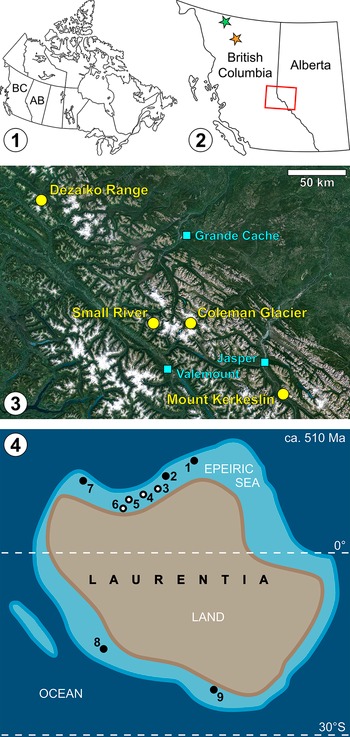
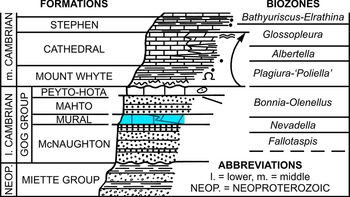
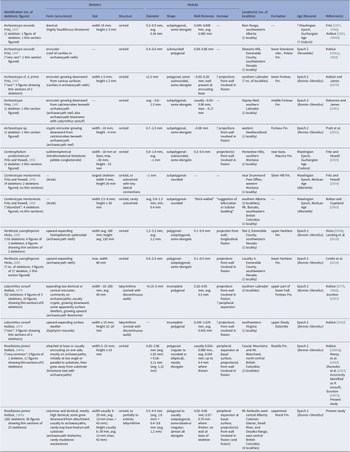
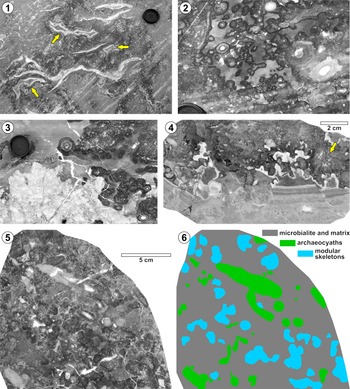
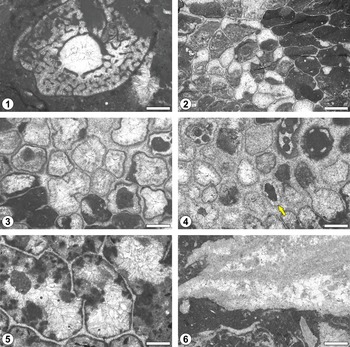

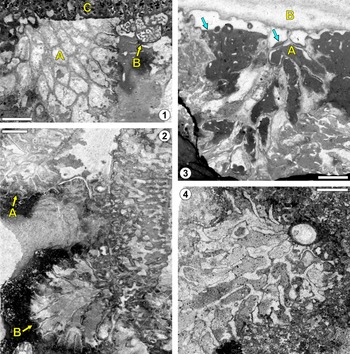
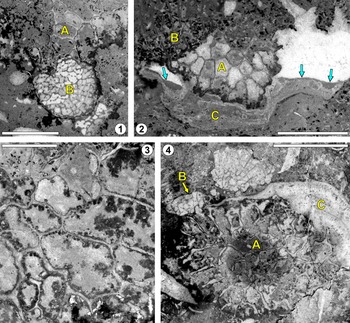
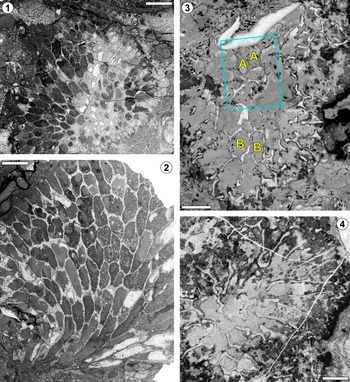
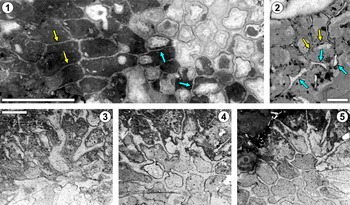
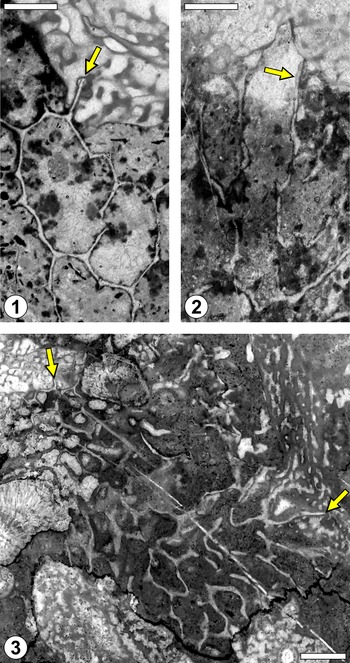


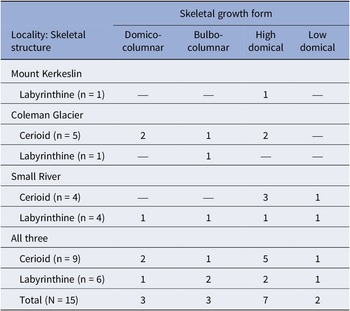
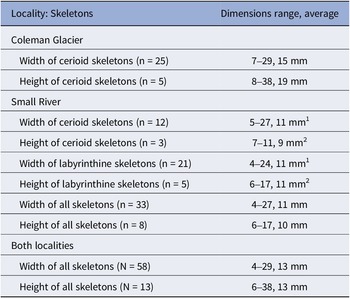


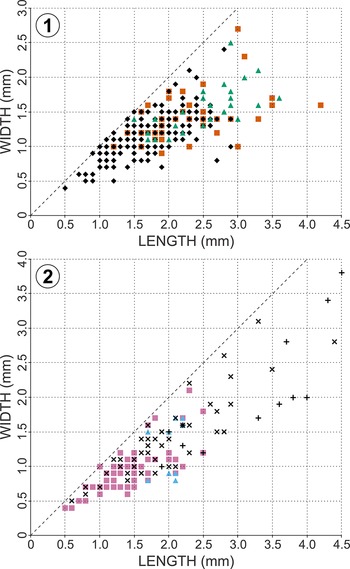
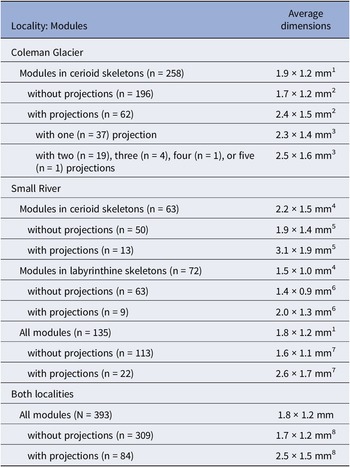
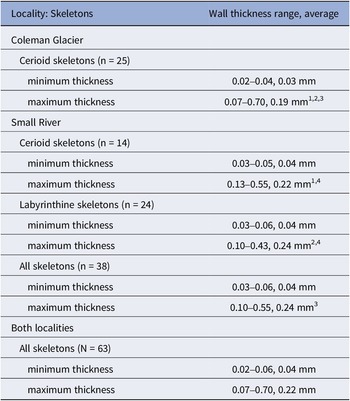

 Open access

