


INTRODUCTION
It’s like a choir with different voices singing the same song, bringing the same message. It’s about bringing a push at the same time. It’s about controlling the narrative.Footnote 1
The study of why some policy issues are discussed at the expense of others is a cornerstone in political science (Bachrach and Baratz Reference Bachrach and Baratz1962; Baumgartner and Jones Reference Baumgartner and Jones1993; Reference Baumgartner and Jones2015; Cobb and Elder Reference Cobb and Elder1983; Gaventa Reference Gaventa1980; Schattschneider Reference Schattschneider1965). Implicit within this literature is the notion that political parties are capable of proactively initiating discussions, thus redirecting the attention of other actors toward an issue (Baumgartner Reference Baumgartner1989; Baumgartner and Jones Reference Baumgartner and Jones1993; Green-Pedersen and Mortensen Reference Green-Pedersen and Mortensen2010; Grossman and Guinaudeau Reference Grossman and Guinaudeau2021; Guinaudeau and Persico Reference Guinaudeau and Persico2013; Jones and Baumgartner Reference Jones and Baumgartner2004; Petrocik Reference Petrocik1996). However, existing research has predominantly focused on the constraints faced by parties in their agenda-setting efforts, such as real-world problems (Grossman and Guinaudeau Reference Grossman and Guinaudeau2021; Kristensen et al. Reference Kristensen, Green-Pedersen, Mortensen and Seeberg2022; Pardos-Prado and Sagarzazu Reference Pardos-Prado and Sagarzazu2019). Consequently, this fundamental notion of party agency deserves further theoretical and empirical attention.
In response, I craft and empirically test a new model, the Issue Initiation Model, that opens a window into parties’ agenda-setting efforts. The gist of the model is that parties are capable of proactively increasing attention around issues through strategic orchestration. Hence, while “messiness,” “accident,” and “dumb luck” are inherent parts of these processes (Kingdon Reference Kingdon1984, 59), the Issue Initiation Model details how parties have agency in setting an agenda. The model maps how parties initiate their focus on an issue that previously received little attention by other parties and the news media, and it tracks how this focus can catalyze party system reactions and eventually travel all the way to news media articles and into parliamentary debate.
I develop and test the validity and distinctiveness of two concepts within this model. Initiation constitutes the starting point at which parties bring their proactive efforts to direct attention toward an issue. The concept captures only the communication that does not respond to ongoing debates. Elevation is the efforts by politicians to promote their party’s focus. This is a way for the initiating party to signal that the initiated agenda is a high priority, not just a trial balloon.
I test the Issue Initiation Model by drawing on an original dataset covering more than 5.5-million tweetsFootnote 2 by political parties and MPs coupled with over 750,000 news articles and more than 419,000 parliamentary questions in the United Kingdom (UK) and Denmark during the years 2015–22. Based on this, I deliver two important findings. First, initiation and elevation are distinct yet interrelated, representing systematic behaviors by political parties and their politicians that differ from other types of behaviors, such as responses to external developments. Second, these concerted efforts by parties and their MPs to initiate and elevate their focus can lead to a breakthrough in the sense that both competing party actors and the mass media redirect their attention toward the issue. Hence, parties can act as agenda setters by initiating and elevating.
Whereas existing studies have predominantly examined these dynamics on the aggregated level (e.g., Green-Pedersen and Mortensen Reference Green-Pedersen and Mortensen2010; Grossman and Guinaudeau Reference Grossman and Guinaudeau2021; Seeberg Reference Seeberg2023), I zoom in on the micro-level dynamics. Specifically, the findings are based on, among others, a series of vector autoregression (VAR) models (cf. Barberá et al. Reference Barberá, Casas, Nagler, Egan, Bonneau, Jost and Tucker2019) employed on a highly granular level all the way down to 15-minute intervals. Crucially, I also demonstrate that beyond these immediate short-term impacts, initiation and elevation have the potential to influence the attention of competing parties and the news media in the subsequent week.
By theorizing and empirically testing the hitherto implicit notion that parties can proactively generate attention around issues, this article has important implications for our understanding of political agenda setting. The Issue Initiation Model opens the window into the engine room of parties’ efforts to set an agenda and traces how they are capable of proactively redirecting the attention of other actors through strategic planning and orchestrated actions.
EXISTING STUDIES
Since the work of Robertson (Reference Robertson1976) and Budge and Farlie (Reference Budge and Farlie1983), the concept of “selective emphasis” has implied that political parties compete by highlighting different issues. Petrocik (Reference Petrocik1996) developed this into “issue ownership,” arguing that parties should concentrate on owned issues to gain electoral advantages.
After the turn of the millennium, a wave of studies started questioning the claims and empirical predictions in the selective emphasis literature. Sigelman and Buell (Reference Sigelman and Buell2004) showed a high degree of overlap in parties’ issue attention, and a number of studies reproduced this finding (e.g., Sides Reference Sides2006; Dolezal et al. Reference Dolezal, Ennser-Jedenastik, Müller and Winkler2014).
Recent studies explain why parties often address the same issues despite incentives to avoid such engagement. First, real-world problems often demand attention (Kristensen et al. Reference Kristensen, Green-Pedersen, Mortensen and Seeberg2022; Tavits and Potter Reference Tavits and Potter2015; Traber, Schoonvelde, and Schumacher Reference Traber, Schoonvelde and Schumacher2020). Second, parties are frequently forced to respond to competitors’ issue foci, even when they would prefer to avoid them (Green-Pedersen and Mortensen Reference Green-Pedersen and Mortensen2010; Seeberg Reference Seeberg2023; van de Wardt Reference van de Wardt2015).
In a nutshell, the literature implicitly portrays parties as being capable of proactively initiating discussions. However, the studies have largely focused on the constraints faced by parties in their agenda-setting efforts. Consequently, the fundamental notion of party agency deserves further theoretical and empirical attention.
THE ISSUE INITIATION MODEL
In response, I propose the Issue Initiation Model, which relies on two basic assumptions. First, political parties have electoral and ideological reasons for trying to redirect the attention of political competitors and the mass media toward certain policy issues (Hobolt and de Vries Reference Hobolt and de Vries2015; Petrocik Reference Petrocik1996). Second, tracing the ultimate origin of an issue would inevitably lead to “infinite regress” (Kingdon Reference Kingdon1984, 72–3). That is, simply because a party does not “invent” an issue, this does not mean that it cannot proactively produce efforts to generate attention around it.
Initiation
To analyze political parties’ proactive agenda-setting efforts—rather than their reactive responses—it is important to establish a clear analytical starting point. I propose initiation as a tool to capture this. Initiation refers to a party’s proactive efforts to redirect the attention of other relevant actors toward a specific issue by introducing its own focus. Three defining elements characterize initiation and distinguish it from other forms of party behavior.
First, it is about a policy issue. Second, it is proactive behavior in the sense that when parties initiate their focus on an issue, they generally do not react to changes in the behavior of other important actors. Third, initiation is a forward-looking activity, meaning that the initiating party points to a problem that—according to the initiating party—has not already been solved in the past. This sets initiations apart from communication about, for example, the party’s own past achievements. The initiating party need not point to a solution to the problem for the statement to constitute initiation.
Importantly, initiation does not require that the focus is entirely new to political debate—this ties back to the point by Kingdon (Reference Kingdon1984, 72–3) about “infinite regress” mentioned above. Rather, what matters is that the initiating party perceives the matter as unsettled and strategically tries to (re)introduce it into the political debate.
Overall, by identifying a starting point in which political parties attempt to set an agenda, initiation constitutes an analytical handle to solve an empirical problem that the literature has yet to solve.
Elevation
Elevation refers to the efforts of individual politicians to promote their party’s focus. It is a collective effort to lift as a group and to actively promote the party’s focus, irrespective of whether this focus constitutes an initiation or not. On the one hand, politicians might, for instance, elevate their party’s critique of another party’s behavior. On the other hand, for a political party that has a initiated focus on an issue, elevation is a way to demonstrate commitment to the initiated agenda.
Elevating the initiated focus sends as a signal to other actors that this focus is not just a trial balloon but also a high-priority agenda. This fits with findings from social movement research that displaying commitment is key to gaining the attention of political actors (Wouters and Walgrave Reference Wouters and Walgrave2017). Even though there can be various reasons why other actors outside and within the party system (do not) attend to the initiated focus, my contention is simply the following: the level of elevation is factored into the calculations of other parties and the mass media.
THE RELATIONSHIP BETWEEN INITIATION AND ELEVATION
Elevation does not automatically follow from initiation. The extent to which the party and its politicians promote the initiated focus will likely vary. Some initiations have greater priority for a party than others, leading to more extensive elevation in those cases. Both external and internal resources constrain this process: media attention is scarce, so constant new initiations would reduce newsworthiness (Bennett Reference Bennett1996), while elevation requires organizational effort from MPs and their staff. Taken together, initiation and elevation form a distinct agenda-setting process, which I test the validity of in the first part of the analysis.
CONSEQUENCES OF ELEVATION
Given that parties are guided by electoral and ideological motivations, increased elevation of an initiated focus can be expected to influence competing actors (see Figure 1). Competitors may feel forced to respond when they perceive the issue as a high priority (Green-Pedersen and Mortensen Reference Green-Pedersen and Mortensen2010), or they may seek to criticize and question it (Meyer and Wagner Reference Meyer and Wagner2016). Such reactions can be individual or more coordinated, supported by internal party communication networks that provide MPs with shared templates, graphics, and messages (Hanel and Marschall Reference Hanel and Marschall2013). I argue that the more vigorously an initiated focus is elevated, the greater the incentive for competing parties to react. This leads to the first hypothesis.
Hypothesis 1: The level of elevation by actors from the initiating party at time t is positively related to the level of attention to the issue by actors from competing parties at time t + 1.
The Issue Initiation Model

When it comes to the mass media agenda, there are strong theoretical reasons to expect that elevation influences coverage. News outlets operate in a competitive environment and rely on criteria of newsworthiness, often giving attention to the actions of powerful actors (Bennett Reference Bennett1996). Against this backdrop, the extent to which parties and politicians elevate their initiated focus should matter. Strong and consistent elevation signals that the focus is a genuine priority rather than a trial balloon, which should increase the likelihood that journalists will consider it relevant for coverage. By contrast, when parties merely initiate without substantial elevation, I argue that the media are less likely to treat the agenda as central. This leads to the second hypothesis.
Hypothesis 2: The level of elevation at time t is positively related to the number of news articles about the issue of initiation at time t + 1.
Finally, conflict between powerful actors is a key element in journalism as sources, and viewpoints are prioritized based on the magnitude and content of conflicts among key players (Bennett Reference Bennett1996). Hence, if the initiating party and its politicians succeed in engaging competing parties in discussions about the initiated focus, this will likely attract journalists’ attention. This leads to the third hypothesis:
Hypothesis 3: The level of attention to the issue of initiation by actors from competing parties at time t is positively related to the number of news articles about the issue of initiation at time t + 1.
Figure 1 summarizes these theoretical arguments. As discussed above, note that elevation does not automatically follow from initiation.
DATA
I test the Issue Initiation Model using a unique dataset consisting of tweets by political parties and MPs coupled with news media articles and parliamentary questions from the UK and Denmark (Eriksen Reference Eriksen2026b). This dataset covers the period of 2015–22, excluding election campaigns.Footnote 3
I first and foremost test the model on initiations and elevation by mainstream parties and their politicians. By “mainstream” parties, I mean the established, major contenders for government office, typically the large center-left and center-right parties (Abou-Chadi Reference Abou-Chadi2016; Hobolt and de Vries Reference Hobolt and de Vries2015; Green-Pedersen and Seeberg Reference Green-Pedersen and Seeberg2025). However, in the final part of the analysis section, I probe the model’s scope conditions by examining initiation and elevation by two niche parties and their politicians to assess how the dynamics extend beyond mainstream parties.
I focus primarily on initiations and elevation by mainstream parties for three reasons. First, they generally attend to a variety of issues, which allows me to test the dynamics of initiation and elevation across diverse issue areas. Second, they remain “the core of the party system” in many Western European countries (Green-Pedersen and Seeberg Reference Green-Pedersen and Seeberg2025, 247; Grossman and Guinaudeau Reference Grossman and Guinaudeau2024). Third and relatedly, they are clearly competitors as they compete to control government offices.Footnote 4 Finally, note that while I focus on initiations and elevation by mainstream parties and their politicians, I focus on the reactions by actors from all competing parties.
The UK and Denmark both feature intense party competition and stable issue ownership (Seeberg Reference Seeberg2017), but their party systems differ. The UK has a two-party dominant system, whereas Denmark’s multiparty system produces minority governments and bloc politics (Green-Pedersen and Kosiara-Pedersen Reference Green-Pedersen and Kosiara-Pedersen2020). Their media systems also diverge: Denmark has moderate state involvement, whereas the UK’s is more limited despite the BBC (Hallin and Mancini Reference Hallin and Mancini2004). These contrasts help test generalizability and reveal possible variation. During the study period, Denmark had two Liberal-led and one Social Democrat-led government, whereas the UK was consistently governed by the Conservatives.
Twitter offers a fine-grained view of parties’ efforts to set an agenda. It has long served as a key source for journalists (Bane Reference Bane2019; McGregor and Molyneux Reference McGregor and Molyneux2020; Zhang and Li Reference Zhang and Li2020) and enables detailed measurement of party communication and interactions with competitors (Barberá et al. Reference Barberá, Casas, Nagler, Egan, Bonneau, Jost and Tucker2019; Schöll, Gallego, and Le Mens Reference Schöll, Gallego and Le Mens2024). Although its popularity has declined recently, Twitter was among the most influential platforms of the past decade, and newer platforms such as Bluesky and Threads replicate its core features.
I collect tweets from two types of profiles. First, I collect from the official accounts of the mainstream parties: the Conservatives (@Conservatives) and Labour (@UKLabour) in the UK, and the Liberals (@venstredk) and Social Democrats (@Spolitik) in Denmark. Second, I gather the tweets by MPs from all parties in the two countries (787 unique MPs in total).Footnote 5 This yields an original Twitter dataset of 19,090 party tweetsFootnote 6 and 5,615,629 MP tweetsFootnote 7 spanning the years 2015–22.
MEASURING VARIABLES
Since initiation captures the efforts of political parties to advance their focus, the starting point when measuring these initiations must be an authoritative source of party communication. As argued by Shapiro and Hemphill (Reference Shapiro and Hemphill2017, 125), “the contemporary ‘press release’ is manifested for several policy issue areas as Twitter-based statements and hashtags” (for similar points, see De Sio and Weber Reference De Sio and Weber2020). To get as close as possible to an authoritative source of party communication, I use tweets from the parties’ official profiles, which are typically managed by staff in close contact with the leadership (Bauer et al. Reference Bauer, Ecker, Imre, Landesvatter and Malich2023).Footnote 8 As a further step toward authoritative messages from the parties, I remove all tweets by the party profiles that were either a retweet, a quote of another tweet, or a reply to another tweet.
Party tweets were coded as initiations if they (1) revealed a focus on a policy issue, (2) were proactive, and (3) were forward-looking. Tweets not dealing with policy issues were excluded. Likewise, tweets reacting to other parties or actors (e.g., criticizing a new government CO₂ deal while claiming one would go further) were not coded as initiations, as this is reactive behavior. Finally, only forward-looking tweets qualified, which means that, for instance, references to past achievements were excluded. The codings were aggregated to the daily level, indicating whether each party initiated on a given day.Footnote 9 Supplementary Appendix A3 provides the codebook, examples, and intercoder reliability tests, which yield satisfactory results.
Elevation is measured through tweets by individual MPs, whose profiles have become an important tool for spreading party messages (Chadwick and Stromer-Galley Reference Chadwick and Stromer-Galley2016). Parties seeking to influence political debate are therefore likely to rely heavily on MPs’ social media channels.
Engagement by competing parties is measured as follows: If the initiating party is in opposition, it is the number of tweets on the issue by MPs from all government parties. If the initiating party is in government, it is the number of tweets by MPs from all opposition parties.Footnote 10
The mass media agenda is measured as the number of news articles about the issue of the initiation. This captures whether elevation on the day of initiation influences subsequent coverage. I analyze news articles from three outlets in each country: the leading left-leaning broadsheet, right-leaning broadsheet, and one mass-market paper (see Yildirim et al. Reference Yildirim, Thesen, Jennings and De Vries2023, 1376). The news media corpus includes 752,611 articles from The Guardian, Daily Telegraph, and The Sun in the UK and Politiken, Jyllands-Posten, and Ekstra Bladet in Denmark.Footnote 11 Because these news media data are only available for Denmark up to 2019 and for the UK up to 2018, analyses relying on them cover 2015–19 in Denmark and 2015–18 in the UK. However, given that the extent to which news media outlets cite posts from Twitter in their news coverage has only increased in recent years (Buch and Mørk Reference Buch and Mørk2020), there is good reason to expect that the observed patterns also apply to the rest of the period. The dataset was generously provided by Gunnar Thesen (see Thesen and De Vries Reference Thesen and De Vries2024).
To capture issue content, all tweets and news articles are labeled using the Comparative Agenda Project codebook, which covers the full range of policy issues across more than 20 categories (e.g., macroeconomics and defense; see Supplementary Appendix A1). I focus on the macro categories, which enables the analysis of general agenda-setting dynamics. Issue coding was conducted with state-of-the-art machine learning techniques, which achieved satisfactory accuracy (see Supplementary Appendix A2 for details). Table 1 summarizes the operationalization of key variables.
Operationalizations of Key Variables

To illustrate these processes, consider an initiation by the Danish Social Democrats on February 5, 2018. On this day, the party introduced a new immigration proposal, among others by posting a tweet that linked to a video outlining its main elements. Social Democratic MPs elevated the focus substantially on that day, for example, by circulating tweets during the very morning of the initiation. One of these MP argued that “we cannot continue to watch people drowning in the Mediterranean,” whereas another described his party’s proposal as “fair and realistic.” Competing MPs reacted quickly. For instance, one government MP warned that the proposal “will attract thousands and thousands of refugees,” leading to direct discussions with Social Democratic MPs. Finally, the initiated focus also traveled into the news media. For instance, one national outlet placed the proposal on its front page under the headline “The Social Democrats want to send asylum seekers to North Africa, but the countries are not considered safe,” whereas another ran an editorial commenting on the initiated focus.Footnote 12
STATISTICAL APPROACH
To examine fine-grained engagement dynamics, I ask whether elevation triggers reactions from competing MPs within the same day. For this, I disaggregate their tweets on initiation days to 15-minute intervals and model the relationship using vector autoregression (VAR) with country, year, and issue fixed effects. This granular design helps capture micro-level dynamics without time-varying confounders, such as media attention or interest group pressure. Because VAR results are difficult to interpret, I rely on impulse response functions (IRFs; cf. Barberá et al. Reference Barberá, Casas, Nagler, Egan, Bonneau, Jost and Tucker2019; Gilardi et al. Reference Gilardi, Gessler, Kubli and Müller2022).Footnote 13 An Akaike information criterion test suggested a lag of 20, and alternative lag specifications yielded consistent results.Footnote 14
When studying the dynamics beyond the 15-minute level, the VAR approach would be ill-suited since it requires parallel time series for all variables. In this case, however, elevation is observed only once—on the initiation day—while its subsequent influence is measured as daily counts of news articles, and of tweets and parliamentary questions by competing party actors. Following prior work, I therefore employ count models (Yildirim et al. Reference Yildirim, Thesen, Jennings and De Vries2023) with their respective details discussed alongside the results.
The unit of analysis is initiations. I employ country and year fixed effects to control for potential heterogenous effects. Adding issue fixed effects does not change the main conclusions but introduces multicollinearity in the models. Thus, the reported models related to Hypotheses 2 and 3 do not include issue fixed effects.Footnote 15 Control variables include prior mass media salience of the issue in the week before initiationFootnote 16 and whether the initiation tweet announced a specific action, as concrete plans may, for instance, increase the news value.
DISTRIBUTION AND CONTENT OF THE INITIATIONS
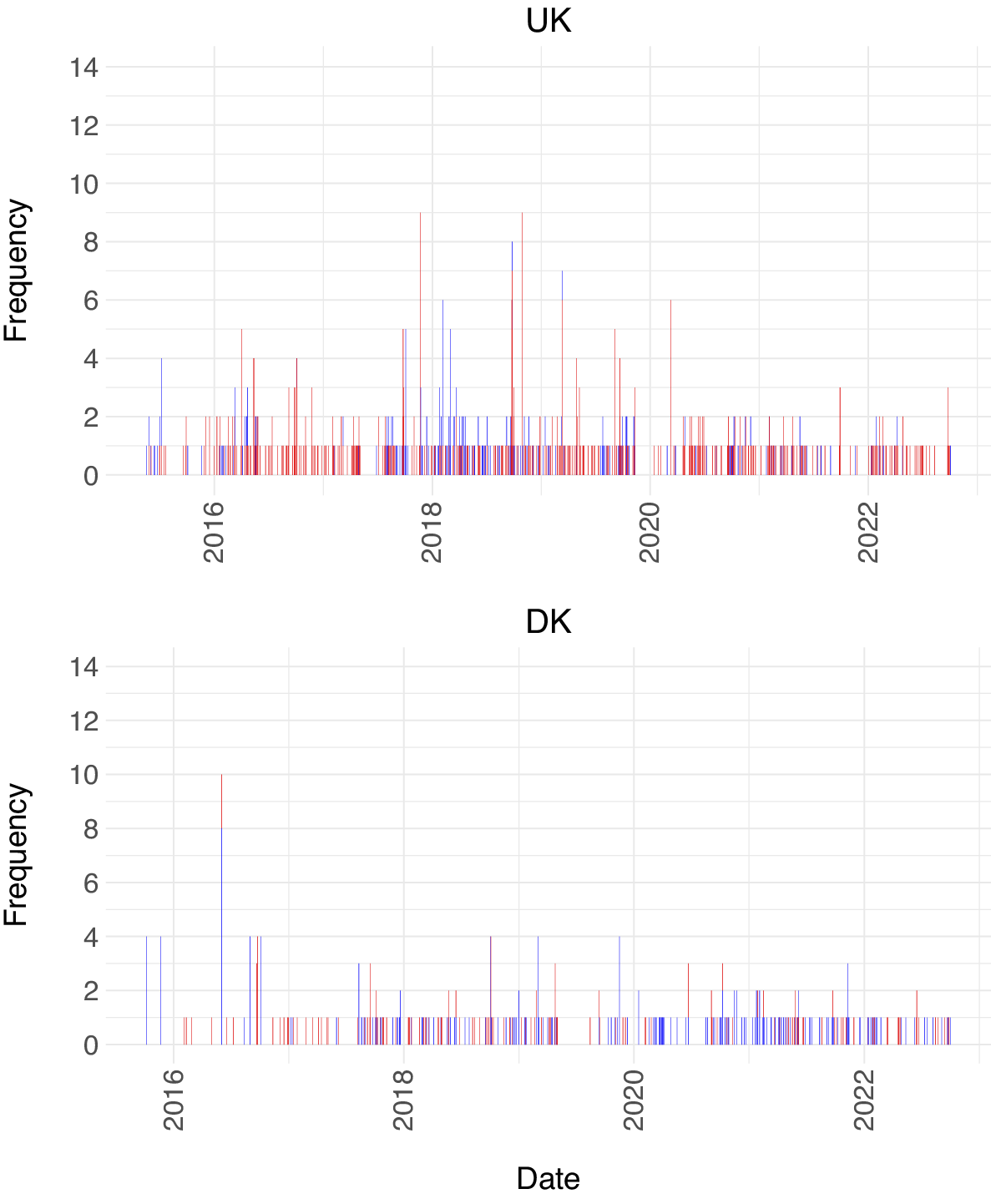
Before I test the validity of initiation and elevation, Figure 2 shows the number of initiations for each party in each country in the examined period. First, the figure shows that the initiations were fairly evenly spread across the period. In the UK, a total of 770 tweets that constitute initiations were created. In Denmark, the Social Democrats and the Liberals created 364 initiations in total.
Number of Initiations per Day Across Parties and Countries
Note: Red bars indicate the frequencies for Labour (the Social Democrats), whereas blue bars indicate it for the Conservatives (the Liberals). On days when both parties in each country created an initiation, the bars are placed on top of each other.

These are substantial numbers, given that there was, on average, around one initiation every 3 days in the UK and every 7 days in Denmark. Recall that both internal and external resources limit how often parties can initiate. The higher number of initiations in the UK could be explained by the parties in this country having more resources in terms of staff and money (Katz and Mair Reference Katz and Mair2018), which could increase their capacity to make proactive efforts to influence political discussions, for instance, based on their own analyses pointing to perceived problems. In sum, even though parties do not initiate every day, initiation is a prevalent and widespread phenomenon in contemporary democracies.
To examine the novelty of initiations, I analyze their distribution in greater detail (see Supplementary Appendix A11). First, a party rarely creates more than one initiation about the same issue on the same day (this occurs in only 6.2% of all initiations), and excluding such cases does not alter the main results. Second, parties typically wait long intervals—on average, around 136 days—before creating new initiations on the same issue again, indicating that initiations generally introduce a fresh focus. Finally, the main findings remain when I exclude initiations where the party had already initiated on the same issue within the preceding week, reinforcing that the initiations dynamics in the analysis are not capturing mere repetitions.Footnote 17
ANALYSIS PART 1: TESTING THE VALIDITY OF THE PROPOSED CONCEPTS
To test the Issue Initiation Model, the analysis is divided into two parts. Part 1 examines whether initiation and elevation are distinct, systematic behaviors that differ from other types of behaviors. Part 2 tests the model’s proposed effects of elevation.
Initiation Is Empirically Distinct from Other Types of Behaviors
To assess whether initiation differs from other party behaviors, I run two tests that also speak to construct validity. First, I examine whether initiation is proactive, meaning parties do not simply react to other actors when focusing on an issue. Second, I test whether these patterns differ from the dynamics observed around noninitiations.
-
(i) Figures 3 and 4 demonstrate that in both countries, the attention to the issue of initiation by all other political parties as well as the mass media was, on average, highly stable in the week prior to initiation. There was generally no substantial increase in the attention to the issue of initiation by other political parties or the news media in the days leading up to the initiations. This is a strong indication that when initiating, the party did not respond to changes in the agendas of other political parties or the mass media. Relatedly, this also suggests that the initiating party did not react to the emergence of real-world events. These patterns strongly suggest that initiations are not merely reflections of daily media routines or online noise but represent proactive efforts by parties to set an agenda.
-
(ii) The figures indicate that the patterns leading up to noninitiation tweets were substantially different. Specifically, there were noteworthy increases in the attention to the issue in the tweets by other parties as well as the mass media in the days leading up to noninitiation tweets, and the overall level of attention to the issue was markedly higher. This demonstrates that the empirical dynamics around noninitiation tweets are substantially different from initiation tweets in that the former are to a much larger extent a part of an ongoing political debate.
Average Attention to the Issue of the Party Tweet by MPs from All Other Parties Than the Party That Posted, Across Initiation Tweets and Noninitiation Tweets
Note: The straight line represents the trend before initiation tweets, and the dotted line represents the trend before noninitiation tweets. Note that the y-axes differ to better visualize the dynamics within each country.

Average Attention to the Issue of the Party Tweet by the News Media in the Days Leading Up to the Tweet, Across Initiation Tweets and Noninitiation Tweets
Note: The straight line represents the trend before initiation tweets, and the dotted line represents the trend before noninitiation tweets. Note that the y-axes differ to better visualize the dynamics within each country.

Elevation of Initiations Differs from Elevation of Noninitiations
Next, I test whether MPs elevate their party’s focus differently when the party has initiated compared to when it has not. A central aspect of elevation is for the initiating party MPs to signal that the initiated agenda is a high priority, not just a trial balloon. I therefore conduct two construct validity tests to examine whether MPs mobilize to a greater extent when their party initiates than when it does not. The first test centers around the number of MP tweets; the second on the extent to which MPs amplify their party’s exact messages.
First, Figure 5 shows that on initiation days, there is a larger increase in the number of tweets by these MPs about the issue of initiation since the day before compared with days without initiation. This implies that MPs tend to mobilize by increasing their attention to that issue. Second, Table 2 shows that when their party initiates, MPs tend to “lift as a group” by retweeting the party message to a much greater extent than when the party tweets without initiating. This strongly suggests that amplifying the party’s messages is an important part of elevation both theoretically and empirically.
Degree of Mobilization of MPs, Across Initiation Tweets and Noninitiation Tweets
Note: The full line shows the number of tweets about the issue of initiation by MPs from the initiating party on the two respective days. The dotted line illustrates the same for days when the party created at least one tweet but did not initiate. The difference-in-differences are significant on the 1% level for each plot.

Amplifying the Party Message

Note: The reported horizontal differences are significantly different on the 1% level for each row.
Together, these findings show that when their party initiates a focus on a policy issue, MPs mobilize by attending to the issue and by amplifying the party messages to a much larger degree than when their party communicates without initiating. This conclusion strongly indicates that elevation is systematically different from other types of behavior, and it establishes the construct validity of the measure of elevation. This underscores that initiation tweets from a party trigger elevation dynamics that are substantially different from those observed when the party produces tweets that are not initiations.Footnote 18
Taken together, these analyses show that initiation and elevation are systematic behaviors, empirically distinct from other types of party and politician activities. (i) Initiations are preceded by markedly lower levels of attention to the issue from other actors compared with noninitiations, and (ii) they are followed by elevation dynamics that differ substantially from those observed after noninitiations. (iii) Finally, Models A26 and A27 in Supplementary Appendix A13 show that engagement dynamics also differ markedly between initiations and noninitiations. In particular, the effect of elevation on subsequent media attention (which will be discussed in detail later) is significantly stronger when a party initiates a focus on an issue than when it communicates without initiating.
In sum, these tests support the validity of initiation and elevation. Before turning to Part 2 of the analysis, I report the empirical relationship between initiation and elevation below.
Elevation Does Not Automatically Follow from Initiation
As argued in the theory section, initiation does not deterministically lead to elevation; some initiations receive greater priority and thus more extensive elevation. Figure 6 illustrates this with substantial variation in elevation tweets (mean = 64.1, SD = 60.7). In other words, initiating a focus does not guarantee extensive elevation.Footnote 19
Distribution of the Elevation Measure
Note: The dotted green line indicates the mean value. Elevation is measured as tweets by MPs from the initiating party on the day of initiation about the issue of initiation.

ANALYSIS PART 2: TESTING THE EFFECTS OF ELEVATION
In this part of the analysis section, I first examine the influence of elevation on subsequent engagement by competing party actors on Twitter. I then assess whether elevation exerts a positive influence on the media agenda, before analyzing whether these effects extend into the parliamentary arena, too. Finally, I explore the scope conditions of the model by testing these dynamics for niche parties.
On Social Media
Elevation Can Catalyze Reactions from Competing Party Actors in the Short Term
To test the microfoundations of the link between elevation and engagement (Hypothesis 1), Figure 7 reports the VAR results, which strongly support the hypothesis. When a party has initiated a focus on an issue, elevation has a significant and substantial impact on subsequent engagement by competing party MPs within the same day. A one-tweet increase in elevation during initiation days is predicted to increase competing party tweets on the same issue by 0.09 within 15 minutes, a sizeable effect given the mean of 0.14 tweets per 15-minute interval. Thus, we observe a rapid and sizeable response by actors from competing parties.
Effect of Elevation on Engagement (IRF)
Note: This figure shows the effect of a one-tweet increase in the number of elevation tweets on the number of tweets about the same issue by competing party MPs 15 minutes later on the days of initiation. Country, year, and issue fixed effects are applied. IRF = impulse response function.

The effect decreases gradually but remains positive and significant beyond 15 minutes, lasting for more than 160 minutes. Figure 8, which cumulates these effects, underscores the sustained influence of elevation on competing party activity. Overall, elevation proves to be an effective way for the initiating party to catalyze reactions from competing parties.
Effect of Elevation on Engagement (Cumulated IRF)
Note: This figure reproduces the results from Figure 7 but with cumulative numbers. IRF = impulse response function.

Figures A5–A8 in Supplementary Appendix A6 report country-specific IRFs. In both Denmark and the UK, elevation triggers significant responses after 15 minutes. At longer lags, UK responses remain consistently significant; in Denmark, significance fluctuates but reemerges later. Despite these nuances, the central conclusion is clear: elevation efforts by MPs from the initiating party can rapidly engage competing party actors.
This is a notable finding: when a party initiates a focus on a policy issue, the collective and orchestrated efforts of its politicians on the same day help draw competing party actors’ attention to that issue. While much of the literature emphasizes the constraints parties face in agenda setting (Grossman and Guinaudeau Reference Grossman and Guinaudeau2024; Pardos-Prado and Sagarzazu Reference Pardos-Prado and Sagarzazu2019), these results show that parties can also spark system-wide discussions about issues that previously received little attention. These discussions erupt so fast that it is the strategic efforts of the initiating party and its politicians—and not, for example, media coverage—that best explains why competing party actors direct their attention to the issue.
Table 3 shows that elevation efforts catalyze not only reactions but also explicit discussions with competing party MPs. On initiation days, on average, 7.2% of competing party MPs’ tweets about the issue (7.1% in the UK, 7.7% in Denmark) directly mention one or more MPs from the initiating party. This figure is conservative, as competing MPs can also engage indirectly without explicit mention. Put differently, a notable share of engagement tweets constitutes direct interactions with initiating party actors. This indicates that the collective efforts of politicians from the initiating party to elevate their focus not only attract the attention of competitors but also make them engage in explicit discussions.
The Average Share of Engagement Tweets That Mention One or More MPs from the Initiating Party

Note: Twitter’s mention function was leveraged to calculate the shares.
MPs from the Initiating Party Tend to Move First
Having shown that elevation can catalyze engagement from competing party MPs, the next question is which actors tend to start these discussions. A core part of my argument is that actors from the initiating party are typically the first to focus on the issue, with competitors following rather than leading. To test this, Figures A9–A12 in Supplementary Appendix A7 track which MPs tweet first about the issue of initiation.
The results suggest that on initiation days, MPs from the initiating party generally tweet earlier and more often about the issue. In the UK, for example, on 516 initiation days, MPs from the initiating party had produced more tweets by 7 AM than their competitors, whereas competing party MPs led at that time in only 123 instances (in 131 cases, neither group had tweeted by 7 AM). The same pattern persists later in the morning and becomes even more pronounced by 10 AM. Comparable results emerge in Denmark, and the differences are even sharper when adjusting for the proportion of MPs per party.
In sum, when parties initiate a focus on a policy issue, their MPs usually begin elevating the focus before competing party MPs start to address it. This suggests that when parties initiate, they aim to set the agenda from the very start of the day. Moreover, it indicates that elevation tweets are generally not reactions to communication from journalists or other external actors.
Elevation Can Catalyze Reactions from Competing Party Actors in the Following Week
The analyses so far have demonstrated that elevation influences the attention of competing party actors within the same day, reflecting immediate agenda-setting dynamics. Yet, if initiation and elevation together constitute a genuine agenda-setting dynamic, their influence should not be confined to such short-term attention cycles. The question, therefore, is whether the influence of elevation persists beyond initiation day.
To test this, Model A1 in Supplementary Appendix A6 and Figure 9 apply the count setup from the “Statistical Approach” section, modeling whether elevation on initiation day predicts the total number of tweets by competing party actors in the following week. Because the dependent variable follows a negative binomial distribution and there is no excess of zeros, I employ negative binomial regression.
The Influence of Elevation on Engagement by Competing Party Actors in the Following Week
Note: Based on Model A1. The vertical lines show the distribution of the elevation variable.

The results show that elevation has a significant and sizeable effect on engagement over this extended timeframe. Each additional elevation tweet on initiation day increases the log count of engagement tweets in the subsequent week by 0.0056. Exponentiating this coefficient indicates a 0.56% rise in the incidence rate of engagement tweets per one-tweet increase in elevation. Substantively, moving from the minimum number of elevation tweets (0) to one standard deviation above the mean (119.5) nearly doubles the expected engagement from 36 to 70 tweets about the issue in the following week. Models A2 and A3 in Supplementary Appendix A6 report the results for each country separately, demonstrating that the effect is present in both countries. Together, these results demonstrate that the collective efforts of politicians from the initiating party to elevate an issue can substantially boost attention from competing party actors well beyond the immediate day, generating party-system discussions that persist for at least a week.
In the News Media
Elevation Can Push the Initiated Focus into the News Media Articles on the Following Day
Having shown that elevation can trigger engagement from competing party actors, the next step is to examine whether these efforts also increase the extent to which the initiated focus travels beyond the party system and into news media coverage (Hypothesis 2). To test this, I employ negative binomial regression as in Model A1 because the dependent variable follows a negative binomial distribution and there is no excess of zeros.
Model A4 in Supplementary Appendix A8 and Figure 10 show that the effect of elevation is both significant and substantial. For each additional elevation tweet on the day of initiation, the log count of news articles on the following day increases by 0.0019. Exponentiating this coefficient indicates an average 0.19% rise in the incidence rate of news articles per one-tweet increase in elevation. Substantively, moving from the minimum number of elevation tweets (0) to one standard deviation above the mean (105) raises the expected count of news articles by 22.7% from 9.9 to 12.2. Models A5 and A6 in Supplementary Appendix A8 present the country-specific results, showing that the effect of elevation is larger in Denmark than in the UK (this country difference is substantiated by the significant country interaction term in pooled Model A7 in the same appendix), although it remains substantial in both cases. Together, these results demonstrate that when a party has initiated a focus on an issue, elevation by the party’s politicians contributes to pushing this focus into the news media articles on the subsequent day.
The Influence of Elevation on Mass Media Coverage on the Following Day
Note: Based on Model A4. The vertical lines show the distribution of the elevation variable.

Elevation Can Push the Initiated Focus into the News Media Articles in the Following Week
The above finding indicates that elevation can influence the media agenda on the day after initiation, reflecting the immediate reach of party-driven communication into the news. Yet, if initiation and elevation together form a genuine agenda-setting dynamic, their influence should not be confined to such short-term attention cycles. A central question, therefore, is whether the influence of elevation also persists over time by sustaining media attention to the initiated focus beyond the next-day cycle. Therefore, I rerun Models A4–A6 with a new dependent variable to examine whether elevation on initiation day affects the number of news articles in the week after initiation.
Figure 11 and Model A9 in Supplementary Appendix A8 demonstrate that the influence of elevation is significant and substantial. Each additional elevation tweet on the initiation day increases the log count of news articles in the following week by 0.0010. Exponentiating this coefficient indicates an average 0.10% rise in the incidence rate of news articles per one-tweet increase in elevation. Raising elevation from its minimum (0) to one standard deviation above the mean (105) increases the expected number of articles about the initiated issue by 11.1% from 50.1 to 55.6. This sizeable effect strongly suggests that when parties initiate their focus on an issue that previously received little attention in the media, elevation of this focus can influence the news agenda well beyond the immediate 1-day cycle.
The Influence of Elevation on Mass Media Coverage in the Following Week
Note: Based on Model A9. The vertical lines show the distribution of the elevation variable.

The smaller effect size compared with the immediate, 1-day impact is itself meaningful. As time passes, it becomes increasingly unlikely—ceteris paribus—that elevation on a single day continues to influence media coverage, since the news agenda is likely shaped at the same time by many other events. Against this backdrop, the fact that elevation still exerts a detectable and significant effect across an entire week indicates that these dynamics are not short-term noise or simple by-products of journalists’ daily reliance on Twitter. Rather, they reflect genuine agenda-setting effects that extend into the broader political debate.
For the country-specific results, Models A10 and A11 in Supplementary Appendix A8 show that elevation alone produces lasting effects in the UK, whereas a different mechanism is at work in Denmark. Here, elevation significantly increases media coverage the following day, but sustaining attention into the subsequent week requires engagement from competing party actors. Model A16 in Supplementary Appendix A9 shows that this engagement effect is both significant and substantial: raising engagement tweets from competing parties from 0 to one standard deviation above the mean (15.4) increases the expected number of news articles in the following week by 6.7% (from 35.8 to 39.7).
These findings point to two distinct pathways to lasting media attention: in the UK’s two-party system, elevation by the initiating party’s MPs is sufficient. In Denmark’s multiparty system, however, sustained coverage requires the initiated focus to spark wider party-system debate (recall here that elevation positively influences the level of engagement by competing party actors in both countries). This difference is theoretically meaningful: in multiparty systems such as Denmark, the party system is key in understanding how agendas develop (e.g., Green-Pedersen Reference Green-Pedersen2010; Green-Pedersen and Mortensen Reference Green-Pedersen and Mortensen2010). A single party alone cannot keep an initiated agenda alive for long; lasting media attention requires that the initiated focus evolves into wider discussions across parties. By contrast, in a two-party system with larger parties, elevation by the initiating party can be sufficient to sustain coverage. These findings reinforce the comparative value of the model by highlighting how the structure of the party system conditions the pathways through which a party’s initiated focus evolves into sustained media attention.
Engagement Also Contributes to Pushing the Initiated Focus into the News Media Articles
Thus far, the analysis has shown that when a party initiates a focus on a policy issue, an effective way to redirect the agendas of political competitors and the mass media is for the initiating party’s MPs to elevate it. According to Hypothesis 3, the reactions of competing party MPs also contribute to pushing the issue into the news media. The previous section touched upon this for Denmark, and Model A12 in Supplementary Appendix A9 shows a significant and sizeable effect of engagement on the media agenda the following day in the pooled model: increasing the number of engagement tweets from 0 to one standard deviation above the mean (82.1) raises the expected number of news articles about the initiated issue one day after by 17.7% (from 10.2 to 12.0). Models A13 and A14 reproduce this result in country-specific models.
Moreover, Model A15 and Figure 12 show that this effect extends to media coverage in the subsequent week, and the results hold in the country-specific models as well (cf. Models A16 and A17). In sum, when the initiating party and its MPs succeed in engaging their political competitors in discussions about the issue of initiation, the likelihood that the news media will direct their attention to the issue increases substantially.
The Influence of Engagement on Mass Media Coverage in the Following Week
Note: Based on Model A15. The vertical lines show the distribution of the elevation variable.

In Parliament
How the Initiated Focus Can Travel into the Parliamentary Arena
So far, the analysis has shown that by initiating and elevating, political parties and their politicians can set an agenda on social media and in the news media. At the same time, political debate does not only unfold in the media sphere—it is also a central feature of parliament (Proksch and Slapin Reference Proksch and Slapin2012). The next step, therefore, is to examine whether these dynamics extend beyond social and news media and into parliament (see further details in Eriksen Reference Eriksen2026a).
The roles of government and opposition parties in parliament differ fundamentally: while government parties carry the responsibility of proposing and implementing legislation, opposition parties primarily rely on rhetorical instruments to communicate (Green-Pedersen Reference Green-Pedersen2010; Green-Pedersen and Mortensen Reference Green-Pedersen and Mortensen2010; Proksch and Slapin Reference Proksch and Slapin2012). Since this article is concerned with rhetorical agenda setting, I focus on the parliamentary activities of opposition parties and ask: can government parties influence the opposition’s parliamentary agenda by initiating and elevating their focus on social media?
To address this question, I focus on one of the most studied forms of parliamentary rhetoric—written questions to ministers (e.g., Garritzmann Reference Garritzmann2017; Green-Pedersen Reference Green-Pedersen2010; Green-Pedersen and Mortensen Reference Green-Pedersen and Mortensen2010; Seeberg Reference Seeberg2013; Reference Seeberg2023). This measure is particularly apt, as any MP can submit questions to ministers on any matter. I analyze the total count of written questions on the same issue in the week after initiation. In terms of modeling, a zero-inflated negative binomial model is employed, with full model details provided in Supplementary Appendix A14.
Drawing on the population of written questions in both countries during the study period (N = 419,341), the pooled Model A28 in Supplementary Appendix A14 and Figure 13 show that government parties and their MPs can indeed influence the parliamentary agenda of the opposition through initiation and elevation on social media. The effect is both significant and substantial: moving from 0 elevation tweets to one standard deviation above the mean (around 82 tweets) increases the expected number of opposition MPs’ written questions about the same issue in the following week by about 45% (from 43.8 to 63.5). This sizeable effect suggests that when government parties initiate and elevate their focus on social media, these efforts spill over into the parliamentary arena by prompting opposition MPs to raise the same focus through written questions to ministers.
The Influence of Elevation by Government Actors on Opposition Actors’ Parliamentary Agenda in the Following Week
Note: Based on Model A28 in Supplementary Appendix A14. Fixed effects are applied on the country and year level. n = 362 weekly observations. The dependent variable captures the total number of written questions submitted by opposition MPs about the same issue as the initiation during the week following a government party’s initiation.

Interestingly, the dynamics unfold somewhat differently across the two countries, as shown in Models A29 and A30. In Denmark, elevation on the initiation day alone does not significantly affect the opposition’s parliamentary agenda. Here, lasting effects emerge when government MPs sustain their efforts into the day after initiation (cf. Model A31), suggesting that influencing the opposition’s agenda in parliament requires more persistent elevation. By contrast, in the UK, elevation on the initiation day is already sufficient to influence opposition parliamentary activity in the following week (cf. Model A29).
This difference is theoretically meaningful: it may reflect the traditionally strong role of the opposition in Denmark (Green-Pedersen and Mortensen Reference Green-Pedersen and Mortensen2010; Seeberg Reference Seeberg2013), which could make Danish opposition parties less immediately responsive to government-initiated agendas on social media. More broadly, the comparison highlights that while initiation and elevation can influence parliamentary agendas in both systems, the mechanisms through which these effects operate vary with the parliamentary context.
Probing the Scope Conditions: Niche Parties
Having demonstrated that mainstream parties and their politicians can influence the agendas of competing parties and the news media by initiating and elevating, an important final question concerns the scope conditions of the Issue Initiation Model: do the theorized dynamics also apply to other types of parties? To explore this, I extend the analysis to two additional Danish parties—the Red-Green Alliance and the Danish People’s Party—which are particularly useful for testing the generalizability of the theorized dynamics beyond mainstream parties: they have never held government office and represent opposite ends of the ideological spectrum. The Red-Green Alliance is a left-wing, redistributive, and climate-focused party, and the Danish People’s Party is a right-wing, anti-immigration party. Due to data restrictions, no UK parties are included in this analysis.
I manually label 2,417 original tweets (1,363 from the Red-Green Alliance and 1,054 from the Danish People’s Party) to identify initiations, with satisfactory intercoder reliability. Supplementary Appendix A15 reports all relevant analyses.
The analyses show that the fundamental distinction between initiations and other types of communication also applies to these parties. As with the mainstream parties, initiations are preceded by stable levels of attention from other parties and the media, whereas noninitiations are typically preceded by increases in attention and generally higher levels of attention. This demonstrates that initiations capture proactive behavior for niche parties as well, suggesting that the logic of initiation generalizes beyond mainstream parties.
When it comes to elevation, MPs from both niche parties strongly amplify their party’s initiations: about 33% of elevation tweets on initiation days are direct retweets of party posts, compared with only 2%–3% on noninitiation days. This marks a clear difference in the elevation dynamics between initiations and noninitiations and underscores the central role of reproducing the party message when elevating initiations. The difference in overall mobilization compared with the day before is smaller than for the mainstream parties, but the systematic gap between initiations and noninitiations remains.
Regarding effects, elevation by niche party MPs sparks reactions from competing party actors on the 15-minute level. However, it does not significantly influence the attention of competing parties over the following week, nor does it influence the media agenda significantly. Instead, elevation has detectable effects on the agendas of ideologically close parties, both on the next day and the following week. Put differently, niche parties are able to engage competing actors during initiation day, yet their impact beyond this short-term focus remains confined to ideologically proximate allies rather than extending to the wider party system or the media.
In sum, the Issue Initiation Model travels beyond mainstream parties: initiation and elevation remain systematic and distinct behaviors among niche parties and their politicians. Yet, the consequences of these behaviors are conditioned by party type: niche parties generally possess less agenda-setting power compared with mainstream parties, a finding that is consistent with recent literature (cf. Green-Pedersen Reference Green-Pedersen2019). This, in turn, strengthens confidence in the main findings: the dynamics documented for mainstream parties are not artifacts of “everything correlating” but reflect the distinctive agenda-setting power that these parties are able to exercise.
DISCUSSION
The conclusion of this study is that political parties are capable of proactively increasing attention around issues through strategic orchestration. To open the window into the engine room of these efforts to set an agenda, I craft and test the Issue Initiation Model. This model allows for tracking parties’ efforts and abilities to influence political discussions in two interrelated ways.
First, it offers two novel concepts: initiation and elevation. Initiation captures the proactive efforts by parties to direct attention toward an issue by introducing their focus, and elevation is the effort by the party and its politicians to promote their party’s focus. I show that initiation and elevation are not merely theoretically innovative but also empirically distinctive from other types of party and politician behaviors. They therefore serve as valuable analytical tools as well as significant measurement contributions to the literature.
Second and relatedly, the model predicts that these systematic attempts by parties and their politicians to initiate and elevate discussions about policy issues can influence the agendas of competing political actors as well as the mass media. This argument is tested on an original dataset comprising more than 5.5-million tweets by political parties and MPs coupled with over 750,000 news articles and over 419,000 parliamentary questions from the UK and Denmark, spanning the years 2015–22. The findings reveal that initiation and elevation have important consequences across venues (social media, news media, and parliament) and across temporal spans (from the 15-minute level up until the following week).
The analyses also provide insights into the scope conditions of the Issue Initiation Model. (i) For mainstream parties in both countries, elevation alone affects the agendas of competitors both in the immediate short term and over the following week, and it influences media coverage the next day. In the UK, elevation alone is sufficient to sustain media attention for a week, whereas Danish mainstream parties need to spark broader party-system debate to secure lasting coverage. Further, in the UK, elevation on the day of initiation by government actors suffices to influence the opposition’s parliamentary agenda during the following week; in Denmark, lasting influence arises when government MPs elevate on the initiation day and continue their efforts into the following day. (ii) For niche parties, the basic behaviors of initiation and elevation follow similar systematic patterns as for mainstream parties, and they are able to engage competing actors during initiation day. Yet their impact beyond the short term remains confined to ideologically proximate allies rather than extending to the wider party system or the media. Together, these patterns underscore that the Issue Initiation Model captures general dynamics while still allowing for meaningful variation across countries and party types.
Future work could follow up on these insights and widen the focus to include more countries and more parties to explore further country differences and variation among party types. Nevertheless, the basic conclusions are likely to generalize to a broad range of Western democracies where professionalized parties operate in close interaction with the media, such as the Netherlands, Germany, and Austria.
The Issue Initiation Model is deliberately parsimonious, theorizing initiation and elevation as two core proactive activities through which political parties can set an agenda. This parsimony provides a foundation for future research to explore recursive dynamics. For example, scholars could examine how engagement by rival parties may trigger renewed elevation (“re-elevation”) by MPs from the initiating party, or how sustained media coverage may in turn stimulate further party system attention to the issue.
While the literature has predominantly emphasized the constraints parties face in their agenda-setting efforts, this study theorizes and empirically tests the implicit notion that parties can also proactively initiate discussions. This does not mean that parties can control political debates. It does mean, however, that their strategic efforts to highlight a previously neglected area can redirect the attention of other key actors toward the same issue. This perspective does not deny the importance of real-world events for agenda setting. Rather, the key implication of the Issue Initiation Model is that in addition to sometimes responding to external developments, parties are also capable of proactively initiating discussions whose timing and content reflect strategic choice rather than reactive behavior.
These insights underscore the enduring role of political parties amid rising voter volatility, declining membership, and the expanding role of extra-parliamentary communication platforms (Jungherr, Rivero Rodríguez, and Gayo-Avello Reference Jungherr, Rodríguez and Gayo-Avello2020; Scarrow, Webb, and Poguntke Reference Scarrow, Webb and Poguntke2017). Despite these shifts, parties retain considerable agency in influencing which issues receive attention. This suggests a need to open a research agenda around how parties seek to initiate discussions.
SUPPLEMENTARY MATERIAL
To view supplementary material for this article, please visit http://doi.org/10.1017/S0003055426101506.
DATA AVAILABILITY STATEMENT
The research documentation and data that support the findings of this study are openly available at the American Political Science Review Dataverse: https://doi.org/10.7910/DVN/O3GDRX.
ACKNOWLEDGEMENTS
I am grateful to Christoffer Green-Pedersen, Helene Helboe Pedersen, Henrik Bech Seeberg, Peter Bjerre Mortensen, Roman Senninger, Rune Slothuus, Fabrizio Gilardi, Isabelle Guinaudeau, Emiliano Grossman, Jonathan Slapin, Lucas Leemann, and Marius Busemeyer for their valuable insights and support. I also thank members of the Comparative Section at Aarhus University, participants at the Publication Seminar at UZH, and attendees of the Comparative Agendas Meetings in 2023 and 2024 and the IPSA 2024 conference for their constructive feedback and stimulating discussions. I further thank Marcus Kriwat, Søren Ulka, Oscar Hersom Bech, Asvin Sivanathan, Vivyan Yan Mygil, Frederik Michel Zacho, and Zaki Guldhammer for their excellent research assistance. Finally, I thank the editor and anonymous reviewers for their helpful comments and suggestions.
CONFLICT OF INTEREST
The author declares no ethical issues or conflicts of interest in this research.
ETHICAL STANDARDS
The author affirms that this article adheres to the principles concerning research with human participants laid out in APSA’s Principles and Guidance on Human Subject Research (2020).







 Open access


Comments
No Comments have been published for this article.