


Introduction
Athens’ Church of Aghios Eleutherios, the Little Metropolis, built from more than ninety spolia of the ancient city, some time after the end of the Fourth Crusade in 1204 CE, remains an archaeological puzzle (figure 1).Footnote 1 When it was built remains a matter of debate among Byzantinists, while Classical archaeologists muse over the monuments that provided its building materials. This article seeks to identify and contextualise the forty-one extant figures sculpted on a long relief embedded into the church, high above the west door. Because most of its figures turn or move to the right, the relief can be read from left to right. Their movements are not coordinated, so it shows progression, rather than procession, which suits the purpose of a calendar. Known as the ‘Little Metropolis Calendar Frieze’ (LMCF hereafter), this frieze includes the earliest-known linear arrangement of the zodiac among other figures that represent seasons, months, and festivals essential to ancient Greek conceptions of time (figure 2 and table 1, with Deubner [Reference Deubner1932] numbers used throughout this article).Footnote 2 That it was created as a calendar is attested by the inclusion of zodiac figures in their natural order: Aries (no. 20), Taurus (no. 23), Gemini (no. 26), Cancer (no. 29), Leo (no. 33), Virgo (no. 35), Chēlai (no. 41), Scorpio (no. 5), Sagittarius (no. 10), Capricorn (no. 14), Aquarius (no. 17), and Pisces (missing).Footnote 3 Two blocks of this frieze, each ca. 3 m long and 0.53 m high, come from a single frieze (figures 3–4); the church builders switched the original ends of the frieze,Footnote 4 and at least 1 m of its middle (between nos. 17 and 18) is lost. The treatment of the blocks left of figure no. 1 and right of figure no. 41, however, show the original beginning and end of this continuous frieze. Three clues suggest the Christian builders of the Little Metropolis recognised and used the LMCF as a calendar: rearranging the blocks to place Aries (no. 20) firstFootnote 5 ; placing the zodiac over the church’s West entrance, which echoes a Romanesque trendFootnote 6 ; and imposing Rhodian crosses on it, in positions that fit the Christian calendar.Footnote 7
The Little Metropolis Church, Athens. Photo: author.

Figure 1 Long description
The image shows a small stone church with a detailed facade featuring intricate carvings. The church has a central dome and a pitched roof. The entrance is marked by a wooden door set within an arched frame. Above the door, there are decorative elements and small windows. The church is surrounded by greenery, including trees and shrubs and a paved walkway leads to the entrance. In the background, a larger building is partially visible.
Drawing of the LMCF, after Palagia Reference Palagia2008, figure. 2.
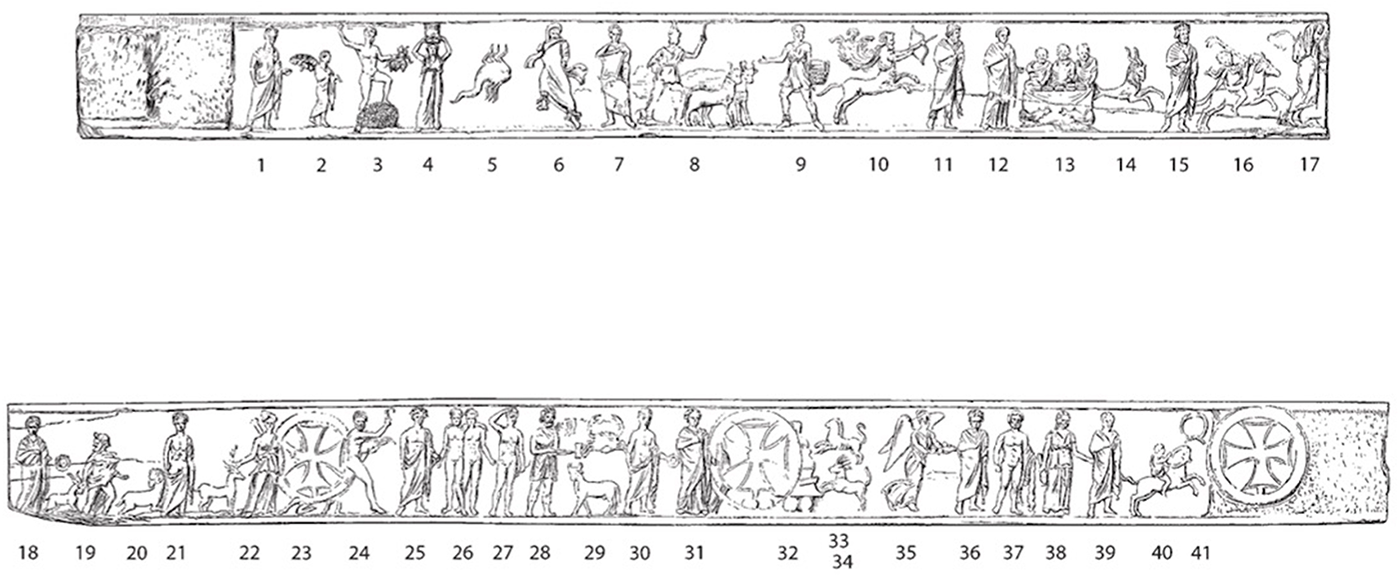
Figure 2 Long description
Two long horizontal strips are stacked one above the other, each framed by a border. Small figures are drawn inside each strip in a carved relief style. The upper strip shows a continuous row of small figures. Beneath this strip, the numbers read 1, 2, 3, 4, 5, 6, 7, 8, 9, 10, 11, 12, 13, 14, 15, 16, 17. The lower strip shows another continuous row of small figures. Beneath this strip, the numbers read 18, 19, 20, 21, 22, 23, 24, 25, 26, 27, 28, 29, 30, 31, 32, 33, 34, 35, 36, 37, 38, 39, 40, 41. Across both strips, the figures include multiple human-like forms in standing or walking poses, several animal-like forms and several symbol-like forms placed among the figures. At the far right end of the lower strip, a large circular emblem contains a cross-like design inside the circle.
Detail of the LMCF, showing Spring through Perseus (nos. 18–24) (courtesy DAI).

Figure 3 Long description
The relief sculpture depicts several figures and animals in a procession. On the left, a person is walking alongside a dog. Next to them, another figure is holding a staff, followed by a third figure with a draped garment. To the right, a large wheel-like structure is visible, with a person standing beside it. Above the figures, there is a decorative frieze with a pattern of alternating shapes. The scene appears to be carved in stone, showcasing intricate details and craftsmanship.
Detail of the LMCF, showing Poseideon through Aquarius (nos. 11–17) (courtesy DAI).
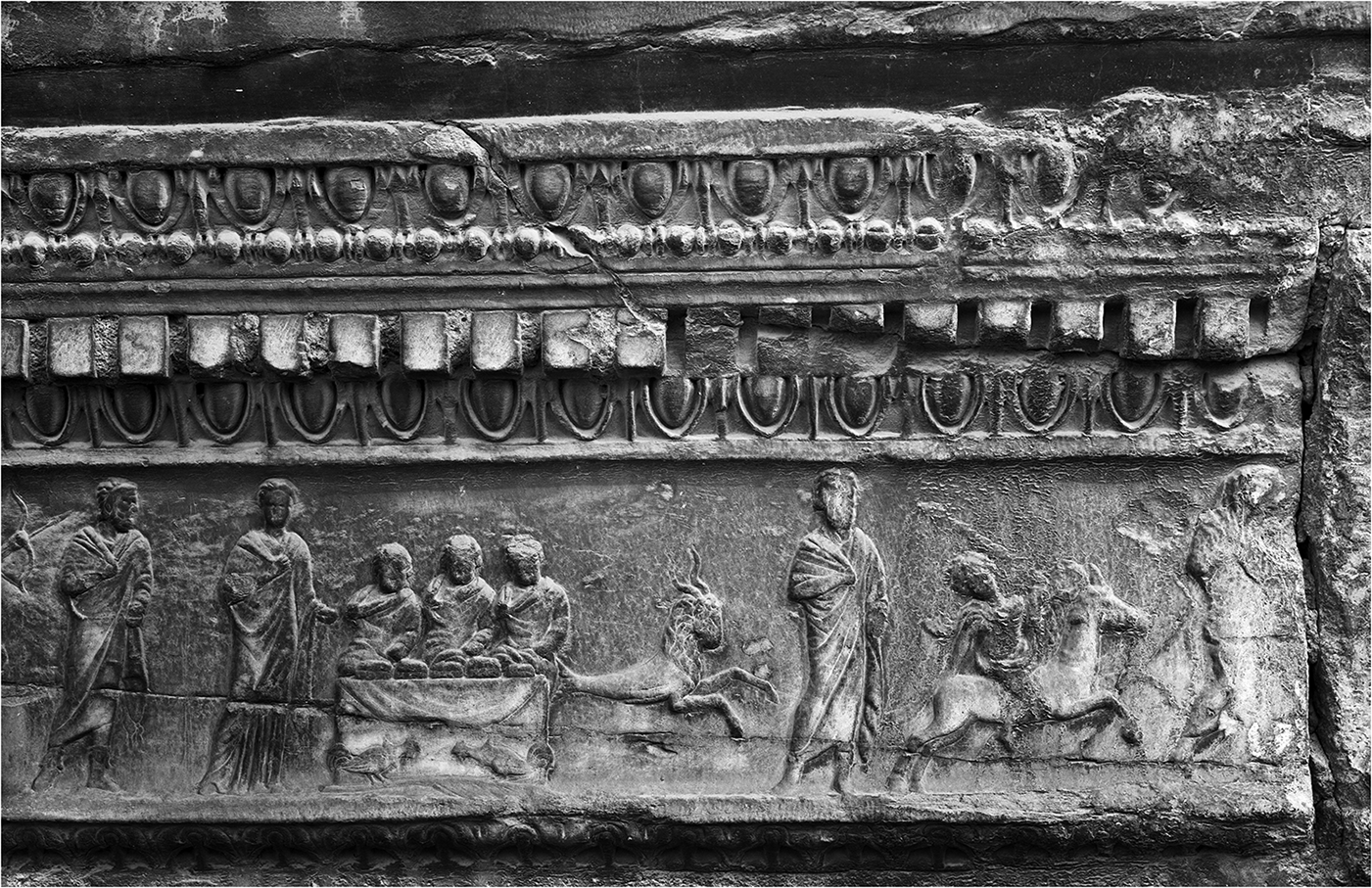
Figure 4 Long description
The relief sculpture shows a series of figures and animals in motion. On the left, several standing figures are depicted, some wearing draped garments. In the center, a group of seated figures is visible, with one figure appearing to hold an object. To the right, a figure is leading a pair of animals, possibly horses, in motion. The background features architectural elements with decorative patterns above the figures. The scene appears to convey movement and interaction among the figures and animals.
Identifications of the figures, following Deubner (Reference Deubner1932) numbers, on the LMCF with author’s new identifications in bold (season-festival-zodiac triads are shaded in grey)
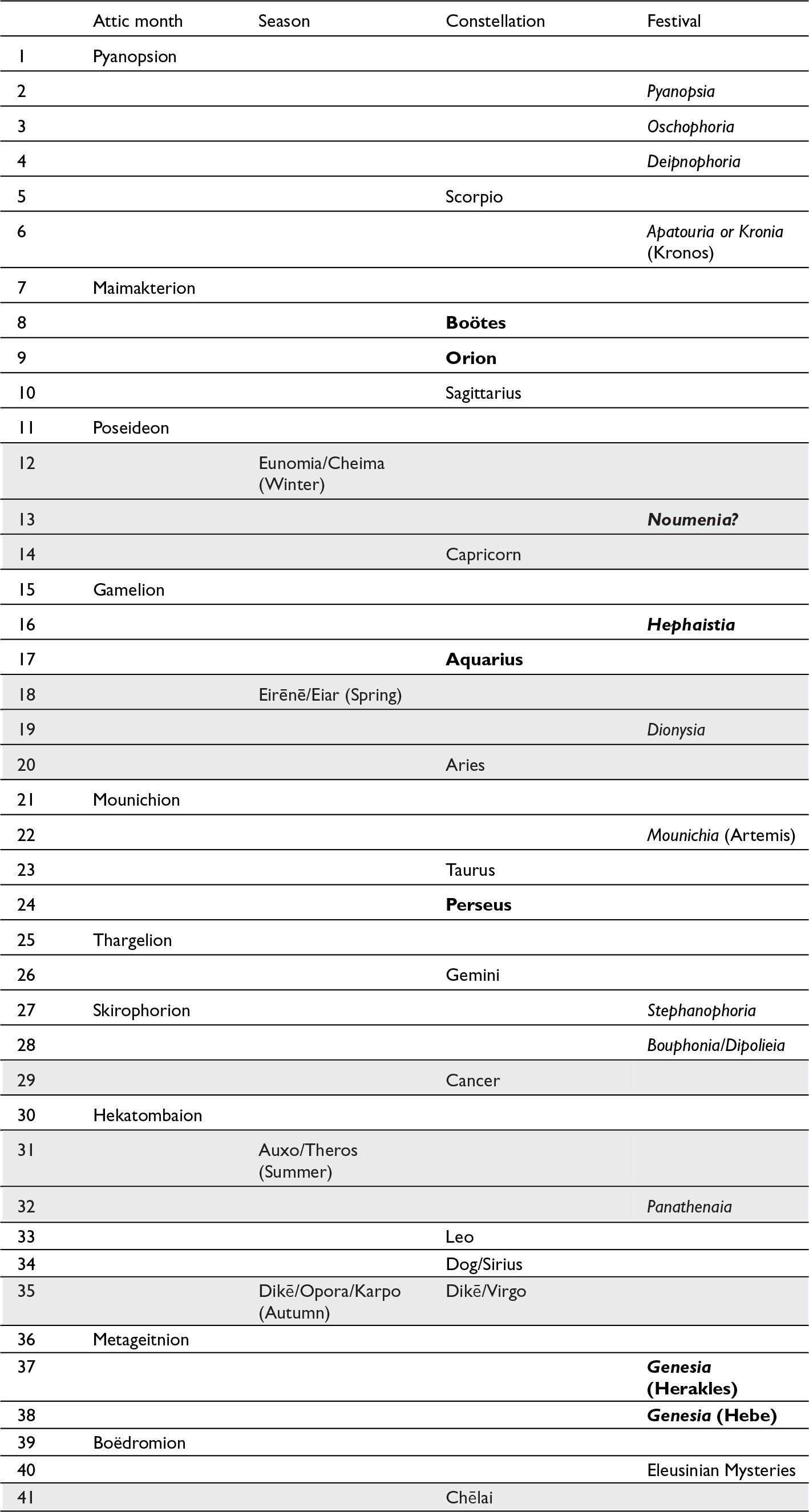
Table 1 Long description
The table lists Attic months alongside associated seasons, constellations, and named festivals, with many rows leaving some columns blank. Constellations progress through a zodiac-like sequence: Scorpio appears near Pyanopsion, then Sagittarius, Capricorn, Aquarius, Aries, Taurus, Gemini, Cancer, Leo, and Dog or Sirius, with Dikē or Virgo and Chēlai also included. Seasonal figures are given at intervals: Eunomia or Cheima for winter, Eirēnē or Eiar for spring, Auxo or Theros for summer, and Dikē or Opora or Karpo for autumn. Festivals are attached to specific points in the sequence, including Pyanopsia, Oschophoria, Deipnophoria, Apatouria or Kronia, Noumenia with uncertainty, Hephaistia, Dionysia, Mounichia, Stephanophoria, Bouphonia or Dipolieia, Panathenaia, Genesia for Herakles and for Hebe, and the Eleusinian Mysteries. Several months appear as anchors with multiple related entries following them, such as Pyanopsion, Poseideon, Gamelion, Mounichion, Thargelion, Skirophorion, Hekatombaion, Metageitnion, and Boëdromion. Because many cells are empty and some identifications are tentative, the associations should be read as proposed links rather than a complete calendar for every month.
Astronomical calendars based on mathematical schemes existed in ancient Greece, but this pictorial combination of sidereal, solar, and festival calendars is unique in antiquity and thus important for our understanding of Greek astronomy.Footnote 8 The dress and attributes of personified seasons and months fit the natural order of the solar and synodic lunar years.Footnote 9 Figures representing Athenian festivals may also fit into their traditional order, but this latter group is harder to assess because of the variety and changeability – in terms of names and timings – of that calendar through Graeco-Roman antiquity. The festival figures – more familiar to ancient Athenian audiences – may have provided the basis on which one read and understood the calendar in antiquity. The now familiar zodiac, fixed in relation to the stars, however, provides a convenient framework for the modern viewer to read the symbols in a yearly progression. From it, we can infer the LMCF’s more generic figures, namely personifications of seasons and months.
The LMCF’s unique combination of Athens’ festival calendar with zodiac figures has garnered scholarly attention since the middle of the nineteenth century. While it is a unique representation of the interplay of Athens’ festivals and the zodiac, no scholarship has sufficiently addressed their lunisolar calendar that supported it, illustrated with personifications of seasons and months.Footnote 10 This is the first attempt to identify all extant figures on the LMCF in a systematic manner. I identify each figure in the context of the sub-calendar on which it functions, considering how it connects to the figures around it: first, the zodiac and other constellations, i.e. the sidereal-year calendar; second, the solar calendar, with its seasons; third, personifications of the synodic lunar months and their attending festivals, on the Athenian festival calendar. The inclusion of figures representing festivals anchors the primacy of festivals in the ancient Athenian calendar. This survey of the complete frieze reveals the pattern whereby three distinct sub-calendars are blended. This decorative blending of science and culture attests to an important but otherwise lost monument from ancient Athens that may have alerted Athenians to different ways in which time was reckoned in an orderly kosmos. I use the information this complex calendrical programme conveys to conjecture the frieze’s original date and function, probably in Hellenistic times.
The sidereal calendar: the zodiac and other stars
The movement of the stars across the sky gave Greeks the most precise way to track the passage of time but also images of mythic characters whose stories they connected to their own earthly pursuits. Groups of stars, called constellations, are ubiquitous in Greek literary discussions of the sky. In the sixth century BCE, Anaximander noted the apparent path of the moon, sun, and planets (DK12 A 5).Footnote 11 Early in the fifth century, Kleostratos made a globe of constellations and asterisms, starting with Aries and Sagittarius (DK 6 B 2–3). Eudoxos, a Knidian in fourth-century Athens, may have put them on a solid sphere (Cic. Rep. 1.22). Aratus seems to have adapted Eudoxos’ work into his Phaeonomena, a didactic poem describing at least forty-seven constellations at the behest of Antigonos in his Macedonian court at Pella, after 267.Footnote 12 For calendrical purposes, the Babylonians focused on the twelve major constellations within eight degrees of either side of the ecliptic, to each of which they allotted thirty degrees of the sky. The Greeks adopted this cycle and associated its signs with lunar months, as illustrated on the LMCF.Footnote 13 The only surprise to a modern viewer of the LMCF is an image of claws, rather than scales, between Virgo and Scorpio (no. 41). This is Chēlai, first known from Eudoxos (frr. 79.15, 89.6–12; Ars col. 24, line 3n), which is the earlier Greek name for the constellation called Zugos (Yoke) by the second century (e.g. Hipparchos 3.1.5), or Libra (Balance) by Roman times.Footnote 14 We find Chēlai also on the Antikythera Mechanism, which sank in a shipwreck dated to ca. 60.Footnote 15 The claws of Scorpio were divided from his body, in both Babylonian and Greek imaginations, to represent two separate constellations. Scorpio’s body (no. 5), without claws is found in the next part of the LMCR, just after the personifications of the month of Pyanopsion (October–November). Writing after the Battle of Actium in 31, however, Vergil (G. 1.32–5) flatters his patron that Scorpio drew back his arms to make way for [the zodiac sign of] Augustus [born on 23 September], namely Libra.
Several other constellations, beyond the zodiac’s twelve, are also illustrated on the LMCF. Commentators since Bötticher (Reference Bötticher1865) 417 have recognised the dog below Leo as Sirius, the dog star (nos. 33–4), which rises at the end of July (in the Gregorian calendarFootnote 16 ) within Leo at the height of the summer. Sirius becomes important on parapegmata – inscribed stones listing celestial risings, settings, and other key dates – which refer to the brightest star within each constellation.Footnote 17 This dog could represent either star or constellation, however, because Sirius is the brightest star in the constellation the Greeks called Dog (ὁ Κύων); its Roman name, Canis Major, evolved because they saw the adjacent Hare (ὁ Λαγός) as a small dog, Canis Minor.Footnote 18
Most Greek states had festivals associated with ploughing and sowing in the next month, Maimakterion (no. 7), November–December on the Gregorian calendar (table 2). So scholars associated the wagon driver wearing a labourer’s pilos or pointed hat (no. 8, figure 5, middle) with ritual ploughing. Palagia (Reference Palagia2008) 222 suggests the Proerosia, a pre-ploughing sacrifice possibly at Eleusis, which combined supplications to Demeter and Apollo at the Rarian Field and Daphni (Eur. Supp. 28–31, 1196–212; Lycurg. ffr. 84–5 Conomis = FGrH 401 F 3.2). Yet Athenians celebrated that festival early in the previous month, Pyanopsion (no. 1).Footnote 19 Simon (Reference Simon2012) 40 identifies him as the legendary ploughman Bouzyges,Footnote 20 who does not relate to any known festival.Footnote 21 No. 8 is surely the constellation, Boötes, inventor of the plough, driving one of two ‘wagons’ (or ‘bears’ per Aratus Phaen. 26) above Scorpio. This image is positioned perfectly in terms of the sidereal calendar, within the Attic month of Maimakterion (no. 7), when Boötes’ brightest star, Arktouros, has its evening setting in Scorpio (no. 5).Footnote 22
Detail of the LMCF, showing Scorpio through Poseideon (nos. 5–11) (courtesy DAI).
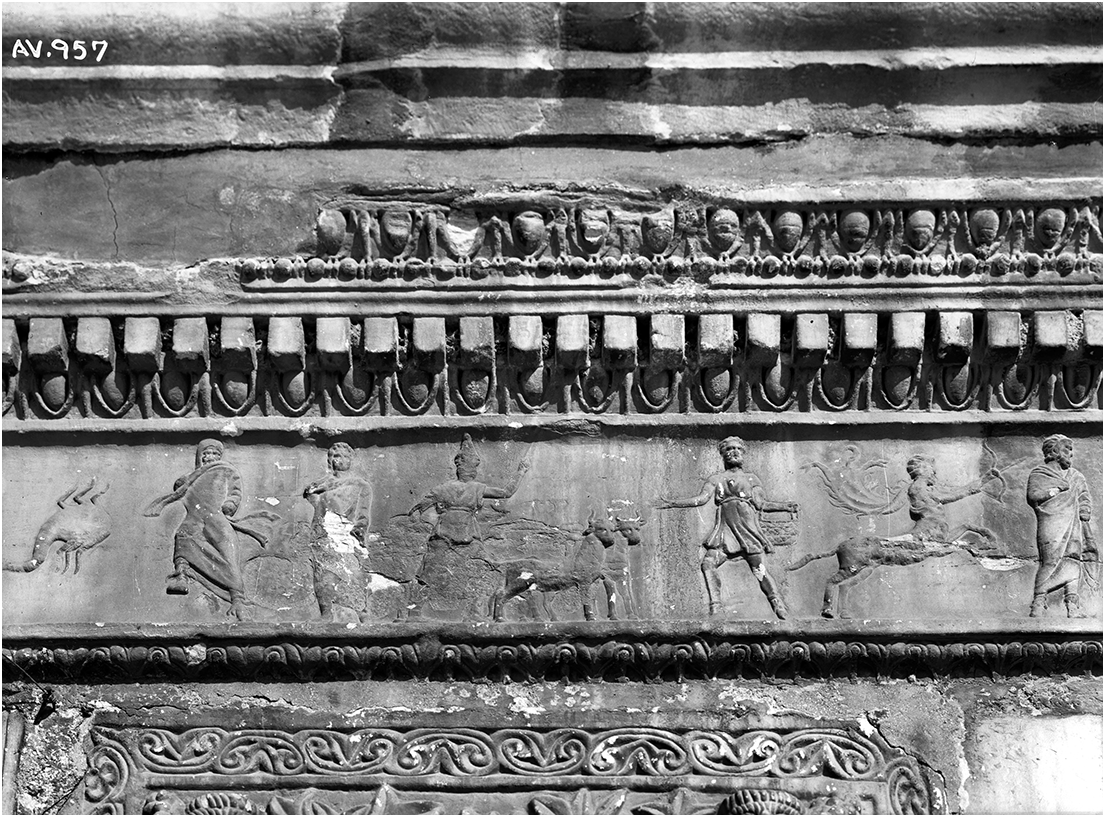
Figure 5 Long description
The photograph shows a carved stone bas-relief viewed straight-on, featuring a horizontal frieze. Approximately seven human figures are depicted in a procession, with some holding objects. Animals, resembling deer, are interspersed among the figures. The relief includes decorative bands above and below; the upper band has a repeating bead and pendant motif, while the lower band features a floral or vine pattern. The figures wear garments and headdresses, suggesting a historical style. The scene captures a specific action, possibly a ceremonial or hunting procession, without inferring cultural specifics.
Attic months and the festivals after which they are named, with Gregorian equivalents
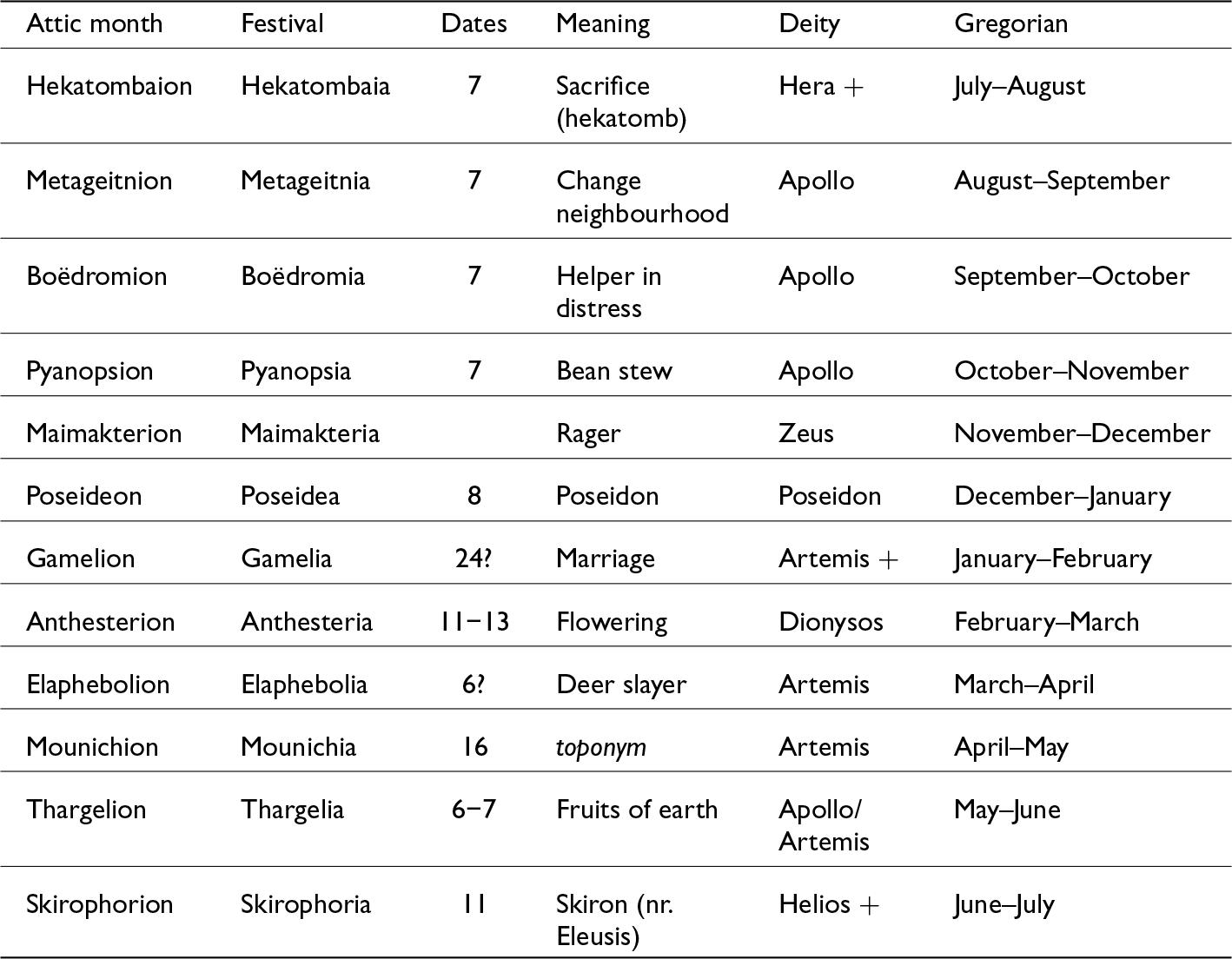
Table 2 Long description
The table lists twelve Attic months with their associated festival names, typical festival dates within the month, the festival meaning, the honored deity, and the approximate Gregorian month range. The Attic year begins with Hekatombaion in July–August and proceeds month by month to Skirophorion in June–July. Apollo appears repeatedly as the main deity in Metageitnion, Boëdromion, Pyanopsion, and Thargelion, while Artemis is central in Gamelion, Elaphebolion, and Mounichion and shares Thargelion. Other months highlight Zeus in Maimakterion, Poseidon in Poseideon, Dionysos in Anthesterion, and Helios in Skirophorion, with Hera also noted in Hekatombaion. Several festivals cluster around early-month dates such as six to eight, while Anthesteria spans three days in the middle of the month and Gamelia and Mounichia fall later in the month. Some date entries are uncertain or missing, indicated by question marks or blanks, so the listed day numbers should be treated as approximate.
The next figure, a bearded man (no.9, figure 5, middle), advances towards Boötes but faces us, with arms apart, a basket over his left arm. Scholars see him as a sower who accompanies the ploughman.Footnote 23 Hesiod (Op. 448–71) and Aratus (Phaen. 1075–6) advised that ploughing and planting should occur together when cranes migrate, which Aristotle (Hist. an. 596b29–597a9) puts in the Athenian month of Maimakterion, confirming Hesiod’s advice to plough at the morning setting of the Pleiades (Op. 614–7), in early November.Footnote 24 Some have sought in vain an Athenian festival in Maimakterion with which to associate him. Simon (Reference Simon1983) 214 tried the Pompaia, in which Athenians carried Hermes’ caduceus, entwined in snakes (Lysimachides [FGrH 366 F 3]) or a magic ‘sheepskin’ (Dion koidion),Footnote 25 perhaps from the shrine of Zeus Meilichios (‘kindly’) on the spur of the Hill of the Nymphs.Footnote 26 In the absence of caduceus and sheepskin, however, we may look to the stars for another interpretation. Might no. 9 represent Orion, the blind giant and winter constellation par excellence? For Homer, Orion was visible, just above the horizon, throughout the year (Il. 18.489), chasing the Pleiades (Hes. Op. 620). Because it comes into full form in late Maimakterion, just before Sagittarius is at its prime, however, the morning setting of Orion signalled winter storms, thus the time of year for ploughing and sowing (e.g. Hes. Op. 609–20).
The texture of the round item that falls below this giant’s left arm suggests a basket, like an archaic beehive, which encourages a deeper exploration of Orion’s myth. His Boeotian birthplace, Ὑρίη/Hyria, perhaps near Aulis, explains both Orion’s name and this attribute: the Cretan word ὕρον, which meant ‘swarm of bees’ or ‘beehive’, was adapted to the place name (Hsch. s.v. Hyrieus), as noted by Elderkin (Reference Elderkin1939) 209–10. With a plural name – characteristic of Mycenaean cities, e.g. Athens – Hyria was a place of beehives. Orion’s birth there explains some of his myths, especially his connections with Crete and mead, that Kerényi (Reference Kerényi1976) 42–3 explores. Orion’s encounter with Artemis, for example, resulted in a bee-sting that evolved into a scorpion bite (sch. Hom. Il. 18.486).Footnote 27 Commenting on Diod. Sic. 4.81.2 (cf. Verg. G. 4.315–558 and Ov. Fast. 1.363–80), Joseph Fontenrose (Reference Fontenrose1981) 182 emphasises Orion’s role as an archetypal herder and cultivator, like Aristaios. Orion’s presence on the LMCF certainly complements that of the tiller, Boötes (nos. 8–9), in representing traditional rural arts. With boots and cape, Orion is dressed for winter, but also looks Thracian. Most place his origins in Boeotia, but Boccaccio (Genealogie 11.19–21) reports he conquered Thrace.Footnote 28
The next zodiac figure, Taurus (no. 23), is obscured by another Rhodian cross, but the bull’s hooves are distinct in the lower arc of the cross (figure 3, right). After Taurus runs Perseus (no. 24, figure 7, left), the Greek hero pursuing the Gorgon Medusa, holding aloft, in his left hand, the sickle with which he beheads her. Although Medusa is not present here or in the sky, this is how the constellation Perseus appears. Despite the clarity of the sickle in Svoronos’ drawing, no previous commentators recognised him.Footnote 29 Were they misled by his beard, perhaps a reference to the Akkadian name for this constellation: Old Man?Footnote 30 Many saw his sickle as a torch, and concluded he was a lampadophoros, running the Hephaisteia (see no. 16, below), according to Simon (Reference Simon1983) 54,Footnote 31 or the Bendideia, according to Palagia (Reference Palagia2008) 226. He would have arrived in Piraeus a month early for this festival, normally on Thargelion 19,Footnote 32 and without the horse emphasised by Plato (Resp. 328a). No. 24 looks like Perseus and is placed where we should expect this constellation on the sidereal calendar. This is the only identification that fits the structural unity of the frieze.
The presence of all zodiacal figures in the correct order presupposes knowledge of Babylonian/Egyptian astrology, introduced to Greece by the fifth century. The use of Chēlai rather than Zugos or Libra encourages a Hellenistic date for the relief. The zodiac is a mere construct, however, that presents a now dominant selection of the many constellations. In addition to the Dog or its brightest star, Sirius (no. 34), both of whom could be represented by a dog, the three important constellations – Boötes (no. 8), Orion (no. 9), and Perseus (no. 24) – here identified for the first time, attest to the zeal of the LMCF’s designers to display a glimpse of the sky that was greater than the zodiac, blending old and new conceptions of time.
The solar calendar and its seasons
The zodiac is reliant on the solar year, insofar as it is a division of 365.25 days of the solar year into 360 degrees of a circle, divided into twelve 30-degree sections symbolised by figures representing major constellations, as explained above.Footnote 33 The Greeks’ adoption of the zodiac therefore is a later phase of the astrometeorological tradition that prioritised the solar calendar for predicting weather to plan sailing, farming, festivals, and other activities that depended on it.Footnote 34 Solar calendars divide the year into four astronomical seasons, based on solar markers – solstices and equinoxes – tied to the earth’s movement in relation to the sun, which vary each year. From as early as Hesiod, Greeks marked time with solstices – τροπαὶ ἠελίοιο, literally ‘turnings of the sun’ – in both summer (Op. 663) and winter (Op. 479, 564).Footnote 35 By the fifth century, they used seasonal adjectives, θερινός and χειμερινός, for summer and winter seasons and solstices (e.g. Hdt. 2.19; Thuc. 7.16). They are later joined by two equinoxes, ἰσημερίαι, to which Aristotle refers: ἐαρινή (‘springtime’: Mete. 2.6.2) and μετοπωρινή (‘autumnal’: Mete. 3.2.16). Meton found the dates of solstices and equinoxes by observing sunrise from his observatory on the Pnyx (Ar. Nub. 1000–1005). He published the moon’s correspondence to these repeating occurrences in the sun’s cycle, ca. 432 (Diod. Sic. 12.36).Footnote 36 Euktemon of Knidos, who studied in Athens within the next few decades, incorporated this Metonic cycle and solar occurrences into parapegmata, extra-calendrical tools that place solstices and equinoxes, markers of astronomical seasons, in conjunction with zodiac signs.Footnote 37
With the solar cycle thus well entrenched in Athenian calendrical matters, the LMCF should take account of seasons: Summer near Cancer, Autumn near Chēlai, Winter near Capricorn, and Spring near Aries. Indeed, this is the case with the latter two: a draped figure (no. 12, figure 6, left) is on the Winter solstice (24 DecemberFootnote 38), before Capricorn (no. 14); a similar figure (no. 18, figure 3, left) corresponds to the Vernal equinox (24 March), before the early Spring rising of Aries (no. 20). Each is arranged in a triplet, moreover, whereby a festival representative intervenes between a season and the relevant zodiac figure: Winter–festival–Capricorn (nos. 12–14) and Spring–Dionysia–Aries (nos. 18–20) (see grey triplets on table 1).
Detail of the LMCF, showing Winter and three men at a table (nos. 12–13) (courtesy DAI).
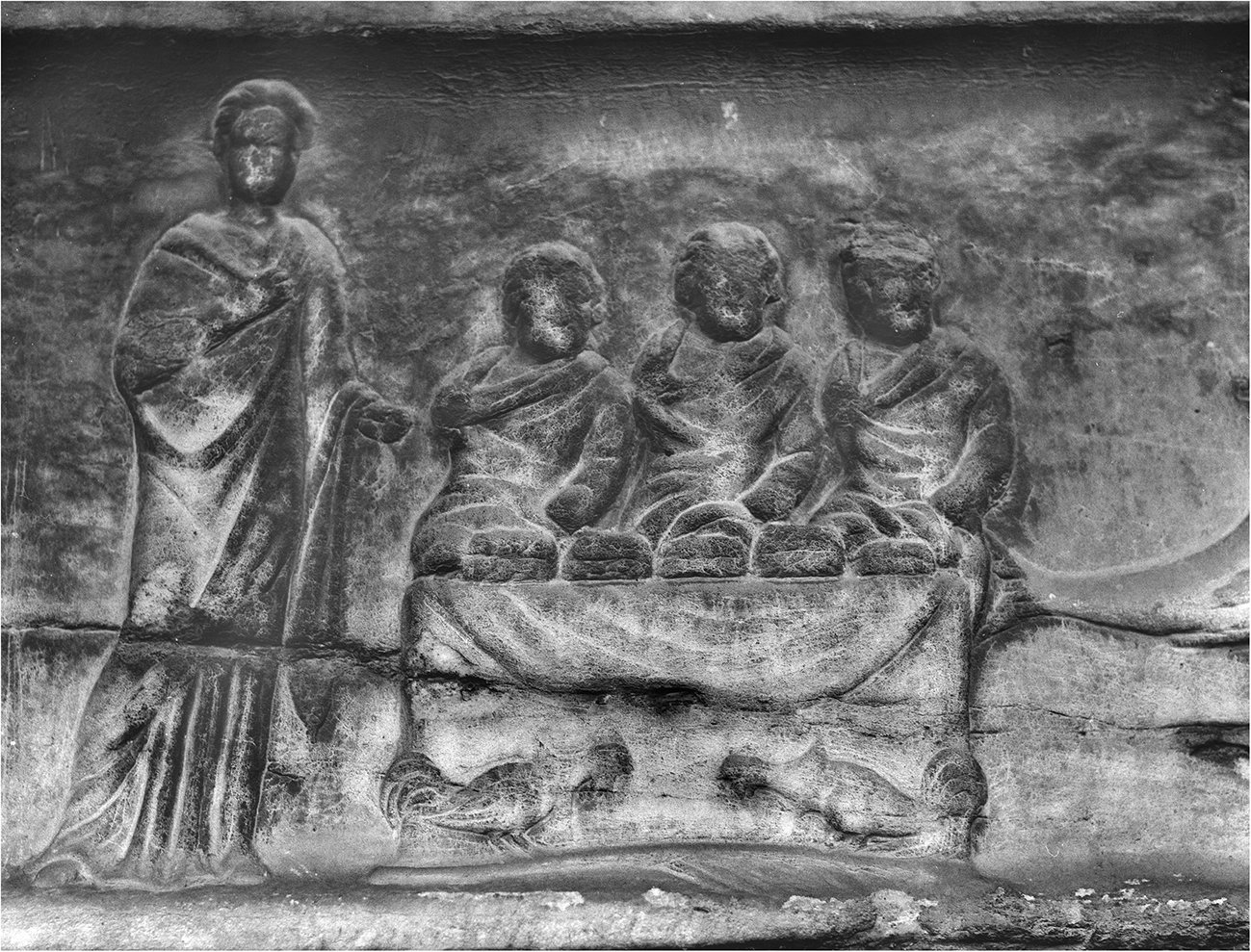
Figure 6 Long description
A rectangular carved stone relief shown from the front. Winter stands at the left edge, wearing a long draped garment. The left arm extends toward the group at the table. Three men sit in a row behind a rectangular table covered with a hanging cloth. Each man wears draped clothing and faces forward. Several rounded objects sit on the tabletop in front of the seated men. Beneath the tablecloth, two animal figures are carved near the lower edge of the relief. The background is the flat carved stone surface around the figures.
The obviously summery, nude male (no. 27, figure 7, middle) in the ‘right’ place for Summer could form a triplet with Bouphonia and Cancer (nos. 28–9) but his masculine appearance does not reflect any known Greek name for summer (τὸ θέρος is neuter), neither is he dressed as a personification, nor does he bear seasonal symbols. A draped woman (no. 31, figure 7, right), identical in dress to the first two ‘seasons’ (nos. 12, 18) with an attribute in her outstretched left hand, is a more likely candidate, yet we lack a similarly dressed figure for Autumn. Autumn’s presence on the missing part of the frieze would break the triplet pattern: the Eleusinian mysteries and Chēlai are extant before the break. No wonder previous identifications of seasons on the LMCF are both variable and internally inconsistent.Footnote 39
Detail of the LMCF, showing Perseus through Summer (nos. 24–31) (courtesy DAI).
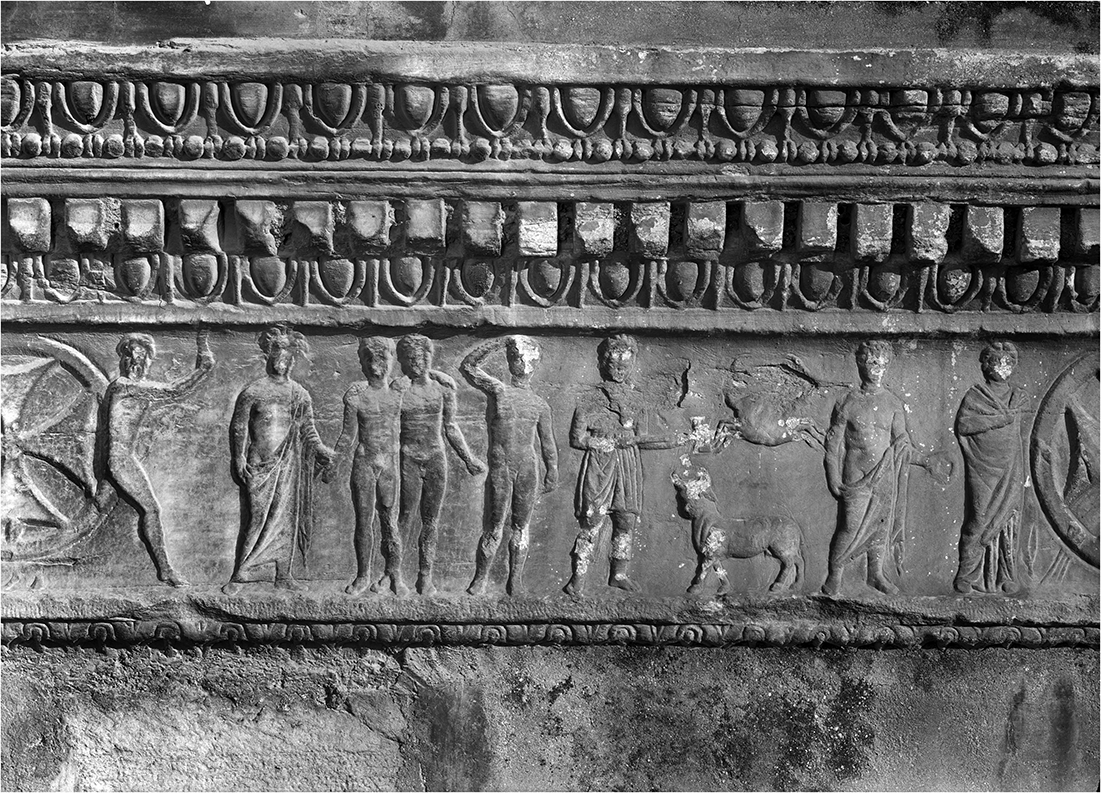
Figure 7 Long description
This black and white photograph captures a horizontal stone frieze, likely from an ancient Greek or Roman architectural structure. The upper register features a richly detailed egg and dart or bead and reel molding border, providing a formal frame for the narrative relief below. The main register depicts a procession of figures, men in various poses, some nude or partially draped, carrying round shields and spears. A dog is visible at the lower right, accompanying the group. The figures are rendered in shallow to medium relief with careful attention to anatomical detail and movement, suggesting skilled classical craftsmanship. The scene may represent a military, ritual, or mythological procession, consistent with friezes found on ancient temples, altars, or sarcophagi.
The illustration and identification of seasons is complicated by the fact that the Greeks had a three-season model from Greek myth, alongside their four meteorological seasons. In the Homeric Hymn to Demeter, Zeus’ divides the year into three, in response to Demeter’s despair at the loss of her daughter. Persephone joins her mother in the growing season and departs after the harvest season, to return to her ‘husband’ in Hades in the fallow season. Greeks personified three seasons as Ὥραι, beautifully dressed women. Homer, Hesiod, and others add another word to ὥρα to distinguish each of them (LSJ9 s.v. ὥρα): ἔαρ (e.g. Hom. Il. 6.148, spring); θέρος (e.g. Hes. Op. 584, 664, summer); and χεῖμα (e.g. Hes. Op. 450, winter). Elsewhere Hesiod names the Horai as daughters of Themis and Zeus: Eirēnē (Peace), Dikē (Justice), and Eunomia (Order) (Theog. 901–2; cf. Apollod. 1.3.1 and Diod. Sic. 5.72).Footnote 40 Hesiod’s epithet for Eirēnē, τεθαλυῖα (Blooming), positions her in Spring: peace enables conditions for flourishing crops. Dikē lived on earth in the golden age, reasoned with mortals in the silver age, and joined the stars in the bronze age, becoming the huge constellation later known as Parthenos (Latin Virgo), according to Aratus (Phaen. 101–33; cf. Eratosth. 9; Hes. Op. 109–201).Footnote 41 Dikē seems well placed here at the autumnal equinox, when day and night are of equal length, recalling the ideal state of balance that existed in the underworld’s Valley of the Blessed. We can associate Eunomia (Order) with the fallow season, when conscientious farmers put things in order.
One of these three-season systems lacks Autumn while the other – Horai as daughters of Zeus – lacks Summer. In astronomical terms, Summer and Autumn were blended into the concept of Ὀπώρα, ‘the part of the year between the [morning] risings of Sirius and of Arktouros (i.e. the last days of July through to the first half of September), the latter part of summer’ (LSJ9 s.v. ὀπώρα; cf. sch. Pind. Ol. 3.33). This is during the pre-eminence of the constellation Virgo, the largest on the zodiac, which transitions from solar Summer to Autumn, when Opora brings on the fruitful harvest also indicated by her name. In Odyssey 11.192, Homer names θέρος and ὀπώρη together. Later authors, starting with Alcman, in the seventh century, use Opora’s name for a season:Footnote 42 in his seventh lyric poem (Fr. 20 [=Ath.10.416d]), in fact, Alcman is the first author to mention four seasons, naming Opora along with Cheima, Eiar, and Theros. By the fifth century, Aristophanes’ chorus of birds – boasting they mark the seasons for mortals – specify three seasons with the same names; Theros is absent (Ar. Av. 709). It is clear that Theros and Opora have a special synergy that is explained by Opora’s special astronomical meaning.
That three draped seasons (nos. 12, 18, and 31) are personifications is made clear by their number and repetitive appearance. All stand in relaxed contrapposto poses, draped in himatia that bind their right arms against their chests, over chitons that descend to the groundline. Deubner (Reference Deubner1932) 250 took them for Theoriai, personifications of festival delegations, while Simon (Reference Simon1983) 6 proposed they were Pompai, personifications of procession, and Palagia (Reference Palagia2008) 217 identified them as personifications of festivals. There are no comparanda for personified Theoriai;Footnote 43 Pompe is a singular rather than plural entity labelled on five fifth-century vases;Footnote 44 and the only labelled festival personification in Greek art is Olympias (Olympic Games).Footnote 45 The objects in their outstretched left hands – their only distinguishing attributes – confirm each season’s identity: Cheima/Eunomia/Winter offers something small, perhaps a cake, to the men sitting behind a table (nos. 12–13, figure 6); Eiar/Eirene/Spring extends a floral wreath (no. 18, figure 3, left); the outstretched hand of Summer (no. 31, figure 7, right) is obscured by another Rhodian cross. They recall Kallixenos of Rhodes’ mention of four Horai, each carrying fruits relevant to her season, in Alexandria’s midwinter Ptolemaia of 279/8 (Ath. 5.198b).Footnote 46 Whereas nos. 12 and 18 are placed in the correct astronomical order, as noticed above, no. 31 is close to where we would expect the Summer solstice, but after rather than before the relevant zodiac figure, Cancer (no. 29). The summer solstice is more of an astronomical than seasonal concept, however, insofar as farmers considered the morning rising of the Pleiades the start of summer. Between long days and large summer constellations, which are poor indicators of specific timeFootnote 47 – Leo, Dog, and Virgo (nos. 33–5, Figure 8, left) shown here together – perhaps an ancient sculptor was challenged to match the summer solstice to the other calendars.
Detail of the LMCF, showing the Panathenaic ship cart through Chēlai (nos. 32–41) (courtesy DAI).
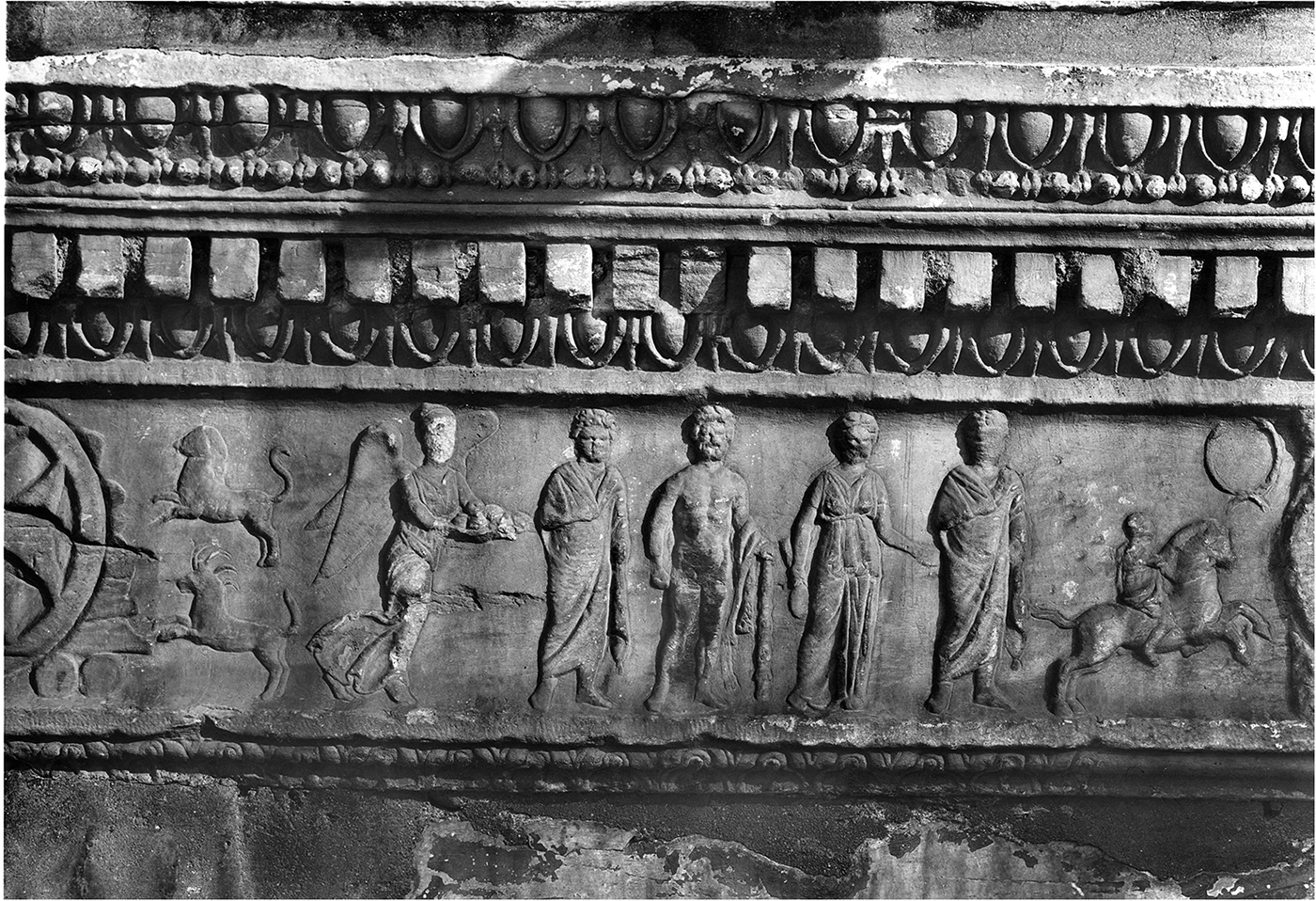
Figure 8 Long description
A horizontal photograph showing a carved stone frieze set within decorative molding. A band of ornament runs along the top edge, with another carved border below it. Across the center, five standing figures wear long draped garments. The figures stand in a row with small gaps between them. Several figures hold their arms bent at the elbow; one figure extends an arm outward. At the left end of the frieze, smaller carved figures and animal forms appear in front of the standing group. At the right end, additional smaller figures and animal forms are carved near the edge. The stone surface shows wear and pitting, with shallow relief lines defining clothing folds and outlines.
The next figure, no. 35, like the other seasons, however, wears a chiton and offers a gift. Wings and three-quarter-view presentation distinguish her from our other seasons. Her gift – she offers a bowl of fruit to the month of Metageitnion (no. 36, figure 8) – suggests her identity as Opora.Footnote 48 But this is our Virgo, as suggested by Reinach in Le Bas (Reference Le Bas1888) 58 and then Palagia (Reference Palagia2008) 228.Footnote 49 The autumnal Hora, Dikē, however, conflates Opora and Virgo, insofar as Aratus (Phaen. 101–33) notes that Parthenos (Virgo) was once called Dikē. As a zodiac figure she is in the correct place but not quite where we would expect this season.Footnote 50 Perhaps the long ‘reign’ of Dikē/Virgo (Parthenos)/Opora – the sun takes 44 days to pass through it – clarifies why, calendrically speaking, the ancient Greeks only needed three seasons.
How might visual representations reflect this triple identity of Dikē/Virgo (Parthenos)/Opora? Dikē is contrasted with Adikia (Injustice) on the sixth-century Chest of Kypselos at Olympia (Paus. 5.18.2).Footnote 51 Opora is the labelled companion of Eirēnē in Dionysiac images on Athenian vases at the end of the fifth century.Footnote 52 In 414, Aristophanes casts her, along with Theoria (Festival Embassy), as an attendant of Eirēnē (Ar. Pax 520–6). Painters and playwrights endow Opora with a generous bowl or plate of fruit, as on the LMCF. Her wings match the Hellenistic understanding of the winged zodiac figure, Parthenos/Virgo, with a star on each of her wings, according to Eratosthenes of Kyrene (9.11), in the third century.Footnote 53 Dikē/Virgo (Parthenos)/Opora’s wings are perhaps warranted here by her triple duty as a divinity, constellation, and season.
In sum, the personifications of seasons on the LMCF are a hybrid presentation of both three- and four-season models. While the solar calendar has been used to determine the placement of two of the traditional three seasons, Eunomia (Winter, no. 12, figure 6, left) and Eirēnē (Spring, no. 18), shown as beautiful, draped women offering gifts, according to tradition, the sidereal calendar demands the presentation of Dikē/Opora (Autumn, no. 35) as the constellation Virgo (Parthenos), who presides over the fruit-harvest period. Because Dikē/Opora is also shown as a winged constellation, the third of the triplet of traditional seasons, is rather allocated to Auxo (Summer, no. 31), before the constellations Leo and Dog. The inclusion of four seasons on the LMCF implies its designers also knew and accepted the scientific concept of four seasons, which helps us date it after Meton’s research in the late fifth century and probably to the third century, when Eratosthenes recognises a winged Parthenos, who coincidentally symbolises the Autumn season.
The Athenian festival calendar and its months
Scholars have long recognised the presence of both personified months and aspects of festivals on the LMCF but underplayed their interconnection. Moons provided the most fundamental mechanism whereby ancient Greeks counted time – each new moon brought a new month (Aratus Phaen. 733–8) – and thus timed festivals according to lunar phases. Since Athens’ festival calendar was essentially a lunar calendar – albeit synchronised with the seasons, through intercalation and other adjustmentsFootnote 54 – I consider lunar and festival representatives here together.
The moon is rarely seen in Greek visual arts, despite its importance to agricultural cycles and timekeeping.Footnote 55 Dallas (Reference Dallas2018) convincingly revived Skias’ interpretation (Reference Skias1901) of eighteen orbs (fifteen are preserved, some with crescents), on the upper frame of the Ninnion pinax, as moons (figure 9).Footnote 56 These eighteen moons count one and a half years from one’s first initiation into the Lesser Mysteries (in Anthesterion) to their ascendance to the highest grade in the Great Mysteries (Boëdromion) (Plut. Vit. Dem. 26.1).Footnote 57 Simon’s (Reference Simon1965) 121 interpretations of waxing and waning ‘moons’ over personifications of months and Pompai and/or Theoriai on an Athenian red-figure calyx krater (figure 10) is problematic. The frieze on this fragmentary vessel could present no more than nine months and corresponding festivals, if completed, but Athens’ months normally numbered twelve. Personifications of months, moreover, are never shown in seated poses elsewhere in Graeco-Roman art.Footnote 58
Pinax of Ninnion from a votive deposit near the Telesterion, Eleusis, c. 370. Athens, NMA 11036 © Hellenic Ministry of Culture – Hellenic Organization of Cultural Resources Development (H.O.C.RE.D.).
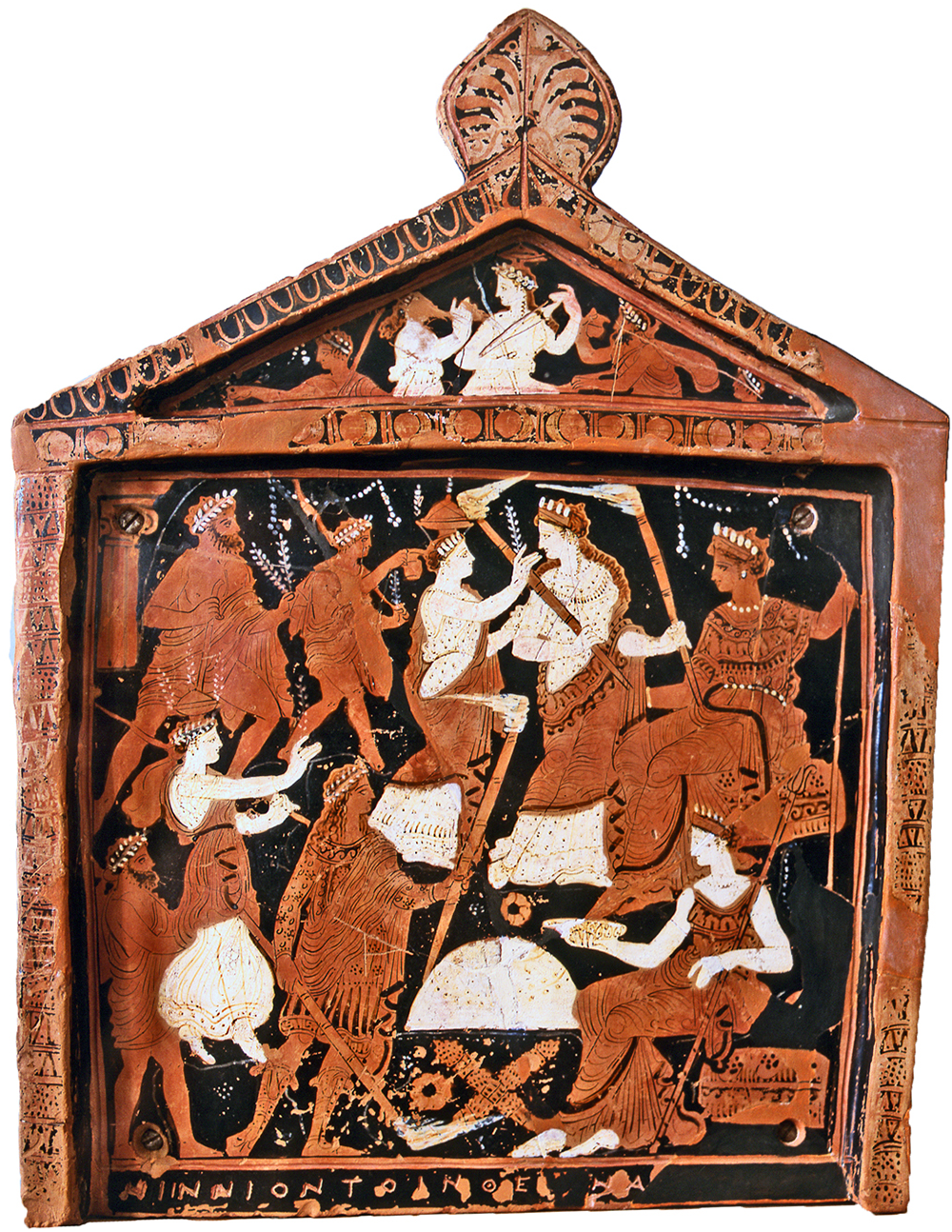
Figure 9 Long description
A terracotta plaque with a rectangular main field and a triangular top. A leaf-shaped ornament sits above the triangle. The outer border contains repeated decorative marks. Inside the rectangular field, several human figures are arranged around a larger central figure. Some figures hold long objects. One figure at the right holds a rectangular object with lines across it. A rounded object with a patterned surface sits near the lower center of the scene. Additional patterned shapes fill parts of the lower area. Inside the triangular top section, two smaller human figures are shown near the center. Along the bottom edge of the plaque, an inscription reads NINNION EPAE.
Athenian red-figure calyx krater attributed to the Oinomaos Painter, c. 375. Athens, NMA 1435 (BAPD 218101) © Hellenic Ministry of Culture – Hellenic Organization of Cultural Resources Development (H.O.C.RE.D.).

Figure 10 Long description
A broken pottery vessel fragment is shown against a plain background. The fragment has an upper painted scene and a lower decorative band. In the upper scene, multiple human figures are arranged across the fragment from left to right. Several figures stand with bent arms and raised hands. One figure near the center is lower to the ground with one knee bent. Another figure to the right stands with one arm lifted. Clothing is shown with draped garments and bare limbs. Below the figures, a horizontal border separates the scene from a decorative band. The lower band contains repeating plant motifs, including palmette and lotus shapes, with curved stems and small filler elements between the larger motifs. The fragment edges are irregular, with missing sections along the top and sides.
The standing male figures in contrapposto, draped in himatia at regular intervals, on the LMCF, however, are generally understood as personifications of the Attic Menes or months (table 2): Pyanopsion (no. 1), Maimakterion (no. 7), Poseideon (no. 11), Gamelion (no. 15), Mounichion (no. 21), Thargelion (no. 25), Hekatombaion (no. 30), Metageitnion (no. 36), and Boëdromion (no. 39).Footnote 59 The months Anthesterion and Elaphobolion probably flanked Pisces, the constellation that rose between these months, on the missing part of the frieze. Their number, twelve – if one accounts for two missing figures – and placement at regular intervals support the identification of these draped men as personifications of months. Haysom (Reference Haysom2016) 51 notes the distinctive tassels hanging from the pointed ends of their garments, which clarify their ‘teamship’. Their individual identities are suggested not by labels or hand-held attributes but by dress. The winter months – Maimakterion, Poseideon, and Gamelion (nos. 7, 11, and 15) – wear boots to protect them from winter storms; Maimakterion’s head is effaced but the latter two are bearded. Thargelion (no. 25) is half draped and seems to wear a crown of spiky leaves or the sun’s rays, perhaps because he stands on the cusp of summer, next to Gemini, the twin zodiac (no. 26, figure 7).
The naked figure (no. 27) just to the right of Gemini (no. 26, figure 7) seems to represent the hotter month, Skirophorion. His stance as stephanophoros, crowning himself with his arm above his head, sets him apart from the other personifications of the months and has long confused iconographers. Haysom (Reference Haysom2016) 301 aptly compares him to the so-called Apollo Lykeios statue type, which Lucian (second century CE) describes:
The place is called a gymnasium and is dedicated to the Lykeian Apollo. You see his statue there; the one leaning on the pillar, with a bow in the left hand. The right arm bent over the head indicates that the god is resting after some great exertion. (Luc. Anach. 7).
Tempting as it is to identify the naked stephanophoros (no. 27) as ‘Apollo Lykeios’ crowning himself with laurel leaves, as in Ovid’s aition of the Pythian crown (Ov. Met. 1.438–567), no such Apollo is known before Ovid.Footnote 60 The pose is hardly relaxing, except while reclining.Footnote 61 And why would Apollo carry his bow while exercising? Perhaps Lucian conflated Apollo with victorious athletes whose statues decorated the Lykeion.Footnote 62 The earliest figure of this type is found in the lower right field on reverses of Athenian new- style tetradrachms minted in 72/1.Footnote 63 If we cannot connect him with Apollo, we need an alternative to Thompson’s (Reference Thompson1961) 563 suggestion that the magistrate Epigenes used this ‘Apolline’ image to hint at connections with Delos. One might have found such stephanophoroi both on late Hellenistic tetradrachms and in the Lykeion if they represented citizens elected as archon basileus for a year. At the end of each civic year, nine new archons or rulers each received a crown, which they retained until the next investiture, a year later.Footnote 64 In most Ionian cities such a stephanophoros would perform the annual Ionian bull sacrifice on the vernal equinox – at the rising of the constellation Taurus (bull) – to mark each new civic year (SIG 589.1).Footnote 65 Athens’ new-year bull sacrifice, the Bouphonia/Dipolieia, however, took place on Skirophorion 14 (sch. Ar. Pax 419) and indeed is shown adjacent to Skirophorion on the LMCF (nos. 27–8). Through the act of crowning himself, perhaps this personification of the month Skirophorion refers to this archetypal crowning of the archon basileus as ‘king for a year’.
That Skirophorion may simultaneously represent a festival, stephanophoria, whereby each archon basileus was crowned at the end of that month, reminds us that the designers of the LMCF understood months as belonging to the Athenian festival calendar, which they therefore fleshed out with representatives of up to twelve more festivals: nos. 2–4, 6, 13, 16, 19, 22, 28, 32, 37–8, and 40. They had the luxury of choice: Parker (Reference Parker2005), appendix 1, counts at least 129 festivals in ancient Athens. Did the LMCF represent the longest, most lavish, most popular, or politically expedient festivals? Assuming at least one further figure on the missing block represented a festival, perhaps even the Anthesteria (in Anthesterion), we have an average and a minimum of one festival illustration per month. The remaining figures are far from standardised, so it is clear none are personifications. They rather illustrate signifying aspects – relevant deity, participant, activity, or object – of each chosen festival. Scholars agree on the figures that represent Pyanopsia (no.2, figure 11, left), Dionysia (no. 19), Mounichia (no. 22), Bouphonia/Dipolieia (no. 28), and Panathenaia (no. 32), each shown after the personification of the month in which it occurred. I discuss these identifications therefore only where they relate to the interpretation of neighbouring figures (with nos. 2 and 28). Haysom (Reference Haysom2016) 57 rightly complains that previous scholars assigned festivals to figures on either sequential or iconographic grounds but not both. We should expect both sequential integrity – as with sidereal, solar, and lunar figures – and recognisability of figures, especially on a public-facing monument. I am guided by these principles in my identifications, which I discuss in sequential order, according to their original presentation.
Just after Pyanopsion (no. 1, figure 11, left), a draped boy walks profile to the right (no. 2). Over his shoulder he holds the eiresione (LSJ9 s.v. εἰρεσιώνη, from εἶρος meaning ‘wool’), a laurel (Simon [Reference Simon1983] 76) or olive (Parke [Reference Parke1977] 76) branch covered with wool, beans, fruits, cakes, and even bottles of olive oil. These last two details are still visible. Children with two living parents carried such branches while singing the ‘eiresione’ song (Plut. Vit. Thes. 22) during Apollo’s Pyanopsia and Thargelia harvest festivals; the boy’s placement after Pyanopsion confirms his reference to the former and may explain the absence of a festival in Thargelion (no. 25). The Oschophoria, honouring Athena and Dionysos, also in Pyanopsion, involved branch-carrying pairs of cross-dressing Salaminian boys (LSS 19.47–50 [SEG 21.527]; sch. Nic. Alex. 109; FGrH Istros 334 F 8; cf. Hsch. s.v. oschophoria and Phot. Bibl. s.v. oschophorein), who proceeded from Dionysos’ to Athena’s sanctuary on the Skira (Strabo 9.393) or Skiron (Paus. 1.1.4), almost certainly in ‘old’ Phaleron (IG II2 1232).Footnote 66 The next figure (no. 3) holds, in his left hand, trailing branches – oschoi or vines – suited to this vintage festival. With his right hand he holds aloft a cup, probably the pentaploa (πενταπλόα), named for its five ingredients: wine, honey, cheese, meal, and a little oil (Ath. 11.42). Deubner (Reference Deubner1932) 249 is surely right that this naked youth, holding oschos and pentaploa, represents the Oschophoria. Kadletz (Reference Kadletz1980) 368 rightly added that, with cup aloft in a victory pose, he is the winner of the youths’ foot-race that either preceded or followed the procession (Procl. Chrestomathy 87ff. [=Phot. Bibl. 239, p.332a13]):Footnote 67 in his commentary on Pindar, Aristodemos explains that the victor, once awarded this cup, would feast with the other runners, on the third day of the Skira (Ath. 11.42).Footnote 68 Rutherford and Irvine use an epinician oschophorikon (P.Oxy. 2451 Bfr.17) to restore the foot-race to the Oschophoria; as they explain, without the foot-race ‘we are at a loss as to the identity of the addressee’ (Reference Rutherford and Irvine1988) 46. Indeed, Heliodorus confirms the oschophorikon form of epinician poetry honoured Athenian youths ‘who have taken part in the race and bear the cutting from the vine heavy with grapes which is called the oschos’.Footnote 69
Detail of the LMCF, showing Pyanopsion through Maimakterion (nos. 1–7) (courtesy DAI).

Figure 11 Long description
This black and white photograph shows a horizontal stone frieze, likely from an ancient Greek or Roman architectural monument. The upper portion features multiple decorative molding bands, including a prominent dentil course and egg and dart ornamentation, creating a richly layered cornice effect. The main frieze register below presents a procession of figures, both robed and partially draped, engaged in what appears to be a ritual or ceremonial scene. The figures are carved in shallow to medium relief, showing varied gestures and poses that suggest narrative movement from left to right. Some figures appear to interact with one another, possibly in a sacrificial, votive, or mythological context. The stone surface shows signs of age and weathering, with areas of erosion visible across the relief. The overall composition and style are consistent with classical Greek or Hellenistic sculptural traditions, possibly from a temple altar, monument, or public building frieze.
Rutherford and Irvine (Reference Rutherford and Irvine1988) 45 rightly rejected Kadletz’ idea (Reference Kadletz1980) 368 that the victorious youth was standing on a winning post, otherwise unparalleled: ‘the mound is clearly composed of small round objects, which seem quite likely to be grapes in view of the fact that the figure is carrying a bunch of grapes in his left hand and are difficult to explain otherwise’. In presenting the vat or wine press from a bird’s-eye perspective rather than profile, the artist clarified the action of the figure: he is not merely standing but moving his legs up and down. Athenaios (14.30 [631B]) mentions an athletic oschophorikos dance that resembled young men wrestling, as one of two forms of the anapalē; the other is the Bacchic, therefore also Dionysiac. Surely such dances emerged from the rhythmic treading of grapes.Footnote 70 A fragmentary Attic pinax shows Athena Skiras (?) in the presence of nude men seemingly dancing while engaged in wine production (figure 12).Footnote 71 Their feet are not preserved but their wreaths, Athena’s presence, and the votive function of the pinax together suggest this a ritual scene. Whether our nude youth (no. 3) is moving his feet in agricultural or choral activity, or both, the creator of this image successfully combined three salient features of the Oschophoria: pentaploa (cup), oschos (vine), and oschophorikos dance that recalls the original but otherwise lost reason for this festival: treading the grapes.
Attic black-figure pinax attributed to the Rycroft Painter, showing ritualised wine production in the presence of Athena Skiras (?). Athens, NMA 15124 (BAPD 301856). Photo: Hellenic National Archaeological Museum, Athens, Photographic Archive, and Kostas Xenikakis © Hellenic Ministry of Culture – Hellenic Organization of Cultural Resources Development (H.O.C.RE.D.).

All previous commentators agree with Deubner (Reference Deubner1932) 250 that the next figure (no. 4, figure 11, middle), a female carrying a kista or box with festival ‘secrets’ on her head, represents a woman associated with Eleusinian rites. Palagia (Reference Palagia2008) 220 adapted Deubner’s idea that she represents the Thesmophoria (Pyanopsion 11–14) at Eleusis, with the suggestion that she represented the Eleusinia athletic competition Hadrian had moved to this month.Footnote 72 How and why would a kistophoros represent an athletic festival? Palagia’s iconographic comparandum, a caryatid from the inner entrance of Eleusis’ Lesser Propylaia, is inexact: that architectural feature is without raised hands. Her proximity to the preceding figures might indicate rather that the kistophoros represents another participant in the Oschophoria. Citing Demon, a fourth-century Attic historian, Plutarch emphasises the importance of the Deiphnophoria, part of the Oschophoria, where dinner-carrying women (deipnophoroi)
…take part and share in the sacrifice and imitate the mothers of those on whom the lot fell [i.e. Theseus’ companions on his journey to Crete], for they continued to come to them with meat and bread. And stories are told at this festival because these mothers recounted tales to comfort and encourage their children (Plut. Vit. Thes. 22.2–4, 23.2–5 [= Demon FGrH 327 F 6]).
Perhaps the kistophoros carrying a burden on her head just after the victor of the Oschophoria (nos. 3–4) is a deipnophoros, ‘dinner carrier’, representing the Deiphnophoria, a part of the Oschophoria. At least from the time of Theseus, the Oschophoria and Pyanopsia ran in tandem, so it is unsurprising that three figures (nos. 2–4) together illustrate these two festivals in the month of Pyanopsion.
The next figure after Scorpio (no. 5) is a heavily-dressed, veiled, and booted older man who appears to dance (no. 6, figure 13). Following Svoronos (Reference Svoronos1899) 35, Deubner (Reference Deubner1932) 250 guessed he might be a personification of Winter. This identification relied on clothing and not placement, for winter is yet to come. He should represent another festival from the end of Pyanopsion (no. 1) for the next figure is the month of Maimakterion (no. 7). His salient features –veil, fetters, and lively posture – are known from literary depictions of the Titan Kronos, but never together in visual arts.Footnote 73 ‘Some claim his head is covered because the beginning of time is unknown’ (Myth. Vat. 3.1.5). Or does the veil denote grief or secrecy? Plutarch assumes he is asleep (Mor. De fac. 26, De def. or. 18).Footnote 74 As Versnel (Reference Versnel1993) 97 puts it, together with his fetters, Kronos’ veil indicates he is ‘out of action’. Although Kronos’ bondage derives from the theogonic myth of successionFootnote 75 –‘Zeus … put his father [Kronos] in bonds because he had wickedly devoured his children’ (Pl. Euthphr. 5e; cf. Cra. 403e) – Kronos was the ideal king of the golden race (Hes. Op. 109–26; cf. Pind. Ol. 2.70).Footnote 76
Detail of the LMCF, showing Kronos (no. 6) (courtesy DAI).

Haysom (Reference Haysom2016) 193 identified the straps tied to the ankles of no. 6 as the woollen bandages used to shackle the feet of Saturn, Kronos’ Roman successor. This in turn would explain his dance: the release from shackles would encourage even this sleepy king to dance. Worshippers removed these shackles from Saturn’s statues during the Saturnalia, a ‘reversal’ festival during which slaves and masters feasted, drank, and celebrated together at the end of the old year, to usher in the new one (Plut. Mor. 1098B; cf. Min. Fel. 22.5; Stat. Silv. 1.6.4; Arn. 4.24). Apollodorus of Athens (second century) says Greeks at Kronia similarly unshackled Kronos statues and shared food across hierarchies (FGrH 244 F 118 [=Macrob. Sat. 1.8.5]).Footnote 77 What else do we know of the Kronia at Athens?
King Kekrops founded an altar for Kronos and Rhea and a Kronia festival (Philoch. FGrH 328 F 97; cf. Accius in Macrob. Sat. 1.7.37). The sixth-century tyrant, Peisistratos, likened his own reign to the happy days of Kronos’ (Ath. pol. 17.5) – the Golden Age of nourishment without labour, like the Garden of Eden – and (re)built this temple in the Ilissos Valley.Footnote 78 In giving labourers a chance to feast without working,Footnote 79 festival celebrations of this banished god and king would celebrate both renewal and food.Footnote 80 Philochorus confirms that masters and slaves (and presumably everyone in between) joined in this new year’s harvest celebration (FGrH 328 F 98 [=Macrob. Sat. 1.10.22]; cf. Accius in Baehr. FPR 3; Büchner, FPL 34).
Ionians celebrated Kronia as a ‘new year’ festival to renew social order through dissolution and reversal.Footnote 81 Versnel (Reference Versnel1993) 105 therefore complains Macrobius erred in putting the Athenian festival in December, for July (early Hekatombaion) traditionally marked the new Athenian civic year, whereas January (late Poseideon) marked the Julio-Claudian new year that we share with the (imperial) Romans, like Macrobius. Burkert (Reference Burkert1985) 228 and Parker (Reference Parker2005) 202 prefer Demosthenes’s date of 12 Hekatombaion (24.26) when, however, the Kronia would have been overshadowed by the Panathenaia. Parker (Reference Parker1996) 270 thus lists it among the festivals that died out before the third century. Machon tells of a famous fourth-century hetaira named Gnathaina, however, who stepped out of the temple of Aphrodite during the Athenian Kronia (Fr. 17 Gow [=Ath. 13.581a]). And an inscription dating from 267/6, Agora 15.4 no. 81.6–7 (SEG 21.372) attests to a sacrifice to Zeus at the Kronia. Yet none of these sources hint at such a festival in Pyanopsion, where Kronos is found on the LMCF. Different Greek poleis had varying concepts of ‘new year’, however, and Pyanopsion, where we find Kronos on the LMCF, corresponds to Dios, Macedonia’s first month according to the Seleukid revision of their lunisolar calendar.Footnote 82 If Kronos represents the Kronia on the LMCF, might his presence suggest a Macedonian prejudice? Macedon became influential in Athens between 322 and 229, through a garrison in the Piraeus, after the Lamian War; the Ptolemies took control thereafter.Footnote 83 I shall return to this historical period when I have finished the analysis of the festivals.
Another possibility is that Kronos here might represent the Apatouria (or amapatoria or omopatoria),Footnote 84 which Athenians celebrated over three days in Pyanopsion, probably 19–21 (IG II2 1237.52–4, 67; Andoc. 1.126; Dem. 39.4: see Lambert [Reference Lambert1993] 143–89). This Ionian festival derived from the Kronia insofar as it re-enacts the ἀπάτη or deceit inherent in Rhea’s presentation of their offspring to Kronos, culminating in a swaddled stone in lieu of Zeus.Footnote 85 Athens’ phratries (sch. Ar. Ach. 146; see Beekes [Reference Beekes2009] 114) used this festival to prove a child’s viability and parentage. On its third day, Koureōtis and/or Meion, clans would formally welcome legitimate children, maybe even girls.Footnote 86
After the personification of the next Attic month, Poseideon, booted and warmly dressed like Kronos, who appropriately accompanies Winter (nos, 11 - 12, figure 4, left) is an image that has mystified all commentators: three male figures sit behind a table, piled high with cakes, in front of which stand a rooster and a hen (no. 13, figure 6). Deubner (Reference Deubner1932) 251 interpreted the birds as a cockfight, an allegory of competition, perhaps in the rural Dionysia, which would be in a different month.Footnote 87 Yet the bird on the right is smaller, with less plumage; together this heterosexual pair of chickens symbolise fertility. Such an image, a pair of chickens below or in front of a table of cakes, is familiar from Hellenistic dedications to the Phrygian moon god, Mēn.Footnote 88 Probably derived from the Zoroastrian lunar deity (Avestan Mångha or Persian Māha), Mēn came to Athens by the fourth century and grew in popularity throughout Roman times.Footnote 89 Lane (Reference Lane1964) 8 describes a handful of reliefs and/or inscriptions attesting Mēn’s worship in Classical to Hellenistic Attica as a ‘closed group’, with iconography unparalleled elsewhere in the Graeco-Roman world. One such relief shows three men and a child approaching a draped Mēn seated side-saddle on a large ram, in front of a large crescent moon (figure 14).Footnote 90 The trio of men recalls the three men behind a table on the LMCF (no. 13, figure 6). That the hem of one worshipper’s himation is visible behind the hen clarifies that the cakes – oblong, round, and conical, like those on the LMCF – are on a table, not an altar. While the crescent moon is unevidenced on the LMCF now, such detail would have been in very low relief and/or painted.
Boston, Museum of Fine Arts 1972.78, c. 340. Photograph © Museum of Fine Arts, Boston.

Figure 14 Long description
The relief depicts three men and a child standing near a table piled with various cakes. In front of the table, a rooster and a hen are visible. To the left, a large ram is positioned, facing the group. The men are dressed in draped garments and the child stands slightly in front of them. The scene is carved in stone, with detailed figures and objects, including the cakes, which are oblong, round and conical in shape.
These men might be Lysias’ Noumēniastai, ‘New-mooners’, an Athenian society of revellers (Lys. Or. Fr. 195.12–16). Lysias is a fourth-century orator, yet the Noumēniastai are otherwise barely evidenced at Athens.Footnote 91 We might compare them to the Menagyrtes, mendicant priests of Mēn and the Great Mother, known from Menander’s lost play, Ὁ Μηναγύρτης (Edmonds, FAC IIIb, frr. 323–4),Footnote 92 who collected food on behalf of Mēn for redistribution to the poor.Footnote 93 The ‘cakes’, perhaps the ‘New moon loaves’ that Lucian (Lex. 6) mentions as leftovers from a festival, are precursors of ‘Three Kings’ cakes nowadays consumed throughout Francophone cultures at the start of Epiphany. The winter solstice, where these Noumeniastai or Menagyrtes (no. 13) appear, is when chickens recommence egg-laying, in anticipation of longer days, thus an ideal time for food charity. While we have no extant evidence of a festival honouring Mēn in Athens, the cakes on the table might also incorporate some memory of the ancient Poseidea and/or Kronia: all three midwinter festivals involve food distribution.Footnote 94 The people at this table could be understood as an extension of Winter’s munificence, following Jones’ (Reference Jones2017) 65 reading of nos. 12–13 as a unified representation of a festival.
The goat-fish Capricorn takes us to the end of January, the beginning of the Attic month of Gamelion (nos. 14–15). Simon (Reference Simon2012) 42 interprets the next figure, a boy with a torch, riding a quadruped (no. 16, figure 4, right), as another constellation, Capella (Goat). Yet her own source, Aratus Phaen. 157–64, places this goat on the opposite side of the sky, just above Gemini, thus six months too early or late. Aratus’ Goat has kids but no rider, so the iconographic comparison fails. Following Deubner (Reference Deubner1932) 251 and Simon (Reference Simon1983) 100, Jones (Reference Jones2017) 65 reads no. 16 as Dionysos on a goat, carrying a thyrsus, in allusion to the Dionysiac festival Lenaia, on Gamelion 12. Yet this quadruped looks equine, with prominent ears that recall the donkey on which Hephaistos returned to Olympos, after Dionysos plied him with an excess of wine. The rider is young and seems to hold a torch, whereas the drunken god traditionally carried his metalsmithing tongs and/or a vessel.Footnote 95 A ritual imitation of Hephaistos’ inebriated state at the Hephaisteia, however, would explain why this lampadophoros seems ready to fall off his ass. We have limited sources for the Hephaisteia, which honoured both Athena and Hephaistos, as ‘parents’ of the Athenians, but Herodotus (8.98.2) confirms its presence among the Greeks in the second half of the fifth century.Footnote 96 He mentions it was a relay race, while Polemon attests to its torch race, overseen by gymnasiarchs, as at the Panathenaia and Prometheia (Harp. 3 s.v. lampas; Istros, FGrH 334 F 2[a] and [b]).Footnote 97 Hellenistic and Roman ephebic inscriptions emphasise the importance of this festival’s torch race.Footnote 98 Whereas Harrison assigns the Hephaisteia to Pyanopsion, an ideal time to celebrate the god of fire and metalwork would have been the winter month of Gamelion (Reference Harrison1977) 415. Our sources back up neither date, but this Hephaisteia suggestion explains the torch, donkey, and posture of rider no. 16.
The traditional interpretation of the next figure, a heavily draped female (no. 17), is a bride or Hera herself at her marriage to Zeus, the Hieros Gamos (theogamia), on Gamelion 27.Footnote 99 It is far more likely that this figure represents the constellation Aquarius, the water bearer, which explains the sinuous tilt of the body and the eminence above their shoulder, namely the bag of water. The gender is indistinct and irrelevant, although most ancient water bearers were female. The block breaks off just at the edge of this figure, marking the end of the piece built into the church. The frieze would have continued, almost certainly, with the zodiac sign for Pisces sandwiched between the personifications of the Attic months Anthesterion and Elaphobolion, and perhaps also an allegory of a festival in Anthesterion.
The frieze resumes at the far left with the female holding a wreath, whom I have identified as the personification of Spring (no. 18, figure 3, left). Next comes a bearded man leading a goat to sacrifice (no. 19), representing the City Dionysia, celebrated between Elaphobolion 10–16. Robert (Reference Robert1899) identified him as Ikarios, who brought the first goat to Dionysos. Svoronos (Reference Svoronos1899) noted his comic mask and suggested he led a victim (tragos) for sacrifice. In either case, this figure symbolises the Great Dionysia, which occurred in this month.Footnote 100 Aries, the ram who marks the beginning of the zodiac year, precedes a youthful, bare-chested personification of the month Mounichion (nos. 20–1), and then Artemis (no. 22), who symbolises her own festival, Mounichia, on 16 Mounichion.Footnote 101 Soon after a few more constellations, Taurus and Perseus (nos. 23–4), and another bare-chested month, Thargelion (no. 25), come the zodiac twins, Gemini (no. 26, figure 7), with no room for a festival between them.
Nude Skirophorion (no. 27), another month, precedes its festival, the Bouphonia/Dipolieia (no. 28), on 14 Skirophorion (Theophrastos in Porph. Abst. 2.10.2, 28.4–31.1, 158.14–160.24 Nauck; cf. Paus. 1.24.4, 1.28.10 and Ael. VH 8.3);Footnote 102 scholars have easily recognised this festival that links agronomy and sacrifice. As Parker (Reference Parker2005) 187–92 clarifies, the booted man is the Bouphonos or ox-slayer, holding an axe over a bull to re-enact a myth associated with this festival of Zeus Polieus. My idea suggested above, that Skirophorion represents also the Skirophoria or crowning of the new archon basileus, explains also the proximity and interconnectedness of these two figures. For, as Harrison (Reference Harrison1912) 144 explains, the Bouphonia/Dipolieia enables the dissolution and reconstitution of social order marked in the political calendar through the annual election of a new archon basileus.
Just before the personification of Hekatombaion (no. 30), the high-summer month and traditional ‘first’ month, we find the unambiguous zodiac sign Cancer (crab) (no. 29). After the female personification of Summer (no. 31) we find the ship cart that brought Athena’s new peplos into the Great Panathenaia (no. 32, figure 8, left). A Rhodian cross obscures most of it, but enough remains to substantiate Wachsmann’s argument (Reference Wachsmann2012) that it was modelled on archaic galleys.
After the stacked constellations of Leo and the Dog (nos. 33–4), the personifications of Autumn, and the month Metageitnion (nos. 35–6), we find a warrior with a club and lion skin (no. 37). This is clearly Herakles, as Bötticher (Reference Bötticher1865) 422 first noted. Which festival does he represent? Parker records at least two festivals honouring Herakles – one, undated, at Marathon and the Diomeia (on 27 Skirophorion?) – and offerings at the Kynosarges gymnasium, near the Lykeion. Here archons and so-called parasitoi dined with the hero (Ath. 6.234c–239e) on the seventh day of Metageitnion (Polemon ap. Ath. 234e).Footnote 103 Unlocking the identity of the next figure, a peplophoros in contrapposto (no. 38), may help us to identify Herakles’ (no. 37) festival. Palagia (Reference Palagia2008) 230 took her Classicising drapery as evidence for a Hadrianic redating of the frieze.Footnote 104 Such Classicising treatment is rife as an archaising device, however, in the Hellenistic baroque (third–second century). Such ‘representational archaism,’ as Pollitt (Reference Pollitt1986) 182 termed it, might represent the image of a statue. If this statue represents Herakles’ promised wife, Hebe, as first suggested by Bötticher (Reference Bötticher1865) 422, they might together represent the Genesia, early in Boëdromion.Footnote 105 Hebe is Herakles’ divine wife, the youngest daughter of Hera and Zeus, and cupbearer of the gods (Hom. Od. 11.603–5, Il. 4.2; Hes. Theog. 921–2; Pind. Isthm. 5.49–60; Apollod. Bibl. 1.3.1; etc).Footnote 106 The attributes of no. 38 – a round thing in her outstretched left hand and something longer, bulbous at the bottom, in her lowered right hand – perfectly suit Hebe’s usual kit: a shallow cup and a tall oinochoe from which she pours libations.Footnote 107 Her pose and attire, moreover, recall a fragmentary statue of Hebe, Athens, NM 1732, that Stewart (Reference Stewart, Neils and Palagia2022) 205 connected to the Temple of Athena Pallenis, at Pallene, where Hebe had cult associations with Herakles.Footnote 108
Pallene, also known as Phlegra (Aesch. Eum. 295; Eur. Ion 988; Ar. Av. 823–5), is where Herakles helped the gods in the gigantomachy, their decisive victory over the giants (Hdt. 7.123; Apollod. Bibl. 1.6.1–2; cf. Diod. Sic. 4.15; Apollod. Bibl. 1.6.1).Footnote 109 Herakles had a shrine here (Luc. Dial. D 7) or at nearby Gargettos (Stephanus of Byzantium s.v. Gargettos; Strabo 8.377). On his dramatic entry, after chasing Eurystheus in Euripides’ Heraclidae 843–5, the rejuvenated Iolaos prays to Hebe and Zeus at this sanctuary of Athena Pallenis.Footnote 110 To celebrate the gigantomachy, Herakles joined the gods in a pompe or procession, presumably from Pallene (Eur. HF 179–80; Ath. 14.618c), accompanied by a kallinikos (song, dance, and/or flute tune) with which Herakles was honoured elsewhere (Archil. Hymn to Heracles: Pind. Ol. 9; sch. Ar. Av. 1764). Lawler (Reference Lawler1948) 254 notes the nuptial character of the processional evocation τήνελλα καλλίνικος that references the gigantomachy (Ar. Av. 823–5) in the context of the bridal courtship of Pisthetairos and Basileia (Ar. Av. 1763–5). Perhaps this recalls Herakles’ marriage to Hebe, the ‘eternal youth that the hero is awarded after his labours’, as Neils (Reference Neils1999) 10 put it. This marriage coincidentally reconciled Herakles with Hebe’s mother, Hera, thus enabling his ascension to Olympos. Hebe is surely Herakles’ companion called parthenos Pallenidos in Euripides’ Herakles (1031) and labelled Herakleous kore (Herakles’ young woman’ [certainly not his daughter]) or simply kore (girl), on images of his victory procession on hydriai, water jars used at weddings, from the sixth century.Footnote 111
Developing Vian’s idea (Reference Vian1952) 278 that the myth of the Pallantids was re-enacted by young people at Pallene, Robertson (Reference Robertson and Dillon1996) 407–8 suggested a re-enacted pompe of young men in a ritual chariot race or exhibition. Valdés Guía (Reference Valdés Guía, Cristilli, Gonfloni and Stok2020) 178 suggests this is a pre- or post-nuptial rite of passage that might resemble a wedding procession.Footnote 112 Pollux (4.100) coincidentally notes rites relating to newlywed women as part of a nuptial song and dance in honour of Herakles after defeating the giants. When Phye, a tall woman from nearby Paiania, who – in the guise of Athena herself – brought Peisistratos to the Akropolis in a chariot on his second return to Athens (Hdt. 1.60; Ath. pol. 14.4), together they re-enacted simultaneously Herakles’ kallinikos pompe and this nuptial procession.Footnote 113 The allusion to Herakles’ deification (and that of Peisistratos) results from the conflation, at least in Attika, of Herakles’ marriage to Hebe with his victory procession after the gigantomachy. All of this ritual activity at Pallene is surely a festival: we have sacrifices, feasting, and a pompe with its own komos, involving newlywed men and women, re-enacting Herakles’ victory celebration, with Hebe in his chariot, departing from Athena’s sanctuary. So far we have no name for this festival. The union of Herakles and Hebe, favoured children of Zeus and Hera, however, is a perfect mythic paradigm for Genesia, a public festival on the fifth day of Boëdromion, which relates to genesis, that is, birth or parenthood (FGrH 328 Philochoros F168 [=Anecd. Bekk.1.86.20]).Footnote 114
After the personification of the next and final month, Boëdromion (no. 39), comes a small rider on horseback (no. 40, figure 8, right). The animal’s hooves and tail show it to be a horse, in contrast to the donkey at no. 16. Simon (Reference Simon1983) 25 and Palagia (Reference Palagia2008) 231, following Robert (Reference Robert1899), see its rider, a boy, as the ephebe who escorted ‘holy things’ from Eleusis to the City Eleusinion in Athens’ Agora, on Boëdromion 13–14 (IG II2 1078), before the Great Eleusinian Mysteries.Footnote 115 Because the Mysteries themselves were secret, such an allusion to this public procession is an appropriate visual indicator of the festival. The original frieze closed with Chēlai (no. 41), as discussed above, and the last of the Rhodian crosses.
A bewildering variety of pictorial allusions to a few of Athens’ many festivals are interspersed on the LMCF with constellations, seasons, and months. My iconographic readings remain hypothetical, but they are based on solid iconographic evidence that indicates their images would have been more familiar to ancient Athenian than modern audiences. Although sources for some of these festivals are late, most had been celebrated since prehistory. Only a festival of the moon god, Mēn, perhaps Noumenia (in Poseideon) pushes us towards a terminus post quem of the fourth century, by which time his worship was introduced to Athens. A review of the festivals represented might help us to guess the motivations of the LMCF designers in choosing these eleven festivals to illustrate the Athenian festival calendar. Athens’ most famous festivals – Dionysia, Panathenaia, and the Eleusinian Mysteries – are included. Seven of the Olympians – Apollo, Artemis, Athena, Demeter, Dionysos, Hephaistos, and Zeus – are well served by this selection, each with their own festival, although Athena and Dionysos share one (Oschophoria) in addition to their own festivals. The inclusion of a Herakles festival is unsurprising: by the Classical era his worship was widespread throughout Attika. Most surprising, perhaps, is that the original calendar had a concentration of festivals at its beginning: Pyanopsia, Oschophoria with its Deipnophoria, and Apatouria or Kronia, all within the first month, Pyanopsion/Dios. Together with Noumenia – known for its moon loaves – or Poseidea in Poseideon, these festivals emphasise the sharing of food across different classes of people to sustain them through the colder months (e.g. no. 13). The Hephaisteia, with its allusion to drunken revelries, caps off the festive winter. It is possible then that the designers of the LMCF used it to show off the benefits of festivals to the masses, including non-citizens and other foreigners. The inclusion of both Noumenia and Hephaisteia, for example, could have appealed to immigrant miners and metalworkers who supported Athenian industry, at least from the fifth century.Footnote 116
Only Kronos (no. 6), if representing the Kronia, potentially threatens the sequential integrity of the frieze. I have provided an alternative suggestion for his festival, the Apatouria, but the Kronia deserves further consideration. Rather than assuming this figure is in the ‘wrong place’, we should accept that this festival was celebrated at different times in different poleis. Kronos’ appearance in Pyanopsion, whose Macedonian equivalent, Dios, was their first month of the year, hints that the LMCF might have been created in a Macedonian context, when Hellenistic Athens found herself under Macedonian influence, between 322 and 229. This would explain also why the original frieze started with figures representing this mid-autumn month, rather than the Hekatombaion, whose Panathenaia traditionally ushered in the new Athenian year. Imposing a Macedonian calendar on Athenians, however, would not have changed Athenian religious practice. This might explain why the relief seems not have been embedded in an ancient architectural context. As noted above, the original ends are roughly dressed, with unfinished mouldings, whereas we should expect a finished treatment from a relief built into flanking walls. Kronos, the Noumēniastai, Dikē, and Chēlai (nos. 6, 13, 31 and 41) are some of the many figures on the LMCF that hint at a Hellenistic origin of this frieze. In the next section, therefore, I consider the role such a frieze might have played in Hellenistic Athens under Macedonian rule.
Time in Hellenistic Athens
Scholarly opinions of the relief’s original date of creation vary greatly. While Robert (Reference Robert1899) prefers second–first century, Deubner (Reference Deubner1932) 248–9 reports the opinions of his contemporary archaeologists: early third century (C. Weickert); late Hellenistic (E. Weigand); first century (F. Cumont); and second–third century CE (G. Rodenwaldt). Deubner (Reference Deubner1932) 249 and Simon (Reference Simon1965; Reference Simon1983) date the frieze to the first century at the latest, because of the masculine Greek (not Roman) months. Stylistic dating is hindered by the small size of the figures – barely 0.25 m tall – and considerable weathering. Palagia’s dating to 138–139 CE relies on stylistic criteria equally valid in a Hellenistic milieu.
The information gleaned about antiquity from this remarkable calendar relief is more helpful than style for the purposes of dating. Astronomical considerations noted in the first part of this article encourage a Hellenistic date: Aratus lists Chēlai as the September–October zodiac sign, which Zugos replaced by the second century. In the same period, Eratosthenes is the first to mention Parthenos/Virgo’s wings. We do not have extant images of four seasons in Hellenistic art, but they marched as a quartet in the Ptolemaia of 279/8. Some festivals provide termini post quem. The earliest source for the Hephaisteia is 421/420. A possible festival to Mēn couldn’t precede his introduction to Attika in the fourth century. The placement of Kronos (no. 6) and his Kronia at the start of the Macedonian new year, together with Parker’s suggestion (Reference Parker1996) 270 that this festival died out in the third century, and the observation that the original frieze began in Pyanopsion/Dios, the beginning of the Macedonian year, point more specifically to an original date of 322–229 for the frieze. Does this help us envisage its original purpose?
A frieze of such length was probably intended as architectural decoration for a large building. Palagia (Reference Palagia2008) 215 n. 7 compared the mouldings that occupy the top half of the frieze – dentils above astragals, between two egg-and-dart friezes – to ‘similar, though less elaborate’ first–second century CE mouldings from the Italic peninsula, to support her idea that the frieze belonged to a Hadrianic arch or doorway. Such arrangements of mouldings are ubiquitous throughout Classical and Hellenistic architecture, including the Caryatid porch of Athens’ Erechtheion (as early as the 430s).Footnote 117 The frieze is too long and thin and its mouldings too flat in profile for an arch. On an arch, moreover, the frieze would run the whole width of the monument or around the corners. Haysom’s (Reference Haysom2016) 109 suggestion that it graced a prothyron or gateway, common on Hellenistic gymnasia, is most convincing. That the original ends (now at the centre in its Christian context) are roughly dressed with unfinished mouldings indicates it was to be built into flanking walls but perhaps never used.Footnote 118 Yet we can hypothesise on its intended use. Although neither remains, sources indicate two gymnasia built in third-century Athens: the Ptolemaion, financed by Ptolemy III Euergetes, ca. 224/3,Footnote 119 and the Diogeneion, named in honour of Diogenes Euergetes, ca. 220 or soon thereafter.Footnote 120 Korres’ (Reference Korres and Korres2009) 86–8 marble Ionic portico, west of the Tower of the Winds, is too far west.Footnote 121 Papaioannou’s (Reference Papaioannou2009) excavations farther east, on the erstwhile site of the Aghios Dimitrios Katiforis – a few hundred metres south of the Little Metropolis Church – remain inconclusive, but ample epigraphic evidence from this dismantled church and its environs attest to state-sponsored ephebeia, whereby future citizens were trained in the Diogeneion.Footnote 122 That gymnasium is named for the Macedonian garrison commander who, on receipt of a bribe of 150 talents, withdrew his troops from the Attic forts in 229 (when he also died), thus freeing Athens from foreign military occupation (Plut. Vit. Arat. 34.5–6; Paus. 2.8.6).Footnote 123 While this was the end of Macedonians in Athens, the city continued to celebrate his contribution to their freedom with Diogeneia festivals for at least a century thereafter.Footnote 124
The LMCF better suits the Ptolemeion, both because Ptolemy actually funded that project – neither Diogenes nor Macedonians were in a position to fund, let alone influence, the structure named for himFootnote 125 – and gave his name also to a priesthood, a tribe – Ptolemaïs (Paus. 1.5.5)Footnote 126 – and a festival. The decree that dates the Ptolemaia between 224/3 and his death in 222 – Agora I 2361; IG II3 1.1150.5–11 – highlights the Ptolemies’ efforts to integrate themselves into Athens’ festival culture, putting the Ptolemaia alongside Athens’ other famous festivals.Footnote 127
[The Athenian People shall decide …] to praise the Ephesian People and crown it with a gold crown according to the law for its piety towards the gods and its good will towards the Athenian People and King Ptolemy, and to announce this crown at the City Dionysia in the new tragedies and the Panathenaia and the Eleusinia and the Ptolemaia at the gymnastic competitions.
The two gymnasia could be one and the same, following Umholtz’s suggestion (Reference Umholtz1994) 133–5 that the Athenians gave Diogenes’ name to a building under construction. For neither Plutarch nor Pausanias, writing in the first and second centuries CE respectively, recognised more than one gymnasium in the city, and both said it was close to the Sanctuary of Theseus, although only Pausanias names a founder, Ptolemy (Plut. Vit. Thes. 36.4; Paus. 1.17.2). Miller (Reference Miller and Hansen1995) suggested the Diogeneion was built just east of the Ptolemaion to expand its function.
Such elaborate academic buildings would suit both the learned content and decorative style of the LMCF, a pictorial calendar that embedded sidereal, solar, and lunar knowledge into Athens’ festival calendar. The function of either or both gymnasia – enabling and encouraging intellectual, athletic, and festival activities – could have simultaneously displayed the benefactor’s religious and intellectual credentials.Footnote 128 The Diogeneion certainly was known as a place for display (IG II2 1078.41–2). The frieze’s placement on a prothyron, literally at the entrance to a gymnasium, would have been visible to a broader audience outside the gymnasium. Perhaps its creators intended it as a visual aid for connecting the variety of traditional and modern calendars used in Hellenistic Athens. Stern (Reference Stern2012) 51 suggests Athens deliberately adopted astronomical calendars to regulate or even determine the festival calendar.Footnote 129 The incursion of Macedonians and other Greeks with yet different calendars further confused matters. Politics interfered with the month names, at least from 304/3, for example, so that Demetrios Polyorketes could attend the Lesser and Greater Eleusinian Mysteries in the ‘correct’ months.Footnote 130
Conclusion
The Little Metropolis calendar relief will continue to puzzle scholars of antiquity and beyond, and its date and purpose might never be certain. The knowledge conveyed by it, however, places it most comfortably in a third-century milieu. From at least the time of Homer and Hesiod, Greek farmers, sailors, and others reckoned time by the stars, the most constant and therefore reliable of time-markers. Evocations of at least eight of the constellations on the LMCF (nos. 5, 10, 14, 20, 23, 26, 29, 33) are clear and obvious to anyone even slightly familiar with the zodiac cycle. Three more zodiac figures are discernible (nos. 17, 35 and 41), one recognised here for the first time (no. 17 = Aquarius). By its creation, Greeks had adopted the Babylonian zodiac, which kept Scorpio separated from his Claws (nos. 5 and 41). The placement of the zodiac figures on the LMCF in the correct order, moreover, proves its calendrical purpose. Yet Greeks continued to use their own names and catasterisms for the constellations, of which there were at least thirty-five more. And so we find up to four more constellations on the LMCF – Boötes, Orion, Perseus, and perhaps the Dog (nos. 8–9, 24, and 34) (the first three identified here for the first time) – each placed exactly where the Greeks saw them in the night sky.
The addition of seasons was necessitated by Classical and Hellenistic efforts to understand the complex interrelationship between the sidereal and solar calendars. The addition of Dikē/Parthenos/Opora (no. 35) – simultaneously a divinity, constellation, and season – is therefore a timely indicator of changes afoot in Hellenistic Greece. Her placement and appearance – wings, a fruit bowl, and a twisting contrapposto – characterise the cosmology and art of third-century Ptolemaic Alexandria. Bringing the number of seasons on the LMCF to four, her presence here recalls the inclusion of four Horai or seasons in Ptolemy II Philadelphos’ Ptolemaia of 278/7.
Like so much Hellenistic sculpture, the Little Metropolis Calendar Relief is both backward and forward looking, in terms of style and iconography. Like the traditional three Horai – draped women (nos. 12, 18, 31) – the Menes or months are understated, repetitive, and therefore conservative: simple draped figures made to look like each other (nos. 1, 7, 11, 15, 21, 25, 27, 30, 36, 39). The attributes and varied attire of both seasons and months reflect the prevailing climatic conditions when they were present: nature’s bounty for seasons; boots in winter; nakedness in summer. Their names are therefore unnecessary.
Because the zodiac and other constellations – and most seasons and months – are precisely marked on this frieze, we have sufficient grounds for believing that the order of presentation of the eleven chosen festivals, of which ten are preserved – Pyanopsia; Oschophoria with its Deipnophoria; Apatouria or Kronia; Poseideia or a celebration of the moon god, Mēn, perhaps Noumenia; Hephaisteia; Dionysia; Mounichia; Bouphonia/Dipolieia; Panathenaia; Geneseia – was meaningful, even if we now lack knowledge of all of their dates, names, significance, or other details. Just as the block missing from the middle would have shown two months (Anthesterion and Elaphobolion, in Attic custom) it would have shown perhaps one further festival.
Visual representation accomplishes the task of calendars – ‘establishing a correspondence between rural, domestic, political, and sacred functions and their respective days, months, or years’Footnote 131 – most forcefully and democratically. The zodiac and signs of other constellations, seasons, and moons provide the celestial basis for a natural calendar. The LMCF designers combined this natural calendar with images of human activity, namely festivals timed according to the months. In combining natural and human calendars, the LMCF therefore symbolises all conceptions of time that mattered in Hellenistic Athens. In Hellenistic gymnasia, which hosted scholars, ephebes, and festival participants, but also celebrated past glories and contemporary artistic tendencies, such a frieze could serve as an aide-mémoire. That it entwines such complexity with a high degree of accuracy – each figure in the order in which Athenians saw it – attests to the depth and breadth of knowledge, but also didacticism, that characterised third–second- century Alexandria and Athens, especially under the Ptolemies.Footnote 132 Whether for religious, political, or financial reasons, it may never have adorned an ancient building and waited perhaps another 1700 years to find a public audience, above the entrance to a Christian church.
Acknowledgments
I am grateful to James O’Donoghue, whose invitation for me to speak at NASA’s International Observe the Moon Night, 14 September 2024, prompted my research on this paper. Thanks also to the librarians of London’s Institute of Classical Studies and Cincinnati’s John Miller Burnam Library, in which, respectively, I drafted and revised this article, and to Cincinnati’s Department of Classics, whose Margo Tytus Visiting Scholarship enabled my work in Cincinnati. I am most grateful to Pieter Broucke, Brian Fuchs, Paul Iversen, Rebecca Levitan, Ian Rutherford, and CCJ’s peer reviewers and editors, all of whom read and commented on the text at various stages of development. All remaining errors are my own.
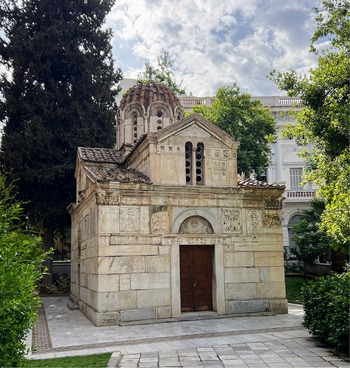
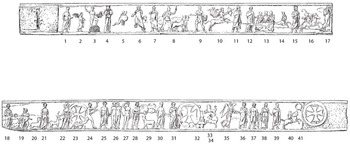
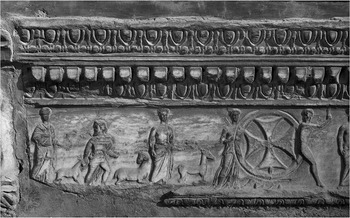

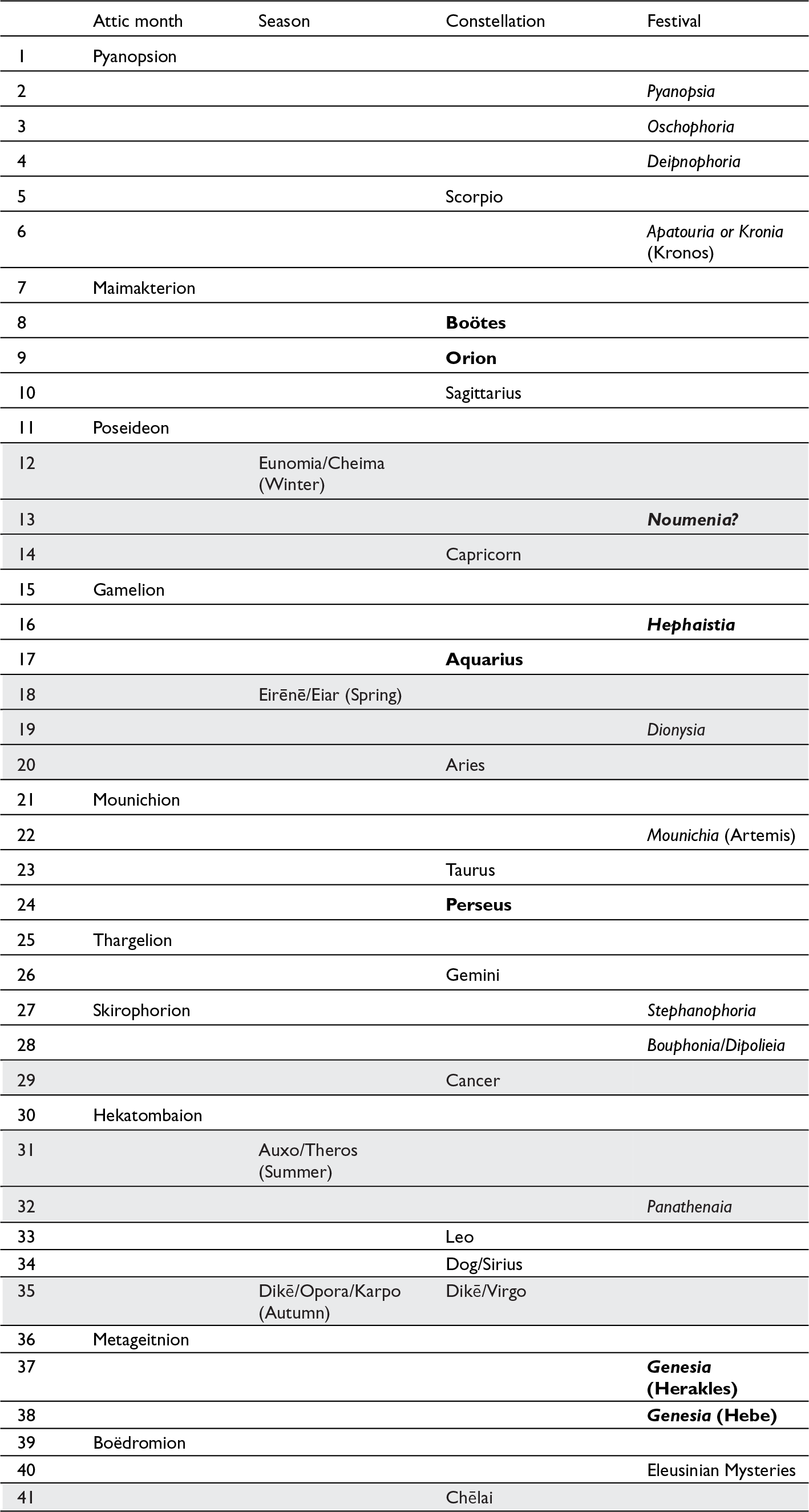
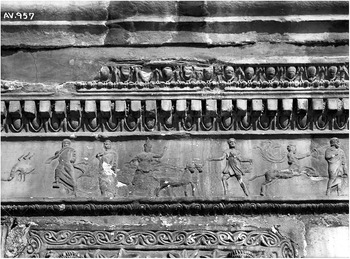
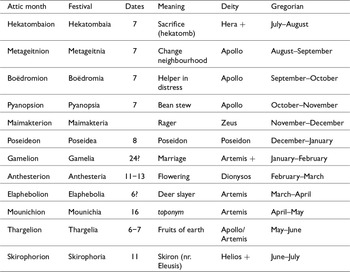
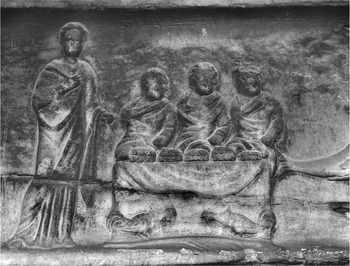
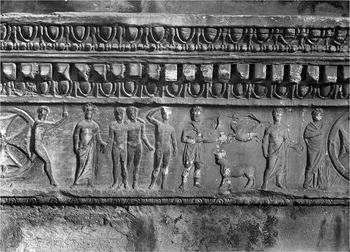
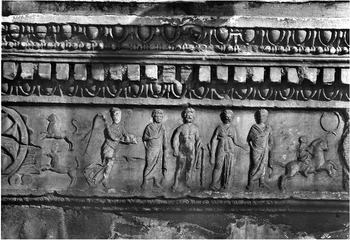
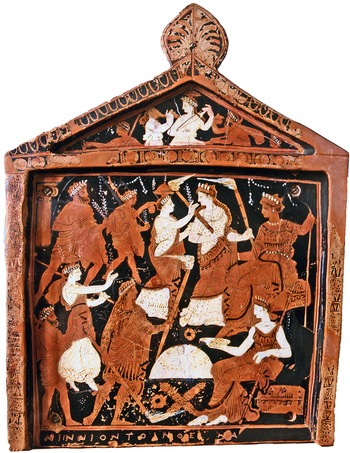
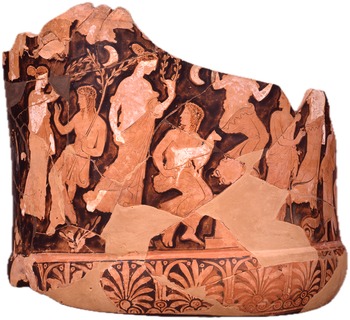
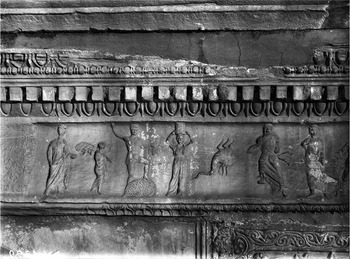


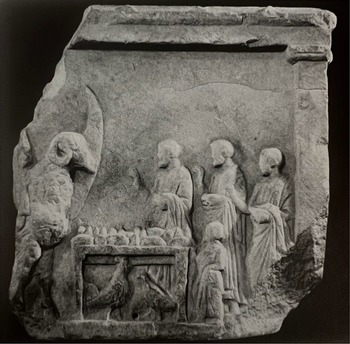

 Open access

