





The use of restraint in psychiatric in-patient settings remains controversial, raising significant ethical, legal and clinical concerns. Guidelines recommend that restraint should be used only as a last resort, with preference given to the least restrictive interventions.Reference Steinert, Lepping, Bernhardsgrütter, Conca, Hatling and Janssen1 Despite a wide range of initiatives to reduce restraint over the past decade, 2–Reference Duxbury, Baker, Downe, Jones, Greenwood and Thygesen8 considerable variation in prevalence persists across in-patient services in the UK and internationally.Reference Steinert, Lepping, Bernhardsgrutter and Conka9 National guidance, including the Department of Health’s Positive and Proactive Care (2014)2 and the Mental Health Act Code of Practice (2015)10, emphasises minimising restrictive interventions. NHS Benchmarking Network data11 reports prevalence of restraint across UK services, but refers specifically to adults with intellectual disabilities. There remains limited, up-to-date, nationally representative data for general adult mental health in-patients, restricting comparability across settings.
Earlier evidence, including a 2013 systematic review, identified several risk factors consistently associated with restraint: male gender, young adult age, minority ethnic background, schizophrenia, involuntary admission, aggressive or absconding behaviour, and the presence of male staff.Reference Beghi, Peroni, Gabola, Rossetti and Cornaggia12 More recent reviews have noted similar associations with young age, male gender, minority ethnic status, greater symptom severity and mood disorders. However, the overall evidence suggests that risk is multifactorial, and there remains a lack of high-quality, contemporary studies that can definitively establish predictive factors.Reference Beames and Onwumere13
Method
We chose a retrospective cohort design for this quantitative study to investigate the clinical, demographic and social factors associated with restraint in in-patient wards.
Data were collected between 1 July 2020 and 31 July 2021, on all patients admitted to the Trust’s in-patient services, which included acute male and female wards, psychiatric intensive care, rehabilitation and older adult wards. Data were obtained for both patients who did and did not experience restraint during their admission. The data collection period preceded the implementation of the Mental Health Units (Use of Force) Act 201814 in March 2023, reflecting the availability of routinely collected data and the timing of ethical approval.
Patient-related sociodemographic variables included gender, age, ethnicity, nationality, marital status, employment and receipt of disability benefits. Clinical variables included the number of admissions during the study period, previous admissions, legal status at the current admission, source of admission, ward admitted, primary diagnosis and length of stay. Service-related variables included the reason for restraint, type of restraint, timing of the restraint by staff shift and duration in minutes.
Restraint was defined according to the Trust’s policy, aligned with national guidance from National Institute for Health and Care Excellence15 and the Mental Health Act Code of Practice. This definition included any physical intervention intended to restrict movement.
Two routinely collected data-sets were used. The ‘admission data-set’ contained sociodemographic and clinical variables for all patients admitted between 1 July 2020 and 31 July 2021. Patients admitted multiple times during the period were counted once. The ‘restraint data-set’ contained similar variables for patients who experienced one or more restraint episodes during the same period, regardless of the number of admissions or restraint incidents.
The main outcome was whether a patient experienced at least one episode of restraint during the study period. Because patients could be admitted more than once and could experience multiple restraints, the data were not independent. To address this, unique identifiers (‘RiO number’ for patients and incident identifier for restraint events) were used to link and differentiate admissions and restraint incidents.
Data were collapsed by these identifiers and merged to produce a data-set that classified patients as restrained or not restrained during the study period. Pairwise deletion was used to handle missing values in individual patient records. Ethical approval was obtained from London – City and East Research Ethics Committee (Integrated Research Application System project ID 307838), the Health Research Authority and Health and Care Research Wales (ref. 22/PR/0368). Individual patient consent was deemed inappropriate owing to the secondary use of a large anonymised data set.
Results
Of the 836 patients admitted, 53.6% (n = 448) were men and 46.4% (n = 388) were women. Patients aged ≥65 years comprised 22.7% of the sample, followed by those aged 36–45 years (17.7%). Most patients were White (87.2%). UK nationality was recorded for 69%, whereas nationality was not recorded for 26.4%. Marital status was recorded as single for 47.2% of patients, but was not available for 18%. In terms of employment, 33% received long-term sickness benefits, 21.7% were retired and status was unknown for 17.9%. Disability status was recorded for 19.4%. Accommodation status was unrecorded for 36% of patients; the most common recorded category was owner occupancy (16.9%).
The final analytic sample (n = 281), derived from merging restraint and admission data-sets, was divided into two groups: those who experienced restraint and those who did not during the study period (1 July 2020 – 31 July 2021).
Descriptive and logistic regression analyses were used to examine the association between sociodemographic and clinical variables and the use of restraint. Because the outcome was dichotomous (restrained versus not restrained), binary logistic regression was used to estimate univariate and adjusted odds ratios. Multivariate regression was performed with a backward selection model in SPSS version 21. Bivariate associations were assessed with chi-squared or t-tests, as appropriate.
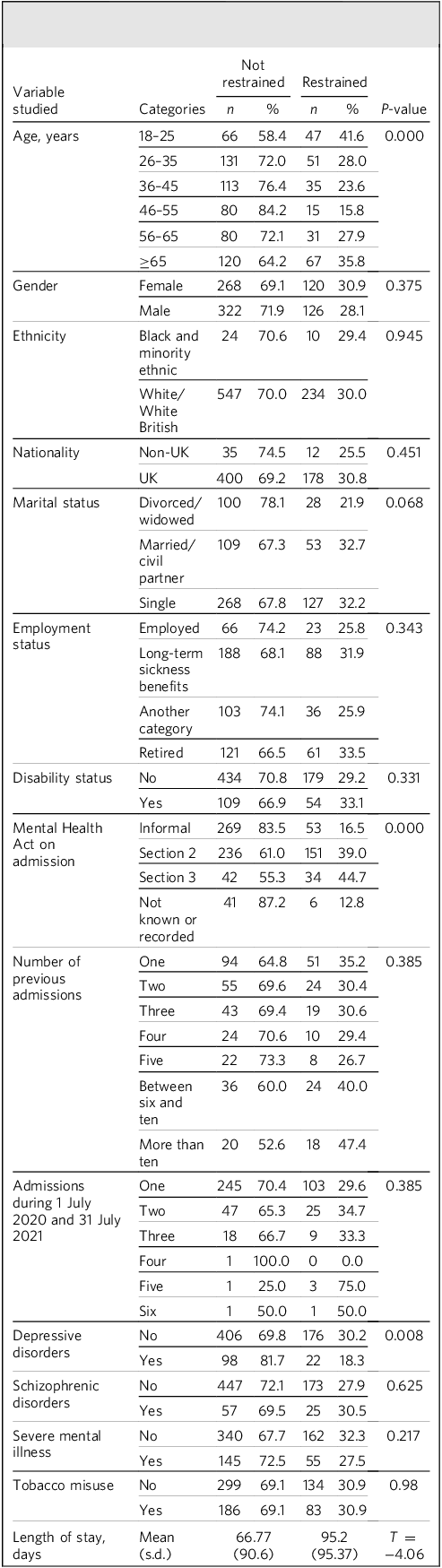
Table 1 shows baseline sociodemographic and clinical characteristics of patients who were and were not restrained.
Baseline sociodemographic and clinical characteristics
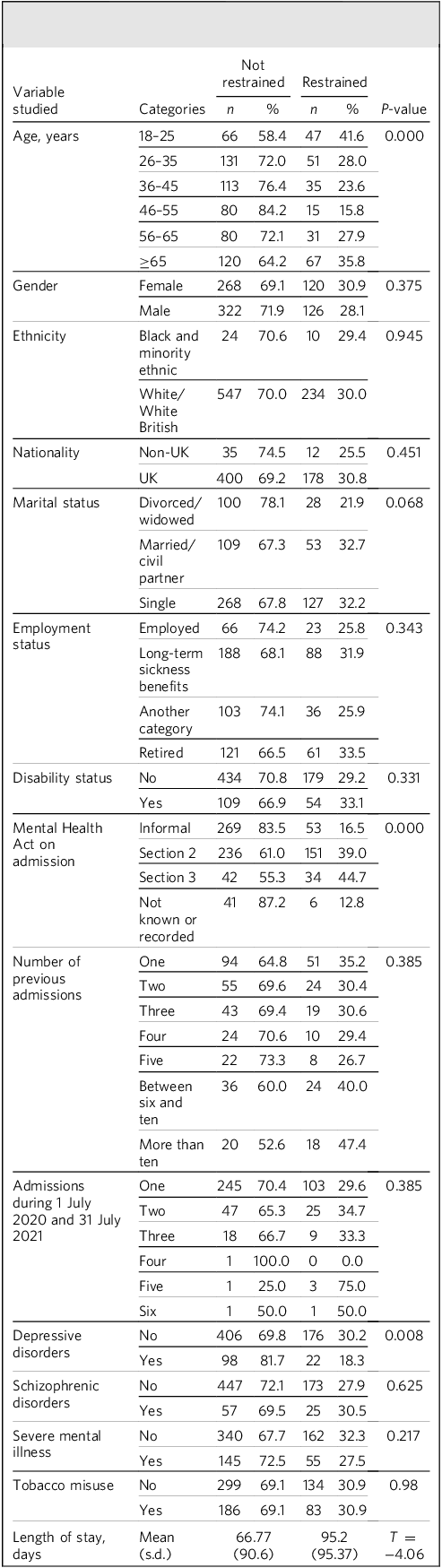
Among those who experienced restraint, the proportion of women (30.9%) was slightly higher than men (28.1%). Patients aged 18–25 years accounted for 41.6% of those restrained, followed by those aged ≥65 years (35.8%). Patients from minority ethnic groups comprised 29.4% of restrained patients, compared with 30% of White patients. UK nationality was recorded for 30.8% of those restrained, whereas nationality was unknown for 25.5%. Regarding marital status, 32.7% of restrained patients were married, 32.2% were single and 21.9% were divorced. A third (33.1%) of restrained patients had a recorded disability. In terms of employment, 33.5% were retired and 31.9% were in receipt of long-term sickness benefits.
Clinical variables showed that 44.7% of restrained patients were detained under Section 3 of the Mental Health Act, 39% under Section 2 and 16.5% were informal. Nearly half (47.4%) of restrained patients had more than ten previous admissions, 40% had six to ten admissions and 34.7% had two admissions during the study period. Recorded primary diagnoses among restrained patients included schizophrenia (30.5%), severe mental illness (27.5%) and depressive disorders (18.3%). Tobacco misuse was reported in 30.9%.
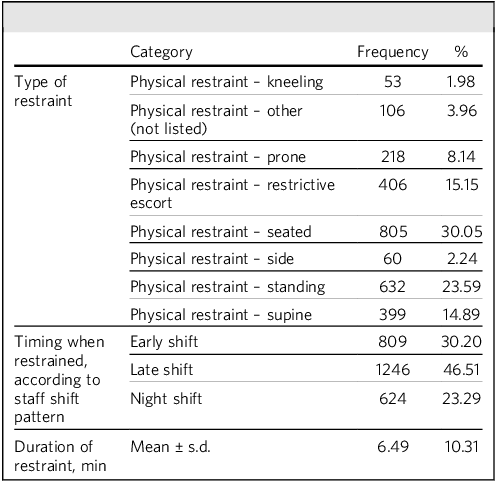
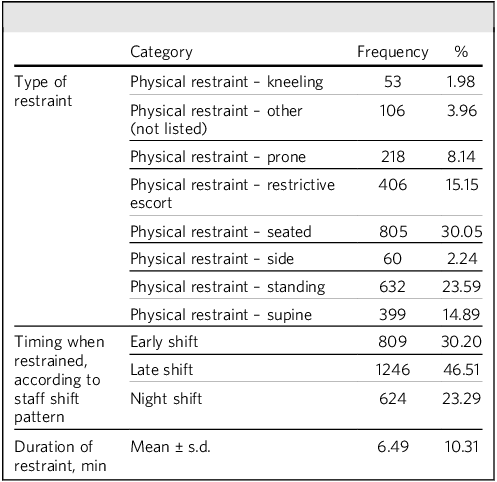
The mean length of stay for restrained patients was significantly longer than for non-restrained patients (95.2 v. 66.8 days). At the incident level, seated restraint accounted for 30.1%, standing for 23.6% and restrictive escort for 15.2%. Nearly half of incidents (46.5%) occurred during late staff shifts. The mean duration of restraint was 6.5 min (s.d. = 10.3) (Table 2).
Analysis of restraint data
A binary logistic regression model was conducted to test the effect of sociodemographic and clinical predictors on restraint. Backward selection was used, with predictors entered simultaneously and removed step by step if their effects were not significant. This approach allowed assessment of the combined model at the outset, as well as how excluding variables affected remaining predictors.
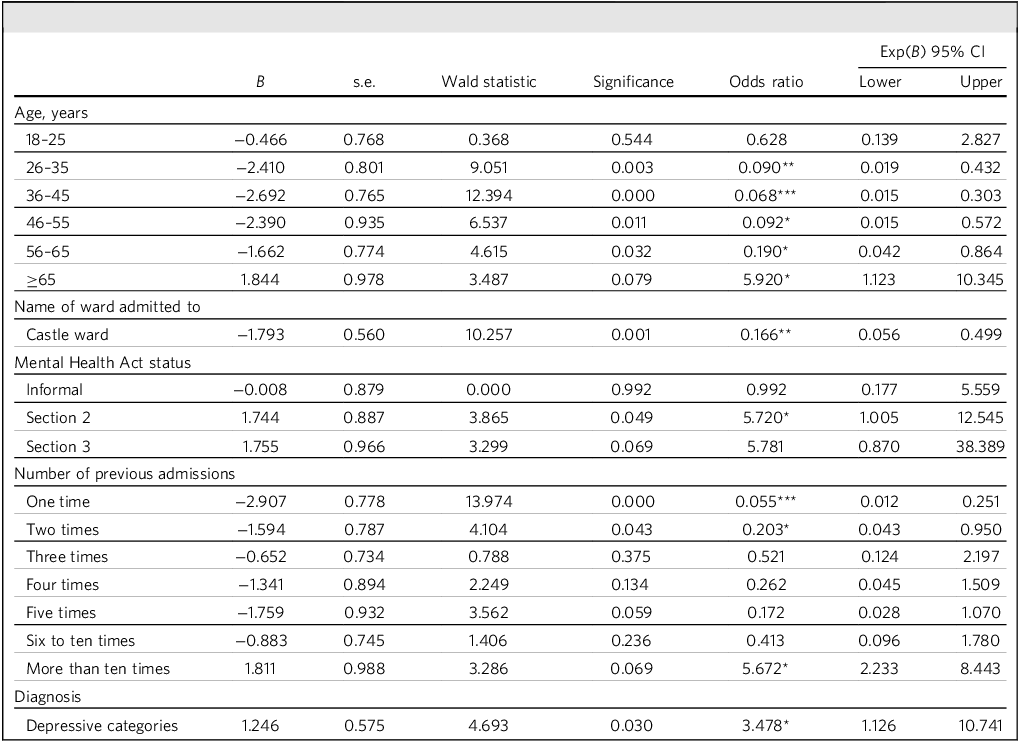
Significant associations were observed for age ≥65 years, detention under the Mental Health Act, repeated admissions and depressive disorders (Table 3). Compared with patients aged ≥65 years, the probability of restraint was significantly lower in age groups 26–35 (odds ratio 0.090, 95% CI 0.019–0.432), 36–45 (odds ratio 0.068, 95% CI 0.015–0.303), 46–55 (odds ratio 0.092, 95% CI 0.015–0.572) and 56–65 (odds ratio 0.190, 95% CI 0.042–0.864) years. The youngest group (18–25 years) did not show a significant effect in the final model.
Logistic regression model of factors associated with the use of restraints in mental health in-patient units
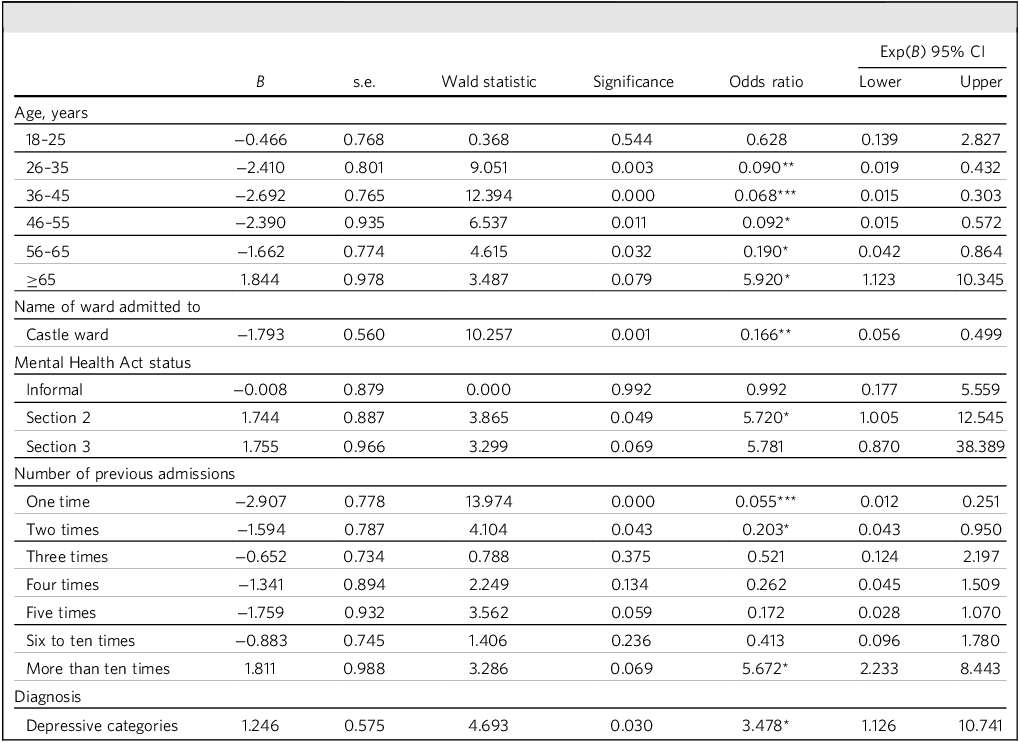
Omnibus χ 2(3) = 66.439, P < 0.001. The Cox and Snell R 2-statistic was 0.338 and the Nagelkerke R 2-statistic was 0.451, which indicated that the model was well fitted.
*P < 0.05, **P < 0.01,***P < 0.001.
Patients admitted to Castle Ward (an acute female ward) had lower odds of being restrained compared with other wards (odds ratio 0.166, 95% CI 0.056–0.499). Patients detained under Section 2 of the Mental Health Act had higher odds of restraint (odds ratio 5.720, 95% CI 1.005–12.545) compared with those admitted informally or under Section 3.
Compared with patients with more than ten previous admissions, those with one (odds ratio 0.055, 95% CI 0.012–0.251) or two previous admissions (odds ratio 0.203, 95% CI 0.043–0.950) were significantly less likely to be restrained. Patients with depressive disorders had significantly increased odds of restraint (odds ratio 3.478, 95% CI 1.126–10.741), whereas other diagnostic categories showed no significant effect.
Discussion
The data collection period preceded the implementation of the Mental Health Units (Use of Force) Act 2018 in March 2023. This timing reflected the availability of routinely collected data and the date of ethical approval. We acknowledge that our findings may not fully capture practice changes introduced post-implementation.
The main finding was that 34% of admitted patients experienced at least one episode of restraint. In terms of social and demographic characteristics, patients who were restrained were more likely to be aged 18–25 or ≥65 years; be female; have a recorded disability; receive long-term sickness benefits or be retired; and have a marital status recorded as single, married or partnered. Clinically, restrained patients were more often detained under Mental Health Act Sections 2 or 3, had histories of frequent admissions, or had a recorded diagnosis of depressive disorder or severe mental illness compared with those who were not restrained.
Statistically significant associations were found for age, marital status, detention under the Mental Health Act, frequency of admissions and diagnosis. Sociodemographic and clinical variables are presented in Table 1, and regression results in Table 3.
Stepwise logistic regression confirmed independent associations with restraint for older age (≥65 years), detention under Section 2, more than ten previous admissions and depressive disorder. Among patients who were restrained, length of stay was also longer than among those who were not restrained.
Service-level factors such as staff gender composition and staffing ratios were not available in the routinely collected data-sets, and therefore were not analysed.
Sociodemographic characteristics
The role of gender in restrictive interventions has been variably reported. Some studies have linked male gender to chemical restraint,Reference Gowda, Lepping, Noorthoorn, Ali, Kumar and Raveesh16,Reference Raboch, Kališová, Nawka, Kitzlerová, Onchev and Karastergiou17 whereas others suggest female patients are at higher risk.Reference Nawka, Kalisova, Raboch, Giacco, Cihal and Onchev18 Studies specifically examining physical restraint often report no significant gender differences, implying comparable use across men and women.Reference Kalisova, Raboch, Nawks, Sampona, Cihal and Kallert19,Reference Tunde-Ayinmode and Little20 However, most of these studies are more than a decade old and largely involved involuntary populations, limiting generalisability.
Age has similarly been examined, with some studies reporting higher restraint rates among younger patients,Reference Nawka, Kalisova, Raboch, Giacco, Cihal and Onchev18 others linking older age with greater risk, and some finding no relationship.Reference Kalisova, Raboch, Nawks, Sampona, Cihal and Kallert19,Reference Raboch, Kalisova, Alexandra, Kitzlerová, Karastergiou and Lorenza Magliano21 In contrast, our study demonstrated a robust association between restraint and older age, particularly ≥65 years (odds ratio 3.920, 95% CI 1.123–10.345).
Clinical characteristics
We found strong associations between restraint and detention under Section 2 of the Mental Health Act (odds ratio 5.72, 95% CI 1.005–12.545), more than ten previous admissions (odds ratio 5.672, 95% CI 2.233–8.443) and depressive disorders (odds ratio 3.478, 95% CI 1.126–10.741).
Previous studies have more often associated psychotic disorders with higher risk of restraint,Reference Husum, Bjørngaard, Finset and Ruud22–Reference Gowda, Lepping, Noorthoorn, Ali, Kumar and Raveesh24 although mood, organic (especially dementia), substance use and personality disorders have also been reported as risk factors.Reference Luciano, Sampogna, Del Vecchio, Pingani, Palumbo and De Rosa25 Severity of illness and specific symptoms such as hostility, suspiciousness and threats of violence are consistently linked to restraint, as is lower global functioning.Reference Husum, Bjørngaard, Finset and Ruud22,Reference Sampogna, Luciano, del Vecchio, Pocai, Palummo and Fico26,Reference Steinert, Bergbauer, Schmid and Gebhardt27
In our study, depressive disorders were significantly associated with restraint. This may reflect presentations characterised by agitation, suicidality and difficulties with de-escalation during acute episodes. Staff perceptions of elevated risk in severe affective illness may also contribute to decisions to restrain.
Although multivariate analysis did not show ward-specific effects, univariate analysis suggested a possible increased risk on Castle Ward, which is an acute female ward.
Although some use of restraint is unavoidable when managing acute risk, our findings emphasise the importance of identifying high-risk groups for whom trauma-informed and preventative alternatives may reduce coercion. The results also suggest that restraint is not solely a response to patient behaviour, but reflects systemic influences such as patterns of detention and frequent admissions.
Models such as safe wards and trauma-informed care have demonstrated reductions in restraint through staff training, relational de-escalation and environmental adjustments. These approaches are particularly relevant for patients with recurrent admissions or depressive disorders, where early engagement and individualised care planning may prevent escalation.
Unlike many earlier studies that linked restraint mainly with schizophrenia and male gender, our findings highlight older adults and depressive disorders. This divergence reflects the evolving complexity of in-patient populations and suggests that assumptions about ‘typical’ high-risk groups may obscure opportunities for targeted intervention.
Strengths and weaknesses of our study
Some major strengths of our study are the relatively large cohort size and inclusion of all admissions over a full year, providing robust prevalence estimates. Several sociodemographic and clinical factors were associated with restraint, notably older age (≥65 years), detention under Section 2, frequent admissions (>10) and depressive disorder.
Limitations must also be acknowledged. Missing data in key sociodemographic variables (e.g. marital status, nationality, accommodation) may have introduced bias. Pairwise deletion could have underestimated or overestimated associations. The retrospective design limited the capture of contextual factors, such as antecedents of restraint or available de-escalation strategies. Generalisability is restricted to similar rural UK settings. Only primary diagnoses were analysed; comorbidities and secondary diagnoses were not systematically recorded. Finally, the study was conducted prior to the implementation of Seni’s Law, which mandates enhanced monitoring and governance of restraint; current practice may therefore differ.
About the authors
Dr Sophia Senthil, MBBS, FRCPsych, is a consultant psychiatrist with Nottinghamshire Healthcare NHS Foundation Trust, Nottingham, UK; and an executive faculty member and co-academic secretary of the General Adult Faculty with the Royal College of Psychiatrists, London, UK. Dr Mithilesh Jha, MBBS, MRCPsych, is a consultant psychiatrist with Lincolnshire Partnership NHS Foundation Trust, Lincoln, UK. Dr Praveen Kumar, FRCPsych, is Inpatient Clinical Director and a consultant psychiatrist with Lincolnshire Partnership NHS Foundation Trust, Lincoln, UK.
Data availability
The data that supports the findings of this study are available from the corresponding author, S.S., upon reasonable request.
Acknowledgements
We thank Tracy McCranor (clinical research manager) and our local research team in supporting and coordinating our project.
Author contributions
S.S. led on the conceptualisation and methodology of the study, was responsible for data collection and preliminary analysis, and wrote the initial draft of the manuscript. M.J. and P.K. provided critical revisions to the manuscript. All authors reviewed and approved the final version.
Funding
This study was supported by a small research project grant awarded to S.S. from the General Adult Faculty, Royal College of Psychiatrists (2021).
Declaration of interest
None.

 Open access


eLetters
No eLetters have been published for this article.